

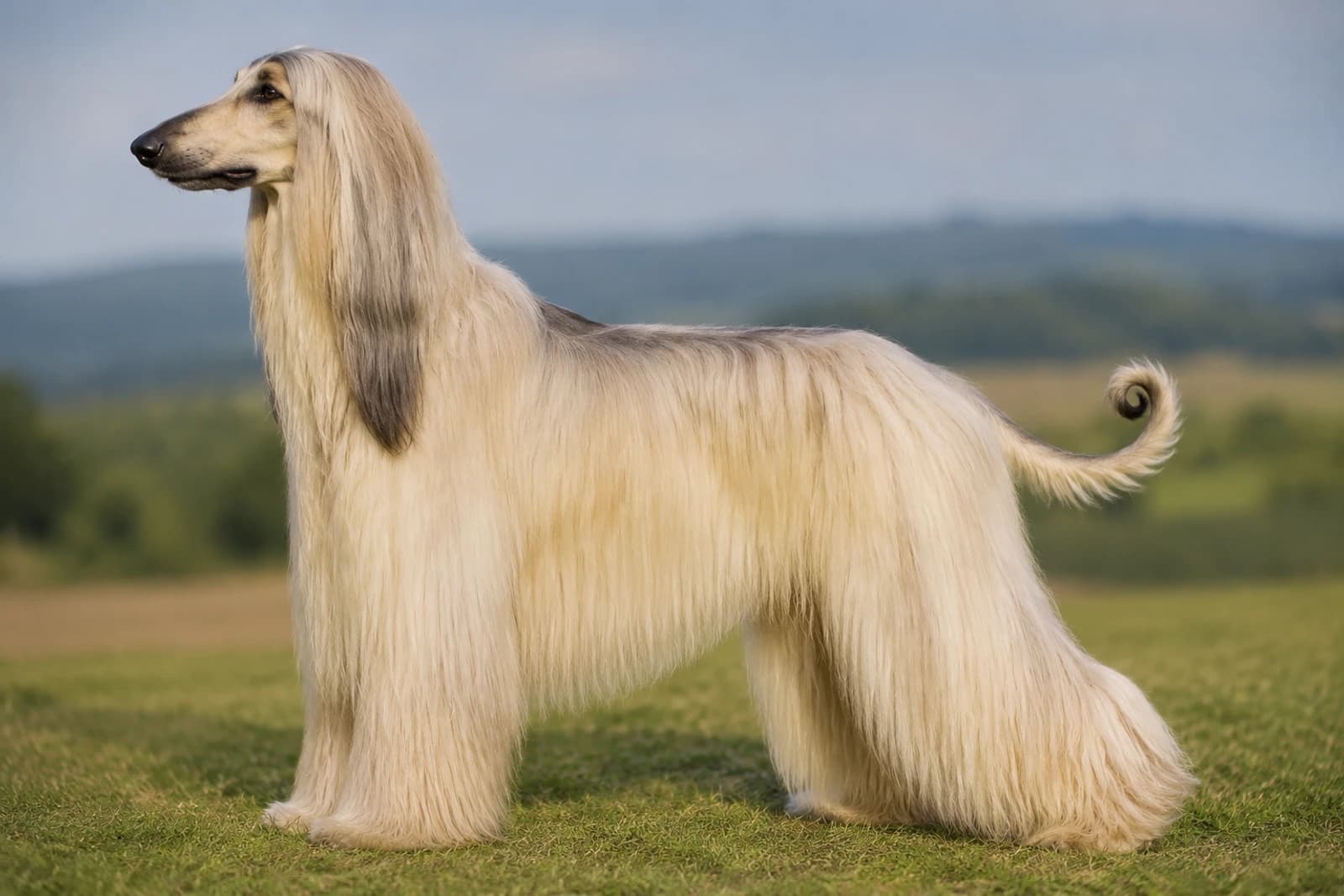
The Afghan Hound is an ancient sighthound known for its dignified, aloof demeanor and stunning long, silky coat. Loyal to their families but reserved with strangers, they are best suited for experienced owners who can provide firm yet gentle training and meet their extensive grooming needs. With moderate exercise requirements and a playful, sometimes clownish side, they thrive in homes with older children and ample space. Not ideal for first-time owners, apartment living, or homes with small animals due to their strong prey drive.
At a glance
- Size
- Giant
- Height
- 25–29 in
- Weight
- 50–64 lb
- Life span
- 12–14 years
- Coat type
- Long, silky, fine single coat
- Group
- Sighthounds
How much does a Afghan Hound cost?
Adopt / rescue
$75–$400
Usually includes spay/neuter, first shots, and a microchip.
Buy from a breeder
$700–$2,000
From a reputable, health-testing breeder.
Approximate USD. Prices vary widely by region, breeder, pedigree, age, and coat colour — adopting is the lower-cost and recommended route. Avoid suspiciously cheap “breeders”; they’re often puppy mills.
Estimate the full cost of a Afghan Hound →Afghan Hound photos
Views
Front, side, rear and top — the full silhouette.Poses
How the breed sits, lies, moves and plays.Puppy to senior
The breed across its whole life.Expressions
The breed’s range of moods.Close-up details
Eyes, ears, nose, paws, tail and coat.Coat colors
The breed’s recognized colors.Click any photo to enlarge. We show the Afghan Hound from every angle — three views, poses, life stages, expressions, close-ups, coat and colors.
Appearance & size
The Afghan Hound stands 25 to 29 inches at the shoulder and weighs between 50 and 64 pounds—a tall, slender frame that gives the breed its unmistakable silhouette. This is a sighthound through and through, built to cover ground with long, efficient strides, not to be heavy or bulky. The chest is deep but narrow, the legs straight and well-boned, and the overall impression is one of refined strength rather than raw power.
Face-on, the first thing you notice is the head: long, narrow, and held high. The muzzle tapers slightly, with a black or self-colored nose. Dark, triangular eyes gaze off into the distance with an aloof expression, and the ears lie flat against the head under a silky topknot of hair. That topknot is a breed signature—fine, long strands that frame the face and cascade down, often tied back in a young dog or during everyday life to keep the hair out of the eyes.
From the side, you see the long, arched neck, the level topline, and the prominent hipbones that are a hallmark of the breed. Afghan Hounds carry their tail low with a slight curve at the tip; it’s not docked. The legs are noticeably long and straight, with large feet covered in thick hair between the toes—like built-in snowshoes. The coat falls in long, silky sheets that sway when the dog moves, accentuating the reach and drive of each stride.
From behind, the hindquarters are powerful and set well back, giving the dog its trademark propulsion. The tail hangs down and has a distinctive upward curl at the end, often described as a ring. The hair on the rump and tail is shorter and closer than the body coat, so you’ll see the dog’s actual shape clearly from this angle.
The coat itself is the breed’s crowning glory. It’s long, fine, and glossy over most of the body—from the neck down across the back, ribs, and thighs—while the face, muzzle, and the front of the legs have short, sleek hair. The long saddle hair on an adult’s back parts naturally along the spine. Afghan Hounds come in virtually every color imaginable: cream, gold, red, black and tan, silver, brindle, blue, and domino patterns are all common. White markings, particularly on the head, are a fault in the show ring but crop up regularly in pet-bred dogs. Puppies are born with a woolly, usually darker coat that changes dramatically as they mature—expect your Afghan’s true adult color and texture to emerge slowly over the first year or two.
This breed is not a wash-and-wear dog. The coat mats if ignored, so regular grooming is non-negotiable. But that flowing hair also makes the Afghan Hound one of the most glamorous breeds you’ll ever see, whether it’s standing still or sprinting across a field.
History & origin
Afghan Hounds are so old that nobody knows exactly when they first appeared, but they almost certainly originated in the mountainous regions that now make up Afghanistan, Pakistan, and northern India. The raw material was likely a slim, long-haired sighthound brought by nomadic tribes from the Middle East or Central Asia thousands of years ago. Isolated by harsh terrain and kept pure within clans, those dogs became purpose-built for galloping through snow, scrambling up rocky slopes, and bringing down game while their handlers followed on horseback.
What they hunted ranged from hare and fox to wild goat, and even predators like snow leopards and wolves. That takes more than raw speed. The Afghan’s powerful but independent streak comes from working far ahead of a hunter, making split-second decisions. Their famously aloof, almost catlike temperament is a direct product of that self-reliance. The long, silky coat you see today wasn't for vanity — it shielded them from brutal cold at high altitudes, where temperatures plummet after dark.
The breed stayed hidden from the outside world until the late 19th and early 20th centuries, when British officers and diplomats began bringing specimens back. The real turning point came in 1907, when a dog named Zardin — owned by a British Army officer’s wife — appeared at a London dog show and served as the original model for the breed standard. World War I nearly wiped out the Western bloodlines, but a handful of dedicated breeders rebuilt them from imports and careful crosses.
The American Kennel Club recognized the Afghan Hound in 1926, and it didn’t take long for the breed to capture public imagination. By the 1970s, the Afghan had become the ultimate show-ring star and a pop-culture icon, with its regal bearing and undeniably dramatic appearance. Today’s Afghan is a curious split personality: a gentle house companion who can nap on your sofa for hours, yet still, at a dead sprint across an open field, the ancient hunter comes roaring back. Responsible breeders now focus on preserving that dual nature — elegance paired with an unbroken thread of independence that traces back to some of the most unforgiving country on earth.
Temperament & personality
The Afghan Hound’s personality is a study in elegant contradictions. You’re getting a dog who can be regally aloof one moment and a goofy, bouncing clown the next — often switching modes without warning. This is not a breed that lives to please you the way a retriever does. Independence runs deep, so expect a thoughtful, sometimes downright stubborn companion who weighs your requests before considering whether they’re worth his time. That said, the bond he forms with his own people is fiercely loyal, even if he shows it with a quiet presence rather than sloppy kisses.
Household fit. An Afghan does best with a family that appreciates his complex nature. He’s watchful and reserved with strangers — a trait that makes him a dignified alarm system, though not a guard dog who will confront. With older, dog-savvy children who respect his space, he can be a calm and gentle housemate. Toddlers who toddle too close when he’s napping or eating may not get the same patience; he’ll simply remove himself rather than growl, but it’s wise to supervise and teach kids to let him rest undisturbed.
Because he’s a sighthound through and through, the urge to chase is hardwired. A squirrel dashing across the yard or a neighbor’s cat can flip a switch from serene to full-throttle pursuit. This means homes with small pets — rabbits, guinea pigs, free-roaming birds — need very careful management. Even a longtime canine housemate can look like prey if it takes off running. Many Afghan Hounds coexist peacefully with dogs they’ve been raised with, but introductions should be slow and supervised.
Energy and quirks. Don’t let that streaming coat fool you into thinking this is a delicate diva. An adult Afghan needs real exercise — a solid 30- to 45-minute daily run in a securely fenced area, or a long, leashed walk with occasional sprint opportunities. Inside, he’s a champion couch-warmer, often picking the plushest spot in the house and melting into it for hours. This calm indoor demeanor, combined with his large size (25–29 inches, 50–64 pounds), makes him a surprisingly good apartment dog if exercise needs are met.
- Affection tends to be subtle. Some Afghans will lean against your leg or rest a regal head on your knee; others prefer being in the same room without physical contact. Forcing cuddles usually makes them exit politely.
- Selective hearing is a breed hallmark. Calling an Afghan off a scent is like trying to negotiate with a diplomat who’s already left the room. Training calls for short, positive, varied sessions — respect gets you further than repetition.
- Sensitivity runs high. This dog can remember a sharp correction for years and respond with a dramatic freeze or a hurt expression. Harsh methods or anger will shut him down or trigger anxiety-driven behaviors like excessive chewing or indoor marking. A homemade citrus or vinegar spray can deter furniture gnawing if teething or boredom chewing crops up, but meeting his mental and physical needs prevents most of it.
- Clownish spells often erupt right after a meal or a bath, when the dignified sighthound suddenly tears around the house in a comical “zoomies” display. Enjoy the show; it’s his way of releasing pent-up good spirits.
Reading his body language becomes second nature. A relaxed, soft-eyed dog who leans into your space is content. If he goes stiff, stares directly, or shifts his weight backward — especially around strangers — give him room. Those are clear signals that he’s uncomfortable, not stubborn. Lip licking, yawning, or turning his head away during training or greetings means he’s asking for a pause. He’ll settle best in a home that understands and respects these signals, rather than pushing past them.
Good with kids, dogs & other pets
An Afghan Hound’s default setting is patient and non-aggressive — you won’t get a snappy, reactive dog when the kids run by. But that doesn’t mean he’s a plug-and-play family pet. He stands 25 to 29 inches at the shoulder and weighs up to 64 pounds, all legs and lean muscle. A sudden zoomie or a hip check can easily topple a toddler, so supervision around young children is not optional. He’s also a sensitive, almost cat-like personality who reads the room quickly. Loud, chaotic households make him shut down or retreat, while calm, respectful kids earn his quiet affection. Teach children to give him space when he’s resting and to avoid yanking that flowing coat.
With Other Dogs
Afghans aren’t hard-wired for dog-park roughhousing. They can live peacefully with other dogs, especially if they grow up together, but they’re selective and often aloof. Early socialization is make-or-break here. The critical window slams shut around 16 weeks, so a puppy needs gradual, positive exposure to a variety of friendly dogs long before that. Without it, you may end up with an adult who is fearful, over-excited, or simply uninterested in canine company. Once an Afghan is mature, forcing interactions with strange dogs can backfire — think stress, not friendship. An adult who’s comfortable just hanging out with you doesn’t need a playdate.
With Cats & Small Pets
This is where you hit the sighthound limits. Afghans were bred to spot movement, give chase, and bring down game. A fleeing cat or a scurrying hamster triggers that instinct fast. Some Afghans can coexist with a confident indoor cat they’ve known since puppyhood, but the prey drive never fully switches off. Never leave an Afghan unsupervised with cats, rabbits, or other small animals. Even a well-socialized dog may interpret a sudden dash as an invitation. If you keep pocket pets, a separate, securely closed room is the only safe bet.
Trainability & intelligence
An Afghan Hound understands every word you say and decides, moment by moment, whether it's worth responding. That’s not stubbornness for its own sake — it’s the original sighthound wiring: centuries of hunting independently over rough terrain without a human giving constant direction. You’ll never turn one into a reliable off-leash obedience champion, and heavy-handed corrections will shatter the trust you need to make any progress at all.
The mind you’re working with
They learn new behaviors quickly when they see a point. The challenge is motivation. Food can work, but many Afghans don’t live for a treat the way a retriever does. Short, playful sessions (think three to five minutes, not twenty) that tap into natural drives — chasing a flirt pole, earning a quick game of tug — usually hold attention better than drilling the same sit-stay over and over. If a session feels like school, they’ll check out.
Building a recall you can almost count on
Recall is the hardest thing you’ll teach. An Afghan Hound at full sprint after a squirrel isn’t negotiating with a treat pouch. Start inside with zero distractions, use a distinct cue, and reward with something genuinely exciting — a squeaky toy hurled in the opposite direction, a jackpot of real meat. Even after months of practice, expect to keep a long line on in unfenced areas. This is a sighthound, not a herding dog.
The right approach from day one
Positive reinforcement is non-negotiable. Yelling, yanking, or intimidation will teach one lesson only: that you are unpredictable and worth avoiding. They’re sensitive in a way that surprises people who see a large, regal dog. Puppy socialization should start by 8 weeks and ramp up gently — new surfaces, odd sounds, calm strangers — always at the dog’s pace. A well-socialized Afghan isn’t a social butterfly; they’re a dignified observer who no longer feels the need to bolt or bark at the unfamiliar.
Realistic expectations
Consistency matters more than intensity. Your Afghan will probably never greet commands with the frantic enthusiasm of a border collie. But with patience, humor, and a relationship built on mutual respect, you’ll get a dog that learns household routines, walks politely on leash, and responds reliably when you’re the most interesting thing in the room. Expect a partner, not a push-button pet.
Exercise & energy needs
An Afghan Hound won’t just trot around the block and call it a day. This is a sighthound bred to spot game, explode into a sprint, and cover ground at breathtaking speed. For a dog that tops out at 64 pounds and 29 inches, a leisurely leash walk is a warm‑up, not the main event. Expect to provide a minimum of 15–20 minutes of full‑out running every single day — not a jog, not a quick dash in the yard, but a genuine, stride‑opening sprint where the dog can hit top gear.
Most Afghans do best with two structured exercise sessions daily: one that’s a longer, sniff‑friendly walk or a hike on a long line, and the second that’s their dedicated sprint session in a securely fenced area or on a lure coursing field. A tired Afghan is a calm Afghan; skip the running, and you’ll often see restlessness, pacing, or creative destruction around the house. This breed’s energy isn’t non‑stop — they’re famous for couch potato moments — but that pent‑up athletic drive needs a release valve.
Mental stimulation matters just as much. Afghan Hounds are independent thinkers, and boredom hits fast. Weave in scent games, puzzle toys, or a flirt pole that lets them stalk and chase. Even a few 5‑minute training sessions that tap into their prey drive can take the edge off.
Activities that fit an Afghan well:
- Lure coursing (the breed is basically built for it)
- Fenced field sessions with a chuck‑it or a lure
- Hiking on a 30‑foot long line where they can stretch their legs safely
- Indoor hide‑and‑seek with treats or a favorite toy
Avoid high‑impact jumping on hard surfaces, especially while they’re still growing, to protect their joints. And never trust an Afghan off‑leash in an unfenced area — that sighthound instinct overrides recall the instant something small and fast moves. If you can’t reliably offer daily sprint space, this isn’t the dog for you right now. A fence that’s at least 5–6 feet high is non‑negotiable.
Grooming & coat care
The Afghan Hound’s long, silky coat is stunning — and it demands a serious time commitment. Expect to brush your dog every single day, without fail. Missing even a day or two invites mats to form deep in that fine, flowing hair, especially behind the ears, under the legs, and along the hindquarters where friction occurs.
The right tools make it manageable
- Start with a pin brush or a slicker brush with rounded pins to gently work through tangles without tearing the hair. Follow up with a wide-toothed metal comb to reach down to the skin and catch hidden snarls.
- Work in sections, parting the coat so you don’t miss anything. A light mist of water or a conditioning spray helps prevent breakage and static.
Bathing happens more often than you’d think
Plan on a bath every week or two — this coat holds dirt and can get greasy. Always brush out all mats before the bath; water tightens knots into felt. Use a high-quality dog shampoo and conditioner, rinse until the water runs clear, then blow-dry while brushing. Air-drying invites tangles and a dull, cottony texture. Many owners invest in a professional-grade dryer to cut the time.
Trimming, nails, ears, teeth
Afghan Hounds aren’t clipped down like poodles. You’ll trim just the hair between the paw pads for traction and maybe tidy the feet for a neater outline. The rest of the coat stays natural. Check nails every few weeks — those large paws can hide overgrown nails. Clean ears weekly with a vet-approved solution; the drop ears trap moisture and debris, setting up potential infections. Brush teeth several times a week to keep that long snout healthy.
Seasonal realities
This is a single-coated breed, so you won’t deal with a dramatic “blow” like a double-coated dog. However, some seasonal shedding still occurs, and daily brushing catches the loose hairs before they end up on your furniture. Outdoor dry, dusty conditions can coat the hair in grit, meaning more frequent rinses. In wet or muddy weather, a light coat spray and a thorough towel-off can delay a full bath.
Afghan Hound grooming isn’t a quick chore — it’s a ritual. If you’re not ready to carve out 20–30 minutes every day, this isn’t your breed. But do it right, and that coat makes your dog look like they’ve stepped straight out of an old oil painting.
Shedding & allergies
If you're looking for a dog that won't cover your couch in hair, an Afghan Hound delivers. This breed has a single-layer, silky coat that acts more like human hair than typical dog fur—shedding is very minimal in daily life. You'll rarely find loose strands drifting across the floor because dead hairs stay trapped in the long coat until you brush them out.
Don't confuse low-shed with low-maintenance. That fine, flowing hair mats up fast, so you'll need to comb through it thoroughly every day—count on 30 minutes or more. This is where you'll collect the hair. Because Afghans lack a dense undercoat, there's no massive seasonal blowout like you'd get with a Husky or Golden Retriever, though you might notice a slight uptick in the hair you pull from the brush in spring and fall.
Drool is a non-issue. Tight lips mean you won't be wiping slobber off walls or your jeans.
Now, the realistic hypoallergenic picture: Afghan Hounds frequently appear on "hypoallergenic" lists, and their minimal shedding means less airborne hair and dander. But no dog is entirely allergen-free. The actual triggers are proteins in dander, saliva, and urine—not the hair itself. Because the long coat traps dander, a bath every week or two can rinse allergens away before they float around the house. The catch? That same coat is a dust-and-pollen magnet, so an Afghan coming in from a romp can carry outdoor irritants right up onto your sofa. If someone in your home has serious allergies, spend real time with adult Afghans in a home setting before committing. One person’s non-issue is another person’s sneeze-fest, and individual reactions can surprise you.
Diet & nutrition
A lean Afghan Hound is a healthier Afghan Hound. Extra pounds strain growing joints in puppies and can worsen age-related wear in adults — especially in a long-legged, deep-chested breed that moves at a gallop. Start thinking about weight from the day your puppy comes home.
Puppy feeding schedule
Giant-breed puppies burn a lot of energy assembling bone and muscle, but they need slow, steady growth to protect hips and elbows.
- 4 meals a day until 4 months old, spaced evenly.
- 3 meals a day from 4 to 6 months.
- 2 meals a day from 6 months on, just like an adult.
Transition to a new diet gradually. If you’re switching from the breeder’s setup, introduce lightly cooked, puréed meats, fish, fruits, and vegetables — or a high-quality commercial puppy food — over a week. Raw chicken wings can appear around 12 weeks under supervision, but only if you’re experienced with raw feeding.
How much to feed an adult Afghan Hound
Most adults weigh 50–64 lb. That translates to roughly 2 to 3 cups of a high-quality dry food per day, split into two meals, or about 2–3% of the dog’s ideal body weight if you feed a commercial raw or home-prepared diet. Adjust portions to his actual activity level — an Afghan that sprints the yard daily needs more fuel than one who prefers a long couch nap.
Check his waist: you should see a clear tuck from the side and feel the ribs easily under a thin padding of flesh, not a muffintop.
What to put in the bowl
A kibble with a named meat first works for many families. If you prep meals at home, aim for a balance of roughly 60% muscle and organ meat, 20–30% dog-safe fruits and veggies, and about 10% extras like eggs, plain yogurt, or cooked grains. White rice and pearl barley are gentle on sensitive stomachs. Canned fish (in water, no salt) adds omega-3s that support that long, glossy coat.
Skip vegetarian or vegan plans — a dog’s dentition and gut are built to process meat, and imposing a meat-free diet shortchanges essential nutrients.
Protect that deep chest
Afghan Hounds have the slim, deep-ribbed build that comes with a higher risk of bloat. Two smaller meals a day instead of one huge pile of food helps. So does waiting at least an hour after eating before any hard running. If your dog still gobbles, use a puzzle bowl to slow him down and engage his brain while he eats.
Rich table scraps and holiday leftovers can trigger pancreatitis. Serve everything in his own dish, away from the table, to head off begging before it starts.
Senior adjustments
Once your Afghan reaches 7 or 8, metabolism starts to dial back even if his appetite doesn’t. Watch his waistline and trim portions gradually as activity drops — obesity in seniors magnifies joint pain. There’s no strong reason to slash protein; smaller, more frequent meals often sit better on an aging stomach. If dental issues make chewing hard, purée meals so he still absorbs those nutrients.
Health & lifespan
Afghan Hounds typically live 12 to 14 years — a long, sturdy lifespan for a giant breed. That longevity doesn’t come without a few known health sensitivities, so going in with eyes open makes a real difference.
- Hip dysplasia can show up in the breed. Responsible breeders screen for it with OFA or PennHIP evaluations, and they’ll be upfront about the results. Keeping your dog lean from puppyhood onward reduces wear on those joints.
- Hypothyroidism — an underactive thyroid — crops up in some lines. The symptoms (weight gain, coat changes, lethargy) are easy to mistake for aging, but a simple blood panel catches it, and daily medication manages it well.
- Juvenile cataracts and other eye issues are another concern. A board-certified veterinary ophthalmologist should have examined both parents within the year. Do not skip asking for that certificate.
- Bloat (gastric dilatation-volvulus) is a risk because of the Afghan’s deep, narrow chest. It’s a true emergency that can kill in hours. Feeding two or three smaller meals, avoiding exercise right after eating, and learning the early signs — unproductive retching, a distended belly — are non-negotiable.
Something particular to sighthounds: Afghans carry very little body fat, which can make them more sensitive to certain anesthesia drugs. Any vet or specialist you work with needs to know your dog is a sighthound before sedation, even for a routine dental.
That long, silky coat is gorgeous, but it also traps heat. Schedule hard exercise for early morning or late evening in warm weather, and watch for heavy panting or sluggishness. Mats in the coat can hide skin infections, so thorough, regular grooming is as much a health task as a beauty one.
Preventive care is straightforward. Stick to monthly heartworm prevention during mosquito season (and a month past it) and keep the rabies vaccination current — it’s legally required, and there’s no treatment once symptoms appear. Pencil in a full vet exam once a year, twice a year once the dog hits senior age. Pay attention to subtle shifts: slowing down, finicky appetite, or a dull coat can be the earliest tip-offs that something needs checking.
When you’re talking to breeders, ask to see hip, thyroid, and eye clearances on both parents. Then keep that schedule of exams, and you’ll catch most problems while they’re still small.
Living environment
An Afghan Hound is a full-throttle athlete in an elegant silk robe. That beauty demands room to run. A house with a large, physically fenced yard is the baseline, not a luxury. These dogs hit 30 mph in a few strides — a cramped apartment will leave them pacing and destructive unless you commit to at least 60 minutes of hard, off-leash sprinting twice a day in a safe enclosure. For most people, that means a fenced backyard.
Yard must-haves
The fence needs to be at least six feet tall and dig-proof. Afghans were born to chase anything that moves, and a squirrel on the other side of a four-foot fence might as well be an engraved invitation. They jump, they dig, and once they’re out, that independent streak means they won’t look back. Forget invisible fences — the prey drive overrides any shock.
Climate comfort
Their long, fine coat was built for the cold mountains of Afghanistan, so they handle chilly weather beautifully. A 30°F morning walk is a treat; a 90°F humid afternoon is misery. In warm climates, exercise them early or late, keep the indoors air-conditioned, and watch for overheating. Their coat also mats brutally when damp, so a dry, cool resting spot matters.
Noise and alone-time
Afghans aren’t serial barkers. They don’t sound an alarm at every passing mail truck. But left bored or anxious, they can develop a haunting howl that your neighbors won’t appreciate. They’re independent thinkers, not Velcro dogs, yet they bond deeply. If you’re gone 10 hours a day without a midday break, expect shredded pillows and a deeply unhappy hound. Gradual alone-time training, plus puzzle toys and a frozen Kong, helps, but this is a breed that does best when someone is home part of the day. If your lifestyle is all-day-away, an Afghan will make it known.
Who this breed suits
If you’re an experienced owner who loves a challenge as much as a companion, the Afghan Hound might just stop you in your tracks. These dogs are striking, independent, and about as far from a needy retriever as you can get — they suit people who respect a dog that thinks for itself.
Best fit: households with at least one very dog-savvy adult. You’ll need patience for training that’s less about obedience and more about negotiation; an Afghan will learn a command perfectly, then decide whether it’s worth his time. A solid, 6-foot fence is non-negotiable, because sighthound instinct overrides any recall when a squirrel bolts. Expect to provide a full-out run — not just a leashed stroll — several times a week, preferably in a secure field or long, fenced stretch. Inside, they’re calm and surprisingly lazy, content to drape themselves on a sofa for hours, which makes them viable for apartment living if you’re religious about those outdoor sprints.
Grooming is the other deal-maker (or breaker). The long, silky coat needs hours of brushing every week to prevent mats, plus regular bathing. Many owners learn to maintain the coat themselves or budget for a professional groomer. If you find the ritual relaxing, you’ll bond deeply over it; if not, you’ll both be miserable.
Think twice if:
- You’re a first-time dog owner. Afghans aren’t forgiving of clumsy handling and can outsmart a novice’s training attempts.
- You have young children. While gentle, these dogs are sensitive and can be knocked off balance — literally and emotionally — by sudden grabs. An accidental tail pull can earn a sharp correction. Older, respectful kids do fine.
- You want a reliable off-leash hiking partner or a dog that lives to please.
- You have free-roaming small pets (rabbits, guinea pigs) or outdoor cats. Prey drive runs deep.
- The grooming commitment makes you hesitate. There’s no short-cut; a clipped Afghan is a different look, but still needs regular upkeep.
Singles and active retirees who want an elegant, independent shadow often thrive with this breed. They don’t demand constant attention, but they’ll quietly follow you from room to room. If you appreciate a bit of aloof dignity and don’t need a velcro dog, the Afghan delivers.
Cost of ownership
Your biggest ongoing expense won’t be the food bowl — it will be the grooming table. The Afghan Hound’s long, human-like fine coat mats fast without a rigorous schedule, so plan on a standing appointment every 4–6 weeks with a pro who knows the breed. In most areas that runs $100–$150 per session, and you’ll still need to line brush at home between visits with a good pin brush and a slicker. Factor in quality shampoo, conditioner, and possibly a high-velocity dryer if you go the DIY route; either way, grooming alone will eat up $100–$200 a month.
Buying a puppy from a responsible breeder who screens for hips, thyroid, and CERF eye clearances — and who isn’t churning out glossy internet listings — typically costs $1,500–$3,000. Puppies from untested pairings may be cheaper, but the long-term bet rarely is.
Food for a 50–64 lb adult with sighthound metabolism isn’t cheap. Expect to go through a 30-lb bag of high-quality large-breed dry food every 4–5 weeks, around $60–$90 monthly. A raw or fresh-food diet will push that higher.
Veterinary care runs about what you’d expect for a giant breed with a deep chest. Annual checkups, vaccines, and monthly heartworm/flea prevention land in the $50–$80 per month range if you’re saving monthly. You need a separate emergency cushion, because bloat (gastric torsion) hits fast and hard, and surgical correction can surpass $5,000. Hip dysplasia and some eye conditions also pop up, which is why many owners insure early: a decent accident-and-illness policy for a young Afghan Hound is generally $50–$100 a month, more if you opt for a low deductible or wellness add-ons.
All in, a healthy, well-maintained Afghan Hound costs around $250–$450 a month — and that’s before you factor in the inevitable replacement of chewed remote controls or the dry-cleaning bills from a post-rain coat shake.
Choosing a Afghan Hound
Responsible breeder or rescue?
You can find an Afghan Hound through a dedicated breeder or by adopting from a rescue. Both paths have trade-offs. Rescue groups often have adults whose personalities are already fully formed—an advantage if you want a known quantity with house manners. The downside: you may not know the dog’s health history, and a rescue Afghan might carry baggage from a neglectful home. If you go the breeder route, you’re playing the long game. Expect a waitlist for a well-bred puppy. A responsible breeder isn’t producing litters on demand; they’re planning to improve the breed and will grill you as hard as you should be grilling them.
Health clearances to ask for
Afghan Hounds can be prone to a few significant health problems, so you need proof, not promises. Insist on seeing official clearances—ideally through the Orthopedic Foundation for Animals (OFA) or a recognized registry. At minimum, both parents should have:
- Hip dysplasia screening (OFA hip evaluation or PennHIP)
- Cardiac exam by a board-certified veterinary cardiologist (Afghans can develop dilated cardiomyopathy)
- Eye exam by a veterinary ophthalmologist (screen for cataracts, progressive retinal atrophy, and other inherited eye diseases)
- Thyroid panel (autoimmune thyroiditis is common)
Some breeders also screen for degenerative myelopathy and bloat risk factors, though no genetic test guarantees a dog won’t bloat. Ask for the actual certificate numbers—you can verify them online. If the breeder hand-waves with “the vet said they’re healthy,” walk away.
Red flags when talking to breeders
Run from anyone who won’t let you meet the mother (and ideally the father, if he’s on site). A breeder who shows you puppies in the front yard but never lets you inside the house or kennel is hiding something. Other deal-breakers:
- Puppies sold before 8 weeks of age.
- Multiple litters on the ground at once, or puppies always available.
- No written contract or health guarantee.
- The breeder doesn’t ask you questions about your lifestyle, yard, experience with sighthounds, or plans for containment (Afghan Hounds can scale fences and bolt after prey).
- “We don’t need to do those expensive tests; the line is clear.” All lines carry risk.
Also, pay attention to the adult dogs’ temperaments. If the mother is skittish, fearful, or aggressive, that’s a red flag—temperament is partly inherited and shaped by early handling.
Picking a puppy
A healthy Afghan Hound puppy at 8–10 weeks is lanky, curious, and a little reserved with strangers—not shutting down, but also not ricocheting off the walls. The breed has an independent streak, so a puppy that holds back to assess you before approaching is normal; a puppy that cowers in a corner or panics is not. Watch how the litter interacts: you want a pup that engages with toys and people, recovers quickly from a startle, and accepts gentle handling. The breeder should have already begun exposing them to grooming tools, nail trims, and household noises.
Expect to pay $2,000–$3,500 for a puppy from fully health-tested parents with conformation or performance titles. Cheap puppies from untested dogs often carry the very health problems those tests catch—hip dysplasia alone can cost you more than the purchase price in surgery and lifelong pain management.
Pros & cons
-
Striking, one-of-a-kind beauty — that long, silky coat and regal silhouette stop people in their tracks, and it's all natural elegance, not grooming-gimmick.
-
Low shedding, low odor — once the coat is properly maintained, Afghan Hounds drop surprisingly little hair around the house and stay remarkably clean-smelling, a big plus for tidy homes.
-
Calm-house temperament — after a good run, they’re content to curl up like a piece of art. They rarely bark and don’t pace the walls indoors.
-
Solid lifespan for a giant — 12–14 years is realistic with responsible breeding and good care, and they tend to stay sound and active well into old age.
-
Quietly devoted — they may never be wiggly greeters, but they form a deep, steady bond with their own family and can be gentle with respectful kids.
-
Coat care is a daily commitment — that glamorous hair mats in the blink of an eye. Expect to brush thoroughly every day, bathe regularly, and either learn to groom professionally or budget for a groomer every 4–6 weeks.
-
Instant recall is a fantasy — they’re sighthounds with a hair-trigger chase instinct. A squirrel, a stray cat, a small fluttering leaf — and they’re gone. A securely fenced yard is non-negotiable; off-leash in an unfenced area is a liability.
-
Training tests your creativity — they aren’t dogs who live to please. Commands get evaluated, not obeyed. They thrive on short, positive, puzzle-like sessions but will out-stubborn you if you rely on repetition or force.
-
Reserved, not social — aloofness with strangers is the breed standard, not a flaw. They won’t solicit belly rubs from every visitor, and many prefer the company of their own household.
-
Health caveats & sighthound sensitivity — can be prone to hip dysplasia, cataracts, and hypothyroidism. All sighthounds tend to be sensitive to anesthesia; a breeder who screens parents and a vet who knows the breed’s quirks are critical.
Similar breeds & alternatives
If the Afghan Hound’s regal silhouette stopped you in your tracks but the daily coat commitment or famously independent mind gives you pause, a few other sighthounds come close while trading off on different fronts.
Saluki — the original desert runner
Physically, the Saluki is the Afghan’s closest cousin. At 23–28 inches and 40–65 pounds, they’re slightly more lightly built, with a lifespan of 12–14 years matching the Afghan’s. The big divergence is coat. Salukis come in smooth or feathered varieties; even the feathered ones have a silky trim on ears, tail, and legs rather than a full-body waterfall of hair. That means weekly brushing instead of the multi-hour weekly marathon an Afghan in full coat demands. Temperament overlaps heavily: independent, reserved with strangers, and convinced they know better than you. Prey drive is just as hair-trigger, so a securely fenced yard is non-negotiable. Choose a Saluki if you want that ancient, aloof sighthound vibe without becoming a part-time groomer.
Borzoi — the gentle giant with an off switch
Standing 26–30+ inches and often weighing 75–105 pounds, the Borzoi brings more bone and bulk than the 50–64-pound Afghan. Their long, silky coat is easier: less dense, more wavy, and it doesn’t mat into armor plating after a rainstorm the way an Afghan’s can. Borzois are generally softer and more affectionate within the family—less likely to act like your house is a hotel they merely tolerate. They still need a safe place to sprint flat-out, but indoors they are champion loungers. The trade-off is lifespan: Borzois average 7–10 years, noticeably shorter than the Afghan’s 12–14. If you want the long-coated, aristocratic look with a more cuddly indoor companion and can accept fewer years, a Borzoi fits.
Greyhound — the easy-care entry point
Don’t overlook the most practical option. At a comparable height (27–30 inches) but with a short, single-layer coat, a Greyhound slashes grooming to a wipe-down with a damp cloth. Weight runs 60–80 pounds. Greyhounds are famously low-key indoors—"45-mile-per-hour couch potatoes"—and often more trainable than an Afghan, though still sighthounds with a chase instinct. They’re better for someone who wants a sprint partner they can actually call off a squirrel occasionally. Lifespan spans 10–14 years. The Afghan wins on sheer drama and cold-weather insulation; the Greyhound wins on simplicity and a broader beginner-friendliness.
Irish Wolfhound — max size, minimal coat fuss
If it’s the sheer presence of a giant sighthound that appeals, the Irish Wolfhound dwarfs the Afghan at 30–34 inches and 105–180 pounds. Their rough, wiry coat needs only occasional brushing, but the trade-off is a lifespan of just 6–10 years — half what you’d get with a well-bred Afghan. Wolfhounds are famously sweet-natured and steady, far less likely to give you the thousand-yard stare when you produce a leash. Exercise demands are moderate for such a huge dog; they’re content with long walks and brief gallops, whereas an Afghan often needs more sustained, high-intensity running to settle indoors. You sacrifice longevity and that silken coat for an uncomplicated, affectionate giant.
Fun facts
- Afghan Hounds are one of the oldest dog breeds, originating from the mountains of Afghanistan.
- Their thick, silky coat protected them from harsh climates and made them prized hunting companions.
- Despite their regal appearance, they have a playful, clownish side and are known for the 'Afghan grin'.
- They excel in lure coursing and other sighthound sports due to their incredible speed and agility.
Frequently asked questions
- How much grooming does an Afghan Hound need?
- Afghan Hounds have a very high-maintenance coat that requires daily brushing to prevent painful mats and tangles. Regular bathing and professional grooming every few weeks are also essential to keep their long, silky hair clean and healthy.
- Do Afghan Hounds shed a lot?
- They shed less than many breeds, but their long hair tends to trap loose strands rather than dropping them around the house. This means regular brushing is needed to remove dead hair and avoid mats.
- Can Afghan Hounds adapt to apartment living?
- With sufficient daily exercise, they can manage in an apartment, but their large size and need to stretch their legs make a home with a securely fenced yard more suitable. They are generally calm indoors if their physical needs are met.
- Are Afghan Hounds good with children?
- They can be affectionate and playful with older children who understand their independent and dignified nature. However, their aloof temperament means they may not tolerate rough handling, so supervision is always recommended.
- Is the Afghan Hound a good choice for first-time dog owners?
- Their strong-willed and independent personality can make training a challenge for inexperienced owners. Combined with demanding grooming needs, they are generally better suited to someone with prior dog experience.
Tools & calculators for Afghan Hound owners
Quick estimates tailored to Afghan Hounds — pre-filled with this breed’s size where it matters.
Articles & stories about the Afghan Hound
Sources & standards
This profile follows recognized breed standards from the American Kennel Club (AKC) and the Fédération Cynologique Internationale (FCI), along with established veterinary and breed-club guidance. These describe general breed tendencies — every dog is an individual.
Owner stories
Have a Afghan Hound? Share your experience — grooming tips, personality quirks, anything goes.