

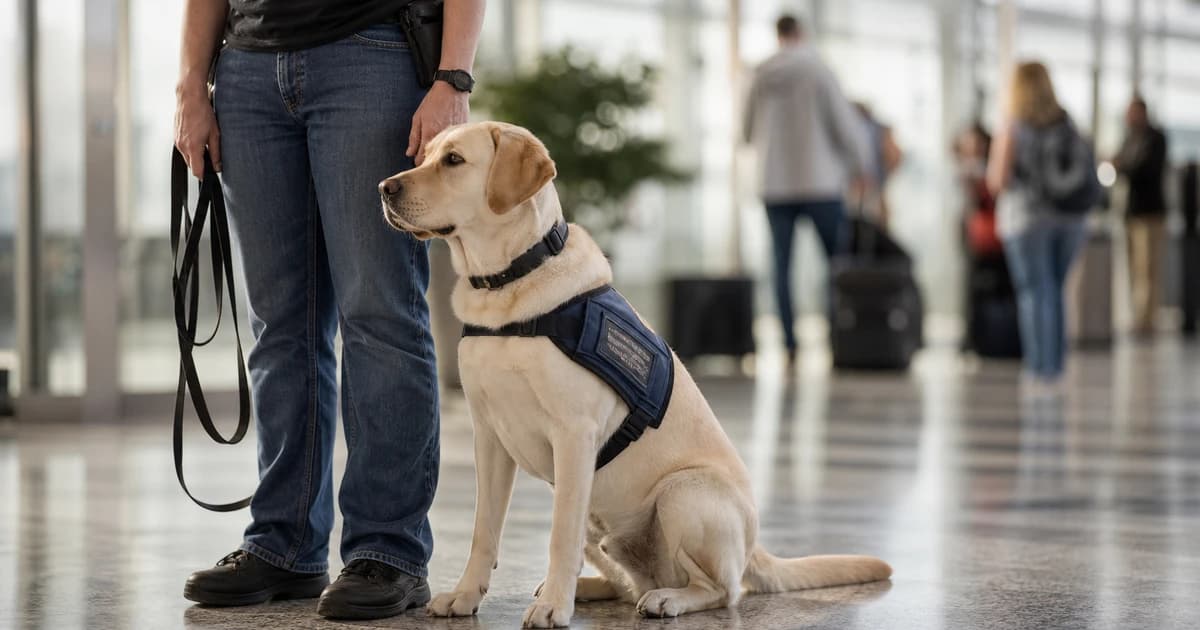
The best service dog breeds share a rare combination: they're smart enough to learn dozens of tasks, calm enough to stay focused in a crowded train station, and stable enough to repeat that performance every single day for years. Not every dog can do this work, and not every smart dog wants to.
This list ranks 12 breeds that consistently meet those demands — from the Labrador that dominates guide-dog programs to the Vizsla that excels at psychiatric support. We weighed temperament, trainability, size, and the day-to-day energy each breed brings to the job.
Some breeds here will surprise you. A few are easier for first-time handlers; others need an experienced hand and a clear job. We've flagged the honest trade-offs so you can match the dog to the actual work you need done.
What makes a good service dog?
Service work is a job, and most dogs would fail the interview. The traits that matter aren't the ones that make a pet adorable — they're the ones that make a dog reliable under pressure.
Temperament
The single biggest factor. A service dog has to stay neutral around screaming toddlers, dropped food, other dogs, and sudden noises. Breeds like the Labrador and Golden Retriever earn their spots because their default setting is steady and people-oriented. A dog that startles easily, guards resources, or gets reactive on leash washes out fast — which is why even within great breeds, only a fraction of individuals make the cut. You want a dog that recovers quickly from surprises and looks to its handler for direction rather than reacting on instinct.
Trainability
Service tasks stack on top of each other: retrieve the phone, brace during a stand, interrupt a panic spike, ignore the sandwich on the floor. Breeds with high biddability and working intelligence — the Poodle, Border Collie, German Shepherd — pick this up faster and retain it longer. The flip side is that brilliant dogs get bored and invent their own jobs if you under-train them. A Border Collie without enough work becomes a problem, not a partner.
Size & sturdiness
Mobility and guide work need real physical presence. A dog providing balance support or retrieving heavy items has to be tall and solid enough to do it without injury — that's where the German Shepherd (50–90 lb), Bernese Mountain Dog (70–115 lb), and standard Poodle come in. For psychiatric or alert work, smaller can be fine. Match the build to the task, not to a vague idea of "big dog equals capable."
Energy & exercise
This cuts both ways. A dog needs enough drive to stay engaged through long training sessions, but enough off-switch to lie quietly under a restaurant table for two hours. The Vizsla and Boxer bring serious energy that has to be burned before they can settle. Retrievers tend to land in a more workable middle. Crossbreeds like the Goldendoodle and Labradoodle can inherit either parent's energy, so individual selection matters more than the label.
No single breed checks every box. A guide-dog candidate and a seizure-alert candidate are looking for different dogs, and the best match depends entirely on what you need the animal to do.
Compare at a glance
Tap any breed name to jump to its full write-up.
| Breed | Size | Weight | Energy | Trainable | Affection | Shedding |
|---|---|---|---|---|---|---|
| Labrador Retriever | Large | 55–82 lb | ||||
| Golden Retriever | Large | 55–75 lb | ||||
| German Shepherd Dog | Large | 49–88 lb | ||||
| Poodle | Small | 7–9 lb | ||||
| Border Collie | Large | 26–44 lb | ||||
| Doberman Pinscher | Giant | 66–88 lb | ||||
| Bernese Mountain Dog | Giant | 71–120 lb | ||||
| Collie | Large | 51–75 lb | ||||
| Boxer | Large | 55–71 lb | ||||
| Goldendoodle | Large | 51–90 lb | ||||
| Labradoodle | Medium | 15–24 lb | — | — | — | — |
| Vizsla | Large | 44–66 lb |
The 12 best service dog breeds
Labrador Retriever
The #1 service and guide dog — biddable, steady, and food-motivated.
Large · 55–82 lb · 10–12 yr
Drop a few treats on the floor and a Lab will track the scent, work the problem, and look up grinning for the next assignment — that eagerness is exactly why this breed dominates guide-dog and assistance programs. At roughly 22 inches and 55 to 82 pounds, the Labrador is big enough to brace a wobbly handler or open a door, yet steady enough to lie quietly under a restaurant table for an hour. Trainability sits at the top of the scale (5/5), and the even temperament means a Lab won't spook at a dropped tray or a crowded bus.
The friendly streak is a working asset: a service Lab needs to ignore strangers who want to pet it, and that calm, non-reactive nature makes the self-control easier to teach.
The honest caveat
Shedding is heavy (4/5), and that short double coat leaves hair on every public-access vest and waiting-room chair. The energy rating of 4/5 also means a Lab held back from real exercise can get restless and mouthy — a working dog still needs decompression walks and play off the clock.
For a first-time handler who wants a dog that's biddable, sturdy, and unfazed by chaos, the Lab is the safe default for good reason.
Golden Retriever
Calm, intuitive, and people-focused; ideal for assistance work.
Large · 55–75 lb · 12–13 yr
A Golden Retriever will carry your phone across the house without a single tooth mark, and that soft, careful mouth hints at why the breed excels at retrieving dropped items, fetching meds, and other fine assistance tasks. Standing 20 to 24 inches and weighing 55 to 75 pounds, a Golden has the size to provide light mobility support and the patience to sit through a long therapy visit. Trainability earns a full 5/5, and the breed's famously low aggression makes it dependable around children, wheelchairs, and unpredictable medical settings.
That sunny, devoted personality is the engine here — a Golden genuinely wants to be useful, and a well-socialized one reads a handler's needs with quiet attention rather than nervous energy.
The honest caveat
Shedding is the highest on this list (5/5), and that dense double coat demands real grooming (3/5) to stay clean enough for hospitals and classrooms. The 12–13 year lifespan is generous, but the energy level (4/5) means a working Golden still needs play and exercise that has nothing to do with the job.
If you want a partner that's gentle by default and easy to train, few breeds match the Golden's combination of temperament and willingness.
German Shepherd Dog
Intelligent and versatile — a classic guide and mobility partner.
Large · 49–88 lb · 10 yr
Watch a German Shepherd clock every exit in a room while staying glued to her handler, and you understand why the breed pioneered modern guide-dog work back in the 1920s. At 23 to 25 inches and anywhere from 49 to 88 pounds, a GSD has the substance for serious mobility tasks — bracing, counterbalance, even helping a handler rise — paired with a 5/5 trainability score and an intelligence that thrives on complex jobs. This is a dog that wants responsibility, which suits psychiatric and guide work where focus matters.
Loyalty and courage define the breed, and that confident, alert nature translates into a service dog that stays composed in noisy, demanding environments.
The honest caveat
That same intensity (energy 5/5) cuts both ways. A Shepherd left understimulated spins into anxiety, barking, or destruction, and the breed needs a handler who can deliver real mental work. Shedding is heavy (5/5), and the temperament flags are narrower than a Lab's — the breed lists as good with kids but isn't a default for households with other small pets. The 10-year lifespan is also on the shorter side for a large dog.
For an experienced handler who needs a sharp, protective working partner, the GSD delivers — but it's not a beginner's first service dog.
Poodle
Highly trainable and low-shedding, great for allergy-sensitive handlers.
Small · 7–9 lb · 12 yr
A Toy Poodle can learn a new cue in a handful of repetitions and then solve the food puzzle you bought to slow it down — that brainpower is the whole reason the smallest Poodle keeps showing up in medical-alert and psychiatric service work. At 11 inches and just 7 to 9 pounds, this is a lap-sized partner that can ride in a carrier, alert to blood sugar changes, or interrupt a panic episode without needing the strength of a big breed. Trainability hits 5/5, and that curly single coat sheds at a 1/5 — the lowest here — making it one of the few service candidates suited to allergy-prone handlers.
The affection runs at 5/5, and the breed's apartment-friendly, first-timer-friendly flags make it workable for handlers with limited space.
The honest caveat
That low-shedding coat is high-maintenance: grooming sits at a demanding 5/5, meaning regular clipping and brushing or the curls mat fast. At 7 to 9 pounds, a Toy also can't do mobility or bracing work — its strengths are scent, alert, and emotional tasks, not physical support. The 4/5 energy and pushy need for company mean it won't quietly entertain itself.
For scent-based alerting in a small, hypoallergenic package, the Poodle is hard to beat.
Border Collie
Off-the-charts intelligence for complex task training.
Large · 26–44 lb · 10 yr
Give a Border Collie a job with rules, sequence, and a payoff, and you'll watch a thirty-pound brain light up — which is both the appeal and the warning label for service work. Standing 20 to 21 inches and weighing 26 to 44 pounds, this is a lean, athletic dog with a 5/5 trainability score and an almost unsettling capacity to learn complex chains of behavior. For handlers who can build genuinely demanding tasks — multi-step alerts, retrieval routines, mobility cues within the dog's size limits — few breeds absorb training faster.
The alert, responsive temperament means a Border Collie reads its handler closely and stays switched on through long working days.
The honest caveat
Energy maxes out at 5/5, and this dog does not idle. Without sustained, thought-intensive work, a Border Collie invents its own projects — usually loud and destructive — and the 4/5 barking score can be a real liability in quiet public-access settings. Affection sits at 3/5, lower than the Labs and Goldens, so the bond is built through partnership rather than easy cuddling. The 10-year lifespan is modest for the size.
In the hands of a dedicated, active handler willing to keep that mind busy, the Border Collie is a brilliant working partner — but it punishes neglect.
Doberman Pinscher
Alert, loyal, and quick to learn — strong in psychiatric and mobility roles.
Giant · 66–88 lb · 13 yr
A Doberman learns your routines and reads your mood with a speed that feels almost telepathic, and that attentiveness is exactly what makes the breed a strong fit for psychiatric and mobility service work. At 26 to 27 inches and 66 to 88 pounds, this is a powerfully built dog that can provide real bracing and counterbalance support, paired with a 5/5 trainability score and a deep, loyal drive to stay plugged into its handler's life. The short, smooth coat keeps grooming low (2/5) — a quick wipe-down and the dog is ready for public access.
The fearless, alert temperament also suits handlers who want a steady presence in crowded or unpredictable settings.
The honest caveat
Energy runs at 5/5, and this is not a dog you can park in the yard — a bored Doberman gets anxious and difficult. The breed's temperament flags are narrow (good with kids, but not listed as reliable around other dogs or cats), so it asks for an experienced, committed handler who can deliver structure and a job. Its size and look can also draw attention in public that a Lab never would.
The 13-year lifespan is generous for a large breed, and for a handler who needs mobility support plus sharp, devoted focus, the Doberman is a serious contender.
Bernese Mountain Dog
Strong and steady, well-suited to mobility-support roles.
Giant · 71–120 lb · 10 yr
Picture a 100-pound dog leaning its full weight against your leg with the gentleness of a sleeping cat — that's the Berner's signature move, and it hints at why this Swiss farm giant can shine in steadying, mobility-support roles. Males run 25 to 28 inches and 85 to 120 pounds, with the heavy bone and deep chest of a draft animal bred to pull carts across alpine farmland. That substance means a Berner can offer real bracing and counterbalance for a handler who needs physical support. They score 4/5 on trainability and bring a patient, even temperament (affection sits at a perfect 5/5) that holds up around kids, cats, and household chaos. The strong-willed streak is real, so consistent, respectful handling beats heavy-handed correction every time.
The honest caveat is hard to overstate: this breed averages just 10 years, the shortest lifespan on this list. For someone investing 18 months to two years training a service dog, that working window is painfully brief. Add a 4/5 shedding coat and 4/5 grooming demands, and the upkeep is constant.
If your need is calm physical support in a home setting — and you can accept a shorter partnership — few dogs match the Berner's grounded, reassuring presence.
Collie
Sensitive and attentive — a fit for medical-alert and psychiatric work.
Large · 51–75 lb · 12–14 yr
A Collie reads a room the way a good nurse does — quietly, constantly, catching the shift in your mood before you've said a word. That sensitivity, paired with a 5/5 trainability score, is exactly what makes the breed worth a hard look for service work, especially psychiatric support and alert tasks. These are large but light-footed dogs, 22 to 24 inches and 51 to 75 pounds for males, built for covering pasture without wearing out. The standout flag here is that Collies are first-timer-friendly, a rarity among working candidates, and they pair gentleness with a 5/5 affection rating and a genuinely protective streak.
Two cautions. First, that famous sensitivity cuts both ways: a Collie handled roughly or left isolated can spiral into anxiety, which often surfaces as nonstop barking — and barking already runs high at 4/5. For a handler who needs a discreet dog in public, that's a training priority from day one. Second, the double coat sheds at 4/5, so expect regular brushing whether you pick the rough or smooth variety.
With a 12-to-14-year lifespan and a temperament tuned to human emotion, a well-raised Collie can give you a long, perceptive working partnership.
Boxer
Energetic and deeply bonded, used in mobility and alert roles.
Large · 55–71 lb · 10–14 yr
A Boxer greets the world like a middleweight boxer who never learned the fight was over — bouncing, wiggling, spine curled into that famous kidney-bean shape. Under the clowning sits a powerful, square-built athlete: males stand 23 to 25 inches and carry 65 to 71 pounds of muscle. That strength and a 4/5 trainability score make Boxers credible candidates for mobility and medical-alert work, and their protective instinct adds a watchful edge that some handlers value. Affection runs to 5/5, and the breed's good-with-kids flag means a Boxer slots into family life without friction.
The energy is the catch. At 4/5, a Boxer needs real daily exercise and structured outlets, and the puppy-like exuberance lingers for years — not ideal if you need a dog that settles instantly in quiet public spaces. You'll spend serious time channeling that enthusiasm into focus. On the plus side, the short, tight coat asks almost nothing: grooming is a 2/5, shedding a manageable 3/5.
For an active handler who can match the breed's drive and put in the training reps, a Boxer offers loyalty, physical capability, and a 10-to-14-year run of unfiltered devotion.
Goldendoodle
Trainable and low-shedding — increasingly used as a service crossbreed.
Large · 51–90 lb · 10–15 yr
The Goldendoodle was practically built for this job — Poodles and Golden Retrievers were crossed in the 1990s specifically to combine a low-shedding coat with the patient, eager-to-work brain that guide programs prize. That origin story isn't marketing; it's the reason this crossbreed lands so naturally on a service list. Standard sizes hit around 24 inches and 51 to 90 pounds, big enough for some physical-support tasks, and the temperament reads like a service-dog wishlist: friendly, social, 4/5 trainable, and a 5/5 on affection. The low-allergen coat (shedding just 2/5) matters for handlers or family members with sensitivities, and the first-timer-friendly flag lowers the bar for novice handlers.
Grooming is the trade-off. That curly-to-wavy coat needs serious upkeep at 4/5 — regular brushing and professional clips, or it mats fast. Energy also sits at 4/5, so a Goldendoodle wants daily work and engagement; left bored, that bright mind invents its own jobs.
The wildcard is consistency. As a crossbreed, individuals vary, so a Doodle from a breeder who health-tests and selects for temperament is worth the wait. Get that right and you have a 10-to-15-year partner that genuinely wants the assignment.
Labradoodle
Bred for guide work; biddable with an allergy-friendly coat.
Medium · 15–24 lb
The Labradoodle exists because of a service-dog request — a blind woman in Hawaii needed a guide dog her allergic husband could live with, and Wally Conron answered by crossing a Labrador with a Poodle in the late 1980s. That practical, allergy-friendly origin is the whole pitch here. The medium version stands 14 to 16 inches and weighs just 15 to 24 pounds — small enough to lift, sturdy enough to hike all afternoon — which suits handlers who want a portable partner for alert work, emotional support, or task assistance that doesn't require bracing weight.
Temperament is the strength: a well-socialized Labradoodle is outgoing, quick-witted, and happiest in the middle of whatever you're doing, with a retrieving instinct that makes fetch-and-carry tasks click. Training feels like play to them.
The caveat is that same restless intelligence. The off switch "doesn't always work," and a bored Labradoodle finds trouble fast, so structured daily engagement isn't optional. This compact cross also won't suit anyone needing a large dog for mobility support — at under 25 pounds, it's built for lighter duties.
For a handler who wants a small, allergy-conscious, highly engaged service prospect, the Labradoodle's purpose-built history is a genuine selling point.
Vizsla
Sensitive and devoted — a strong fit for psychiatric assistance.
Large · 44–66 lb · 13–14 yr
A Vizsla won't sit politely across the room — it'll press a shoulder into your leg, follow you from couch to kitchen, and fold its 44-to-66-pound frame into your lap like it weighs nothing. That bone-deep need for contact, paired with real sensitivity and a 4/5 trainability score, makes the breed a natural fit for psychiatric service and deep-pressure or grounding tasks. These are athletic Hungarian pointers, 21 to 25 inches tall, with a short, dense rust coat that asks almost nothing — grooming sits at 2/5. They're affectionate to a 5/5 and good with kids and other dogs.
Now the honest part: energy is a maxed-out 5/5. A Vizsla needs serious daily exercise and a job, and without it the same sensitivity that makes the breed so attuned can curdle into anxiety and clinginess that undermines public work. This is not a dog that switches off between tasks. The flip side of that velcro temperament is separation distress if left alone too long.
For an active handler who wants a deeply bonded partner and can meet the exercise demand, a Vizsla offers 13 to 14 years of unshakable attention — and few breeds stay this physically present, this consistently.
Reader rankings
Our editors ranked these, but you decide the real winner. Tap the paw to vote for your favorite — it climbs the list. 4,172 votes so far.
- 1
 Poodle
 - 2
 Golden Retriever
 - 3
 Labrador Retriever
 - 4
 Bernese Mountain Dog
 - 5
 Boxer
Boxer - 6
 German Shepherd Dog
 - 7
 Border Collie
 - 8
 Collie
 - 9
 Vizsla
 - 10
 Doberman Pinscher
How to choose the right dog for your home
Start with the task, not the breed. Write down exactly what you need the dog to do — mobility bracing, allergen detection, psychiatric interruption, guide work — because that determines size, energy, and temperament more than any breed ranking.
Matching your lifestyle
Be honest about your activity level and living space. A Border Collie or Vizsla in a quiet apartment with a low-mobility handler is a recipe for a frustrated dog and a stressed owner. Retrievers and Poodles adapt to more living situations. Bernese Mountain Dogs are gentle and steady but have a short lifespan (7–10 years) and heat sensitivity that can shorten a working career.
Breeder vs. program vs. rescue
Most successful service dogs come from breeders who health-test and temperament-screen specifically for working lines, or from accredited service-dog organizations that breed and raise candidates from puppyhood. Rescue dogs occasionally succeed, but the unknown background makes them a gamble for serious task work. Programs cost more upfront but deliver a vetted, partly-trained dog.
Meeting the parents
If you go through a breeder, meet the dam and ideally the sire. Watch how they handle you, noise, and handling of their feet and ears. Temperament is heritable, and a skittish or pushy parent is a warning sign. Ask what the breeder is selecting for — "good with kids" is not the same as "service-prospect calm."
Budget and ongoing cost
A program-trained service dog can run well into five figures. Even an owner-trained dog from a quality breeder costs thousands before you add professional training, vet care, food, and gear. Larger breeds eat more and cost more at the vet. Factor in 8–14 years of care depending on the breed.
Red flags
Walk away from breeders who won't show health clearances, sell puppies before eight weeks, or claim every puppy is "service material." Be wary of anyone guaranteeing a dog will pass public-access training — no honest source promises that.
Before you decide
The hardest truth about service dogs: most candidates don't make it. Even from top breeders, washout rates are high, and the reasons are often nothing the handler did wrong — a dog can be sweet, healthy, and smart and still be too soft, too reactive, or too distractible for public work.
These breeds are not for someone who wants a low-effort companion. The high-drive options — German Shepherd, Border Collie, Doberman, Vizsla, Boxer — need substantial daily exercise and mental work, or they develop anxiety and destructive habits. Under-stimulating a working dog is the most common mistake new handlers make.
Size cuts both ways. Big breeds like the Bernese Mountain Dog and German Shepherd provide physical support but cost more to feed and treat, and the Berner's short lifespan means fewer working years. Crossbreeds like the Goldendoodle and Labradoodle are marketed as hypoallergenic and predictable, but coat and temperament vary litter to litter — there's no guarantee.
Don't underestimate the training timeline. A reliable service dog typically takes 1–2 years to fully prepare. If you need help now, an established program is usually the better path than raising a puppy yourself.
Related reading
 tips
tipsWhich Dog Breeds Actually Make the Best Service Dogs — And Why
 diary
diaryI Got a Border Collie Thinking It Was Just a Smart Dog. I Was Wrong.
 training
'Leave It' Saved My Dog's Life Twice. Here's How We Trained It.
 tips
tipsGerman Shepherd Puppy: Surviving (and Loving) the First 7 Days
 diary
diaryOur Labrador's First Year: The Good, The Exhausting, and The Worth It
Dog-owner tools & calculators
Free calculators to help you plan, budget, and care for your dog — here's what each one does:
AI Tools
Health & breeding
- Dog Heat Cycle CalculatorEstimate the four stages of your dog's heat, her fertile window, and when the next cycle is likely.
- Dog Age CalculatorConvert your dog’s age to human years using the modern, size-adjusted formula.
- Dog Lifespan CalculatorEstimate life expectancy from breed size and weight, with tips to add healthy years.
- Dog Quality of Life CalculatorScore comfort, mobility, appetite and good days vs. bad to support hard end-of-life decisions.
- Puppy Weight CalculatorPredict your puppy’s adult weight from its current age and weight.
- Dog Pregnancy CalculatorEstimate the whelping (due) date and key milestones from the breeding date.
- Dog Vaccination Schedule CalculatorSee your puppy’s DA2PP and rabies dates from birth, and what’s due now and coming up.
- Dog Body Condition Score CalculatorIs your dog a healthy weight? A guided 9-point body check with an ideal-weight range by size.
- Dog Skin Symptom CheckerUpload a skin photo and symptoms for cautious AI triage, red flags, and vet-visit guidance.
- Dog Spay & Neuter Timing CalculatorWhen is the right age to spay or neuter? Get a window by size and sex, with the trade-offs.
Care & feeding
- Dog Water Intake CalculatorHow much water your dog should drink per day, by weight, activity and food type.
- Dog Walking CalculatorHow much daily walking your dog needs by breed and age — and the calories you both burn.
- Dog Food CalculatorHow much to feed your dog per day, from daily calorie needs (RER/MER) and your food’s calories.
- Homemade Dog Food CalculatorEstimate cooked homemade dog food portions, meals, ingredient split, and batch prep by calories.
- Dog Treat Calorie CalculatorUse the 10% treat rule to calculate a safe daily treat budget and food adjustment.
- Dog Veggie Prep CalculatorConvert raw dog-friendly vegetables into cooked yield, freezer bags, and plain cooking notes.
Cost & planning
- Dog Cost CalculatorWhat a dog really costs — upfront, monthly, and lifetime — adjusted for your country and dog size.
- Dog Insurance Cost CalculatorHow much is pet insurance? Estimate a monthly and yearly premium range by size, age, and region.
- Dog Food Cost CalculatorHow much does dog food cost per month? Combine calorie needs with your food’s real bag price.
Sizing
Safety
- Onion Toxicity for Dogs CalculatorEstimate whether the amount of onion your dog ate is a toxic dose for their weight.
- Raisin & Grape Toxicity CalculatorGauge the risk after your dog eats grapes or raisins, and when to call the vet.
- Chocolate Toxicity CalculatorEstimate the risk from the type and amount of chocolate your dog ate, by weight.
- Can Dogs Eat It? Food Safety CheckerSearch any human food — chocolate, grapes, xylitol — to see if it’s safe or toxic for your dog.
Frequently asked questions
- What is the best service dog breed for beginners?
- Labrador and Golden Retrievers are the easiest for first-time handlers. Their forgiving, people-focused temperaments tolerate training mistakes, and they're the most common breeds in guide-dog programs for good reason. Both adapt to a wide range of tasks and living situations.
- Are Poodles good service dogs?
- Yes. Standard Poodles rank among the most trainable breeds and are a strong choice for handlers who need a low-shedding coat. They're sharp and quick to learn but need consistent mental stimulation to avoid boredom. Their intelligence makes them well-suited to complex task work.
- What's the best service dog for mobility assistance?
- You need size and sturdiness for bracing and retrieving heavy items, so German Shepherds (50–90 lb), Bernese Mountain Dogs (70–115 lb), and standard Poodles are top picks. The dog must be tall and solid enough to support weight without risking injury. Match the build to your specific physical needs.
- Can a German Shepherd be a service dog?
- Absolutely — they're a classic choice for mobility, guide, and psychiatric work. They're highly trainable and physically capable, but they can be more protective and reactive than retrievers, so they need an experienced handler and careful temperament selection. A well-bred, well-socialized Shepherd is an excellent working partner.
- Are Goldendoodles or Labradoodles good service dogs?
- They can be, and their lower-shedding coats appeal to allergy-sensitive handlers. The catch is that crossbreeds inherit unpredictably — coat type, energy, and temperament vary within a single litter. Choose individual prospects carefully rather than relying on the label.
- What's the best service dog breed for psychiatric support?
- Retrievers, Poodles, and Vizslas all do well at psychiatric tasks like deep-pressure therapy and interrupting panic episodes. The Vizsla in particular forms intense bonds and stays close to its handler. The right choice depends on whether you also need a calm public-access dog or a more high-energy companion.
- How long does it take to train a service dog?
- Plan on roughly 1–2 years from puppy to a fully reliable working dog. Public-access training and specific task work take consistent, professional-level effort on top of basic obedience. If you need a working dog sooner, an established program with partly-trained dogs is faster.
- Why do Labradors make such good service dogs?
- Labs combine a stable, friendly temperament with strong trainability and a sturdy build that handles physical tasks. They recover quickly from surprises and stay focused on their handler in distracting environments. That reliability is why they dominate guide-dog and assistance programs worldwide.
- Are Border Collies good service dogs?
- They're brilliant and highly trainable, but their intense drive makes them a demanding choice. A Border Collie needs significant daily exercise and mental work or it develops anxiety and problem behaviors. For an active handler with the time to keep one engaged, they excel at complex tasks.
- What size dog is best for service work?
- It depends entirely on the job. Mobility and guide work need a large, sturdy dog, while alert and psychiatric tasks can suit medium or even smaller dogs. Pick the size that matches your specific needs rather than defaulting to the biggest option.
- How much does a trained service dog cost?
- A program-trained service dog often runs into five figures, reflecting years of breeding, raising, and specialized training. Owner-training from a quality breeder still costs thousands before vet care, food, and professional help. Larger breeds add ongoing expense across an 8–14 year lifespan.
- Can Boxers and Vizslas be service dogs?
- Both can work well, especially for active handlers. Boxers are loyal and trainable but bring high energy that needs daily outlets. Vizslas bond intensely and suit psychiatric support, though they too require serious exercise before they can settle for public-access work.
- Are Dobermans good service dogs?
- Yes — Dobermans are intelligent, trainable, and devoted, which suits them to mobility and psychiatric work. They need an experienced handler and thorough socialization to channel their alertness appropriately. A well-raised Doberman is steady and deeply bonded to its person.
- Why do most service dog candidates wash out?
- Even from excellent breeders, many dogs are too soft, too reactive, or too distractible for the demands of public work. It's rarely a training failure — temperament under pressure is largely innate. That high washout rate is why vetted programs and careful prospect selection matter so much.
Sources & methodology
Rankings reflect our editorial assessment of temperament, trainability, and suitability for this use, guided by recognized breed standards (AKC, FCI) and established veterinary and breed-club references. These describe general breed tendencies — every dog is an individual, so meet the dog, not just the breed.
- American Kennel Club (AKC) breed standards
- Assistance Dogs International (ADI) program data
- International Association of Assistance Dog Partners (IAADP)

Emma Larsson
Certified Dog Trainer·Sweden
Emma runs a dog training studio in Göteborg and has worked with over 300 dogs across 40+ breeds. She writes about reading dog behaviour and building the kind of trust that turns a difficult dog into a great one.
Reader stories
Own one of these breeds, or shopping for your next dog? Share your experience to help other readers choose.