

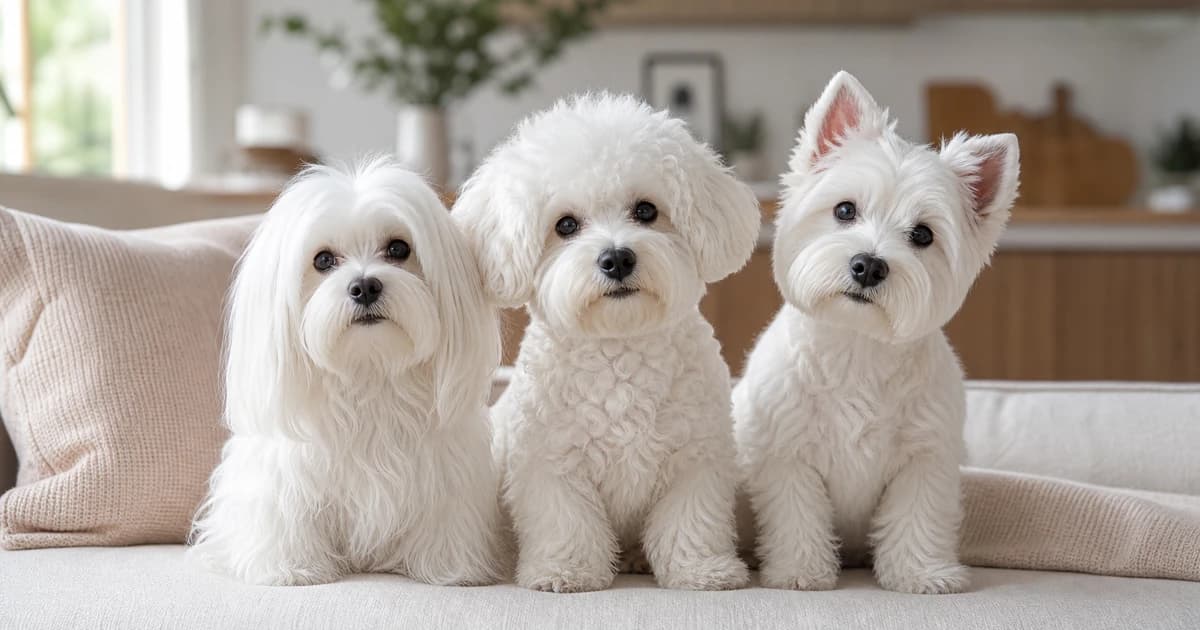
Small white dog breeds carry an obvious charm — that bright coat reads clean, cheerful, and a little fancy — but the dogs underneath range from velcro lapdogs to scrappy terriers who'd happily chase a fox out of a hedge. Picking one on looks alone is how people end up surprised six months in.
This list covers 14 white (or mostly-white) breeds and ranks them on temperament, size and sturdiness, grooming reality, and how they actually fit into a busy home. I've flagged the honest downsides too, because a Maltese and a West Highland White Terrier might match on color and weight while differing wildly on stubbornness and prey drive.
Use it to shortlist, then go meet dogs in person. The right breed is the one that suits your week, not your wallpaper.
What makes a good small white dog?
White coats don't change a dog's character, but the breeds that wear them well share a few practical traits worth weighing before you commit.
Temperament
Most of these dogs were bred as companions, and it shows. The Bichon Frise, Havanese, Coton de Tulear, and Maltese are people-focused and thrive on contact, which makes them affectionate but prone to clinginess. Then there are the terriers — the Westie and Sealyham — who keep an independent, opinionated streak and won't dote on you the same way. The Lhasa Apso leans aloof and watchful, a guard dog in a small package. Match the personality to how much company you actually want.
Size & sturdiness
These are little dogs, but "little" spans a real range. A Maltese can sit under 7 lb, fragile enough that rough toddler handling is a genuine risk. A Westie or Sealyham, by contrast, is a compact, solid 15–20 lb terrier built to dig and tussle. Pomeranians and Papillons are tiny and delicate; the Cavapoo and Havanese fall somewhere comfortably in between. Households with small kids should lean toward the sturdier end.
Energy & exercise
Don't assume small equals low-effort. Papillons are quick, athletic, and genuinely brainy — they'll outwork a lazy owner. Westies and Pomeranians want real daily walks and stimulation or they get noisy and bored. The Maltese, Lhasa Apso, and Japanese Chin are content with modest exercise and lap time. The Cavapoo and Coton sit in the middle: a good walk plus play keeps them settled.
Grooming & upkeep
This is where white breeds earn their reputation. White hair shows tear stains, grass marks, and dirt fast, and many of these coats demand serious maintenance. The Maltese, Coton, Havanese, and Bichon need regular brushing and professional trims to avoid matting. The Chinese Crested hairless variety flips the script — minimal coat, but skin that needs sun protection and care. The Japanese Spitz has a surprisingly low-odor coat that sheds dirt well. Budget time and money for grooming, or pick a lower-maintenance option from the start.
Trainability
The Papillon and Havanese are eager and sharp, picking up cues quickly. The Cavapoo's poodle side helps too. Terriers and the Lhasa Apso can be stubborn, and small dogs of any breed are easy to undertrain because owners let things slide. Consistency matters more than the breed's raw smarts.
Compare at a glance
Tap any breed name to jump to its full write-up.
| Breed | Size | Weight | Grooming | Shedding | Low-allergen | Energy |
|---|---|---|---|---|---|---|
| Maltese | Small | 5–7 lb | ✓ | |||
| Bichon Frise | Small | 11–15 lb | ✓ | |||
| Coton de Tulear | Small | 8–15 lb | ✓ | |||
| West Highland White Terrier | Small | 15–22 lb | ✓ | |||
| Japanese Spitz | Small | 11–20 lb | — | |||
| Sealyham Terrier | Small | 18–24 lb | ✓ | |||
| Havanese | Small | 7–13 lb | ✓ | |||
| Bichon Yorkie | Medium | 7–13 lb | ✓ | |||
| Cavapoo | Small | 9–25 lb | ✓ | |||
| Pomeranian | Small | 5–7 lb | — | |||
| Lhasa Apso | Small | 13–15 lb | ✓ | |||
| Papillon | Small | 5–11 lb | — | |||
| Chinese Crested | Medium | 11 lb | ✓ | |||
| Japanese Chin | Small | 5–7 lb | — |
The 14 best small white dog breeds
Maltese
The classic tiny white lapdog, with a silky coat and low shedding.
Small · 5–7 lb · 12 yr
Five to seven pounds of pure white silk with the attitude of a dog ten times the size — the Maltese is the lapdog other lapdogs aspire to be. Standing about 10 inches tall, this toy breed has carried no working résumé across two thousand years; its only assignment has ever been your company, and it takes that job seriously. Expect a shadow that trails you from kitchen to couch, then looks genuinely betrayed when you rise.
The coat is the obvious draw. That single, silky white layer barely sheds (1/5) and ranks among the more allergy-friendly options, but it's no shortcut — grooming sits at the top of the scale (5/5). Skip a day of combing and you'll be picking out mats; many owners settle on a shorter "puppy cut" to stay sane.
Living with one
Smart (4/5 trainability) and eager to please, the Maltese learns tricks and house manners readily, though its fearless streak can tip into yappiness if you don't curb the barking early. Energy is moderate (3/5) — short walks and indoor play suffice, which makes apartments a natural fit. Good with kids, cats, and other dogs, and forgiving of first-time owners.
If you want a small white dog and don't mind daily coat upkeep, few breeds repay the effort with this much devotion.
Bichon Frise
A cheerful white powder-puff with a curly low-shedding coat.
Small · 11–15 lb · 12 yr
Pick up a Bichon Frise and the powder-puff illusion vanishes — under that white cloud is a springy, muscular little athlete that once earned its keep on Mediterranean trading ships and street stages. At 9 to 11 inches and 11 to 15 pounds, it's a touch sturdier than it looks, built to keep up rather than be carried.
The curly, dense coat is the headline for anyone shopping the small-white category. It sheds very little (1/5) and lands on the low-allergen list, but it's deceptively high-maintenance: grooming rates 4/5, and that curl traps loose hair into mats unless you brush regularly and book the groomer. The trade-off buys you a non-greasy, near-hypoallergenic companion.
Temperament
Cheerful is the operative word. Bichons do happy little two-legged dances, wag constantly, and bond hard (affection 5/5) without smothering you. They're bright (4/5 trainability) and genuinely good with children, cats, and other dogs. The honest caveat: that sensitivity cuts both ways — Bichons left alone too long can grow anxious and noisy (barking 3/5), so they suit homes where someone's around most of the day.
With moderate energy (3/5), a couple of walks and some play keep one content in an apartment. For a first-time owner wanting a lively white dog without a shedding problem, it's a strong pick — just budget for grooming.
Coton de Tulear
A cotton-coated companion dog with a soft white coat and sunny nature.
Small · 8–15 lb · 15–19 yr
A living powder puff with the longest clock on this list — the Coton de Tulear can share your life for 15 to 19 years, a remarkable run for any breed. Native to Madagascar, it stands 9 to 11 inches and weighs 8 to 15 pounds, with a slightly rectangular frame hidden beneath a profusion of soft, cottony white hair that gives the breed its name (and the occasional faint gray or tan shading).
That cotton-wool texture is gorgeous and low-shedding (1/5), low-allergen too, but don't mistake "soft" for "easy." Grooming runs 4/5 because cottony hair tangles fast; daily combing keeps the mats away.
What they're like
Bright, charming, and relentlessly happy, the Coton bonds tightly to its people (affection 5/5) and is among the quieter small whites — barking sits at just 2/5, a real advantage for apartment dwellers and close-quartered neighbors. Trainability is solid (4/5), and energy is moderate (3/5), so daily walks plus indoor play cover the needs. They get on with kids, cats, and other dogs.
The caveat: that deep attachment means a Coton wants to be with you, and long stretches of solitude don't suit them. If you want a gentle, long-lived white companion and can commit to the brushing, this Madagascan rarity is hard to beat.
West Highland White Terrier
A sturdy white terrier with more attitude than its size suggests.
Small · 15–22 lb · 9–15 yr
Fifteen to twenty-two pounds of snow-white self-belief, the Westie struts through life convinced he's a big dog who simply got a great coat. Bred from the rough working terriers of the Scottish Highlands, he stands 10 to 11 inches with a deep chest and stocky, muscular build — this is a worker, not an ornament.
Unlike the silk-and-cotton crowd here, the Westie wears a dense double coat with a harsh outer layer. It sheds modestly (2/5) and qualifies as low-allergen, and grooming runs 4/5, since that crisp texture needs regular tidying (hand-stripping for show coats, clipping for pets).
Personality
Confident, lively, and affectionate (4/5), he'll spoon on the sofa one minute and tear across the yard the next. Energy is higher than the others on this list (4/5), so daily exercise isn't optional. He's good with kids and other dogs and adapts to apartments — provided you address the two terrier realities: he's a vocal alert-barker (4/5) and has an independent streak that makes training (3/5) a negotiation rather than a given.
If you want a small white dog with grit and personality instead of a pampered lapdog, the Westie delivers — just come prepared with patience, a brush, and a tolerance for opinions loudly expressed.
Japanese Spitz
A bright white spitz with a foxlike face and friendly family style.
Small · 11–20 lb · 10–16 yr
Imagine a miniature Samoyed with a fox-sharp face and a tail curled like a question mark over its back — that's the Japanese Spitz, the largest small white on this list at 12 to 15 inches and 11 to 20 pounds. The brilliant white double coat stands off the body in a plush ruff, giving the breed a striking, almost theatrical look.
Here's the honest trade-off for that fluff: shedding runs 3/5, higher than the single-coated whites above, and you'll see seasonal blowouts. The flip side is that grooming is only moderate (3/5) — the coat is famously self-cleaning and sheds dirt easily, so regular brushing rather than constant professional trips keeps it bright. Note this breed isn't flagged low-allergen, so allergy-sensitive households should look elsewhere.
Living with one
Affectionate (5/5), cheerful, and loyal, the Japanese Spitz attaches closely to its family and is smart enough (4/5 trainability) to pick up routines quickly. Energy is moderate (3/5); daily walks and play satisfy it. It's good with kids, cats, and other dogs, and handles apartment life. Barking sits at 3/5 — it'll announce visitors but isn't relentlessly noisy.
For someone who wants the dramatic white-fluff look in a small, trainable, devoted package — and doesn't mind a vacuum cleaner — this Japanese breed hits a sweet spot few others reach.
Sealyham Terrier
A low-shedding white terrier with a compact, sturdy frame.
Small · 18–24 lb · 12–14 yr
Low-slung, broad-chested, and built like a small tank, the Sealyham Terrier is the rare working dog that's now genuinely uncommon — a Welsh original developed to go to ground after badger and fox. At 10 to 11 inches but a solid 18 to 24 pounds, it's the heaviest breed here, carrying real density on short legs.
The weather-resistant wiry coat is mostly white, sometimes flecked with lemon, tan, badger, or black markings around the head. It barely sheds (1/5) and earns low-allergen status; grooming is moderate (3/5), needing regular brushing and tidying to keep that harsh texture in shape.
What to expect
Outgoing, alert, and good-humored, the Sealyham is calmer than most terriers — affection rates 4/5, energy a manageable 3/5, so it doesn't demand the constant motion a Westie does. It's good with kids and other dogs and adapts well to apartments. Barking sits at 3/5: it'll sound off at the doorbell but isn't a chronic noisemaker.
The caveat is the classic terrier stubbornness — trainability is 3/5, so consistency and patience matter more than with the eager toy breeds. And finding a breeder takes effort, since numbers are low.
If you want a sturdy, low-shedding white dog with character and don't mind tracking one down, the Sealyham rewards the search.
Havanese
Often white or cream, low-shedding, and famously social.
Small · 7–13 lb · 14–16 yr
Cuba's only native breed bounces through life like the class clown who also happens to be the teacher's pet. The Havanese stands 8 to 12 inches and tips the scale at 7 to 13 pounds, so it disappears under a coffee table yet fills a room with personality. That long silky double coat comes in white among many other shades, and at a 1/5 shedding score with a low-allergen label, it drops almost nothing on your couch.
This is one of the easier small dogs to live with. Affection runs at a full 5/5, energy sits at a manageable 3/5, and trainability of 4/5 means tricks, manners, and house rules click faster than you'd expect from a toy breed. It gets along with kids, other dogs, and cats, and apartment life suits it fine.
The honest caveat
That gorgeous coat is high-maintenance — grooming rates 4/5. Skip a few days of brushing and you'll fight mats behind the ears and under the legs, plus regular trims or professional appointments add up.
For a first-time owner who wants a small, white, low-shedding companion that genuinely enjoys training sessions, the Havanese is a sensible pick — provided you budget time for the brush. With a 14–16 year lifespan, you're signing on for a long, lively friendship.
Bichon Yorkie
A small companion cross with white, cream, and tan coat options.
Medium · 7–13 lb · 13–15 yr
Cross a Bichon Frise with a Yorkshire Terrier and you get a 7-to-13-pound bundle that's half lap warmer, half doorbell alarm. The Bichon Yorkie stands 9 to 12 inches, but the frame underneath the fluff is sturdier than the silhouette suggests — a well-sprung ribcage and level topline, not a fragile teacup. Coats run white, cream, tan, black, or a mix, in soft wavy or curly textures that shed at just 1/5 and carry a low-allergen tag.
Personality is the selling point. Affection hits 5/5, and this dog wants to be wherever you are — your lap, your pillow, your bag. Energy is a moderate 3/5, so a couple of walks and some play indoors keep it content. It does well with kids and other dogs and adapts to apartments.
Two honest caveats
Barking rates 4/5, and the alert, slightly stubborn streak from both parents means this dog announces visitors with enthusiasm. Grooming is a full 5/5 — the curly coat mats fast without near-daily brushing and routine trims.
As a designer cross from the 1990s–2000s, you'll see variation litter to litter, so meet the parents if you can. For someone home often who wants a velcro companion and doesn't mind training away the yappiness, this lively little hybrid earns its keep over a 13–15 year span.
Cavapoo
A soft-coated companion cross that can come in white, cream, or parti-color.
Small · 9–25 lb · 12–15 yr
Picture a Golden Retriever's optimism shrunk into a 9-to-25-pound package and you've got the Cavapoo's whole appeal. This Cavalier–Poodle cross runs a wide size range — 9 to 14 inches tall — because the Poodle side can be toy or miniature, so one pup lands chunky-toy and another comes out leggy. Coats are soft and wavy to curly in cream, apricot, red, white, and more, shedding at 1/5 with a low-allergen rating.
Temperament is the draw. Affection sits at 5/5 and the default mood is delighted to see you. It's gentle with children, sociable with other dogs and cats, and content to nap on the couch after a walk. Energy is a moderate 3/5 and trainability rates 4/5, which suits first-time owners and apartments alike.
The honest caveat
That soft coat needs real upkeep — grooming is 4/5, meaning regular brushing and professional trims to head off mats. The size lottery also matters: if you need a predictably small dog, the 9–25 pound spread can surprise you, so ask the breeder about the Poodle parent.
For a family wanting an affectionate, low-shedding companion with a sunny streak and a 12–15 year lifespan, a well-bred Cavapoo delivers — just go in expecting some grooming bills and a bit of size guesswork.
Pomeranian
A tiny spitz puffball that can come in striking white.
Small · 5–7 lb · 12–15 yr
A white Pomeranian looks like a tiny arctic fox that's been freshly blow-dried, and it carries itself like a dog three times its 5-to-7-pound size. Standing 9 to 11 inches, this German spitz descendant packs bold, alert confidence into a fluffy double coat with a thick undercoat and long outer layer. White is one of many colors on offer, alongside orange, cream, black, and parti.
Don't let the lapdog reputation fool you. Affection runs 5/5 and energy is a brisk 3/5, but this is an opinionated little dog — trainability sits at 3/5 and the independent spitz streak shows. It's good with other dogs and fits apartment living, plus first-timers can manage it with consistency.
Two honest caveats
Barking maxes out at 5/5. Pomeranians announce the doorbell, the mail carrier, and the existence of squirrels, so early training matters in close quarters. That showpiece coat also sheds at 4/5 with 5/5 grooming demands — expect a thick undercoat blow and regular brushing to keep it from matting.
This breed wants to be in the middle of everything and will perk up at every sound. For someone who wants a small, striking white dog with outsized personality and a 12–15 year lifespan — and who can tolerate a vocal watchdog — the Pom rewards the effort.
Lhasa Apso
A small long-coated sentinel with white and cream coat options.
Small · 13–15 lb · 15–18 yr
For over a thousand years this small, bearded dog patrolled Tibetan monastery walls as a four-legged alarm, and that sentinel attitude still defines the Lhasa Apso. Built long and low, a typical adult stands about 10 inches and weighs 13 to 15 pounds, with a sturdy, well-muscled frame hidden under a long, dense, straight double coat. White is one of its many shades, beside gold, honey, smoke, and grizzle.
This is not a people-pleaser, and that's the point. Affection rates a measured 3/5 — the Lhasa decides when to grace you with attention, greets strangers with polite suspicion, and adores its own people on its own terms. Energy is moderate at 3/5, and apartment life suits it well.
The honest caveat
Trainability is a stubborn 2/5. This independent, confident dog won't drill obedience for the fun of it, so first-time owners expecting quick compliance will be frustrated. Grooming also runs 5/5 — that floor-length coat mats without frequent brushing, and many owners keep it in a shorter pet trim.
Shedding is low at 2/5 with a low-allergen label, and the lifespan is remarkable: 15 to 18 years. If you want a dignified, watchful housemate rather than an eager sidekick — and you can commit to coat care and patient, consistent handling — the Lhasa is a long-lived, loyal choice.
Papillon
A fine-boned toy dog with a white base and butterfly ears.
Small · 5–11 lb · 14 yr
You'll spot a Papillon from across the park by the ears — large, fringed, and fanned out like butterfly wings, which is exactly what the French name means. Under that flourish sits a tiny dog of 8 to 11 inches and 5 to 11 pounds, wearing a long silky single coat that's white with patches of any other color. A drop-eared version, the Phalène, counts as the same breed.
What sets this breed apart is brainpower. Trainability hits a rare 5/5 — Papillons consistently outperform far larger dogs at obedience and agility — paired with 4/5 energy and a 5/5 affection score. They bond hard, follow you room to room, and want into every conversation. Good with kids, dogs, and cats, and apartment-friendly too.
The honest caveat
That sharp mind needs a job. A bored Papillon invents its own entertainment, and the lively energy means a daily walk plus mental games aren't optional. Shedding sits at a middling 3/5, higher than the curly-coated dogs on this list, though grooming itself is a manageable 3/5.
With a 14-year lifespan and a single coat that's easy to maintain compared to double-coated breeds, the Papillon is the pick for someone who wants a small white dog that genuinely loves to learn — and who'll actually use that intelligence.
Chinese Crested
A low-shedding toy companion with hairless and powderpuff varieties.
Medium · 11 lb · 12 yr
Two puppies from the same litter can look like they belong to different species — that's the Chinese Crested's party trick. The Hairless variety wears smooth, warm skin across most of its body, with silky hair only on the head, ears, lower legs, and tail. The Powderpuff gets a full soft double coat. For a white-dog shortlist, both come in white or white combinations, and at 9–13 inches and around 11 pounds, this is a genuinely tiny companion.
Shedding sits at a low 1/5, which makes the Hairless especially appealing if dander is a concern in your house. The flip side: bare skin needs sunscreen in summer, sweaters in winter, and regular care to stay healthy, so "low-maintenance" isn't quite right. Grooming lands at 3/5 either way.
The temperament is the selling point. Rated 5/5 for affection, a Crested is a true velcro dog who burrows under blankets and trails you between rooms. Energy is moderate (3/5), and they're rated good with dogs, cats, and first-time owners.
The honest caveat: they don't cope well alone. Separation anxiety is common, and a lonely Crested will let you know. Plan for a dog who's rarely left for long stretches, and you'll have a devoted, apartment-sized shadow with a roughly 12-year run.
Japanese Chin
A quiet toy companion often seen in elegant black-and-white or red-and-white.
Small · 5–7 lb · 10 yr
Picture a five-pound dog that moves like it's barely touching the floor and watches the room like a tiny aristocrat — that's the Japanese Chin. Standing 8–11 inches and weighing just 5–7 pounds, it carries a square, refined silhouette and a long, silky single coat. The Black & White variety puts it squarely on a white-dog list, alongside Red & White and Black & Tan.
This breed was bred for one job: companionship in the imperial court, going back to the Nara period. It shows. The Chin is quiet (barking 2/5), reserving its voice for genuinely strange events — a stranger at the door often gets a puzzled stare rather than a fuss. Affection runs to 5/5, and it reads your mood with uncanny accuracy, pressing closer when you're tense and settling when you relax.
Energy is low at 2/5, so short walks and indoor play suit it fine, which makes it a strong apartment pick and good with dogs, cats, and new owners. The flat face means moderate shedding (3/5) and the silky coat needs regular brushing, grooming rated 3/5.
The honest caveat: that pushed-in face brings the breathing and heat sensitivity issues common to flat-faced dogs, so skip strenuous heat and watch its breathing. Lifespan is around 10 years. A calm, devoted lapdog for a quieter household.
Reader rankings
Our editors ranked these, but you decide the real winner. Tap the paw to vote for your favorite — it climbs the list. 3,574 votes so far.
- 1
 Bichon Frise
 - 2
 Maltese
 - 3
 Havanese
 - 4
 Coton de Tulear
 - 5
 West Highland White Terrier
 - 6
 Pomeranian
 - 7
 Japanese Chin
 - 8
 Cavapoo
 - 9
 Sealyham Terrier
 - 10
 Lhasa Apso
How to choose the right dog for your home
Start with your honest weekly schedule, not the breed you've already fallen for. A Coton de Tulear or Havanese that's alone nine hours a day will struggle; a Lhasa Apso copes better with independence. If you work long hours, factor in daycare or a dog walker before you buy.
Match the dog to your life
Apartment with thin walls? A Pomeranian's bark may cause friction. Active family who hikes? A Papillon or Westie can keep up better than a tiny Maltese. Small children at home? Skip the most fragile breeds and look at the sturdier terriers or a mid-sized Cavapoo. Be realistic about grooming time, too — a full-coat Maltese is a lifelong commitment to brushing and trims.
Breeder vs. rescue
Good breeders health-test parents, raise pups underfoot in the home, and ask you plenty of questions. Expect a waitlist and a contract. Rescues and breed-specific rescue groups are full of wonderful dogs, including purebreds and mixes like Bichon Yorkies and Cavapoos that didn't work out elsewhere. Adoption suits people who want a slightly older, settled dog and don't need a specific puppy timeline.
Meet the parents
Wherever possible, see at least the mother with the litter. Watch her temperament — nervous or snappy parents often produce nervous pups. Observe whether the litter is clean, alert, and socialized to household sounds. A breeder who won't let you visit, or who has puppies always available, is a warning sign.
Budget honestly
The purchase price is the smallest number. Grooming for a coated white breed can run hundreds a year. Add quality food, insurance or a savings buffer for vet bills, and the dental care small breeds frequently need. Tiny dogs can require costly procedures precisely because their small mouths crowd their teeth.
Red flags
Walk away from sellers who push multiple breeds, won't show health clearances, meet you in a parking lot, or rush the deal. "Teacup" labels are a marketing tactic, not a breed standard, and often signal poor breeding. A reputable source will happily answer slow, detailed questions.
Before you decide
White coats are high-visibility, which cuts both ways. Tear staining shows clearly under the eyes on the Maltese, Bichon, and Coton, and keeping a white dog actually white takes ongoing effort. If you want a wash-and-go dog, most of this list isn't it.
These breeds are generally not for people who want an aloof, low-contact pet. Companion breeds bond hard and can develop separation anxiety, barking, or destructive habits when left alone too long. The terriers — Westie, Sealyham — bring prey drive, digging instincts, and a stubborn streak that surprises owners expecting a docile lapdog.
Size creates its own hazards. The smallest breeds are easily injured by jumps off furniture, careless feet, or rough play, and they're not ideal first dogs for homes with very young children. Small-breed dental disease is common, so daily tooth care isn't optional.
The most frequent mistake is undertraining and overcoddling. Owners carry small dogs everywhere and skip socialization, then wonder why the dog is fearful or yappy. Treat them like real dogs — leash training, manners, exposure to the world — and most of these breeds turn into delightful, easygoing companions.
Related reading




Dog-owner tools & calculators
Free calculators to help you plan, budget, and care for your dog — here's what each one does:
AI Tools
Health & breeding
- Dog Heat Cycle CalculatorEstimate the four stages of your dog's heat, her fertile window, and when the next cycle is likely.
- Dog Age CalculatorConvert your dog’s age to human years using the modern, size-adjusted formula.
- Dog Lifespan CalculatorEstimate life expectancy from breed size and weight, with tips to add healthy years.
- Dog Quality of Life CalculatorScore comfort, mobility, appetite and good days vs. bad to support hard end-of-life decisions.
- Puppy Weight CalculatorPredict your puppy’s adult weight from its current age and weight.
- Dog Pregnancy CalculatorEstimate the whelping (due) date and key milestones from the breeding date.
- Dog Vaccination Schedule CalculatorSee your puppy’s DA2PP and rabies dates from birth, and what’s due now and coming up.
- Dog Body Condition Score CalculatorIs your dog a healthy weight? A guided 9-point body check with an ideal-weight range by size.
- Dog Skin Symptom CheckerUpload a skin photo and symptoms for cautious AI triage, red flags, and vet-visit guidance.
- Dog Spay & Neuter Timing CalculatorWhen is the right age to spay or neuter? Get a window by size and sex, with the trade-offs.
Care & feeding
- Dog Water Intake CalculatorHow much water your dog should drink per day, by weight, activity and food type.
- Dog Walking CalculatorHow much daily walking your dog needs by breed and age — and the calories you both burn.
- Dog Food CalculatorHow much to feed your dog per day, from daily calorie needs (RER/MER) and your food’s calories.
- Homemade Dog Food CalculatorEstimate cooked homemade dog food portions, meals, ingredient split, and batch prep by calories.
- Dog Treat Calorie CalculatorUse the 10% treat rule to calculate a safe daily treat budget and food adjustment.
- Dog Veggie Prep CalculatorConvert raw dog-friendly vegetables into cooked yield, freezer bags, and plain cooking notes.
Cost & planning
- Dog Cost CalculatorWhat a dog really costs — upfront, monthly, and lifetime — adjusted for your country and dog size.
- Dog Insurance Cost CalculatorHow much is pet insurance? Estimate a monthly and yearly premium range by size, age, and region.
- Dog Food Cost CalculatorHow much does dog food cost per month? Combine calorie needs with your food’s real bag price.
Sizing
Safety
- Onion Toxicity for Dogs CalculatorEstimate whether the amount of onion your dog ate is a toxic dose for their weight.
- Raisin & Grape Toxicity CalculatorGauge the risk after your dog eats grapes or raisins, and when to call the vet.
- Chocolate Toxicity CalculatorEstimate the risk from the type and amount of chocolate your dog ate, by weight.
- Can Dogs Eat It? Food Safety CheckerSearch any human food — chocolate, grapes, xylitol — to see if it’s safe or toxic for your dog.
Frequently asked questions
- What is the best small white dog breed for families with kids?
- Sturdier breeds handle family life better than the most fragile ones. The Havanese and Coton de Tulear are friendly and reasonably robust, while a Westie suits older kids who respect a terrier's independence. Avoid the tiniest options like the Maltese or Pomeranian around toddlers, since they injure easily.
- Which small white dog breeds don't shed much?
- The Maltese, Bichon Frise, Coton de Tulear, and Havanese all have coats that shed minimally, which is part of why they're popular with allergy-conscious owners. No dog is truly hypoallergenic, though, since dander and saliva also trigger reactions. The trade-off is heavy grooming — these coats need regular brushing and trims to stay matt-free.
- Are small white dogs hard to keep clean?
- Yes, more so than darker dogs. White fur shows tear stains, food, grass, and mud quickly, especially around the eyes and mouth. Regular face wiping, baths, and grooming keep them presentable, so factor that upkeep into your decision.
- What's the most low-maintenance small white dog breed?
- The Japanese Spitz has a coat that resists dirt and odor surprisingly well for its fluff, and the hairless Chinese Crested skips coat grooming entirely (though its skin needs care). Among the rest, expect meaningful grooming commitments. There's no genuinely fuss-free option in the heavily coated breeds.
- Which small white dog is best for apartments?
- The Maltese, Havanese, and Japanese Chin adapt well to apartment living thanks to modest exercise needs. Watch barking, though — a Pomeranian or Lhasa Apso can be vocal, which causes problems with close neighbors. Daily walks still matter regardless of square footage.
- Do small white dog breeds bark a lot?
- Some do. Pomeranians and many terriers, including the Westie, are alert and quick to sound off, and the Lhasa Apso was bred as a watchdog. Calmer barkers include the Maltese and Japanese Chin. Early training reduces nuisance barking in any of them.
- What is the lifespan of small white dog breeds?
- Small breeds generally live longer than large ones, and many here can reach the mid-teens with good care. Lifespan depends on the specific breed, genetics, weight, and dental health. Keeping them lean and on top of vet care helps them age well.
- Are small white dogs easy to train?
- It varies a lot. Papillons and Havanese are bright and eager, picking up cues fast, while terriers and the Lhasa Apso bring a stubborn streak. The bigger pitfall is owners letting small dogs skip training because they seem harmless. Consistency matters more than raw intelligence.
- What's the difference between a Maltese and a Bichon Frise?
- The Maltese has long, silky straight hair and tends to be smaller and more delicate, while the Bichon Frise sports a curlier, plush coat and a slightly sturdier build. Both are affectionate companion breeds that bond closely with their people. Temperament is similar, but the Bichon often reads as a touch more playful and outgoing.
- Is a Cavapoo a good small white dog for first-time owners?
- A Cavapoo can be an excellent starter dog — friendly, trainable, and adaptable thanks to its Cavalier and Poodle parentage. Coat color varies, so a fully white one isn't guaranteed in every litter. Buy from a breeder who health-tests both parent breeds, since crossbreeds can inherit issues from either side.
- Why does my white dog have brown stains around its eyes?
- Tear staining is common in white breeds like the Maltese, Bichon, and Coton, caused by tears and saliva oxidizing on light fur. It's usually cosmetic but can signal blocked tear ducts or irritation worth a vet check. Daily face cleaning and keeping the hair trimmed around the eyes helps keep it under control.
- Are small white dogs good with other pets?
- The companion breeds like the Havanese, Bichon, and Coton generally get along well with other dogs and cats when socialized early. Terriers such as the Westie and Sealyham carry prey drive and may chase smaller animals. Introductions should be slow and supervised regardless of breed.
- Do white dogs have more health problems?
- Coat color alone doesn't determine health, and these breeds vary widely in their concerns. Small dogs as a group are prone to dental crowding and joint issues like luxating patella. Buy from breeders who screen for breed-specific conditions to lower the risk.
Sources & methodology
Rankings reflect our editorial assessment of temperament, trainability, and suitability for this use, guided by recognized breed standards (AKC, FCI) and established veterinary and breed-club references. These describe general breed tendencies — every dog is an individual, so meet the dog, not just the breed.
- American Kennel Club (AKC) breed standards
- Fédération Cynologique Internationale (FCI) breed standards
- The Kennel Club (UK) Breed Information Centre

Marco Ferretti
Veterinarian·Italy
Dr. Marco Ferretti is a small-animal vet in Florence with a special interest in canine nutrition and breed-specific health conditions. He translates clinical research into plain advice real dog owners can actually use.
Keep exploring
- Small Fluffy Dog BreedsPint-sized, soft-coated companions that are all floof.
- Best Dog Breeds for FamiliesFriendly, patient, kid-proof breeds that thrive in a busy household.
- Best Service Dog BreedsIntelligent, steady, highly trainable breeds suited to assistance work.
- Browse all dog breeds →
- Try the Dog Heat Cycle Calculator →
Reader stories
Own one of these breeds, or shopping for your next dog? Share your experience to help other readers choose.