

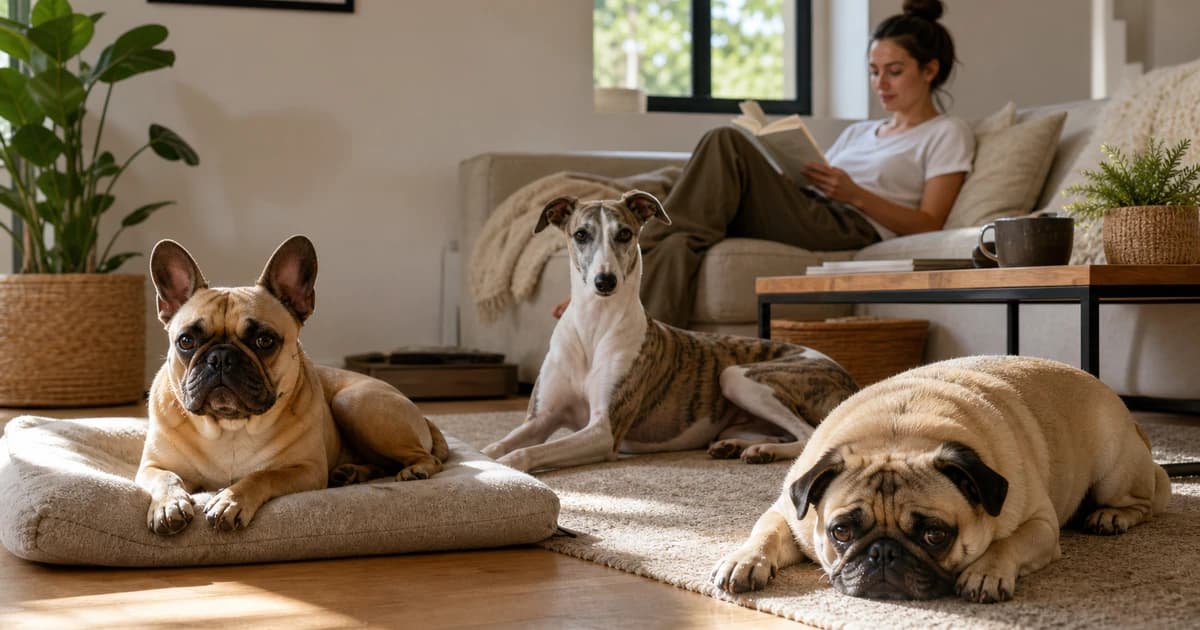
Low maintenance dogs aren't a myth, but the term gets thrown around loosely. What most people actually want is a dog that doesn't need two hours of running every day, won't shred the furniture out of boredom, and won't bury you in grooming bills or vet drama. That's the lens we used here.
This list leans on three things: modest exercise needs, manageable grooming, and a temperament that's content with normal family life rather than a job to do. Every breed below scores well on at least two of those, and we've been honest about where each one falls short — because no dog is zero effort.
A quick warning before you scroll: several short-faced breeds on this list trade exercise needs for breathing and heat issues, and a couple of the giants need almost nothing in the way of running but eat like horses. Easy in one column often means costly in another.
What makes a dog low maintenance?
"Low maintenance" is a balancing act across a few different demands. A dog that's easy on exercise might be a nightmare to groom; a breed that's quiet indoors might be stubborn to train. The breeds here win by keeping most of those columns reasonable at once.
Energy & exercise
The lowest-effort dogs are happy with a walk or two and some pottering around the house. Greyhounds surprise people here — despite the racing reputation, they're famous couch potatoes who need a couple of short walks and the occasional sprint, then they sleep most of the day. Bulldogs, Pugs, and French Bulldogs also sit at the low end, partly by temperament and partly because their flat faces limit how hard they can safely work. The flip side: Whippets and Italian Greyhounds have a real chase instinct and want a secure space to bolt around in.
Size & sturdiness
Big isn't always harder. Great Danes and Bullmastiffs are calm, low-energy giants that are often called gentle around the home — but their size means bigger food bills, shorter lifespans, and serious cost when something goes wrong. Toy breeds like the Chihuahua and Japanese Chin take up almost no space and cost little to feed, though small dogs can be fragile around toddlers and rough handling.
Grooming
This is where the list splits hard. Smooth-coated dogs — Greyhound, Whippet, Boston Terrier, smooth Dachshund — are about as easy as it gets: a quick brush, the odd bath, done. The Xoloitzcuintli's hairless variety needs almost no brushing but does need skin care and sun protection. At the other end, the Chinese Crested's exposed skin and the Cavalier's silky feathered coat ask for more attention than their easygoing personalities suggest.
Temperament & trainability
A low-maintenance dog should fit into your routine without constant negotiation. Cavaliers, Pugs, and Boston Terriers tend to be people-pleasers who settle quickly and don't ask for much beyond company. Chihuahuas and Dachshunds are bright but can be willful — the Dachshund especially has a stubborn streak that makes housetraining a slog for first-timers. Bulldogs are mellow but famously unbothered by your training plans. Match the dog's wiring to how much patience you actually have, not how much you'd like to have.
Compare at a glance
Tap any breed name to jump to its full write-up.
| Breed | Size | Weight | Energy | Grooming | Shedding | Barking |
|---|---|---|---|---|---|---|
| French Bulldog | Medium | 24–29 lb | ||||
| Greyhound | Giant | 60–66 lb | ||||
| Whippet | Large | 24–40 lb | ||||
| Bulldog | Medium | 51–55 lb | ||||
| Pug | Small | 13–18 lb | ||||
| Basset Hound | Medium | 40–60 lb | ||||
| Boston Terrier | Medium | 11–24 lb | ||||
| Italian Greyhound | Medium | 9–11 lb | ||||
| Cavalier King Charles Spaniel | Medium | 11–18 lb | ||||
| Chihuahua | Small | 5–7 lb | ||||
| Dachshund | Small | 9–11 lb | ||||
| Chinese Crested | Medium | 11 lb | ||||
| Japanese Chin | Small | 5–7 lb | ||||
| Xoloitzcuintli | Medium | 10–55 lb | ||||
| Bullmastiff | Giant | 90–130 lb | ||||
| Great Dane | Giant | 110–175 lb |
The 16 best low maintenance dogs
French Bulldog
Low exercise needs, tiny grooming load, and a quiet city-friendly temperament.
Medium · 24–29 lb · 10 yr
Skip the daily brush-out, the long runs, and the noise complaints — a Frenchie asks for almost none of it. That short, fine coat rates a 1 out of 5 for grooming, so a quick wipe-down and a weekly once-over keeps it tidy (though at 3/5 shedding, expect a light dusting of hair on dark trousers). At 11 to 13 inches and 24 to 29 pounds, this is a dense little dog built for apartment life: energy sits at 2/5, and a couple of short walks plus some indoor play covers the daily quota. The barking score is the lowest possible — 1/5 — which your neighbors will quietly appreciate.
They're affectionate to a fault, scoring a full 5/5, and that translates to a dog who wants to be on your lap, in your lap, and ideally inside your shirt. Good with kids, other dogs, and cats, and forgiving enough for a first-time owner.
The honest caveat
That flat face means heat is genuinely dangerous — Frenchies overheat fast and can't cool themselves well, so summer walks need timing and care. A 10-year average lifespan is on the shorter side for a small dog, too. If you can manage the climate and the snoring, you get one of the easiest companions going for a small, busy home.
Greyhound
A short-coated sprinter that is often calmer indoors than people expect.
Giant · 60–66 lb · 11–12 yr
The fastest breed on the list is also one of the laziest, and that contradiction is exactly why a Greyhound earns its spot. These dogs hit 45 miles per hour in a sprint, then spend roughly 18 hours a day melted into the nearest soft surface. Energy is a moderate 3/5, but it comes in short, intense bursts — a daily walk and the occasional gallop in a fenced space satisfies a healthy adult. The rest is couch.
Grooming is a 1/5: that short, smooth coat needs little more than a quick rub-down, and shedding stays low at 2/5. Barking sits at the floor (1/5), so you get a quiet, almost cat-like presence in the home. At 27 to 30 inches and a surprisingly light 60 to 66 pounds, they're a giant dog that folds neatly into apartment living, and the affectionate, laid-back temperament makes them genuinely easy company.
The honest caveat
That prey drive is real. A squirrel through the window can flip the switch from statue to rocket, so a securely fenced area and a leash near roads are non-negotiable — recall is unreliable when something small darts past.
For anyone who wants a big, gentle, low-fuss dog that won't demand hours of exercise, a retired racer is hard to beat. Many come pre-house-trained from adoption groups.
Whippet
Clean, quiet, and couch-loving after a daily stretch of exercise.
Large · 24–40 lb · 12–15 yr
Picture a small Greyhound with the same off-switch and you've got the Whippet — a sighthound that sprints at 35 miles an hour, then claims the sunniest patch of sofa for the rest of the afternoon. Standing 17 to 20 inches and weighing a feather-light 24 to 40 pounds, they're easy to live with: energy is a manageable 3/5, satisfied by a good run in a safe space followed by long hours of contented stillness.
The maintenance side is where they shine. That short, fine coat scores 1/5 for grooming and 2/5 for shedding, so upkeep is a damp cloth and not much else. Barking sits low at 2/5. They're affectionate as they come — a full 5/5 — and rate well with kids, other dogs, and apartment life. First-time owners do fine with them.
The honest caveat
Thin coat plus low body fat means Whippets feel the cold sharply; a sweater for winter walks isn't a fashion choice. And like every sighthound, the chase instinct can override recall in a heartbeat, so open spaces need to be secure.
With a 12 to 15 year lifespan, they're also one of the longer-lived options here — a quiet, low-grooming companion you'll likely have around for the long haul.
Bulldog
Mellow, sturdy, and content with gentle walks instead of big adventures.
Medium · 51–55 lb
A Bulldog's idea of a workout is shuffling from the dog bed to the sofa and back, which makes this 51-to-55-pound block of muscle one of the most low-energy companions you can own. The energy score is a flat 2/5, and that's no exaggeration — a short stroll and they're satisfied. Standing just 15 to 16 inches but built impossibly wide, they're calm, docile, and content to lounge for most of the day.
Grooming runs an easy 2/5, with a short, smooth coat that needs little beyond a regular wipe and attention to those facial wrinkles. Shedding lands at 3/5, so some hair management is part of the deal. Barking is the lowest possible at 1/5. With a 5/5 affection rating and green lights for kids, dogs, and cats, the Bulldog is a famously patient family dog and a sensible first-time pick.
The honest caveat
That flat, pushed-in face brings real costs: Bulldogs struggle in heat, can't tolerate hard exercise, and the breed carries well-documented breathing issues. Their willful streak (trainability 2/5) means stubborn standoffs over basic commands.
Keep them cool, keep the wrinkles clean, and don't expect quick obedience. In return you get a steady, affectionate housemate who genuinely prefers a quiet life.
Pug
Small, sociable, and low exercise - with heat and breathing caveats.
Small · 13–18 lb · 10 yr
Compact enough to live anywhere and too lazy to wear you out, the Pug fits a low-maintenance brief almost by accident. A grown one stands 10 to 11 inches and weighs 13 to 18 pounds — small dog, surprising heft — with an energy rating of just 2/5. A short walk and some indoor clowning cover the daily needs, and the rest of the time they're a warm weight against your leg. The affection score maxes out at 5/5, and they're rated good with kids, dogs, and cats alike.
Grooming is a modest 2/5; the short coat is simple to maintain, though those facial folds need regular cleaning. Barking is low at 2/5, and the apartment-friendly, first-timer-friendly flags make them an easy entry point into dog ownership.
The honest caveat
Two things to weigh honestly. Shedding is heavier than the small size suggests at 3/5 — Pugs leave hair everywhere. And the flat face brings the same heat sensitivity and breathing concerns as other brachycephalic breeds, plus a 10-year average lifespan that's modest for a dog this small.
If you want a comedian who'll happily match your couch hours and doesn't need much exercise, the Pug delivers — just budget for a lint roller and keep them out of the summer heat.
Basset Hound
Gentle and low-key, with a short coat and a stubborn hound streak.
Medium · 40–60 lb · 10–13 yr
Few dogs commit to relaxation quite like a Basset Hound, whose default mode is leaning against your legs and snoring. Don't be fooled by the 40-to-60-pound bulk on those short legs — at just 13 to 15 inches tall, this is a low-slung lounger with an energy rating of 2/5. A steady walk satisfies them, and indoors they're a calm, gentle presence rather than a whirlwind.
Grooming sits at an easy 2/5; the short, dense coat needs only routine brushing, though those long ears want regular checks. Affection scores a full 5/5, and they're rated good with kids, other dogs, and cats, with apartment and first-timer flags both checked.
The honest caveat
The maintenance ease has limits. Barking is a notable 3/5 — Bassets have a deep, carrying bay — and shedding runs 3/5, so loose hair is a constant. The bigger thing is that nose: once a scent grabs them, training (a stubborn 2/5) goes out the window, and recall becomes a negotiation you'll lose. A securely fenced yard and a reliable leash are essential.
With a 10-to-13-year lifespan, they're a long, mellow companion for someone who wants a quiet housemate and doesn't mind the occasional bay or a yard fence they can't tunnel under.
Boston Terrier
Wash-and-go grooming in a compact, friendly companion.
Medium · 11–24 lb · 13 yr
That short, smooth tuxedo coat is the whole grooming routine: a quick wipe-down and a once-a-week brush, and a Boston Terrier looks ready for company. Shedding sits at a modest 2/5, and grooming barely registers at 1/5, so you won't be paying for clipper appointments or vacuuming daily. At 15 to 17 inches and 11 to 24 pounds, this is a compact American breed that fits a flat or a small house without complaint, and the apartment-friendly flag holds up in practice.
What keeps the maintenance light is also a trainability score of 4/5 paired with quiet intelligence. Bostons read household routines quickly and respond well to consistent, kind handling, which means less time spent untangling bad habits. Affection runs at the top of the scale (5/5), and barking stays low at 2/5, so a neighbor-friendly dog is realistic.
The honest caveat: energy is 4/5, higher than people expect from a 'low-key' little dog. A Boston needs real daily play and a couple of brisk walks, or that lively brain turns to mischief. Their short muzzle also means they struggle in heat and humidity, so plan exercise for cooler hours.
For a first-time owner who wants a tidy, devoted dog and can commit to short daily activity, the Boston earns its keep.
Italian Greyhound
A tidy, low-shedding little sighthound for quiet adult homes.
Medium · 9–11 lb · 14 yr
Picture a Greyhound shrunk to lap size — 13 to 15 inches tall, just 9 to 11 pounds — and you have the smallest true sighthound and one of the easiest coats to keep. The hair is short and fine, shedding rates a 2/5, and grooming is a 1/5; a rubber mitt once a week handles the lot, with no doggy odor to manage. Energy lands at a moderate 3/5, so an Italian Greyhound is happy to sprint hard for ten minutes, then melt into your lap for the afternoon.
That lap habit is the breed's signature. They burrow under blankets, wedge against your hip, and follow you room to room, scoring a full 5/5 on affection. Barking stays low at 2/5, which suits apartment living, another spot where this breed thrives.
The caveat is fragility, not coat care. Those long, slender legs are genuinely delicate, and IGs are notorious for breaking them in ordinary jumps off furniture. They're also sensitive (3/5 trainability), so heavy-handed correction backfires, and that thin coat means a sweater in cold weather is non-negotiable.
If you want a clean, quiet, devoted companion and you can dog-proof the height of your couch, the Italian Greyhound asks very little in return.
Cavalier King Charles Spaniel
Gentle, adaptable, and easy to live with if you keep up with brushing.
Medium · 11–18 lb · 12 yr
A couple of 20-to-30-minute walks and some indoor play, and a Cavalier King Charles Spaniel is content — this is a dog built for company, not for marathons. At 12 to 13 inches and 11 to 18 pounds, with energy at a relaxed 3/5, it slots neatly into apartment life and adapts to your pace rather than dictating its own. The breed earns every one of its family flags: good with kids, dogs, and cats, first-timer-friendly, and a 5/5 on affection that shows up as a warm body leaning against your leg all evening.
Trainability of 4/5 and low barking (2/5) make daily life smooth. Cavaliers want to please, so basic manners come without a fight.
The honest trade-off is the coat. Long, silky, and slightly wavy, it shed at a 3/5 and grooming runs 3/5 — meaning a few brushings a week and attention to the ears and feathering to prevent mats. So this isn't the lowest-effort coat on this list. The bigger consideration is health: a 12-year lifespan is on the shorter side for a small breed, and the line has known heart and neurological concerns worth discussing with a responsible breeder.
For someone home often who wants an affectionate, easygoing dog, the modest brushing is a small price.
Chihuahua
Tiny food bills and simple coat care, but early manners matter.
Small · 5–7 lb · 12 yr
Few dogs deliver this much presence for this little upkeep: a Chihuahua stands just 6 to 9 inches tall and weighs 5 to 7 pounds, which means tiny food bills, tiny living space, and a dog you can carry under one arm. The smooth-coated variety asks almost nothing — grooming sits at 2/5 — and even the long coat stays manageable with a weekly brush. Energy is a moderate 3/5, satisfied by indoor zoomies and a short walk, making this one of the most genuinely apartment-suited breeds going.
Devotion runs deep at 5/5. A Chihuahua picks a person and orbits them, alert to every footstep at the door.
That alertness is also the catch. Barking rates 4/5, and an unsocialized Chihuahua can become a snappy, suspicious doorbell that never stops. They're bold and a little sassy, so early manners work and consistent rules matter more than their size suggests. At 5 pounds they're also delicate around rough toddlers, which is why they pair better with older kids or adults.
Get the socialization right early, and you have a low-cost, low-fuss, fiercely loyal companion that lives comfortably in the smallest of homes.
Dachshund
Small, short-coated, and apartment-ready, with back-care considerations.
Small · 9–11 lb · 12–15 yr
A miniature Dachshund's long, low body rides on five-to-six-inch legs and tops out around 9 to 11 pounds, so the daily-care load is light by nature. Coat care depends on the variety — the smooth and longhaired types need little more than a weekly brush, and shedding sits at a tidy 2/5 with grooming at 2/5. Energy is a moderate 3/5: a couple of walks and some sniffing satisfies most of them, and the apartment-friendly flag holds for owners who don't expect a placid lapdog.
That's the rub, because this badger-hunting hound comes with a stubborn streak. Trainability rates just 2/5, so recall and housebreaking take patience and a sense of humor. Barking is a loud 4/5 — the breed was literally bred to bark underground — and a Dachshund left alone too long will protest vocally or chew the baseboards.
There's also a structural caveat worth knowing: that long spine is prone to disc problems, so stairs and furniture jumps should be limited, and weight kept in check.
What you get in exchange is a clever, devoted, low-grooming companion with a 12-to-15-year lifespan — one of the longest on this list. Match the stubbornness with consistency, and the maintenance stays genuinely low.
Chinese Crested
Low shedding and compact size, but skin and coat care still matter.
Medium · 11 lb · 12 yr
Here's the breed that practically doesn't shed: the Chinese Crested scores a 1/5 on shedding and carries a low-allergen flag, making it one of the cleaner options for a tidy home. The Hairless variety has soft skin and tufts only on the head, feet, and tail, so there's no coat to vacuum up — though it trades brushing for skin care. At 9 to 13 inches and around 11 pounds, with a moderate 3/5 energy level, this is an apartment-suited, first-timer-friendly dog that's happy with light daily activity.
Affection maxes out at 5/5. A Crested is a velcro dog that burrows under blankets and trails its chosen person everywhere.
The maintenance shifts rather than disappears. The Hairless skin needs sun protection in summer and warmth in winter, plus regular cleaning to keep it healthy, and grooming still rates 3/5 once you factor that in. The Powderpuff variety, born in the same litters, comes with a full double coat that does need real brushing.
The bigger caveat is temperament: separation anxiety is genuine, and a Crested left alone too long gets stressed and noisy. For a household with someone usually home, this is a near-shed-free, deeply devoted companion that asks for attention more than equipment.
Japanese Chin
Quiet, catlike, and happy with indoor companionship.
Small · 5–7 lb · 10 yr
Picture a five-pound dog that crosses a room like it's gliding on casters, then folds itself into your lap and stays there. At 8 to 11 inches and topping out around 7 pounds, the Japanese Chin asks for almost nothing in the way of space — an apartment suits it perfectly, and its energy sits at a mellow 2 out of 5, so a couple of short strolls and some indoor play cover the day.
This is a quiet breed by nature. Barking rates a low 2/5, and a stranger at the door usually gets a curious stare rather than a fuss. The Chin reads your moods closely and matches them, which makes it an easy presence to live with. Affection runs to a full 5/5 — this dog wants to be near you, not running laps around the yard.
The honest caveat
The silky single coat looks high-effort, but grooming lands at a moderate 3/5: regular brushing keeps it tidy, and shedding is middling. The bigger watch-point is the flat face, which means heat and hard exercise need real caution. As a calm, first-timer-friendly companion that's good with cats and other dogs, the Chin earns its keep by simply being pleasant company.
Xoloitzcuintli
A low-shedding, low-grooming primitive breed for steady owners.
Medium · 10–55 lb · 13–18 yr
There's no undercoat to blow, no tumbleweeds of fur under the couch — the Xoloitzcuintli's hairless body shedding rating sits at a remarkable 1 out of 5. For anyone tired of lint-rolling every surface they own, this ancient Mexican breed is close to a clean slate, and its low-allergen coat is a genuine draw for sensitive households.
Size is flexible, which is part of the appeal: Xolos range from 10 to 23 inches and 10 to 55 pounds, so you can pick a lap-sized version or a sturdy mid-size dog. They're calm, thoughtful, and loyal, with moderate energy (3/5) that's easily satisfied. Add a long 13-to-18-year lifespan and a temperament that's good with kids, dogs, and cats, and you have a low-fuss companion built for the long haul.
The honest caveat
Hairless doesn't mean maintenance-free. Bare skin needs sunscreen, protection in cold weather, and occasional bathing to stay healthy — so you trade brushing for skin care. Trainability is middling at 3/5, helped by their genuine attentiveness to their person. For a quiet home wanting a devoted, near-shed-free dog with serious longevity, the Xolo is an unusual but rewarding pick.
Bullmastiff
Calm and low-grooming, though its sheer size raises every cost.
Giant · 90–130 lb · 10 yr
A Bullmastiff would rather lean its 100-plus pounds against your shins than tear around the backyard, and that's exactly what makes this giant surprisingly easy to keep. Standing 24 to 27 inches and weighing 90 to 130 pounds, it carries its bulk with a slow, deliberate calm. Energy rates a moderate 3/5, satisfied by a daily walk rather than miles of running — this is a dog that idles low.
The short, dense coat needs little: grooming sits at 2/5, just a quick weekly going-over. Barking is minimal at 2/5, since the breed was built to track poachers silently and pin them, not announce them. Affection runs to a full 5/5, and that loyalty shows up as a heavy head dropped onto your lap and a habit of following you room to room.
The honest caveat
Low-maintenance in grooming and exercise doesn't mean low-commitment. A protective giant needs early socialization and confident handling, and the breed is best with kids it knows. The 10-year lifespan is short for a dog this size, and feeding, vet care, and sheer space requirements scale with the weight. For families with room and a steady hand, though, the Bullmastiff is a remarkably undemanding housemate.
Great Dane
Surprisingly simple coat care for a giant dog - space and budget are the catch.
Giant · 110–175 lb · 7–10 yr
For a dog that stands eye-level with the dinner table, the Great Dane is shockingly low-effort to maintain. The short, smooth coat earns the lowest possible grooming score — a 1 out of 5 — meaning a wipe-down and the occasional brush is the whole routine. Despite a frame that runs 28 to 32 inches and 110 to 175 pounds, energy lands at a moderate 3/5; these are famous couch occupants who'd happily spend the afternoon sprawled across your feet.
Temperament is the other selling point. Gentle, patient, and dependable, the Dane scores 5/5 for affection and gets along with kids, other dogs, and cats. It's a giant that thinks of itself as a lapdog, and the low grooming burden plus the relaxed exercise needs make daily care genuinely simple.
The honest caveat
The hard truth is the lifespan: just 7 to 10 years, short even by giant-breed standards. You're also committing to enormous food bills, a car big enough to haul the dog, and the reality that anything at counter height is fair game. Maintenance here is about cost and space, not effort. If you can accommodate the scale, the Dane delivers easygoing companionship with very little fuss over its coat or its calendar.
Reader rankings
Our editors ranked these, but you decide the real winner. Tap the paw to vote for your favorite — it climbs the list. 3,220 votes so far.
- 1
 French Bulldog
 - 2
 Cavalier King Charles Spaniel
 - 3
 Bulldog
 - 4
 Pug
Pug - 5
 Japanese Chin
 - 6
 Boston Terrier
 - 7
 Whippet
 - 8
 Greyhound
 - 9
 Basset Hound
 - 10
 Chinese Crested
How to choose the right dog for your home
Start with your real schedule, not your aspirational one. If you're out ten hours a day, a clingy companion breed like the Cavalier or French Bulldog will struggle — these dogs want people around. If you live in a flat with no garden, a Whippet's need to stretch its legs matters more than its calm indoor manners.
Breeder vs rescue
Good breeders health-test their stock, let you meet the mother, and ask you plenty of questions in return. That matters enormously for the flat-faced breeds and the giants, where breeding shortcuts cause lifelong problems. Rescue is a strong route too — adult dogs come with a known temperament, and breed-specific rescues exist for almost everything on this list, including Greyhounds and Bulldogs.
Meet the parents
Whatever the route, see the dog interacting before you commit. A nervous, snappy parent often produces nervous pups. With companion breeds, watch how the dog reacts to you — friendliness and calm should be obvious, not coaxed. For the giants, ask about hip and heart screening specifically.
Budget honestly
The purchase price is the small number. Feeding a Great Dane or Bullmastiff costs far more than a Pug, and their medication doses scale with weight. Flat-faced breeds frequently need vet attention for breathing, eyes, and skin folds — insurance premiums reflect this. A hairless Xolo or Chinese Crested needs skin products and sunscreen as routine spend, not extras.
Red flags
Walk away from sellers who won't show you where the dogs live, who have multiple breeds available at once, who push you to pay a deposit fast, or who can't produce health paperwork. "Teacup" or extreme-flat-face marketing is a warning sign, not a feature. A dog sold without any questions about your home is a dog bred for profit, not health.
Before you decide
Low effort doesn't mean no effort, and a few breeds here carry real caveats. The brachycephalic group — French Bulldog, Bulldog, Pug, Boston Terrier — can't cool themselves well and struggle in heat and exercise. Some need surgery to breathe comfortably. If you live somewhere hot or want a hiking buddy, these aren't your dogs.
The giants are a different gamble. Great Danes and Bullmastiffs are wonderfully calm at home, but they have notably short lifespans and big-dog health risks, plus the everyday reality of a dog that can knock over a child or clear a coffee table with one tail wag.
Don't mistake small for delicate-free. Chihuahuas, Italian Greyhounds, and Japanese Chin can be injured easily and aren't ideal around very young, grabby children. Dachshunds carry back-injury risk tied to their long spine, and their stubbornness frustrates owners who expected an easy ride.
The most common mistake is buying on looks. A Frenchie's face or a Dane's grandeur sells the dog; the vet bills, the snoring, the heat limits, and the lifespan don't show up in the photo. Pick for the years, not the picture.
Related reading




Dog-owner tools & calculators
Free calculators to help you plan, budget, and care for your dog — here's what each one does:
AI Tools
Health & breeding
- Dog Heat Cycle CalculatorEstimate the four stages of your dog's heat, her fertile window, and when the next cycle is likely.
- Dog Age CalculatorConvert your dog’s age to human years using the modern, size-adjusted formula.
- Dog Lifespan CalculatorEstimate life expectancy from breed size and weight, with tips to add healthy years.
- Dog Quality of Life CalculatorScore comfort, mobility, appetite and good days vs. bad to support hard end-of-life decisions.
- Puppy Weight CalculatorPredict your puppy’s adult weight from its current age and weight.
- Dog Pregnancy CalculatorEstimate the whelping (due) date and key milestones from the breeding date.
- Dog Vaccination Schedule CalculatorSee your puppy’s DA2PP and rabies dates from birth, and what’s due now and coming up.
- Dog Body Condition Score CalculatorIs your dog a healthy weight? A guided 9-point body check with an ideal-weight range by size.
- Dog Skin Symptom CheckerUpload a skin photo and symptoms for cautious AI triage, red flags, and vet-visit guidance.
- Dog Spay & Neuter Timing CalculatorWhen is the right age to spay or neuter? Get a window by size and sex, with the trade-offs.
Care & feeding
- Dog Water Intake CalculatorHow much water your dog should drink per day, by weight, activity and food type.
- Dog Walking CalculatorHow much daily walking your dog needs by breed and age — and the calories you both burn.
- Dog Food CalculatorHow much to feed your dog per day, from daily calorie needs (RER/MER) and your food’s calories.
- Homemade Dog Food CalculatorEstimate cooked homemade dog food portions, meals, ingredient split, and batch prep by calories.
- Dog Treat Calorie CalculatorUse the 10% treat rule to calculate a safe daily treat budget and food adjustment.
- Dog Veggie Prep CalculatorConvert raw dog-friendly vegetables into cooked yield, freezer bags, and plain cooking notes.
Cost & planning
- Dog Cost CalculatorWhat a dog really costs — upfront, monthly, and lifetime — adjusted for your country and dog size.
- Dog Insurance Cost CalculatorHow much is pet insurance? Estimate a monthly and yearly premium range by size, age, and region.
- Dog Food Cost CalculatorHow much does dog food cost per month? Combine calorie needs with your food’s real bag price.
Sizing
Safety
- Onion Toxicity for Dogs CalculatorEstimate whether the amount of onion your dog ate is a toxic dose for their weight.
- Raisin & Grape Toxicity CalculatorGauge the risk after your dog eats grapes or raisins, and when to call the vet.
- Chocolate Toxicity CalculatorEstimate the risk from the type and amount of chocolate your dog ate, by weight.
- Can Dogs Eat It? Food Safety CheckerSearch any human food — chocolate, grapes, xylitol — to see if it’s safe or toxic for your dog.
Frequently asked questions
- What is the most low maintenance dog breed?
- For sheer ease, the Greyhound is hard to beat — short coat, calm indoor temperament, and a need for only modest daily walks plus the odd sprint. They sleep most of the day and don't demand constant entertainment. The main catch is needing a secure area for them to run safely off-lead.
- Are low maintenance dogs good for first-time owners?
- Many are, especially easygoing companion breeds like the Cavalier King Charles Spaniel, Pug, and Boston Terrier, which are forgiving of beginner mistakes. Avoid the stubborn ones — the Dachshund and Bulldog test your patience during training. First-timers should also think hard before taking on a giant breed, where the health and cost stakes are higher.
- Which low maintenance dogs are best for apartments?
- Greyhounds, Whippets, Italian Greyhounds, and Pugs all do well in flats because they're quiet and low-energy indoors. Boston Terriers and French Bulldogs suit small spaces too. The key is daily walks to burn off energy, since a small home doesn't replace exercise.
- Do low maintenance dogs still need grooming?
- Smooth-coated breeds like the Greyhound, Whippet, and smooth Dachshund need only occasional brushing and the rare bath. But the Cavalier's silky coat and the Chinese Crested's exposed skin take more upkeep than their relaxed personalities suggest. Even hairless dogs like the Xolo need regular skin care and sun protection.
- Are big dogs ever low maintenance?
- Yes — Great Danes and Bullmastiffs are surprisingly calm and don't need heavy exercise. The trade-off is cost: they eat far more, their medication scales with weight, and they have shorter lifespans. Their size also means they can accidentally knock over kids or furniture.
- What low maintenance dog is best with kids?
- The Cavalier King Charles Spaniel and Boston Terrier are friendly, sturdy enough, and tolerant of family life. Bullmastiffs and Bulldogs are gentle giants and gentle stockier dogs respectively, though supervision is essential with any big breed. Avoid fragile toy breeds like the Italian Greyhound and Chihuahua around very young children.
- Why are flat-faced dogs considered low maintenance but risky?
- French Bulldogs, Pugs, and Bulldogs need little exercise and have laid-back temperaments, which makes daily life easy. But their short skulls cause breathing problems and poor heat tolerance, and some need surgery to breathe comfortably. Expect higher vet bills and limits on activity in warm weather.
- Which low maintenance dog needs the least exercise?
- Bulldogs and Pugs sit at the very bottom for exercise needs, partly by nature and partly because their breathing limits hard activity. Great Danes and Bullmastiffs also need relatively little for their size. A couple of short, easy walks usually covers it.
- Are low maintenance dogs easy to train?
- It varies a lot. Cavaliers, Pugs, and Boston Terriers are eager to please and pick things up readily. Dachshunds and Bulldogs, by contrast, are stubborn and slow to housetrain, so patience and consistency matter. Low effort on exercise doesn't always mean low effort on training.
- How much does it cost to own a low maintenance dog?
- Toy breeds like the Chihuahua and Japanese Chin are cheap to feed and medicate. Giants like the Great Dane and Bullmastiff cost far more in food and weight-based medication. Flat-faced breeds often carry higher insurance and vet costs due to breathing and eye issues, so factor that in beyond the purchase price.
- Do low maintenance dogs bark a lot?
- Most breeds here are fairly quiet indoors, especially the Greyhound, Whippet, and Bullmastiff. Smaller dogs like the Chihuahua and Dachshund can be more vocal and prone to alarm-barking. Early socialization helps keep noise in check.
- Are hairless dogs like the Xolo and Chinese Crested low maintenance?
- They skip the brushing, but they're not effort-free. Exposed skin needs regular cleaning, moisturizing, and sun protection, and it's vulnerable to scrapes and cold. Think of it as swapping coat care for skin care rather than removing maintenance entirely.
- Can low maintenance dogs be left alone during the workday?
- Some tolerate it better than others. Greyhounds and Whippets often settle and sleep, while companion breeds like the Cavalier and French Bulldog are deeply attached and can become distressed when left for long stretches. None should be alone for a full workday without breaks or company.
Sources & methodology
Rankings reflect our editorial assessment of temperament, trainability, and suitability for this use, guided by recognized breed standards (AKC, FCI) and established veterinary and breed-club references. These describe general breed tendencies — every dog is an individual, so meet the dog, not just the breed.
- American Kennel Club (AKC) breed standards
- Fédération Cynologique Internationale (FCI) breed standards
- The Kennel Club (UK) Breed Information Centre

Emma Larsson
Certified Dog Trainer·Sweden
Emma runs a dog training studio in Göteborg and has worked with over 300 dogs across 40+ breeds. She writes about reading dog behaviour and building the kind of trust that turns a difficult dog into a great one.
Keep exploring
- Best Dog Breeds for FamiliesFriendly, patient, kid-proof breeds that thrive in a busy household.
- Small Fluffy Dog BreedsPint-sized, soft-coated companions that are all floof.
- Best Service Dog BreedsIntelligent, steady, highly trainable breeds suited to assistance work.
- Browse all dog breeds →
- Try the Dog Heat Cycle Calculator →
Reader stories
Own one of these breeds, or shopping for your next dog? Share your experience to help other readers choose.