

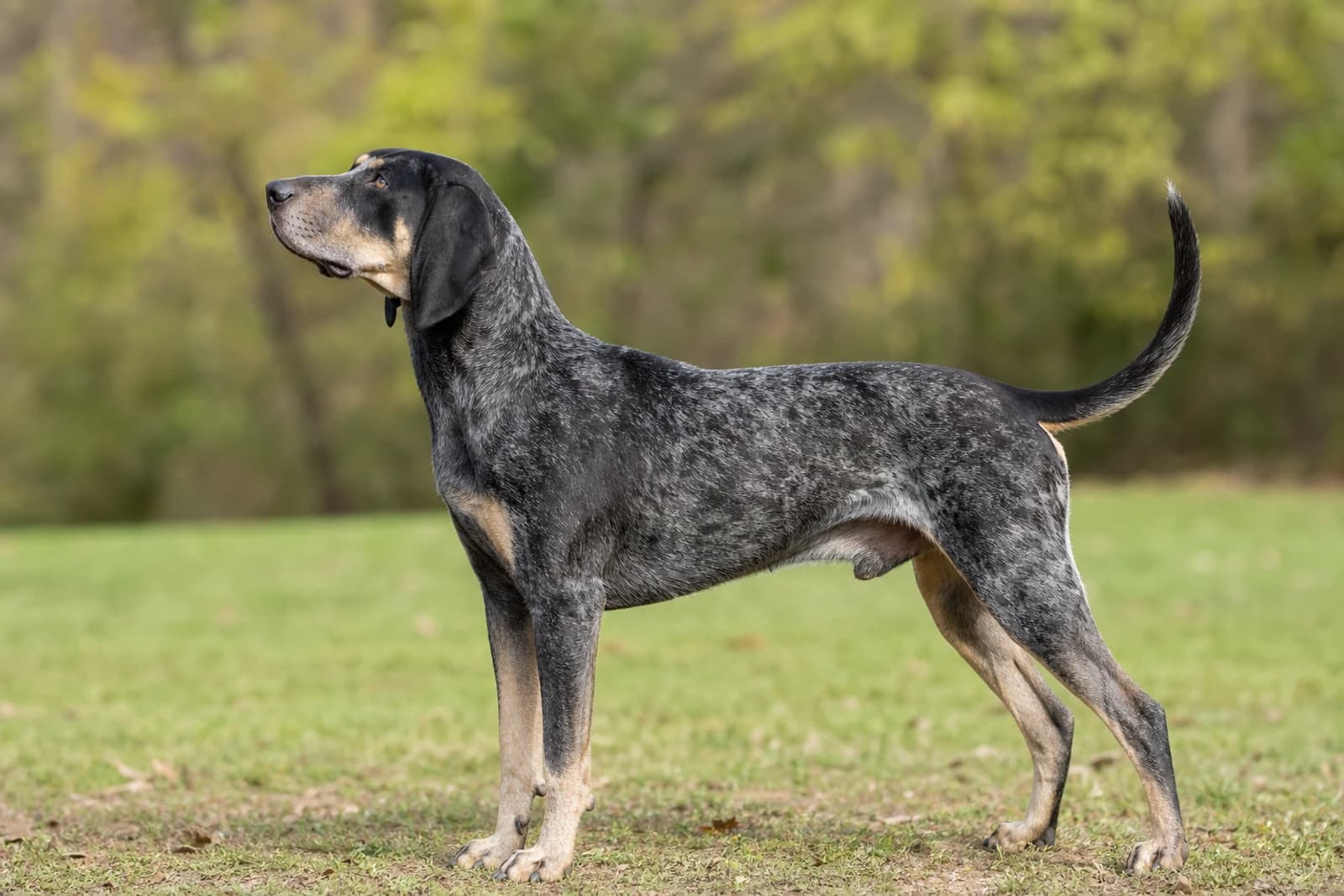
The American English Coonhound is a versatile hunting dog with a strong prey drive and a friendly, sociable nature. Ideal for active families or hunters, this breed thrives with plenty of exercise and mental stimulation. Their loud baying bark and high energy make them better suited to rural homes than apartments. Early socialization is key, especially around small animals, as their instincts can lead them to chase. With proper training, they are loyal companions. Their short, low-maintenance coat and affectionate temperament appeal to those who appreciate a dedicated, hardworking dog.
At a glance
- Size
- Giant
- Height
- 23–26 in
- Weight
- 46–90 lb
- Life span
- 10–11 years
- Coat colors
- Redtick, Bluetick, Tri-color, Black & Tan, Red & White
- Coat type
- Short and hard
How much does a American English Coonhound cost?
Adopt / rescue
$75–$400
Usually includes spay/neuter, first shots, and a microchip.
Buy from a breeder
$700–$2,000
From a reputable, health-testing breeder.
Approximate USD. Prices vary widely by region, breeder, pedigree, age, and coat colour — adopting is the lower-cost and recommended route. Avoid suspiciously cheap “breeders”; they’re often puppy mills.
Estimate the full cost of a American English Coonhound →American English Coonhound photos
Views
Front, side, rear and top — the full silhouette.Poses
How the breed sits, lies, moves and plays.Puppy to senior
The breed across its whole life.Expressions
The breed’s range of moods.Close-up details
Eyes, ears, nose, paws, tail and coat.Coat colors
The breed’s recognized colors.Click any photo to enlarge. We show the American English Coonhound from every angle — three views, poses, life stages, expressions, close-ups, coat and colors.
Appearance & size
This is a big, rawboned hound, not a delicate show dog. You’ll notice the difference in substance right away: males stand 24–26 inches at the shoulder and run 60–90 pounds, while females are an inch shorter and often 46–65 pounds. That’s a lot of dog, but the frame stays rangy, never bulky. The body is just slightly longer than tall, so the dog looks balanced in motion, not square.
The coat is the first thing most people ask about. It’s a short, hard, protective double layer — dense enough to shrug off briars and cold rain, but it lays flat and slick. The color patterns are distinctive, and a well-bred American English is predominantly white with heavy ticking or roaming patches. You’ll see classic redtick (red ticking or patches on white), bluetick (black ticking on white, often with tan trim), and tri-color patterns that add tan points to a black-and-white base. Solid red, white, or black is rare and not the breed’s hallmark. The ticking isn’t just on the body; it spills down the legs, and the tail tip is frequently white.
Front view
Square up with the dog and the chest is the headline. It’s deep and reasonably wide, with a prominent keel that drops to the elbows. The forelegs are straight, with strong, round bone and tight cat-like feet. The head is clean, not exaggerated: a broad skull with a moderate stop, a long square muzzle, and large, open nostrils. The ears are set low and hang in soft, thin folds that reach at least to the nose tip — those ears sweep forward as the dog scents, funneling ground smells right to his nose. The eyes are wide-set and plead for a job; they’re dark brown, with a soft, inquisitive hound expression that never looks hard.
Side view
From the side, the running gear becomes obvious. The shoulder is long, sloping, and well-laid-back, blending into a level topline that holds steady on the move. The brisket is deep, then the underline rises into a definite tuck-up. The tail is set just below the level of the back, carried up with a slight saber curve when the dog is tracking. The neck is clean and moderately long, blending smoothly into the withers with no throatiness.
Rear view
A coonhound has to drive all night, so the rear quarters are visibly powerful. The upper thigh is well-muscled, the stifle is well-bent, and the hocks are parallel, short, and straight when viewed from behind. You’ll see no weakness or slipping at the croup — this dog pushes off hard and covers ground easily. The overall picture is an athlete that looks ready to trot endlessly, which is exactly what he was built for.
History & origin
The American English Coonhound sprouted from the foxhounds that English colonists brought to the New World. In 1650, Robert Brooke shipped a pack of English Foxhounds to Maryland, and those dogs seeded generations of American hunting stock. Later, George Washington—an obsessive foxhunter—imported his own English hounds and experimented with a few French hound crosses, but the foundational type stayed firmly English.
As families moved into the tangled hollows of the Appalachians and Ozarks, the old foxhound had to adapt. Raccoons, not foxes, became the prize. These animals didn’t run to ground; they climbed trees. Hunters needed a dog that could untangle a scent hours after the animal passed—a trait called a cold nose—then trail it through miles of steep, brush-choked terrain, and finally announce its location with a piercing, steady bay. Over decades, selective breeding reshaped the foxhound. The dogs grew rangier, tougher, and developed a hardwired instinct to tree game rather than drive it to ground.
By the late 1800s, the type was distinct enough to earn the name English Fox and Coonhound. The United Kennel Club recognized it in 1905, making it one of the earliest registered coonhound breeds. To avoid confusion with the English Foxhound, the name eventually shifted to American English Coonhound—a nod to its all-American evolution. The American Kennel Club placed the breed in the Hound Group in 2011.
In the South, these hounds worked far more than raccoons. They hunted deer, bear, and even mountain lion in packs, their voice echoing through the woods. The breed’s signature trailing sound—a rapid, high-pitched chop that transitions to a deep, drawn-out bawl at the tree—made them indispensable on moonless nights. While other coonhound breeds (Bluetick, Redbone, Treeing Walker) branched off with different infusions, the American English Coonhound stayed closest to its foxhound roots. You still see it in the ticked coats: red and white, blue and white, or tricolor.
Today the dogs remain fixtures in competitive night hunts and field trials, but plenty pull double duty as amiable family companions. A dog that can pinpoint one raccoon scent in a swamp can just as easily claim a spot on the couch—provided it’s had its solid hour of running.
Temperament & personality
If you bring an American English Coonhound home expecting a quiet, low-maintenance house ornament, you’ll find yourself outvoted by about 65 pounds of tireless, voice-of-the-hound enthusiasm. This is a dog bred to cover miles of rough ground on a scent trail, baying loud enough to guide his hunter from half a county away. That heritage shapes nearly every personality quirk you’ll live with.
At heart, he’s a sunny, people-oriented dog who likes kids and gets along well with other hounds—pack living is in his bones. But “friendly” doesn’t mean “clingy.” He has an independent problem-solver’s streak, the kind that can make him selectively deaf when his nose locks onto something more interesting than your recall command. Respectful, consistent engagement works far better than heavy-handed correction. You’re not forcing this dog into compliance; you’re negotiating with a confident partner who wants to know what’s in it for him.
Energy demands are serious, not decorative. An hour of leash walking won’t cut it. He needs real running, off-leash romps in a securely fenced space, or a long hike where he can work his nose. Without that outlet, that big voice—a booming, melodic bay that most coonhound people adore—gets channeled into baying at boredom, the fence line, or the neighbor’s cat. He’s not being “bad”; he was literally designed to sound off. If you share walls or have noise-sensitive neighbors, you need to be honest about whether you can manage that.
Inside the house, a well-exercised Coonhound is usually relaxed, even a little lazy. You’ll see that loose, soft-eyed posture of a content dog sprawled across your couch. He’s gentle with children, though his size (anywhere from 46 to 90 pounds of tail-wagging muscle) means he might accidentally bowl over a toddler. Early training to avoid food guarding is smart; teach kids to let him eat in peace.
Quirks come with the territory. This breed lives through his nose, and that can lead to some memorable behavior. He may roll in something deeply, indescribably foul—whether to “share” the scent with his pack or simply because he thinks it smells fantastic is up for debate. Indoor urine marking can become a habit if you don’t get out ahead of it, since that strong scent memory tells him exactly where to go again. Clean accidents with a vinegar-based spray to neutralize the odor, and reward outdoor elimination immediately with a treat.
He’s not a guard dog. A forward-leaning posture and direct stare from a Coonhound usually means a squirrel has just committed a felony in the backyard, not that he’s about to defend the homestead. If you want a watchful presence, know that his typical response to a stranger is a curious bay followed by a wagging welcome.
Bottom of the barrel: You’re adopting a nose with a dog attached. Give him a fenced yard, a real job (even if it’s just daily scent games), and a household that can laugh when he sings, and you’ll have a loyal, goofy companion ready to head out on whatever adventure you name. Just don’t expect him to whisper.
Good with kids, dogs & other pets
The American English Coonhound’s steady, non-aggressive temperament makes it a surprisingly good match for families with children — as long as you keep one thing in mind: this is a 46–90-pound dog that doesn’t always know its own size. A happy tail swipe or an excited shoulder lean can easily topple a toddler. Patient by nature, the breed rarely snaps or growls, but supervision around young kids is non-negotiable, especially during rowdy indoor play. Their deep, resonant baying can also startle infants or sensitive children, so gradual, positive introductions to the dog’s voice and energy level help everyone settle in.
With other dogs, American English Coonhounds typically shine. They were bred to work in packs, and that heritage often translates into easygoing canine companionship. Most enjoy a multi-dog household, roughhousing without escalating, and curling up together afterward. Same-sex pairings can sometimes spark friction once the dog matures, but early and ongoing socialization — starting well before 16 weeks of age — smooths out most issues. If you’re adding an adult to a home with existing dogs, ditch the forced meetings at the dog park. Parallel walks on neutral ground let relationships develop without the pressure that can flip a hound’s brain into hunt-drive mode.
Small pets are the real test. Coonhounds were built to chase and tree raccoons, and a fleeing cat, rabbit, or guinea pig triggers instincts that are hard to override. A puppy raised alongside a confident indoor cat from day one can learn to coexist, but never leave the two unsupervised; a sudden dash across the room can reawaken that chase reflex in a heartbeat. Rodents and birds are best kept securely separated. Don’t count on obedience alone to override generational wiring.
The socialization window slams shut early. Everything that happens between 3 and 16 weeks lays the groundwork for an adult dog that can handle a bustling family kitchen, visiting nieces and nephews, and the neighbor’s barking Lab without falling apart. After that period, you’re still not helpless, but progress is slower, and forcing a wary adult into chaotic social situations often backfires — stress piles up, and fear-based reactions can emerge. Respect where your individual dog is. A Coonhound that wants only your company doesn’t have to be the life of the dog park.
One final piece that ties all this together: this breed bonds hard. They want to be with their people, not left alone in the backyard or crated for ten-hour stretches. A lonely Coonhound can develop whining, pacing, and destructive chewing — behaviors that small children won’t understand and that can strain the whole household. If your family can offer consistent togetherness, patient introductions, and a home where the hound is underfoot more often than not, you’ll get a sunny, gentle companion that treats kids like part of its pack.
Trainability & intelligence
An American English Coonhound is smart—but that intelligence comes wrapped in a serious independent streak. These dogs were bred to make their own decisions while chasing game over miles of terrain, so they don't hang on your every word the way a retriever might. Training has to work with their nose, not against it. If a scent drifts by, it's going to trump your "sit" command, and no amount of stern repetition will change that.
What motivates them
Food is your best friend. Coonhounds are often incredibly treat-driven, and high-value rewards (small bits of cheese, freeze-dried liver, or leftover chicken) can convince them that listening to you beats following that rabbit trail. Pair treats with genuine praise or a squeaky toy, but never rely on force or intimidation—punishment-based methods erode trust fast and can make an already vocal dog anxious or shut down.
The recall reality
Recall is the biggest training hurdle. A Coonhound off-leash in an unfenced area is a Coonhound who may tree a squirrel three counties over while you're still calling his name. Work on a long line from day one, practice "come" with jackpot rewards, and accept that 100% reliability is a unicorn. Keep sessions short and upbeat: 5–10 minutes beats a 30-minute slog that ends in frustration for both of you.
Common challenges
- Selective deafness: They hear you; they just weigh the cost-benefit of obeying against a compelling smell.
- Vocalness: Baying is part of the breed's charm, but it can escalate to nuisance barking if they're bored or under-exercised. Channel it with a "speak" and "quiet" cue using rewards.
- Stubborn streak: Consistency matters more than iron will. If you waver on a rule, they'll remember that for life.
A training plan that works
Start socialization early, ideally between 3–14 weeks, and keep exposing them to new people, dogs, and environments throughout their first year. A Coonhound who learns that strangers and strange places aren't scary is far less likely to develop fear-based reactivity. Use positive, relationship-based methods exclusively—clear communication builds the trust you need before you can expect reliable obedience.
- Reward desired behaviors immediately with treats, play, or both.
- Avoid punishment, which can turn a confident hound into a wary one.
- Begin puppy classes by 10–12 weeks and stick with them; the structured exposure pays off.
- Keep a pocket full of smelly treats and practice "watch me" to redirect that nose.
Handle the Coonhound's brain fairly, and you'll get a dog who learns routines quickly, knows his job on a hunt or a hike, and settles indoors with good manners—provided his exercise needs are met. Just know that no amount of training will ever erase the instinct to follow a scent. Keep a leash and a ready treat stash, and you'll always find your way back to cooperation.
Exercise & energy needs
This dog was built to cover ground for hours, nose down and tail up. Plan on a solid 60–90 minutes of real exercise every day, split into at least two sessions. A couple of 20-minute leashed walks won’t cut it—you’re dealing with a deep-chested athlete who needs to run, sniff, and problem-solve to stay happy.
How to burn that energy
- Off-leash running in a securely fenced area lets a Coonhound stretch out and hit full stride. They’ll do laps at full tilt, then crash for a nap.
- Long, woodsy hikes on a 20–30-foot long line give the nose a workout while the body moves. Let them zigzag and track scents; that mental drain is as valuable as the mileage.
- Scent work is non-negotiable. Hide treats or a favorite toy and let them find it, enroll in a nosework class, or set up a mock trailing course. A puzzle toy in the living room is a nice appetizer, but it doesn’t come close to the real thing.
- Many Coonhounds take to swimming and can be excellent water retrievers, which is easier on growing joints than pounding pavement.
Pacing and precautions Most American English Coonhounds range from 46 to 90 pounds—a size that puts real stress on hips and elbows. Avoid forced running on hard surfaces with puppies under a year old; their growth plates need time to close. Adult dogs should still get most of their intense work on grass, dirt, or swimming rather than concrete. If your dog comes up lame or stiff after a big day, scale back and check in with your vet.
Because this breed was shaped to work independently for hours, boredom rarely stays quiet. A dog who gets half the exercise he needs will find his own outlet—endless baying, fence-pacing, digging, or dragging you down the street after a squirrel. Two solid sessions a day, plus a 10-minute scent game before bed, often mean the difference between a relaxed companion and a four-legged hurricane.
Grooming & coat care
You won’t spend your weekends wrestling mats out of an American English Coonhound. Their short, hard, single-layer coat is one of the breed’s easiest traits to live with. A quick weekly once-over is usually all it takes to keep them looking and feeling good — but that doesn’t mean you can skip it entirely.
Brushing & shedding
Grab a bristle brush (pig bristle is ideal) or a hound glove with rubber nubs. These tools lift dead hair and spread the natural oils that give the coat its healthy gleam. Work from head to tail, then finish with a soft bristle pass for a little bit of shine. Coonhounds shed lightly all year, with a noticeable bump in the spring and fall. During these heavier weeks, a rubber curry brush or a metal slicker with rounded pins can pull out the loose undercoat-like fuzz before it lands on your couch. Aim for two or three short sessions a week when shedding ramps up, and once a week the rest of the time. The outdoor miles these dogs love actually help loosen old hair, so a good run before brushing makes the job even faster.
Bathing
A true wash is rarely needed — think three or four times a year, or when your hound finds something fragrant to roll in. Use a mild, dog-specific shampoo so you don’t strip the skin’s protective oils. Over-bathing can dry out the coat and make it look dull. Between baths, a wipe-down with a damp cloth or a spritz of waterless dog grooming spray handles trail dust and mud.
Ears, nails & teeth
Those drop ears are a classic coonhound feature, and they trap moisture and grime. Lift the ear leather every week and give the inside a gentle wipe with a vet-approved cleanser. A faint “houndy” smell is normal; redness or a sour odor is not. Nails grow fast on active dogs, but if you hear clicking on hard floors, it’s time for a trim — usually every 3–4 weeks. Teeth need regular brushing a couple of times a week with dog toothpaste to keep tartar in check, especially since this breed isn’t known for chewing on dental toys obsessively.
Seasonal note & skin checks
With no insulating undercoat, the American English Coonhound doesn’t blow coat dramatically like a husky, but you’ll still see extra hair in the spring as the days lengthen. Step up brushing frequency a bit then. Because their skin is relatively exposed, check for scratches, burrs, or ticks after off-leash runs in the brush. A quick post-hunt pat-down catches little problems before they become big ones.
Shedding & allergies
If you’re picturing a tidy, no-hair-left-behind hound, the American English Coonhound will quickly reset your expectations. That short, dense coat is a notorious shedder — hair works its way into upholstery, car seats, and the air with a quiet persistence that surprises first-time owners. It’s not a delicate sprinkle; it’s a steady, moderate-to-heavy fallout year-round, and it spikes hard twice a year when the undercoat blows out. During those couple of weeks each spring and fall, daily brushing becomes non-negotiable if you don’t want to wear the dog on your clothes.
A rubber curry brush or a hound glove is your best friend here. It grabs the loose dead hair before it hits the floor, and the dogs usually love the massage feel of it. Even with a solid grooming routine, accept that you’ll be running your vacuum more than you might like.
Then there’s the drool. Those loose, expressive jowls do more than produce a soulful bay — they can sling stringy saliva after a drink, during a meal, or in the long minutes you hold a treat just out of reach. Not every individual is a faucet, but if you’re fastidious about clean counters and dry floors, this is a breed that will test you.
An allergy-friendly dog this is not. No breed is truly hypoallergenic, and the Coonhound’s combination of constant shedding, periodic blizzards of fine hair, and protein-rich drool makes it a poor gamble for someone with canine allergies. The allergens hitch a ride on dander and saliva, both of which circulate freely in any home with this breed. If sneezing spells or itchy eyes are a deal-breaker, spend a few hours in a Coonhound household before bringing one into yours. For a family set on the breed, the practical move is simple: invest in washable couch covers, keep a slobber rag handy in every room, and resign yourself to a little extra fur as a permanent part of the décor.
Diet & nutrition
Puppy feeding schedule
Get your Coonhound pup on a routine early. From eight weeks to four months, they need four small meals a day, evenly spaced. Between four and six months, drop to three meals, then settle into the adult rhythm of two meals after six months. Transition to new food gradually — start with lightly cooked, puréed meats, fish, fruits, and vegetables, or a high-quality puppy kibble. Once they’re around twelve weeks old, you can carefully introduce raw items like chicken wings under supervision, but always match bone size to the pup’s mouth.
Adult portions and keeping the weight off
American English Coonhounds run on enthusiasm and a very real food drive. A dog who acts like he’s starving five minutes after a full bowl can easily pack on extra pounds. At 46 to 90 pounds with a deep chest, extra weight slams the joints, and it can shorten an already modest 10- to 11-year lifespan. Use a measuring cup or kitchen scale for every meal — the bag’s suggestion is a starting point, not a rule. Adjust based on body condition and exercise. A big weekend in the field might earn a slightly larger portion; a lazy rainy day means scale back a little.
- Puzzle bowls or snuffle mats slow rapid eaters, cut the risk of bloat, and wear out that planning brain.
- Never feed from the table. Healthy leftovers — plain meat, cooked vegetables, a little rice — go in the dog’s own bowl so begging never takes root.
What a solid meal looks like
Whether you choose a top-quality commercial diet or cook at home, aim protein-forward. A rough home-prepared split: about 60% raw and cooked meat, 20–30% dog-safe fruits and vegetables, and 10% extras like eggs, plain yogurt, or cooked grains. Lightly blending or mashing vegetables helps nutrient absorption — a dog’s jaw moves only vertically and lacks salivary enzymes to break down cell walls.
- For sensitive stomachs, plain white rice is a reliable bland carbohydrate; pearl barley adds fibre without upset.
- Steer clear of vegetarian or vegan plans. A dog’s digestive system and teeth are built to process meat, and cutting it leaves real nutritional gaps.
- Rich, fatty scraps (especially around holidays) can trigger pancreatitis, so keep turkey skin, gravy, and greasy trimmings far out of reach.
Senior adjustments
Once your Coonhound hits seven or eight, metabolism and daily mileage start to dip. Switch to smaller, more frequent meals if appetite fades or digestion gets finicky. There’s no strong reason to cut protein — focus on portion control instead. If teeth are missing or gums are tender, purée meals. Weigh your dog every couple of weeks and ratchet down the daily calories as the afternoon naps stretch longer. A lean, muscled frame means fewer aches and more seasons nose to the ground.
Health & lifespan
A healthy American English Coonhound typically lives 10 to 11 years. That’s on the shorter side for a dog, but not unusual for a large, hard-working breed. Keeping him sound through those years comes down to a mix of smart prevention, good body condition, and the screening that responsible breeders do before you ever bring a puppy home.
Like many deep-chested dogs, this breed can be prone to bloat (gastric dilatation-volvulus) — a life-threatening emergency where the stomach twists. Talk to your vet about preventive gastropexy if you’re already scheduling a spay or neuter. Feeding two or three smaller meals a day instead of one big bowl and avoiding heavy exercise right after eating help lower the risk.
Weight management makes a real difference here. These hounds are famously food-motivated, and a Coonhound with unrestricted kitchen access will pack on pounds fast. A lean dog puts less stress on developing joints, which matters because large breeds can be predisposed to hip and elbow dysplasia. Responsible breeders screen breeding stock through organizations like the Orthopedic Foundation for Animals (OFA), so ask for those clearances.
The floppy ears that help scoop scent also trap moisture and debris. Plan on weekly ear checks and cleanings; chronic ear infections are a preventable nuisance when you stay on top of it. As for eyes, some lines may carry inherited conditions such as progressive retinal atrophy or cataracts. Again, a breeder who does annual eye exams through a veterinary ophthalmologist is one you want to stick with.
Out in the field, this dog doesn’t know when to quit, which means heartworm prevention is non-negotiable. Give monthly medication during mosquito season and for a month after it ends — a hunting hound’s exposure is sky-high. Rabies vaccination is a legal requirement and, once symptoms appear, there is no treatment, so stay current.
This is a thin-coated breed that can struggle in bitter cold. A good insulated vest isn’t fashion; it keeps a short-haired dog comfortable on winter hunts or walks. And even a tough, independent Coonhound needs early socialization and positive handling. Chronic stress from isolation or harsh training methods can lead to anxiety-driven behavior and a weakened immune response over time.
Watch for subtle shifts — less enthusiasm on the trail, a pickier appetite, lameness that comes and goes. Annual wellness exams are your baseline, but for a senior Coonhound (around age 8), bump that to twice a year. Bloodwork catches endocrine and organ changes before they become obvious.
Catching a joint problem or a heart murmur before it slows him down starts with knowing what’s normal for your own dog and showing up at the vet’s office — not just for shots, but for a thorough once-over.
Living environment
Living with an American English Coonhound means living with a full-throated, high-octane athlete who was never meant to be a couch ornament. Apartment living is a poor fit. These dogs are loud. The moment a squirrel scampers past the window or a stranger walks up the driveway, their signature baying (a drawn-out bawl that can carry for blocks) kicks in. If you have close neighbors or shared walls, expect complaints. A single-family home on a decent chunk of land is the gold standard.
A sturdy, escape-proof yard isn’t just nice—it’s practically mandatory. Coonhounds follow their nose, and once locked on a scent trail they’ll scale a four-foot fence without breaking stride. A six-foot solid or wood-privacy fence, buried a few inches at the base, saves you from frantic midnight chases. Even with a yard, don’t count on them self-exercising. This breed needs you out there, actively moving.
Count on two hard daily exercise sessions—each an hour or more, not a casual leash walk. A brisk jog, a long off-leash romp in a secure field, or an hour of nose-work that lets them puzzle out a scent article will actually take the edge off. Shortchanging this will buy you a dog who howls for hours, shreds drywall, or paces obsessively. Splitting the workload into morning and evening chunks works better than one marathon, and adding mental work—hiding food puzzles, teaching scent discrimination—keeps their brain as tired as their legs.
Noise tolerance is low for neighbors, high for you. Inside the home, they’re generally calm when they’ve had their fill, but outside triggers provoke immediate vocalization. You cannot train out the bay completely; it’s hardwired.
Being left alone is a genuine pain point. Bred to work in packs, American English Coonhounds bond tightly with their people and can tip into destructive anxiety if they’re solo for eight-plus hours daily. Crating helps, but you’ll still need to budget for a midday dog walker or doggy daycare if work keeps you away. Gradual, short-alone spells during puppyhood build some independence, but this isn’t a breed that thrives on solitude.
Climate-wise, they tolerate Southern heat fairly well thanks to a short, hard coat, though you’ll skip midday pavement when it’s baking. Cold weather is a different story: that same thin coat and lean frame offer little insulation. Expect to pull out a jacket or limit exposure on freezing days. They belong indoors with the family, not in a backyard kennel.
Who this breed suits
This hound was built to work all night behind a pack, then do it again the next day — so the right owner is someone who can give him a job, or at least a serious daily outlet. If you run, hike rugged trails, or hunt, you’ll have a tireless partner. If your exercise plan tops out at a couple of short leash walks, this breed will run circles around you and remodel your house out of boredom.
The right home usually has a large, securely fenced yard with a fence at least six feet high. American English Coonhounds are escape artists when a scent catches their attention, and they can climb or dig under barriers that would stop other dogs. They do best with another dog — they’re deeply social and pack-driven, and a second canine buddy cuts down on the howling and loneliness. People who work long hours away from home will find a Coonhound tough to manage, because solitude can trigger nonstop baying (you’ll hear it from down the block) and destructive chewing.
Families with older, sturdy kids are a solid match. This is a 46-to-90-pound dog who stands up to 26 inches at the shoulder; he’s friendly and patient by nature, but a romping Coonhound can accidentally flatten a toddler. Seniors who actually want a daily running partner for a fast-paced 10-11 year commitment might keep up — but the typical senior will find the pulling on leash and sheer stamina overwhelming.
First-time owners should think twice. Training this breed means working with a nose that overrides everything, and a streak of independence that ignores “sit” if there’s a squirrel half a mile away. They’re not stubborn to be difficult, but a Coonhound won’t fawn over obedience the way a retriever will. You need patience, a sense of humor, and a plan for recall that never fully relies on off-leash freedom.
Look elsewhere if…
- You care about quiet. The baying is loud, frequent, and carries.
- You need a reliable off-leash dog. That nose shuts off ears.
- You have cats, rabbits, or other small animals. Generations of hunting instinct make them a severe risk.
- You don’t have a tall fence or the time for at least an hour of hard running, not strolling.
- You hate drool and a voice that announces every visitor like a town crier.
If you can’t give this dog a physical outlet and accept a hound who will follow his nose first and your requests second, he’ll make life hard. If you can, he’s an eager, wagging partner who’ll keep up on any adventure.
Cost of ownership
Buying an American English Coonhound puppy from a breeder runs $500 to $1,200. Proven hunting lines or show champions push you toward the higher end. Adoption through a breed-specific rescue costs less—typically $150 to $400—and often covers spay/neuter and initial shots.
Plan on $150 to $250 a month for a healthy adult. Here’s the breakdown:
- Food: A 60- to 90-pound athletic dog needs quality kibble, not filler-heavy brands. Budget $60–$80 monthly for two to three cups a day of a large-breed formula. Skimping here tends to show up as dull coats, flaky skin, or joint trouble later.
- Grooming: The hard, short coat is practically no-fuss. A weekly once-over with a rubber curry brush and a bath every few months handles shedding. All you really need is a $10–$20 monthly spend on decent shampoo and nail clippers if you do it yourself. Professional grooming is optional—maybe $40–$60 a visit—but most owners handle the basics at home.
- Vet and preventatives: Routine care, annual vaccines, heartworm testing, and monthly flea/tick/heartworm preventatives for a giant dog land around $50–$70 per month when averaged out. Floppy ears also need regular cleaning to head off infections; ear medication or a cytology visit adds $100–$300 if problems crop up.
- Pet insurance: Hip dysplasia, bloat, and ear infections are the big-ticket worries. A solid plan with a $35–$60 monthly premium can save you a gut punch later—emergency bloat surgery alone can hit $3,000–$6,000.
One-time costs worth mentioning: a heavy-duty crate ($100–$200) because this breed can power through flimsy wire, and a secure fence if you don’t already have one. A nose that catches a scent won’t hear you yelling “come,” so many owners also drop $200–$400 on a GPS tracking collar for off-leash adventures.
Choosing a American English Coonhound
Your best shot at a happy, healthy American English Coonhound starts with picking the right source — and being honest about whether this big, loud, driven hound actually fits your life. Rescues are one path, but if you go with a puppy, you need a breeder who treats health testing as a requirement, not an afterthought.
Breeder or Rescue?
Breed-specific rescues and shelters often have adult Coonhounds or mixes. The upside: you skip the landshark puppy stage and may find a dog whose exercise needs and volume are already known. The downside: these dogs can land in rescue precisely because their original family underestimated the baying, the escape-artist skills, or the need to follow a scent for miles. A rescue will be upfront about what you’re getting into.
A responsible breeder, on the other hand, is building a healthier next generation. They’ll ask you at least as many questions as you ask them — about your yard, your noise tolerance, and how long the dog will be alone. They’re not in a hurry to hand over a puppy.
Health Clearances to Ask For
This is a large, deep-chested breed with a lifespan of 10–11 years. You want to see hard proof, not just a “vet says they’re healthy.” Ask for documentation from the Orthopedic Foundation for Animals (OFA) — or a recognized equivalent — for hip dysplasia and elbow dysplasia. Eye clearances (performed within the last year by a veterinary ophthalmologist) are also standard. Because these dogs can reach 90 pounds and carry a lot of bone, bloat is a real risk; a breeder who tracks gastric torsion in their lines and discusses preventive measures (multiple small meals, no vigorous exercise right after eating) is paying attention. Some breeders also test for cardiac issues and the DNA marker for progressive rod-cone degeneration (PRCD), even if it’s less common in the breed.
If a breeder hesitates to share numbers or claims testing “isn’t necessary” for the breed, walk away.
Red Flags That Should Stop You Cold
- No health testing, or testing only one dog. Both sire and dam need clearances.
- Puppies available all the time or multiple litters on the ground. American English Coonhounds are not a mass-market breed.
- Advertising “rare” colors, “giant” lines, or “teacup” sizes. Adult dogs fall between 46 and 90 pounds and stand 23–26 inches. Any breeder pushing extremes is selling hype, not health.
- Refusing to let you meet the dam (and the sire if on-site) in person, or showing you a fearful, unsocialized mother.
- Releasing puppies before 8 weeks. Coonhound pups need that extra time for bite inhibition and litter socialization.
- No questions for you. A breeder who doesn’t screen for a secure fence, baying tolerance, and an active lifestyle isn’t safeguarding their dogs.
Picking a Specific Puppy
Spend time watching the whole litter. You want a puppy who wiggles up to investigate, recovers quickly from a startle, and doesn’t hang back constantly or bully litter-mates. A good breeder will have already exposed the pups to household noises, handled their feet and ears, and started crate familiarization. Look for clear eyes, clean ears (Coonhound ears can trap moisture, so you want to see a breeder who’s already checking them), and a puppy with a rounded belly, not a potbelly that signals worms. Trust the breeder’s matchmaking: they’ve seen the pups day in and day out and can steer you toward the one who fits your noise tolerance and activity level, not just the cutest face.
Pros & cons
Pros
- A social, soft-tempered hound that genuinely likes people. They get along well with kids and other dogs when introduced with a bit of common sense — this is not a breed that's standoffish or unpredictable in a family.
- Short, dense coat is wash-and-wear. Weekly brushing handles moderate shedding, and baths are only needed when they roll in something ripe. No professional grooming required.
- Athletic enough to keep up on a long hike or a trail run, yet remarkably lazy inside. A well-exercised Coonhound will happily melt into your sofa for hours.
- Their signature baying voice is music to hound lovers’ ears, and that single-minded scent drive makes them a ton of fun for nose-work games or tracking sports.
- A lifespan of 10–11 years with a relatively short list of common breed issues. Responsible breeders screen for hip and elbow dysplasia, and the breed doesn’t carry the same genetic baggage as some more exaggerated types.
Cons
- Loud is an understatement. The baying carries for blocks, and these dogs will sound off at a squirrel, a delivery truck, or sheer boredom. Apartments and close neighbors are a real challenge.
- Prey drive owns them. If a scent is down, your voice ceases to exist. A physical fence is non-negotiable; off-leash reliability is a fairy tale for the vast majority of the breed.
- Stubbornness pairs with a nose that never quits. Training takes patience, short sessions, and rewards that beat whatever they’re smelling. They aren’t a push-button obedience dog.
- “A walk around the block” doesn’t register. Plan on a solid hour of hard running, off-leash play in a secure area, or long sniff-heavy hikes every day, or you’ll find your yard dug up and your trash can raided.
- Their deep chest means bloat is a serious risk. Multiple small meals, no heavy exercise right after eating, and knowing the warning signs are part of owning one safely.
- Prepare for a little slobber on your walls and a master counter-surfer. A Coonhound that smells a sandwich will test every inch of your kitchen’s security.
Similar breeds & alternatives
If you’re drawn to the American English Coonhound’s speed and full-throated bawl but want to weigh options, three coonhound cousins split the difference in meaningful ways.
Treeing Walker Coonhound
The Walker is the breed most often confused with ours. It runs taller and lighter — typically 50–70 lb — and almost always wears a slick black-and-tan blanket coat rather than red ticking. This is the racecar: blisteringly fast, intensely competitive, and a touch higher-strung. If your priority is field trials and outright foot speed, the Treeing Walker has the edge, but you trade some of the American English’s heft and the classic red-ticked look.
Bluetick Coonhound
Instead of red ticking, you get a deep blue-speckled coat and a colder, more methodical nose. Blueticks generally work at a slower, more deliberate pace, which suits an owner who wants long, sniff-heavy hikes rather than a flat-out gallop. They still pour out a loud, rolling bugle, but the hunting style is less frantic and the dog often carries more bone than a Walker — closer to our breed in substance.
Redbone Coonhound
The solid-red option typically brings a steadier, more easygoing temperament. Redbones are often a touch more people-oriented and quicker to settle indoors after a solid run. You still sign up for a full-throated hound and a prey drive that never quits, but the Redbone’s mellower off-switch makes it a forgiving pick for a family that wants a coonhound spirit with a slightly softer edge.
Where does the American English fit? It’s the heavy-boned bruiser — up to 90 lb — that blends ground-covering speed with a legendary bawl mouth. The breed’s red-ticked coat (with or without a black saddle) is unmistakable, and its voice carries for a country mile. If you want a big, booming hound that looks like it stepped out of a vintage hunting print, the American English Coonhound owns that lane.
Fun facts
- Descended from English Foxhounds brought to America in the 17th century.
- Known for their distinctive baying bark that can be heard for miles.
- Specially bred to tree raccoons and other game.
- Recognized by the American Kennel Club in 2011.
Frequently asked questions
- How much exercise does an American English Coonhound need?
- As a high-energy breed (level 5 out of 5), they need at least 60–90 minutes of vigorous daily exercise such as running, hiking, or scent work. Without sufficient physical and mental stimulation, they can become destructive or excessively vocal. A securely fenced yard is ideal for supervised off-leash play.
- Do American English Coonhounds shed a lot?
- They have a short, dense coat that sheds a moderate amount year-round, with seasonal increases. Weekly brushing with a hound glove or rubber curry brush helps manage loose hair and keeps the coat healthy. They are not considered heavy shedders, but regular grooming is still beneficial.
- Are American English Coonhounds good apartment dogs?
- Generally, they are not well-suited to apartment living due to their large size, high energy, and tendency to be vocal. Their loud baying can disrupt neighbors, and they require ample space to run. Apartment living can be managed only with rigorous daily outdoor exercise and tolerant neighbors.
- Are American English Coonhounds good with children?
- They can be good family dogs, as they are affectionate and sociable, especially when raised with children. However, their large size and high energy may inadvertently knock over small kids, so supervision is recommended. Proper socialization and training from puppyhood help foster a gentle and safe relationship.
- Is an American English Coonhound a good choice for first-time owners?
- They tend to be challenging for novice owners because of their independent, determined nature and high exercise needs. Their strong prey drive and inclination to follow scents require consistent training and a securely fenced yard. First-time owners may find them overwhelming unless they are prepared for the significant commitment.
Tools & calculators for American English Coonhound owners
Quick estimates tailored to American English Coonhounds — pre-filled with this breed’s size where it matters.
Articles & stories about the American English Coonhound
Sources & standards
This profile follows recognized breed standards from the American Kennel Club (AKC) and the Fédération Cynologique Internationale (FCI), along with established veterinary and breed-club guidance. These describe general breed tendencies — every dog is an individual.
Owner stories
Have a American English Coonhound? Share your experience — grooming tips, personality quirks, anything goes.