

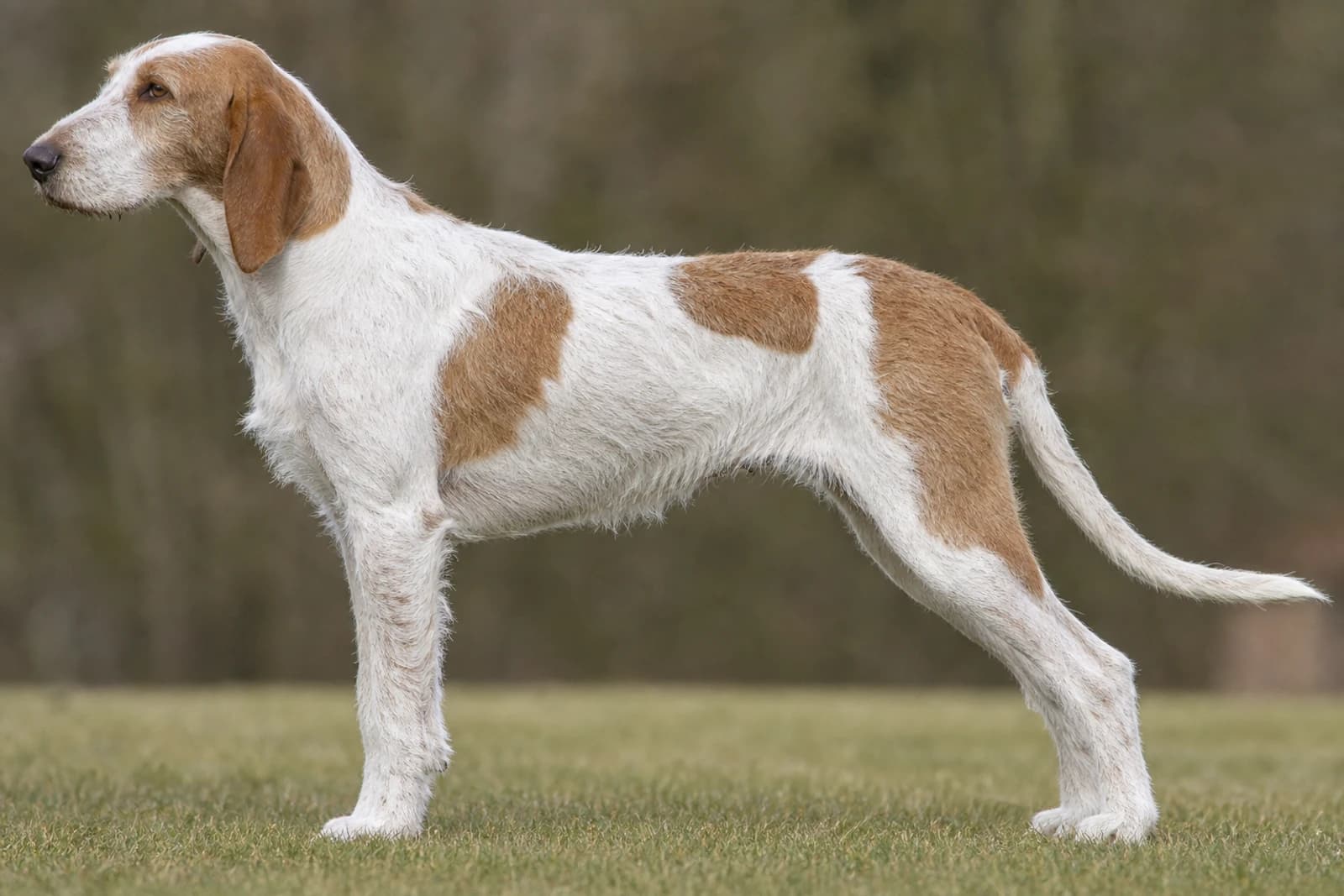
The Anglo-Francais de Petite Venerie is a French scenthound developed for hunting small game. This medium-sized, pack-oriented breed thrives in active rural homes with ample space and an owner familiar with hounds. They are gentle with family but have high exercise needs and a strong prey drive, making them unsuitable for apartments or sedentary lifestyles. With their melodious voice and determination, they excel in hunting and make loyal, affectionate companions for those who understand their independent nature.
At a glance
- Size
- Large
- Height
- 19–22 in
- Weight
- 35–44 lb
- Life span
- 12–13 years
- Coat colors
- Tricolor, White and Orange, White and Lemon
- Coat type
- short, dense, and smooth
- Group
- Scenthounds
- Origin
- France
How much does a Anglo-Francais de Petite Venerie cost?
Adopt / rescue
$75–$400
Usually includes spay/neuter, first shots, and a microchip.
Buy from a breeder
$700–$2,000
From a reputable, health-testing breeder.
Approximate USD. Prices vary widely by region, breeder, pedigree, age, and coat colour — adopting is the lower-cost and recommended route. Avoid suspiciously cheap “breeders”; they’re often puppy mills.
Estimate the full cost of a Anglo-Francais de Petite Venerie →Anglo-Francais de Petite Venerie photos
Views
Front, side, rear and top — the full silhouette.Poses
How the breed sits, lies, moves and plays.Puppy to senior
The breed across its whole life.Expressions
The breed’s range of moods.Close-up details
Eyes, ears, nose, paws, tail and coat.Coat colors
The breed’s recognized colors.Click any photo to enlarge. We show the Anglo-Francais de Petite Venerie from every angle — three views, poses, life stages, expressions, close-ups, coat and colors.
Appearance & size
Nineteen to twenty-two inches at the shoulder and 35 to 44 pounds — the Anglo-Francais de Petite Vénerie walks the line between a nimble beagle-sized hound and a full-throated foxhound. This is a compact, no-fuss athlete, built to cover rough ground for hours, not to fill the couch.
A deep, well-sprung chest gives ample room for heart and lungs. The loin is short and strong, with a distinct tuck that breaks the silhouette midway down the belly. The back is straight and level, never roached or swayed. From the side, you’ll notice a clean, long-striding frame: the neck slopes smoothly into a well-set shoulder, and the tail rises in a gentle sabre curve, never curling over the back.
From the rear, the driving power is plain to see. The hindquarters are muscular and well-angled — the stifles bent and the hocks low — so the dog moves with an efficient, ground-eating trot that barely looks like it’s working. The tail is thick at the base, tapering to a fine point, and carried lively.
The head is noble but never heavy. The skull is slightly domed with a defined stop, and the muzzle is square and equal in length to the skull. The nose is broad and black with wide-open nostrils — a scent machine first. Dark, slightly angled eyes look back at you with a gentle curiosity. Ears are set at eye level, thin and hanging in soft folds; pulled forward, they reach at least to the tip of the nose. From the front, the chest appears deep but not overly wide, and the front legs stand straight and parallel, giving a workmanlike, honest stance.
The coat is short, smooth, and dense, lying tight against the body with zero feathering. Colors fall into two camps:
- Tricolor: a black blanket or saddle, bright tan on the cheeks, muzzle, chest, legs, and under the tail, broken up by crisp white.
- Orange-and-white: patches that range from pale lemon to deep russet on a white ground. Ticking — those small flecks on the white — is perfectly acceptable and gives the coat a purposeful, hardy look.
Everything about this scenthound says ready. No frills, no exaggerations. The lightweight yet solid build, the wash-and-wear coat, and the calm, willing expression add up to a dog that looks like a partner, not a piece of furniture. A quick rubdown with a towel after a rainy run is all the grooming it asks of you.
History & origin
France gave the dog world plenty of impressive scenthounds, but the Anglo-Francais de Petite Venerie is the one hunters turn to when they want a relentless, close-working pack animal that won’t outrun the horses. The breed was forged from three distinct influences: the durable, vocal Beagle-Harrier; the compact, rabbit-savvy Beagle; and the aristocratic Porcelaine, a sleek white hound with legendary nose and stamina. The goal wasn’t a surprise—breeders in the late 19th and early 20th centuries aimed for a medium-sized hound with the drive to pursue hare and rabbit all day, the voice to let handlers track the chase from a distance, and the temperament to cooperate in a pack of 20 or more dogs.
The “Anglo” part of the name points to the English Beagle blood, which contributed a shorter back, lighter bone, and that signature musical bay. The “Francais” side brings the cold-nose trailing ability and heat tolerance from old French hound lines. The “Petite Venerie” translates roughly to “small game hunting,” and that’s exactly the niche: this isn’t a deerhound or a wolf hunter, but a specialist for rabbit, hare, and sometimes fox. For decades, the dogs were just known as a type—practical crosses kept by rural huntsmen. No one bothered to write a formal standard until the mid-20th century, when enthusiasts pushed for official recognition. The Fédération Cynologique Internationale (FCI) accepted the breed in 1978, cementing the name and the blueprint we have today.
Outside of France, the Anglo-Francais de Petite Venerie remains rare, and most specimens still live in working kennels, not suburban backyards. A few dedicated breeders in other countries are slowly introducing the breed to performance homes, especially for scent work and field trials. If you see one in the United States, it’s almost certainly an import or from a very small, preservation-minded breeder who values those deep-rooted hunting instincts.
Temperament & personality
The Anglo-Français de Petite Vénerie is, at heart, a pack-driven scenthound that wants to be part of your daily rhythm. He’s friendly and obedient by nature, but those descriptors show up best when he gets enough exercise and company. Leave him isolated in the backyard for hours, and you’ll hear about it—anxiety in this breed often sings out as deep-chested baying or persistent barking.
Inside the house, a well-exercised dog shifts gears into a calm, affectionate companion. A loose body, soft eyes, and a willingness to flop at your feet tell you he’s content. He’s generally gentle with respectful kids and gets along with other dogs, though his nose never fully clocks out. A fleeing squirrel or a tantalizing scent trail can override his recall in a heartbeat, so a securely fenced yard is non-negotiable.
Energy burns hot and steady. This is a dog bred to trot through the French countryside for hours, not lap the block twice. Count on 60–90 minutes of vigorous, nose-led activity daily—off-leash running in safe spaces, long “sniffari” walks where you let him set the pace, and games that make him hunt for hidden treats or toys. A tired hound is a quiet hound. Skip the outlet, and you’ll deal with redirected chewing (adult dogs gnaw to keep jaws strong and teeth clean) or indoor marking.
Speaking of marking, scenthounds live by their noses, and urine is a neon sign that says “repeat here.” If an accident happens inside, clean it thoroughly with an enzymatic cleaner or a vinegar spray to neutralize the odor. Reward outdoor potties with a treat right then and there—it sticks better than any punishment. And because this breed can be food-motivated, training with small rewards gets the message across without a power struggle. They’re strong-willed but respond to respectful consistency, not force.
Two quirks to embrace: first, they’ll happily roll in dead worms or something far fouler—it’s a hound’s version of perfume, and no amount of scolding will convince them otherwise. Second, their spatial memory is scent-based. That well-pee’d corner by the guest-room door? It’s now part of their mental map, so you’ll need to break the cue with odor removal, not just a stern look.
With family, they’re reliable and good-natured, but a few boundaries matter. Never hover over or interrupt the dog while he eats—it can spark food guarding. Teach children to give him quiet mealtime space, and you’ll preserve the easygoing dynamic that makes this breed such a steady household companion.
Good with kids, dogs & other pets
These dogs have a naturally patient, easy-going nature that makes them steady around children. They aren't reactive or nippy, so a bustling family home rarely rattles them. That said, a 35–44 lb scenthound barreling down the hallway can still mow over a toddler. Close supervision is non-negotiable, especially when food bowls or favorite toys are in the mix. Teach kids to give the dog space during rest and to handle ears and tail gently.
With other dogs, the Anglo-Francais de Petite Venerie usually fits right in. Bred to work in vocal, cooperative packs, they genuinely enjoy canine company. A slow, on-leash introduction in neutral territory sets the stage for a smooth multi-dog household. The catch: early isolation leaves a mark. A puppy that never meets other dogs during the first few months can grow into an adult that is fearful, over-excited, or awkward around its own species. Force a timid adult dog into dog-park mob scenes and you'll likely trigger defensive snapping, not play.
Cats and small pets demand realism. These hounds were built to chase fur through brambles. A sprinting squirrel or a flustered cat can flip a hard-wired switch. Some individuals coexist peacefully with a house cat they’ve known since puppyhood, but a new cat, rabbit, or guinea pig is often viewed as quarry. Never leave them unsupervised with small animals unless you’ve logged months of consistently calm, indifferent behavior—and even then, don’t bet the farm.
The lynchpin is early socialization. The sensitive window slams shut between 12 and 16 weeks. Between 3 and 14 weeks, expose the puppy—gently, never forcefully—to children of different ages, calm adult dogs, car rides, clanging pans, and wobbly surfaces. A pup raised in a sterile bubble often becomes an adult that startles at doorbells or panics at the vet. If you miss that window, you’re not out of options, but the path forward is slow, reward-based counter-conditioning. Dragging a fearful adult dog toward every stranger or dog at the park only deepens the fear.
Trainability & intelligence
This is a scenthound. That single fact shapes every training session you’ll ever have. The Anglo-Francais de Petite Venerie was purpose-built to follow a scent trail with single-minded determination, so his brain lights up when his nose is working — not when you’re asking for a sit-stay just because. He’s a solid 3 out of 5 on the trainability scale, meaning he’s no robotic yes-dog, but he’s far from untrainable. He simply needs a reason to care, and that reason almost always involves food.
Recall is the arena where this independence hits hardest. Once a deer trail or rabbit streak crosses his path, the word “come” can evaporate. You counter that by building a bank of brilliant positive experiences. Use stinky, high-value rewards — tiny cubes of leftover roast chicken, dried liver — and jackpot him every single time he does return to you. Never punish a slow recall; that only teaches him that coming back ends the fun. Practice on a long line in progressively scentier fields, and be realistic: complete off-leash reliability may never be your reality unless you’re in a securely fenced area.
The breed learns quickly when the transaction is clear. Short, game-like sessions (five minutes, a few times a day) beat marathon drills every time. Clicker training works beautifully here because it marks the exact moment he gets it right. Early socialization is non-negotiable. Between 3 and 14 weeks, let him safely explore different surfaces, meet gentle strangers, and hear household clatter so he doesn’t grow into a fear-reactive adult. Keep that up throughout his first year.
- What motivates him: His nose and his stomach. Pair a command with a release to “go sniff” as the ultimate reward.
- Common pitfall: Harsh corrections or punishment-based methods will crater his trust. He’s sensitive under that houndy exterior, and a heavy hand creates anxiety, not compliance.
- Don’t skip: Polite leash walking and a rock-solid “wait” at doors. A 35–44 lb dog who lunges after a scent can pull you off your feet.
Harness his natural drives instead of fighting them. Hide a treat in a snuffle mat after a round of obedience work, or teach him to find your keys by scent. That’s the kind of partnership a clever scenthound respects.
Exercise & energy needs
Count on giving this dog two 60-minute exercise sessions a day — and don’t mistake a leash stroll for a workout. Bred to course game through thick cover for hours, the Anglo-Français de Petite Vénerie has real stamina that a couple of quick walks won’t dent. Each session should be purposeful movement: off-leash running in a secure area, a long line hike where she can zigzag and scent, or a hard trot alongside a bike. Thirty minutes of that kind of work plus thirty minutes of sniff-and-explore time counts, but a slow 20-minute loop on pavement doesn’t.
This is a nose on legs. Physical exercise alone will leave a smart scent hound fidgety and looking for trouble. Pair every outing with mental work. Let her untangle a scent trail you’ve laid, work a frozen Kong for her breakfast, or hunt hidden treats in the yard. A bored Anglo-Français will find her own job — often the kind that shreds couch cushions or sings the song of her people to the entire neighborhood.
- Best outlets: long forest walks with permission to get muddy, canicross, tracking classes, barn hunt, or a flirt pole session followed by a decompression sniffari. These hounds thrive on off-leash freedom in safe, fenced spaces, though recall can be a work in progress when a rabbit bolts — use a long line if her trailing drive is high.
- Puppy and senior notes: Young dogs need several short romps and zero forced pavement pounding while joints mature. Older dogs still need those two daily outings, but dial back speed and add softer footing and shorter distances. You’ll know you’ve gotten it right when she comes home, flops on her bed, and sleeps hard — not when she’s pacing the house ten minutes after you return.
Grooming & coat care
The coat is short, tight, and built for work — no undercoat, no heavy shedding cycles, no drama. A once- or twice-weekly session with a natural-bristle brush or a rubber hound glove pulls out loose hair, spreads natural oils, and leaves that smooth tri-color or orange-and-white coat glossy. Spring and fall will nudge the shedding up a notch, so you might brush three times a week, but you won’t be fighting mats or fistfuls of fluff.
Bathing stays on an as-needed basis. A rinse after a wet hunt or a wipedown with a damp towel takes care of most field grime. Over-shampooing strips the coat’s weatherproofing, so reach for the bottle every few months, or when he’s rolled in something truly offensive.
Ears demand the most attention. Those long, drop ears seal in moisture and limit airflow. Check inside once a week for redness, dark wax, or a yeasty smell. Use a vet-approved ear cleaner and a soft cloth on the visible ear flap and just inside the canal — never a cotton swab poked deep. After a swim or a soaking rain, dry the ear leather and the outer canal thoroughly.
Nails, teeth, and the bonus of outdoor time. If you hear nails clicking on hard floors, it’s time for a trim; monthly usually covers it. Brush teeth daily with dog toothpaste if you can, but even three times a week cuts down on tartar. Regular runs through brambles or fields help the coat turn over naturally and keep the skin under it healthy. A quick post-adventure towel-dry and a glance inside the ears is pretty much all the coat care this hound needs.
Shedding & allergies
This isn’t a low-shedding breed, and anyone hoping for a hair-free house should look elsewhere. The Anglo-Francais de Petite Venerie wears a short, dense, weather-ready coat that drops a steady trickle of fine hairs all year. Those tiny needles weave into upholstery, stick to dark pants, and float into corners you didn’t know existed. Twice a year — usually as the seasons shift — you’ll hit a full-on blowout where clumps come off in your hand and your vacuum earns its keep.
- Daily shedding: Moderate, but constant. Short, stiff hairs that don’t tumble into dust bunnies the way soft undercoat does; instead they lodge in carpet fibers and car seats.
- Seasonal spikes: Spring and fall bring heavier coat changes. A quick brush every day during those weeks keeps it from becoming overwhelming, but doesn’t stop the fall.
- Drool factor: Manageable for a hound, but still present. Expect wet jowls after drinking and a slobber string or two when you’re holding a treat or cooking bacon. Keep a rag handy near the water bowl.
On the allergy front, no dog is hypoallergenic, and this one won’t fool your immune system. Dander sticks to those shed hairs, and the saliva that comes with occasional drool carries allergens too. If someone in your home reacts strongly to dogs, spending a weekend with an adult Anglo-Francais is the smartest test before bringing a puppy home. You can brush him outside every few days to cut down on airborne particles indoors, but you’ll still find hair. A robot vacuum that runs daily helps more than any special shampoo.
Diet & nutrition
An Anglo-Francais de Petite Vénerie that gets a solid daily run can still pile on weight if you eyeball the kibble. These scenthounds are often highly food motivated, and an extra half-cup here and there pushes a 35–44 lb frame into obesity faster than most people realize. Excess weight strains their joints, saps stamina on the hunt or trail, and shortens an otherwise typical 12–13 year lifespan. Keep your dog lean: you should be able to feel ribs beneath a thin fat cover, and there should be a visible waist tuck from above.
Feed a high-quality commercial diet formulated for active medium-large breeds, or a well-planned home-prepared diet built around animal protein, vegetables, fruits, and digestible grains. Pearl barley or white rice work well for dogs with touchy stomachs; avoid rich, fatty scraps that can trigger pancreatitis. Portion sizes depend on age, build, and real daily exercise—not the activity you hope to give. A couch-potato weekend needs less food than a 10-mile hiking day.
Puppies need four evenly spaced meals until four months, then three meals until six months, then two meals a day like an adult. Transition any new food slowly over a week or two. Older dogs often do better with smaller, more frequent meals, but there’s no good reason to slash protein unless a specific kidney issue is diagnosed. Weigh your dog monthly and adjust portions gradually if the number creeps up.
If your dog inhales meals, a puzzle bowl or snuffle mat slows eating and gives that scent-driven brain something to work on. Never feed from the table; if you have leftover cooked vegetables, plain eggs, or a little canned fish, put it in the dog’s own bowl. That habit keeps begging in check and lets you control exactly what’s going into a breed that will happily overeat given half a chance.
Health & lifespan
Most Anglo-Francais de Petite Venerie live 12 to 13 years—solid for a large dog, but those years depend on spotting trouble early. Two areas deserve your attention from day one: those long, drop ears and the skin underneath a field-ready coat.
Ear infections can become a recurring headache because moisture and debris get trapped in the floppy ear canal. You’ll likely see head shaking, a sour smell, or flinching when you go near the ears. A weekly cleaning with a vet-recommended drying solution cuts the odds dramatically, and after a wet hunt or swim, dry them thoroughly. Skin conditions, often allergic dermatitis, are the other common complaint. Watch for relentless licking, reddened patches, or thinning hair on the belly and flanks. Environmental allergens like pollen or grass, and sometimes food proteins, set it off. A high-quality diet that skips common fillers can help, but you may need an elimination trial or vet-prescribed medication to get it under control—don’t just wait it out.
Responsible breeders screen breeding stock for hip dysplasia and inherited eye disorders that pop up in scenthound lines. Ask to see the actual health clearances; a verbal “they’re healthy” isn’t enough.
Preventive work keeps a good lifespan from slipping away. Heartworm prevention is non-negotiable: give it monthly during mosquito season and for one month after, because this dog’s nose leads straight into damp, buggy cover. Keep the rabies vaccine current—it’s legally required, and there’s no treatment once symptoms appear. Since the breed is sturdy and food-motivated, weight creeps on fast. Even three extra pounds strain joints and can shorten a life that should reach the early teens. Measure meals, use a fistful of kibble for training instead of extra treats, and protect that daily off-leash exercise.
You’ll likely be at the vet more than just for annual shots. Subtle changes—less enthusiasm on the trail, a change in appetite, a mild limp—mean it’s time to go. A vet who knows hounds can catch an ear or skin flare-up before it spirals, giving you more good years together.
Living environment
Forget apartment life. An Anglo-Francais de Petite Venerie is a working scenthound built to follow his nose for miles, not curl up in a one-bedroom. This dog needs a securely fenced yard — and by secure, I mean a 6-foot wooden fence with no gaps and maybe a buried barrier. Weighing only 35–44 pounds, he’s agile enough to climb or dig under shoddy fencing the instant a scent trail appears. Underground electronic fences are useless; when the nose is locked on, pain doesn’t register.
Daily exercise isn’t a suggestion, it’s a requirement. A pair of 45–60 minute sessions gives him the hard running and tracking work his brain craves. Think off-leash sprints in a safe field, long rural hikes, or hours spent working a drag line in your own yard. Skip the heel-and-sniff stroll around the block — it won’t touch his energy. If you shortchange this, you’ll get howling, digging, and a dog who dismantles furniture out of sheer boredom.
His short coat shrugs off chilly French winters, so he’s naturally adaptable to cold. In a hard freeze, a coat and a sheltered spot suffice. Hot weather is trickier. He can overheat fast, so save hard exercise for early mornings or evenings and always have shade and water handy.
Now, the voice: the Anglo-Francais de Petite Venerie bays, not barks. It’s a loud, ringing, bred-in announcement that carries through walls and down the street. Training can ease the trigger-happy outbursts, but you will never silence a hound entirely. Shared walls and easily annoyed neighbors make this a bad match.
Alone time? This is a pack hound, deeply bonded to his people. Left solo for a full workday, he’ll often turn anxious and destructive, vocalizing until someone returns. If your week means 9-to-5 with no one home, this breed will suffer. He needs someone around for chunks of the day and a life that includes him in real outdoor work. Puzzle toys and short periods of independence can be built gradually, but they’re a supplement, not a replacement for your company and a job to do.
Who this breed suits
This dog is built for people who move—a lot. The Anglo-Français de Petite Vénerie is a 35–44 lb scent hound with the engine of a marathoner and the nose of a detective. His ideal owner is an active, outdoorsy household that can give him a minimum of 90 minutes of off-leash running or purposeful tracking work every single day. A quick stroll around the neighborhood won’t cut it. He thrives with hikers, trail runners, and hunters who have access to large, securely fenced spaces where he can follow his nose without hitting a road.
Best Matches
- Active families with older kids. He’s a pack animal at heart and genuinely enjoys the rough-and-tumble of family life. Children over 8 or 9 do best; his lanky, enthusiastic frame can accidentally bowl over toddlers. He’s clean and friendly, not guard-dog suspicious.
- Multidog households. Bred to work in packs, he typically slots in beautifully with other dogs. A canine buddy helps drain his social and physical batteries. He rarely picks fights and often pines without company.
- Rural or large-property homes. He needs room to sniff hard and a fence that goes at least 5 feet tall. This breed can scale or dig out when a scent trail calls. Expect a big, melodious voice—he bays, and nearby neighbors will definitely hear it. Apartment life is a poor fit unless you can commit to hours of daily outdoor exercise and live somewhere very tolerant of hound vocals.
Think Twice
- First-time dog owners. He’s smart but not biddable. Scent overwhelms “sit” in a heartbeat. Training demands patience, consistency, and a genuine love for working with a dog who weighs every command against what his nose is telling him. Recall off-leash is a major project.
- Sedentary or busy singles/couples. If he’s bored, he’ll redecorate with your couch cushions and serenade the block with hours-long arias. A 12–13-year lifespan means this is a long commitment to serious daily output.
- Homes with small pets. He’s bred to pursue rabbit, hare, and fox. Cats, rabbits, or guinea pigs read as quarry, not roommates. Some individuals can learn to coexist with indoor cats raised together, but the drive runs deep.
- People who want a quiet, clingy lap dog. He’s affectionate on his own terms, but not velcro. He’ll nose-bump you for a scratch and then go back to his real job: inventorying the yard’s smell map.
If you’re ready to manage a determined nose, embrace a full-throated hound song, and give this dog a physically demanding, socially rich life, the Anglo-Français de Petite Vénerie will be a tireless, cheerful partner for over a decade—but only if you really mean it.
Cost of ownership
You won’t stumble on an Anglo-Francais de Petite Venerie puppy at a local pet shop. The breed is rare in the US — only a handful of dedicated breeders produce litters each year. Expect to pay $1,800 to $2,500 for a well-bred pup from health-tested parents. If you import from France (where the breed originated), transport and import fees can push the total past $3,000. Waiting lists are common, so reach out early. Adoption through breed-specific rescue is virtually nonexistent, but a lucky rehome might run $300–$600.
Monthly upkeep for this 35–44 lb scenthound is moderate, but it’s a long game — the breed’s 12–13 year lifespan means over a decade of steady costs.
- Food: An adult eats about 2½–3 cups of high-quality kibble daily. That translates to roughly $45–$65 per month, depending on brand and protein content. Active lines may need a performance formula, nudging the total higher.
- Grooming: The short, dense coat requires minimal professional attention. A weekly brush, occasional bath, and regular nail trims can be handled at home. Budget under $20 a month for shampoo, wipes, and a good brush; a pro visit every few months for nails or a thorough clean-up might add $40–$60.
- Routine vet and prevention: Annual exams, vaccinations, and heartworm tests typically run $200–$400 a year. Monthly flea, tick, and heartworm preventives add $25–$35. Average that out to $50–$75 per month, but keep a cushion for common scenthound issues like ear infections or minor cuts from fieldwork.
- Insurance: An accident-illness policy from a reputable provider costs $35–$55 a month. Given the breed’s tendency for ear troubles and the possibility of hip dysplasia, it’s a practical hedge against a $3,000 emergency surgery.
Factor in one-time puppy shots, spay/neuter ($200–$500), a crate, leash, and collar, and you’ll spend another $300–$500 up front. Ongoing monthly costs beyond the basics — toys, chews, training classes, or occasional boarding — add $30–$60 more. Realistically, plan on $150–$250 a month to cover everything comfortably once your dog reaches adulthood. That’s the number to pencil in before you bring home this lively French hound.
Choosing a Anglo-Francais de Petite Venerie
If you’re hunting for an Anglo-Francais de Petite Venerie in the US, brace for a search—this scenthound is a rare sight outside France. Most people either import a puppy from a French breeder or stumble onto a mixed hound in rescue that carries the look. Either path can work, but your first move should be to connect with the breed’s parent club or a scenthound rescue network.
A responsible breeder will talk your ear off about health clearances. Ask for proof that both sire and dam have had their hips screened through OFA or PennHIP (scores of “fair” or better are the minimum), elbows cleared, and a current eye exam from a board-certified veterinary ophthalmologist. Because those long, drop ears trap moisture, don’t be surprised if ear infections crop up in the line—a breeder who’s honest about that and shows you clean-eared parents is a good sign. Avoid anyone who can’t provide those documents or brushes off the question with “the breed is healthy” and no paperwork.
Red flags: a breeder who sells “rare” puppies at a jacked-up price without health guarantees, won’t let you meet at least one parent on site, raises puppies in a sterile kennel with zero household exposure, or ships a puppy anywhere to anyone with a credit card. This is a pack hound with a deep nose and a big voice; pups raised in isolation often struggle with noise phobias and separation anxiety later.
When you meet the litter, sit on the floor and watch. You want a puppy that trots over to investigate you with a wagging tail, not one that cowers in the corner or bullies its littermates relentlessly. Check each prospect’s eyes and nose for discharge, ears for redness or odor, and gait for any hitch or limp. A 7-to-8-week-old puppy should feel solid in your hands, not pot-bellied with worms, and should accept gentle handling all over. If possible, see the mother—her temperament around you and the pups gives you a preview of what your dog will likely become with good socialization.
You may not find a purebred in a shelter, but scenthound rescues and transport groups occasionally have small French hound mixes. Adopting an adult lets you skip the house-training marathons and get straight to long walks, though you’ll need to be clear-eyed about the animal’s unknown history. If you go the rescue route, a two-week trial period and a negative heartworm test are non-negotiable. Expect a driven nose and a robust howl regardless of where your dog comes from.
Pros & cons
-
A passionate, musical voice that's classic hound: a deep, rolling bay they'll use freely when excited or on a trail, not ideal for noise-sensitive homes.
-
Born to run in a pack — these dogs genuinely enjoy the company of other hounds and often settle into multi-dog households more smoothly than many breeds.
-
Steady, friendly temperament with family; they're not guard dogs and typically greet strangers with a wag rather than suspicion, making them a poor choice if you want a watchdog.
-
Surprisingly manageable size for a large scenthound: at 35–44 lb and 19–22 inches, they're easier to load into a car or control on a lead than their bigger Anglo-Francais cousins.
-
Stamina for days — if you're a runner, cyclist, or long-distance hiker who wants a tireless trail partner, this breed will still be pulling when you're ready to quit.
-
Nose-first, brain-second — a scent trailing across a road can erase every bit of training and recall in an instant, so off-leash freedom is rarely safe outside a securely fenced area.
-
High exercise demands that aren't optional: a quick walk around the block won't touch it; they need a solid hour or more of hard running, scent games, or structured hunting work daily, or you'll see destructive restlessness.
-
Independence that reads like stubbornness — they were bred to make decisions at a distance from the hunter, so "sit" and "stay" can feel optional to a dog who'd rather follow his nose.
-
Escape-artist tendencies — a 5-foot fence is a suggestion, not a barrier, to a focused hound; you'll need dig-proof, climb-proof containment and a yard check habit.
-
Not built for apartment living or quiet suburbs — the combination of a booming voice, intense prey drive around neighborhood cats and squirrels, and need to run creates friction in close quarters.
Similar breeds & alternatives
If you're drawn to the Anglo-Francais de Petite Venerie's pack-hound game and manageable size, a few other scenthounds call for a closer look—and each swaps out one piece of the puzzle.
-
Beagle – The most obvious starting point. At 13–15 inches and 20–30 pounds, the Beagle is noticeably smaller and far more common. Both breeds bay, sniff obsessively, and thrive in a pack. The Petite Venerie runs taller and leaner (19–22 inches, 35–44 pounds), built for a longer day in the field. Beagles are easier to find and more adaptable to suburban life, but they often come with the same single-minded nose and less of the cooperative, "team hunter" bidability the French hound brings.
-
Harrier – Essentially a large Beagle. Harriers stand 19–21 inches and weigh 45–60 pounds, so they're heavier and more robust than the Anglo-Francais de Petite Venerie. Both need real outlets for their nose, but a Harrier's size and stamina lean toward hare and fox, while the French hound was purpose-bred for rabbit with a slightly lighter frame. If you want that tall, tri-color pack hound look without the Anglo-Francais' scarcity in the US, a Harrier is your closest proxy—just count on a bigger bark and a more independent streak.
-
Petit Basset Griffon Vendéen (PBGV) – Another French rabbit hound, but cut from different cloth. PBGVs are shorter (13–15 inches), rough-coated, and famously cheerful to the point of clowning. The Petite Venerie is smooth, long-legged, and all-business in the field. If you prefer a shaggier, more terrier-like personality, the PBGV delivers. If you want that clean, long-legged hound silhouette and a slightly more reserved demeanor, stick with the Anglo-Francais.
-
Anglo-Francais de Moyenne Venerie – The next step up in the same family. The "Moyenne" version runs 23–27 inches and 50–66 pounds, bred for larger quarry like deer. So this is the answer if the Petite Venerie's rabbit-hunting size feels a bit small for your taste, but you still want the tri-color, French-English blend and that pack-first temperament.
Since the Anglo-Francais de Petite Venerie remains rare outside France, any of these alternatives might be easier to actually bring home. A Harrier or Beagle will land closest in spirit, while a PBGV scratches the French-hound itch in a smaller, scrappier package.
Fun facts
- Developed in France by crossing English Foxhounds with local French scenthounds.
- Bred specifically for hunting small game like rabbits and hares.
- Known for their distinctive baying voice used to communicate during hunts.
- Gentle and friendly, they can be excellent companions for active families.
Frequently asked questions
- Is the Anglo-Francais de Petite Venerie good with children?
- This breed tends to be friendly and even-tempered, making it a generally good companion for children when properly socialized. However, due to its independent and determined nature, supervision is recommended to ensure interactions remain positive. Early socialization and training can help the dog integrate well into a family setting.
- How much exercise does an Anglo-Francais de Petite Venerie need?
- With an energy level of 4 out of 5, this scenthound requires plenty of daily physical activity, such as long walks, runs, or opportunities to explore with its nose. A fenced yard is beneficial, but mental stimulation through scent games is equally important to prevent boredom. Without adequate exercise, it may develop undesirable behaviors.
- Do Anglo-Francais de Petite Venerie shed a lot?
- They have a moderate shedding level of 3 out of 5, so expect some regular hair around the home, particularly during seasonal changes. Weekly brushing can help manage loose fur and keep the coat healthy, but they are not considered heavy shedders compared to some other breeds.
- Are Anglo-Francais de Petite Venerie easy to train for first-time owners?
- This breed can be intelligent but also independent and determined, which may challenge novice owners. Patience, consistency, and positive reinforcement methods are essential, as harsh techniques can backfire. First-time owners should be prepared to invest time in training and scent-work activities to channel their drive.
- Can an Anglo-Francais de Petite Venerie live in an apartment?
- Due to their high energy and tendency to vocalize as scenthounds, they are generally not well-suited for apartment living. They thrive in homes with access to a secure outdoor area where they can exercise and follow scent trails. Insufficient space may lead to restlessness and excessive barking.
- Do Anglo-Francais de Petite Venerie bark a lot?
- As a scenthound, this breed can be quite vocal, often baying or howling when following a scent or when excited. Training can help manage nuisance barking, but a completely quiet home is unlikely. Potential owners should consider their tolerance for noise and local noise regulations.
Tools & calculators for Anglo-Francais de Petite Venerie owners
Quick estimates tailored to Anglo-Francais de Petite Veneries — pre-filled with this breed’s size where it matters.
Articles & stories about the Anglo-Francais de Petite Venerie
Sources & standards
This profile follows recognized breed standards from the American Kennel Club (AKC) and the Fédération Cynologique Internationale (FCI), along with established veterinary and breed-club guidance. These describe general breed tendencies — every dog is an individual.
Owner stories
Have a Anglo-Francais de Petite Venerie? Share your experience — grooming tips, personality quirks, anything goes.