

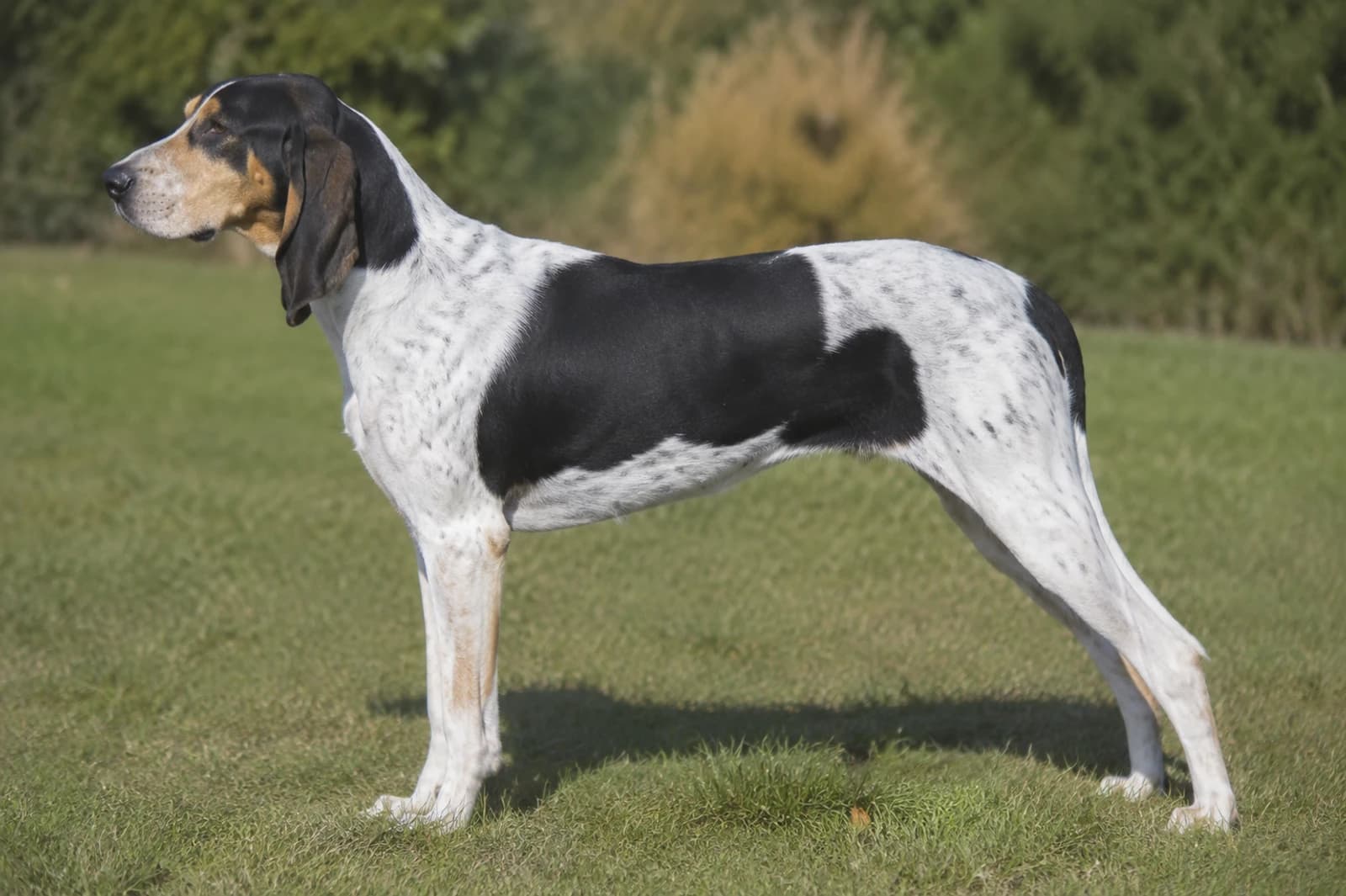
The Ariégeois is a medium-to-large French scenthound, originally bred to hunt hare in packs. With a gentle, affectionate nature and a melodious howl, this breed makes a devoted companion for active individuals or families who can provide ample exercise and mental stimulation. Its short, easy-care coat and sociable personality suit rural or suburban homes, while its strong hunting instinct requires a secure yard. Best for owners with hound experience, the Ariégeois thrives on companionship and consistent training.
At a glance
- Size
- Large
- Height
- 20–23 in
- Weight
- 55–60 lb
- Life span
- 10–14 years
- Coat colors
- White & Black, White, Black & Tan
- Coat type
- Short, dense, smooth
- Group
- Scenthounds
- Origin
- France
How much does a Ariégeois cost?
Adopt / rescue
$75–$400
Usually includes spay/neuter, first shots, and a microchip.
Buy from a breeder
$700–$2,000
From a reputable, health-testing breeder.
Approximate USD. Prices vary widely by region, breeder, pedigree, age, and coat colour — adopting is the lower-cost and recommended route. Avoid suspiciously cheap “breeders”; they’re often puppy mills.
Estimate the full cost of a Ariégeois →Ariégeois photos
Views
Front, side, rear and top — the full silhouette.Poses
How the breed sits, lies, moves and plays.Puppy to senior
The breed across its whole life.Expressions
The breed’s range of moods.Close-up details
Eyes, ears, nose, paws, tail and coat.Coat colors
The breed’s recognized colors.Click any photo to enlarge. We show the Ariégeois from every angle — three views, poses, life stages, expressions, close-ups, coat and colors.
Appearance & size
The Ariégeois is a lean, aristocratic hound built for scenting across country rather than straight-line power. It stands 20 to 23 inches at the shoulder and weighs a solid 55 to 60 pounds, putting it right on the line between medium and large. When you see one from the side, the first thing you notice is how streamlined it looks — deep but tapered chest, a narrow waist, and long legs that suggest it was born to lope across fields for hours.
The head refines the picture. From the front, you get a flat, somewhat broad skull with a gentle stop, a straight muzzle just slightly shorter than the cranium, and a black nose with wide-open nostrils. The eyes are dark brown, set well apart, and carry a quiet, earnest expression — not that droopy sad-hound look, but a steady, intelligent gaze. The ears are the signature feature: thin, set low below the eye line, and long enough to reach the nose when pulled forward. They hang in soft folds, moving just enough on a scent trail that you almost see the dog thinking.
Move around to the side again and the silhouette takes shape — the neck is slightly arched and clean, flowing into prominent shoulders and a level back. The chest reaches the elbows, with ribs that spring wide but flatten toward the rear for efficient stride. The tail tapers from a thick base to a fine point and is carried like a saber, curved slightly upward when the dog is in motion. From the rear, the hindquarters are muscular and well-angulated, with straight, parallel hocks and tight feet that handle rugged terrain without fuss.
The coat is a short, glossy single layer that lies smooth against the body. It’s built for brambles and brush, not cold weather, so you’ll feel every rib and muscle through the skin when you run a hand along the dog’s flank. Color is limited to white with black patches, and you’ll nearly always see a dusting of black ticking across the white areas — some dogs have tan dots over the eyes or on the cheeks, but that tricolor marking isn’t a dealbreaker either way. A snowy chest, white legs, and a white tail tip are common, giving the dog a flashy, easy-to-spot outline even in low light. The overall impression is clean, symmetrical, and built for scent work rather than show-ring glitter.
History & origin
The Ariégeois hails from the rugged, rocky foothills of the French Pyrenees, specifically the Ariège department that gives the breed its name. In the early 1900s, French hunters wanted a lighter, faster scenthound than the heavier Bleu de Gascogne they already had. So they selectively crossed the Bleu de Gascogne with other local hounds to produce a dog that could cover ground quickly in the region’s steep, bramble-choked terrain. The result was a lean, agile pack hound standing 20–23 inches at the shoulder and weighing just 55–60 pounds — built for effortless, all-day trotting over rough country.
What they bred the Ariégeois to do was straightforward: track hare and rabbit by scent, moving in a tight, harmonious pack that relied more on nose and teamwork than raw speed. Its fine, short coat — typically white with black markings and occasional tan points — let it handle the heat of long hunts under the southern French sun, while its compact frame slipped easily through thick undergrowth. By the early 20th century, the breed had carved out a reputation among local hunters as a reliable, voice-happy trail hound that could pick up a cold scent and stay on it for hours.
World War II nearly erased the Ariégeois. Like many European hunting breeds, its numbers plummeted during the war years — a combination of neglect, food shortages, and the chaos that swept rural communities. By the late 1940s, only a handful of dogs remained in the Ariège region. A small group of dedicated enthusiasts tracked down the survivors, cross-referencing old hunting records and pedigree notes to reassemble a breeding stock. They focused on preserving the original hunting ability and distinctive appearance, avoiding outside crosses that would dilute the breed’s purpose.
Today, the Ariégeois is still a rare sight outside its homeland. In France, it’s valued by a quiet network of hunters who run packs through the Pyrenean foothills in search of hare. A few have made their way into companion homes abroad, but the breed’s numbers remain modest — a living throwback to a very specific time and place in French hunting history.
Temperament & personality
An Ariégeois is a steady, good-natured scenthound that brings the calm focus of a pack hunter into your home. These dogs — typically 55 to 60 pounds and 20 to 23 inches at the shoulder — are built for endurance, but indoors they often sprawl out like oversized lap warmers. Expect a dog that’s deeply bonded to your family without being needy; they’re perfectly content to follow you from room to room and then snooze at your feet.
The nose runs the show. On a walk, an Ariégeois locks onto a scent and pulls with a single-minded determination that can feel like selective deafness. A securely fenced yard is non-negotiable, because if that hound-cry rings out — a deep, melodic bay — they’re likely already following a trail and won’t hear your recall. This isn’t stubbornness for the sake of it; it’s a thousand years of breeding to work independently in a pack. Instead of force, use respectful, consistent engagement to channel that drive. Short, scent-focused games (hide treats in the yard, work on nose-work skills) satisfy their brain far more than mindless drilling.
With their people, Ariégeois are gentle and even-tempered. They typically get along well with other dogs, having been developed to hunt in groups, but their prey drive can be strong: a darting cat or a pet rabbit may trigger a chase. Supervise introductions and teach children to give the dog space during meals — resource guarding can develop if they’re startled while eating. The same calm observation goes both ways: learn to read your hound’s body language. A soft eye and loose, wiggly body mean a content dog; a stiff posture with a direct stare warns you to back off. You’ll see plenty of yawns, lip licks, and turned-away heads — these are calming signals, not just fatigue.
These hounds have a rich scent-driven inner life. Your Ariégeois will stop to re-sniff the same bush on every walk, picking up spatial scent cues they laid down days ago. They might also express their opinion by marking with urine — neutering and prompt cleanup with an enzymatic cleaner help keep that in check. And like many scenthounds, an Ariégeois may decide that a dead earthworm or a patch of fox scat makes the perfect perfume; a quick bath will follow. Neglect or long hours left alone can lead to anxiety-driven barking, so this is a breed that thrives on companionship and a regular routine. Provide at least an hour of real exercise daily — a jog, a hike, a long sniffari — and your Ariégeois will repay you with a decade or more of stoic, loving companionship (10 to 14 years is typical).
Good with kids, dogs & other pets
The Ariégeois brings a patient, non-aggressive temperament to family life — he’s one of the easier scenthounds for first-time owners. That said, he’s still a big, active dog (55–60 lb, 20–23 in tall) who can accidentally knock over a toddler in a moment of excitement. Supervision around small children is a must, and kids need to learn not to grab ears or yank tails. When given respectful treatment and early exposure to children of all ages, this hound tends to be steady and tolerant.
With other dogs — you’ll usually find an Ariégeois in his element. Bred to hunt in packs, he’s naturally social and often reads other dogs’ cues well. He can thrive in a multi-dog home when introductions are handled thoughtfully. Puppy playdates and ongoing positive experiences with other dogs during the first 16 weeks build that easygoing attitude. Even so, don’t assume instant friendship with every dog; body language matters, and same-sex pairings can sometimes produce tension in adulthood. A well-socialized Ariégeois is generally a solid playmate, but you’ll still want to step in if play escalates or one dog looks uncomfortable.
Cats and small pets — here’s where the breed’s scenthound nature demands honesty. A nose that can follow a cold trail for miles doesn’t switch off when a cat darts across the living room. Some Ariégeois raised from puppyhood with a family cat learn to coexist indoors, but that tolerance rarely extends to squirrels, rabbits, or stray cats outside. Off-leash in an unfenced yard, expect him to take off after anything that moves fast and smells interesting. Small caged pets should be kept securely out of reach. Never leave an Ariégeois unsupervised with a free-roaming small animal, no matter how calm he seems.
On the companionship side, this is a dog who hates being left alone for long stretches. He was developed to work closely with hunters and other hounds, and isolation can lead to howling, destructive chewing, or anxiety. If your household is empty most of the day, you’d need a plan for midday walks, doggy daycare, or another dog for company. Early, gentle socialization — exposing your puppy to a wide variety of people, sounds, surfaces, and friendly animals before 16 weeks — gives you the best shot at a confident, unfussy adult. After that window closes, forced greetings with new dogs or kids can backfire; go at the dog’s pace and never push him into scary situations.
Trainability & intelligence
Your Ariégeois is smart in the way a dedicated scent hound needs to be — he can solve problems, follow a trail for miles, and work independently away from you. That same independence is why obedience won’t come as easily as it does in a retriever who lives to please. You’re working with a solid 3 out of 5 trainability; he absolutely can learn household manners and reliable commands, but he’ll weigh every request against what his nose is telling him right now.
What you’re up against The biggest hurdle is his nose. Once a scent grabs his attention, your voice may as well be on mute. For this reason, a bombproof recall takes months — sometimes years — to build, and even then I’d never gamble it off-leash near a road. He’s not stubborn for the sake of it; he’s been bred for centuries to lock onto a scent and follow it single-mindedly. Frustration, yelling, or punishment will backfire. This is a sensitive hound who shuts down under harsh handling, making trust the only currency that works.
How to get through Positive reinforcement, delivered in short, clear sessions, is your best friend. High-value treats — think chicken, cheese, or liver — can momentarily outbid the environment, but you’ll need to build up difficulty gradually. Start the second your puppy comes home, ideally before 16 weeks, and never stop reinforcing the basics.
- Socialization is not optional. Hounds can tip toward reserved or wary with strangers if they’ve only seen the inside of your house and yard. Between 3 and 14 weeks, expose him gently to different people, surfaces, sounds, and safe dogs. Pair every new experience with a reward so he learns that novel things predict good stuff. Without this, you risk a dog who startles easily or reacts out of fear, not malice.
- Keep sessions upbeat and brief. Drills and repetition bore a scent hound. Two or three five-minute bursts a day beat a grinding half-hour session. End on a win — even a simple “sit” — and pay with a jackpot of play or a really good snack.
- Work his nose, don’t fight it. Games like “find it” or scent-work classes channel his natural talent into a cooperative activity. A dog who’s allowed to use his brain on his terms becomes a much more willing partner when you ask for a formal heel.
The Ariégeois won’t win any obedience championships, and that’s fine. Patient, fair consistency from early puppyhood builds a dog who looks to you for direction — most of the time — and trusts you enough to check in even when his nose is screaming the opposite. That’s the real win.
Exercise & energy needs
Plan on two solid hours of real exercise every day—split into a morning and an evening session, not a single marathon walk. A quick leashed potty break around the block doesn’t count. The Ariégeois is a medium-large scenthound bred to cover ground all day, so a 60-minute outing that gets his heart pumping and his nose working twice daily is the baseline.
Splitting that time matters just as much as the total. A single long hike can leave a young, fit dog still buzzing when you’re ready for bed, while two focused sessions let him burn energy and then crash indoors. That nose needs a job. Skip the mindless repetition; instead, work tracking games into your walks, let him follow scent trails on a long line, or hide treats around the yard. Puzzle toys and food-dispensing gadgets at home fill the gaps, because a bored Ariégeois will quickly turn his frustration into howling, digging, or dismantling couch cushions.
For the right owner, these dogs make tremendous running and hiking partners. Many happily trot alongside a bicycle or tear around a securely fenced field in full sniff-and-sprint mode. Their prey drive is real, though—one whiff of a rabbit and recall training gets tested hard, so off-leash freedom only makes sense in safe, enclosed spaces. Puppies and adolescents need common-sense boundaries: limit repetitive jumping and pounding on hard surfaces until growth plates close.
Age won’t turn an Ariégeois into a couch potato, either. An older dog still expects a decent daily walk and generous sniff time, just traded at a slower pace. If you can’t give close to two hours of active outdoor time, every day, the Ariégeois will let you know with noise, mischief, and a dog who’s impossible to tune out.
Grooming & coat care
The Ariégeois coat is about as low-key as grooming gets. You’re looking at a short, smooth, dense layer that sheds a moderate amount and pretty much takes care of itself. That doesn’t mean “never touch it,” but a few minutes a week will keep the shine and skip the fur tumbleweeds.
Weekly brushing
A once- or twice-weekly pass with a natural bristle brush or a hound glove is all you need. The bristle brush spreads natural oils through the coat, ramps up the gloss, and sweeps away loose hair before it ends up on your sofa. During spring and fall you might see a slightly heavier shed; just bump the brushing to every other day for a week or two. Skip the slicker or pin brushes — there’s no long coat to detangle here.
Bathing
Bathe only when the dog is genuinely dirty or has rolled in something memorable. A quick rinse after a messy hunting trip or a shampoo every few months is plenty. Over-bathing strips the skin’s protective oils, which can leave the coat dull and itchy. Use a mild, dog-specific shampoo and make sure you rinse thoroughly — soap residue trapped in that dense coat can cause irritation.
Ears, nails, and teeth
Floppy, drop ears are the one spot that needs consistent attention. Check them every week for redness, wax buildup, or a yeasty smell. Wipe the outer ear with a damp cotton ball or a vet-approved cleaner, but never dig into the canal. Nails get a trim every 3–4 weeks; if you hear clicking on the floor, they’re overdue. Brush the teeth a couple of times a week with dog toothpaste to keep that scent hound mouth in check.
Outdoor advantage
Ariégeois thrive on outside time, and all that trotting and sniffing stimulates healthy skin and coat turnover. Regular exercise naturally helps loosen dead hair and reduces stress-related shedding indoors. Keep an eye on those ears after wet or muddy walks — moisture trapped under the leather is the fastest route to an infection.
Shedding & allergies
The Ariégeois sheds all year, not just during a single season. His short, dense coat drops a steady rain of white hairs — often with black ticking — that work their way into upholstery and cling to dark clothing. You’ll spot them on the couch cushions, floating in sunbeams, and lining the floor mats of your car.
Twice a year, usually in spring and fall, the shedding kicks into a heavier blowout. For a few weeks you can pull handfuls of loose undercoat with a rubber curry or hound glove. Daily brushing during those windows keeps the worst of it under control. The rest of the year, a quick weekly once-over with a slicker or bristle brush does the job. Because the hair is short and stiff, it doesn’t tumble into drifts like a long-coated breed, but it weaves into fabrics stubbornly. A lint roller lives on your entryway table.
Drool is part of the picture too, though not as theatrical as a Bloodhound. After a drink of water or on a hot day, you’ll see long strings hanging from the flews. A quick head shake can fling that saliva onto walls and legs, so keep a dedicated “hound towel” near the water bowl. For anyone with allergies, the real issue isn’t hair or drool alone — it’s dander and the proteins in saliva. No dog is truly hypoallergenic, and the Ariégeois produces enough of both to trigger reactions in sensitive owners. If a low-shed, low-drool dog is a non-negotiable, this breed will frustrate you. If you can live with a little white hair and the occasional slobber flick, it’s a manageable trade for a sweet-natured running partner.
Diet & nutrition
An Ariégeois burns a lot of energy when he’s on a scent line, but at home that same single-minded drive can easily turn toward the food bowl. A 55–60 lb adult with a moderate exercise routine usually needs two meals a day, totaling roughly 2½–3 cups of high-quality dry food—or the caloric equivalent in a well-balanced home-prepared diet. If your dog hunts or runs for hours, bump the ration up; if he’s a weekend warrior, dial it back. Use his ribs as your gauge: you want a thin layer of fat over them, not a padded blanket.
Food motivation varies, but many scent hounds act like they’ve never been fed. That makes portion control non-negotiable. Even an extra 5 lbs stresses hips, elbows, and the long back over a 10- to 14-year span. Split his daily allotment into two feedings, never free-feed, and measure every scoop. Puzzle bowls and slow feeders are your allies here—they turn eating into a nose-work session and prevent gulping.
Puppies & growth: Start with four evenly spaced meals until 4 months old, then three meals until 6 months, then the adult two-meal schedule. Transition a new puppy onto a high-quality commercial puppy food (or lightly cooked, puréed meats, fruits, and vegetables) over a week or so. Around 12 weeks you can offer a raw chicken wing under supervision for jaw exercise and cleaning—just watch for choking.
Seniors: An older Ariégeois whose pace has slowed doesn’t need the same calorie load. Switch to smaller, more frequent meals if he’s getting stiff or his teeth are worn. Purée his food when chewing becomes difficult. Keep protein high-quality; there’s no solid reason to slash it in a healthy elder. Weigh him monthly and trim portions if the ribs start to disappear.
What to put in the bowl (and what to skip): Aim for roughly 60% animal protein—raw or cooked—along with 20–30% fruits and vegetables, and 10% extras like eggs, plain yogurt, or digestible grains such as pearl barley or white rice. The Ariégeois is a meat-eater by design; a vegetarian or vegan diet doesn’t fit his biology. Rich, fatty holiday scraps are a fast ticket to pancreatitis, so keep leftovers out of reach and serve any sanctioned extras in his own bowl to kill begging at the source.
Practical kitchen habits: Cook extra batches of grain or chopped veggies on the weekend so you have a ready-to-mix foundation. Unsalted water from steaming vegetables works as a broth if you’re out of stock. And never underestimate that nose—secure trash bins and countertops. A hound who can pick up a rabbit trail two hours cold will find the butter dish in seconds.
Health & lifespan
You can expect a healthy Ariégeois to share your life for 10 to 14 years — a solid run for a large scenthound. The biggest structural issue to keep on your radar is hip dysplasia. These dogs pack 55–60 pounds onto a frame that’s built to cover ground for hours, and if the hip joints don’t fit smoothly, you’ll see stiffness, a hitch in their gait, or reluctance to jump. Responsible breeders screen breeding stock with OFA or PennHIP evaluations and should be able to show you those results. A lean hound is a longer-lived hound; extra weight accelerates joint wear and raises the odds of arthritis, so weight management matters from day one.
Like most dogs with long, drop ears, an Ariégeois can be prone to ear infections. Get in the habit of checking and drying those floppy ears after a damp run through tall grass. Some individuals also develop skin sensitivities — you might notice excessive licking or seasonal itchiness. A high-quality diet and quick attention to red patches often keep things in check.
Don’t overlook the mind’s impact on the body. An Ariégeois left alone and under-exercised can slide into anxious, repetitive barking that ramps up stress hormones. Early socialization and daily, engaging work (even a long scent game in the yard) do more than burn energy — they build a resilient, settled dog. This isn’t a breed you can isolate in the backyard and expect to thrive.
Routine care is straightforward but non-negotiable: monthly heartworm prevention during mosquito season (and one month beyond), plus a rabies vaccine that’s required by law. Beyond that, annual vet visits give you a chance to catch subtle shifts — a slight limp, a change in appetite — before they become big-ticket problems. If you’re buying a puppy, ask the breeder directly about hip scores and what they’ve seen in their lines. The conversation tells you plenty about their priorities.
Living environment
An Ariégeois is a working scenthound through and through — so apartment living lands somewhere between miserable and outright impossible. These dogs have a deep, rolling bay they’re bred to project over miles of French countryside. Your walls won’t contain it, and close neighbors won’t tolerate it.
A house with a securely fenced yard is the baseline. We’re talking a solid 5- or 6-foot barrier, check it regularly for dig-out spots, and know that invisible fences don’t stop a nose on a scent line. Inside, they’re surprisingly calm couch companions, but outside is where the real brainwork happens.
They’re adaptable to cold climates — that short coat handles a chill better than you’d guess — but provide a draft-free, insulated shelter. Heat is the bigger concern; stick to early-morning or late-evening exercise in summer and always have shade and water ready.
Now, leaving them alone for long stretches? That’s the quickest way to a problem. Bred to hunt in packs, the Ariégeois is social to the bone. An empty house from 9 to 5 often triggers separation anxiety that shows up as nonstop barking, howling, or chewing. Gradual desensitization training and a midday dog walker help, but this isn’t a dog that thrives on solitude.
Expect to provide at least an hour of real exercise daily, not just a leashed stroll. These hounds need off-leash running in a safe area, plus serious sniff work: hide treats, drag a scent trail through the yard, or use puzzle feeders to wear out that nose. Two 30-minute sessions often work better than one long push, especially on days when you can’t get outside as much.
Who this breed suits
You’ll thrive with an Ariégeois if your weekends are built around trail miles, not couch cushions. This 55–60 lb scenthound is built to cover ground for hours, and he needs a solid 60–90 minutes of hard exercise daily — off-leash running in a securely fenced area, long hilly hikes, or a serious morning jog. A couple of leisurely sidewalk walks won’t cut it; a bored Ariégeois will dismantle your yard or sing you a full-length baying concert.
This breed clicks when you:
- Already enjoy running, hiking, or bikejoring and want a four-legged partner who can go the distance without quitting.
- Live in a rural or suburban home with a high, dig-proof fence (underground barriers are wise) — his nose erases any recall training when a rabbit bolts.
- Understand and even appreciate a hound’s voice. He will bay with glee when a scent trail gets hot, and that’s not a behavior you can train out.
- Have another friendly dog. An Ariégeois is deeply social; a canine buddy helps him settle indoors and prevents the isolation anxiety that can lead to destruction.
- Want a gentle, patient family dog. This breed plays well with respectful kids, though his lanky 20–23 inch frame can accidentally bowl over a toddler in the hallway.
Think twice — and probably walk away — if:
- You’re a first-time owner counting on easy off-leash obedience. His scent drive is hardwired, and he’ll make his own decisions once his nose locks on.
- Your household includes cats, rabbits, or other small pets. Centuries of hare-hunting instinct don’t mix with a free-roaming hamster.
- You live in an apartment, condo, or any home with touchy neighbors. His baying is loud, carries, and is used with enthusiasm.
- You’re away for long workdays and the dog would be alone. This is a pack animal that can become a howling, destructive wreck without company.
If your version of daily exercise is a short stroll and you prize a silent, velcro couch bug, give the Ariégeois a miss. This is a dog for the person who grins when they hear a hound open up on a scent, not someone who needs peace and quiet.
Cost of ownership
An Ariégeois puppy from a responsible breeder who health-tests parents and raises pups with early scent exposure typically runs $1,500 to $2,500. Because the breed is still rare outside France and far from a backyard-breeder staple, you may wait months for a litter and will need to budget for potential travel if a US breeder isn’t nearby. Avoid any breeder who can’t show hip, elbow, and eye clearances or who ships sight-unseen with no questions asked — that’ll cost you far more later.
Once your hound is home, expect a steady $180 to $280 per month in routine expenses, not counting the first-year gear haul.
- Food: A 55–60 lb Ariégeois with a real work drive or long daily runs needs quality fuel. High-protein kibble runs about $65–85 a month. Raw or fresh feeding pushes that closer to $120, but it can pay off in coat and recovery for a very active dog.
- Grooming: The short, dense coat is wash-and-wear, so you’re not paying for trims. Budget $15–25 monthly averaged out for good ear cleaner (those drop ears trap moisture), nail dremeling, and the occasional bath. A pro nail grind every six weeks runs $20–30 if you’d rather not do it yourself.
- Vet and prevention: Annual exams, core vaccines, heartworm and flea/tick preventatives for a large dog land around $50–70 a month when you spread the bills out. This is not the place to cheap out — scent hounds rack up miles through brush and tall grass, and leptospirosis is a real risk.
- Insurance or medical savings: Pick one. A solid accident-and-illness policy averages $45–65 a month for this size and breed. Without it, set aside at least $75 a month for the unexpected: a field laceration, a foreign-body surgery after eating something foul, or the orthopedic issues (hip dysplasia, patella trouble) that can surface in poorly bred lines.
Right out of the gate, you’ll also drop $300–600 on a crate, long line, martingale collar, and a GPS tracker worth its salt. An Ariégeois on scent will vanish over a ridge without a backward glance.
Choosing a Ariégeois
If you're in the US, an Ariégeois puppy won’t be easy to locate — the breed is uncommon even in its native France. Decide early whether you’ll wait for a responsible breeder or keep an eye on regional hound rescues. A rescue Ariégeois may show up through groups that specialize in scenthounds or working dogs, but don’t count on a local shelter having one. The payoff is an adult dog whose energy level and personality are already known.
Starting with a breeder
A good Ariégeois breeder prioritizes working ability and sound temperament over mercurial beauty. They hunt their dogs or actively work them in a pack setting, so they understand how the hound’s drive translates to a family home. Ask to meet at least one parent on site; that dog should be calm but alert indoors, not bouncing off walls or hiding.
Health clearances you should see (written proof):
- Hip evaluation — OFA, PennHIP, or equivalent screening from a recognized veterinary body. Hips are the big one for this large, active hound.
- Elbow evaluation — less commonly problematic, but responsible breeders still screen to rule out dysplasia.
- Eye examination — a recent CERF or OFA eye exam clearing parents for heritable eye disease.
Ariégeois, like many deep-chested breeds, can be prone to bloat. No genetic test exists for it, but a breeder who talks openly about feeding routines and prophylactic gastropexy (stomach tacking) during spay/neuter is a plus.
Red flags that should send you elsewhere:
- The breeder can’t produce documentation for the clearances above.
- Puppies are raised in a kennel run with minimal human contact — early socialization cements a hound that’s steady indoors, not destructive.
- They downplay the breed’s exercise needs or guarantee a “low-key” companion. An under-exercised Ariégeois will sing the song of his people and redecorate your house.
- Multiple litters on the ground constantly, or no questions asked about your lifestyle.
Picking your puppy
Visit around 7 to 8 weeks, when puppy personality is clear. You want a pup who moves willingly toward you, investigates novelty with ears up and tail neutral, and recovers quickly from a startle (a dropped set of keys, a sudden noise). The ultra-timid pup hiding in the corner likely won’t cope well with a busy family; the excessively bossy one may be a handful to channel. A middle-of-the-road, curious pup who engages with littermates and then comes over to sniff your hand is often the easiest to live with.
Don’t ignore the nose — even at this age, a pup that pauses to work a scent trail across the whelping box shows exactly what you’re signing up for. A puppy raised in a home that introduces crate training, short car rides, and exposure to everyday sounds will transition far more smoothly than one that has only known a barn. Take home a pup who’s been set up for the real world, and you’ll have a hound ready to put that spectacular nose to work on the trails with you.
Pros & cons
Pros
- A genuine family hound. Ariégeois dogs thrive on companionship and are remarkably gentle and patient with children who respect them. They form deep bonds with their household and typically get along well with other dogs, especially when raised together.
- Athletic drive meets an off-switch. Built to cover miles in the French countryside, this breed will happily be your running, hiking, or canicross partner. Once their exercise tank is drained, they often settle calmly indoors into a surprisingly quiet, affectionate companion.
- Low-maintenance coat. The short, smooth double coat sheds moderately and needs only an occasional once-over with a hound glove or rubber brush to keep it gleaming. No trips to the groomer required.
- Sharp nose, happy mind. A scent hound through and through, the Ariégeois excels at nosework, tracking, and barn hunts. Tapping that innate ability with scent games can wear them out faster than a long run alone and gives them a real sense of purpose.
Cons
- High prey drive, zero off-leash reliability. Bred to pursue hare, these dogs possess a hair-trigger instinct to chase anything small and fleeing. A passing squirrel, cat, or even a fast-moving bicycle can override months of recall training in an instant. Off-leash freedom without a fenced area is a gamble you will likely lose.
- They don't bark — they bay. The Ariégeois voices its finds with a piercing, carrying howl-bark that neighbors half a mile away will hear. This is not a dog for apartment living or any situation where noise complaints are a concern.
- Exercise is a serious commitment. A quick morning stroll does not cut it. Plan on at least 60–90 minutes of vigorous, daily movement—running, hiking, or structured scent work—plus mental engagement. Under-exercised hounds become bored, destructive, and vocal.
- Independent thinking can frustrate first-time owners. Scent hounds are collaborative partners, not biddable robots. They may decide your command is less interesting than the rabbit scent on the wind. Consistency, patience, and a sense of humor are non-negotiable training tools.
- Wanderlust and health watchpoints. Secure, high fencing is mandatory—these dogs will follow a scent trail through any gap. Like many large-chested breeds, they can be prone to bloat; feed measured meals after exercise, not before. With those drop ears, regular checking for infections is a weekly routine, and responsible breeders screen for hip dysplasia.
Similar breeds & alternatives
If the Ariégeois’s blend of pack-hound stamina and gentle house-manners appeals to you, a few other dogs belong on your shortlist—each tweaks the recipe just enough to matter.
Porcelaine – The closest sibling in size and purpose. Both stand 20–23 inches and hover around 55–60 lb, both were bred in France to hunt in large, vocal packs, and both settle indoors with a soft, affectionate nature. The difference is purely visual and may be the deciding factor: the Ariégeois wears a crisp white coat with black patches and tan accents (often a black saddle), while the Porcelaine is a luminous white with orange patches and pinkish skin showing through the ears. Exercise needs, voice, and prey drive are nearly identical. If you prefer the black-and-tan look or want a marginally sturdier build, you lean Ariégeois; if the orange-on-porcelain palette grabs you, the Porcelaine is the same dog in a different suit.
Petit Bleu de Gascogne – Same height range, but this one weighs just 35–40 lb—noticeably lighter on the leash and easier to scoop up after a long hunt or hike. Its coat is a blue-mottled speckling (black and white) with distinct tan points, giving it a completely different appearance from the Ariégeois’s clean white and black. Temperament is equally pack-oriented and sweet, but the Petit Bleu’s slighter frame can be a better fit if you want a dog that eats less and is easier to manage physically while still providing a deep, ringing bay and relentless nose. Both breeds need a securely fenced yard and a family that doesn’t mind hound music.
Beagle – The go-to family scent hound, but shrunk to 13–15 inches and 20–30 lb. If the Ariégeois’s size or exercise demand (a solid hour of running, not a leash stroll) gives you pause, a Beagle delivers the same comedic, nose-driven personality in a much smaller package. Be prepared for a louder, more stubborn housemate who views training as a negotiation, whereas the Ariégeois, bred for cooperative pack hunting, often accepts direction a little more readily once trust is earned. A Beagle gains you portability and a shorter coat that’s dead-easy to rinse; you lose the Ariégeois’s taller leg over rough ground and its deeper, more musical voice.
If you want the Ariégeois temperament but in a coat that’s easier to keep spotless, the heavily speckled Petit Bleu hides dirt better than pure white; if a 55-lb pull on the other end of the leash worries you, the 35-lb Petit Bleu or 25-lb Beagle puts less strain on your shoulder when a rabbit bursts from cover.
Fun facts
- Named after the Ariège region in the French Pyrenees.
- Descended from the Grand Bleu de Gascogne and Gascon Saintongeois breeds.
- Known for a deep, melodious howl used to communicate on the hunt.
- A relatively rare breed, even in its native France.
Frequently asked questions
- Are Ariégeois dogs good with children?
- The Ariégeois is known for its affectionate and gentle nature, which can make it a good companion for children when properly socialized. However, due to its size and high energy, supervision is recommended around young kids to prevent accidental knocks. This breed's pack-oriented sociability often extends to family members, forming strong bonds.
- How much exercise does an Ariégeois need?
- As a high-energy scenthound, the Ariégeois requires at least an hour of vigorous daily exercise to stay happy and healthy. Long walks, jogs, or opportunities to follow scent trails in a secure area are ideal. Without sufficient physical and mental stimulation, it may develop unwanted behaviors.
- Do Ariégeois shed a lot?
- The Ariégeois has a short coat that sheds moderately throughout the year, with seasonal increases. Weekly brushing can help control loose fur and keep shedding manageable. It is not considered a heavy shedder like some other breeds.
- Are Ariégeois easy to groom?
- With a grooming level of 1 out of 5, the Ariégeois is very low-maintenance. Its short coat only needs occasional brushing to remove dirt and dead hair, and baths are only necessary when the dog gets dirty. Regular ear checks are important for this floppy-eared breed.
- Do Ariégeois bark a lot?
- As a scenthound, the Ariégeois has a strong instinct to vocalize when on a trail or alerting to interesting scents, so it can be quite vocal. Training can help manage excessive barking, but potential owners should expect some level of noise. This breed may not be suitable for noise-sensitive environments.
- Are Ariégeois suitable for first-time dog owners?
- The Ariégeois can be a challenge for novice owners due to its independent thinking and high exercise needs. Its strong prey drive and tendency to follow scents require consistent training and a securely fenced yard. Experienced owners who understand hound behavior may be better suited.
Tools & calculators for Ariégeois owners
Quick estimates tailored to Ariégeoiss — pre-filled with this breed’s size where it matters.
Articles & stories about the Ariégeois
Sources & standards
This profile follows recognized breed standards from the American Kennel Club (AKC) and the Fédération Cynologique Internationale (FCI), along with established veterinary and breed-club guidance. These describe general breed tendencies — every dog is an individual.
Owner stories
Have a Ariégeois? Share your experience — grooming tips, personality quirks, anything goes.