

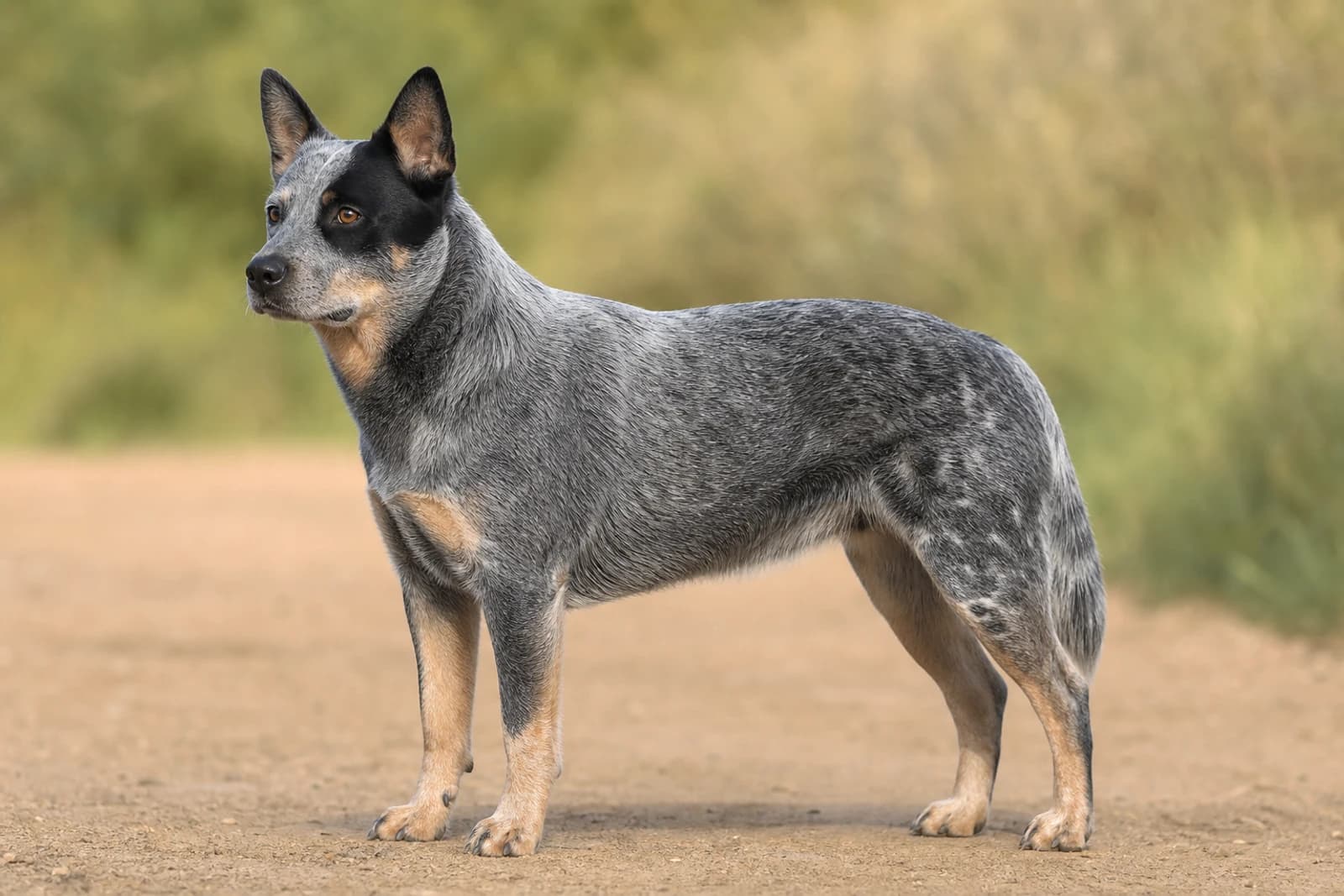
The Australian Cattle Dog, also known as the Blue Heeler or Red Heeler, is a robust, medium-sized herding breed built for endurance and intelligence. Ideal for active singles or families experienced with high-energy dogs, they thrive when given a job to do. Their intense loyalty and protective nature make them excellent companions, but they require consistent training and ample exercise to prevent boredom. Not suited for novice owners or apartment living, this breed excels in canine sports and forms deep bonds with their handlers.
At a glance
- Size
- Large
- Height
- 17–20 in
- Weight
- 31–40 lb
- Life span
- 10 years
- Coat colors
- Blue, Blue Mottled, Blue Speckled, Red Mottled, Red Speckled
- Coat type
- short double coat
- Group
- Working
How much does a Australian Cattle Dog cost?
Adopt / rescue
$75–$400
Usually includes spay/neuter, first shots, and a microchip.
Buy from a breeder
$700–$2,000
From a reputable, health-testing breeder.
Approximate USD. Prices vary widely by region, breeder, pedigree, age, and coat colour — adopting is the lower-cost and recommended route. Avoid suspiciously cheap “breeders”; they’re often puppy mills.
Estimate the full cost of a Australian Cattle Dog →Australian Cattle Dog photos
Views
Front, side, rear and top — the full silhouette.Poses
How the breed sits, lies, moves and plays.Puppy to senior
The breed across its whole life.Expressions
The breed’s range of moods.Close-up details
Eyes, ears, nose, paws, tail and coat.Coat colors
The breed’s recognized colors.Click any photo to enlarge. We show the Australian Cattle Dog from every angle — three views, poses, life stages, expressions, close-ups, coat and colors.
Appearance & size
What you notice first is a dog built like a coiled spring: compact, muscular, and balanced, with no trace of bulkiness. Males stand 18–20 inches at the withers, females 17–19 inches. Weight lands between 31 and 40 pounds, though a working line dog in hard condition can look lighter than the scale says. The silhouette is slightly longer than tall — about a 10:9 ratio — so the body reads as rectangular, not square.
The double coat is weather-resistant. You’ll feel a dense undercoat beneath a harsh, straight outer coat that lies flat and repels rain and dirt. Length is short to medium, with longer hair on the breeches and a modest ruff around the neck that’s more pronounced in males. Two main color roads exist: blue and red speckle. Blue dogs can be blue, blue-mottled, or blue-speckled with or without black, blue, or tan markings on the head. Tan often appears on the legs, chest, and jaw, and many have a white spot on the forehead called a Bentley Star. Red speckle dogs are evenly speckled all over with no red patches larger than a half-dollar, though darker red markings on the head are fine. Puppies are born white and develop their speckles as they grow.
From the front, the head commands attention. The skull is broad and slightly curved between upright, pointed ears that are set wide apart and pricked when alert — they look like they’re scanning for the next command. The muzzle is strong and medium-length, tapering to a black nose. Eyes are oval, dark brown, and give off a quick, intelligent expression. The chest is deep and muscular, with well-sprung ribs that leave plenty of room for heart and lungs.
From the side, the neck blends smoothly into laid-back shoulders, a level topline, and a deep brisket that reaches to the elbows. The forelegs are straight and parallel, with thick, round bone. Hindquarters appear broad and powerful, with well-turned stifles that drive the dog’s signature explosive movement.
From the rear, you see muscular thighs, straight hocks, and a tail that hangs in a slight curve, reaching about to the hock. The tail is never docked and is carried low unless the dog is excited, when it may rise but never curls over the back. The overall impression, from any angle, is a no-frills athlete built for endurance and sudden bursts of speed.
History & origin
The Australian Cattle Dog didn’t happen by accident. It was purpose-built in the 19th century to tackle a job that broke other dogs — controlling unruly mobs of cattle across thousands of miles of scorching, scrubby Australian wilderness.
Early British imports like the Smithfield sheepdog couldn’t handle the heat or the long distances, and they barked too much, spooking half-wild range cattle. Ranchers needed a silent, tenacious heeler with the grit to drive stock all day and the sense to nip low at the heels without taking a kick to the skull.
The Hall’s Heeler Experiment
The real foundation was laid on the sprawling cattle stations of Thomas Simpson Hall in New South Wales. Starting around the 1820s, Hall crossed dogs used by drovers with the native Dingo — an animal that could withstand blistering heat, live on little water, and work with a deadly quiet crouch-and-spring style. The result was a variety of red or blue bob-tailed dogs known as Hall’s Heelers. By the 1840s, they were the worst-kept secret among drovers. The dogs didn’t just survive the outback; they thrived in it.
After Hall’s death, the dogs spread to other breeders, notably George Elliott and the Bagust brothers, who added Dalmatian blood for endurance and a protective streak toward horses and handlers, along with smooth-coated blue merle Collies to anchor the mottled coat and build trainability. A touch of Australian Kelpie sharpened the natural herding instinct. By the 1890s, the breed had largely settled into two coat colors: blue (often with red speckle) and red speckle, with the strong, compact frame you still see today — 17 to 20 inches, 31 to 40 pounds of dense muscle.
From Queensland Heeler to the Show Ring
For decades, the dogs were called Queensland Heelers or simply Blue Heelers. In 1903, breeder Robert Kaleski drew up the first official standard and gave the breed the name Australian Cattle Dog, tying it firmly to the federation of the young nation. The Kennel Club of New South Wales granted recognition that same year, and the American Kennel Club followed in 1980.
The working mentality never faded. Even with a show ring career in the 20th century, the ACD remained a staple on stations, moving beef from Queensland to the Kimberleys. Today, the dog you see in a suburban backyard still carries that same quiet, calculating drive. Expect a 10-year lifespan of relentless focus — whether on cattle or a well-thrown Frisbee.
Temperament & personality
An Australian Cattle Dog doesn’t just like having a job — he’s hardwired to need one. Idle time quickly turns into chewed baseboards, marathon barking, or that infamous ankle-nipping you hear about. This is a sharp, independent thinker who weighs every situation. You can see it in the forward lean of a dog who’s decided he’s in charge of the room, or the direct stare that tells you he’s gearing up to move stock — whether that’s a flock of sheep or your kids racing through the kitchen.
Loyalty runs deep, but it’s earned, not given away. An Australian Cattle Dog bonds intensely with his person and tends to be indifferent or outright suspicious toward strangers. You’ll rarely find one bouncing into a visitor’s lap. Instead, expect watchful alertness. He notices everything: that open gate, the delivery truck, the scent of a neighbor’s dog on the fence line. A single sharp bark is often enough to announce a change in the environment, but a bored or isolated dog can escalate into nuisance vocalizing.
Inside the household, his herding heritage shows up in ways that can startle an unprepared family. Chasing runners, nipping at heels, and circling to “gather” people are not aggression — they’re pure instinct. Kids can be frequent targets, and while a Cattle Dog may be fiercely protective of his family’s children, supervision is non-negotiable. Food-guarding tendencies can emerge if meals are disturbed, so teach everyone to let the dog eat in peace.
Energy is nuclear, not casual. A 31–40 lb dog with this much drive needs a solid hour of full-tilt movement daily — running, tugging, herding balls, or climbing. Mental work matters just as much; puzzle toys, hide-and-seek, and obedience drills burn the brain fuel that, left unspent, fuels obsessive or anxious habits. Puppies chew to explore and soothe teething pain, while adults destroy tough objects to keep jaws strong and teeth clean. You’ll save your shoes by providing frozen carrots, durable chew toys, and handling mistakes with a sharp “uh-uh” rather than punishment — a citrus or vinegar spray on forbidden items works as a backup.
Affection exists, but it isn’t mushy. Your Cattle Dog shows love by sticking close, nudging your hand with his nose, and reading your subtle body language shift before you’ve consciously moved. He mirrors your mood: loose, soft eyes and a relaxed spine mean he’s comfortable. Lip licks, yawns, or a turned head signal he’s feeling pressure, so pay attention. A strong-willed dog like this shuts down under force but thrives with clear, consistent boundaries and work that lets him make decisions alongside you.
If you ever catch him rolling in something truly foul, remember that’s just a scavenger-ancestry flex — possibly announcing to the world (or just himself) that he’s found something wonderful. Redirect him to a more acceptable task without making it a battle, and he’ll move on quick.
Good with kids, dogs & other pets
This is a herding breed with a strong instinct to chase and nip — small, fast-moving kids often trigger that response. If you have young children, you’re managing mouthiness and motion sensitivity from day one, not just “will he be nice?”. An Australian Cattle Dog who grows up alongside kids and gets daily guidance can be a loyal, playful shadow, but supervision is non-negotiable. Those 31–40 pounds of coiled muscle can knock over a toddler without meaning to, and a heel nip in the hallway feels a whole lot different to a five-year-old than to a steer.
- Teach the kids first — no running and screaming around the dog, no tugging ears, and let the pup settle without being carried everywhere.
- Redirect the herding by giving the dog a job to do away from running children, like fetching a toy or holding a down-stay while the kids move.
With other dogs, the Cattle Dog tends to be pushy and same-sex assertive, especially with unfamiliar dogs. Early socialization is everything. The critical window closes around 12–16 weeks, so a steady stream of positive, supervised exposures to strange dogs, people, and places before that point prevents lifelong suspicion. After that window, forced introductions often backfire, adding stress and risking fights. A well-socialized ACD can learn to coexist peacefully, but off-leash dog parks are rarely a good fit — rough play quickly escalates when a dog this quick and determined decides to take charge.
Cats and small pets live on thin ice. The breed’s prey drive is high, and creatures that skitter or dash (rabbits, cats, guinea pigs) look like targets. A few ACDs raised from puppyhood with a confident, dog-savvy cat manage a truce, but you’re still stacking the deck against natural instinct. If you keep small animals, plan on strict separation, sturdy gates, and never leaving them loose together.
Start socialization between 3 and 14 weeks, expose the pup gradually to novel sounds, surfaces, and polite adult dogs, and continue reinforcing calm responses through adolescence. An Australian Cattle Dog isn’t a carefree “everyone’s best friend” — he’s a sharp, intense partner who needs a clear set of rules about what (and who) to herd and what to leave alone.
Trainability & intelligence
This is a dog who figures out what you want faster than you can finish asking — and decides in that same half-second whether it’s worth doing. Australian Cattle Dogs bring brilliant, problem-solving intelligence to every interaction. They learn new cues in a handful of repetitions and can chain complex behaviors if you make the payoff clear. But “clear” doesn’t mean “forceful.” Harsh corrections or drilling the same sit 40 times in a row will backfire spectacularly. A Cattle Dog who feels bullied may shut down or get creative in ways you won’t enjoy — think redirected nipping or pointedly ignoring you while opening a cabinet.
What makes training click
Motivate with what they value in the moment: a tugged toy, a thrown ball, a quick game of chase, or simply the chance to work shoulder-to-shoulder with you. Food rewards work, but most ACDs will sell out harder for action and interaction. Keep sessions short, snappy, and mentally demanding. Mix physical exercise with brain work — a 10-minute scatter-feed search calms a busy mind more than an extra mile of running. These dogs thrive on consistency, not repetition. Give a cue the same way every time, yes, but vary the context so the dog learns that “down” means “belly on the ground” whether you’re in a parking lot or a sheep pen.
Early and ongoing socialization isn’t optional. Between 3 and 14 weeks, and honestly for the first year, expose them gradually to different people, dogs, surfaces, and sounds. A Cattle Dog who misses that window can become a sharp, reactive adult who treats every stranger as a problem to be managed. Use high-value treats and calm praise to build the association: new stuff = good outcomes. This foundation also oils the gears for reliable recall later.
Recall, impulse control, and real-world reliability
A Cattle Dog’s off-switch is not pre-installed. They’ll lock onto a running kid, a bicycle, or a fleeing squirrel with laser focus, and a basic recall can crumble at 40 yards. Build it from puppyhood on a long line in incrementally distracting environments, and reward a voluntary check-in so hard the dog practically levitates. Never punish a slow return; that teaches them that coming back ends the fun. Instead, make the recall a predictor of something better than whatever they were chasing — a jackpot of tug or a handful of chicken.
Trust underpins every reliable behavior. When your Cattle Dog knows that your guidance is fair, predictable, and worth listening to, you’ll get a partner who hesitates at the treeline and glances back for direction. That’s the real payoff of all that patient, relationship-based training.
Exercise & energy needs
Plan on moving — a lot. An Australian Cattle Dog isn't the dog you take for a meandering leash walk and call it done. This is a tireless working breed built to hustle cattle across rough terrain all day, so his gas tank is bottomless. In a home setting, at least 60–90 minutes of hard, focused exercise every day is the baseline, not a luxury. Think off-leash running, long hikes with elevation, chasing a ball until your arm gives out, or biking alongside you at a steady trot. A quick romp in the yard doesn't touch it.
Split that daily quota into two or three sessions. A single long workout can physically wear him out, but his brain stays restless. Pair physical activity with mental work — this breed needs a job. Puzzle toys, scent games, learning new tricks, and impulse-control training all count. A 15-minute session of advanced obedience or a flirt pole with sit-stays burns more mental fuel than another mile of running. For the driven Cattle Dog, sports like agility, flyball, herding trials, or nose work are ideal outlets that blend movement with problem-solving.
Without enough structured exercise and mental engagement, you'll see the receipts — obsessive barking, furniture demolition, heel-nipping, and anxiety. A bored Cattle Dog invents his own entertainment, and you won't like it. As these dogs age, watch for joint wear; avoid repetitive high-impact stuff on hard surfaces with a puppy or senior, and lean on swimming or softer footing. Still, for a healthy adult, hard work is what makes him a calm, focused companion indoors, not a furry chainsaw.
Grooming & coat care
A short, dense double coat is the Australian Cattle Dog’s all-weather armor. The outer guard hairs are straight, harsh, and lie flat against the body; underneath sits a thick, soft undercoat that insulates from heat and cold alike. This is a wash-and-wear breed, but shedding season demands real follow-through.
The coat’s roan pattern does the heavy visual lifting. A “blue” Cattle Dog is actually a black-and-white mix that reads as blue-gray — a true roan — while red speckle dogs show a red roan. Tan points on the legs, chest, and face are common. Neither pattern changes the grooming equation: the coat is built for durability, not fuss.
Brushing frequency. Most of the year, a quick weekly pass with a pig-bristle brush distributes skin oils and adds shine. When the undercoat blows — typically twice a year, in spring and fall — switch to daily sessions. An undercoat rake or a rubber curry brush pulls out loose fluff by the handful before it drifts across your floors. A slicker brush can help clear debris, but this isn’t a long-coated dog; you’re after dead undercoat, not tangles.
Bathing. Less is more. Bathe only when the dog rolls in something truly foul. A rinse with plain water handles everyday mud, and the harsh outer coat sheds dry dirt on its own. Over-bathing strips the natural oils that keep the coat weather-resistant, so a thorough bath two or three times a year is plenty. Use a mild dog shampoo and follow up with a good rinse. During a shed, a de-shedding shampoo followed by a high-velocity dryer at a self-wash station blows out loose undercoat faster than brushing alone.
Trimming — none. Don’t shave or clipper this coat. Removing the guard hair exposes the undercoat to sun and messes with the dog’s ability to regulate temperature. The silhouette stays naturally tidy.
Nails, ears, teeth. Active Heelers often wear their nails down on hard ground, but check every few weeks. If you hear clicking on the floor, it’s time to trim. Ears should be clean and dry; a quick wipe after swimming or a muddy romp wards off infections. Brush teeth several times a week to stay ahead of tartar — this breed’s 10-year lifespan rewards consistent dental care.
Seasonal coat care. The big blowout can overwhelm a house in days. Daily raking and a blast with a dryer knock it back. If the undercoat goes untouched, it can compact into dense, uncomfortable mats behind the ears, in the ruff, and along the hindquarters. Outdoor work and regular exercise actually help — a dog that’s physically and mentally satisfied sheds less stress-induced hair, and coat turnover stays on a healthier cycle. During peak shed weeks, brushing outside and giving the dog a quick rubdown with a damp chamois picks up the last of the fuzz before you head back in.
Shedding & allergies
An Australian Cattle Dog sheds more than his smooth, no-fuss coat suggests. You’ll find short, stiff guard hairs working their way into upholstery, car seats, and your favorite black shirt year-round, with two distinct seasonal blowouts that crank the volume way up. This is a double-coated breed: a dense, weather-resistant undercoat sits beneath a harder outer layer. When spring arrives and winter undercoat starts dropping, or in the fall as the new coat builds in, you can expect tufts of fluff to appear at the dog’s flanks and rear within hours of a brushing session.
Drool, at least, is almost nonexistent. These dogs typically don’t have the loose jowls that leave slobber streaks on walls, so that’s one less cleanup battle. But if you’re trying to match a dog to a family member with allergies, the low-drool trait doesn’t make the breed hypoallergenic — because it’s not. Allergies are triggered by dander and proteins in saliva and urine, not just the hair itself, and an ACD produces plenty of dander along with all that shed fur.
The grooming routine that keeps the household halfway sane is straightforward: a slicker brush or an undercoat rake used two to three times a week during normal periods. During a full coat blow, daily sessions are often the only way to stay ahead of the tumbleweeds. A high-velocity dryer or a professional deshedding bath can help kickstart the worst of it in one exhausting session.
Be realistic about the hair that will still drift under furniture and cling to baseboards despite your best efforts. If someone in your home is allergic to dogs, spending time with adult Cattle Dogs before committing is a smarter move than hoping the breed will be an exception. A good vacuum with strong suction and a lint roller habit are your real allies here.
Diet & nutrition
Australian Cattle Dogs pack a ton of muscle and drive into a 31–40 pound frame. They burn serious energy when they’re working or training hard, but put one in a more sedentary home and the math flips fast — this is a breed that will eat whatever you give it and then look for more. Portion control isn’t optional; it’s the single biggest lever you have to keep their joints healthy through a lifespan that averages just 10 years.
What a healthy adult ACD’s plate looks like
- Daily amount: For a 35-pound dog with a normal activity level, 1.5 to 2 cups of high-quality dry kibble per day, split into two meals. High-intensity working dogs or those running alongside a bike for miles may need closer to 2.5 cups. The bag is a starting point — adjust by how your dog actually looks and feels.
- Wet, raw, or home-prepared: If you go that route, aim for roughly 60% meat (raw or lightly cooked), 20–30% fruits and vegetables, and the rest from eggs, plain yogurt, or digestible grains like pearl barley or white rice. Purée or finely process plant matter; dogs lack the digestive enzymes to break down cell walls effectively, so blending helps them absorb nutrients.
- Pace of eating: Many Cattle Dogs inhale meals. Use a slow-feeder bowl or puzzle feeder to stretch mealtime and engage that problem-solving brain.
Puppy feeding schedule
- 8 weeks to 4 months: 4 meals a day, evenly spaced.
- 4 to 6 months: 3 meals a day.
- 6 months onward: 2 meals a day, like an adult.
Transition pups to new food gradually. Around 12 weeks you can introduce raw chicken wings under supervision, but keep the diet puréed or lightly cooked at first. High-quality commercial puppy food works fine; just pick a formula for medium-to-large breeds to avoid overly fast growth that strains developing joints.
The weight trap no one talks about
Australian Cattle Dogs are built tough, but hips and elbows don’t forgive extra pounds. Obesity ramps up the odds of joint pain, spinal issues, and shortened lifespan. A dog that’s just 3–4 pounds overweight is carrying a meaningful load on those lean frames. Check the ribs weekly — you want a light covering of flesh, not a padded layer. Cut back food a little if your dog is slowing down, and bump it up when you’re in the middle of a hard training block. Activity and diet have to move in lockstep.
What to watch in seniors
As the dog ages (bigger changes often hit around 7–8), activity naturally tapers off. That’s when weight creeps up. Switch to smaller, more frequent meals if the stomach seems sensitive, and keep protein intake normal — there’s no strong reason to reduce it. Purée meals if teeth are missing or gums are sore. Monitor weight monthly and drop the total daily food by tablespoons, not whole scoops, so the transition stays safe.
A few hard-won rules
- Never feed directly from the table or your own plate. Begging starts as a cute tilt of the head and ends as a full-time job you can’t un-train.
- Scraps go in the dog’s bowl, after you’ve decided they’re healthy. Unsalted vegetable cooking water makes a decent meal base when you’re out of stock.
- Avoid rich, fatty leftovers — holidays and barbecue trimmings can trigger pancreatitis in a breed that’s already prone to gulping first and digesting later.
- Canned fish (in water), cooked veggies, and eggs are quick, healthy add-ins. Batch-cook grains and proteins on the weekend and you’ll always have a foundation ready.
Stick to meat-based nutrition. Dogs’ teeth, jaws, and digestive tracts evolved to process animal protein, so a vegetarian or vegan path isn’t species-appropriate for a working breed this energetic. Match food to the work, and you’ll see a dog that stays hard, happy, and hungry at the right times — not all the time.
Health & lifespan
A well-bred Australian Cattle Dog typically lives around 10 years. That number gets a lot of pushback from passionate owners whose dogs have sailed past 14, but the average holds, largely because the breed faces some inherited conditions that don’t announce themselves early.
What you’re up against
- Hip and elbow dysplasia: These are the heavy hitters. Malformed joints can show up as early as the first year, or slowly grind down a middle-aged dog. You’ll notice stiffness, a reluctance to jump into the truck, or a hitch in the back end.
- Progressive retinal atrophy (PRA): A degenerative eye disease that eventually leads to blindness. Night-time confusion or dilated pupils are often the first clue.
- Congenital deafness: This breed has a higher-than-average rate of deafness, often linked to coat color. Pups can be deaf in one ear or both. A BAER test at 6–8 weeks tells you exactly what you’re dealing with.
None of these are a guarantee. They’re just the risks a responsible breeder actively tries to breed away from.
What a good breeder is doing about it
Ask to see paperwork—not a verbal assurance. You want hip scores (OFA or PennHIP), a current eye clearance from a board-certified veterinary ophthalmologist, and a BAER hearing test result on each puppy. If a breeder brushes off these requests, you’re in the wrong place. These dogs work and run hard; building a body on a shaky foundation is a recipe for pain and early retirement.
Keeping yours on the right side of the odds
Joint health gets a massive assist from weight management. At 31–40 pounds, a Cattle Dog carries a surprising amount of muscle on a compact frame. Even a few extra pounds overload those hips and elbows, especially on hard surfaces. They’ll eat like they’re starving—ignore the act, measure the kibble, and keep treats lean.
Their double coat handles cold mornings fine, but heat is a real danger. These dogs will work until they drop, literally. In temps above 80°F, shift exercise to early morning or evening, provide constant shade and water, and watch for sluggishness or dry gums.
On the medical side, never skip the basics. Heartworm prevention every month during mosquito season and one month beyond it is non-negotiable. Rabies vaccination is legally required and, once symptoms appear, untreatable. Your vet will flag your state’s schedule.
Stress takes a physical toll, too. A Cattle Dog that’s isolated or chronically bored often develops anxiety-driven behaviors—chewing, pacing, endless barking—that can lead to gut issues, weight loss, or self-injury. Early socialization and daily, meaningful work (not just a walk) are more than convenience; they’re health coverage.
Catch it early
These dogs stoically mask pain. If you notice subtle shifts—lagging behind on a hike, blinking more in sunlight, flinching when you touch an ear—bring them up at your next vet visit. For a breed this driven, a change in fire is often the first and only sign something’s wrong.
Living environment
The Australian Cattle Dog is not a breed that politely waits for you to finish your coffee. This is a compact, intense working dog built to move cattle across miles of open range—and that drive doesn’t switch off indoors. An apartment can work only if you treat exercise like a part-time job: a solid hour of running, sprinting, or focused play twice a day, plus training sessions that challenge that sharp brain. Even then, many will pace or stare out the window, looking for a job. A house with a securely fenced yard is a far better base. The fence needs to be at least six feet and dig-proof—these dogs are escape artists who can clear low barriers without a running start.
A yard alone isn’t enough, though. They won’t self-exercise. You’ll use it for fetch, flirt-pole work, or herding games, not to park the dog while you’re away. Climate-wise, the double coat is surprisingly practical: it slows heat in summer and insulates in winter. They can handle reasonable heat and cold, but you still need shade, fresh water, and common sense. No breed thrives locked in a hot yard with nothing to do.
Barking is part of the package. An Australian Cattle Dog notices every squirrel, delivery truck, and neighbor closing a car door. They’re quick to sound the alarm and won’t whisper. In a shared-wall setting, that natural vocal behavior can become a real problem. You can manage it with training, but you won’t silence it completely.
Leaving them alone for a full workday is where many households stumble. These dogs form a tight bond and can develop serious separation anxiety if regularly isolated. Without you, they’ll make their own entertainment—chewing drywall, barking non-stop, or obsessively circling. A better setup includes a person home much of the day, doggy daycare, or a dog-proofed space with puzzle toys and frozen kongs after a hard morning workout. If your routine means the dog is alone for 9 hours, this breed will tell you in the clearest terms that it isn’t working.
Who this breed suits
An Australian Cattle Dog is a full-time job in a 35-pound package. This breed doesn’t simply need exercise — it needs a reason to wake up. If your idea of a good day is a 5-mile trail run followed by an hour of agility drills or advanced trick training, you’ll find a tireless partner. If not, this dog will dismantle your couch and your sanity with equal efficiency.
Who’s the right fit:
- Serious athletes and adventurers. Runners, mountain bikers, and hikers who cover distance daily will match the ACD’s stamina. A 20-minute neighborhood loop is barely a warm-up for a dog bred to drive cattle across rough terrain for hours.
- Dog sport enthusiasts. These dogs shine in agility, flyball, herding trials, and nose work. A competitive home that treats training as a year-round project, not a 6-week class, will keep that buzzing brain occupied.
- Active singles or couples with wide-open days. A remote worker who can schedule midday sessions on the property or a dedicated owner who structures life around the dog’s needs can make it work. The dog won’t care about your title, only that you’re all-in.
- Rural or large-fenced suburban homes. A big, secure yard helps, but only if you’re out in it engaging the dog — not just opening the door to let it pace alone. A true working home with livestock is this breed’s idea of heaven.
Who should think twice:
- First-time dog owners. A Cattle Dog’s intelligence and intensity can steamroll a novice. They’re master manipulators and will exploit every gap in your training. Without a solid background in positive reinforcement and timing, you’ll lose the battle of wits.
- Sedentary households. An apartment dweller who wants a weekend walking buddy will end up with a destructive, neurotic shadow. These dogs don’t have an off switch; they invent their own jobs — like herding every car that passes the window.
- Families with very small children. The ACD’s ingrained heeling instinct includes nipping at heels, and a shrieking toddler running across the yard looks a lot like a calf on the move. While they can be raised alongside kids under careful management, the risk of “policing” behavior that spooks or bruises a young child is real.
- Seniors or anyone with limited mobility. Unless you’re a 70-year-old marathoner, the sheer physical demand — hours of off-leash exercise, mental puzzles, and firm handling — is punishing. You’ll be matching a decade-long peak athlete, not a lapdog that tuckers out after fetch.
- Owners who value a quiet, predictable home. ACDs tend to be vocal, alert barkers who treat every delivery truck like a border incursion. They’re also often one-person dogs, deeply bonded but aloof with strangers, which requires constant socialization to prevent reactivity.
If you’re considering this breed, ask yourself honestly: can you provide a minimum of 90–120 minutes of vigorous, engaged activity every single day, plus an outlet for that sharp mind? A Cattle Dog won’t compromise, and a bored one will turn your life into a management crisis. The right owner gets a fiercely loyal, whip-smart shadow who will go anywhere and do anything. Just know that “anything” is the baseline.
Cost of ownership
A puppy from health-tested parents usually runs $1,200–$2,500. Show-line or proven working-line breeders with full hip, elbow, eye, and BAER hearing screenings charge toward the high end. You’ll see “farm-bred” pups listed for $600–$800, but skipping those clearances is a gamble — deafness and elbow dysplasia are real problems in the breed. Adoption fees through a rescue or shelter land around $150–$400, often for young adults that already need an experienced hand.
Monthly upkeep for a 31–40 lb dog with a 10-year lifespan looks like this:
- Food: $50–$75 for a quality high-protein kibble or raw diet that supports their non-stop engine. A working-line Cattle Dog burning serious calories in herding or agility will eat more.
- Vet & preventives: $55–$85 averaged out. Annual exams, vaccines, year-round heartworm and flea/tick meds are the floor. Because these dogs can be stoic and keep going when hurt, an emergency fund matters. That short 10-year lifespan means you’ll be into senior bloodwork, joint supplements, and possibly arthritis management by age seven or eight — earlier than you’d expect for the size.
- Insurance: $35–$60 monthly. Policies help offset the breed’s tendency toward hip/elbow issues, progressive retinal atrophy, and accidental injuries from their kamikaze approach to work.
- Grooming: $10–$30 if you handle brushing and nail trims yourself, with an occasional professional bath during heavy shedding season. Their coat sheds dirt but blows undercoat twice a year like a snowstorm.
- Training & gear: Count on $150–$300 upfront for a solid group obedience class and at least one private session if herding instincts turn into heel-nipping. Then budget for puzzle toys, a virtually indestructible herding ball, and chew items that last more than an afternoon — because a bored Cattle Dog dismantles cheap toys as fast as you can buy them.
Choosing a Australian Cattle Dog
This is a high-octane working dog that eats up a 10-hour day and asks for more. If you picture a couch buddy, pause now — an Australian Cattle Dog needs a real job, not just a walk. Your first big choice is whether to buy from a breeder or adopt. Both are valid, but the paths look very different.
Health clearances: what you’re actually paying for
These dogs run hard and their bodies take a pounding. A responsible breeder screens every adult before breeding and shows you the paperwork. Demand these at minimum:
- Hip dysplasia: OFA or PennHIP evaluation. Look for an OFA rating of Fair, Good, or Excellent.
- Elbow dysplasia: OFA elbow clearances.
- Eye exam: CAER (formerly CERF) clearance from a veterinary ophthalmologist, refreshed annually. Progressive retinal atrophy (PRA) is on the table.
- Hearing: BAER testing. Unilateral or bilateral deafness isn’t rare, thanks to the white spotting genes that give the breed its flash. A breeder who doesn’t BAER-test the litter before pups go home is cutting a dangerous corner.
- DNA tests: Ask about prcd-PRA status if available, though a current eye exam carries more weight.
A 10-year life span is short enough without stacking preventable joint and eye disease. Don’t settle for a “vet check” — that’s not a clearance.
Red flags that should make you walk
- Puppies available year-round with no waitlist or application. Ethical breeders plan litters sparingly.
- No health testing on the parents, or only genetic panels without orthopedic and eye certs.
- Pups sent home before 8 weeks. Cattle Dog pups need that extra time with mom to learn bite inhibition — these are sharky dogs.
- Breeder focuses on rare colors (blue, “lilac,” merle) or charges a premium for them. Color is irrelevant to working ability and temperament.
- A breeder who can’t tell you exactly what the parent dogs have accomplished — herding titles, sport work, or at minimum a structured temperament test. “They’re great family dogs” isn’t enough.
Rescue: a high-impact shortcut
Plenty of Australian Cattle Dogs land in rescue between 6 months and 2 years old, when their relentless energy burns out an underprepared owner. Adopting an adult lets you skip the teething-and-chaos puppy window and get a dog whose real-world personality is visible. A breed-specific rescue can match you with a dog whose drive level fits your household. Whether you rescue or buy, budget for training classes that engage a brain that runs at warp speed.
Picking a puppy that won’t be a project dog
You want the middle-of-the-road pup — not the one cowering in the corner, not the one launching itself at your face and refusing to settle. Look for a pup that trots up to investigate you, plays with a toy, and can be redirected when you pick them up. Ask to see the mother and, if possible, the sire. A dam who is nervy or snappy under normal conditions is a strong predictor of an anxious adult dog who bites first and asks later. A sound adult is alert and watchful but tolerant of strangers in her own space.
Get the health paperwork in your hand before you hand over money, and know that a well-bred Cattle Dog puppy will run you into the thousands — cheaper pups almost always cost more in the long run.
Pros & cons
A working dog through and through, the Australian Cattle Dog needs a job, not just a backyard. If you can provide that, you’ll gain an unmatched partner. If not, the downsides hit hard.
Pros
- Scary-smart and trainable — picks up commands in a flash and shines in agility, herding, or complex tricks.
- Fiercely loyal — bonds tightly with one person, often acting like a shadow that’s always watching your back.
- Compact, athletic build — 31–40 pounds on a 17–20-inch frame; muscular and agile without being oversized.
- All-day stamina — built to run, herd, or hike for hours; turns a morning trail run or ranch work into play.
- Low-maintenance coat — a dense, weather-shedding double coat that stays clean with an occasional brush.
Cons
- Non-stop exercise needs — a stroll around the block is a warm-up; plan on at least 60–90 minutes of hard running or purposeful work every day.
- Natural heeler, natural nipper — strong herding instinct can mean ankle-biting, especially with fast-moving kids or pets.
- Wary of strangers by default — without heavy, early socialization, can become aloof or reactive toward unfamiliar people and dogs.
- Destructive when idle — bored Cattle Dogs find their own “work,” often chewing walls, digging floors, or dismantling furniture.
- Shorter commitment window — lifespan averages 10 years; responsible breeders screen for hip dysplasia and eye conditions like progressive retinal atrophy.
Similar breeds & alternatives
- Border Collie shares the ACD’s whip-smart herding brain but channels it through a more eager-to-please, handler-focused lens. Expect a dog that needs a job just as badly, but is more sensitive and prone to neurotic spinning or shadow-chasing if underworked. ACDs bring a tougher, more independent streak; they’ll work through rough stock without shutting down, whereas a Border Collie may get intimidated. Both shed and need serious mental engagement, but the Border Collie often demands more daily minutes of active training and is less natural as a hands-off family watchdog.
- Australian Shepherd offers similar size (40–65 lb) and herding energy, but with a softer temperament and a longer, higher-maintenance double coat. Aussies tend to be more social with strangers and less territorial. If you want a dog that’s more likely to greet guests warmly and less likely to reserve judgment, that’s a pro—if you want a quiet property guardian who weighs 31–40 lb, the ACD fits better. Both breeds require at least an hour of running daily, but the ACD’s wash-and-wear coat and lower-grooming needs can be a real advantage for muddy, active households.
- Australian Kelpie is the ACD’s leaner, heat-tolerant cousin, built for endurance over raw stockyard force. Kelpies are often lighter (25–45 lb) and more driven by movement—a good match if you want a tireless running partner who can cover miles but may lack the ACD’s tenacious gripping style and protective reserve. Both are short-coated, intense, and not for casual owners, but the Kelpie typically has a longer lifespan (12–15 years) compared to the ACD’s roughly 10 years.
- Jack Russell Terrier shrinks the tenacity and athleticism into a 13–17 lb package, which suits city or small-space dwellers who still want a rugged, long-lived dog (13–16 years). Like the ACD, JRTs are bold, smart, and can out-stubborn you, but they express it through terrier digging and chasing rather than herding nips. You trade the ACD’s wariness of strangers for a smaller, more portable body—but still sign up for a dog that will dismantle your schedule without enough exercise and problem-solving.
Fun facts
- Australian Cattle Dogs were developed by crossing herding dogs with the native Dingo.
- They are known for their unique speckled coat, which comes in blue and red varieties.
- These dogs have outstanding stamina and were bred to drive cattle across vast distances.
- Their intelligence and problem-solving skills make them top competitors in dog sports like agility and obedience.
Frequently asked questions
- Are Australian Cattle Dogs good with children?
- Australian Cattle Dogs can be loyal and protective family members, but their herding instincts may lead them to nip at running children. They are best suited for families with older kids who understand how to interact calmly with a high-energy dog. Early socialization and supervision are important to ensure positive interactions.
- How much exercise does an Australian Cattle Dog need?
- As a high-energy working breed, Australian Cattle Dogs require at least 1–2 hours of vigorous exercise daily. Activities like running, hiking, or dog sports are ideal to satisfy their physical and mental needs. Without sufficient exercise, they may become destructive or develop behavior issues.
- Do Australian Cattle Dogs shed a lot?
- Australian Cattle Dogs have a dense double coat that sheds moderately year-round, with heavier shedding once or twice a year. Regular brushing can help manage loose hair, but they are not considered a low-shedding breed. Owners should be prepared for consistent grooming to control shedding around the home.
- How often should an Australian Cattle Dog be groomed?
- Australian Cattle Dogs have a relatively low-maintenance coat that needs brushing only once a week to remove dead hair and distribute oils. Bathing is rarely required unless the dog gets particularly dirty. Their grooming needs are minimal compared to many other breeds.
- Can Australian Cattle Dogs live in an apartment?
- Australian Cattle Dogs are not typically recommended for apartment living due to their high energy and need for space to run. With a very active owner who provides extensive daily exercise and mental stimulation, they might adapt, but they thrive best in homes with a securely fenced yard.
- Are Australian Cattle Dogs suitable for first-time dog owners?
- Australian Cattle Dogs can be challenging for first-time owners because of their high intelligence, strong will, and intense exercise needs. They require consistent training and a firm, patient handler. First-time owners should be prepared for significant time commitment and may benefit from professional training classes.
Tools & calculators for Australian Cattle Dog owners
Quick estimates tailored to Australian Cattle Dogs — pre-filled with this breed’s size where it matters.
Articles & stories about the Australian Cattle Dog
Sources & standards
This profile follows recognized breed standards from the American Kennel Club (AKC) and the Fédération Cynologique Internationale (FCI), along with established veterinary and breed-club guidance. These describe general breed tendencies — every dog is an individual.
Owner stories
Have a Australian Cattle Dog? Share your experience — grooming tips, personality quirks, anything goes.