

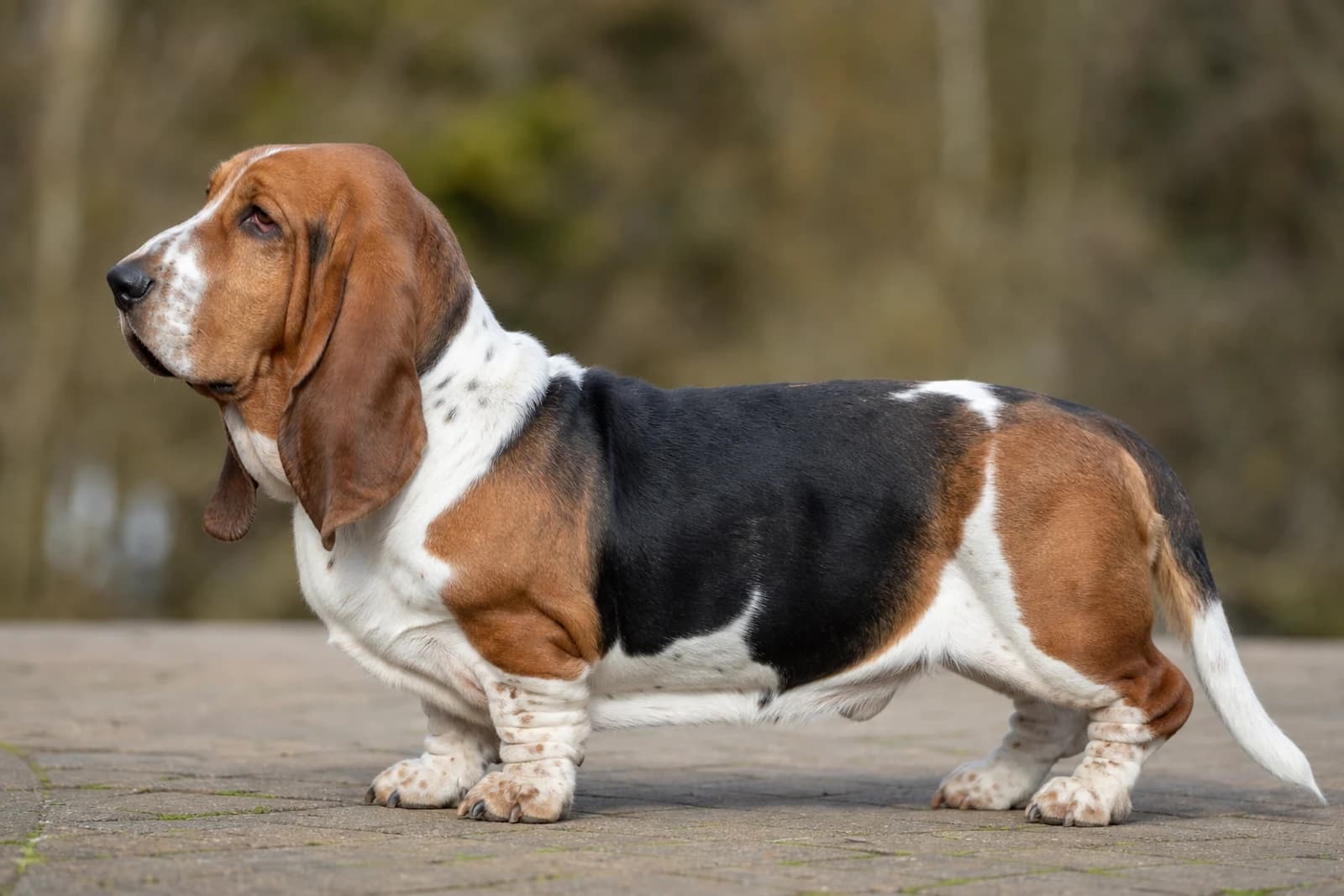
The Basset Hound is a short-legged scenthound known for its long, droopy ears, mournful eyes, and exceptional nose. Despite a sometimes sad expression, they are cheerful, affectionate, and patient dogs, making them wonderful family pets. They are great with children and other animals but can be stubborn. Low-energy indoors, they enjoy moderate walks and scent games. Their short coat is easy to care for, though they shed moderately. Ideal for owners seeking a loyal, low-key companion with a good sense of humor.
At a glance
- Size
- Medium
- Height
- 13–15 in
- Weight
- 40–60 lb
- Life span
- 10–13 years
- Coat colors
- Tricolor (Black, White & Tan), Lemon & White, Red & White, Mahogany & White
- Coat type
- Short, smooth, dense
- Group
- Scenthounds
How much does a Basset Hound cost?
Adopt / rescue
$50–$300
Usually includes spay/neuter, first shots, and a microchip.
Buy from a breeder
$400–$1,200
From a reputable, health-testing breeder.
Approximate USD. Prices vary widely by region, breeder, pedigree, age, and coat colour — adopting is the lower-cost and recommended route. Avoid suspiciously cheap “breeders”; they’re often puppy mills.
Estimate the full cost of a Basset Hound →Basset Hound photos
Views
Front, side, rear and top — the full silhouette.Poses
How the breed sits, lies, moves and plays.Puppy to senior
The breed across its whole life.Expressions
The breed’s range of moods.Close-up details
Eyes, ears, nose, paws, tail and coat.Coat colors
The breed’s recognized colors.Click any photo to enlarge. We show the Basset Hound from every angle — three views, poses, life stages, expressions, close-ups, coat and colors.
Appearance & size
A Basset Hound is a lesson in controlled extremes — you can’t mistake that silhouette for anything else. They stand just 13 to 15 inches at the shoulder, but pack 40 to 60 pounds onto a stretched, heavy-boned frame. A full-grown Basset is more dog than his height suggests: the body is long and deep, with a prominent breastbone and a barrel-like ribcage that’s closer to the ground than you’d think possible. Short, massively boned legs end in huge, outward-turning paws — think snowshoe proportions — that keep the dog stable whether he’s trotting over a field or plopped on the kitchen floor.
When you see a Basset head-on, the first thing that registers is the sheer weight of the skull. The muzzle is broad and deep, never pointy, with a distinct stop and loose, velvety flews that hang well below the jawline. A slightly furrowed brow and that trademark wrinkled skin over the forehead give the face a mournful, almost comical dignity. The eyes are dark brown, soft, and set in diamond-shaped rims, and the upper eyelid often droops slightly, revealing a rim of deep pink. Those long, low-set ears are another signature: they wrap forward in a fold and easily pull past the nose tip when you stretch them out. The chest, seen from the front, is deep and wide, filling the space between those stout forelegs without looking clumsy.
From the side, the Basset’s proportions become even clearer. The body length exceeds the height at the withers — it’s not a short-backed dog by any stretch. The topline is level, the back broad, and the sternum section deepens into a prominent keel. The front legs are short, heavily muscled, and slightly crooked around the chest, not straight; rear legs stand with a moderate angle at the stifle. You’ll often see a bit of loose skin rippling at the dewlap and along the sides of the neck, which is just part of the old scenthound design. At the back end, the tail is a natural extension of the spine — thick at the base, tapering, and carried with a saber curve. A Basset on the move uses that tail like a flag, a white tip often visible above the grass when the rest of him disappears in cover.
The coat is a practical, no-fuss affair: short, dense, and smooth, with enough weight to shed dirt easily. Colors run the classic tricolor (black, tan, and white), red and white, lemon and white, or mahogany and white. Any hound color is acceptable, and markings can be distributed over the body in a blanket, saddle, or open-pattern arrangement without fuss — this isn’t a breed where a specific white-dot pattern matters. The skin itself is supple and loose everywhere, not clinging tightly like a Boxer’s, and that looseness, together with the heavy paws and solemn expression, defines the overall look. A Basset’s appearance doesn’t lie: this is a dog built to follow a ground scent all day at a steady, rolling pace, then crumple into a snoring heap the moment the work is done.
History & origin
The Basset Hound’s story starts in medieval France at the Abbey of St. Hubert — the same monks who developed the hound that later became the Bloodhound. Their problem was simple: they needed a scenthound that a hunter could follow on foot, not horseback. A dog fast enough to hold a trail but slow enough that a person could keep up through dense woods. The fix was breeding for a dwarfed, short-legged hound with a nose that could lock onto a rabbit or hare and refuse to quit. The name gives you the blueprint: “bas” means low in French, and the “-et” suffix makes it literally “rather low” — a ground-skimming tracker.
By the 1500s, these dogs were prized by French aristocrats who hunted small game over rough, thick terrain where taller hounds lost the scent or outran the handler. After the French Revolution, they spread to commoners who depended on them to put food on the table. The original French Bassets were lighter-boned and varied in type, but they all shared that unmistakable combination of short legs, long ears, and a tireless nose.
The Basset Hound you see today was largely built in England. In 1866, Lord Galway imported a pair, but the breed took its modern shape when Sir Everett Millais brought a French Basset named “Model” to his kennel in 1874. Millais felt the French stock needed more substance, so he crossed them with Bloodhounds. The result was a heavier, wrinklier dog with even greater scenting power, a deeper voice, and the solemn expression people now recognize on sight. The Kennel Club (UK) recognized the breed in 1880, and the American Kennel Club followed in 1885.
Through the early 1900s, the Basset slowly shifted from hunter’s tool to show dog and family companion. Pop culture moments — the Hush Puppies mascot, cartoon sleuth Droopy — only spread the fame of those doleful eyes and drooping ears. That nose, though, never got the memo about retirement. A Basset Hound today still lives to follow a scent trail, even if it now leads to the sofa.
Temperament & personality
A laid-back friend on the surface, the Basset Hound is ruled by a world you can’t see — scent. That mournful face and unhurried saunter hide a nose that can override every ounce of training the moment it latches onto an interesting trail. In the house, you get a calm, gentle companion who’d rather lean against your legs and snore than chase a ball. Outdoors, the same dog will lower his head, stiffen into a forward lean, and pull you toward that tantalizing smell with a single-mindedness that can feel like stubbornness — and honestly, a lot of it is. He’s not being difficult; he’s just doing the job his breed was built for.
Affection comes in bulk. A Basset wants to be where you are, preferably touching you, often from the couch. This pack-hound loyalty means isolation hits hard. Left alone for long stretches, he may howl, bay, or chew his way out of boredom and anxiety. A midday dog walker or another canine pal helps, but he’s happiest when the family is home.
With a moderate energy level, exercise should be a couple of relaxed daily walks — 30 to 45 minutes each, with plenty of sniffing pit stops. He’s no running partner, and that heavy, low-slung body gets stressed by stairs and jumping, so keep him off the furniture if your vet advises. Inside, he defaults to couch potato mode, which can tip toward obesity if you’re not careful with treats.
Food is a serious matter. Never interrupt a Basset while he’s eating; a normally gentle dog can snap over a meal if pressured. Teach children to give him peace during dinner, and manage a tendency to counter-surf by keeping food well out of reach. That food drive, though, is your best training tool. Reward-based methods work where force fails. Strong-willed and independent, he’ll shut down or stubbornly ignore harsh corrections, but a pocket full of tiny treats and patient consistency can get him to do almost anything — unless his nose says otherwise.
Watchfulness isn’t his strong suit. He’ll announce a delivery with a deep, rolling bay, then likely greet the stranger with a wag. Aggression toward people isn’t the norm, but any dog can develop issues without proper socialization. With other pets, he’s typically easygoing, though early introductions always make for smoother relationships.
House-training calls on all your patience. A Basset can be famously slow to catch on, and once an accident happens, the leftover scent becomes a repeated invitation. Enzyme cleaners that truly break down urine and feces are non-negotiable. Treat him the moment he potties outdoors — punishment after the fact only confuses him. In rarely used rooms, he may mark because the space lacks the family’s scent signature; spend time there so it smells like home, not a blank canvas.
There are quirks you just live with. He drools, often after drinking, and slings slobber onto walls and pants. He sheds year-round. That short, dense coat carries a distinct houndy odor. And when a repulsive scent crosses his path, he might drop, roll, and coat himself in it with the bliss of someone applying expensive cologne. Theories vary — masking his own smell, advertising a find to the pack, or simply because it feels fantastic — but the result is the same: an emergency bath.
He sticks close to children, tolerates a fair bit of clumsy affection, and moves slowly enough that he won’t bowl them over. Yet his patience has limits. If a toddler crowds his face, pulls his long ears, or grabs his food bowl, you may see calming signals — lip licking, yawning, turning the head away. Step in before those signs escalate. Supervise interactions, keep meals peaceful, and this easygoing hound will reward your household with years of gentle, low-key loyalty — punctuated by the occasional, unforgettable aroma adventure.
Good with kids, dogs & other pets
Basset Hounds have a well-earned reputation as one of the most patient, easygoing breeds around children. Their low-key, non-aggressive temperament means they rarely spook or snap, even when little hands grab a long ear or a toddler stumbles into their space. At 40–60 pounds and built low to the ground, they’re sturdy but not bulletproof—a Basset’s back is long and easily injured, so teach kids never to let them jump off furniture or try to carry them. Close supervision with young children is still non-negotiable; no dog is a babysitter.
With other dogs, Bassets usually slide right in. Bred to work in packs, they carry that social instinct into home life and typically greet canine housemates with a lazy tail wag. Early socialization matters. The window between 3 and 14 weeks is your chance to cement that natural friendliness and prevent noise sensitivity or hesitance around unfamiliar dogs down the road. Even after that window, consistent positive experiences—not forced interactions—keep them comfortable in multi-dog households. An adult Basset who’s happy with just you doesn’t need a parade of strange dogs to feel fulfilled.
Cats and small pets demand more planning. A Basset’s nose leads every decision, and while they lack the hair-trigger chase drive of some scenthounds, they will follow a scent right to the cat’s dish. Many live peacefully with cats when raised together from puppyhood. For rabbits, guinea pigs, or other small mammals, treat coexistence as a management project: keep cages secure and elevated, and always introduce on leash with heavy rewards for calm disinterest.
A Basset who’s left untrained and underexposed can tip into timidity or unhealthy clinginess. These are dogs that ache for companionship—long hours alone in a yard invite destructive chewing and mournful howling. If you adopt an adult who’s already uneasy around new people or pets, don’t push. Gradual desensitization works; a chaotic dog park can backfire. For plenty of Bassets, a quiet house with their trusted people is paradise enough.
Trainability & intelligence
A Basset Hound learns exactly what you teach him—especially if food is involved—but he’ll decide when it’s worth his effort. That nose runs the show. They’re clever, problem-solving dogs, not necessarily obedient ones, and the moment a scent trail grabs their attention, your voice becomes background noise. Training a Basset is less about drilling obedience and more about negotiating with a low-slung, independent thinker who values treats above all else.
Motivation and the right reward. Forget "eager to please." You’ll get miles further with a pouch full of tiny, smelly morsels—cut-up hot dogs, cheese, freeze-dried liver. Praise alone rarely cuts it. Short, upbeat sessions (five minutes are plenty) keep him from wandering off mentally. He’s surprisingly quick to pick up new commands when he knows something delicious is on the line, but he’ll just as quickly play dumb if the reward isn’t to his liking or the distraction is more interesting.
The scent-driven recall problem. The real challenge isn’t learning a cue; it’s getting a Basset to respond when his nose is pressed to the ground. A solid, off-leash recall in an unfenced area is a long-term project—and for many Bassets, it’s never 100% reliable. His world is wired through smell, and a single rabbit trail can override months of training. This isn’t defiance for defiance’s sake; it’s hardwired instinct. Until you have a bombproof leave-it and recall in moderately distracting environments, a securely fenced yard or a long training lead is non-negotiable.
What works—and what backfires.
- Positive, patient, and consistent. Bassets shut down fast under correction, harsh voices, or repetition that borders on nagging. They’ll simply lie down and check out. Reward the exact behavior you want immediately, and ignore what you don’t (or redirect it). Build trust with clear, calm communication. Consistency matters: if you sometimes allow counter-surfing because it’s cute, he’ll assume it’s always allowed.
- Start early and socialize extensively. Between 8 and 16 weeks, expose your Basset puppy to different people, friendly dogs, various surfaces, and everyday sounds—always keeping the experiences positive. A well-socialized Basset is confident and less likely to default to stubborn, fearful, or reactive behavior as an adult. Without it, that natural independence can tip into aloofness or selective deafness.
- Channel the nose, don’t fight it. Nose work games, scent trails hidden in the house or yard, and puzzle toys tire his brain out in a way that straight obedience drills never will. A tired sniffer is a more cooperative student.
House-training realities. Bassets are not notoriously fast at house-training. Their low-to-the-ground anatomy and “I’ll get to it when I’m done sniffing” attitude mean you’ll need a crate and a strict, reward-based schedule. Expect some plateaus. Patience and a enzymatic cleaner for accidents are your best friends. Punishing mistakes only teaches him to sneak away and do it where you can’t see.
Training a Basset Hound isn’t about dominance—it’s about building a relationship where your cookie beats the smell. Accept that he’ll never be a robot, and you’ll get a dog who learns what matters to him and, over time, to you.
Exercise & energy needs
Don’t mistake that low-slung, plodding walk for laziness. A Basset Hound is built for endurance, not speed—those 40 to 60 pounds of loose skin and heavy bone were meant to follow a scent trail for hours, not sprint around a park. A daily walk of 30 to 45 minutes, split into two shorter strolls, is plenty to keep him physically healthy and mentally content. One long forced march can backfire; his stubby legs and long spine are vulnerable to impact, so pave the way with flat, soft surfaces and avoid stairs, jumping, and rough play.
The real engine here is his nose. A Basset who simply ambles around the block without sniffing is a Basset who hasn’t started his workout yet. Let him stop, snort, and puzzle over every leaf—that’s his version of a crossword puzzle. Scatter feeding, hide-and-seek with smelly treats, and simple scent games indoors will wear him out faster than extra mileage. A few 10-minute nose-work sessions can turn a restless dog into a contented rug.
Watch the weight. Bassets are champion eaters and can pack on pounds fast, which punishes those already delicate hips, elbows, and intervertebral discs. If you hear heavy panting or see a reluctance to move, you’ve probably overdone it. Two 15- to 20-minute sniff-fests a day, plus a short potty break, hit the sweet spot for most adults. Puppies need even shorter, more frequent bursts to protect growing joints, and seniors benefit from gentle consistency rather than any major effort. Build your routine around a floppy, methodical pace—and never skip the cool-down snuffle.
Grooming & coat care
A Basset Hound’s short, dense double coat sheds more than you’d guess from his smooth look. Expect tumbleweeds of hair in the house year-round, with two heavy blowouts in spring and fall. Brushing isn’t just a tidy-up — it’s how you keep the hair on your floor rather than your couch.
Brushing
Stick with a soft bristle brush or a rubber curry mitt. A bristle brush pulls out loose undercoat, distributes natural oils, and adds a nice gleam without scratching the skin. Skip metal slicker brushes; those are for longer coats and can irritate a Basset’s short, hard topcoat. Aim for two to three brushings a week during normal times, bumping up to daily when he’s blowing coat. It takes five minutes and cuts down the shedding significantly.
Bathing & skin folds
Bathe only when he starts smelling like a hound who rolled in something questionable — usually every 6–8 weeks is plenty. Use a mild dog shampoo, rinse thoroughly, and, crucially, dry his facial wrinkles and neck folds with a soft towel. Moisture trapped in those folds breeds bacteria and yeast. Wipe them out daily with a damp cloth or dog-safe wipe, even if no bath happened.
Ears, nails & teeth
Those long, velvety ears are prime real estate for infections. Clean them once a week with a vet-approved ear cleaner — never pour water or alcohol directly into the canal. Swab the outer part and dry thoroughly. Check for redness or a yeasty smell each time. Nails on those heavy, short legs need a trim every 2–3 weeks; clicking on the floor means you’re late. Brush his teeth several times a week to keep that classic hound breath in check.
No matter if your Basset is a classic tricolor, red and white, or lemon, the grooming routine stays the same. Consistency wins — a few minutes a day on wrinkles, ears, and a quick brush keeps a low-slung dog comfortable and your home bearable.
Shedding & allergies
That short, glossy coat is deceptive — Basset Hounds shed constantly, and twice a year they blow a dense undercoat so thoroughly you could knit a second dog. Count on finding white or tan hairs woven into your furniture, clothes, and probably your morning coffee. Weekly brushing with a rubber curry or hound glove knocks the worst of it out before it hits the rug, but during spring and fall blowouts, you’ll want to brush every other day to stay ahead of the tumbleweeds.
And then there’s the drool. Those deep, beautiful jowls collect water and sling spit after every drink, meal, or enthusiastic sniff. Walls, floors, knees — nothing is safe. For allergy sufferers, that’s the real double whammy: you’re not just reacting to dander, but to the proteins in saliva and skin oils that coat every surface. No Basset Hound will ever pass for hypoallergenic. If you need a low-allergen dog, this isn’t your breed.
Managing it is simple, not effortless. Keep a chamois or wipe rag handy near the water bowl, and accept that a certain amount of hair just comes with the package. A robot vacuum helps, but you’ll still pull sofa cushions and find a tiny Basset-sized fur outline.
Diet & nutrition
A Basset Hound will convince you he's starving every single meal. That droopy expression and world-class nose make him a champion beggar, but giving in has serious consequences. Those short legs and long back are already prone to intervertebral disc disease and joint stress — every extra pound multiplies the risk. Keep your adult Basset lean, between 40–60 lb, with visible waist tuck and ribs you can feel but not see.
Weight management comes first
Obesity is the number-one nutritional threat for this breed. Even a few pounds over can trigger back pain, hip issues, and shortened lifespan (10–13 years). Measure portions with a real measuring cup — don’t eyeball. If your dog starts gaining, cut back the kibble by 10% and replace with green beans or unsalted vegetable water for bulk without the calories. A food scale works even better.
How much to feed
Exact amounts depend on the food’s calorie density, age, and exercise level. A moderately active adult Basset typically needs 900–1,200 calories per day, split into two meals. Puppies: four meals until 4 months, three until 6 months, then twice daily. Seniors often do better on three smaller meals to ease digestion and keep metabolism steady, especially as activity drops. Reduce food gradually for older dogs — don’t wait until they’re plump.
Breed-specific diet notes
Bassets do well on a high-quality commercial diet that includes around 60% animal protein (meat, fish, eggs), 20–30% fruits/vegetables, and the rest from digestible grains like pearl barley or white rice. The latter is handy if your hound gets a sensitive stomach. Avoid rich, fatty scraps — pancreatitis is a real danger after holiday leftovers. Raw chicken wings can be introduced around 12 weeks under supervision, but never leave a puppy unattended with bones.
Put that nose to work
Speed-eating is common, so a puzzle bowl or slow feeder is non-negotiable. It prevents bloat and engages the brain for a few extra minutes. For added mental work, scatter a portion of kibble in a snuffle mat or across the kitchen floor — he’ll love the hunt.
Serve every meal in his own bowl, never from the table, and never feed a begging Basset. Once he learns that droopy stare works, you’ll have a lifelong con artist on your hands.
Health & lifespan
Bassets typically live 10–13 years. Hitting the high end of that range almost always comes down to managing their weight and staying ahead of a few predictable trouble spots, starting with the back.
At 40–60 pounds on a 13–15-inch frame, a Basset carries a lot of dog close to the ground. The long, low spine is a potential weak point — they can be prone to intervertebral disc disease (IVDD), where a damaged disc presses on the spinal cord, causing pain, wobbling, or paralysis. Keeping them lean, using ramps instead of stairs, and discouraging jumping off furniture are the simplest, most effective ways to protect the back.
The ears and skin folds are high-maintenance by design. Those heavy, velvety ears trap moisture and block air, so ear infections can become a recurring headache. A weekly cleaning with a vet-safe solution is standard for many dogs. The face wrinkles, especially the deep fold around the muzzle, need daily wiping and drying — otherwise skin fold dermatitis can set in fast, leaving the area red, smelly, and infected.
Responsible breeders screen breeding stock for several inherited concerns before any litter. Ask about:
- Hip and elbow dysplasia clearances through the OFA (Orthopedic Foundation for Animals)
- Eye exams that rule out entropion (the eyelid rolling inward, causing lashes to scrape the eye) and ectropion (the lower lid sagging open)
- A DNA test for Basset Hound thrombopathia, a clotting disorder that can turn minor cuts or surgery into a bleeding crisis
The deep chest also puts Bassets at risk for gastric dilatation-volvulus (bloat), where the stomach fills with gas and twists. Feeding two smaller meals a day instead of one big one, using a slow-feed bowl, and keeping them calm for an hour after eating lowers the danger.
- Heartworm prevention: monthly medication during mosquito season and for one month after it ends — a mosquito bite is all it takes.
- Rabies vaccination: legally required, and once symptoms appear, there’s no effective treatment.
- Vet cadence: annual wellness visits through middle age, then twice a year for seniors to catch subtle joint, eye, or kidney changes before they escalate.
Watch for a Basset who suddenly refuses stairs, whines getting onto the couch, or just seems off. That stoic scent-hound exterior can hide a spinal issue until it’s serious.
Living environment
A Basset Hound fits best in a home where you can limit stairs and jumping right from the start — their long back and short legs make spinal injuries a real concern. A single-level house or an apartment with an elevator and carefully blocked-off furniture is far safer than an open-plan layout full of vertical temptations.
Yard and safety
A securely fenced yard isn't a luxury; it's the price of admission. Bassets follow their nose with a single-mindedness that overrides any recall training. They don't typically scale fences, but they will dig underneath or shove through a loose board if a rabbit scent drifts by. Use a solid perimeter, bury the fence line if you can, and check for gaps regularly. Inside, teach your dog to use a ramp for the couch and car. Skip high-impact games like jumping for a ball — walk, sniff, and explore instead.
Apartment life
You can make an apartment work, but you'll need to be honest about two things: noise and time. A Basset doesn't yap; they produce a deep, booming bay that travels straight through drywall. Early training that rewards quiet moments helps, but the instinct to announce a visitor or a passing squirrel never fully disappears. Talk to your neighbors before you bring one home. The exercise requirement is modest — two 20–30 minute strolls a day, preferably with plenty of sniff stops — so a yard isn't essential if you get outside consistently.
Climate tolerance
Their short, dense coat offers little defense against extreme temperatures. Bassets overheat fast in summer heat: walk early in the morning, stick to shade, and keep indoor spaces cool. In cold weather, a coat and shorter outings keep them comfortable. These are indoor dogs through and through.
Noise and alone time
This is the biggest challenge for most homes. Bassets bond tightly to their people and can howl, drool, or chew when left alone for a full workday. Crate training, puzzle toys loaded with smelly treats, and gradually stretching your absences build some independence. Even better — if your schedule keeps you away long hours, arrange a midday dog walker or consider a second calm dog for company. Scent work and slow, sniffy walks tire out their brain more than a forced jog ever will, which in turn makes couch-potato hours genuinely restful.
Who this breed suits
If you live for long rambling walks where the dog sets the pace — stopping to inhale every blade of grass — a Basset Hound will be your soulmate. They fit beautifully with first-time owners precisely because they aren’t demanding. A Basset is more interested in a good sniff and a soft spot on the couch than in mastering complex commands. They’ll forgive inconsistent training and don’t need a marathon runner, just a dedicated walker who can handle a solid 30–45 minutes of daily low-speed exercise to keep that 40–60 pound body from tipping into obesity.
- Families with gentle children get a patient, almost comically tolerant companion who’ll endure dress-up sessions and clumsy hugs. Their weight and low center of gravity mean they’re less likely to knock a toddler over than a leggier breed.
- Seniors and apartment dwellers love the indoor-low-energy, outdoor-curious split. After a walk, they’re happy to snooze for hours, and their medium size works in small spaces — provided you can carry a 50-pound dog up stairs if the elevator breaks.
- Singles looking for a devoted, low-key buddy find a dog who’ll follow you from room to room and announce visitors with a deep, rolling bark, then immediately ask for belly rubs.
- Multi-pet homes usually work, because the Basset’s pack-dog origins make them sociable with other dogs and even cats.
Who should pause and think twice:
- Clean freaks. Bassets drool — long strings of it after drinking, eating, or just contemplating dinner. They shed more than you’d guess from a short coat, leaving white hairs on dark pants.
- Anyone wanting a dog with reliable off-leash recall. When that nose locks onto a scent, your words stop existing. A securely fenced yard is non-negotiable.
- Owners who prize biddability. Training a Basset means negotiating with a clever, food-obsessed negotiator who may decide that “come” is an optional suggestion. You’ll need patience and pockets full of treats.
- Those sensitive to noise. While generally calm, they have an outsized bay that travels through walls, and they may use it when bored or left alone too long.
The right home gives a Basset structure without expecting blind obedience, regular ear cleaning to prevent infections, and a tolerance for a little slobber on the furniture.
Cost of ownership
A well-bred Basset Hound puppy from health-tested parents typically costs $800 to $1,500. Show-quality pups can push past $2,000. Adopting through a breed rescue lands you in the $200 to $400 range, often with spay/neuter and first vaccinations already covered.
One-time setup runs about $200 to $350. You’ll need a sturdy crate, a low-sided bed, stainless bowls, a front-clip harness (skip the collar for walks—it strains their neck), and cleaning supplies. Their heavy paws and loose skin mean you’ll probably invest in a few extra rugs or runners, too.
Monthly, expect to spend $150 to $300 before treats and toys. Food is the steady line item: a 50-pound Basset puts away roughly 3 cups of quality kibble a day, or $40 to $70 per month. Keeping that weight off their short legs is the cheapest health insurance you’ll ever buy. Grooming is simple—daily brushing handles the constant shedding. If you bathe at home and trim nails yourself, ear cleaner and paw balm might run $20 a month. Even a pro groom every six weeks rarely tops $60 per visit.
Veterinary costs are where the breed’s build hits your budget. Annual exams, vaccines, heartworm prevention, and flea/tick control cost $500 to $800 a year. Add in near-guaranteed ear infections, and possible cherry eye, bloat, or IVDD, and pet insurance starts to look smart. Premiums for a Basset Hound run $30 to $60 a month, with wellness add-ons that cover routine visits. Without it, a single bloat surgery can hit $4,000 overnight.
Your first year—purchase or adoption fee, supplies, food, routine vet work, and insurance—easily passes $2,500. Rescue fees keep the entry point low, but the grocery bill and exam-room tendency will fill up the receipts right alongside the drool.
Choosing a Basset Hound
If you're open to an adult dog, start with rescue. Basset Hounds land in shelters more often than people realize—usually because someone fell for the velvety ears, then got overwhelmed by the drool, the digging, or a hound who tunes out the instant a scent hits the ground. Breed-specific rescues know their dogs well and can match you with a couch-loving charmer whose personality is already clear. They also get puppies occasionally. You'll pay a fraction of the price of a breeder and give a dog a second shot.
If your heart is set on a pup from a breeder, hold out for one who treats breeding as a serious responsibility, not a side hustle.
Health clearances to ask for
Basset Hounds can be prone to hip and elbow dysplasia, eye diseases, and a bleeding disorder called von Willebrand's disease. A responsible breeder screens both parents and shows you the paperwork without hesitation.
- Hips and elbows — OFA or PennHIP evaluation (not just a vet saying they "look fine").
- Eyes — a current CAER (CERF) exam by a veterinary ophthalmologist, clearing them of glaucoma, cherry eye, and entropion.
- von Willebrand's — DNA test or carrier status disclosure if it's in the lines. Ask flat-out: "Have any puppies in previous litters had clotting problems?"
Don't settle for a breeder who waves off these tests because "Bassets are healthy little dogs." They aren't invincible—the short, heavy body puts real stress on joints, and those droopy eyes are magnets for irritation.
Red flags that should send you the other way
- Puppies sold before eight weeks old. Basset breeders need to fight pressure to let them go early (those wrinkles are hard to resist), but early separation causes behavior problems later.
- More than one or two litters on the ground at once, or an endless supply of puppies available.
- "Rare" colors like solid blue or excessive white, which can bring deafness or skin issues. A good breeder cares about health, not a markup on coat patterns.
- They can't show you where the dogs live or won't let you meet the mother. A clean, home-raised litter is a bare minimum.
- The breeder asks zero questions about your life. Someone who doesn't care whether you have a fenced yard or any experience with a stubborn scenthound isn't protecting their puppies.
Picking the right puppy
In a well-bred litter, you're not choosing alone—a good breeder helps place pups based on temperament. If you visit, watch for a puppy who is curious without being frantic, and who recovers quickly from a startle. A Basset puppy shouldn't be so shy she hides, nor so pushy she bullies her littermates nonstop. Physically, look for clear eyes, clean ears without a sour smell, and a puppy that moves easily, not dragging her hind legs or wobbling like she just got off a boat. Bassets are low-slung, but at 8-10 weeks they should be sturdy and active, not obese.
Even the healthiest, best-bred Basset puppy will need a lifetime of ear cleaning, careful feeding to protect those short legs, and a family that laughs when the nose overrides the brain. You're picking a 10- to 13-year commitment to a dog who will leave puddles of drool on your floors and steal your heart anyway. Vet the source, trust your gut, and never buy a puppy out of guilt or impulse.
Pros & cons
Pros
- Exceptionally gentle, patient, and affectionate — this is a dog that reliably tolerates clumsy toddlers, loud households, and the chaos of family life without a grumble.
- Low-key exercise needs indoors. A 40–60 lb Basset is a champion napper who’s satisfied with a couple of 15 to 20-minute sniffy walks and then hours of uninterrupted snoozing.
- That mournful face, long velvet ears, and perpetually wrinkled brow break the ice everywhere; you’ll make more neighbors on a single block walk than most dogs do in a month.
- A dedicated scenthound whose nose writes the daily itinerary. Watching him methodically puzzle out a scent trail turns even a short potty break into entertainment.
- Sturdy and surprisingly dense for a dog that stands only 13–15 inches at the shoulder — a solid, huggable presence that feels more like a weighted blanket than a fragile lap dog.
- Typically gets along with other dogs and even cats, especially when raised together. Pack-oriented and far happier with company than left alone for long stretches.
- Grooming is as simple as it gets: a short, smooth, wash-and-wear coat that needs nothing more than a quick weekly once-over with a hound glove or rubber curry.
Cons
- Selective hearing is baked in. Once a fascinating scent drifts past, your recall command vanishes into thin air — off-leash freedom is simply not a safe bet.
- Drool is a constant housemate. Those long, pendulous lips fling slobber after every drink of water, leaving trails on furniture, walls, and your lap.
- The short coat sheds more than you’d guess. Expect a fine layer of white hairs on dark pants and upholstery year-round, with heavier seasonal dumps twice a year.
- Those iconic, low-hanging ears trap moisture and turn into infection factories. Skipping the weekly wipe-out and thorough drying after a bath or rain invites a painful, foul-smelling problem.
- A deep, booming bay that carries city blocks. They’ll sound off when tracking a squirrel, excited, or simply bored, which won’t endear you to apartment neighbors.
- A long back and dwarf legs make Bassets prime candidates for intervertebral disc disease (IVDD). One reckless couch jump or stair tumble can mean a slipped disc and a multi-thousand-dollar surgery.
- House-training can be a marathon, not a sprint. Easily distracted by smells and slow to connect the dots, some puppies take a year or longer to become reliably accident-free.
- Weight piles on fast. An extra half-cup of kibble and a skipped walk can push a 55-pound Basset toward 70, stressing joints and an already vulnerable spine.
Similar breeds & alternatives
If you’re drawn to the Basset’s low-slung body and mellow indoor vibe but want to weigh other options, a few related breeds highlight what makes a Basset a Basset — and what you might trade off.
-
Beagle – Think of a Beagle as a Basset on espresso. Similar scent-hound determination and merry personality, but packed into a smaller, 20–30 lb frame with far more stamina. Beagles typically stand 13–15 inches tall like a Basset, yet they’re built for active days, not long naps. They shed about the same, drool far less, and their shorter ears mean easier cleaning. The catch: a bored Beagle will serenade the neighborhood; Bassets save their famous bay for real excitement. Beagles need a good hour of off-leash running or vigorous games, whereas many Bassets are satisfied with a daily plodding walk.
-
Bloodhound – If you love the Basset’s droopy face and scent obsession but want a giant version, the Bloodhound fits. At 80–110 lbs and 23–27 inches, they’re double the dog with an even more powerful nose, heavier wrinkling, and Olympic-level drool. Both breeds share a laid-back house attitude, but Bloodhounds are escape artists with a single-track mind outdoors; a fenced yard is non-negotiable. Lifespan (7–10 years) runs shorter than a Basset’s 10–13.
-
Dachshund – The long-and-low silhouette looks familiar, but Dachshunds are terrier-spirited earthdogs, not pack hounds. Standard Dachshunds weigh 16–32 lbs, so they’re substantially smaller, but they bring similar stubbornness and a surprisingly big bark. Coat options (smooth, long, wire) give more variety than the Basset’s short coat, and they shed less. Exercise needs are modest, though a Dachshund is more likely to dig and snap at small animals than follow a scent trail. Back problems are a shared concern — both breeds demand careful weight management and no jumping off furniture.
Fun facts
- The Basset Hound's sense of smell is second only to the Bloodhound's.
- Their long ears help sweep scents from the ground toward their nose.
- They were originally bred in France as hunting dogs for small game like rabbits.
- Their name comes from the French word 'bas,' meaning 'low.'
Frequently asked questions
- Are Basset Hounds good with kids?
- Yes, Basset Hounds are typically very good with children due to their affectionate, gentle, and patient nature. They tend to be loyal and tolerant, making them excellent family pets. However, as with any breed, interactions between dogs and young children should always be supervised.
- Do Basset Hounds shed a lot?
- Basset Hounds are moderate shedders, with a short, dense coat that sheds year-round, though more heavily during seasonal changes. Regular weekly brushing can help manage loose fur and keep their coat healthy. They are not considered hypoallergenic.
- How much exercise does a Basset Hound need?
- Basset Hounds have a low to moderate energy level, so a daily walk and some playtime is usually sufficient to keep them happy and healthy. They enjoy sniffing and exploring on walks, but care should be taken to prevent overexertion due to their long-backed build. Mental stimulation through scent games can also be beneficial.
- Are Basset Hounds easy to train?
- Basset Hounds can be stubborn, which may make training a challenge for first-time owners. They respond best to positive reinforcement and patience, as harsh methods can cause them to shut down. Consistency and short, engaging sessions are key to success.
- Do Basset Hounds bark a lot?
- Basset Hounds are known for their deep, melodious bark, and they may vocalize when excited, bored, or following an interesting scent. They are not typically incessant barkers, but they can be more vocal than some other breeds. Proper training and adequate exercise can help minimize nuisance barking.
- Can Basset Hounds live in apartments?
- Basset Hounds can adapt well to apartment living due to their low energy level and relatively calm indoor demeanor. However, their potential for barking and howling should be considered, as it may disturb neighbors. Regular walks and mental stimulation are essential to keep them content in smaller spaces.
Tools & calculators for Basset Hound owners
Quick estimates tailored to Basset Hounds — pre-filled with this breed’s size where it matters.
Articles & stories about the Basset Hound
Sources & standards
This profile follows recognized breed standards from the American Kennel Club (AKC) and the Fédération Cynologique Internationale (FCI), along with established veterinary and breed-club guidance. These describe general breed tendencies — every dog is an individual.
Owner stories
Have a Basset Hound? Share your experience — grooming tips, personality quirks, anything goes.