

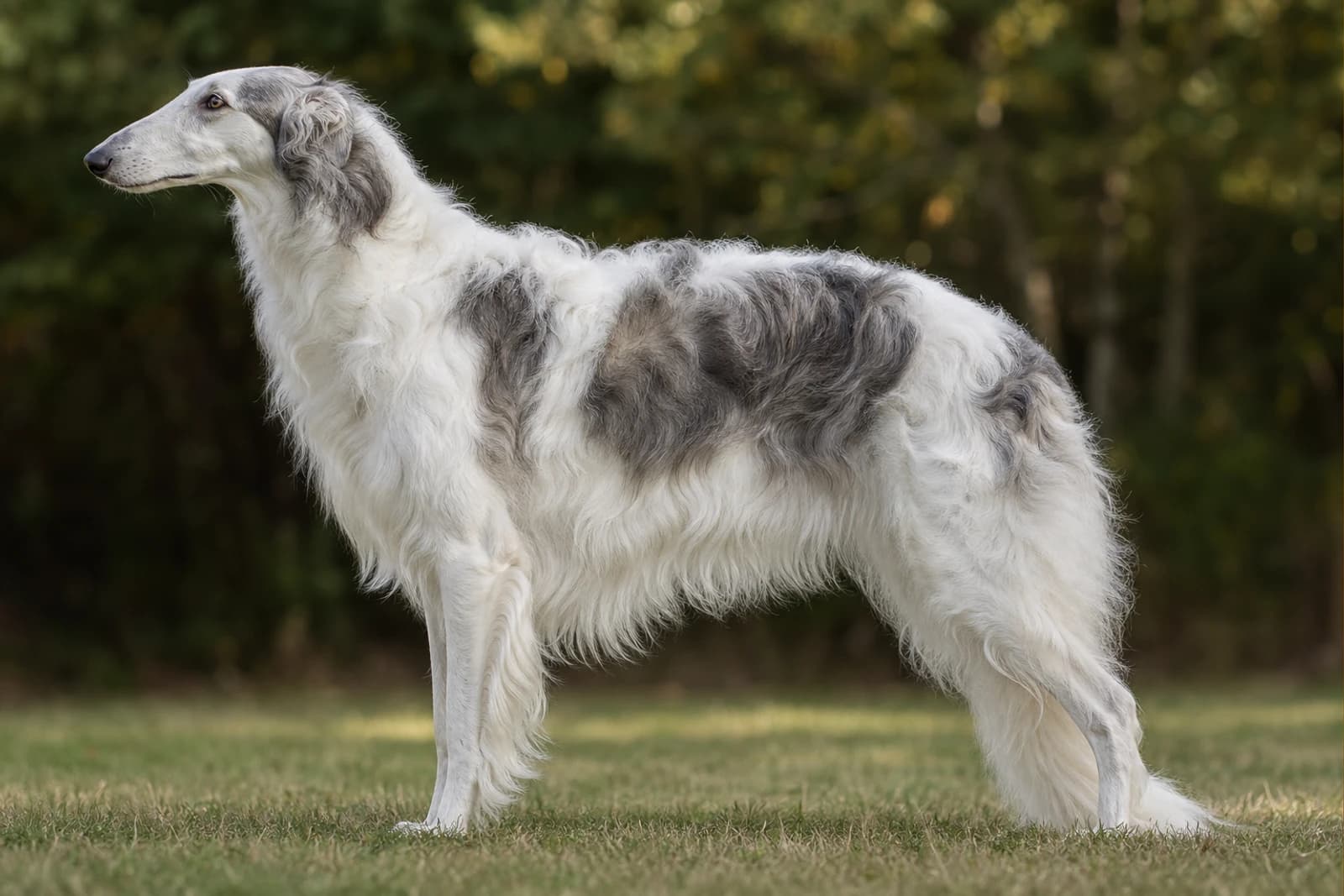
The Borzoi, also known as the Russian Wolfhound, is a graceful and noble giant sighthound built for speed and endurance. These quiet, sensitive dogs are gentle with their families but aloof with strangers. They need daily exercise and a secure, fenced area to run, but are calm and dignified indoors. Not suited for novice owners, the Borzoi thrives in a home that understands sighthound independence and strong prey drive. With their long, silky coat and aristocratic bearing, they are a stunning, loyal companion for the right household.
At a glance
- Size
- Giant
- Height
- 27–29 in
- Weight
- 60–106 lb
- Life span
- 11–13 years
- Coat colors
- White, Gold, Red, Gray, Brindle, Black, Cream, Silver
- Coat type
- Long, silky, flat or wavy coat
- Group
- Sighthounds
- Origin
- Russia
How much does a Borzoi cost?
Adopt / rescue
$75–$400
Usually includes spay/neuter, first shots, and a microchip.
Buy from a breeder
$700–$2,000
From a reputable, health-testing breeder.
Approximate USD. Prices vary widely by region, breeder, pedigree, age, and coat colour — adopting is the lower-cost and recommended route. Avoid suspiciously cheap “breeders”; they’re often puppy mills.
Estimate the full cost of a Borzoi →Borzoi photos
Views
Front, side, rear and top — the full silhouette.Poses
How the breed sits, lies, moves and plays.Puppy to senior
The breed across its whole life.Expressions
The breed’s range of moods.Close-up details
Eyes, ears, nose, paws, tail and coat.Coat colors
The breed’s recognized colors.Click any photo to enlarge. We show the Borzoi from every angle — three views, poses, life stages, expressions, close-ups, coat and colors.
Appearance & size
A Borzoi stops you in your tracks the first time you see one — tall, impossibly slender, and moving like silk in the wind. This is a giant sighthound with a build that says speed and grace in equal measure. Males stand 28 to 29 inches at the shoulder; females generally 27 to 28 inches. Weight swings from a lean 60 pounds in a smaller female to a muscular 106 pounds in a big male, but even the heaviest ones carry zero bulk.
The silhouette is unmistakable. From the side, you see a deep, narrow chest that leaves plenty of room for galloping lungs, a dramatic tuck at the waist, and long, straight legs with fine bone. The back arches just slightly, dropping into a low-set, curved tail that hangs nearly to the hock when the dog is relaxed. From the front, the chest is surprisingly deep and narrow, the front legs set straight and close together — not a wide, bulldog stance. From the rear, the hindquarters are broad and powerfully muscled, angulated enough to drive a double-suspension gallop, but still handled with an almost delicate curve.
The head is long and lean, with a barely perceptible stop and a slight Roman curve to the muzzle. Dark, almond-shaped eyes sit close to the skull, and the expression is calm, intelligent, and distinctly reserved — this is not a dog that gushes affection at every stranger. Ears are small, set high, and lay back along the neck when the dog is at ease, giving the profile an even sleeker line. When alert, they can tip forward, but they never look heavy or houndy in the traditional sense.
The coat is a story of contrasts. Silky soft, it can be flat or slightly wavy, never woolly. It lies close on the head, ears, and front of the legs, then feathers into long fringes behind the thighs, down the tail, and around the neck and chest — the neck frill is especially lush in mature dogs who still carry a winter coat. Colors run the gamut: solid white, red, fawn, black, brindle, or any of those mixed with white. You’ll often see a white dog with red or brindle patches, a deep silver brindle, or a rich gold with a black mask. No color combination is penalized, and coats can shift over time, with puppies darkening or lightening into adulthood.
History & origin
A Noble Hunter from Russia
The Borzoi was built for a single, breathtaking job: running down wolves. Russian nobility began sculpting the breed in the 14th to 15th centuries, crossing swift sighthounds from the Middle East—likely Arabian Greyhounds—with robust native dogs that could handle brutal winters. The result was a tall, deep-chested athlete with explosive speed and the nerve to hold a cornered wolf until mounted hunters arrived. For centuries, these dogs were called Russian Wolfhounds, a name that tells you exactly what they did.
Coursing wolves wasn’t sport for commoners. It was a grand, ritualized affair on the sprawling estates of tsars and boyars. A single hunt might involve more than a hundred Borzoi, matched in pairs or trios, plus horses, hunters, and beaters. The dogs were bred exclusively within the aristocracy, never sold or given away outside that circle. That isolation kept the type pure for generations, producing a dog that paired refined elegance with surprising toughness. The name Borzoi itself comes from the old Russian word for “fast.”
The 1917 Russian Revolution nearly erased the breed. Associated with the wealthy class the revolutionaries despised, thousands of Borzoi were slaughtered. A handful survived thanks to individuals who spirited dogs across borders and to established lines already exported to England and other European countries. A few earlier imports had reached America in the late 1800s, giving breeders a foothold. The American Kennel Club recognized the Borzoi in 1891, and dedicated fans gradually rebuilt the population around the qualities of the old aristocratic hunts.
Today’s Borzoi is a quiet, gentle companion with a dramatic silhouette, but the coursing instinct is still right under the skin. A fenced yard and a long leash aren’t just precautions—they’re acknowledgments of a history that makes a Borzoi who he is.
Temperament & personality
At home, a Borzoi is a quiet, elegant shadow—often a 100-pound cat who’s decided the softest spot on the sofa is theirs. They’re deeply affectionate with their own people, leaning their full weight against your leg or curling up with a deep sigh. This isn’t a bouncy, in-your-face breed; their love is calm, steady, and given on their terms.
With strangers, the story flips. Borzoi are highly wary and can be strikingly aloof. They don’t do the tail-wagging meet-and-greet; a person who crowds them or reaches out too fast may trigger a sudden snap. This is a dog that values personal space and can react sharply when stressed or cornered. Children must learn to give the dog room, especially during meals—never interrupt a Borzoi while they’re eating, because it can fuel food guarding. Slow, low-pressure introductions are everything.
Beneath the silky coat, there’s a stubborn, independent mind. Borzoi were bred to make split-second decisions while chasing game, and that self-reliance hasn’t faded. They’re strong-willed, not pushovers. Harsh corrections or repetitive nagging shut them down or spark resistance. What works is respectful, consistent engagement—a partnership, not a command performance. If you appreciate a dog that thinks for itself, that intelligence feels like a quiet conversation rather than a training drill.
A handful of quirks shape daily life:
- Watchful, not guardy. They’ll notice every leaf that flutters past the window and may issue a single deep bark, but don’t expect them to hold a burglar at bay. Their wariness makes them back their bark if they truly feel threatened, but they’re more likely to retreat and observe.
- Prey drive on a hair trigger. A squirrel, a fleeing cat, a plastic bag skittering across a field—any of these can erase years of training in a heartbeat. A securely fenced yard is non-negotiable; off-leash freedom in unsecured areas is a gamble you’ll lose one day.
- Sensitive to being alone. A Borzoi left by themselves for long hours often develops anxiety-driven behaviors: excessive barking, destructive chewing, or house soiling. They need their people nearby, and a neglected dog can become a noisy, stressed one.
- Cat-like cleanliness. Many owners swear their Borzoi grooms itself like a cat and house-trains quickly. Still, old urine smells inside are a powerful cue to re-offend, so clean accidents with an enzyme cleaner or a vinegar spray to break the scent cycle.
With their quiet nobility and keen, watchful nature, Borzoi reward owners who respect their boundaries and offer steady, gentle companionship. Push too hard, and they’ll politely step away; earn their trust, and you’ll have a loyal, almost telepathic friend who seems to know your mood before you do.
Good with kids, dogs & other pets
A Borzoi is patient and non-aggressive by nature, which sounds ideal for kids — and in a calm household, it can be. The catch is that this is a 60-to-106-pound dog who doesn’t always know his own size. A friendly lean can floor a toddler, and a sudden gallop through the living room is like a small horse on a tear. They do best with older children who understand how to move around a dog without startling him.
This is not a breed that rolls with noise and chaos. Frequent visitors, shouting, and unpredictable activity stress them out. If your home runs at a constant roar, a Borzoi will withdraw rather than join the fun. That said, their default with kids is gentle and tolerant — just always supervised, especially around little ones who grab or squeal.
With other dogs, early socialization makes all the difference. Grew up with a pack? A Borzoi typically coexists peacefully with dogs of similar size. Small dogs that dart and squeak can trigger a sighthound’s prey drive, turning a play session into a chase. Some individuals never see tiny dogs as anything but targets, so introductions need to be slow and on-leash until you know.
Then there are cats and small pets. A Borzoi was bred to spot movement across an open field and sprint it down. That instinct doesn’t negotiate. Some live peaceably with the family cat they were raised alongside, but a cat that bolts out the door or a neighbor’s rabbit hutch is fair game in the dog’s mind. Even a well-socialized Borzoi can revert to instinct in a split second. No amount of training fully erases that wiring; responsible management means physical separation when you aren’t there to supervise.
The socialization clock runs hard and fast. Between about 3 and 16 weeks, a Borzoi puppy needs calm, positive exposure to kids, other dogs, and the everyday world — otherwise you risk an anxious adult who startles easily or reacts out of fear. After that window, forcing an already-wary adult into novel situations can backfire, making fear worse. If you adopt an older Borzoi who is happiest in the quiet company of one or two trusted people, respect that. He doesn’t need to meet every dog at the park.
Trainability & intelligence
Borzois are smart, but they weren’t designed to follow orders—they were built to spot a flicker of movement half a mile away, make their own split-second decision, and run it down at 35 miles an hour. That means training a Borzoi feels less like obedience school and more like a respectful negotiation between two independent minds.
Why trust matters more than commands
This breed shuts down under pressure. A raised voice, a yank on the leash, or drill-style repetition can make a Borzoi mentally check out or simply walk away. They respond to patience, consistency, and a relationship built on positive reinforcement—praise, a game of tug, or a high-value treat delivered right when they offer the behavior you want. Because they’re not always food-crazed, you’ll need to figure out what makes your particular dog light up: for some it’s a squeaky toy, for others it’s the chance to run with you. Keep sessions short, varied, and quit the moment they nail it. If you push for one more rep, you teach them that training is tedious, and they’ll remember that tomorrow.
The recall reality
Recall is the hill where most Borzoi training dreams go to die. The same instinct that makes them breathtaking to watch in a lure coursing field—an explosive chase drive—overrides everything when a squirrel or a loose dog appears on the horizon. You can build a solid recall in the living room, and you can proof it in a fenced field until it’s muscle memory. But in an unenclosed space, a running Borzoi is covering 100 yards in a handful of seconds, and no treat competes with that primal rush. That’s not disobedience; it’s a thousand years of selective breeding. So off-leash freedom outside a secure area isn’t a goal, it’s a risk. A long training line and a six-foot fence are your best tools.
Socialization is non-negotiable
Borzois who miss early, careful exposure to the world often grow into adults who startle easily and react with fear. The prime window for puppy socialization runs from 3 to 14–16 weeks. During that time, introduce your pup to a wide range of people (men, kids, people in hats), other calm dogs, household sounds, and different surfaces underfoot. Keep every encounter gentle and pair it with something good—a treat, soft talk, a quick play session. Don’t force interactions; let the pup investigate at its own speed. After that window, you’ll maintain those positive experiences through adolescence and beyond. Mature Borzois tend to be aloof with strangers, but a well-socialized one stays neutral and confident rather than spooky.
- What works: Reward-based shaping, food/play motivation tailored to the dog, short upbeat sessions, a calm voice, and massive proofing in increments.
- What backfires: Punishment, impatience, force, or expecting a border collie level of handler focus. All you’ll get is a dog who doesn’t trust you.
Start the day your puppy comes home—tie training into daily life, keep it low-pressure, and gradually raise the bar. A Borzoi who enjoys cooperating with you is a safe, confident companion. A Borzoi who learns that training means pressure and harsh corrections learns to avoid you. The real win isn’t about perfect heeling; it’s about building a bond strong enough that your dog chooses to check in, even when the world is full of interesting prey.
Exercise & energy needs
A Borzoi might look like a laid-back aristocrat indoors, but outside he’s a sprinter bred to chase wolves across the Russian steppe — and his exercise needs reflect that. Plan on two 60‑minute sessions a day, and at least one of them must give him room to gallop full‑out in a safely fenced area. A few sedate leash walks won’t cut it; these sighthounds need off‑leash running to stay sane and physically healthy.
Because they hit 35 mph in seconds, a flimsy fence or an unfenced park is a disaster waiting to happen. A blink and he’s a quarter‑mile gone after a squirrel. Focus on large, enclosed fields, securely fenced dog parks (if he’s tolerant of other dogs), or fenced‑acreage rentals. Lure coursing is the perfect outlet — it mimics the chase, satisfies his prey drive, and gives his mind a job to do. Open‑field sprints, flirt poles, and short bursts of canicross (on soft ground, not pavement) also work well.
Mental stimulation fills the gaps. A 10‑minute scent game in the yard, a challenging puzzle toy, or hiding his breakfast around the house taps into the independent problem‑solving side of a hound who’s used to thinking for himself. Without that, a bored Borzoi can turn anxious or destructive.
A few cautions: giant, deep‑chested dogs can be prone to bloat, so no intense running right after meals. Growing puppies and adolescents shouldn’t do repetitive forced running or jarring jumps — their joints need low‑impact sprinting, not marathon pounding. In hot weather, opt for early‑morning or evening runs and watch for overheating, because that thick coat and big body trap heat.
If you can trade a monotonous jog for a hard, fast sprint session followed by a mental wind‑down, you’ll have a calm, content dog who’s happy to lounge the rest of the day.
Grooming & coat care
The Borzoi’s long, silky coat is a single coat with no insulating underlayer, but the fine feathering behind the ears, on the chest, back of the legs, and tail tangles in a heartbeat. Plan on two or three thorough brushings a week as a baseline, and daily sessions during the twice-a-year shedding blow when dead hair cascades off the dog.
-
Brushing tools A pin brush with rounded tips or a slicker brush designed for long coats pulls out loose hair and gently detangles without scraping the skin. Go over feathering and thick areas with a metal comb afterward to find hidden snarls. Bristle-only brushes just skate over the surface here, so save those for short-coated breeds.
-
Bathing A bath every three or four months — or whenever the dog finds something foul to roll in — works well. Use a mild dog shampoo and a creamy conditioner to keep the long hair from snapping. Rinse until the water runs absolutely clear, then towel off. Dry completely with a low-heat blow dryer while you brush, especially in the dense feathering behind the ears and on the thighs; any trapped dampness invites hot spots and a musty-dog smell.
-
Nails, ears, teeth Trim nails every four to six weeks with a grinder or heavy-duty clippers — neglected nails affect the Borzoi’s upright pasterns and splay the feet. Clean those drop ears weekly with a dog-specific solution to avoid moisture buildup. Brush teeth several times a week to keep tartar from hardening.
-
Seasonal shedding Twice a year the coat comes out in fistfuls. A warm bath followed by a long blow-dry and line brushing blows out the bulk of it before it coats your sofa. Outdoor activity also nudges dead hair loose, so your daily off-leash runs do double duty.
Run your hands over the dog during every session. Under all that silk you’ll find small bumps, scratches, or skin changes early, before they turn into a vet visit.
Shedding & allergies
You’ll find Borzoi hair on your clothes, your sofa, and probably your morning toast. This is a moderate-to-heavy shedder with a long, silky coat that goes through dramatic seasonal blowouts.
- Year-round shedding: Even with routine brushing, a steady rain of fine hair settles on floors and furniture. A good vacuum and lint rollers become household staples.
- Seasonal blowout: Twice a year—typically spring and fall—the dog drops undercoat in earnest. You’ll be able to gently pluck whole tufts of loose fur. Daily brushing during these periods cuts down on the tumbleweeds, but accept that your house will look like a wooly snow globe for a few weeks.
The coat itself is single-layered, without the dense undercoat of a Husky, but the sheer length and volume mean plenty of airborne fluff. Hard surfaces make the shed obvious; dark fabric acts like a magnet.
Drool is minimal for a giant breed. Some Borzoi will leave a wet chin-mark on your leg after a long drink, and a few get stringy when they’re eyeing dinner, but you’re not mopping jowls constantly.
As for allergies: no dog is truly hypoallergenic, and a Borzoi sheds far too much to be a safe gamble for allergy sufferers. The actual triggers—dander, saliva proteins—hitch a ride on all that loose hair and spread through your home. If you have mild allergies, spend hours inside a breeder’s or owner’s home before committing. Many people react, and “less shedding than a Lab” is not a claim you’ll ever make about this breed.
Diet & nutrition
Borzois are deep-chested, which puts them at real risk for bloat — so the single most useful change you can make is feeding two or three smaller meals a day instead of one big one, and keeping them quiet for at least an hour before and after eating. A slow-feeder or puzzle bowl helps wind-suckers who bolt their food.
How much to feed
Portions depend on size, metabolism, and how hard your dog actually runs. A 75–85 lb adult Borzoi who gets a solid daily gallop may need around 1,800–2,100 calories; a quieter 100-lb male might do fine on 2,200. Start at roughly 2–2.5% of your dog’s ideal body weight per day in a raw or gently cooked diet, then adjust by feel. You want a visible waist from above and the last two ribs easily felt under a thin layer of flesh. Free-feeding is a fast track to obesity in a breed that carries any extra weight directly on long, slender legs and a spine that doesn’t forgive it.
Keeping them lean
Some Borzois are picky grazers; others inhale everything and would happily eat themselves round. Weigh your dog monthly. If the ribs start disappearing, cut back 5–10%. Even a few extra pounds can worsen arthritis or disc issues later on. Older dogs are especially prone to creeping weight gain as sprinting tapers off — preemptively reduce food, don’t wait for the scale to spike.
What to put in the bowl
Base the diet on animal protein. A practical split for many Borzois looks like 60% raw or lightly cooked meat and organ meats, 20–30% puréed or finely processed vegetables and fruits, and the remaining 10% from eggs, plain yogurt, or occasional grains like pearl barley or white rice. Puréeing or blending the plant matter improves nutrient absorption since a dog’s jaw only chops vertically and they don’t start breaking down carbohydrates in the mouth. Raw meaty bones — chicken wings, duck necks — can be introduced around twelve weeks, always supervised.
Puppies and seniors
Giant-breed puppies need slow, controlled growth to protect developing joints. Feed a large-breed puppy formula or a carefully balanced home-prepared diet in four evenly spaced meals until four months, three meals until six months, then two meals for life. Transition any new food gradually with lightly cooked, puréed meats and vegetables.
Older Borzois often do better on three smaller meals. There’s no strong case for slashing protein; keep the meat quality high and purée if missing teeth make chewing tough. Skip rich holiday trimmings and fatty scraps — a single greasy meal can trigger pancreatitis in this breed.
Health & lifespan
Borzoi typically live 11 to 13 years. That’s a solid run for a giant breed, but a few health conditions show up often enough that you’ll want to be ready for them long before any symptoms appear.
Bloat is the emergency to commit to memory
Deep chests come with a real danger: gastric dilatation-volvulus, or bloat. The stomach fills with gas and twists on itself, cutting off blood flow. It can kill a dog in hours. Feed two or three smaller meals spread across the day instead of one giant portion, and keep your Borzoi quiet — no hard running or rough play — for at least an hour before and an equal stretch after eating. Know the red flags: a swollen belly that feels tight like a drum, unproductive retching, drooling, and sudden restlessness. Some owners choose a preventive gastropexy, a surgery that tacks the stomach in place, often performed at the same time as a spay or neuter. Have the conversation with your vet early.
Joints and bones grow fast — and break down early when they’re stressed
All that height and weight puts real torque on developing joints. Hip dysplasia and elbow dysplasia both appear in the breed, which is why responsible breeders look for OFA or PennHIP scores before a breeding decision. As the years pile on, arthritis becomes a familiar adversary. The single most powerful tool you have is weight management. A Borzoi at a healthy weight isn’t just “not fat” — you should be able to see a hint of the last few ribs and feel them clearly under a thin layer of skin. Every extra pound chews into cartilage you can’t get back.
Eyes and heart deserve a specialist’s look
Progressive retinal atrophy (PRA) and other inherited eye diseases can steal vision gradually. Reputable breeders run annual eye exams through a veterinary ophthalmologist and share those results openly. In some lines, heart conditions like dilated cardiomyopathy surface, so if the pedigree suggests it, ask for cardiac clearances as well. These aren’t everyday problems for most Borzoi, but they’re significant enough that you want the paperwork.
They adore cold weather and wilt in the heat
That long, silky coat is built for Russian winters, not July sidewalks. Borzoi overheat quickly when temperatures climb. Exercise in the early morning or late evening during hot stretches, always provide shade and cool water, and watch for heavy panting or a sudden lack of coordination. Heat exhaustion turns into heat stroke fast in this breed.
Routine care catches the rest before it catches you
Yearly vet visits let you spot early signs of trouble, from subtle heart murmurs to skin issues that hide under all that coat. Run your hands over your Borzoi regularly — feel for lumps, hot spots, or dry, flaky patches. Keep heartworm prevention going every month during mosquito season and one month beyond it. Stay current on rabies vaccination; it’s legally required and there’s no cure once symptoms appear. And don’t ignore small behavior shifts like a drop in appetite or a sudden preference for sleeping in a different spot. Those quiet signals are often the first things your vet needs to hear.
Living environment
A Borzoi is a giant sprinter built to course across open fields — and that instinct doesn't disappear behind four walls. The single most important requirement is a securely fenced yard. These dogs see a squirrel or a fluttering leaf and can hit 35–40 mph in a few strides, completely deaf to a recall command. Underground electronic fences won't cut it; a physical barrier at least 6 feet high is non-negotiable. Off-leash walks in unenclosed parks are a gamble you simply don't take.
That said, this is not a backyard-only dog. Borzoi are famously indoor loungers — they'll drape themselves across your sofa for hours after a good run. A house with a yard is ideal, but a spacious, quiet apartment can work if you commit to two daily outings that include a full-tilt sprint opportunity. Think a fenced dog park or a lure-coursing session, not just a leash walk around the block. Without a place to stretch those long legs, a bored Borzoi can become restless, and a restless 100-pound dog can do real damage to doorframes and drywall.
Climate-wise, the breed's dense double coat makes it surprisingly cold-tolerant; your Borzoi will happily trot through snow and may even prefer sleeping in a cool room. Heat is another story. Temperatures above 80°F can be dangerous — limit outdoor exercise to early mornings or evenings in summer, provide shade, and never leave one in a hot car. Their deep chests also put them at risk for bloat, so skip intense activity right before and after meals.
As for noise, Borzoi are exceptionally quiet. Barking is rare, reserved for genuine alarm, which makes them a good fit for close neighbors. The flip side is their sensitivity to being alone. They form deep bonds with their people and can develop serious separation anxiety if left solo for a full workday, day after day. Crate training from puppyhood, puzzle toys, and gradually building up alone-time tolerance help, but this is a breed that suffers in isolation. If your household is empty for 8–10 hours straight, a Borzoi isn't the right match.
Who this breed suits
Best-fit homes
- A calm adult who wants an aristocratic housemate. The Borzoi is quiet and regal indoors, often spending hours draped over a couch without a sound. A single person or couple with a predictable schedule — especially one that allows a midday potty break — gets a dog that’s startlingly low-key once its daily sprint needs are met.
- Families with older, dog-savvy kids. Borzois are gentle, but at 60–106 pounds and with a sudden 35-mph burst, they can accidentally knock over a toddler. Children who understand soft hands and don’t squeal-and-chase will find a serene, loyal shadow.
- Sighthound veterans. If you’ve lived with a Greyhound, Whippet, or Afghan, the Borzoi’s independence won’t throw you. They respond to calm, positive guidance and ignore repetition drills. You already know the drill: a treat bag, a secure fence, and zero off-leash trust except in enclosed areas.
- Seniors with a truly secure, large yard. The breed’s indoor mellow makes it a natural fit for a retired person who can’t do hours of walking. But you must be physically able to handle a 100-pound dog on a leash that will lunge sideways when a squirrel darts out. A 6-foot solid fence lets the dog exercise itself in explosive zoomies while you watch from the porch.
More challenging matches
- First-time dog owners. A Borzoi is not forgiving of mistakes. Harsh tones make them shut down, and a beginner’s tendency to repeat commands will bore them into ignoring you. A Labrador forgives your learning curve; this breed doesn’t. You can succeed with a great mentor, but expect a steeper climb.
- Apartment dwellers without private run access. Yes, they’re couch potatoes inside. But they desperately need daily off-leash sprints. Dog parks are a dangerous gamble — a yapping Maltese can instantly light up their ancestral drive to chase down small furry things.
- Homes with cats, rabbits, or toy-breed dogs. A few Borzois coexist peacefully with cats they’re raised alongside, but the breed’s 600-year job was running down fleeing animals. That instinct isn’t a switch you flip off. Too often, the outcome is a dead family pet.
- Anyone dreaming of an off-leash hiking companion. Forget it. A distant deer or a blowing leaf can make a Borzoi deaf to any recall. Plan on a long line or an enclosed field, always.
- People who want a dog glued to their side. Borzois love you, but they aren’t needy. They’ll lean against your leg for five minutes, accept ear rubs, then retreat to a quiet corner. That aloofness is a feature, not a flaw, if you enjoy a dog with its own mind.
Cost of ownership
A well-bred Borzoi puppy from a responsible breeder who health-tests for cardiac, thyroid, and eye issues typically lands between $2,000 and $4,000. Show-potential pups or those from exceptional European lines can push past $5,000. Rescue adoption fees, when a Borzoi surfaces, usually run $300–$700, but they’re rare in shelters.
Ongoing costs hit hard because this is a giant breed with specific needs. Food will be your biggest monthly line item. A 90-pound adult eats 4 to 5 cups of high-quality kibble a day — that’s roughly $80–$120 a month, more if you go raw or add fresh toppers. Treats for training (yes, they need motivation) add another $15–$25.
Grooming is simpler than the flowing coat suggests. A weekly thorough brush and an occasional bath keep things in check. You’ll still want a good pin brush, a comb, and a detangling spray. Budget $30–$60 every two months if you hire a pro for sanitary trims and nail work, or $15–$25 a month in DIY supplies.
Vet care carries familiar giant-breed risks. Routine checkups, vaccines, and preventives run $400–$700 a year. But a Borzoi’s deep chest makes bloat (GDV) a genuine emergency — an unplanned surgery can cost $4,000–$7,000. Hip and elbow dysplasia, osteosarcoma, and heart disease also appear in the breed. Pet insurance for a giant breed often sits between $60 and $110 a month depending on your deductible and coverage level. If you self-insure, put away at least that much in a dedicated account, because a single major incident will drain it fast.
Beyond the basics, factor in a 42-inch crate ($150–$300), a martingale collar and a lightweight long line for safe gallops, and the reality that a Borzoi will destroy flimsy beds. Counting everything, a realistic monthly nut lands in the $200–$350 range, not counting the initial purchase or an emergency fund. The first year, with puppy shots, spay/neuter, and gear, often tops $5,000 all in.
Choosing a Borzoi
Finding a healthy, stable Borzoi means taking your time with a breed that’s a giant sighthound, not a low-key lap dog. You’re looking at a dog who can easily weigh 60 to 106 pounds and stand 27 to 29 inches tall, with lightning speed and a deeply sensitive streak. Start by deciding between a responsible breeder and a breed-specific rescue—both can get you a great dog, but the paths differ.
Health Clearances You Need to See
Borzoi can deal with a few serious health issues, so you want paperwork, not promises. Ask breeders for OFA hip evaluations (a rating of Fair or better is typical), a cardiac exam done by a board-certified cardiologist, and an eye exam from a veterinary ophthalmologist. Some will also test thyroid function. Bloat is a real threat in deep-chested dogs like this. While there’s no genetic test for it, a good breeder knows the lines and can talk openly about whether they’ve seen it. You might also hear about breeders who perform a prophylactic gastropexy on puppies—it’s not a guarantee, but it can reduce the risk.
What Screams “Walk Away”
A breeder who doesn’t offer to show you the dam, or who uses a sire they’ve never met and can’t describe, is skipping the basics. Avoid anyone selling puppies on a first-come, first-served basis without a questionnaire about your yard, fencing, and experience with independent sighthounds. Red flags pile up fast: no AKC or national club registration, “health guarantee” that only lasts a week, puppies always available, multiple litters on the ground at once, and a refusal to take back a dog for any reason. If they mock you for asking about heart tests or hip scores, move on.
Picking Your Puppy
Spend time watching the litter interact. A Borzoi puppy who hangs back and assesses you before approaching isn’t necessarily shy—that’s often the thoughtful, typical temperament. The tornado bouncing off the walls may grow into a dog who’s harder to settle. Ask specifically about the parents’ prey drive. If you have cats or small dogs, the breeder should have already raised pups alongside them or be brutally honest about odds. A great breeder matches you to the pup, not the other way around.
Rescue as a Very Real Option
Borzoi rescue groups often have young adults and middle-aged dogs who are past the chewing-and-sprinting stage. The huge advantage is that you’ll know the dog’s actual size, temperament, and prey drive before you bring him home. Adoption coordinators can tell you whether a particular dog walked into a cat test and yawned or went rigid. Wait times can be long, and you might not get a puppy, but you’ll avoid many puppyhood headaches. Expect the rescue to grill you just as thoroughly as a conscientious breeder would. Medical histories can have gaps, so budget for a thorough vet check and possibly updated cardiac or eye exams if records are thin.
Take the time. A well-sourced Borzoi can give you more than a decade of quiet elegance and short, explosive zoomies in a safely fenced field.
Pros & cons
Pros
- Quiet, calm house dog: Borzoi are gentle and dignified indoors—they’ll happily sleep on the couch for most of the day and rarely bark without reason.
- Low-maintenance coat: Their silky, medium-length coat sheds lightly year-round with seasonal heavy blows. Weekly brushing handles most of it, and there’s little doggy odor.
- Affectionate but not clingy: They bond deeply with their family, offering sweet, quiet affection on their own terms. You get a loyal shadow without constant neediness.
- Clean and polite: Many owners describe them as cat-like—they groom themselves, are naturally tidy in the home, and don’t slobber.
- Good with respectful kids and other dogs: Their sighthound pack instincts make them tolerant of canine housemates, especially other Borzoi. They’re usually patient with children who understand they’re not roughhousing partners.
- Elegant sprint athlete in a manageable package: A 30–45 minute daily romp in a safely fenced area or a long-line sprint session satisfies their exercise needs. After that, they’re content to lounge.
Cons
- Extreme prey drive: Anything small and fast—cats, squirrels, Chihuahuas—can trigger a full-speed chase. Off-leash reliability isn’t in their nature; you’ll need secure fencing at all times.
- Independent streak in training: They’re smart but not biddable. Commands that make sense to a retriever often get a Borzoi’s “maybe later” stare. Patience and short, positive sessions are essential.
- Not a velcro or demo dog: Aloofness with strangers is the breed default—they aren’t tail-wagging greeters. If you want a dog that lives to please everyone, this isn’t it.
- Giant breed health concerns: Bloat is a real and urgent risk; responsible breeders screen for osteosarcoma, heart issues (DCM), and eye diseases like PRA. Lifespan of 11–13 years means you don’t get as many years as with smaller breeds.
- Space and containment demands: Indoor couch-potato life works well IF you can provide a large, fenced yard or regular access to a safe open field. Apartments without that daily sprint outlet lead to a frustrated, destructive hound.
- Grooming can hide trouble spots: Silky feathering behind the ears and on the legs mats if ignored. You’ll also need to stay on top of nail trims (their hare-like feet are sensitive) and ear checks.
Similar breeds & alternatives
Greyhound
A natural step down in size if the Borzoi’s height and weight feel like more than you want to manage. Most Greyhounds stand 27–30 inches but weigh just 60–70 pounds — compact enough to curl up on the couch without taking it over. Their short, single coat needs zero brushing beyond a quick wipe, sheds less, and dries in minutes. The trade-off is weather protection: you will need a coat for them in genuinely cold winters, while the Borzoi’s double coat handles frost without fuss. Both breeds share the same sprint-hard-then-sleep-hard rhythm indoors, but Greyhounds are typically less aloof and more likely to greet visitors with a wag rather than a stare.
Irish Wolfhound
If the Borzoi feels imposing, the Wolfhound tips the scales much further. Males commonly reach 32–34 inches and top 150 pounds. That extra bulk comes with a much shorter lifespan — 6 to 8 years is typical — and a rough, wiry coat that needs hand-stripping or clipping to stay tidy. Temperament-wise, both are gentle house companions, but Wolfhounds lean more openly friendly, while the Borzoi is often cat-like and selective with affection. The Borzoi’s silky feathering is lower-maintenance than the Wolfhound’s dense, dirt-collecting coat, and the Borzoi tends to be a little more agile on its feet despite its size.
Afghan Hound
At first glance, both breeds are long-haired head-turners. The practical difference is in the maintenance. An Afghan’s fine, human-hair-like coat mats quickly and demands near-daily brushing, plus regular baths and blow-dries to keep its sheen. A Borzoi’s weather-resistant double coat sheds seasonally but stays tangle-free with a weekly going-over — far less work. Afghans are also famously independent and can be harder to motivate with training, whereas Borzois often respond to calm, consistent encouragement. If you want the dramatic flowing silhouette in a colder climate, the Borzoi’s coat handles wet, snow, and mud with less ongoing effort.
Scottish Deerhound
The Deerhound matches the Borzoi’s general frame (28–32 inches, 75–110 pounds) but swaps the silky coat for a rough, wiry jacket that gives a wilder, shaggier look. Indoor energy levels are similar: both are quiet, dignified, and need a safe, fenced area to stretch their legs at full speed. Deerhounds are slightly more social with other dogs on average; Borzois can be more possessive or reserved. Grooming-wise, the Deerhound’s coarse coat traps debris and may need more combing to avoid clumps, while the Borzoi’s feathers glide through with a pin brush. Both share that same introvert-with-a-burst personality.
Saluki
A leaner, heat-built cousin for anyone who loves the Borzoi’s grace but lives in a warm climate or wants less dog to handle. Salukis stand 23–28 inches and weigh 35–65 pounds, with a light, silky feathering on the ears and tail. Their smaller frame shrugs off heat well, but they lack the cold-tolerance and sheer presence of a Borzoi. Salukis share the strong prey drive and need for secure fencing, but they often bring an even sharper independent streak. Both breeds are sensitive and will shut down under a heavy hand, but a Saluki’s slighter build makes it a more cat-proof, lap-sized sighthound without giving up that low-key indoor charm.
Fun facts
- Originally bred by Russian aristocracy for hunting wolves, the Borzoi's name means 'swift' in Russian.
- They are one of the tallest dog breeds, with males standing up to 29 inches at the shoulder.
- Borzois can reach speeds of 35 to 40 miles per hour, thanks to their aerodynamic build and powerful lungs.
- Despite their size, they are known as 'couch potatoes' indoors, often enjoying long naps on soft surfaces.
Frequently asked questions
- Are Borzoi good with children?
- Borzoi are generally gentle and calm around well-behaved children, but due to their large size and independent nature, interactions should always be supervised, especially with younger kids who may be startled by their sudden sprints. Early socialization helps them learn to be patient and tolerant.
- Do Borzoi shed a lot?
- Borzoi have a medium-length silky coat that sheds moderately year-round, with heavier shedding typically during spring and fall. Regular brushing a few times a week can help manage loose hair and keep shedding under control.
- How much exercise does a Borzoi need?
- Borzoi need daily exercise, including brisk walks and opportunities to run in a securely fenced area, but they are not hyperactive indoors. A moderate energy level means they can be content with a couple of longer walks or romps each day, plus mental stimulation.
- Are Borzoi suitable for first-time dog owners?
- Borzoi can be a challenge for first-time owners due to their independent streak and sensitivity, often requiring patient, reward-based training. Their sighthound instincts and large size also demand an owner who can provide proper management and a safe, fenced space.
- Do Borzoi bark a lot?
- Borzoi are typically quiet dogs that seldom bark without reason, though they may vocalize to alert or when excited. They are not known as nuisance barkers and tend to be calm and reserved in the home.
- Can Borzoi live in an apartment?
- Borzoi can adapt to apartment living if provided with sufficient daily exercise and mental stimulation, as they are generally calm indoors. However, their large size and need for occasional high-speed running make a home with a securely fenced yard more ideal.
Tools & calculators for Borzoi owners
Quick estimates tailored to Borzois — pre-filled with this breed’s size where it matters.
Articles & stories about the Borzoi
Sources & standards
This profile follows recognized breed standards from the American Kennel Club (AKC) and the Fédération Cynologique Internationale (FCI), along with established veterinary and breed-club guidance. These describe general breed tendencies — every dog is an individual.
Owner stories
Have a Borzoi? Share your experience — grooming tips, personality quirks, anything goes.