

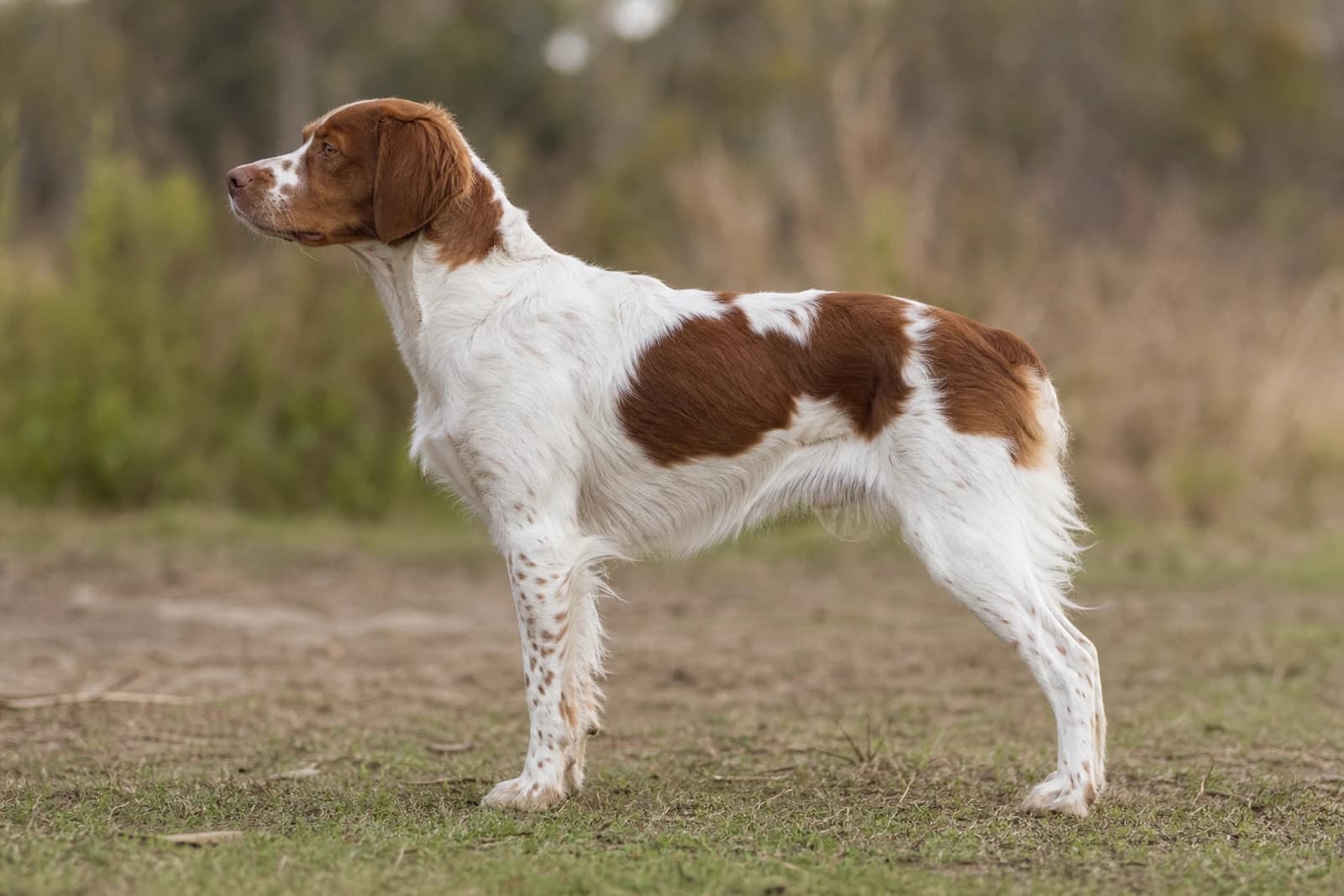
The Bretagne is an athletic, versatile hunting dog from France, best suited for active families or individuals who can provide ample exercise and mental stimulation. With a friendly, eager-to-please nature, this breed thrives on companionship and outdoor adventures. Its keen nose and trainability make it a standout in field trials and obedience, while its affectionate temperament ensures it's a devoted household companion. Though adaptable, the Bretagne needs space to run and may not suit apartment living. Ideal for experienced owners or dedicated first-timers who enjoy training, hiking, or hunting alongside their canine partner.
At a glance
- Size
- Large
- Height
- 18–23 in
- Weight
- 35–53 lb
- Life span
- 12 years
- Coat colors
- orange and white, liver and white, tricolor
- Coat type
- dense, flat or slightly wavy, medium-length fur
How much does a Bretagne cost?
Adopt / rescue
$75–$400
Usually includes spay/neuter, first shots, and a microchip.
Buy from a breeder
$700–$2,000
From a reputable, health-testing breeder.
Approximate USD. Prices vary widely by region, breeder, pedigree, age, and coat colour — adopting is the lower-cost and recommended route. Avoid suspiciously cheap “breeders”; they’re often puppy mills.
Estimate the full cost of a Bretagne →Bretagne photos
Views
Front, side, rear and top — the full silhouette.Poses
How the breed sits, lies, moves and plays.Puppy to senior
The breed across its whole life.Expressions
The breed’s range of moods.Close-up details
Eyes, ears, nose, paws, tail and coat.Coat colors
The breed’s recognized colors.Click any photo to enlarge. We show the Bretagne from every angle — three views, poses, life stages, expressions, close-ups, coat and colors.
Appearance & size
A Bretagne gives the impression of a leggy, well-muscled pointer built for all-day hunts, but when you check the numbers, you see a dog that’s refreshingly moderate. Adults stand 18 to 23 inches at the shoulder and weigh 35 to 53 pounds, with males typically filling out the upper half of both ranges. That puts them squarely in the large category without any of the heft of a retriever. Bone is substantial but never coarse, so the body stays agile and quick on its feet.
Build and silhouette
From the side, the dog is balanced and roughly square — sometimes just a shade longer than tall. A deep, well-sprung chest reaches down to the elbows, and the ribcage carries its width well back into a short, strong loin. The topline is level or has a barely perceptible slope from the withers toward the croup, and the underline tucks up enough to show a long, efficient stride without looking gaunt. Viewed from the front, the forelegs drop straight and parallel, and the chest is deep but not so wide that it pushes the elbows out. From the rear, you see muscular thighs, well-let-down hocks, and a stub tail in constant motion.
Coat and color
The double coat lies flat or with a light wave — never curly — and feels dense, with a fine undercoat that adds weather resistance. Feathering is moderate: backs of the front legs, the rear thighs, the underline, and the ears all carry longer fringe, while the chest feathering stays light. Color is always white combined with clear patches or heavy ticking in orange, liver, or (less commonly) black. A heavily ticked dog can look roan — a speckled, salt-and-pepper effect across the colored areas. You’ll see everything from a mostly white body with a handful of solid orange spots to a dark orange-roan dog with white legs and a white blaze up the face. Nose leather matches the darkest coat pigment, and the oval eyes run amber to brown with that trademark soft, alert gun-dog expression.
Head and tail
The head is wedge-shaped, with a slightly rounded skull, a moderate stop, and high-set ears that are short, triangular, and lightly fringed — they frame the face without the heavy draping you’d see in a Cocker. The real calling card, though, is the tail. Most Bretagnes are born with a natural bobtail 2 to 4 inches long or no tail at all. Longer tails are traditionally docked to that stub length. The result is a clean rear and a wagging nub that telegraphs exactly what the dog is thinking, step after step.
History & origin
The Brittany’s story starts in the scrubby, heather-covered hills and farm fields of Brittany, France, during the 1800s. Local hunters — many of them peasants and poachers who couldn’t afford a whole kennel of specialist dogs — needed a single, versatile gun dog. They bred compact, quick spaniel-type dogs that were already common in the region, then added some English pointing and setting blood. British sportsmen visiting the area brought pointers and setters, and the crosses produced a dog with an intense natural point, a soft mouth for retrieving, and the stamina to work all day without the heavy build of the larger English breeds.
Right from the start, many pups were born with a naturally short tail or no tail at all, a trait the locals favored and one that became a breed hallmark. The dogs were unassuming, biddable, and happy both in the field and in a modest cottage — a true working man’s dog.
Formal recognition took shape in the early 1900s. French breed enthusiasts organized the first standard in 1908, calling the dog the Épagneul Breton (Brittany Spaniel). The “spaniel” label stuck because of the coat — a little feathering and wave — but everyone who hunted over them knew these dogs pointed like pointers, not flushing spaniels. The breed’s versatility earned it a loyal following throughout France and eventually across Europe.
The first Brittany landed in the United States in 1931, imported by Louis A. Thébaud. The American Kennel Club registered the breed in 1934 as the Brittany Spaniel. On American ground, field trial enthusiasts began selecting for a taller, rangier dog with a faster ground-covering style and a shorter coat. By 1982, the AKC dropped “Spaniel” from the name entirely, recognizing it as simply the Brittany — a nod to its pointer-like way of hunting. Meanwhile, many breeders in Europe and a few in the U.S. still preserve the original French type, often labeled French Brittanys, which stay a bit smaller, carry more coat, and work a little closer. The dual lines share the same foundation: a tireless, no-fuss hunting partner bred for people who wanted one dog to point, retrieve, and curl up at the hearth.
Temperament & personality
If you don’t give this dog a real job, she’ll invent one — and you won’t like the landscaping bill. The Bretagne is a high-energy bird dog with a work ethic that borders on compulsion. She needs a solid 60 to 90 minutes of hard, off-leash running every day, not a polite walk around the block. A tired Bretagne is a content Bretagne; a bored one will dig, chew, and bark with impressive dedication.
This is a velcro breed through and through. She wants to be wherever you are — on the couch, in the kitchen, under your feet. She’s openly affectionate and forms a deep bond with her people. While she’s typically gentle, a 40-plus-pound dog vibrating with enthusiasm can knock over a toddler without meaning to. Supervise small kids, and teach everyone to leave her alone during meals to prevent food guarding. She’s far too soft-natured to be a guard dog, but she’s an alert watchdog who’ll announce visitors with a sharp bark before dissolving into a wiggling, tail-slapping welcome.
Training needs a respectful, consistent hand. The Bretagne is smart and independent, but force shuts her down fast. She reads your tone and body language like a book. A harsh correction can cause her to lip-lick, yawn, or turn away — classic calming signals that mean you’ve pushed too hard. Keep sessions short, positive, and fair, and you’ll get a dog who works with you, not against you. That said, her strong will and single-minded prey drive mean reliable off-leash recall takes real work. When her nose locks onto a scent, her ears go offline.
That nose rules her world. Bred to hunt all day, she tracks scent trails with a forward lean and an intense, quivering stillness that can look like aggression to someone who doesn’t know the breed. She may also indulge in a time-honored Brittany pastime: rolling in dead fish, manure, or anything truly foul. It’s not rebellion; it’s just her scavenger ancestry reminding you she’d have made an excellent village garbage dog.
Indoors, that same scent obsession shows up in house-training. A Bretagne marks territory by urinating, especially intact males, and the odor is a persistent cue to go again. Clean accidents with an enzymatic cleaner — vinegar alone won’t break down the proteins — and watch less-used rooms that don’t smell like the family. She may define her “house” by your scent, so a guest bedroom can become a tempting potty spot. Take her out on a schedule and reward outdoor elimination immediately; punishment after the fact just teaches her to hide from you.
She’s also a dedicated chewer. Puppy teething is intense, and adult jaws need hard objects to stay healthy. Supply a rotating cast of tough chew toys, or your baseboards, shoes, and remote controls will pay the price. A homemade citrus spray from boiled peels can redirect her without a battle.
Separation anxiety is a real downside. Neglect or long isolation can spark excessive barking, howling, and destructive chewing. Gradually build up alone-time tolerance from day one, and consider a midday dog walker if you’re gone more than four or five hours. This is not a breed that does well in a sedentary home — plan on daily runs, nose-work games, and a patient training approach, or you’ll find your yard redesigned by an enthusiastic 40-pound excavator with no off switch.
Good with kids, dogs & other pets
The Bretagne brings a steady, forgiving temperament to family life — one of the reasons he’s often described as a gentle playmate for respectful kids. Don’t mistake that softness for laziness, though. At 35–53 pounds of lean muscle, a bouncy adolescent can easily knock over a toddler who’s unsteady on their feet. Supervise interactions until everyone learns the rules: no tail-tugging, no climbing on the dog, and quiet spaces when the dog chooses to step away.
His patient personality really shines when children are taught to interact calmly. Early socialization is the engine behind that kid-friendly adult. The window from about 3 weeks to 16 weeks is when a puppy’s brain soaks up what’s normal and safe. Introduce the pup to gentle handling, the sounds of a busy kitchen, strollers rumpling by, and different ages of people. This isn’t a nice-to-have — it’s the difference between a dog who greets a shrieking 5-year-old with a wag and one who startles or retreats. Even after that prime period, a consistent, positive approach continues to build confidence.
With other dogs, the Bretagne generally reads social cues well and fits easily into multi-dog households when he’s had plenty of neutral puppy play dates and park visits. He’s not typically a quarrel-starter. Same-sex disagreements can pop up with some individuals, but early exposure to varied dogs reduces that risk considerably.
Cats and other pets deserve a realistic look. Many Brittanys coexist with indoor cats they were raised with, especially if introduced in puppyhood with a baby gate and heavy treats. Small, fast-moving pocket pets — hamsters, gerbils, or a bird that flutters — will almost certainly trigger his prey drive. That’s a deep-bred instinct in sporting dogs; it’s not aggression, just a hardwired chase sequence. Keep small animals caged securely in a separate room, and never leave them loose together.
Above all, don’t underestimate his need for near-constant companionship. This is not a breed that handles being shunted to the backyard while the family lives inside. Left alone hour after hour, a Bretagne can slide into anxious barking or destructive habits. Plan for a dog who wants to be underfoot, whether that’s during homework time or a Saturday morning pancake flip.
Trainability & intelligence
You’re working with a dog that wants to figure things out, not just follow orders. The Bretagne is whip-smart, reads your body language in a heartbeat, and learns new cues faster than you can refill the treat pouch. A quick “sit” or “down” won’t be a problem — the challenge is getting that response when a rabbit tears through the yard. That sharp hunting instinct can flip the switch from “attentive student” to “zero recall” unless you’ve built a rock-solid foundation of trust and high-value rewards.
Forget heavy-handed corrections. This breed’s sensitivity runs deep. Raise your voice and you’ll watch her shut down or offer appeasement behaviors that stall real learning. Instead, lean into short, game-based sessions where a tennis ball or a squeaky toy is just as good as a treat. Keep drills under five minutes, end on a win, and you’ll have a dog who throws herself into training like it’s her job.
- Motivation moves fast. A Bretagne is driven by play, movement, and the chance to use her nose. Find what she’ll work for — a tug, a thrown bumper, a handful of freeze-dried liver — and she’ll be all in.
- Recall is an investment, not a given. Start in a quiet hallway at eight weeks, then a fenced yard, then a long line in a field. Reward every check-in before she’s tempted to blow you off. Miss that early window because life got busy, and you’ll be rebuilding trust with an adult who already knows how fun ignoring you can be.
- Socialization demands a gentle touch. Between 3 and 14 weeks, gradually expose her to new people, uneven surfaces, traffic sounds, and friendly dogs — but never flood her. A cautious or low-sociability pup forced into a dog-park scrum can spiral into fear-reactivity that takes months to undo. Short, positive experiences in controlled settings build the steady confidence you want.
Common rough spots: a Bretagne may “forget” commands around moving distractions, dig in if she senses you’re unfair (even if you’re just inconsistent), and substitute her own agenda when bored. The fix is patience and clarity. If she’s staring at a squirrel instead of lying down, she isn’t stubborn — she’s telling you the reward on offer doesn’t beat the 40-pound impulse to hunt. Pay her accordingly.
A well-trained Bretagne isn’t a robot. She’ll still spin in circles when you pick up the leash and use every ounce of that 35 to 53 pounds to get to the door. But you’ll have a dog who checks in, thinks before she bolts, and can settle on a mat when asked — because the relationship, not the punishment, made it worth her while.
Exercise & energy needs
Your Bretagne doesn’t do well with a casual stroll around the neighborhood. This is a serious hunting dog, built to cover ground all day, and that drive doesn’t switch off just because he lives in the suburbs. Plan on at least an hour of genuine exercise every day, broken into two sessions—thirty minutes in the morning, another thirty in the evening, and rambunctious young adults often need more.
- Physical work is the bare minimum. A quick leash walk around the block won’t cut it. He needs to open up and run: off-leash hikes, a fenced field with a Chuckit, or a hard swim. Without that outlet, restlessness can show up as digging, chewing, or barking. Two daily sessions keep him level-headed indoors. Even on slammed days, a 20-minute flirt pole session beats nothing.
- Brain work matters just as much. A Bretagne needs to use his nose and figure things out. Hide part of his dinner in a puzzle toy, lay scent trails in the yard, or practice finding a hidden bumper. Pairing physical effort with a problem—like weaving through cones for a retrieve—tires him out faster than straight-line running.
- Sports that fit. Agility, rally, flyball, dock diving, and competitive scent work all play to his strengths. If you hunt, upland bird work is what he’s made for. If you don’t, a weekend nose-work class gives him a similar buzz.
- Protect growing joints. Bretagnes can be prone to hip dysplasia, and even well-bred pups benefit from caution. Avoid repetitive jumping on hard surfaces and high-impact pounding until growth plates close around 12–18 months. Soft footing, short bursts of free play, and controlled retrieving are safer during that first year and help build stamina without strain.
Grooming & coat care
Brush your Bretagne two or three times a week with a metal slicker brush that has rounded pins, and you’ll keep both shedding and matting in check. Their coat is a medium-length, flat or slightly wavy double layer — dense enough to shed dirt and light rain, with moderate feathering on the chest, legs, and tail that’s prone to tangles if ignored.
- Tools: A slicker brush reaches the soft undercoat; follow up with a greyhound-style comb behind the ears and through the rear feathers where mats sneak in. Skip the bristle brush — it won’t penetrate, though a quick pass over a clean, dry coat adds polish before a show or photo.
- Shedding: Most of the year you’ll see a steady trickle of hair. Twice a year, when they blow coat, expect a heavy drop. During those seasonal shifts, brush daily for a week or so and the worst of it stays in the brush instead of on the couch.
- Bathing: A bath every six to eight weeks — or immediately after a roll in something dead — is enough. Use a mild dog shampoo. Overwashing strips the oils that give the coat its natural resistance to weather and briars.
- Nails, ears, teeth: Trim nails every three to four weeks (the floor-click test never lies). Their drop ears trap moisture and warmth, so a weekly sniff-and-wipe with a damp cotton ball or a vet-approved cleaner prevents yeasty infections. Brush teeth a few times a week with dog toothpaste; it’s dull work, but dental bills hurt more.
- Outdoor life: A Bretagne’s coat turns over faster with plenty of exercise. Hard off-leash runs in the field push out dead hair and support skin health, so the daily romp earns its keep in the grooming department too.
Sticking to this routine takes under ten minutes a session, and it doubles as a weekly once-over for ticks, hot spots, or dry skin before they become bigger problems.
Shedding & allergies
You’ll find a fine, short hair on your dark clothes, your couch, and drifting into corners year-round. The Bretagne is a moderate shedder — not the heavy, tumbleweed-level coat blow of a double-coated spitz, but enough that if you’re fastidious about a hair-free home, you’ll be pulling out the vacuum three or four times a week.
Twice a year, usually in spring and fall, the shedding kicks into a higher gear for a few weeks. This seasonal blowout can catch you off guard. A quick daily brush with a slicker or a rubber curry comb during those weeks makes a real difference, catching the loose undercoat before it settles everywhere.
Drool, on the other hand, is a non-issue. This isn’t a jowly breed, so you won’t be wiping slobber off walls or keeping a drool rag on hand. A bit of moisture after drinking is about the extent of it.
As for allergies, there’s no sugar-coating it: the Bretagne is not hypoallergenic. All dogs produce dander and saliva proteins, and a dog that sheds this consistently spreads those allergens all over the house. If you or a family member have dog allergies, spend time around adult Bretagnes before committing — don’t assume a short coat means less reaction. That short, dense hair embeds itself in upholstery and carpet fibers, making it harder to eliminate than longer, easier-to-lift hair from some wooly breeds.
Invest in a good lint roller and a robot vacuum if you love a spotless floor.
Diet & nutrition
Fuel for a field athlete
Bretagnes were born to cover ground at a gallop. Their diet needs to support that engine without adding extra weight that taxes their joints. Most are enthusiastic eaters — some to the point of obsession — so it’s on you to manage portions, not the dog. An active 40–50 pound adult typically burns through 1,200–1,500 calories a day, which translates to roughly 2½ to 3 cups of a nutrient-dense kibble split between two meals. Use your hand as a gauge: you should feel the ribs under a thin layer of muscle, not see them starkly, and never have to dig through a squishy layer.
If your Brett inhales his dinner, a puzzle bowl or slow-feeder does double duty — it forces him to take smaller bites (reducing the risk of bloat) and gives that busy brain a little workout. Measure every meal and resist the urge to top up the bowl just because he gave you the “I’m starving” eyes. Even a couple of extra pounds can aggravate hips and elbows that are already working hard.
What a solid diet looks like
Lean animal protein does the heavy lifting. Whether you choose a high-quality commercial food or cook at home, aim for a foundation built around meat, fish, or eggs. A practical breakdown for a home-prepared meal: about 60% lean meat and organs, 20–30% dog-safe fruits and vegetables, and 10% extras like cooked egg, plain yogurt, or whole grains. Pearl barley is a digestible, high-fiber grain many Brittanys tolerate well, while plain white rice is a classic reset for a sensitive stomach.
Avoid the trap of thinking a working dog can handle rich table scraps. Fatty trimmings, skin, and holiday leftovers can trigger pancreatitis — a sudden and serious inflammation. Feed him in his own bowl, away from the dinner table, and any dog-safe leftovers you do save should go right into that same bowl later, never off your plate. That keeps begging from ever becoming a habit.
From puppy to senior
- Puppies up to 4 months: Four small meals spaced evenly through the day. Transition a new puppy gradually onto a lightly cooked, puréed diet (finely ground meat, fish, and soft fruits/veg) or a premium large-breed puppy formula. You can introduce raw chicken wings around 12 weeks, always under supervision.
- 4 to 6 months: Drop to three meals.
- 6 months and older: Settle into the adult two-meal rhythm.
Senior Brittanys often lose a step while their appetite stays strong — a recipe for middle-age spread. Dial back food gradually as activity declines, and consider feeding three smaller meals instead of two. If an older dog has missing teeth or a painful mouth, purée everything so he still extracts every nutrient without struggling to chew. There’s no evidence you need to skimp on protein for a healthy senior; just watch the scale and adjust.
Health & lifespan
A well-bred Bretagne typically lives about 12 years—solid, active years when you stay on top of preventive care and pay attention to the breed’s few known weak spots. At 35–53 pounds and 18–23 inches at the shoulder, this is a medium-sized dog, and many of the conditions responsible breeders screen for are the ones you would expect in an athletic, driven field breed.
What responsible breeders screen for
Ask for hip dysplasia clearances (OFA or PennHIP) on both parents. Brittanys can be prone to hip issues even though they are light-framed. Epilepsy also pops up in lines; there is no DNA test yet, so a breeder who tracks seizure history across multiple generations and is open about it is worth their weight in gold. Progressive retinal atrophy and other inherited eye diseases appear occasionally, so yearly eye exams by a veterinary ophthalmologist are one of the best ways a breeder can stack the deck in your favor.
Conditions that show up later
- Hypothyroidism: a sluggish thyroid can steal a middle-aged dog’s energy and coat quality. A simple blood panel catches it, and it is manageable with daily medication.
- Skin allergies: Brittanys can react to environmental triggers or food ingredients. Red, itchy paws or recurrent ear infections often point to an underlying allergy. Keeping a clean, dust-free home and feeding a high-quality diet can sometimes reduce flares, but work with your vet if the scratching won’t quit.
- Bloat (gastric dilatation-volvulus) is less common than in deep-chested giants, but it’s still on the radar. Avoid heavy exercise right after meals.
Day-to-day health moves that pay off
A Bretagne is built to run, so weight management rarely gets out of hand—unless you overfeed. These dogs are famously food-motivated, so measure meals, skip the table scraps, and use kibble as training rewards to keep that lean, muscular frame. A fit body takes pressure off joints and likely lowers the chance of orthopedic trouble ticking over into full-blown lameness.
Mosquito season means heartworm prevention. Give the monthly chewable on time, and don’t drop it until a month after the first hard freeze. Rabies vaccination is legally required everywhere; there is no treatment once symptoms show, so stay current.
Head off trouble before it starts
- Yearly vet checkups catch a lot. Bloodwork, a thorough joint exam, and a look into those bright eyes can flag hypothyroidism, early hip changes, or brewing skin infections. Once a Bretagne hits senior status (around 8 or 9), bump visits to twice a year.
- Early socialization does more than shape temperament—it cuts stress. A dog that views vet handling and new environments as no big deal has lower cortisol levels, which means less likelihood of stress-triggered gut issues or skin flare-ups. Pair handling with a treat from puppyhood and you’ll have a patient patient for life.
Watch for subtle behavior shifts: a dog who suddenly hangs back on a walk, picks at food, or seems “off” but not obviously sick may be telling you something. Catching those quiet signals early often keeps a manageable condition from turning into an emergency.
Living environment
A Brittany won’t thrive in a small apartment unless you’re ready to make outdoor exercise a non-negotiable part of your daily routine. This is a compact but high-octane hunting dog, built to cover ground all day. Without adequate space and a job to do, that drive can turn into pacing, chewing, or barking.
A house with a securely fenced yard is the sweet spot. Don’t count on an invisible fence—these dogs will blow right through it if a squirrel or scent line catches their attention. A 6-foot physical barrier gives them room to sprint, sniff, and patrol without risking a dash down the street. Even with a yard, plan on at least 60–90 minutes of vigorous exercise broken into two sessions: off-leash running, fetch, or a solid hike, not just a leashed stroll around the block. Pair that with scent games or puzzle toys indoors; their nose is always running, and 15 minutes of hide-and-seek with treats can tire them out as much as another walk.
Climate-wise, they’re adaptable. Their medium-length double coat handles cold and damp conditions well—they’ll happily bound through snow or a chilly rain. In hot weather, dial back midday activity and stick to early mornings or evenings. They can overheat if you push them hard when the pavement sizzles.
Barking tends to spike when they’re bored or under-exercised. A tired Brittany is a quiet one. Expect some alert barking at the doorbell or a stray cat, but you can shape that with consistent redirection. They’re not naturally neurotic barkers, but a perpetually lonely dog will find a way to let the whole block know.
That leads to the biggest pain point: time alone. Brittanys bond intensely with their people and were bred to work close. Left alone for a full workday without preparation, many develop serious separation anxiety—destructive chewing, nonstop vocalizing, or trying to escape. Puppies need gradual alone-time training from day one. Start with 5-minute absences and build up slowly, always leaving them with a frozen Kong or a snuffle mat. For adults, a midday dog walker or a doggy daycare a couple days a week can keep their spirits steady. If your household is gone 9–10 hours daily without a break, this breed will struggle deeply.
Who this breed suits
A Bretagne might be your perfect match if…
You genuinely enjoy a dog that treats every day like opening morning of bird season. The Bretagne is a lean, 35–53-pound athlete who will happily match your pace for a 90-minute trail run and then look at you like, “What’s next?” Active singles and couples who hike, cycle, or hunt get an eager, portable partner—the 18–23 inch frame fits a canoe or a tent without hogging the floor. First-time owners can absolutely succeed here because Brittanys are soft-mouthed and biddable, but you must be the type who sees daily training and serious outdoor exercise as non-negotiable. Clockwork 30-minute leash walks won’t cut it; this dog needs hard running, off-leash romps, or fetching until your arm gives out.
Families with kids hit the jackpot if there’s space to burn energy together. The breed’s natural gentleness and play drive make them a tireless fetch partner for an eight-year-old, though their exuberance can knock over a toddler without meaning to. A home with a securely fenced yard—think tall and dig-proof—is ideal, because a bored Bretagne becomes a four-legged escape artist who can clear a four-foot gate if a squirrel taunts them. Seniors who stay active well into retirement will find a cheerful, shadow-following companion, but only if long daily rambles or twice-a-day jogs are already part of life. Couch-potato retirees will quickly be outmatched.
You’d be wise to look elsewhere if…
Your workdays keep you gone 10 hours, or your idea of downtime is a quiet weekend indoors. Brittanys form deep bonds and suffer from separation anxiety when left alone too long—destructive chewing and constant howling are common protests. Apartment dwellers should also think twice; the breed isn’t loud by nature, but pent-up energy translates to pacing, whining, and a home-remodeling spree. Though affectionate, the Bretagne’s high prey drive means free-roaming cats, backyard chickens, or tiny dogs may never be safe, even with training. If you want a low-key dog that’s content with a daily lap-sit, this is not your breed. The Bretagne’s heart is built for long horizons, muddy paws, and a life lived at a trot. Leave them to it, or be ready to keep up.
Cost of ownership
A well-bred Bretagne puppy from a responsible breeder who screens hips, elbows, and eyes usually costs between $1,200 and $2,000. Field-bred lines with proven hunting titles can push the upper end of that range. Avoid bargain puppies — the lower upfront price often signals skipped health clearances that cost far more later.
Once the dog is home, budget around $120 to $180 a month for the basics. A 40-to-50-pound dog with this much energy burns through calories, so count on a high-quality, protein-forward kibble running $45 to $65 monthly. Treats for training — and you’ll be training a lot with this breed — add another $10 to $15. Grooming is lighter than you might expect for a feathered coat. Weekly brushing at home handles most of the shedding, but a professional tidy-up every eight weeks ($40 to $60 per session) keeps the ears and furnishings neat, averaging out to about $20 to $30 a month. Routine vet care (annual exam, vaccines, heartworm and flea/tick prevention) runs $250 to $400 a year, or roughly $25 to $35 monthly. Pet insurance for a healthy, active gun dog typically lands between $35 and $55 a month, depending on your deductible and coverage level.
Over a 12-year lifespan, you’re looking at $17,000 to $25,000 in basic care — and that’s before emergency surgery for a torn cruciate ligament (not uncommon in hard-charging bird dogs) or the cost of replacing a couch a bored adolescent might dismantle. Budget for a sturdy emergency fund or a low-deductible insurance plan right from the start.
Choosing a Bretagne
You can get your Bretagne from a breeder or a rescue, but either way the non-negotiable is a dog built to handle a decade of hard-running adventures with sound hips and a steady temperament. Expect to spend time on a waiting list—responsible breeders plan litters sparingly.
Breeder basics and health clearances
Walk away from any breeder who cannot pull up the following clearances on the Orthopedic Foundation for Animals (OFA) website by name or kennel name. For Bretagnes, the must-haves are:
- Hips: OFA evaluation (fair or better; “good” or “excellent” is what you want to see)
- Elbows: OFA clearance
- Thyroid: blood panel with normal results, ideally repeated at age 2 and beyond
- Eyes: annual exam by a veterinary ophthalmologist (CAER certification)
Many ethical breeders also test for cardiac issues and may voluntarily screen for borderline hip x-rays if the line has throwbacks. There is no DNA test for epilepsy, which crops up in the breed, so dig into the family tree: ask outright if any close relatives have had seizures. A straight answer builds trust; a vague one is a red flag.
Red flags that send you running
- No proof of health clearances, or “the vet said they’re fine” instead of OFA numbers.
- The breeder won’t let you see the property where the dogs live, or meets you in a parking lot.
- Multiple litters on the ground at once, year-round availability, no questionnaire about your lifestyle.
- Puppies released before 8 weeks.
- “Rare” color or coat descriptors being used to justify a jacked-up price. Bretagnes come in liver and white or orange and white; anything else is a marketing gimmick.
Picking your pup
Spend time with the whole litter if possible. A well-bred puppy approaches you with a loose, wagging body and recovers quickly from a startle like a clap. You don’t want the pup that freezes in the corner or the one who body-slams littermates with no bite inhibition. Ideally the breeder has raised them underfoot with exposure to kitchen noises, kids, and crates, and hands you a folder with vet records, microchip info, a health guarantee that clearly names your obligations, and a signed contract requiring the dog come back to them if you ever can’t keep it.
The rescue path
Bretagne-specific rescues occasionally place ex-hunting dogs or owner-surrendered adults, especially if their exercise needs were underestimated. An adult skips the house-training chaos, but you still inherit a dog that demands a solid hour of off-leash running daily. Ask for a trial period and any known history of separation anxiety, which can flare when a high-drive dog is suddenly idle. Whether you go breeder or rescue, the right fit starts with brutal honesty about how much daily sweat you’re willing to put into this dog.
Pros & cons
Pros
- They’re famously affectionate “Velcro” dogs who stick to your side whether you’re on a trail or just moving from room to room.
- Sharp and eager to please, Brittanys pick up commands fast and excel in obedience, agility, and field work — you get a partner who genuinely wants to work with you.
- The 35–53 lb frame hits a sweet spot: big enough for all-day hunts and hikes, compact enough to tuck into the car and curl up on the couch afterward.
- Their short, dense coat sheds seasonally but needs little more than a weekly brush and the odd bath — no professional grooming bills.
- With responsible breeding, a healthy Bretagne often reaches 12 years, so you get a long stretch of high-energy companionship.
Cons
- This is a high-octane gun dog, not a casual stroller. Figure on at least a solid hour of off-leash running, real mental puzzles, and a job to do — a bored Brittany will find destructive work.
- They can be prone to separation anxiety. Left alone for long stretches, they howl, chew drywall, or dig craters in the yard; they’re a poor fit for a quiet empty house.
- A strong prey drive kicks in around squirrels, cats, and birds. Reliable recall takes consistent, daily training from puppyhood, especially off-lead.
- That keen mind turns to counter-surfing, shredded cushions, and escape artistry if you skip the mental exercise — bored isn’t a state they tolerate well.
- Potential health issues include hip dysplasia, epilepsy, and ear infections (those floppy ears trap moisture). Stick with a breeder who screens for all three, and keep ears clean and dry.
Similar breeds & alternatives
If the Bretagne catches your eye but you want to weigh other options, a few breeds share that biddable, athletic bird-dog spirit with meaningful differences you’ll feel day to day.
-
English Springer Spaniel. Roughly the same weight (40–50 lb) but often stockier and heavier-coated. Springers flush game rather than point, so their field style is more crashing-through-cover than catlike stalk. At home, they’re equally affectionate, but their double coat means a lot more shedding and regular stripping if you want to keep the burrs and mats at bay. A Bretagne’s shorter, denser coat is lower maintenance.
-
Small Munsterlander. A fellow versatile pointer from continental lines, the Munsterlander runs 40–60 lb and stands 20–23 in—right on par with a large Bretagne. The difference is coat again: feathering on legs, chest, and tail, plus a heavier build that can feel less nimble in tight cover. Munsterlanders are often more reserved with strangers, while Bretagnes tend toward an outgoing, everybody’s-friend warmth.
-
Vizsla. The Vizsla is a lean, short-coated pointer with a similar weight window but a couple extra inches of height (21–24 in). Both breeds are “Velcro” dogs that hate being left out of the action, but a Vizsla’s single coat is practically zero-protection in cold or wet, so if you hunt late-season or live somewhere damp, the Bretagne’s denser, weather-resistant coat becomes a real advantage. Vizslas also need a full hour of hard running, whereas a Bretagne can often stay sane with slightly less if you mix in brain work.
-
French Spaniel. Larger (45–60 lb, 21–24 in) and heavier-boned, the French Spaniel is a calm, steady pointer with a gentle mouth. He’ll cover ground methodically rather than zip with the Bretagne’s terrier-like hustle. Coat care is similar, but the French Spaniel’s bigger frame means more food, more space, and a touch more patience during training—aimed at a hunter who values steadiness over speed.
Fun facts
- The Bretagne originated in the Brittany province of France and was developed as an all-purpose pointing and retrieving gun dog.
- Known for their exceptional sense of smell, they excel in tracking and hunting game birds.
- Despite their large size, they are remarkably agile and energetic, often competing in dog sports like agility and flyball.
- Bretagnes are sometimes referred to as 'Epagneul Breton' or simply 'Brittany,' though the standard Brittany is smaller.
Frequently asked questions
- How much exercise does a Bretagne need?
- Bretagnes are moderately active dogs that typically need around an hour of daily exercise. They enjoy brisk walks, playtime, and mental stimulation to stay content. Without enough activity, they may become restless or develop destructive behaviors.
- Are Bretagnes good with children?
- Bretagnes can be affectionate and patient with children when properly socialized. Their gentle nature often makes them good family companions, but interactions should be supervised with young kids. Teaching children respectful interaction is also important.
- Do Bretagnes shed a lot?
- Bretagnes have a moderate shedding coat that requires regular grooming. Weekly brushing helps manage loose hair and keeps their coat healthy. They are not considered heavy shedders, but they do shed year-round with seasonal increases.
- Is the Bretagne suitable for apartment living?
- Bretagnes can adapt to apartment living if they receive sufficient daily exercise and mental engagement. They are relatively calm indoors but need outdoor time to burn energy. A home with a yard is ideal, but apartments can work with dedicated owners.
- Are Bretagnes easy to train for first-time owners?
- Bretagnes are intelligent and eager to please, which tends to make them trainable for first-time owners. Positive reinforcement methods work well with this breed. Consistency and early socialization are key to preventing stubbornness or shyness.
- Do Bretagnes bark a lot?
- Bretagnes are not excessive barkers by nature, but they may alert bark at unfamiliar sounds or visitors. With training, they can learn to be quiet on command, though some individuals may become more vocal if bored or anxious.
Tools & calculators for Bretagne owners
Quick estimates tailored to Bretagnes — pre-filled with this breed’s size where it matters.
Articles & stories about the Bretagne
Sources & standards
This profile follows recognized breed standards from the American Kennel Club (AKC) and the Fédération Cynologique Internationale (FCI), along with established veterinary and breed-club guidance. These describe general breed tendencies — every dog is an individual.
Owner stories
Have a Bretagne? Share your experience — grooming tips, personality quirks, anything goes.