

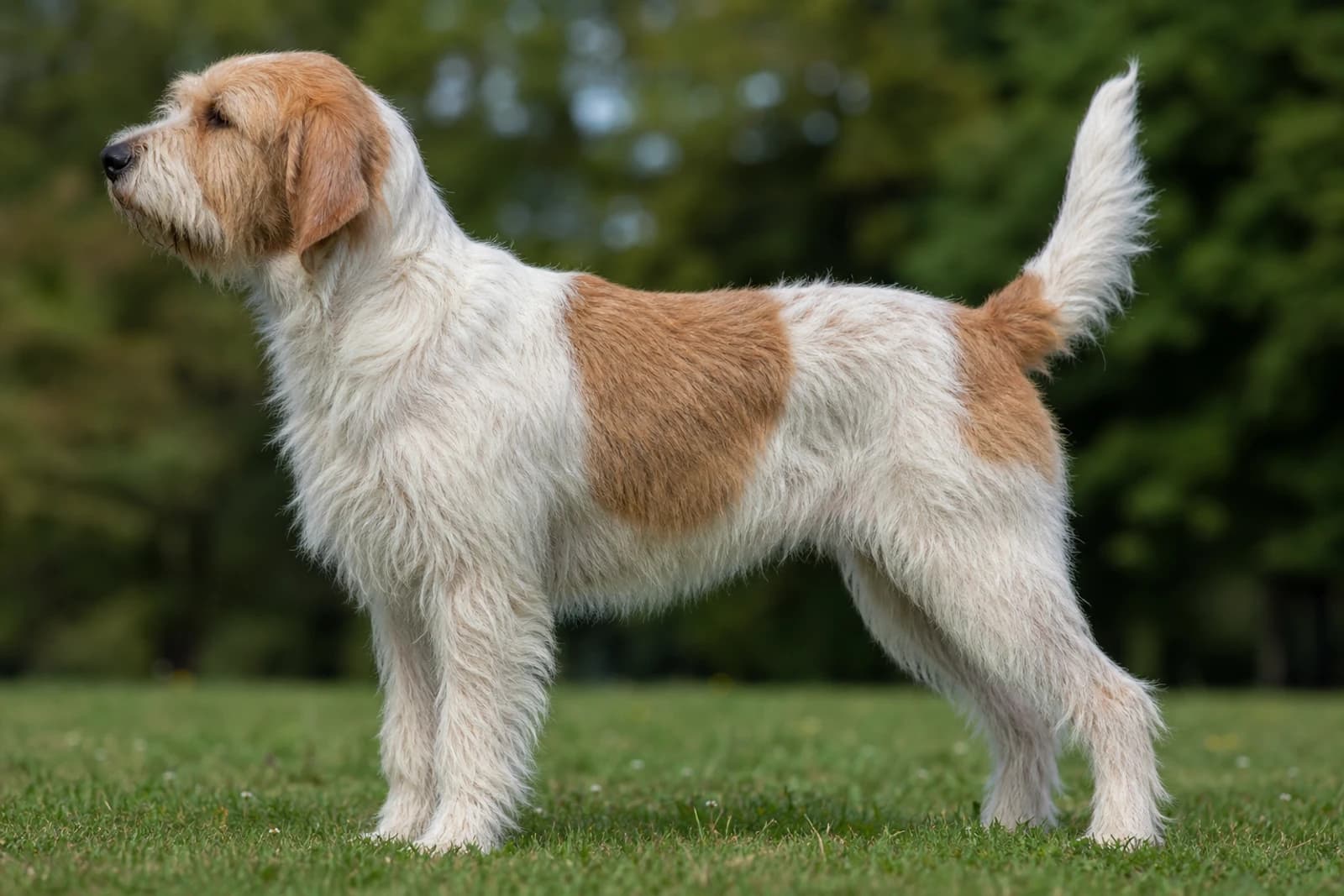
The Briquet Griffon Vendéen is a medium-sized French scent hound with a rough, wiry coat and a lively, affectionate nature. Originally bred to hunt hare and rabbit in packs, this breed thrives in active homes with ample space to roam and follow its nose. While loving and good with children, its high prey drive and independent streak call for consistent training and secure fencing. Best suited to experienced owners who can provide daily exercise and mental stimulation, this hound rewards its family with unwavering loyalty and a cheerful, outgoing disposition.
At a glance
- Size
- Large
- Height
- 19–22 in
- Weight
- 35–53 lb
- Life span
- 12 years
- Coat colors
- White and orange, White and lemon, White and black, Tricolor, Grizzle
- Coat type
- Rough and wiry double coat
How much does a Briquet Griffon Vendéen cost?
Adopt / rescue
$75–$400
Usually includes spay/neuter, first shots, and a microchip.
Buy from a breeder
$700–$2,000
From a reputable, health-testing breeder.
Approximate USD. Prices vary widely by region, breeder, pedigree, age, and coat colour — adopting is the lower-cost and recommended route. Avoid suspiciously cheap “breeders”; they’re often puppy mills.
Estimate the full cost of a Briquet Griffon Vendéen →Briquet Griffon Vendéen photos
Views
Front, side, rear and top — the full silhouette.Poses
How the breed sits, lies, moves and plays.Puppy to senior
The breed across its whole life.Expressions
The breed’s range of moods.Close-up details
Eyes, ears, nose, paws, tail and coat.Coat colors
The breed’s recognized colors.Click any photo to enlarge. We show the Briquet Griffon Vendéen from every angle — three views, poses, life stages, expressions, close-ups, coat and colors.
Appearance & size
At first glance, a Briquet Griffon Vendéen reads as a working scenthound built for a full day in rough country — compact, rough-coated, and unmistakably French.
Build & Proportions
The body is slightly longer than tall, with a rectangular outline that signals endurance over raw speed. You’ll see a deep, well-sprung chest that reaches the elbows and a strong, level back. The loin is muscular and moderately short. The overall bone is substantial but never cloddy; a Briquet should look capable of covering rocky, thorny terrain without wasting energy.
Expect a height of 19 to 22 inches at the shoulder and a working weight between 35 and 53 pounds. That range puts the breed firmly in the large-medium category — substantial enough to push through brush, light enough to hunt all day. Males tend to top out higher and heavier, while females are often at the lower end.
Coat & Color
The breed’s name tells half the story. The coat is harsh and shaggy, with a dense undercoat for weather protection. The outer hairs are long and rough to the touch, forming a natural ruff around the neck. It’s not soft or silky; if you run your hand over a correct Briquet, it feels wiry, almost bristly. This double coat sheds dirt and water, so mud tends to dry and fall away instead of soaking in.
Colors are classic for French griffons. You’ll see:
- Fawn (from pale sandy to deep red)
- Grizzle (mixing dark and light hairs in a way that looks like pepper-and-salt)
- White with orange, lemon, or black markings — often with ticking or roaning on the white areas
- Tricolor, where black, white, and tan appear together
A solid black or black-and-tan coat is unacceptable in the standard. The lighter underbody and leg feathering often show a softer, paler shade than the main body.
The Head & Expression
This is where the griffon personality lives. Stop and muzzle are equal in length, with a slightly domed skull. The eyes are large for a hound, dark, and framed by long eyebrows that angle outward, giving a lively, alert expression without making the dog look harsh. A full beard and moustache cover the muzzle, with the leather of the nose fully black and wide-open nostrils.
Ears are set low, just below the eye line, and fold inward. They’re soft, long enough to reach the nose when pulled forward, and coated in fine, wavy hair. The head carries proudly on a strong, clean neck with a slight arch.
From Every Angle
- Front view: Straight, well-boned forelegs set squarely under a broad chest. The shoulders are well laid-back, and the pasterns have just enough slope to absorb shock over rocks.
- Side view: The dog’s rectangular frame is clear here. The topline stays firm, the underline tucks up slightly at the loin, and the tail — thick at the base, tapering — is carried like a saber, high but never curled over the back.
- Rear view: Hindquarters are muscular without being over-angulated. Thighs are deep, and the rear pasterns stay vertical. When the dog moves, it drives from behind with a smooth, ground-covering trot.
It’s a working dog’s silhouette: no exaggerated angles, no showy flourishes. The whole package is efficient and honest.
History & origin
The Briquet Griffon Vendéen is the workingman’s version of France’s rough-coated Vendéen hounds—bred down from the towering Grand Griffon specifically for hunters who chased hare and rabbit on foot through the thick, thorny bocage of western France. “Briquet” is an old French term for a medium-sized, solidly built dog, and that’s exactly what you get: a tenacious scent hound compact enough to duck under briars without losing the stamina or voice of a full pack hound.
The breed’s story starts in the Vendée, a coastal department known for dense hedgerows, marshy lowlands, and tangled cover that can swallow a big dog. For centuries, local hunters kept packs of “white hounds” descended from the old Chiens Blancs du Roi and Crusader-era sighthounds, deliberately crossed with rough-coated sheepdogs and griffons to create a hardy, weatherproof coat. By the 16th century, these dogs had split into several sizes for different game. The largest—the Grand Griffon Vendéen—could bring down wolf and boar. But as large game dwindled and hunting shifted to small quarry, many hunters wanted a more nimble, portable dog they could follow on foot, not horseback. By the early 1800s, they were systematically selecting the smallest Grand Griffons and probably adding a dash of Basset blood to create the Briquet.
The result stood 19 to 22 inches at the shoulder and weighed 35 to 53 pounds—big enough for a full day’s work, small enough to slip through narrow gaps in the hedgerow. They hunted in boisterous packs, giving tongue freely so the hunter could track their progress even when the dogs were out of sight. The Briquet’s specialty was hare, but it also took fox and roe deer, driving them in wide, methodical circles until the hunter could intercept.
Like many European working breeds, the Briquet nearly disappeared after the two World Wars. By the mid-1940s, only a handful remained. Dedicated fanciers in France scoured the countryside for surviving specimens and painstakingly rebuilt the breed, gaining official FCI recognition in 1954. Numbers have always stayed small. Today, you’ll still find Briquets hunting in rural France, where their melodious cry and steady, tireless style are prized. Outside of France, the breed is rare—though a few dedicated kennels in the UK, Scandinavia, and North America preserve it. Even so, anyone who brings a Briquet Griffon Vendéen home gets a piece of living French hunting history: an unpretentious, rough-and-tumble hound that hasn’t had the wild edges bred out of it.
Temperament & personality
A Briquet Griffon Vendéen is a pack hound through and through—cheerful, determined, and happiest with its nose to the ground and its people nearby. Think of a 40-pound terrier-like scruff with the soul of a scent-tracking machine and the sociability of a dog that’s always run in a larger group. They form tight bonds with the household and show affection openly, often leaning against your legs or draping a heavy paw across your lap.
Energy lives at the center of the Briquet’s world. Expect a dog that trots into every room ready for the next adventure. A casual stroll around the block doesn’t cut it; they need a solid hour of moving, sniffing, and puzzle-solving every day. Without that, a Briquet invents its own entertainment—digging craters in the yard, dismantling shoes, or serenading the neighborhood with a rich, carrying bay. A tired Briquet curls up contentedly, but never mistake a quiet afternoon for a lazy nature.
Affection runs deep but comes with bouncy enthusiasm. They’re gentle with kids who are steady on their feet, yet a happy Briquet can accidentally knock over a toddler with a wagging body. They read the household mood well and want to be part of whatever the family is doing, whether that’s lounging on the sofa or piling into the car. Left alone too often, the breed’s pack orientation flips into separation anxiety—barking, chewing, and house-soiling often stem from isolation, not spite.
Watchfulness is the hound’s default, but guarding is not. A Briquet will announce every delivery truck and squirrel with a deep, carrying voice, then wiggle up to the visitor once you signal it’s fine. They lean into their bark more than their bite; early socialization keeps the noise level manageable and prevents overreaction to every new scent outside the window.
Quirks come straight from the nose. A Briquet follows scent trails with single-minded focus. Off-leash reliability is a gamble even with training because an intriguing odor can make recall disappear. Indoors, that powerful sniffer turns to scent-marking if given a chance. Unneutered males especially may urine-mark along baseboards or furniture, and residual smells pull them back to the same spots. Clean accidents with an enzymatic cleaner the first time, or you’ll be fighting a losing re-soiling battle. On walks, brace yourself for sudden pauses while your dog deciphers a “pee-mail” conversation.
They also have a hound’s unfiltered taste in perfume. You may catch your Briquet rolling ecstatically in something foul—another dog’s function, not fashion, statement. It’s a deeply ingrained behavior, and a vinegar rinse beats a stern lecture.
Training a Briquet means respecting the independent streak. They’re smart and food-motivated, but they shut down under harsh handling. Use short, positive sessions and never interrupt a meal—food guarding can develop fast if a dog feels rushed. Puppies chew with abandon to relieve teething pain; redirect with frozen rubber toys and a citrus-peel spray on off-limits wooden legs.
At the end of the day, this is a dog that fills your home with noise, motion, and an unshakeable good humor. You’ll vacuum more hair and mud than you expect, and you’ll learn to laugh when a skunk-scented hound grins up at you proudly. That’s life with a Briquet Griffon Vendéen.
Good with kids, dogs & other pets
With children, the Briquet Griffon Vendéen is the calm, steady type. He’s genuinely patient and non-aggressive by nature, but at 35–53 pounds of muscle and enthusiasm, he doesn’t always know his own size. A fast game of chase can turn into an accidental body-check that sends a toddler flying, so active supervision isn’t about bite risk — it’s about managing that happy, clumsy momentum. He’s far more likely to lean his full weight against a seated kid and thwack a coffee table with his tail than to grumble. Teach children to brace for the “Briquet lean” and they’ll have a dog who treats them like the best playmates in the pack.
With other dogs, you’re in luck. Bred to hunt in a pack, the Briquet reads canine body language easily and generally prefers company to confrontation. He typically slots in well with a resident dog after a calm, structured introduction. His high need for companionship means a compatible canine buddy can actually help him settle when you’re gone — this is not a breed that does well left alone in the yard for hours. A second dog isn’t a substitute for training, but it can ease the loneliness that sparks barking or chewing.
Now the part where you meet the scenthound. The Briquet was built to trail hare and rabbit, and that prey drive doesn’t punch out just because a cat or pet rabbit lives indoors. With puppyhood socialization that starts before 16 weeks, many Briquets learn to treat the family cat as part of the household — but a strange cat bolting across the yard will still ignite the chase. Smaller pets like guinea pigs, hamsters, or free-roaming rabbits are never completely safe. Secure hutches, closed doors, and zero off-leash access around small animals are your real insurance. Some owners get a peaceful interspecies truce; others learn right away that a Briquet’s nose overrides his “leave it” when something small and furry darts. Manage the environment, and you’ll spare everyone the stress. Stack those early positive exposures with kids and other dogs, and you’ll likely wind up with a tail-wagging shadow who leans on your family hard — in the best way.
Trainability & intelligence
A Briquet Griffon Vendéen is a scenthound through and through — bred to follow his nose with single-minded passion, not to hang on your every word. Intelligence runs deep in this breed, but it’s the independent, problem-solving kind. He learns quickly when something interests him and becomes selectively deaf the moment a rabbit trail hits the ground. Training isn’t about breaking that drive; it’s about shaping it.
Count on food as your most reliable motivator. Small, high-value treats (think diced hot dog or freeze-dried liver) paired with calm, consistent marker words will get you much further than pressure or nagging. Keep early sessions bite-sized — multiple five-minute rounds a day beat one long drill. Because the Briquet can weigh 35–53 pounds and carry surprising power, polite leash walking and a rock-solid “touch” or hand target should be non-negotiable from puppyhood.
Recall will be your biggest challenge. Expect a hound that catches a scent to blow past a recall command as if you never said it. You manage this by building the behavior in low-distraction environments first, rewarding every check-in with an explosive party of praise and treats, and never — ever — punishing a slow return. A long training line in open spaces gives you control without eroding trust.
Socialization needs early, deliberate work. Start exposing your puppy to new people, sounds, surfaces, and safe dogs between 3 and 14 weeks of age, and keep those exposures regular because a Briquet who isn’t continually broadened can tip toward reserved or reactive around strangers. Gentle, positive introductions matter here; the breed’s sensitivity means harsh corrections will sour him on training and damage the relationship you need for off-leash reliability.
Channel his nose, don’t fight it. Nosework games, scent articles, or tracking courses make a happier, more biddable dog because he gets to scratch his #1 biological itch while working with you. A Briquet who gets satisfying outlet for his nose at home is far less likely to tune you out on walks. Teach him that cooperating with you leads to the good stuff — finding hidden treats, earning a game of tug, getting to sniff the next bush — and you’ll have a partner who’s clever, joyful, and capable of surprising focus in the middle of a scent-filled world.
Exercise & energy needs
A Briquet Griffon Vendéen doesn’t need a marathoner — you’re looking at a solid 60–90 minutes of activity every day, split into at least two sessions. This is a medium-large scent hound built to cover ground, work at a steady trot, and zero in on game for hours. A quick leash walk around the block won’t cut it. Think off-leash romps in a securely fenced area, long hikes with sniffing breaks, or running alongside a bike on soft terrain.
Because they were bred to follow their nose and make decisions in the field, physical exercise alone misses the point. Mental stimulation is non-negotiable. Lay a scent trail in the backyard, hide a tuggable toy in tall grass, or feed meals out of a puzzle toy that forces problem-solving. These dogs light up when they get to use their brain, and without that outlet, you’ll see the flip side: a bored Briquet can become a noisy, destructive escape artist.
Two shorter sessions often work better than one grind. A brisk 30-minute morning walk with lots of sniffing opportunities paired with a 45-minute afternoon off-leash session gives them the rhythm they crave. Pay attention to intensity. While they’re sturdy and athletic, avoid repetitive high-impact pounding — especially jumping on hard surfaces — until joints are fully developed. This goes double if your dog comes from lines where hip or elbow dysplasia can pop up. Soft footing and varied movement are safer.
If you want to go beyond daily walks, scent work, barn hunt, or tracking classes play right into their genetics. Agility at a moderate height can work for a well-conditioned adult, but don’t push heavy courses before growth plates close around 12–14 months. A tired, mentally satisfied Briquet is a calm housemate; skipping the work just builds an anxious, pent-up hound who’ll compose his own soundtrack.
Grooming & coat care
A rough, weather-beating coat is one of this breed’s trademarks — and it’s easier to live with than it looks. The Briquet Griffon Vendéen has a double coat: a dense, soft undercoat and a harsh, wiry outer coat that should feel almost bristly to the touch. That texture naturally repels dirt, burs, and water, so you’re not signing up for constant baths.
Brushing twice a week with a metal slicker brush (rounded pins) followed by a greyhound comb keeps the coat in shape and the furniture bearable. Focus on the feathering behind the legs and the longer hair on the belly — those are the spots that mat first. During the twice-yearly undercoat shed, bump it to every other day; a warm bath and a good line-brushing session will pull out fistfuls of dead fluff and speed things along.
Bathing is strictly as-needed. Over-washing strips the coat’s oils, softens the wire texture, and makes the dog smell like wet hay. A rinse with plain water gets rid of mud from a hike, and a gentle dog shampoo maybe two or three times a year is usually enough unless he’s rolled in something foul.
- Trimming & stripping: Show dogs are hand-stripped to preserve the harsh, flat-lying coat. If you’re not aiming for the ring, you can clip the body with a ¾ inch guard comb for a neat, lower-maintenance look. Just know that clipping repeatedly will soften the coat to a plush, cottony feel that mats more easily and loses weather protection.
- Ears: The drop ears trap moisture. Check weekly and clean with a vet-approved drying ear cleaner. A quick sniff test is your best early warning system.
- Nails: These are active dogs that wear their nails down on hard ground, but the dewclaws and side toes need attention. Keep them short enough that you don’t hear clicking on floors — long nails can break in rough cover.
- Teeth: Daily brushing (or at minimum a few times a week) with an enzymatic dog toothpaste helps ward off the periodontal disease that shows up in many breeds by middle age.
The coat changes with the seasons, so pay attention to undercoat density when the weather shifts. A healthy Briquet with time outdoors will cycle coat naturally, but a dog living mostly indoors might hold onto dead hair longer and need more help from you. If you want that crisp, stand-offish wire jacket without investing in endless grooming, commit to hand-stripping a section every few weeks and the coat will practically maintain itself.
Shedding & allergies
The Briquet Griffon Vendéen’s shaggy, wire-haired coat gives you a break on vacuuming — they’re a light shedder most of the year. That rough, double-layered jacket traps a fair amount of dead hair instead of dumping it on your couch. You’ll still find the occasional coarse strand on dark pants, but you won’t be chasing tumbleweeds across the floor.
Come spring and fall, things ratchet up a notch. Expect a seasonal blowout where the undercoat lets go in clumps over two or three weeks. A slicker brush or stripping knife sweeps through it daily during that window and keeps the mess manageable. The rest of the time, a thorough comb-out once or twice a week prevents matting and pulls out the dead stuff before it lands on upholstery.
Drool is another piece of the allergy picture, and here the Briquet is surprisingly tidy for a scent hound. You might see a little moisture after a long drink, but they aren’t the jowly, fling-it-on-the-ceiling type. That means less allergen-laden saliva spread around the house, though it doesn’t turn them into a hypoallergenic dog.
And that’s the hard truth: no wire-coated breed is truly allergy-proof. Allergens hang out in dander and skin oils, not just hair. Even a low shedder produces enough to set off a sensitive person. If you or someone in the house has serious allergies, arrange a few hours of close contact with an adult Briquet before bringing one home — it’s the only way to know if you’ll react.
Diet & nutrition
A Briquet Griffon Vendéen in good weight feels solid under your hands — you can easily feel the ribs, but they shouldn’t be staring back at you. This breed tends to be food-driven, so free-feeding is a fast track to joint strain. Measure every meal.
Start with about 2½ to 3 cups of a quality dry food per day for an active adult in the 40–50-pound range, split into breakfast and dinner. Adjust up or down based on your dog’s waistline and how many miles you’re logging together. If you cook at home, build meals around animal protein — lean meat, fish, or eggs making up roughly half to two-thirds of the bowl — with the rest coming from dog-safe vegetables and a small portion of grain or plain yogurt. A slow-feeder bowl stops a fast eater from gulping air, and blending or puréeing the meal helps older dogs with missing teeth absorb nutrients.
Puppies need steady, moderate growth, not a sprint. Feed four evenly spaced meals until four months, then three meals until six months. From six months on, switch to the adult two-meal rhythm. You can introduce a raw meaty bone like a chicken wing around 12 weeks, but only under direct supervision.
As your Briquet ages, his metabolism will slow. Gradually reduce portions before you see extra padding. Smaller, more frequent meals can keep an older dog comfortable, and there’s no need to slash protein unless your vet advises it. Watch out for holiday leftovers and rich treats — they can trigger pancreatitis in any dog. And everything you give him lands in his own bowl, never straight from your plate. Begging that starts at the table is tough to undo.
Health & lifespan
You can reasonably expect a healthy Briquet Griffon Vendéen to stick around for 12 years. Some lines push a year or two beyond that, but hitting that mark almost always comes down to a mix of good breeding and day-to-day attention to the things that wear a dog down over time.
This is a rugged little package — a medium-sized hound with a dense, tousled coat and a work ethic — but no breed gets a free pass. The Briquet’s build puts a handful of health considerations on the radar.
Hips and elbows. As with a lot of hunting breeds that hit that 35-to-53-pound range, hip dysplasia can show up. It’s not rampant, but it’s enough that any responsible breeder will have both parents screened with OFA or PennHIP radiographs. Don’t settle for “the vet said they looked fine.” Get the actual numbers.
Eyes and ears. Those floppy ears trap moisture and gunk, which means ear infections become a recurring nuisance if you don’t stay on top of weekly cleaning. On the eye front, some lines can carry hereditary conditions like cataracts or progressive retinal atrophy (PRA). Breeders who are serious about long-term puppy health get annual eye clearances from a veterinary ophthalmologist — ask to see the paperwork.
Weight. Briquets live for their noses and their stomachs. Without portion control and real daily exercise (not just a walk around the block), they’ll pack on pounds fast. Extra weight puts unnecessary strain on joints and can shave time off that 12-year lifespan. Measure meals, limit treats, and keep them lean.
Skin. That wiry, weather-resistant coat is an asset, but skin allergies and hot spots do crop up in the breed. If you notice persistent scratching or yeasty smells, diet and environment are usually the first places to look.
Preventive basics that no dog skips. Monthly heartworm prevention during mosquito season (plus one month after it ends) is non-negotiable. A rabies vaccine is legally required, and there’s no effective treatment once symptoms develop — don’t let that lapse. Annual wellness exams catch subtle shifts in weight, appetite, or energy that you might overlook day to day. For a Briquet nearing senior status, bump that to twice-a-year visits.
Breeders who know their lines will freely discuss all of this and hand over health clearances without hesitation. That’s the baseline you want.
Living environment
This is a scenthound through and through—a working pack dog that thrives on movement and company, which directly shapes where it can live comfortably. Apartments are a tough fit. The Briquet Griffon Vendéen has a big, baying voice it loves to use, and thin walls won’t make you popular with neighbors. A house with a securely fenced yard is the practical baseline. Plan on a fence that’s at least five feet tall and sunk into the ground; a 40-pound hound following a rabbit scent will tunnel or climb without a second thought. An underground electronic fence won’t stop a nose-driven dog in full cry.
You can’t tire this breed out with a quick stroll. Count on at least an hour of real exercise every day, split into two sessions—morning and evening work well. One long session often leaves a hound mentally restless. Add 15 to 20 minutes of nose work: hide treats, use a snuffle mat, or lay a simple scent trail in the yard. Puzzle toys alone won’t cut it; this dog needs to use its nose outdoors. Avoid repetitive high-impact activity like nonstop fetch on hard surfaces. The breed can be prone to hip and elbow dysplasia, so it’s smarter to mix free sniffing with short bursts of running on grass.
Climate-wise, the Briquet’s rough, double coat gives decent protection in cool or wet weather, but it’s no snow dog. In hot, humid conditions, move walks to early morning or late evening. That dense coat plus relentless scent-tracking drive can push a dog past its heat limits before you realize it.
Noise is a real consideration. Expect a loud, drawn-out bay when a squirrel trespasses or a delivery truck stops. Consistent quiet cue training helps, but you won’t extinguish the instinct entirely. If you have close neighbors, talk to them honestly before bringing a Briquet home.
This is not a dog that handles long stretches alone. Bred to hunt in packs, the Briquet Griffon Vendéen bonds hard with its people and can develop serious isolation anxiety. Destructive chewing and howling are common signs. Crate training, short practice departures, and leaving behind a frozen food puzzle can ease the stress, but if your schedule keeps you away eight-plus hours daily, this breed will suffer. Provide a canine buddy or midday dog-walker visit to keep the loneliness in check.
Who this breed suits
This dog is a French hunting hound through and through — bred to work all day in a pack, nose glued to the ground. The right owner isn’t someone who just “likes long walks.” You need to give a Briquet Griffon Vendéen at least an hour of hard, off-leash running every day (think fenced acreage, not a dog park), plus scent games or job-like training that wears out that problem-solving brain. Without it, you’ll get a restless, vocally dramatic house guest who sings his hunting ballads for the entire neighborhood.
Active families with older kids (8 and up) fit well, especially if the family enjoys hiking, jogging, or hunt sports. The breed is generally patient and affectionate with children, but his 40-to-50-pound frame and exuberant play style can knock down a toddler, so supervise closely around little ones. He’s also a solid match for a single or couple who hunts rabbits or hare and wants a driven, musical-voiced partner. Retirees or seniors can work only if they’re unusually energetic and already accustomed to handling a nose-driven hound — not as a first-time hound owner easing into a slower pace of life.
First-time owners should think twice. This isn’t a dog who hangs on your every cue; centuries of independent tracking bred a stubborn streak. Training is possible, but you need patience, consistency, and a sense of humor about the idea of “off-leash recall” in an unsecured field — a scent trail will override your voice 90% of the time. A securely fenced yard is non-negotiable. Underground fences don’t count; a Briquet following a scent isn’t fazed by a mild shock.
You should also reconsider if:
- You have cats, rabbits, or other small pets (strong prey drive).
- You live in an apartment or share walls with neighbors (a booming bay is standard).
- You’re gone 8+ hours a day. This pack-oriented breed can develop destructive chewing and anxiety when left alone for long stretches.
- You want a dog who’s calm in the house without a daily workout. Expect a 12-year commitment to dog-tired being the only path to sofa snuggles.
Cost of ownership
A Briquet Griffon Vendéen puppy from a responsible breeder typically costs $1,500–$2,800. This is a rare breed in the U.S., so expect a waiting list and the real possibility of travel expenses. Prices under $1,000 usually skip the hip, elbow, and eye screenings that matter.
Once your dog is home, budget $120–$180 a month for routine care.
- Food: $45–$65 for a quality kibble that keeps a 40–55 lb adult lean. A dog that hunts or logs serious daily miles will push the upper end of that range.
- Grooming: That weatherproof double coat needs weekly brushing and a full strip or clip every 6–8 weeks. A pro session runs $70–$100. You can learn to hand-strip at home, but tools and a high-velocity dryer add upfront cost. Count on another $25 a month for baths, ear cleaning, and nail trims if you handle some yourself.
- Vet: Annual exams, vaccines, and preventives average $500–$650, or $40–$55 monthly. Hip dysplasia, patellar luxation, and stubborn ear infections pop up in the breed, so a surprise bill can happen. Set aside an extra $20–$30 a month as a cushion.
- Insurance: An accident-and-illness policy for an active medium-large dog runs $45–$70 a month. Orthopedic coverage isn’t a luxury here.
First-year one-timers — spay/neuter ($300–$600) and gear like a crate, leash, bed, and grooming supplies ($400–$700) — hit on top of that. Over a 12-year lifespan, you’re north of $20,000 before a single unplanned surgery. The real variable is whatever expensive chaos a busy scenthound’s nose digs up.
Choosing a Briquet Griffon Vendéen
Breeder or Rescue?
The Briquet Griffon Vendéen is still uncommon outside France. You might get lucky with a breed-specific rescue or a rehoming through the parent club, but most people end up working with a breeder. Don’t overlook the occasional adult who needs a second start — European hunting dogs sometimes arrive through import rescues and the Griffon Vendéen community is tight-knit enough to quietly circulate word. Just go in knowing that a wait is normal, and you may need to travel.
Health Clearances to Demand
The two health screens you never compromise on: hip dysplasia and elbow dysplasia. Ask for official OFA or PennHIP results for both parents, not a vet’s offhand “they look fine.” Eye clearances (CERF or OFA Eye Certification) from a board-certified veterinary ophthalmologist round out the bare minimum. Some breeders also run thyroid panels and basic cardiac exams, but hip and elbow scores are where you plant your flag. Insist on seeing the report numbers so you can verify them yourself online. No paperwork, no deal.
Warning Signs
A breeder who can’t produce documentation, or who waves off clearances with “my line’s always been healthy,” is a liability. Multiple litters on the ground at once, puppies always available, and a website that feels like a shopping cart signal volume over quality. This is a hunting breed first — a good breeder talks your ear off about scent work, tracking, or what the parents do in the field, not just about adorable tricolor markings. If you aren’t welcomed to meet the dam on the property (and the sire, if he’s local), walk away. The rearing space should be clean, indoors or out, with clear evidence that the pups have been handled daily and exposed to normal household racket. Anything less is a gamble you don’t need to take.
Picking Your Pup
Visit the litter between 7 and 9 weeks. Watch who comes to investigate you. A curious pup that grabs your shoelace, sniffs your hand, and then totters back to tussle with a littermate is showing the middle-of-the-road temperament that usually slides best into family life. The hider in the corner and the relentless bully pinning everyone’s ears are red flags for a novice home. Ask exactly what the breeder has done for early socialization: supervised time on different surfaces, gentle handling by multiple people, and introductions to crates and car rides. A written health guarantee and a contract that spells out a no-questions-asked return policy if circumstances change are non-negotiable. Plan on a quiet vet check within a few days of bringing your pup home, and keep the breeder’s number handy — they should never stop being a resource.
Pros & cons
Pros
- Friendly, even-tempered companion that bonds with the whole family and is notably patient with gentle children.
- Designed to work in packs, so they fit easily into multidog homes and rarely instigate dog-dog conflict.
- Sturdy medium‑large frame (19–22 in, 35–53 lb) — substantial enough for outdoor adventure, yet not so oversized that they knock over toddlers.
- Exercise needs are straightforward: an hour of nose‑led rambling or off‑leash play in a secure field, then content to snooze indoors.
- Typical lifespan of 12 years, and many stay sharp and mobile well past that mark with proper care.
Cons
- A high prey drive and world‑class nose mean recall in unfenced spaces is a constant challenge; expect to keep them leashed or in a safely enclosed area.
- Vocal by nature: deep baying and howling are part of daily life. Not suited for apartment living or noise‑sensitive neighbors.
- Coat management is real work: the harsh double coat sheds moderately year‑round and requires weekly brushing plus hand‑stripping or carding every few months to stay healthy.
- Expect hound perfume and drool — you’ll be wiping slobber off walls and furniture, and bathing more often than you might like.
- Floppy, low‑hanging ears trap moisture and debris; ear infections become frequent if you don’t dry and clean the canals weekly.
- Can be prone to hip dysplasia; seek a breeder who provides OFA or PennHIP clearances for both parents.
Similar breeds & alternatives
If you're drawn to the Briquet's cheerful, rough-coated hound personality but want to adjust the size, leg length, or volume, a few close relatives and similar breeds make natural side-by-side comparisons. The Briquet is a true medium-large pack hound — leggy enough to bound over uneven cover, weighing 35–53 lb, with a voice that carries — so the best alternatives trade off one or more of those traits without losing the scenthound soul.
- Grand Griffon Vendéen: The Briquet's bigger, brawnier cousin. This dog runs 60–70 lb and stands several inches taller, giving it even more power on rough hunts. Same shaggy, harsh coat and same melodic bay, but it demands more room and sturdier fencing. If you want a Briquet-like character in a larger, deeper-chested package, this is the step up — though it's even rarer in the U.S.
- Petit Basset Griffon Vendéen (PBGV): A low-slung version with a long body and 13–15 inch height, topping out around 40 lb. The PBGV keeps the wiry, tousled coat and the happy-go-lucky attitude while converting the Briquet's leggy agility into a ground-hugging, terrier-like weave. It's often noisier indoors, just as stubborn, and needs less running distance because those short legs work hard. Easier to find in North America, but plan on a dog who thinks every squirrel is a personal challenge.
- Grand Basset Griffon Vendéen: Sits between the PBGV and the Grand in bone and substance, but still has distinctly shortened legs and a basset-shaped body (15–18 inches at the shoulder, about 40–45 lb). Coat and voice echo the Briquet, but the movement is a slower, steady ground-sniffing gait rather than springy leaps. Expect a slightly calmer house companion, but don't expect a quiet one when a scent trail fires up.
- Basset Fauve de Bretagne: A lesser-known wire-coated scenthound from France, 32–40 lb with a short-legged, square build. The Fauve is often less sharp in voice than the Vendéen family and has a reputation for being more biddable, though still an independent nose on legs. It's a good pick if the Vendéen baying gives your neighbors pause, but you still want a rugged, wash-and-go coat.
- Otterhound: A rare, much larger (65–115 lb) shaggy hound with a similarly rough, oily double coat and a deep bay. The Otterhound is slower to mature, needs serious space, and can be even more stubborn. Only consider this if you truly want a giant Briquet-type personality and have the property to match.
All of these hounds share a pack-born need for company and can develop separation anxiety if left alone for long stretches. The Briquet's niche is a mid-size, athletic, mid-volume hound that can still crash on the couch after a solid hour of off-leash hiking. If you need less exercise-driven intensity, lean toward the basset-shaped relatives; if you want more power and presence, look at the Grand.
Fun facts
- The breed's name 'Briquet' is French for 'medium-sized dog', distinguishing it from the larger Grand Griffon Vendéen.
- They are one of four Griffon Vendéen breeds, all developed in the Vendée region of France.
- Briquet Griffons were bred to hunt hare and rabbit in packs, relying on their keen nose and endurance.
- Their coat is described as 'rustic' and requires regular hand-stripping to maintain its harsh texture.
Frequently asked questions
- How much does a Briquet Griffon Vendéen shed?
- This breed has a rough, double coat that sheds moderately throughout the year. Weekly brushing helps reduce loose hair and maintain coat health. They are not considered hypoallergenic.
- Are Briquet Griffon Vendéens good with children?
- They are typically friendly and can be affectionate with kids, especially when socialized early. Due to their size (35–53 pounds and 19–22 inches tall), supervision is advised around small children to prevent accidental bumps. Their pack-oriented nature makes them a loyal family companion.
- How much exercise does a Briquet Griffon Vendéen need?
- These energetic hounds require at least an hour of vigorous daily exercise, such as long walks, runs, or scent work. Without enough activity, they may become restless and develop unwanted behaviors. Their robust build and stamina suit an active owner.
- Can a Briquet Griffon Vendéen live in an apartment?
- They are generally not well-suited to apartment life due to their large size, high energy, and tendency to bark. A house with a secure yard is ideal, but apartment living might work if the owner can provide ample outdoor exercise and mental stimulation. Their vocal nature may also disturb neighbors.
- Do Briquet Griffon Vendéens bark a lot?
- As scenthounds, they are naturally vocal and will bark when tracking scents, alerting to strangers, or expressing excitement. This trait makes them good watchdogs but can be challenging in noise-sensitive environments. Consistent training can help minimize excessive barking.
- What is the lifespan of a Briquet Griffon Vendéen?
- The typical lifespan is around 12 years. Providing a balanced diet, regular exercise, and routine veterinary care can help them reach their senior years in good health. Like all breeds, they may be prone to certain genetic conditions, so monitoring is key.
Tools & calculators for Briquet Griffon Vendéen owners
Quick estimates tailored to Briquet Griffon Vendéens — pre-filled with this breed’s size where it matters.
Articles & stories about the Briquet Griffon Vendéen
Sources & standards
This profile follows recognized breed standards from the American Kennel Club (AKC) and the Fédération Cynologique Internationale (FCI), along with established veterinary and breed-club guidance. These describe general breed tendencies — every dog is an individual.
Owner stories
Have a Briquet Griffon Vendéen? Share your experience — grooming tips, personality quirks, anything goes.