

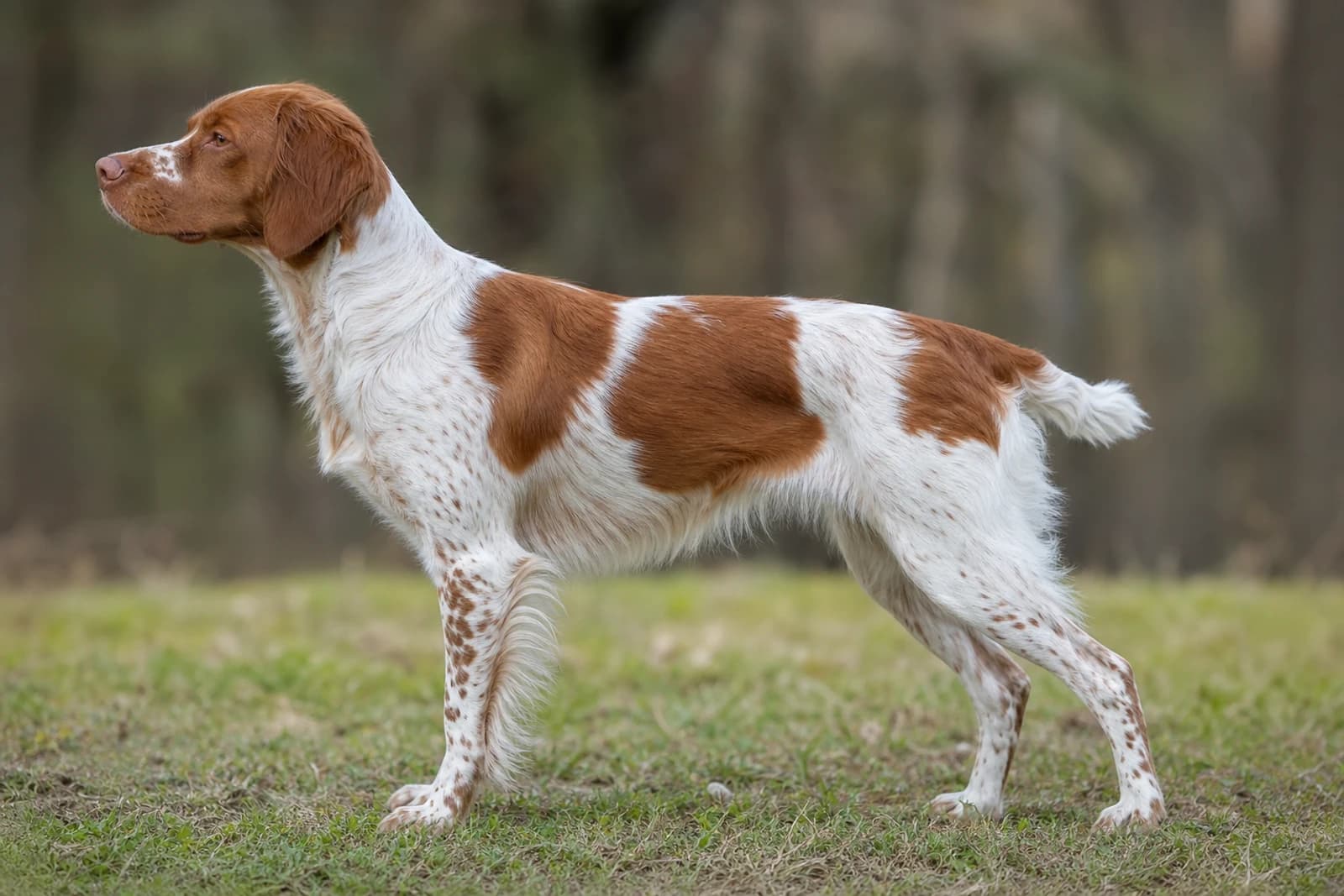
The Brittany is a compact, athletic gun dog brimming with energy and enthusiasm. Ideal for active families with spacious yards, this breed thrives on running, hiking, and hunting. They form deep bonds with their humans and display unwavering affection, but demand consistent training to channel their intelligence. Not suited for apartment living or sedentary owners, the Brittany excels as a versatile companion for outdoorsy households seeking a loyal, high-spirited partner.
At a glance
- Size
- Large
- Height
- 19–20 in
- Weight
- 31–40 lb
- Life span
- 12–14 years
- Coat colors
- Orange & White, Liver & White, Orange Roan, Liver Roan
- Coat type
- Short to medium length, dense, flat or wavy with light feathering
- Group
- Gun
How much does a Brittany cost?
Adopt / rescue
$75–$400
Usually includes spay/neuter, first shots, and a microchip.
Buy from a breeder
$700–$2,000
From a reputable, health-testing breeder.
Approximate USD. Prices vary widely by region, breeder, pedigree, age, and coat colour — adopting is the lower-cost and recommended route. Avoid suspiciously cheap “breeders”; they’re often puppy mills.
Estimate the full cost of a Brittany →Brittany photos
Views
Front, side, rear and top — the full silhouette.Poses
How the breed sits, lies, moves and plays.Puppy to senior
The breed across its whole life.Expressions
The breed’s range of moods.Close-up details
Eyes, ears, nose, paws, tail and coat.Coat colors
The breed’s recognized colors.Click any photo to enlarge. We show the Brittany from every angle — three views, poses, life stages, expressions, close-ups, coat and colors.
Appearance & size
The Brittany gives an immediate impression of a compact, athletic bird dog built for a full day of hard work, not just a quick romp. He stands 19 to 20 inches at the shoulder and tips the scale at a lean 31 to 40 pounds — enough leg and lung to cover rough ground without the bulk of a larger pointer. That leggy, slightly square outline is your first clue he’s all business, but the soft expression and constantly wagging stub of a tail keep him from looking harsh.
The coat is practical and low-maintenance in the field. It’s a single coat — dense, flat or lightly waved, never curly — with a slight feathering on the backs of the legs and the underline. That means no heavy undercoat to trap mud or burrs. The skin shows through a bit, giving him a clean, tight-jacketed look. Colors come in clear orange and white or liver and white, often as distinct patches or heavy ticking that creates a roan pattern. Tri-colors are a fault in the show ring but pop up now and then.
From the front, you see a moderately deep chest that reaches to the elbow, with well-sprung ribs and straight, substantial forelegs. The front is not so wide that he’d waste energy plowing through cover; it’s efficient. Viewed from the side, the top line is solid — a slight slope from the withers to a strong, level back, then a gentle rounding over the croup. The neck is long enough to let the nose sweep the ground effortlessly, with no throatiness. The head is clean and wedge-shaped, with high-set, triangular ears that frame the face and hint at his always-alert nature.
From the rear, the Brittany’s drive comes from broad, muscular thighs and well-angled stifles. The hocks sit low to the ground and point straight back, never bowing out. The tail is naturally short (about 4 inches at most) or docked to that length. You’ll spot that stub sticking straight out or quivering with excitement when he’s locked on scent — one of the breed’s most recognizable trademarks. Legs from any angle look nimble, not heavy, which makes him quick on the turn and light on his feet in thick brambles.
History & origin
The Brittany you see in the field today traces straight back to the peasant hunters of northwestern France. In the mid-1800s, rural families in the province of Brittany needed a dog that could handle their mixed-bag hunting style — a dog that would point woodcock, partridge, and snipe, then retrieve the downed bird from water or heavy cover. They didn’t keep meticulous breeding records, but they steadily shaped a compact, tireless dog that pointed with instinctive style and retrieved with a soft mouth. Early artwork from the 1600s shows dogs with similar markings and build, so the foundational stock likely existed for centuries before anyone gave it a name.
By the late 1800s, British sportsmen were exporting their own pointers and setters to the continent. Local French dogs were crossed with English Setters, and possibly some Welsh Springer Spaniels, to sharpen the nose and lengthen the run. The result was a leggier, faster dog than the old farm spaniels, but one that still worked close and stayed eager to please. The first breed standard was written in 1907, and the name “Brittany Spaniel” stuck for decades. That “Spaniel” label later became a point of contention: the breed points like a setter, with a characteristic crouch and intense freeze, and its retrieving style is pure utility.
The first Brittanys crossed the Atlantic in the 1930s, and the American Kennel Club registered the breed in 1934. American hunters quickly valued them as dual-purpose dogs — equally capable on pheasant in the Dakotas and quail in the South. In 1982, the AKC officially dropped “Spaniel” from the name, acknowledging that the Brittany’s hunting style is distinct. Today, dual champions (titled in both conformation and field trials) are so common in the breed that they barely raise an eyebrow. You’ll still find Brittanys working rough cover in France and the U.S., but just as many now sleep on couches after running down squirrels in the backyard — a testament to the same versatility that those 19th-century Breton farmers first locked in.
Temperament & personality
A Brittany doesn’t have an off switch — not really. These are high-octane bird dogs bred to hunt all day, and that drive pours into everything they do. If you’re looking for a couch ornament, look elsewhere. A Brittany needs a solid hour of running, swimming, or off-leash exploring every day, plus brain work like scent games or retrieving drills. Without it, the dog you come home to won’t be calm; he’ll be wired, vocal, and possibly redecorating the house with stuffing from the sofa.
Energy is only half the story. Brittanys are intensely people-oriented, often described as “velcro dogs.” They want to be with you — on the couch, under your desk, in the backyard, always touching or at least in the same room. They can be cuddly and sweet, but the flip side is a dog who tanks emotionally when left alone too long. Isolation routinely triggers anxiety-driven behaviors: nonstop barking, chewing baseboards, or marking. If your household is gone 10 hours a day, this breed will struggle hard.
With family, a well-exercised Brittany is gentle, patient, and surprisingly goofy. They generally adore children, though a body-check from a 35-pound streak of joy can knock a toddler over, so supervise the chaos. Around strangers, they’re watchful and will announce a new arrival with a sharp bark, but true aggression is rare. Think alert watchdog, not guard dog.
Training reveals both the breed’s brilliance and its strong-willed streak. Brittanys learn fast, but they shut down under harsh handling. Fair, consistent, reward-based methods work because these dogs genuinely want to please you — they just need to understand what you’re asking without being bulldozed. Loud corrections or force will sour that eager spirit into avoidance.
And then there are the quirks. A Brittany on a walk will point butterflies, falling leaves, the neighbor’s cat frozen in the window — the instinct is hardwired and relentless. Many also carry a less charming habit: rolling in dead things, manure, or anything truly foul. It’s not a health problem, just a dog who thinks Eau de Rotting Carp is the height of fragrance. Watch for the telltale shoulder drop and be ready with a bath.
Good with kids, dogs & other pets
A Brittany’s patient, low-aggression temperament gives him a real edge in homes with kids. He’s unlikely to startle or snap, and his 31–40-pound frame is sturdy enough for active play without being so big that a happy body-slam sends a toddler flying. Still, that spring-loaded enthusiasm needs a watchful eye. A Brittany mid-zoom can knock over a small child, so keep early interactions calm and always supervise until your kids know how to read his signals — and he learns that flailing arms aren’t a game.
With other dogs, the Brittany usually slides into the pack easily. Most are naturally social and would rather trade play bows than throw their weight around. That said, rude greetings from a pushy dog can rattle even an even-tempered Brittany, so set up first meetings on neutral ground with both dogs on leash. If you already have a confident, well-mannered resident dog, they’ll often become fast friends.
Cats and small pets are where you need to think this through. Behind those soft eyes is a versatile gun dog bred to find birds and flush game. A Brittany who grows up with the family cat and learns the rules early can absolutely coexist — but that same dog may still chase a neighbor’s cat or a squirrel outside. Pocket pets like rabbits or hamsters trigger hardwired prey drive; secure cages and separate spaces are non-negotiable. Don’t expect him to outgrow the impulse.
Early, steady socialization is the key that unlocks all of this. The critical window for building confidence opens around three weeks and begins to close by about four months. During that time, introduce your Brittany puppy gently to a wide range of people, well-behaved dogs, different surfaces, and everyday sounds. Keep the exposures positive and never force a timid puppy to “get over it.” A Brittany who misses that window can still learn to cope with careful adult training, but pushing a fearful adult dog into social situations usually backfires — it raises stress and can create the very reactivity you’re trying to avoid.
One final note that catches many new owners off guard: Brittanys are high-companionship dogs. They weren’t built to live in the backyard or spend long stretches alone. A Brittany isolated in a kennel or left solo for full workdays often develops noisy separation distress. If your family is out most of the day, plan for dog walkers, daycare, or a second dog who won’t just entertain him but genuinely gets along.
Trainability & intelligence
Brittanys want more than anything to be your partner. That eagerness, paired with sharp intelligence, makes them a breed you can train to an impressive level — as long as you understand what motivates them and what shuts them down.
How they learn
A Brittany reads your mood before you speak. They pick up new cues fast when training feels like a game, not a chore. Use food rewards by all means, but don’t overlook what often works even better: a squeaky ball, a quick tug session, or the promise of running free. Keep lessons short — three to five minutes of focused work beats drilling until they glaze over. End on a win every time.
The approach that sticks
Positive, relationship-based methods are non-negotiable. A harsh voice or a collar correction can crush a Brittany’s confidence. These dogs are soft and will shut down or avoid you rather than try again. Calm consistency gets you miles further than force. Show them what you want, mark the moment they get it right, and pay them with whatever they love most in that instant.
Recall and common challenges
Off-leash reliability takes honest work. A Brittany’s nose and prey drive are real, and a darting bird can override weeks of practice. Start recall in a quiet hallway the day you bring the puppy home. Then move to fenced fields with a long line, gradually adding distance and distractions. Never punish a slow recall — you’ll just teach them that coming back ends the fun. Instead, make returning to you the gateway to another retrieve or a jackpot treat.
The biggest challenge is channeling their intensity without dimming it. They can be so keen that they offer behaviors you didn’t ask for, or decide they know a better route to the bird. That’s not stubbornness; it’s a dog bred to think independently while ranging. Work with it by keeping the yardstick reasonable and building impulse control through games like “leave it” and stayed retrieves.
Socialization and confidence
A Brittany who only knows his own backyard can become jumpy and reactive. Between three and sixteen weeks, introduce your puppy gently to different people, sounds, surfaces, and friendly dogs. A pup who wades through a shallow creek, meets a man in a hat, and walks over a metal grate without fuss grows into the steady adult you can take anywhere. That early foundation makes all later training stick because the dog trusts you to keep the world safe.
Exercise & energy needs
Plan on a solid 60 to 90 minutes of real movement every single day, split into at least two sessions. This is not a breed that thrives on a couple of leash walks around the neighborhood. A Brittany was built to hunt all morning in rough cover, then come home and still want to play fetch in the backyard. Adult dogs typically need a long, off-leash run or a vigorous bike ride in the morning, plus a shorter, sniffy walk or a training session in the evening.
Intensity matters as much as the clock. A casual stroll on a six-foot leash won’t dent a Brittany’s gas tank. They need to gallop, turn on a dime, and use their nose. Without that outlet, the breed’s smarts and sensitivity can curdle into restlessness, nonstop whining, or creative destruction. You’ll see a much calmer house companion when they’ve burned off real steam earlier in the day.
Mental work is non-negotiable here. Brittanys light up when they get to solve problems, so weave in scent games, hide-and-seek with a toy, or a few rounds of a puzzle feeder. Even a 10-minute “find it” game in the house can take the edge off on a rainy day. On the physical side, field work, hunt tests, agility, flyball, rally, and long hikes in birdy terrain all play to their strengths. If you jog or mountain bike, your Brittany will happily be your shadow — just build up distance gradually and wait until joints are fully mature before high-impact pavement pounding.
Puppies and young adults need careful handling. Those spring-loaded legs look ready for anything, but growth plates close slowly. Short, soft-surface play sessions and positive-reinforcement training wear them out safer than a marathon run. A Brittany who’s just been walked around the block is a Brittany who will dismantle your couch cushions by 3 PM — so a tired dog really is a good dog here.
Grooming & coat care
Your Brittany’s coat is built for the field, not the salon. It’s flat or slightly wavy, dense, and medium-length, with light feathering on the back of the legs and a stub tail. That feathering is where tangles like to hide, especially after a run through wet brush. A quick, once-a-week session keeps the rest honest.
For tools, reach for a slicker brush with rounded pins. It pulls loose undercoat and debris out of that dense top layer without scratching the skin. Follow with a greyhound-style comb through the feathering behind the ears and legs — you’ll catch any small mats before they turn into something you have to cut out. A few extra miles on the trail means you might need to double up that week, but you won’t be brushing daily unless you’re deep in spring shed.
Bathe only when the dog gets into something seriously foul. Over-bathing strips the natural oils that give the coat its water-resistant quality. Use a mild dog shampoo and rinse thoroughly; any leftover suds will itch. Between baths, a wipe-down with a damp cloth or a splash of waterless shampoo handles most swampy dog smell.
Ears are the one area that demands more attention. Brittanys have drop ears that trap moisture, and they’ll swim in any puddle they find. Flip those ears inside out once a week, sniff for any yeasty odor, and wipe the flap and opening with a vet-approved ear cleaner. Nails need a trim every 2–4 weeks — you’ll hear the click on hard floors when they’re too long. Teeth get a brushing several times a week, and a dental chew doesn’t replace the brush but it helps.
Seasonally, expect a heavier shed in spring as the winter undercoat blows. A rubber curry brush can speed that up dramatically — loosening dead hair without scouring the dog bald. Outdoor exercise does the rest, promoting a healthy coat turnover that, honestly, works better than any spray-on shine.
Shedding & allergies
A Brittany won’t carpet your home in fur, but calling them low-shedding would be misleading. They have a single, dense coat—flat or slightly wavy, with feathering on the legs, belly, and tail—and that coat drops short, fine hairs year-round. Because there’s no fluffy undercoat, you don’t get the drifts of fuzz some breeds leave, but you will find hair woven into upholstery, carpets, and your favorite dark pants.
Twice a year, in spring and fall, expect a seasonal blowout that kicks the shedding into overdrive. A daily session with a slicker or pin brush during those few weeks keeps loose hair from taking over. The rest of the year, brushing two or three times a week—especially focused on the feathering, which tangles if you ignore it—keeps the floor presentable and gives you a chance to pick out burrs after a run in the field.
Drool is a non-issue. Brittanys are dry-mouthed and rarely slobber on walls or clothing unless food is right in front of them.
The allergy picture is straightforward: no dog with this kind of coat is truly hypoallergenic. Brittanys shed and produce dander, so they’re not a safe choice for someone with serious allergies. Some individuals may trigger reactions less than a heavy-shedding double-coated breed, but there’s no guarantee. If allergies run in the household, spend real time around adult Brittanys before committing. Plan to brush outside, vacuum often, and keep the dog out of bedrooms to minimize reactions—you’ll still be sharing your life with a lot of fine hair.
Diet & nutrition
A Brittany is a high-octane athlete built to hunt. You need to feed that engine, but this breed’s bottomless appetite can steer you wrong fast. A typical adult Brittany (31–40 lb, 19–20 in) stays lean on 1.5 to 2.5 cups of quality dry food per day, split into two meals. That number isn’t fixed—hunters who log 10 miles a morning need more fuel than a dog who jogs lightly a few times a week. Let body condition be your real guide: you want to feel ribs under a thin padding, not see them.
- Puppies (up to 4 months): four evenly spaced meals a day.
- 4–6 months: three meals.
- 6+ months: the adult two-meal rhythm.
Portion control matters because Brittanys are often starving actors. They come by it honestly—a dog bred to hunt all day needs to care about food—but that same enthusiasm tilts toward obesity when the exercise doesn’t match. Excess weight loads their joints and spine, and with a 12–14 year lifespan, you want every year pain-free. Cut back gradually if your dog starts to soften, and rein in training treats by using a portion of their daily kibble instead of extras.
What goes in the bowl can be straightforward. Many Brittany owners do well on premium kibble. If you go raw or home-cooked, a common starting ratio is roughly:
- 60% raw or cooked muscle meats and organ meats
- 20–30% dog-safe fruits and vegetables
- 10% additions like eggs, grains (pearl barley or white rice for sensitive stomachs), or plain yogurt
Blend or process the mix. A dog’s jaw moves vertically; they don’t grind food, and saliva lacks the digestive enzymes ours has. Pureeing helps your dog actually absorb the nutrients. Skip the table scraps habit—especially rich, fatty trimmings that can trigger pancreatitis. Put any healthy leftovers (cooked vegetables, unsalted veggie-cooking water, plain grains) right in their own bowl at mealtime, not while you’re eating.
Senior Brittanys who slow down still benefit from quality protein—there’s no solid reason to cut it—but you’ll need to trim total calories as their mileage drops. Smaller, more frequent meals can be gentler on an aging gut. And if you’ve got a speed-eater, a food puzzle bowl or scattering kibble across a clean floor turns a 30-second gulp into a few minutes of calm, mental work.
Health & lifespan
A Brittany you keep lean and well-inspected will typically give you 12 to 14 years of crackling energy. This is a sturdy 31–40-pound athlete on a 19–20-inch frame, and a handful of extra pounds immediately drives up joint stress and the odds of hip dysplasia. Responsible breeders screen sires and dams with OFA or PennHIP radiographs — don’t settle for less.
Eyes are another front. Progressive retinal atrophy, juvenile cataracts, and collie eye anomaly show up in the breed. The right breeder has both parents’ eyes examined annually by a veterinary ophthalmologist and registers the results through OFA or CERF. Keep up those exams yourself; early retinal changes don’t wave a flag.
Epilepsy can strike in otherwise healthy lines. There’s no DNA test yet, so you’re relying on a breeder who voluntarily discusses any seizure history — if they sidestep the question, walk away. Skin allergies, often environmental, are a more common nuisance. A dog that constantly licks its paws or battles recurring ear infections may need a diet trial or aggressive flea control.
Preventive care is refreshingly simple. Monthly heartworm prevention runs from the first mosquito until a month past the last frost. Rabies vaccination stays legally required — there’s no treatment once symptoms appear. Brittanys hunt in freezing water and sprint in August heat, but their dense single coat offers little insulation either way. A neoprene vest in cold ponds and plenty of shade and water breaks in the field prevent a good day from going bad.
Early, positive handling pays off. A Brittany socialized to nail trims, ear cleaning, and novel situations from puppyhood is far less likely to develop stress-induced digestive upset or noise phobias. Schedule annual wellness exams until age 8, then bump to twice yearly. This dog will soldier through a limp or a subtle appetite dip long before they act sick — your vet catching a hitch in the gait or a small weight loss on the scale is often the first warning. Stack those screenings with an honest breeder and a sliver of daily vigilance, and you’re looking at a decade-plus of hard-charging partnership.
Living environment
This is a dog bred to hunt for hours over rough terrain — and that spirit lives in the Brittany that curls up on your couch. The ideal setup? A house with a large, securely fenced yard where a Brittany can safely sprint, flush imaginary birds, and sniff out hidden treats. A 4- or 5-foot fence is a bare minimum; many will scale shorter barriers or dig under if a squirrel taunts them. Apartment living rarely works unless your lifestyle already includes at least two substantial, off-leash exercise sessions daily — think 45–60 minutes of hard running or fieldwork, not a couple of laps around the block. Without that outlet, a Brittany will invent a job you probably won’t like, from incessant alarm barking to shredding the drywall.
Barking is part of the package. This breed is expressive and quick to sound off at passersby, delivery trucks, or a fluttering moth. That alert nature crosses into problem territory fast when boredom sets in, so shared-wall living can fray neighbor relations. Climate-wise, the Brittany’s dense, medium-length coat handles damp and cold surprisingly well; winter hiking is a joy. But they overheat quickly in summer humidity, so plan morning or evening runs and always carry water.
The hardest truth for many owners is time alone. Brittanys bond intensely with their people. Left by themselves for a full workday, they’re prone to howling, house-soiling, and obsessive destruction. Gradual alone-training, crate work, and puzzle toys help, but this is not a dog for a household where everyone is gone 10 hours a day. A Brittany thrives when included — sprawled at your feet while you work from home, then charging through the woods beside you. That’s the deal.
Who this breed suits
If you genuinely love being outside in all weather — running, hiking, hunting, or biking — the Brittany might be your ideal partner. This is a dog who thrives on movement and human connection, not a casual backyard companion. You should have a bare minimum of an hour of off-leash, hard-running exercise each day; a few walks around the block won't touch the sides. A Brittany who gets that outlet, though, turns into a cheerful, affectionate shadow that melts into family life.
They pack a lot of talent into a 31–40 lb frame. That modest size makes them easier to load into a car, share a couch with, or handle in a smaller home than a big retriever — but don’t mistake their build for low-energy. A Brittany still thinks and acts like a full-throttle gun dog. You’ll do well if you want a dog who’s fast, agile, and up for anything from an all-day hike to learning advanced tricks. They're bright and eager to please, so training feels more like teamwork than a chore.
This breed can work for a first-time owner — with a giant asterisk. You need to be honest about your activity level before you even pick up a leash. If your current routine is mostly indoors, the Brittany is a poor choice. First-timers who succeed are those who commit to daily, intense exercise and positive, consistent training from day one. The breed is sensitive and shuts down under harsh corrections, but flourishes with clear, upbeat guidance.
Families with energetic, school-age kids get a tireless playmate. Just know a zooming Brittany can accidentally knock over a toddler, so supervise the small ones. Singles and couples who hike, trail-run, or hunt have a ready-made adventure buddy. Even active seniors can be a match if they’re already walking several miles a day and can manage a dog that pulls on a scent. A retired person who loves long daily outings and wants a dog that stays perpetually cheerful will adore the companionship.
Who should pause
- Apartment dwellers without direct, immediate access to open space where the dog can safely run off-leash every day. A Brittany won’t wait for the weekend.
- Sedentary households. This dog will become destructive, vocal, and anxious if under-exercised — chewing drywall, digging craters, barking endlessly.
- Those who work long hours away. Brittanys bond hard and can develop separation anxiety if left alone too long. If you can’t come home midday or arrange a runner, this isn’t a good fit.
- Owners looking for a calm, low-shedding houseplant. Brittanys shed moderately and stay puppyish well into their senior years.
A Brittany isn’t demanding because he’s stubborn — he just needs a job and a buddy. If you can give him a daily outlet for his speed and smarts, you get back a dog who’s up for anything, happily tired at day’s end, and devoted enough to lean against your leg while you plan tomorrow’s run.
Cost of ownership
Plan on $800 to $2,000 for a well-bred Brittany puppy from a health-tested litter. A show prospect or a pup from nationally ranked field lines can push past $2,500. Adopting from a rescue typically runs $200 to $500. Once you bring that wiggly 31- to 40-pound athlete home, the real budget settles in.
Upfront supplies
It’s easy to drop $300 to $500 before you even pick up the dog. A crate sized for a 19–20-inch-tall adult, a couple of sturdy leashes (Brittanys can pull hard when birds are involved), a secure harness, food bowls, a dog bed that survives digging, and safe chew toys are the bare minimum.
Monthly breakdown
- Food: An active, medium-sized gun dog eats like it. Budget 2 to 3 cups of quality dry kibble per day. At roughly $50 to $70 for a 30-pound bag, you’re looking at $40 to $70 a month. If you feed raw or fresh, double that.
- Vet and prevention: Annual exams, vaccines, and heartworm plus flea/tick preventives run about $300 to $500 per year total — roughly $25 to $40 a month averaged out. That’s before anything goes wrong. A broken toe, a torn nail on a hike, or an ear infection (those floppy ears need regular checks) can add a few hundred unexpectedly.
- Insurance: Many owners opt for accident and illness coverage on a hunting breed that lives to run. Premiums for a healthy Brittany typically fall between $35 and $55 per month, depending on your deductible and location.
- Grooming: The Brittany’s flat or slightly wavy coat is wash-and-wear. You’ll need a rubber curry brush and occasional nail trims. Professional grooming is rare, so maybe $10 to $20 a month for supplies and an occasional self-serve bath. Ears need weekly cleaning — cheap prevention against costly infections.
- Extras: Training classes, especially for impulse control around birds, run $100 to $200 for a six-week session. Daycare or a dog walker (this breed does not thrive on idle afternoons) can add $100 or more monthly.
All in, expect to spend $150 to $250 a month for a healthy adult Brittany — not counting the hunting gear, training birds, or gas money for weekend field trips that the dog will joyfully demand. Over their 12- to 14-year lifespan, you’re making a solid $25,000 commitment before extras, so run the numbers honestly.
Choosing a Brittany
Most people get their Brittany from a breeder who health-tests parents and raises pups in the house, not a kennel. That said, a rescue can be a great route if you find a local Brittany club—they often place adult dogs who just need a second chance. Either way, you want a dog who’s bold, busy, and people-focused, not shy or sharp.
Health clearances to ask for
Good breeders are open about what they screen for. At minimum, ask to see:
- OFA or PennHIP hip evaluation on both parents
- CAER eye exam done within the last year by a veterinary ophthalmologist
- prcd-PRA DNA test result (progressive retinal atrophy is an inherited form of blindness that pops up in the breed)
Some also screen elbows, cardiac, and thyroid. If epilepsy shows up in the line, a responsible breeder will discuss it frankly—there’s no DNA test, so pay attention to how they answer. A shrug or “never had that” without detail is a yellow flag.
Red flags when you’re shopping
Skip any breeder who sells puppies under eight weeks old, won’t let you meet at least one parent on site, or pushes multiple litters available at once. Cute photos and a deposit button don’t replace phone calls and a contract. Breeders who don’t ask you questions about your home, yard, and exercise plans are just moving dogs. Walk away from anyone who guarantees a “perfect” dog—no honest person makes that promise.
Picking your puppy
Plan to visit around six to seven weeks, when pups are mobile and personalities are showing. Watch who runs up to greet you with a wagging nub, explores a new toy, and recovers quickly from a startle (like a dropped pan). The pup glued to your lap might be sweet, but a Brittany who hangs back too much can trend fearful. Ask to see the litter’s early socialization routine—pups raised with daily handling, noise exposure, and crate time tend to settle into real life faster. Bring a list of your questions and don’t rush the visit. The right pup won’t be the one who’s just “pretty” to look at, but the one who matches your energy and weekends.
Pros & cons
Pros
- Eager-to-please and quick to learn. Brittanys thrive on positive reinforcement and pick up commands faster than many pointing breeds. Their natural cooperation makes them a standout in obedience, agility, and field work.
- Manageable size for an active household. At 31–40 pounds and 19–20 inches tall, they’re large enough to be a rugged weekend adventure buddy but compact enough to fit in the back seat or curl up indoors without dominating the room.
- Low-maintenance coat. The dense, flat or wavy coat sheds moderately year-round but requires little more than a weekly brush and the occasional bath. No extensive clipping or stripping — a real time-saver.
- A long, capable companion. A healthy Brittany can hit 12–14 years, giving you more than a decade of partnership if you keep them physically and mentally engaged. Many stay playful well into their senior years.
- Affectionate and generally social. With proper early exposure, most Brittanys get along well with children, other dogs, and even strangers. They’re not protective watchdogs — they’d rather greet visitors with a wagging stub tail.
Cons
- An athlete that demands a real outlet. A casual leashed walk won’t cut it. Plan on at least 60–90 minutes of vigorous, off-leash exercise daily — running, swimming, or hunting-like games — or you’ll face a restless, unraveling dog.
- Destructive potential when bored. A Brittany without a job will invent one. Chewed drywall, dug-up gardens, and nonstop pacing are common complaints from owners who underestimate their mental drive. A tired Brittany is a good Brittany; a bored one is a wrecking crew.
- Prey drive on a hair trigger. Birds, squirrels, rabbits — the instinct to chase and point is deeply wired. Reliable off-leash recall takes dedicated training, and a fenced yard is non-negotiable unless you’re in a controlled hunting setting.
- Sensitive and soft. Harsh corrections or a chaotic household can cause this dog to shut down or develop anxiety. They read your tone and body language like a book; you’ll get far more out of a Brittany with patience and consistency than with a heavy hand.
- Separation anxiety risk. Bred to work closely with a handler, many Brittanys struggle when left alone for long hours. They can become noisy or destructive, so they do best in a home where someone is around most of the day. Responsible breeders screen for health issues like hip dysplasia and epilepsy, but ask about these before committing.
Similar breeds & alternatives
If the Brittany’s blend of pointing instinct, compact build, and decent off-switch has you looking, but you want to weigh alternatives, a handful of breeds regularly get compared. Here’s where they drift apart.
-
English Springer Spaniel
Same ballpark size — 40–50 lb, 19–20 inches — but a flusher, not a pointer. Springers bring more coat: heavier feathering that needs regular brushing and periodic trims, plus ears that demand weekly cleaning to keep infections at bay. The Springer’s personality often runs a fraction harder than the Brittany’s, and it can be less forgiving of clumsy handling. If you’re drawn to a sensitive pointer that bounces back from trainer mistakes, the Brittany usually feels more accommodating. -
German Shorthaired Pointer (GSP)
A larger, higher-octane cousin at 45–70 lb and 21–25 inches. GSPs share the versatile pointing-and-retrieving resume, but their independence and fuel tank can overwhelm a home that just wants an active family companion. A Brittany, at 31–40 lb, often settles indoors after that solid hour of running, while a GSP may still be looking for the next job. -
Vizsla
The “velcro” pointer sits around 40–60 lb and 21–24 inches. Both breeds form intense bonds with their people, but Vizslas tend to tip into separation anxiety more readily if left alone for long stretches. Exercise demands are comparable (a daily hour of off-leash running, minimum), though Vizslas sometimes need extra mental work to stay calm. Coat-wise, the Brittany’s wash-and-wear medium-length hair wins over a Vizsla’s short coat if you want to avoid potential skin sensitivities. -
Boykin Spaniel
A smaller flushing breed at 25–40 lb and 14–18 inches. The Boykin matches the Brittany’s eager-to-please attitude, and its exercise requirements dial back slightly — 45–60 minutes of active play plus a couple of walks can do the job. The trade-off is a curly double coat that mats without regular clipping, and a tendency to be more vocal around the house.
The Brittany carves out a useful middle: a pointing dog that won’t dwarf your living room, softer to train than a Springer or GSP, less clingy than a Vizsla, and lower coat maintenance than most of its spaniel-shaped peers. Just budget for that daily run — it’s non-negotiable across every breed in this lineup.
Fun facts
- Originally from the French province of Brittany, this breed dates back to the 1800s.
- They are the smallest of the pointing breeds and are often mistaken for spaniels.
- Brittany's are known for their exceptional nose and are highly regarded as versatile hunting companions.
- They excel in dog sports such as agility, flyball, and obedience.
Frequently asked questions
- Are Brittanys good with kids?
- Brittanys are generally affectionate and playful, making them excellent companions for children. As with any breed, early socialization and supervision are recommended to ensure positive interactions. Their high energy can be a great match for active kids.
- Do Brittanys shed a lot?
- Brittanys have a medium-length, flat or wavy coat that sheds moderately. Weekly brushing helps manage loose hair and keeps their coat healthy. Shedding can increase seasonally, so more frequent grooming may be needed during those times.
- How much exercise does a Brittany need?
- Brittanys are high-energy sporting dogs that require at least an hour of vigorous exercise daily. Activities like running, fetching, or agility can satisfy their need for physical and mental stimulation. Without enough exercise, they can become restless and develop unwanted behaviors.
- Can Brittanys live in apartments?
- Brittanys thrive in homes with ample space and a securely fenced yard, so apartment living can be challenging. They are active indoors and may not have sufficient room to burn off energy in a small space. Regular outdoor exercise is essential if an apartment is the only option.
- Do Brittanys bark a lot?
- Brittanys have an alert nature and may bark to announce visitors or unusual sounds, but they are not known for excessive barking. Proper training and mental stimulation can help control any barking tendencies. They generally make good watchdogs without being a nuisance.
- Are Brittanys good for first-time dog owners?
- Brittanys are intelligent and eager to please, which can make training easier, but their high energy and need for consistent activity can be overwhelming for novice owners. They thrive with an experienced hand that can provide firm, positive training and plenty of exercise. First-time owners should be prepared for an active lifestyle and dedicated training.
Tools & calculators for Brittany owners
Quick estimates tailored to Brittanys — pre-filled with this breed’s size where it matters.
Articles & stories about the Brittany
Sources & standards
This profile follows recognized breed standards from the American Kennel Club (AKC) and the Fédération Cynologique Internationale (FCI), along with established veterinary and breed-club guidance. These describe general breed tendencies — every dog is an individual.
Owner stories
Have a Brittany? Share your experience — grooming tips, personality quirks, anything goes.