

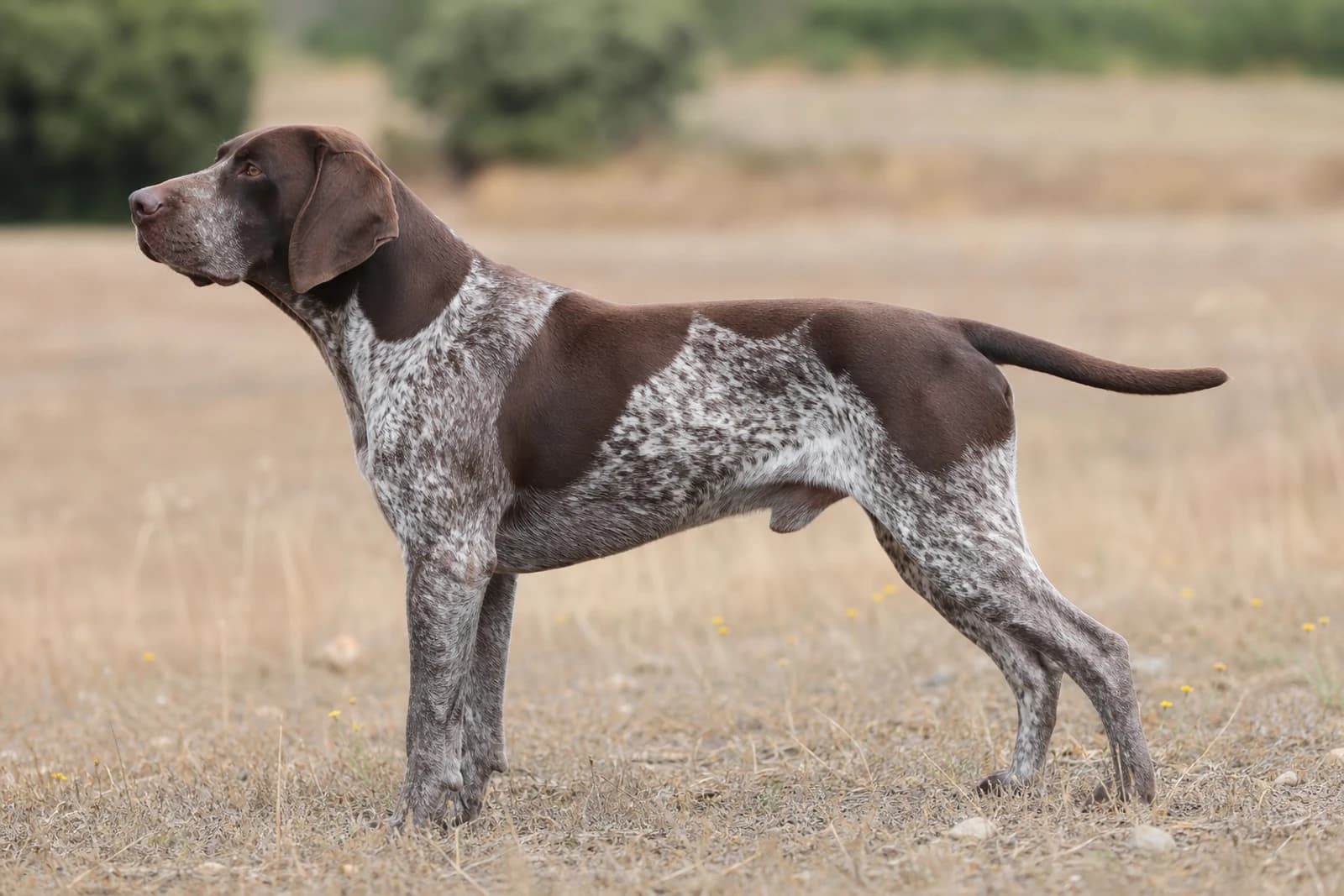
The Burgos Pointer is a sturdy, versatile hunting companion with a calm and affectionate nature, best suited for active families or hunters who can provide plenty of outdoor exercise. This Spanish breed is loyal and gentle with children, making it a great family dog for those with space and time to engage its keen mind and body. Not ideal for novice owners or apartment living, the Burgos Pointer thrives in a home where it can channel its natural pointing instincts and be a devoted member of the pack.
At a glance
- Size
- Giant
- Height
- 23–26 in
- Weight
- 55–66 lb
- Life span
- 12–14 years
- Coat colors
- Liver and white, Liver roan, Liver
- Coat type
- Short, dense, and smooth
- Group
- Gun
- Origin
- Spain
How much does a Burgos Pointer cost?
Adopt / rescue
$75–$400
Usually includes spay/neuter, first shots, and a microchip.
Buy from a breeder
$700–$2,000
From a reputable, health-testing breeder.
Approximate USD. Prices vary widely by region, breeder, pedigree, age, and coat colour — adopting is the lower-cost and recommended route. Avoid suspiciously cheap “breeders”; they’re often puppy mills.
Estimate the full cost of a Burgos Pointer →Burgos Pointer photos
Views
Front, side, rear and top — the full silhouette.Poses
How the breed sits, lies, moves and plays.Puppy to senior
The breed across its whole life.Expressions
The breed’s range of moods.Close-up details
Eyes, ears, nose, paws, tail and coat.Coat colors
The breed’s recognized colors.Click any photo to enlarge. We show the Burgos Pointer from every angle — three views, poses, life stages, expressions, close-ups, coat and colors.
Appearance & size
A heavy-boned hunter, not a runway model
When you first spot a Burgos Pointer, you notice the sheer substance. This is a big, powerful gun dog built for a long day in rough country—not a sleek, dash-and-grab sprinter. A grown male stands 23 to 26 inches at the shoulder and weighs 55 to 66 pounds; females fall at the lower end of that range but never look delicate. Everything about the frame says “endurance and strength”: the chest is deep and broad, dropping well down to the elbows, the ribs are well sprung, and the back is strong and only slightly sloping from the withers to the croup. Carrying extra weight on this breed is easy to do, and it shows quickly, so you’ll see responsible owners keeping them lean and hard-muscled.
The head is equally substantial. The skull is broad, with a distinct occipital peak and a moderate stop. The muzzle is wide and slightly arched—never snipey—and the lips hang just enough to give the dog a serious, composed expression. Eyes are medium-sized, dark hazel, and set deep enough that you get a calm, intelligent gaze, not a soft puppy-dog stare. Ears sit at eye level, large and triangular, lying flat against the cheeks.
Coat and color: low-fuss, liver-based
The coat is a tight, dense, short layer of hair that feels smooth to the touch and does its job keeping out light rain and brambles. On the head and ears, the hair is finer and even shorter. The breed is all about liver and white combinations. You’ll see solid liver dogs, white dogs with bold liver patches, liver roans, and heavily ticked white coats that almost look liver from a distance. Liver speckling across the white is so common it’s practically a breed signature. Nose, eye rims, and foot pads are always liver-colored—a dead giveaway that you’re looking at a true Burgos, not a similar pointing breed with a black nose.
Front, side, and rear: balanced power
From the front, the forelegs drop straight and muscular, set under a wide chest with shoulders that slope well back. Broad, round feet with well-arched toes give the dog stability on rocky ground. From the side, the deep chest and level topline draw your eye straight to the strong loin and moderate tuck-up—nothing exaggerated, just functional. The tail is set moderately high, thick at the base, and in working lines it’s often docked by a third to a half; natural tails carry with a slight upward curve when the dog is alert. From behind, you see heavily muscled thighs and well-let-down hocks that drive an easy, ground-covering trot. This is a dog that looks like it can go all day—and then do it again tomorrow.
History & origin
The Burgos Pointer comes straight off the high plateaus of Castile and León, named for the northern province of Burgos where it was hammered into shape over centuries. Spanish hunters on the meseta needed a dog that could methodically quarter miles of rocky, wind-scoured ground in search of red-legged partridge and hare, then lock into a point steady enough for a hunter traveling on foot. The dogs they developed were not the light, racy pointers of England—they were substantial, big-boned, and deep-chested, built for stamina over speed and for cold mornings in thorny scrub.
Historical records place a recognizable Burgos-type pointer in the region as far back as the 1500s. Local sportsmen crossed early pointing dogs with heavy mastiff-like scenthounds, selecting for a deep nose, a calm temperament, and a trot that could eat up distance all day without exhausting the handler. One physical quirk that still shows up is a split or “double” nose—sometimes a single nostril with a cleft, sometimes a true divided nose—that traces back to those ancient crosses and is linked to exceptional scenting ability.
Formal recognition came in the early 20th century. A breed standard was drafted in the 1920s, and the Real Sociedad Canina de España approved it in 1932. Then the Spanish Civil War hit, followed by the lean years of World War II. Meat shortages and a steep decline in traditional hunting pushed the breed to the brink. A few dedicated hunters and breeders, noticing only scattered dogs left in remote villages, began a deliberate rescue in the 1940s and 1950s. They gathered the survivors and bred strictly for working ability, ignoring passing trends.
That salvage operation produced the Burgos Pointer we see today: still rare, still a hunter’s tool first. While it has gradually spread to France, the United States, and other countries, its numbers remain small. There is some historical debate about whether Spanish pointers like the Burgos were tapped to add substance to the early English pointer, but the Burgos itself never morphed into a field-trial specialist. It stayed what it was—a heavy-duty bird dog that can handle a full day’s hunt without fuss, on terrain that punishes lesser dogs.
Temperament & personality
The Burgos Pointer runs on a two-speed switch: calm to the point of being a throw pillow indoors, then a tireless, ground-covering galloper the moment you step outside. A stroll around the block barely registers. This is a dog built to hunt all day in rough terrain, so plan on a solid hour of off-leash running, scent games, or field work daily. Skip it, and you’ll see that pent-up energy turn into anxious barking, chewing drywall, or pacing the hallway at 3 a.m.
Affection runs deep without being needy. A Perdiguero de Burgos will shadow you from room to room and press a shoulder against your leg, but rarely demands constant attention. That quiet loyalty makes them sharp watchdogs. They’ll bark to let you know a stranger pulled into the driveway, then usually wag and settle once you give the all-clear. Left unsocialized as pups, though, their natural reserve with unfamiliar people can slide into timidity, so early, positive exposure to new faces and places matters.
With children, the breed tends toward gentle patience—a big, steady presence that tolerates clumsy hugs. Still, a 60-pound dog can knock over a toddler without meaning to, and no Burgos Pointer should be interrupted while eating. A stiff body, hard stare, and forward-leaning posture often precede a snap, so teach kids to let the dog eat in peace and to read those signals. The breed is strong-willed but not hard-natured; they respond to calm, consistent guidance, not force. Jerk the leash or raise your voice, and you’ll likely get a dog that shuts down and ignores you.
Puppyhood brings a chew-everything phase, driven by teething and curiosity, and even adults keep their jaws busy on hard chews to stay clean and strong. Stock durable toys and redirect mistakes with a homemade citrus spray from boiled peels or a mist of white vinegar—both safe deterrents that won’t turn the moment into a wrestling match.
Scent rules this dog’s world. House-training accidents leave behind a chemical cue that invites repeat performances, so clean messes with an enzymatic cleaner or vinegar solution to break the cycle. Intact males, and some confident females, may urine-mark indoors if they catch the odor of an unfamiliar dog. A less-used guest room can feel like foreign territory to a nose-driven animal, so spread your family’s daily scent around the house to reinforce what’s “home.”
You’ll notice quirks that come straight from the breed’s scavenger ancestry—like rolling in anything dead or rotten. Some individuals seem positively proud of the stench, a behavior researchers compare to showing off a great food find or simply enjoying the perfume. Lip licking, head turns, and yawns are appeasement signals, not tiredness; respect them, and you’ll deepen the dog’s trust. Out in the field, a forward-leaning body with a locked stare means the point is about to happen. Read that body language, and you’ll catch the dog’s intentions long before it acts.
A Burgos Pointer’s temperament is a set of strong tendencies, not a factory preset. Socialize thoroughly, provide hard daily exercise, and pay attention to the individual dog in front of you for the full 12 to 14 years, and you’ll have a poised, affectionate partner that’s as content on the couch as it is charging through the brush.
Good with kids, dogs & other pets
With children
A well-bred Burgos Pointer brings a calm, non-aggressive patience to a household with kids. They’re not the type to get snappy over a bumped tail or a clumsy hug. The bigger practical concern is their size — at 55–66 pounds and around two feet tall at the shoulder, a happy greeting or a whip of that solid tail can topple a toddler before anyone realizes what happened. Supervision and some ground rules (no riding the dog, no tugging on ears) keep things safe on both sides.
This breed craves companionship and doesn’t do well stuck in a yard or left alone all day. They want to be where the family is, which makes them a steady, loyal playmate for older children who can throw a ball or join a long walk. Just don’t expect them to be the neighborhood’s rough-and-tumble wrestling partner; their patience has limits, and young kids need to learn to read a dog’s “I’ve had enough” signals.
With other dogs
Most Burgos Pointers get along easily with other dogs when they’ve had the right start. The key is positive, gradual exposure to friendly dogs during the critical socialization window — roughly from three to sixteen weeks of age. Puppies who meet a wide variety of calm, well-behaved adult dogs during that period tend to grow into adults who are relaxed and socially fluent.
If you’re bringing an adult Pointer into a home with existing dogs, don’t force things. Let them meet on neutral ground, keep early interactions brief, and watch body language. An older dog who grew up with limited social contact may be perfectly content just coexisting with you and might find a pushy new dog stressful rather than fun. Forced greetings can backfire and create tension, so go at the dog’s pace.
With cats and small pets
Here’s where the hunter in the Burgos Pointer comes through. Bred to find, point, and retrieve game, they have a deeply ingrained prey drive. A cat that darts across the room or a pet rabbit in a hutch can trigger instincts that override even the sweetest temperament. You can stack the odds with early, carefully managed introductions when the dog is a puppy — letting a kitten and a Pointer puppy grow up together often leads to a truce. But even then, never leave them unsupervised. Small caged pets like hamsters or guinea pigs should be housed out of reach; a flipping tail and a determined sniff can turn into a dangerous game in seconds. For this breed, a cat-and-dog household works only with a strong, consistent “leave it” cue and a lifelong commitment to attentive management.
Trainability & intelligence
The Burgos Pointer is sharp, driven, and bred to think for itself in the field — a combination that makes training both rewarding and a test of patience. This is not a breed that blindly obeys. He learns fast when the work is interesting, but a repetitive drill or a heavy hand will shut him down. You’ll get the best results when you approach training as a partnership built on trust, not a hierarchy enforced by corrections.
- Learning & motivation: A well-timed game of tug, a pocketful of high-value treats, or a chance to use his nose all far outweigh stern words. He picks up new commands quickly, but his independent streak — classic for a pointer — means he’ll pause and assess a situation before responding. That “pause” can look like stubbornness, but it’s really the dog weighing whether your request makes sense in that moment.
- Recall: The nose runs the show, and that can make reliable off-leash recall the single biggest challenge. A Burgos Pointer catching a scent may tune out everything else. Proofing recall around birds, deer, or even a strong breeze carrying an interesting odor takes months of steady, reward-heavy work. Start in low-distraction environments and don’t rush the process.
- Socialization & sensitivity: Despite his size (55–66 lb), this is a sensitive dog who can become wary or aloof with strangers if not carefully exposed as a puppy. The window between 3 and 14 weeks is critical. Gradual, positive introductions to new people, surfaces, sounds, and other animals build the confidence that prevents fear-based reactivity later. Harsh punishment destroys the bond you’re trying to build and often creates a more resistant, anxious dog.
- What works: Short, varied sessions with lots of praise. Hide a piece of kibble under a cup and let him sniff it out as a reward — that’s more valuable to him than a pat on the head. End on a success. Keep your voice calm and your signals consistent. If you get frustrated, walk away; he’ll read your tension and check out. Once the bond is solid, you’ll have a biddable hunting partner who works with you, not just for you.
Exercise & energy needs
Plan on a solid 60 to 90 minutes of real exercise every day, split into at least two sessions. This is a large, athletic gun dog built to cover miles of rough terrain in a single hunt. A 20-minute stroll on a leash won’t scratch the surface. You need off-leash running, hard trotting alongside a bike, or vigorous field work — the kind of activity that gets a dog breathing hard and using its muscles fully. A fenced area where the dog can sprint, quarter, and follow its nose is ideal.
Daily exercise routine
Two 30- to 45-minute sessions work well for most adult Burgos Pointers. A morning run or long hike can be followed by an afternoon session of retrieving, swimming, or a structured off-leash romp. Avoid pounding pavement for hours on end, especially with a young dog whose joints are still developing. Grass, dirt trails, and sandy ground are kinder on the body. Stick to low-impact exercise during the first year and gradually build endurance once the growth plates close. Responsible breeders screen for hip dysplasia, but it’s up to you not to overdo it before the dog is physically mature.
Mental stimulation counts
Physical fatigue alone won’t settle this breed. They need to use their brain just as much. Incorporate scent games — hide a dummy with a strong-smelling treat, let the dog quarter into the wind to find it, or scatter kibble in the yard for a “find it” session. Puzzle toys that require problem-solving help, but they’re no substitute for the real thing: work that mimics hunting. Training for field work, even if you never hunt, gives the dog a sense of purpose. Retrieve drills, steadiness work, and directional commands all burn mental energy.
Sports and activities that fit
Burgos Pointers thrive in canine sports that match their heritage. Field trials, hunt tests, and upland bird dog training are obvious fits. They also excel at canicross, bikejoring, and skijoring — anything that lets them pull and run steadily for miles. Swimming is a great low-impact alternative on hot days or for an older dog who still needs to move. If you’re not into organized sports, plan regular off-leash runs in rural areas where the dog can safely explore and stretch out.
A Burgos Pointer that gets the right mix of hard exercise and nose work will lounge around the house like a throw rug. Skip the outlet, and you’ll see a dog that paces, digs fence lines, chews up your baseboards, or invents its own job — which rarely matches what you had in mind.
Grooming & coat care
The Burgos Pointer’s short, dense coat needs very little fuss—but you still want a routine that keeps your dog comfortable and your home from becoming a hair magnet. This breed carries a smooth, single-layer coat with no insulating undercoat, so you won’t deal with the huge seasonal blowouts of a double-coated dog.
A pig-bristle brush or a grooming mitt is all you really need. Run it over the dog two or three times a week to pull out dead hair, spread natural oils, and deliver that glossy, healthy sheen. During spring and fall you might notice slightly more shedding; bump it up to a quick daily once-over during those weeks. A rubber curry brush works beautifully then, loosening extra hair without scratching the skin.
Bathing is an as-needed event. The coat naturally sheds dirt and dries fast, so outside of a roll in something foul, a rinse with plain water often does the job. When you do suds up, use a mild dog shampoo no more than every couple of months—over-washing can strip the oils that keep the coat shiny and weather-resistant.
Ears demand regular attention. Those floppy leathers trap moisture and cut airflow, setting up perfect conditions for yeast and bacteria. Flip them open and wipe them out weekly with a canine ear cleaner, and always dry them thoroughly after a swim or a wet hunt.
Nails usually stay short in an active dog that covers a lot of ground, but don’t count on it. Check every two weeks and trim the tips if you hear clicking on hard floors. Teeth get a brushing a few times a week to keep tartar and gum issues at bay.
You’ll never need a trip to the groomer for clipping or stripping—this pointer’s coat is fully wash-and-wear. A few minutes with a bristle brush, a quick ear check, and nail attention are all it takes. The payoff is a clean, comfortable dog and a whole lot less hair on the furniture.
Shedding & allergies
The Burgos Pointer is not a low-shedding dog, and it is absolutely not hypoallergenic. That short, sleek liver-and-white coat might fool you into thinking hair cleanup will be minimal, but these dogs lose a steady amount of hair year-round and blow their coat heavily twice a year.
- Shedding level: Moderate to heavy during seasonal transitions. Expect to find short, stiff hairs weaving into upholstery, car seats, and your favorite dark pants.
- Seasonal blowout: In spring and fall, you’ll think the dog is unraveling. A quick once-over with a rubber curry or hound glove pulls out loose coat by the fistful. During these weeks, daily brushing makes a real dent in the airborne fuzz.
- Drool: Some individuals are tidy; others fling slime after drinking or when you’re holding a treat. Count on wiping down walls near the water bowl. They aren’t Saint Bernards, but a dangling string of drool after a run is common enough to mention.
- Allergies: There is no such thing as a truly hypoallergenic dog, and this breed produces plenty of dander and saliva proteins. If someone in your house has dog allergies, a Burgos Pointer is a risky choice. Spend time around the breed—preferably in a home, not a breeder’s kennel—before committing.
You’ll manage the hair best with a weekly 5-minute curry session and a solid vacuum. But if the idea of dog glitter on every fleece jacket bothers you, this isn’t your breed.
Diet & nutrition
Feed your Burgos Pointer for the athlete it is, even if its day job is family companion. These dogs sit in the large-breed bracket at 55–66 lb, and extra weight hits their joints harder than it does on a smaller dog. The breed can be extremely food-driven, so free-feeding or measuring by eye is a fast track to obesity. Figure out a daily calorie target based on real activity — not vague assumptions — and stick to it. A lean, working 60 lb adult burns through more food than a weekend-hiker of the same weight, and you adjust the scoop accordingly. For most moderately active adults, that’s roughly 2 ½–3 cups of a high-quality, meat-first dry food, split into two meals.
- Puppy schedule: Four small meals a day until 4 months, then three until 6 months, then the adult two-meal pattern. Choose a large-breed puppy formula to support slow, even growth and protect developing hips and elbows. Transition to new foods over a week, starting with lightly cooked, puréed meats and vegetables or a premium kibble. Raw chicken wings can come in around 12 weeks under your supervision — they’re a natural toothbrush and chew workout.
- Homemade option: If you go fresh, aim for roughly 60% raw or cooked meat, 20–30% fruits and vegetables, and 10% extras like eggs, plain yogurt, or pearl barley. Blitz or finely chop everything; dogs don’t chew sideways and lack salivary amylase, so breaking cell walls before it hits the bowl means better nutrient absorption. Cook larger batches of barley, veg, and lean protein so you always have a base ready.
- Senior adjustments: As that 12–14 year lifespan rolls on, activity often tapers. Weigh your dog every few weeks and shave a few kibbles off the daily portion before you see the ribs disappear. There’s no need to ditch protein — older dogs do fine with it — but smaller, more frequent meals can ease digestion. If teeth are failing, purée the whole meal. A slow-feeder bowl helps at any age if your Pointer hoovers dinner in 30 seconds, and it quietly works their brain, too.
- Hard no’s: Never dish up food straight from the table; begging, once learned, is near impossible to un-train. Rich, fatty scraps (holiday trimmings, bacon grease) can trigger pancreatitis, and a vegetarian or vegan diet denies this carnivore-leaning gun dog the nutrients it evolved on.
Match the feed to the dog in front of you — not the one on the bag — and you’ll keep a Burgos Pointer moving comfortably for years.
Health & lifespan
A well-bred Burgos Pointer typically lives 12 to 14 years — a long run for a 55 lb athlete that puts serious mileage on its joints. That longevity depends heavily on good breeder choices and day-to-day care that matches the breed’s working roots.
What responsible breeders screen for
You want parents with verifiable health clearances, not just a clean vet note. Hips and elbows should be evaluated by OFA or PennHIP, since even mild dysplasia can cripple a dog that hunts hard and jumps into trucks. Annual eye exams by a veterinary ophthalmologist check for progressive retinal atrophy and cataracts, both of which show up in some pointing lines. Cardiac certifications aren’t universal, but asking if the sire and dam were screened by a cardiologist can tip you off to early heart issues.
Conditions to keep on your radar
- Joint wear: Deep-chested and built to run, these dogs punish their hips, elbows, and stifles over a lifetime. Staying at a lean working weight (visible waist, easy tuck-up) is the single best thing you can do. Every extra pound above 66 cuts an active dog’s comfort and lifespan.
- Bloat: A real threat in any deep-chested gun dog. Feed two or three smaller meals, avoid raising the bowl, and enforce a quiet hour after eating — no hard sprinting, no horseplay. Know the early signs (restless pacing, unproductive retching) so you can act fast.
- Ear infections: Those floppy ears seal in moisture. After a swim, a wet retrieve, or even a heavy dew, dry them thoroughly. A weekly sniff and glance inside catches trouble before it becomes a costly vet trip.
- Skin sensitivities: Some lines react to environmental allergens or low-quality fillers. A diet with solid omega-3s and limited grains often clears things up, but relentless scratching warrants a workup for allergies.
Daily habits that protect health
- Preventives on a calendar: Monthly heartworm medication during mosquito season — and one dose after it ends — is non-negotiable. Rabies vaccination is legally required and has no cure once symptoms appear, so stay current.
- Exercise that works body and brain: These aren’t weekend-warrior dogs. A brisk hour of off-leash running, sniff games, and field work burns physical energy and prevents the stress that fuels anxious, immune-draining behaviors.
- Early, low-stress handling: Getting a puppy used to having his paws, ears, and mouth examined makes vet exams and nail trims routine instead of a wrestling match. Dogs that remain calm at the clinic face lower stress-related health risks over a lifetime.
Even a Pointer that looks invincible needs an annual hands-on checkup and baseline bloodwork, especially once she passes 10. Subtle shifts in joint range of motion, heart rhythm, or organ function show up there long before you’d notice a change in the field.
Living environment
A Burgos Pointer in an apartment is a non-starter. This is a 55-to-66-pound bird dog whose ancestors crisscrossed the Spanish meseta for hours. Confining one to a few rooms without a yard guarantees chewed baseboards and a frustrated, vocal dog. You need a house with a securely fenced yard—invisible fences don’t stop a dog who’s locked onto a squirrel. Expect him to use that yard for bursts of self-directed sniffing and sprinting between your actual exercise sessions.
Plan on two solid outings daily, not a couple of quick loops. A leashed walk around the neighborhood won’t take the edge off—this dog needs off-leash running, swimming, or hard-hunting work for 60 minutes or more each time. You can split that into a morning run and an evening field session if you have access to open land, but the yard does the heavy lifting for all the hours in between.
Inside, they’re surprisingly calm given the outlet, but don’t mistake that for independent. Burgos Pointers are velcro dogs who shadow you from room to room. Being left alone for full workdays sets the stage for howling, destructive chewing, and separation distress. A household where someone works from home or a schedule that breaks up the alone-time is far safer.
- Barking: Not neurotic, but they have a deep, carrying alert bark. You’ll hear it when the doorbell rings or a cat trespasses in the yard. Close-quarters neighbors won’t appreciate it.
- Climate: Their short coat handles heat well—shade and water cover you in summer—but offers zero protection against cold. Once temperatures dip into the 30s, a good insulated coat is a must, not an accessory.
- Yard must-haves: A 6-foot physical fence. Burgos Pointers carry strong prey drive, and their point-and-chase instinct overrides recall when a rabbit bolts.
If your setup can’t offer a large fenced yard, a couple hours of real exercise split across the day, and company more often than not, this isn’t your breed.
Who this breed suits
If you are an avid runner, cyclist, or dedicated upland hunter, the Burgos Pointer will slot into your life like a well-worn shooting vest — eager, tireless, and ready to cover rough ground for hours. This is a 55-to-66-pound athlete with a ground-eating trot that demands a full hour of hard, off-leash running or vigorous retrieving work each day, not a couple of sedate leash walks. Provide that, and you get a remarkably calm, affectionate housemate who flops at your feet the moment the gear goes away. Skip it, and that easygoing temperament unravels into chewing, howling, and escape-artist antics.
The breed bonds tightly with its people and does best in a home where someone is around for much of the day. They are notorious for pining and developing separation anxiety when left alone for long stretches, so a work-from-home owner, a retired couple, or a family with staggered schedules will see the dog’s sweet, steady side. With older children who can handle a muscular 23-to-26-inch-tall dog without getting accidentally knocked over, the Burgos is patient and gentle. The coat is a low-maintenance bonus: moderate shedding, and a quick weekly brush is plenty.
Hunters get a versatile, soft-mouthed pointer that retrieves on land and in water, then settles quietly indoors without demanding constant entertainment. Singles or couples who hike, trail run, or mountain bike will find a tireless, biddable partner that thrives on a shared job.
Think twice if you live in an apartment with no immediate access to big, safe off-leash areas — this breed needs room to stretch out at a gallop. First-time owners who aren’t prepared to commit to daily high-octane exercise and consistent, positive training may find the Burgos’s sensitivity and drive overwhelming, though the dog is forgiving with a calm, fair handler. Sedentary households, anyone looking for a backyard ornament, or people who expect a dog that’s content with a potty break and a couch marathon will end up with a profoundly miserable animal. Seniors should honestly assess whether they can absorb a sudden leash-jerk when a rabbit bolts — this is a strong, fast-reacting hunting dog at heart. If you cannot promise muddy paws and a sprint session twice a day, choose a lower-octane companion.
Cost of ownership
Bringing home a Burgos Pointer puppy from health-tested parents in the U.S. will typically set you back $1,500 to $2,500. Because the breed is genuinely rare on this side of the Atlantic, you may wait six months to a year for a planned litter. Importing a pup from a top Spanish kennel can push the price past $3,000, with crate, flight, and customs fees adding another $500–$800. That upfront cost usually buys you a pup whose parents had hip, elbow, and eye clearances—for a working gun dog meant to go all day, that screening matters.
Monthly costs settle into a steady rhythm once the puppy stage passes.
- Food: A 55–66 lb Burgos Pointer is a lean, hard-muscled athlete that burns calories fast. Plan on 2½ to 3 cups of high-quality kibble daily, which comes to $60–$80 a month. Raw or fresh-food plans can easily top $100.
- Grooming: The short, dense coat is wash-and-go. An occasional bath, weekly brushing during shedding season, and regular nail trims keep you at $0–$20 a month if you do it yourself, or a $40–$60 pro visit every couple of months.
- Routine vet and preventatives: Annual exams, vaccinations, heartworm prevention, and flea/tick control spread out to roughly $50–$75 a month. Don’t skip the preventatives—this breed lives to root through brush and water.
- Pet insurance: For a purebred prone to hip dysplasia and bloat, a solid accident-and-illness policy runs $45–$65 a month, depending on your deductible and location.
Count on a baseline of $130–$180 in predictable monthly care, not including training classes, a sturdy crate for a determined chewer, or the cost of replacing the remote control they dissected while you were in the shower.
Choosing a Burgos Pointer
A Burgos Pointer isn’t a dog you stumble across at the local shelter or in a weekend classified ad. This is a rare Spanish gun dog with a tight gene pool, so finding a responsible source takes patience—but that persistence separates a healthy, rock-solid companion from a medical guessing game.
Breeder or Rescue?
Start with the Burgos Pointer Club of America or the breed’s parent club in Spain for breeder referrals. Because numbers are small, litters don’t happen on demand; expect a waitlist. Adult rescues are equally scarce, but don’t rule them out. Pointing dog rescues, bird-dog rehoming networks, or even Spanish hunting-dog groups occasionally place a Burgos that lost its home. A rescue can be a wonderful shortcut past the puppy stage—just be ready for the high prey drive and exercise needs that land these dogs in rescue in the first place.
Health Clearances to Ask For
The breed is generally sturdy, living 12–14 years, but a few issues crop up often enough that ethical breeders screen both parents before breeding. Request written proof of:
- Hips: OFA or PennHIP evaluation—dysplasia is possible in a heavy-boned, fast-growing dog this size (55–66 lb).
- Elbows: OFA clearance, since joint problems aren’t limited to hips.
- Eyes: a current CERF or OFA Eye exam—ectropion, entropion, and cherry eye can appear in the breed.
- Cardiac: an echocardiogram or specialist cardiac exam; some pointer lines carry a low incidence of congenital heart defects.
A breeder who brushes off these tests or claims “my vet said they’re fine” without documentation is a red flag, not a bargain.
Red Flags That Should Make You Walk Away
- No hunting or field exposure. The Burgos Pointer is a working dog through and through. Breeding purely for companionship, without proving the parents’ nose, temperament, and stamina in the field, tends to water down the very traits that make the breed distinctive.
- Puppies leaving before 8 weeks. These are large, slow-maturing dogs; letting them go too early risks poor social development and bite inhibition.
- Multiple litters on the ground, always available. A small gene pool breeder usually produces at most one or two litters a year.
- Selling through a pet store or broker. Not how rare-breed preservation works.
Picking a Puppy
When you visit, look for puppies raised inside the home with steady, everyday noises—a setting that builds stable nerves. The dam should be confident, not skittish or guardy, and happy to see you. The puppy itself? A little initial wariness is normal, but you want one that recovers quickly, engages with you, and investigates new objects instead of slinking away. Avoid the extreme: the overly shy pup huddled in a corner, and the manic one bowling over littermates can both turn into a challenge in a high-drive gun dog. Either way, ask the breeder how they evaluate drive and nerve; they should be able to describe each puppy’s developing personality in concrete, not just cute, terms.
Pros & cons
Pros
- Indoors, they’re a different dog. A Burgos Pointer who gets his daily running is calm, gentle, and quietly affectionate. They bond tightly with their family and are reliably steady with children they’re raised alongside — not needy, but present.
- A hunter’s partner with no off switch in the field. They bring an exceptional nose, natural pointing and retrieving instinct, and almost scary stamina. Even if you don’t hunt, the breed takes to scent work, canicross, or long off-leash trail runs like they were born for it.
- Tough and relatively unfussy. A well-bred Burgos Pointer can live 12–14 years. The short, dense coat sheds modestly and needs little more than a weekly brush-out; they don’t carry a heavy doggy odor.
- Genuine off-switch indoors. Once the exercise tank is empty, these dogs are content to sprawl quietly on a rug, not pace or demand attention.
Cons
- Exercise is non-negotiable — and a lot of it. A couple of leash walks won’t dent their needs. Count on 90+ minutes daily of hard running, free galloping, or retrieving drills. Without it, you’ll see restless destruction and an unhappy, pacing dog.
- Prey drive runs deep. Small animals, stray cats, and even fast-moving bicycles can trigger a full-tilt chase. Reliable recall off-leash around wildlife takes years of consistent training, and some individuals never become trustworthy.
- They think for themselves. The independent problem-solving that makes them brilliant in the field often shows up as selective hearing at home. First-time owners will find the stubborn streak a real challenge without experienced, patient handling.
- Hard to acquire. Rare almost everywhere outside Spain. Finding a responsible breeder means long waitlists, travel, and careful vetting to avoid hasty cross-breeding that dilutes health and temperament.
- Size and space matter. At 55–66 pounds and up to 26 inches tall, they’re a lot of athlete. Apartment living is a poor fit unless you can guarantee daily access to large, safe off-leash areas — a small yard alone won’t solve it.
Similar breeds & alternatives
If you’re drawn to the Burgos Pointer’s deliberate, heavy-boned frame and calm-but-capable field style, but you can’t easily find a breeder in North America, a few more common pointing breeds offer a similar feel — with important twists in energy, coat, and availability.
-
Bracco Italiano – The closest physical match to the Burgos Pointer is another giant from the Mediterranean, weighing 55–88 lb and standing 22–27 in. The Bracco is also a slow, methodical hunter that works close and pours on a ground-eating trot rather than a sprint. The big difference is the head: the Bracco’s muzzle is long and Roman-nosed, with huge, low-set ears, while the Burgos carries a more square, double-chinned muzzle and a distinctive split nose. Both are affectionate house dogs that can turn into couch weights after a hunt, but the Bracco’s popularity in the U.S. has grown, making puppies easier to locate.
-
Spinone Italiano – If you value the Burgos’s composed, people-soft temperament but need a wirehaired coat for cold, wet cover, the Spinone checks both boxes. It’s a muscular 22–27 in, 61–86 lb pointer that trots with the same measured, enduring gait. The coat changes everything: it’s dense, harsh, and weatherproof, where the Burgos’s short, tight coat is built for dry, hot Spanish uplands rather than all-day drizzle. Spinoni are famously gentle with kids and other dogs, much like the Burgos, and they’re easier to find on this side of the Atlantic.
-
English Pointer – This is the alternative for someone who loves the look of a classic pointing silhouette but wants more speed and range. At 45–75 lb and 23–28 in, an English Pointer is taller and far leaner, built to fly across huge open fields. Where the Burgos Pointer stays close and works a patch of cover with patience, the English Pointer ranges out, runs hard, and expects a fit owner who can keep up. The short coat is similar, but the energy gap is enormous — a Burgos will settle after a solid off-leash run; an English Pointer may still pace.
-
German Shorthaired Pointer (GSP) – A GSP can tip the scales at a comparable 45–70 lb, but stands a bit shorter (21–25 in) and is packed with athletic drive. Unlike the Burgos’s steady, almost stubborn independence, the GSP is a versatile, high-octane collaborator that needs a job and a good two hours of hard exercise daily. If you want a giant pointer that’s easygoing at home and won’t dismantle your routine when you skip a run, the Burgos fits; if you’re looking for a do-it-all gun dog with boundless energy, the GSP is the more practical, widely available choice — just know you’re signing up for a far busier houseguest.
All of these breeds share a strong pointing instinct and a generally people-friendly nature, but the Burgos Pointer’s particular blend of giant size, short coat, and unhurried, heat-tolerant working style remains hard to duplicate. Your choice comes down to what you’ll live with every day: the coat you want to deal with, the pace of exercise you can honestly provide, and how far you’re willing to search for a puppy.
Fun facts
- The Burgos Pointer is one of the oldest Spanish pointing breeds, used for centuries to hunt partridge.
- It is known for its remarkable stamina and ability to work in challenging terrain.
- Despite its size, it is known for a notably calm and gentle demeanor at home.
- The breed is also called Perdiguero de Burgos, after the region of Burgos where it originated.
Frequently asked questions
- How much exercise does a Burgos Pointer need?
- Burgos Pointers have high energy levels and require plenty of daily exercise. They thrive with long walks, runs, and opportunities to run off-leash in secure areas, plus mental stimulation like training or scent work. Without enough activity, they may become restless or develop unwanted behaviors.
- Are Burgos Pointers good with children?
- Generally yes, Burgos Pointers are calm, affectionate, and loyal, which can make them great family companions. Early socialization and supervision are important due to their size and strength, but they tend to be gentle and patient with kids.
- Do Burgos Pointers shed a lot?
- Burgos Pointers shed moderately, falling around a 3 out of 5 on the shedding scale. Regular brushing helps manage loose hair, and you can expect some seasonal increases. They aren't considered hypoallergenic.
- How much grooming does a Burgos Pointer require?
- Grooming needs are low, rating about 2 out of 5. Their short, dense coat only needs occasional brushing to remove dirt and loose hair, plus baths as needed. Routine nail trims and ear checks are also recommended.
- Can a Burgos Pointer live in an apartment?
- Due to their large size and high energy level, Burgos Pointers are not ideal for apartment living. They do best in homes with a secure yard where they can stretch their legs, but a dedicated owner in an apartment could meet their needs with rigorous daily exercise and outdoor time.
- Are Burgos Pointers good for first-time dog owners?
- Burgos Pointers can be suitable for first-time owners who are committed to consistent training and exercise. Their intelligence and determination respond well to positive reinforcement, but the breed's energy and size may be challenging for those without prior dog experience.
Tools & calculators for Burgos Pointer owners
Quick estimates tailored to Burgos Pointers — pre-filled with this breed’s size where it matters.
Articles & stories about the Burgos Pointer
Sources & standards
This profile follows recognized breed standards from the American Kennel Club (AKC) and the Fédération Cynologique Internationale (FCI), along with established veterinary and breed-club guidance. These describe general breed tendencies — every dog is an individual.
Owner stories
Have a Burgos Pointer? Share your experience — grooming tips, personality quirks, anything goes.