

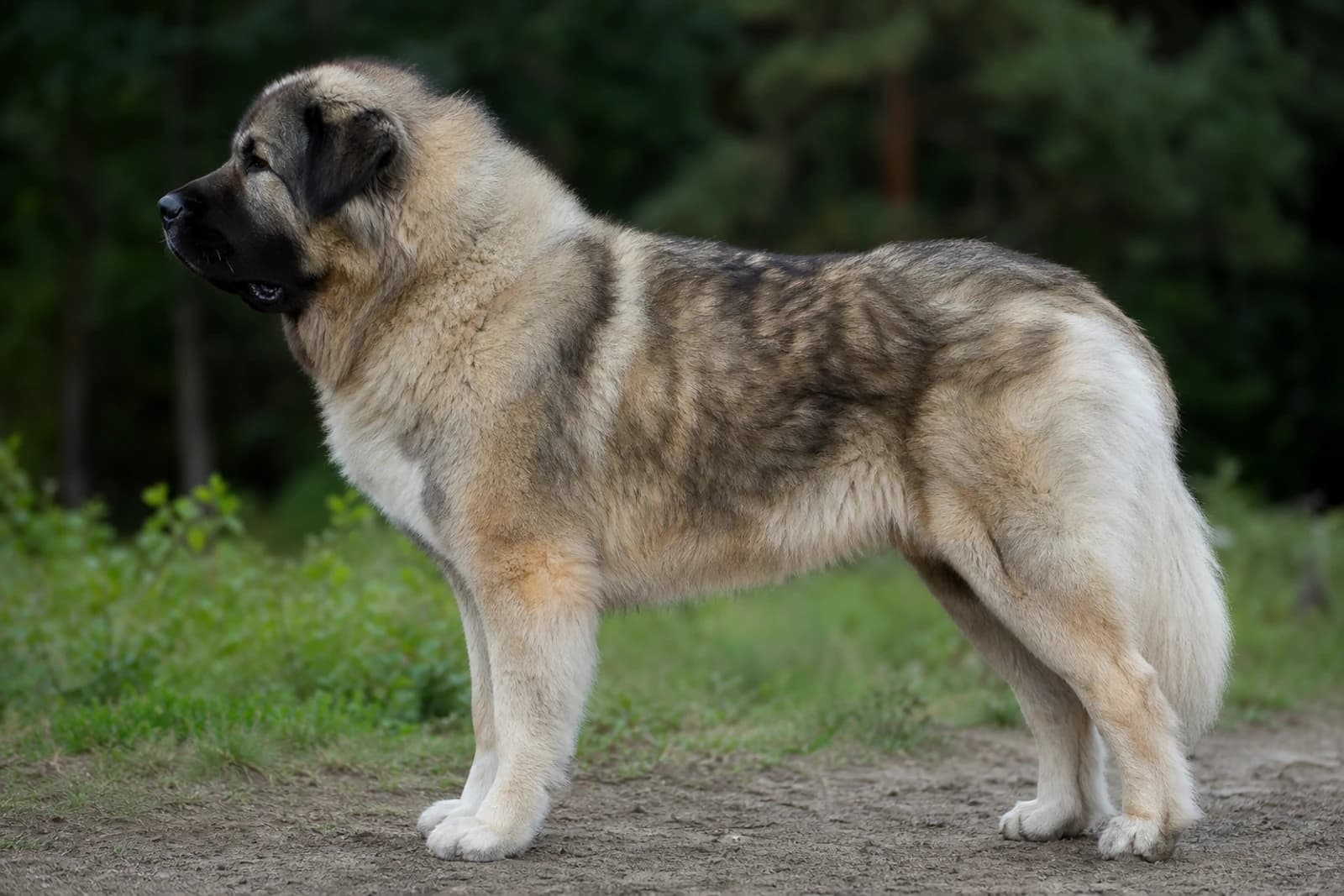
The Caucasian Shepherd Dog is a massive, powerful guardian breed originating from the Caucasus Mountains. Bred to protect livestock from predators, this breed is exceptionally loyal, fearless, and protective of its family and territory. They are best suited for experienced owners with ample space and time for training and socialization. While calm and affectionate with their own, they can be wary of strangers and other animals. With the right handler, they make devoted, lifelong companions.
At a glance
- Size
- Giant
- Height
- 26–30 in
- Weight
- 99–154 lb
- Life span
- 10–11 years
- Coat colors
- gray, fawn, brindle, white, tan, piebald, rust
- Coat type
- Thick double coat, ranging from short to long
How much does a Caucasian Shepherd Dog cost?
Adopt / rescue
$75–$400
Usually includes spay/neuter, first shots, and a microchip.
Buy from a breeder
$700–$2,000
From a reputable, health-testing breeder.
Approximate USD. Prices vary widely by region, breeder, pedigree, age, and coat colour — adopting is the lower-cost and recommended route. Avoid suspiciously cheap “breeders”; they’re often puppy mills.
Estimate the full cost of a Caucasian Shepherd Dog →Caucasian Shepherd Dog photos
Views
Front, side, rear and top — the full silhouette.Poses
How the breed sits, lies, moves and plays.Puppy to senior
The breed across its whole life.Expressions
The breed’s range of moods.Close-up details
Eyes, ears, nose, paws, tail and coat.Coat colors
The breed’s recognized colors.Click any photo to enlarge. We show the Caucasian Shepherd Dog from every angle — three views, poses, life stages, expressions, close-ups, coat and colors.
Appearance & size
The first thing that hits you is the sheer mass. A Caucasian Shepherd doesn’t just stand tall — it fills the doorway. At 26 to 30 inches at the shoulder and anywhere from 99 to 154 pounds, this is a dog built to stop wolves, not just scare them. The frame is rectangular, with a heavy bone structure and thick, powerful muscles that ripple under the skin. Males often push the top of the scale, while females settle into the lower end, but neither sex looks slight.
Start at the front and you’re met with a broad, bear-like head. The skull is wide and flat, the muzzle deep and blunt, tapering just slightly. Dark, oval eyes sit deep under well-defined brows, giving an expression that’s watchful and utterly unflappable. Ears were traditionally cropped short in working lines, but uncropped ears hang flat. The neck is thick and short, with a pronounced dewlap that blends into a deep, wide chest. From the side, the body shows balance — a strong, level topline, a broad loin, and a chest that reaches at least to the elbows. There’s a slight tuck-up, but the silhouette is substantial, not leggy. Move to the rear and the hindquarters are equally muscular, with well-angled stifles and a tail that’s carried low or in a sickle curve at rest, sometimes raised when alert.
The coat is where you see real variety. All three lengths exist: short, medium, and long. The long coat develops a heavy ruff around the neck, feathering on the backs of the legs, and a plumed tail — almost mane-like. A dense, woolly undercoat packs underneath, making the dog look even bigger and providing serious insulation. Colors range widely: solid gray, fawn, red, cream, or white; brindle; piebald; and agouti patterns like wolf-gray. A solid black mask is common and intensifies that no-nonsense stare.
What’s distinctive isn’t just one feature, but the whole package — a dog that looks like it was carved from the mountains it guarded, rough-edged and utterly formidable. And if you see one in a heavy winter coat, the ruff framing that massive head, you understand why they never needed to be loud to be heard.
History & origin
The Caucasus Mountains have been shaping this dog for as long as shepherds have run flocks across that brutal terrain. We’re not talking about a breed someone cooked up in a kennel a century ago — the Caucasian Shepherd Dog is an ancient landrace, carved by necessity and a landscape where wolves, bears, and raiders were daily realities. Herding families across Georgia, Armenia, Azerbaijan, Dagestan, and the surrounding highlands needed a dog that could hold its own against predators weighing twice as much, without a human there to give orders. So they selected for raw courage, deep suspicion of anything unfamiliar, and the physical heft to back it up. For centuries, nobody wrote down pedigrees; a good dog stayed because it survived and kept the sheep alive.
By the early 1900s, the Soviet military saw something useful in those scattered working dogs. They rounded up the best specimens from different regions — heavy-boned mountain types, longer-legged plain types — and started a state-controlled breeding program aimed at producing a uniform guard dog for prisons, borders, and industrial sites. The first breed standard hit paper in the 1930s, and the dog gained official recognition as the Caucasian Ovcharka. That Soviet push was also a bottleneck: the dogs that made it into kennels were chosen for aggression and trainability in a military context, which still runs through many lines today.
After the Iron Curtain fell, the breed spilled into the West, landing in the U.S. in the mid-1990s. Serious enthusiasts mostly import directly from working kennels in Russia and the Caucasus, not show breeders who pick for bulk over function. Today, a well-bred Caucasian remains exactly what it was 500 years ago: a serious livestock guardian with an independent mind, a low tolerance for strangers, and the size (99 to 154 pounds, up to 30 inches at the shoulder) to make good on that attitude. You’re not getting a retriever; you’re getting a dog whose entire history was spent making life-or-death decisions alone at 10,000 feet.
Temperament & personality
Temperament & personality
This isn’t a dog that bounces up to strangers. The Caucasian Shepherd is hardwired to assess potential threats, and its default answer is suspicion. You get a calm, steady presence indoors—not a bundle of frantic energy—but that calm is deceptive. It’s the stillness of a guard dog waiting for a reason to act. When something does catch its attention, the reaction is immediate and loud. These dogs bark deeply and often, which makes them a deterrent, but it also means you’ll never sneak a delivery past your yard.
Affection in this breed looks different from what many people expect. They form a deep bond with their own family and will shadow you from room to room, but they don’t beg for petting or jump up for hugs. Instead, they lean against you—a 130-pound lean that says “you’re mine.” They’re not aloof in the sense of being uninterested; they simply express loyalty by guarding, not by fawning.
Because they’re so territorial, indoor urine marking can become a problem. A Caucasian Shepherd may decide a guest bedroom that rarely smells like the family needs his scent posted. This isn’t a housebreaking failure—it’s the dog treating your home like a territory to be defined and reinforced. Removing urine odors thoroughly with an enzymatic cleaner is non-negotiable; even a trace of old scent can cue a repeat performance. You’ll also notice him sniffing and marking the same outdoor spots on walks, building a scent map of his range.
The breed is fiercely independent. He does not care about pleasing you simply because you ask. You earn cooperation through consistent, respectful handling—never by force, which will be met with escalating resistance. Read his body language constantly. A stiff posture and hard stare from this dog mean a bite is a real possibility, not just a warning. On the flip side, lip licks, yawns, and head turns are his attempt to de-escalate, and you need to recognize and honor those signals immediately.
Around the household, the Caucasian Shepherd’s guarding instinct can blur boundaries. He may try to physically place himself between your child and a visiting friend, which a child might misinterpret as an invitation to push back. That can end badly. The breed is not recommended for homes with young children or other pets without an exceptionally skilled owner. Food guarding is another common hotspot: teach every family member, especially kids, to give the dog total privacy during meals. A 150-pound dog that feels cornered while eating is a serious liability.
He needs a job, not just a walk. Patrolling a large fenced property and making the rounds satisfies his drive; a couple of leash strolls around the block won’t. Without that purpose, he invents his own—usually chewing anything that smells like you, or barking through the night. Provide durable, tough chews to keep those powerful jaws working and to clean teeth; a bored Caucasian Shepherd will dismantle furniture. If you catch him gnawing on something off-limits, a homemade citrus spray on the item can turn him off without confrontation.
The owner who matches this dog reads canine signals as fluently as the dog does, keeps a predictable routine, and has no need for a gregarious, easygoing pet. If that sounds like more than you want to handle, the breed will reveal the mismatch every single day.
Good with kids, dogs & other pets
A Caucasian Shepherd Dog is not a plug-and-play family pet that automatically welcomes kids, dogs, or small animals. These 99–154-pound guardians are bred to think independently and take threats seriously. That means safe coexistence depends almost entirely on early, thorough socialization and lifetime supervision — not on hope.
With children
Early and ongoing positive exposure teaches a Caucasian Shepherd to be patient and protective with the kids in its own household. However, supervision around young children is non-negotiable, purely because of the dog’s size. A friendly bump can knock over a toddler, and rough play or shrieking can be misread as a threat. They often do best with older, respectful children who understand canine body language. Visiting playdates full of unfamiliar kids are not a good match; the guarding instinct tends to kick in when chaos levels rise.
With other dogs
Same-sex aggression and territoriality run deep in this breed. A well-socialized puppy can learn to live peacefully with an opposite-sex housemate, especially if they’re raised together. But off-leash dog parks, doggy daycares, or off-hand introductions to strange adults are asking for trouble. Many adult Caucasian Shepherds are dog-intolerant, and forced interactions can trigger serious fights. Respect that aloofness with other dogs isn’t a flaw — it’s the breed working as intended.
With cats and small pets
They aren’t typically driven by high prey drive, but their suspicion of anything new means a visiting cat or unfamiliar small animal can be viewed as a problem to neutralize. A puppy raised indoors with a resident cat from the start may accept it as part of its flock, but even then, you’ll want to watch for chasing or overly possessive reactions. Separate feeding areas and escape routes are wise precautions.
The real work: socialization
The sensitive window slams shut around 12–16 weeks. That’s your narrow chance to calmly introduce your puppy to a wide variety of people, gentle older kids, calm dogs, different surfaces, and everyday sounds. Lack of early experience often leads to adult dogs who are timid, sound-phobic, or reactive during routine handling and vet visits. After that window, you can still help a dog build confidence, but forcing a fearful adult into social situations backfires — adding stress without improving sociability. With this breed, managing their environment and respecting their boundaries is often the smarter, safer path than trying to “fix” their temperament.
Trainability & intelligence
Forget a dog that hangs on your every word. The Caucasian Shepherd was bred to make life-or-death calls on its own while standing between a flock and a wolf pack. That means intelligence here isn’t eagerness to please — it’s sharp, independent judgment. He’ll learn a new routine in a handful of repetitions, then decide whether he feels like complying based on what’s happening outside the window. You’re managing a 130-pound security detail that reads the world faster than you do, and your job is earning the right to be heard.
Motivation rarely looks like a Labrador’s food drive. Many lines are only mildly interested in treats. What moves the needle is the dog’s ancient sense of territory and partnership. He works with you when he trusts that you’re competent and that following your lead keeps the property safe. Building that trust takes thousands of calm, consistent, reward-based interactions. Praise, a favorite squeaky toy, or a moment of play often means more than a biscuit.
Recall is a razor-thin proposition. A Caucasian Shepherd who’ll come instantly in the kitchen may blow you off completely if he spots a stranger at the fence line. These dogs were expected to handle threats, not drop everything and run back to a shepherd. Off-leash reliability is never a given, and chasing a prayer of a perfect recall can get you or someone else hurt. Keep physical control through a fence or a strong leash, always.
Common challenges come down to operational stubbornness. You’re not dealing with a dog who “forgot” the command; he weighed your request against his own threat assessment and vetoed it. That’s why punishment-based methods don’t just fail — they backfire. A harsh correction teaches him you’re an adversary, not a leader. Once trust is broken, a suspicious, 150-pound guardian is a genuine liability. The only path is positive reinforcement, clarity, and patience that stretches over years, not weeks.
- Start massive socialization between 3 and 14 weeks, hitting hundreds of calm, rewarding exposures — strangers, children, other dogs, different flooring, loud trucks, umbrellas opening. One scary encounter can seed a lifelong reactivity problem, so keep every introduction positive and unhurried.
- Use immediate rewards for any desired behavior. If today’s currency is a scrap of cheese or a 30-second tug session, pay up fast. He’s not biddable enough to work for delayed gratification.
- Insist on calm, consistent handling from day one. A pup who learns that tugging on a leash or mouthing hands gets him nowhere, without ever being scared, becomes an adult who can be safely managed in tight spaces.
If you can’t commit to 18+ months of daily, thoughtful training and relentless socialization, this isn’t the breed for you. A half-trained Caucasian Shepherd who’s learned to distrust strangers but never learned to check in with his owner is a risk, not a companion.
Exercise & energy needs
Your Caucasian Shepherd Dog isn’t built for marathon runs or high-octane leaps — but a 99–154 lb guardian still needs regular, low-impact work to stay settled and sound. Think 60 minutes of daily activity, split into two sessions — a morning and an evening outing — rather than one long grind. This breed’s independent nature means you won’t wear it out with a single frantic fetch session; you’ll get better results from steady, focused movement that also gives the mind a job.
- Walks on soft terrain. A 30-minute leash walk through a quiet park or nature trail twice a day is a solid baseline. Pavement pounding adds unnecessary joint stress.
- Scent work and food puzzles. Let them sniff out hidden treats or work a frozen Kong. Mental exercise burns energy and satisfies that watchdog brain without physical strain.
- Short, purposeful training. Three to five minutes practicing “place,” “watch,” or a down-stay around controlled distractions. It reinforces calm behavior and tires them out faster than the same time spent pacing.
- Moderate hauling or carting (for healthy adults). If your dog’s hips and elbows are clear — responsible breeders screen for dysplasia — light pulling over grass builds muscle without jarring impact. Stop at the first sign of fatigue or stiffness.
Puppies and adolescents need even more caution. Their growth plates don’t close until well past a year, so no forced running, jumping, or heavy pulling until your vet gives the green light. Two or three shorter leash sessions (15–20 minutes) a day are plenty, paired with plenty of chew time and puzzle feeders.
When this breed doesn’t get enough combined physical and mental work, you’ll often see it in the yard — pacing, barrier-frustration barking, or overreaction to delivery trucks. That giant guardian energy has to go somewhere. Give it an outlet that respects both its size and its joints, and you end up with a dog that’s calmer indoors and more level-headed when real intrusions happen. Start with two 25–30-minute outings, and if your dog still seems restless, add a third short mental workout (like a hidden-treat search) before you multiply the miles.
Grooming & coat care
The Caucasian Shepherd’s coat is a dense double layer built for harsh mountain weather, and that means two things: it sheds, and it matts if ignored. The undercoat blows out with the seasons—expect a week-long fur blizzard in spring and fall that will fill every corner of your house. During these peaks, you’ll brush daily; the rest of the year, three times a week is a realistic minimum to keep things manageable.
Tools you’ll reach for
- A metal slicker brush with rounded pins to lift dead undercoat and work through the longer outer guard hairs without scratching the skin.
- A wide-toothed pin brush or rotating-pin comb for the feathering on the legs, britches, and the thick ruff around the neck.
- An undercoat rake — this is the real workhorse when the seasonal dump hits. It strips out loose fuzz that a standard brush can’t reach.
- A greyhound-style metal comb to check for hidden mats behind the ears and under the elbows where the coat is thickest.
Brushing routine
Go section by section: part the coat down to the skin so you’re not just skimming the surface. Mats form tight against the skin and can silently turn into painful pelts if you only brush the top layer. Behind the ears and where the collar sits are the first spots to knot up. If you hit a mat, don’t yank—break it apart gently with a comb or your fingers, then work through it. A quick daily once-over with a pin brush during non-shedding months keeps the coat dirt-free and distributes skin oils, giving that rugged coat a natural shine.
Bathing
You won’t bathe him often, and that’s on purpose. The coat’s oily texture repels dirt and moisture, and over-washing strips those protective oils, leaving the skin dry and coat brittle. Once every 3–4 months is plenty unless he’s rolled in something foul. When you do bathe, use a dog shampoo formulated for double coats, and be prepared for a marathon drying session—trapped moisture against the skin invites hot spots. A high-velocity dryer helps, but if you don’t have one, towel dry thoroughly and keep him out of drafts until he’s completely dry.
Nails, ears, and teeth
A 150-pound dog with overgrown nails is a floor-gouging, uncomfortable animal. Trim his nails every two to three weeks; the quick in dark nails is harder to see, so take small slices. Ears flop or hang in many lines, so check weekly for debris and a musty smell—wipe with a vet-approved drying solution, never alcohol. Brush his teeth a few times a week with dog-safe toothpaste to avoid the dental disease that’s common in giant breeds.
The seasonal blowout and a firm “don’t”
When the undercoat lets go, spend 15–20 minutes a day outside with the undercoat rake and slicker brush. Fill trash bags. Then fill another. Outdoor exercise supports healthy coat turnover and stress-related shedding stays lower when a dog gets his miles. But no matter how tempting, never shave a Caucasian Shepherd to “keep him cool.” You’ll destroy the coat’s insulation—it protects from heat just as much as from cold—and the undercoat may not grow back correctly, leaving patches and a dull, clumpy texture for life.
Shedding & allergies
If you want a dog that stays off the furniture and won’t leave a layer of fur on your dark slacks, the Caucasian Shepherd is a walking blizzard of the wrong choice. These dogs shed heavily, year-round, with a coarse outer coat and a dense, woolly undercoat that releases constantly. You’ll find it floating in your coffee, woven into carpet fibers, and clinging to every fabric surface. Daily vacuuming becomes a ritual, not a quick touch-up.
Twice a year, during spring and fall blowout, the shedding kicks into something truly biblical. Clumps of undercoat pull away in tufts, and you can fill a trash bag just from brushing. Plan on 20–30 minutes of serious brushing per day during these periods, and still expect fur tumbleweeds to roll across the floor.
Then there’s the slobber. Caucasian Shepherds have loose, pendulous jowls that trap saliva and release it at the worst moments. After a long drink, they’ll drip a string of drool that can arc across the room with a head shake. Walls, ceilings, pant legs—nothing is safe. Keep a dedicated drool rag handy near the water bowl.
None of this bodes well for allergy sufferers. No dog is truly hypoallergenic, but heavy shedders like the Caucasian Shepherd spread dander and saliva-based allergens everywhere. The sheer volume of hair and dried saliva only amplifies the problem. If anyone in your household has dog allergies, this breed will make every day a sneezing, itchy-eyed ordeal.
Diet & nutrition
Massive bones and a thick coat hide the real numbers on a scale: a lean adult Caucasian Shepherd can still top 130 pounds, and working lines often push past 150. Every extra inch around the ribs bites into those 10–11 years. Portion control matters here more than it does for a lapdog, because the breed’s sheer size punishes lazy joints fast.
Puppy feeding: slow growth, sound foundations
Giant-puppy joints are held together by hopes and collagen — they do not need to grow at warp speed. From weaning to four months, feed four evenly spaced meals a day. Drop to three meals from four to six months, then settle into the adult rhythm of two meals a day for life. Use a large-breed puppy formula with controlled calcium and phosphorus; adult food or all-life-stages diets can rocket a pup’s skeleton past safe limits. Transition new foods over a week. Around twelve weeks, supervised raw meaty bones like a chicken wing are okay for many, but raw feeding done wrong is dangerous — work with a nutrition-savvy vet if that’s your route. Purée the first solids (lightly cooked meats, fish, fruit, vegetables) to help that vertical jaw action.
Adult portions and the scale
A couch-loving, neutered male around 130 pounds often holds steady on 2,200–2,600 calories a day, split into two feedings. A patrolling livestock guardian burning real energy can easily need 3,500 calories or more. Ignore the bag chart and use a body condition score. You want to feel ribs under a light blanket, not a pillow. Any extra weight grinds down elbows and hips that are already under a tremendous load. If the dog inhales meals, a puzzle bowl or slow feeder is a simple rebellion against bloat — a life-threatening emergency in these deep-chested giants. Keep at least an hour of calm on both sides of a meal.
Home-prepared and ingredient shortcuts
Some owners feed a base of roughly 60% animal protein (meat, organs, fish, eggs), 20–30% fruits and vegetables, and 10% other bits like grains or yogurt, balanced with a professional. Cook double batches of pearl barley or white rice to use as a bland base when the stomach goes sour. Unsalted water from boiled vegetables can moisten a meal on its own. Save the table scraps for your own plate — pancreatitis after a greasy holiday handout isn’t rare, and begging is nearly impossible to undo once it’s learned.
The senior years
Around age seven, watch the waistline like a hawk. Older dogs often move less, so cut back gradually if you spot padding. There’s no solid reason to drop protein; they need it to keep muscle from melting away. If teeth go missing, purée meals to help absorption. Tiny, more frequent portions can settle an old dog’s stomach, and joint supplements (glucosamine, chondroitin, omega-3s) are worth a chat with your vet. The same bloat rules apply: smaller, calmer meals matter just as much at ten as they did at two.
Health & lifespan
A 10- to 11-year lifespan is what you can realistically expect from a giant breed like the Caucasian Shepherd. That’s not a long time, so every year counts — and the way you manage a few big health factors directly shapes how many of those years are good ones.
The weight on those joints
At 99 to 154 pounds, this dog puts serious stress on his skeleton. Joints can wear down early. Hip and elbow dysplasia show up often enough that responsible breeders screen both parents through OFA or PennHIP evaluations and don’t breed dogs with poor scores. Once you own the dog, keeping him lean is non-negotiable. Even an extra 10 pounds accelerates arthritis and shortens mobility. Portion control matters more than you’d think, especially with a food-motivated, powerful dog who’d happily eat himself into a health crisis.
The bloat risk nobody wants to talk about
Like many deep-chested giants, Caucasian Shepherds can develop gastric dilatation-volvulus (bloat) — the stomach twists, trapping gas, and it becomes a life-threatening emergency within hours. Feed two or three smaller meals a day instead of one huge one. No sprinting, rough play, or long walks right after eating. Some owners opt for a prophylactic gastropexy (a surgery that tacks the stomach to the body wall) during spay/neuter, which dramatically reduces the risk of twisting.
Preventable threats
- Heartworm prevention — a monthly chew or tablet during mosquito season and for a month after it ends keeps your dog out of a slow, ugly disease.
- Rabies vaccination is legally required and has no treatment once symptoms appear. There’s no skipping it.
- Annual vet visits catch subtle trouble early. For a breed this size, start biannual exams around age 6 or 7. Watch for changes you can spot at home: trouble rising, heavier panting than usual, a drop in appetite, or sudden irritability (pain often shows up as a shorter temper).
The heat factor
That dense double coat protects against brutal cold, but it makes a Caucasian Shepherd overheat fast in warm weather. Move exercise to early morning or late evening in summer, always provide deep shade and cold water, and never leave him in a parked car.
A less obvious health tool
Early, positive handling from puppyhood keeps baseline stress low. A giant guard dog who trusts people and can be touched all over without panic is easier to examine, treat, and nurse through an illness. That socialization isn’t just for manners — it’s preventive medicine.
Living environment
This is not a dog for apartment life or a small suburban postage stamp. The Caucasian Shepherd Dog needs a house with a seriously fenced yard — think 6-foot minimum, preferably solid wood, with an underground barrier or concrete footer because these dogs dig like backhoes when bored or motivated. An invisible fence is useless against a 130-lb guardian who’s decided the threat is on the other side. If you’re not on acreage, at minimum you need a large, securely enclosed space where the dog can patrol, sniff, and survey without escaping.
Climate-wise, this breed is built for the Caucasus Mountains, not a Florida summer. That dense double coat handles snow and freezing wind with ease, but it becomes a liability once temperatures climb past 75–80°F. In warm months, limit outdoor time to cooler mornings and evenings, and always provide deep shade, fresh water, and a cool resting spot indoors. A kiddie pool can help, but don’t count on it to prevent heat stress during a July afternoon.
Barking is not a nuisance here — it’s a core feature. A Caucasian Shepherd’s deep, booming bark is its first line of defense, and it will deploy that voice against every delivery truck, stray cat, and weird-looking leaf. You will not train the guardian instinct out of them, only manage it with early socialization and consistent cues to quiet down. This makes them a terrible fit for condos, tight neighborhoods, or anywhere with noise ordinances.
Being left alone doesn’t trigger the sort of panic you’d see in a Velcro breed. These dogs are independent by nature, bred to work without constant human direction. A well-exercised adult can handle stretches alone in a safe yard, provided you’ve left puzzle toys, frozen chews, or a sand pit to dig in. But count on a destructive streak that runs until 18–24 months. A bored adolescent will remodel your landscaping, shred patio furniture, or tunnel toward freedom. If your household is gone 10 hours a day and returns too exhausted for a long walk and some one-on-one time, a different breed will save you a lot of heartache and repair bills.
Who this breed suits
A Caucasian Shepherd isn’t a dog you casually add to the household. This is a 150-pound guardian who makes decisions without consulting you — and was bred to face down wolves, not fetch tennis balls. The right owner is someone who needs a dedicated property protector on a securely fenced property, has deep giant-breed experience, and doesn’t mind a dog that is aloof with strangers and resistant to obedience for its own sake.
The kind of owner who clicks
- Experienced handlers of livestock guardians or dominant working breeds. If you’ve comfortably lived with a Kangal, Central Asian Shepherd, or similar independent protector, you have the reference points. First-timers will find the breed’s combination of power, wariness, and stubbornness overwhelming.
- Rural or large-acreage singles and couples without small children. A Caucasian Shepherd thrives on a job — patrolling a perimeter, watching over livestock or an isolated homestead. You need 6-foot-plus fencing, not an invisible system, because this dog will blow through a boundary it deems irrelevant. The breed generally doesn’t tolerate roughhousing from kids, and a 150-pound dog that guards resources around toddlers is a recipe for injury.
- People who prioritize security over sociability. You won’t have a dog that greets neighbors warmly. This breed reserves all affection for its immediate pack and treats outsiders as a threat until proven otherwise. You’ll be managing introductions for the dog’s entire 10- to 11-year lifespan.
Who should walk away
- Apartment dwellers, suburban families, and first-time dog owners. A 26- to 30-inch-tall guardian in a condo is a liability nightmare. Many homeowner’s insurance carriers won’t cover the breed. If your life involves frequent visitors, playdates, or dog parks, a Caucasian Shepherd will make every one of those situations stressful.
- Seniors or anyone with mobility limits. A 99–154-pound dog that wasn’t bred to heel on a leash can easily pull an adult off their feet. During adolescence, leash manners require physical strength and relentless consistency.
- Those wanting a velcro dog or a weekend hiking buddy. This breed doesn’t live to please. It won’t reliably retrieve, swim, or run alongside a bike. A Caucasian Shepherd’s exercise need is about mental patrol and territory walks, not 10-mile trail runs. Being left alone on a farm for hours is mentally satisfying; a crowded dog park is not.
If you’re still considering one, factor in the cost of feeding a 154-pound carnivore, the price of secure containment, and the reality of a dog that may never be safe around your children’s friends. This is a working guardian that can turn deadly if mismatched with its environment. The small pool of truly appropriate homes typically has a livestock operation or a security need that makes the daily management and liability worth it.
Cost of ownership
Getting a well-bred Caucasian Shepherd puppy from health-tested parents usually lands between $1,500 and $3,000. A pup out of proven livestock guardian or titled working lines can push past that. Bargain puppies almost always skip the hip, elbow, and cardiac screenings that matter in a giant breed, so that initial savings often vanishes into vet bills later.
Once the dog is home, the monthly costs reflect a 150-pound guardian built to patrol. Food alone is a line item you don’t want to underestimate. Expect to go through $100–$150 a month in high-quality large-breed kibble. Raw or fresh feeding easily doubles that number.
- Vet care and insurance: Annual checkups, preventives, and titers for a giant dog rarely stay under $600 a year. Bloat, hip dysplasia, and cruciate tears are real threats. An emergency GDV surgery can hit $5,000 overnight. Pet insurance isn’t padding—plan on $70–$120 a month for a policy that actually covers giant-breed orthopedic issues.
- Grooming: The coat is a thick double layer that sheds in clumps twice a year. You’ll need an undercoat rake and a high-velocity dryer (figure $200+ up front). A professional groom for a dog this size and coat runs $80–$120 a visit, and you’ll appreciate the help during shedding seasons.
- Invisible hardware: A dog with this much territorial instinct demands a 6-foot secure fence, often with buried reinforcement. That’s a one-time four-figure project if your yard isn’t already set up. Sturdy XL crates, heavy-duty leashes, and chew-proof bowls add up too.
Realistically, monthly outlay sits between $250 and $400 before you set aside any emergency cash. If a cruciate ligament blows—common in giants—the repair alone runs $3,500 to $5,000. Owning a Caucasian Shepherd isn’t about the purchase price; it’s about being ready for the decade-long financial ride.
Choosing a Caucasian Shepherd Dog
Rescue or Breeder: Where to Start
Caucasian Shepherds are a terrible fit for most homes — and that reality shapes your options. Breed-specific rescues almost always have dogs, many under three years old, surrendered by owners who couldn’t handle the guarding intensity, the property line patrol, or the sheer size. An adult rescue skips the land-shark puppy stage and may come with a known temperament, but you’ll face a rigorous screening process. If a rescue peppers you with hard questions about your fence height, livestock, and past giant-breed experience, that’s a green flag. Don’t expect a rescue to hand over a dog because you have a big yard and good intentions.
Responsible breeders are scattered thin and produce few litters. Expect a six- to eighteen-month wait. A serious breeder works their dogs on stock or in personal-protection sports, lives on the property with the dam, and starts interviewing you the moment you inquire. They won’t sell to a home with young children unless you can demonstrate real giant-guardian experience, and they’ll demand a contract that brings the dog back to them if your situation collapses.
Health Clearances You Should Demand
Huge joints fail fast without testing. A breeder’s word that “the parents are healthy” means nothing — you need paperwork. Ask to see OFA hip scores (Excellent or Good, or a PennHIP DI below 0.30) and OFA elbow clearances. Next, a cardiac exam from a board-certified cardiologist, because dilated cardiomyopathy can surface in the breed. An annual eye exam (CAER) checks for entropion or ectropion. These four screens — hips, elbows, heart, eyes — are the floor, not a bonus.
Also ask for the age and cause of death of the grandparents. A 10–11 year lifespan is typical, but lines with multiple dogs dropping at seven or eight from bloat or heart failure are a warning. The breeder should talk bluntly about bloat risk and gastropexy without you having to bring it up. If you’re handed a “vet checked” health record and a smile, walk.
Red Flags That Mean Keep Looking
– Puppies available now, no waitlist.
– Breeder doesn’t ask about your dog experience, fence type, or what you’ll do when the dog decides the UPS truck is a threat.
– You can’t meet the mother on-site, or the mother is cowering, snarling, or locked away.
– Puppies leave before 10 weeks. This breed needs extended littermate time to learn bite inhibition and dog-to-dog signals; eight weeks is an absolute minimum, ten to twelve is better.
– “Rare white,” “XXL bone,” or “real Russian lines” hype. These are marketing, not quality.
– No written contract, no lifetime return policy, and a breeder who disappears once the check clears.
Picking a Puppy That Fits Your Life
Let the breeder match you. They’ve watched the litter for weeks and know which pup melts into a puddle with handling versus which one is already posturing over food bowls. If you’re allowed to choose, don’t gravitate toward the pup charging the gate — that boldness often matures into a dog who challenges your leadership. The pup hiding in the back corner is an equal risk; fear in a 130-pound guardian quickly turns into a bite. You want a puppy that notices you, maybe gives a low woof, then walks over with a steady, deliberate body. Pick the pup up, cradle it on its back, touch its paws and ears. It should tolerate the handling without freezing or mouthing hard. A breeder who uses a structured program (Puppy Culture or similar) can show you early neurological stimulation logs and temperament test results. Expect to leave with a folder containing a signed contract, health certificates, and a pedigree — not just a puppy and a receipt.
Pros & cons
Pros
- A 99–154 lb dog that stands up to 30 inches at the shoulder is a walking deterrent. Most threats reconsider before the dog even moves — and the deep, echoing bark seals the deal.
- They bond hard to their own people. You won’t get a velcro dog pestering you for attention, but you will get a quiet shadow that always places itself between you and the door.
- Inside the house, they’re surprisingly low-key. Give them a secure area to patrol and a solid walk, and they’ll spend the rest of the day sprawled by the entryway, not pacing or chewing the baseboards.
Cons
- This is not a dog you “just introduce” to guests. Their guarding brain doesn’t toggle off for the pizza delivery guy, a nephew’s sleepover, or the neighbor’s off-leash Lab. Management is constant.
- First-time owners get overwhelmed fast. You’re negotiating with a 130-pound animal that was bred to make independent choices — motivation, clarity, and consistency have to be there from day one, or you’ll lose.
- The coat leaves its mark everywhere. Twice a year the dense undercoat dumps by the handful, and year-round drool ends up on walls, ceilings, and your pants.
- Kids and other pets are a hard maybe. Many adults have zero tolerance for other animals in their space and can react poorly to children’s sudden movements or high-pitched voices. Early, relentless socialization improves the odds, but never guarantees a multi-pet or kid-friendly dog.
- A 4-foot chain-link fence is a joke. You’ll need six-foot solid barriers with a dig-proof base, a double-gate system, and zero illusions about unsupervised yard time.
- Giant breed timeline: a 10–11 year life span means joint trouble, bloat risk, and heart issues can show up earlier than you’d hope — and the goodbye comes too soon.
Similar breeds & alternatives
If the Caucasian Shepherd’s intense guarding instinct gives you pause, a few similar livestock guardians dial things up or down in specific ways.
Central Asian Shepherd (Alabai)
Even larger and arguably more hard-wired for dog-on-dog combat, this cousin matches the Caucasian’s massive frame and independent mind. You’ll see males easily tick past 170 pounds. A Central Asian is often less tolerant of other dogs but equally devoted to their own people. Daily boundaries and serious fencing aren’t optional.
Tibetan Mastiff
Heavy-boned, thick-coated, and fiercely territorial, the Tibetan Mastiff leans more nocturnal and aloof indoors — a rug that occasionally patrols. Where a Caucasian is likely to close distance and confront, a Tibetan may hold back, using deep-barrel barking to intimidate. The grooming load and the inherent stubbornness are a draw.
Anatolian Shepherd
This is the trade-off: brute force versus long-haul athleticism. Anatolians are lighter, faster, and built to cover miles of pasture, not just sit on a fenceline. You’ll need more daily running and a taller barrier to curb their wanderlust, but they’re often less outright dog-aggressive. Their short coat sheds heavily without matting. Pick the Anatolian if you need a mobile guardian more than a stationary sentry.
Great Pyrenees
A Pyrenees wraps that giant, white-floof presence in a much more family-tolerant package. They’ll still bark and patrol, but their bite threshold is noticeably higher — they prefer deterrence over force. That means more patience with kids and visitors, and you give up some of the Caucasian’s hair-trigger territorial response. Heavy shedding and a 10–12-year lifespan remain part of the deal.
Fun facts
- One of the oldest Molosser breeds, dating back over 2,500 years.
- Known as the Caucasian Ovcharka in Russia.
- Their thick coat protects them from harsh mountain climates.
- They were used by Soviet military for guard duty.
Frequently asked questions
- Are Caucasian Shepherd Dogs good with kids?
- Caucasian Shepherd Dogs can be protective of family, but they are not inherently gentle with children and require careful training and supervision. Their sheer size and guarding instincts can pose risks in homes with small kids, so early socialization is a must. They tend to be better suited for families with older, dog-savvy children.
- How much do Caucasian Shepherd Dogs shed?
- Caucasian Shepherds have a dense double coat that sheds heavily, especially during spring and fall. Regular brushing is necessary to manage loose fur and keep their coat healthy. Expect a fair amount of dog hair around the home.
- How much exercise does a Caucasian Shepherd Dog need?
- Although not overly energetic, these giant dogs need daily walks and opportunities to stretch their legs in a securely fenced area. They enjoy mental challenges like training sessions, but excessive exercise can strain their growing joints, so moderation is key.
- What is required for grooming a Caucasian Shepherd Dog?
- Their thick coat requires weekly brushing to prevent mats and tangles, increasing to daily during heavy shedding seasons. Bathing every few months and routine nail trims, ear checks, and dental care round out the grooming routine.
- Are Caucasian Shepherd Dogs suitable for apartment living?
- Due to their large size and strong territorial instincts, Caucasian Shepherds are poorly suited for apartment living. They thrive in homes with a large, securely fenced yard and can be vocal, which may disturb neighbors.
- Are Caucasian Shepherd Dogs good for first-time dog owners?
- Caucasian Shepherd Dogs are not recommended for first-time dog owners. Their independent, strong-willed nature and powerful guarding instincts require experienced handling and consistent training to prevent behavioral issues.
Tools & calculators for Caucasian Shepherd Dog owners
Quick estimates tailored to Caucasian Shepherd Dogs — pre-filled with this breed’s size where it matters.
Articles & stories about the Caucasian Shepherd Dog
Sources & standards
This profile follows recognized breed standards from the American Kennel Club (AKC) and the Fédération Cynologique Internationale (FCI), along with established veterinary and breed-club guidance. These describe general breed tendencies — every dog is an individual.
Owner stories
Have a Caucasian Shepherd Dog? Share your experience — grooming tips, personality quirks, anything goes.