

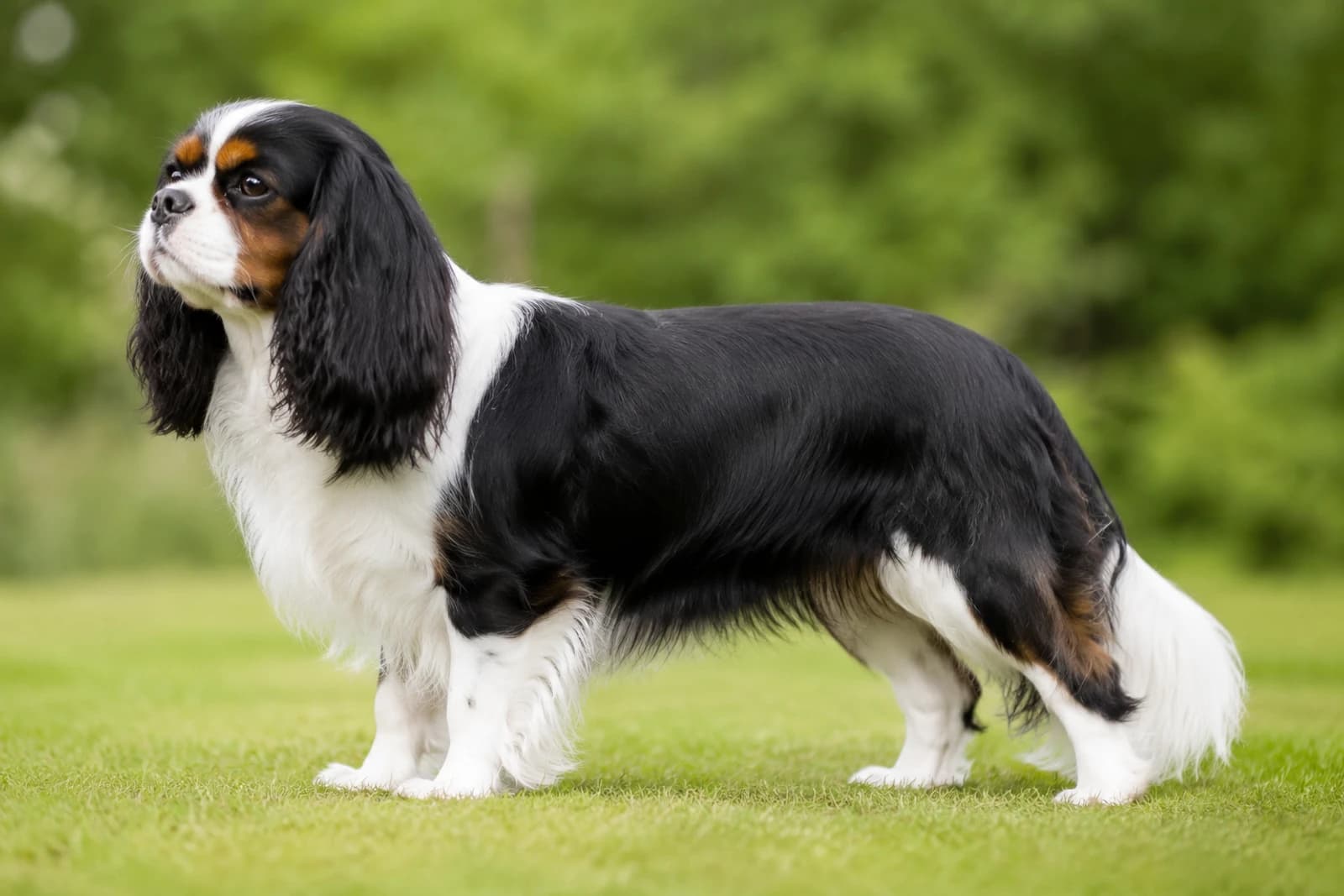
The Cavalier King Charles Spaniel is a small, elegant toy spaniel with a sweet, gentle nature. Ideal for families, seniors, or first-time owners, they thrive on companionship and are adaptable to apartment living. With a silky coat, expressive eyes, and a loving personality, they enjoy cuddling as much as a daily walk. Their moderate energy levels and eagerness to please make training enjoyable. These devoted lapdogs form strong bonds, rarely straying far from their humans.
At a glance
- Size
- Medium
- Height
- 12–13 in
- Weight
- 11–18 lb
- Life span
- 12 years
- Coat colors
- Blenheim, Tricolor, Ruby, Black and Tan
- Coat type
- Long, silky, slightly wavy
- Group
- Companion
How much does a Cavalier King Charles Spaniel cost?
Adopt / rescue
$150–$500
Usually includes spay/neuter, first shots, and a microchip.
Buy from a breeder
$2,000–$4,000
From a reputable, health-testing breeder.
Approximate USD. Prices vary widely by region, breeder, pedigree, age, and coat colour — adopting is the lower-cost and recommended route. Avoid suspiciously cheap “breeders”; they’re often puppy mills.
Estimate the full cost of a Cavalier King Charles Spaniel →Cavalier King Charles Spaniel photos
Views
Front, side, rear and top — the full silhouette.Poses
How the breed sits, lies, moves and plays.Puppy to senior
The breed across its whole life.Expressions
The breed’s range of moods.Close-up details
Eyes, ears, nose, paws, tail and coat.Coat colors
The breed’s recognized colors.Click any photo to enlarge. We show the Cavalier King Charles Spaniel from every angle — three views, poses, life stages, expressions, close-ups, coat and colors.
Appearance & size
A well-bred Cavalier King Charles Spaniel looks like a tiny hunting spaniel scaled down into an elegant lapdog, with soft curves and a gentle expression that match its companion role. The body is moderately boned and slightly longer than tall, never fragile or overdone. You’ll see a squarely built little dog with a springy, free-moving gait.
Height at the shoulder runs 12 to 13 inches, and weight lands between 11 and 18 pounds, with a bit of variation depending on bone and substance. Some lines produce a stockier 16-pound dog, while others stay a lighter 12–13 pounds. What you shouldn’t see is a dog so light it looks toy-like or so heavy it gets squat. The overall build balances substance with grace.
The coat is your showstopper. It’s long, silky, and free of curl, with a slight wave allowed. Feathering flows heavily from the ears, backs of the legs, chest, belly, and tail—giving the dog a softly draped, liquid outline when it moves. Four colors are accepted:
- Blenheim: rich chestnut markings on a pearly white ground, with the classic chestnut lozenge on the crown highly prized.
- Tricolor: black markings on white, with tan points over the eyes, on the cheeks, inside the ears, under the tail, and on the legs.
- Black & Tan: jet black with rich tan markings in the same places as the tricolor, no white.
- Ruby: solid rich red, though a tiny white patch on the chest is permitted.
From the front, the Cavalier’s face is unmistakable. The skull appears almost flat between the ears, the muzzle is about an inch and a half long with a gentle taper, and the large, round, dark-brown eyes are set wide and low. They give the breed its famously sweet, melting expression—always soft, never hard or prominent. The long, high-set ears hang close to the head with thick silky feathering, framing the face like a curtain.
From the side, the neck is moderately long and flows cleanly into a level topline. The chest is moderately deep, reaching the elbows, and the tail is set to carry level with the back or slightly higher—constantly wagging, a hallmark of the breed. From the rear, you see moderate angulation in the hindquarters with the same heavy feathering cascading down hocks and tail, creating a elegant, animated silhouette in motion. The whole package looks balanced and unexaggerated, a spaniel in miniature.
History & origin
The Cavalier King Charles Spaniel isn’t just a modern lap dog — it’s a direct descendant of the little spaniels that curled up in the laps of European aristocrats as far back as the 1500s. While the breed as we know it was formally separated and named in the 20th century, its story really begins in the royal courts of England.
During the 1600s, King Charles I and particularly his son Charles II were inseparable from their toy spaniels. Charles II was so famously obsessed that the dogs are named after him; diarist Samuel Pepys noted the King played with his spaniels during council meetings and let them roam the House of Parliament. These early dogs were small, silky-coated, and had a moderate muzzle and a slightly domed skull — a look quite different from the ultra-flat face that would later become popular.
After Charles II’s death, other short-nosed breeds like the Pug were brought to England. The toy spaniel type gradually shifted toward a flatter face, higher-domed head, and more compact body. This altered version became known as the King Charles Spaniel (and in the United States, the English Toy Spaniel). The original, longer-nosed type all but vanished.
The turning point arrived in the 1920s when an American enthusiast, Roswell Eldridge, traveled to the U.K. and was disappointed not to find any dogs that matched the old paintings. He offered a £25 prize at Crufts for the best “Blenheim Spaniel of the old type” — specifically one with a longer muzzle and flatter skull. The prize money was substantial, and it sparked enough interest that a small group of breeders began trying to resurrect the original style. A dog named Ann’s Son, owned by breeder Amice Pitt, is considered a foundational sire, and Pitt herself was the first to register the name “Cavalier King Charles Spaniel” to distinguish the revived longer-nosed dogs from the existing King Charles Spaniel.
The breed developed steadily over the next two decades, and in 1945 The Kennel Club (U.K.) officially recognized it as a separate breed. The AKC followed in 1995. Today’s Cavalier — standing 12–13 inches and weighing 11–18 pounds — remains purely a companion. It was never bred for work, hunting, or guarding; its only job was to be a gentle, portable friend who could warm a lap on a cold carriage ride, and that’s exactly what it still does.
Temperament & personality
The Cavalier is built for companionship in the most literal sense — this is a dog who wants to be touching you, following you, or at least keeping you in sight. Expect a shadow. They’ll curl up on your lap while you work, lean against your leg on the couch, and happily join you for a stroll, but they are not demanding athletes. A couple of 20–30 minute walks plus some indoor play usually satisfies their exercise needs, after which they’ll be back to full-time snuggling.
Their affection runs deep and is generally doled out to everyone: family, visitors, other dogs, and even cats. A Cavalier’s first reaction to a stranger at the door is often a wagging tail, not suspicion. They can alert bark — a chirpy “someone’s here!” — but a guard dog they are not. They’d rather greet a new person with a wiggly body and a lick than anything resembling reserve.
That people-oriented nature has a sharp edge, though. This breed hates being alone. Left for long hours without preparation, many Cavaliers slide into anxious behaviors: barking, destructive chewing, or house soiling. They aren’t being stubborn — isolation genuinely distresses them. Crate training, a consistent schedule, and teaching them to settle with a stuffed chew can help, but if your household is empty most of the day, this is not the breed for you.
Around children, Cavaliers tend to be patient and gentle — no coincidence they’re often called “love sponges.” Still, kids need to learn a few basics: never interrupt a dog while she’s eating, and watch for a stiff body or a hard stare if things get too overwhelming. A soft, loose body and relaxed eyes mean the dog is happy. With respectful handling, Cavaliers slide into family life like they’ve always been there.
The breed’s default is calm and easygoing, but that’s a tendency, not a warranty. Individual dogs vary, and early socialization matters. Responsible breeders screen for stable temperaments, yet you still get some Cavaliers with more pep or stubborn streaks than others. They respond best to gentle, positive training — harsh corrections backfire on a dog this soft-natured. Use a happy tone and a treat, and you’ll see the eagerness in that forward-leaning, feathery-wagging hello.
Good with kids, dogs & other pets
Few breeds slide into a household with kids as effortlessly as the Cavalier. This 11- to 18-pound spaniel has a patience and non-aggression that’s rare: they rarely snap, even when little hands get grabby. But their small size demands real care. A toddler can easily drop or step on a 12-inch-tall dog, so floor-level cuddling and close supervision are musts—think of the Cavalier as a lap dog, not a plaything to be carried around.
With other dogs, Cavaliers tend to be sociable and not prone to guarding. They’re rarely the instigators of a squabble. Still, a 15-pound Cavalier can get rolled by a rambunctious large breed at the dog park; pick playmates that match their easygoing pace.
Their low prey drive makes cats and small pets easier. Most Cavaliers regard the family cat as a potential napping partner, not something to chase. With calm, gradual introductions, rabbits and guinea pigs often integrate without drama. Always supervise early meetings anyway—a spooked cat can scratch an eye, and a small prey animal can trigger an unexpected swat.
What locks in that trademark sweetness is early socialization. Start between 3 and 14 weeks by letting your puppy meet gentle children, friendly dogs, and everyday sounds in treat-filled sessions. Puppies raised without this—think pet stores or puppy mills—carry a higher risk of fearfulness and anxiety as adults. If you adopt an older dog, you can still build confidence, but go slow. Forced greetings in a noisy park just add stress and can backfire.
One hard truth: these companion dogs hate being left alone. A home with people around most of the day lets them shine. A second dog can offer company, but it won’t replace the human connection they’re hardwired to need. If your family is gone from dawn to dusk, the Cavalier—no matter how well-socialized—will struggle.
Trainability & intelligence
Cavaliers are not hard-headed dogs — they genuinely want to get it right. That biddable nature makes training less about breaking down stubbornness and more about building confidence. They learn new cues quickly when the lesson feels like a game, and they’ll repeat a behavior eagerly for a sliver of chicken or an excited “good dog.” The flip side is extreme sensitivity; a sharp tone or frustrated sigh can cause them to shut down completely. So the golden rule is simple: keep every session soft, short, and stacked with rewards.
Because they were bred to be close companions, Cavaliers thrive on your attention. This is a huge training asset. They rarely wander off mentally when you’re the source of praise and treats. However, their nose can pull them onto a scent trail in a heartbeat, so a reliable recall doesn’t happen overnight. Start practicing in boring, fenced spaces with high-value treats, and don’t expect a finished recall off critters until you’ve proofed it for months. Even then, accept that a Cavalier’s recall is more “I’ll be right there after I check this smell” than a border collie’s instant spin-and-sprint.
Common sticking points include house training and separation whining. Many Cavaliers are slow to be fully reliable indoors — often because they hate rain or cold and learn to sneak a pee on a rug if you’re not watching. Patience, a strict schedule, and lavish party-level praise for going outside will get you there. Crate training helps, but never as punishment.
- What works best: daily 3–5 minute training bursts, a cheerful voice, clicker precision, and rewards delivered the instant the right behavior happens.
- What to avoid: punishment-based methods, long drills, or using your “angry voice.” These erode trust and can create a dog that freezes or cowers instead of trying.
- Socialization is non-negotiable. Because Cavaliers can lean timid, expose your puppy to new people, gentle dogs, different surfaces, and everyday sounds well before 16 weeks — and keep those positive experiences going into adulthood. A confident Cavalier who expects the world to be friendly is far less likely to react with fear later on.
If you approach training as a relationship-building ritual rather than a chore, you’ll end up with a dog who hangs on your every word and offers polite behaviors without being asked. Push too hard or use corrections, and that soft eye contact will vanish.
Exercise & energy needs
Forget marathon runs—this little spaniel thrives on moderate, regular movement, not high-intensity workouts. A Cavalier King Charles Spaniel’s exercise needs sit squarely in the middle: enough to stay fit and mentally engaged, but never to the point of exhaustion. Plan on 40–60 minutes of daily activity, split into at least two sessions. A couple of 20–30 minute leash walks—morning and evening—paired with indoor play or a sniffy game in the yard hits the sweet spot for most adults.
Flat faces mean they don't cool themselves efficiently. In warm weather, shift walks to early morning or late evening, keep a steady but unhurried pace, and watch for heavy panting—overheating comes on fast. Brachycephalic dogs often do better with short, frequent outings than one long march, so three 15-minute strolls on a hot day can work beautifully.
Mental stimulation matters just as much. Cavaliers were bred as companions and they genuinely want to do things with you. Hide treats around the house, introduce a puzzle feeder, or teach a new trick in five-minute bursts. Scent games—like scattering kibble in the grass—tap into their spaniel nose and burn surprising energy. These are also safe, low-impact ways to tire out a dog who can be prone to knee and back issues.
Speaking of which, skip high-impact jumping and rough-housing. A short game of gentle fetch on carpet or grass is fine, but protect those joints by avoiding steep stairs, slick floors at full zoom, and hard landings off furniture. Puppies, in particular, need protected exercise while their growth plates close—stick to self-directed play and leash walks on soft surfaces until your vet clears them for more.
If you skimp on daily exercise, a Cavalier won't dismantle your couch out of boredom, but you may see a dog who paces, whines, or puts on extra pounds (they love their food). Consistency is the bigger deal. A steady rhythm of walks and brain games keeps this people-oriented breed content, calm, and ready to cuddle without a guilty conscience.
Grooming & coat care
A Cavalier’s coat is one of the breed’s calling cards — silky, medium-length, and a single coat with no dense underlayer. That softness comes with a practical side: it mats easily, especially behind the ears, under the legs, and along the feathering. Plan on brushing three to four times a week to keep tangles at bay, and bump it up to daily during spring and fall shedding seasons. A metal slicker brush with rounded pins followed by a metal comb works through the long hair and catches loose strands before they wind up on your sofa.
Bathing every four to six weeks keeps the coat clean without stripping natural oils. Always use a gentle dog shampoo, and rinse thoroughly — leftover residue invites skin irritation. Because those long, drop ears block airflow, they need weekly cleaning with a vet-approved ear solution. Check for wax buildup, redness, or any funky smell; ear infections can become chronic if ignored.
Nail trims every three to four weeks and daily tooth brushing (or at minimum a few times a week) round out the essential routine. As for trimming, a Cavalier’s feathering on the ears, legs, and tail can grow into a flowing skirt. Some owners leave it natural, while others use thinning shears to neaten up the furnishings and trim between the paw pads for better traction. You’re not clipping the body coat short — ever. Stripping or shaving ruins the texture and exposes the skin.
When shedding kicks into high gear, a high-quality diet and regular outdoor exercise support healthy coat turnover and cut down on stress-related hair drop. You’ll still find plenty of Cavalier glitter on your clothes, but a consistent routine makes it manageable and spots small issues — a hot spot, a burr, a scratched ear — before they turn into a vet visit.
Shedding & allergies
If you picture a dog that won’t leave hair behind, the Cavalier isn’t it. They shed a moderate amount all year long — more of a steady, fine drizzle than an occasional flurry. Their single, silky coat lacks a dense undercoat, so you won’t see the massive seasonal blowouts of a double-coated breed, but you will find those long, lightweight hairs on your clothes, furniture, and floating across the floor. Expect a slight uptick in spring and fall as the coat turns over; a few times a week with a pin brush or slicker helps keep the loose hair under control and prevents those little “tumbleweeds” from gathering in corners.
Drool isn’t part of the package. A Cavalier might get a bit wet-mouthed at the sight of a high-value treat or after a big drink of water, but they aren’t heavy, messy droolers.
As for allergies, no dog is truly hypoallergenic, and the Cavalier is no exception. The real triggers are proteins in dander, saliva, and urine — not just hair. Cavaliers produce all three, so they can absolutely set off reactions. The fine, airborne hair also helps dander circulate, which doesn’t do allergy sufferers any favors. Some people with mild allergies report fewer symptoms around this breed than, say, a heavy-shedding double-coated dog, but that’s no guarantee. If someone in your household has known allergies, spend real time with adult Cavaliers in a home setting — not just a quick meet — before making the commitment.
Diet & nutrition
Cavaliers are enthusiastic eaters who rarely act full, and that makes portion control the single most important part of feeding this breed. Even a pound or two over their ideal 11–18 lb frame can silently strain the heart and compress the spine — a real worry with a breed already prone to mitral valve disease and syringomyelia. Use a kitchen scale rather than a measuring cup; a few extra kibbles added at every meal quickly become a weight problem you can’t see under that silky coat.
For an adult Cavalier, split the daily ration into two meals. Most do well on a high-quality commercial food formulated for small breeds, but you’ll still adjust based on activity. A dog who trots a couple of miles a day needs more fuel than the one who prefers a lap. If you home-prepare meals, aim for roughly 60% meat, 20–30% fruits and vegetables, and a small fraction of grains, eggs, or yogurt — and always run the recipe past your vet to avoid gaps. Pearl barley or white rice can be gentle, digestible carbohydrate sources when a stomach acts up.
Puppies need four evenly spaced meals a day until four months old, then three meals until about six months. At that point you can settle into the adult twice-a-day rhythm. Transition a puppy onto solids by starting with finely puréed meats and cooked vegetables or a premium puppy kibble softened with warm water. Raw chicken wings (introduced at roughly twelve weeks, supervised) are an option if you’re educated on raw feeding, but they’re not required.
Senior Cavaliers often slow down without telling you, so trim their portions the second you notice that extra padding over the ribs. There’s no solid case for cutting protein in healthy older dogs, but splitting the same daily amount into three smaller meals can be easier on a sensitive stomach. Keep the scale handy — many an old dog’s arthritis gets blamed on age when a few lost ounces would have brought real relief.
A few habits make the difference. Never feed from the table or your plate, because this breed learns that begging works. Instead, put any leftovers you intend to give into their own bowl, after you’ve cooked it plainly — no salt, onion, garlic, or gravy. If your Cavalier inhales meals, a food puzzle bowl slows them down and adds a few minutes of brain work. And after holidays, resist the urge to share rich scraps; a sudden fatty meal can trigger pancreatitis in a small, food-driven dog. Measure, don’t guess, and you’ll keep that wagging tail attached to a healthy weight for years.
Health & lifespan
A Cavalier King Charles Spaniel typically lives around 12 years, but that number only tells part of the story. These dogs pack a lot of love into a shorter lifespan than many small breeds — and the biggest reason is their heart.
Mitral valve disease (MVD) is the single most common health problem in the breed. By age 5, roughly half of all Cavaliers show some murmur; by 10, nearly all have it. It's a leaky heart valve that can progress to congestive heart failure. There's no cure, but early diagnosis and medication can buy time and improve quality. Regular veterinary checkups are not optional — a skilled vet catching a murmur early matters enormously.
The second heavy hitter is syringomyelia (SM), a neurological condition where the skull is too small for the brain, forcing it to crowd the spinal opening. This can create fluid-filled cavities in the spinal cord. Signs range from scratching at the neck (often while walking, without touching the skin) to outright pain. The severity varies wildly. A responsible breeder screens breeding stock with MRI and cardiologist exams before mating, and they’ll openly share those results. If a breeder can't show you heart and eye clearances (and ideally an MRI report) on both parents, walk away.
Other issues that pop up in the breed:
- Eye conditions: cataracts, progressive retinal atrophy, dry eye, and retinal dysplasia are all possible. Annual eye exams by a veterinary ophthalmologist are gold standard.
- Ear infections: floppy, long ears trap moisture and wax. Weekly cleaning and drying keeps most trouble at bay.
- Hip dysplasia and patellar luxation: not as widespread as in larger breeds, but still present. Keeping weight in check protects joints.
- Dental disease: small mouths mean crowded teeth easily build tartar. Daily brushing and dental cleanings under anesthesia when needed go a long way.
Weight management is critical for a Cavalier’s longevity. An extra two pounds on an 11–18 lb dog isn’t cute — it’s equivalent to a person lugging around a 20-pound backpack, and it strains an already vulnerable heart and compromised joints. They are master beggars, so measure meals and ignore the eyes.
Monthly heartworm prevention and a legally required rabies shot aren’t special to this breed, but don't skip them. Mosquito season varies by region; keep giving the preventive for a full month after it ends.
On the daily-care front, these dogs are highly social. Neglect or isolation can trigger anxiety-driven behaviors — barking, chewing, paw licking — that feed back into physical stress. Socialize them early, handle them often, and treat veterinary visits as a positive routine. Subtle behavior changes, like a dog who no longer jumps on the couch or starts eating slower, can be early signs of neck pain from SM or fatigue from a weakening heart. A dog can’t tell you, so you watch.
Living environment
A Cavalier’s first rule of housing is simple: if you’re there, it’s home. They are true companion dogs, quiet-natured and compact enough to make excellent apartment residents, and they don’t need a yard to thrive. Two 15‑minute leash walks a day plus a couple of indoor romps or fetch sessions are usually enough to keep a healthy adult Cavalier physically content — short, frequent activity suits their moderate energy and flat‑faced breathing style far better than one long, huffing hike. A small, securely fenced yard is a nice bonus for sniffing and sunbathing, but a couple of daily walks around the block and a good puzzle toy cover the exercise boxes nicely.
Climate is something to take seriously. That sweet, pushed‑in face means they overheat fast. On warm days, walk early or late, keep sessions brief, and watch for panting that doesn’t settle. When temps climb into the 80s, substitute indoor scent games or a snuffle mat for any outdoor exercise. Cold weather is easier to manage — a sweater on frigid mornings does the job — but these are still house dogs, not snow athletes.
Noisewise, you’re getting a lover, not a yapper. A Cavalier may bark a polite “someone’s at the door,” but consistent, nuisance barking usually signals boredom or loneliness rather than a guard‑dog streak.
And that brings up the real non‑negotiable: alone time. Cavaliers are wired to be with their people, and a full workday of solitude can trigger destructive chewing, house‑soiling, or constant whining. If you’re gone eight hours straight, a midday dog walker, a neighbor’s visit, or doggy daycare isn’t a luxury — it’s baseline. You can build their tolerance with gradual departures, food‑stuffed Kongs, and a cozy crate, but a Cavalier will never be a casual “leave ’em and forget ’em” pet. They want to nap on your feet, ride along in the car, and be part of whatever you’re doing. If that sounds like your lifestyle, you’ll have a shadow who fits right into a house or apartment.
Who this breed suits
If you can’t have a dog underfoot, this isn’t the breed for you. Cavaliers live for human company — they’ll trail you from couch to kitchen without missing a beat. They do best in homes where somebody is around most of the day. A retired person, a couple working staggered schedules, or a family with a stay-at-home parent will see this dog at its happiest.
Who a Cavalier suits best
- First-time dog owners. Cavaliers are famously agreeable. They’re eager to please, forgiving of beginner mistakes, and responsive to calm, positive training. There’s no hard edge you need to manage.
- Seniors and less active singles. A Cavalier needs moderate exercise — 30 to 45 minutes of daily walking split into a couple of outings, plus indoor play. No high-octane runs required. At 11–18 pounds and 12–13 inches tall, they’re portable enough to scoop up but sturdy enough to handle a gentle stroll around the block.
- Families with gentle children. These spaniels are patient and affectionate with kids who know how to handle a small dog. They’ll chase a ball in the living room and then crash on a lap for a movie. Supervise toddlers, though — a Cavalier’s slight build doesn’t mix well with accidental drops or clumsy cuddles.
- Apartment dwellers. They bark a greeting, not a constant alarm. Their size and exercise needs fit nicely into compact spaces, as long as you provide that daily walk.
- Multi-pet households. A well-socialized Cavalier generally gets along with other dogs and even cats. They’re pack animals at heart.
When to reconsider
- You work long hours outside the home. This breed develops separation anxiety quickly. Left alone for eight or ten hours routinely, you’ll likely see destructive chewing, house-soiling, or nonstop barking. A Cavalier’s mental health crumbles without steady companionship.
- You want a running partner or a guard dog. A Cavalier will trot alongside you for a mile or two, but they’re not built for serious distance or speed. And the only thing they’ll do to an intruder is wag their tail.
- Rowdy, rough-and-tumble kids dominate the house. Even the most tolerant Cavalier can get hurt if handled like a plush toy. If your household is all toddler tackles and loud chaos, wait until the kids can learn a softer touch.
- You aren’t prepared for the breed’s health risks. Mitral valve heart disease and syringomyelia (a painful neurological condition) are pervasive in the breed. Responsible breeders screen breeding stock and share heart and MRI results, but no line is completely risk-free. You’ll need a vet fund and the emotional bandwidth for the possibility of a dog with significant medical needs. The typical lifespan hovers around 12 years, but those years can involve cardiologist visits and daily meds.
A Cavalier gives you a constant, warm presence. Offer a steady lap, a predictable routine, and the commitment to manage what their health might throw at you, and this little spaniel becomes a devoted shadow.
Cost of ownership
A Cavalier puppy from health-tested parents usually costs $2,000–$3,500, though show-potential lines can push past $4,000. Adoption fees run $200–$500, but rescue Cavaliers often come with unknown health backgrounds, so you’ll want a thorough vet check right away. First-year supplies — crate, bed, bowls, harness, initial vaccines — add another $400–$700.
Monthly expenses settle into a rhythm, but the real wild card is vet care. Expect these ongoing costs:
- Food: A high-quality kibble for an 11–18 lb dog runs $30–$50/month. Treats and dental chews add a few dollars.
- Grooming: That silky coat needs brushing every other day and a professional groom every 6–8 weeks. Budget $40–$60 per session, or roughly $25–$40/month if you space appointments and maintain at home.
- Routine vet & preventatives: Annual exams, vaccinations, heartworm/flea/tick prevention often total $400–$600/year, so about $35–$50/month.
- Pet insurance: Because mitral valve disease and syringomyelia are common in the breed, many owners carry a policy — typically $30–$60/month for decent coverage. Without it, a cardiology workup alone can hit $800–$1,200, and ongoing medications can run $50–$150 per month.
All in, a reasonably healthy Cavalier usually costs $100–$200 per month, not counting the purchase price. But the breed’s well-known heart and neurological issues mean you could face a year with $3,000–$5,000 in specialist bills. Start a dedicated emergency fund or buy insurance early, before any conditions become pre-existing — it’s the one piece of financial planning that turns a scary diagnosis into a manageable number.
Choosing a Cavalier King Charles Spaniel
The single most important decision you’ll make is finding a breeder who fights the two structural problems built into the breed: mitral valve disease and Chiari-like malformation with syringomyelia. A Cavalier’s sweet face means nothing if the dog is in pain or facing heart failure by age 5. That’s where a responsible breeder is night-and-day different from a typical puppy producer.
Breeder vs rescue
Rescue is a real path, though you’ll rarely find a puppy. Cavaliers end up in rescue because an older owner passed away or a family couldn’t afford the medical bills. You’ll get a dog whose health history is often incomplete and whose temperament may carry some baggage. If you go in with eyes open and a vet fund ready, it’s a generous way to bring one of these dogs home.
If you buy, you hold all the cards, but only if you’re willing to walk away from a cute face when the health documentation isn’t there.
Health clearances that actually matter
Ask for these clearances on both parents, not just a “vet check.” Look for official results through the Orthopedic Foundation for Animals (OFA) or a comparable open registry, not just a printout on letterhead.
- Heart: clearance from a board-certified veterinary cardiologist (not a stethoscope listen in the exam room). The OFA heart clearance is valid if done after the dog is 12 months old, and dogs should be re-evaluated annually into old age. A murmur before age 5 is a huge red flag in a breeding dog.
- MRI for CM/SM: Chiari-like malformation and syringomyelia screening. An MRI read by a neurologist identifies whether the skull is too small for the brain, causing fluid-filled pockets in the spinal cord. This is excruciating. Responsible breeders follow the breed club’s protocol and scan breeding stock; minimal or mild scans are a minimum, but the best breed only dogs who are free of syringomyelia at 2–3 years old.
- Eyes: a CAER (formerly CERF) exam within the last year, because hereditary cataracts and retinal problems do pop up.
- Patellas: OFA evaluation for luxating patellas, since loose kneecaps are common in toy/spaniel types.
Some breeders also screen hips (OFA) and do DNA tests for episodic falling syndrome and dry eye/curly coat, but cardiac and MRI are the non-negotiables.
Red flags that should make you leave immediately
No proof of cardiologist or MRI screening — “my vet said they’re healthy” doesn’t cut it. Puppies released before 10–12 weeks; Cavaliers need that extra time with mom and littermates to develop social skills and confidence. Multiple litters on the ground at once or a breeder who always seems to have puppies available. A breeder who doesn’t ask you any questions about your lifestyle, children, or how you’d handle a dog with a lifelong condition. Anyone marketing “teacup” or mini Cavaliers — the breed already sits at 11–18 lbs; pushing smaller only compounds skull-to-brain size problems.
Picking your puppy
Meeting the dam (and ideally the sire, or at least video and health records) shows you adult temperament. Look for a puppy that comes up to you without being frantic, and settles with gentle handling. Avoid a pup that hides the whole time or snaps when you touch its ears or neck — a potential early sign of syringomyelia pain. Ask what early socialization and noise exposure the litter has had, and whether the breeder has started crate introduction and basic house-training for you. A solid health guarantee should specifically cover a congenital heart defect for at least two years, because early murmurs can be absent at 8 weeks and appear later.
You’re not just buying a puppy — you’re buying the breeder’s protocols and honesty. Stack the deck with tests, and you’re far more likely to get a Cavalier who stays by your side for a full, comfortable life, not a heartbreak at year six.
Pros & cons
Pros
- A true people dog. Cavaliers live for human contact and will happily curl up on your lap for hours. Their sweet, patient nature makes them a safe pick for families with gentle kids, seniors, and first-time owners who want a low-key companion.
- Gets along with everyone. They rarely start a fight and usually coexist peacefully with other dogs, cats, and even small pets. You won’t see a lot of territorial posturing.
- Apartment-friendly with basic exercise. A couple of brisk 20-minute walks and a romp indoors is plenty; they aren’t demanding athletes. At 11–18 lb and 12–13 inches tall, they fit under airplane seats and don’t need a yard.
- Eager-to-please and food-driven. Most pick up sit, stay, and recall easily, and many excel as therapy dogs because they’re so calm and people-focused.
- Coat care is straightforward. The silky, medium-length fur sheds moderately but doesn’t need clipping. A few brushings a week and an occasional bath keep it from matting, especially behind the ears and on the feathering.
Cons
- Can’t handle being left alone. This is a breed that can develop severe separation anxiety if you work long hours away from home. Destroyed pillows, nonstop barking, and housetraining regressions are common fallout.
- Heavy health baggage. Cavaliers are heartbreakingly prone to mitral valve heart disease — over half show a murmur by age 5 — which can cut a 12-year lifespan shorter. Syringomyelia, a painful condition where the skull is too small for the brain, also runs in lines. Even responsible breeders can’t erase the genetic risk, and vet bills add up.
- Zero watchdog instinct. A burglar gets a wagging tail, not a warning bark. If you want any kind of alert dog, this isn’t it.
- Brachycephalic trade-offs. Their face isn’t completely flat, but the short muzzle still makes them snore, snort, and overheat fast. Hot-weather walks need careful timing, and they tire quickly in humidity.
- Potty training can try your patience. Some Cavaliers are stubborn about going outside reliably, so be ready for crate training and a long, consistent routine—especially with a puppy.
- Food obsessions and weight creep. Many will inhale anything edible, then look at you like they’re starving. Without strict portion control, they pack on pounds, which puts terrible strain on their heart and joints.
Similar breeds & alternatives
If the Cavalier's appeal is that sweet, soft expression without the extreme flat face of many toy breeds, you’ll quickly see how it differs from its closest lookalike, the English Toy Spaniel (often called the King Charles Spaniel in the UK). That dog runs smaller—typically 8 to 14 pounds—with a domed skull, almost non-existent muzzle, and a higher risk of breathing trouble and eye issues. The Cavalier is the healthier, sturdier choice for the same gorgeous silky coat and devoted personality, weighing in at 11 to 18 pounds with a proper snout that lets it run and cool off normally.
Cocker Spaniel
For a spaniel with more drive and a larger frame, an American or English Cocker Spaniel sits in the 20- to 30-pound range. These are still affectionate family dogs, but they were bred to flush game, so you inherit a bigger gas tank. Expect at least an hour of real exercise—not just a stroll—where a Cavalier thrives on a couple of 20- to 30-minute walks. Cocker coats are much heavier and prone to matting; professional grooming every 4–6 weeks is common, versus the Cavalier’s moderate brushing needs. If you want a sturdier hiking partner with typical spaniel sweetness, a Cocker fits—but be ready for the upkeep and noise level.
Havanese
The Havanese often pops up as a non-shedding alternative in the same 7- to 13-pound bracket. Their long, soft coat requires daily brushing and regular trims, but you won’t find much hair on the sofa. Temperament wise, a Havanese is just as gentle and clownish, though often a bit more Velcro and slightly reserved with strangers at first—a Cavalier tends to greet everyone like an old friend from the start. Both breeds need early socialization to avoid timidity, but the Cavalier’s coat is far more wash-and-wear.
Bichon Frise
Another hypoallergenic candidate, the Bichon weighs 12–18 pounds and brings a bouncier, more mischievous energy. Where a Cavalier will happily mold itself to your nap schedule, a Bichon is more likely to instigate a game of chase. Their white powder-puff coat demands professional grooming every month and frequent at-home care. Choose the Bichon if shedding or allergies are a dealbreaker, but you’re okay trading some of the Cavalier’s quiet, lap-snuggling stillness for a playful spark.
A Papillon can also enter the conversation if you want a tiny spaniel-type with a big brain—but at 5–10 pounds with intense athleticism and a need for mental challenges, it’s a much more demanding dog than the Cavalier’s relaxed, “let’s watch a movie” rhythm. The Cavalier’s particular niche remains a dog that combines a true spaniel look with a low-key, beginner-friendly personality, and a face that doesn’t come with the health baggage of its flatter-faced cousins.
Fun facts
- Named after King Charles II, who was rarely seen without one.
- The Blenheim variety often features a distinct chestnut 'thumbprint' atop the head.
- They are part of the toy spaniel family and have a royal heritage.
- Cavaliers are natural therapy dogs due to their empathetic and gentle nature.
Frequently asked questions
- Are Cavalier King Charles Spaniels good with children?
- Cavalier King Charles Spaniels are generally gentle, affectionate, and patient, making them wonderful family companions. They tend to get along well with children, but supervision is recommended to ensure safe interactions.
- Do Cavalier King Charles Spaniels shed a lot?
- These dogs have a medium-length silky coat that sheds moderately year-round, with heavier shedding during seasonal changes. Regular brushing a few times a week can help control loose hair.
- How much exercise does a Cavalier King Charles Spaniel need?
- They have moderate exercise needs and typically enjoy a daily walk and some playtime. They can adapt well to their owner's lifestyle, but without enough activity, they may become overweight.
- Can Cavalier King Charles Spaniels live in apartments?
- Yes, they can be excellent apartment dogs due to their small size and generally calm indoor demeanor. As long as they receive daily walks and mental stimulation, they are content in smaller living spaces.
- Are Cavalier King Charles Spaniels suitable for first-time dog owners?
- Their friendly, eager-to-please nature makes them a good choice for novice owners. They respond well to positive reinforcement training and are usually easy to manage.
- Do Cavalier King Charles Spaniels bark a lot?
- They are not known for excessive barking, but they may alert bark when someone approaches the door. With consistent training, they can learn to be quiet on command.
Tools & calculators for Cavalier King Charles Spaniel owners
Quick estimates tailored to Cavalier King Charles Spaniels — pre-filled with this breed’s size where it matters.
Articles & stories about the Cavalier King Charles Spaniel
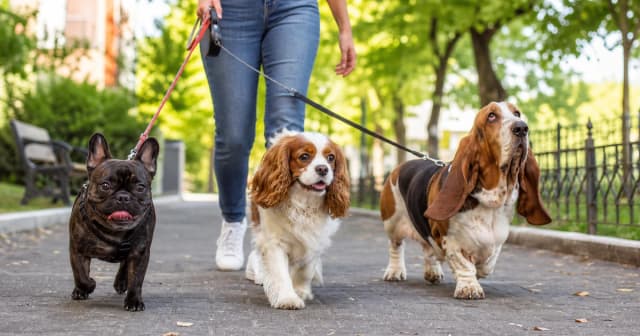
Apartment Dogs: What Breeds Actually Work (And What Doesn't)
Small size doesn’t always mean apartment-friendly. We use breed data on energy, barking, and temperament to reveal which dogs truly thrive in tight spaces—and which don’t.

Small Fluffy Dogs That Are Actually Good With Kids
Small and fluffy doesn't have to mean fragile or snappy. Here are seven breeds that prove pint-sized can still be kid-friendly—with a few honest catches every parent should know.
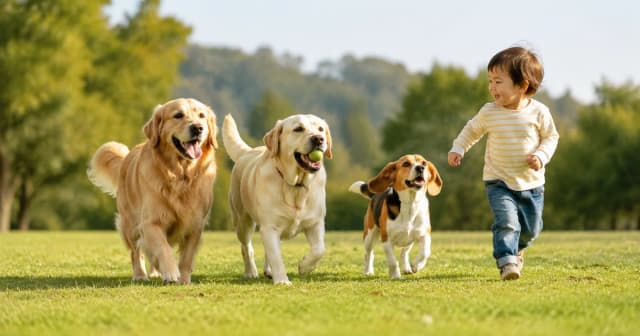
The 8 Best Dog Breeds for Families With Toddlers (Ranked by Temperament)
Any parent who’s seen a toddler grab a dog’s ear knows the cold sweat. Our honest, parent-tested ranking of the 8 best breeds for toddlers weighs patience, size, and real-world chaos.
Sources & standards
This profile follows recognized breed standards from the American Kennel Club (AKC) and the Fédération Cynologique Internationale (FCI), along with established veterinary and breed-club guidance. These describe general breed tendencies — every dog is an individual.
Owner stories
Have a Cavalier King Charles Spaniel? Share your experience — grooming tips, personality quirks, anything goes.