

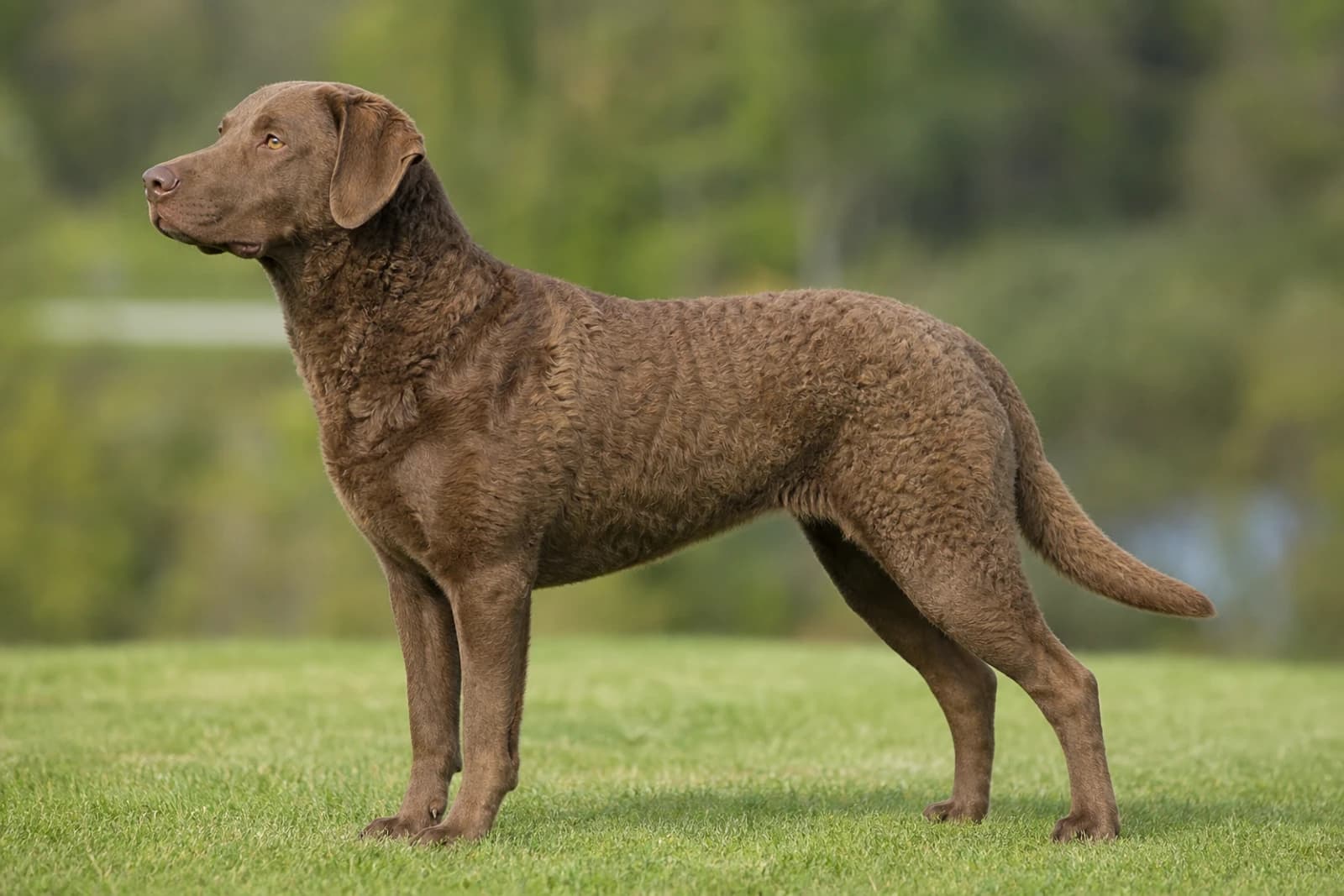
The Chesapeake Bay Retriever is a devoted, hardworking gun dog built for icy waters. This breed thrives with active, experienced owners who can provide vigorous daily exercise and firm, consistent training. They are affectionate and protective of their families, making them excellent companions for outdoorsy households. Not suited for apartment living or sedentary lifestyles, the 'Chessie' best fits a home with a large yard and a job to do.
At a glance
- Size
- Giant
- Height
- 21–26 in
- Weight
- 55–79 lb
- Life span
- 12–13 years
- Coat colors
- Brown, Sedge, Deadgrass
- Coat type
- Dense, wavy, waterproof double coat
How much does a Chesapeake Bay Retriever cost?
Adopt / rescue
$75–$400
Usually includes spay/neuter, first shots, and a microchip.
Buy from a breeder
$700–$2,000
From a reputable, health-testing breeder.
Approximate USD. Prices vary widely by region, breeder, pedigree, age, and coat colour — adopting is the lower-cost and recommended route. Avoid suspiciously cheap “breeders”; they’re often puppy mills.
Estimate the full cost of a Chesapeake Bay Retriever →Chesapeake Bay Retriever photos
Views
Front, side, rear and top — the full silhouette.Poses
How the breed sits, lies, moves and plays.Puppy to senior
The breed across its whole life.Expressions
The breed’s range of moods.Close-up details
Eyes, ears, nose, paws, tail and coat.Coat colors
The breed’s recognized colors.Click any photo to enlarge. We show the Chesapeake Bay Retriever from every angle — three views, poses, life stages, expressions, close-ups, coat and colors.
Appearance & size
Everything about a Chesapeake Bay Retriever’s looks says function over flash. This is the most powerful of the retrievers — a dense, substantial dog built to break ice, swim hard, and bring back geese all day. The breed falls into a “giant” size category among gun dogs, but don’t expect St. Bernard height. Males stand 23 to 26 inches at the shoulder; females run 21 to 24 inches. Weight ranges from 55 to 79 pounds, and a fit Chessie carries no extra baggage. You’ll feel the heft when you pat that deep chest — they’re solid muscle wrapped in a one-of-a-kind coat.
That coat is the breed’s signature. It’s a true double coat: the outer hair is harsh, short, and slightly wavy, not tightly curled, with a pronounced wave that falls over the shoulders, neck, back, and loins. The undercoat is dense, fine, and woolly, like a thermal lining. Both layers work together with a natural oiliness that makes water bead up and roll off. You’ll notice a slightly musky, oily feel when you touch a dry Chessie — that’s by design, not a grooming failure. The coat on the face, legs, and ears is shorter and straighter, so the wavy “jacket” really stands out on the body.
Acceptable colors all stay in the brown family, but the range is wide. Think of a dead marsh in three tones:
- Deadgrass: pale, washed-out straw to dull, faded tan. This is the most recognizable Chessie color and a huge camouflage advantage in winter marshes.
- Sedge: a reddish-brown, from a light fox red to a darker coppery hue.
- Dark brown: solid, rich liver or bittersweet chocolate, often with lighter shadings.
A small white spot on the chest or toes pops up from time to time and is accepted, though a solid-colored dog is always preferred.
At the front, the head is broad and round-skulled with a medium stop, and the muzzle is roughly equal in length to the skull — never snipey. The lips are thin, not pendulous, giving them a businesslike jaw. The eyes are what lock you in: clear, medium-large, and set wide apart, with a very distinct shade of yellowish-amber. They have a direct, intelligent look that’s neither hard nor soft. Ears sit high on the head, small, and hang loosely in a triangular fold.
Stand at the side and you’ll see a dog slightly longer than tall, with a strong, level topline that dips just a hint behind the withers. The chest reaches down to the elbows, and the ribcage is deep and barrel-shaped, not slab-sided. A moderate tuck-up keeps the dog athletic. The tail is a natural rudder — moderately long, thick at the base, and carried straight or with a slight curve; it’s never plumed like a Golden’s.
From the rear, the hindquarters are broad and powerfully muscled. The stifles are well-bent, and the rear pasterns (the hocks) sit low to the ground. No flashy angulation, just clean, driving power. When a Chessie moves, the whole package covers ground without wasted motion — exactly what you want in a dog that might have to swim against a current for hours.
History & origin
Two dogs pulled from a shipwreck off the Maryland coast in 1807 started it all. An English brig foundered in heavy seas, and a local vessel rescued the crew and two Newfoundland puppies—a dingy red male named Sailor and a black female called Canton. The pups wound up with separate families along the Chesapeake Bay, and both turned out to be extraordinary water retrievers. Those two dogs, bred to local hunters’ retrievers and possibly other types like the English Otterhound and Curly-Coated Retriever, became the foundation of the Chesapeake Bay Retriever.
What they bred for wasn’t a gentleman’s shooting dog. The Chesapeake Bay is massive, cold, and unpredictably rough. Market gunners and waterfowlers needed a dog that could handle long swims through ice-choked water, break through skim ice, and pick up dozens of birds in a single day without quitting. The result was a dog with a dense, oily double coat that sheds water like a duck’s back, a powerful, slightly wavy body, and a willingness to work through conditions that would send most retrievers back to the truck. Coat color trends toward shades of dead grass, sedge, or brown—natural camouflage in the marsh.
The Chesapeake became one of the earliest breeds recognized by the American Kennel Club, registered in 1878, just a year after the AKC itself formed. By then, the type was already well-established along the Eastern Shore. The Carroll Island Gun Club, just north of Baltimore, was instrumental in refining the breed during the late 19th century, keeping meticulous records and breeding for performance above all else. They prized a tough, intelligent dog that could mark multiple downed birds and remember where each one fell, then deliver them with a soft mouth.
Today’s Chesapeake still carries that old-time working edge. While you’ll see them in field trials and hunt tests, the breed never split into distinct show and field lines the way Labs and Goldens did. That keeps them closer to the original blueprint—a hardened, capable retriever that doesn’t need coddling. They’re less common as a family pet than other retrievers, partly because their independent nature and protective instincts ask more of an owner, but the dogs you meet today trace straight back to those two shipwreck survivors and the men who recognized what a Chesapeake-born retriever ought to be.
Temperament & personality
A 70-pound Chesapeake Bay Retriever sprawled across your kitchen floor looks calm. Don’t mistake that for low energy. This is a dog built to break ice, plunge into rough water, and retrieve ducks all day in freezing conditions. A 30-minute leash walk won’t cut it. Plan on at least 60–90 minutes of hard, off-leash running, swimming, or dummy work daily — otherwise that intensity gets channeled into digging, chewing, and problem barking. These dogs need a job, not just a yard.
Deep loyalty, not a social butterfly. A Chessie bonds fiercely with its people but stays reserved — sometimes aloof — with strangers. Expect watchful behavior, not a wagging welcome for every visitor. You’ll get a dog that alerts when someone approaches the door and quietly sizes up new people before deciding they’re okay. Early, ongoing socialization matters a lot here; without it, wariness can harden into suspicion or defensiveness. In multi-pet households, same-sex dog aggression surfaces more often than in many other retrievers, so introductions and management need a thoughtful touch.
Smart, stubborn, and not for pushovers. These retrievers think for themselves. They’ll test rules, ignore a command they find pointless, and out-stubborn an owner who relies on force. Consistency and clear, fair expectations work far better than a heavy hand. Training should be engaging and reward-based — a well-timed retrieve or a treat given immediately after a correct response keeps them working with you, not against you. The same independent streak means a bored Chessie left alone in the backyard may ignore the fence line and go find something more interesting to do.
Quirks you’ll live with
- They love to carry things. A plush toy, a soggy tennis ball, the remote. Provide a stream of durable chew items, because those powerful jaws need to work. An adult Chessie will destroy flimsy toys in minutes; hard rubber, thick rope, and frozen marrow bones hold up better.
- Wet dog smell has a whole new meaning. Their oily double coat repels water but can get rank fast, especially after a swim in muddy ponds or a roll in something dead. Many Chessies genuinely enjoy covering themselves in foul odors — it’s likely a holdover from scent-obsessed scavenger ancestors, not spite. Keep a hose and dog shampoo handy.
- House-training can be stubborn. A confident male may urine-mark indoors if he feels his territory is in flux. Clean accidents with an enzymatic cleaner immediately. The lingering scent otherwise cues him to revisit the same spot. Take him out on a schedule, and the second he eliminates outside, hand him a high-value treat and quiet praise.
Around the household
A well-socialized Chesapeake is calm and affectionate inside the home, often shadowing family members from room to room. He’ll lean against your leg, rest his big head on the couch, and ask for chest scratches with a low, grumbling groan. But he won’t thrive as a solo backyard ornament. Isolation fuels anxiety, which comes out as destructive chewing, escape attempts, or nonstop barking. Teach children to let him eat in peace — interrupting mealtime can provoke food guarding in any dog, and a dog this large and determined is not a minor concern. Watch his body language: a stiff posture, hard stare, or forward shift in weight says he’s uncomfortable or about to act. A loose, wiggly body and soft eyes mean he’s relaxed. Respected and given an outlet for his drive, a Chessie settles into a steady, no-nonsense house dog who guards sleeping kids and greets you at the door with a wet, massive paw on your arm.
Good with kids, dogs & other pets
A well-socialized Chesapeake Bay Retriever can be a steady, loyal companion to his family’s children, but his size, protectiveness, and strong opinions about other animals mean success is built, not assumed. Start early — the window between 3 and 14 weeks is critical — and keep the exposure going through adolescence. Without that foundation, the same dog can become possessive, reactive with strange dogs, and a serious risk to small pets.
With kids, the 55–79-pound frame is the first thing to manage. A young Chessie’s full-body enthusiasm can easily knock a toddler over, so ground rules and supervision are non-negotiable. They’re patient dogs when raised with respectful children, but they don’t have a bottomless tolerance for clumsy handling. Never let a child hug, corner, or disturb the dog while he’s eating or resting. Because the breed often bonds tightly with one person, a Chessie who glues himself to a particular child may start guarding that child from other kids — something you short-circuit with plenty of early exposure to varied people, sounds, and situations before 16 weeks.
Around other dogs, the breed tends toward selectivity, not social-butterfly status. Same-sex aggression is common, particularly between intact males. You’ll need deliberate, positive puppyhood introductions to build a dog who can coexist calmly, but even then, the adult Chessie often has little patience for chaotic dog-park scuffles. A stiff correction can escalate fast. If you already have a dog, a calm opposite-sex pairing with slow, supervised integration gives you the best odds. Once the socialization window closes (around 12–16 weeks), forcing a fearful or standoffish adult to “make friends” adds stress and can trigger fights — not healthy play. It’s okay if your adult Chessie simply ignores other dogs rather than playing with them.
Cats, rabbits, and other small pets trigger the breed’s hardwired retrieve-and-dispatch instinct. A puppy raised indoors with a confident cat from day one may learn to live with that particular cat, but a fleeing critter anywhere else is fair game. Free-range guinea pigs, backyard chickens, or a neighbor’s cat are liabilities you manage with sturdy gates, a bulletproof “leave it,” and never with blind trust. Assume every small animal will be seen as a duck to be fetched, and plan accordingly.
All of this folds into the Chessie’s deep need for companionship. This isn’t a dog you leave out in the yard alone for hours; isolation feeds anxiety, destructiveness, and barrier aggression. He belongs inside with the family, working his brain and body daily. When you commit to early, wide-ranging socialization and respect his guardian nature, you get a tolerant, affectionate partner who’s safe with his own kids and manageable around other animals. Cut corners, and you’ve got a powerful 70-pound dog who writes his own rules.
Trainability & intelligence
Chessies are whip-smart problem solvers — but that brain comes with an independent streak shaped by generations of working alone in rough, icy water. They don’t offer blind obedience; they ask, “What’s in it for me?” So your job is to make the right answer pay.
Start the day your puppy comes home. A 55–79 lb dog with a mind of its own becomes a liability without early, consistent guidance. Socialization before 16 weeks is non-negotiable: expose them gradually to strangers, kids, other dogs, loud surfaces, and new environments. This isn’t about a quick trip to the park — it’s repeated, positive, low-pressure encounters that build a steady, confident adult. Skip it, and you’ll likely end up with a fearful or guardy giant who’s hard to manage.
Training itself runs on trust, not force. Harsh corrections, yelling, or yanking will shut this breed down fast and corrode the relationship. Instead, load up on high-value treats, enthusiastic praise, and a favorite bumper or ball. Short, game-like sessions work best — keep repetitions interesting and stop before they lose focus. Because a Chesapeake is sensitive enough to get anxious under pressure but confident enough to ignore you if you’re boring, find the balance: firm boundaries delivered with patience and a light touch.
Recall deserves special attention. A dog bred to power through waves to a downed duck often has strong prey drive and a mind of its own. Off-leash reliability doesn’t happen by accident. Build it on a long line with rewards so good they’d swim through a nor’easter for them. Gradually add distance and distractions. If you rely on yelling or punishment when they blow you off, you’ll teach them that coming back means the fun ends — and with this breed, that lesson sticks in the worst way.
Expect some pushback. They’ll test house rules, “forget” a known command if a smell is more interesting, or decide to renegotiate a boundary. Consistency is your only leverage. Every family member needs to enforce the same cues the same way, every time. When you’re patient and clear, a Chessie’s natural biddability breaks through the stubbornness. They want to work with you — they just need to know you’re worth working for.
Exercise & energy needs
A Chesapeake Bay Retriever isn’t the kind of dog who’s happy with a few easy turns around the neighborhood. Bred to break through ice and haul ducks all day in frigid water, this is a powerful working retriever that needs daily, hard-charging exercise — not just a check-the-box walk. Plan on a minimum of 90 to 120 total minutes of real activity every day, split into two or more sessions. A single long slog won’t do it; this breed’s brain needs as much of a workout as his muscles.
Water work tops the list. A 30-minute session of nonstop retrieving into a pond or lake will exhaust a Chessie more than double that time on dry land. On terra firma, aim for long off-leash hikes over rough terrain, running alongside a bike (once his joints are mature), or vigorous fetching with a bumper. They excel at dock diving, field trials, and hunt tests — sports that combine physical burn with the mental focus these dogs were born for.
- Fetch in deep water — swimming retrieves are ideal for joint-friendly, full-body exercise.
- Off-leash trail runs or hikes — uneven ground engages their mind and body.
- Scent work and blind retrieves — a 20-minute nose drill can settle a restless dog on a stormy day.
- Puzzle toys and structured training — always include mental challenges, not just physical reps.
Be careful with impact before the dog is fully grown. Chessies can be prone to hip and elbow dysplasia, so avoid forced pavement running and repetitive jumping until growth plates close (around 18–24 months). Swimming and soft-surface retrieving are your safest bets during puppyhood. Responsible breeders screen parents, but you still own the exercise plan.
When a Chesapeake doesn’t get enough — or gets the wrong kind — you’ll know fast. Boredom and pent-up drive come out as digging, chewing, barking, or a restless, anxious energy that no amount of dog bed will fix. Keep sessions frequent. A morning water retrieve followed by an evening hike, for instance, leaves you with a calm, content dog who’s ready to crash on the couch instead of eating it.
Grooming & coat care
That oily, wavy double coat is your Chesapeake Bay Retriever’s built-in foul-weather gear — dense and slightly harsh to the touch, with a woolly undercoat for insulation and a coarse outer coat that repels water. It’s the lowest-maintenance part of owning a Chessie, but it does have specific rhythms.
Brushing & tools
Aim for a quick brush-out once or twice a week with a rubber curry brush or a hound glove. These pull out loose undercoat and spread the coat’s natural oils, keeping it glossy and water-resistant. During the two big seasonal sheds — typically spring and fall — switch to an undercoat rake or a de-shedding tool (used gently) and brush 3–4 times a week. You’ll be amazed at the drifts of hair you pull out. For occasional debris and light tangles behind the ears or in the thicker neck ruff, a metal slicker brush with rounded pins works without scratching the skin. Skip the bristle-only brush; it won’t get down to the undercoat.
Bathing & the natural oils
Bathe your Chessie only when he’s genuinely grimy — maybe every 3–4 months — or after a swim in particularly murky water. Over-bathing strips the protective oil, and it can take weeks for the coat to regain its weatherproofing. When you do bathe, use a mild, dog-specific shampoo and rinse thoroughly. Many owners simply hose off salt or mud with plain water and let the dog air-dry; the coat’s texture sheds water fast.
Post-swim ears & other upkeep
Those drop ears are the biggest trouble spot. After any swimming or wet retrieve, dry the ears inside and out with a towel and check for redness or a yeasty smell. A vet-approved ear cleaner once a week helps head off infections. Nails grow quickly on a big, active dog; trim them every 3–4 weeks or when you hear them clicking on hard floors. Brush those teeth at least three times a week — your Chessie’s strong jaws and affinity for gnawing won’t prevent tartar buildup by themselves. In winter, especially if you hunt together, check the feathering between the toes for ice balls or foxtails, and quickly towel-dry the coat to avoid chill without stripping oils.
Shedding & allergies
If you’re picturing a dog that doesn’t leave fur on the couch, the Chesapeake Bay Retriever will quickly change your mind. That dense, wavy double coat—oily and built to shrug off ice water—sheds year-round, with two major seasonal blowouts in spring and fall. During those windows, tufts of undercoat come out in handfuls. You’ll find fur on floors, furniture, and everything you wear. Daily brushing with a slicker brush or undercoat rake cuts way back on the indoor tumbleweeds, but you’ll still need a vacuum you actually like using.
That same oily coat traps dander, and dander is what triggers most pet allergies—not the hair itself. No dog is truly hypoallergenic, and the Chessie is realistically nowhere close. They produce plenty of dander, and the shedding spreads it efficiently. Add to that a respectable amount of drool after drinking or when they’re excited about dinner, and you’ve got saliva proteins in the mix that can also aggravate allergies.
If someone in the house has mild dog allergies, spend time around adult Chessies before you bring a puppy home. Frequent grooming, HEPA air filters, and keeping the dog out of bedrooms help, but a Chesapeake Bay Retriever will never be a low-maintenance choice for an allergy sufferer.
Diet & nutrition
A hungry Chesapeake Bay Retriever will convince you they’ve never been fed. These dogs are powerfully food-driven, and that makes portion control non-negotiable. Extra weight lands hard on a breed already prone to hip and elbow dysplasia, so keeping them lean isn’t just about looks — it directly protects their joints.
How much to feed by age and weight
- Puppies (8 weeks–4 months): Four evenly spaced meals daily. Start with a high-quality large-breed puppy food or a gradual transition to lightly cooked, puréed meats, fish, fruits, and vegetables. Around 12 weeks, you can introduce raw chicken wings under supervision.
- 4–6 months: Drop to three meals a day. Portions increase as the dog grows, but always follow the food manufacturer’s weight-based guidelines and adjust to your pup’s body condition.
- 6 months–adult: Two meals a day. An active 65–70 lb adult typically needs somewhere between 1,600 and 1,800 calories — that might be 2½ to 3 cups of dry kibble or an equivalent amount of a balanced raw/home-cooked diet. A 55 lb female will need less; a heavily worked 79 lb male hunting in cold water may need more. The scale and your hands are your best tools: you want to feel the ribs with light pressure, not see them.
- Senior years (8+): As activity tapers, cut calories before you see the pounds creep on. Switch to smaller, more frequent meals if digestion seems sluggish. There’s no good reason to restrict protein in a healthy older dog, so keep the meat content high but the portions tight.
What a well-built meal looks like Chessies thrive on a species-appropriate diet heavy in animal protein. A practical starting point is about 60% raw or cooked meat, 20–30% dog-safe fruits and vegetables, and 10% other ingredients like eggs, plain yogurt, or digestible grains. Since a dog’s jaw moves only vertically and saliva lacks digestive enzymes, blending or lightly processing meals can improve nutrient absorption — especially helpful for fast eaters or seniors with sensitive mouths. For quick meals, combine canned fish (packed in water), cooked vegetables, eggs, and grains like pearl barley or white rice. Unsalted water from cooking vegetables makes a decent base if you’re out of stock.
- Slow them down: A food puzzle bowl or a snuffle mat turns that gulp-and-gone habit into a 10-minute mental workout and cuts the risk of bloat.
- Never from the table: Chessies learn begging in about three seconds and unlearn it never. Put any leftovers directly into their own bowl.
Weight-watching guardrails
- Use a measuring cup or kitchen scale at every meal. Eyeballing is how a 70 lb dog becomes an 85 lb dog with sore hips.
- Skip rich, fatty trims — especially after holidays — because they can trigger pancreatitis in this deep-chested breed.
- A vegetarian or vegan diet isn’t up for debate. A dog’s entire digestive system evolved to process meat, and imposing a meat-free menu deprives them of essential nutrients.
- For seniors, weigh them monthly. If the number climbs, reduce the daily ration by a couple of tablespoons before it becomes a problem. You’re not being mean; you’re protecting those aging elbows.
Health & lifespan
Expect a well-cared-for Chesapeake to live 12 to 13 years. That’s a solid run for a large, powerful dog — and hitting the top end almost always comes back to weight control and joint health. A lean, muscled Chessie has a real advantage; an extra 10 pounds can slam the brakes on an aging frame.
Like most big retrievers, this breed carries some genetic baggage. The heavy hitters responsible breeders try to avoid:
- Hip and elbow dysplasia — abnormal joint development that can lead to arthritis. Look for breeders who screen with OFA or PennHIP and can show you the results.
- Progressive retinal atrophy (PRA) and other inherited eye diseases — progressive blindness that’s preventable with genetic testing.
- Exercise-induced collapse (EIC) — a nervous system disorder that shows up during intense activity. DNA tests can flag carriers.
- Degenerative myelopathy — a slow, non-painful spinal cord disease; screening helps prevents affected puppies from developing it.
- Gastric dilatation-volvulus (bloat) — a deep chest is a risk factor. Feed two or three smaller meals, not one big one, and avoid hard exercise right after eating.
Skin and ear trouble show up often enough to mention. The oily, dense double coat that keeps them warm in icy water can trap moisture and irritants. Allergies, hot spots, and yeast infections in those floppy ears aren’t unusual. Weekly ear cleaning and a solid diet go a long way.
Chessies tend to run warm — their coat handles the cold brilliantly, but a summer hike without plenty of shade and water can overheat them faster than you’d think. Watch for heavy panting and slowing down.
Preventive care is boring but non-negotiable. Stay on top of monthly heartworm prevention at least during mosquito season and for a month after. Keep the rabies vaccine current — not just for legal reasons, but because there’s no treatment once symptoms appear. Annual vet visits catch subtle changes early, and for a breed that stoically masks discomfort, that’s the difference between managing a problem and letting it snowball.
Living environment
A Chesapeake Bay Retriever isn’t built for apartment life or a home without a securely fenced yard. This is a 55- to 79-lb dog with the power and drive to work rough water all day—square footage and quick leash walks won’t cut it. A yard with a tall, dig-proof fence gives you a place to train, play fetch, and let the dog blow off steam without guards up. Even better if you have access to safe, swimmable water. A pond, lake, or well-fitted kiddie pool turns exercise into the kind of full-body, joint-friendly workout these retrievers crave.
That dense, oily double coat earns its keep in cold, wet conditions. Chessies shrug off icy marsh water and winter drizzle that would send other dogs shivering indoors. The trade-off: they overheat fast in hot, humid weather. Stick to early-morning or late-evening exercise during summer, and always provide shade and cool water when they’re outside.
Expect a watchdog who barks when something’s out of place—delivery truck, stranger at the door, a squirrel taunting from the fence. A well-exercised, mentally satisfied Chesapeake usually settles down after an alert or two. A bored one, however, can turn into a vocal, fence-pacing nuisance that neighbors won’t appreciate.
Tolerance for being left alone is low. These dogs forge intense bonds with their people, and a full workday of solitude often triggers howling, chewing, or escape attempts. If you’re gone long hours, budget for a midday dog walker or doggy daycare. Even with planned absences, start early with gradual alone-time training, crate games, and stuffed puzzle toys. This is a breed that wants to be where you are, and it functions best when its schedule includes plenty of time in your orbit.
Plan on at least two 60-minute sessions of exercise daily—swimming, long-line retrieving, off-leash running on soft footing. Pour in mental work, too: scent games, retrieving drills with varied objects, food puzzles that make the dog solve a problem. Without that combined physical and mental outlet, you’ll quickly see the restless, destructive side of a dog whose brain and body were built to work.
Who this breed suits
If you're looking for an easygoing, first-time dog, cross the Chesapeake Bay Retriever off your list. These are tough, headstrong working dogs built to break ice and power through rough water. They need an owner who's as confident and consistent as they are stubborn.
Best match: experienced dog people who live for the outdoors. Hunters, waterfowlers, and anyone who spends weekends on the boat or at the lake will have a tireless companion. Even without a hunting home, a Chesapeake thrives with a single owner or active family who can give him 60 to 90 minutes of hard, off-leash exercise every day — real swimming, retrieving in rough water, running beside a bike, or serious hiking. A walk around the block won't cut it. These dogs are built to work, not stroll.
Inside, they're famously loyal and protective, often bonding deepest with one person while still being affectionate with the whole family. A Chessie can do well with kids old enough to handle a 55-to-79-pound, 21-to-26-inch dog that doesn't always know his own strength — toddlers get knocked over. Their guardian instincts run deep, so they're naturally reserved with strangers and need early, ongoing socialization to stay discerning rather than suspicious. If you want a dog who loves everyone he meets, this isn't your breed.
Seniors and anyone with limited mobility should pause. That same powerful drive that powers a Chessie through icy water translates into a serious pull on leash, especially during training. The oily double coat that insulates them in freezing water also sheds persistently, picks up a distinct "wet dog" smell, and requires weekly brushing plus the occasional bath to keep odor manageable.
Think hard before bringing one home if any of these apply:
- You're a first-time dog owner.
- You live in an apartment or lack a securely fenced yard.
- Your exercise plan rarely goes beyond a daily leash walk.
- You want a dog that's universally friendly with strangers and other dogs.
- You're not ready for a dog that can develop same-sex aggression as an adult.
- You hate shedding, drool, or that permanent damp-dog aroma.
- You're not prepared for 12 to 13 years of a strong-willed dog who will make his own rules unless you step up as a calm, firm leader every single day.
Cost of ownership
A Chesapeake Bay Retriever from a responsible breeder who tests hips, eyes, and elbows typically runs $1,500 to $3,000, with show or field-titled lines sometimes pushing toward $4,000. Rescue adoption fees land in the $200–$500 range. Either way, the purchase price is just the cover charge.
Monthly upkeep mirrors the dog’s athletic frame and workmanlike metabolism. Expect to feed a high-quality kibble built for large, active dogs—around 3 to 4 cups a day for a 70-pound adult. That pencils out to $60–$80 per month; raw or fresh-cooked diets can double that number. Grooming is low-drama because the oily double coat mostly takes care of itself with weekly brushing, but you will need a forced-air dryer or a few professional appointments when the coat blows out seasonally. Budget maybe $15–$25 a month averaged out for shampoo, deshedding tools, and a twice-yearly pro session.
Routine vet care (annual exam, vaccines, heartworm and flea/tick preventatives) lands around $50–$70 a month. The breed can be prone to hip dysplasia, progressive retinal atrophy, and occasional elbow issues, so many owners carry health insurance at $55–$80 a month for a large-breed plan with a decent deductible. That’s not fluff—a single TPLO surgery for a blown cruciate ligament can surpass $5,000.
Factor in the dog’s drive: these retrievers need a job. Group obedience classes or a few private sessions with a trainer who gets the breed’s independent streak will set you back $150–$400 up front, with advanced field work adding more if you go that route. Realistically, budget $200–$300 total monthly, not counting surprise vet bills, chew-proof toys, or the inevitable upgrade to a crate that can contain a dog who thinks nothing of dismantling a cheap one.
Choosing a Chesapeake Bay Retriever
Start with the breeder, not the puppy. With a Chesapeake, you’re choosing a working dog that’s hardwired to think for itself and fiercely devoted to its people — often turning aloof or protective with strangers if not bred and raised carefully. Bad breeding amplifies these risks, which is why the first decision is whether to go through a responsible breeder or adopt from a rescue.
A good breeder prioritizes health, structure, and the rock-solid temperament that makes a Chessie a safe family companion. Insist on verifiable health clearances. At minimum, both parents should have an OFA hip evaluation (ideally Excellent, Good, or Fair) and elbow clearance. An annual eye exam by a veterinary ophthalmologist is non-negotiable; retinal atrophy (PRA) and cataracts can appear. Look for DNA test results for exercise-induced collapse (EIC) and degenerative myelopathy (DM) — those are not rare in the breed. Ask to look up the results yourself on the OFA website. If a breeder waves off testing with “my dogs are healthy,” walk away.
Rescue is a solid route, especially if you’re open to an adult dog. Breed-specific rescues often place Chessies that wash out of hunting homes or households unprepared for the breed’s intensity. You’ll miss the puppy phase but gain a known temperament, which matters a lot with a dog that can be same-sex aggressive or wary of strangers. Puppies rarely surface in rescue; when they do, they go fast.
Red flags when puppy shopping:
- Puppies available right now, all year long, with no application process.
- A breeder who never asks about your experience, your household, or your plans for containment and exercise.
- Ads that hype “rare silver,” “deadgrass,” or any coat color as a premium — none are rare.
- Not being allowed to meet the dam (and ideally the sire, if on site) in person or via video.
- Puppies handed over before 8 weeks with little to no early socialization or exposure to water, crates, and normal household noise.
When you meet a litter, watch for a pup that is curious and confident but not the first one to bully its littermates. A truly overbearing puppy can mature into a handful that challenges other dogs and tests boundaries. Ask the breeder which pup they’d choose for a family with your specific lifestyle — a good breeder knows their dogs cold and will steer you away from the highest-drive pup unless you’re an experienced hunter or active handler. The right puppy is rarely the prettiest head in the box; it’s the one with the health tested parents and a breeder who gives a damn about where it lands.
Pros & cons
Pros
- Built for hard, cold-water work. A dense, oily double coat shrugs off freezing water and dries fast. This is a dog that will happily break ice to retrieve a downed duck, then do it again.
- Fiercely loyal and protective. Chessies bond tightly to their family and watch the house with a quiet seriousness. You don’t need to teach them to be protective — they come that way, and they mean it.
- Sharp, independent thinker. This isn’t a robot retriever that waits for your every command. A Chesapeake assesses situation, water current, and cover, often making good decisions on his own during a hunt.
- Athletic and hardy health profile. Running 55–79 pounds of solid muscle on a 21–26-inch frame, the breed typically lives 12–13 years with relatively few major genetic pitfalls when sourced from health-screened lines.
- Go-anywhere stamina. If your weekends involve hiking, kayaking, or hours in the field, you’ll have a dog who matches your pace without complaint. This is a true all-weather, all-terrain companion.
Cons
- Stubbornness carries a price. That independent brain means a Chesapeake won’t blindly obey. Training takes patience, consistency, and a handler who understands that yelling just makes a Chessie dig in his heels. Novice owners often get frustrated fast.
- Not a social butterfly. Early and ongoing socialization is non-negotiable. Many Chessies are aloof or outright suspicious with strangers and can be scrappy with unfamiliar dogs, especially same-sex ones. This is not a dog that thrives at the dog park.
- Heavy, year-round shedding and a distinct odor. The oily coat that protects them in water sheds profusely and carries a musky, wool-like smell you can’t wash away entirely. Your house, car, and hands will wear that “Chessie scent.”
- Demanding exercise requirements. A walk around the block won’t touch it. Figure on at least an hour of vigorous, off-leash running, swimming, or steady retrieve work daily, or you’ll see destructive restlessness.
- Reserved even within the family. While deeply devoted, many Chessies aren’t overtly cuddly or demonstrative. They’ll guard you with their life but may not invite belly rubs, which can surprise someone expecting a Golden Retriever temperament.
Similar breeds & alternatives
If you’re drawn to the Chesapeake Bay Retriever’s workmanlike build and waterfowling grit but wonder whether there’s a retriever with a softer edge or a different coat, three other breeds usually top the list.
Labrador Retriever – The most popular retriever for a reason. Labs weigh 55–80 pounds, stand 21.5–24.5 inches, and live 10–14 years. Their short, dense double coat needs far less maintenance than the Chessie’s oily, wave-covered hide, and they shed heavily but predictably. Temperament is the biggest split: Labs are famously gregarious, eager to please everyone they meet, and bounce back quickly from a correction. A Chesapeake is more reserved, often aloof with strangers, and brings a protective streak Labs lack. For an active family new to retrievers, a Lab is typically the smoother fit; for a duck hunter who wants a tougher, more territorial dog that thrives in icy water, the Chessie pulls ahead.
Golden Retriever – Similar size (55–75 pounds, 21.5–24 inches) with a flowing, feathered coat that is gorgeous but a magnet for burrs and mud. Goldens live 10–12 years and are exceptionally biddable—often described as soft-mouthed and soft-hearted. A Chessie is more independent and can be stubborn, so training requires a calm, consistent hand and a sense of humor. Goldens generally do better in homes where gentle affection is the daily currency; a Chesapeake bonds just as deeply but shows it with purposeful work and quiet loyalty, not a wagging tail for every visitor.
Curly-Coated Retriever – The outlier that’s closest in spirit. Similar height (23–27 inches) but often heavier (60–95 pounds). The tight, crisp curls repel water like a Chessie’s coat but stay cleaner and shed less. Both breeds are reserved with strangers, longer to mature, and need firm, early socialization. The Curly-Coated, however, tends to have a sharper, more mischievous intelligence—think canine calculus—while the Chessie is a blue-collar problem-solver. Life span for the Curly is 9–12 years. If you admire the Chessie’s independence and waterproof coat but want a slightly more elegant, often longer-legged package, the Curly-Coated Retriever is worth a hard look.
Fun facts
- Bred to retrieve waterfowl from the icy Chesapeake Bay.
- Has a distinctive oily coat that repels water and insulates.
- Known for its stamina and endurance in cold, rough water.
- One of the few breeds developed entirely in the United States.
Frequently asked questions
- Are Chesapeake Bay Retrievers good with children?
- They can be affectionate and protective with familiar children, but early socialization and training are essential due to their size and strength. Supervision is wise, especially around younger kids, to ensure safe interactions.
- How much do Chesapeake Bay Retrievers shed?
- Their dense, oily double coat sheds moderately year-round, with heavier shedding during seasonal changes. Regular brushing once or twice a week can help manage loose hair and keep the coat healthy.
- How much exercise does a Chesapeake Bay Retriever need?
- This high-energy breed requires plenty of daily exercise, such as long walks, runs, or swimming, to maintain physical and mental well-being. Without enough activity, they may become bored and develop unwanted behaviors.
- Are Chesapeake Bay Retrievers suitable for apartment living?
- Generally, they are not well-suited to apartments because of their large size and high exercise needs. They thrive in homes with a yard and enjoy access to water, and may feel restless in confined spaces.
- Do Chesapeake Bay Retrievers bark a lot?
- They are not typically excessive barkers, but they may bark to alert you of strangers or unusual situations. With their protective nature, training and socialization can help keep barking in check.
- Is the Chesapeake Bay Retriever a good choice for first-time dog owners?
- They can be challenging for first-time owners due to their independent and strong-willed nature. Consistent, firm yet positive training and prior dog experience are often recommended to manage this breed successfully.
Tools & calculators for Chesapeake Bay Retriever owners
Quick estimates tailored to Chesapeake Bay Retrievers — pre-filled with this breed’s size where it matters.
Articles & stories about the Chesapeake Bay Retriever
Sources & standards
This profile follows recognized breed standards from the American Kennel Club (AKC) and the Fédération Cynologique Internationale (FCI), along with established veterinary and breed-club guidance. These describe general breed tendencies — every dog is an individual.
Owner stories
Have a Chesapeake Bay Retriever? Share your experience — grooming tips, personality quirks, anything goes.