

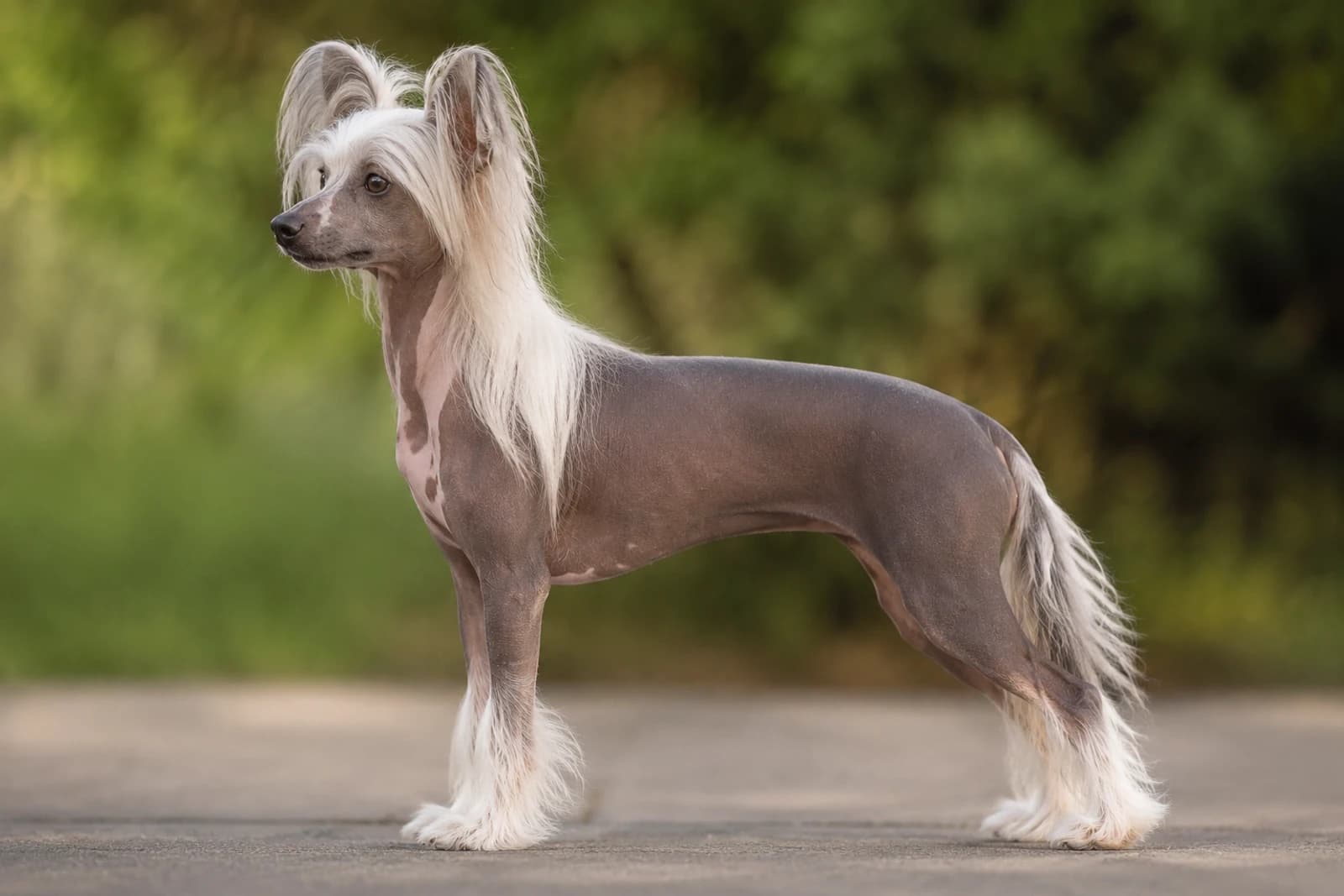
The Chinese Crested is an alert, affectionate toy breed that thrives on close human companionship. Available in hairless and powderpuff varieties, this dog is a devoted lapdog ideal for apartment living and allergy sufferers. Its gentle, playful nature makes it a loving companion for adults and considerate older children, though it may be too delicate for rough play. With moderate energy, it enjoys indoor play and short walks, but craves constant warmth and attention. This intelligent, slightly stubborn breed does best with consistent training and a household where someone is usually at home.
At a glance
- Size
- Medium
- Height
- 9–13 in
- Weight
- 11 lb
- Life span
- 12 years
- Coat colors
- Any color or combination, including white, black, gray, liver, apricot, cream
- Coat type
- Hairless variety with soft skin and tufts on head, tail, and feet; Powderpuff variety with long, soft double coat
How much does a Chinese Crested cost?
Adopt / rescue
$75–$400
Usually includes spay/neuter, first shots, and a microchip.
Buy from a breeder
$700–$2,000
From a reputable, health-testing breeder.
Approximate USD. Prices vary widely by region, breeder, pedigree, age, and coat colour — adopting is the lower-cost and recommended route. Avoid suspiciously cheap “breeders”; they’re often puppy mills.
Estimate the full cost of a Chinese Crested →Chinese Crested photos
Views
Front, side, rear and top — the full silhouette.Poses
How the breed sits, lies, moves and plays.Puppy to senior
The breed across its whole life.Expressions
The breed’s range of moods.Close-up details
Eyes, ears, nose, paws, tail and coat.Coat colors
The breed’s recognized colors.Click any photo to enlarge. We show the Chinese Crested from every angle — three views, poses, life stages, expressions, close-ups, coat and colors.
Appearance & size
You see the Chinese Crested’s most famous feature right away — there are actually two entirely different coats coming from the exact same litter. The Hairless variety isn’t truly bald. It has soft, silky hair on the head (the “crest”), the ears, the lower legs (“socks”), and the tail (the “plume”). The rest of the body is smooth-skinned and warm to the touch. The Powderpuff carries a full double coat all over — a soft, fine undercoat and a straight, veil-like outer coat that feels cool and silky. Both varieties can appear in any color, any combination of colors, and any pattern. Solid pinks, black, blue, spotted, white with patches — there’s no restriction.
Breeders don’t select for one coat type over the other; many pairings will produce both, because the hairless trait is a dominant gene that’s lethal in double-dose. Powderpuffs are essential to the breed’s survival.
Standing still, the dog is small but fine-boned, never heavy. They stand 9 to 13 inches at the shoulder and weigh around 11 pounds. From the front, the chest is moderately broad and the front legs are long and straight, giving an elegant, deer-like look. From the side, you notice the level topline, a slight tuck-up at the belly, and a graceful neck that flows into a well-laid-back shoulder. The crest on a Hairless flows forward, framing an alert, wedge-shaped head with large, upright ears (sometimes fringed). The Powderpuff’s ears are drop style if uncropped, but many breeders leave them natural. From the rear, the back legs are moderately angulated, the tail is set high and carried up or out — on a Hairless, the plume is long and silky, looking almost like a flag. The skin itself is a standout feature: on hairless dogs it’s soft, warm, and often gets a summer tan or freckles; light-colored dogs can show pink and lavender tones, while darker skin has a warm gray or black sheen. Regardless of variety, the overall impression is a svelte, slightly exotic dog that’s built for agility, not bulk.
History & origin
It sounds like a riddle: a Chinese dog with African roots, perfected by British and American breeders. But that’s the Chinese Crested’s real origin story.
The hairless trait didn’t start in China. Smooth-skinned dogs appear in carvings and written accounts from Central and South America, Asia, and Africa that go back thousands of years. Genetic evidence points to a spontaneous mutation that popped up in multiple places, but the Chinese Crested’s direct ancestor was likely the African Hairless Dog — a tiny, warm-skinned ratter that thrived in the heat. Traders carried these dogs along the African coast and into Asia, where Chinese sailors snapped them up.
By the 1700s, Chinese trading ships had perfected the breed for a very specific job: pest control. A dog that didn’t shed, didn’t carry fleas into cramped quarters, and weighed only around 11 lb could chase vermin through every inch of a junk without taking up precious space. Sick crew members welcomed the dog’s body heat, too — sailors believed the bare skin could draw illness out of a human and into the dog. That “living hot-water bottle” reputation turned the dogs into treasured amulets, and they earned nicknames like “Chinese treasure dog” and “magic dog” long before the Western world noticed them.
European explorers brought specimens back in the 1800s. Early dog shows classified them alongside other hairless oddities, but the first real breed standard took shape not in Beijing but in Britain and the United States. American fanciers, most notably the burlesque star Gypsy Rose Lee, became passionate breeders in the mid-20th century. Lee’s kennel produced a string of champions and pushed the Chinese Crested into the spotlight. The American Kennel Club granted full recognition in 1991.
The Hairless and the Powderpuff
Every Chinese Crested carries one of two coat genes, but you can’t fully separate them. The hairless variety has silky hair on the head (the “crest”), feet, and tail, and a gene that’s dominant but lethal in utero when homozygous — meaning two copies of the gene prevent an embryo from developing. That’s why every hairless parent actually carries a recessive coated gene. Breed a hairless to a hairless, and you’ll get a mixed litter: some hairless pups and some fully coated “Powderpuffs.” Powderpuffs have a soft, double coat and zero hairlessness genes. For decades, they were quietly culled or given away as pets; today, they’re registered and shown right alongside their bare-skinned littermates.
The breed’s path from African ratter to shipboard healer to pampered companion zigzagged across three continents, but the Chinese Crested never lost the traits that made it invaluable centuries ago — portable size, quick reflexes, and an almost unsettling love of snuggling up to warm skin.
Temperament & personality
A Chinese Crested is a velcro dog through and through. If you want a pint-sized shadow who burrows under your blankets and follows you from room to room, this is your breed. They tend to pick a favorite person but still shower the whole family with affection — just don’t expect them to handle long stretches of solitude. Separation anxiety is real, and a bored or lonely Crested will air grievances through excessive barking, or by turning your shoes into a chew project.
These dogs are alert and watchful without tipping into outright aggression. They’ll sound the alarm when strangers approach, making them excellent little doorbells, but early socialization teaches them to settle down once you give the all-clear. They read body language keenly: a stiff, staring posture often signals an incoming growl, while lip licking, yawning, or a backward center-of-gravity lean tells you they’re uncomfortable and need space. Respect those signals, and you’ll rarely see a snap.
Energy lands somewhere between mischievous house elf and couch potato. A daily walk and a couple of lively play sessions usually do it, though they can rev up for spurts of zoomies. Indoors, the hairless variety is pathologically heat-seeking — sun puddles, laptop keyboards, your armpit — and will sulk if they get chilled. Powderpuffs share the same cuddly personality beneath a soft double coat.
House-training takes patience. Like many small dogs, a Chinese Crested can become a chronic urine-marker, especially if the scent of old accidents lingers. Clean up thoroughly (a vinegar spray helps neutralize the cue) and reward outdoor elimination immediately with treats. Punishing indoor mistakes only creates a sneaky dog who hides their puddles behind the couch. Chewing is another constant: puppies gnaw to explore, and adults benefit from hard chews to keep jaws strong and teeth clean. A homemade citrus spray on forbidden items can save your furniture without a power struggle.
Stubborn but sensitive, they respond best to respectful, consistent handling. Force or harsh corrections cause them to shut down, while short, positive training sessions turn their cleverness into reliable tricks. Let children know never to interrupt the dog during meals to avoid food-guarding, and don’t baby them so much that you accidentally create a tyrant who runs the house. Treat your Crested like the bright, devoted little character they are, and you’ll have a companion who’s as entertaining as they are loyal.
Good with kids, dogs & other pets
This little dog rarely starts a fight. The Chinese Crested is patient by nature and almost never aggressive, which sounds ideal for a family with kids. But he weighs just 11 lb and stands maybe 13 inches tall — a child who squeezes too tight or drops him can cause real damage. Teach children to sit on the floor and let the dog climb into their lap rather than carrying him around. No unsupervised play with anyone under about six or seven; a Crested’s fine bones and thin skin don’t forgive accidents.
Early socialization is the make-or-break piece. The prime window runs from roughly 3 weeks to about 14 weeks (closing around 16), so you want the puppy meeting gentle kids, other small dogs, and calm cats during that stretch. Short, upbeat exposures to different people, sounds, and surfaces head off the timidity this breed can develop when under-socialized. A Crested left to himself in a quiet house until five months old may panic around new visitors or hide from a neighbor’s friendly Lab.
With other dogs, he’s generally easygoing if you’ve put in the groundwork. He often enjoys the company of polite, similarly sized housemates. Large, high-energy dogs that bowl him over in play are a risk — a 70-lb “just wanting to say hi” can snap a Crested’s leg. Structured introductions in a neutral space work best, and skip the rowdy dog park unless you know the crowd is small and mellow. An adult Crested who’s already nervous around other dogs doesn’t need forced meet-and-greets; that backfires and amps up fear.
Cats inside the home usually mesh well, especially if the puppy grows up with them. Even with a peaceable relationship, a cat’s swat can scratch that bare skin, so supervised face-to-faces early on teach both animals to respect each other’s space. Small pets like rabbits or guinea pigs should stay in a secure enclosure when you’re not right there; while the Crested isn’t a high-prey-drive terrier, he’s still a dog, and a fast-moving critter might trigger a chase.
You can skip the guilt if your adult Crested turns out to be more of a one-person shadow than a social butterfly. Not every dog needs a pack of canine pals. Focus on what makes your individual dog feel secure, and set up every interaction — child, dog, or cat — so it stays low-key and voluntary.
Trainability & intelligence
This breed is sharp—your Chinese Crested will pick up a new trick in a handful of repetitions when the payoff is good. That intelligence comes wrapped in a surprisingly sensitive package, though, and an independent streak that means “I know what you want” doesn’t always equal “I feel like doing it right now.” Train the dog in front of you with short, upbeat sessions that lean heavily on treats, a favorite squeaky toy, or a goofy “good dog!” party. Anything harsh—even a stern tone—can cause them to shut down or get anxious, so stash the heavy corrections permanently.
Motivation is rarely the problem if the reward is high-value. Tiny bits of chicken or cheese will hold their attention far longer than a pat on the head. Use that to your advantage when teaching a reliable recall, which can be a real sticking point. A Chinese Crested who has spotted a squirrel or simply decided the couch is comfier than coming to you may conveniently forget the command. Practise recall on a long training leash in distraction-light environments first, and reward every single check-in with something fantastic. Never scold a dog who eventually returns; that just teaches them that coming back ends the fun.
House training can take extra patience. These dogs hate cold and wet weather, so a covered potty spot or an indoor litter box setup often saves both your sanity and your floors. Consistency is non-negotiable—puppies need potty breaks every couple of hours, with immediate praise and a treat the moment they go in the right place.
- Socialization starts early. The window between 3 and 14 weeks is prime time to gently introduce your pup to new people, odd sounds, different floor surfaces, and calm, vaccinated dogs. A Chinese Crested who misses this can become jumpy or barky with strangers.
- Keep sessions to 5–10 minutes. Their focus drifts quickly, and a bored Crested will invent its own game. End on a win, even if it’s just a perfect “sit.”
- Respect the sensitivity. If you get frustrated, your dog will read it instantly. Breathe, go back to something easy, and try again later. Trust is this breed’s foundation for everything else.
Work with that tender personality instead of against it, and you’ll end up with a dog who learns reliably, adores showing off its repertoire, and stays connected to you even when temptation strikes.
Exercise & energy needs
A Chinese Crested doesn’t need miles of pavement pounding. Most days, 20–30 minutes of total activity, split into two or three short sessions, hits the sweet spot for this 11-pound dog. A 10–15 minute walk around the block plus a couple of lively indoor play bursts — chasing a crinkle ball or working a puzzle toy — usually covers it. These little dogs are alert and playful, not lazy, so consistency matters more than duration.
Keep the intensity low-to-moderate. Sprinting across the living room? Great. Jumping off the back of the sofa? Not so much. Their fine-boned legs and a breed tendency toward luxating patellas (slipping kneecaps) make high-impact landings a real risk. Stick to soft surfaces for play and avoid rough-and-tumble with much larger dogs.
Mental exercise is just as important as the physical kind. Chinese Cresteds are clever and Velcro-close to their people, which means they thrive on activities that involve you. A snuffle mat at breakfast, a quick trick-training session, or hiding treats around the house for a scent hunt can burn off mental energy on days when a walk isn’t possible. Many take well to dog sports like rally, nose work, or low-height agility, as long as training is upbeat and rewards-driven.
Hairless and Powderpuff varieties have the same moderate engine, but the Hairless does come with weather quirks. Chilly mornings call for a coat, and direct sun means dog-safe sunscreen — both can cut outdoor time short. No problem: a 15-minute session of indoor fetch or learning a new command fills the gap without overheating or shivering.
A bored Crested tends to shadow you and voice complaints. Regular short outlets prevent that restlessness and keep the dog settled and happy, no gym membership required.
Grooming & coat care
Grooming a Chinese Crested isn’t a one-size-fits-all routine — you’ll handle things completely differently depending on whether you have the nearly hairless variety or the fully coated Powderpuff. That choice determines your daily reality more than any other breed trait.
The Hairless: skin first, hair second
With only soft wisps on the head (the “crest”), tail (the “plume”), and lower legs (the “socks”), your main job is skin care, not coat management. The exposed skin produces oil but has no hair to wick it away, so a weekly bath with a gentle, moisturizing dog shampoo prevents blackheads and acne. After bathing, pat dry and apply a light, dog-safe lotion or coconut oil if the skin feels dry or chapped. In sunny weather, that bare skin burns quickly — a zinc-free sunscreen made for dogs goes on before any extended outdoor time. During winter, a soft sweater or hoodie helps conserve body heat. You’ll still need a soft bristle brush to gently go through the crest, plume, and socks a couple of times a week to lift away dust and loose hairs without scratching the skin.
The Powderpuff: a double-coated dog in a small package
The Powderpuff sports a dense, soft undercoat beneath a longer outer coat, and it absolutely requires daily brushing to stay ahead of matting. A pin brush or slicker brush with rounded pins glides through the long, straight hairs without tearing. Follow up with a metal comb to catch tangles starting at the roots, especially behind the ears, under the arms, and along the thighs — those are magnet spots for knots. Expect light shedding year-round and heavier blowouts in spring and fall. Bath every three to four weeks (or when dirty), and blow-dry on a low, cool setting while line-brushing to maintain that soft, flowing coat. Many owners keep the face, feet, and sanitary areas trimmed short for cleanliness.
All-around upkeep for both varieties
Ear cleaning once a week with a vet-approved solution reduces wax buildup and infections in these drop or semi-prick ears. Nails need clipping or grinding every two to three weeks — you’ll likely hear them clicking on hard floors as your cue. Dental care is non-negotiable. Chinese Cresteds are prone to early tooth loss and gum disease, so brush those teeth daily if you can, or at least three times a week with a dog enzymatic toothpaste. Start young so it becomes routine. Regular checks around the mouth and paws often catch early signs of food allergies or contact irritation before they blow up into a hot spot.
Shedding & allergies
The Chinese Crested comes in two coat types, and they sit at opposite ends of the shedding spectrum. The hairless variety has almost no body hair—just soft skin with tufts on the head (the crest), lower legs (socks), and tail (plume). Shedding is so minimal you’ll rarely find a hair on your couch. The powderpuff variety is a whole different story: a full, soft double coat that sheds lightly to moderately all year and goes through a heavier seasonal blowout once or twice a year. Weekly brushing keeps the puff’s loose hair under control, but expect to see it on dark clothing.
Even with the hairless, don’t mistake “near-zero shedding” for “allergy-proof.” Allergens live in dander (dead skin flakes) and saliva, not just fur. Hairless Cresteds still produce dander and need regular bathing—every week or two—to wash away skin oils and flakes before they build up. Powderpuffs create typical dog dander, but their hair can trap it, so airborne particles may be lower than with some heavy shedders. Neither variety drools much; they’re a clean-mouthed breed, so saliva allergens stay out of the equation for the most part.
If someone in your home has allergies, spend at least an hour with an adult Crested of the exact coat type you’re considering before bringing one home. Reactions vary wildly from dog to dog, not just breed to breed.
Diet & nutrition
A Chinese Crested tips the scales at just 11 pounds, so every extra ounce matters. Even a half-pound weight gain can strain tiny joints and set the stage for long-term trouble. Feed to your dog’s specific build, not the label’s broad suggestion. In practice, that means starting with roughly ¼ to ½ cup of high-quality dry kibble per day, split into two meals, and then adjusting up or down based on what you see (not what you hope to see). You want a visible waist from above and a slight tuck-up from the side.
Puppies have the same end-size but a faster metabolism, so they need more frequent meals: four evenly spaced feedings until four months, then three meals until six months, then the adult two-meal pattern. Transition a new puppy gradually to avoid digestive upsets — lightly cooked, puréed meats mixed with a little fruit or veggie mash works well initially.
Dental quirks deserve a special word. Hairless Chinese Cresteds often have missing or ingrown teeth and shallow roots, making dry kibble a chore. If your dog struggles, blend or purée the food. It improves nutrient absorption and saves them from pain. Even if teeth aren’t an issue, slowing down a gulper with a puzzle bowl protects against bloat and turns mealtime into a mental workout.
Pick a diet that’s protein-forward. Whether you go commercial or carefully balanced homemade, the bulk should be real meat, not corn or mystery meals. If you cook, combine cooked meats, fish, eggs, and dog-safe vegetables. Bland white rice or pearl barley can soothe a sensitive stomach, but use grains as a modest side, not the main event. Raw chicken wings (under supervision) can come in around twelve weeks, but watch them like a hawk. Steer clear of fatty holiday trimmings — a single rich meal can spark pancreatitis in a little dog.
Senior Cresteds slow down, and their waistlines pay the price. Switch to smaller, more frequent feedings if needed and cut back portions as exercise tapers off. Serve every meal in the dog’s own bowl, never from the table. Once begging takes root, it’s a devil to undo.
Health & lifespan
A well-cared-for Chinese Crested often hits 12 years, and some sail past it. Reaching that age means staying ahead of the small-dog vulnerabilities built into this breed, not just hoping for the best.
Dental disease is the biggest daily fight. That tiny mouth crams teeth together, trapping plaque and tartar. Without a steady brushing routine and veterinary cleanings under anesthesia, a Crested can lose teeth early and live with chronic pain—much of which a dog won’t show until the damage is done. Patellar luxation is another common one. You might notice a hop-and-skip step where the kneecap pops out of its groove and then slides back. Mild cases can be managed with weight control and joint supplements, but a severe luxation often calls for surgery. Eye conditions, including progressive retinal atrophy and lens luxation, also appear in the breed. Reputable breeders test parent dogs’ eyes and patellas before breeding, but even with that, things can surface later.
Skin is where the hairless variety demands real labor. Bare skin sunburns, chaps, and develops blackheads or acne if you don’t clean it regularly. Allergies—to food, grass, or laundry detergent—can set off rashes that turn into infections when the dog scratches. The coated Powderpuff isn’t off the hook either; that dense double coat mats fast against the skin, trapping moisture and bacteria. Both types hate the cold and overheat quickly. A hairless Crested in summer needs dog-safe sunscreen or a light shirt; in winter, a coat is non-negotiable even for a quick trip outside.
Hypoglycemia hits tiny puppies and smaller adults hard. A missed meal can drop blood sugar to a dangerous level, so feed small, frequent portions instead of one or two big meals. And keep that 11-pound frame lean. Even half a pound extra puts real strain on fine-boned legs and already iffy knees.
Ask a breeder point-blank about patella and eye clearances. Walk away from anyone who waves off skin or teeth trouble as “just how the breed is.” Then commit to yearly vet checkups—twice a year once the dog hits senior status—and a home routine that includes mouth checks, skin inspections, and weigh-ins. A limp that comes and goes or a cloudy eye caught early changes everything.
Living environment
A Chinese Crested slots into apartment life as naturally as a cat — and sometimes even uses a litter box with a little training. At around 11 pounds, she does not need a yard; a secure balcony patch or a few square feet of living room floor handles her zoomies just fine. That said, a small fenced yard is a nice bonus for sunbathing under supervision. The real deal-breaker isn’t square footage, it’s climate.
The hairless variety runs cold easily and sunburns fast. You’ll be layering on dog-safe sunscreen for outdoor time and pulling a sweater over her head the moment the thermostat dips below 65°F. Even the coated Powderpuff can struggle in extreme heat or cold, so this is emphatically an indoor dog with brief, comfortable outdoor trips.
On noise: she’s alert and will announce the delivery truck, so early training on a “quiet” cue helps if you share walls. Left unchecked, boredom barking can become a habit, but two short daily play-and-sniff sessions (think 15 minutes of indoor games, a lap around the block, or a puzzle toy) usually satisfy her energy and turn down the volume.
Tolerance for being alone is where this breed demands total honesty. A Chinese Crested bonds like Velcro and can spiral into distress if left alone for eight-hour stretches. Gradual desensitization and leaving a frozen stuffed Kong or a treat-dispensing puzzle can buy you a couple of hours, but this isn’t a dog you’ll stick in a crate and forget. If your household is empty most of the day, plan on a dog sitter, midday drop-in, or a small, calm doggy daycare — otherwise you’ll likely deal with destructive chewing, constant vocalizing, or housetraining regressions.
Who this breed suits
If you want a dog that rarely leaves your side — literally — the Chinese Crested belongs on your short list. This 11-pound, 9-to-13-inch companion is built for togetherness, not independence. They thrive with owners who are home a lot, whether that’s a retiree, a remote worker, or someone who simply wants a warm lap-warmer during Netflix marathons.
A near-perfect fit
- Apartment dwellers and seniors. No yard? No problem. A Crested’s exercise needs are modest — a couple of brisk 15-minute walks and some indoor play keep them content. They’re quiet, don’t shed much (the hairless variety barely at all), and are famously low-odor. For older adults, the breed offers affection without the physical demands of a larger dog.
- First-timers who enjoy a little routine. The training is straightforward: they’re smart, food-motivated, and eager to please. Housebreaking can take consistency, but the real learning curve is skincare. You’ll need to moisturize, bathe, and protect that exposed skin from sun and cold, and you’ll get comfortable with dog-safe sunscreen and sweaters. If that sounds more like self-care than a chore, you’ll do fine.
- Singles and couples wanting a dedicated shadow. Expect a dog that follows you from room to room and perches on the back of the sofa like a cat. They bond deeply with one or two people. If your idea of a good evening is a dog curled against your ribs under a blanket, the Crested delivers.
Think twice if…
- You’re gone nine-to-five, five days a week. Separation anxiety runs deep in this breed. Left alone for long stretches, they can become destructive or develop nervous habits. A Crested does best with someone around most of the day.
- Your household is full of young, rough-and-tumble kids. At 11 pounds with fine bone and fragile skin, they’re easily injured by clumsy hands. Families with older, dog-savvy children who understand “gentle” can work, but toddlers and enthusiastic grabbers are a risky match.
- You want a low-maintenance pet. The hairless variety may not shed, but the grooming regimen is real. Acne, blackheads, sunburn, and dry skin are constant considerations; the powderpuff coat needs regular brushing, too. Both types demand attention to dental health and nail care.
- You live for outdoor adventure in extreme weather. These dogs don’t tolerate cold, and that bare skin burns fast. They’re indoor companions at heart — short winter potty breaks and a well-stocked sweater drawer will be your norm.
If you’re ready to manage the unique needs of a mostly hairless dog and can offer near-constant companionship, a Chinese Crested will fill the role of loyal, quirky roommate for around 12 years.
Cost of ownership
A Chinese Crested puppy from a responsible breeder typically costs $1,500 to $3,000, with show-potential or rare-colored pups sometimes going higher. The price reflects genetic health testing, early socialization, and the extra care breeders put into fragile newborns. If you’re open to adoption, retired show dogs or rescue Cresteds often run $200 to $500, though availability is limited.
Monthly expenses settle around $100 to $200, but some line items can spike fast.
- Food: An 11-pound adult eats roughly half a cup of high-quality kibble per day, so you’ll spend $20 to $40 a month. Hairless Cresteds burn more calories staying warm, so you might inch toward the upper end in winter.
- Grooming: This depends entirely on the variety. A Hairless needs weekly baths, gentle exfoliation, and dog-safe moisturizer or sunscreen, plus occasional acne spot treatments. Budget $30 to $50 a month for supplies. A Powderpuff requires thorough brushing every other day and a professional clip every 6–8 weeks — easily $40 to $70 per session, so plan on $30 to $60 a month averaged out.
- Veterinary and insurance: Annual checkups, vaccines, and heartworm prevention add up to $200 to $400 a year. Dental care is a larger line item here: Hairless Cresteds often have missing or misshapen teeth and are prone to tartar buildup. A professional cleaning runs $300 to $800, and you may need it more frequently than with other breeds. Pet insurance — which you’ll want because the breed can encounter lens luxation, patellar luxation, and skin allergies — usually costs $25 to $45 a month for a solid plan with a reasonable deductible.
Stash a separate $500 to $1,000 emergency fund. Dental extractions or a skin infection can hit without warning, and waiting only compounds the bill.
Choosing a Chinese Crested
Most people fall for the hairless look first. That’s fine, but your real starting point should be finding a dog built to live a long, comfortable life — and a 12-year lifespan is average only if the puppy comes from health-tested parents.
Rescue or breeder?
Chinese Crested–specific rescues exist, and you’ll often see both hairless and powderpuff varieties. A rescue can be a sweet deal if you’re ready for a dog that may need some skin rehab or dental work. Adults usually top out around 11 pounds and stand 9–13 inches, so even a slightly-neglected dog bounces back in a manageable package. If you go the rescue route, ask about known eye or knee problems and whether the dog has been seen by a veterinary dentist.
The health clearances that actually matter
A responsible breeder screens for more than “vet checked.” You want to see official results you can look up on the OFA website:
- Eye exam by a veterinary ophthalmologist (not just a regular vet check). Chinese Cresteds can inherit progressive retinal atrophy (PRA), primary lens luxation, and glaucoma. The breeder should have a current CERF or OFA Eye exam for both parents within the last year.
- Patellar luxation evaluation. Those skinny back legs can pop out of place if the stifles aren’t sound. Both parents need an OFA patella clearance.
- Cardiac exam, ideally an echocardiogram. While less common, early heart issues do crop up, so an OFA cardiac clearance is a green flag.
Don’t accept “parents were healthy” in place of actual paperwork.
Red flags worth walking away from
Chinese Cresteds have a dominant hairless gene that is lethal in double dose. Ethical breeders breed a hairless to a powderpuff — that produces healthy litters with roughly half hairless and half coated pups. A breeder who only mates hairless to hairless is either ignorant or willing to risk dead puppies. Walk. Other deal-breakers: selling “teacup” or extra-small Cresteds (a well-bred adult already only weighs 11 pounds, and going smaller invites fragile bones), refusing to let you meet the mother on site, or pumping out multiple litters at once with no questions asked about your home.
Puppy pick: what to look for
At 8–10 weeks, a confident Chinese Crested puppy will trot right up to investigate you. Extreme shyness can harden into fearfulness later, so pick the bold-but-not-manic puppy. With a hairless pup, check the skin: some baby acne is normal, but you shouldn’t see raw, crusty patches or a strong yeasty odor. Peek inside the mouth — hairless dogs often miss teeth, but a severely undershot bite or missing lower canines can make eating messy. A powderpuff pup should have a soft, even coat without bald spots. If the breeder can’t hand you those eye and patella clearances before you leave a deposit, find another breeder.
Pros & cons
-
Pick your look. The nearly naked Hairless feels like warm suede; the fully coated Powderpuff is a soft, cottony lapdog. Both stand 9–13 inches and weigh a portable 11 pounds.
-
Shedding isn’t your problem. Hairless Cresteds leave no fur on the couch. Powderpuffs shed minimally, and a quick weekly brush catches what little there is.
-
Apartment life suits them perfectly. A couple of brisk 20-minute walks and some indoor zoomies satisfy their moderate energy. Inside, they’re calm, quiet, and content to curl up in a sunbeam — preferably on you.
-
They’re little shadows. A Crested bonds fiercely, follows you room to room, and thrives on physical closeness. At 11 pounds, they’re easy to scoop up for car rides, errands, or snuggling under a blanket.
-
Alert, not yappy. They’ll announce a visitor with a sharp bark, then melt into wiggling greetings once they see you’re okay with the stranger.
-
Hairless skin is a hands-on commitment. You’ll be applying sunscreen and dog-safe moisturizer, managing the occasional breakout, and layering on sweaters whenever the temperature drops. Sunburn and cold stress are real risks.
-
That Powderpuff coat isn’t wash-and-wear. Without thorough, regular brushing — especially around the fine, cottony ear and leg feathers — mats and tangles take hold fast.
-
Dental drama comes standard. Hairless individuals, in particular, are prone to missing teeth and early gum disease. Daily brushing and annual cleanings are non-negotiable for many.
-
Velcro dogs can mean separation anxiety. A Crested left alone for long workdays may panic, bark incessantly, or become destructive. They do best with someone home much of the day.
-
Small size, big fragility. An 11-pound dog can be seriously injured by a rough child’s grab or a tumble from the couch. Playdates with small kids and larger dogs need constant supervision.
-
Health quirks to screen for. Responsible breeders check for luxating patellas, eye disorders, and Legg-Calvé-Perthes disease. Even well-bred individuals sometimes develop skin allergies or irritable bowel issues, so a vet who knows the breed is priceless.
Similar breeds & alternatives
When you love the idea of a small, nearly bare-skinned companion but the Chinese Crested’s fine bone and distinct “crest” give you pause, a few other breeds get you close. The Peruvian Inca Orchid (small variety) stands just 10–16 inches and 8–18 pounds. It’s similarly affectionate and quick to form a strong bond with one person, yet it tends to be a little more alert and athletic. You exchange the Crested’s powder-puff option for a dog that may have a small mohawk of hair on the head but otherwise demands the same sunscreen-and-moisturizer routine. Skin is thin and nicks easily on both breeds, so a home without sharp edges matters.
The Toy Xoloitzcuintli (10–14 inches, 10–15 pounds) brings a calmer, more stoic temperament to the table. Where a Chinese Crested can be a busy little shadow, many Toy Xolos wait and watch before engaging. Their skin is thicker and less prone to teenage acne, but dental issues pop up in both hairless breeds — missing or pointed teeth are the norm, not the exception. You’ll still need a steady schedule of baths and balms, and you’ll still get a dog that wants to burrow under blankets at naptime.
For a hairless dog with a terrier’s workmanlike attitude, the American Hairless Terrier (10–16 pounds, 12–16 inches) turns the dial on energy. It matches the Chinese Crested’s weight range yet asks for more physical and mental work — think twice the daily zoomies and a much sharper nose for critters. A real plus: the breed typically retains a full set of healthy teeth, something you rarely get in other hairless dogs. The coatless skin still needs sun protection and a soft wardrobe in cold weather, but the personality is less velcro, more independent problem-solver. If the Crested’s fully coated Powderpuff version caught your eye instead, consider a Havanese; you lose the hairless quirk but gain a sturdier little lapdog (7–13 pounds) with a wash-and-go double coat that doesn’t leave you managing bare skin, missing teeth, or an intricate skincare regimen.
Fun facts
- The Chinese Crested has African origins, likely descending from ratters on Chinese trading ships.
- Hairless Chinese Cresteds need sunscreen and skincare to protect their exposed skin.
- The Powderpuff variety has a full coat and requires regular brushing to prevent mats.
- These dogs are often used as therapy animals due to their intuitive, comforting presence.
Frequently asked questions
- Are Chinese Cresteds good with children?
- The Chinese Crested can be a loving companion for families with gentle older children who respect their small size. They tend to be affectionate and playful, but early socialization is important to build comfort around kids. Because they can be delicate, interactions with very young children should always be supervised. With proper introductions, they often form strong bonds with all family members.
- Do Chinese Cresteds shed a lot?
- The Hairless Chinese Crested typically sheds very little, making it a popular choice for allergy sufferers, though it does require regular skin care. The Powderpuff variety has a soft, long coat that sheds a minimal amount and needs frequent brushing to prevent mats. Overall, both versions are considered low-shedding compared to many other breeds.
- How much exercise does a Chinese Crested need?
- This breed is moderately active and generally does well with daily walks and play sessions indoors or in a secure yard. They enjoy mental stimulation and short bursts of activity, but they are also content to lounge with their owners. Aim for around 30 minutes to an hour of exercise each day to keep them happy and healthy.
- Is the Chinese Crested suitable for apartment living?
- Yes, the Chinese Crested adapts very well to apartment living due to its small size and moderate energy level. They are generally quiet enough for close quarters if their needs are met, though some individuals may alert bark. Their minimal shedding is also an advantage in smaller spaces.
- Is the Chinese Crested a good choice for first-time dog owners?
- This breed can be a good match for first-time owners who are ready to dedicate time to grooming and socialization. They are intelligent and eager to please, which makes training relatively straightforward with positive methods. However, the Hairless variety requires special attention to skin protection, so new owners should be prepared for that commitment.
Tools & calculators for Chinese Crested owners
Quick estimates tailored to Chinese Cresteds — pre-filled with this breed’s size where it matters.
Articles & stories about the Chinese Crested
Sources & standards
This profile follows recognized breed standards from the American Kennel Club (AKC) and the Fédération Cynologique Internationale (FCI), along with established veterinary and breed-club guidance. These describe general breed tendencies — every dog is an individual.
Owner stories
Have a Chinese Crested? Share your experience — grooming tips, personality quirks, anything goes.