

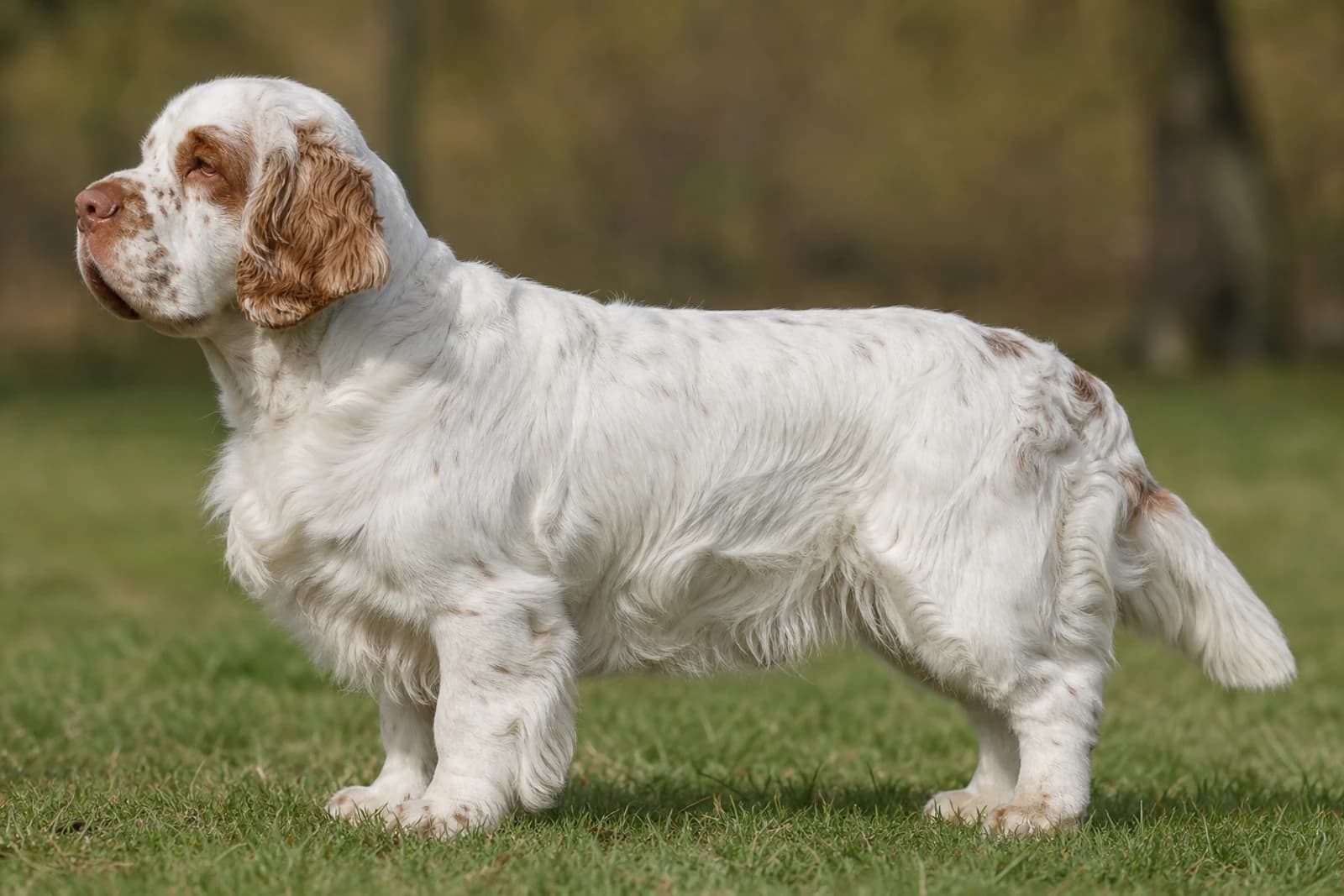
The Clumber Spaniel is a large, gentle, and affectionate breed, ideal for families or individuals seeking a calm, devoted companion. With their distinctive heavy build, droopy eyes, and soft expression, they thrive in homes where they can be part of daily activities. They are patient with children and generally get along with other pets. While they enjoy leisurely walks and play sessions, they are not overly demanding of exercise, making them suitable for less active owners who can provide moderate daily activity. Their loving nature and tendency to form strong bonds make them excellent lap dogs despite their size.
At a glance
- Size
- Large
- Height
- 17–20 in
- Weight
- 55–75 lb
- Life span
- 10–12 years
- Coat colors
- White with lemon markings, White with orange markings
- Coat type
- Dense, straight, silky
How much does a Clumber Spaniel cost?
Adopt / rescue
$75–$400
Usually includes spay/neuter, first shots, and a microchip.
Buy from a breeder
$700–$2,000
From a reputable, health-testing breeder.
Approximate USD. Prices vary widely by region, breeder, pedigree, age, and coat colour — adopting is the lower-cost and recommended route. Avoid suspiciously cheap “breeders”; they’re often puppy mills.
Estimate the full cost of a Clumber Spaniel →Clumber Spaniel photos
Views
Front, side, rear and top — the full silhouette.Poses
How the breed sits, lies, moves and plays.Puppy to senior
The breed across its whole life.Expressions
The breed’s range of moods.Close-up details
Eyes, ears, nose, paws, tail and coat.Coat colors
The breed’s recognized colors.Click any photo to enlarge. We show the Clumber Spaniel from every angle — three views, poses, life stages, expressions, close-ups, coat and colors.
Appearance & size
A Clumber Spaniel looks like someone crossed a small tank with a soft-eyed spaniel and then dipped it in vanilla ice cream. This is a large, big-boned dog built low to the ground, with a rectangular silhouette that’s much longer than it is tall. Stand him next to other spaniels and the difference hits you immediately: he’s a solid 55 to 75 pounds of muscle and heavy timber, standing just 17 to 20 inches at the shoulder. That low center of gravity isn’t an accident — it’s the blueprint of a dog originally meant to work heavy cover in front of a slow-moving hunter.
From the front, everything reads dense and substantial. The chest is deep and wide, dropping down between the front legs with plenty of heart room. Shoulders are laid back and powerful, and the straight, heavy-boned forelegs set well apart give him a bulldozer-like stance. Feet are large, round, and well-padded, pointing straight ahead or just slightly outward. The head — easily the breed’s calling card — is massive for the frame: a broad, square muzzle with a distinct stop and heavy brow ridges, topped with a deep flews that create the signature calm, almost mournful expression. Eyes are large, set deep, and dark amber, with a soft, easygoing gaze. Ears hang low, set right at eye level, and are thickly covered in wavy, silky feathering.
Move around to the side and the dog reads like a heavy-duty freight car. The neck is thick and moderately long, blending smoothly into well-sprung ribs that go way back. The back is straight and strong, the loin short and slightly arched, and the croup slopes gently toward the tail. You’ll notice a subtle tuck-up, but nothing radical — this is a working spaniel, not a sighthound. The coat is dense, straight, and flat, not curly or wooly. It’s weather-resistant, with a soft, silky undercoat and longer feathering on the ears, legs, belly, and tail. Color is primarily white with lemon or orange markings on the head, muzzle, and at the base of the tail. A fully white body with a colored head is typical and preferred, though light freckling on the muzzle and legs often shows up and isn’t faulted in a pet.
From the rear, the back legs are straight when viewed from behind, with plenty of bone and heavy muscle in the thighs. The hocks are well let down and the rear pasterns short. The tail — whether docked or left natural — is set just below the topline and carried level with the back, never up or curled. A feathery plume of longer hair gives the back end a flagged look when the dog moves. That rolling, unmistakable gait ties the whole package together: the Clumber drives from the rear with a slow, powerful reach, covering ground like a draft horse rather than a sprinter. He’s not fast, but he can go all day. Add in a tendency to drool after eating or drinking, and you’ve got a dog whose appearance is as practical as it is distinctive — nothing flashy, everything built for work.
History & origin
The Clumber’s story begins with a French nobleman who knew trouble was coming. During the French Revolution, the Duc de Noailles sent his entire kennel of treasured spaniels to England for safekeeping. They landed at Clumber Park in Nottinghamshire, the estate of the Duke of Newcastle, where those foundation dogs shaped what we know today as the Clumber Spaniel.
British gamekeepers took that French stock and crossed it with local lines—most likely early Basset Hounds and the now-extinct Alpine Spaniel—to create a dog purpose-built for flushing pheasants and partridge from dense, brambly cover. The result was a spaniel unlike any other: heavy in bone, low to the ground, and completely indifferent to the thorns that shredded lighter, faster dogs. Standing just 17–20 inches at the shoulder and carrying 55–75 pounds of muscle, the Clumber was the slowest of the spaniels but the most deliberate, moving with a methodical, never-miss-a-bird determination.
For more than a century, the breed remained a favorite of British aristocracy. King Edward VII and Prince Albert both kept Clumbers, cementing their reputation as the gentleman’s shooting dog—a quiet, tireless worker that didn’t need frantic speed because it put birds up reliably, time after time. The first Clumbers arrived in North America by the mid-1800s, and the American Kennel Club registered the breed in 1884, making it one of the earliest recognized spaniels. Today the Clumber remains relatively rare, and that scarcity has protected its working roots. You’ll still find breeders who prize a dog that can hunt heavy cover all day, then settle without fuss by the fire.
Temperament & personality
The Clumber Spaniel is the definition of a gentle giant in a compact, low-slung package. Indoors, you’ll find a dog who defaults to mellow—often content to sprawl at your feet while you work or watch TV. But don’t mistake that calm for laziness. He still carries the heart of a flushing spaniel and needs a daily walk of 30–45 minutes to stay healthy and happy. Without it, you may see some creative chewing, especially as a puppy. A tired Clumber is a well-behaved Clumber.
Affection here is quiet and steady, not demanding. He leans against your leg, follows you room to room, and curls up nearby rather than on top of you. This is a dog who wants to be with his people. Left alone for long stretches, that devotion can turn into anxiety—think drool, destructive chewing, or barking you rarely hear otherwise. Start alone-time training early and keep it positive.
With kids, the Clumber’s 55–75-pound heft and patient nature make him a favorite. He tolerates ear tugs and clumsy hugs well, but teach children the same rule you’d apply to any food-motivated dog: never bother him while he’s eating. That easygoing attitude can vanish around a bowl if he feels pressured. The same goes for a prized chew toy. Manage those moments, and you’ll sidestep any guarding behavior.
Watchfulness is more “low-key alert” than guard dog. He may rumble a deep, baritone bark if a stranger approaches, but he’s rarely suspicious beyond a good look. Most visitors get a calm sniff and then indifference. Expect a body language masterclass in relaxed: soft eyes, loose tail, droopy jowls—a classic Clumber lean backward that says I’m no threat.
His stubborn streak is real. Training works best with food and a respectful, consistent approach. Force just makes him dig in his heels. Short, upbeat sessions keep his nose engaged, because a Clumber who catches an interesting scent will tune you out completely. That nose also explains his love of rolling in things you’d rather he didn’t—a habit some behaviorists compare to a human spritzing on perfume. Don’t be surprised if your gentle, dignified spaniel comes in smelling like dead worm. It’s part of the package.
Good with kids, dogs & other pets
Clumber Spaniels come by their gentle, unflappable reputation honestly — this is a breed that rarely picks a fight and often adores children. Their patient, non-aggressive nature makes them a natural fit for families, but the dog’s sheer heft (55–75 pounds of low-slung muscle) means you need to supervise around toddlers. A well-meaning Clumber can easily topple a small child with a happy body lean or a wagging tail.
You’ll get the best results with kids when you teach both parties clear boundaries. Show children how to respect the dog’s space during meals and naps, and never leave interactions unsupervised. Clumbers are famously people-oriented and crave companionship, so a home where someone is around most of the day suits them far better than one where they’re isolated in a backyard or left alone for long stretches.
With other dogs, Clumbers are typically easygoing, but early and ongoing socialization is the difference between a tolerant adult and one who becomes fearful or reactive. The critical window for shaping a puppy’s outlook closes around 12–16 weeks. During that time, gradually expose your Clumber to a mix of friendly, well-mannered dogs, new people, different floor surfaces, car rides, and everyday household sounds. Keep each experience positive and low-pressure. A puppy raised in a bubble — say, from a puppy mill or pet store cage — often struggles with anxiety and aggression later, so meeting the breeder and seeing how pups are raised matters enormously.
Cats and small pets require a careful introduction and a realistic view of the breed’s prey drive. While many Clumbers coexist peacefully with cats, especially if they’re raised together, the spaniel’s instinct to chase may kick in with a scurrying animal. Start introductions slowly, use gates or leashes to control interactions, and never leave the dog alone with a free-roaming rabbit, guinea pig, or other small critter. If you bring an adult Clumber into a home with existing pets, let the dog’s comfort dictate the pace. Forcing greetings or flooding a dog with too much novelty can backfire, creating fear or even defensive snaps. A Clumber that’s been gradually desensitized and never forced into scary situations usually grows into that steady, affable companion the breed is known for.
Trainability & intelligence
Clumber Spaniels are smarter than their mellow expression lets on, but they don’t hand out obedience for free. They weigh decisions, calculate whether a command is worth their time, and can be impressively stubborn when the payoff isn’t obvious. That means you’ll earn every reliable sit and stay through consistency and a rewards-based approach—not by raising your voice.
Food usually breaks through their independent streak. Keep training sessions short, cheerful, and heavy on treats, praise, or a quick tug session. If you drill too long or let frustration creep in, a Clumber simply shuts down or wanders off. They’re sensitive: punishment-based corrections damage trust and can make them anxious or avoidant, undoing weeks of careful progress.
Recall is the sticking point for many owners. A Clumber’s nose rules. Once they catch an interesting scent, the world outside your voice disappears. You can’t punish that out of them—you have to build a recall that’s even more reinforcing than any trail. Start in a distraction-free room, then slowly add difficulty while rewarding with high-value food or a favorite toy. Even then, expect a 60-pound spaniel to occasionally pretend he didn’t hear you when a rabbit crosses the path.
Socialization works hand-in-glove with training. Introduce Clumber puppies to different people, surfaces, sounds, and calm dogs before 14 weeks. They’re naturally reserved and can grow aloof or suspicious without broad, positive early exposure. Ongoing practice in new settings keeps their confidence up and blocks the fear-based stubbornness that gets mistaken for just being “stubborn.”
On the plus side, a Clumber who trusts you can learn complex chains for fieldwork, obedience, or scent work. They’re methodical, not flashy, and they’ll repeat a job you’ve made worthwhile for them. The trick is never letting them decide the bargain isn’t fair.
Exercise & energy needs
A Clumber doesn’t need to run for miles, but he does need to think. This is a heavy-boned spaniel with a deliberate, ground-covering trot — not a restless athlete. Aim for 45 to 60 total minutes of daily activity, comfortably split into two sessions. A pair of 20–30 minute exploratory walks where he can sniff every bush often tires him out more than a single long march.
How intensity and structure matter
Low-impact movement is the rule. Clumbers carry a lot of weight on a long back and relatively short legs, so jumping, hard stops, and forced jogging can stress hips, elbows, and spinal discs. Let him move at his own pace on grass, dirt, or sand. In warm weather, keep sessions short and early — that dense coat and heavy build make overheating a real risk.
The real energy burner: his nose
This breed was built to methodically flush birds in thick cover, and that problem-solving drive is still there. Mental work deeply satisfies a Clumber. Fifteen minutes of hiding treats for him to find, a frozen puzzle toy, or a short session of clicker training can leave him more content than an extra walk. Nosework, tracking, and rally are all natural fits. Even a few retrieves indoors on a rainy day count.
Activities to try (and to skip)
- Do: leisurely walks with sniff breaks, swimming (excellent no-impact exercise), scent games, obedience, tracking, rally.
- Be careful with: long stair climbing, agility involving jumps, fetch on slick floors, and anything high-impact during growth. Puppies, in particular, need protected joints — no structured running until growth plates close.
Pay attention to the individual dog. Some Clumbers are lazier than others, but skipping too many days can lead to weight gain and boredom. If your dog starts nosing the leash or pacing, that’s his signal he’s under-exercised — not because he wants a marathon, but because he needs a job for his brain and a good, unhurried stretch of his legs.
Grooming & coat care
That dense, silky white coat may look serene in a show ring, but at home it’s a shedding machine. Clumber Spaniels pack a heavy double coat that drops hair year-round and kicks into overdrive twice a year. Plan on three solid brushing sessions a week as a baseline, and budget for daily brushing during spring and fall blowouts unless you want white fur tumbleweeds rolling across every floor.
Tools that actually work
Skip the soft bristle brush—a Clumber’s coat wants a metal slicker brush with rounded pins to reach through the straight outer hair and loosen the thick undercoat. Follow up with a greyhound-style comb to catch tangles before they turn into mats. The trouble zones are always the same: behind the ears, inside the hind leg feathering, and deep in the armpits. If you hear the comb snag, stop and work the knot out with your fingers or a dematter—never rip through.
Bathing and the dirty-dog reality
Clumbers are low-slung, drooly, and magnetically drawn to mud. Bathe them every 6–8 weeks (or when the smell wins) using a whitening shampoo safe for dogs, then rinse until the water runs absolutely clear. Soap residue trapped in that dense undercoat is a fast track to hot spots. After the bath, blow-dry or thoroughly towel-dry the feathering on the legs, chest, and tail—dampness invites skin irritation.
Ears, nails, and the stuff that gets overlooked
Those long, heavy ears look regal but trap moisture and debris. Check and clean them with a vet-approved ear cleaner once a week, more often after swimming or a wet outing. Nails need a trim every 3–4 weeks; if you hear clicking on hard floors, they’re already too long. Don’t forget to brush the teeth daily or at minimum a few times a week—Clumbers can be champion droolers, and that constant moisture can kick up tartar issues.
Seasonal reality check
Spring and fall bring a full coat dump. For about three weeks each season, you’ll swear a second dog lives in your house. Up the brushing to once a day, and consider a warm bath to help loosen dead undercoat faster. Never shave a Clumber. The double coat insulates against both heat and cold, and cutting it short can ruin the texture and leave the skin vulnerable. A tidy-up of the feet and the feathering edges is fine; let the rest be.
One last thing: after tall grass or a wet romp, run your hands over the dog’s belly and inside the feathering to check for foxtails, burrs, or the first sign of a rash. That thick coat hides early trouble well.
Shedding & allergies
Clumber Spaniels shed — a lot. Forget the tidy spaniel stereotype; these are dense, double-coated dogs built for wet bramble, not a spotless living room. They drop hair every single day, and twice a year they blow coat so heavily you’ll wonder if you’re raising a second dog in dust bunnies. A thorough brushing three or four times a week pulls out loose undercoat before it lands on your sofa, but you’ll still find white fur clinging to every dark surface. Their pale coat makes every strand obvious.
They also drool. Those heavy, pendulous jowls pour water across the floor after every drink, and mealtime excitement or a warm afternoon leaves long strings of slobber on walls, table legs, and your jeans. If you have an aversion to dog spit, this isn’t a minor quirk — it’s a daily reality.
From an allergy standpoint, a Clumber is a poor choice. No dog is truly hypoallergenic, but a heavy shedder that drools is especially likely to stir up reactions. Dander collects in the thick coat, and saliva proteins spread everywhere. Regular baths and vacuuming help reduce airborne particles, but they won’t make the breed safe for an allergic household. Expect to invest in a quality vacuum, lint rollers by the case, and a mop you don’t mind using constantly.
Diet & nutrition
Clumber Spaniels are masters at convincing you they’re starving — and every extra pound lands squarely on hips and spine that are already prone to trouble. Portion control isn’t optional; it’s the single most important piece of their diet.
Weight management: a daily priority
A full-grown Clumber (55–75 lb) puts significant stress on his joints. Letting him get heavy invites hip dysplasia and intervertebral disc flare-ups. Feed to a visible waist and a ribcage you can feel with flat fingers, not guesswork. Measure every meal with a real measuring cup. If he gets treats for training, subtract those calories from the main meals. A food puzzle bowl or snuffle mat slows down a gulper and gives his brain a workout at the same time.
What to feed
Skip vegetarian or vegan plans — a dog’s gut and teeth are built for meat. A high-quality commercial food that lists a named animal protein first works fine for most families. If you go homemade, aim for roughly 60% raw or cooked meat, 20–30% fruits and vegetables, and the remainder from eggs, plain yogurt, or cooked grains like pearl barley or white rice. Blend or process the mix; dogs lack the side-to-side jaw motion and salivary enzymes we have, so puréeing unlocks more nutrients. Pearl barley brings gentle fiber, while plain white rice is a go-to if his stomach gets upset.
Puppy feeding schedule
- Up to 4 months: four evenly spaced meals a day.
- 4 to 6 months: drop to three meals.
- After 6 months: two meals a day, which he’ll stay on for life.
Transition any new food over 7–10 days. Around twelve weeks you can introduce raw chicken wings as a supervised chew, but always keep a close eye. Controlled, steady growth protects developing joints, so resist the urge to “bulk up” a puppy.
Senior adjustments
Older Clumbers naturally slow down. Scale back calories before the scale creeps up. Splitting his daily ration into three small meals can be easier on a sensitive stomach. If teeth go missing, purée meals to keep nutrition absorption high. There’s no need to slash protein; just keep the portions honest and the treats stingy.
No table feeding, no greasy holiday leftovers — a single rich meal can trigger pancreatitis. A lean, fit Clumber is a much more comfortable dog with a real shot at those 10–12 years.
Health & lifespan
A well-cared-for Clumber Spaniel usually lives 10 to 12 years. That’s right in line with most large breeds, but reaching the upper end of that range often comes down to managing a handful of predictable health concerns — and keeping weight in check.
What can go wrong
Clumbers are heavy-boned, low-slung dogs with a long back and a deep chest. That structure makes them more prone to intervertebral disc disease (IVDD) than many other spaniels. A sudden yelp, reluctance to jump, or a wobbly hind end warrants an immediate vet trip. Joint problems don’t stop there — hip dysplasia and elbow dysplasia show up in the breed, and responsible breeders screen for both through OFA or PennHIP evaluations before pairing dogs.
Those soulful, slightly droopy eyes also come with a list. Entropion (eyelid rolling in) and ectropion (eyelid sagging out) can cause chronic irritation. Cataracts and retinal dysplasia pop up, too. A yearly eye exam by a veterinary ophthalmologist is standard for any breeding dog, and it’s a good idea for your pet as well.
Floppy, thick ears trap moisture and muck, so ear infections are a recurring nuisance. Watch for head shaking, a sour smell, or gunk buildup. Add in a dense, water-resistant coat, and you’ve got a dog that can develop skin fold dermatitis or hot spots if dampness lingers.
And then there’s the appetite. Clumbers are famously food-driven, which makes obesity a real threat. Extra pounds stress already vulnerable joints and shorten lifespan. You shouldn’t see the ribs, but you should feel them easily under a thin layer of padding. A lean Clumber is a healthier Clumber.
What responsible breeders do
Talking to a breeder who takes health seriously means asking the right questions. Expect to see proof of:
- Hip and elbow dysplasia screening (OFA or PennHIP)
- Eye clearance from an ACVO ophthalmologist, done within the last year
- A written health guarantee that covers genetic conditions for at least the first year or two
Some breeders also test for PDP1 (a metabolic muscle disorder) and thyroid function, though these are less widespread in the breed than the orthopedic and eye issues above.
Daily and routine care
- Heartworm prevention. Give it monthly during mosquito season and for at least one month after the last mosquitoes disappear. There’s no cure once a dog shows symptoms, so this is non-negotiable.
- Rabies vaccination. Required by law, and for good reason — it’s fatal if not prevented.
- Ear cleaning. A once-a-week wipe with a vet-approved drying solution prevents a lot of infections.
- Exercise and diet. A solid hour of walking or sniffing daily, split into a couple of sessions, keeps joints moving and the mind engaged. Measure meals, skip the table scraps, and use a portion of kibble for training rewards.
You know your dog better than anyone. Subtle changes — less eagerness for a walk, a shift in appetite, getting snippy when touched in a certain spot — are often the first clues. Schedule annual wellness exams, and bump that to twice a year once your Clumber hits age 7 or 8. Catching a brewing problem early is far easier than digging out of one later.
Living environment
A Clumber Spaniel adjusts his pace to your home, not the other way around. He’s a low-key, heavy-boned housemate who’d rather nap at your feet than patrol a fence line. A house with a few steps is fine; a fifth-floor walk-up will feel like a chore for a dog who weighs up to 75 pounds and has a long, lumbering body.
Yard or apartment?
A securely fenced yard is a bonus, mostly so he can wander, sniff, and roll in the grass at his own speed. No fence? He does perfectly well on a couple of daily leash walks. Apartment living works if you commit to those walks and don’t mind a dog who sheds steadily and drools after meals and water. The real prerequisite isn’t square footage—it’s tolerance for a little slobber on the couch.
Exercise and climate
Skip the idea of a jogging partner. A Clumber’s build—long back, heavy bone—makes him unsuited for high-impact pounding. Two daily walks of 20–30 minutes, plus time to nose around, check his physical box. His brain needs just as much: hide a treat-filled puzzle toy or let him work a scent trail indoors. Without that mental outlet, he can get sulky or destructive. Heat is his enemy. His dense coat and sturdy body cause him to overheat fast, so air conditioning is non-negotiable in summer. Walk him early and late, never midday.
Noise and alone time
This is a quiet breed. A Clumber isn’t a yapper, but he will alert bark if someone comes to the door, then immediately lean against them for scratches. Leaving him alone for a full workday, though, often backfires. He bonds deeply and can slide into separation anxiety—chewing, drooling, or howling. If your schedule demands long absences, build up his tolerance gradually from puppyhood and provide a rotation of food puzzles and frozen kongs. Even then, a midday dog walker or a neighbor’s visit makes a big difference.
Living with a Clumber means accepting a certain amount of fur and drool as part of the deal. In return, you get a dog who’s content to doze next to your desk, always ready for a slow, sniff-filled stroll.
Who this breed suits
A Clumber Spaniel fits best in a home that prizes a calm, affectionate shadow over a high-speed athlete. This is a dog who wants to lean on you during a movie, follow you room to room, and welcome you with a full-body wag that leaves a trail of hair and drool in its wake. If that sounds like a fair trade, you’re already well-matched.
Best matches
- Families with older children — Clumbers are gentle and famously tolerant, but a full-grown adult (55–75 lb) can accidentally barrel into a toddler just by turning around. Kids who are steady on their feet and understand canine body language do beautifully.
- Seniors or moderately active owners — A few 20- to 30-minute walks a day, plus a good sniff session in a fenced yard, meets their exercise needs. They’re built for long, leisurely strolls, not sprinting, and they overheat quickly in warm weather.
- Singles or couples who work from home — These velcro dogs develop deep bonds and can slip into separation anxiety if left alone for eight-plus hours daily. A household with someone around most of the time is ideal.
- Country or suburban dwellers — A single-level home with easy access to a secure yard saves their long back and heavy frame from excessive stairs, and gives them space to patrol at their own deliberate pace.
Who should think twice
- Neat-freaks and minimalists — Clumbers are champion shedders. White hair will weave itself into every fabric you own, and drool accompanies meals, play, and any mildly exciting moment. Daily sweeping and a tolerant attitude toward slobber are non-negotiable.
- Apartment residents (unless you’re exceptionally committed) — They’re quiet and low-energy indoors, but the sheer volume of shed fur, the drool, and their preference for an easy potty exit without an elevator ride can make close-quarters living a chore.
- Owners looking for a jogging partner or an agility prospect — A Clumber’s short, rolling gait and heavy build make high-impact exercise a risk to joints. They can enjoy a short off-lead burst of sniff-and-explore, but they aren’t built for miles of pavement pounding.
- People with very young children or frail adults — The size, combined with a happy-go-lucky clumsiness, can cause unintentional knocks. A Clumber stepping on a bare foot or bumping into unsteady legs is not a small thing.
- Those unprepared for training stubbornness — With a mind of their own, they respond to patience and positive reinforcement, not repetition or frustration. Some lines can show possessiveness over food or stolen items; responsible breeders screen for temperament, and training from day one matters.
Count on a 10–12 year commitment where ear cleaning, wrinkle hygiene, and managing a tendency to pack on extra pounds become daily habits. The right owner sees these as small effort for a dog that brings an outsized, happily snoring presence to the living room.
Cost of ownership
Expect to pay $1,800 to $3,500 for a well-bred Clumber Spaniel puppy from a responsible breeder who screens for hips, eyes, and elbows. This is a rare breed, so you may wait on a litter and pay toward the upper end for a pup from health-tested, titled parents. Rescues and breed-specific rehoming groups charge $300 to $800, though young adults show up less often.
Monthly upkeep lands squarely in large-dog territory. A 60-pound Clumber will eat about 3½ to 4½ cups of quality dry food a day, which runs $60 to $90 per month if you avoid filler-heavy bargain kibble. You can add joint supplements early — the breed’s long back and weight-forward build put extra stress on hips and knees. Count on $20 to $40 a month for a good glucosamine/chondroitin product.
Grooming is not a set-it-and-forget-it affair. That dense, double-layered white coat traps dirt and sheds enough to coat your furniture in tumbleweeds. You’ll brush three or four times a week at home, plus budget every 6 to 8 weeks for a pro groom ($75–$100 per session) to thin the undercoat, trim feathering, and keep the heavy ears clean. Tack on $15–$25 a month for ear cleaner and wipes — those pendant ears are infection factories if left damp.
Veterinary costs track with any large breed prone to orthopedic issues. Annual exams, vaccinations, and heartworm/flea/tick prevention run $400 to $600 a year. If hip dysplasia, entropion, or a disc problem crops up, diagnostic imaging and specialist visits can add a quick $2,000 to $5,000 in a bad year. Pet insurance for a Clumber typically costs $45 to $80 a month depending on your deductible and coverage level; without it, set aside at least a $2,500 emergency fund right from day one.
Add in a $150–$300 initial outlay for a crate, bed, sturdy food bowls, and a few indestructible chew toys — Clumbers are mouthy puppies — and your first-year cost can hit $4,500 to $6,000 before you factor in any training classes. The quiet, rolling routine of a healthy adult Clumber will still nudge $200 to $300 a month once everything is normalized, and the breed’s hearty appetite and grooming needs make it hard to dip much below that for long.
Choosing a Clumber Spaniel
You’ll either go through a responsible breeder or adopt through the Clumber Spaniel Club of America’s rescue network. Rescued Clumbers are less common, but the wait can be worth it: you skip the puppy chaos and often get a dog whose adult temperament is already known. Ask for any existing veterinary records, especially recent eye exams and hip evaluations. Whether you go breeder or rescue, you’re looking for a dog with solid health groundwork and that signature gentle, people-loving Clumber nature.
What a responsible breeder looks like
A breeder who does it right lives and breathes the breed. They’re typically a member of the national club and follow its code of ethics. They breed only adult dogs with verifiable health clearances, not just a vet check. For Clumbers, that means:
- Hips: OFA or PennHIP evaluation
- Elbows: OFA elbow dysplasia screening
- Eyes: annual exam by a board-certified veterinary ophthalmologist (OFA Eye certification or CERF)
- Thyroid: a full panel from an approved lab
- DNA: tests for pyruvate dehydrogenase phosphatase 1 (PDP1) deficiency and progressive rod-cone degeneration (prcd-PRA)
Don’t be shy about asking to see the actual certificates. A good breeder has nothing to hide and will happily explain what each result means. They’ll also want to know about your home, yard, activity level, and experience with a heavy, sometimes stubborn spaniel who sheds and drools. They’ll push a spay/neuter contract for pet puppies and will take the dog back at any point in its life—no questions asked.
Red flags that should make you walk away
- A breeder who cannot produce the above clearances or brushes off your questions
- Puppies always available; no waitlist for a relatively rare breed
- Multiple litters on the ground at once
- Raised in a kennel or garage instead of underfoot in the home
- Selling online with a credit card button or through a broker
- Won’t let you meet at least one parent (usually the dam)
A Clumber puppy should meet you in a busy household, not a sterile setup. You want early exposure to household sounds, kids, and different flooring.
Picking your puppy
Visit around six to eight weeks of age when personalities start to emerge. Clumber puppies are normally calm-mannered, but a well-socialized litter will still be curious. Look for a puppy who approaches you willingly, shows interest, and recovers quickly from a startle—not the one hiding in the corner or the one who bullies littermates relentlessly. That steady, middle-of-the-road temperament is the hallmark of a stable adult who will nap on your feet and trot alongside you in the field without a fuss. Expect the breeder to have started basic socialization, early crate introduction, and to hand over a folder with health records, microchip details, and a feeding plan—not a dog dumped in a cardboard box.
Pros & cons
Pros
- Low-key inside the house. This is not a dog that ricochets off the walls. A Clumber is content with a solid 30–45 minute daily walk and some yard sniffing — then claims the softest spot on the couch.
- Gentle with everyone. Their patience runs deep, which makes them a natural fit for families with kids or anyone who wants a big, affectionate dog without the high-strung edge. They rarely meet a stranger they don’t like.
- Devoted once you’re theirs. Clumbers bond hard with their people. That soulful, droopy expression isn’t an act — these dogs genuinely want to be near you, whether you’re reading or raking leaves.
- A hunter’s nose in a low-speed package. They were bred to work through heavy cover, so they love scent games, casual retrieve sessions, and anything that lets them use their nose without requiring a sprint.
Cons
- Shedding and drool come with the deal. White hairs will weave themselves into your furniture and dark pants. A Clumber’s loose flews produce regular slobber, especially after drinking or on warm days.
- Ears and skin folds demand routine care. Those long, low-set ears trap moisture and need weekly cleaning to prevent infections. The deep chest and facial wrinkles can get grimy, too — neglect here turns into vet bills fast.
- Stubborn when they don’t see the point. They’re food motivated but not biddable. Training sessions call for patience, short reps, and high-value treats; a Clumber won’t simply obey because you asked nicely.
- Surprisingly strong for a mellow dog. A 70-pound spaniel that locks onto a squirrel can pull you off balance if you’re not ready. Leash manners take consistent work, especially with that broad, low-slung build.
- Joint and eye issues are real concerns. Responsible breeders screen for hip dysplasia, elbow problems, and entropion, but the breed’s 10–12 year lifespan often includes managing arthritis. Jumping down from an SUV or tall bed as a puppy can set up long-term damage.
Similar breeds & alternatives
If the Clumber’s calm, heavy-footed companionship feels right but you want to dial down the drool or dial up the pep, a few other spaniels and low-slung breeds are worth a side-by-side look.
-
English Springer Spaniel – 19–20 inches, 40–50 pounds. Consider this the athlete of the spaniel family. A Springer needs a solid hour of off-leash running or vigorous fieldwork daily, not a leisurely sniff-and-stroll. They’re sharper, more driven, and quicker to learn than a Clumber, but that energy can turn into restlessness if you skip a day. Coats are moderate shedders and need regular stripping. Pick this one if you want a bird dog who’ll keep up on a five-mile trail run.
-
Sussex Spaniel – 13–15 inches, 35–45 pounds. The Sussex shares the Clumber’s heavy bone, serious expression, and low-to-the-ground stalk. Golden liver coats hide dirt better than white, but the drool and shedding are similar. Expect more stubbornness and a deeper, rolling bark. A Sussex is calm indoors, though often more territorial and reserved with strangers. They’re harder to find, and responsible breeders screen for hip and heart issues just as with Clumbers.
-
Field Spaniel – 17–18 inches, 35–50 pounds. Leaner and leggier, a Field splits the difference between a Clumber’s couch-potato vibe and a Springer’s fire. They bring more playfulness and trainability without the marathon exercise requirement—around 45 minutes of active movement suits them. Solid liver or black coats shed less, and drool is minimal. Good for a family that wants a devoted, adaptable spaniel who is game for a hike but won’t pace the walls afterward.
-
Basset Hound – 14–15 inches, 40–65 pounds. Not a spaniel, but if you love the Clumber’s low-slung, droopy, easygoing nature, the Basset doubles down on it. They’re scent hounds, so the off-leash recall you might get from a Clumber evaporates; a fenced yard is non-negotiable. Short coats still shed constantly, and the soulful baying can rattle windows. Energy sits even lower than a Clumber’s—a couple of 20-minute walks suffice—making them a top choice for true homebodies who don’t need a retrieving partner.
Fun facts
- Among the oldest spaniel breeds, tracing back to 18th-century France and England.
- Favored by British royalty, including Queen Victoria and King Edward VII.
- Known for carrying objects gently in their mouths, often presenting 'gifts' to owners.
Frequently asked questions
- What size are Clumber Spaniels?
- Clumber Spaniels are a large breed, standing 17 to 20 inches tall and weighing between 55 and 75 pounds. They have a sturdy, heavy-boned build that makes them one of the heavier spaniels.
- How long do Clumber Spaniels typically live?
- The typical lifespan of a Clumber Spaniel is 10 to 12 years. Providing proper care, a balanced diet, and regular veterinary checkups can help them reach their senior years comfortably.
- Are Clumber Spaniels good family dogs?
- Clumber Spaniels can be devoted and gentle companions, often getting along well with children when socialized early. Their calm and affectionate nature tends to make them a good fit for family living.
- How much exercise does a Clumber Spaniel need?
- Clumber Spaniels have moderate exercise needs, typically requiring daily walks and playtime. They enjoy outdoor activities but are not as high-energy as some other spaniel breeds, so they can adapt well to a relaxed household routine.
- Do Clumber Spaniels shed a lot?
- Clumber Spaniels do shed, and they have a dense, straight coat that requires regular brushing to manage loose hair. While not the heaviest shedders, they are not hypoallergenic and will leave some hair around the home.
- Are Clumber Spaniels easy to train?
- Clumber Spaniels are intelligent but can be somewhat independent or stubborn, so training benefits from patience and positive reinforcement. Consistency and early socialization help mold a well-mannered companion.
Tools & calculators for Clumber Spaniel owners
Quick estimates tailored to Clumber Spaniels — pre-filled with this breed’s size where it matters.
Articles & stories about the Clumber Spaniel
Sources & standards
This profile follows recognized breed standards from the American Kennel Club (AKC) and the Fédération Cynologique Internationale (FCI), along with established veterinary and breed-club guidance. These describe general breed tendencies — every dog is an individual.
Owner stories
Have a Clumber Spaniel? Share your experience — grooming tips, personality quirks, anything goes.