

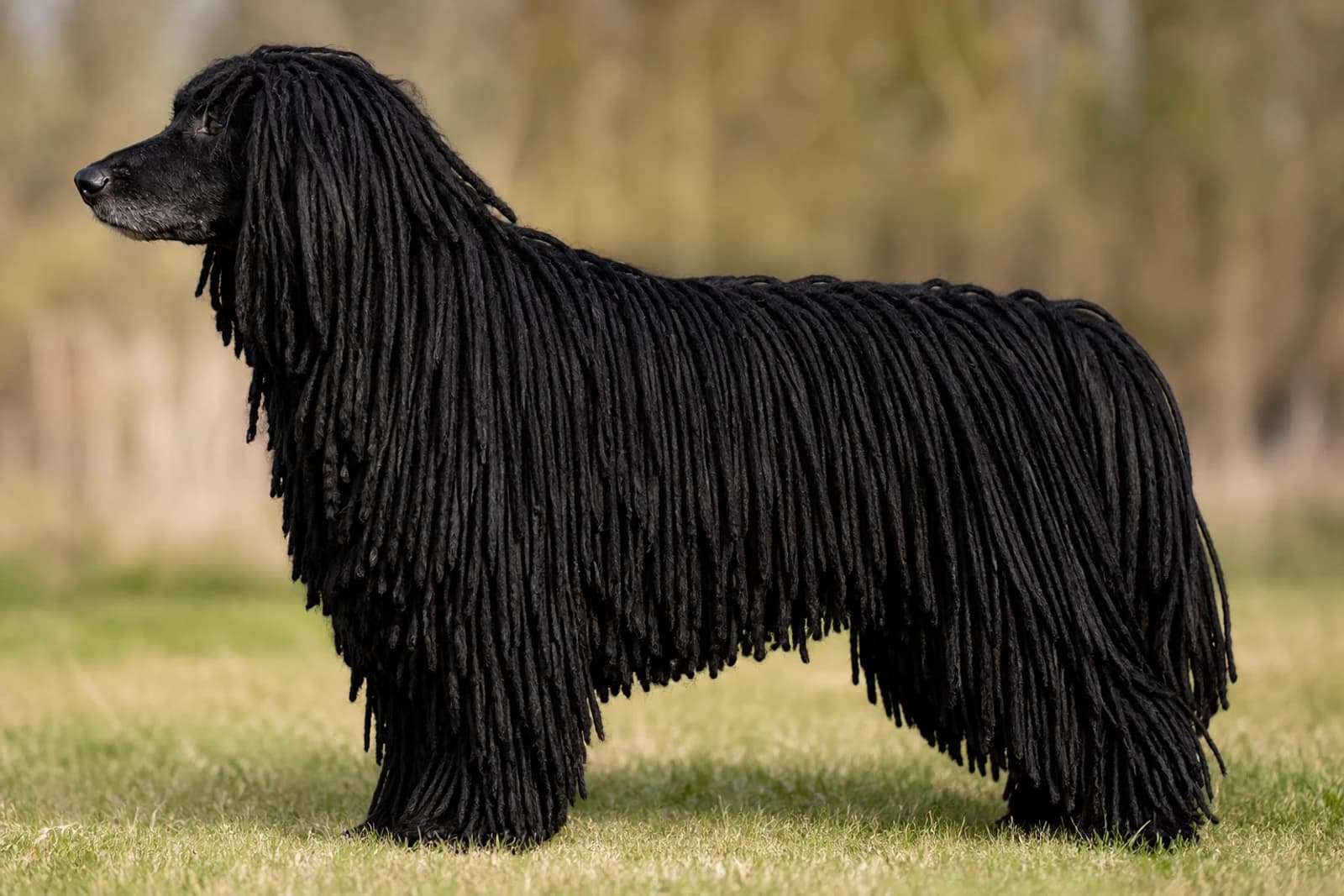
The Corded Poodle, a variant of the Standard Poodle, is an elegant and highly intelligent dog with a unique corded coat that forms dreadlock-like curls. Suited for active families or individuals who can provide daily exercise and mental stimulation, this breed thrives on human companionship. Ideal for allergy sufferers due to its hypoallergenic coat, the Corded Poodle is not for those who can't commit to rigorous grooming. With proper training and socialization, they make loyal, playful, and affectionate companions, excelling in various dog sports and activities.
At a glance
- Size
- Large
- Height
- 9–24 in
- Weight
- 46–71 lb
- Life span
- 10–13 years
- Coat colors
- White, Black, Apricot, Gray, Brown, Cream, Silver
- Coat type
- Corded, dense, and curly
- Group
- Gun
How much does a Corded Poodle cost?
Adopt / rescue
$75–$400
Usually includes spay/neuter, first shots, and a microchip.
Buy from a breeder
$700–$2,000
From a reputable, health-testing breeder.
Approximate USD. Prices vary widely by region, breeder, pedigree, age, and coat colour — adopting is the lower-cost and recommended route. Avoid suspiciously cheap “breeders”; they’re often puppy mills.
Estimate the full cost of a Corded Poodle →Corded Poodle photos
Views
Front, side, rear and top — the full silhouette.Poses
How the breed sits, lies, moves and plays.Puppy to senior
The breed across its whole life.Expressions
The breed’s range of moods.Close-up details
Eyes, ears, nose, paws, tail and coat.Coat colors
The breed’s recognized colors.Click any photo to enlarge. We show the Corded Poodle from every angle — three views, poses, life stages, expressions, close-ups, coat and colors.
Appearance & size
The Corded Poodle isn’t a separate breed — it’s a Poodle with a deliberately cultivated corded coat that hangs in tight, woolly ropes all over the body. While the traditional Poodle clip shows off tight curls, the corded coat is what happens when those curls are never brushed. Instead, the hair mats naturally into strands that a groomer separates by hand into even, dangling cords.
Size-wise, you’re looking at a Standard Poodle under all those ropes. Adult Corded Poodles stand 15 to 24 inches at the shoulder and tip the scales between 46 and 71 pounds, with males generally running larger. The body is squarely built: the length from breastbone to rump nearly equals the height at the withers. That square silhouette stays visible even when the coat is fully corded, though the ropes can shave a few inches off the visual leg length. The chest is deep, the ribs are well sprung, and the topline stays level from withers to croup — a balanced, athletic stance that hasn’t budged just because the dog is wearing a different coat.
From the front, the head is long and refined with a slight stop under a mass of cords that often form a natural topknot. The eyes are dark, oval, and set well apart, with an alert, intelligent expression. Ears hang flat and long, completely covered in cords that can brush the shoulders. The muzzle is straight, and the bite is a neat scissors. In a pet or working corded dog, the face is typically shaved clean from the nose to the back of the skull for hygiene (the most common base is a “lion clip”), leaving the cords to cascade from the crest of the neck. The front legs look straight and slender, with cords falling like fringe from the shoulders and elbows.
View the dog from the side and the square build really stands out. A deep brisket drops to the level of the elbows, the underline tucks up slightly, and the tail is set high, usually docked to half its natural length, and carried jauntily. In a fully corded dog, that tail becomes a thick, swinging rope. The hindquarters are muscular and well-angulated, which you can see when the dog moves — the gait is light and springy, a suspended trot that makes those cords sway in rhythm.
From the rear, the corded coat softens the muscular outline, but you’ll still see a strong, straight back and well-let-down hocks. The cords on the backside and tail tend to be longest and thickest, giving a dramatic finish.
Cord color follows standard Poodle colors — solid blacks, whites, blues, grays, silvers, browns, café-au-lait, apricots, creams, and reds. Multi-colored or parti coats exist but are less common in show lines. The cords themselves start as dense, woolly curls and, as they lengthen, felt into ropes that can reach the floor if left untrimmed. Most owners keep the cords at a manageable length — around 3 to 8 inches — by stripping ends or trimming them off the ground. The cords shed very little, like any Poodle, but they trap dander and debris, so the coat is a serious grooming commitment: you’ll need to dry the cords thoroughly after bathing to prevent mildew and carefully separate them weekly to avoid unchecked matting. Strip the coat away, and the Corded Poodle’s underlying frame is exactly the same elegant, sturdy athlete as a standard-clipped Poodle — just wearing a much more labor-intensive wardrobe.
History & origin
Pulling a duck from icy water takes a special kind of dog, and the Corded Poodle was built for exactly that. The breed traces back to the boggy hunting grounds of 17th‑century Friesland and the coastal marshlands of what is now the northern Netherlands and Germany, where waterfowlers needed a rugged retriever that could shrug off freezing canals and thick reeds. Early dogs were likely a cross between sturdy local water dogs — the predecessors of today’s Wetterhoun and Stabyhoun — and curly‑coated retrieving types brought by Spanish traders. Breeders selected for a dense, naturally twisting coat that locked into long cords, not just curls. Those cords worked like a portable wet suit: they shed water quickly, insulated against the cold, and protected the dog’s skin from slush ice and sharp sedges.
By the 1700s, the corded type had become a fixture on sprawling estate shoots across the Low Countries and the Rhine Valley, earning the name Corded Poodle (from pudel, German for “to splash,” and the obvious coat trait). Their job was to mark downed birds, break ice to retrieve, and work at great distances with minimal hand signals — a thinking gun dog before the term existed. Weighing 46 to 71 pounds and standing anywhere from knee‑high to just below the hip (the broad 9‑to‑24‑inch height range reflects a long history of purpose‑driven size variation), they were versatile enough to hunt geese on open water one day and push through cattails for snipe the next.
The 19th century nearly did them in. As driven shoots replaced rough shooting and sleeker retrievers like the Labrador gained favor, the shaggy corded dogs fell out of fashion. Most kennel clubs lumped them in with standard Poodles, and by World War I only a handful of breeding families in East Frisia and Overijssel kept the true working lines alive. The cords weren’t just a cosmetic choice; they were a low‑maintenance functional coat in the field — but the elaborate grooming required to keep cords sanitary in a kennel environment made them a hard sell for the Victorian show ring.
Modern Corded Poodles descend directly from those isolated pockets. Dedicated fanciers in Germany and the Netherlands rebuilt the gene pool in the 1970s and ’80s, insisting on hunting drive and that distinctive cabled coat alongside sound hips and level temperament. The breed hasn’t racked up widespread AKC recognition — it’s still classed as a rare gun dog — but you’ll see them working the flooded timber in the American Midwest, competing in retriever hunt tests, and occasionally turning heads in the ring with a coat that can take three years to reach full length. What never changed: a tough, water‑loving dog that would rather break a skim of ice than let a bird drift away.
Temperament & personality
A Corded Poodle is, under those dramatic ropes, a standard Poodle through and through — brainy, sensitive, and hardwired to stay right by your side. Expect a dog that reads your mood before you speak and throws itself into every game, walk, or training session with an almost unsettling focus. The package here weighs in at 46–71 pounds and stands 9–24 inches at the shoulder, so you get a sturdy, athletic partner with stamina to spare.
The mind behind the cords
- Frighteningly smart and people-oriented. This isn’t a dog you leave alone in the yard for hours. Without at least an hour of real exercise — running, swimming, a hard game of fetch — plus a puzzle toy or a training drill, boredom sets in fast.
- Strong-willed, not stubborn. Force flops. Respectful, consistent engagement gets the gears turning. They’ll happily work for you once they see the point, but they remember unfairness, so keep corrections fair and brief.
- Sensitivity carries a price. Neglect or isolation often tips into anxiety-driven behaviors: barking marathons, destructive chewing, or indoor urine marking. The latter isn’t spite — it’s a scent memory. Dogs return to the same spot because the odor signals “my territory.” A thorough cleanup with vinegar neutralizes the cue and breaks the cycle.
Attachment and household rhythm
A Corded Poodle wants to be in your pocket. They’ll follow you room to room, lean against your leg, and supervise your chores. That velcro loyalty makes them fantastic companions, but it also means they can struggle when the house is empty. Puppies chew to explore and soothe sore gums; adults chew hard objects to keep jaws strong and teeth clean. If your dog chooses the chair leg over a bone, a homemade citrus spray (boiled citrus peels) or a vinegar spritz can redirect the habit without a fight.
Inside the home, they can be alert watchdogs — a knock at the door nets a sharp, declarative bark. Early socialization tones down any over-guarding tendency, but you’ll never lose the built-in doorbell. With kids and other pets, they’re typically gentle, provided children respect boundaries. The big non-negotiable: never interrupt the dog while it’s eating. Walk up and bother a dog mid-meal, and you plant the seeds for food guarding. Give them a peaceful corner to eat, and teach kids to do the same.
Reading your dog’s body language
Corded Poodles broadcast their emotional state clearly if you know what to watch for.
- Forward-leaning posture — confident, ready to move.
- Backward lean, tucked tail — nervous, wanting space.
- Stiff body + hard stare — a serious warning; don’t crowd a dog showing this.
- Loose, wiggly frame and soft eyes — a content, approachable dog.
- Yawning, lip licking, turning the head away — calming signals; the dog is trying to diffuse tension.
Using these signals helps you head off trouble before it escalates.
Quirks worth knowing
- A Poodle of any coat variety may roll in putrid stuff — dead fish, goose droppings, you name it. Researchers compare it to our perfume habit, while others link it to scavenger ancestry. Either way, it’s a nose-forward hobby you’ll probably have to manage.
- House training goes faster when you reward the moment. Hand your dog a treat the second they finish eliminating outside — that positive link sticks far better than punishing an accident. Remember that a dog’s “house” map is shaped by family scents, not walls; introduce them to every room early or risk accidents in the spare bedroom.
- Patience and clarity win the day with this breed. Pair a steady routine with plenty of mental puzzles, and you’ll have a corded shadow who is funny, fiercely loyal, and impossible to outsmart.
Good with kids, dogs & other pets
A Corded Poodle who grows up with gentle, predictable handling is a steady, affectionate addition to a household with kids. These dogs are naturally patient and non-aggressive, but their size — 46 to 71 pounds of lanky, enthusiastic body — means they can accidentally topple a toddler or preschooler simply by leaning in for a cuddle. Eye-level toddlers often startle dogs, so close supervision is essential with very young children, not because the Poodle means harm, but because a paw on a small chest or a swift zoomie can hurt.
Teach children to respect the dog’s space: no ear-pulling, no climbing on the dog, no interrupting them while they eat or sleep. The breed is sensitive and reads tone of voice sharply; harsh corrections or yelling can erode trust quickly. When treated kindly, most Corded Poodles settle into a role as a watchful, playful shadow who happily joins backyard tag games and then crashes on the couch for a movie marathon.
With other dogs, the picture is generally bright — provided the groundwork is laid early. A puppy who meets a wide range of friendly, vaccinated dogs between 3 and 16 weeks of age typically grows into an adult who greets canine strangers with relaxed curiosity rather than fear or over-the-top excitement.
- Same-household dogs: Corded Poodles often enjoy the company of another dog, especially one that matches their play style. Introductions should be slow, on neutral ground, and never forced.
- Unfamiliar dogs: An adult who missed early socialization may become timid or reactive. Pushing that dog into off-leash meetings only raises stress, so let them set the pace. Some individuals are perfectly content with just their human family and don’t need a wide canine social circle.
Cats and small pets require more caution. The Poodle’s retrieving background comes with a moderate prey drive, and a squirrel-like dart of a fleeing cat can flip a chase switch. Plenty of Corded Poodles live peacefully with indoor cats, but that harmony is built on gradual, positive introductions and a climate of calm. Keep rabbits, guinea pigs, and hamsters in secure enclosures the dog cannot nose open; the sheer size difference means a friendly paw can injure a small animal by mistake.
The biggest factor behind the scenes isn’t a single socialization checklist — it’s the dog’s near-constant need for human connection. A Corded Poodle left alone for long hours can unravel into barking, chewing, or irritable behavior that tests everyone’s patience, including the kids and other pets. When the family includes the dog in daily life, provides mental exercise, and never leaves them isolated outdoors, the Poodle’s tolerant, goofy side shines. Put the real effort into those first six months, and you’ll stack the odds heavily in your favor for a calm, kid-safe, multi-pet household.
Trainability & intelligence
Intelligence shows up fast: a Corded Poodle often picks up a new cue in a handful of repetitions. You won’t need to drill. Brief sessions — five minutes of focus, then a break — hold their attention far better than long, repetitive ones. If you ask for the same sit-stay too many times, they get bored and start improvising, which may mean offering a spin instead, or quietly testing the kitchen counter.
Because they read your voice and posture with an almost spooky accuracy, harsh corrections backfire. A sharp tone can make them hand-shy or cautious about trying. Reward-based training — a well-timed “yes!” and a small treat, a quick game of tug, or a tossed ball — builds a dog that works with you, not for you. This is how you get a recall that holds when a squirrel dashes across the street, not one that fizzles after two reps.
Early socialization matters more than most people expect. Between 8 and 16 weeks, expose your puppy gradually to friendly strangers, traffic sounds, different floor surfaces, and calm adult dogs. A Corded Poodle that misses this window often grows wary or reactive — not mean, just highly observant and sensitive to new things. Pair every introduction with a tiny high-value reward, and you’ll raise a dog that can settle under a café table or greet a toddler without fuss.
The real training hurdle isn’t stubbornness; it’s keeping that quick brain busy. Weave obedience into scent games, trick training, or a morning nose-work session. Teach “come” and turn it into hide-and-seek around the house. A Corded Poodle that’s under-challenged will invent its own job — like opening cupboards or stealing the remote — and it will learn that skill faster than you can childproof the kitchen.
Exercise & energy needs
Your Corded Poodle stands 9 to 24 inches tall and packs 46 to 71 pounds of athletic muscle — this is a large, active gun dog that won’t be satisfied with a couple of quick leash strolls. Plan for a solid 60 minutes of daily exercise, split into at least two sessions, with one of those sessions involving real running, swimming, or sustained off-leash movement. A single walk doesn’t touch their endurance; they need to stretch their stride and work their lungs.
Intensity matters just as much as the clock. A brisk 30-minute morning jog, followed by an afternoon of fetch, hiking, or a long swim, keeps the Poodle’s body and brain in balance. Corded coats are dense, so avoid midday heat — exercise early or late, and carry water. Don’t let the elegant cords fool you; these dogs are built to retrieve in cold water and rough cover, and they’ll go until they drop if you let them.
Physical effort alone isn’t enough. The Corded Poodle’s working brain demands daily mental stimulation — think scent games, puzzle toys, hide-and-seek, or retriever drills with dummies. Without it, boredom quickly turns into nuisance barking, chewing, or anxious pacing. They excel at agility, rally, dock diving, and advanced obedience, and structured classes burn mental and physical energy at once.
- Two sessions a day — 30 minutes each, minimum. One should be high-energy; the other can be a brisk walk with training mixed in.
- Swimming is a low-impact star activity that spares joints while tiring out the whole dog. Most Cords take to water naturally.
- Scent work or food puzzles after exercise help them settle. A 15-minute nose game can take the edge off as well as another walk.
- Skip the high-impact jumping on hard surfaces, especially while young — large Poodles can be prone to hip and elbow issues. Build jumping skills gradually and on appropriate footing.
If you cut corners on exercise, you’ll get a restless, pushy shadow who steals shoes and outsmarts every obstacle you set up. Hit that hour, make them think, and you’ll have a content, cooperative companion.
Grooming & coat care
Forget the slicker brush. Once a Poodle’s coat is intentionally corded, you trade brushing for the daily work of separating those cords by hand. A Corded Poodle wears a dense, single-layer coat (no undercoat) that naturally twists into ropes if you stop combing it out. Your job is to guide that process so the cords form cleanly instead of becoming one solid mat.
How cords form — and what you do each day
Starting when the dog is a puppy or after a close clip, you gently twist small sections of damp hair into neat spirals. As the coat grows, you part the cords with your fingers every day, pulling them apart at the skin so they don’t web together. Skip this step for even a couple of days and you will have painful mats that need cutting out. Most owners spend 15–30 minutes a day working through the coat, checking right down to the skin. A slicker brush or pin brush — great for a traditional Poodle clip — is useless here; your hands are the only tool that won't fuzz up the cord texture.
Bathing and drying: plan for a marathon
Bathing a Corded Poodle is an event. The cords soak up water like a sponge and get shockingly heavy. Properly rinsing out shampoo takes forever, and incomplete rinsing leads to skin irritation or mildew deep inside the cords. The real challenge is drying. Even with a high-velocity dog dryer, a full corded coat can take 2–3 hours to dry completely. Never let him air-dry; damp cords breed bacteria and musty odor. Many owners schedule baths for a warm, dry day and plan nothing else. How often? Every 4–6 weeks is typical, more if he’s gotten into something foul. Dry shampoo for dogs can stretch the interval between baths.
Trimming cords and keeping the dog functional
Floor-length cords are show-ring tradition, but for a family pet, that’s a recipe for a dirty, tangled mess. You can trim the cords to a manageable length — mid-body or shorter — with scissors. Many people keep the cords on the body and then use a clipper to shave the face, feet, and sanitary areas short for hygiene. Regular cord trims also lighten the drying load.
Nails, ears, teeth: the non-negotiable basics
Ears need extra attention because moisture gets trapped easily. After every bath, wipe the inner ear flaps dry and check for redness or a yeasty smell. A weekly ear cleaner made for dogs helps. Nails get long fast on a largely housebound dog, so trim or grind them every 2–3 weeks. Brush teeth daily if you can; dental disease is a real risk in a breed with a 10–13 year lifespan.
Seasonal coat care
There’s no seasonal shed to vacuum up — you’ll just find the occasional dead hair caught in the cords. The downside: wet autumn walks and spring mud turn into a nightmare when cords drag on the ground. A raincoat that covers the cords or a shorter clip during messy seasons saves hours of rinsing and drying. In hot weather, the cords insulate, but they can also hold heat; keep outdoor exercise to cooler parts of the day and always have water available.
Shedding & allergies
The Corded Poodle leaves almost no hair on your couch — but that doesn’t mean she’s zero-maintenance. Her single-layer coat is made of hair, not fur, and it grows continuously rather than falling out. Instead of drifting across the living room, shed strands stay trapped inside the cords themselves. You’ll find very little hair on your clothes or floors; what you will find is a dog who needs you to carefully separate and maintain those cords so dead hair doesn’t mat into painful, damp tangles.
There is no seasonal blowout, because there’s no undercoat to dump. The trade-off is that every loose hair stays put, and the cords can hold onto dander, dust, and pollen. This is what makes the “hypoallergenic” label tricky. While many people with mild allergies do well with a Poodle, no dog is completely allergen-free. The proteins that trigger reactions are still present in her skin flakes, saliva, and urine. With a corded coat, you also have to be extra vigilant about bathing and thorough drying — trapped moisture can lead to skin irritation or mildew, which isn’t great for a human with sensitivities.
Drool isn’t part of the package. Poodles tend to keep their lips tight, so you won’t be wiping slobber off your walls.
If you’re banking on a truly non-shedding dog for allergy reasons, spend some time around adult Corded Poodles first. A responsible breeder will be honest about coat upkeep and can tell you whether their particular lines produce less dander. And plan on a steady routine of cord management, because when that trapped hair finally comes out, it comes out in your hands during grooming — not on its own.
Diet & nutrition
Corded Poodles can be champion eaters — many will polish off whatever you put in front of them and then look for more. That food drive, combined with a large frame (46–71 lb), makes portion control the single most important part of your everyday feeding routine. Carrying extra weight puts real stress on hips and joints, and large Poodles are already prone to issues like hip dysplasia. You should be able to feel your dog’s ribs with light pressure even through the cords; if you can’t, cut back and bump up exercise.
Puppies eat four small meals a day until four months, then three meals until six months, then settle into a twice-a-day schedule. A moderately active adult Corded Poodle around 55 pounds typically needs somewhere between 1,600 and 1,800 calories split across two feedings, but you’ll adjust based on body condition and daily activity. Seniors often do better with two or three smaller meals, and you’ll lower portions as they slow down — don’t just keep filling the bowl out of habit.
Deep-chested breeds like this one also have a higher bloat risk. Keep meals calm, avoid one massive dinner, and hold off on hard running for an hour after eating.
Whether you feed a high-quality commercial kibble or prepare food at home, the starting point is animal protein. A practical home-cooked split is roughly 60% meat, fish, and eggs; 20–30% fruits and vegetables; and a bit of grains or plain yogurt. Because dogs lack salivary digestive enzymes and can’t grind food side-to-side like we do, puréeing or blending veggies and meat helps them pull out nutrients. If your Poodle inhales food, a slow-feeder puzzle bowl adds mental work and protects against bloat.
Raw, soft bones like a chicken wing can come in around twelve weeks — always under your watch. When you have extra cooked grains or steamed vegetables, serve them in your dog’s own dish, never directly from the table. Begging is hard to break once it starts, and a few extra rich scraps can even trigger pancreatitis in a susceptible dog.
Health & lifespan
Most Corded Poodles live 10 to 13 years, which is right in line with what you’d expect from a large, deep-chested breed. The coat may look dramatic, but the underlying health profile is the same as a well-bred Standard Poodle — generally solid, with a handful of inherited conditions worth knowing about before you bring one home.
Responsible breeders screen for hip dysplasia, progressive retinal atrophy (PRA), and von Willebrand’s disease (a bleeding disorder). They’ll also test for sebaceous adenitis, an inflammatory skin condition that pops up in Poodles more than most breeds. A corded coat actually makes skin checks more critical because mats or trapped moisture can mask early redness, flaking, or odor. If you maintain the cords correctly — thoroughly drying them to the skin after baths — you sidestep a lot of avoidable infections.
Another one to watch is gastric dilatation-volvulus (bloat). Deep chests like the Corded Poodle’s are prone to it, and it’s a true emergency. Feeding two or three smaller meals a day, not one huge one, and waiting a bit before and after heavy exercise lowers the risk. Thyroid issues (usually hypothyroidism) and epilepsy also appear in some lines, so annual bloodwork and watching for subtle shifts in energy or appetite matter.
Because this is a large, food-motivated dog, weight management is a big piece of longevity. A lean Poodle puts less stress on joints and avoids compounding hip troubles. Plan on 60–90 minutes of daily exercise — not just a stroll around the block — and measure food, especially when the cords hide the ribcage from a quick glance-over.
- Heartworm prevention: monthly medication during mosquito season and for a month after it ends; no skips.
- Rabies vaccination: legally required, no room for negotiation.
- Dental care: Poodles are not off the hook. Annual cleanings and daily brushing keep teeth and gums in shape.
- Vet visits: twice-a-year exams catch early signs of eye changes, heart murmurs, or joint stiffness. Senior dogs over 8 may need more frequent checkups.
Early socialization also cuts stress-related cortisol spikes that can suppress immunity. A Poodle that learns to handle grooming, handling, and new environments as a puppy is easier to examine, cord or no cord.
Living environment
You can make apartment living work, but the real test is whether you can give this dog two solid hours of movement and brain work every single day — no skimping. A Corded Poodle is large (46–71 lb) and athletic, with a Standard Poodle’s drive to move and think. If your daily routine can’t absorb that commitment, a house with a secure, tall-fenced yard buys you breathing room, but don’t mistake a yard for a solution. This dog will never self-entertain by trotting around the lawn and calling it good. He needs you out there with him.
Yard needs
A fenced yard is a huge day-to-day advantage for off-leash sprints, sniffing, and quick potty breaks — but it is not a substitute for purposeful walks or runs. Plan on two separate hour-long exercise sessions, not just a leisurely stroll. Mix in scent games, retrieval, or a flirt pole to knock the mental rust off. Without that combo, frustration builds fast and comes out as digging or fence-running.
Climate tolerance
That dramatic corded coat is thick, dense, and slow to dry. In hot, humid weather it traps heat and puts the dog at real risk of overheating. Keep summer outings to early morning or late evening, watch for heavy panting, and never leave him in a warm car. Cold-weather tolerance is better, but wet cold is a problem: cords hold moisture against the skin, leading to chills and skin funk. Towel dry thoroughly after rain or snow, and check between cords for ice balls in winter.
Noise and barking
Corded Poodles are sharp watchdogs — they notice everything and will sound off when a delivery truck arrives or a stranger walks by. Without a strong daily outlet, that vigilance turns into nuisance barking, often directed at nothing at all. Early “quiet” training and a heavy dose of puzzle toys, frozen kongs, or hide-and-seek games keep their busy brain from filling the silence with noise.
Time alone
This is not an independent breed. Corded Poodles bond like Velcro and can slide into full-blown separation anxiety if left alone day after day. A dog who panics when you leave may destroy door frames, bark for hours, or soil the house. If your schedule has you gone nine or ten hours straight, arrange for a midday dog walker or consider a small-group daycare. Start with short departures, leave high-value food puzzles, and build calm independence gradually. A bored, lonely-minded Poodle makes life hard for everyone around him — so be honest about how much company you can realistically provide.
Who this breed suits
If you’re not genuinely excited to spend 30–60 minutes every day on a coat that can take half a day to dry, the Corded Poodle is not for you. This is a show-floor passion project disguised as a family dog. Behind those dramatic, mop-like cords is a Standard Poodle — whip-smart, athletic, and wired for human connection — but the coat transforms daily life into a serious, expensive grooming commitment.
This breed suits a very specific owner. Think dedicated show-home handlers, artists who view coat maintenance as a craft, or deeply experienced dog people who want a living sculpture. You’ll spend a chunk of each day separating, tidying, and checking cords for debris, matting, or moisture; after a swim or a bath, a full dry can take 6–8 hours with a high-velocity dryer. If you pay a pro, budget $200+ a month because few groomers know how to properly care for cords without cutting them off. The dog’s size (46–71 pounds and up to 24 inches tall) also means you need space and physical stamina for grooming — bending over a dining-table-sized dog for an hour.
Activity-wise, a Corded Poodle still has the engine of a working gundog. A couple of short walks won’t cut it. You need to be the person who happily gives a solid hour of off-lead running, swimming, or retrieval work — and then immediately deals with the wet, mud-caked coat afterward. Their intelligence is stratospheric, so dog sports (agility, rally, nose work) and advanced trick training are where they shine. An under-stimulated Poodle behind that coat will gut your couch just as fast as any smooth-coated one.
Good-fit homes include active singles or couples who treat dog care like a second part-time job, retriever enthusiasts who want a conversation-starting field partner, and older families with gentle, dog-savvy teenagers who can learn to handle the cords. The temperament underneath is generally affectionate and clownish, good with respectful kids, but young children are a poor match — a toddler grabbing a cord hurts the dog, and play-slobber or food in the hair means hours of cleanup.
Who should think twice. First-time owners. Busy families with packed sports schedules. Anyone who wants a low-maintenance “wash and wear” breed. Seniors who can’t lift a heavy dog onto a grooming table or stand for long periods. Apartment dwellers where a single shake sends a wet cord slapping lamps off tables. If you travel often and board the dog, understand that most kennels and pet sitters will not know how to maintain the coat; you’ll likely come home to a shaved dog.
Before getting a Corded Poodle, shadow someone who lives with one for a week — not a quick meet-and-greet, but days of wet-dog smell, drying-fan noise, and all. That reality check tells you more than any description can.
Cost of ownership
Corded coats are labor-intensive, and that’s where most of your money goes. Owners who aren’t ready to maintain the cords themselves pay $100–$200+ per professional grooming session every 4–6 weeks, which pushes the monthly grooming bill well past what you’d spend on a typical Standard Poodle. Learning to do it at home saves cash but demands hours of separating, bathing, and drying cords without creating mats — and buying the right shampoos, conditioners, and a high-velocity dryer still adds up.
A Corded Poodle puppy from a breeder who specializes in the look and tests for health clearances typically runs $2,500 to $5,000, sometimes more for show-quality lines. The rarity of truly well-maintained corded coats keeps prices high.
Monthly costs break down roughly like this for a 46–71 lb adult:
- Food: $70–$110 for high-quality kibble or raw; this is an active large gun dog with a decent appetite.
- Grooming: $80–$250 depending on whether you do cord care yourself or pay a groomer — and how often you bathe the dog (cords need to dry completely to avoid mildew).
- Routine vet + preventatives: $50–$80 averaged over the year, covering annual exams, vaccines, heartworm, and flea/tick control.
- Pet insurance: $40–$75 for a large breed, though premiums rise if you choose low-deductible, high-reimbursement plans.
Add a one-time outlay for gear (crate, leash, cord-safe combs) and possibly a few hundred dollars for early training classes. A realistic monthly range is $200–$500+. If you can’t commit to the grooming routine or its cost, a corded coat will quickly become a neglected, uncomfortable mess.
Choosing a Corded Poodle
Corded Poodles are not a separate breed — they’re Standard Poodles whose coats have been guided into felted cords instead of kept in a curly clip. That single fact shapes every choice you make. You aren’t just looking for any Poodle breeder; you need one who starts cord training from puppyhood, gently separating the hair into distinct, dangling cords well before the puppy ever leaves their hands. A clean, non-matted corded coat takes months to establish and the technique isn’t guesswork — it’s a skill that responsible breeders pass on to you.
Health clearances are the same breed-required basics you’d demand for any Standard Poodle. Expect written proof — not a verbal promise — of OFA hip and elbow evaluations, an annual ophthalmologist exam, and DNA or phenotypic tests for progressive retinal atrophy (PRA), von Willebrand’s disease, and sebaceous adenitis. Many breeders also screen thyroid and cardiac. If a breeder says their lines are “healthy” but can’t produce current certificates, walk away.
Red flags pop up fast. The biggest: a “Corded Poodle” puppy sold with a fluffy, un-corded coat. Without early cord formation started by the breeder, you’re buying a puppy you’ll have to cord from scratch — and not all adult Poodle coats take to cording evenly. Avoid anyone pushing “teacup” or “rare” corded sizes, shipping puppies sight unseen, or breeding dogs back-to-back. A breeder who won’t let you meet at least one corded parent (ideally the dam) and who dodges questions about daily cord care isn’t someone you want to trust with a 10- to 13-year commitment.
Rescuing a corded Poodle is rare but possible through breed-specific rescues. Be realistic, though: a neglected corded coat often smells, mats down to the skin, and requires a full shave-down. You might rescue a Poodle and cord the coat later with help from an experienced groomer, but that’s a slow, hands-on project.
Picking a puppy comes down to coat and temperament. The earliest cords should already be distinct — maybe an inch or two long — with clean part lines and no matted slabs. More telling is how the puppy handles touch. Gently separate a section of cords. The right puppy may squirm a little but settles and accepts it without panic. That tolerance is non-negotiable because you’ll be parting and maintaining cords weekly for the dog’s entire life.
Pros & cons
Pros
- Brain and biddability. Poodles are top-tier problem solvers — they pick up commands faster than most breeds and genuinely enjoy working with you. That makes training a breeze, whether you’re aiming for polished obedience or just a reliable house dog.
- Coat that doesn’t coat your couch. The tightly corded coat barely sheds and traps dander, so you won’t find tumbleweeds of hair on the floor. Many allergy sufferers do well with them.
- Striking, one-of-a-kind look. Those neat ropes aren’t just eye-catching; once cords are mature, you skip daily brushing and dematting sessions. A properly maintained corded coat stays cleanly separated without the constant combing a brushed Poodle demands.
- Athletic and up for anything. A Standard Corded Poodle (46–71 pounds, standing up to 24 inches at the shoulder) has the stamina for long hikes, runs, dock diving, or agility. They’ll match an active household step for step, not just a stroll around the block.
- Loyal, people-centered companion. Poodles bond deeply and often have a goofy, playful side that keeps the household laughing. They’re alert enough to bark when someone approaches, but aggression isn’t in their typical makeup.
Cons
- Grooming is a lifestyle, not a chore. Creating and keeping healthy cords takes serious commitment. You’ll be separating cords by hand to prevent them from felting into a solid mat, and bathing means thoroughly saturating and rinsing each rope, then drying completely — a damp corded coat can mildew on the dog. Plan on hours of drying, often with a high-velocity dryer.
- A bored Poodle is a destructive Poodle. If you skip the mental workout (puzzle toys, nose work, training sessions) and the solid hour of daily exercise, expect digging, chewing, and creative acts of spite.
- Health watch list. Bloat is a real risk in deep-chested Standards; responsible breeders also screen for hip dysplasia, eye disorders, Addison’s disease, and sebaceous adenitis. A financial cushion for vet bills matters here.
- Dirt magnet. Those cords can trap mud, twigs, and whatever they roll in. You’ll find yourself picking debris out of the coat after ordinary walks, and they can develop a distinct doggy odor if not kept clean and dry.
- Reserved with strangers. Without consistent early socialization, a Corded Poodle can become aloof or anxious around new people and dogs. This isn’t a plug-and-play social butterfly — you’ll need to put in the work from puppyhood.
Similar breeds & alternatives
The most obvious alternative is a Standard Poodle with a traditional clip — same dog, same 40–70 pound frame, same whip-smart brain and low-shed single coat, but without the massive daily commitment that corded upkeep demands. A short retriever or kennel cut gives you the Poodle’s athletic build and minimal shedding while reducing grooming to a weekly brush and a trim every 6–8 weeks. If the “hypoallergenic” curly coat is what pulls you toward a Corded Poodle, you have several other breeds that deliver the same clean-house perk with less fuss.
-
Portuguese Water Dog. 35–60 pounds, waterproof curls or waves, and a working-retriever spirit that rivals any Poodle. Their coat is clipped short in a lion or retriever trim — no cords. Porties tend to be a bit less sensitive and more rambunctious in water. Expect to provide a solid hour of vigorous swimming or running daily.
-
Barbet. A rare French water dog weighing 35–65 pounds with a long, dense curly coat that can naturally cord if left untouched, but most owners keep it in a manageable brush-out. Barbets are typically more even-keeled than a high-voltage Standard Poodle while still needing 45–60 minutes of real exercise. The softer coat mats ferociously if neglected.
-
Lagotto Romagnolo. At 24–35 pounds, this is a compact curly alternative. The dense, rust-colored curls don’t cord easily, but they do require regular clipping. Lagotti are busy, scent-driven dogs bred for truffle hunting — endless nose work, not just a stroll around the neighborhood. Less overtly sensitive than a Poodle, but equally bright.
-
Irish Water Spaniel. The clown of the spaniel group, 45–65 pounds, with tight liver curls and a whip-like rat tail. They shed very little and don’t need a complicated haircut, but their independent streak can make training more of a negotiation than a straightforward command session. Plan on at least an hour of purposeful exercise to keep this one from redecorating your house.
A corded coat is a deliberate, high-maintenance choice — the cords must be regularly separated, dried thoroughly after every swim, and kept clean to avoid mildew. If you’re drawn to the Poodle’s personality but your life can’t accommodate that daily cord care, a Portuguese Water Dog in a lion clip or a Lagotto in a short utility trim gets you a similar clever, active, low-shed partner with far fewer hours at the grooming table.
Fun facts
- The corded coat is made of dense curls that naturally form cords if left to grow and are maintained properly.
- Corded Poodles were originally bred as water retrievers, with the cords providing insulation and protection.
- Once corded, the coat requires regular separation to prevent matting and keep it clean.
- Poodles are ranked as one of the most intelligent dog breeds, excelling in obedience and agility.
Frequently asked questions
- How much grooming does a Corded Poodle require?
- Corded Poodles need extensive grooming to maintain their distinctive cords, which involves separating and tending to the cords daily to prevent matting. Regular bathing and drying are essential, as cords can trap dirt and mold if not properly cared for. Many owners opt for professional grooming every few weeks to keep the coat healthy.
- Are Corded Poodles hypoallergenic and do they shed?
- Corded Poodles are considered low-shedding and can be a good choice for allergy sufferers, as they produce less dander than many breeds. The corded coat traps loose hair, reducing the amount shed around the home, but regular grooming is still necessary to prevent matting. No dog is completely hypoallergenic, but Corded Poodles tend to be more tolerable for sensitive individuals.
- Is the Corded Poodle a good family dog?
- Corded Poodles are typically intelligent, affectionate, and thrive on being part of family activities, making them excellent companions for households with children. They are usually gentle and patient, but early socialization and training are important to ensure positive interactions. Supervision is recommended with very young kids due to the dog's size and energy.
- How much exercise does a Corded Poodle need?
- Corded Poodles are an active breed that requires daily physical and mental stimulation, such as brisk walks, play sessions, or interactive games. Without sufficient exercise, they may become bored and develop undesirable behaviors. Aim for at least 30 to 60 minutes of activity each day, along with puzzle toys to engage their sharp minds.
- What is the average lifespan of a Corded Poodle?
- The Corded Poodle typically has a lifespan of 10 to 13 years, though some may live longer with proper care. Regular veterinary check-ups, a balanced diet, and adequate exercise can help maximize their longevity. This breed can be prone to certain genetic conditions, so responsible breeding and health screenings are important.
Tools & calculators for Corded Poodle owners
Quick estimates tailored to Corded Poodles — pre-filled with this breed’s size where it matters.
Articles & stories about the Corded Poodle
Sources & standards
This profile follows recognized breed standards from the American Kennel Club (AKC) and the Fédération Cynologique Internationale (FCI), along with established veterinary and breed-club guidance. These describe general breed tendencies — every dog is an individual.
Owner stories
Have a Corded Poodle? Share your experience — grooming tips, personality quirks, anything goes.