

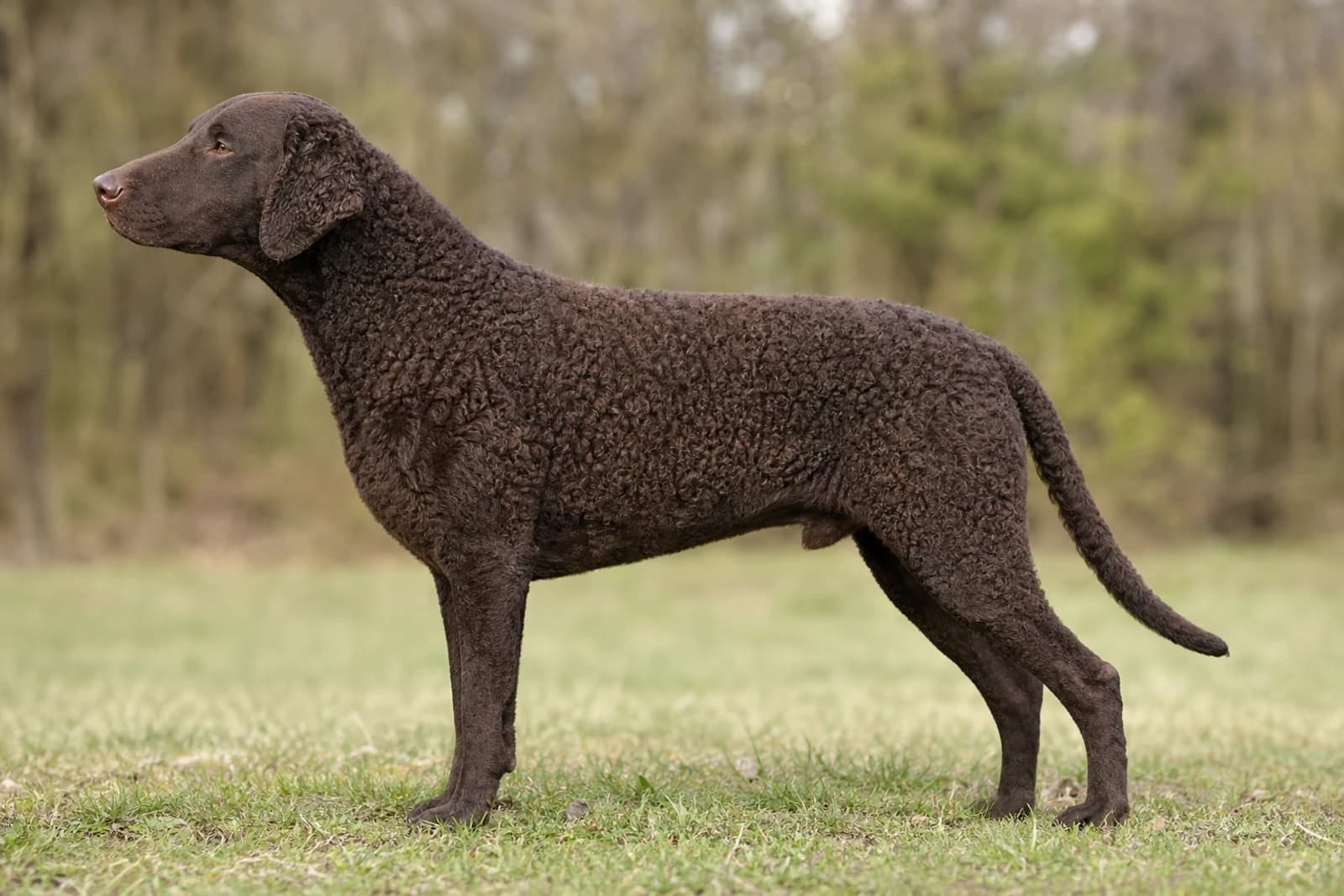
The Curly Coated Retriever is a robust, athletic gun dog built for an active lifestyle. This breed suits experienced owners who can provide vigorous daily exercise and mental stimulation, thriving in rural or suburban homes with space to roam. Loyal and affectionate with family, they are reserved with strangers and slightly independent, rewarding consistent, patient training. Their dense, water-resistant curls require moderate upkeep, and they excel in canine sports like agility and dock diving. Not ideal for first-time owners or apartment living, these intelligent, playful dogs form deep bonds with those who appreciate their spirited nature.
At a glance
- Size
- Giant
- Height
- 25–27 in
- Weight
- 60–71 lb
- Life span
- 12–13 years
- Coat colors
- Black, Liver
- Coat type
- Tight, crisp curls
- Group
- Gun
How much does a Curly Coated Retriever cost?
Adopt / rescue
$75–$400
Usually includes spay/neuter, first shots, and a microchip.
Buy from a breeder
$700–$2,000
From a reputable, health-testing breeder.
Approximate USD. Prices vary widely by region, breeder, pedigree, age, and coat colour — adopting is the lower-cost and recommended route. Avoid suspiciously cheap “breeders”; they’re often puppy mills.
Estimate the full cost of a Curly Coated Retriever →Curly Coated Retriever photos
Views
Front, side, rear and top — the full silhouette.Poses
How the breed sits, lies, moves and plays.Puppy to senior
The breed across its whole life.Expressions
The breed’s range of moods.Close-up details
Eyes, ears, nose, paws, tail and coat.Coat colors
The breed’s recognized colors.Click any photo to enlarge. We show the Curly Coated Retriever from every angle — three views, poses, life stages, expressions, close-ups, coat and colors.
Appearance & size
The tight, crisp coat is what you’ll notice first — and what you’ll never confuse with any other retriever. It covers the dog from the top of the head down to the tip of the tail in a mass of small, hard, close-lying curls. There’s no undercoat, which means shedding is minimal and the dog carries zero fluff. You can actually see the outline of the body through the curls, especially over the ribs and shoulders.
Stand this dog next to a Labrador or Golden, and the difference in build is immediate. The Curly Coated Retriever is a lean, up-on-leg athlete — more racehorse than draft horse. Males run 25 to 27 inches at the shoulder and weigh 60 to 70 pounds; females settle between 23 and 25 inches and 55 to 65 pounds. Those numbers put the breed squarely in the large category, but the weight is carried in long, clean muscle, not bulk. A well-conditioned Curly looks like it could run all day without a water break.
Coat color comes in two solid options: black and liver. Black is glossy and deep; liver is a rich, warm brown that ranges from a dark mahogany to a lighter red-brown. A tiny white patch on the chest is allowed but never sought after. The curls themselves aren’t the loose, open ringlets you see on a Poodle. They’re more like tight waves that feel crisp and springy to the touch — think astrakhan lamb. On the ears, the hair forms smaller, tighter curls. The face and front of the legs are smooth, with short, straight hair that sets off the curly jacket.
From the front, the head is long and wedge-shaped, with a distinct stop and a muzzle that tapers slightly but never looks snipey. The eyes are large, dark, and almond-shaped, giving an expression that’s intelligent and a little mischievous. Ears lie close to the head — small, set above the eye line, and covered in tiny curls. The whole front assembly sends the message: I’m fast, but I’m also paying attention.
Move to the side, and you see a deep chest that reaches to the elbows and a well-sprung ribcage, but the underline tucks up more than you’d expect on a retriever. The neck is moderately long and slightly arched, flowing into a level topline that stays flat even when the dog is moving. The tail follows the croup smoothly and is carried straight out or slightly up — never over the back. It’s fully covered in curls, right down to the tip.
From the rear, the hindquarters are powerful and well-angulated, with a straight, strong hock. The stance is balanced, not camped out or crouched, and you’ll notice the absence of feathering anywhere. No plume on the tail, no pants on the thighs. This is a retriever designed to slice through icy water and heavy cover without carrying a pound of extra hair. The curls stay so dense that water beads up and runs off, and the dog comes out of a pond almost dry at the skin.
History & origin
The Curly Coated Retriever belongs to the earliest chapter of retrieving-dog history — a straight-line descendant of the water dogs that English gamekeepers depended on in the late 1700s and early 1800s. Long before Labs and Goldens became household names, this tightly curled, no-nonsense worker was the retriever of choice on sprawling country estates, trusted to plunge into icy marshes and haul back downed waterfowl without hesitation.
The breed’s exact ancestry isn’t pinned to a single written record, but the blueprint is clear. The English Water Spaniel (now extinct) contributed a waterproof coat and duck-hunting instinct. The St. John’s Dog — the foundational Newfoundland derivative that seeded nearly all retrievers — added swimming power, a soft mouth, and a hard-wired work ethic. Some early breeders likely folded in Poodle blood to tighten and lock the curl, because nobody wanted a flat-coated dog when the job called for breaking through frost and brambles day after day. By the 1840s, what was being referred to as the “Curly-Coated Retriever” was already a recognizable, consistent type: a leggy, black or liver dog with a crisp mass of small, tight ringlets covering the body from skull to tail tip.
The Curly hit the public stage early. At England’s first organized dog show in Newcastle in 1860, the breed was exhibited alongside pointers and setters, and it quickly became a fixture in the sporting ring. For the rest of the 19th century, it reigned as the British shooter’s ultimate tool — tough enough to handle a heavy goose, independent enough to hunt out thick cover on its own, and buoyant enough to swim against a current for hours. Written accounts from the period praise the breed’s stamina and its almost uncanny ability to track a winged bird that other dogs had given up on.
Then the ground shifted. The rise of driven shooting in the late 19th and early 20th centuries favored a quieter, more easily controlled dog that could sit steady in a line for hours. The Labrador retriever, bred for precisely that kind of biddable teamwork, began to eclipse the curly-coated veteran. The Curly never disappeared — the Curly Coated Retriever Club was formed in England in 1896 and has guarded the breed ever since — but it became a connoisseur’s choice rather than a common sight.
That rarity persisted when the breed crossed the Atlantic. A few imports came to the United States in the early 20th century, and the American Kennel Club recognized the Curly in 1924, but numbers stayed small. Today, the breed remains a niche gem, intentionally kept out of the mass-production spotlight. Responsible breeders focus squarely on preserving the original working character: a keen nose, an athletic frame, and a coat that still sheds water and shrugs off heavy cover without demanding hours of grooming. The Curly Coated Retriever reached the modern era as it began — built for a job, loyal to its people, and a stubbornly practical piece of gundog history.
Temperament & personality
The Curly Coated Retriever is a quick study with an independent streak that keeps you on your toes. They’re not the push-button retrievers some people expect—you earn their cooperation through respectful, consistent engagement, not heavy-handed corrections. Do that, and you get a calm, confident partner who’s steady in the house but lights up the second a decoy or a tennis ball appears.
These dogs are genuinely affectionate with their own people, though they show it on their terms. Expect a lean against your leg or a quiet head on your knee rather than nonstop wiggle-and-lick greetings. With strangers, the typical Curly is reserved, almost aloof. He’ll stand back and study newcomers before deciding to engage—that forward-leaning, alert posture often puzzles owners until they realize it’s just information gathering, not aggression. A relaxed, soft-eyed dog who’s loose in his body is simply taking it all in; a stiff, hard stare with a frozen body is a different story and warrants redirection.
Because they were bred to work independently for hours, Curlies handle alone time better than many retrievers—provided they’ve had a solid hour of real exercise first. A neglected or under-exercised dog can tip into nuisance barking or more creative mischief. They’re also notorious for scent-driven hobbies. Don’t be shocked when your dignified retriever drops to roll on a dead fish or a pile of deer droppings. Retrievers carry the scavenger’s nose, and Curlies seem especially proud to wear the stink like perfume.
In a home with kids, they’re patient and gentle if raised alongside them and treated with respect. That means teaching children early: never disturb the dog while he’s eating, and back off if he’s chewing a bone. A dog’s center of gravity tells you a lot—a Curly who leans away or lip-licks wants space, and smart owners listen. They generally coexist well with other dogs, though same-sex dog aggression can flare in some lines, so early neutrality training pays off. Manage them carefully around cats and pocket pets; their retrieving instincts and prey drive don’t vanish just because you’re not hunting that day.
What you won’t get is a guard dog in the traditional sense. A Curly might bark a warning when someone’s at the door, but he’s more likely to sniff them for clues than stop them in their tracks. The temperament is reliably sound, but “calm,” “brave,” or “gentle” are tendencies, not lifetime guarantees—socialization and daily structure make the real difference.
Good with kids, dogs & other pets
With Children
Curly Coated Retrievers have a patient, non-aggressive core that makes them a natural for family life—if you put in the training early. A 65-pound dog still figuring out its legs can accidentally topple a toddler, so teaching a solid “sit” for greetings and keeping roughhousing supervised is key. They tend to dial up the silliness with active, respectful kids and love being part of backyard fetch sessions. Because they were bred to retrieve with a soft mouth, a young Curly may mouth hands during play; redirect that to a toy consistently from week one.
With Other Dogs
Most Curlies do well with other dogs when they’ve had steady, positive exposure before that 12–16 week window closes. Without it, they can turn standoffish or socially clumsy around unfamiliar dogs. If you adopt an older dog who missed that early mix, don’t push. A dog genuinely content with just its person doesn’t need a crowded dog park to be happy, and forced greetings often create more stress than friendship. For a puppy, a well-run class and play dates with calm, known dogs set the right tempo.
With Cats and Small Pets
That natural retrieving engine means a darting cat or a scurrying small animal can look like a job to do. Plenty of Curlies coexist peacefully with indoor cats—but you need to start with slow, leashed introductions and reward calm indifference. Always give the cat a clear escape route, and never leave them unsupervised during the first weeks. Small pets like rabbits or guinea pigs belong in enclosures a big, curious retriever can’t breach or knock over.
The Socialization Window Matters
The heavy lifting happens between 3 and 14 weeks. Expose a puppy gradually—different people, hats, kids on scooters, clattery surfaces, traffic hum—all while keeping things cheerful. Miss that window, and you risk winding up with a fearful, reactive adult. Curlies are a companionship-driven breed; leaving one alone in the yard for hours day after day often creates separation distress and a nervous, unhappy dog. Pick a breeder whose puppies are raised underfoot in a busy home, not isolated in a kennel. If you have a fearful adult on your hands, skip the forced social outings. Build confidence at home with short training sessions, food puzzles, and calm, predictable routines. That’s often exactly what they need to settle in.
Trainability & intelligence
You’re not dealing with a push-button retriever here. This is a thinking dog—sometimes overthinking. A Curly Coated Retriever picks up new commands in a flash, but then decides whether you’ve made it worth his while to repeat them. Treats, a scratch behind the ear, or a splash in the water—find his currency and he’ll work for you with real enthusiasm.
The downside? He bores easily. If training feels like drudgery, he’ll tune you out or start freelancing. You’ll get much further with three focused five-minute sessions a day than one grueling half-hour slog.
-
Motivation: This is a genuine retriever, so retrieve-driven games and water work are your best training allies. Use a ball, a bumper, or even a chance to swim as the ultimate paycheck. He’s far more likely to nail a “come” if it predicts a splash in the lake, not the end of fun.
-
Recall: It can be a sticking point. That independent streak, combined with a nose for interesting scents, means a solid recall takes months of consistent proofing—not days. Start inside, then add distance, distractions, and finally tempting wildlife. Never call him to you then punish him; you’ll teach him that coming back is a sucker’s game.
-
The right approach: Harsh corrections backfire spectacularly. This breed often shuts down or gets sidestep-creative if you yell or yank. Positive, reward-based methods build trust, and trust is the only path to a reliable response when his instincts are screaming “go chase that goose.” Be patient, be consistent, and be the more interesting option. That last part is the real work: you have to out-charm a bird dog mid-sprint.
-
Socialization: Early exposure is non-negotiable. Before 16 weeks, let him safely encounter skateboards, kids, umbrellas, and different surfaces. An unsocialized Curly can become aloof or reactive around strangers, and a 70-pound dog with a reserved temperament can be hard to manage. Ongoing, positive experiences well into adulthood keep his reactions from tipping into suspicion.
He is intelligent enough to manipulate a soft trainer and sensitive enough to check out under a harsh one. Clear, fair boundaries and a sense of humor will get him where you want him: a keen, capable partner who actually enjoys the conversation.
Exercise & energy needs
Plan on giving this athlete at least 90 minutes, often closer to two hours, of hard, daily exercise split into two sessions. A short walk around the neighborhood won’t cut it. Curlies were built to work all day in water and cover, and that drive is still right under the surface.
What “enough” looks like. A good morning session is a solid hour of off-leash running, steady swimming, or a mix of land and water retrieves. The afternoon or evening session can be 30–45 minutes of brisk walking, another round of fetch, or a training session that doubles as a brain workout. Aim for a total of 90–120 minutes of real movement each day, not just time spent outdoors.
Mix physical with mental. These dogs are clever and independent, so they need their heads worked just as much as their legs. Combine exercise with scent games, hidden retrieves, or obedience drills that make them solve problems. A 20-minute session of advanced commands or a frozen puzzle toy after a swim can tire them out faster than extra running. Without that mental outlet, a Curly will invent its own job—often one you won’t like.
Activities that fit the breed. – Field work and hunt tests – Dock diving and water retrieves – Long runs on soft trails with you (once growth plates close) – Canicross or skijoring in cool weather – Nose work and advanced trick training
Watch the joints. As a large, deep-chested breed, a Curly can be prone to hip dysplasia. Avoid repetitive jumping on hard surfaces and high-impact forced running (like pavement jogging) until the dog is fully mature, usually around 18–24 months. Use swimming to build fitness without pounding. Skip the midday heat, especially if humidity is high—that thick curly coat traps warmth.
Grooming & coat care
The hallmark of the Curly Coated Retriever is a crisp, tight mass of small curls that covers the body from the occiput to the tip of the tail. This is a single coat — no insulating underlayer — which means you won’t wrestle with seasonal blowouts or clouds of hair on the furniture. Shedding is minimal year-round, but the trade-off is a coat that demands a particular kind of care. Treat it like a wool sweater: the wrong approach can ruin the texture.
Brushing is not a daily ritual here, and a dry brush is your enemy. Dragging a slicker or pin brush through those dry curls breaks the pattern, creates frizz, and can lead to tangling rather than prevent it. Instead, reach for a wide-toothed comb or simply your fingers on a damp coat. Mist with plain water or work through the coat during a bath when it’s wet and pliable. Target areas that trap debris: behind the ears, the armpits, and the feathered backs of the legs. A quick once-over every week or two is plenty; some owners only comb out a Curly when they bathe him, which might be just three or four times a year.
Bathing is an occasional event. Curlies have naturally oily, water-resistant coats that repel dirt. Too much shampoo strips those oils and softens the curls. Use a mild, dog-specific product only when the dog is genuinely grimy or has rolled in something offensive. After rinsing, let him air-dry completely — a blow-dryer will straighten the ringlets into a weird, wavy mess. The air-dried coat will snap back into those hallmark crisp curls on its own.
Trimming is minimal. A Curly’s silhouette is clean and natural, so you’re not sculpting a topiary. Occasional neatening of the feathering on the legs, tail, and belly with thinning shears is fine if you like a tidier look. Never shave the coat down, as it may grow back in uneven patches and lose its curl structure for good.
The rest is standard big-dog maintenance. Drop ears mean weekly checks and gentle cleaning to prevent infections. Nails grow fast on a 60–71-pound animal; trim them every three to four weeks, or whenever you hear clicking on hard floors. A dental routine — brushing those teeth a few times a week — keeps that mouth healthy into a 12–13 year lifespan.
Seasonal coat changes are subtle. You might notice a slight uptick in loose hair in spring and fall, but nothing like the blizzard a double-coated retriever produces. Stick to the same damp-comb routine, and the coat will cycle through without issue. The golden rule: hands off the dry curls, and let water do the work.
Shedding & allergies
The tight, crisp curls that give the Curly its name do something handy: they trap shed hair against the body instead of releasing it into your living room. This is a single-coated breed—no fluffy undercoat—so you won’t see the tumbleweeds that many retrievers produce. Dead hair stays locked in the curls until you brush it out. That translates to very little visible shedding on furniture and floors, but there’s a real catch. Ignore grooming, and those curls mat rapidly, trapping moisture and potentially irritating the skin.
Year-round, you’ll find minimal hair loss. Spring and fall might bring a slight uptick as the coat cycles, but this is not a dramatic seasonal blowout. There’s simply no dense undercoat to explode. Most of the hair you’d expect to see on dark pants ends up in the brush.
Drool is moderate and manageable. You won’t deal with ropes of slobber; you’ll mostly see a drippy beard after a long drink or a bit of anticipation drool at mealtime. A towel by the water bowl solves it.
No dog is truly hypoallergenic—allergens live in dander, saliva, and urine. Because the Curly sheds so little, it spreads fewer allergen-loaded particles around the house, and some allergy sufferers genuinely tolerate the breed better. But you can’t know for sure without spending time with an adult dog. If allergies in your home are severe, arrange a hands-on visit before bringing a puppy home. The low-shed perk also comes with a firm commitment: that coat needs weekly brushing with a wide-toothed comb or a slicker made for curls. Removing dead hair before it mats keeps the skin healthy, which helps minimize dander. The trade-off is simple: you’re swapping daily vacuuming for a steady grooming habit. For the right owner, that’s a good deal.
Diet & nutrition
A lean Curly is a healthy Curly. This breed often has a strong food drive, so extra pounds can creep on fast if you free-feed or get generous with treats. Carrying too much weight stresses the joints of a large, athletic dog already built to cover ground hard, and can shorten a life that normally spans 12 to 13 years.
How much and how often
Measure portions by the dog’s actual weight, not the bag’s guess. Most adult Curlies between 60 and 71 pounds do well on 3 to 4 cups of quality dry food a day, split into two meals. If you feed a raw or home-prepared diet, aim for roughly 60% meat and fish, 20–30% fruits and vegetables, and the rest from eggs, grains, or yogurt. Adjust up or down based on ribs: you want to feel them easily but not see them jutting out. An hour of hard running daily means more fuel; a couch-potato week means less.
- Puppies need four evenly spaced meals a day until four months old, then three meals until six months, then the adult two-meal rhythm. Transition a pup gradually—start with lightly cooked and puréed meats, fish, fruit, and vegetables, or a high-end commercial puppy formula. Raw chicken wings can be introduced around twelve weeks under close supervision.
- Seniors often slow down. Cut back food gradually as exercise drops, and watch the scale. If an older dog has missing teeth or a tender mouth, purée the meal to help nutrient absorption. There’s no solid reason to slash protein in a healthy senior Curly.
- Speed eaters benefit from a puzzle bowl. It stretches out mealtime, adds a little mental work, and reduces the risk of bloat—something to take seriously in a deep-chested retriever.
What goes in the bowl
A Curly’s teeth and gut are built for a meat-rich diet. Vegetarian or vegan meals don’t match that physiology and can deprive him of nutrients he needs. Build meals around animal protein: raw or cooked meat, canned fish (packed in water, no salt), and eggs are all fair game. Add digestible carbohydrates like white rice for a sensitive stomach or pearl barley for steady fiber. Cook extra batches of grains or veggies on the weekend so you have a quick homemade base during the week. Use the unsalted water from cooking vegetables as a light broth if you’re short on stock.
Keep rich, fatty scraps—especially after holiday feasts—out of reach. A sudden high-fat load can trigger pancreatitis. And never feed him directly from the table; that one bite teaches begging faster than you can put down your fork. Leftovers go into his own bowl, away from the dinner action.
Health & lifespan
A well-cared-for Curly lives 12 to 13 years — a strong number for a large, athletic retriever. Keep her lean and genuinely tired, and you stack the deck for hitting the long end of that range.
The breed has a handful of inherited vulnerabilities that responsible breeders actively screen for. No clearances can guarantee a problem-free dog, but they cut the odds sharply. When you talk to a breeder, ask for current OFA or PennHIP results on both parents. The conditions that pop up most often:
- Hip dysplasia and elbow dysplasia — joint malformations that can lead to arthritis and lameness if unchecked.
- Eye diseases, especially progressive retinal atrophy (PRA) and cataracts. PRA causes gradual blindness; a DNA test exists for the most common form.
- Bloat (gastric dilatation-volvulus) — a life-threatening emergency in deep-chested dogs. Curlies are right in the danger zone.
- Epilepsy — seizure disorders appear in some lines, and there is no single screening test, so a good breeder will be upfront about any history.
Some lines also show a higher-than-average rate of certain cancers (hemangiosarcoma, osteosarcoma), though no reliable pre-breeding screen exists yet. That’s one reason annual vet exams matter — catching subtle changes early changes what you can do.
That dense, tightly curled coat was built for freezing water, but it can tip into trouble in hot weather. Overheating during summer workouts is a real risk. Keep exercise off asphalt when the sun is high, bring water, and watch for heavy panting that doesn’t resolve quickly.
Curlies are enthusiastic eaters with a habit of giving you the “I’m still hungry” look. Resist it. Extra weight stresses joints and increases bloat risk, so measure meals and use part of the daily ration for training treats rather than adding extras. A lean Curly is a healthier Curly.
Preventive meds are straightforward but non-negotiable. Keep up monthly heartworm prevention during mosquito season and for one month after the last frost, and stay current on rabies vaccination — it’s legally required and the disease is fatal once symptoms appear. Early, positive socialization also pays off here; a Curly who learns to handle vet exams and grooming calmly faces less stress-induced wear on her body over a lifetime.
Schedule a full physical at least once a year, and twice a year once she hits senior status (around 8 or 9). Watch for the small stuff: a dog who suddenly stops finishing meals, starts limping after a nap, or squints in bright light is sending you a signal. Act on it early.
Living environment
A Curly Coated Retriever is a large, athletic gun dog that does best in a home with space to stretch out, both indoors and out. An apartment is rarely a good fit—even if you’re dedicated to outdoor exercise, this dog’s size (25–27 inches, 60–71 pounds) and full-throttle energy level quickly overwhelm a small living space.
A securely fenced yard is almost essential. The Curly needs room to tear around, and off-leash sprinting is how they truly blow off steam. Without it, you’ll be fighting boredom and the destructive behaviors that follow. Plan on a minimum of 60 minutes of heart-pumping exercise twice a day—think running, swimming, and retrieving sessions that work both body and mind. Mental stimulation is just as critical: puzzle toys, scent games, and training challenges help tire out their keen brain. If you’re a jogger or cyclist, they can make a steady endurance partner once joints are mature, but avoid repetitive high-impact work on hard surfaces during growth to protect developing bones.
Their dense, curl-covered coat is built for cold water and damp conditions, so a Curly often thrives in cooler, even drizzly climates. Heat and humidity are another story—limit hard activity in high temperatures and always watch for signs of overheating. They shed moderately and require specific grooming to maintain the coat’s protective oils, but that isn’t a major climate concern.
As for noise, this isn’t a yappy breed. Expect a reserved, watchful nature with strangers and occasional alert barking, but constant barking is rare in a well-exercised dog.
One real challenge: Curly Coated Retrievers form deep bonds with their people and hate being left alone for long stretches. A home where someone is around most of the day works best. If you must be gone, gradual alone-time training from puppyhood, puzzle feeders, and a predictable routine can help prevent separation anxiety. A lonely, under-exercised Curly may become destructive or vocal, so be honest about how much company you can provide.
Who this breed suits
The Curly Coated Retriever belongs in the hands of a dedicated, active owner who genuinely enjoys training — not someone just checking the “daily walk” box. This dog was built to hunt all day in icy water, and that legacy shows up in a 60–71-pound athlete with a clever, sometimes maddeningly independent streak. If your week already includes trail running, long swims, or advanced retriever work, you’ll find a tireless partner here. They thrive in households where the human is home more often than not, or where schedules allow for midday breaks; boredom quickly translates to destructive problem-solving.
A natural fit
- Active singles and couples who want a dog to share their outdoor obsession. A 25–27-inch, lean-muscled Curly can keep up on a 10-mile trail run and still have gas left to fetch bumpers at the lake. Plan on at least 60–90 minutes of off-leash, high-output exercise each day, not a few laps around the block.
- Experienced sport-dog homes. These dogs shine in field work, dock diving, and serious obedience where their intelligence and drive are channeled. They respond to calm, consistent handling — not heavy-handed corrections — and respect someone who makes training a two-way game, not a lecture.
- Families with older, dog-savvy kids. A Curly can be a loyal family retriever if boundaries are taught early. But a full-speed, 70-pound retrieving machine that forgets its own size can topple a toddler, so sturdy kids who know not to grab at the dog or interrupt its rest are much safer. Adult supervision is non-negotiable.
Think twice — or more
- First-time dog owners. A Curly’s sharp problem-solving skills and resistance to repetition can leave a novice feeling outmaneuvered. This is not a golden retriever; they often deliberate before complying and will exploit gaps in consistency. You need to out-think them kindly, day after day.
- Couch potatoes and busy families with no yard. Apartments aren’t automatically a dealbreaker, but only if you commit to multiple daily sessions of vigorous outdoor work. A bored Curly left alone for eight hours will redecorate with your sofa cushions and dig to China. A securely fenced yard for sprinting and self-directed romping is a real sanity-saver.
- Homes looking for a velcro dog. Many Curlies are affectionate on their own terms but carry a notable independent streak. They’re not the breed who will smother you in kisses; they might lean in for a brief rub, then retreat to the coolest corner of the kitchen floor. If you want a dog that constantly seeks physical contact, this could feel surprisingly aloof.
- Seniors or less-mobile owners, unless you’re an exceptionally fit retiree with a history in field breeds. The sheer strength and stamina, especially during the exuberant adolescent years (which last well past age two), can be overpowering. A sudden lunge after a squirrel will test even a sturdy handler.
If the idea of managing a high-octane, thinking retriever sounds thrilling rather than exhausting, a well-bred Curly from health-screened lines (hips, heart, eyes) brings 12–13 years of sharp, tireless companionship. If your vision of dog ownership is a quiet lap warmer, look elsewhere — this breed needs to move and think hard to stay sane.
Cost of ownership
A Curly Coated Retriever puppy from a breeder who health-tests and proves their dogs typically runs $1,500 to $3,000. Because litters are small and the breed is uncommon, you may wait a year or more for the right pup. That price should include OFA hip, elbow, and eye clearances on both parents, which is non-negotiable for a working retriever.
Once the dog is home, monthly costs stack up quickly:
- Food: $60–$100. A 60–71 lb, high-energy dog eats 3–4 cups of quality kibble a day, and raw or fresh diets push that higher.
- Grooming: $0–$30 on average. The tight curls are low maintenance if cared for correctly—never brush dry, bathe infrequently, and use a blunt-toothed comb only when wet. Most owners handle it themselves, so professional grooms are rare.
- Routine vet + prevention: $50–$75. Vaccines, heartworm, flea/tick meds, and annual wellness labs for a giant breed.
- Insurance: $40–$70. A solid accident-and-illness policy makes sense for a deep-chested breed that can bloat and a large breed that can develop hip or elbow dysplasia.
Without extraordinary vet visits, expect $150–$300 per month. Skip insurance? Then bank at least that much in a separate emergency fund. A single bloat surgery with gastropexy can easily exceed $5,000, and Curlies don’t tend to give you a warning.
Choosing a Curly Coated Retriever
Your best chance at a healthy, temperamentally sound Curly Coated Retriever starts with a breeder who treats every litter like a conservation project — because, frankly, the gene pool is small. These are rare dogs, and responsible breeders don’t churn out puppies. Expect a waitlist, a thorough interview, and an agreement to return the dog to them if life ever falls apart.
Breeder or rescue: know what you’re signing up for. Curlies in rescue are uncommon and often end up there because someone underestimated their brain and drive. If a rescue appeals to you, work with the national breed club; they’ll know the dogs in foster and can tell you honestly if the dog resource-guards the couch or needs a crate for the first six months. With a puppy, you get a blank slate to shape, but also a 25–27-inch, 60–71-pound dog who hits adolescence at warp speed. Either route, you need a home that doesn’t mistake independence for stubbornness and has the water, open space, or field time this dog was built for.
Health clearances you must ask for — and verify yourself. Don’t take a breeder’s word for “vet checked.” You want published results in the OFA database (or equivalent) on both parents. The bare minimum:
- Hips: OFA Good or Excellent, or a PennHIP score with no laxity.
- Elbows: OFA clear, no grade 1 or up.
- Eyes: a passing CAER exam from a boarded ophthalmologist within the last year. Retinal folds and cataracts can show up early.
- Cardiac: an echocardiogram clearing the dog of SAS and other murmurs.
- DNA: Exercise-Induced Collapse (EIC) status — two clear parents, or one clear and one carrier. Also demand prcd-PRA and cord-1 PRA results be public and negative/clear. Responsible Curly breeders rarely breed carriers to carriers, and they’ll walk you through exactly why.
Red flags that should make you walk away. A breeder who won’t let you meet the dam on-site and see where the puppies are raised. A breeder who has puppies on the ground every season, always has a leftover available, or pressures you with “act now” guilt. Selling pups before 8 weeks. A refusal to discuss what’s gone wrong in their lines — every program has dealt with something, and the honest ones tell you. Also run from anyone breeding for “rare” silver or red coats, or marketing them as hypoallergenic guard dogs. Curlies are retrieving gundogs with tight curls, period.
Picking the right puppy. At 7 or 8 weeks, a solid Curly pup isn’t the one hiding under the whelping box, and it’s probably not the one body-slamming its littermates nonstop. Look for the puppy who notices you, investigates, and then settles into chewing a toy or watching the action. A little reserve with strangers is normal; cowering or snapping isn’t. Ask the breeder to show you short retrieves with a tennis ball — a pup that chases, picks it up, and brings it back at least a few steps tells you the built-in wiring is there. Let the breeder match you based on energy level: a high-octane field prospect won’t make a low-key family dog, and vice versa. You want a dog that will sprint through a marsh and crash on your kitchen floor when the day is done — and a breeder who stays on the phone with you when the first ear infection or training plateau hits.
Pros & cons
Pros
- A loyal, fun-loving family companion. Curlies are affectionate with their own people, gentle with children they’ve been raised with, and have a playful, goofy side that keeps the household laughing.
- Minimal shedding and a self-cleaning coat. Those tight, water-resistant curls barely drop hair, and mud and burrs don’t cling the way they do to flat coats. A weekly rinse and air-dry keeps them fresh.
- Sharp, independent thinker. This isn’t a mindless retriever; they pick up commands quickly and enjoy having a job to do. Train with consistency and humor, and you’ll have a responsive partner that thrives in advanced obedience, field work, or therapy visits.
- Robust and long-lived for a larger dog. With a life span of 12–13 years and a solid 60–71-lb frame, many Curlies stay active and healthy into their teens when bred responsibly. Good breeders screen hips, eyes, and cardiac health.
Cons
- Demands serious daily exercise. A leashed walk around the block won’t cut it. Plan on a full hour of off-leash running, swimming, or retrieving — preferably twice a day — or expect a restless dog who channels that energy into chewing, digging, or barking.
- Aloof with strangers and not a pushover to train. Curlies are reserved around people they don’t know and can be willful if you’re inconsistent. Early, ongoing socialization is non-negotiable, and first-time dog owners often find their stubborn streak challenging.
- A coat that can mat without proper care. While low-shedding, those curls can tighten into felted mats along the ears, neck, and legs if you skip brushing. A monthly comb-out with a wide-toothed comb and occasional trimming around the feet and ears is required, though they should never be shaved.
- Mouthiness and an intense retrieving instinct. As a natural retriever, they pick up anything — shoes, remote controls, a child’s toy — and carry it around. You’ll need to redirect to appropriate chew items and teach a solid “drop it” from day one, or your belongings become fair game.
Similar breeds & alternatives
If the Curly’s self-possessed, slightly independent streak appeals but you want a retriever who’s a little softer or more overtly goofy, there are a couple of close cousins that come to mind. None are carbon copies, and the differences often come down to coat and temperament, not just size.
-
Flat-Coated Retriever. At first glance they share that long, athletic silhouette and can match a Curly’s height (Flat-Coats stand 23–24.5 inches, so a bit shorter at the shoulder, though similar weight). The real fork in the road is personality. Flat-Coats are famously perpetual puppies—boisterous, waggy, and often slow to mature. A Curly is more likely to stand back, size up a stranger, and decide you’re okay on his own terms. Flat-Coats also have a lustrous, flat coat that sheds more heavily, while the Curly’s tight, crisp curls are low-shedding but require careful, occasional combing to avoid matting down to the skin. Lifespan is another stark difference: Flat-Coats often live just 8–10 years due to a high cancer rate, making the Curly’s 12–13-year span a practical plus.
-
Labrador Retriever. The classic family retriever. Labs are typically shorter (21.5–24.5 inches) and heavier-boned, often topping 70 pounds, while Curlies carry a leaner, rangier frame in the 60–71-pound range even at 25–27 inches. Temperament is where they really part ways. A Lab will actively seek out every person in the room, tail sweeping the coffee table; a Curly usually reserves his affection for his own people and can be politely aloof with strangers. Labs are more eager to please during training; a Curly gets bored with repetitive drills and needs a thinker’s approach.
-
Chesapeake Bay Retriever. If you’re after a tough, not-needy water dog, the Chessie is a comparable alternative. They’re heavier (65–80 pounds) and more powerfully built than the leggy Curly. Both breeds have a protective bent and a no-nonsense work ethic, but a Chessie can move from reserved to outright stubborn or dominant with an unsteady handler, while a Curly tends toward quiet confidence. Chessies also have a dense, oily double coat that sheds in waves, not rings of curls.
-
Standard Poodle. A left-field pick if the crisp curls and low-drool factor appeal to you. Poodles are taller (over 15 inches at the shoulder, Standards usually 22–27 inches) but often lighter-boned than a Curly. The big trade-off: a Poodle is a Velcro dog, deeply sensitive and in-tune with its owner’s mood. The Curly is far more independent. Both need a groomer’s touch—the Poodle’s coat demands frequent clipping, the Curly’s curls need careful raking to prevent hidden mats—but a Poodle won’t give you that guarded, survey-the-property-from-the-deck kind of vigilance you get from a Curly.
Fun facts
- One of the oldest retriever breeds, developed in England in the late 18th century.
- Their tight, weather-resistant coat enabled them to work in icy waters.
- They are often described as the most independent and cat-like of the retrievers.
- The breed's distinctive curls were originally tightly knit to provide protection and buoyancy.
Frequently asked questions
- Do Curly Coated Retrievers shed?
- Their unique curly coat tends to shed minimally, making them a good option for those with mild allergies, though no dog is completely hypoallergenic. They require only occasional brushing to remove loose hair, as over-grooming can cause frizz.
- How much exercise does a Curly Coated Retriever need?
- As a high-energy sporting breed, they typically need at least an hour of vigorous daily exercise, such as running, swimming, or retrieving games. Without adequate activity, they may become bored and develop destructive behaviors.
- Are Curly Coated Retrievers good with children?
- They are usually affectionate and playful with children, but due to their giant size (60–71 pounds), supervision is recommended to avoid accidental bumps or knocks. Early socialization helps them learn to be gentle family companions.
- What is the grooming requirement for a Curly Coated Retriever?
- Their tight, water-resistant curls need only occasional brushing to remove dead hair, and over-brushing should be avoided to prevent frizz. Routine ear checks and occasional trimming around the feet and tail keep them looking neat.
- Can a Curly Coated Retriever live in an apartment?
- This giant breed (25–27 inches tall) is not ideally suited for apartment living due to its high energy and need for space. They thrive best in a home with a secure, fenced yard where they can run freely.
- Is a Curly Coated Retriever suitable for first-time dog owners?
- They can be independent and strong-willed, which may be challenging for first-time owners without consistent training. With firm, experienced guidance they are trainable, but they are often better suited to those with some dog experience.
Tools & calculators for Curly Coated Retriever owners
Quick estimates tailored to Curly Coated Retrievers — pre-filled with this breed’s size where it matters.
Articles & stories about the Curly Coated Retriever
Sources & standards
This profile follows recognized breed standards from the American Kennel Club (AKC) and the Fédération Cynologique Internationale (FCI), along with established veterinary and breed-club guidance. These describe general breed tendencies — every dog is an individual.
Owner stories
Have a Curly Coated Retriever? Share your experience — grooming tips, personality quirks, anything goes.