

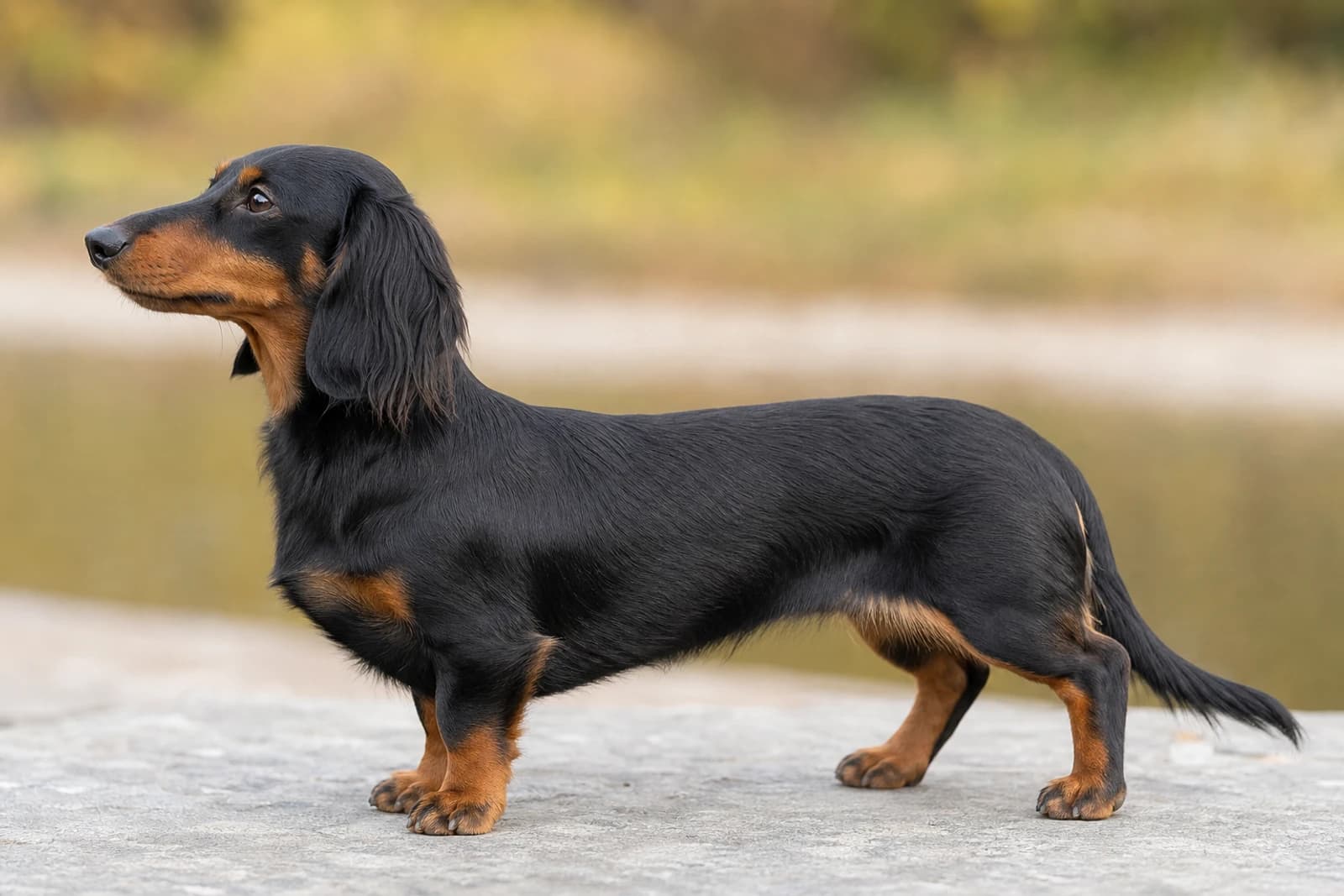
The Dachshund, a small scent hound from Germany, is known for its long body and short legs. Bred to hunt badgers, this breed is courageous, stubborn, and full of personality. Dachshunds thrive with active individuals or families who appreciate their independent nature and can provide consistent training. They are loyal companions but may not suit homes with small children or other pets due to their hunting instincts. With three coat varieties and a distinctive appearance, the 'wiener dog' is a beloved breed worldwide.
At a glance
- Size
- Small
- Height
- 5–6 in
- Weight
- 9–11 lb
- Life span
- 12–15 years
- Coat type
- Smooth, longhaired, or wirehaired
- Group
- Scenthounds
- Origin
- Germany
How much does a Dachshund cost?
Adopt / rescue
$50–$300
Usually includes spay/neuter, first shots, and a microchip.
Buy from a breeder
$400–$1,200
From a reputable, health-testing breeder.
Approximate USD. Prices vary widely by region, breeder, pedigree, age, and coat colour — adopting is the lower-cost and recommended route. Avoid suspiciously cheap “breeders”; they’re often puppy mills.
Estimate the full cost of a Dachshund →Dachshund photos
Views
Front, side, rear and top — the full silhouette.Poses
How the breed sits, lies, moves and plays.Puppy to senior
The breed across its whole life.Expressions
The breed’s range of moods.Close-up details
Eyes, ears, nose, paws, tail and coat.Coat colors
The breed’s recognized colors.Click any photo to enlarge. We show the Dachshund from every angle — three views, poses, life stages, expressions, close-ups, coat and colors.
Appearance & size
A Dachshund’s silhouette stops you in your tracks: a long, low-slung body perched on impossibly short legs. The miniature Dachshund—the size we’re focusing on here—stands just 5 to 6 inches at the shoulder and hits the scale at 9 to 11 pounds. That small, stretched frame is all muscle and purpose, built for squeezing into burrows after badgers.
Build & size
From the side, you see the deep, slightly curved chest that houses plenty of heart and lung room, a straight backline, and a slight tuck-up at the loins. The front end is where the real marvel is. Those very short forelegs incline slightly inward, which keeps the dog’s weight balanced and reduces shoulder strain when digging. The hind legs are straight, well-muscled, and set parallel, driving power from the rear without wasted motion. From behind, the hocks are neither turned in nor out.
Coat types
A Dachshund isn’t just one look—the breed comes in three distinct coats.
- Smooth: A short, glossy coat that lies tight to the body. It’s sleek to the touch and needs little beyond a wipe-down.
- Longhaired: Soft, slightly wavy hair forms feathering on the ears, backs of the legs, and tail. This coat gives a more elegant impression but still hides a robust working dog underneath.
- Wirehaired: A harsh, wiry outer coat over a dense undercoat, finished with a beard and bristly eyebrows. This coat is the most weather-resistant of the three.
Coat colors and patterns vary widely—anything from solid reds and creams to black-and-tan, chocolate, dapple, and brindle appears in the breed.
Head & expression
The head is long and wedge-shaped, with a slight arch of the skull and a prominent stop that breaks the slope cleanly. The muzzle tapers but never looks snipey. Broad, drop ears are set near the back of the skull and hang gracefully alongside the cheeks, framing the face. Almond-shaped, dark eyes sit above a large black nose, giving an alert, intelligent expression that’s pure hound.
Legs & tail
The front legs’ inward slant is subtle but gives the Dachshund its uniquely capable stance—think of it as a built-in shovel angle. The tail is a solid extension of the spine, robust and well-coated, tapering to a fine point and carried in line with the back, not curled over it. When the dog is on scent, that tail flags just enough to let you know there’s mischief brewing.
History & origin
The Dachshund was purpose-built to go underground and face a badger in its own den, and that no-nonsense job shaped everything about the breed. The name says it plainly: Dachshund is German for “badger dog.” Hunters in Germany needed a dog short enough to slip into a sett, brave enough to corner a clawed, 20-pound badger, and loud enough to bark continuously so the hunter could locate the dog and dig down to both of them. That’s the blueprint you still see today – paddle-like front paws for digging, a deep chest for stamina in tight tunnels, and the famously long spine that lets the dog turn around in an underground passage only inches high.
Early Dachshunds were substantially larger than the miniatures many households know now. The original smooth-coated dogs weighed 30 pounds or more and traveled well over rugged ground. The first dedicated breed club formed in Germany in 1840, and by 1850 Dachshunds had reached England, catching on with sportsmen and show enthusiasts alike. To make the dogs more versatile in different cover, German breeders later developed two additional coat types. The wire-haired variety came from crosses with rough-coated terriers, giving it a protective, bristly jacket for brambles and thorny underbrush. The long-haired Dachshund likely owes its silky, water-shedding coat to spaniel crosses, producing a dog that could handle damp conditions while looking a little softer in the parlor.
The miniature Dachshund emerged from a different impulse. In early 20th-century England, breeders began scaling down the standard dog deliberately for companionship, creating a smaller hound that could still bolt a rabbit but fit easily into city life. A separate miniature Dachshund club was established in 1935, officially splitting the little dog from its larger working relative. From badger dens in medieval Germany to the lap of a modern sofa, the Dachshund’s history is a straight line of determination – and a built-in excuse for those holes in your flower beds.
Temperament & personality
You don’t so much own a Dachshund as you earn the trust of a sharp, loyal little hound that clocks your moods before you do. They bond hard, often to one person, and will follow that person from room to room, curling into the smallest warm pocket they can find. Flip side: isolation crushes them. A Dachshund left alone too long will bark nonstop or redecorate the baseboards. They thrive with a household where someone is home, or at least a routine that breaks up long absences.
Step outside and the hunting brain takes over entirely. A dog under 11 pounds can drag you toward a rabbit hole with a tenacity that feels absurd. A fresh scent trail erases recall; the nose is running and the ears shut off. Indoors, that nose stays on duty—Dachshunds lean hard on scent memory. A single urine-soiled spot, even faint, can cue repeat marking for weeks. You’ll need an enzymatic cleaner followed by a vinegar spray to break the odor loop; standard soap won’t cut it.
With their people, they’re playful and often comically earnest—flinging a toy with fierce purpose, then demanding a belly rub. Around strangers, the warmth vanishes. An unexpected knock gets a sharp, insistent bark, and a visitor may receive a chilly once-over. That wariness makes them cheap alarm systems, but without early, consistent socialization it can tip into fear-based aggression. Learn to read the pre-bite signs: a stiff forward lean, hard eyes, or a low growl. Dachshunds can also guard a food bowl, so teach kids to give the dog space at mealtime.
Stubborn is the breed default. A Dachshund doesn’t respond to force; they dig in harder. Keep training short, upbeat, and powered by food. You’ll negotiate more than command, and that independent streak is why living with one feels like teaming up with a small, opinionated equal rather than owning a push-button pet.
You’ll rarely sit on a sofa without a warm, sausage-shaped lump pressed against your leg. But check under the throw blanket first—they’ve already claimed the best spot.
Good with kids, dogs & other pets
A Dachshund can be a wonderful playmate for older, gentle kids — but that long back and small frame (just 9–11 lb) make them a poor match for toddlers who don’t yet understand how to handle a dog carefully. Always supervise interactions with young children. A well-meaning hug, a dropped toy, or a clumsy step can easily injure a Dachshund’s spine. Teach kids to use two hands, stay low to the ground, and never pick the dog up without adult help. When children are respectful, you’ll see the patient, affectionate side of the breed come out — they’ll happily curl up on a lap or join in a game of fetch.
With other dogs, a well-socialized Dachshund is generally easygoing, but they don’t automatically love every dog they meet. Their early weeks matter enormously. Expose your puppy to calm, friendly dogs — not just one, but a variety of sizes and play styles — during that critical window before 14–16 weeks of age. An adult Dachshund who missed out on that exposure can become guarded or snappy around unfamiliar dogs. Even a normally confident one may need a slow introduction when a new dog joins the household.
Cats and small pets bring out the scent-hound prey drive. Dachshunds were bred to pursue badgers and other den animals, so a fleeing hamster, a fluttering bird, or a cat that runs can trigger a hardwired chase. Some Dachshunds learn to live peacefully with a cat they’re raised alongside, but don’t count on it. Keep rodents, rabbits, and reptiles in secure enclosures the dog can’t reach, and never leave them alone together.
Underneath the stubborn streak, these dogs are deeply attached to their people. They’re prone to loneliness and won’t do well if left alone all day — separation distress shows up as barking, chewing, or housetraining accidents. A family who can include the Dachshund in daily life, with plenty of companionship and a steady routine, will get the best of this little dog. Neglect that need, and even the most patient Dachshund will tell you about it.
Trainability & intelligence
Dachshunds are whip-smart but wired to think for themselves — so don’t confuse their independence with dimness. They pick up new commands as fast as any people-pleasing breed, but they’ll weigh whether your request is worth their while before they act on it. Training isn’t about showing them who’s boss; it’s about convincing them that cooperating brings better rewards than following their nose down the nearest scent trail.
What works — and what backfires
- Keep it positive. Treats, a squeaky toy, or a genuine belly-rub session all work. Reward the exact behavior you want the instant it happens, and you’ll see the light bulb click.
- Be consistent. Dachshunds test boundaries. If “off” means one thing on the sofa and something else in the kitchen, they’ll exploit the loophole. Every family member needs to use the same cues and follow through.
- Short, light sessions. Boredom sets in fast. Three or four five-minute rounds per day beat a single grinding half-hour.
- Skip the heavy hand. Punishment, even a harsh tone, can sour their trust and make them shut down — or worse, double down on the stubbornness. These dogs were bred to face badgers underground; intimidation doesn’t humble them, it just damages your relationship.
The recall hurdle
When a dachshund locks onto a scent, their ears go on vacation. Recall training demands extra creativity: practice first on a long line, use jackpot rewards, and never punish a dog that finally comes back — even if it took five minutes. In unfenced areas, assume they’ll tune you out the moment a rabbit darts across.
Start early, socialize calmly
Puppyhood is your window. Between 3 and 14 weeks, gradually introduce your dachshund to different people, friendly dogs, car rides, doorbells, slick floors — the whole noisy human world. Go at their pace. Force a nervous pup into a stranger’s arms and you’ll cement the very wariness you’re trying to prevent. Keep treats flowing during these exposures so new things predict good outcomes.
A dachshund that’s raised with gentle, persistent guidance and generous rewards becomes a confident, responsive companion — not because they’ve been bossed around, but because they’ve learned that listening to you pays off. Expect to earn their cooperation every day rather than command it, and you’ll have a training partner who’s far sharper than their stubborn reputation suggests.
Exercise & energy needs
Just two 20-minute walks a day. That’s the minimum a healthy adult Dachshund needs to burn off steam and keep extra weight from settling on a frame that absolutely can’t afford it. Think of it as 40 minutes total, broken in half—morning and evening—not one long trudge. Boredom turns a Dachshund into a tiny demolition crew, and a skipped walk today usually means shredded mail or a barking jag tomorrow.
The real challenge isn’t duration, it’s impact. Everything you do together has to protect that long back and those short legs. No letting him launch off the couch, scramble up steep stairs, or chase a ball with airborne leaps. A ramp or a lift is non-negotiable furniture insurance. If your heart’s set on high-jump agility or cliff-diving fetch, leave this breed out of it.
Play to his nose instead. A Dachshund is a scenthound through and through, and 10 minutes of scent work can tire him out as much as a 20-minute walk. Hide a smelly treat inside a snuffle mat, scatter kibble in the grass and let him snuffle it out, or turn a hallway into a nose-tracking game. Puzzle feeders, frozen Kongs, and food-dispensing toys chip away at mental energy on rainy days when a walk is short or slick sidewalks feel dicey.
Safe stamina depends on the individual dog. A fit 2-year-old might happily knock out two 30-minute walks, while a senior or a dog carrying a few extra pounds does better with three 15-minute strolls to keep strain low. Swimming is gold when you have a calm, controlled spot—zero impact, full-body work—but no dock diving and no rough exit ramps. In the backyard, a kiddie pool with a couple inches of water and floating treats turns into a nose-exercise station.
Be stingy about dog-park visits. One rough tumble with a bigger dog can mean a spinal injury and months of crate rest. Instead, set up small playdates with other polite small dogs where sniffing and gentle chase are the main events. Exercise here isn’t about wearing him to a nub; it’s about hitting that sweet spot where he’s content, calm, and not one wrong jump away from a vet bill you don’t want.
Grooming & coat care
Grooming a Dachshund is not one routine — it depends entirely on the coat type: smooth, longhaired, or wirehaired. Each has its own tool set and rhythm.
- Smooth coat: A sleek, short single coat that sheds lightly all year. Run a soft bristle brush over her once or twice a week to pull up loose hairs and distribute natural oils for a glossy finish. A damp cloth or grooming mitt works, too.
- Longhaired coat: Soft, slightly wavy, and prone to tangles around the ears, chest, and “feathers” on the backs of the legs. Brush every other day with a metal slicker brush (rounded pins) followed by a steel comb to prevent mats and keep the coat vibrant. Increase to daily during spring and fall shedding.
- Wirehaired coat: A dense, wiry outer coat with an insulating undercoat. Use a slicker brush and comb two or three times a week to remove debris and loose hair. Dead undercoat needs to be pulled out by hand (hand-stripping) every few months to maintain texture—skip the clippers, which soften the coat and leave it dull.
Bathe only when he’s truly dirty. Every 2–3 months is plenty, using a mild dog shampoo. More frequent baths strip the protective oils, especially on wirehaired dogs.
The low-slung build means a belly, chest, and ear tips that constantly sweep the ground. Wipe him down with a damp towel after walks, and pay attention to the ear flaps — moisture and grime trapped there can lead to infections. Clean ears weekly with a soft cloth or veterinary ear wipe; never push anything into the ear canal.
Teeth tend to accumulate tartar quickly. Brush with dog enzymatic toothpaste at least three times a week, ideally daily. Nails grow fast on these small, active feet; trim every 3–4 weeks or as soon as you hear clicking on hard floors.
Come heavy shedding season, stepping up brushing and adding an undercoat rake for wirehaired dogs keeps the loose fur off your sofa and out of the carpets. Keep a stash of coat-specific tools and those post-walk towels by the door, and the grooming load stays manageable.
Shedding & allergies
Dachshunds shed. No matter which coat catches your eye—smooth, wirehaired, or longhaired—you’ll find a steady dusting of hair around the house. The volume is moderate, but the experience varies by coat type:
- Smooth: Short, stiff hairs that work their way deep into carpet fibers and clothing. A damp cloth or lint roller becomes your best friend.
- Wirehaired: Sheds less noticeably because the wiry topcoat traps dead hair. That hair still falls out, though, and these coats need hand-stripping a couple times a year to prevent matting and keep the texture.
- Longhaired: The silky strands are the most visible shedders. They tend to drift into corners and clump on rugs, but a quick daily brushing captures a lot of it.
Twice a year, usually as the seasons change, expect a heavier shed. It’s not the full-blown undercoat dump of a double-coated breed, but you’ll notice more hair on the floor for a few weeks.
On the drool front, you’re in luck. Dachshunds are not slobbery dogs. A thirsty Doxie might leave a few water drips on your floor, but you won’t be wiping jowls.
As for allergies, no dog is hypoallergenic, and these little hounds are no exception. Dander and saliva, not hair length, trigger most pet allergies. If you or a family member has allergies, spend real time with an adult Dachshund—ideally of the coat type you’re considering—before committing. A smooth coat that sheds tiny dander-carrying hairs into everything can be just as challenging as a fluffier one.
Diet & nutrition
Extra pounds are a Dachshund’s worst enemy—that long, low spine simply isn’t built to carry excess weight. A lean, fit Dachshund (typically 9–11 lb) has far better odds of avoiding the back and joint problems this breed is prone to. So start with a measuring cup, not your eye. Most adult Dachshunds do well on two controlled meals a day totaling about ½ to 1 cup of high-quality dry food, adjusted precisely to their size, age, and activity level. A couch potato needs less than one who tears around the yard.
Because Dachshunds are often chowhounds that will eat until the bowl is empty, use a slow-feeder puzzle bowl or a snuffle mat to stretch out mealtime and engage their brain. Treats count, too—factor them into the daily calorie budget, and make them tiny. A single blueberry or a sliver of carrot is often enough motivation.
- Puppies (up to 4 months): Four small, evenly spaced meals a day.
- 4–6 months: Transition to three meals.
- 6+ months: Move to the adult schedule of two meals, which you’ll maintain for life.
Aim for a diet built around roughly 60% animal protein (cooked or raw meat, eggs), 20–30% dog-safe fruits and vegetables, and a small portion of grains or yogurt. If you cook at home, blend or finely purée the food—a Dachshund’s jaw only moves vertically, and blending helps them absorb more nutrients. For older dogs who slow down, shrink portions before weight creeps up, and consider three smaller meals if their digestion does better that way. Skip rich, fatty table scraps, especially after holidays; they can trigger pancreatitis. And if your senior Dachshund is missing teeth, simply purée their regular food instead of switching to a mushier, often-carb-heavy commercial product.
Health & lifespan
A healthy Dachshund often sails past the 12-year mark, with 15 not being unusual — but those years depend heavily on protecting one famous feature: that long, low back. The breed’s elongated spine makes it genuinely prone to intervertebral disc disease (IVDD). A single ill-advised leap off the sofa can rupture a disc, causing pain, paralysis, or the need for emergency surgery that runs $5,000 and up. So the real longevity hack here is relentless back hygiene.
From day one, pick your dog up with two hands — one under the chest, one supporting the rump — never scoop by the forelegs. Install ramps or pet steps next to couches and beds, and train an enthusiastic “off” cue for jumping. Stairs are a daily gamble; if you have a multi-story home, carry your dog or use a baby gate to limit unsupervised climbing. Obesity multiplies the spinal risk, so keep a Dachshund lean, with a visible waist and ribs you can feel but not count. For the standard 9–11 lb dog, even a single extra pound is a real burden. Your vet can show you the right body condition score.
Responsible breeders screen for hereditary conditions, but IVDD doesn’t have a straightforward genetic test. Instead, they select for sound conformation and a history of strong backs. Beyond the spine, watch for patellar luxation (a kneecap that pops out of place), which is common in toy-sized frames, and don’t skip dental care — small mouths trap tartar quickly, and neglected teeth can lead to heart or kidney problems. Monthly heartworm prevention during mosquito season and a rabies vaccine as required by law are non-negotiable.
Early socialization also plays a quiet health role for a dog that can be territorial and vocal; a chronically stressed, under-exercised Dachshund will bark excessively and pack on pounds. Give yours reasonable daily movement on level ground — not a jog, but a sturdy walk and a chance to sniff — and you’ll be doing your part for that spine.
Living environment
A Dachshund fits naturally into apartment life, but don't mistake small size for low energy. This is a tenacious scent hound who needs daily outdoor sniffing missions and real mental engagement — a couple of quick potty breaks won't cut it. Plan on at least two 20–30 minute walks every day, letting him follow his nose at his own pace. A securely fenced yard is a bonus (and a safer place for nose-driven, off-leash exploring), but you can absolutely manage with leashed walks and a nearby park. Never let a Dachshund off-leash in an unfenced area; his prey drive and single-minded tracking instinct will override your recall.
Inside, your home needs a spine-safe setup. Long backs and short legs make stairs, jumping on furniture, and hard landings real hazards. Even at 9–11 pounds, a Dachshund should have pet ramps or soft steps to reach the couch and bed. Block off staircases or carry him. Avoid games that encourage twisting, leaping, or high-impact stops.
Temperature-wise, Dachshunds lean toward moderate climates. In cold weather, that low-slung belly and short single coat chill fast — a sweater or coat helps during walks. In heat, heavy panting on pavement is a warning; shift walks to early morning or evening and keep sessions short.
Noise is a real consideration. Bred to alert hunters below ground, Dachshunds tend to be vocal. They’ll bark at knocks, passing dogs, and suspicious squirrels on the windowsill, which can strain apartment neighbor relations. Early training combined with plenty of puzzle toys, scent games, and a comfy “den” spot can tone it down, but you won’t get silence.
Separation anxiety is a common struggle. A Dachshund bonds hard and hates being left alone for long stretches. If you work full-time away from home, line up a dog walker, daycare, or a midday neighbor drop-in before you bring one home. Gradual desensitization and leaving mentally tiring toys (stuffed Kongs, snuffle mats) help build comfort with alone time, but this is not a breed that tolerates 8-plus solitary hours without consequence.
Who this breed suits
A great fit if…
You want a small dog with a big-dog personality. Dachshunds weigh just 9 to 11 pounds, so they tuck neatly into apartment life, RV travel, or a lap on movie night. They shed minimally and do fine with a couple of daily walks totaling 40–60 minutes, plus some backyard sniff-and-dig sessions. The breed’s original job — chasing badgers underground — means a Dachshund turns every walk into an all-snout investigation. If you find that endearing rather than exasperating, you’ll get along.
First-time owners can absolutely succeed with a Dachshund, provided they’re ready to be calmly consistent. These dogs are smart and food motivated, but they’re also stubborn; treat-driven training and short, upbeat sessions work better than repetition or force. Seniors and single owners often thrive with the breed because a Dachshund becomes a devoted shadow, content to snooze under a desk between adventures. Older children (say, 8 and up) who understand how to handle a long-backed dog gently do well, too.
Think twice if…
You have toddlers or preschoolers. A Dachshund’s spine is the breed’s financial and emotional Achilles’ heel. Even a small child’s clumsy hug or a tumble off the couch can trigger a disc rupture. Responsible homes use ramps to furniture, carry the dog up and down stairs, and keep jumping to a minimum — a commitment not every family wants.
You want a quiet, go-with-the-flow companion. Dachshunds are alert watchdogs with a big voice, and they’ll announce the mail carrier, the squirrel, and the suspicious leaf. Early training can tone down the noise, but silence isn’t in the contract. That same independence also means house-training can take longer than with a people-pleasing breed; accidents are common if you’re not diligent.
You’re looking for a jogging partner or a dog-park socialite. Those short legs aren’t built for marathon miles, and some Dachshunds inherit a feisty, take-charge attitude that can lead to scuffles with unfamiliar dogs. They’re happiest in a predictable routine where they can be the clown of the household.
If you can manage their back safety, accept a little sass, and laugh off the comedy of a determined hound nose, a Dachshund will repay you with 12 to 15 years of fierce devotion.
Cost of ownership
Bringing a Dachshund Home
A puppy from a responsible breeder who screens for patellas, eye issues, and the spine problems common in the breed will typically run $800 to $2,000. Show-potential pups or rare coat patterns (like shaded cream or dapple) can nudge past $3,000. Adoption through a breed-specific rescue or shelter is much lighter on the wallet — fees land between $50 and $400 — and often includes an initial vetting.
Monthly Nut and Bolts
- Food: A 9- to 11-pound dog burns through about half to three-quarters of a cup of high-quality kibble daily. Budget $20 to $40 a month; a few extra dollars for joint-support supplements is wise given their long backs.
- Grooming: Smooth coats are gloriously low-maintenance — a quick brush, nail trim, and ear check at home costs almost nothing. Longhaired and wirehaired types need more detangling and occasional stripping; if you use a pro groomer, expect $40 to $60 a session every 6 to 8 weeks. Monthly outlay usually stays under $30 if you do the basics yourself.
- Routine vet and prevention: Annual exams, vaccinations, and year-round heartworm/flea/tick prevention run about $200 to $400 a year ($15 to $35 a month). Dental cleanings — and Dachshunds’ crowded mouths often need them — add $200 to $600 each time, so ask your vet about a plan.
- Pet insurance: For a breed with a predictable, pricey orthopedic risk, accident-and-illness coverage makes sense. Premiums average $25 to $45 a month. Skip wellness add-ons if you’d rather self-fund preventives.
Realistically, a healthy Dachshund’s routine monthly costs settle in the $70 to $130 range — not counting a surprise trip under the sofa for a stolen chocolate bar.
The Back Problem Wildcard
At some point, about 1 in 4 Dachshunds will deal with intervertebral disc disease (IVDD). Conservative crate rest and meds can cost a few hundred dollars. Surgery — decompression with or without a hemilaminectomy — often lands between $3,000 and $8,000. With a 12- to 15-year lifespan, that’s a financial risk worth staring at directly. Either fund a dedicated emergency account or confirm your insurance policy covers IVDD without a pile of exclusions.
Choosing a Dachshund
Your first stop is deciding between a responsible breeder and a rescue. Both can land you a great dog, but with a breed built long and low, the health stakes are real — so you’ll need to ask harder questions than for a sturdier terrier.
Health clearances you need to see
A breeder who isn’t producing paperwork for both parents is wasting your time. For a miniature Dachshund, the non-negotiables are:
- Patellar luxation – OFA clearance (or equivalent), because slipping kneecaps are common in tiny dogs.
- Annual CAER eye exam – a current certificate from a veterinary ophthalmologist.
- PRA (cord1 mutation) DNA test – this simple swab test tells you if a dog is clear, carrier, or affected for a form of progressive retinal atrophy.
No single genetic test exists for IVDD, the disc disease that can paralyze a Dachshund. But a serious breeder tracks disc health across generations, doesn’t breed dogs who needed back surgery young, and offers a written health guarantee that covers IVDD for at least the first couple years.
Red flags that should send you elsewhere
Walk away from anyone selling “teacup,” “toy,” or micro-mini Dachshunds. The standard miniature already sits at 9–11 pounds; purposely breeding dogs under 8 pounds amplifies bone fragility and health problems. Also steer clear if the breeder can’t show you the mother on site, raises puppies in a kennel outbuilding with no household exposure, or dodges questions about back injuries in the lineage. Puppies who seem overly shy, flinch at normal noises, or move stiffly in the hind end are not “just tired” — skip them.
Rescue is a smart shortcut
If puppy chaos sounds exhausting, a breed-specific rescue can match you with an adult whose personality is already on display. A good rescue will disclose any known IVDD history, so you know upfront whether you’re signing up for ramps and careful lifting. Many adult Dachshunds arrive house-trained and past the chewing phase — you just need to honor their back safety from day one.
Choosing your puppy
When you visit a litter, watch the puppies move on a non-slip floor. A healthy Dachshund puppy scampers evenly, without bunny-hopping or stiffness after getting up. The breeder should have already started handling ears, paws, and mouth daily, and the pups should approach you with curiosity, not freeze.
Bringing home a Dachshund means rearranging your furniture instincts: invest in ramps or steps for couches and beds before you pick up the puppy, and never let a stranger — or a well-meaning kid — pick them up without supporting both chest and rear. That one habit does more to prevent a slipped disc than any supplement ever will.
Pros & cons
-
Pros
- Compact & apartment-friendly: A 9–11 lb dog that stands only 5–6 inches tall tucks neatly into city life. A couple of brisk 20-minute walks plus indoor play usually satisfies their exercise needs — though they’ll happily tag along on longer sniffaris.
- Loyal and full of character: Dachshunds bond tightly with their people and show an outsized, almost comedic personality in a tiny package. They’re brave to the point of forgetting their size, which makes them surprisingly good watchdogs.
- Low grooming in the smooth coat: The short, sleek variety sheds minimally and needs little more than a quick wipe-down with a hound glove. Longhaired and wirehaired coats require more work, but the standard smooth Dachshund is wash-and-go easy.
- Long-term companion: A 12–15 year lifespan is common, so you get a long stretch with that big personality.
-
Cons
- Stubborn streak and house-training challenges: Bred to hunt independently, these little hounds can decide they know better. Potty training often takes extra patience and consistency — expect setbacks, especially in wet weather.
- Back problems are a real risk: That iconic long spine paired with short legs makes them prone to intervertebral disc disease (IVDD). Jumping off furniture, climbing stairs, or even rough handling can trigger a painful, expensive emergency. Weight control and ramps become a way of life.
- Vocal and territorial: Dachshunds rarely miss a chance to announce a doorbell, a squirrel, or a leaf blowing past. Their barking can become a nuisance in close quarters, and without early socialization they can be standoffish or snappy with strangers and unfamiliar dogs.
- Digging and chasing are hardwired: As true scenthounds, they dig with a purpose and tune out everything when a scent trail grabs them. Off-leash reliability is poor — a fenced yard is non-negotiable, and even then you’ll want to check for escape tunnels.
- One-person tendency: Many form an intense attachment to a single favorite human and may guard that person from other pets or family members, a behavior that needs proactive management to keep the peace.
Similar breeds & alternatives
If the Dachshund’s long back and terrier-like stubbornness give you pause, a few other breeds share some of that spunk and nose-driven charm while tilting the scales in a different direction.
- Beagle – A fellow scent hound that tracks with the same happy tail-wag but comes in a sturdier, short-legged package less prone to spinal drama. At 13–15 inches and 18–30 pounds, Beagles are notably bigger than a 9–11 pound miniature Dachshund and need more daily mileage—expect a vocal partner who bays rather than barks and thrives as part of a pack. Where the Dachshund can be a one-person dog willing to run the show, a Beagle is usually more social and forgiving with kids but equally tenacious on a scent trail.
- Basset Hound – If it’s the low-to-the-ground silhouette and soulful ears you love, the Basset delivers in a much heavier, easygoing format (40–65 pounds). They share the Dachshund’s incredible nose and independent mind, but dial back the intensity. A Basset is content with a slow, sniffy stroll and plenty of couch time, while a miniature Dachshund often behaves like a big dog in a small body, needing focused play and firm boundaries. Do note that Bassets, with their own long spines, can also be prone to back issues.
- Pembroke Welsh Corgi – For those drawn to the long-back, short-leg shape but wanting a more biddable, active companion, the Corgi is a herding dog, not a hound. At 24–30 pounds, they’re stouter and more trainable, bred to move livestock rather than track game. You trade the independent scent-work drive for a bossy streak that responds well to structure and rewards a dedicated owner with less selective hearing.
Fun facts
- The name 'Dachshund' means 'badger dog' in German, reflecting their original purpose.
- They come in three coat types: smooth, longhaired, and wirehaired.
- Dachshunds are prone to intervertebral disc disease (IVDD) due to their long backs.
- They were the first official mascot of the 1972 Munich Olympics.
Frequently asked questions
- Are Dachshunds good with children?
- Dachshunds can be good companions for older, gentle children, but they may become snappy if handled roughly or surprised. Due to their small size and delicate backs, interactions with young kids should always be supervised. Early socialization and training help them build patience and tolerance.
- Do Dachshunds shed a lot?
- Dachshunds are moderate shedders overall. The smooth-coated variety sheds a bit more noticeably, while longhaired and wirehaired coats require more grooming but may shed less. Weekly brushing helps control loose hair and keeps their coat healthy.
- How much exercise does a Dachshund need?
- They need daily walks and play sessions to stay fit and happy, but their exercise needs are moderate. Activities should avoid high-impact jumping or stairs to protect their long backs from injury. Mental stimulation, like scent games, is also important for this scent hound breed.
- Are Dachshunds easy to groom?
- Smooth-coated Dachshunds are very low-maintenance, requiring only occasional brushing. Longhaired and wirehaired varieties need more frequent brushing to prevent mats and tangles. All types benefit from regular nail trims, ear cleaning, and dental care.
- Do Dachshunds bark a lot?
- Dachshunds tend to be vocal and can bark frequently, a trait from their history as hunting dogs bred to alert handlers. Early training and providing adequate exercise can help manage excessive barking. They often bark at unfamiliar sounds or when bored.
- Is a Dachshund a good choice for a first-time dog owner?
- Dachshunds can be suitable for first-time owners who are patient and consistent with training. They are intelligent but can be stubborn, so positive reinforcement works best. Their small size and adaptability make them well-suited for apartment living if daily walks are provided.
Tools & calculators for Dachshund owners
Quick estimates tailored to Dachshunds — pre-filled with this breed’s size where it matters.
Articles & stories about the Dachshund

Dachshund Back Problems (IVDD): What We Wish We'd Known Before the Emergency
The yelp that changes everything—a dachshund's back is a ticking time bomb. Here's what we learned about IVDD, surgery, and the ramp that might have saved us a $7,000 bill.
Sources & standards
This profile follows recognized breed standards from the American Kennel Club (AKC) and the Fédération Cynologique Internationale (FCI), along with established veterinary and breed-club guidance. These describe general breed tendencies — every dog is an individual.
Owner stories
Have a Dachshund? Share your experience — grooming tips, personality quirks, anything goes.