

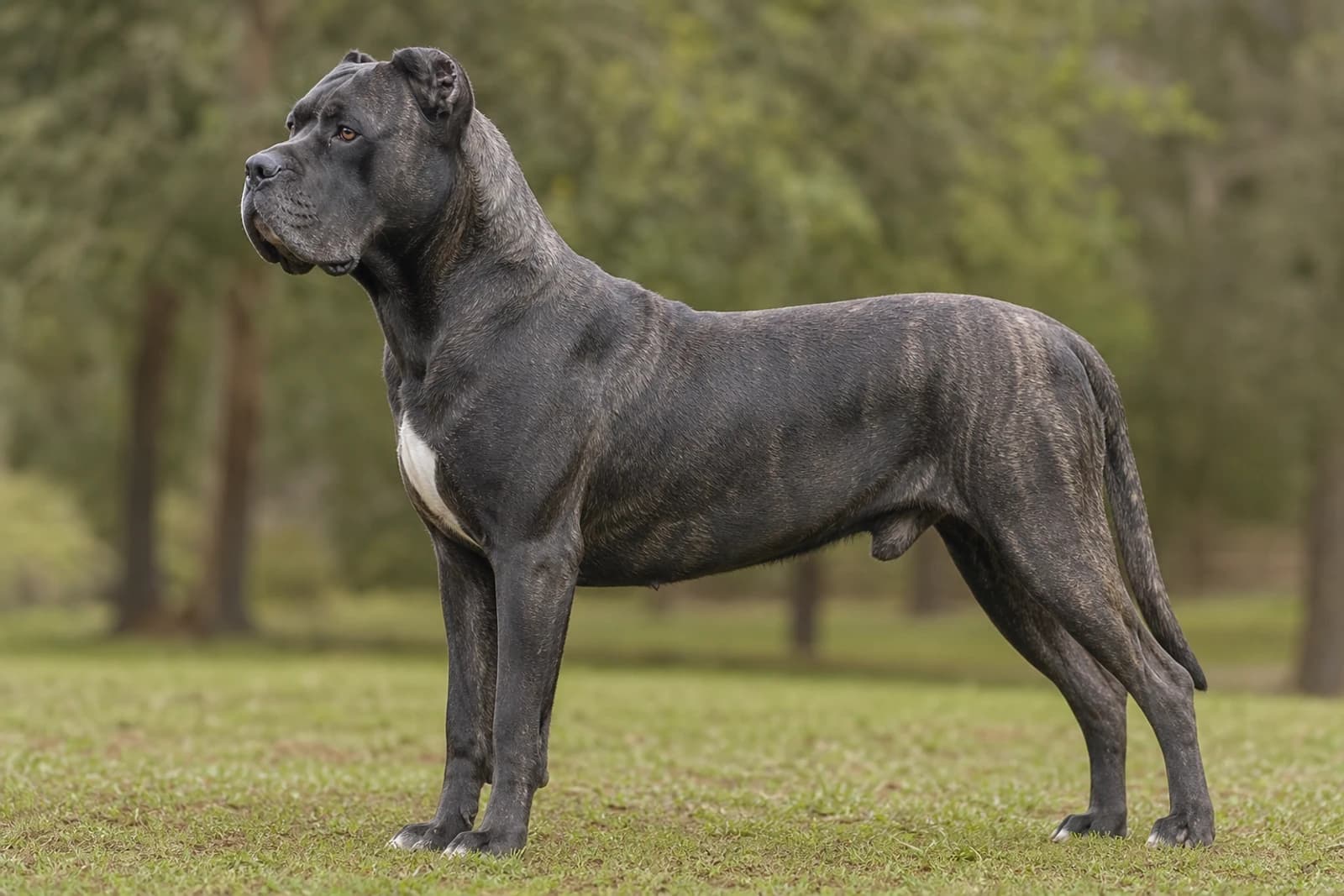
The Dogo Canario is a giant breed from Spain’s Canary Islands, originally bred to guard livestock and property. This powerful, confident dog is intensely loyal and protective of its family, making it an excellent guardian. However, the breed requires an experienced owner who can provide firm, consistent training and early socialization. Dogo Canarios are calm but strong-willed, and they need plenty of exercise and mental stimulation. They are best suited for active households without small children or other pets, and they do not adapt well to apartment living. With the right handler, they are devoted companions, but they are not recommended for novice owners.
At a glance
- Size
- Giant
- Height
- 22–26 in
- Weight
- 88–143 lb
- Life span
- 9–11 years
- Coat colors
- Fawn, Brindle, Black
- Coat type
- Short, dense coat
How much does a Dogo Canario cost?
Adopt / rescue
$75–$400
Usually includes spay/neuter, first shots, and a microchip.
Buy from a breeder
$700–$2,000
From a reputable, health-testing breeder.
Approximate USD. Prices vary widely by region, breeder, pedigree, age, and coat colour — adopting is the lower-cost and recommended route. Avoid suspiciously cheap “breeders”; they’re often puppy mills.
Estimate the full cost of a Dogo Canario →Dogo Canario photos
Views
Front, side, rear and top — the full silhouette.Poses
How the breed sits, lies, moves and plays.Puppy to senior
The breed across its whole life.Expressions
The breed’s range of moods.Close-up details
Eyes, ears, nose, paws, tail and coat.Coat colors
The breed’s recognized colors.Click any photo to enlarge. We show the Dogo Canario from every angle — three views, poses, life stages, expressions, close-ups, coat and colors.
Appearance & size
The Dogo Canario is a powerhouse wrapped in a short, tight coat—a molosser built with more bone and substance than almost anything else you’ll meet on the street. Males stand 24 to 26 inches at the shoulder and routinely tip the scales between 110 and 143 pounds. Females run a couple of inches shorter, settling into the 88- to 110-pound range. That weight sits on a rectangular frame: the body is roughly 10–15% longer than the dog is tall at the withers, which gives the breed its characteristic ground-covering stride and low-centered stability.
The coat is a single, harsh layer that lies flat and shiny. You won’t find much undercoat here—just a dense, rough texture that sheds dirt easily. Color comes in two basic camps, always paired with a black mask that covers the muzzle and often extends to the eyes. Fawn ranges from a sandy wash to a deep red; brindle throws dark, irregular stripes across a fawn or red base, with some dogs showing such heavy striping they look almost black (often called reverse brindle). Small white markings on the chest, throat, or feet are common, but large white patches are a fault in the show ring.
From the front, the head is what grabs you first. It’s broad, massive, and slightly wrinkled when the dog is alert, with a pronounced stop and a muzzle that’s wide and deep right to the black nose. The eyes are medium, oval, and range from dark brown to amber—always watchful and absolutely calm. Ears are a personal and regional choice: natural rose ears fold back close to the head; cropped ears stand erect and sharpen an already intimidating silhouette. The neck is thick, slightly arched, and carries a moderate dewlap that blends into a deep, wide chest. Forelegs are straight, heavy-boned, and set well apart, ending in compact cat feet.
Viewed from the side, the Dogo’s chest reaches to the elbows and the belly tucks up just enough to keep the dog athletic, never slab-sided. The back is firm and level, the loin short and muscular, and the tail set low—thick at the root, tapering to a point, and hanging at rest with a slight curve. When the dog moves, the tail rises to about back level in a saber curve, but it never curls over the back. From the rear, the hindquarters are broad and heavily muscled, with well-let-down hocks that drive a powerful, elastic trot. The skin is loose but not hanging—just enough to let you know this is a working guardian, not a showy mastiff that’s been softened for the couch. Every inch of the Dogo Canario says serious, from the blunt wedge of the skull to the slow, deliberate swing of the tail.
History & origin
The Dogo Canario is, at its core, a catch-and-hold farm dog forged on the volcanic slopes of the Canary Islands. What started as a rugged cattle worker for Spanish settlers quietly became one of the most capable guardians—and one of the most misunderstood—in the molosser family.
Island roots
The breed’s foundation traces to the Bardino Majorero, a tough, medium-sized sheepdog native to Fuerteventura. When Spanish colonists and Portuguese traders arrived in the 15th and 16th centuries, they brought heavy mastiff-type dogs and Alaunt-type gripping dogs with them for protection and war. Islanders crossed those imports with the local Bardinos, selecting for size, courage, and a vise-like bite. The result was a dog that could work semi-wild cattle: chase down a steer, latch onto its ear or jowl, and hold it for branding or butchering without shredding the animal.
The Presa Canario takes shape
By the 1700s, a distinct population known as the Perro de Presa Canario—presa meaning “seize” or “grip”—was widespread on Gran Canaria and Tenerife. These dogs guarded estates, eliminated feral dogs and vermin, and, unfortunately, served as pit fighters during a period when dog-on-dog and dog-on-bull contests were legal entertainment on the islands. Farmers didn’t split hairs between a working guard dog and a fighting dog; they needed the same traits: explosive power, a low center of gravity, and an unshakeable nerve.
Near-extinction and revival
The breed nearly collapsed in the mid-20th century. Dog fighting was outlawed, modern farming needed less “catch” work, and indiscriminate crossbreeding diluted the bloodlines. By the 1950s and 60s, true Presa Canario specimens were vanishingly rare. A dedicated revival effort kicked off in the 1970s when enthusiasts combed remote island farms for surviving dogs that still carried the old type. Breeders reconstructed the Presa, pulling from those remnants and making strategic infusions of other molossers—English Mastiff, Bullmastiff, and Alano Español among them—to broaden the gene pool while safeguarding working temperament.
Modern recognition
The Spanish Kennel Club would eventually grant full recognition. The United Kennel Club registered the breed as the Perro de Presa Canario in 2003, later adopting the Dogo Canario name. The American Kennel Club currently lists it in the Foundation Stock Service. Today, a 88- to 143-pound adult stands 22 to 26 inches at the shoulder and rarely backs down from a threat. Early breeders rebuilt the body; today’s stewards are trying just as hard to preserve the steady, discerning mind the dog needs to do its original job without becoming a liability.
Temperament & personality
A Dogo Canario in your living room isn’t a piece of furniture that happens to bark. This is a 100-plus-pound dog who takes her job seriously and expects you to do the same. That doesn’t mean she’s wired for chaos. A well-bred Dogo is remarkably calm indoors, often choosing a spot near a window or doorway where she can keep an eye on things without pacing. The stillness is deceptive — she’s always scanning, always sorting familiar from unfamiliar.
Energy runs in solid, purposeful bursts rather than nervous circles. She’ll need a full hour of hard exercise daily, not a couple of laps around the block. A long run, a session with a spring pole, or structured obedience work that makes her think and move settles her mind far better than just wearing out her legs. Afterward, she’s likely to plant herself at your feet and be quietly content, not demand constant petting.
Affection is on her terms and all the more meaningful for it. You won’t get frantic tail-wagging every time you walk in. Instead, she’ll lean heavily against your leg or rest her massive head on your knee — gestures that say you’re mine without fanfare. She bonds deeply with her family but isn’t a social butterfly. Strangers aren’t greeted with instant trust; she expects an introduction on neutral ground and a clear signal from you that the person belongs.
That wariness is paired with a strong territorial instinct. If you don’t manage it, urine marking inside the house can become a conversation. She’ll revisit spots that carry her scent or the scent of family members, defining her “territory” by smell rather than walls. That’s why accidents in a spare bedroom or a corner the kids rarely use can snowball. The fix isn’t yelling — it’s cleaning with an enzyme neutralizer that erases the invisible cue, then rewarding her immediately when she eliminates outside. Grab a treat the second she finishes in the yard, every time, or she’ll decide that marking by the coat closet makes more sense.
Living with a dog this strong-willed means you read the small print of her body language. A forward-leaning posture with a stiff, still tail and a direct stare isn’t curiosity; it’s a near-certain signal that she’s assessing a threat and may act on it. In contrast, a loose body, soft eyes, and a slow, sweeping tail tell you she’s at ease. You’ll also see her lip-lick, yawn, or turn her head away when she’s trying to dial down tension — her own or yours. Pay attention. A Dogo who is corrected harshly or pushed around doesn’t become more obedient; she becomes harder and less safe. Firm, consistent guidance without force is the only language she respects.
No amount of training replaces management around meals. Never interrupt her while she’s eating. A bowl grab or a child crawling near her food can trigger guarding instincts that, in a dog this size, become dangerous fast. Give her a quiet spot and teach every family member that she eats alone, uninterrupted.
Chewing is non-negotiable, not because she’s destructive by nature but because her jaws need work. Puppies chew to explore and soothe teething pain; adults chew to keep jaw muscles strong and teeth clean. Outfit your house with heavy-duty rubber toys and raw marrow bones from day one. If she decides a table leg is worth tasting, a homemade citrus spray from boiled lemon or orange peels can send her elsewhere, as can a vinegar-water mix. Neither hurts her, and both break the habit without a fight.
This breed carries her center of gravity forward — a physical expression of confidence and readiness. You have to be prepared to meet that, not by overpowering her, but by proving you’re a leader worth following. If you can do that, you get a steady, brave dog who walks through life like she’s already seen the worst of it and decided it’s not worth your worry.
Good with kids, dogs & other pets
With kids
A well-raised Dogo Canario is deeply loyal and typically calm within his household, but that loyalty doesn’t erase physics. A dog who runs 88 to 143 pounds and stands up to 26 inches at the shoulder can accidentally hurt a child just by turning around in a hallway or leaning against a toddler for a scratch. Even a gentle play bow can send a five-year-old flying. Fair supervision means eyes on the dog and child every second — no exceptions, no running to answer the door. Many Dogos live beautifully with older, respectful kids who understand that this isn’t a wrestling buddy. The key is relentless, positive exposure to well-behaved children starting before 16 weeks of age and continuing throughout adolescence. Without it, a Dogo’s natural protectiveness can harden into suspicion of any unfamiliar child who visits. Never put a baby on the floor near a resting Dogo, and teach children never to bother the dog when he’s in his crate or eating.
With other dogs
Here’s where the breed’s history hits home. The Dogo Canario was built to guard and, in earlier centuries, to fight other dogs. Same-sex aggression — especially female-to-female — is common, and even a dog raised with puppy classes can develop intolerance by maturity around age two. Some adult Dogos coexist peacefully with one opposite-sex housemate they’ve grown up with, but counting on a dog-park social butterfly will get you into trouble fast. Off-leash greetings with unfamiliar dogs are a gamble, and forcing an adult Dogo to “make friends” when he’s already tense can ignite a fight, not build confidence. Many owners simply manage it: solid fences, parallel leash walks with no face-to-face sniffs, and a life where the dog’s social needs are met by his people, not by every dog in the neighborhood. If you’re set on multi-dog chaos, this probably isn’t the right breed.
With cats and small pets
Assume high prey drive. A cat sprinting past, a pet rabbit in an exercise pen, or even a small dog that squeaks like a toy can trigger a deadly chase. Some Dogos raised from puppyhood with indoor cats learn to coexist, but that tolerance rarely extends to unfamiliar animals outside. When the household includes pocket pets, birds, or a cat who races across the room, a Dogo can shift from couch potato to predator in a heartbeat. Secure separation when you’re not directly supervising is non-negotiable. Far too many owners learn this the hard way.
Trainability & intelligence
This is not a breed that lives to please you. The Dogo Canario is a self-assured, thinking dog — sharp enough to learn quickly, but independent enough to decide whether your request is worth his time. Training success hinges on earning his trust and respect, not demanding blind obedience. If you come in heavy-handed, you’ll damage the relationship and potentially create a 100-plus-pound dog who shuts down or pushes back. What works is calm, consistent, reward-based work that makes cooperation the obvious choice.
A giant guardian with low stranger tolerance, he needs early and ongoing socialization more than most. Start between 3 and 14 weeks and keep at it well into adulthood. Expose the puppy to a wide variety of people, calm dogs, different surfaces, and everyday sounds — always at his pace and with plenty of treats or play. One bad scare during this window can create long-term wariness, so never flood him. Even with great socialization, he’ll likely remain aloof with newcomers. The goal is a stable dog who can assess situations without overreacting, not a social butterfly.
Because the breed can be strong-willed and has a natural guarding streak, foundation obedience should begin the week the puppy comes home. Focus on impulse control, a solid “leave it,” and a reliable down-stay. Recall is a weakness: the Dogo is not a velcro dog, and his prey drive or protective instinct can override a command. Practice recall on a long line in low-distraction settings, use high-value rewards, and expect that off-leash freedom in unsecured areas may never be safe. He learns best through short, game-like sessions that challenge his brain — turn training into a puzzle, not a drill, and he’ll stay engaged. Punishment-based methods, including shock collars or yelling, erode trust and spike anxiety in a breed whose physical power makes any fallout dangerous. Instead, capture and reinforce the behavior you want with praise, food, or a quick tug toy.
Expect a testing phase during adolescence where he’ll “forget” commands just to see if the rules still apply. Stay patient and consistent. Cycle back to structured training and double down on real-world proofing. A well-trained Dogo Canario is an unshakeable, discerning companion — but getting there takes thousands of thoughtful repetitions and a handler who knows that leadership is shown, not forced. Enrolling in a positive-reinforcement puppy class and later an advanced obedience group can give you the environment you need to proof behaviors around other dogs and distractions, while a trainer familiar with guardian breeds can help you troubleshoot without pushing the dog into defensiveness.
Exercise & energy needs
A Dogo Canario is a serious athlete packed into a massive frame — this is not a breed that thrives on a casual stroll around the block. These dogs were built to guard property and move cattle, and that working heritage demands a daily dose of physically and mentally taxing activity.
Expect to put in 60 to 90 minutes of exercise every day, split into at least two sessions. One long walk won’t be enough; you’ll need a mix of brisk walking, controlled jogging, or hiking on varied terrain to truly drain their tank. A bored Dogo is a problem waiting to happen — pent-up energy often surfaces as destructive chewing, barking, or hypervigilance that can drift into true reactivity. They need a job, not just a lap around the neighborhood.
Intensity matters. An adult Dogo can handle a hard run or a long uphill hike, but you’ve got to protect those growing joints. Puppies and adolescents under 18 months shouldn’t do high-impact work like repetitive jumping or hard-surface running — it can set the stage for hip and elbow problems later. Stick to soft grass, dirt trails, and free play where they control the pace. Even with adults, keep pavement pounding to a minimum and watch for signs of overheating in warm weather — that big body holds heat.
Mental stimulation has to go hand-in-hand with the physical. Puzzle toys are fine as a side dish, but the main course should be structured training that mirrors real work. Scent work, tracking, advanced obedience, and protection sports (IPO, French Ring) are all natural fits. A Dogo that gets 30 minutes of focused nose work or heel-work will often settle more completely than one that just ran laps. Teach them to carry a pack on hikes (once mature), or work on long downs and send-aways. The goal is to engage their brain’s problem-solving engine, not just tire out their legs.
If you can’t commit to that daily, hands-on regimen, this breed will let you know — loudly and destructively. A Dogo Canario’s exercise is a lifestyle requirement, not a weekend hobby.
Grooming & coat care
The Dogo Canario’s short, dense coat lies tight against the skin and gives off a polished sheen with minimal effort. Don’t let that low-fuss look fool you—this breed sheds steadily and blows coat twice a year with real intensity. A quick weekly pass with a pig-bristle brush or a rubber curry mitt keeps the loose hair contained and spreads natural oils for that healthy gloss. During spring and fall, step it up to two or three times a week; you’ll thank yourself when the drifts of fawn or brindle hair aren’t coating the furniture.
Bathing needs are rare. A few times a year is plenty unless your dog finds something truly foul to roll in. Over-shampooing strips the coat’s natural waterproofing and can lead to dry, itchy skin. Stick with a mild, dog-specific product and rinse thoroughly.
Trimming? Not part of the picture. The Dogo Canario’s coat does its job without scissoring or clipping. The real work sits in the details:
- Nails: These giants put force on their paws, so overgrown nails quickly become painful and alter gait. Trim every 3–4 weeks or whenever you hear clicking on hard floors.
- Ears: Natural, pendant ears trap moisture and wax, especially in humid weather. Wipe the outer ear with a damp cloth weekly and dry thoroughly. If your dog’s ears are cropped, they still benefit from a quick check for debris.
- Teeth: Get a routine going early. Brush three times a week with enzymatic dog toothpaste to hold off tartar buildup and the gum problems common in large breeds.
Seasonal coat care leans heavily on what’s already in your routine: ramped-up brushing and the occasional wipe-down with a damp hand to catch dirt. Regular outdoor romps actually accelerate healthy coat turnover and cut down on stress shedding. Just check between those thick, webbed toes after walks—a simple foot wipe prevents moisture-related irritation between the pads.
Shedding & allergies
A Dogo Canario sheds more than you’d guess for a short-coated dog. The coat is fine, dense, and flat, and those stiff little hairs weave themselves into carpet, upholstery, and your clothes year-round. Twice a year—usually spring and fall—the shedding kicks into a full-blown blowout. For a few weeks, you’ll pull tufts of undercoat out with your fingers, and daily brushing with a rubber curry or hound glove becomes the single best thing you can do to keep the tumbleweeds under control.
Then there’s the drool. This is a giant, jowly breed, and the saliva flows freely. After a meal, a deep drink, or any spike of excitement, you’ll see ropes of it. It ends up on walls, floors, furniture, and your pant legs. Keeping a dedicated drool rag in a couple of rooms isn’t being dramatic; it’s just practical.
None of this adds up to a hypoallergenic dog. The dander and the saliva proteins that trigger allergies are present in spades. If someone in your household reacts to dogs, don’t rely on a quick meet-and-greet. Spend real, extended time around adult Dogos—indoors, with normal slobber and shed hair—because the combination often hits harder than fur alone.
Diet & nutrition
A Dogo Canario that tips the scales at 88 to 143 pounds needs fuel, but the kind that supports those big bones without adding stress. Because this is a giant breed with a relatively short 9- to 11-year lifespan, every extra pound pounds the joints. Feed for a lean, athletic dog—you want to feel the ribs under a light cover of flesh, not see them, and never have to search for them.
Start with a high-quality giant-breed or active-dog formula that lists whole meats early. For a moderately active 100- to 110-pound adult, a daily 4 to 5 cups of dry food split into two meals is a reasonable baseline. A larger or hard-working dog may push toward 6 cups; a couch-loving 90-pounder may only need 3½ to 4. The second you notice the waistline disappearing, cut back. These dogs can be remarkably food-driven, so free-feeding is an open invitation to obesity—and obesity turns hip or elbow issues from manageable to crippling.
Puppies need careful pacing to protect growing joints:
- Up to 4 months: four evenly spaced meals a day.
- 4 to 6 months: drop to three meals.
- 6 months onward: two meals like an adult, forever.
Pick a large-breed puppy food with controlled calcium and phosphorus—fast growth is not the goal, strong growth is. A raw chicken wing or two under supervision can debut around 12 weeks, but all transitions happen slowly, starting with puréed meats, fish, or soaked kibble.
Seniors dial the activity down, so watch the scale and shift calories accordingly. Smaller, more frequent meals can help aging digestion, but don’t slash protein; old muscle still needs it. If teeth become a problem, purée the meals to keep nutrient uptake high.
A few house rules keep a Dogo healthy around your kitchen:
- Never feed directly from the table. Begging, once learned, is incredibly stubborn.
- Use a food puzzle bowl for fast eaters—it slows the gulping and adds mental work.
- Save unsalted vegetable-cooking water as a no-sodium base for homemade meals.
- Skip those rich post-holiday scraps. A fatty overload can trigger pancreatitis before you notice the drool and distress.
A meat-centered diet suits this dog’s physiology. Whether you feed a premium kibble, a carefully balanced raw or home-cooked plan, or a mix, roughly 60% of the calories from animal protein sources is a solid target. Add in some cooked vegetables, eggs, and a digestible grain like white rice or pearl barley if the stomach ever goes sour. Just keep portions honest, and you’ll see that lean, powerful silhouette hold up year after year.
Health & lifespan
A well-cared-for Dogo Canario typically lives 9 to 11 years, which is solid for a giant breed that can top 140 pounds. That middling window means every health decision you make — what you feed, how you manage weight, which screenings you run — packs extra punch.
Health conditions worth knowing about
Like many large, muscular dogs, the Dogo Canario can be prone to orthopedic problems. Hip and elbow dysplasia show up often enough that responsible breeders routinely screen parent dogs through the OFA or PennHIP. A heavy, fast-growing puppy puts a lot of strain on developing joints, so controlled exercise and a high-quality large-breed puppy diet matter more here than with a smaller dog.
Bloat (gastric dilatation-volvulus) is another serious risk with deep-chested dogs. A Dogo who bolts his food or exercises hard right after eating can end up in a life-threatening emergency. Splitting meals into two or three smaller portions and restricting activity around mealtimes is straightforward prevention you can start on day one.
Heart issues, particularly dilated cardiomyopathy, crop up in some lines, and the breed can also have a predisposition to eye conditions like entropion or progressive retinal atrophy. These aren't a given, but they're exactly the kind of thing a breeder who tests and shares CERF or OFA eye clearances is trying to steer away from. Skin problems — allergies, hot spots, stubborn yeast infections — also appear as a recurring gripe across the breed. Often they connect back to diet, environmental triggers, or a less-than-perfect coat that traps moisture.
How to stack the deck
Weight management here isn't optional. An extra 10 or 15 pounds on a 130-pound dog wrecks joints, taxes the heart, and shortens life. Feed measured portions, keep treats functional rather than indulgent, and handle the breed's considerable food drive with structure, not free-for-all snacking.
Annual wellness exams — and switching to twice-yearly visits once the dog hits senior status around 7 — catch all the subtle changes a stoic Dogo might hide. Watch for small shifts: a little less enthusiasm on walks, a new reluctance to jump into the car, or a coat that loses its shine. Those quiet signals often say more than a limp.
Heartworm prevention is non-negotiable during mosquito season and for a month after it ends, and keeping current on rabies vaccination isn't just the law — it's protection against a disease with no effective treatment once symptoms set in.
Early socialization and calm, positive handling do a surprising amount for physical health. A stressed, socially isolated dog racks up cortisol, which can suppress immunity and aggravate skin and gut issues. A Dogo Canario raised with respectful, consistent engagement burns off less energy on anxiety and more on simply being a sound, resilient dog.
Living environment
A Dogo Canario in an apartment is a tough hand for everyone—these are 88–143 lb guardians built to watch property, not share walls. One booming alert bark and you’ll have neighbor trouble fast. A house with a genuinely secure yard is non-negotiable. We’re talking a 6‑ft solid fence, buried at the base or a concrete footer if they start digging, and a double‑gated entry so nobody slips through when visitors arrive. A standard chain‑link fence won’t cut it; a determined Dogo goes over or through it.
Inside the house, they pick a spot where they can see the front door and main living area. They’re not compulsive pacesetters, but they need two solid exercise sessions a day—a morning walk or long run, then an evening session with mental work. Swap one of those for a tug session and a puzzle toy stuffed with food if the weather is miserable. A bored Dogo left in a yard all day will rehearse boundary patrolling, digging, and barking at anything that moves. That level of noise doesn’t stay contained in a suburban lot.
Climate‑wise, their short, single coat handles heat better than deep cold, but their size makes overheating a real risk in high summer. Exercise them in the early morning, provide thick shade and cool water, and skip midday pavement. In freezing weather, limit outdoor time; a coat doesn’t hurt for short walks, but they aren’t built to live out in the snow.
This breed bonds fiercely and does not tolerate being left alone for long hours. A household where people are gone 8‑plus hours daily invites howling, destructive chewing, and a hyper‑vigilant dog that never settles. Even with careful desensitization, you’ll likely still come home to marker barks at every delivery. Factor that reality check into your home layout and work schedule, not after the dog is already stressed and screaming at the window.
Who this breed suits
The Dogo Canario fits a narrow slice of owners—ones who don’t flinch at a 143-pound guardian whose loyalty comes wrapped in a serious, protective streak. This isn’t a weekend-warrior dog or a house ornament. If you’ve successfully raised and trained a powerful working breed before (think mastiff, herding guardian, or dominant breed), you’re the right target. First-time owners will be in over their heads.
Best fit
A confident, assertive handler who can enforce rules without harshness, every single day. Singles or active couples with fenced acreage and a clear job for the dog—property patrol, bite-work sports, or advanced obedience—get the most out of this breed. An adult-only home or one with older teens who understand canine body language can work, but the dog’s sheer mass and wariness of strangers mean constant supervision is non-negotiable. Expect to put in at least 60–90 minutes of focused exercise: long jogs, weight pulling, or controlled tether training. The mind needs just as much work. A bored Dogo Canario drafts its own job descriptions, and none of them end well for your drywall.
Think twice
- Apartment dwellers or couch-potato households. A 100+ lb guardian bred to move and challenge anything unfamiliar will unravel in tight quarters with nothing to do.
- Families with small children. Even a well-socialized Dogo can knock a toddler flat by accident, and a child’s erratic noises can agitate a protective dog that’s already hardwired to read every disturbance as a potential threat.
- Seniors or anyone without the physical strength to control a dog that outweighs them. If a squirrel triggers a full-bore lunge, you’re handling 130 pounds of muscle; if you can’t hold that, you’re both a danger.
- Anyone unwilling to socialize like it’s a second career. This breed needs calm exposure to strangers, kids, other dogs, and oddball environments from puppyhood through adulthood. Skip it, and you create a liability.
- Those living in areas with breed restrictions. Many cities, counties, and insurers ban or refuse coverage for Presa Canario types. Check before you even look at a litter.
The 9–11 year lifespan means a decade of sharp management. This dog gives everything to someone it respects—but if you can’t be the unflappable leader it needs 365 days a year, pick a more forgiving breed.
Cost of ownership
Bringing a Dogo Canario into your life means budgeting for a powerful giant breed that eats like one and comes with breed-specific health considerations. A well-bred puppy from a responsible breeder who screens for hip dysplasia, elbow dysplasia, and cardiac issues typically costs between $1,800 and $3,500. Show-prospect or imported working lines can push that number higher, but a lower price tag often signals skipped health testing — a costly gamble.
Monthly expenses land squarely in giant-breed territory. Food will be your biggest regular line item. An adult Dogo (88–143 lbs) may plow through 40–50 lbs of high-quality kibble per month, running you $80–$120, depending on protein content and brand. Raw or fresh-food plans easily double that.
Vet and preventive care need its own cushion. Annual exams, vaccines, heartworm/flea/tick prevention for a dog this size average $500–$800 per year, but be ready for more. Responsible breeders screen for patellar luxation, bloat, and ACL tears — all common in heavy, deep-chested breeds — and treatment for any of these can hit $3,000–$7,000 in a blink. I strongly recommend pet insurance from day one. Monthly premiums for a Dogo Canario run $60–$100 for a solid accident-and-illness plan with a decent deductible.
Grooming is mercifully simple. A short, single coat needs a weekly brush and an occasional bath. If you do it yourself, you’re out maybe $15–$25 a month for shampoo, wipes, and nail trims. A pro groomer every 6–8 weeks might add $50–$70 per visit, though you’ll need a groomer comfortable handling a strong, aloof guardian breed.
Don’t overlook training and socialization costs. A large, territorial dog with a 9-to-11-year lifespan requires early, ongoing professional guidance. Group classes followed by a few private sessions can set you back $500–$1,000 in the first year, and it’s money that directly prevents far more expensive behavioral problems later. Realistically, figure $200–$300 total per month when you average food, preventive care, insurance, and the occasional replacement of indestructible chew toys that aren’t.
Choosing a Dogo Canario
A Dogo Canario isn’t a wash-and-wear family dog. Where you get one can make the difference between a confident guardian and an unmanageable liability, so take your time.
Breeder or Rescue?
A breed-specific rescue can be a solid path, especially if you’re experienced with powerful guardian breeds. You’ll likely adopt an adult whose temperament is already on display. Ask hard questions: Why was the dog surrendered? What’s been done behaviorally since intake? Meet the dog more than once and bring every household member. A dog with an unknown past may carry baggage around strangers or other animals—something you can’t rehab with a few treats.
A responsible breeder, on the other hand, builds from the ground up. They’ll be choosy about who gets a puppy because they know these dogs aren’t beginner material. Expect to be interviewed about your home setup, handling experience, and what happens if things go sideways.
Health Clearances You Need to See
Demand proof, not promises. Both sire and dam should have OFA or PennHIP hip and elbow scores—ideally “good” or better on hips. A cardiac clearance from a board-certified veterinary cardiologist is non-negotiable, as dilated cardiomyopathy lurks in lines. A current ophthalmologist’s eye exam rules out inherited eye disease. Many breeders also run a full thyroid panel. Get the numbers yourself; don’t settle for “the vet said they’re fine.” Giant breeds collapse fast when joints and hearts fail, and you’re already looking at a 9–11 year lifespan.
Red Flags That Should Make You Walk
- Anyone who won’t show you original health certificates or dodges your questions.
- Litters raised in a kennel or garage with minimal household noise and foot traffic. Under-socialized puppies turn into 100+ lb dogs that crumble under normal stress.
- Breeders who promise “guard instinct” as a selling point or push a puppy on you in the first conversation.
- No questions asked about your experience, your living situation, or your plan if the dog develops aggression. They should be screening you out if you’re not the right fit.
- Lack of a take-back clause in the contract. Good breeders will take a dog back at any age, no blame.
Picking Your Puppy
Visit the litter around 6–7 weeks and watch. The mother should be calm but alert—a frantic, skittish, or aggressive dam is a giant warning bell. You want a puppy that approaches without hesitation, investigates you for a moment, then settles. The bully who shoves littermates aside might overwhelm a family home; the one hiding in the corner may never develop the stable confidence a guardian breed needs.
A sharp breeder will have already performed temperament testing and will use it to match puppies to homes, not just color preferences. Ask what they’ve done for early neurological stimulation, sound desensitization, and crate introduction. If they can’t tell you in detail, keep looking. That breeder should also be the person you call at midnight five years from now when your dog suddenly starts limping or growls at the neighbor. That kind of support is part of the deal.
Pros & cons
Pros
- Fiercely loyal guardian — this dog takes family protection seriously and will stand his ground without hesitation. You get an unwavering, clear-headed defender.
- Confident and calm with proper leadership — a well-socialized Dogo reads situations before reacting. Inside the home he can be surprisingly mellow, even couch-potato affectionate, once his needs are met.
- Low-maintenance coat — a short, hard single coat that needs a quick weekly brushing and the occasional bath. No clipping or stripping, though he does shed seasonally.
- Bonds tightly with his people — earn his trust and you have a dog that’s velcro-level devoted. He thrives on being included in daily life and gives steady, quiet companionship.
- Athletic working partner — strong and agile for his giant 88–143 lb frame, he can excel at protection sports, weight pull, or long hikes with an experienced handler who can channel his drive.
Cons
- Not a beginner’s dog — a powerful, willful animal that requires an owner with breed experience and the time to provide firm, consistent training every single day.
- Dog aggression is common — many Dogo Canarios are intolerant of strange dogs, especially same-sex ones. Early and relentless socialization helps, but may not override strong genetic tendencies.
- High liability — his protective instinct, natural suspicion toward strangers, and sheer size mean you must manage him carefully. In some places breed bans or insurance restrictions apply.
- Heavy drooler — especially after drinking or during warm weather. Keep a rag handy.
- Short lifespan — 9–11 years is typical for a giant breed. Along with that comes the real possibility of hip and elbow dysplasia, bloat, and heart conditions; responsible breeders screen for the heritable ones.
- Separation distress — he bonds so intensely that being left alone for a full workday can lead to destructive behavior and anxiety. This isn’t a dog for a long-hours empty house.
Similar breeds & alternatives
If the Dogo Canario’s raw guarding drive and independent streak give you pause, a few other giant breeds deliver similar physical presence but with real differences in biddability, energy, and day-to-day manageability.
Cane Corso. At 23.5–27.5 inches and 88–110 pounds, the Corso is a touch leaner than many Dogos but shares the muscular, mastiff-type build and a 9–12 year lifespan. You get an alert, confident guardian, yet the Corso often settles into a more trainable, family-engaged personality—less sharp-edged suspicion of strangers when properly socialized. Still an intense dog, but one that typically bounces back faster from corrections and craves direction rather than constantly testing it.
Dogo Argentino. A pure-white athlete standing 24–27 inches and 80–100 pounds, bred to hunt big game in packs. The Dogo Argentino matches the Canario’s explosive power and needs a solid hour of hard running, not just a walk. The key difference: this is a higher-energy, dog-selective breed with a staggering prey drive. If you want a dog that will actively work with you rather than patrol independently, the Argentino can be a better fit—provided you can manage same-sex aggression and an iron will that rivals the Canario’s.
Boerboel. South Africa’s farm guardian runs 22–27 inches but easily tips the scales at 150–200 pounds—significantly heavier than the Dogo Canario. That mass comes with a notably calmer, watch-and-wait temperament. Boerboels are still protective and physically formidable, but they’re less likely to boil over into reactivity. Expect a lower daily exercise requirement and a dog content to sprawl across your living room between demonstrations of quiet intimidation.
Bullmastiff. A deliberate contrast: 24–27 inches, 100–130 pounds, and a 7–9 year lifespan. The Bullmastiff was bred to hold poachers, not to fight them, so you sacrifice some of the Canario’s hair-trigger intensity for a dog that’s easier to redirect. Shorter muzzle, less endurance in the heat, and a couch-potato rhythm between short bursts of strength. If you want a guardian who’s genuinely lazy indoors and less likely to challenge your leadership every day, the trade-off is a shorter lifespan and a dog that won’t keep up on long runs.
Fun facts
- The breed was historically used for guarding livestock and property in the Canary Islands.
- Dogo Canario nearly went extinct in the 1960s but was revived by dedicated breeders.
- They were originally bred from the Bardino Majorero and English Mastiff-type dogs.
- They are known for their deep, intimidating bark and imposing presence.
Frequently asked questions
- Are Dogo Canarios good with children?
- Dogo Canarios can be loyal and protective of children in their family, but due to their large size and strong guarding instincts, supervision is essential. They tend to do best in homes with older children who understand how to interact with dogs. Early socialization and training are critical to ensure positive relationships.
- Do Dogo Canarios shed a lot?
- Dogo Canarios shed moderately year-round, with heavier shedding during seasonal changes. Weekly brushing with a firm bristle brush or grooming mitt can help manage loose hair. Overall, they are not considered heavy shedders compared to some other breeds.
- How much exercise does a Dogo Canario need?
- Dogo Canarios require regular daily exercise, such as brisk walks or jogging, along with mental stimulation to prevent boredom. They are not hyperactive but need consistent activity to maintain muscle tone and a calm demeanor. A securely fenced yard is ideal for off-leash play.
- Is the Dogo Canario a good dog for first-time owners?
- Dogo Canarios are typically not recommended for first-time dog owners. They require experienced handling, firm and consistent training, and extensive socialization due to their powerful build and protective nature. Without proper leadership, they can become dominant or difficult to manage.
- Can a Dogo Canario live in an apartment?
- Due to their large size and need for space, Dogo Canarios are better suited for homes with a large, securely fenced yard. Apartment living is generally not ideal unless the owner can provide ample daily outdoor exercise and the building allows large breeds. Their protective barking may also disturb neighbors.
- Do Dogo Canarios bark a lot?
- Dogo Canarios have a natural guarding instinct and tend to bark to alert their owners to potential threats. With proper training, excessive barking can be minimized, but they are generally more vocal than some other breeds. They are not considered nuisance barkers if their needs are met.
Tools & calculators for Dogo Canario owners
Quick estimates tailored to Dogo Canarios — pre-filled with this breed’s size where it matters.
Articles & stories about the Dogo Canario
Sources & standards
This profile follows recognized breed standards from the American Kennel Club (AKC) and the Fédération Cynologique Internationale (FCI), along with established veterinary and breed-club guidance. These describe general breed tendencies — every dog is an individual.
Owner stories
Have a Dogo Canario? Share your experience — grooming tips, personality quirks, anything goes.