

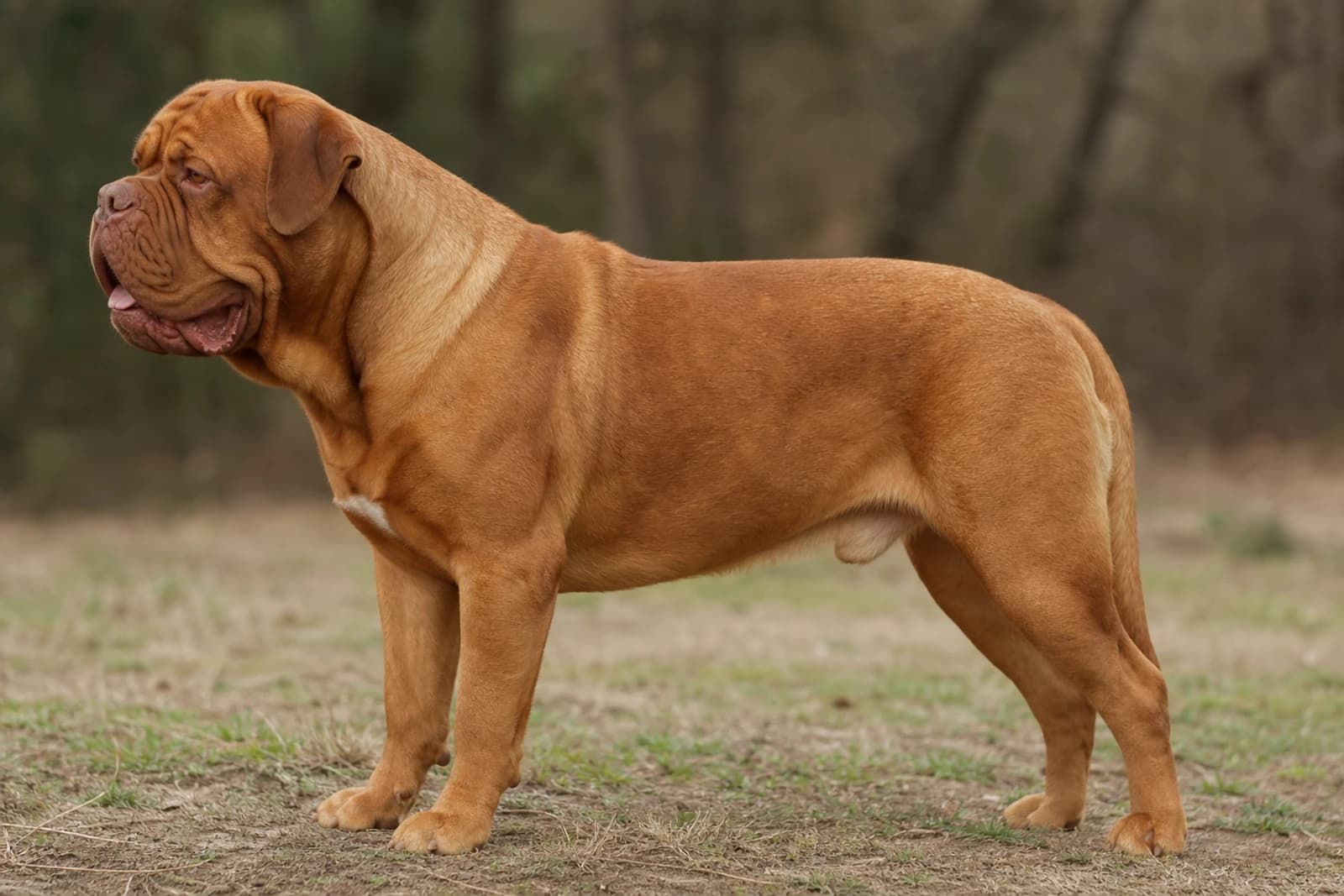
The Dogue de Bordeaux is a giant, muscular guardian with a deep loyalty to its family. Best suited for experienced owners, this calm but protective breed thrives in homes with space and older, respectful children. While affectionate and low-energy indoors, early socialization and firm training are essential to manage its stubborn nature. This drooling, short-coated companion is not ideal for apartments or novices but rewards dedicated guardians with unwavering devotion.
At a glance
- Size
- Giant
- Height
- 23–27 in
- Weight
- 99–110 lb
- Life span
- 10–12 years
- Coat colors
- fawn, mahogany, red
- Coat type
- short and fine
How much does a Dogue De Bordeaux cost?
Adopt / rescue
$200–$600
Usually includes spay/neuter, first shots, and a microchip.
Buy from a breeder
$2,500–$6,000
From a reputable, health-testing breeder.
Approximate USD. Prices vary widely by region, breeder, pedigree, age, and coat colour — adopting is the lower-cost and recommended route. Avoid suspiciously cheap “breeders”; they’re often puppy mills.
Estimate the full cost of a Dogue De Bordeaux →Dogue De Bordeaux photos
Views
Front, side, rear and top — the full silhouette.Poses
How the breed sits, lies, moves and plays.Puppy to senior
The breed across its whole life.Expressions
The breed’s range of moods.Close-up details
Eyes, ears, nose, paws, tail and coat.Coat colors
The breed’s recognized colors.Click any photo to enlarge. We show the Dogue De Bordeaux from every angle — three views, poses, life stages, expressions, close-ups, coat and colors.
Appearance & size
A Dogue de Bordeaux stops you the moment you see his head. It’s enormous — one of the largest in the dog world for the size of the body — and so heavily wrinkled that a deep furrow runs down the forehead like a permanent scowl. The muzzle is broad and blunt, with thick, pendulous lips that hang below the jawline. The eyes are set wide, oval, and hazel to dark brown, and they’re often partly hidden by loose skin. When the dog looks at you, the expression is serious and soulful, never hostile. Ears are set high, small, and slightly darker than the coat; they drop down and flop forward, framing the face.
From the side, you see a body built on low-slung, massive lines. The chest is deep, reaching at least to the elbows, and the neck is a thick, skin-covered column with a prominent dewlap that starts under the chin and continues down the throat. The topline dips just a bit behind the shoulders, then rises into a muscular loin and a moderately angled croup. The tail is thick at the base, tapering to the hocks, and carried low when relaxed.
From behind, the rear is broad and powerful. The hind legs are well angulated, with heavy bone and visible musculature through the thighs. The paws turn neither in nor out, and the loose skin on the hocks and thighs adds to the breed’s characteristic folds.
At the front, the shoulder blades are muscled and laid back. The forelegs are straight, heavy-boned, and set wide, creating a bulldog stance that speaks of raw power. The chest width and the distance between the front legs are striking: a dog that looks ready to knock a door down, but rarely does.
The coat is short, fine, and soft to the touch, lying flat against the body. All shades of fawn are acceptable — from a light, washed-out Isabella to a deep, rich mahogany. A small white patch on the chest and white on the toes are allowed, but not sought after. The coat may have a black or red mask; the black mask is most common and adds to the intense expression, while a red mask is seen in dogs with a lighter overall tone.
A full-grown male stands 23 to 27 inches at the shoulder and weighs 99 to 110 pounds — but the mass is what catches you off guard. This is not a leggy giant; it’s a ground-hugging powerhouse with a ribcage like a wine barrel. Females are proportionally smaller, but equally substantial. Despite the bulk, a well-conditioned Dogue has surprising agility. You won’t mistake him for anything else, and you won’t forget the weight of that stare.
History & origin
You can trace the Dogue de Bordeaux back to at least the 1300s, making it one of France’s oldest and most stubbornly unchanged working breeds. The massive, loose-skinned mastiff we recognize today developed in the Aquitaine region around Bordeaux, but its roots go much deeper—likely descending from Roman molossers and the Alaunt dogs brought by nomadic tribes.
For centuries, this wasn’t a single-purpose dog. A Dogue de Bordeaux guarded isolated châteaux, herded semi-wild cattle, and pulled carts loaded with meat through the narrow streets of market towns. Butchers especially relied on them; a good dogue would keep strangers away from the shop and haul the day’s deliveries without complaint. Wealthy landowners used their power to hunt wild boar and bear, and battlefield accounts from the Middle Ages describe dogs matching this description that were sent into combat wearing spiked collars.
The first written mention often cited is from the 14th-century Livre de Chasse by Gaston Fébus, who referred to a “dogue” used for boar hunting and protection. The breed was formally standardized much later, in 1896, when veterinarian Pierre Mégnin published the first official breed standard. Despite that milestone, the two World Wars nearly erased the breed. By the 1950s, the Dogue de Bordeaux was critically endangered—only a handful of dogs survived, and many weren’t purebred.
The revival came from a dedicated group of French enthusiasts, notably Dr. Raymond Triquet, who painstakingly searched for remaining specimens and rebuilt the breeding stock from the 1960s onward. Without that effort, the breed would have vanished. The Fédération Cynologique Internationale recognized the Dogue de Bordeaux in 1954, and later the breed slowly started spreading outside France.
For many Americans, the breed’s big moment arrived in 1989 with the movie Turner & Hooch. Tom Hanks’ drooling, scene-stealing co-star ignited global interest overnight. While that sudden fame led to irresponsible breeding and a wave of owners who weren’t prepared for a 100-pound territorial dog, it also cemented the breed’s place in popular culture. The American Kennel Club welcomed the Dogue de Bordeaux into the Working Group in 2008, where it stands today as a rare but devoted family guardian.
Temperament & personality
A well-bred Dogue de Bordeaux reads the room before he acts. He’s watchful without being nervous, affectionate without being needy, and confident enough to lounge on the couch for hours—right up until a stranger approaches the door. At 99–110 lb, this is a giant breed with a surprisingly low-key indoor energy level. A couple of 20-minute walks and a good sniff session usually satisfy his exercise requirements, but mental engagement matters just as much. Without it, boredom can quickly turn into destructive chewing or barking, especially in a dog left alone for long stretches.
This is a people-focused breed that forms tight bonds with its entire household. Expect a 100-pound shadow who leans against your legs and follows you from room to room. That forward-leaning posture, while endearing, is also a subtle signal of confidence; a Dogue who stiffens suddenly and locks eyes with a visitor is no longer in couch mode. He’s assessing a potential threat, and you need to respect that shift. Early, ongoing socialization turns this natural wariness into sound judgment rather than suspicion, but the instinct never fully goes away. The breed does best with an owner who can read canine body language—the loose, soft-eyed dog is relaxed; the rigid, staring dog is not. Lip licks, yawns, and head turns are early calming signals worth heeding before a situation escalates.
With his own family, patience runs deep. A Dogue who has grown up with respectful kids often tolerates clumsy hugs and loud play. That said, food guarding is a real possibility in any dog this powerful. Teach children that mealtime is off-limits, and never interrupt him when he’s eating. The same goes for a favorite bone: if you need to take something away, trade for a high-value treat rather than prying it from his mouth.
Strong-willed by nature, the Dogue de Bordeaux responds to calm, consistent leadership—not force. Harsh corrections can backfire, creating a defensive or shut-down dog. Positive reinforcement works, especially when you reward outdoor elimination with a treat right after he goes. (Punishing accidents just teaches him to hide from you, not from the behavior.) Dogs this size can be slow to mature mentally, so expect a long, goofy adolescent phase where selective hearing is normal. Keep training sessions short, fair, and upbeat.
Separation anxiety crops up if the dog’s need for human proximity isn’t met. A Dogue isolated in the backyard or crated for ten hours a day often develops anxious vocalizing and chewing. Hard rubber toys, stuffed Kongs, and scent work help, but at the end of the day this is a breed that needs to be part of the family’s daily rhythm. If you’re gone most of the time, the Dogue de Bordeaux is a poor fit, and no amount of citrus spray on the furniture will fix loneliness.
Good with kids, dogs & other pets
A Dogue de Bordeaux can be a remarkably steady, gentle presence with kids—but that sweet temperament is wrapped in 99 to 110 pounds of muscle and bone. The real risk isn’t aggression; it’s physics. A happy tail swipe clears coffee tables, and a casual body lean can flatten a toddler. You’ll need to supervise every interaction between a young child and a dog this size, not because the Dogue means any harm, but because he genuinely doesn’t know his own bulk. Families with older, sturdier kids who understand how to respect a dog’s space tend to hit the sweet spot.
With other dogs, early and ongoing socialization makes the difference. A Dogue who’s been exposed to friendly dogs from puppyhood—especially during that narrow window before 16 weeks—usually grows into an easygoing, tolerant adult. Some individuals, particularly males, can be selective or pushy with same-sex dogs once they mature, so off-leash hellos should happen on neutral ground and under your watch. Never force interactions; a 100-pound dog who decides he’s had enough is a situation nobody wants.
Cats and small pets are possible, but they require careful, gradual introductions. Raise a puppy alongside a cat, and you’ll often see them coexist without drama—both species napping in the same sunbeam. A Dogue de Bordeaux with a strong chase instinct is less common than in some other breeds, but his sheer mass makes even a clumsy, playful pounce dangerous for a rabbit or a kitten. Keep small animals safely separated when you can’t supervise, and teach a solid “leave it” early.
Socialization isn’t a one-and-done puppy class. The critical period slams shut around 12 to 16 weeks, but your job continues for life. Expose your Dogue to children of all ages, different dogs, new sounds, and varied environments at a pace he can handle. A poorly socialized adult can become fearful and reactive, and at this scale, fear looks a lot like a problem you don’t want to manage after the fact. If you adopt an older dog who’s uneasy around kids or other animals, respect his limits; forcing meet-ups can backfire with a giant breed. The good news: get the social foundation right, and you’ll have a patient, affectionate family member who’d rather lean against your leg than stir up trouble. Just don’t leave him in the backyard for hours—this is a breed that craves close contact and withers without it.
Trainability & intelligence
This isn’t a dog that lives to please you on instinct — the Dogue de Bordeaux is a thoughtful, often stubborn giant who needs a reason to cooperate. Intelligence here looks more like quiet problem-solving than flashy obedience, so training starts with building a real relationship, not just running through commands.
A 110-lb dog who decides to ignore a recall isn’t just frustrating; he’s dangerous. That’s why the work has to begin the moment your puppy comes home. The breed is surprisingly sensitive for its bulk, so harsh corrections shut them down fast. They’ll check out, pretend they can’t hear you, or dig in their heels. What works: a calm, patient tone, high-value treats, and training sessions that feel like a conversation, not a drill. Even then, expect a delay — these dogs process a request before acting on it, which novices mistake for disobedience.
Early socialization is non-negotiable. Between 3 and 14 weeks, expose your puppy to a checklist of new people, friendly dogs, different flooring textures, and everyday sounds like doorbells and delivery trucks. A poorly socialized Dogue can tip into suspicion or fear-based reactivity, and you do not want to manage that in a dog of this size. Keep all introductions positive and gradual — force a meet-and-greet and you’ll create the exact wariness you’re trying to prevent.
Formal obedience classes help a lot, but pick a trainer who understands guardian breeds and uses relationship-based, reward-centric methods. You’re teaching lifelong manners for a dog that will outweigh many adults: polite leash walking, a solid “wait” at doors, and a reliable “drop it.” The recall will probably never be whippet-fast, but you can build a trustworthy response if you never punish a slow return. Set the foundation now, and you’ll end up with a stable, attentive companion who chooses to check in with you instead of ignoring you.
Exercise & energy needs
Your Dogue de Bordeaux runs hot—literally. That broad chest and pushed-in muzzle make him a champion napper, not a distance athlete. Overexertion and heat are real risks, so the whole exercise conversation starts with short, cool, and low-impact.
Plan on 30–45 minutes of total daily movement, split into at least two easygoing sessions. A couple of 15- to 20-minute leash walks in the early morning and late evening, when the pavement is cool, is a good baseline. Let him amble and sniff rather than power-walk; the mental payoff from investigating the neighborhood often tires him out as much as the physical part. Swap one walk for a 10-minute romp in a safely fenced yard if you have one, but never leave him outside in warm weather unattended—he can overheat fast.
Because this breed carries serious mass on a frame that’s prone to joint stress, keep exercise low-impact from puppyhood through old age. No jogging, no jumping for a frisbee, no steep stair repeats. Swimming or wading in shallow water is fantastic when the temperature cooperates—it works muscles without pounding elbows and hips. Puppies under 18 months need an even lighter hand: short play bursts and controlled walks only, protecting those growing growth plates.
Mental work matters just as much as the walk. A Dogue who’s bored will redecorate your couch. Stash his meals in a puzzle feeder or a frozen Kong, hide treats in a snuffle mat, or teach a simple “find it” scent game indoors. A 10-minute training session on basic cues counts toward his daily fatigue budget and tightens your bond.
Watch for heavy panting, drool that turns thick, or a sudden refusal to move—those are signs to stop, cool him down, and try again later. A consistent but gentle routine, year-round, keeps him muscular, level-headed, and outrageously content.
Grooming & coat care
The Dogue de Bordeaux wears a short, fine single coat that lies smooth against the body. It’s a low-maintenance coat in terms of brushing, but the breed’s real grooming commitment lives in those expressive wrinkles. You’ll also contend with more drool than most families are prepared for — wipe rags become part of your daily gear.
Brushing
A soft bristle brush or a rubber curry mitt is all you need. The coat has no undercoat to strip out, so weekly sessions remove loose hair, distribute natural oils, and bring up a rich, glossy shine. Colors range from deep mahogany to light isabella fawn, often with a black or brown mask, and a good brushing makes the pigment pop. During spring and fall, you might notice a slight uptick in shedding; bumping brushing to two or three times a week keeps the floors manageable. Whatever you do, skip the slicker or pin brushes — they’re overkill for this coat.
Wrinkle care and bathing
The facial folds and the area around the muzzle need the most attention. Dampness and food debris get trapped, setting up yeast or bacterial infections. Wipe the creases daily with a damp, soft cloth, then dry thoroughly. Bathe the dog every 4–6 weeks or when he rolls in something fragrant. Use a gentle dog shampoo and be meticulous about rinsing and drying inside the wrinkles. A waterless shampoo or dog-safe wipes bridge the gap between baths.
Nails, ears, and teeth
Giant breeds tend to wear their nails down less on hard surfaces, so you’ll likely need to trim every 2–3 weeks. Overgrown nails can torque the toes and make that bulky 110-pound frame uncomfortable. Floppy ears trap moisture, so flip them open weekly, check for redness or odor, and clean with a vet-approved solution. Brush teeth daily if you can, or at minimum three times a week, to combat the tartar buildup common in massive jaws.
Shedding and seasonal care
This breed doesn’t blow coat dramatically. You’ll see steady, moderate shedding year-round with a small seasonal nudge. The real heavy lifting isn’t the hair — it’s wrinkle hygiene. Stay on top of that, and the rest of the routine virtually takes care of itself.
Shedding & allergies
A Dogue de Bordeaux sheds steadily — you’ll spot short, fawn-colored hairs on dark pants even when the dog is across the room. The coat is a single, fine layer that releases hair year-round, with a heavier blowout in spring and fall when warm weather returns or winter undercoat needs to go. Weekly brushing with a rubber curry or hound glove cuts down on what ends up on the couch, but you’re still going to vacuum more than you’re used to.
Drool is the real domestic headline. Those loose, fleshy jowls don’t just hang — they funnel water, food, and saliva. After a drink, expect a dripping trail from the bowl across the floor. A meal turns into a slobbery face-wiping ritual against your pant leg. When the dog shakes its head, long strings of drool can hit walls, cabinets, and ceiling spots you won’t notice until they dry. Some owners keep dedicated “drool rags” stashed in every room.
On the allergy front, let’s be blunt: this is not a breed for sniffly households. There’s no truly hypoallergenic dog, but the Dogue de Bordeaux piles on the triggers. Dander clings to the shed hair, and the moisture in the drool spreads allergy-provoking proteins everywhere the dog goes. If you or a family member already react to dogs, spending a weekend in a home with an adult Dogue will tell you more than any description can.
Diet & nutrition
Carrying extra weight on a frame this massive punishes joints that are already under a lot of pressure. A Dogue de Bordeaux should look solid, not stuffed. Adults clock in around 99–110 lb, and almost every one will try to convince you they’re starving. That food drive makes obesity a real risk, so portions belong in a measuring cup — not guessed.
For most moderately active adults, 4–6 cups of a quality large-breed kibble per day, split into two meals, keeps things on track. A Dogue who gets a solid hour of walking and romping might need the upper end; a couch potato who ambles around the yard likely needs closer to 3.5–4 cups. If you’d rather count calories, figure roughly 1,800–2,200 a day for a 100 lb dog and adjust based on how his ribs feel under your fingers. Every training treat, cheese cube, and kong filler counts against that total.
Puppies put on mass fast, and you want steady growth, not runaway speed. Start on a large-breed puppy formula from weaning, fed as four evenly spaced meals until four months old, then three meals until six months, then the two-meal adult rhythm. Around twelve weeks, a raw chicken wing or neck (under supervision) gets those jaws working and introduces whole food, but only if you’re comfortable handling raw safely.
A whole-food approach suits this breed well. Aim for about 60% muscle meat and organs, 20–30% dog-safe fruits and veggies, and 10% extras like eggs, plain yogurt, or steamed grains — pearl barley and white rice are gentle, digestible options. Because dogs’ jaws move only up and down and saliva lacks the enzymes we have, puréeing or blending plant ingredients helps them absorb more nutrients. Unsalted water from cooking vegetables works as a fast, low-fat base for homemade meals.
This deep-chested breed inhales food if you let him. A puzzle bowl or slow feeder cuts down on gulping and gives that big head something to figure out. And never feed from the table — begging is a nightmare to undo. Leftover safe bits go into the dog’s own bowl, nowhere near your plate.
Senior Dogues, especially the ones who slow down, will pile on pounds if nobody adjusts their intake. Decrease daily calories in small steps as activity drops, and consider three or four smaller meals instead of two big ones. There’s no need to slash protein — keep animal protein quality high to hold onto muscle that supports aging joints. If teeth are worn or sore, puréeing the whole meal makes nutrition easier to absorb.
Avoid rich, fatty leftovers like holiday ham trimmings or bacon grease. A single high-fat blowout can trigger pancreatitis in this breed, which is both painful and dangerous. Stick to routine, measure everything, and let that broad chest stay strong without hauling around extra weight.
Health & lifespan
A well-bred Dogue de Bordeaux typically lives 10–12 years. That’s a respectable run for a dog who weighs north of 100 pounds, but you earn every extra year through careful breeding choices and a few non-negotiable daily habits.
The breed can be prone to several orthopedic and cardiac conditions you should know about up front. Hip dysplasia and elbow dysplasia appear frequently in giant dogs, and this one is no exception. A responsible breeder screens both parents through the Orthopedic Foundation for Animals (OFA) or PennHIP and shares those scores openly — verbally reassuring you isn’t enough. Dilated cardiomyopathy (DCM) — a progressive weakening of the heart muscle — runs in some lines, so ask for a recent echocardiogram clearance from a veterinary cardiologist, not just a stethoscope check.
Those loose, expressive folds create their own problems. A Dogue can inherit entropion (eyelids that roll inward) or ectropion (lids that droop outward), both of which lead to chronic squinting, tearing, and corneal irritation. The same deep wrinkles that give the breed its signature look trap moisture, yeast, and bacteria, making skin fold dermatitis a recurring battle. Daily wipe-downs with a clean, dry cloth help, but expect to keep medicated wipes or ointments on hand.
Perhaps the most urgent threat is gastric dilatation‑volvulus (bloat). A deep chest and a tendency to inhale food put this breed in the high-risk category. Feed two or three smaller meals, use a slow-feeder bowl, and keep the dog calm for at least an hour after eating. Learn the early signs — restlessness, a distended belly, unproductive retching — because bloat kills without emergency surgery.
Weight is everything. A young Dogue packs on size shockingly fast, and extra pounds punish developing joints. Keep adults lean; you should feel ribs under a thin layer of flesh. Obesity fire-hoses arthritis and can easily lop years off a giant dog’s life.
That pushed-in face is endearing, but it turns the Dogue into a terrible heat-tolerator. Overheating can happen in minutes. Never leave him in a parked car, walk in early morning or evening during hot months, and watch for heavy panting, thick drool, or unsteadiness. Cold isn’t as dangerous, but a winter coat for prolonged freezing-weather outings isn’t overkill.
Beyond breed-specific worries, keep core prevention tight. Heartworm prevention goes monthly during mosquito season and one month after. Rabies vaccination is legally required and fatal once symptoms start, so no exceptions. Schedule a full physical once a year, and switch to twice-yearly exams once he hits seven. Subtle weight drop, reluctance to rise, or a fading appetite can be the first whisper of a heart or joint problem — catching it early keeps your options open.
When you talk to breeders, demand the paperwork: OFA hip and elbow scores, a cardiac echo report, and an eye exam dated within the last year. If a breeder can’t hand them over, walk away. That upfront scrutiny is the single biggest lever you have for stacking the odds toward a long, comfortable life.
Living environment
A Dogue de Bordeaux can surprise you with how little indoor space he actually needs. At 99–110 pounds, this giant is a champion napper, often content to sprawl on a cooling mat for hours. That said, the environment has to work around his physical vulnerabilities, not just his mellow attitude.
Apartment living is possible, but only if you're on the ground floor or in a building with an elevator. Stairs are hard on growing joints and can worsen elbow and hip issues over time. You'll also need easy access to a shaded outdoor spot, because potty breaks must be quick when it's hot. These dogs overheat fast—a brachycephalic face combined with a massive body makes heat and humidity genuinely dangerous. Air conditioning is non-negotiable, and outdoor time during summer should be limited to early morning or late evening. They're far more comfortable in cooler climates.
A fenced yard is a bonus but not a must; this isn't a breed that races laps for fun. What a yard does provide is a private place for short, slow-paced potty breaks and scent exploration without the pressure of a long walk when temperatures spike. Daily exercise doesn't demand a huge time commitment: two 20-minute walks during the coolest hours, paired with a puzzle feeder or a frozen Kong, usually keeps him physically and mentally satisfied. Just avoid high-impact play—no frisbee leaping or hard running on pavement.
Noise-wise, the Dogue is typically quiet indoors. You'll hear a deep, rumbling bark when someone approaches the door, but he's not a constant barker.
The real sticking point is being left alone. These dogs bond fiercely with their people and are prone to loneliness and separation anxiety. A household where someone is home most of the day is ideal. If you must work away, plan for a midday break from a neighbor or walker, and start early on alone-time training with gradual absences and long-lasting chews. Leaving a heartbroken Dogue de Bordeaux crated for eight hours is a recipe for drool-soaked destruction and miserable howling.
Who this breed suits
This breed fits best with an owner who's already handled a large, strong-willed dog and isn't fazed by a little chaos. You need enough physical strength to manage 110 pounds of muscle when a squirrel dashes by, plus the patience to train a dog that matures slowly and can be as stubborn as he is devoted. If you’re a neat freak, this isn’t your dog — slobber will decorate your walls, furniture, and clothes daily. A sense of humor about drool and snoring is non-negotiable.
Families with sturdy older kids often do well; the Dogue's natural protectiveness and gentle indoor presence make him a loyal shadow, but toddlers risk getting bumped over by that blocky frame. Singles or couples who work from home or have a predictable schedule thrive here because this breed craves near-constant human contact and can develop separation anxiety if left alone for long stretches. A securely fenced yard matters more than marathon runs. Two or three 20–30 minute walks plus some mental work is plenty — they're couch potatoes indoors, but without a proper outlet they'll turn into 100-pound bulldozers.
Who should think twice:
- First-time dog owners. A Dogue de Bordeaux rarely forgives inconsistency or soft handling. Early and ongoing socialization is mandatory to keep guarding instincts in check, and a novice can easily get overwhelmed by the breed’s combination of power and selective hearing.
- Apartment dwellers or anyone with noise-sensitive neighbors. That massive head pushes out epic snores, and many Dogues communicate with a deep, rumbling bark that carries through walls.
- People living in hot, humid climates without air conditioning — the short muzzle makes overheating a real danger even with modest activity.
- Homes with same-sex dogs, especially males. Dog aggression can surface at maturity, and two intact males are a recipe for trouble without very careful management.
- Anyone who prioritizes a tidy house, a dry couch, or a travel-friendly dog. These giants shed, drool, and don’t fit under an airplane seat. They’re homebodies who see a weekend away from you as punishment, not a vacation.
Cost of ownership
Purchase Price
- A well-bred puppy from a breeder who health-tests parents and proves working or conformation titles typically costs $2,000–$4,000.
- Rescue adoptions through breed-specific groups usually run $200–$500, though you may face unknowns about health history.
Monthly Food Bill
A full-grown Dogue De Bordeaux eats like the giant he is. At 99–110 lb, count on 4–5 cups of high-quality dry kibble a day—roughly a 30‑lb bag every two to three weeks. That works out to $80–$120 a month. If you add a joint supplement (glucosamine with chondroitin is common for this dysplasia-prone breed), tack on another $20–$40.
Grooming
The short, single coat keeps grooming cheap. A rubber curry brush, an occasional bath, and regular nail trims are all you need. DIY supplies might run $20 a month; a pro bath and tidy every few months costs $50–$80 if you go that route, but plenty of owners never do.
Veterinary Care and Insurance
Routine care is weight-dosed, so it stings. Annual exams, vaccines, and heartworm/tick preventatives easily reach $300–$500 upfront, plus $40–$60 monthly for preventatives. That’s just maintenance. The breed’s predisposition to bloat, dilated cardiomyopathy, and elbow/hip dysplasia means one emergency can blow past $5,000. Pet insurance for a giant breed typically lands between $70 and $110 a month with solid coverage. Without it, you’d need a dedicated pet emergency fund of at least $200–$300 monthly to keep a crisis from becoming a catastrophe.
Choosing a Dogue De Bordeaux
Breeder or Rescue?
A giant, sensitive dog with a short 10–12 year lifespan is not a casual decision. You can find a Dogue de Bordeaux through a rescue—and there are often adults needing rehoming because someone underestimated the drool, the size, or the early health costs. If you go that route, ask about any known orthopedic history and whether the dog has shown signs of bloat. A good rescue will be brutally honest.
Buying from a breeder puts more control in your hands, but only if you find someone who treats their dogs as family members, not livestock. Expect to be interviewed, not just handed a receipt. The best breeders show their dogs, belong to the Dogue de Bordeaux Club of America, and will take the dog back at any age for any reason.
Health Clearances You Should Ask For
A 110 lb dog puts enormous stress on a growing skeleton. You want written proof, not a verbal “they’re fine.” Ask to see OFA or PennHIP results for hips and elbows on both parents, rated fair or better (excellent, good, or fair for OFA hips). Cardiac clearance from a board-certified veterinary cardiologist is non-negotiable—this breed can suffer from dilated cardiomyopathy. You also need a current eye exam by a veterinary ophthalmologist (look for CERF or OFA eye clearance), because entropion and ectropion are common and painful. Some breeders also screen thyroid function. If a breeder shrugs off any of these, walk away. A responsible breeder will have the paperwork ready and explain which lines carry what risks.
Red Flags That Scream Walk Away
- Multiple litters on the ground at once, or puppies always available.
- No health testing “because our dogs are healthy.”
- Puppies leaving before 10 weeks—giant breeds need that extra littermate time for bite inhibition and early social skills.
- Prices drastically below the typical $2,000–3,500 range for a well-bred Dogue.
- Breeder doesn’t ask about your home, fencing, experience with giant breeds, or how you plan to handle the drool and the potential for bloat.
- A contract that doesn’t spell out what happens if your puppy develops a genetic heart defect or severe hip dysplasia before age two.
Picking the Right Puppy
Visit the litter in person. The puppies should be in a clean indoor area, not isolated in a kennel. You want to see at least the dam (the sire might not be on site, which is normal) and she should be calm but watchful, not a trembling mess. Puppies ought to be sturdy, with clear eyes, no nasal discharge, and no obvious breathing noise at rest—though a Dogue’s face is so short, some snorting is expected. Watch them move: a puppy that bunny-hops or seems stiff in the rear might already have early joint trouble. Temperament matters just as much. A Dogue de Bordeaux is naturally devoted and confident; avoid the pup that hides in the corner or the one who barrels into you without a shred of inhibition. Ask the breeder which puppy they’d place in a family with kids, and why. They’ve seen these pups daily—lean on that insight.
Pros & cons
Pros
- Velcro-like loyalty — This breed wants to be with you, often leaning a solid 110 pounds against your leg. Quiet and watchful, he’s a natural deterrent who rarely acts out without reason.
- Surprisingly mellow indoors — Give him a solid walk or 30–45 minutes of daily exercise and he turns into a giant floor rug, content to nap while you work or watch TV.
- Easy grooming — The short, fine coat sheds seasonally. A weekly rubber curry brush picks up loose hair, and a wipe with a damp cloth tackles mud. No pricey trims needed.
- Patient with kids who know how to behave — Raised with respectful children, a well-socialized Dogue de Bordeaux is often tolerant and gentle, though constant supervision around little ones is a must because of sheer size.
Cons
- Drool everywhere — Loose jowls produce thick ropes of slobber. You’ll find it on walls, furniture, and guests. This is not a dog for someone who cringes at a messy house.
- Heat and breathing troubles — The short muzzle limits cooling. Skip hot-day walks and keep air conditioning on. Brachycephalic snoring can rattle windows.
- A stack of potential health issues — Responsible breeders screen for hip and elbow dysplasia, aortic stenosis, dilated cardiomyopathy, and certain cancers. A 10–12 year lifespan is decent for a giant breed, but diagnostics and treatments get pricey.
- Stubbornness meets sensitivity — He’ll dig in his heels if pushed, yet shuts down under harsh correction. Training demands patience, short sessions, and a calm, positive approach. Bribing with treats is easy; bracing for the drool afterward is not.
- High cost to feed and maintain — Premium food for a 99–110 lb dog, double doses of preventives, and giant-breed veterinary care add up fast. One major surgery can blow a budget.
- Not for a first-time owner — Untrained strength plus a quiet guardian instinct can become dangerous. Early, relentless socialization and a handler who can lead without force are non-negotiable.
- Selective with other dogs — Same-sex aggression or reactivity toward unfamiliar dogs is common in some lines. A dog-park social butterfly is the exception, not the rule.
Similar breeds & alternatives
If you love the Dogue de Bordeaux’s massive head and deep loyalty but wonder about other options, a few mastiff breeds share that protective core — yet differ in size, energy, and upkeep.
English Mastiff
The English Mastiff takes “giant” a big step further. While a Dogue de Bordeaux tops out around 110 pounds and 27 inches, an English Mastiff often pushes 160 to 230 pounds. That extra bulk comes with a shorter life expectancy of 6 to 10 years, compared to the Dogue’s 10 to 12. Both dogs produce rivers of drool and snore like freight trains, but the Mastiff is generally more easygoing with strangers once properly introduced. Inside the house, neither demands a marathon; a couple of short walks and some sniffing around the yard suffice. The Mastiff’s coat is shorter and comes in brindle, fawn, or apricot, but it lacks the Dogue’s deep red mask and dramatic wrinkles. The trade-off for that undeniably imposing frame is a lifespan that’s several years shorter.
Bullmastiff
Think of the Bullmastiff as a more agile, slightly leaner cousin. At 100 to 130 pounds and 24 to 27 inches, it’s in the same size ballpark but carries itself with more hustle. Bred to silently catch poachers, the Bullmastiff is a quick, quiet guardian rather than the Dogue’s lumbering presence. It still drools and has a pushed-in face, but the wrinkles are less extreme, meaning less skin-fold cleanup. The lifespan is 7 to 9 years, shorter than the Dogue’s, and you should expect a bit more daily exercise — a solid half-hour romp plus a walk. If the Dogue’s relaxed, couch-loving demeanor appeals but you want a dog that can keep up on a hike, the Bullmastiff hits a sweet spot without sacrificing the loyal, protective nature.
Cane Corso
The Cane Corso matches the Dogue’s protective intensity but channels it into a higher-energy, more trainable package. Standing 23.5 to 27.5 inches and weighing 88 to 110 pounds, the Corso is similarly sized yet looks and acts like a true working dog. The muzzle is notably longer, so breathing problems and heat intolerance are less severe than in the very flat-faced Dogue. Drool? Some, but far less than a Dogue or Mastiff. The Corso needs at least an hour of vigorous exercise daily, plus challenging mental work — this is not a dog content to lounge all afternoon. Lifespan is comparable at 9 to 12 years. If the Dogue’s stubborn streak and laid-back indoor vibe feel too mellow, a Cane Corso will demand much more from you, but offers an athletic, responsive guardian in return.
Fun facts
- One of the oldest French breeds, descending from the Roman Molossus.
- Rose to fame as the drooling co-star in the 1989 movie 'Turner & Hooch'.
- Known for their massive head and deeply wrinkled face.
- These gentle giants can produce up to 1.5 liters of drool per day.
Frequently asked questions
- Are Dogue de Bordeaux good with children?
- The Dogue de Bordeaux can be a gentle and loyal family companion when well-socialized from puppyhood. Their large size and occasional clumsiness mean supervision is essential around young children. They tend to be patient and protective, making them good family dogs for experienced owners.
- How much do Dogue de Bordeaux shed?
- Dogue de Bordeaux have a short, fine coat that sheds moderately year-round. Regular weekly brushing helps manage loose hair, and they may experience heavier shedding during seasonal changes. They are not considered hypoallergenic.
- What is the daily exercise requirement for a Dogue de Bordeaux?
- This giant breed requires moderate daily exercise, such as a few short walks or play sessions, to stay healthy and prevent obesity. Due to their brachycephalic traits, strenuous exercise in hot weather can be dangerous, so early morning or evening activity is best.
- Are Dogue de Bordeaux easy to train?
- Dogue de Bordeaux are intelligent but can be strong-willed, so consistent, positive training from an early age is crucial. They respond well to firm yet gentle guidance, but their independent nature may challenge novice owners. Early socialization helps ensure a well-mannered adult dog.
- Can a Dogue de Bordeaux adapt to apartment living?
- Despite their massive size (99–110 pounds), Dogue de Bordeaux can adapt to apartment life if given sufficient daily exercise and mental stimulation. However, their size, potential for drooling, and loud snoring may not suit all living situations. A ground-floor unit with easy outdoor access is ideal to avoid strain on joints from stairs.
Tools & calculators for Dogue De Bordeaux owners
Quick estimates tailored to Dogue De Bordeauxs — pre-filled with this breed’s size where it matters.
Articles & stories about the Dogue De Bordeaux
Sources & standards
This profile follows recognized breed standards from the American Kennel Club (AKC) and the Fédération Cynologique Internationale (FCI), along with established veterinary and breed-club guidance. These describe general breed tendencies — every dog is an individual.
Owner stories
Have a Dogue De Bordeaux? Share your experience — grooming tips, personality quirks, anything goes.