

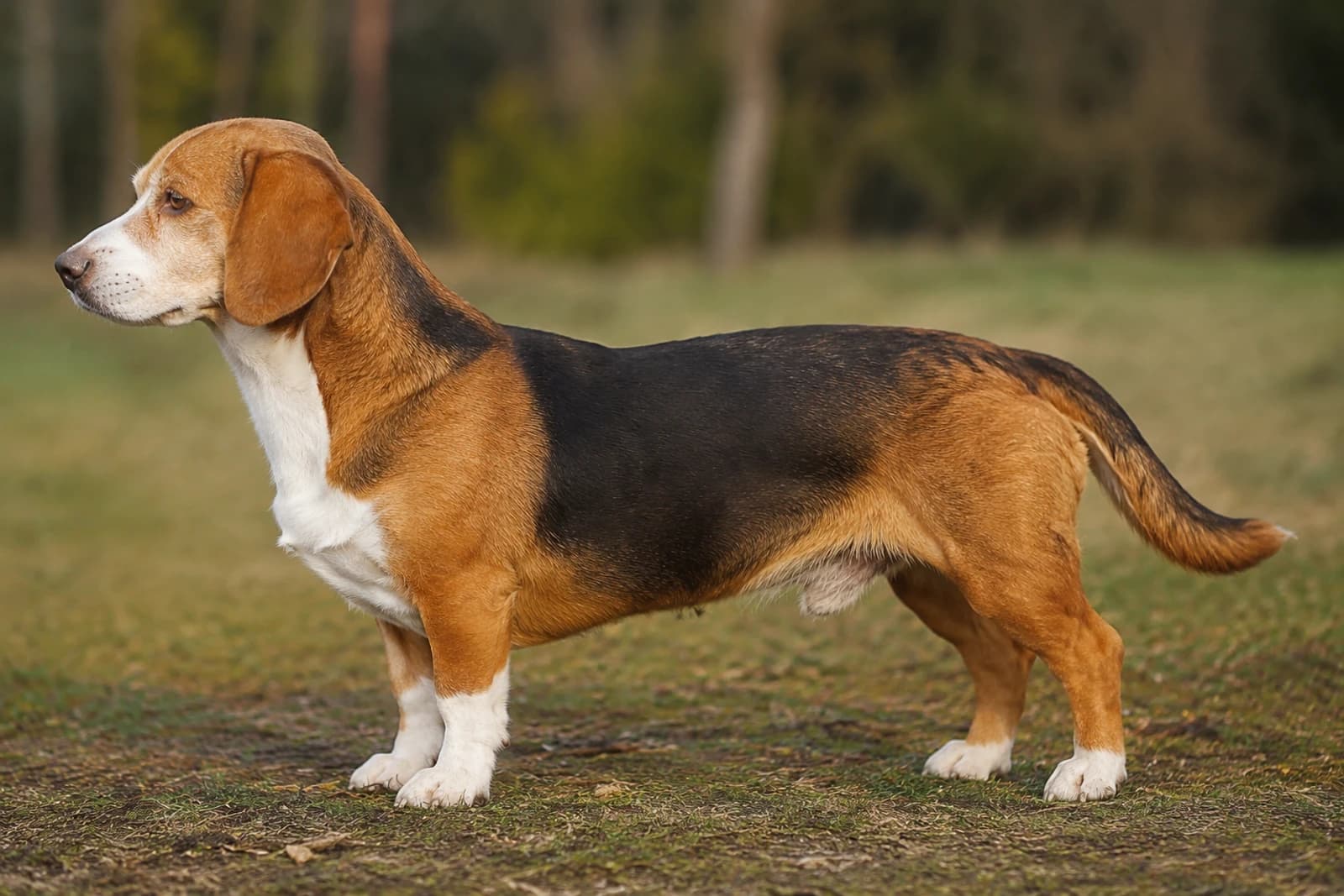
The Drever is a robust, short-legged scent hound from Sweden, prized for its tracking ability and calm, friendly nature. Ideal for active families or individuals who enjoy outdoor adventures, this breed thrives with consistent training and ample exercise. Drevers are loyal, good-natured, and especially patient with children, but their strong hunting instinct requires a secure yard and leash walks. They suit owners seeking a versatile hunting companion or a steadfast family dog with a moderate energy level and a big heart.
At a glance
- Size
- Medium
- Height
- 12–15 in
- Weight
- 31–35 lb
- Life span
- 12–14 years
- Coat colors
- fawn, red, black and tan, tri-color
- Coat type
- short, dense, and harsh
- Group
- Scenthounds
How much does a Drever cost?
Adopt / rescue
$75–$400
Usually includes spay/neuter, first shots, and a microchip.
Buy from a breeder
$700–$2,000
From a reputable, health-testing breeder.
Approximate USD. Prices vary widely by region, breeder, pedigree, age, and coat colour — adopting is the lower-cost and recommended route. Avoid suspiciously cheap “breeders”; they’re often puppy mills.
Estimate the full cost of a Drever →Drever photos
Views
Front, side, rear and top — the full silhouette.Poses
How the breed sits, lies, moves and plays.Puppy to senior
The breed across its whole life.Expressions
The breed’s range of moods.Close-up details
Eyes, ears, nose, paws, tail and coat.Coat colors
The breed’s recognized colors.Click any photo to enlarge. We show the Drever from every angle — three views, poses, life stages, expressions, close-ups, coat and colors.
Appearance & size
A Drever looks like a full-sized scenthound compressed into a low-slung, muscular package. The breed stands just 12 to 15 inches at the shoulder and a healthy adult sits right between 31 and 35 pounds, so you get a substantial, heavy-boned dog on remarkably short legs — not delicate or toyish, but workmanlike and robust.
The body is distinctly longer than it is tall, with a level topline and a deep, broad brisket that reaches down to the elbows. From the side you can see the spring of well-sprung ribs and a moderate tuck-up that keeps the silhouette athletic rather than slabby. The neck is strong and clean, blending into smooth, sloping shoulders. The chest, viewed from the front, is wide and deep, with straight, short forelegs set squarely under the body; slight pasterns give just enough shock absorption when the dog is working rough ground. In the rear you’ll find a well-angulated hindquarter with parallel hocks and a muscular upper thigh, which balances the forward-heavy build.
The head is long and fairly broad, with a slight stop and a muzzle that tapers just a little. Expression is calm, intelligent, and alert. The ears are a key breed hallmark: set low, hanging flat against the cheeks, wide and long enough to nearly reach the nose when pulled forward, with a slight fold that frames the face. Eyes are medium-sized and dark, never protruding, and the dark-rimmed lids contribute to a soft but focused look. The tail is a natural extension of the topline — long, strong at the base, carried saber-like or with a gentle curve, but never curled over the back.
The coat is hard, dense, and straight, lying close to the body. It’s a practical, weather-resistant jacket that needs next to no fuss. Colors show the Drever’s scenthound heritage: you’ll see everything from solid red or fawn to black and tan, often with a sprinkling of white markings on the chest, toes, tail tip, or as a thin collar or blaze. Tricolors (black, tan, and white) are common and very typical.
Because the Drever’s build puts extra stress on the spine, keeping weight in check is non-negotiable. This is a sturdy little hound, but extra pounds quickly turn a sound, agile worker into a dog that struggles to move freely and risks back strain.
History & origin
The Drever was purpose-built to hunt deer in Sweden’s tangled, snowy forests, and its name gives you a direct clue. “Drev” is Swedish for the kind of hunt that pushes game steadily, not in a panicked sprint. If you want a hound that stays close, works thick cover, and moves a deer at a walk or slow trot, you breed for short legs and enormous staying power.
In the early 1900s, Swedish hunters relied on the Westphalian Dachsbracke, a German scenthound that looked like a larger, leggier Dachshund. It did the job, but not quite right for tight Scandinavian woods. Breeders started crossing those Dachsbracke with local Swedish hounds—dogs already adapted to the terrain—to create a lower, sturdier scenthound that could duck under brush and keep a chase manageable. By the 1910s and 1920s, the type we now call the Drever had emerged: a dog standing just 12 to 15 inches, weighing 31 to 35 pounds, with the long body and drop ears of a dedicated scent trailer.
The Swedish Kennel Club officially recognized the breed in 1947, and the FCI followed in 1955. Before that, the Drever had worked Swedish forests for decades without a separate name, often simply lumped in with Dachsbracke. Once recognized, the breed’s popularity surged among hunters who needed a hound that wouldn’t overrun the game. The Drever’s style—slow, persistent, and vocal—let a hunter on foot predict where the deer would cross and move into a clear shooting lane.
Today, Drevers remain the most commonly used hunting hound in Sweden, but outside Scandinavia they’re still a rare sight. In the United States, a small number of dedicated importers are slowly introducing the breed; you’re far more likely to find them registered with the United Kennel Club than the AKC. Their fanciers are drawn to a scenthound that’s equal parts tireless trail dog and easygoing house companion—a combination that traces straight back to those early Swedish breeders who wanted a tough little dog that could handle a full day of drev and still curl up at the hearth.
Temperament & personality
A Drever’s personality runs on two gears: steady and determined. On a scent trail, they’re fearless, focused, and can keep going long after you’d expect a short-legged dog to tire. At home, that drive switches off and you get a calm, gentle housemate — but calm and gentle are behavioral tendencies, not fixed guarantees. Every dog is an individual, shaped by breeding, upbringing, and environment. These dogs are pack hounds through and through. They typically mesh well with other dogs and prefer company over solitude; long stretches of isolation can trigger anxiety-driven barking or destructive chewing.
They’re moderately energetic. A long daily walk plus dedicated sniff time in a secure area satisfies their physical and mental needs. Drevers are affectionate without being clingy — they’ll lean against your leg, follow you from room to room, and greet you with a thorough nose-to-shoes investigation, but they won’t demand constant lap space.
Watchfulness comes naturally. A Drever’s deep, rolling bark will announce strangers, unfamiliar scents, or suspicious squirrels, but aggression isn’t their style. They alert and assess. With early socialization, they learn to separate normal daily noises from genuine cause for concern.
In the household, they’re solid companions for families that understand scent-driven behavior. That powerful nose dictates a lot of quirky moves. Puppies explore the world by chewing, and adults keep their jaws strong by gnawing — so provide plenty of appropriate chews and use a citrus or vinegar spray to protect off-limits items. Some Drevers are enthusiastic rollers of foul-smelling stuff, a throwback to masking their scent or just relishing a stink. Expect a dog that may mark territory indoors if urine scents linger; clean accidents promptly with an enzymatic cleaner to break the re-soiling cue. Don’t interpret a backward-leaning posture as shyness without looking at the whole picture: a forward lean often signals confidence, while stiff body posture with a direct stare can precede a defensive snap.
Food-time respect is non-negotiable. Teach children to let the dog eat peacefully to prevent resource guarding. Watch for calming signals like lip licking, yawning, or turning the head away — those mean the dog needs space. House training clicks faster when you reward outdoor elimination immediately with a treat. Because Drevers can associate specific scents with past experiences, a less-frequented room might become an accident spot if it doesn’t carry the family’s scent blend. Keep those areas ventilated and occasionally walked through to reinforce that the whole house belongs to the pack.
Good with kids, dogs & other pets
A Drever’s low-to-the-ground, 31–35-pound build is naturally forgiving with children — they’re sturdy enough not to be knocked over by an excited hug, yet small enough that a toddler won’t be steamrolled. Their temperament is patient and non-confrontational, so when kids know how to interact gently, the combination works. Still, no dog should be left unsupervised with a small child who hasn’t learned to give space. Even the most tolerant Drever will correct a tail pull or an ear grab if pushed too far.
With other dogs, this pack-bred scenthound usually fits right in. Drevers were developed to hunt alongside other hounds, so they read canine social cues well and rarely start trouble. A new adult dog of similar size will typically be accepted after a brief, neutral introduction. Off-leash play in a fenced yard or on a long line tends to be far more satisfying than tight quarters at a crowded dog park, where the scent-driven part of their brain can override good manners the moment a trail lights up.
Cats and small pets are the category where you need to be honest about what a Drever is. They’re scent hounds with a deep urge to track and flush game. A Drever puppy raised with a resident cat from the 3-to-14-week socialization window often learns the family feline is off-limits, and they’ll snooze on the same couch. But introduce an adult Drever to a cat or let either one meet a fleeing rabbit, ferret, or guinea pig, and that short-legged body will spring into hunting mode. The chase is instinct, not malice, but it’s fast, loud, and dangerous for the smaller animal. So if your home includes free-roaming small pets, start with a puppy and supervise every interaction for months — and still keep caged rodents or birds behind a closed door when you’re not there.
Early socialization is what moves the needle on all of these relationships. Drever puppies need gradual, positive exposure to children of different ages, friendly adult dogs, and (if applicable) household cats, plus the everyday sounds and surfaces of your life, before the window starts closing around 12–16 weeks. Miss that period and you’ll still be able to shape an adult Drever’s world, but pushing a shy or anxious adult into dog-park chaos usually backfires; forced interactions can spike stress and even trigger a fight. It’s perfectly fine if your adult Drever is content with his immediate family and a handful of known dog pals rather than acting like a canine social butterfly.
A last piece that ties into children and other pets: Drevers crave companionship. Leave one alone in the backyard for long hours and you’ll get howling, digging, and a dog who’s too pent-up to be calm around kids. Involve them in the daily rhythm — a snuffle mat in the kitchen while the kids do homework, a walk where your child holds a second leash, an evening spot on the couch — and that steady, patient nature has a chance to shine.
Trainability & intelligence
A Drever learns differently than a border collie. This is a scenthound with a sharp, independent mind. Intelligence here isn’t about drilling a perfect sit-stay for five minutes. It’s about problem-solving a deer track, navigating dense cover, and making decisions at a distance from you. So training becomes a negotiation, not a command performance.
You’ll get the best results by leaning hard into positive reinforcement—specifically, tiny, high-value food rewards and bursts of play. The nose rules everything, so a treat hidden in a snuffle mat or a “find it” game builds focus faster than repetition drills. Motivation tanks the second you raise your voice or try to force compliance. These dogs shut down under pressure and can become stubborn or avoidant.
Recall is the real test. When a scent trail lights up, your Drever’s hearing effectively switches off. Off-leash reliability without a fenced area takes months of patient, incremental proofing. Start training from puppyhood, with reward-based methods, and avoid the trap of punishment—it only teaches your dog you’re unpredictable, not that you’re the boss.
Socialization needs the same gentle touch. Before 16 weeks, introduce your puppy to an array of people, sounds, surfaces, and other dogs in short, positive sessions. Drevers are bred to work in packs, but that doesn’t guarantee they’ll be a social butterfly. A bad experience early can lead to fear-based reactivity that’s hard to undo. Keep introductions low-key and always let the dog retreat if it wants to.
What works is shaping behavior through trust and clear communication. For a Drever, that looks like: short, game-like sessions, plenty of scent work, and the understanding that you’re building a partnership, not programming a robot.
Exercise & energy needs
A Drever won’t run alongside your bike for miles or beg for a flirt pole until his legs give out, but underestimate his daily needs and you’ll end up with a restless, noisy housemate. The sweet spot is 60 to 80 minutes of exercise each day, split across two sessions. One long walk is rarely enough. Think a 30- to 45-minute morning ramble with plenty of sniffing latitude, plus a 20- to 30-minute late-afternoon session that mixes movement with a focused activity.
The real key isn’t raw mileage — it’s nose time. This is a scenthound bred to track deer through Scandinavian forests, not a retriever built for repetitive sprints. If your walks consist of a brisk, head-up heel past the same stretch of sidewalk, your Drever is underemployed. Let him drift on a long line through woods, fields, or even a quiet neighborhood where he can process every scent post along the way. A 45-minute sniff walk tires him out more honestly than double that time jogging.
Mental work counts just as much as physical. Puzzle toys, hide-and-seek games with treats, and structured nose-work classes give his brain the workout it craves. A few ten-minute scent sessions scattered through the day — even indoors, hiding kibble in a rolled-up towel — take the edge off when the weather is terrible.
- Watch the spine. Drevers are long-backed and short-legged, which means repetitive jumping and high-impact activities (agility at competition heights, leaping off furniture, hard stops during fetch) can stress the intervertebral discs. Keep games low to the ground and use ramps or steps for the car and couch.
- Two-a-day rhythm is non-negotiable. A single walk, no matter how long, leaves a Drever with pent-up energy during the other half of the day. Boredom in this breed tends to surface as barking, digging, or obsessive tracking of indoor scents (say goodbye to your baseboards).
- Ideal activities: Trail hikes with a long line, beginner barn hunt, scent work trials, or even casual mantrailing. A Drever who gets to use his nose with purpose sleeps like a stone afterward.
- What to skip: Marathon fetch sessions, agility courses with high jumps, long runs on pavement. These aren't built for pounding the joints.
Puppies and adolescents need the brakes applied, even though they’ll act like they don’t. Enforce short, low-impact outings until growth plates close — around 12 to 14 months for this size — or you risk joint trouble down the road. Seniors often stay surprisingly spry into their early teens, but dial back the duration, not the frequency. A couple of 20-minute meanders daily keeps an older Drever mobile without stiffening up.
If you can’t offer a genuine commitment to twice-daily, scent-rich outings, this isn’t the right breed for your current season of life. A Drever with unmet needs doesn't just get sad — he gets loud and creative.
Grooming & coat care
The Drever’s coat is the definition of wash-and-wear — until shedding season hits. A short, hard, dense outer coat and a soft undercoat make up a true double coat that sheds moderately most of the year and heavily twice a year, usually spring and fall. During those blowouts, you’ll need to brush daily; the rest of the time, two or three times a week handles loose hair and keeps the skin healthy.
A bristle brush (pig bristle works great) or a rubber curry mitt does the job best. These tools pull out dead undercoat, spread natural oils, and leave the short coat gleaming without scratching the skin. No clipping or trimming is ever necessary — the harsh outer coat is weather-resistant and self-regulating.
Baths are rare. Wash only when your Drever has rolled in something truly rank or after a particularly muddy trek; over-bathing strips the protective oils and can irritate the skin. A quick rinse with plain water often covers minor dirt.
Drop ears mean weekly ear checks are non-negotiable. Lift each ear, give it a sniff, and gently wipe away wax or debris with a vet-approved cleaner. Moisture trapped in those floppy ears invites infection fast. Nails need a trim about once a month — if you hear clicking on the floor, they’re too long. Teeth get a daily brushing if you can manage it, but even two or three times a week makes a real difference in preventing tartar and gum trouble.
A Drever that’s regularly running through the woods on a scent trail naturally drives healthy coat turnover and sheds less from stress. Still, a few minutes with a brush after an outing catches burrs, ticks, or scrapes you’d otherwise miss. Because the coat is short and close, skin issues show up quickly — regular grooming becomes your early-warning system for hot spots, rashes, or lumps that need a vet’s eye.
Shedding & allergies
Shedding pattern. The Drever’s coat is a classic short, dense double coat built to shrug off brush and bad weather. That practical jacket comes with a trade-off: hair on your sofa, your floors, and your clothes is a year-round reality, not an occasional surprise. Count on steady moderate shedding that you’ll notice on dark trousers and light rugs alike.
Seasonal blowout. Twice a year, usually in spring and fall, the undercoat cycles in earnest. For a few weeks you’ll find tufts of loose fur drifting into corners and clinging to upholstery. This is when a rubber curry brush or a hound glove earns its keep. A quick daily pass pulls the dead coat before it ends up everywhere; outside those heavy weeks, a couple of brushings a week keep the mess in check.
Drool factor. Drevers don’t rank with the big jowly hounds, but they are still scent-driven dogs. Anticipation around food, a fresh water bowl, or a particularly interesting smell can produce a wet chin and the sudden head shake that sends a string flying. Most owners just keep a rag near the feeding station and don’t consider it a deal-breaker. If a streak-free kitchen is non-negotiable, expect a little mild, occasional slobber.
The allergy picture. No dog with a shedding double coat is hypoallergenic, and the Drever is no exception. Dander and hair ride the same air currents and settle in the same places, so this breed isn’t a good gamble for someone with dog allergies. If allergies are mild, spending an hour in a Drever household before bringing one home gives you a real-world preview—some people react less to certain dogs, but banking on that is a risk, not a plan.
Diet & nutrition
A Drever’s nose can get her into trouble, but her appetite can get her into more. These scent hounds are deeply food motivated and will pack on pounds fast if you’re not careful. For a dog built low to the ground with a long back, extra weight is a direct threat—it stresses the spine and short legs, raising the odds of painful disc problems. Portion control isn’t optional; it’s the first line of defense.
Feeding schedule and amounts
An adult Drever (31–35 lb) does best on two measured meals a day. Start with the kibble bag’s guideline for a dog of that ideal weight, then adjust by feel—you should easily feel the ribs under a light layer of fat and see a clear waist tuck from above. If the ribs disappear, cut back the food and bump up the exercise.
- Puppies: four evenly spaced meals until about 4 months, three meals until 6 months, then settle into the adult two-meal rhythm.
Transition a puppy to new food slowly, beginning with lightly cooked and puréed meats, fish, fruits, and vegetables, or a high-quality commercial puppy food.
What belongs in the bowl
A species-appropriate diet centers on meat. Aim for roughly 60% meat (raw or cooked), 20–30% dog-safe fruits and vegetables, and the remaining 10% from eggs, plain yogurt, or digestible grains like pearl barley or white rice. Pearl barley supplies gentle fiber; white rice is bland nutrition for a sensitive stomach. Canned fish (in water, no added salt), cooked vegetables, and scrambled eggs round out easy, healthy meals.
Don’t impose a vegetarian or vegan diet—dogs need the nutrient package animal tissue delivers, and a meat-free plan shortchanges them.
Skip rich, fatty table scraps, especially after holidays. A sudden high-fat hit can trigger pancreatitis. Any leftovers go in the dog’s own bowl, never from your hand or plate, or you’ll have a champion beggar on your hands fast.
Slow down the speed eater
A Drever who inhales every meal benefits from a puzzle bowl or snuffle mat. It forces smaller, slower bites (lowering the risk of bloat and indigestion) and gives that hardworking nose a satisfying job.
Older dogs
Senior Drevers often slow down. Watch the scale closely and reduce calories gradually to match a lower activity level. Two or three smaller meals may sit better than one large serving. Keep protein high—there’s no solid evidence seniors need less. If teeth are missing or the mouth is tender, purée the meals; blending aids nutrient absorption since a dog’s jaw can’t grind food the way ours can.
Keeping that waist trim is the simplest way to protect a Drever’s long spine and keep her trotting comfortably for years.
Health & lifespan
Most Drevers live 12 to 14 years when they stay lean and receive consistent preventive care. The biggest structural vulnerability comes from that long, low body: the breed can be prone to intervertebral disc disease (IVDD), just like their Dachshund cousins. You won’t eliminate every risk, but you can tilt the odds by keeping weight off the spine and stopping hard jumps off couches or beds. A sudden yelp, wobbling hind legs, or reluctance to climb stairs means a vet trip—don’t wait.
Those drop ears are charming but high-maintenance. Warm, dark, and damp makes a perfect home for yeast and bacteria, so a weekly ear cleaning and thorough drying after wet walks cuts down infections. Pay attention to head-shaking, scratching, or a funky smell; left too long, a minor ear issue can become a chronic pain.
Weight control pulls double duty here. Extra pounds stress the back and accelerate arthritis in hips and knees, and Drevers are opportunistic eaters who rarely say no to a meal. Free-feeding is a direct route to obesity. Measure portions, use treats sparingly, and protect that 31–35 pound ideal. A solid hour of brisk walking or nose-work satisfies their scenthound engine without piling on the calories.
Responsible breeders screen for inherited eye disorders and can show you OFA or equivalent clearances for the parents. Ask. Hip and elbow scores are worth seeing as well, even if problems aren’t rampant. Some Drevers develop skin allergies—itchy paws, recurrent ear gunk—so a quality diet and a quick response to early scratching help keep inflammation in check.
- Rabies vaccination isn’t optional; it’s required by law and has no effective treatment once symptoms appear.
- Heartworm prevention should be given monthly throughout mosquito season and for one month after it ends.
- Annual wellness exams catch subtle shifts—less appetite, a quieter stride, a little extra stiffness—before they mushroom into serious losses in mobility or quality of life.
Start handling puppies early: lift their paws, peek inside ears, open their mouth. A Drever that’s comfortable being examined stresses less at the vet, and that calmer baseline makes everything from nail trims to early diagnosis of back pain far easier on everyone.
Living environment
A house with a fenced yard is the most natural setup for a Drever, but an apartment can work if you take the breed’s voice and nose seriously. These are scenthounds built to track game, and that drive shows up at home. In a yard, they’ll patrol with their nose glued to the ground—so a secure, dig-proof fence is non-negotiable. Drevers aren’t jumpers, but they will tunnel under a gap faster than you’d think if a rabbit scent drifts through. Without a yard, you’ll need multiple daily outings to places where they can sniff freely, not just march alongside you on a short leash.
Exercise isn’t about sprinting. Plan on a solid 45–60 minutes of walking and scent work each day, split into at least two sessions. A stroll around the block where they can’t stop to investigate every blade of grass misses the point. Puzzle toys, snuffle mats, and nosework games indoors help burn mental energy, especially on bad-weather days. Swap one walk for a long sniffy hike on the weekend and you’ll have a much calmer dog the rest of the week.
Climate-wise, the Drever’s short, dense coat and Swedish heritage make him more tolerant of cold than heat. He’ll be comfortable in chilly weather, often happily rolling in snow, but may need a coat only in extreme cold. Warm months demand early-morning or late-evening exercise, shade, and access to cool water—overheating hits medium dogs with a heavy coat faster than you’d guess.
Noise is the biggest apartment hurdle. Drevers bay, a rolling, carrying howl-bark that they let loose on a trail or when excited. You’ll hear it when the delivery truck arrives or a squirrel flicks its tail outside the window. Training a “quiet” cue and redirecting with a scent game helps, but you’ll never erase the instinct completely. If you have close neighbors, be upfront about what life with a vocal scenthound sounds like.
Alone time is another line you don’t want to cross too often. This is a pack hound that bonds deeply, and being left alone for a full workday can trigger howling, destructive chewing, or anxiety. Crate training, gradual desensitization, and food-stuffed toys that take 30 minutes to empty work as a buffer. In many homes, a second well-matched dog offers the companionship that makes separation tolerable. If your schedule keeps you away for 8+ hours routinely, the Drever’s need for company simply won’t line up.
Who this breed suits
If a weekend hike where the dog leads the sniff patrol sounds right, a Drever might be your match. This compact Swedish scenthound (12–15 inches, 31–35 pounds) was built to follow a scent through dense brush. At home, he’s an easygoing, sturdy companion — patient with kids and sociable with other dogs — but that nose never clocks out.
You need to provide a solid daily workout of 45–60 minutes; think sniff-heavy walks, backyard romps, or dragging-a-scent-toy sessions. Without it, he’ll find his own entertainment, often loudly. He’s a pack hound, so active retirees, singles who hike regularly, and families with a secure, escape-proof yard fit well. First-time owners can absolutely succeed if they’re patient with hound stubbornness and accept that off-leash reliability isn’t in the cards — that nose will find a deer trail faster than any recall.
Who should think twice:
- You live in an apartment, have noise-sensitive neighbors, or simply want a quiet dog. Drevers bay with real volume, and it’s not something you can train away.
- You have free-roaming cats, pet rabbits, or other small animals. The chase instinct is hardwired.
- You’re away from home for long stretches most days. A Drever left alone too much becomes unhappy and noisy.
- You dream of off-leash hikes through open woods. He’ll vanish the moment a scent catches his attention.
What you get in return: 12–14 years of loyal, low-drama company from a dog who’s always ready for the next walk — provided you bring the fence and a sense of humor about the occasional concert.
Cost of ownership
A Drever puppy from a responsible breeder isn’t something you’ll find on a random classifieds page. In the US, the breed is still uncommon, so expect to pay $1,500–$2,500 for a well-bred pup, possibly more if you import from Sweden and factor in shipping and health testing paperwork. Rescues do exist, but they’re rare — and a Drever specific rescue might involve a wait.
Once the dog is home, your monthly budget settles into a predictable rhythm. For a 31–35 lb adult, a high-quality dry food (think 2 cups a day) will run you about $40–$60 a month. Splitting that into two meals helps prevent bloat, a concern in deep-chested scent hounds.
Grooming is mercifully low-key. The Drever’s short, hard, straight coat just needs a weekly brush with a rubber curry to pull out loose hair. Baths happen when the dog rolls in something foul. You’ll spend maybe $10–$15 a month if you DIY — the cost of shampoo, a sturdy comb, and the occasional pack of nail grinding bands. If you pay a groomer for nail trims and ear cleanings every six weeks, tack on another $20 a month.
Veterinary costs are the real consistent line item. A routine year — exam, core vaccines, heartworm test, and monthly preventatives (flea, tick, heartworm) — typically lands between $500 and $700, or about $40–$60 monthly. Drevers have a nose that keeps their face glued to the ground, so ear infections and minor scrapes can pop up; budgeting a little extra for an unplanned vet visit is smart. Pet insurance for a medium scenthound usually adds $30–$50 a month, depending on deductible and coverage. Given their drive and low-slung build, muscle strains or a torn dewclaw aren’t out of the question.
Add a few bucks for poop bags and the occasional replacement chew toy (this mouthy breed goes through them fast), and you’re looking at a total ongoing cost of roughly $150–$200 a month, not counting the first-year splurge on a good crate, a secure non-slip harness, and a bed — maybe $250 upfront. One thing that saves coin: you can tire out a Drever for free with a long morning hike in the woods. They don’t need pricey doggy daycare if you’re willing to give them a solid hour of outdoor sniff-and-trot time yourself.
Choosing a Drever
Drevers are a niche hound in North America — finding one almost always means getting on a responsible breeder’s waiting list or catching the rare adult in a scenthound rescue. Either path, your first filter should be the breed’s long back. A Dachshund-shaped body means disc trouble isn’t a fringe worry, so you want someone who breeds with spine health top of mind, not just a cute face.
Breeder or rescue: what matters most
A good breeder runs health clearances, plain and simple. Ask for proof of OFA hip evaluations (fair or better), patellar luxation screening, and a recent ophthalmologist’s exam (CERF or CAER). Some will also test elbows or do cardiac checks, but hips, knees, and eyes are the non-negotiable trio for a short-legged scenthound. Even more revealing: grill them about back problems in the line. They should be able to tell you matter-of-factly how many dogs dealt with IVDD and what they do to avoid breeding two extremes of dwarfism. If they dodge the question or say “never had a problem,” that’s a red flag — every long-backed breed has problems if you look hard enough.
Rescues are scarce, but breed-specific hound rescues and regional shelters occasionally place a Drever mix or an older purebred. You’ll trade puppy predictability for a known personality and skip the chewing phase. Always ask what they know about the dog’s back history and whether the dog shows any resource guarding or sensitivity to handling, since Drevers can be stubborn about their own people and their food.
Red flags that should send you elsewhere
- No health clearances or “vet checked” as the only proof.
- Pushing a puppy out the door before 8 weeks (12 weeks is even better for confidence).
- Selling multiple litters with rare colors or tiny “teacup” Drevers — the breed has one size, and miniature isn’t it.
- Refusing to let you meet at least the dam, or meeting her in a kennel run instead of a home area.
- Not asking you a single question about your lifestyle or how you’ll manage a low-slung hound on stairs.
Choosing your puppy
Watch a litter for a bit before you reach. You want the pup who trots over with a relaxed wag, not the one hiding in the corner or the one bulling past littermates. A Drever puppy should show a clear “nose down” moment — they’re bred to follow scent, so a pup who pauses to sniff everything is displaying normal hardwiring. Check for clean, dry ears (those drop ears trap moisture), clear eyes with no squinting, and a smooth, confident gait — no bunny-hopping or obvious arching of the back. Ask the breeder to describe each puppy’s budding personality: the independent thinker, the soft one, the busy one. A Drever who hesitates a second then puts his paws on your knees before casually wandering off to sniff a crate corner is often exactly right: friendly but self-sufficient.
Pros & cons
-
Compact, sturdy build — 31–35 lb packed into a 12–15 inch frame gives you a big hound personality in a manageable, apartment-friendly package.
-
Easy-care coat — a short, dense double coat that needs nothing more than a weekly brush and the occasional bath.
-
Even-keeled with the family — naturally friendly, patient with kids who treat him respectfully, and usually gets along fine with other dogs.
-
Robust health profile — a typical lifespan of 12–14 years, and he lacks the exaggerated dwarfism that plagues some short-legged breeds, though keeping him lean matters.
-
Nose-driven fun — if you love nose work, trailing games, or just a walk where the dog writes the route with his nose, he’s all in.
-
Scent trumps recall — when that nose locks on, your voice disappears. A securely fenced yard is non-negotiable, and country walks without a leash are a gamble.
-
Independent and hard to bribe — Drevers don’t live to please. Training is a patient negotiation with high-value food, and even then they’ll decide if it’s worth their time.
-
Big voice in a small dog — he bays, deeply and often, especially when bored or tracking. Neighbors will hear it.
-
Weight stacks up fast — a few extra pounds stress a long back and short legs. Free-feeding turns into a vet visit.
-
Small-animal hazard — that prey drive is real; cats, rabbits, and squirrels rarely get a pass, and reliable off-leash impulse control takes years of work.
Similar breeds & alternatives
If you’re drawn to the Drever’s short-legged, no-nonsense scenthound build but want to compare options, a few other breeds naturally come up. Each one shifts the balance of size, drool, noise, and backyard athleticism in a different direction.
- Basset Hound: Another low-slung tracker, but significantly heavier at 40–65 pounds. Bassets are famously mellow indoors and famously drooly everywhere else. Drevers keep the friendly, laid-back house manners while throwing in more stamina for longer walks and a drier mouth.
- Beagle: A similar height (13–15 inches) but lighter, typically 20–30 pounds. Beagles burn hot with energy and have a piercing bay that goes off the moment a scent trail lights up. A Drever tends to be a bit more biddable and less noise-prone, though that nose still calls the shots outside.
- Dachshund (standard): Overlaps in weight (16–32 pounds) but stands only 8–9 inches at the shoulder. The Dachshund’s extra-long back raises the stakes for spinal injuries, and their independent, sometimes territorial personality can make them trickier with strangers and small kids. The Drever’s taller, more moderate frame gives you a sturdier athlete with an easiergoing social style.
All three share the hound’s deep joy in sniffing and a hard-wired instinct to follow a scent, so secure fencing is non-negotiable. The Drever carves out its own niche: lighter and less slobbery than a Basset, less fragile than a Dachshund, and often a decibel or two quieter than a Beagle—a practical middle weight for a family that wants a scenthound without the extremes.
Fun facts
- The Drever is named after the Swedish word 'drev,' meaning 'to drive' (as in hunting).
- They were developed by crossing the Westphalian Dachsbracke with local Swedish scenthounds.
- Despite their short legs, Drevers are sturdy dogs with great endurance and a loud, melodious bay.
- They are recognized as Sweden's most popular scenthound breed.
Frequently asked questions
- Are Drevers good with children?
- Drevers are typically friendly and patient with children, making them good family companions. However, like any dog, they should be supervised around young kids to ensure gentle play. Their medium size and sturdy build can handle some roughhousing, but early socialization is important.
- Do Drevers shed a lot?
- Drevers have a short, dense coat that sheds moderately throughout the year. Weekly brushing can help control loose hair and keep shedding manageable. They are not considered heavy shedders compared to some breeds.
- How much exercise does a Drever need?
- As a scenthound, the Drever has moderate energy levels and needs daily exercise to stay healthy. A long walk combined with sniffing games or off-leash time in a secure area usually meets their needs. Regular exercise also helps prevent behavioral issues like excessive barking.
- Are Drevers easy to train?
- Drevers are intelligent but can be independent and stubborn, which may challenge first-time owners. Consistent, positive reinforcement training with treats and praise yields the best results. Patience and short, engaging sessions are key to keeping their attention.
- Do Drevers bark a lot?
- As scenthounds, Drevers may bark or bay when they catch an interesting scent, which can be frequent. They can also be vocal when bored or alerting to strangers, making them decent watchdogs. Training and adequate exercise can help minimize nuisance barking.
- Can Drevers live in apartments?
- Drevers can adapt to apartment living if they receive sufficient daily exercise and mental stimulation. However, their tendency to bark or bay may not be ideal for apartments with close neighbors. Providing plenty of activities indoors, like puzzle toys, can help.
Tools & calculators for Drever owners
Quick estimates tailored to Drevers — pre-filled with this breed’s size where it matters.
Articles & stories about the Drever
Sources & standards
This profile follows recognized breed standards from the American Kennel Club (AKC) and the Fédération Cynologique Internationale (FCI), along with established veterinary and breed-club guidance. These describe general breed tendencies — every dog is an individual.
Owner stories
Have a Drever? Share your experience — grooming tips, personality quirks, anything goes.