

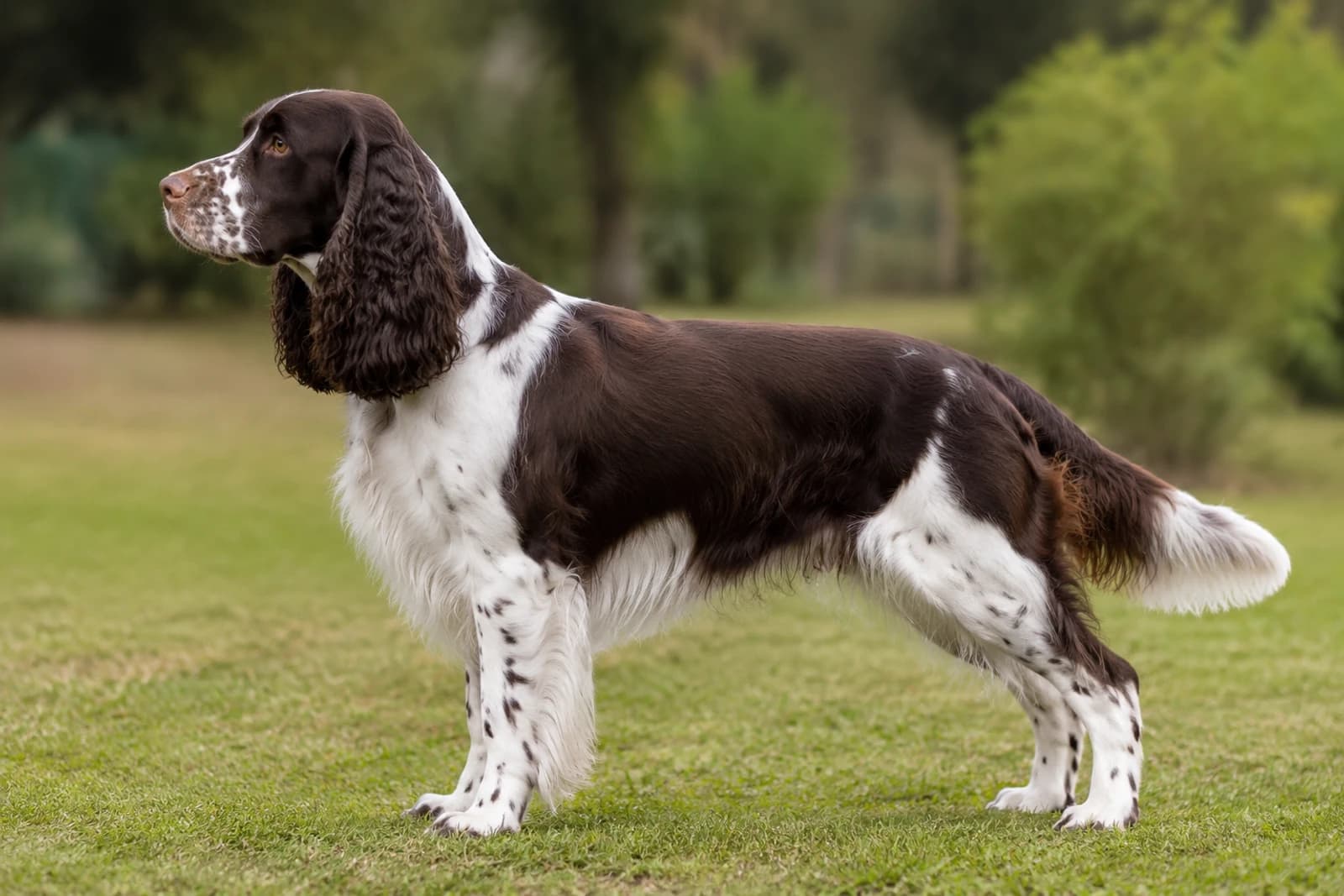
The English Springer Spaniel is an enthusiastic, energetic gun dog perfect for active families who love the outdoors. Bred to flush and retrieve game, they thrive on human interaction and aim to please. Their cheerful, affectionate nature makes them loyal companions. With a medium-length, water-resistant coat and a need for daily exercise, they excel in dog sports and adventures. Ideal for owners who can provide mental stimulation and quality time, they are affectionate with children and other dogs when properly socialized.
At a glance
- Size
- Large
- Height
- 18–22 in
- Weight
- 40–51 lb
- Life span
- 12–14 years
- Coat colors
- Black & White, Liver & White, Blue Roan, Liver Roan, Tricolor
- Coat type
- Medium-length, water-resistant double coat
- Group
- Gun
How much does a English Springer Spaniel cost?
Adopt / rescue
$75–$400
Usually includes spay/neuter, first shots, and a microchip.
Buy from a breeder
$700–$2,000
From a reputable, health-testing breeder.
Approximate USD. Prices vary widely by region, breeder, pedigree, age, and coat colour — adopting is the lower-cost and recommended route. Avoid suspiciously cheap “breeders”; they’re often puppy mills.
Estimate the full cost of a English Springer Spaniel →English Springer Spaniel photos
Views
Front, side, rear and top — the full silhouette.Poses
How the breed sits, lies, moves and plays.Puppy to senior
The breed across its whole life.Expressions
The breed’s range of moods.Close-up details
Eyes, ears, nose, paws, tail and coat.Coat colors
The breed’s recognized colors.Click any photo to enlarge. We show the English Springer Spaniel from every angle — three views, poses, life stages, expressions, close-ups, coat and colors.
Appearance & size
The English Springer Spaniel reads as purpose-built motion — a medium-to-large gun dog with a sturdy, compact frame that covers ground in an easy, ground-eating stride. You’ll often hear “large” in the size category, but the numbers tell a more honest story: males and females stand 18 to 22 inches at the shoulder and weigh between 40 and 51 pounds. That puts them squarely in the athletic mid-size bracket, where they’re big enough to bust through heavy cover all day yet nimble enough to zigzag under brush without losing steam.
Front-on, the Springer projects balance and substance. A deep, well-sprung chest fills the space between straight, muscular forelegs. The shoulders slope back and the elbows sit close, giving the stance a clean, uncluttered look. From the side you see the body’s real proportion: roughly equal length from point of shoulder to point of buttock as from withers to ground, with a level topline that stays firm whether the dog is standing or sliding into a crouch. The loin is short and strong, the rear angulation moderate — enough to drive a powerful push-off without exaggeration. Viewed from behind, the hindquarters are broad and well-muscled, the hocks let down and parallel when the dog moves.
The head belongs to a classic spaniel. The muzzle is about half the length of the skull, with a defined but not abrupt stop. Soft, almond-shaped eyes — dark hazel to deep brown — sit wide apart and hold a steady, alert expression that’s all gentle intelligence. Long, lobular ears drop close to the cheeks, set at eye level and framing the face. They’re covered in silky coat, and if you run a hand over them you’ll feel the fine, feathered fringe that is a hallmark of the breed.
The double coat is built for all-weather fieldwork. The outer coat is medium length, flat or slightly wavy, and dense enough to turn briars and water. Underneath, a short, soft undercoat provides insulation. Feathering grows on the ears, chest, backs of the forelegs, belly, and on the hind legs above the hocks. The tail is customarily docked to a short stub in the US, carried level or a touch above the back when the dog is excited. Natural tails are set on low, thicker at the base and tapered, never curling over the back.
Color is one of the breed’s calling cards. You’ll see:
- Liver and white
- Black and white
- Liver tri-color (liver and white with tan points above the eyes, on the cheeks, inside the ears, and under the tail)
- Black tri-color (same pattern with black as the base)
- Roan versions of the above, where colored hairs intermingle with white, giving a speckled or blue-roan look
White often appears as a blaze on the face, a collar, and on the chest, legs, and belly. No matter the combination, the coat should never appear fussy or overdone — it’s a working jacket that sheds dirt and dries fast after a swim.
History & origin
The spaniel family itself is ancient—dogs that look like modern spaniels show up in art and writing as far back as the 14th century. But the English Springer Spaniel as we know it is the springboard for all the land spaniels that followed, and the name “springer” didn't appear in print until the early 1800s. Before that, any medium-sized, long-haired flushing dog in England was simply a land spaniel, and for centuries its sole job was to dash ahead of hunters, find game birds, and—literally—spring them into the air so they could be taken by nets or falcons.
When shotguns replaced nets in the 1700s, the dog’s role sharpened. Hunters needed a spaniel that would work close, burst into a hard flush only within gun range, then retrieve from water or thick cover. The same litters often produced pups of different sizes. The smallest ones went on to work woodcock and became Cockers; the larger, leggier pups could power through brambles and bring back a hare or a goose. Those bigger dogs were the ones called “springers.”
Through the 1800s, aristocratic lines like the Norfolk spaniels (black-and-white, solidly built) and the Shropshire spaniels (leaner, with more liver) contributed to a standardized English Springer. In 1902, England’s Kennel Club recognized the breed, and the American Kennel Club followed in 1910. Two distinct types emerged over the 20th century: the heavier-boned show-bred springer, with a deeper chest and more profuse coat, and the field-bred springer, still tight and tireless, whose frame rarely tops 50 pounds and whose coat is a practical flat or wavy. Both are the same breed, but a field trial dog bred for 30-minute all-out sprints in heavy cover looks nothing like the ring champion standing 22 inches at the shoulder under a spray of feathering. Today you’ll find both lines, each delivering the springer’s original currency: a phenomenal nose, an instinct to flush game hard and hold steady, and the physical grit to work cold water and dense undergrowth all day.
Temperament & personality
You’re not getting a low-key lapdog. The English Springer Spaniel runs on two speeds — full throttle and passed out cold — with a built-in homing device that keeps them stuck to your side. Bred to work entire days flushing and retrieving game, they bring that relentless drive into the home. If you’re looking for a quiet evening, you’ll still find 45 pounds of wiggly spaniel wedging themselves onto the couch next to you, tail beating a happy rhythm against the cushions.
Affection is the default setting. Springers will greet you like a returning war hero even if you just took the trash out. They want to be part of every family activity and will shadow you from room to room. That devotion has a shadow side: isolation ramps up anxiety quickly, and a neglected Springer tells you about it with barking, chewing, or house-soiling. Expect a dog who needs to be in the thick of things. They’re generally excellent with children — gentle, patient, and up for any game — but their enthusiasm can bowl over a toddler, so supervision is still a must.
As a gun dog, the Springer’s brain needs as much exercise as their legs. A walk around the block doesn’t cut it. Count on a solid hour of off-leash running, swimming, or focused fetch every day, plus training sessions that make them think. Without that outlet, they invent their own jobs, which often involves dismantling shoes, digging up flower beds, or obsessively carrying and chewing anything they can fit in their mouth. You’ll notice a classic spaniel quirk: they’re soft-mouthed retrievers by nature, so they’ll proudly deliver “gifts” — socks, toys, the remote — without damaging them. Put that mouth to work with chew toys; a frozen Kong or a natural hard chew gives their jaws a healthy outlet and saves your belongings. A homemade citrus spray on forbidden items (boil citrus peels, strain, mist) can steer them toward appropriate targets.
Watchfulness is there, but not in a guard-dog sense. They’ll bark an alert when someone approaches the house, tail wagging so hard their whole back end sways. The bark says “Hey, someone’s here!” rather than “Back off.” Body language tells you everything: a forward lean paired with a fixed stare means they’ve locked onto a scent or movement and are about to bolt. A loose, wiggly posture with soft eyes and that nonstop tail says life is good. When they’re overwhelmed or anxious, you might see lip licking, yawning, or a head turn — respect those signals and give them a break.
Springers are strong-willed but wildly eager to please when you engage them respectfully. Crank up the pressure or get harsh, and you’ll meet stubbornness. Keep training upbeat, consistent, and treat-heavy. Their noses run the show, so recall can be a challenge when a scent trail beckons. Start early and practice often. One final note on the nose: indoor accidents can become repeat performances because the smell triggers them to re-mark the same spot. Clean messes with an enzyme cleaner or a white vinegar spray (which neutralizes urine odors and deters re-soiling) and reward outdoor potty trips with a high-value treat the instant they finish. It's a simple fix that saves your rugs and reinforces the right habit fast.
Good with kids, dogs & other pets
A well-bred English Springer Spaniel brings a patient, non-aggressive temperament that slots easily into a household with kids. They are sturdy enough at 40–51 pounds to handle a tumble, yet gentle in their default state. That said, no 18–22 inch tall dog is foolproof with toddlers. A Springer’s enthusiasm can accidentally knock over a small child, so supervision around the very young is simply a practical rule.
Early socialization shapes how successfully your Springer reads other dogs and unfamiliar children. The critical window slams shut around 12–16 weeks. Before that, pile on positive, gradual exposure to varied people—including wobbly toddlers, strollers, and shrieking playgroups—along with friendly adult dogs, different surfaces, and everyday sounds. A puppy raised without this buffet of experience can grow into an adolescent who is timid, noise-phobic, or overly aroused around other dogs.
Most Springers live happily with another canine housemate, especially if they grow up together. Littermates or long-term companions often become inseparable playmates. An adult Springer who hasn’t had much early dog exposure may become selective. Forcing that dog to mingle at a busy dog park backfires—it dials up stress, not friendliness. Respect their comfort zone and let new dog introductions unfold slowly, on neutral ground, with both leashes slack.
Cats and small pets are where the spaniel’s bird-flushing roots surface. A Springer raised alongside a housecat from puppyhood can coexist peacefully. But that same dog often chases a fleeing outdoor cat or fixates on a pet bird. Small mammals like rabbits or guinea pigs trigger a deep instinct that training rarely extinguishes. Never leave a Springer unsupervised with pocket pets or feathery creatures. Use baby gates, closed doors, and a solid “leave it” cue to keep the peace.
One overlooked compatibility factor: these dogs hate being isolated. A family that is gone 10 hours a day, even with kids who come home to play briefly, risks a bored, lonely Springer who digs, barks, or chews. They need to be woven into daily life, not left in a yard or a back room. If your family can offer abundant companionship, daily off-leash exercise, and a commitment to early socialization, this breed will return it with a joyful, steady presence.
Trainability & intelligence
A Springer Spaniel learns fast—often nailing a brand‑new command in a handful of repetitions when you reward with praise, a squeaky toy, or a sliver of hot dog. Bred to work in gun‑dog partnerships, they naturally tune into a handler’s voice and body language, and they genuinely want to cooperate. That eagerness puts them among the most trainable spaniels if you stick with positive, relationship‑based methods.
Training isn’t optional with this breed. The same quick mind and tireless body that make a Springer a star in the field will also invent its own entertainment: bird‑chasing, obsessive scent‑trailing, or digging the flowerbed. Start the day the puppy comes home, around 8 weeks, with short, upbeat sessions that always end on a win. Socialization is equally urgent—expose the pup to a wide variety of people, surfaces, noises, and calm dogs during the 3‑to‑14‑week window so it doesn’t grow into a fearful, reactive adult.
Recall is the skill that separates a reliable Springer from a runaway. A squirrel or pheasant can flip a switch, and suddenly your attentive partner is a blur of spots vanishing into the treeline. Proof the “come” cue with a long line in distracting environments well into adolescence, and pair it with a reward that’s more exciting than the chase—real meat, a favorite ball, or a splash in a puddle. With consistent practice, you’ll get a dog who whips around and checks in the moment you call, even at a full run.
What works: Short, game‑based drills, clear markers (a clicker or an enthusiastic “yes!”), and rewards that match the dog’s energy. Cherish any sign of calm—rewarding four paws on the floor teaches impulse control faster than nagging. What backfires: harsh corrections or drilling the same command too long. Springers are sensitive and will shut down under a hard hand, while a bored Springer gets creative in ways you won’t like. Redirect unwanted behavior instead of punishing it, and challenge the brain with scent work, advanced obedience, or agility. The breed’s need for mental engagement is real; a tired‑thinking dog is a well‑mannered dog.
Keep your expectations realistic around high‑octane distractions. A young Springer might ace “sit” in the kitchen but forget English at the dog park. That isn’t stubbornness—it’s too much excitement and not enough generalization. Take the training on the road, gradually adding difficulty, and you’ll shape a dog who stays responsive wherever you go. A Springer who trusts you and knows the job will throw itself into your cues with tail‑wagging intensity.
Exercise & energy needs
A Springer Spaniel isn’t the dog you bring home for a few laps around the block. He’s a hard-charging gun dog who needs 60 to 90 minutes of real, heart-pumping exercise every day—ideally split into at least two sessions. A single long walk won’t cut it. This dog was bred to hunt for hours, quartering through rough cover and crashing into water, so off-leash running, swimming, and retrieving are oxygen for him.
Plan on a serious morning session of 30–45 minutes where he can sprint, flush, and pivot. Follow it with an equally active afternoon or evening session—another 30–60 minutes of field work, hiking, or fetching in a safe, open space. Without that outlet, untapped energy curdles into destructive chewing, restlessness, and nonstop barking. He’ll be miserable, and your house will pay the price.
- Intensity matters more than clock time. A slow sniff-and-stroll doesn’t drain a Springer. He needs to gallop, change direction, and think. Long-line training in a field, off-leash romps with other sturdy dogs, or a vigorous game of water retrieve all count. If you’re a runner or cyclist, a well-conditioned adult Springer can keep pace for miles—once his growth plates have closed, usually after 12–18 months.
- Mental exercise fills the gaps. Smart, nose-driven dogs unravel when their brains go idle. Mix in 10–15 minute bursts of scent work (hide his breakfast around the yard), puzzle feeders, or trick training after a run. Even a few minutes of “find it” in the living room can settle him faster than another lap around the park.
- Best activities and sports. Springers thrive in field trials, hunt tests, and dog sports that mirror their original job. Agility, flyball, and dock diving all lean into their speed and loves-to-please attitude. Casual scent walks and backyard nosework games are free and do wonders on rainy days. Swimming is a favorite—and easy on joints.
A note on growing bodies: responsible breeders screen for hip and elbow dysplasia, but the breed can be prone to joint issues. Avoid repetitive high-impact pounding on pavement with puppies and stick to grass or dirt for hard play. Watch the dog in front of you: some Springers will run themselves ragged well into their senior years; pacing them can be half the battle. If you can’t commit to that kind of daily sweat-and-think routine, the Springer isn’t your match right now.
Grooming & coat care
Your English Springer Spaniel’s double coat is built for busting through brush and water, but it needs hands-on upkeep at home. That medium-length outer layer is dense and often wavy, with soft, insulating undercoat — plus long feathering on the ears, chest, legs, and tail. She sheds moderately all year and more heavily as seasons shift, so a consistent routine makes life with a Springer a lot less hairy.
Brushing
Reach for a metal slicker brush with rounded pins or a pin brush to work through the feathering and prevent mats. A greyhound comb gets tangles out of the long ear fringe and skirt. Aim for two or three solid brush-outs a week; during spring and fall shedding cycles, jump to daily brushing to stay ahead of the dead undercoat. Don’t just skim the surface — part the coat and brush down to the skin, especially behind the ears, inside the thighs, and under the tail, where mats sneak in.
Bathing
Bathe your Springer every six to eight weeks, or when the “wet dog” smell overstays its welcome. Use a mild dog shampoo that won’t strip the coat’s natural oils. An outdoor pre-rinse is your friend if she’s been on a particularly muddy flush. Rinse thoroughly — leftover soap in that dense coat invites irritation. Towel-dry and let her air-dry, or use a low-heat dryer while brushing to straighten feathering.
Trimming
You’ll pluck the occasional rogue hair, but a quick tidy-up with thinning shears or blunt-tipped scissors keeps things neat. Trim the hair that grows long between the paw pads and around the feet to reduce mud and burr collection. Clip the feathering on the legs and belly lightly if dragging debris inside drives you nuts. Many owners have a groomer neaten the ear edges and tail flag every few months — just don’t go scalping: that topcoat protects from sun and cold.
Nails, ears, and teeth
Those lovely drop ears are a perfect trap for moisture and gunk. Check them weekly for redness, odor, or wax buildup, and wipe the inner flap with a vet-approved ear cleaner. Nails need a trim every three to four weeks — if you hear clicking on the floor, they’re overdue. Teeth get a brush two or three times a week to stall tartar and keep her breath friendly.
Seasonal coat care
When winter undercoat blows out in spring, step up brushing sessions and a slicker with a pin brush combo pulls the loose fluff before it lands on the sofa. In autumn, as the coat thickens, you’ll do the same. Dry, heated indoor air can make the skin flaky; a quick wipe-down with a damp cloth or a rinse-free grooming spray keeps things comfortable between baths. All that time outdoors — running through fields, splashing in creeks — naturally buffs off dead hair and stimulates oil glands, so regular romps are part of a shiny, healthy-looking coat.
Shedding & allergies
If you picture a silky, medium-length coat that barely sheds, the English Springer Spaniel will surprise you. These dogs have a double coat with a dense, weather-resistant undercoat, and they drop hair steadily all year. It is not the drifting-tumbleweed level of a heavy shedder, but you will find fine, dark or white hairs woven into your couch, your car seats, and your clothes. Weekly brushing cuts down the loose fur, but you cannot stop it completely.
Twice a year, usually in spring and fall, Springers blow their undercoat. During these seasonal blowouts, the shedding ramps up dramatically. You will pull handfuls of fluff from the feathering on their legs, chest, and ears, and daily brushing becomes a necessity to keep the mess under control and prevent mats.
Drool is a separate, milder issue. Most Springers drool predictably — after drinking water, during intense exercise, or when they are watching you eat. You will want to keep a rag handy near the water bowl, but they are not slobber machines like some giant breeds.
No dog is truly hypoallergenic, and the Springer is a poor choice for allergy sufferers. Allergens stick to dander (dead skin flakes), saliva, and urine — not just hair. Because Springers shed year-round and produce normal amounts of dander, they can trigger reactions just as easily as many other breeds. If someone in your home has dog allergies, spend time with an adult Springer in a confined space before committing. Regular brushing, vacuuming, and an air purifier help, but they will not eliminate the problem.
Diet & nutrition
Springers are famously food-driven — that enthusiasm makes training a snap but means the food bowl can quickly become a weight trap. Even a couple of extra pounds hammer joints already predisposed to hip and elbow dysplasia, so strict portion control isn’t optional; it’s daily preventive medicine.
How much to feed
A moderately active, 45-pound adult typically needs 1,100–1,400 calories a day, split into two meals. If your dog tears through an hour of hard field running, you’ll edge toward the high end; a rainy day spent napping calls for scaling back. Skip the generic bag chart and trust your hands: run your fingertips lightly along the ribcage. You should feel ribs under a thin layer of fat, with a visible waist when you look down from above. If you’re pressing through a cushion, trim roughly a quarter cup per meal until that shape reappears.
Puppy feeding schedule
- Four months and under: four evenly spaced meals daily.
- Four to six months: drop to three meals.
- Six months on: two meals, like an adult. Transition a puppy to a new diet gradually. Start with lightly cooked, puréed meats, fish, fruits, and vegetables, or a top-shelf commercial puppy food. Raw chicken wings can be introduced around twelve weeks — always under supervision.
What to put in the bowl
Whether you choose premium kibble, raw, or home-cooked, the backbone is high-quality animal protein. A solid home-prepared ratio: roughly 60% raw or cooked meat, 20–30% dog-safe fruits and vegetables, and 10% extras like eggs, pearl barley, or plain yogurt. Blend or purée the plant ingredients — dogs’ jaws move only vertically and they lack salivary enzymes, so processing actually makes the nutrients available instead of sending them straight through the gut whole.
- Fast eaters: use a food puzzle bowl. It forces slower, more deliberate eating and gives that busy Springer brain a workout.
- Sensitive stomachs: plain white rice offers bland, digestible carbs when things get dicey.
- Rich foods and holiday scraps can trigger a serious bout of pancreatitis. One fatty ham trimming isn’t worth the emergency vet visit.
Senior adjustments
Older Springers slow down, but their appetite rarely does. Switch to smaller, more frequent meals (three a day works for many) and gradually reduce total calories as activity drops. There’s no evidence you need to cut protein; just keep a hawk-eye on the scale. If your senior starts feeling soft over the ribs, act immediately. Serve any leftovers in the dog’s own bowl, never from the table — begging is a habit that’s brutally hard to undo.
A lean Springer is a healthy Springer. When the waist blurs and the ribs disappear under padding, the food bowl needs less, not more.
Health & lifespan
Most Springers live 12 to 14 years with solid care. That’s a good run for an energetic gun dog, but the breed does come with a handful of inherited quirks you’ll want to know about before falling in love with a puppy.
- Hip and elbow dysplasia – malformed joints that can lead to arthritis later in life. Responsible breeders x-ray their dogs and submit results to OFA or PennHIP.
- Eye disorders – progressive retinal atrophy (PRA) and retinal dysplasia can cause vision loss. Annual eye exams by a veterinary ophthalmologist (CERF or OFA Eye certification) and DNA testing for PRA are common in well-bred lines.
- Phosphofructokinase (PFK) deficiency – a metabolic condition that leads to exercise intolerance and episodes of anemia. A straightforward DNA test identifies carriers, so breeders can avoid producing affected pups.
- Ear infections – those long, heavy ears trap moisture and debris like a wet glove. Weekly cleaning and thorough drying after swimming or baths are non-negotiable.
- Allergies and skin trouble – atopic dermatitis, hot spots, and ear inflammation often flare up. Diet and environmental triggers are usually the culprit, so you may need to experiment with food and keep pollen-heavy romps in check.
- Autoimmune conditions – immune-mediated hemolytic anemia and related disorders appear in some families, though no screening test exists. A breeder who tracks bloodlines closely can steer you away from lines that have turned up trouble.
- Epilepsy – idiopathic seizures crop up occasionally. Ask if the breeder has seen any seizure activity in their lines.
Weight management matters here more than you might think. Springers are chowhounds, and an extra 5 pounds translates to stress on hips, elbows, and a heart that’s already working hard to fuel a full day in the field. Measure meals, lay off the table scraps, and keep that off-leash running a daily habit.
Basic preventative care still applies: monthly heartworm medication during mosquito season (and one month after), plus a legally required rabies vaccine. Annual wellness exams and bloodwork catch brewing problems early, especially once a dog hits the senior years around age 8 or 9.
Ask a breeder for hip and elbow clearances, a current eye exam report, and PFK DNA status on both parents. A breeder who tests for the stuff you can test for, and who talks honestly about what’s shown up in their lines, is your best defense against nasty surprises.
Living environment
Apartment vs. house
An English Springer Spaniel is a go-all-day hunting dog, not a quiet apartment ornament. They can live in an apartment, but it’ll work only if you treat off-site exercise like a second job: plan on two daily sessions of 30–45 minutes where they actually run, swim, or hike hard—not just sniff the sidewalk. A house with a securely fenced yard removes a ton of friction. When your Springer can charge out the back door to chase a ball or patrol for squirrels, indoor restlessness drops noticeably.
Yard matters
A physical fence is non-negotiable. Springers lock onto a scent and blow past an invisible fence as if it doesn’t exist. The yard isn’t just a toilet spot—it’s a sprint track. Give them enough room to hit full stride, and they’ll be far more settled indoors. Without that safe space, you’ll need to replace those zoomies with leashed runs or trips to a fenced dog park.
Climate tolerance
That dense, water-repellent double coat was built for soggy English fields, so cold, drizzly days don’t faze them. They’ll happily bound through snow. Heat is the real danger. When temperatures rise, exercise early or late, always carry water, and watch for heavy panting. Springers can overheat fast, especially if they’re dark-coated.
Noise and barking
Springers have opinions and aren’t shy about voicing them. The doorbell, a squirrel on the fence, or just plain excitement often triggers a deep, ringing bark. In an apartment with shared walls, that can get old for neighbors fast. Train a solid “quiet” cue and keep their brain busy with scent games and puzzle toys. A bored Springer barks more, period.
Alone time tolerance
These dogs velcro themselves to their people. Left alone for a full workday, many develop separation anxiety—chewed moldings, endless howling, or house soiling are the usual signs. If your schedule keeps you gone for hours regularly, budget for doggy daycare or a midday walker. Start short absences early, make the crate a good place, and leave a stuffed Kong to smooth departures. Even then, a Springer does best in a home where someone is around a good chunk of the day. A tired, mentally satisfied dog handles alone time better, but this isn’t a breed that thrives in an empty, silent house.
Who this breed suits
An English Springer Spaniel fits you if your idea of a good day involves mud, water, and hours of hard play. These aren’t casual house dogs — they’re compact, 40-pound hunting machines bred to flush and retrieve from dawn to dusk, and they come with an “on” switch that only flips off after serious exercise. If you’re ready to be their teammate, they’ll be the most devoted shadow you’ve ever had.
Active families get a rough-and-tumble playmate who adores kids, but manage the matchup: a Springer at full tilt can knock over a toddler without meaning to. Older children who can throw bumper after bumper and join in training click best. Expect a dog who wants to be in the middle of the chaos, not watching from a dog bed.
First-time owners can thrive with a Springer, but only if you’re genuinely excited about putting in the work. You’ll need to commit to positive, consistent training from day one — this breed is biddable but brainy, and a bored Springer invents his own jobs (digging, barking, dismantling the sofa). A weekly obedience class and daily mental puzzles are non-negotiable right along with the physical output.
Singles and active retirees who hike, trail-run, hunt, or simply spend most of their time outdoors get a Velcro companion who’s all-in. For seniors, the honest question is whether you can handle a strong, enthusiastic dog on a leash who may lunge for every pigeon and puddle, and can you deliver two strenuous outings a day, rain or shine. If you’re a hunter or a birder, however, you’ll find a partner who lives for the field and curls up contentedly at your feet afterward — provided his belly is full of exercise, not just kibble.
Who should think twice
If your routine includes long office hours, a low-exercise lifestyle, or a pristine garden, a Springer will quickly become a destructive whirlwind. Separation anxiety is common; left alone too long, they’ll chew drywall, howl nonstop, or engineer escapes. Apartment dwellers beware — you can’t shortcut a breed that needs off-leash sprinting and flushing games. A quick walk around the block barely registers.
Grooming is another real commitment. Feathering traps burrs and mud, shedding is constant, and those floppy ears demand cleaning after every swim or rainy trek to prevent nasty infections. If you’re looking for a wash-and-wear dog, this isn’t it.
No “I’ll start on Monday” — these dogs need a bare minimum of 60 minutes of hard running, retrieving, or nose-work every single day, plus ongoing training. If you can’t promise that for the next 12–14 years, choose a lower-octane breed.
Cost of ownership
A well-bred English Springer Spaniel puppy from a responsible breeder who screens for hip dysplasia, eye disorders, and cardiac issues typically costs $1,500 to $2,800. Show-line prospects or puppies from titled field-trial parents can push the top of that range. You’ll also drop another $300 to $500 on a crate, bed, bowls, leash, collar, and safe chew toys before the first night home.
Once your Springer is settled, count on monthly expenses in the $150 to $300 ballpark, depending on where you live and the choices you make.
Monthly cost breakdown
- Food: A 40–51 lb dog with this much drive and athleticism eats about 2.5–3 cups of quality kibble a day. That runs $50–$80 per month. Raw or fresh-food plans can double it.
- Grooming: A Springer’s medium-length double coat sheds moderately year-round and mats if neglected. A professional groom every 6–8 weeks costs $60–$90 per session, so budget $40–$60 per month. Between visits you’ll still brush several times a week, clean floppy ears, and trim feathering.
- Routine vet care and preventatives: Annual exams, vaccinations, and year-round flea/tick/heartworm prevention average $50–$70 per month. Real costs can spike if chronic ear infections — common in this breed — require repeat treatment.
- Pet insurance: Accident and illness policies for a medium-sized purebred run $35–$55 per month. A plan that covers hereditary conditions helps offset the cost of hip or elbow surgery down the road.
Factor in a couple hundred dollars for a basic obedience class or field-training starter sessions early on — Springers need mental work, and a trainer who understands gundogs is a smart investment.
Choosing a English Springer Spaniel
Where to Start: Breeder or Rescue?
English Springer Spaniel rescues are packed with good dogs—often young adults surrendered because someone underestimated the breed’s athletic motor. That’s a real advantage: you skip the housebreaking and razor-blade-teeth stage, and the foster family can tell you exactly how that dog behaves off leash, on furniture, and around kids. For a home that wants a hiking buddy but not a 24/7 puppy project, rescue is the smarter path.
If you want a puppy you’ll shape from eight weeks old, find a breeder who treats breeding as a responsibility, not a side hustle. This is a 40–51 lb dog with a career-level work ethic, and poor temperament or hidden health problems turn that into a decade-plus headache.
Health Clearances to Demand
English Springers can carry serious inherited conditions. You need to see hard proof—not a verbal “vet checked them”—for both parents:
- Hips: OFA good or excellent (or a PennHIP score in the low-risk zone). Fair is passable but not ideal in a dog you’d breed; ask the breeder to explain.
- Elbows: OFA normal.
- Eyes: A current CAER exam by a board-certified veterinary ophthalmologist, repeated annually on breeding dogs.
- DNA tests: PRA (prcd form), phosphofructokinase deficiency (PFK), and familial nephropathy (FN). A parent can be a carrier, but two carriers should never be mated—an affected puppy is a heartbreak.
If a breeder can’t hand you these reports with the dog’s registered name and number, walk away. Expect them to volunteer this paper, not act annoyed you asked.
Red Flags That Close the Deal Fast
- Always has puppies available, or breeds more than two litters a year.
- Won’t let you meet the dam on site (sire may be off premises, that’s okay, but you can video call).
- Puppies raised in a kennel run with minimal human handling.
- Selling pups younger than eight weeks.
- Running a multibreed operation that looks more like a puppy warehouse than a home.
- Asks you zero questions about your lifestyle, yard, or exercise plan. A responsible breeder grills you right back.
Picking Your Puppy
A litter of 7-week-old Springers is a joyful riot, but don’t let the first one that mobs you seal the deal. Watch the whole litter for 20 minutes. Look for a puppy that recovers quickly from a normal startle (a dropped food bowl, a new voice) and returns to investigate—that bounce-back is a better predictor of stability than the boldest or quietest pup in the group. A good breeder will have already been tracking which puppies suit a family, a working home, or a quiet-but-active-adult household. Lean on that insight instead of picking the cutest face.
Pros & cons
Pros
- A happy-go-lucky family dog that thrives on human companionship and generally gets along well with children and other pets when socialized early.
- Quick to learn and eager to please — a standout in obedience, agility, and fieldwork when you channel that drive.
- Sturdy yet manageable size (40–51 lb, 18–22 inches at the shoulder) fits many homes without being a giant breed.
- Life expectancy of 12–14 years gives you a long stretch with a loyal, tail-wagging partner.
Cons
- Exercise needs are non-negotiable: plan on 60–90 minutes of off-leash running, swimming, or hard field play every day, not a stroll around the block.
- A bored Springer invents its own jobs. Without enough mental and physical work, expect digging, barking, and destructive chewing.
- Strong prey drive and a nose that never quits mean squirrels, birds, and the neighbor’s cat will test your recall relentlessly.
- Coat care adds up — moderate year-round shedding, heavier seasonal blows, plus feathering that mats without weekly brushing. Those drop ears trap moisture and debris, so ear infections become a recurring nuisance unless you clean and dry them regularly.
- Separation anxiety is common; a Springer left alone too long often howls, paces, or redecorates your house.
- Health issues to ask about: hip dysplasia, elbow dysplasia, and inherited eye disorders (progressive retinal atrophy, retinal dysplasia). Responsible breeders screen parents and can show you proof.
Similar breeds & alternatives
If the Springer’s spring-loaded friendliness and bidability feel right but you’re sizing up options, a few breeds share its bird-dog roots while dialing things up or down.
-
Welsh Springer Spaniel – Red and white, 35–55 lb, 17–19 in. More reserved with new people, a little less boisterous indoors, but still needs that solid hour of off-leash exploration. A good switch if the ESS’s constant social battery wears you out.
-
Brittany – Lighter (30–40 lb, 17.5–20.5 in), shorter coat, no feathering. Same high energy but with a pointing, wide-ranging style. You skip the daily detangling, but you might lose some of the ESS’s Velcro cling.
-
American Cocker Spaniel – 20–30 lb, 13.5–15.5 in. Halve the exercise needs (30–45 min), keep the silky coat and ear-maintenance requirements. A spaniel that fits in a lap and doesn’t require a fenced acre to unwind.
Fun facts
- Named for their ability to 'spring' game birds into flight.
- Available in two varieties: field-bred (working) and show-bred (conformation).
- Known as 'the clown of the spaniel family' due to their playful, merry nature.
Frequently asked questions
- Are English Springer Spaniels good with children?
- English Springer Spaniels are generally known for being friendly and affectionate, making them great family pets. They tend to be patient and playful with children, but supervision is always recommended. Early socialization helps ensure positive interactions.
- How much exercise does an English Springer Spaniel need?
- As a high-energy sporting breed, English Springer Spaniels need at least 60 to 90 minutes of daily exercise. They thrive on activities like long walks, running, and retrieving games. Without sufficient physical and mental stimulation, they may become restless.
- Do English Springer Spaniels shed a lot?
- English Springer Spaniels have a medium-length double coat that sheds moderately year-round. They tend to have heavier shedding during seasonal changes. Regular brushing can help manage loose hair and keep their coat healthy.
- Are English Springer Spaniels easy to train for first-time owners?
- English Springer Spaniels are intelligent and eager to please, which can make them responsive to training. However, their high energy and occasional stubbornness might challenge inexperienced owners. Consistent, positive reinforcement methods work best.
- What is the grooming routine for an English Springer Spaniel?
- Their coat requires brushing at least two to three times a week to prevent mats and tangles. Regular ear checks and cleaning are important to avoid infections, as their floppy ears can trap moisture. Occasional trimming around the ears and feet helps maintain a neat appearance.
- Can English Springer Spaniels live in an apartment?
- Apartment living can be challenging for an English Springer Spaniel due to their high exercise needs and energetic nature. A home with a securely fenced yard is ideal, but with adequate daily exercise and mental stimulation, they can adapt to smaller living spaces. Barking may be an issue in close quarters if not properly managed.
Tools & calculators for English Springer Spaniel owners
Quick estimates tailored to English Springer Spaniels — pre-filled with this breed’s size where it matters.
Articles & stories about the English Springer Spaniel
Sources & standards
This profile follows recognized breed standards from the American Kennel Club (AKC) and the Fédération Cynologique Internationale (FCI), along with established veterinary and breed-club guidance. These describe general breed tendencies — every dog is an individual.
Owner stories
Have a English Springer Spaniel? Share your experience — grooming tips, personality quirks, anything goes.