

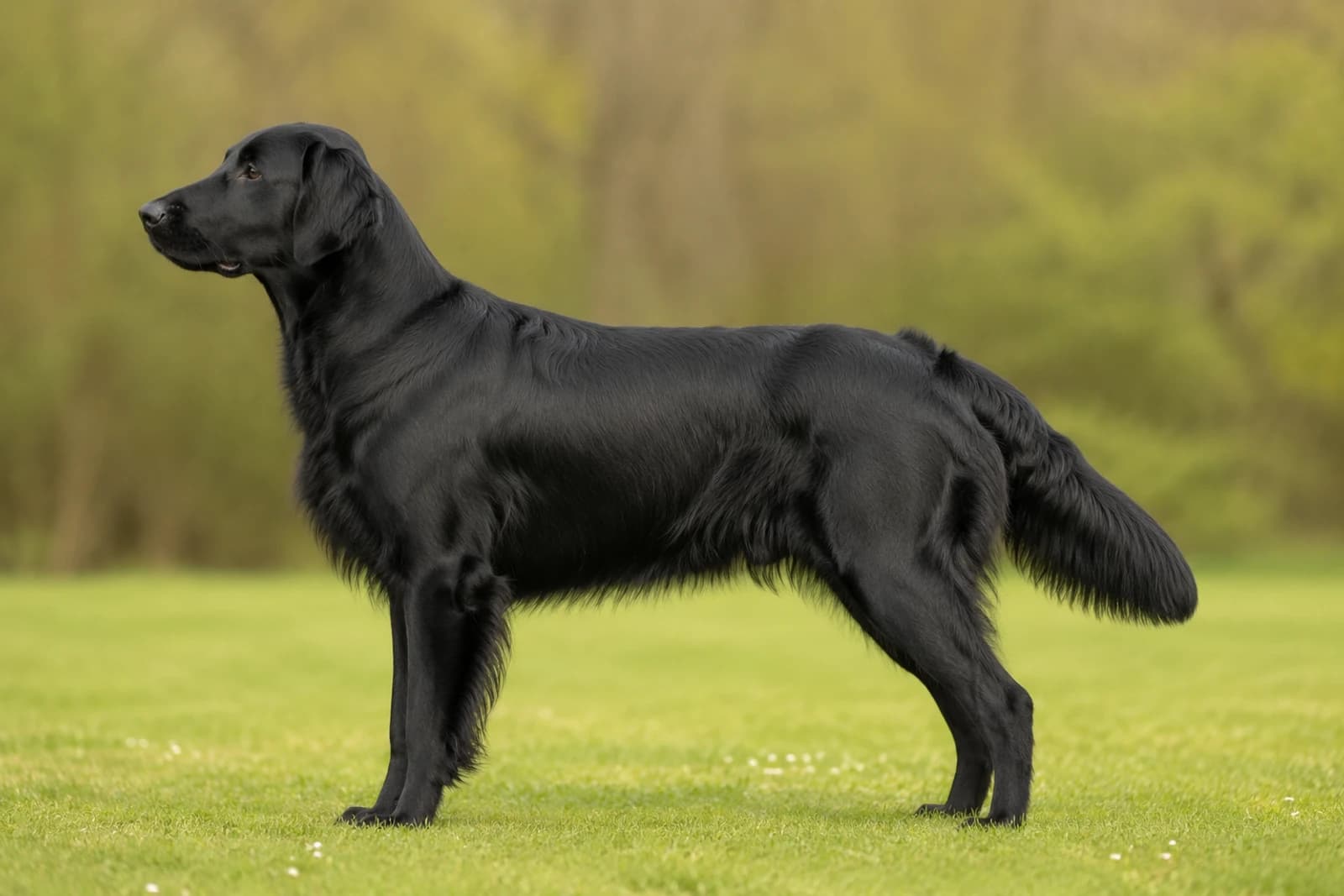
The Flat-Coated Retriever is a cheerful, eternally youthful sporting breed perfect for active families or individuals who love outdoor adventures. Their "Peter Pan" personality means they remain playful and puppy-like well into adulthood. They are highly affectionate, form strong bonds, and thrive on companionship. While excellent with children and other dogs, their exuberance may overwhelm small kids. This breed needs ample daily exercise and mental stimulation; they are not suited for couch potatoes or apartment living. Best for experienced owners with time to train and engage them consistently.
At a glance
- Size
- Large
- Height
- 22–24 in
- Weight
- 55–79 lb
- Life span
- 11–13 years
- Coat colors
- black
- Coat type
- Flat, medium-length, glossy double coat
- Group
- Gun
- Origin
- United Kingdom
How much does a Flat Coated Retriever cost?
Adopt / rescue
$75–$400
Usually includes spay/neuter, first shots, and a microchip.
Buy from a breeder
$700–$2,000
From a reputable, health-testing breeder.
Approximate USD. Prices vary widely by region, breeder, pedigree, age, and coat colour — adopting is the lower-cost and recommended route. Avoid suspiciously cheap “breeders”; they’re often puppy mills.
Estimate the full cost of a Flat Coated Retriever →Flat Coated Retriever photos
Views
Front, side, rear and top — the full silhouette.Poses
How the breed sits, lies, moves and plays.Puppy to senior
The breed across its whole life.Expressions
The breed’s range of moods.Close-up details
Eyes, ears, nose, paws, tail and coat.Coat colors
The breed’s recognized colors.Click any photo to enlarge. We show the Flat Coated Retriever from every angle — three views, poses, life stages, expressions, close-ups, coat and colors.
Appearance & size
You’ll spot a Flat Coated Retriever from across the field by that single gleaming color: a rich, solid black that shines like polished jet in the sun. There’s no brindle, no masking, no splash of white creeping up the chest (a small mark there is technically allowed but seriously faulted by breeders who value the clean silhouette). The coat lies dead flat—hence the name—smooth and silky against a lean, athletic frame.
Everything about the build says “streamlined endurance.” A male stands 23 to 24 inches at the shoulder; females dip to 22 to 23 inches. Weight runs 60 to 79 pounds for a male, 55 to 70 for a female, but no well-bred Flat Coat carries extra bulk. They’re large dogs who look ready to run all day, not lumber. The topline is level from withers to tail-set, the chest deep and well-sprung but not barrel-shaped, leaving plenty of room for heart and lungs. The underline shows a defined tuck-up behind the ribs, giving the whole dog a leggy, balanced outline.
The coat itself is the defining textural signature. Dense, weather-resistant, and as flat as paint, it falls in straight lines along the body, with moderate feathering on the backs of the legs, the underline, and the tail. The hair never curls or waves. This sleekness means you won’t see the typical retriever “fluff”—instead, you’ll notice every muscle ripple.
From the front, the head is long and clean-cut, with a flat skull, a barely perceptible stop, and a strong, square muzzle. Dark almond-shaped eyes give a soft, intelligent expression that’s pure retriever. The ears are small, pendant, and lie close to the head. Forelegs are straight and bone is moderate—never heavy. Viewed from the side, that level topline, the deep ribcage, and the smooth coat hugging the contours make the dog look like an arrow drawn back. The tail is set on only slightly below the level of the back and is carried happily, just above horizontal when the dog is excited. From the rear, you’ll see well-muscled thighs, nicely bent stifles, and a straight hock. And that tail—feathered and lively—rarely stops sweeping back and forth. It’s the breed’s built-in mood meter, always in motion.
History & origin
The dog you know as the Flat-Coated Retriever began as a no-nonsense working partner on the shooting estates of 19th-century Britain. As driven game shoots expanded in the early 1800s, gamekeepers needed a tireless, quick-witted retriever that could cover huge swaths of ground, mark multiple downed birds, and handle icy water as eagerly as dry stubble fields. The foundation came from St. John’s water dogs — the smaller, working-type Newfoundland that also gave rise to the Labrador. Gamekeepers and early dog men crossed those imports with now-extinct setting spaniels for a stylish, wide-ranging search and a softer mouth, and then, almost certainly, folded in collie-type herding dogs to sharpen the dog’s trainability and relentless stamina. Nobody kept studbooks, but by the mid-19th century a distinct black retriever with a gleaming flat coat was catching eyes on shoots from Scotland to the English Midlands.
For decades, the breed was simply called the “gamekeeper’s dog” or the Wavy-Coated Retriever; the flat coat eventually became the preferred type as breeders tightened the standard. Men like S.E. Shirley (who later founded The Kennel Club) championed the breed, and in 1915 the Kennel Club recognized it officially. Through the early 1900s, the Flat-Coat was often the first-choice retriever on big estates — fast, merry to the point of grinning, and so biddable that a quiet whistle was all you needed. Then came World War II. Breeding ground to a halt. Kennels emptied. By the war’s end, the Flat-Coat was teetering on extinction. The dogs you see today descend from a tiny handful of survivors tracked down and carefully rebuilt by a few determined breeders who refused to let the line die.
After the war, Labradors and Golden Retrievers surged in popularity as all-around family dogs, and the Flat-Coat slipped into a niche role. What you get now is still that same dog at heart: a born worker with a soft mouth and a sense of humor that hasn’t been bred out. That history leaves you with a 55–79 lb retriever who needs real, daily engagement — a solid hour of off-leash running, not a casual stroll — and a close bond with his people. He’s a hunting dog first, and he’ll retrieve anything you ask, but he won’t thrive parked in the backyard. The breed’s origin story explains exactly why.
Temperament & personality
If you’re looking for a dog that settles into a dignified middle age by three, the Flat-Coated Retriever isn’t it. This breed stays goofy, exuberant, and puppy-brained well into its senior years — often called the Peter Pan of retrievers. What that really means in daily life: an adult Flat-Coat greets you with full-body wags, may bound into your lap without remembering he weighs 65 pounds, and can turn a quiet evening into a toy-fetching marathon.
Energy is the headline here. A leisurely walk around the block barely registers; they want a solid hour or more of running, swimming, or retrieving. Without that outlet, a Flat-Coat invents his own entertainment. That usually translates to relentless chewing — couch cushions, remote controls, patio furniture — because chewing is how they explore and relieve boredom. Puppies will gnaw to teethe, but adults keep strong jaws busy with hard objects to clean teeth and stay satisfied. Giving them purpose-driven chew toys and puzzle games matters more than you might think.
Affection is another deep thread. They’re not aloof dogs who check in occasionally. They lean on you, follow you room to room, and nose your hand when they want contact. This closeness can tip into anxiety if they’re left alone for long stretches; neglect or isolation often sparks barking, digging, or indoor accidents. They do best in households where someone is around a lot or where they have another active dog for company.
With kids, they’re generally patient and playful, but that bounding enthusiasm can accidentally knock over a toddler. They’re also famously friendly toward strangers and other dogs — don’t expect a watchdog. A burglar might get a wagging tail rather than a growl. Their retrieving instinct runs deep, so they’ll proudly deliver socks, flip-flops, or anything left within reach. That’s not thievery so much as love.
Training a Flat-Coat plays to his intelligence and his stubborn streak. He’s quick to learn but gets bored with repetition. Force-free, varied sessions that feel like a game get the best results. Strong-willed dogs like this shut down under pressure but bloom with respectful, consistent engagement. And if you’ve got a chewer targeting off-limits items, a homemade citrus or vinegar spray (boiled peels or a white vinegar mix) can deter him without blunt-force corrections. Candy the world with acceptable alternatives instead.
Good with kids, dogs & other pets
Few large breeds match the Flat‑Coat’s patience with children. They’ll retrieve a soggy tennis ball for an hour, then lean against a kid on the couch without a hint of resource guarding. But you’re still managing 55–79 pounds of nonstop enthusiasm. An adolescent in full wiggle can accidentally topple a toddler, so supervision is non‑negotiable until both dog and child learn to read each other. Teach kids calm greetings and never leave any dog unattended with small children.
With other dogs, the breed is famously social. Most Flat‑Coats light up at the sight of another dog and play with a loose, bouncy style that reads friendly rather than pushy. That comfort, however, hinges on early exposure. Puppies need steady, positive introductions to unfamiliar dogs well before 16 weeks. If you adopt an adult who missed that window, don’t force meet‑ups—a contented life with their family is plenty. A well‑socialized Flat‑Coat, though, often becomes the neighborhood’s goodwill ambassador.
Cats and small pets demand more caution. The retrieving instinct is real: a darting cat or flapping bird can flip a switch from couch buddy to determined chaser. Many Flat‑Coats live peacefully with indoor cats when raised together, but slow, leash‑and‑gate introductions are essential. Pocket pets like hamsters or rabbits are a riskier gamble. Treat their enclosures like Fort Knox and never leave them loose together unsupervised.
Underpinning everything is the Flat‑Coat’s intense need for company. These dogs form deep bonds and shouldn’t be left alone for long workdays or housed outdoors. Isolation can quickly sour into chewing, barking, or frantic greetings that unnerve children and other pets. Anchor your routine around companionship, mental puzzles, and calm, consistent handling. Get that right, and you’ll have a dog who views your kids as littermates, your other dog as a built‑in buddy, and—with sensible management—the cat as just another roomie.
Trainability & intelligence
A Flat-Coated Retriever scores a perfect 5 out of 5 for trainability — and it shows. These dogs are quick, creative thinkers who genuinely want to figure out what you’re asking. That doesn’t mean they mature into solemn, polished performers on a standard timeline. A Flat-Coat’s brain stays puppy-soft for years, so you’re working with a goofy, exuberant partner who can nail a complex retrieve one minute and steal your shoe the next.
What makes them tick in training
Short, upbeat sessions win every time. Reward-based methods — treats, a squeaky toy, an all-out game of tug, or just your genuine “yes!” — light this breed up. They read your mood like a book. Harsh corrections or a frustrated tone don’t make them try harder; they make them check out emotionally. The dog who trusts you will work through distractions and bounce back from mistakes. The one who doesn’t will offer avoidance behaviors instead of effort.
The extended puppy problem
Flat-Coats stay adolescent longer than most retrievers. Where a Lab might settle into adult focus by two, a Flat-Coat often behaves like a well-meaning hooligan well past three. That means you need patience and a sense of humor. Consistency matters more than intensity. If you teach a recall today, but let him blow you off tomorrow because you’re at the beach and he’s chasing seagulls, the lesson gets muddy. Practice short, unreinforced reps in boring environments, then proof the behavior around gradually bigger temptations.
Recall, drive, and the nose
Bred to mark downed birds and return them to hand, Flat-Coats have a strong built-in retrieve instinct. That gives you a head start on a reliable recall, but don’t coast on genetics. A squirrel, a tennis ball, or a funny smell in the wind can still override the command if you haven’t built serious reinforcement history. Use a long line during outdoor training until you’d bet actual money on the recall — no matter what’s happening.
The right start
- Begin socialization between 3 and 14 weeks, introducing your puppy to different people, sounds, surfaces, and friendly dogs at a pace he can handle. A well-socialized Flat-Coat is confident and bombproof; one who misses those windows can turn nervous and reactive.
- Reward the behavior you want the instant it happens. Praise, a quick tug session, or a small high-value treat — the timing matters more than the reward itself.
- Skip punishment-based methods entirely. They erode the trust this breed needs to learn without anxiety, and a Flat-Coat who loses faith in you becomes a dog who simply stops listening.
Your Flat-Coat will learn fast, forget occasionally, and push boundaries during that long teenage phase. Keep sessions playful, relationship-focused, and consistent, and you’ll end up with a dog who works with you — not just for you — well into his silver-faced senior years.
Exercise & energy needs
Plan on at least two hours of hard, off-leash running every day — a leashed neighborhood stroll won’t touch this dog’s gas tank. Most Flat Coated Retrievers need a full 60 minutes of intense exercise twice daily, and plenty of owners find that even two hours is a starting point, not a limit. They were bred to hunt all day in water and heavy cover, so they come with a deep, seemingly bottomless reservoir of stamina.
Break that two-hour minimum into sessions that combine all-out running, swimming, and retrieving drills. A long morning hike off leash, a lunchtime fetch session where you wear out your throwing arm, and an evening swim will keep a Flat Coat manageable. They live to carry things, so use that drive: chuck a bumper into a pond, hide a canvas dummy in tall grass, or launch a ball far enough to force a real sprint. On days when weather or schedules make outdoor work tough, lean heavily on mental exercise. Ten minutes of nose work — hiding a smelly treat or a frozen Kong in the house — can take the edge off, but it’s a supplement, never a substitute.
Because these dogs mature slowly (often acting like goofy teenagers well past age three), be thoughtful about high-impact exercise on hard surfaces while joints are still developing. Skip the forced road runs and repetitive jumping on concrete until growth plates close. Once mature, they excel at dog sports that mirror their gun-dog roots: field trials, hunt tests, dock diving, and long-distance canicross are all great fits.
A Flat Coat who isn’t physically and mentally spent will find his own entertainment, and that usually involves chewing drywall, serenading the neighbors, or rearranging your trash. He’s not being bad — he’s just wired for action. If you can’t honestly offer two vigorous, focused activity sessions most days, year-round, this isn’t the breed you want.
Grooming & coat care
A single, flat-lying coat without an insulating undercoat means the Flat-Coated Retriever sheds less than many retrievers — but don’t mistake that for no-shed. You’ll still see loose black hair on light floors. Moderate year-round shedding kicks up noticeably in spring and fall when the coat turns over. During those heavier weeks, a quick daily brushing keeps the worst of it contained. The rest of the year, two or three sessions a week do the job.
Reach for a pin brush first to gently detangle the feathering on the legs, chest, and tail. A soft slicker works too, just keep the touch light on the flat, close-lying body coat. Follow up with a natural-bristle brush to lift out remaining dead hair and pull natural oils from root to tip — it’s what brings up that deep black sheen without coat sprays. A wide-tooth metal comb slips easily behind the ears and through the rear furnishings where small knots like to hide.
Bathe only when the dog’s “field perfume” gets distracting, roughly every six to eight weeks. Over-washing strips the coat’s natural water resistance and luster. Use a mild dog shampoo, work it in down to the skin, and rinse until the water runs completely clear — any soapy residue left behind will dull the finish and can lead to flaking. A thorough towel dry followed by air-drying or a low-heat dryer is best; gently brush while drying to keep the hair sleek and flat.
Trimming is minimal. Many owners just neaten up the hair between the paw pads and, if they’re feeling tidy, lightly sculpt any stray feathers. Nails deserve attention every three to four weeks. If you hear clicking on the floor, they’re overdue. Floppy, drop ears trap moisture, so a weekly wipe with a vet-approved cleanser is good insurance, especially after a swim. Daily tooth brushing with a dog-formulated paste reduces the tartar that can turn into a bigger problem in active retrievers.
The single coat lightens the grooming routine compared to a double-coated breed, but you’ll still want a lint roller stashed in the mudroom for dark pants.
Shedding & allergies
A Flat Coated Retriever sheds enough that you’ll notice it on dark clothing, furniture, and floors year-round, and then a whole lot more when the seasons shift. This is a double-coated breed with a dense undercoat that does a complete blowout once or twice a year, typically in spring and fall. During those weeks, loose fur comes off in soft clumps and a quick pass with a rubber curry comb turns into a snow globe situation. Outside of heavy shedding periods, a twice-weekly brushing keeps the coat shiny and catches most of the dead hair before it lands on your sofa.
There’s no such thing as a hypoallergenic retriever. Flat Coats produce normal amounts of dander and saliva proteins, so if you have dog allergies, this breed is a genuine risk. They aren’t heavy droolers—you won’t be wiping slobber off walls—but they do drip a bit around food bowls and after long drinks.
One added layer: Flat Coats can be prone to skin issues, including allergies and seborrhea. A dog with irritated skin may shed even more heavily, and the coat can become oily or flaky. Responsible breeders screen for inherited skin problems, and keeping the coat clean, dry, and well-nourished with omega-rich food helps minimize extra shedding. Still, prepare for a house that never stays truly fur-free.
Diet & nutrition
Flat Coats will eat themselves into a pudge if you let them, and most of them are opportunistic chowhounds. That food drive makes training a breeze, but it also means obesity is a genuine risk, especially in a big, bouncy breed whose joints already take a pounding. Excess weight can aggravate hips, elbows, and knees, so watch the waistline like a hawk.
For an adult weighing 55–79 pounds, you’ll typically split 3–4 cups of high-quality dry food into two meals a day, but the real number depends on how much your dog actually moves. A Flat Coat who spends an hour galloping through fields needs more fuel than a weekend walker. Start with the bag’s suggested amount for his weight, then adjust based on rib feel—you want to feel the last couple of ribs without seeing them.
Make meat the foundation of every meal. A practical ratio to shoot for is about 60% animal protein (chicken, beef, fish, eggs), 20–30% fruits and vegetables, and the rest from digestible grains or extras like plain yogurt. Omega-3 fatty acids from fish oil or sardines are your secret weapon for the signature sleek black coat—they support skin health and cut down on dry, flaky itchiness. If your dog bolts food, use a puzzle bowl to slow him down and engage his brain.
Puppies need four smaller meals a day until four months old, then three meals until six months, then you can settle into the adult two-a-day rhythm. Transition a puppy onto a new diet gradually, starting with lightly cooked, puréed meats and veggies or a high-quality commercial puppy food. Raw chicken wings can be introduced around twelve weeks under supervision, but always match portions to a growing pup’s frame.
Senior Flat Coats might do better with three or even four lighter meals a day instead of two big ones; there’s no strong reason to slash protein just because a dog gets older. Keep a close eye on the scale as activity naturally declines, and peel back portions a few kibbles at a time to avoid that middle-aged spread. Keep rich holiday scraps out of the bowl—a fatty load of ham or gravy can trigger pancreatitis. And no, a vegetarian diet isn’t species-appropriate for a dog whose whole digestive system is built around meat.
Measure every meal, and teach your Flat Coat that food arrives when he works for it, whether that’s a puzzle, a training session, or a long retrieve. It keeps him lean and his greedy brain busy.
Health & lifespan
A Flat-Coat’s typical lifespan is 11–13 years, but I won’t sugarcoat it: cancer is the heavyweight in this breed. Hemangiosarcoma, osteosarcoma, and the particularly nasty histiocytic sarcoma steal far too many of them much younger than that — sometimes at 7 or 8. There’s no guaranteed way to dodge it, but responsible breeders dig deep into pedigree health histories to stack the deck. You want a puppy from lines where dogs lived long and died of old age more often than not.
Responsible breeders also screen for hip dysplasia through OFA or PennHIP, and have a veterinary ophthalmologist examine eyes annually to catch cataracts or glaucoma early. Progressive retinal atrophy (prcd-PRA) is an inherited form of blindness found in the breed; a DNA test exists, so any breeding pair should be cleared and matched so they don’t produce affected pups. Ask to see the paperwork on both parents.
Flat-Coats can bring along fussy skin. You’ll see hot spots, runny ears, or constant licking if seasonal allergies or a food sensitivity get going. Sometimes it’s just that they swam in a pond and the damp undercoat sat tight against the skin. Rinse them with clean water after swims, dry thoroughly, and don’t hesitate to loop your vet in when the scratching escalates. A diet with solid omega-3s and a limited ingredient list often helps, but you may need to experiment a little.
They are walking appetites. A Flat-Coat will snatch food off the counter, hoover the ground, and convince you with those big athlete’s eyes that he’s starving. Don't buy it. Extra weight punishes joints already at risk for dysplasia and cranks up the odds of an ACL tear. Measure every meal, treat like flavor-bombs, not food, and keep the calories honest.
Preventive care is no different than other large dogs, but you stay on it religiously. Monthly heartworm prevention during mosquito season (and a month beyond), up-to-date rabies vaccination — the law and common sense — and a vet who sees your dog twice a year, not once. Learn to read the early, quiet signals: a Flat-Coat who loses his bounce, starts skipping meals, or suddenly won’t chase a ball isn’t just having an off day. That’s your cue to get an exam and bloodwork pronto, because with this breed a quick catch can buy meaningful time.
Living environment
If you’re imagining a Flat-Coated Retriever lounging in a small apartment while you’re at work, picture a bottled hurricane with a wagging tail. These are large, exuberant dogs (55–79 pounds of perpetual puppy energy) that barely slow down before age eight or nine. A house with a securely fenced yard isn’t a luxury—it’s practical sanity. Without room to burn off steam between outings, they invent their own jobs: excavating the sofa cushions, counter-surfing, or re-landscaping the houseplants.
A yard needs at least a 5–6-foot solid fence, and gates that latch firmly. Flat-Coats were bred to spot and retrieve game, and a squirrel in the neighbor’s yard triggers the same full-tilt chase. Benign-looking gaps or a sagging gate become open invitations. The fence isn’t about containment from aggression—this breed loves everyone—it’s about keeping a cheerful, single-minded runner out of traffic.
Climate matters more than most people expect for a retriever. That glossy black double coat soaks up sun like asphalt; a Flat-Coat can overheat quickly in hot, humid weather, even at rest. They’re natural water dogs, though, and a supervised pond, lake, or kiddie pool turns a sweltering afternoon into playtime. In cold or wet weather they shrug off the chill and will happily retrieve in icy water. If you live in the South or desert Southwest, plan on exercising early or late, providing deep shade, and never leaving them outside without a way to cool down.
Noise levels are moderate. They’ll bark to announce visitors—the “doorbell alarm” comes standard—but once the guest is inside, the barking ends and the body-wiggling begins. Extended periods of isolated boredom, however, can translate into frustrated barking or howling that neighbors will notice.
Now the hard truth about leaving them alone: Flat-Coats are Velcro dogs wired for closeness. A full workday with no human contact often leads to distress behaviors—chewed doorframes, destroyed blinds, anxious vocalizing. If your household is gone for eight-plus hours routinely, this breed will struggle, no matter how many puzzle toys you leave. They do best in homes where someone works remotely, takes the dog to work, or can come home midday. Gradual alone-time training from puppyhood helps, but a Flat-Coat’s baseline need is to be near its people, not in the next room but practically on your feet. Plan your daily life around that, and you’ll have a blissfully happy dog; ignore it, and you’ll both pay the price in stress and shredded furniture.
Who this breed suits
If you can offer two things without fail — a solid hour of hard running every day and a household that treats the dog like a central member of the family — a Flat Coat can be the most joyful, tail-wagging shadow you’ll ever have. They were bred to work all day alongside hunters, which means a stroll around the block barely registers. A long off-leash hike, a vigorous swim, retrieving drills until your arm gives out … that’s the kind of owner this breed truly suits.
Active families are a natural fit. Flat Coats adore children and join in any game with infectious enthusiasm. The catch? That same exuberance can knock over a toddler, so homes with older, sturdy kids — or owners who’ll manage the whirlwind — do best. They’re classic retrievers: mouthy, soft, and brilliantly trainable, so they thrive with an owner who makes training a daily habit, not an afterthought.
Singles or couples with an outdoor lifestyle are another great match. This is a dog who will happily run alongside a mountain bike, paddle out on a kayak, or wake you at dawn for a tennis-ball session. They do not do well left alone for eight hours; separation anxiety can surface if you’re gone too long. Retired racers or work-from-home owners who can break up the day with play get top marks.
First-timers can absolutely handle a Flat Coat, provided they genuinely want a dog that demands as much mental work as physical. Intelligence without a job turns into creative mischief — chewed remotes, dug-up gardens, a nonstop, sproingy bounce. If you’re willing to dive into positive-reinforcement classes and keep that big retriever brain occupied, you’ll be rewarded with a dog that’s eager to please and ridiculously fun to live with.
Seniors need an honest self-check. A 60-pound dog that acts like a puppy until age five or six — and still needs daily hard exercise past that — can overpower someone who isn’t steady on their feet. The rare senior who jogs, swims, or throws bumpers daily might adore the breed’s sunny nature. For most, though, the physical toll is too high.
Who should think twice. Apartment dwellers, unless you have a private dog park and a commitment to tiring this dog out no matter the weather. Sedentary owners or anyone who views a backyard as sufficient exercise. Families with infants and no time to manage a bouncing, mouthy adolescent. And anyone who can’t stomach a high cancer rate — Flat Coats often don’t live long, and that heartbreak is part of the deal. They’re a short-lived burst of perpetual sunshine, not a quiet lapdog.
Cost of ownership
A well-bred Flat-Coated Retriever puppy from a breeder who screens for hips, elbows, eyes, and relevant cardiac and cancer markers will typically cost $1,500 to $3,000. Puppies from established show or field lines can push toward $3,500. The bigger financial picture, though, is the decade-plus of care for a large, high-energy dog with a well-known cancer risk — histiocytic sarcoma and hemangiosarcoma are not rare in the breed, so you're budgeting for an animal that may need specialized treatment down the road.
Monthly expenses break down like this:
- Food: $60–$100. An active 55–79 lb dog eats 3–4 cups of quality kibble daily. You won't skimp here; a healthy weight supports those joints.
- Grooming: $30–$50, averaged out. The sleek, flat coat needs just weekly brushing and an occasional bath. A professional grooming every 6–8 weeks ($60–$80 per visit) keeps shedding manageable if you don't want to do it yourself.
- Routine vet and preventive care: $40–$60/month. This covers an annual exam, core vaccines, heartworm and flea/tick prevention, and periodic bloodwork. Neutering or spaying adds a one-time $300–$700 expense, often done in the first year.
- Pet insurance: $40–$80/month. Given the breed's predisposition to cancer, hip dysplasia, and bloat, a policy with good major-medical coverage can prevent a $5,000–$10,000 emergency from becoming a choosing-time crisis. If you self-insure, aim to keep at least $2,000–$3,000 in a dedicated savings account.
All told, expect a monthly spend in the $150–$300 range, with the first year running higher because of puppy vaccinations, a crate, beds, and multiple training classes. A Flat-Coat's love of chewing also means budgeting a steady supply of sturdy toys; they'll dismantle the flimsy ones in minutes.
Choosing a Flat Coated Retriever
Flat-Coats are wonderful, but they come with a heavy genetic burden: cancer rates in the breed are alarmingly high. Hemangiosarcoma, osteosarcoma, and malignant histiocytosis show up far too often and far too young. Choosing a breeder isn’t just about getting a healthy puppy today—it’s about stacking the odds for a dog that lives past ten. A responsible breeder talks openly about longevity in their lines and shows you documented health clearances without hesitation.
Health Clearances You Must Ask For
- Hip Dysplasia: OFA or PennHIP evaluation. Parents should have Fair, Good, or Excellent ratings.
- Elbow Dysplasia: OFA elbow clearance.
- Eye Exam: A current CERF or OFA eye screening by a veterinary ophthalmologist to rule out PRA, cataracts, and other heritable eye diseases.
- Cardiac: A cardiac clearance (echocardiogram or board-certified cardiologist auscultation) is strongly recommended.
- Cancer History: This sits apart from typical clearances. Ask to see a five-generation pedigree with ages and causes of death. Multiple dogs dying of cancer before age eight is a serious red flag, no matter how many championship titles hang on the wall.
Red Flags
- The breeder dodges the cancer discussion or claims “my line doesn’t get cancer.” No line is immune.
- Health clearances aren’t posted on the OFA site or you can’t verify them independently.
- Puppies are always available, multiple litters are on the ground at once, or one sire is used repeatedly.
- “Rare” liver or yellow Flat-Coats. The breed standard allows only solid black. Any other color is a disqualification and a mark of a breeder chasing novelty over soundness.
- The dam isn’t on site or you can’t meet at least one parent. A flighty or aggressive mother often passes those traits on.
- Dogs live in kennel-only setups with minimal human interaction. Flat-Coats raised underfoot with constant household noise settle into family life much more reliably.
Rescue: A Fair Option If You’re Honest About Energy
Flat-Coat rescue isn’t as large as Labrador or Golden networks, but dogs do come in. Many are surrendered because an owner couldn’t keep up with the breed’s exercise needs or didn’t expect the extended puppyhood—this breed acts like a goofy teenager until age three or four. An adult rescue lets you skip housebreaking and teething, and a good organization will have evaluated the dog in a foster home. The trade-off: you won’t have a complete health picture, so you inherit unknown genetic risks. Still, for a home with a fenced yard, a runner, or a serious daily fetch habit, a rescue can be a great fit. Expect a thorough application and a home visit.
Picking a Puppy
A healthy Flat-Coat puppy is bold, wiggly, and comes straight up to sniff you—not skulking in the corner. Solid black coat, clean eyes, clean ears, and a clean rear end are non-negotiables. A tiny white chest spot is a minor cosmetic fault, not a health defect. The breeder should hand you a written contract with a health guarantee that covers heritable conditions, plus a take-back policy for the life of the dog. Look for early socialization: puppies exposed to different surfaces, sounds, and gentle handling. Check where the litter sleeps and plays; an indoor, clean setup where puppies are part of daily chaos is exactly what you want. Expect a waitlist—responsible breeders rarely have immediate availability. If you can’t visit in person, don’t buy a dog from a photograph. The right Flat-Coat is worth the drive, the wait, and the hard questions.
Pros & cons
Pros
- A Flat-Coat runs on relentless, goofy joy — you get a dog who stays playfully puppy-like into his senior years and meets every day at full throttle.
- Built for the water and the field, they are naturals at fetch, swimming, dock diving, and any retrieving game that lets them work their soft mouth.
- Once they’ve burned off the edge, they melt into an affectionate, 55- to 79-pound lap dog that bonds hard with the whole family and generally gets along with kids and other dogs.
- Coat care is straightforward: a weekly brush keeps the sleek black coat gleaming, and they shed moderately year-round with a heavier blowout twice a year.
- Smart and eager to please, they learn fast — provided you keep training upbeat, reward-focused, and free of heavy-handed corrections.
Cons
- The exercise need is demanding. Count on a solid hour of off-leash running, swimming, or retrieving every day, plus mental challenges. A bored Flat-Coat will redecorate your home with destructive chewing and loud vocal complaints.
- They mature in slow motion. You’ll be managing a tall, lanky “puppy” who still counter-surfs, mouths, and bounces off walls until age three or even four.
- Cancer looms over the breed. Hemangiosarcoma and osteosarcoma show up at unusually high rates, and even carefully bred dogs can be affected; the 11- to 13-year life expectancy is too often cut short.
- That full-body exuberance can inadvertently bulldoze toddlers and unsteady adults, and excited barking makes apartment or close-quarters living a real challenge.
- A Flat-Coat is a terrible guard dog. A stranger will be met with a wagging tail and a slobbery tennis ball, not suspicion.
- Dark black hairs will find their way onto every light-colored surface and outfit you own, despite only moderate shedding.
Similar breeds & alternatives
If you’re drawn to the Flat-Coat’s relentless play drive and glossy good looks, you might also click with a Lab, a Golden, or a Curly-Coat. Each one has a very different off switch.
-
Labrador Retriever
A Lab is the obvious alternative — similar size (55–80 lb, 21–24 in), same water-loving gun dog roots, and a choice of black, yellow, or chocolate. The biggest daily difference is the coat: a Lab’s short, dense double coat sheds like a blizzard and needs less brushing but far more vacuuming. A Flat-Coat’s sleek, feathered coat mats if you skip weekly combing, but it doesn’t leave a carpet of hair on everything. Temperament-wise, Labs tend to be more food-driven and quicker to settle in the house after a good run; a Flat-Coat often stays in kitten mode well past age four and needs a firm off-switch command. Both need at least an hour of off-leash sprinting and swimming, but the Flat-Coat’s longer legs and leaner build make a 30-minute stroll pointless — they need to run. -
Golden Retriever
Goldens are heavier (55–75 lb, 21–24 in) with a dense, water-repellent double coat that’s cream to dark gold. That coat requires almost daily brushing during shedding season, while a Flat-Coat’s flat-lying black coat is lower maintenance week to week. Health concerns also differ: responsible breeders in both camps screen hips, elbows, and eyes, but Flat-Coats have a higher-than-average cancer rate, and Goldens often face a higher lifetime risk of ear infections and skin issues. Personality is the real fork in the road. A well-bred Golden is famously patient and biddable; a Flat-Coat is equally sweet but noticeably more impulsive and distractible, especially around water, birds, or anything that moves fast. -
Curly-Coated Retriever
The oldest retriever, the Curly-Coat matches the Flat-Coat in height (23–27 in) and weight (60–95 lb), but that tight, crisp coat is worlds apart — it barely sheds, air-dries fast, and needs only occasional rinsing, not regular brushing. Key temperament contrast: Curlies are reserved with strangers and known for an independent streak; Flat-Coats are tail-wagging fools for every person they meet and often more handler-sensitive. If you want a steady, one-family dog, the Curly may appeal. If you want the unofficial greeter of the dog park, the Flat-Coat is your dog — just be ready for a dog that flings itself into puddles and never fully grows up.
Fun facts
- Often called the 'Peter Pan of retrievers' for their eternal youthful spirit.
- Their tails are in constant motion, giving them the nickname 'the canine with the wagging tail.'
- Originally developed to retrieve game from land and water in the UK.
- They excel in dog sports like agility, obedience, and field trials.
Frequently asked questions
- Do Flat Coated Retrievers shed a lot?
- Flat Coated Retrievers shed moderately year-round, with heavier shedding during seasonal changes. Weekly brushing helps remove loose fur and keep their coat healthy, but they are not considered hypoallergenic. Consistent grooming can significantly reduce the amount of hair around the home.
- Are Flat Coated Retrievers good family dogs with children?
- They are typically excellent with children, known for their friendly, patient, and playful nature. Their high energy can sometimes lead to accidental knocks, so supervision is advised with younger kids. When properly socialized, they can be affectionate and gentle companions for the whole family.
- How much daily exercise do Flat Coated Retrievers need?
- This breed is high-energy and thrives on at least an hour of vigorous exercise each day, such as running, swimming, or fetch. Without sufficient physical and mental stimulation, they may become bored and potentially destructive. An active outdoor lifestyle is ideal for keeping them happy and well-behaved.
- Are Flat Coated Retrievers suitable for first-time dog owners?
- They can be a good fit for first-time owners who are committed to consistent training and ample exercise. Their intelligence makes them trainable, but their youthful exuberance and strong retrieving instincts may require extra patience. Early socialization and obedience classes are often recommended to manage their boundless enthusiasm.
- Can a Flat Coated Retriever adapt to apartment living?
- Apartment living can be challenging for this breed due to their large size and high energy needs. With multiple long daily walks and mental stimulation, they may adjust, but a home with a fenced yard is generally better suited. Without enough activity, they might become restless and vocal, which could bother neighbors.
Tools & calculators for Flat Coated Retriever owners
Quick estimates tailored to Flat Coated Retrievers — pre-filled with this breed’s size where it matters.
Articles & stories about the Flat Coated Retriever
Sources & standards
This profile follows recognized breed standards from the American Kennel Club (AKC) and the Fédération Cynologique Internationale (FCI), along with established veterinary and breed-club guidance. These describe general breed tendencies — every dog is an individual.
Owner stories
Have a Flat Coated Retriever? Share your experience — grooming tips, personality quirks, anything goes.