

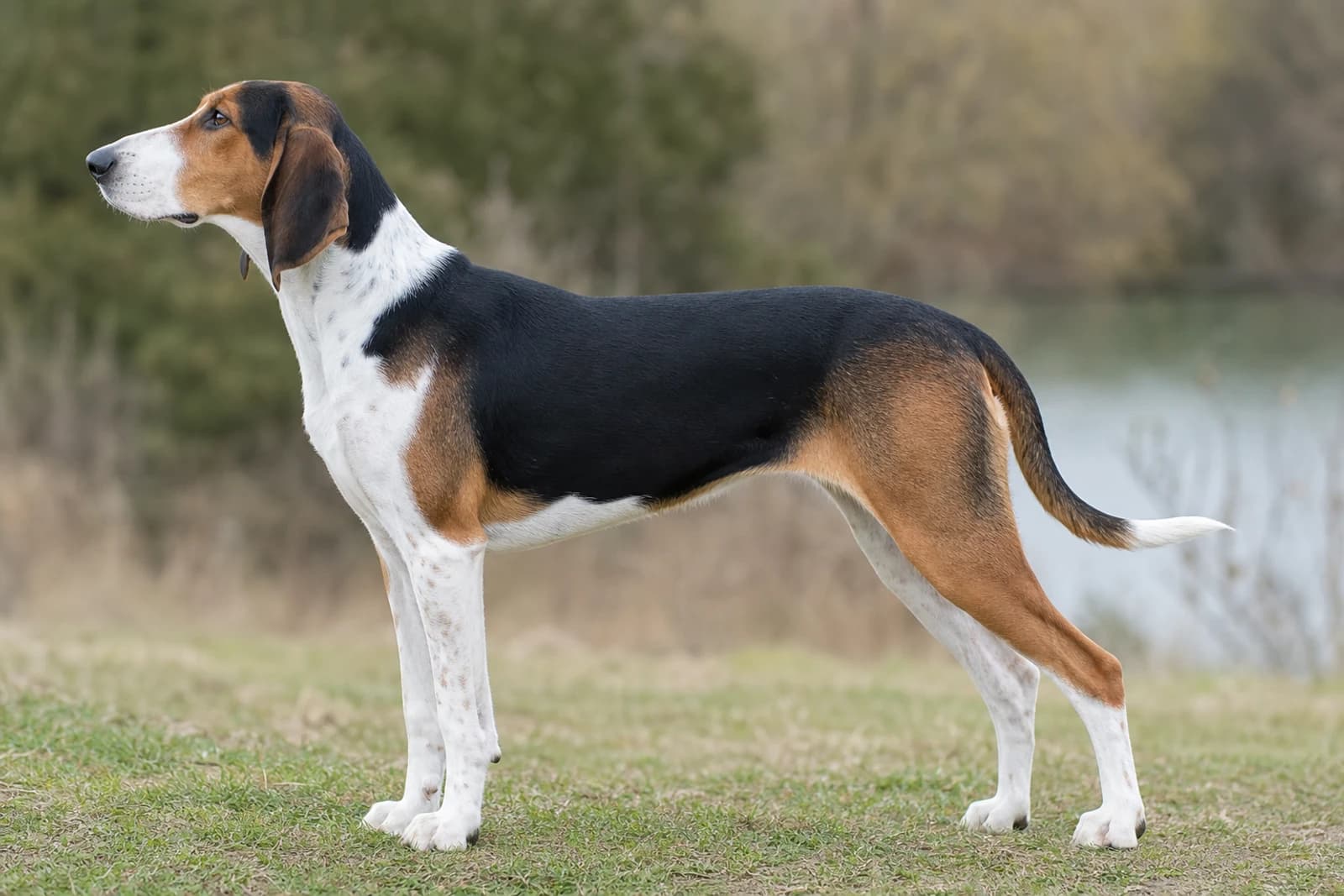
The French Tricolour Hound is a large, athletic scenthound with a striking tricolor coat, bred for hunting hare and deer in packs. This breed suits active, outdoor-loving owners who can provide ample space and vigorous daily exercise. Gentle and sociable with family, it thrives in homes with other dogs but presents challenges for first-time owners due to its independent nature and powerful voice. Not suited for apartment living, it needs secure fencing and consistent, patient training.
At a glance
- Size
- Giant
- Height
- 24–28 in
- Weight
- 75–77 lb
- Life span
- 11–12 years
- Coat colors
- Tricolor coat
- Coat type
- Short, dense, smooth
- Origin
- France
How much does a French Tricolour Hound cost?
Adopt / rescue
$75–$400
Usually includes spay/neuter, first shots, and a microchip.
Buy from a breeder
$700–$2,000
From a reputable, health-testing breeder.
Approximate USD. Prices vary widely by region, breeder, pedigree, age, and coat colour — adopting is the lower-cost and recommended route. Avoid suspiciously cheap “breeders”; they’re often puppy mills.
Estimate the full cost of a French Tricolour Hound →French Tricolour Hound photos
Views
Front, side, rear and top — the full silhouette.Poses
How the breed sits, lies, moves and plays.Puppy to senior
The breed across its whole life.Expressions
The breed’s range of moods.Close-up details
Eyes, ears, nose, paws, tail and coat.Coat colors
The breed’s recognized colors.Click any photo to enlarge. We show the French Tricolour Hound from every angle — three views, poses, life stages, expressions, close-ups, coat and colors.
Appearance & size
A French Tricolour Hound gives you that old-world, large-hound presence without the bulk you see in heavier mastiff types. Expect a dog that stands 24 to 28 inches at the shoulder and tips the scale at a lean 75 to 77 pounds. That combination makes the breed substantially tall—bordering on giant—but always athletic, with a frame built to cover serious ground while hunting.
The coat is the main event, visually. It’s short, dense, and sleek to the touch, lying flat against the body with a healthy shine. The color is a strict tricolor pattern: a deep black mantle or large saddle, a pure white underside (chest, belly, all four legs, and the tail tip), and brilliant tan markings that show up as dots above the eyes, on the cheeks, inside the ears, and along the lower legs. The white tip of the tail isn’t just a cosmetic quirk—it’s a working feature that helps you keep visual contact with the dog in heavy brush. The coat needs little beyond a quick wipe-down, which is a plus for a dog that spends time outdoors.
Look at this hound head-on and you’ll see a deep, moderately broad chest and straight, well-boned forelegs that stand dead vertical. The ears are a defining trait: long, set low, and hanging with a slight inward curl, falling well past the jaw. From the side, the body stretches out in proper scent-hound proportion—a strong, level topline, a deep brisket reaching to the elbows, and a gentle tuck-up behind the ribs. The tail tapers smoothly, carried like a sabre with that unmistakable white flag at the end. From the rear, the hindquarters are powerfully muscled with well-let-down stifles and rear pasterns that stay parallel, ready to drive the dog forward with a ground-eating trot.
Expression-wise, you get the classic hound gaze: dark, oval eyes set deeply, giving a calm, slightly soulful look that matches an independent working brain. The muzzle is long and squared off, with a black nose and thin, close-fitting lips. Nothing about this dog is exaggerated—just a solid, purposeful hound shaped by centuries of French pack work.
History & origin
The French Tricolour Hound didn’t happen by accident—it was a deliberate project to blend two distinct hunting traditions. By the 19th century, French hunters wanted a hound that combined the nose and bone of their native scenthounds with the speed, compact frame, and unmistakable pack music of the English Foxhound. So kennelmen in France set about crossing imported English Foxhounds with established French breeds, likely the Grand Bleu de Gascogne, the Poitevin, and the Saintongeois (now extinct). The result was a large, leggy tricolor dog that could fly across open country, sing out on the line, and still hold tough when the cornered quarry was a wild boar.
That tricolor coat—black saddle, rich tan, and clean white—wasn’t just aesthetic. It became the breed’s visual signature, locked in through generations of selective breeding. The early fanciers weren’t chasing a ribbon at a dog show; they were building a tireless pack animal for hunting deer and boar behind horseback riders. They needed a hound that could cover eight or ten hours of rough terrain and still have voice left to signal the pack’s whereabouts. English Foxhound blood brought a leaner silhouette and a reliable, rhythmic baying style. The French ancestors contributed a deep chest, powerful scenting ability, and generations of know-how for working large game in dense forest.
By the late 1800s, the French Tricolour Hound had its firm place in the great hunting kennels of France. Unlike some other French hound breeds that later split into multiple size varieties, this one stayed singular: a 24- to 28-inch dog scaling right around 75 pounds, bred exclusively for function. That functional focus kept the breed rare outside its homeland. Even now, most French Tricolour Hounds live in France, working in packs and rarely seen as casual pets. Recognition by the FCI has brought some international awareness, but the breed’s intense pack mentality and sheer exercise needs mean it hasn’t spread far. What you get is a direct line back to a 19th-century hunter’s ideal: a hound built to run, cry, and never quit.
Temperament & personality
This is a hound who makes up his own mind. Brave, deeply stubborn, and oddly thoughtful, the French Tricolour Hound reads situations with a kind of deliberate judgment you don’t always see in pack breeds. He’ll hold eye contact, weigh your request, and then decide whether today’s “come” is worth his time. That doesn’t mean he’s disobedient — it means you need a sense of humor, consistent boundaries, and a willingness to let him think before he acts. Force backfires here. Respectful, patient handling that works with his independence gets you miles further than a raised voice.
He’s calm at rest but all business outdoors. Plan on a solid 60–90 minutes of moving and sniffing each day, not a quick stroll. This is a scent hound built to follow a trail for hours; mental exercise — long leash walks with permission to nose every bush, puzzle games, hidden treats — burns energy faster than aimless running. Without that outlet, a bored Hound turns anxious. Barking, chewing drywall, indoor urine marking, or obsessive digging often trace straight back to too much alone time and too little nose work.
Speaking of marking: treat your home’s scent map with clear-headed realism. The French Tricolour Hound may decide a guest room or a corner by the back door is “his” territory if it smells unfamiliar. Vinegar spray (white vinegar and water) neutralizes urine odors and discourages re-soiling. Immediately praise and offer a treat the moment he eliminates outside — positive reinforcement reshapes the habit far better than scolding an accident. The same scent obsession can make him an escape artist, so a secure fence is not optional.
With his own family, he’s a steady, undemanding presence — not a Velcro dog but quietly fond of lounging nearby while you work. He’s watchful and will announce visitors with a deep bay, though he’s no yappy alarm system. Strangers get a polite but reserved once-over. Aggression isn’t typical, but a stiff body, a hard stare, and a tail held high and still tells you to de-escalate and give him space. Learn those signals; a 75-pound hound who feels cornered is no joke.
Households with very young kids or novice owners should think twice. A French Tricolour Hound will guard his food bowl if startled mid-meal, so teach children never to interrupt him while he eats. He also may not tolerate rough handling or tail-pulling, and his sheer size means accidental knockdowns happen. Older, dog-savvy kids who respect his autonomy usually earn a loyal shadow.
He’s got quirks. Expect some creative chewing — provide raw marrow bones or sturdy rubber toys to satisfy the jaw-strengthening instinct, and use a citrus peel spray (boil peels in water, strain, mist) on baseboards or chair legs. Don’t be shocked if he rolls in something foul on a walk; hound people will tell you it’s either a scent-masking leftover from hunting ancestry or his way of bragging about a find. A quick rinse and a wry shrug are part of the deal. For the right owner, that mix of brains, nose, and unbothered confidence makes for a fascinating, deeply satisfying companion.
Good with kids, dogs & other pets
The French Tricolour’s patient, non-aggressive personality naturally leans toward safe interactions with children, but his sheer size—75 to 77 pounds of lanky muscle standing up to 28 inches—can accidentally bowl over a toddler in a moment of excitement. Always supervise play, and teach kids to respect this hound’s sensitive side. He doesn’t bounce back from rough handling or shouting the way some hardy breeds do; a bad experience can leave a mark, so gentle introductions and consistent rules in the house go a long way.
With other dogs, you’re starting from a good place. Bred to work in close packs, French Tricolours typically enjoy canine company and often feel more settled when they have a confident dog buddy around. That pack drive, however, doesn’t mean automatic harmony. The critical socialization window closes around 12–16 weeks—ideally start between 3 and 14 weeks—with gradual, positive exposure to well-mannered adult dogs. If you adopt an adult who missed that window and is already timid or reactive, do not force meet-and-greets. Pressuring a fearful dog can spike anxiety or trigger a scuffle, so focus instead on making your home a low-stress place where he feels safe, even if that means limiting contact with unfamiliar dogs.
Cats and small pocket pets demand a heavier dose of realism. These are scent hounds with a history of hunting rabbits and other game. A French Tricolour raised alongside an indoor cat from puppyhood, with patient, supervised introductions, can learn to coexist peacefully—especially if the cat is dog-savvy and has escape routes. But expect that chase instinct to kick into high gear outdoors. Small animals like hamsters, guinea pigs, or backyard chickens will read as prey, so secure barriers and separate living spaces are a must. Never leave any small pet unattended with the dog, even if they’ve lived under the same roof for years.
At his core, this is a deeply social, companionship-hungry breed. He wasn’t designed to be left alone for long stretches or stuck in the yard while the family is inside. A household where someone is around most of the day, with another easygoing dog and kids who understand gentleness, will see this hound’s sweetest side. Isolation breeds distress, and a lonely, anxious Tricolour can develop noise phobias, destructive habits, or over-the-top excitement during the few interactions he does get. Most importantly, put the work in early. Timidity in adulthood—spooking at thunder, panicking during vet visits—often traces back to gaps in those first few months. A well-socialized French Tricolour is a steady, family-centered dog, but achieving that requires an experienced owner who reads his sensitivity and quietly manages the world he walks into.
Trainability & intelligence
The French Tricolour Hound is a smart, independent problem-solver — not the biddable, eager-to-please type you’d get in a retriever. Centuries of following scent trails with minimal human input shaped a mind that weighs whether your cue is actually worth the interruption. That lands them at a moderate trainability (3/5), and it means a novice handler can feel outmatched without guidance.
Motivation is everything. These dogs respond to positive reinforcement — high-value treats, a favorite squeaky toy, or genuine excited praise the instant they get it right. Punishment or heavy-handed corrections backfire fast, wrecking trust and teaching avoidance instead of cooperation. You’re not breaking a stubborn streak; you’re building a reason for the dog to choose you over a scent plume.
- Recall is the honest sticking point. When a French Tricolour Hound locks onto a trail, the rest of the world disappears. Expecting a bombproof off-leash recall without months of patient proofing is a setup for failure. Use a long line in open spaces, practice recall daily with jackpot rewards, and never rely on your voice alone near roadways or wildlife. Some owners never get 100% reliability around fresh scent, so a securely fenced yard is your safety net, not a luxury.
- Start socialization early — ideally between 3–14 weeks — with gradual exposure to different people, sounds, surfaces, and other animals. This reduces fear-based reactivity later. Since the breed can be sensitive to tone, gentle, consistent guidance builds the trust that makes a dog want to check in willingly.
- Short sessions work best. Their intelligence comes with a low tolerance for drilling. Aim for 5–10 minutes of upbeat training, end on a success, and let the lesson settle. Over time, you’ll see more reliable responses, but always operate on the assumption that the nose wins in a tie.
Exercise & energy needs
This is an endurance athlete built to cover miles on a scent trail — not a dog you can tire out with a quick game of fetch in the backyard. Expect to give a French Tricolour Hound 90 to 120 minutes of vigorous exercise every day, split into at least two sessions. One leisurely walk will leave him restless and looking for a project, usually one you won't like.
Intensity matters as much as the clock. These hounds were developed to hunt across open country for hours, so they need sustained, ground-eating movement: long trots, hills, and off-leash running in a secure area whenever possible. A stiff 45-minute morning run paired with an hour of hiking or scent tracking in the afternoon fits the bill. They don't do well as casual neighborhood strollers.
Mental fatigue is just as critical as physical. Lean hard into their nose. Scent work, tracking, and barn hunt are tailor-made for this breed. Even a slow, sniff-driven walk where you let him follow a trail for 30 minutes will drain mental batteries better than a forced march. Puzzle toys and frozen kongs help indoors, but nothing replaces real scent games. Without that outlet, a bored Tricolour can channel his intensity into howling, digging, or chewing through walls.
Because he's a giant breed carrying 75–77 pounds on a deep chest, protect his joints while he's growing. Stick to soft surfaces, avoid repetitive jumping, and build mileage gradually. Once fully mature, you can ramp up to more demanding activities: canicross, bikejoring, or long-distance trail running — all sports where he can stretch out and work. Just pay attention to signs of soreness, and remember that even an 11- to 12-year lifespan means this high-octane dog will eventually need you to dial things back with age.
Grooming & coat care
You won’t spend your weekends wrestling with a brush, thankfully. The French Tricolour Hound carries a short, dense, single-layer coat—sleek, hard, and built to shed mud and brambles. For everyday upkeep, once-a-week passes with a bristle brush (natural pig bristle works best) pull out loose hair, distribute skin oils, and leave the tricolor pattern glossy. The coat has no undercoat to clump or mat, so you skip the detangling sprays and prolonged slicker sessions entirely.
Expect moderate shedding year-round, with a heavier blow in spring and fall. During those seasonal peaks, bump brushing to two or three times a week. It keeps the hair off your couch and stimulates the skin as fresh coat pushes through. An active hound who runs hard outdoors will naturally shed dead fur, too—regular off-leash sprints on dirt or grass accelerate that turnover.
Bathing is a rare event. Unless your dog finds something truly foul to roll in, a rinse with plain water or a mild dog shampoo two or three times a year is plenty. Over-washing strips the protective oils that make this coat almost self-cleaning. No trimming or shaping is required anywhere on the body.
Ears, nails, and teeth follow the big-dog basics. Those long, drop ears trap moisture and need a weekly wipe with a dry or slightly damp cloth—redness or a yeasty smell means a vet visit. Nails grow fast on a 75-pound dog; if you hear clicking on hardwood, it’s time for a trim, typically every three to four weeks. Brush the teeth two to three times a week to stave off tartar buildup common in deep-chested hounds.
Even a wash-and-wear coat benefits from your hands on it regularly. Those quick brushing sessions let you spot any cuts, ticks, or dry patches early, especially after a day crashing through brush. For a giant breed, that’s a real gift.
Shedding & allergies
A French Tricolour Hound will leave a fair amount of hair around the house, but it’s not the kind of coat that forms tumbleweeds overnight. They’re moderate shedders — think a steady drizzle rather than a blizzard. Because this is a big, muscular hound with a short, dense coat, the hair you do find will be coarse, dark, and surprisingly visible on light floors and furniture.
Seasonal blowout happens twice a year. In spring and fall, expect a sudden uptick in shedding that can last a few weeks. A rubber curry brush or a hound glove used every other day during those periods pulls dead undercoat out fast. The rest of the year, two brisk brushing sessions a week are enough to keep loose fur under control and the coat glossy.
Drool is more of a lifestyle issue than shedding for many owners. Long, pendulous lips mean water drips after drinking and a light slobber after meals or excitement. Not mastiff-level, but you’ll want a rag handy near the water bowl.
No dog is truly hypoallergenic, and this breed is no exception. Dander sticks to the short hairs and spreads wherever the dog sheds, so allergy sufferers should spend time around the breed before committing. Regular brushing, good vacuuming, and washing the dog’s bedding will help, but they don’t make the allergen load disappear.
Diet & nutrition
A lean French Tricolour Hound stays sound longer—those 75 to 77 pounds ride on long legs and a deep chest that really don’t need extra baggage. Even a few too many pounds grind on joints already built for hard miles. This is a food-motivated breed that will happily overeat, so free-feeding just isn’t in the cards. Measure every meal.
For a moderately active adult, split the daily ration into two feedings. With a quality kibble, start around 3–4 cups per day and adjust until you can easily feel ribs without pressing through a fat pad. A fresh-food approach works great on this frame: roughly 60% animal protein (raw or gently cooked meat, fish, eggs), 20–30% blended or finely chopped fruits and vegetables, and the remaining 10% from digestible grains like pearl barley, plain yogurt, or organ meat. Blending or finely chopping the veg portion helps a dog’s up-and-down jaw get the most out of the nutrients.
Puppies grow fast and need the fuel spread thin:
- 4 meals a day until 4 months old
- 3 meals until 6 months
- then the adult 2-meal schedule
Introduce new foods gradually—lightly cooked purées or a top-notch commercial puppy formula to start. Supervised raw chicken wings can come in around 12 weeks.
Senior dogs do better on smaller, more frequent meals. If teeth are missing, purée the whole bowl. You don’t need to cut protein, but you do need to shrink portions as the miles slow down. Older Tricolours pack on weight alarmingly fast, and obesity in a deep-chested hound isn’t just a joint wrecker—it’s a pancreatitis invitation. Keep rich, greasy scraps out of the kitchen routine. And skip the vegetarian experiment; this dog’s digestive machinery expects meat. Slow things down with a puzzle bowl to engage that busy nose and prevent gulping. A weekend batch-cook of grains, vegetables, and proteins makes healthy meals a no-brainer during a hectic week.
Health & lifespan
A French Tricolour Hound typically gives you 11 to 12 years — a solid stretch for a dog that stands 24 to 28 inches at the shoulder and hovers around 75 to 77 pounds. That timeline stays on track when you zero in on the breed’s two main physical weak spots: hips and skin.
Hip dysplasia is the big-ticket worry. Like many giant breeds, these hounds can develop poorly fitting hip joints that eventually lead to arthritis and pain. Responsible breeders don’t guess — they screen with OFA or PennHIP x-rays and share the results. If you’re buying a puppy, insist on seeing both parents’ clearances.
Skin issues are the other thread that runs through the breed. You might see raw, itchy patches, recurrent ear infections, or yeasty folds around the face and neck. A diet rich in omega-3 fatty acids can help from the inside, while a habit of thoroughly drying the coat after wet walks (and checking for hidden damp spots under the collar) cuts down on surface trouble. Some dogs react to environmental allergens, so if the scratching won’t quit, a vet dermatology workup beats guessing.
Weight presses directly on those big joints — every extra pound accelerates wear. These are strong, food-motivated dogs who will happily eat double their ration if you let them. Measure meals, keep training treats tiny, and run your hands over the ribs every couple of weeks: you want to feel them with light pressure, not see them from across the yard.
Prevention is pretty cut-and-dried:
- Heartworm prevention — give a monthly medication during mosquito season and for one full month after the first hard freeze. Even a small lapse opens the door.
- Rabies vaccination — legally required, no exceptions, because once symptoms appear there is no effective treatment.
The short tricolor coat offers almost zero insulation. In freezing weather a waterproof jacket keeps a hound comfortable without having to shiver through a walk.
This breed has an emotional volume knob that’s sensitive to isolation. French Tricolour Hounds were built to work in packs, and loneliness can tip straight into anxiety-driven barking — the kind that rattles windows. Chronic stress from neglect isn’t just a behavioral problem; it can lower immune defenses and make skin flare-ups more frequent. Early, positive socialization and calm, consistent handling settle the nervous system before it gets wound up. These are not dogs you bully into compliance; they respond to clear, respectful direction and shut down under force.
A yearly vet checkup — or twice yearly once they hit middle age — lets you catch shifting joint health, creeping weight gain, and skin changes when they’re still easy to manage. No drama, just a paper trail that keeps a giant, bouncy hound feeling good for the long haul.
Living environment
A French Tricolour Hound belongs in a home with space to move and a fence that means business — not a decorative picket barrier. This is a giant scent hound bred to hunt in packs across open countryside. An apartment or a townhouse with shared walls is a terrible fit. The deep, carrying bay that thrills you on the trail will absolutely wreck your relationship with the neighbors. If you don’t have a standalone house with a securely fenced yard, or better yet, rural acreage, look at a different breed.
The yard itself needs to be escape-proof. That nose can override every other command once it latches onto an interesting smell. A 75-pound dog that clears a four-foot fence without a second thought is a real possibility. Underground electronic fences won’t cut it either — pain doesn’t beat instinct, and you’ll just get a dog that runs through the shock and can’t find its way home.
Indoor space matters, too. The house should have enough room for a giant breed to stretch out without constantly knocking over furniture. Hardwood or tile floors are practical for muddy paws after a run. These dogs shed moderately year-round, so invest in a good vacuum and accept that dog hair is now part of the decor.
Climate-wise, the Tricolour’s short, dense coat provides reasonable insulation against cool weather, but he’s not a snow dog. Freezing temperatures call for limited outdoor time and a warm place to sleep. Heat is the bigger concern. A hound that relentlessly follows scent can overheat if you push too hard on a summer afternoon. Exercise early in the morning or late in the evening, and always have fresh water available.
Noise is a non-negotiable part of the package. These hounds don’t just bark — they bay, a loud, mournful, resonant sound that travels shockingly far. It’s beautiful in the field; it’s a noise complaint machine in a suburban setting. If you’re sensitive to noise or have close neighbors, you must train a reliable “quiet” cue from day one, but even then, expect the instinct to vocalize to surface when he’s excited or tracking.
Tolerance for being left alone runs low in a pack-bred hound. A French Tricolour Hound forms strong bonds with his people and can slide into anxious, destructive behavior if left solo for eight or nine hours a day. You’ll need a household where someone is around more often than not, or plan for doggy daycare. Gradual desensitization from puppyhood helps, but this breed craves companionship, not solitude.
Exercise goes well beyond a couple of leashed walks around the block. Count on a minimum of two vigorous daily sessions — think 45 to 60 minutes of hard running, off-leash in a safe area, plus dedicated scent work. Trick training, puzzle feeders, and long tracking games on a long line will tire his brain in ways that mere distance never will. A bored, under-exercised Tricolour Hound will dismantle your yard, sing opera for hours, and invent his own entertainment. Get his nose and legs working together every day, and you’ll have a calm, satisfied housemate who’s ready to curl up.
Who this breed suits
If a long run through the woods followed by a full-throated sing-along sounds like a good time, you’re in the right headspace. The French Tricolour Hound is a giant nose with a giant voice, built to work in packs and chase scent for hours. He lands best with an owner who truly enjoys that drive, not one who just endures it.
Best fits
- Dedicated runners, hikers, and hunters who already log serious miles. A 75–77 lb hound standing 24–28 in at the shoulder needs at least 90 minutes to two hours of off-leash running or fast-paced hiking daily — casual neighborhood loops won’t dent his stamina.
- Homes with a large, securely fenced yard. This is not a breed you can trust with an invisible fence or a half-hearted gate latch. His nose overrides every other command once a scent trail lights up.
- People who work from home or can bring a dog along. Bred to hunt in close-knit packs, he’s social to the core and can develop serious separation anxiety if left alone 8–10 hours a day. He does best with near-constant company, whether that’s another dog or a human who’s around a lot.
- Owners with a sense of humor about noise. The Tricolour’s deep, rolling bay is part of the deal. It’s his job to announce the trail, and he’ll do it with gusto — expect serenades at the mail carrier, the squirrel, and the suspicious leaf.
- Active families with older kids. He’s generally patient and pack-oriented, but a 77 lb zoomie machine can accidentally flatten a toddler. Sturdy teenagers who can help meet his exercise quota are a better match.
Think twice if
- You’re a first-time dog owner who wants an easy, biddable companion. Scent hounds are independent problem-solvers. He’ll weigh every command against whatever his nose finds more interesting. Training requires patience, consistency, and a rewarding relationship — not a bossy approach.
- You live in an apartment, condo, or tight suburban lot with noise-sensitive neighbors. The basso profundo bay carries through walls and down the block. It’s not a once-in-a-while bark; it’s a deep, sustained announcement that happens whenever his instincts kick in.
- Your leisure time is more “quiet coffee shop” than “muddy trailhead.” A bored Tricolour will dismantle your sofa, excavate the yard, and sing the song of his people for hours. This is a breed that needs a job, not just a walk.
- You have cats, rabbits, or other small pets. Generations of pack hunting make his prey drive non-negotiable. He may coexist with a dog-savvy cat he’s raised with, but anything that flees triggers a full-speed chase.
- You prize a spotless house. That handsome tricolor coat is blessedly low-maintenance — a quick wipe-down does the trick — but he’s a drooler and a shedder who tracks in half the trail after every outing.
Cost of ownership
A well-bred French Tricolour Hound puppy from a breeder who screens for hips, eyes, and temperament typically runs $1,200–$2,500 in the US. Some hunting-line litters may land on the lower end, but scarcity keeps prices firm. You'll also need to budget for spay/neuter, a crate large enough for a 77 lb adult, and a first round of sturdy leashes and tracking gear, which can add $400–$600 in the first few months.
Once the dog is home, the monthly rhythm is predictable but not cheap. A 75–77 lb hound is a big engine that burns through fuel. Expect to go through a 30-lb bag of high-quality kibble every three weeks or so, landing you at $70–$90 per month for food. Treats for nose-work sessions add another $15–$20.
Grooming is low-maintenance: the short tricolor coat needs a weekly brush and the occasional bath, so you can skip the salon bill. Budget $10–$15 per month for shampoo, ear cleaner (those drop ears trap moisture), and nail trims.
The real recurring bite is veterinary and insurance. A giant, deep-chested breed is prone to bloat, and a long-backed athlete can run into hip dysplasia. A good wellness plan with flea, tick, and heartworm prevention runs $45–$65 monthly. Pet insurance to cover those bigger what-ifs – GDV surgery, cruciate ligament repairs – adds another $50–$80 per month, depending on your deductible and coverage level. All in, expect $200–$300 each month to keep a French Tricolour Hound fed, healthy, and ready to run, not counting the occasional boarding or replacement of a shredded dog bed. Stashing an extra $1,000 in a dedicated emergency fund before you pick up the leash is a smart, plain-spoken move.
Choosing a French Tricolour Hound
French Tricolour Hounds are rare outside France, so your search will almost certainly lead to a breeder rather than a rescue. You might get lucky with a breed-specific hound rescue that brings dogs from Europe, but don’t count on it. If you see an adult listed as one at a local shelter, it’s often a Treeing Walker Coonhound or a mix — not a slam, just a reality check.
When you do find a breeder, prioritize health clearances above all else. This is a large, deep-chested hound, so ask to see OFA hip and elbow scores (at minimum fair or better), a certification from a veterinary ophthalmologist within the last year, and, ideally, a cardiac exam. Bloat — gastric dilatation-volvulus — is a real risk; a breeder who talks openly about feeding routines and prevention is a good sign. Avoid anyone who waves off health questions or only shows you a quick vet check.
Run from breeders who always have puppies available, won’t let you meet the mother (and father if possible), or keep dogs in kennels that feel more like a warehouse than a home. This breed thrives on human contact; early socialisation inside the house shapes a stable family companion. A breeder who specialises in packs for hunting might produce driven dogs, but you need to see that the parents are calm, approachable, and not hyper-reactive.
When you visit a litter, watch for a puppy that investigates you with a wagging tail, not one that hangs back trembling or bullies its littermates. Scent hounds are naturally nose-driven, but a sound puppy should also make eye contact and accept gentle handling. Check that ears are clean, eyes are clear, and bellies aren’t distended. Ask the breeder which puppy they’d pick for a family pet — and why. Their answer reveals whether they’re matching temperaments or just moving puppies.
Pros & cons
-
A born hunter with a legendary nose. The French Tricolour Hound was built to work — if you want a dog for scent trials, tracking, or true pack hunting, this breed’s drive and stamina are hard to match.
-
Pack-friendly temperament. Bred to run with other hounds, they typically mesh easily with family dogs and are generally gentle and patient with kids they’ve been raised alongside.
-
Easy-care coat. Their short, dense tricolor coat sheds moderately and thrives on a quick weekly brushing. No clipping, no fuss — just the occasional wipe-down after a muddy field run.
-
Indoor demeanor is surprisingly calm. Once you’ve met their daily exercise requirement, they’re usually content to sprawl at your feet or doze in a sun patch, not bounce off the walls.
-
Decent lifespan for a giant breed. With responsible feeding, weight management, and screening for hip and elbow health, a well-bred Tricolour can live 11–12 active years.
-
Giant size demands space. At 75–77 lb and up to 28 inches tall, this is a dog that needs a large, securely fenced yard — apartment living is a nonstarter.
-
A nose with an off switch you can’t always reach. When a scent trail calls, everything else fades. Reliable off-leash recall takes relentless, early training, and even then, a fenced area is a safer bet than an open field near a road.
-
A voice that carries for miles. The deep, rolling bay is charming on a hunt but less charming when it starts at 6 a.m. in a quiet suburb. Close neighbors will hear it.
-
High prey drive, no sugar-coating. Cats, rabbits, and other small pets often trigger chase instinct. Cohabitation can work with careful introductions, but it’s never a guarantee.
-
Exercise is a baseline, not a nice-to-have. Plan for a solid hour or more of running, hiking, or active scent work every single day — a quick walk won’t touch their physical or mental tank.
Similar breeds & alternatives
If the French Tricolour Hound’s tri-color coat and pack-hunting style have you hooked, a few close French cousins tick similar boxes while shifting the scale in size, coat, or temperament. None are casual pets—every one was built to follow scent for hours—so a large, fenced yard and a solid off-leash running routine are baseline, not optional.
-
Anglo-Français de Petite Vénerie – The scaled-down choice. At 19–22 inches and 35–45 pounds, this tricolor hound preserves the same black-saddled, tan-pointed white pattern in a much smaller frame. You still get a driven nose and a ringing voice, just with less brute strength and a more manageable footprint. Expect a lifespan that often reaches 12–14 years, slightly longer than the Tricolour’s 11–12.
-
Grand Bleu de Gascogne – Same giant category (25–28 inches, 70–80 pounds) but trades the tricolor for a blue-mottled coat with black patches and tan trim. The personality mirrors the Tricolour’s deep bay and pack loyalty, though Grands Bleus often settle a bit more calmly indoors after a good run.
-
Poitevin – A tricolor option with a distinctly leaner build. Height runs 24–28 inches but weight usually lands around 66–77 pounds. Long lines, lighter bone, and a more independent hunting drive make the Poitevin a sharper-edged athlete. Where the Tricolour leans heavily on its pack, the Poitevin can be more single-minded and needs a handler who stays interesting even when prey scent fills the air.
-
Billy – For speed over power. A large hound (24–28 inches, 50–70 pounds) built almost entirely white with orange or lemon patches, occasionally showing tricolor hints. Lighter and faster than the Tricolour, with an even higher chase instinct, the Billy does best with a runner’s lifestyle and fewer off-leash distractions.
If the tricolor pattern is your dealbreaker and you have the space for a giant, the French Tricolour Hound gives you robust pack-hound presence. The Petite Vénerie keeps the colors in a smaller, more adaptable body, while the Poitevin delivers a similar look in a racier, less pack-dependent frame.
Fun facts
- Bred to hunt hare in large packs with a distinctive, melodic baying
- One of a family of French hounds, developed from old St. Hubert hounds
- Requires a securely fenced yard to prevent roaming after scents
- Known for its striking tricolor coat of black, white, and tan
Frequently asked questions
- Are French Tricolour Hounds good with children?
- The breed is generally gentle and sociable, so they can do well with considerate children, especially when socialized early. However, their large size and high energy mean supervision is advised around very small kids to prevent accidental knocks.
- How much exercise does a French Tricolour Hound need?
- As a highly energetic breed, this hound requires at least an hour of vigorous daily exercise such as running, hiking, or scent work. Without sufficient activity, they may become restless and develop unwanted behaviors.
- Do French Tricolour Hounds shed a lot?
- This breed has a short, dense coat that sheds moderately throughout the year. Weekly brushing helps manage loose hair, and shedding may increase seasonally.
- Are French Tricolour Hounds easy to groom?
- Grooming is relatively low-maintenance. A weekly brush with a hound glove or bristle brush is usually enough to keep their coat healthy and remove debris.
- Do French Tricolour Hounds bark a lot?
- As a vocal breed originally used for hunting, they are prone to baying and barking, especially when they pick up an interesting scent or are left alone for long periods. Early training can help manage excessive vocalization.
- Is the French Tricolour Hound suitable for first-time dog owners?
- Due to their independent nature and high exercise needs, they can be a challenge for inexperienced owners. Consistent training and plenty of stimulation are required, but with commitment, they can make loyal companions.
Tools & calculators for French Tricolour Hound owners
Quick estimates tailored to French Tricolour Hounds — pre-filled with this breed’s size where it matters.
Articles & stories about the French Tricolour Hound
Sources & standards
This profile follows recognized breed standards from the American Kennel Club (AKC) and the Fédération Cynologique Internationale (FCI), along with established veterinary and breed-club guidance. These describe general breed tendencies — every dog is an individual.
Owner stories
Have a French Tricolour Hound? Share your experience — grooming tips, personality quirks, anything goes.