

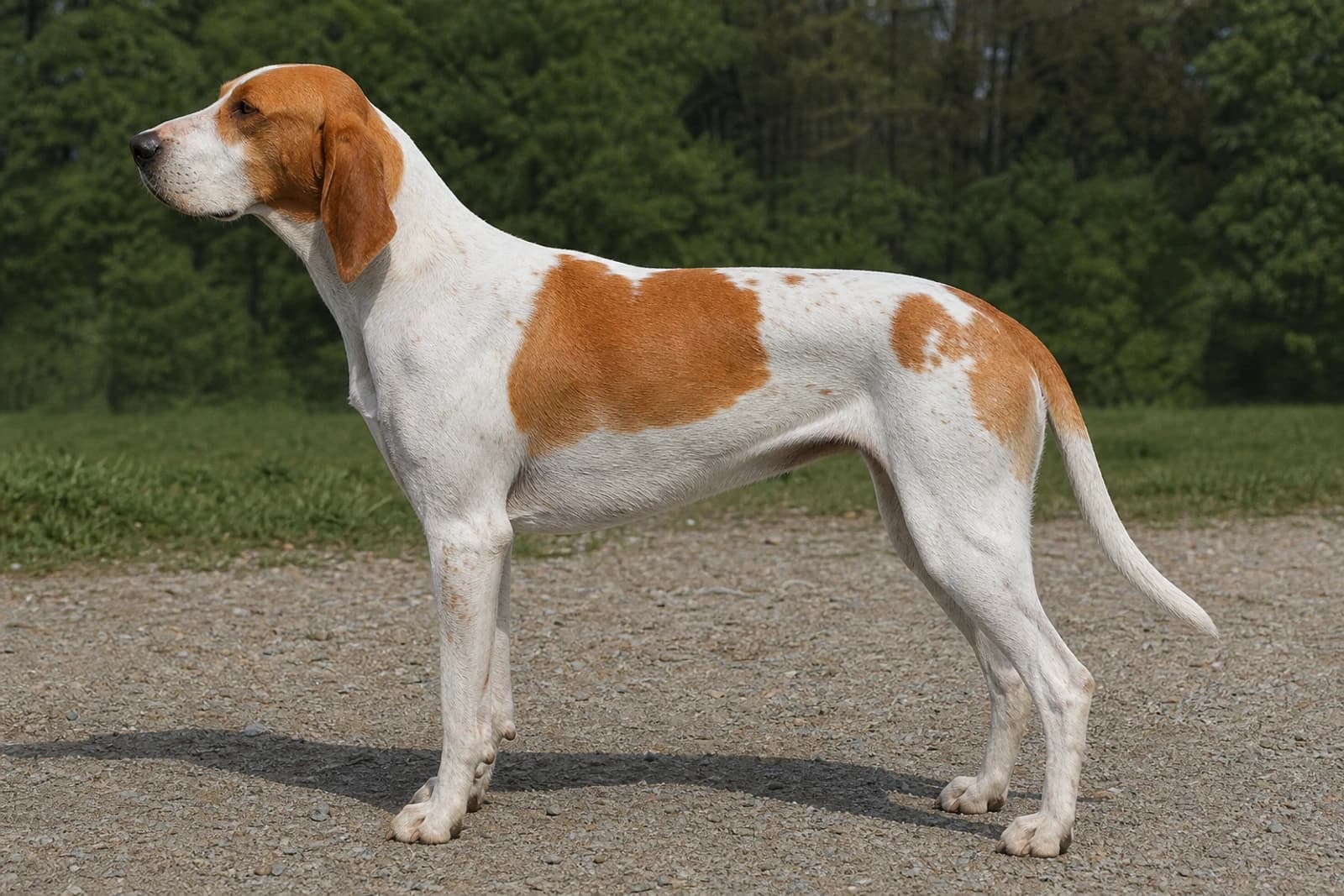
The French White and Orange Hound is a large, elegant scent hound originally bred for hunting in packs. Known for their distinctive white and orange coat, these gentle giants are friendly, sociable, and loyal to their families. They thrive in active homes with plenty of outdoor space and do best with another dog companion. While affectionate and good with older children, their strong prey drive makes them unsuitable for homes with small pets. Their independent nature requires patient, consistent training, so they are better suited to experienced owners. With proper exercise and companionship, they are calm and devoted indoors.
At a glance
- Size
- Giant
- Height
- 24–28 in
- Weight
- 60–71 lb
- Life span
- 12–13 years
- Coat colors
- White and Orange
- Coat type
- Short, dense coat
How much does a French White and Orange Hound cost?
Adopt / rescue
$75–$400
Usually includes spay/neuter, first shots, and a microchip.
Buy from a breeder
$700–$2,000
From a reputable, health-testing breeder.
Approximate USD. Prices vary widely by region, breeder, pedigree, age, and coat colour — adopting is the lower-cost and recommended route. Avoid suspiciously cheap “breeders”; they’re often puppy mills.
Estimate the full cost of a French White and Orange Hound →French White and Orange Hound photos
Views
Front, side, rear and top — the full silhouette.Poses
How the breed sits, lies, moves and plays.Puppy to senior
The breed across its whole life.Expressions
The breed’s range of moods.Close-up details
Eyes, ears, nose, paws, tail and coat.Coat colors
The breed’s recognized colors.Click any photo to enlarge. We show the French White and Orange Hound from every angle — three views, poses, life stages, expressions, close-ups, coat and colors.
Appearance & size
The French White and Orange Hound is a big, serious dog — 24 to 28 inches at the shoulder and 60 to 71 pounds — but he carries his size like a marathon runner, not a bodybuilder. You’re looking at a Giant breed that’s all lung and leg, built to float over rough ground for hours without crashing. From the side, that intent shows up as a deep chest that reaches to the elbows, a long well-sprung ribcage, and a back that’s either level or rises just a hair over the loin. There’s zero sag or softness; the whole frame feels stretched and efficient.
Front view tells you straight forelegs, strong bone but no coarseness, and elbows that hug the ribs cleanly. The chest is deep but deliberately narrow — a design feature that prevents the hound from beating himself up with his own elbows as he gallops. From the rear, powerful first and second thighs taper into low-set, well-angulated hocks. The tail, thick at the root and tapering to a fine point, hangs down in a slight curve when the dog is relaxed and rises saber-style, never curled, when he’s on a scent line.
The coat is a no-fuss working jacket: short, dense, close-lying, and tough enough to shrug off wet brush. Color is the breed’s calling card. The body is predominantly white, with distinct orange patches or a full orange saddle stretching across the back. The ears are almost always solid orange, and many dogs develop a light orange ticking on the muzzle and legs — tiny speckles that give the coat a bit of camouflage in the field without making the dog hard to spot at a distance. There’s no black shading or tricolor, just that clean white and fiery orange.
Distinctive features pull the whole dog together quickly:
- Ears: Long, thick, and set low, reaching at least to the nose when pulled forward. They drape in soft folds and frame a face that looks perpetually thoughtful.
- Head: Slightly domed skull, a square muzzle (not pointy, not blocky), and a dark, gentle eye that softens the whole expression.
- No excess baggage: This is a dry hound — tight lips, minimal dewlap, and no loose skin wobbling around. It’s a purposeful silhouette that says “distance” instead of “decoration.”
History & origin
If you trace the French White and Orange Hound back far enough, you land in the sprawling kennels of medieval France, where powerful scent hounds were the specialized tools of kings and nobles chasing stag, wolf, and boar. The direct ancestor worth knowing is the Saintongeois, a now-extinct hound from the Saintonge region that was big-boned, white with black or orange patches, and revered for its nose and voice. By the 1800s, though, the Saintongeois had nearly vanished, diluted by crossbreeding and changing hunting fashions.
The breed we see today didn’t solidify until French breeders started a deliberate rebuild in the early 20th century. They wanted a pack hound that was lighter on its feet than the old Saintongeois, but kept the white coat, the deep bawl, and the grit for a full day’s chase. Their answer was to cross the remaining Saintongeois-type dogs with imported English Foxhounds. The Foxhound contributed drive and a more athletic build; the French blood anchored the distinctive coloring and that rolling, musical bay that carries through dense forest. The result was a hound that was mostly white with bold orange patches—sometimes just tiny specks on the ears, sometimes a saddle of color across the back.
For decades, these dogs were bred with function first, not paperwork. Hunters in western France ran them in large packs after roe deer and wild boar, valuing stamina and a cold nose that could work an old trail. The French White and Orange Hound earned a formal breed standard in 1957, alongside its close cousin the French White and Black Hound. That official recognition didn’t change its day job: the vast majority still live in hunting packs, not on family sofas. Even today, the breed is exceptionally rare outside France, and the ones that do pop up in other countries almost always come from working kennels where the hounds sleep in shared yards and answer to the huntsman’s horn, not the doorbell.
Temperament & personality
A French White and Orange Hound lives by its nose, and that single fact shapes almost everything about sharing a home with one. Picture a dog who can be sprawled across the couch in a boneless heap one moment — soft-eyed, relaxed, completely content — and the next moment have every muscle coiled forward because a scent trail just lit up her brain like a switchboard. That forward lean isn’t aggression; it’s pure, undiluted intent. She’s not asking permission. She’s already working.
Inside the house, these giants (24–28 inches, 60–71 pounds) are steady and surprisingly easy to live with. They form tight bonds with their people and greet family members with a low, warbling bay that sounds more like a song than a bark. They’re patient with respectful kids, though a toddler underfoot can get accidentally bowled over by a swinging tail or a sudden turn. Most are calm and gentle around other dogs — pack hounds by heritage, they read canine social cues well. A stiff, direct stare from a strange dog will send them a clear signal, and they usually respond with a lip lick, a yawn, or a turned head rather than a confrontation. Cats and other small pets are a different story; that prey drive kicks in hard when something small and furry darts.
Stubborn? Absolutely, if you mean they won’t take orders just because you gave them. Force unravels this dog. You get much further with food, patience, and a respectful consistency that lets the dog think she’s making the choice. When a scent grabs her attention, your recall might as well be static. Off-leash reliability is something very few owners achieve without obsessive, reward-heavy training in fenced areas.
Quirks come with the nose. Expect your hound to stop mid-walk and sniff a single blade of grass for forty seconds, then urine-mark the spot to leave her own calling card. (This is spatial memory in action; she’ll recognize that very spot tomorrow.) Rolling in dead things or fox scat happens without warning — think of it as her version of putting on perfume, deeply gratifying in ways we’ll never understand. Puppies chew to explore and soothe aching gums; adults keep their jaws strong on hard chews. If your shoes become a target, a simple spray of white vinegar or boiled citrus peels can redirect the habit without drama.
Indoors, she’s not a 24/7 cuddle bug. She likes her space and often follows you from room to room just to be nearby, settling down with a heavy sigh. Soft eyes, loose body, a gently wagging tail — that’s the baseline mood. Even a dog this large can tiptoe into a sunbeam and vanish for a few hours. Just don’t mistake that off-switch for a low-energy breed. She needs a solid hour of moving, sniffing, and tracking every day, not a quick leash loop around the block. A tired hound is a quiet hound, but a bored one will compose lengthy arias for the neighborhood. Give her scent games, long meandering walks where she’s allowed to follow her nose, and a couple of frozen Kongs, and you’ll have a 12- to 13-year partnership that’s warm, uncomplicated, and always a little bit funky-smelling.
Good with kids, dogs & other pets
This giant, patient hound can be a wonderful family dog — but 60–71 pounds of happy muscle can topple a toddler without meaning to. Kids who are steady on their feet will appreciate the breed’s easygoing, non-aggressive nature, while little ones need close supervision and a few ground rules. Teach children not to climb on the dog or disturb them while eating, and you’ll get back a loyal companion that genuinely enjoys being part of the household bustle.
- Size and strength: A 24–28 inch hound bowling over for belly rubs sends a kindergartner flying. Keep a hand on the collar during excited greetings and playtime.
- Never leave them alone together — not because of temperament, but because accidents happen fast with a dog this big.
- Pack mentality works in your favor: This breed craves companionship and isn’t wired to be a solo yard dog. Involve them in daily life, and they’ll bond hard with every family member, including the noisy, unpredictable small humans.
Other dogs
You’ll have an easier time than most breeds. French White and Orange Hounds were developed to hunt in packs, so they typically read canine social cues well and enjoy company. In a multi-dog home they often settle in quickly, especially if everyone has space to stretch out.
- Early socialization matters more than genetics. Expose your puppy to friendly, vaccinated dogs before 16 weeks — varied sizes, ages, and play styles — to build rock-solid social skills that last a lifetime.
- Watch the size mismatch. Even a playful swat from a 65-pound hound can overwhelm a small dog. Interrupt play if the smaller dog looks stressed.
- Adult rescues may need a slower introduction. If a previous adult hound hasn’t met many other dogs, don’t force interactions. A few well-managed parallel walks can do more than a chaotic dog-park free-for-all.
Cats, rabbits, and other small pets
Here’s where the hunting heritage kicks in. A scent hound’s nose and eyes lock onto movement, and a darting cat or scurrying pet rodent can trigger a hard chase. That doesn’t mean coexistence is impossible, but it requires clear management.
- Raised-together scenario: Puppies who grow up with a confident, indoor cat often learn to treat the cat as family. The cat needs escape routes (high perches, baby-gated rooms) and you need a solid “leave it” cue.
- Small pets under 5 pounds: Rabbits, guinea pigs, hamsters — assume they are not safe loose in the same room. A French White and Orange Hound can snatch a small animal before you can blink. Secure enclosures and separate living areas are non-negotiable.
- Never test drive with an adult hound of unknown history around free-roaming small pets. A slow, leashed introduction with immediate redirection the instant the hound fixates tells you whether you have a workable situation or a hard “no.”
The socialization bottom line
All of the above leans on one thing: what your hound learns between 3 and 14 weeks. Gently introduce the puppy to kids, other dogs, traffic sounds, different flooring, and any animal you hope they’ll live with later. Miss that window and you’re fighting an uphill battle — fearful adults and undersocialized dogs don’t bounce back just by flooding them with new experiences. Respect the adult dog’s comfort zone, but with a puppy, front-load the effort. A well-socialized French White and Orange Hound enters family life with a quiet, steady confidence that makes every interaction safer and more relaxed.
Trainability & intelligence
This hound’s brain is wired for the chase, not for blind obedience. He learns fast when something matters to him. Your job is to make yourself and your rewards matter more than the rabbit scent drifting across the field.
The nose rules the moment
Focus is his currency, and it’s short-lived around novel smells. You might have a solid 30 seconds of eye contact before his nose twitches and he’s mentally gone. Keep training sessions brief, upbeat, and stuffed with high-value treats — chicken, cheese, or freeze-dried liver. If he sits instead of jumping, reward him like he just hit the jackpot. He’s clever, but not eager to please in a traditional sense; he’ll quickly figure out which behaviors pay off and will repeat those only when the reward history is strong.
Why punishment backfires
This breed is sensitive under that athletic, 60–71‑pound frame. A sharp tone or a leash jerk teaches distrust, not manners. Redirect what you don’t like and immediately reinforce what you do. Consistency from every family member matters — a single person letting him pull on the leash undoes weeks of work.
The recall you’ll fight for
Off‑leash reliability is the hardest skill you’ll build. Once a French White and Orange Hound catches a scent, your voice becomes background noise. Train recall from puppyhood in a hallway, then a fenced yard, rewarding every check‑in with a jackpot. Even with years of practice, never trust him off‑leash near traffic or in open country without a long line. That deep chest holds lungs built for all‑day pursuit — you can’t physically stop a 65‑pound dog at full speed.
Socialize early and often
Expose your puppy to dozens of new people, loud appliances, and strange surfaces before 16 weeks. A poorly socialized hound of this size can become wary or reactive, using his deep, resonant voice to express fear. Gradual, positive introductions build the confidence that makes all other training stick. Nose work and tracking games tire him mentally, and a hound who’s solved scent puzzles is far more likely to check in with you.
Exercise & energy needs
The French White and Orange Hound isn’t a dog you can wear out with a few laps around the block. This is a working scent hound built to cover miles of varied terrain while following a trail, and his daily needs reflect that. Aim for at least 90 minutes of real, off-leash exercise, split into two sessions — a 60-minute morning run or hard hike and a 30-minute evening walk or scent game. A single long walk on a leash won’t touch his physical or mental reserves; he needs to stretch his legs at a trot or full run.
- High-endurance cardio is the foundation. Trail running, canicross, or long, muddy hikes with room to zigzag and sniff are ideal. A fenced field where he can track a lure or chase a flirt pole works too. If you bike with him, wait until his joints are fully mature (around 18–24 months) and keep the duration moderate to protect his hips and elbows.
- On truly awful weather days, substitute one session with indoor scent work: drag a smelly treat or deer-antler scent through the house and let him untangle the trail. Hide-and-seek with family members also burns mental fuel fast.
Mental stimulation isn’t a nice-to-have; it’s what keeps this hound settled indoors. A bored French White and Orange Hound will create his own job — dismantling couch cushions, howling at the mail carrier, or pacing circles through the kitchen. Daily puzzle toys, snuffle mats, and food-dispensing games channel his nose and brain. A 15-minute nosework session (find the hidden birch-scented tin) can tire him out as effectively as a second run on some days.
- Structured scent sports like AKC Scent Work, barn hunt, or tracking lessons tap his natural talent and give you a deeply satisfied dog.
- Group hikes with other reliable dogs let him practice social trailing without wandering off — but always use a long line or secure area, because his nose can override recall when a scent grabs him.
Respect his giant frame. Until his growth plates close, skip repetitive high-impact stuff like sustained road running or jumping off tailgates. Once he’s mature, you’ll still want to watch for signs of stiffness and swap a hard run for a swim or a long, exploring walk when he’s feeling creaky. The payoff for all that daily effort? A calm, content hound who’s more than happy to sprawl beside you for the evening — no destruction, no drama.
Grooming & coat care
Your French White and Orange Hound’s short, dense coat is one of the easiest parts of living with this giant scent hound. It doesn’t mat, doesn’t need clipping, and it repels most mud until he shakes. That said, a once-a-week grooming routine keeps the orange-and-white pattern crisp and catches skin issues early—especially in the field where scrapes and ticks are part of the deal.
Brushing
Reach for a natural pig-bristle brush or a soft rubber curry mitt. Once a week, work head to tail in short strokes; this lifts dead hair, spreads natural oils, and brings up a shine you can literally see. During spring and fall, when he drops a bit more coat, bump it to twice a week. A brisk outdoor run beforehand loosens dirt and speeds coat turnover, and this breed gets plenty of that already if he’s hunting or hiking with you. Skip the slicker—it’s overkill on a coat this short.
Bathing
Bathe only when he’s genuinely muddy or has that unmistakable houndy odor. Over-washing strips the coat’s protective oils and can lead to flaky skin. Use a mild dog shampoo, rinse until the water runs clear, and towel him off. Between baths, a damp cloth or a spritz of dog-safe deodorizer handles most everyday grime.
Ears, nails, and teeth
Drop ears are the one high-maintenance spot. Lift a flap weekly and take a sniff—yeasty, sour, or musty smells signal an infection brewing. Wipe out visible wax and debris with a vet-approved cleaner and a cotton ball, never a Q-tip. Nails grow fast on a dog that may not always grind them down on hard ground; trim them as soon as you hear clicking on the floor, usually once a month, and don’t forget the dewclaws. For teeth, a quick brushing several times a week with dog toothpaste slows tartar buildup and helps him hold onto those teeth all 12 or 13 years.
Seasonal shifts
You’ll notice a moderate shed spike when the daylight changes in late spring and early fall. Up the brushing sessions, and if the skin looks dry or flaky, ask your vet about adding a fish oil supplement—it can make a real difference. A hound that stays active outdoors cycles through seasonal coat changes with less fuss, so a little extra brushing is usually all it takes.
Shedding & allergies
If you picture a short-coated dog as a low-shed option, the French White and Orange Hound will humble you fast. That dense, flat coat was built to fend off weather and brambles, and it sheds steadily all year. When seasons shift—especially as winter coat blows out in spring—the hair loss kicks into overdrive. You’ll find short, stiff white and orange hairs woven into upholstery, carpets, and the edges of your socks. A quick pass with a rubber curry brush or a hound glove twice a week pulls a surprising amount of dead coat, but it won’t stop the shedding; it just keeps the tumbleweeds manageable.
Drool adds another layer to the cleanup picture. This isn’t a constantly slobbering breed like a Bloodhound, but after drinking, during meals, or when a scent has them excited and panting, expect wet jowls and the occasional string of drool on your floors and furniture. Keep a hand towel near the water bowl.
No dog is truly hypoallergenic, and this hound makes no promises. The allergens that trigger reactions come from dander (skin flakes), saliva, and urine—all of which this breed produces in abundance alongside that shedding hair. If someone in your household has dog allergies, hosting a French White and Orange Hound means constant exposure. Regular brushing, frequent vacuuming, and washing dog bedding help, but you’re still signing up for a home where sniffles and itchy eyes are on the table.
Diet & nutrition
A giant breed built for long days in the field, the French White and Orange Hound stays healthiest when you keep him lean — no extra padding over the ribs. Even a few extra pounds put real stress on joints that already carry a 60–71 lb frame, and responsible owners watch the scale as closely as the food bowl.
Daily portions and routine
Split the adult ration into two meals — morning and evening. A moderately active dog in the 65 lb range might need 3–4 cups of high-quality dry food per day, but adjust up or down based on body condition, not the bag chart. If you feed a homemade mix, aim for roughly 60% raw and cooked meat, 20–30% fruits and vegetables, and 10% eggs, grains, or plain yogurt. Blending or processing meals helps because dogs lack salivary enzymes and their jaws only chew vertically; a puréed consistency aids nutrient absorption.
Weight management and feeding tricks
Some hounds are treat-motivated to the point of obsession, so free-feeding is a direct path to obesity. Use a food puzzle bowl if he bolts his dinner — it slows him down and gives his busy nose a job. Never feed directly from the table, and put any leftovers (cooked veggies, a bit of egg, grains) into his own bowl to keep begging from taking root.
Puppy feeding schedule
Puppies need four evenly spaced meals a day until four months old, three meals until six months, then the adult two-meal schedule. Transition new foods slowly with lightly cooked and puréed meats, fish, and vegetables, or stick to a high-quality large-breed puppy formula. Raw chicken wings can be introduced around twelve weeks — always under supervision — to work those jaws.
Senior adjustments
Older dogs often do better with three smaller meals instead of two, and there’s no strong reason to cut protein unless your vet says otherwise. The real enemy is creeping weight gain as exercise tapers off. Monitor his waistline monthly and reduce portions if he starts softening up. Skip rich, fatty scraps (especially after holidays) — they can trigger pancreatitis in a breed this size. Unsalted vegetable cooking water makes a good low-cost meal base when you’re out of stock.
Health & lifespan
You can expect a French White and Orange Hound to live 12 to 13 years—solid for a dog of this size. But those numbers assume a lean, active dog. Let weight creep up, and you’ll lose a year or two faster than you think. This breed was built to cover ground, not carry extra pounds, so every ounce over ideal weight bites into joint health and overall longevity.
What responsible breeders screen for
No breed is perfectly bulletproof, and this hound has a few weak spots you should know about. Good breeders use health testing to stack the deck in your favor.
- Hip and elbow dysplasia — The breed can be prone to malformed joints that lead to early arthritis. Reputable breeders evaluate hips and elbows with OFA or PennHIP x-rays before breeding.
- Bloat (GDV) — Deep-chested and large, these hounds are at risk for gastric dilatation-volvulus, where the stomach twists. It’s life-threatening and needs immediate surgery. Feed two or three smaller meals a day, not one big one, and skip heavy exercise right after eating.
- Ear infections — Long, floppy drop ears trap moisture and reduce airflow. A weekly sniff-and-wipe with a vet-approved cleaner, plus drying after swims or baths, prevents most problems before they start.
- Skin allergies — Some lines can struggle with environmental or food allergies that show up as itchy paws, recurrent yeasty ears, or red bellies. A simple diet and prompt vet attention usually keep it manageable.
Everyday health you can control
That short, smooth coat offers little insulation. In winter, your hound will need a waterproof jacket on walks. On sunny days, those white patches burn easily—dab dog-safe sunscreen on the ear tips and bridge of the nose. Never shave this breed; the coat protects whatever temperature regulation it can muster.
Weight management is ground zero for a long life. Because these hounds are famously food-motivated, measuring meals and limiting treats isn’t negotiable. You should feel ribs easily and see a tucked waist from above. Pair that with a solid hour of off-leash running or nose-work most days, and you’ll dodge the obesity-driven joint trouble that sidelines so many large dogs.
Annual vet visits catch small problems—a subtle heart murmur, a thyroid dip, early arthritis—long before they upend your dog’s comfort. Once your hound hits eight, bump that to twice-yearly bloodwork. Rabies vaccination is legally required, and monthly heartworm prevention during mosquito season (plus one month after) is non-negotiable for a dog that lives nose-down in the brush.
A lean body condition adds more healthy years than almost any other single factor. Keep ribs just visible and you’ll give your hound the best shot at chasing scent trails deep into its teens.
Living environment
You won't find a happy French White and Orange Hound in an apartment or a townhouse with paper-thin walls. This is a big, deep-chested scenthound build for endurance, and his voice carries like a foghorn. When he decides to bay—whether because he's onto a squirrel, lonely, or just excited—you won't just hear it; your neighbors three doors down will feel it. A house with a bit of breathing room is the only sensible setup.
-
Yard must-haves: A securely fenced yard is non-negotiable. We're talking at least 6-foot fencing that's dug in or reinforced at the base. This dog's nose rules his brain. If a raccoon or rabbit wanders past, he'll go over, under, or through a flimsy barrier without a second thought. An invisible fence won't cut it either—once he's in hot pursuit of a scent, a mild correction won't stop him.
-
Exercise reality: Forget a leisurely pair of 20-minute strolls. A French White and Orange Hound needs 60 to 90 minutes of genuine movement every day, usually split into two sessions. Think off-leash running in a safe area, long hikes, or hard gallops in that big fenced yard. Combine that with scent games—hiding treats, dragging a smelly lure, puzzle toys that make him use his nose—or you'll end up with a bored, loud, destructive roommate. A tired hound is a quiet(er) hound.
-
Climate sensitivity: His coat is short, dense, and minimalist. That translates to "no thanks" in freezing weather. He'll need a coat or a quick return indoors when temperatures drop. Scorching summer days aren't much better if you're running him on pavement; stick to morning or evening exercise and provide shade. He's not a dog you can leave in the yard for hours in July without risking heat exhaustion.
-
Leaving him alone: Don't plan on long workdays away. French White and Orange Hounds were bred to run in packs, and isolation can trigger howling marathons or anxiety-driven chewing. If you're gone for more than maybe four hours, expect the neighbors to complain. You can ease this with another dog companion, lots of pre-departure exercise, and gradual desensitization training from puppyhood, but a family member who's home most of the day is a far more reliable solution.
Who this breed suits
This hound is built for long days following scent trails, not for quiet evenings on the couch. You’ll thrive together if you’re an outdoorsy person or family with space, patience, and a genuine appreciation for a dog who thinks with his nose first.
Active families with a large, securely fenced yard and older kids who won’t be bowled over by 60–71 pounds of enthusiasm get the best match. The French White and Orange Hound is a pack-bred scenthound, so he typically enjoys living with other dogs and does well in multi-dog households where he can follow a buddy. Singles and couples who run, hike, or horseback ride will find a tireless companion — provided you can give him a solid 90 minutes of off-leash exploration daily, not just a quick loop around the block. Hunters and scent-work enthusiasts will see his true brilliance; his nose is relentless, and he needs a job that uses it.
First-time owners can make it work, but only with a real commitment to positive, consistent training. This is not a push-button obedience dog. He’s independent, easily distracted by interesting smells, and can be magnificently stubborn. Seniors should think carefully: a 24-to-28-inch-tall hound who hits the end of the leash after a squirrel is a lot to handle physically, and a quieter retirement lifestyle won’t meet his exercise needs.
Skip this breed if you live in an apartment, lack a fenced yard, or want a dog who’s content with on-leash walks. His deep, carrying bay will travel right through walls and across neighborhoods — charming on a hunting trip, much less charming to your neighbors at 6 a.m. Homes with cats, rabbits, or other small pets are a risky fit; centuries of pack-hunting instinct don’t switch off. You should also look elsewhere if you’re after a Velcro dog who hangs on your every word. This hound loves his people but follows his nose first, and he’ll wander for miles after a scent if the fence isn’t escape-proof. A 12-to-13-year commitment to an active, vocal, and strong-willed giant is a joy for the right owner — and a fast track to frustration for the wrong one.
Cost of ownership
Getting a French White and Orange Hound puppy from a dedicated US breeder typically runs $1,200–$2,000, sometimes more if the sire or dam is imported. These are rare pack hunting hounds, so expect a waiting list. A few stateside breeders exist, but you may need to travel or coordinate shipping. Always budget an extra $300–$500 for initial supplies — a tall, heavy-duty crate ($150+), a bed that won't get shredded, a properly fitted tracking harness, and a drag line.
Once the dog is home, the real monthly spend breaks down like this:
- Food: A 60–71 lb hound with a deep chest and long legs burns through calories. Figure $70–$100 a month on high-quality kibble (3–4 cups a day) or a bit more on a raw diet. These dogs can bloat, so a slow-feeder bowl and two meals a day are non-negotiable — a small upfront investment that pays off.
- Routine vet & prevention: Annual exams, vaccines, heartworm and flea/tick preventives average $35–$60 a month across the year. Count on $400–$600 yearly for the basics alone. Long floppy ears trap moisture and crud, so you'll pay for ear cleaners and the occasional infection treatment even if you stay on top of weekly ear care.
- Pet insurance: For a large, deep-chested scenthound, $45–$75 a month is a realistic ballpark for a plan with good illness and accident coverage — especially one that doesn't exclude bloat or hip dysplasia. Without insurance, a single GDV emergency surgery can hit $5,000. That's the difference between a $60 premium and a devastating loan.
- Grooming: The short, dense coat sheds seasonally and needs little more than a hound glove and an occasional bath. Most owners handle this themselves. Professional nail trims and ear plucking at a groomer run $25–$40 every 6–8 weeks, so budget $20–$30 a month if you outsource it.
- Training and exercise support: These aren't beginner dogs. Even if you do the legwork, a group scent-work class or a few private sessions early on costs $150–$400 spread over the first year. In adult years, you might spend $15–$30 a month on replacement long lines, treat pouches, and sturdy chew toys that survive a determined hound jaw.
Add it up in a typical month, and you’re looking at $170–$280 before you factor in the one-time puppy price, boarding, or the inevitable emergency fund. The real cost driver isn't grooming — it's the dedication to preventatives and training that keeps a pack-bred nose and brain from finding trouble on its own.
Choosing a French White and Orange Hound
Most people start with a breeder simply because the French White and Orange Hound is rare outside France. That doesn’t mean you should skip rescue entirely — a handful of breed-specific hound rescues exist, and some hunting dogs are surrendered when they wash out of the pack. A rescue skips the sleepless puppy months and often comes with some housetraining already in place. If your heart is set on a puppy though, finding the right breeder is everything.
Health clearances that matter
A responsible breeder screens for problems a big, deep-chested scent hound can be prone to. Hip and elbow dysplasia are at the top of the list — ask for OFA or PennHIP results, not just a vet’s note saying the sire “looks fine.” Bloat (GDV) is a life-threatening emergency in deep-chested breeds; a breeder who tracks family history of bloat and shares that information openly is worth their weight in gold. Eye clearances from a veterinary ophthalmologist (CERF or CAER) rule out hereditary conditions like cataracts or progressive retinal atrophy. Those long, floppy ears trap moisture and invite infections, so even though there’s no official ear clearance, the breeder should be able to talk about ear health across generations and show you clean, odor-free ears on the parents. Some breeders also run an echocardiogram to check for heart issues, but it’s less universal than hip and eye testing.
Red flags that should make you walk away
No health testing documentation is a dealbreaker, no matter how charming the dogs seem. Because this is a working hound with a thunderous bay and a nose that never quits, a breeder who never hunts, tracks, or otherwise works their dogs with purpose raises a red flag — you risk getting a bundle of high-drive instincts with no channel for them. Multiple litters on the ground at once or a website that sells puppies with a shopping cart is a sign of a commercial operation, not a preservation breeder. If the breeder doesn’t press you about your yard size, your tolerance for noise, or your ability to manage a 60-to-71-pound dog that will follow a scent into the next county, they aren’t serious about placing a hound in a safe home. Also skip anyone who guarantees a puppy will be the perfect family dog — this breed’s independence and stamina are real, and honesty about that matters.
Picking your puppy
By 8 to 10 weeks, you can see the raw outline of an adult hound that will stand 24 to 28 inches tall and stay with you for 12 to 13 years. Don’t assume the boldest puppy lunging at your shoelace is the best fit. An overly independent pup can turn into a dog that tunes you out whenever a scent trail calls. Instead, squat down and watch which puppies check in with you, recover quickly from a novel noise, and show drive toward a tossed toy or a treat — these are stronger building blocks for training. Litter dynamics tell you plenty: a pup that gets bullied or hides in a corner may be timid; a pup that relentlessly harasses siblings might be too much for a calm household. Meet both parents if possible, but pay closest attention to the dam. A mother who’s approachable, steady, and not shy or defensive is the clearest preview of your puppy’s future temperament. Walk away from any puppy with crusty eyes, a runny nose, or a dull coat and low energy — those are not just “puppy colds,” they’re early warning signs that the litter wasn’t raised well.
Pros & cons
Pros
- Bred to hunt in packs, so they’re naturally good with other dogs; a multi-dog household rarely stresses them.
- That white-and-orange coat is short, dense, and practically self-cleaning — a quick wipe-down after a muddy hike and you’re done.
- At 60–71 lb and 24–28 inches at the shoulder, they’re big enough to be rugged partners without being unmanageably heavy.
- A deep, rolling bay that serious hound people adore; if you love the sound of a working pack, this dog delivers it in spades.
- Surprising endurance for a stocky-built scenthound: a 5-mile run or an all-day tracking session is a good day, not a burden.
- Friendly, stable temperament with people — they greet strangers with a wag, not wariness.
- 12–13 years is a solid run for a large breed, often with few major structural issues when bought from health-tested parents.
Cons
- The bay is loud and carries. Close neighbors or thin walls will make this a constant negotiation; apartments are a nonstarter.
- Off-leash reliability is a permanent worry. Once a scent locks in, recall evaporates — you’ll feel invisible while he follows his nose into the next county.
- Exercise isn’t optional. A 20-minute stroll won’t touch the energy; plan on at least an hour of hard running or nose work daily.
- Those drop ears trap moisture, so you’ll be cleaning them weekly to dodge infections — skip it and the vet bills stack up.
- Can be maddeningly stubborn during training. Food rewards help, but the independent streak means he always weighs whether the treat is worth the trouble.
- Expect slobber: the jowls fling drool after drinking, and you’ll find it on walls and clothing.
- Prey drive is cannonball strong. Squirrels, cats, and even small dogs in motion can trigger a chase response you can’t outrun.
Similar breeds & alternatives
If your heart says “orange-and-white hound” but the pure pack-dog intensity of the French White and Orange Hound gives you pause, a few close relatives and similar breeds might hit the sweet spot.
Porcelaine
Smaller and more openly affectionate with people, the Porcelaine looks like a finer-boned, scaled-down cousin — 21–23 inches, 55–62 pounds. They share the gleaming white coat with orange patches and that musical hound voice, but they’re generally less reserved with strangers and adapt more readily to family life. You still get a serious nose and daily running requirements (an hour or more off-lead), but the Porcelaine tends to have a softer, more biddable edge. A solid pick if you want that elegant French hound look in a more house-friendly package.
Grand Bleu de Gascogne
If size and presence are part of the appeal, the Grand Bleu de Gascogne dials it up — 25–28 inches, 71–77 pounds of slowly swinging, blue-mottled hound. They’re heavier-boned, produce more drool, and have a deep, rolling bay that can carry for miles. Temperament-wise, they’re calmer indoors than the fiery White and Orange, but noisier and surprisingly stubborn. You trade some of that sharp hunting-drive sprint for a more deliberate, almost regal tracking style. They still need acres of space and a job, but the vibe is less “whippet cross” and more “couch-sized wrecking ball with a nose.”
English Foxhound
The English Foxhound brings a similar height range (23–27 inches, 60–75 pounds) and a comparable work-hard, stay-in-the-pack mentality. Their coat is typically tricolor or bicolor, not the clean white-and-orange, but the structure and endless stamina are very close. English Foxhounds can be slightly more tolerant of a predictable routine with a single owner, though they’re still by no means a casual house pet. If you’re drawn to the French hound’s athleticism and voice but want a breed more established in North American packs and rescue networks, this is a practical alternative.
Billy
The Billy pushes the size and energy envelope in the other direction. Standing 23–28 inches and 66–77 pounds, often pure white or white with pale orange or lemon patches, these hounds were built for speed and endurance on boar and roe deer. They’re intense, independent problem-solvers that likely need even more daily mileage than the French White and Orange Hound, and they rarely dial down to a true off-switch inside. Choose a Billy only if your household runs on the same clock as a marathon training cycle.
Across all of these, the common thread is a hound that was made to work in a pack and follow its nose over the horizon. The French White and Orange Hound stakes out a middle ground: it’s a bit less imposing than a Grand Bleu, a notch more reserved than a Porcelaine, and more tightly coupled to the rhythm of a hunting pack than many English Foxhounds. Before chasing any of them, spend real time with the sound of a baying hound at close range — because every breed on this list will sing you the song of their people, loudly.
Fun facts
- They are part of the French hound family, traditionally used for hunting in packs with their keen sense of smell.
- Their white and orange coat provides high visibility in the field, helping hunters keep track of the pack.
- They have a deep, melodious voice that carries over long distances when on the trail.
- This breed is quite rare outside of France, making them a unique choice for dedicated hound enthusiasts.
Frequently asked questions
- Are French White and Orange Hounds good with children?
- Yes, they are generally gentle and sociable, making them good companions for respectful children. Their large size means supervision is recommended with very small kids to prevent accidental bumps. Early socialization helps ensure a positive relationship.
- Do French White and Orange Hounds shed a lot?
- They have a short coat that sheds moderately, so expect some loose hair around the home. Weekly brushing can help manage shedding and keep their coat healthy. They are not considered heavy shedders compared to some breeds.
- How much exercise does a French White and Orange Hound need?
- Being an energetic breed, they require substantial daily exercise—ideally over an hour of vigorous activity. Long walks, runs, or scent-based games suit their natural hunting instincts. Without enough exercise, they may become restless.
- What is the grooming routine for a French White and Orange Hound?
- Their short, dense coat is low-maintenance, needing only occasional brushing and baths as needed. Routine nail trimming, ear cleaning, and dental care are important. Overall grooming is minimal compared to longer-haired breeds.
- Are French White and Orange Hounds suitable for apartment living?
- Due to their large size and high energy, they are better suited to homes with ample space and a securely fenced yard. Apartment living can be challenging unless their exercise needs are met consistently and they have plenty of room to move. Their vocal nature may also disturb neighbors.
- Is the French White and Orange Hound a good choice for first-time dog owners?
- Their friendly temperament is appealing, but their independence and high exercise needs can pose challenges. First-time owners should be ready to provide consistent training and ample activity. With dedication, they can succeed, but prior dog experience is beneficial.
Tools & calculators for French White and Orange Hound owners
Quick estimates tailored to French White and Orange Hounds — pre-filled with this breed’s size where it matters.
Articles & stories about the French White and Orange Hound
Sources & standards
This profile follows recognized breed standards from the American Kennel Club (AKC) and the Fédération Cynologique Internationale (FCI), along with established veterinary and breed-club guidance. These describe general breed tendencies — every dog is an individual.
Owner stories
Have a French White and Orange Hound? Share your experience — grooming tips, personality quirks, anything goes.