

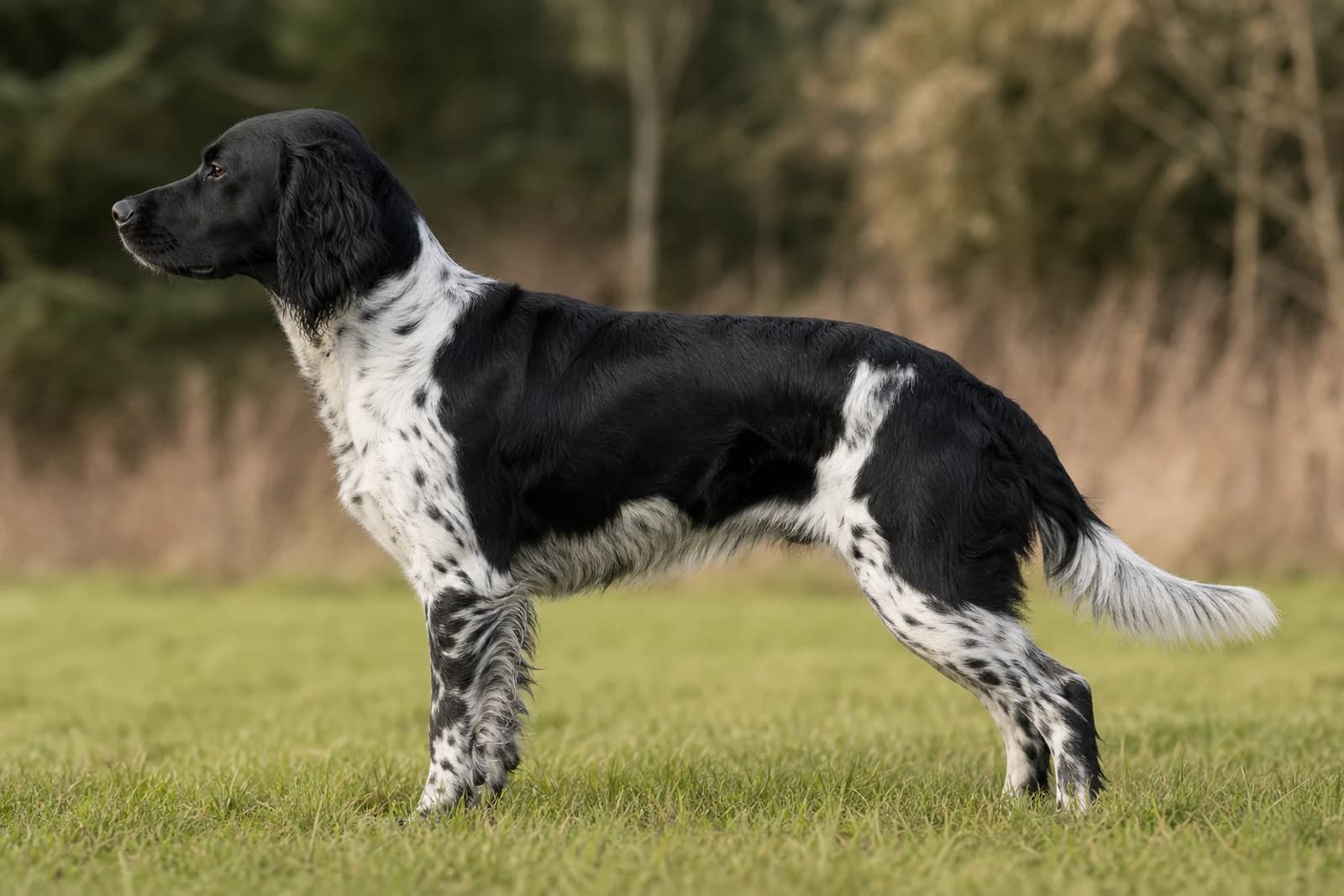
The Frisian Pointing Dog, also known as the Stabyhoun, is a versatile and affectionate sporting breed from the Netherlands. Ideal for active families, these gentle and patient dogs thrive on human companionship and excel in canine sports. They are intelligent and eager to please, making training a joy. Their moderate energy level requires daily exercise, but they are equally content relaxing at home. With their loyalty and calm demeanor, they are wonderful companions for children and other dogs, though early socialization is important. This rare breed is perfect for those seeking a devoted and adaptable four-legged friend.
At a glance
- Size
- Large
- Height
- 20–21 in
- Weight
- 42–55 lb
- Life span
- 12–14 years
- Coat colors
- Black and White, Brown and White, Orange and White
- Coat type
- Dense, water-repellent double coat of medium length
How much does a Frisian Pointing Dog cost?
Adopt / rescue
$75–$400
Usually includes spay/neuter, first shots, and a microchip.
Buy from a breeder
$700–$2,000
From a reputable, health-testing breeder.
Approximate USD. Prices vary widely by region, breeder, pedigree, age, and coat colour — adopting is the lower-cost and recommended route. Avoid suspiciously cheap “breeders”; they’re often puppy mills.
Estimate the full cost of a Frisian Pointing Dog →Frisian Pointing Dog photos
Views
Front, side, rear and top — the full silhouette.Poses
How the breed sits, lies, moves and plays.Puppy to senior
The breed across its whole life.Expressions
The breed’s range of moods.Close-up details
Eyes, ears, nose, paws, tail and coat.Coat colors
The breed’s recognized colors.Click any photo to enlarge. We show the Frisian Pointing Dog from every angle — three views, poses, life stages, expressions, close-ups, coat and colors.
Appearance & size
Lean and purposeful, the Frisian Pointing Dog gives an immediate impression of a gun dog that can go all day. At 20 to 21 inches at the shoulder and 42 to 55 pounds, it’s a medium-large frame that never tips into bulk. The proportions matter more than absolute size: the body is slightly longer than tall, which gives the dog a stretched, ground-covering stride. A deep chest reaches to the elbows, but the ribcage isn’t barrel-shaped—plenty of lung room without interfering with front movement. The back is firm and level, the loin short and strong, and the croup slopes gently.
The head is clean and wedge-shaped when viewed from above. A slightly rounded skull blends into a straight, medium-length muzzle with a distinct but not abrupt stop. The nose is solid black on black-coated dogs and brown on brown-coated dogs, with wide nostrils. Eyes are round, dark brown, and set well apart, giving an alert, friendly expression without a hint of nervousness. The ears drop close to the cheeks, set fairly low and carried with a slight forward lift. They’re covered in the breed’s signature long, silky feathering, which also fringes the eyes are not fringed—just the ears.
The coat is a functional double layer: a dense, water-resistant undercoat beneath a medium-length outer coat that lies flat and straight, maybe with a slight wave. It’s not woolly or open. You’ll find pronounced feathering on the backs of the front legs, the thighs, and the tail. The tail itself is long, reaching at least to the hock, and carried level or with a slight upward curve when the dog moves or is alert. Flagging it out doesn’t curl over the back. From behind, the hindquarters show moderate angulation—well-turned stifles and short, perpendicular hocks—and the breeches are heavily feathered, giving a full silhouette that still looks athletic.
Color is always piebald: a white base with patches of either black or brown (liver). Ticking or roan speckles inside the white areas are common and perfectly fine. A solid-colored head with a white blaze and a white muzzle is typical, and the patch distribution can vary from a few spots to a nearly solid saddle. The overall look is balanced, hardworking, and elegant without being fragile—a dog built to quarter a field for hours, not just pose for a photo.
History & origin
The Frisian Pointing Dog’s story starts deep in the peat bogs and woodlands of Friesland, a remote northern province of the Netherlands. Outside that region, you’ll hear the name Stabyhoun (roughly “stand-by-me dog”) — a nod to the breed’s long history as an inseparable farmhand and hunting partner. For centuries, Friesian smallholders and tenant farmers needed a single dog that could point upland birds, retrieve shot waterfowl from icy canals, dispatch rats and moles around the barn, and keep watch over the homestead. They couldn’t afford a full kennel of specialists, so they molded a moderate-sized, biddable pointing dog that did it all, then curled up by the hearth at night.
Written records mentioning the Stabyhoun reach back to the early 1800s, but the type likely existed long before, kept genetically tight by Friesland’s geographic isolation. Unlike many European gun dog breeds, it was never splintered into separate show and working lines or heavily crossed with imported dogs. Farmers bred for reliability and stamina, not flash, so the Stabyhoun retained a distinct brown-and-white coat pattern, a soft mouth, and a calm, deliberate hunting style suited to the region’s dense cover and waterways.
The breed nearly vanished after World War II as farming modernized and hunters turned to faster, longer-range dogs. A handful of dedicated Friesian fanciers gathered the remaining population and founded the Dutch Stabyhoun Association in 1947. The first official breed standard followed, and every surviving line was traced to just a few foundation animals. That bottleneck shaped the modern dog’s character and health — responsible breeders today still operate within a closely managed gene pool of roughly 3,500 to 5,000 dogs worldwide.
The Stabyhoun earned full recognition from the Fédération Cynologique Internationale (Group 7, pointing dogs) and the United Kennel Club, and sits in the American Kennel Club’s Foundation Stock Service. While still rare outside the Netherlands, the breed is gradually gaining a quiet following among families who appreciate its gentle, versatile nature and its history as an honest working partner, not a kennel dog.
Temperament & personality
The Frisian Pointing Dog has two gears — an unhurried, almost catlike calm indoors, and a tenacious, scent-obsessed engine the moment you step outside. At 42–55 pounds and 20–21 inches tall, they’re large enough to be sturdy but compact enough to curl up on a couch without rearranging the furniture. That indoor restraint disappears on a walk, where his world is ruled by his nose.
These dogs are deeply affectionate without being needy. They form strong bonds with every household member, greeting you with a soft-eyed lean and a wagging tail rather than a frantic bounce. With kids, they tend to be gentle and patient, though no child should ever disturb a dog while it’s eating — a calm meal routine prevents food guarding. With visitors, expect a brief, alert bark that shuts off the moment you signal everything’s fine. This isn’t a hyper-vigilant watchdog; they’re watchful without being suspicious.
The breed’s real personality shows in its hunting style. A Frisian will freeze mid-stride, weight shifted forward, one paw lifted — that classic pointing stance — locked onto a scent. That same nose leads to a few behaviors you’ll either laugh at or scrub out of your carpet. They roll in dead things, fox scat, or anything properly foul. Why? Theories range from masking their own smell (a leftover from hunting ancestry) to simply showing off a “find” to other dogs, or maybe they just enjoy the stench the way we enjoy cologne. Accept it as part of the package and keep a vinegar-water spray handy for post-roll deodorizing.
Scent drives housetraining too. If an indoor accident’s odor lingers, the dog will be drawn back to the same spot. Clean with a white or cider vinegar solution to break that scent cue, and immediately reward outdoor elimination with a treat. Most Frisians catch on quickly; punishment is counterproductive with this sensitive, occasionally stubborn breed. On walks, unneutered males (and some females) may urine-mark to “read” and update the neighborhood scent map — a fascinating habit, but one you’ll want to manage with a “leave it” cue unless you enjoy stopping every twenty feet.
Stubborn streaks are real, but force doesn’t work here. These dogs think for themselves and tune out demands. Respectful, consistent training — short sessions that mimic hunting problems, like finding a scented toy — engages their brain and burns energy faster than an hour of mindless retrieving. A forward-leaning posture and hard stare are the body-language cues to watch for; they often signal the intensity that, around food or a treasured chew, can tip into guarding. Give meals in peace, provide hard chews (they keep jaws strong and teeth clean), and teach kids to give the dog wide berth during chow time. For puppies who explore the world with their teeth, offer cold, sturdy chew toys and use a homemade citrus spray on chair legs as a deterrent.
Left alone for long stretches, a Frisian can spiral into barking or destruction, not out of spite but out of distress. They do best with a person around for part of the day or a calm canine buddy. A 12–14 year lifespan makes these ups and downs a long game, but if you want a partner who sees the world through his nose — and occasionally decides a rotten log is the finest cologne — you’ll get a steady, wholehearted friend.
Good with kids, dogs & other pets
Frisian Pointing Dogs have the patient, non-aggressive temperament you want around children. At 42–55 pounds and 20–21 inches tall, they’re sturdy enough to handle a clumsy toddler’s bump but light enough not to bowl a kid over. The real watchpoint isn’t size — it’s emotional sensitivity. Yelling, rough play, or a child who ignores a subtle “I’m done” signal can shut this dog down. Teach kids to pet with an open hand and notice when the dog walks away. Supervision around young children still matters, not because the dog will snap, but because a cornered, anxious dog of any breed can air-snap in self-defense.
One more thing about family fit: this breed hates being left out of the action. A household where someone is home much of the day is ideal. Being relegated to the backyard or left alone for eight-plus hours breeds loneliness and stress, which chips away at that easygoing nature.
With other dogs, they’re naturally cooperative — a legacy of working closely with hunters and multiple dogs in the field. They usually make friends easily with a well-socialized resident dog, but they can be reserved with unfamiliar dogs at first. The puppy phase between 3 and 16 weeks is prime time to shape that. Get your pup into a positive puppy class and arrange calm, one-on-one greetings with adult dogs you trust. Skip chaotic dog-park free-for-alls; a Frisian Pointing Dog doesn’t need a huge social circle — a few reliable canine buddies alongside their human family is enough. If you’re adopting an adult who missed early exposure, don’t force interactions. Respect the dog’s comfort zone and let new relationships build slowly on neutral ground.
Small pets are where you need to manage instinct. This is a pointing breed, wired to spot, stalk, and flush birds and small mammals. A puppy raised indoors with a cat may learn to coexist peacefully, but that doesn’t extinguish the urge to stare down a squirrel on a walk. With rabbits, guinea pigs, or chickens, the point-and-pounce response can surface even years later. Keep small caged pets in a secure room, never leave dog and loose pocket pet together unsupervised, and use controlled on-leash introductions when a cat is in the mix. The goal isn’t to erase the instinct, just to teach the dog that family cats and housemates are not quarry — and that training begins the day the puppy comes home.
Trainability & intelligence
A Frisian Pointing Dog learns quickly — but mostly when he sees the point. These are cooperative, dogged hunting partners shaped by generations of work on waterfowl and upland game, not sleeve-tugging obedience robots. He’ll pick up a new behavior in a handful of repetitions if the payment is right. The catch is that “right payment” often means a retrieve, a splash in a pond, or the chance to freeze into a rock-steady point — not just a biscuit. Motivation lives in his nose and his desire to work with you, so stash food rewards for kitchen training and switch to a tennis ball, a frozen duck wing, or a brief game of tug when you move outside.
Training falls apart the moment it becomes repetitive drilling. Short, clear sessions that end on a win keep his attention. He’s sensitive to tone; a sharp voice shuts him down faster than a snapped lead, and once trust cracks, he’ll start offering avoidance behaviors instead of the behavior you asked for. That sensitivity makes him easy to read but means punishment-based methods backfire spectacularly. You’re building a teammate, not enforcing compliance.
Recall is where the real test lives. A Frisian’s natural retrieving drive gives you a head start — he wants to come back, especially if you’re holding something interesting — but a fresh scent trail will yank his brain sideways. Proof the “here” command early with a long line and a whistle. A whistle carries over wind and water without the frustration in your voice when he blanks you the first time a pheasant flushes. Make coming back the most reliably paid behavior he has: jackpot rewards every time his feet hit your side, not just when he feels like it.
Common challenges surface when the dog is sharper than the handler’s timing. He’ll figure out that the “down” cue only applies while you’re watching, or that breaking point to grab the bird gets him a self-reward you can’t take back. You have to be a step ahead, and that means starting puppy manners the day he comes home — sit, place, crate, loose-leash walking — before the field drive fully kicks in. Socialization is equally non-optional. Let a puppy safely meet varied people, hear traffic sounds, and wade through tall grass before 14 weeks, or you risk a dog who defaults to wariness and noise-sensitivity that’s tough to undo later. Treat the whole world as his training ground, and he’ll grow into a level-headed, clear-eyed partner who works with you because the relationship pays better than any distraction the marsh can throw at him.
Exercise & energy needs
A Frisian Pointing Dog isn’t satisfied with a leisurely neighborhood loop. Bred to cover ground, hunt, and point for hours, this dog comes with a real engine that needs daily hard use—think at least 60 to 90 minutes of vigorous exercise split into two sessions, not counting potty breaks. A single 30-minute walk might take the edge off, but it won’t touch the deep reserves of stamina.
The right mix includes off-leash running, swimming, or pulling you on a canicross or bikejoring rig. These dogs want to stretch out, hit top speed, and explore with their powerful nose. Because they’re medium-to-large and leanly built, they’re well-suited to sustained trotting and galloping over varied terrain. In a fenced area or safe open space, a good long fetch session with a dummy or a ball launcher can help, but plan on at least two substantial activity blocks daily—a morning run and a late-afternoon session—to keep them physically calm indoors.
Physical exercise alone isn’t enough. This is a pointing breed, meaning their brain is as active as their body. Without daily mental work, they’ll create their own jobs—and you probably won’t like the ones they pick (digging, fence-running, redecorating the couch). Rotate through scent games, hide-and-seek with a toy, puzzle feeders, and structured training sessions that make them think. Short, frequent 10-to-15-minute nose-work drills inside or in the yard do wonders.
Natural outlets for these instincts are field work, hunt tests, tracking, and barn hunt. If hunting isn’t your thing, competitive obedience, agility, or rally all channel that drive and teamwork. Swimming is a low-impact option that saves joints while burning energy, which matters because you’ll want to avoid repetitive pounding on pavement with a young dog whose growth plates are still closing. Even adults can be prone to overuse injuries if you skip warm-ups and cool-downs, so build fitness gradually.
When a Frisian Pointing Dog’s exercise tank stays full and his nose gets a job, he’s a calm, focused housemate. Skip that and you’ll see a dog who’s restless, mouthy, or impossible to settle. This breed is not a candidate for a walk-in-the-morning, couch-the-rest-of-the-day lifestyle. If you can’t promise two hard outings a day plus true puzzle work for the mind, you’ll both end up frustrated.
Grooming & coat care
The Frisian Pointing Dog wears a dense double coat with moderate feathering on the back of the legs, tail, and chest. That combination means you’ll spend more time with a slicker brush and a steel comb than a simple bristle brush. Aim to brush two to three times a week year-round, and bump it up to daily during spring and fall when the undercoat blows out heavily.
A slicker brush with rounded pins reaches through the topcoat to pull dead undercoat without scratching the skin. Follow up with a medium-tooth comb through the feathering and behind the ears—those are the first spots to mat. Mats left unchecked tighten against the skin and can lead to hot spots, especially in a dog that’s active in water and brush. Skip the bristle brush; it won’t get deep enough to prevent tangles.
Bathe every six to eight weeks, or sooner if he’s rolled in something ripe. Use a gentle dog shampoo that won’t strip the coat’s natural oils, and always dry him completely down to the skin. A damp undercoat in warm weather invites hot spots and that musty dog smell.
Floppy ears mean weekly checks. Wipe the outer ear flap and visible canal with a vet-approved cleaner, but never dig deep. Nails that click on the floor are overdue—trim every three to four weeks. Teeth appreciate daily brushing; even three times a week cuts tartar buildup significantly.
When seasonal shedding kicks into high gear, an undercoat rake can remove clouds of loose fur faster than a brush alone. If your dog hunts or swims, a quick post-outing rinse and a once-over with a comb keeps burrs and grit from turning into mats overnight. Consistent care pays off: a well-maintained coat dries fast, sheds less between brushing sessions, and stays sleek without the battle.
Shedding & allergies
The Frisian Pointing Dog is not a low-shedder, and no amount of wishful thinking will turn this breed hypoallergenic. That beautiful, medium-length coat—sleek on the body with light feathering on the chest, legs, and tail—comes with a dense undercoat that does a steady, year-round job of depositing fine hairs on your floors, furniture, and dark pants.
Twice a year, usually in spring and fall, the shedding shifts from a low hum to a full-blown event. For a few weeks, you’ll pull tufts of loose undercoat out with your fingers and wonder how the dog isn’t bald. During those seasonal blowouts, daily brushing with a slicker brush or undercoat rake is non-negotiable if you want to keep the fur tumbleweeds under control. The rest of the year, two or three solid brushing sessions a week will catch the worst of it.
Drool is not part of the package. This is a clean-mouthed breed; you won’t be wiping slobber off the walls or carrying a rag on walks.
If you or someone in your house has dog allergies, be realistic. The dander and the sheer volume of shed hair make this a poor choice. A Frisian Pointing Dog sharing your home means a long-term relationship with lint rollers and a vacuum that earns its keep.
Diet & nutrition
Keeping a Frisian Pointing Dog lean is one of the best things you can do for his long-term health. At 42–55 pounds and 20–21 inches at the shoulder, this is a large, athletic breed where extra weight puts unnecessary strain on joints and can shorten a 12- to 14-year lifespan. Many Frisians are food-motivated and will happily eat more than they need, so portion control isn’t optional — measure every meal and stay honest about treats.
How much to feed
Start with the dog in front of you, not the chart on the bag. For an active adult around 50 pounds, a typical starting point is about 2½ to 3 cups of a high-quality kibble split between two meals. If you feed a raw or home-prepared diet, aim for roughly 60% meat (raw and lightly cooked), 20–30% fruits and vegetables, and the remaining 10% from eggs, yogurt, or digestible grains like pearl barley. Blend or purée the mix when you can — a dog’s jaw moves vertically and lacks salivary enzymes, so breaking down cell walls helps him absorb more nutrients. The real test is your dog’s waistline. You should feel ribs with a thin layer of fat and see a tuck behind the ribcage. If that starts to vanish, cut back a quarter cup at a time and bump up exercise.
Puppy and senior tweaks
Growing Frisians need the fuel, but not in one giant bowl. Up to 4 months, feed four small meals a day; from 4 to 6 months, drop to three; by adulthood, settle into two. Transition a pup gradually with finely puréed meats, fish, and softened vegetables or a premium large-breed puppy food. Raw items like chicken wings can be introduced around 12 weeks under supervision.
Older dogs whose activity drops off often pack on pounds. Switch to more frequent, smaller meals and consider puréeing meals if missing teeth make chewing difficult. There’s no good reason to slash protein in a healthy senior — just keep an eye on the scale and cut back when the daily walks get shorter.
Day-to-day habits that matter
A fast eater? Use a food puzzle bowl or scatter part of his ration in the yard. It slows him down and gives his brain a workout. Never feed directly from the table, and save holiday-rich scraps for the trash; a sudden high-fat meal can trigger pancreatitis in any dog. If you want to use leftovers, put them in his own bowl and only after you’ve left the dining area. Canned fish (in water), cooked eggs, and unsalted vegetable cooking water all mix into a quick supplement. Just remember: this is a species built for meat. A vegetarian or vegan diet robs him of essential nutrients and doesn’t match his digestive hardware. Stick with a foundation of real animal protein, watch the scale, and you’ll have a hunting partner who stays sound well into his teens.
Health & lifespan
A well-bred Frisian Pointing Dog typically lives 12 to 14 years — a long run for a large, high-octane hunter. Hitting that range depends heavily on genetics, weight management, and staying ahead of a few breed-typical concerns.
Like many deep-chested pointing breeds, these dogs can be prone to bloat (gastric dilatation-volvulus), a fast-moving emergency. Split his daily food into at least two meals and avoid heavy exercise right before or after eating. Responsible breeders screen for hip and elbow dysplasia using OFA or PennHIP evaluations, and they get breeding dogs’ eyes checked yearly by a veterinary ophthalmologist to rule out inherited conditions like progressive retinal atrophy. While the breed isn’t overloaded with dramatic health problems, some lines do carry a tendency toward skin allergies or hypothyroidism. A transparent breeder will walk you through what has — and hasn’t — appeared in their dogs.
Obesity poses a real threat. These pointers are famously food-motivated and will pack on pounds if you let generosity get ahead of the measuring cup. Extra weight punishes joints already built for sudden sprints and hard turns. Keep him lean: you should feel his ribs easily and see a clear waist from above. A diet with omega-3 fatty acids can give joint and coat health a little extra support.
The Frisian Pointing Dog wears a short, dense coat and handles cold about as well as you’d expect — not well at all. In icy water or biting wind, a neoprene vest goes a long way. On steamy summer days, scale back workouts and enforce shade breaks and water before he overheats. He’ll never quit on you voluntarily.
Preventive care makes the 12- to 14-year window realistic:
- Give heartworm prevention monthly during mosquito season and for one month after it wraps up. Rabies vaccination is legally required in the US and has no treatment once symptoms appear.
- Schedule annual exams, and switch to twice-a-year visits once he turns 7 or 8. Bloodwork, eye checks, and a hands-on physical catch changes that a stoic dog will hide.
- Handle paws, ears, and mouth early and often. A dog who accepts at-home inspection gives you a head start on ear infections, cracked nails, or early hot spots.
Even subtle shifts — stiffness after getting up, obsessive licking of one elbow, or an off meal — deserve a quick vet call. With a dog this tough, you’re the first line of defense.
Living environment
A Frisian Pointing Dog is a hunter through and through. Expect this dog to be restless and noisy in an apartment — the close quarters and shared walls just amplify natural alert barking and high energy. A house with a physically fenced yard is the practical baseline, not a luxury. This is a 20–21-inch, 42–55-pound athlete bred to quarter fields for hours, so a yard gives them a spot to burn off steam between purposeful outings. Without it, you’ll be doing a lot of structured outdoor time.
Plan on at least 60 minutes of real exercise twice a day, not just a leashed stroll. A quick walk doesn’t touch this dog’s internal battery. Combine off-leash running, long-line exploration, or retrieving with scent games — hiding a toy or using puzzle feeders keeps a sharp nose busy and puts a dent in mental fatigue. Multiple shorter sessions often work better than one marathon, especially in hot weather. The breed’s coat handles damp and cold just fine, but they can overheat if you push hard in summer; exercise early or late.
Barking is part of the package. They’re vocal when excited, when they see movement outside, and when they’re bored. You can shape it with training, but silence isn’t realistic. Neighbors matter here.
Tolerance for being alone is low — this dog forms tight bonds and can tip into anxiety if left solo for long stretches. Start gradual desensitization early, and build in environmental enrichment like treat-dispensing toys to ease the alone time. If you’re gone 8 or 9 hours a day without a plan, you’ll come home to howling, pacing, or chewed door frames. A midday dog walker or doggy daycare is not overkill; it’s often the difference between a settled dog and a stressed one.
Who this breed suits
This dog wants to be part of everything you do, and the closer that “everything” includes a daily job, the better. The Frisian Pointing Dog is a calm-natured, people-oriented hunter at heart who makes a superb fit for an active family that treats a dog as a full member of the household. She is gentle and famously patient with children, rarely sharp in the home, and will happily trade a long morning run for an afternoon sprawled in the living room—provided she got the run first. Singles and couples who hike, trail-run, or swim regularly will find a tireless, cheerful shadow here.
First-time owners can absolutely succeed if they commit to positive, consistent training. The breed is smart, biddable, and sensitive enough that harsh methods sour her quickly; a steady flow of short, upbeat sessions turns her into a quiet overachiever. For that reason, a motivated first-timer is often a better match than a laissez-faire experienced owner. Seniors who still move well can also be a great fit: at 42–55 pounds and standing 20–21 inches, this is a manageable large dog that does not bowl you over, but a gentle 12-to-14-year companion who needs a solid hour of off-leash galloping or a brisk, purpose-led walk and a good swim. A fenced yard helps—the pointing instinct is real, and a squirrel can override recall in an instant—but the breed adapts to a more suburban rhythm so long as the exercise is real.
Think twice if your dog will be alone for long stretches. The Frisian Pointing Dog bonds hard and leans toward separation anxiety; a house full of people or a human who works from home is a far better setup. She is not a guard dog in any meaningful sense—wary enough to notice a stranger, friendly enough to show them where the silver is. If you want a low-energy lapdog or a dog content with a 15-minute leash cruise and no mental work, this breed will gently fall apart. Skip the breed if you cannot provide a daily outlet for both brain and body, whether that is retrieving drills, nose work, or swimming sessions. This is a thinking dog who needs a purpose, not just a presence.
Cost of ownership
Bringing home a Frisian Pointing Dog starts with finding one. The breed is rare outside the Netherlands, so a well-bred puppy from a responsible breeder who screens for hips, elbows, and eye conditions typically runs $1,500 to $3,000. If you need to import, shipping and import fees can push the total closer to $4,000. Rescues occasionally have adults for a few hundred dollars, but they are scarce.
Monthly costs settle into a predictable rhythm for this 42–55 lb athlete. Plan on about $200 to $300 per month for the essentials, broken down like this:
- Food: $50–$70. A high-quality kibble keeps a pointing dog’s lean muscle in good shape. You’ll go through roughly one 30‑lb bag a month if you feed 2½ to 3 cups a day. Active dogs in heavy work or hunting seasons may need a bit more.
- Grooming: $20–$40. The short, dense coat sheds moderately and needs a quick brushing once or twice a week. A bath every couple of months and nail trims are the main chores. Most owners handle this at home, so the real expense is shampoo, a good brush, and the occasional professional nail grind if you’d rather not do it yourself.
- Veterinary care and preventives (averaged monthly): $50–$80. A routine annual exam, vaccinations, and year-round heartworm and flea/tick prevention usually land between $500 and $700 a year. Like many medium-to-large breeds, the Frisian can be prone to hip dysplasia, so budget for occasional diagnostic X-rays as the dog ages. Routine dental cleanings may pop up every few years as well.
- Pet insurance: $35–$60. Premiums vary with age, location, and deductible, but covering a large, active dog that might tear a cruciate ligament or swallow something foolish gives real peace of mind. A savings account set aside for emergencies works too, just aim to keep at least $2,000–$3,000 available.
Unexpected costs — a chewed-up dog bed, a training class to channel that pointing drive, or replacing a run of fencing — crop up with any energetic dog. Anticipate an extra $50–$100 a month in the first year as you stock leashes, crates, and puzzle toys to keep that clever nose busy.
Choosing a Frisian Pointing Dog
Responsible breeder or rescue?
The Frisian Pointing Dog is still a niche breed in North America, so you won’t stumble on a litter every weekend. A responsible breeder who hunts, tests, or shows their dogs is your best path to a puppy with the steady nerve and cooperative nature the breed is known for. Rescue is rarer but not impossible — a few all-pointing-breed and regional hunting-dog rescues occasionally place an adult Frisian. An adult skip the puppy chaos, but ask hard questions about the dog’s history with cats, livestock, and kids, because a birdy dog raised without clear boundaries can be a handful in a non-hunting home.
Health clearances to demand
This breed generally lives 12–14 years and stays athletic around 42–55 lb, so joint and eye health top the list. A breeder should hand you official OFA or PennHIP results for hips (at minimum) and elbows. Annual eye exams by a board-certified veterinary ophthalmologist are non-negotiable because several pointing breeds can carry progressive retinal atrophy or early-onset cataracts. Also ask about thyroid panels and a cardiac evaluation (echo or Doppler) to rule out dilated cardiomyopathy, which can lurk in sporting lines. “The vet said they look healthy” doesn’t count — insist on documentation you can verify online.
Red flags when talking to breeders
Walk away if the breeder can’t produce those clearances for both parents, sells puppies before eight weeks, or always has multiple litters on the ground. Be skeptical of anyone who guards random “rare color” pricing, dodges questions about a dog’s bird sense or prey drive, or treats the puppy conversation like a retail transaction instead of a long interrogation about your lifestyle and yard. A breeder who never asks you anything won’t stand behind the pup either.
Choosing your puppy
Once you’ve found a litter from health-tested, working-minded parents, spend time watching the pups move and interact. You’re looking for a bold, curious puppy — not the one hanging on the fringe or cowering at a dropped bucket. A Frisian Pointing Dog pup should trot right up to check you out, then shift into a soft-mouthed, playful mood. Avoid the absolute firecracker who can’t settle; that intensity may feel fun for ten minutes but translates to a jobless, furniture-eating adult in a quiet household. A good breeder will have already graded the litter’s structure and temperament, so lean on their notes and match the energy level to the real day-to-day you’ll actually provide.
Pros & cons
Pros
- Affectionate and gentle with their own family, including children. Inside the house they are calm and often content to lounge, provided they’ve had a proper run first.
- Short, dense coat needs little more than a weekly brush and an occasional wipe-down — no professional grooming required. Shedding is year-round, so they are not a match for most allergy sufferers.
- Clever and biddable. They pick up new commands quickly with positive reinforcement and enjoy the mental challenge of advanced training, scent work, or dog sports.
- Natural pointing instincts make them attentive to their handler; with consistent training many earn reliable off-leash freedom in safe, uncrowded areas.
Cons
- Serious daily exercise: plan on 60–90 minutes of off-leash running, scent games, or hunting-style work. A short leash walk won’t cut it, and a bored dog may chew, dig, or bark.
- High prey drive, hard-wired from generations of bird hunting. Expect strong reactions to squirrels, cats, or backyard chickens — a secure fence and a long line in open spaces are a must.
- Reserved by nature with strangers. Without thorough, positive puppy socialization the breed can become overly timid, suspicious, or reactive.
- Separation anxiety potential. This is a people-oriented breed that suffers if left alone for long workdays; it does best in a household where someone is home most of the day.
Similar breeds & alternatives
The Small Munsterlander (19–22 in, 40–60 lb) is the most direct pointing-breed alternative. Both dogs are intelligent, affectionate family companions that settle indoors, but the Munsterlander often brings a stronger field motor. Count on at least an hour of hard off-leash exercise for a Munsterlander; many Stabyhouns do well with a purposeful 45-minute walk and some retrieve work.
The Wetterhoun (21–23 in, 55–77 lb) shares the same Friesland roots and a similar lifespan, yet this curly-coated water retriever is stockier, more independent, and naturally reserved with strangers. Where the Stabyhoun greets guests with a wag, the Wetterhoun needs consistent socialization to avoid wariness.
If a flushing spaniel appeals, the English Springer Spaniel (19–20 in, 40–50 lb) matches the Stabyhoun’s weight but brings a bouncier, more exuberant temperament. Springers thrive on mental games and can turn destructive without them; the Frisian pointer’s softer, more deliberate nature tends to make it a calmer house companion, even on light-activity days. Families seeking a rare pointing dog that truly knows how to power down at home will find the Stabyhoun’s off-switch sets it apart from most gundogs in this size class.
Fun facts
- One of the rarest dog breeds, with only a few thousand worldwide.
- The breed's name means 'stand by me dog' in the local Frisian language.
- They are versatile hunters, capable of pointing, retrieving, and even man-trailing.
Frequently asked questions
- Is the Frisian Pointing Dog good with children?
- Frisian Pointing Dogs are generally patient and gentle, making them excellent family companions. They tend to be very tolerant of children, but early socialization and supervision are still important. Their playful yet calm nature often makes them a wonderful match for active households.
- How much does a Frisian Pointing Dog shed?
- The Frisian Pointing Dog has a medium-length, dense coat that sheds moderately. Weekly brushing can help manage loose hair and keep shedding under control. They are not considered hypoallergenic, so regular grooming is beneficial for keeping the home tidy.
- What are the exercise needs of a Frisian Pointing Dog?
- This breed requires a fair amount of daily exercise to stay happy and healthy. A long walk, a vigorous play session, or an off-leash run in a secure area can meet their needs. Without enough activity, they may become restless, but they are not hyperactive when properly exercised.
- Can a Frisian Pointing Dog live in an apartment?
- A Frisian Pointing Dog can adapt to apartment living if given sufficient daily exercise and mental stimulation. However, due to their size and energy level, a home with a yard is often more ideal. They tend to be quiet indoors but do best with a dedicated exercise routine.
- Does the Frisian Pointing Dog bark a lot?
- Frisian Pointing Dogs are not known for excessive barking, but they will alert to strangers or unusual sounds. With proper training, any nuisance barking can be minimized. Their calm temperament usually means they are not overly vocal compared to some other breeds.
- Is the Frisian Pointing Dog easy for first-time owners?
- This breed can be a suitable choice for first-time owners who are committed to consistent training and exercise. They are generally eager to please and intelligent, which can make training rewarding. However, early socialization and gentle guidance are key to bringing out their best traits.
Tools & calculators for Frisian Pointing Dog owners
Quick estimates tailored to Frisian Pointing Dogs — pre-filled with this breed’s size where it matters.
Articles & stories about the Frisian Pointing Dog
Sources & standards
This profile follows recognized breed standards from the American Kennel Club (AKC) and the Fédération Cynologique Internationale (FCI), along with established veterinary and breed-club guidance. These describe general breed tendencies — every dog is an individual.
Owner stories
Have a Frisian Pointing Dog? Share your experience — grooming tips, personality quirks, anything goes.