

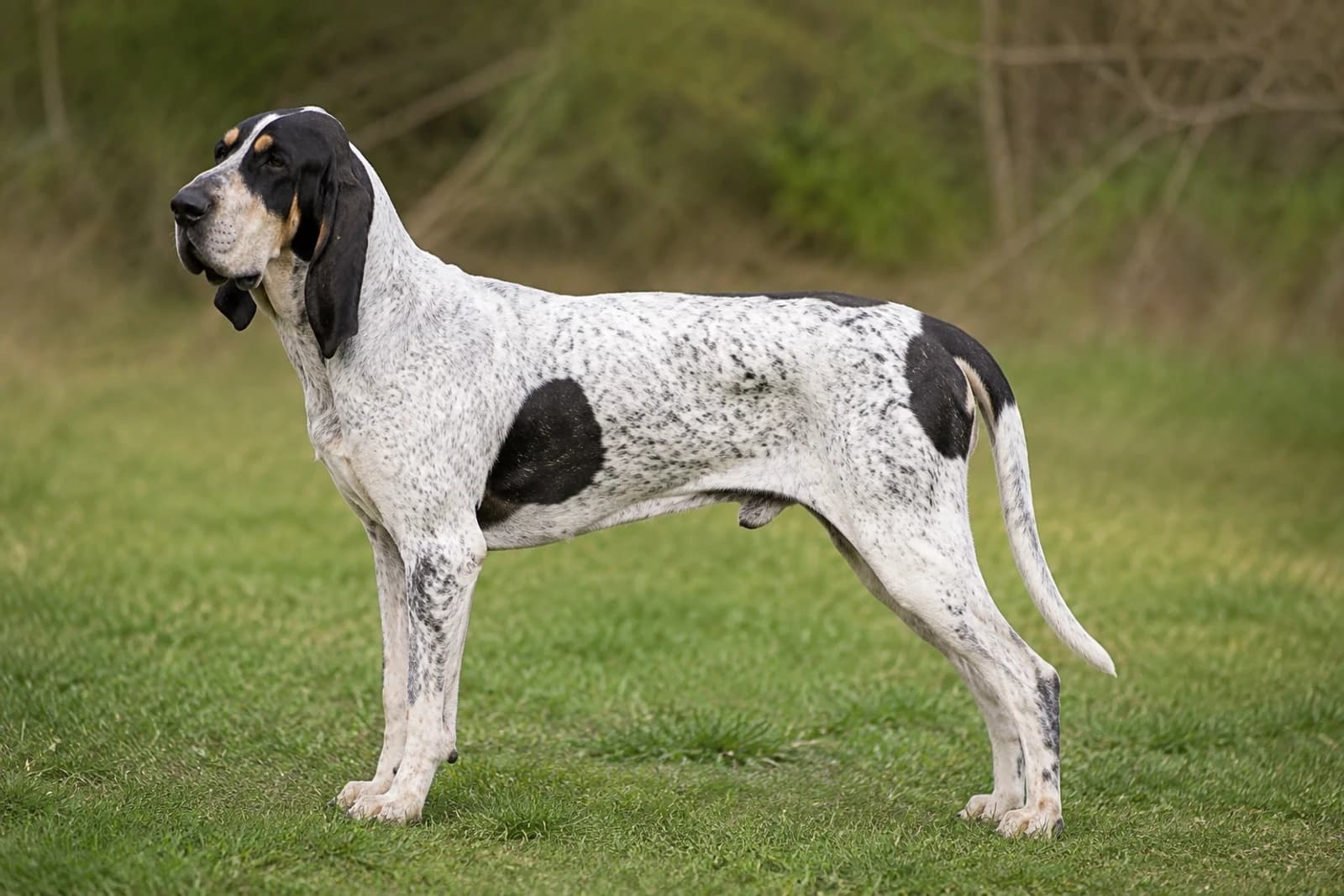
The Gascon-Saintongeois is a medium-sized French scenthound, known for its endurance, deep bark, and pack-oriented nature. Best suited for active owners in rural or suburban homes, this breed thrives with ample exercise and human companionship. Families who enjoy outdoor pursuits will appreciate its loyalty and unwavering nose, though its vocal tendencies and high prey drive may challenge apartment dwellers.
At a glance
- Size
- Large
- Height
- 19–22 in
- Weight
- 37–40 lb
- Life span
- 12–13 years
- Coat colors
- White & Black with tan markings, White & Orange
- Coat type
- Short, dense, and weather-resistant
How much does a Gascon-Saintongeois cost?
Adopt / rescue
$75–$400
Usually includes spay/neuter, first shots, and a microchip.
Buy from a breeder
$700–$2,000
From a reputable, health-testing breeder.
Approximate USD. Prices vary widely by region, breeder, pedigree, age, and coat colour — adopting is the lower-cost and recommended route. Avoid suspiciously cheap “breeders”; they’re often puppy mills.
Estimate the full cost of a Gascon-Saintongeois →Gascon-Saintongeois photos
Views
Front, side, rear and top — the full silhouette.Poses
How the breed sits, lies, moves and plays.Puppy to senior
The breed across its whole life.Expressions
The breed’s range of moods.Close-up details
Eyes, ears, nose, paws, tail and coat.Coat colors
The breed’s recognized colors.Click any photo to enlarge. We show the Gascon-Saintongeois from every angle — three views, poses, life stages, expressions, close-ups, coat and colors.
Appearance & size
A lanky, athletic frame cloaked in a short, dense jacket — that’s the Gascon-Saintongeois at a glance. Don’t let the “large” category fool you into expecting a heavy giant; this hound is tall and rangy, standing 19 to 22 inches at the shoulder and tipping the scales at a modest 37 to 40 pounds. Every ounce is muscle and sinew built for stamina, not bulk. The chest is deep and let down to the elbow, the ribs well-sprung without looking barrelly, and the loin broad and powerful. From the side, the underline tucks up cleanly, tracing a smooth curve from brisket to belly that speaks of the lung room needed for a full day in the field.
The coat is one of the breed’s defining calling cards. It’s short, flat, and dense to the touch — weather-resistant rather than silky — and lies tight against the skin. Color is a crisp white base broken by black patches, often arranged in a mantle sweeping over the back and shoulders. What really catches the eye is the ticking: a heavy spray of black or bluish speckles across the white, especially on the legs, muzzle, and tail, giving the dog a dappled, almost marbled effect. Some dogs also show warm tan points above the eyes, on the cheeks, inside the ears, and under the tail, which adds a rich, tricolor finish.
Now take a walk around the dog. From the front, the head is long and noble, with a slightly domed skull, a moderate stop, and a muzzle that’s a shade shorter than the skull. The nose is black and wide, the lips have a gentle flew without being pendulous. Eyes are dark, deep-set, and quietly expressive, with a soft, almost pleading look typical of scenthounds. Ears are set low, falling in a graceful fold well past the jaw, soft and thin as velvet. Move to the side and you see a neck that’s lightly arched and clean, flowing into a strong, straight back and a croup that slopes just enough. The tail is thick at the root, carried smoothly and never curled over the back — at a trot, it’s a saber held in line with the spine or slightly lifted. From the rear, the hindquarters are muscular and moderately angulated, with straight, parallel hocks that drive a ground-eating, effortless stride.
No feature is exaggerated. The whole animal reads as honest, functional, and tireless — a dog whose appearance promises a long day hunting before you even snap on a lead. If you’re drawn to the streamlined elegance of a well-made scenthound, the Gascon-Saintongeois shows it off in a compact, no-fuss package.
History & origin
If you trace the Gascon-Saintongeois back far enough, you land on a lost breed and a very determined French nobleman. The dog you see today was deliberately stitched together in the 1840s by Baron Joseph de Carayon-Latour, who refused to let the old Saintongeois hound vanish completely.
The Saintongeois was once the pride of the Saintonge region, a white-and-orange pack hound prized for hunting wolves and wild boar. By the time the French Revolution tore through the countryside, those organized packs scattered and the breed was nearly obliterated. Carayon-Latour managed to gather a few surviving hounds that still carried the old blood, but he knew they weren’t enough to rebuild a viable population. His solution was to cross them with the Grand Bleu de Gascogne, a much more common French scent hound with a legendary nose and a deep, resonant voice. The resulting litters threw tri-color dogs—black, white, and tan—that combined the Saintongeois’s elegance and lighter frame with the Grand Bleu’s substance and cold-trail tracking ability.
Carayon-Latour didn’t name the new breed after himself; he simply called it the Gascon-Saintongeois, naming both parent lines. By the mid-19th century, it was establishing itself as a versatile pack hound in southwestern France. The larger dogs—what we’d now call the Grand Gascon-Saintongeois—were used on deer, boar, and roe deer. Some hunters, though, wanted a smaller, quicker hound specifically for hare and rabbit. So they bred smaller specimens together, eventually producing the Petit Gascon-Saintongeois. That’s the size reflected in the 19–22 inch, 37–40 pound dog you’re reading about here. Both varieties are the same breed with the same origin, just selected for different game.
The French kennel club (Société Centrale Canine) recognized the Gascon-Saintongeois in the 1850s, but the breed never exploded in popularity the way some other hounds did. It stayed close to its working roots. Two world wars disrupted free breeding again, and dedicated breeders had to pull the numbers back from slim stock. Today, you still won’t stumble across one at the local dog park outside France. It remains primarily a hunter’s dog in its homeland, with a small but serious following among those who run packs on foot.
Temperament & personality
The Gascon-Saintongeois is a pack hound through and through — bred to hunt with other dogs across miles of French countryside, so he's wired for teamwork, endurance, and following his nose wherever it leads. Inside the house, you get a surprisingly calm, gentle dog who likes sprawling at your feet. Outside, that switch flips, and a solid hour of off-leash running or nose-focused exploration is the bare minimum. Skip the short leash stroll; this dog needs ground to cover, scents to untangle, and freedom to lope.
With his own family, he’s affectionate but not needy. He checks in with a soft, relaxed body and easy eyes — your cue that he’s content. He rarely pesters you for attention, but he does crave company. Isolation is a bad deal here. A lonely Gascon-Saintongeois left in the yard often becomes a noise complaint waiting to happen. Neglect these social needs and you’ll get anxiety-fueled baying and destructive chewing, not out of spite, but because his scent memory tells him marking or gnawing soothes the stress.
He carries a deep, rolling bay that can travel a mile, so he’s a natural watchdog — you’ll know the moment a stranger pulls in the driveway. Just don’t confuse alertness with guarding. He’s as likely to lean forward with a stiff, intense stare as he is to wag, but aggression toward people isn’t in his makeup. That forward-leaning posture is usually about wanting to move toward something interesting, not about making a stand.
This is a strong-willed, independent thinker. Commands that contradict his nose? You’ll get a head turn, a lip lick, maybe a yawn — all classic calming signals that say “I’d rather not.” Respectful, consistent handling works far better than force. Bribery with treats right after the correct choice — particularly after outdoor potty breaks — locks in the lesson. Because he’s a scent marker by instinct, any lingering urine smell indoors gives him a powerful cue to re-offend. Clean accidents with vinegar spray to neutralize the odor and remove that invitation.
The Gascon-Saintongeois typically gets along with children and other dogs, no surprise for a pack hound. But his prey drive is real. Small pets running away trigger a hard-wired chase. Teach kids never to interrupt him while he’s eating — food-guarding can surface with startled, fast movements — and let him enjoy meals in peace. Expect him to roll in foul-smelling stuff given half a chance; some think it’s a throwback to scavenger ancestors advertising food sources. To him, it’s just a good time. At 12–13 years, you’re signing up for a long-lived companion who stays game well into old age.
Good with kids, dogs & other pets
A Gascon-Saintongeois typically brings a steady, non-aggressive patience that fits well into a home with respectful kids. These are large-but-lean hounds (19–22 inches at the shoulder, 37–40 pounds) who rarely look for a fight. They’ll tolerate a surprising amount of clumsy handling from young children as long as someone teaches the basics — no ear-pulling, no climbing on the dog, no interrupting meals. Even then, never leave any dog unsupervised with toddlers. A wagging tail doesn’t mean a dog won’t correct a poke with a warning snap if pushed too far.
This is a pack breed at heart, so living with other dogs often comes naturally. They grew up working in noisy kennels and running shoulder-to-shoulder on hunts. Introducing a Gascon-Saintongeois to a resident dog usually goes smoothly, especially with a neutral, on-leash walk first. Same-sex squabbles aren’t the norm, but they can happen if both dogs are intact and strong-willed. Spaying or neutering takes the edge off. Dogs that are this social don’t do well shoved outside alone. They need to be underfoot, in the room with you. Left isolated in a yard or kennel for hours, they’ll voice their misery — think deep, mournful baying — and may develop destructive habits or anxiety.
Cats and small pets require more caution. A Gascon-Saintongeois isn’t a hard-wired killer, but the nose runs the show. If a cat bolts, the chase instinct can kick in before the dog remembers that the cat is a family member. Many live amicably with indoor cats they’ve known since puppyhood, especially if you’ve never turned the chase into a game. Rabbits, guinea pigs, and other pocket pets should be housed in sturdy enclosures well out of snout reach, and interactions need close oversight.
The most important piece? Socialization can’t be a casual afterthought. Puppies go through a critical imprinting window between about 3 and 14 weeks. During that stretch, they need at least a hundred positive encounters: different people (kids, men with beards, people in hats), friendly vaccinated dogs, traffic noise, slippery floors, grooming tools. A Gascon-Saintongeois who misses out on that early buffet of experiences can grow into a fearful adult who startles at normal life — and a scared 40-pound hound is difficult to manage. If you’re bringing home an older rescue, don’t flood them with forced meetings. Let them watch from a distance, build trust, and respect that a content adult dog might not need a bustling social calendar.
Trainability & intelligence
A sharp nose and an independent streak shape everything about training a Gascon-Saintongeois. This is a scenthound bred to work in packs, often at a distance from the hunter, so she’s not wired to glance your way for permission before acting. She can learn quickly when the lesson feels like a game, but plain obedience drills bore her — and a bored hound simply checks out.
Start puppy classes early, ideally by 10–12 weeks, and keep sessions brief, upbeat, and reward-heavy. High-value smelly treats (think freeze-dried liver or cheese) work far better than dry biscuits. The moment you get a wanted behavior — a sit, a check-in, a nose touch — mark it and pay up immediately. Fumbling with the treat pouch kills the moment for a dog that processes the world through her nose.
Recall is the make-or-break skill. Her instinct to follow a ground scent can override any command when she’s off leash. You’ll need to build a rock-solid, joyful recall in low-distraction environments long before you ever test it in the woods. Use a long line, practice with a whistle, and reward every return as if she just won the lottery. Never punish a slow recall; a hound that learns coming back ends the fun will simply stop coming back at all.
She’s sensitive in her own way. Harsh corrections or loud frustration shut her down or push her into stubborn avoidance. Instead, be the most interesting thing in the environment. Use chase games with a flirt pole, hide-and-seek, or scent puzzles to channel her nose in ways that also build cooperation. Once she trusts that working with you pays better than chasing a rabbit, her responsiveness goes way up.
Socialization needs the same patient, positive approach. Expose her to kids, strangers, different flooring, traffic sounds, and other dogs well before 16 weeks, always pairing new experiences with treats or calm praise. A well-socialized Gascon-Saintongeois grows into a steady adult, but skipped steps here can lead to reactivity or wariness that’s far harder to undo later.
Common challenge: she’ll test whether “stay” really means stay when a squirrel darts by. That’s not defiance — it’s her job description. Expect to reinforce basics consistently through adolescence, and don’t mistake a moment of single-minded sniffing for a lack of intelligence. She knows what you want; she just needs a compelling reason to choose you over the scent trail every single time.
Exercise & energy needs
A hound that once tracked game for miles across the Gascony countryside won’t be content with a quick stroll around the block. The Gascon-Saintongeois carries serious working stamina in a surprisingly compact, 37–40 lb frame, so daily exercise needs to be purposeful—both physically and for that nose.
Plan on at least 60–90 minutes of movement a day, broken into two or three sessions. A single long walk rarely cuts it; this dog thrives on variety. A typical rhythm might be a 30-minute morning jog or brisk walk, followed by an afternoon off-leash romp in a secure area, and a shorter evening sniffari that lets his nose do the heavy lifting.
Intensity isn’t about sprinting—it’s about sustained effort and mental engagement. These dogs were bred to work in packs over varied terrain, so they excel at hiking, canicross, or jogging alongside a bike once joints are mature (around 18 months). Because they’re a large breed with a deep chest and moderate build, avoid forced high-impact jumping or hard pavement runs during growth to protect developing joints.
The real secret to a tired Gascon-Saintongeois is scent work. Hide a favorite toy, lay a drag track with a treat, or scatter his dinner in the grass. Ten minutes of dedicated nose games burns as much mental energy as a 20-minute walk. Puzzle feeders and snuffle mats are fine backup, but outdoor scent detection—even a simple “find it” game in the yard—taps into what he was literally built to do.
Without enough outlet, that keen drive can curdle into barking, digging, or obsessive fence patrols. Keep sessions consistent, and watch for a calm-but-ready attitude at home the rest of the day. For a fit adult, activities like barn hunt trials, tracking, or casual canicross are all excellent ways to deepen your partnership while meeting his needs.
Grooming & coat care
Brushing
A bristle brush or a hound glove is all you really need for this short, dense coat. These tools grab dead hair, spread natural oils, and keep the coat’s natural sheen without irritating the skin. Two to three quick sessions a week is enough most of the year. When the Gascon-Saintongeois blows coat in spring and fall, swap to daily brushing—it takes under ten minutes and stops loose fur from blanketing your floors. A rubber curry brush can help during those heavy-shed weeks, stimulating the skin and lifting out the old undercoat faster.
Bathing
Less is more. Bathing twice a year is plenty for a house dog, and even a working hound rarely needs more than a rinse unless they’ve found something truly foul to roll in. Too-frequent washing strips the protective oils that keep this breed’s coat weather-resistant. Stick to a gentle, dog-specific shampoo and rinse until the water runs completely clear.
Ears, nails, teeth
Low grooming needs don’t mean you skip the basics. Those drop ears are classic hound territory for trapped moisture and gunk. Lift them weekly and give the inner flap a swipe with a damp cloth or a vet-recommended ear cleaner—any yeasty smell or dark discharge warrants a closer look. Nails grow steadily; trim every three to four weeks, or whenever you hear clicking on hard surfaces. Brush teeth two or three times a week with an enzymatic dog paste to keep tartar and gum trouble in check.
Seasonal coat care
The Gascon-Saintongeois doesn’t have a heavy undercoat, but you’ll still see a noticeable shed twice a year. Lean into it: a vigorous outdoor brushing session after exercise not only cuts down on indoor hair but also supports healthy coat turnover—outdoor activity itself helps loosen and release dead fur. No fancy grooming salon is ever required; this is a wash-and-wear dog that thrives on steady, simple home care.
Shedding & allergies
You might mistake that sleek, short coat for low maintenance, but the Gascon-Saintongeois sheds steadily, and the fine hairs have a way of weaving into upholstery and clothing. Year-round you’ll find a dusting of white or ticked hairs on dark floors and furniture; a weekly once-over with a rubber curry or hound glove makes a real difference, pulling loose coat before it lands everywhere.
Seasonally, expect a real blowout. Twice a year — usually spring and fall — shedding kicks into high gear. For a few weeks you’ll want to brush daily, preferably outdoors, and run a damp cloth across hard surfaces to catch the drift. A high-velocity dryer or a quick post-walk toweling also helps knock loose hair free before it migrates indoors.
Drool adds another layer. These are scent hounds with somewhat loose, moist lips. While not as waterfall-prone as a Bloodhound, the Gascon-Saintongeois will drip after drinking and may sling small threads of saliva when it’s hot, hungry, or tracking an interesting smell. Keeping a slobber rag near the water bowl is practical, not paranoid.
The allergy picture is straightforward: no short-coated dog is hypoallergenic, and this breed is no exception. Dander clings to that abundant shed hair, and the saliva proteins that trigger allergies are part of the package. If someone in your home reacts to dogs, spend honest time around an adult Gascon-Saintongeois — not just for a few minutes, but in a closed room after a brushing session — before assuming anything.
Diet & nutrition
A Gascon-Saintongeois in working condition is a lean machine, but this breed rarely turns down a meal. A 37–40 lb adult can pack on pounds quickly if portions aren’t measured and adjusted to actual activity. That matters a lot here — extra weight stresses joints and the spine in a deep‑chested hunting dog that’s built to cover ground. Keep a rib or two easily palpable, and you’re in the right zone.
- Adult feeding: Two meals a day, using a high‑quality food where the first ingredient is a named animal protein. Follow the bag’s weight‑based guidelines, then tweak downward if the scale creeps up. A moderately active adult will usually land around 900–1,000 calories a day, but a hard‑running hound might need 1,100+. Don’t eyeball it — use a real measuring cup or a kitchen scale.
- Puppy rhythm: Four small, evenly spaced meals until 4 months, then three meals until 6 months, then two. Transition a new puppy gradually: start with lightly cooked and puréed meats, fish, and mashable veggies, or a premium puppy formula. You can introduce raw chicken wings around 12 weeks, always with supervision.
- Slow‑feed smarts: If your Gascon‑Saintongeois inhales food, swap the regular bowl for a puzzle feeder. It adds mental work and helps prevent bloat, a concern in large, deep‑chested dogs.
This breed does best on a diet built around animal protein — roughly 60% meat and fish, 20–30% fruits and vegetables, and the rest from eggs, plain yogurt, or digestible grains like pearl barley or white rice. Puréeing or blending meals aids absorption, something worth doing for seniors with sensitive mouths or missing teeth.
Cut out table scraps before they start. This is a dog that learns fast and will train you if you give in. Rich, fatty holiday handouts can trigger pancreatitis, so keep leftovers in his own bowl if you share at all, and never from the counter.
As the dog ages, shift to smaller, more frequent meals and watch the waistline like a hawk. A 13‑year‑old that barely jogs the fence line needs substantially fewer calories than a 3‑year‑old that runs two miles behind your bike. Weigh monthly, adjust rations, and you’ll help those joints stay solid into double digits.
Health & lifespan
A healthy Gascon-Saintongeois often enjoys a lifespan of 12 to 13 years — solid for a lean, athletic hound who stays active. At 37–40 pounds, they’re lighter than their height suggests, which helps take pressure off joints, but that doesn’t mean you can let your guard down.
What responsible breeders screen for
Because this is a rare French hound, health data isn’t piled a mile high, but sensible breeders don’t guess. They X-ray hips and elbows for dysplasia, have a veterinary ophthalmologist check eyes annually, and may run a thyroid panel if a line shows any hint of sluggish metabolism. The ears deserve your attention from day one: long drop ears trap moisture, so ask your vet to show you how to clean them safely. A neglected ear infection can turn a happy dog sour fast.
Preventive care you can’t skip
Heartworm prevention is non-negotiable. Give the monthly medication during mosquito season and keep it going for one month after the last buzz. Rabies vaccination is legally required — there’s no cure once symptoms show, so don’t gamble. A short, dense coat means this dog can chill easily in cold rain, so keep a weatherproof jacket handy for winter outings. In summer, avoid midday pavement runs — his pads won’t thank you.
Keeping weight in check for the long haul
A hound who lives to sniff will also live for his supper, and obesity is a quiet thief of those later years. Extra pounds stress hips and elbows that may already carry a low-grade dysplasia nobody spotted at age two. Feed measured meals, use a portion of the daily ration for training rewards, and keep his ribs easy to feel under a thin layer of fat. You’re aiming for a visible waist from above, no round barrel.
Subtle signals you should act on
Scent hounds aren’t always drama queens about pain. Watch for reduced enthusiasm on walks, a slight hitch when standing up, or increased grumpiness — those can point to early arthritis or a brewing ear problem. Annual wellness exams catch subtle changes in joint flexion, heart sounds, and eye clarity. Once your dog passes eight, consider adding a basic blood panel to those visits; it’s how you catch a thyroid slide or early kidney slowdown before you see outward symptoms.
Skin issues crop up in plenty of hound breeds, so be suspicious of a dog who licks his paws raw or gets recurrent hot spots. Often the fix is simpler than you think: a diet that skips common proteins like chicken, a solid flea control routine, and rinsing off pollen after a romp through tall grass. If something looks “off” for more than a day or two, let the vet take a look — early intervention always costs less than a crisis.
Living environment
A cramped apartment and a Gascon-Saintongeois are a recipe for mutual frustration. This is a scenthound built to motor through rough terrain for hours, not a dog satisfied with a couple of leash strolls around the block. A house with a securely fenced yard is the minimum — six-foot fencing, because a nose tracking a deer will take him right over a four-foot barrier without a second thought. Digging under is also on the table if boredom sets in.
Plan on at least an hour of hard exercise daily, split into two sessions. A morning run or off-leash hike and an evening nose-work session with a long line do more for this breed than a single marathon walk. These dogs live through their noses, so puzzle toys, scent trails in the backyard, or even structured tracking classes make the difference between a calm housemate and a restless one who redecorates the couch.
Noise is a real consideration. The baying is deep, loud, and carries. That “song” might delight you while working in the garden, but neighbors 50 yards away will feel differently. Close quarters amplify the problem.
They bond tightly with their people and struggle with long stretches alone. A Gascon-Saintongeois left solo all day often tips into howling, chewing, or escape artistry. If the household regularly vanishes for eight-plus hours, this isn’t your breed. They do better with someone around part of the day, or with a mid-day dog walker who actually tires them out.
Climate-wise, the short coat offers minimal insulation. These dogs tolerate heat better than deep cold, but they still need shade and water. In freezing weather, a coat and shortened sessions keep them comfortable. A dog door to a climate-controlled space works well if you’re gone for a few hours.
A tired Gascon-Saintongeois who’s had a solid chase and a good sniff will crash hard on the sofa. Just don’t bank on building that into a couch-potato lifestyle — the drive is always simmering underneath.
Who this breed suits
The Gascon-Saintongeois fits best with owners who want a tireless outdoor companion and a calm indoor housemate — as long as you can handle a dog whose nose overrules his ears. If your weekends revolve around trail running, hunting, or long hikes, and you’ll carve out a solid hour of vigorous, off-leash (or long-line) exercise every day, this dog slots right into your life. Plan on extra scent games and tracking practice indoors — a tired nose makes for a quiet hound.
A securely fenced yard is non-negotiable. These dogs will follow a rabbit trail with zero awareness of traffic, and recall vanishes the moment a scent ignites. You’ll need a home where you can manage that drive, not fight it.
First-time dog owners often underestimate the stubborn independence of a scenthound. Training is a patient negotiation, not a string of instant compliance. If you’ve raised a hound before and use positive, food-motivated methods, you’ll earn a devoted, easygoing companion. The breed thrives in a pack, so an existing friendly dog at home is a genuine asset — it burns energy and soothes the Gascon-Saintongeois’s innate social craving.
Families with school-age kids who respect a dog’s space do well. At 37–40 pounds and 19–22 inches tall, the dog isn’t enormous, but a zooming, leggy hound can knock a toddler flat. Supervise early interactions. Temperament is gentle and patient, not snappy, but the breed’s loud, resonant bay can startle sensitive children — and your neighbors.
Think twice if you live in an apartment or condo. The baying that accompanied hunting packs is still very much alive, and it surfaces with excitement, boredom, or a squirrel sighting. Homes with cats, rabbits, or free-range chickens invite constant management stress — the prey drive is intense, and mistakes happen fast. Sedentary owners or families gone 10 hours a day will come home to destruction and a frustrated, barking hound.
Seniors who still hike daily might manage, but leash-pulling and sudden bursts of speed demand steady hands. If you’re frail or prefer a low-key lap dog, look to another breed. When you can offer daily adventure, another dog, and calm consistency, the Gascon-Saintongeois pays you back with a sofa companion who snores softly between outings.
Cost of ownership
The first thing to know: this is a rare breed in the US, and that alone drives the upfront price. Expect to pay $1,500 to $3,000 from a responsible breeder who screens for hip dysplasia and tracks field performance. Puppies occasionally pop up for less, but cut-rate litters often skip critical health testing — false savings that can haunt you later. A well-bred adult rehome or retired show dog might run $500 to $1,200, though you’ll wait a while to find one.
Once the dog is home, monthly costs settle into a predictable rhythm. For a 37–40 lb adult with a strong nose and real endurance, you’re looking at roughly:
- Food: $55–$80
Plan on 2½ to 3 cups of quality kibble a day, or a raw equivalent. Active hounds burn calories fast, and cheap fillers just mean more backyard cleanup. - Routine vet & prevention: $40–$65
Annual exams, core vaccines, heartworm prevention, and flea/tick control average out monthly. A large-breed dog in this weight class usually lands right in that pocket. - Pet insurance: $35–$55
A solid accident-and-illness policy for a large hound rarely dips below $35. You’ll appreciate it if the infamous scent-drive leads to a broken toe or a porcupine encounter. - Grooming & essentials: $15–$30
The short, dense coat needs little more than a rubber curry and the occasional bath. Budget most of this line for nail trims, ear cleaning (those drop ears trap moisture), and replacing chewed-up leashes.
Factor in one-time gear—a truly escape-proof fence or a $200–$400 GPS tracking collar is cheap insurance for a hound bred to follow its nose without checking in. Between food, care, and a small cushion for replacement toys, a $150–$225 monthly total is realistic once everything is set up.
Choosing a Gascon-Saintongeois
Where to begin your search
A Gascon-Saintongeois isn’t a dog you’ll stumble on at your local shelter. This is a rare French pack hound, barely known outside its homeland, so finding one in the US usually means a long wait and a relationship with a dedicated breeder — often someone who imported their foundation stock from France. Check the breed club directory first, and don’t be surprised if you have to travel or fly a puppy home.
Rescue is even trickier. There is no active US-based breed rescue, though a handful of scent-hound or pointing-breed rescues may get an occasional stray or owner-surrender. If you go that route, be prepared for a dog that may never have lived indoors, and ask pointed questions about early socialization. For most families, a well-bred puppy is the practical path.
Health clearances you need to see
A responsible breeder tests the parents, not just the puppy, and hands you paperwork. For a medium‑large, working-true hound that should hit 12–13 years, ask for:
- Hip dysplasia screening — an OFA or PennHIP evaluation. A fair or better rating on both parents is the floor, not a bonus.
- Elbow dysplasia screening — less commonly advertised, but joint stress is real in a pack hound that runs hard over rough ground.
- Eye exam — a current CERF or OFA eye clearance from a veterinary ophthalmologist. Some hound lines can carry progressive retinal atrophy or entropion.
- Cardiac evaluation — not universal, but a baseline echocardiogram rules out dilated cardiomyopathy and gives you peace of mind.
If a breeder says, “The line is healthy, we don’t need tests,” walk away. The lifespan number means nothing if hidden issues crash the dog at six.
Red flags that should send you elsewhere
Beyond missing health clearances, watch for:
- Litters on the ground constantly — no devoted breeder is producing Gascon-Saintongeois twice a year. This is a niche breed. Waitlists are normal.
- Puppies raised in kennels with zero household exposure. This is a pack hound that needs to learn indoor life, not just a concrete run.
- A breeder who won’t let you meet at least the dam, and ideally both parents, in person or over video. Temperament is inherited; you need to see steadiness and soundness, not nervously pacing dogs.
- Selling puppies younger than 8 weeks or pushing extra “guardian contracts” without clear terms. Those are often redirection, not devotion.
Picking the right puppy from the litter
Even within a well-bred litter, individual pups vary. At 7–8 weeks, look for a puppy that investigates you without bolting, then comes back for more. A Gascon-Saintongeois should show a gentle, inquisitive curiosity — not cowering in the corner, but also not bulldozing littermates. Avoid the frantic outlier; that intensity can hardwire into a hard-to-manage adult.
Ask the breeder to walk you through the first 8 weeks of socialization. Pups raised in a busy kitchen or family room, exposed to crates, car rides, and handled daily by children, will transition into your home far faster than a pup kept in a detached barn. And don’t pick on color alone — this breed’s black-and-white ticked coat is handsome, but the calmest, most responsive puppy in the bunch will save you a year of headaches.
Pros & cons
-
Pros
- Sharp nose and boundless enthusiasm for scent work. A Gascon-Saintongeois lives for the trail, making this breed a natural partner for hunters or anyone who wants to dive into tracking sports. Their legendary endurance means they'll go all day in rough country without flagging.
- Remarkably easygoing pack hound at home. Bred to work in a close team, they typically get along smoothly with other dogs and are gentle, patient companions for families. Their short, low-maintenance coat sheds dirt and water, so mud from a long hike brushes off with a quick rubdown.
- Manageable size with a robust frame. At 19–22 inches at the shoulder and roughly 37–40 pounds, they're large enough to be tireless in the field but don't feel overwhelming in a house or vehicle. A 12–13 year lifespan means you're signing on for a long partnership.
-
Cons
- A voice that carries for miles. This is a baying hound, not a quiet pet. The deep, rolling bark is music to a hunter’s ear but can quickly wear thin in a subdivision. Without early management, you'll get an earful every time a squirrel crosses the fence line.
- Off-leash reliability is a hard sell. That powerful nose overrides recall commands the instant a scent trail lights up. A securely fenced yard is non-negotiable; unsupervised wanderings often end with a dog miles from home, deaf to your calls.
- Stubborn streak meets serious exercise needs. Count on a solid, varied hour of running, hiking, or deliberate nose work every day—a quick leash walk around the block won't take the edge off. Training requires patience and creativity, because a bored Gascon-Saintongeois will out-stubborn you and rewrite your schedule. First-time owners often find the independent mindset more than they bargained for.
Similar breeds & alternatives
If you love the look of a blue-mottled scenthound but want to weigh similar breeds, start with the Petit Bleu de Gascogne. It’s essentially the base stock from which the Gascon-Saintongeois was developed. Same height and weight (19–22 inches, 40 pounds or so), same heavily ticked coat, same melancholy-brown eyes, same trailing instinct. The differences are so minor that even breed clubs sometimes treat them as variants. The practical distinction: the Petit Bleu is even rarer in the United States, so you may wait years for a puppy. If you’re open to a slightly bigger dog, the Porcelaine gives you a flashier white coat with orange ticking, a leaner build, and 40–55 pounds on a 22–23-inch frame. They’re a bit softer and more reserved with strangers, yet still bred to hunt in packs. Both the Petit Bleu and Porcelaine need a solid hour of hard, off-leash movement daily—not just a walk around the block.
For a more pronounced shift in body type, the Basset Hound shares the same French scenthound heritage but comes in a low-slung, 50–65-pound package built for nose work at a walker’s pace. A Basset will be far less demanding physically and more content as a single dog, whereas the Gascon-Saintongeois leans heavily on canine companionship. Be prepared for more drool, more stubbornness, and a deeper, rolling bay.
If you like the rough-coated look, the Grand Basset Griffon Vendéen sits at a similar shoulder height (15–18 inches, but stouter at 40–45 pounds) and brings a shaggy, weather-resistant jacket and a scrappier, more independent attitude. They’re equally vocal and pack-oriented but often harder to recall off-leash in open country. All these breeds share a deep nose and a distinctive voice, so the real decision comes down to how much runner you want versus a more moderate trekker.
Fun facts
- They descend from the Saintongeois, once prized by French royalty as Virelade hounds.
- Their deep, melodious bark carries for miles in the field.
- The breed nearly vanished after the French Revolution but was revived by dedicated breeders.
- They are exceptional at hunting large game like wild boar and deer in packs.
Frequently asked questions
- Is the Gascon-Saintongeois good with children?
- This breed tends to be gentle and affectionate with children, making it a good family companion. However, its hunting heritage means it may be boisterous, so supervision with younger kids is recommended.
- How much exercise does a Gascon-Saintongeois need?
- A Gascon-Saintongeois has high exercise needs, requiring at least an hour of vigorous activity daily. Long walks, runs, or play sessions in a secure area are ideal to keep this active hound happy and prevent boredom.
- Does the Gascon-Saintongeois shed a lot?
- With its short, dense coat, the Gascon-Saintongeois is a moderate shedder. Regular weekly brushing helps manage loose hair and keeps the coat healthy, but expect some shedding year-round.
- Is the Gascon-Saintongeois suitable for apartment living?
- Due to its strong hunting instincts and vocal nature, this breed is not well-suited for apartment living. It thrives in a home with a securely fenced yard where it can explore and express its natural behaviors.
- Is the Gascon-Saintongeois a good choice for first-time dog owners?
- While loyal and good-natured, the Gascon-Saintongeois can be independent and stubborn, which may challenge inexperienced owners. Early, consistent training and a firm but gentle hand are important, so it's often better for those with some dog experience.
- Does the Gascon-Saintongeois bark a lot?
- As a scent hound, the Gascon-Saintongeois has a deep, resonant bark that it uses freely when on a trail or alerting to something unusual. This vocal tendency makes it a good watchdog but can be problematic in noise-sensitive environments.
Tools & calculators for Gascon-Saintongeois owners
Quick estimates tailored to Gascon-Saintongeoiss — pre-filled with this breed’s size where it matters.
Articles & stories about the Gascon-Saintongeois
Sources & standards
This profile follows recognized breed standards from the American Kennel Club (AKC) and the Fédération Cynologique Internationale (FCI), along with established veterinary and breed-club guidance. These describe general breed tendencies — every dog is an individual.
Owner stories
Have a Gascon-Saintongeois? Share your experience — grooming tips, personality quirks, anything goes.