

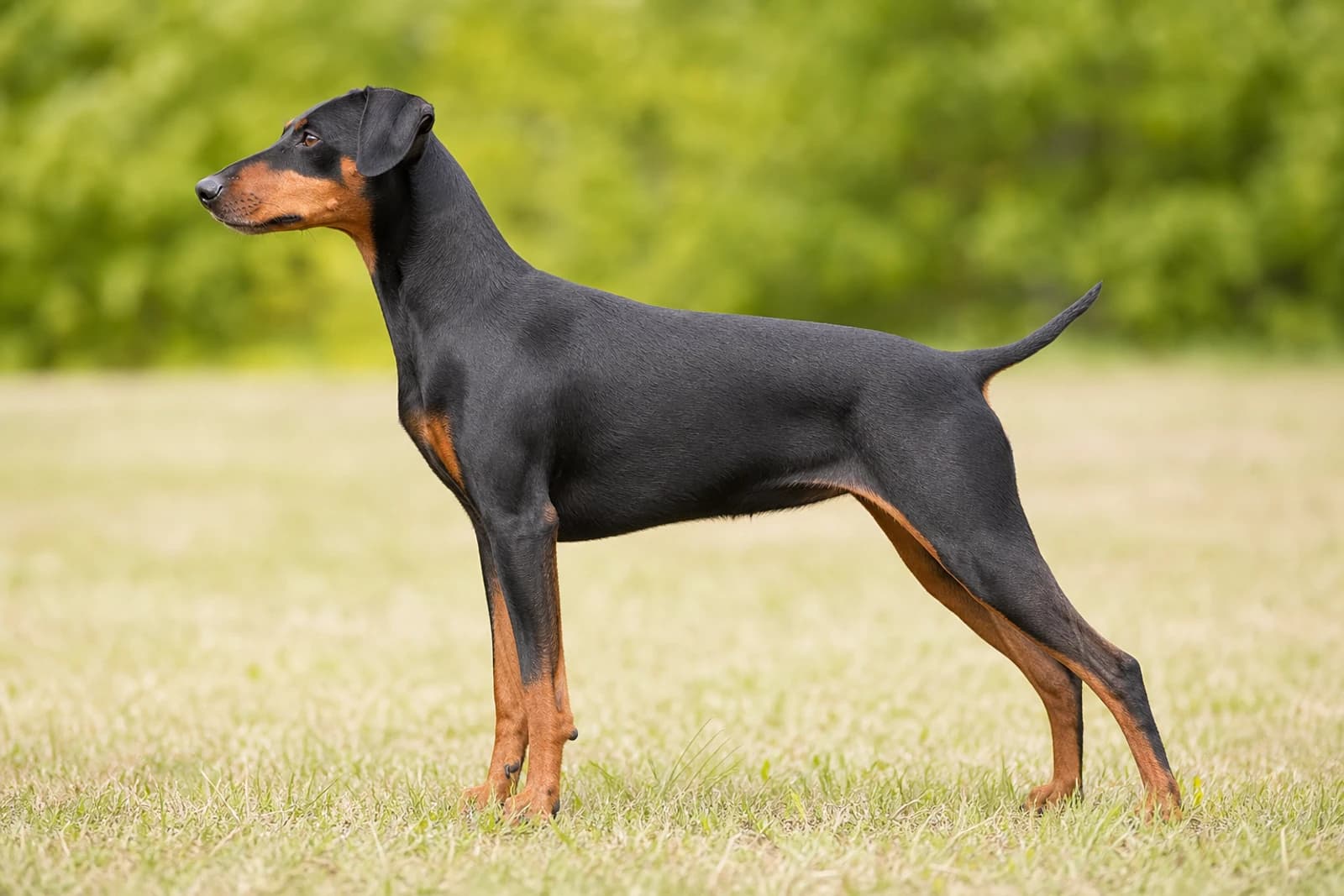
The German Pinscher is a medium-sized working breed known for its elegance, intelligence, and vivacious spirit. Best suited for active households with experienced owners, this dog thrives on vigorous exercise and mental challenges. They are loyal and affectionate with family but can be headstrong, requiring firm, consistent training. Their alert nature makes them excellent watchdogs, but their high prey drive demands caution around small pets. Not ideal for novice owners or apartment dwellers, the German Pinscher rewards a dedicated handler with unwavering companionship and boundless energy.
At a glance
- Size
- Medium
- Height
- 17–19 in
- Weight
- 24–35 lb
- Life span
- 12–14 years
- Coat colors
- Black and Tan, Red, Blue and Tan, Fawn
- Coat type
- Short, smooth, and dense
- Group
- Terriers
How much does a German Pinscher cost?
Adopt / rescue
$75–$400
Usually includes spay/neuter, first shots, and a microchip.
Buy from a breeder
$700–$2,000
From a reputable, health-testing breeder.
Approximate USD. Prices vary widely by region, breeder, pedigree, age, and coat colour — adopting is the lower-cost and recommended route. Avoid suspiciously cheap “breeders”; they’re often puppy mills.
Estimate the full cost of a German Pinscher →German Pinscher photos
Views
Front, side, rear and top — the full silhouette.Poses
How the breed sits, lies, moves and plays.Puppy to senior
The breed across its whole life.Expressions
The breed’s range of moods.Close-up details
Eyes, ears, nose, paws, tail and coat.Coat colors
The breed’s recognized colors.Click any photo to enlarge. We show the German Pinscher from every angle — three views, poses, life stages, expressions, close-ups, coat and colors.
Appearance & size
You see a dog that’s all business, built for a full day’s work but refined enough to turn heads. The German Pinscher stands squarely on the line between medium and large — not a scaled-down Doberman, but its own agile, muscular package. Males and females both range from 17 to 19 inches at the shoulder, weighing anywhere from 24 to 35 pounds. That’s about the same weight as a sturdy French Bulldog, but stretched over a lean, athletic frame with zero stockiness. There’s no loose skin or plodding heft here; every ounce sits suspended on long, straight legs.
The body is deliberately square. Measure from the prosternum (the front point of the chest) to the rear of the buttocks, and it equals the height at the withers. This square silhouette is a breed hallmark, giving the dog a crisp, no-nonsense outline. The back is short and firm, with a slight, elegant tuck-up at the loin. You won’t see a sagging topline or a roached back. A well-bred German Pinscher looks like a coiled spring when standing relaxed — and that spring uncoils into a smooth, ground-covering trot when the dog moves.
The coat is short, dense, and lies flat against the body. It’s glossy enough to reflect light, with no trace of a wave or a wiry texture. Run your hand over it and you’ll feel a smooth, hard finish that sheds dirt easily. This is a wash-and-wear dog. Colors are rich and simple, without flashy white markings. The most common is black with sharply defined tan points on the cheeks, muzzle, throat, chest, legs, and under the tail. Then there’s solid red, which can range from a pale deer fawn to a deep, burnished stag red — often with a slight black overlay on the back and ears. You’ll also see blue (a dilute black) with tan, and fawn (Isabella) with tan, though they’re less common. All tan markings should be clean and crisp, not muddied into the base color.
From the front, the German Pinscher gives an impression of taut, controlled power. The chest is moderately wide, the forechest visible but not bulging. The forelegs are straight, parallel columns dropping cleanly to compact, catlike feet. Elbows hug the body without pinning. The head is a distinct wedge — long and dry, with a flat skull and a minimal stop. The muzzle matches the skull in length, and the tight lips never droop. The eyes are oval, medium-sized, and dark, with an alert, staring-straight-at-you expression that misses nothing.
Natural ears are set high and fold forward in a V-shape, kissing the cheeks at eye level. In countries where cropping is still practiced, the ears stand erect, sharpening the already keen expression. Either way, the set is high, enhancing the neck’s graceful arch. The neck flows into well-laid-back shoulders, and from the side you’ll notice the withers rise slightly above the level of the back — a small detail that speaks to ideal front assembly.
From the rear, the dog looks just as structured. The hind legs are straight and parallel, with well-angled stifles and hocks that drive forward without cow-hocks or bowing. The tail is set high and either docked short (traditionally) or left natural, where it curves upward like a saber. A natural tail never curls over the back or droops — it’s carried with the same proud, fast tempo as the rest of the dog. In motion, the legs converge toward a centerline, but at a standstill you’ll see a wide, stable stance that says this dog can pivot on a dime. That compact, muscular rear, combined with a chest that doesn’t overreach, lets the German Pinscher change direction in a heartbeat — a trait it shares with other terrier breeds despite being classified in the Working Group in some countries.
The whole package is sleek without being delicate. You’re not looking at bulk or bone for the sake of it; you’re looking at a dog whose body was edited down to what’s necessary for speed, endurance, and a 14-year lifespan of hard play.
History & origin
The German Pinscher nearly vanished after World War II. If not for a determined breeder in the 1950s, the smooth, medium-sized dog standing in front of you today would be little more than a footnote in old European breed books. That near-extinction and revival shaped the breed’s modern numbers — it remains uncommon — and also preserved a dog whose history reaches back to some of Germany’s oldest working farm dogs.
Well before the 1800s, these dogs were the all-purpose hands on rural homesteads. They hunted rats and vermin with the single-mindedness of a terrier, sounded the alarm at strangers, and patrolled stable yards as compact guardians. Their size — ranging from about 17 to 19 inches at the shoulder and 24 to 35 pounds — made them valuable because they had the heft to confront an intruder but the agility to bolt down a rat hole. The German Pinscher was the foundation stock that later produced the Miniature Pinscher (a scaled-down version) and the Doberman Pinscher, after Karl Friedrich Louis Dobermann intentionally crossed the breed with other dogs in the late 19th century to create his larger protection dog.
For decades, smooth-coated and wire-haired pups were born in the same litters and considered the same breed. In the early 1900s, that changed when breeders split the wire-coated dogs into what became the Standard Schnauzer. The smooth-coated dogs retained the name German Pinscher and a first breed standard was written around 1884. The next century was not kind. Two world wars and the Great Depression hit the breed hard, and by the late 1940s, no purebred German Pinschers remained. The breed survived thanks to Werner Jung, a kennel master in West Germany who tracked down a few oversized Miniature Pinschers and other pinscher-type farm dogs that still carried the original type. Using careful selection over several generations, Jung rebuilt the breed to its pre-war look and temperament. The kennel club of Germany re-recognized the German Pinscher in 1956.
Today the breed’s numbers are still small, but it has spread beyond Germany. The American Kennel Club recognized the German Pinscher in the Working Group — though many fanciers note its terrier-like tenacity with small quarry — and the United Kennel Club classifies it as a Terrier. Wherever it lands on a registry list, the dog that Jung salvaged still carries the same instincts: a serious, sharp-eyed worker hardwired to patrol and protect its own patch.
Temperament & personality
Energy and daily needs
A bored German Pinscher is a demolition crew in a 24–35-pound frame. This dog runs on terrier drive—plan on at least 60 minutes of hard exercise every day. A leisurely walk around the block won’t touch it. You need off-leash sprints in a secure area, long fetch sessions, flirt pole work, or a solid run. Add a mental workout (clicker training, food puzzles, nose work) or he’ll invent his own entertainment, usually involving your couch cushions.
With family and other pets
Bonding is real, but it’s not clingy. After he’s burned off that energy, he’ll happily crash next to you, but he’s not a 24/7 lap dog. He can do well with respectful older kids who understand one hard rule: never interrupt him while he’s eating. Food guarding shows up fast if that gets ignored. Early, ongoing socialization is non-negotiable. Many German Pinschers are pushy with other dogs, especially same-sex, and their high prey drive makes cats or small pets a constant risk—unless they’ve literally grown up together and even then, supervision is wise.
Watchdog nature
You’ll know about every delivery truck, neighbor, and suspicious squirrel. This breed was built to sound the alarm, and he takes the job seriously. The bark is sharp, persistent, and not something you can train out entirely—management, yes, silence, no. With strangers, he leans forward, body stiff, staring directly. That’s not aggression yet, but it’s assessment. A relaxed dog shows a loose body, soft eyes, and maybe a yawn or a lip lick to say “I’m no threat.” Learn those signals; they’ll save you a lot of misunderstandings.
Chewing, marking, and other daily quirks
Chewing isn’t a phase—it’s a lifestyle. Puppies chew to explore; adults chew to keep jaws strong and teeth clean. Give him tough rubber toys, raw bones, and bully sticks before he redesigns your chair legs. A homemade citrus spray (boil citrus peels in water, strain, spritz) can redirect him from off-limits items. A vinegar spray works as a deterrent too, and it also neutralizes urine odors if accidents happen.
Indoor marking usually isn’t spite, it’s scent-driven. A spot that smells like old pee screams “bathroom” to a dog. Clean accidents with an enzymatic cleaner or a vinegar solution to kill the cue. Reward outdoor potty breaks with a treat right away—punishment after the fact just confuses him. And because he defines “inside” by the family’s scent, a rarely used guest room might get tagged until he feels it’s properly claimed.
He might also roll in something foul. Whether it’s an ancestral camouflage trick or just his weird perfume choice, keep shampoo handy.
Training a strong will
Yanking, yelling, or trying to physically overpower him backfires. This is a thinking dog with a stubborn streak; force just triggers a battle you’ll lose. Short, game-like training sessions that challenge his brain work far better than drilling commands. High-value treats, clear rules, and a calm, consistent approach get respect. Treat him like a smart partner, not a subordinate, and he’ll give you focus you didn’t expect.
Is a German Pinscher for you?
This isn’t a beginner’s dog. His intensity, high prey drive, and low tolerance for rough handling can overwhelm a novice. If you want a quiet, low-key companion, keep looking. But if you’re ready for a high-octane, loyal thinker who holds you accountable for every walk, training session, and chewed-up remote, the German Pinscher delivers. And when he rolls in something dead right before guests arrive, at least you can blame his scavenger heritage.
Good with kids, dogs & other pets
A German Pinscher’s success with kids, other dogs, and smaller animals leans heavily on two things: early, relentless socialization and a clear-eyed respect for his terrier wiring. Without those, you get a quick-to-react, sometimes bossy housemate. With them, the breed’s natural patience and affection can shine.
With kids: These are sturdy 24‑ to 35‑pound dogs who can handle active play without being fragile, but they move fast. A zooming Pinscher can accidentally knock over a toddler. They tend to be non‑aggressive and tolerant when raised alongside respectful children, yet they won’t put up with ear‑pulling or clumsy grabbing. Supervision and teaching kids how to interact matter just as much as training the dog. Nippy mouthing can surface during rowdy chase games, so redirect that energy onto toys instead of ankles.
With other dogs: Same‑sex aggression and a pushy play style are real possibilities if the puppy misses the prime socialisation window. That window closes around 12‑to‑16 weeks—well before most pups leave the breeder. Look for a breeder who starts exposing the litter to friendly dogs, varied people, and new surfaces from three weeks on. Once home, regular puppy classes and controlled, positive meet‑ups build a grown dog who reads canine signals without defaulting to a stiff, hair‑trigger posture. An adult German Pinscher who wasn’t socialised early may never be a dog‑park regular; forced interactions often make fear worse, so read your individual dog and don’t push it.
With cats and small pets: Terrier instincts run deep. Many German Pinschers can learn to coexist with a family cat if introduced gradually during puppyhood, with constant supervision for months, never assuming they’re safe. Free‑roaming small animals like rabbits, hamsters, or guinea pigs almost always trigger a chase‑and‑dispatch response that no amount of training fully erases. Management is non‑negotiable: separate spaces, sturdy enclosures, and zero off‑leash access when small furries are around.
Early exposure prevents the timidity, noise phobia, and over‑excitement that come from a poorly socialised dog. But even a well‑bred, well‑raised German Pinscher needs a family that treats supervision around young children and small pets as a permanent house rule, not a phase to outgrow.
Trainability & intelligence
A German Pinscher learns commands in a flash—but that doesn't mean he'll follow them just because you asked. This is a whip-smart terrier, not a born pleaser. Training works best when you treat it as a two-way negotiation with a dog that has his own opinions and a wicked sense of humor.
Because they pick up new behaviors in just a handful of repetitions, you'll be tempted to rush. Don't. The real challenge isn't teaching the sit; it's convincing him that sitting for you is worth his while. Boredom sets in fast, so short, varied sessions (5–10 minutes) beat long drilling marathons every time. Mix in plenty of play and switch up rewards—treats, a tug toy, a chance to sprint. Figure out what your individual dog finds valuable and use it as currency, because a German Pinscher who decides the paycheck isn't good enough will simply opt out.
Recall demands special honesty. High prey drive and terrier tenacity mean a squirrel or a blowing leaf can override years of training in a heartbeat. Off-leash reliability in unfenced areas isn't a given. Use a long line to proof recalls around distractions, and reward check-ins like they're winning the lottery.
Common challenges pop up when you mix intelligence with independence. They'll test boundaries, offer their own "improvements" to your cues, and can develop selective hearing the moment you get predictable. Harsh corrections backfire badly—sensitivity hides under that confident exterior, and punishment erodes trust. Instead, build a history of positive wins. If they make a mistake, redirect and make the right choice pay off.
Socialization is non-negotiable. Begin early, ideally before 16 weeks, and keep it going into adulthood. Introduce your puppy to a wide range of people, dogs, sounds, and surfaces at a pace he can handle. A German Pinscher who misses out on this often becomes suspicious or reactive, and that's a lot harder to fix than to prevent.
Your best tool is a rock-solid relationship. When this dog trusts you completely, he'll throw himself into work with a focus that can surprise you. Keep training sessions quick, creative, and genuinely fun—a predictable routine is his cue to start freelancing. And if you slack on mental exercise, he'll invent his own job, and you probably won't like what he comes up with.
Exercise & energy needs
Count on at least an hour of real exercise every day—and not just a stroll around the block. The German Pinscher is a medium-sized terrier with a serious work ethic, and that compact 25–35 lb body packs the energy of a much larger dog. A single long walk usually isn’t enough. You’ll get the best behavior when you split the daily requirement into two solid sessions: think 30–40 minutes in the morning and another 30–40 minutes in the evening.
Intensity matters as much as minutes. These dogs want to move. A brisk jog, a hard game of fetch, or off-leash sprints in a secure area burn off the steam that otherwise gets channeled into barking, digging, or destructive chewing. A backyard alone won’t do the job—they need interactive, directed activity with you. Because of their strong prey drive, any off-leash time should happen only in a fenced space; a stray squirrel can trigger an instant chase.
Mental exercise counts just as heavily. German Pinschers are sharp, and a bored brain turns into a problem. Work puzzle toys, hide-and-seek with treats, and daily obedience or trick training into the routine. Dog sports are where this breed truly shines. Try agility, barn hunt, rally, or scent work—activities that mix fast movement with quick thinking match their natural talents perfectly.
If you skimp on either physical or mental outlets, you’ll see the fallout: restlessness, constant attention-seeking, and noisy reactivity. Puppies need short, frequent play and training bursts instead of marathon runs to protect developing joints. For adults, watch for signs of fatigue or overheating in hot weather and scale back impact on hard surfaces. A well-exercised German Pinscher settles into a calm, affectionate house companion—but getting there means you commit to the schedule every single day.
Grooming & coat care
The German Pinscher’s short, dense coat is practically wash-and-wear. You won’t find any undercoat to trap dirt or tangle, so grooming is minimal — a quick weekly session keeps everything sleek and healthy.
- Brushing: A soft bristle brush or a rubber grooming mitt once a week removes loose hair, spreads natural oils, and polishes that glossy finish. During spring and fall, shedding ticks up a notch; two quick passes per week handles the extra fuzz. Skip wire slickers or hard pins — they’re overkill on this coat.
- Bathing: Bathe only when the dog is visibly dirty or starts to smell, which for most Pinschers means every two to three months. Use a mild, dog-specific shampoo and rinse thoroughly. Over-washing strips the coat’s natural oils and can leave the skin dry and flaky. A damp cloth wiped over the body and legs handles muddy paw moments between baths.
- Ears and nails: The ears are naturally V-shaped and fold forward, so they trap a little more moisture than fully upright ears. Lift them weekly, give a sniff, and wipe out any wax or debris with a vet-approved ear cleaner — no cotton swabs deep in the canal. Nails grow fast on this active breed; aim for a trim every three to four weeks, or as soon as you hear clicking on hard floors.
- Teeth: Brush teeth at least three times a week with a dog toothpaste to keep tartar down and breath fresh. Daily is even better if you can make it a habit early on.
- Seasonal notes: There’s no dramatic coat blowout. You’ll notice a slight increase in shedding when the days lengthen in spring, and again as the coat thickens for winter. A few extra minutes with the brush or mitt keeps it off the couch.
Because the coat is so low-maintenance, it’s easy to overlook basic checks. Regular handling during these short grooming rituals makes it simple to spot lumps, bumps, or skin irritation before they become problems.
Shedding & allergies
The German Pinscher’s tight, glossy coat looks practically zero-maintenance, but it sheds a steady stream of short, needle-sharp hairs that weave themselves into upholstery and clothing. If you run a damp hand over your Pinscher’s back, you’ll come away with a palm full of dark specks almost any week of the year.
Shedding picks up noticeably during spring and fall, though you won’t see the dramatic undercoat “blowout” of a double-coated breed — this is a single-coated dog. The trade-off is that those fine, shed hairs are more difficult to vacuum out of car carpet than a fluffy tuft you can just pinch and toss. A quick weekly once-over with a rubber curry brush or hound glove pulls loose hair before it ends up on the couch, and it’s often the only grooming you’ll need between baths.
Drool is practically nonexistent. You won’t be wiping slobber from walls or dodging flying ropes of spit. That’s a plus for neat freaks, but it has nothing to do with allergies.
No dog is truly hypoallergenic, and the German Pinscher is not a “low allergy” pick. People react to proteins in dander, saliva, and urine — not just hair volume. This breed produces all of those. If someone in the house has a dog allergy, spend real time around adult Pinschers before bringing one home. The short coat just means the dander that does shed settles everywhere without being trapped by a longer coat.
Diet & nutrition
A lean, muscular 24–35 lb German Pinscher burns fuel fast. You control the calorie tap, so portion by what your dog actually burns — not just the weight-class suggestion on the bag. Skip the guesswork: for a 30 lb adult getting an hour of real exercise (running, sprinting, not just a leash stroll), start with about 1½ cups of high-quality kibble per day, split into two meals. Adjust up or down a quarter-cup based on ribs you can easily feel but not see.
What goes in the bowl
A balanced raw or home-cooked diet works beautifully for this terrier. Aim for roughly 60% meat (raw or gently cooked), 20–30% vegetables and fruit, and 10% extras like eggs, plain yogurt, or cooked grains. Because a dog’s jaw moves only up and down and saliva lacks the digestive enzymes ours have, running meals through a blender or food processor helps unlock more nutrients. If your Pinscher inhales food, use a puzzle bowl to slow them down and keep that quick mind busy.
Puppy portions and transitions
Puppies need four evenly spaced meals a day until 4 months old, then three meals until 6 months. After that, switch to the adult two-meal rhythm. Move to a new diet gradually — start with lightly cooked and puréed meats, fish, fruits, and vegetables, or a top-shelf commercial puppy formula. Around 12 weeks, you can introduce a raw chicken wing under direct supervision.
Weight and senior years
The German Pinscher can tip toward food obsession, so portion laxity becomes a real weight problem. Extra pounds strain joints and feed that terrier stubbornness. Treats count: a few training treats can easily add 50–100 calories. Senior dogs (age 7 and up) often slow down; when they do, cut daily calories slightly and switch to smaller, more frequent meals to keep blood sugar steady and digestion easy. Don’t slash protein — there’s no solid evidence that older dogs need less. Use unsalted vegetable water as a meal base if stock isn’t on hand, and never feed rich holiday scraps; they can trigger pancreatitis in a dog this size.
Serve leftovers in your dog’s own bowl — never from the table — to head off begging before it hardens into habit.
Health & lifespan
A German Pinscher typically lives 12 to 14 years, and that’s not just a number on paper — these are sturdy, medium-sized terriers (24–35 pounds) who often stay lively well into their teens. Overall, the breed is notably healthy, but there are a few inherited weak spots that smart breeding and sharp-eyed ownership can keep in check.
Responsible breeders screen for von Willebrand’s disease, a bleeding disorder that can show up in some Pinscher lines. They’ll DNA-test the parents so you know whether your puppy is clear, a carrier, or affected — and you can plan minor surgeries or dental work with your vet accordingly. Hip dysplasia crops up occasionally even in lean, athletic dogs, so good breeders also submit hip X-rays through OFA or PennHIP. Eye problems, particularly cataracts, appear in the breed, and annual eye exams with a veterinary ophthalmologist catch those early.
Because the German Pinscher is a compact 17–19 inches and built like a coiled spring, weight management matters more than most owners realize. An extra three pounds on a 30-pound frame is like an extra 15 on a human — it taxes joints, invites diabetes, and robs them of the quick, ground-covering trot you fell in love with. They’re famously food-motivated, so portion out meals, skip the table scraps, and keep treats strictly accounted for.
That short, dense coat offers no insulation against bitter cold, and these dogs overheat fast if left in the sun. In freezing weather a coat isn’t overkill; in summer, exercise during the coolest parts of the day. Otherwise, they’re hardy.
A note that gets underplayed: the German Pinscher is wired to notice everything and can tip into stress-related behaviors — pacing, barking, GI upset — when isolated or handled roughly. Early, positive socialization isn’t just training; it’s a direct investment in lower lifetime stress and a stronger immune system. Regular vet checks (yearly for adults, twice-yearly after age 8) with a thyroid screen around middle age let you stay ahead of hypothyroidism, which can masquerade as weight gain or a dull coat.
Watch for subtle shifts — less enthusiasm on walks, a stiff climb after a nap, a change in appetite. Because this breed powers through discomfort, you’re often the first diagnostic tool.
Living environment
A German Pinscher’s living situation works only if you’re ready to meet two daily non-negotiables: serious, sweat-breaking exercise and a plan for a hair-trigger watchdog bark. Skip either one, and a tidy house or tolerant neighbors won’t save you.
Apartment vs. house
An apartment can work, but it’s not the path of least resistance. You’ll need to give this 24–35-pound athlete at least an hour of off-leash running, flirt-pole sprints, or long sniff walks split into morning and evening sessions, plus puzzle toys or scent games that tire out his brain. Without that, the bored barking will start — and once it starts, it’s loud. Neighbors in shared buildings often run out of patience. A detached house with a securely fenced yard makes life easier, but only if that yard is an add-on, not a substitute for your own involvement.
Yard and escape-proofing
A yard is no luxury; it’s a safety measure. At 17–19 inches at the shoulder, a motivated Pinscher can scale a four-foot fence or dig under it in minutes. A five- or six-foot privacy fence, buried several inches at the base, keeps this terrier-minded dog from launching after squirrels, cats, or anything that moves fast. Underground electronic fences are useless — prey drive overrides any warning zap.
Noise and barking
They don’t bark to hear themselves; they bark because they’re watchdogs bred to announce anything out of place. Every delivery truck, knocking branch, and neighbor’s dog becomes a headline. You can train a solid “quiet” cue and buffer the noise with white noise or window film, but you’ll never erase the instinct entirely. If you share walls, this is the single biggest friction point.
Tolerance for being alone
This is not a breed you can leave for eight or nine hours and expect a calm house. Pinschers bond tight to their people and can chew, scratch, or bark when lonely or under-exercised. Four to five hours max is realistic, and even that requires slow, puppy-level desensitization to being alone, a crate they love, and a frozen Kong or long-lasting chew. Anyone with a long daily commute should look elsewhere.
Weather tolerance
A short, dense coat with no undercoat means real cold hits hard. Below 40°F, a fitted coat and shorter outdoor sessions prevent shivering and misery. Summer heat is more manageable, but hot pavement and midday sun demand shade, water, and a shift to early morning or evening exercise.
Who this breed suits
A German Pinscher isn't a starter dog. You'll get the most out of this breed if you already speak “dog” — someone who enjoys training, sets consistent boundaries, and treats mental exercise as mandatory, not optional. They slot best with active singles, couples, or families with older kids (teens) who won't accidentally knock over a 30-pound powerhouse. Seniors can thrive with one too, as long as they're still hiking daily or doing something that burns that intense, brainy energy; a leisurely stroll twice around the block will leave this dog making his own entertainment, and you won't like what he comes up with.
First-time owners usually find them a handful. A German Pinscher needs clear structure and doesn't forgive sloppy handling — they're fast learners who will train you if you don't train them. If you want a dog that learns tricks in a flash but then argues about performing them just because you asked, welcome home. This breed lives for a challenge: obedience, rally, barn hunt, trick dog titles, you name it. A solid hour of off-leash sprinting, combined with puzzle toys or nose work, is closer to their daily baseline than a jog around the neighborhood.
Think twice if your house runs on calm and quiet. They're alert to every delivery truck, squirrel, and leaf-blower, and they'll tell you about it. Apartment dwellers with close neighbors should consider the noise factor. A securely fenced yard is a big plus — not to park them in, but as a safe zone to explode around in. They also have zero chill around pocket pets or stray cats; that terrier-like prey drive is real, despite the working-group classification.
Families with toddlers face a management challenge. The dog's quick, whip-smart movements and low tolerance for clumsy handling can lead to a snap if a child trips on them. They do bond hard with their own people, often cementing a fierce loyalty to one person. Separation anxiety can crop up, so a work-from-home schedule or someone who's around a lot fits better than a house that's empty 9 to 5. If you're looking for a push-button companion, skip this breed. If you want a partner who'll keep you laughing, test your skills daily, and never let boredom creep in, a German Pinscher delivers — as long as you show up ready to work every single day.
Cost of ownership
Purchase price
A well-bred German Pinscher from a breeder who screens hips, eyes, cardiac, and runs a DNA test for von Willebrand’s disease typically costs $2,000 to $3,500. Show-potential puppies or dogs from imported European lines can push toward $4,000. This breed is still uncommon in the US, so you’ll likely join a waitlist and pay a deposit months before a litter is born.
Steer clear of anyone selling a “rare” puppy for under $1,200 without documented health clearances — those dogs often come with steep long-term expenses you can’t see upfront. Rescue is possible through regional Pinscher or terrier groups, but placement is rare; adoption fees usually range between $250 and $500 when a dog does become available.
Monthly budgeting
A 30-pound German Pinscher burns through calories. Plan on spending $40–$70 a month on high-quality kibble (or more for raw or fresh diets). Treats for training and durable chew items add another $15–$30 — this is a mouthy, clever dog that needs legal outlets.
Grooming is refreshingly low-maintenance. Their short, dense coat needs just a quick weekly brushing and the occasional bath. You can do nails and ear cleaning yourself for a few dollars in supplies, or budget $20–$40 a month if you send the dog to a pro every six to eight weeks.
Veterinary care and preventative meds – annual exams, vaccinations, heartworm, flea/tick prevention – typically run $25–$40 a month. Spaying or neutering, if not included in the purchase, will be a significant one-time cost during the first year. Pet insurance for a medium breed with known risks like hip dysplasia and Von Willebrand’s runs another $30–$50 monthly for a solid accident-and-illness policy. Include $10–$20 a month for ongoing mental gear — puzzle toys, snuffle mats, a sturdy flirt pole — because a bored German Pinscher is an expensive problem waiting to happen.
Choosing a German Pinscher
You’ve got two main paths: track down a responsible breeder or join a breed-specific rescue’s waiting list. Shelters rarely see purebred German Pinschers, but the national club’s rescue network occasionally places adults. A rescue dog skips the puppy chaos, and the group should honestly describe the dog’s energy and any known behavior quirks. If you go with a breeder, health clearances are the tell.
Health clearances that actually matter
A breeder who’s serious will hand you documentation without you having to beg. For a German Pinscher, the baseline is:
- Hips: an OFA or PennHIP evaluation (ask for the official certificate, not a “vet said they look fine”).
- von Willebrand’s Disease: a DNA test (clear or carrier result) or a vWD factor assay. This bleeding disorder pops up in the breed, and you don’t want to discover it during a routine spay.
- Eyes: a current exam by a board-certified veterinary ophthalmologist—OFA Eye or CERF form.
Some also run cardiac and thyroid panels, but the three above are bare minimum. You can look up the dog’s OFA records yourself.
Red flags that scream “walk away”
- Health testing stops at deworming and a quick physical. If you hear “vet-checked” without hip or vWD paperwork, move on.
- The breeder always has puppies, breeds multiple litters at once, or treats the deposit like a Black Friday doorbuster—urgent payment before they’ve even asked about your home.
- You can’t meet the mother on-site (video call if the sire lives elsewhere). Puppies raised in a kennel building, isolated from kitchen noise and vacuum cleaners, miss critical early socialization.
- A price list that charges extra for “rare” blue or fawn coats. Dilute colors occur naturally, but a breeder charging a premium while glossing over the risk of color dilution alopecia is selling hype, not health.
Picking your pup
At 7–9 weeks, a sound German Pinscher puppy is curious and confident, not cowering in a corner or bulldozing littermates with zero bite inhibition. Watch for the pup that approaches, investigates your shoelace, then settles. Extreme fear or outright aggression at this age isn’t normal and doesn’t get better with love alone. Ask how the breeder socializes: do the pups hear clanging pans, walk on different surfaces, and get handled by multiple people? A breeder who raises the litter underfoot and questions your experience with a whip-smart, high-drive terrier is worth their weight in gold. Spending more on a puppy from fully health-tested, home-socialized parents is the cheapest insurance you’ll ever buy against heartache and avoidable vet bills.
Pros & cons
-
Sleek, wash-and-wear coat — a quick once-over with a brush each week handles shedding without fuss
-
Compact but athletic build (24–35 lb, 17–19 in) fits apartment life and travels easily, provided exercise needs are met
-
12–14 year lifespan means you get a long-running, sturdy companion
-
Razor-sharp brain: picks up obedience, agility, and trick training fast when you keep sessions fresh
-
Instinctive watchdog — a single alert bark tells you something’s up, nothing more
-
Deeply loyal, forms a tight bond with its own people
-
Requires a solid hour of hard daily exercise — running, flirt pole, off-leash sprints, or dog sports; a leash stroll around the block won’t touch it
-
Tenacious prey drive; squirrels and cats trigger instant chase, so off-leash recall demands proofed training in fenced areas
-
Can be dog-selective and territorial — early, continuous socialization is non-negotiable to prevent scrappiness
-
Independent problem-solver with a “what’s in it for me?” streak; tests boundaries and bores easily under repetitive training
-
A bored German Pinscher turns destructive fast — expect digging, chewing, or barking if mental and physical outlets fall short
-
Naturally reserved with strangers; without careful, positive introductions they tip into suspicion
-
The breed can be prone to hip dysplasia, von Willebrand disease, and inherited eye issues — responsible breeders screen breeding stock for these
Similar breeds & alternatives
If the German Pinscher’s sleek, no-fuss build and alert nature appeal, but the driving work ethic gives you pause, a few breeds sit on either side in size and temperament.
Miniature Pinscher
Often mistaken for a “mini” German Pinscher, the Min Pin is actually a distinct, older toy breed — standing just 10–12 inches and weighing 8–10 pounds. They share the same black-and-tan elegance and a confident, “big dog” attitude, but the comparison ends there. Min Pins are feisty companion dogs, not high-octane farm workers. A brisk walk and some indoor play satisfy them, whereas the German Pinscher needs a solid hour of running plus brain work. If you love the look but want a smaller dog that fits apartment life and skips the intense drive to patrol and problem-solve, the Min Pin is the closer match.
Doberman Pinscher
The Doberman is the German Pinscher’s larger cousin, a dedicated protection breed rather than a terrier. At 24–28 inches and 60–100 pounds, the Doberman demands substantially more space and strength to manage. Both breeds are alert, loyal, and sleek-coated, but the Doberman’s guarding instinct runs deeper, and it usually craves close human contact. A Doberman is a better fit if you want a large, imposing dog and can commit to early, extensive socialization. The German Pinscher gives you a similar silhouette with a smaller footprint and more terrier tenacity.
Standard Schnauzer
Same German farm heritage, same size range (17–20 inches, 30–50 pounds), but wrapped in a wiry, bearded coat that requires hand-stripping or regular clipping. Standard Schnauzers share the German Pinscher’s keen watchdog nature, intelligence, and high energy, yet they often channel it with a slightly more even temperament around other dogs. The coat difference is the major fork: minimal shedding and a smooth, wash-and-wear coat on the German Pinscher versus a weather-resistant, high-maintenance wire coat on the Schnauzer.
Manchester Terrier (Standard)
The standard Manchester Terrier — 15–16 inches, 12–22 pounds — offers the same glossy black-and-tan coat and whippet-like outline in a smaller, slightly softer package. They’re true terriers: alert, smart, and up for a chase, but generally less intense than the German Pinscher’s guardy, almost working-dog demeanor. Manchesters do well with daily brisk walks and a good sprint in a secure area. A rarer breed, but worth considering if you want a similar look without the serious policing attitude.
Fun facts
- The German Pinscher is a descendant of the rat-catching dogs of medieval Germany and influenced the development of the Doberman Pinscher and Miniature Pinscher.
- They are not terriers despite being classified as such in some registries; they are working dogs.
- After World War II, the breed nearly vanished and was painstakingly revived from a single dog in East Germany.
- German Pinschers are natural watchdogs with a tendency to chase small animals due to their vermin-hunting heritage.
Frequently asked questions
- How much exercise does a German Pinscher need?
- German Pinschers are energetic dogs that require a good amount of daily exercise, typically 45–60 minutes of brisk walking, jogging, or active play. Without adequate physical and mental stimulation, they can become bored and develop destructive behaviors. A securely fenced yard is ideal, but they should not be left outside alone for long periods.
- Do German Pinschers bark a lot?
- German Pinschers tend to be alert and vigilant, which can lead to barking at unfamiliar sounds or visitors. With proper training and early socialization, excessive barking can be managed, but they are naturally vocal dogs. They make an effective watchdog due to this trait.
- Is a German Pinscher good for apartment living?
- A German Pinscher can adapt to apartment living if given sufficient daily exercise and mental challenges. Their medium size and moderate energy indoors can suit a smaller space, but their alert barking might disturb neighbors without training. Access to regular outdoor activity is essential.
- Does a German Pinscher shed a lot?
- German Pinschers have a short, dense coat that sheds moderately throughout the year. Regular weekly brushing can help manage loose hair and keep their coat healthy. They are not considered hypoallergenic, but their grooming needs are relatively low-maintenance.
- Are German Pinschers good with children?
- German Pinschers can be good with older, respectful children when raised together or properly socialized. Their energy and playfulness make them fun companions, but they may be too intense for young toddlers. Supervision and teaching children how to interact with dogs is always recommended.
- Is a German Pinscher a good choice for first-time dog owners?
- German Pinschers are intelligent and independent, which can be challenging for first-time owners unfamiliar with consistent training. They require firm, positive guidance and plenty of mental stimulation to prevent stubbornness. Experienced owners who can provide structure often find them to be loyal and rewarding companions.
Tools & calculators for German Pinscher owners
Quick estimates tailored to German Pinschers — pre-filled with this breed’s size where it matters.
Articles & stories about the German Pinscher
Sources & standards
This profile follows recognized breed standards from the American Kennel Club (AKC) and the Fédération Cynologique Internationale (FCI), along with established veterinary and breed-club guidance. These describe general breed tendencies — every dog is an individual.
Owner stories
Have a German Pinscher? Share your experience — grooming tips, personality quirks, anything goes.