

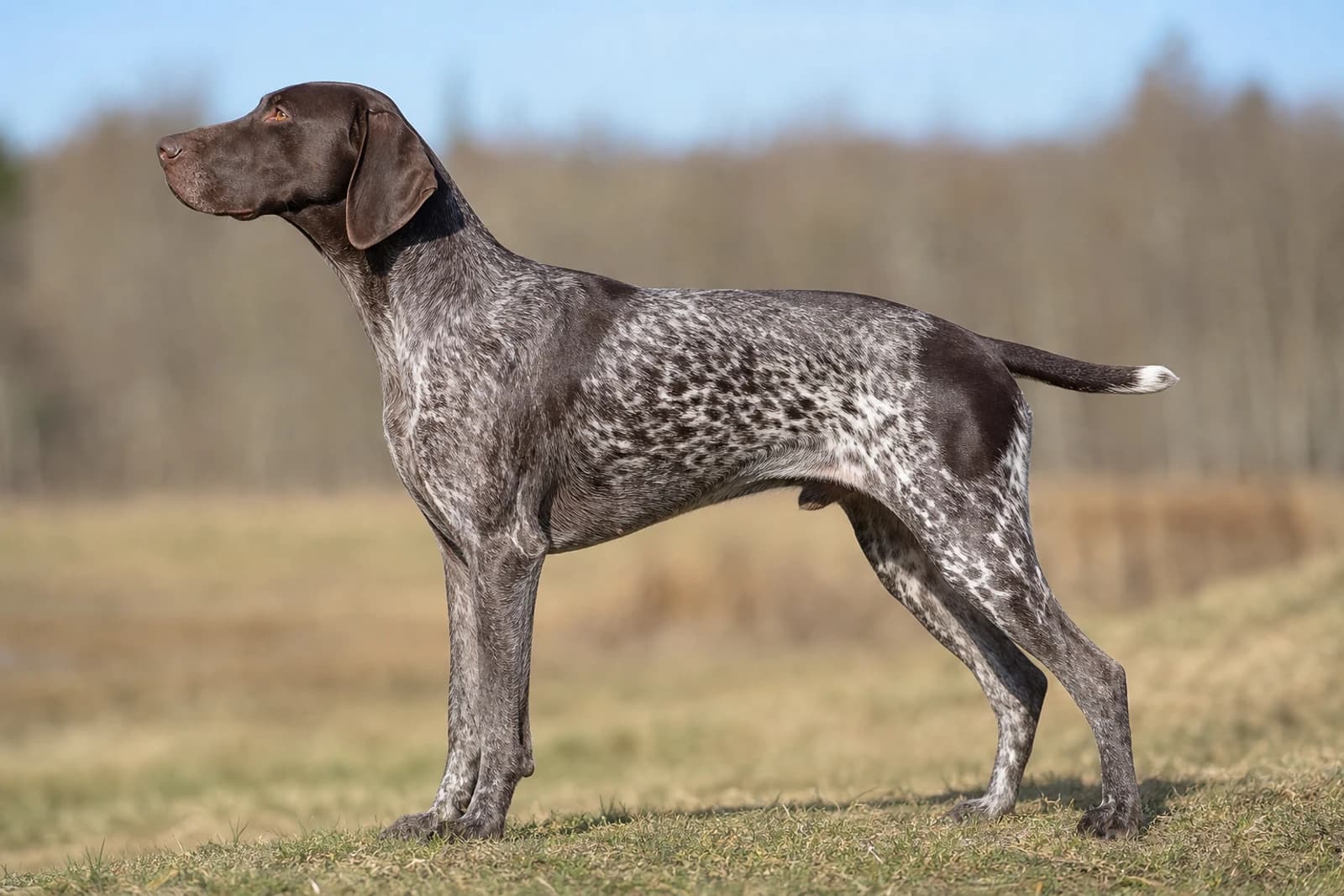
The German Pointer is a versatile hunting dog that thrives with active, outdoor-oriented families. They require ample daily exercise—ideally an hour or more of running, swimming, or field work. High intelligence and eagerness to please make training rewarding, but they need consistent mental stimulation. This breed bonds deeply with its family and is affectionate indoors, though may be too exuberant for small children without supervision. Best suited for experienced owners with a yard, the German Pointer is a loyal, high-energy companion.
At a glance
- Size
- Large
- Height
- 21–25 in
- Weight
- 44–71 lb
- Life span
- 10–14 years
- Coat colors
- Liver, Liver & White, Liver Roan, Black, Black & White, Black Roan
- Coat type
- Short, dense, water-resistant coat
How much does a German Pointer cost?
Adopt / rescue
$75–$400
Usually includes spay/neuter, first shots, and a microchip.
Buy from a breeder
$700–$2,000
From a reputable, health-testing breeder.
Approximate USD. Prices vary widely by region, breeder, pedigree, age, and coat colour — adopting is the lower-cost and recommended route. Avoid suspiciously cheap “breeders”; they’re often puppy mills.
Estimate the full cost of a German Pointer →German Pointer photos
Views
Front, side, rear and top — the full silhouette.Poses
How the breed sits, lies, moves and plays.Puppy to senior
The breed across its whole life.Expressions
The breed’s range of moods.Close-up details
Eyes, ears, nose, paws, tail and coat.Coat colors
The breed’s recognized colors.Click any photo to enlarge. We show the German Pointer from every angle — three views, poses, life stages, expressions, close-ups, coat and colors.
Appearance & size
You see the athlete before you see the dog. The German Pointer is built to cover ground with an effortless, ground-eating stride, and everything about the body tells that story from any angle.
Stand the dog in front of you and you’ll notice a deep, fairly narrow chest that drops to the elbows, leaving plenty of heart and lung room. The forelegs are straight and lean, set well under the body, with shoulders that slope back just enough to absorb shock. The head is clean-cut — a long, squared-off muzzle with a slight stop, a brown nose set flush, and a broad skull that doesn’t get bulky. The eyes are almond-shaped, an alert amber or brown that looks straight through you, not soft or round. The ears start high on the head, broad, and hang close to the cheeks without folding. When the dog is at attention, the whole front end says “ready.”
From the side, the outline is pure function. The back is short and strong, with a slight slope from the withers to the rump. The chest reaches the elbow, and the belly tucks up sharply behind the ribcage — no slab-sided barrel here, just a lean, muscular midsection. A long, slightly arched neck blends cleanly into the shoulders. The tail is typically docked to about 40 percent of its natural length in countries where that’s still standard; when moving, the dog carries it straight out from the back or just above the topline, never curled over the back.
From behind, the rear legs are wide and muscular, with well-bent stifles and hocks that track straight when the dog moves. You don’t see cow hocks or narrowness — it’s a powerful rear assembly built for sprinting and quick turns.
The coat is the breed’s calling card: short, flat, and dense, with a harsh feel that repels water and burrs equally well. It lies tight to the body with no undercoat. The most common colors are solid liver, or liver and white in any arrangement — patched, ticked, or roan. You’ll occasionally see black and white, but liver dominates because black can’t show in the ring in some countries. The white areas are often heavily speckled with tiny liver flecks that nearly blend at a distance, giving the dog a distinctive “ticked” look against a solid liver head.
Males stand 23 to 25 inches at the shoulder and run 55 to 71 pounds; females sit at 21 to 23 inches and 44 to 60 pounds. A German Pointer should never look heavy or soft. If you can’t count the last three ribs with your eyes on a fit dog, he’s carrying too much weight.
A pair of subtle but telling details: the toes are webbed — a nod to the breed’s water work — and the skin fits snug without dewlaps or throatiness. Everything about the appearance says “ready to run, point, and retrieve,” right down to the intelligent, unwavering gaze.
History & origin
The German Pointer is the direct result of 19th-century German hunters wanting a single dog that could do it all. Before the 1800s, pointing, retrieving, and tracking were separate jobs handled by different types of dogs. German sportsmen set out to blend those talents into one versatile package – a robust, sharp-nosed gun dog that could work field, forest, and water right alongside a foot hunter.
The foundation came from the old Spanish Pointer, a heavy-set pointing breed that was crossed with local German hounds and scent trailers. Bloodhound and early foxhound blood added nose and tracking persistence. Later infusions of English Pointer brought more speed, style, and a higher carriage on point. The goal was not a specialist but a true generalist: a dog that would locate game by air scent, freeze on point, flush on command, retrieve from land or water, and follow a wounded bird or hare for hours if needed. And at the end of the day, it had to curl up quietly at the hunter’s fireside.
Much of the breed’s refinement happened in the principalities of the German Confederation, particularly around the court of Prince Albrecht of Solms-Braunfels. By the 1870s, breeders were documenting their work, and the first formal standard for the Deutsch Kurzhaar – the German Shorthair – was written in 1879. That standard emphasized a short, dense liver or liver-and-white coat, a powerful build without bulk, and a steady, cooperative temperament. The breed quickly became the go-to dog for German foresters and gamekeepers.
The German Pointer arrived in the United States in the 1920s. A few passionate hunters imported foundation stock, and the American Kennel Club recognized the breed in 1930. After World War II, returning G.I.s with exposure to the breed’s versatility helped fuel steady growth. Today, the dog you see in the show ring or out on a morning run is still remarkably close to the original blueprint: a lean 44–71 pound athlete that needs a job, thrives on human partnership, and measures its day in scent trails rather than couch cushions.
Temperament & personality
A German Pointer is equal parts tireless athlete and devoted shadow — a dog who lives to be with you and to go wherever you go at full throttle. He stands 21 to 25 inches at the shoulder and weighs 44 to 71 pounds, but his personality fills a room. Expect a bright, affectionate, and intensely energetic companion who wants a job, not just a lap.
This is not a breed content with a couple of strolls around the block. He needs a solid hour or more of hard running, swimming, or fast-paced retrieving every day — mental exercise counts, too. A bored Pointer will create his own entertainment, and your sofa legs, shoes, or drywall often end up on the losing side of that equation. Puppies chew to explore and soothe teething pain; adults keep their jaws strong by gnawing on hard objects. Give them a steady supply of sturdy chew toys and teach “drop it” early, or you’ll donate a lot of footwear to the cause.
For all his physical drive, the German Pointer is a soft-hearted clinger with his family. He’ll follow you from room to room, lean against your legs, and claim any available lap. That deep bond makes prolonged isolation rough on him — neglect or long hours alone can trigger anxiety-driven barking, digging, or house-soiling. If your schedule keeps you away most of the day, this is not the dog for you.
His intelligence cuts both ways. He learns commands rapidly, but he’s also an independent thinker with a stubborn streak. Force and harsh corrections backfire; this dog thrives on respectful, consistent handling that rewards cooperation. Keep training upbeat and varied, and he’ll surprise you with how much he can master.
Around strangers, the Pointer is watchful without being sharp. He’ll announce visitors with a booming bark, often leaning forward with the same intense, stiff-legged posture he uses on point in the field. That stare can look intimidating, but once he knows someone is welcome, he typically warms up. True aggression is rare in a well-socialized Pointer, yet early and ongoing exposure to new people, dogs, and situations is non-negotiable. Without it, his confidence can tip into wariness that makes him harder to manage around unfamiliar dogs or in crowded spaces.
The breed’s nose governs a lot of his daily behavior. Your walks will include long pauses while he reads every scent message left by other dogs. Indoors, he may try to reclaim a spot where a previous accident’s odor lingers — a good enzymatic cleaner is your ally. And if a dead critter or a fresh manure pile presents itself on a hike, many Pointers won’t just sniff; they’ll drop a shoulder and roll with enthusiasm befitting their hunting ancestry. It’s equal parts gross and endearing, and you’ll learn to laugh about it after bath number fifty.
With children, a Pointer is typically gentle and playful, but his rambunctious, full-body enthusiasm can knock a toddler over without meaning to. Supervise, and teach kids never to bother him while he eats — any dog can develop guarding behaviors if meals feel threatened. A Pointer who has been properly exercised, trained, and included in family life is a laughter-filled, loyal housemate who will happily wear himself out by your side for the next decade or more.
Good with kids, dogs & other pets
German Pointers are genuinely patient, non-aggressive dogs, which sets a strong foundation for families with kids. A well-raised Pointer can be gentle and tolerant, but that doesn’t mean you skip supervision. These are large, athletic dogs — 44 to 71 pounds of muscle and bounce — and a happy sprint through the living room can knock a toddler flat. Teach children not to climb on the dog or interrupt meals, and always keep an eye on interactions. The dog’s forgiving nature shouldn’t be tested.
The real work happens long before the dog meets your kids. Puppies have a critical socialization window that starts closing around 12 to 16 weeks. Before that, gradually introduce them to children of different ages, people in hats, clattering skateboards, and the chaos of family life. Positive, low-pressure exposures now drastically reduce fear-based reactivity later. A Pointer who missed early socialization can become timid around strangers, jumpy at loud noises, or overexcited around other dogs — not because of a bad temperament, but because nobody showed him the world when he was young.
With other dogs, a socialized Pointer tends to be easygoing and playful. They’re not typically looking for a fight. Still, an exuberant 60-pound Pointer can overwhelm a shy or elderly smaller dog, so match playmates by energy level and supervise early meetings. Given the breed’s hunting background, off-leash play with unfamiliar dogs should be watched carefully — instinctive chasing and intense body language can sometimes ignite tensions.
- Cats: If you raise a puppy alongside a cat with slow, positive introductions, many Pointers learn to coexist indoors. But the prey drive is real. A cat that darts across the room is a moving target, and some Pointers never fully turn that off. Manage the environment with baby gates and separate safe zones, and only trust them loose together after months of calm, disinterested behavior — not just tolerance.
- Small pets: Rabbits, guinea pigs, hamsters, or chickens are a much harder sell. A Pointer’s instinct to chase and grab small, fast-moving critters runs deep. Even a dog that’s perfect with kids and other dogs may view a guinea pig as quarry. For households with free-roaming small pets, this breed is a risky choice. Secure enclosures are non-negotiable, and never leave them alone in the same room.
Trainability & intelligence
A German Pointer can nail a new command in a few reps, but that quick brain comes with a deal: you have to be more compelling than whatever the nose is saying. These dogs were shaped to hunt at a gallop, lock onto scent, and hold a point far ahead of the hunter — so intelligence here isn’t desk-smarts, it’s field-smarts. They’ll read your mood, learn routines instantly, and figure out how to open the treat drawer if you turn your back. That makes them a joy to teach, but also means sloppy or harsh training backfires fast.
What actually motivates them
Food, yes, but don’t underestimate access. A Pointer will work hard for a chance to run, a retrieve, or a few seconds of tug. Mix treats with play and real-life rewards. Short, crisp sessions beat drilling — they get bored if you repeat a down-stay ten times after they’ve already got it. When they disconnect, they’re not being stubborn in a spiteful way; their brain just pinged something more interesting in the distance. You win by noticing that glazed look and switching gears before they mentally check out.
The recall reality check
Off-leash reliability is the make-or-break skill. A German Pointer whose recall is shaky will blow you off the instant a bird flushes or a squirrel twitches. Build a “here” cue from puppyhood that’s jackpotted every single time — think cooked chicken, a squeaky ball, or a short play session. Use a whistle or a distinct word, never poison it by calling them for something they hate (like nail trims or leaving the park). Practice it in boring places first, then gradually add distractions. Expect multiple regressions during adolescence; that’s normal, not failure.
Socialization and trust
Start wide exposure early — before 16 weeks, if possible. German Pointers are generally friendly, but their sensitivity means a single scary event can stick. Introduce them to children, uneven footing, loud noises, and other dogs at a pace that keeps their tail wagging. Force-free methods are non-negotiable. A hard correction doesn’t make them tougher; it makes them hand-shy and slower to respond. They thrive on a relationship where clear cues and rewards build trust, not fear. Praise the action you want the instant it happens, and ignore (or redirect) the rest.
For a dog that can reason its way through a puzzle toy just as easily as it reads your body language, training isn’t about domination. Give this dog a job that taxes the brain as much as the legs, and you’ll have a teammate who hangs on your every word — at least until the next interesting smell rolls in.
Exercise & energy needs
Plan on a solid hour of hard running and off-leash exploring every day — split into at least two sessions. These are 44–71-pound athletes, originally bred to cover miles of rough terrain in search of game, and a couple of leash strolls around the block won’t put a dent in their energy.
A good daily target is 60 to 90 minutes of vigorous movement. Think brisk jogs, long hikes over uneven ground, swimming, or field work where the dog can sprint and change direction freely. They’re built for sustained effort — 21 to 25 inches of muscle and lung capacity — so the more chance they have to really stretch their legs, the calmer they’ll be at home.
- Off-leash running in a safe, fenced area or on a long line is what truly settles this breed. Fetching, chasing a bumper into a pond, or romping with another sturdy dog all count.
- Scent work and nose games are just as important as the physical outlet. Hide a toy or specific scent article and let them hunt it down; a short session of focused sniffing can tire out their brain faster than another mile of jogging. Puzzle toys and food-dispensing gadgets also help, but nothing beats real trailing and searching activities.
- Structured sports shine here. German Pointers excel at agility, flyball, dock diving, and field trials. These channel their drive and let you work as a team.
Skipping exercise day after day will backfire. A bored Pointer is a creative demolition crew — chewing, pacing, or barking at every squirrel that passes. Consistent, heavy-duty movement keeps them level-headed and genuinely happy in your house.
A quick note on young dogs: avoid repetitive high-impact pounding (forced road running, jumping for height) until their growth plates close, usually around 12–18 months. Stick to free play on grass, short swims, and plenty of mental work while they’re still growing. For adults, watch the heat — those deep chests and the drive to keep going can push them past the point of good sense on a hot day.
Grooming & coat care
German Pointers wear a short, dense double coat that's built for the field—water-resistant, harsh to the touch, and remarkably low-fuss. You still need a simple weekly routine to keep the shine and manage the moderate shed.
Brushing
Once a week, run a bristle brush over the whole body to lift dead hair and spread natural oils; that’s the secret to that healthy gleam. The coat doesn’t mat, so you can skip the detangling tools most of the year. During spring and fall blowouts, switch to a rubber curry mitt every other day. The soft nubs pull out handfuls of loose undercoat without irritating the skin. If your dog runs through brambles, a fine-toothed metal comb works out any burrs, but you won’t need it otherwise.
Bathing
Overbathing strips the coat’s protective oils, so a full bath every two to three months is plenty—unless your pointer finds something truly ripe to roll in. Use a mild dog shampoo and rinse until the water runs clear; leftover suds often cause flaking. A quick plain-water rinse after a swim in a muddy pond will handle most between-bath grime. Their short coat dries fast, so you’re not dealing with a soggy dog for hours.
Nails, Ears & Teeth
Those drop ears trap moisture and need a weekly once-over. Lift the flap, sniff for a yeasty odor, and wipe the inside with a cotton ball dampened with a veterinary ear solution—never dig into the canal. Nails grow quickly; if you hear clicking on the floor, they’re overdue. Trim every 3–4 weeks, and don’t forget the dewclaws, which don’t wear down on their own. Daily brushing with dog toothpaste keeps tartar at bay and prevents costly dental problems down the road. Start handling feet, ears, and mouth when the dog is a pup so grooming never becomes a wrestling match.
Seasonal shedding
Twice a year, you’ll get a true hair event—fur on the furniture, in the car, and floating across the kitchen floor. Ramp up brushing to daily for a couple of weeks, and a warm bath can help loosen the old coat. All that time running, swimming, and crashing through the field naturally drives healthy coat turnover, so a fit pointer often sheds less dramatically than a sedentary one. Even so, evenings on the couch will still leave a dusting of pale hairs on your dark pants—a fair trade for a dog who lives to go. A short curry session and an ear check take ten minutes, then you’re back out there together.
Shedding & allergies
You’ll find little brown hairs woven into your couch, your car upholstery, and your favorite black pants. German Pointers shed consistently all year, but it’s not the fine, drifting cloud some double-coated breeds produce. Their coat is short, dense, and sleek — and it quietly drops fur everywhere.
Twice a year, usually in spring and fall, that low-grade shedding ramps into a full-blown blowout. For a few weeks, daily brushing becomes non-negotiable if you don’t want to wear a second coat of dog hair. A rubber curry brush or hound glove will pull up loose fur fast, and a quick once-over after a run outside keeps the worst of it out of the house. Don’t bother with expensive de-shedding tools; the coat is too short for them to make much difference.
Drool is a non-issue for most dogs. You might see a drip after a long drink of water or when you’re holding a treat, but they aren’t slobbery by nature.
If allergies are a concern, know this: no German Pointer is hypoallergenic. They produce dander, and all that shed hair distributes it onto every surface. Some allergy sufferers find the short coat more manageable because there’s less airborne fluff, but that’s not a guarantee. Spend real time in a home with adult Pointers before committing — your sinuses will thank you.
Diet & nutrition
Feed a German Pointer like the athlete they are — a lean, well-muscled 44–71 lb frame needs real fuel, not filler. A 60/20/20-ish split (meat and fish as the base, then vegetables and fruits, with eggs, grains, or yogurt making up the rest) keeps energy steady without piling on empty weight. If you go commercial, pick a high-protein formula suited for active large breeds and adjust portions based on how many miles you actually cover that day, not the label’s generic chart. A dog tearing through fields for an hour needs more than one stuck inside with a couple of leash walks.
This breed can get chubby fast if you don’t balance food with output. They’re not notorious beggars, but steady treat-streams and oversized meals catch up, and extra pounds hammer their joints — hips and elbows already get enough scrutiny from responsible breeders. Portion control is your first line of defense: use a scale, measure kibble, and don’t leave food down all day. A puzzle bowl or snuffle mat forces them to work for it, slowing down gulpers and burning a few calories in the process.
Puppy milestones: From weaning to 4 months, four meals a day; then three meals until 6 months; after that, the adult rhythm of morning and evening meals. Introduce lightly cooked, puréed meats, fish, and veg early, or stick with a top-shelf puppy food. Raw chicken wings can show up around 12 weeks — supervise closely, and only if your vet gives the nod.
For seniors, switch to smaller, more frequent meals as metabolism downshifts. You don’t need to drop protein; that old myth doesn’t hold up. Do, however, trim total calories the moment you notice a softer outline, because obesity in an older Pointer is a direct path to a shorter, stiffer life.
A few non-negotiables: never feed from the table — a counter-surfing 60-pounder isn’t cute. Put leftovers in their bowl if you share safe scraps (cooked veg, a bit of egg, plain grains). And skip the rich holiday handouts — a fatty meal can trigger pancreatitis before you finish your pie.
Health & lifespan
What to expect from a German Pointer’s health over the years
A well-bred German Pointer typically lives 10 to 14 years — a solid stretch for a large, athletic dog. Many stay eager and mobile into their double digits when you keep them lean, work them regularly, and stay ahead of the breed’s known vulnerabilities.
Conditions worth keeping on your radar
No line is perfectly clean. German Pointers can be prone to a handful of inherited and structural issues. Responsible breeders screen hard to lower the odds.
- Hip and elbow dysplasia – malformed joints that grind into painful arthritis. Reputable breeders test both parents through OFA or PennHIP and publish the results.
- Bloat (gastric dilatation-volvulus, or GDV) – a deep-chested dog emergency where the stomach twists. Feeding two or three smaller meals instead of one large bowl, plus avoiding a hard run right after eating, significantly cuts the risk.
- Eye disorders – progressive retinal atrophy (PRA) and hereditary cataracts appear in the breed. Annual CERF exams by a veterinary ophthalmologist, paired with DNA testing for PRA, let breeders identify affected dogs before they’re bred.
- Von Willebrand’s disease – a clotting disorder. It’s not everywhere, but a simple DNA test tells you if a pup is clear, a carrier, or affected.
- Skin allergies and hot spots – that short, dense coat can trap moisture and allergens. You’ll see obsessive licking or chewing, often tied to pollen, food sensitivities, or flea saliva. High-quality nutrition, quick drying after water work, and a clean, dry resting spot help a lot.
Some lines also carry a predisposition to epilepsy or autoimmune thyroiditis. A transparent breeder will walk you through what they’ve seen in recent generations.
The weight equation matters a lot
A German Pointer carrying extra weight multiplies the stress on vulnerable hips and elbows. These dogs are champion chowhounds and rarely say no to a snack. Use a measured, high-protein kibble and keep treats to a sliver of the daily calories. You should be able to feel the ribs with light pressure — that’s your target. Obesity trims years off a large breed, so this isn’t cosmetic.
Preventive care that’s non-negotiable
- Heartworm prevention – give it monthly during mosquito season and for one month after it ends. Pointers live outdoors, nose to the ground, where mosquitoes thrive.
- Rabies vaccination – legally required; there’s no effective treatment once symptoms appear.
- Regular vet checkups – at least yearly for young adults, twice a year once they hit seven. Subtle signs like reduced stamina, squinting, or a dull coat can flag early heart changes (dilated cardiomyopathy shows up in some lines), thyroid slippage, or an eye issue before it’s advanced.
- Temperature awareness – the single-layer coat offers almost no insulation. In cold weather, a neoprene vest keeps muscles warm during hunts or long hikes. In heat, exercise only during early morning or evening and pack water; heat stroke hits a hard-running Pointer fast.
When you talk to a breeder, ask for the paperwork: OFA hip and elbow clearances, a recent CERF eye exam, and DNA results for von Willebrand’s disease and PRA. That upfront diligence gives your dog the best crack at a long, sound life.
Living environment
Living with a German Pointer isn’t about adjusting your routine a little — it’s about building your daily life around a dog that was born to cover ground. A house with a large, securely fenced yard is non-negotiable. These are 44–71 lb athletes who clear 4-foot barriers without thinking, so a 6-foot fence and dig-proof reinforcement near the base are smart investments. An apartment, or a home with only a tiny concrete patio, will almost certainly lead to shredded furniture and a frustrated dog.
Plan on a solid hour of off-leash running twice a day, not just a leashed walk around the block. Pointers live to sprint, sniff, and chase, so woodland hikes, field runs, or a fenced acre plus scent games and retrieving drills fit the bill. Multiple shorter sessions — a morning blaze through the brush, a midday puzzle toy session, and an evening game of fetch — often work better than one marathon outing that leaves them wired afterward. Without that outlet, pent-up energy spills into barking, chewing, or pacing.
Climate tolerance is decent but not extreme. Their short, dense coat offers little protection against real cold, so a neoprene or insulated vest is necessary for winter hunts or long walks below freezing. They overheat in high humidity if you push too hard, but they handle moderate heat fine, provided you watch for signs of exhaustion and avoid midday pavement burns.
As for noise, a German Pointer won’t yap at every leaf, but they do alert bark when someone approaches the door. Boredom barking is a different story — a Pointer left with nothing to do may turn into the neighborhood critic. This is a breed that craves human proximity to the point of being intensely prone to separation anxiety. Leaving one alone for a full workday without extensive, gradual desensitization often results in howling, destructive escape attempts, or self-injury. They do best in homes where someone works from home, or with a secure outdoor kennel and a dog door so they can move and watch. Start alone-time training early, use food-stuffed toys to build positive associations, and never punish fear-based behavior — you’ll just deepen the panic.
If you travel often, work long hours, and come home to crash on the couch, a Pointer will dismantle your house and your patience. This breed does not do well on “just relax” weekends.
Who this breed suits
If your idea of a good Saturday is a 10-mile trail run followed by an afternoon of backyard fetch, the German Pointer might be your perfect match. These dogs were built to hunt all day — 44 to 71 pounds of coiled muscle and endurance — and they’re miserable without a serious outlet. You’re looking at a dog that needs at least 90 minutes of hard, off-leash exercise daily, not a couple of quick walks. A fenced yard is almost non-negotiable, and access to open fields or woods is even better.
Active singles and couples who run, hike, or bike regularly will thrive with this breed. Families with older kids (think 10 and up) can work well, because a Pointer will happily join every game of tag and splash session, but smaller children often get bowled over by an exuberant 60-pound dog that doesn't know its own strength. Hunters and field-trial enthusiasts obviously find them a natural fit, but you don’t need a shotgun — you do need the willingness to channel that drive into canine sports like agility, dock diving, or scent work.
First-time owners should think twice. Pointers are smart but easily bored, and they’ll redecorate your drywall if their brain isn’t tired. They’re also sensitive dogs that shut down under harsh training; you need patience and consistency. Seniors or apartment dwellers will struggle to meet the exercise requirement, and a Pointer left alone all day often develops noise complaints (howling, barking) or separation anxiety. This is a velcro breed that wants to be touching you, not crated for ten hours. If your lifestyle doesn't already include daily sweat and mud, a German Pointer will eat you out of house and home — literally, right down to the couch cushions.
Cost of ownership
Expect to pay between $1,000 and $2,500 for a well-bred German Pointer puppy from a breeder who does OFA hip screenings and can speak to the lineage’s health and working ability. Show- or field-trial prospects can push that number above $3,000. Rescue adoption fees typically run $200–$500, often covering initial vaccines and spay/neuter.
Monthly costs
- Food: $60–$100. A 50–65 lb athlete eats around 3–4 cups of quality kibble daily. Add in training treats and the occasional raw bone, and the monthly feed bill reflects an active metabolism.
- Grooming: $10–$30. The short, dense coat is wash-and-wear. A rubber curry brush, occasional bath, and monthly nail trim (you can DIY or pay $15 at a clinic) cover the essentials.
- Routine vet & preventatives: $40–$70 averaged monthly. Annual exams, core vaccines, heartworm and flea/tick prevention add up. Plan for a dental cleaning every couple of years, too.
- Pet insurance: $35–$65. This is a breed where insurance often earns its keep. German Pointers can be prone to bloat, hip dysplasia, and a few inherited cardiac or eye conditions. A solid policy helps you make medical decisions without a credit-card panic. Savings-only plans can work if you keep a $5,000+ emergency fund, but premiums for accident-illness coverage on a young dog tend to run in this range.
- Toys & chew items: $20–$40. A bored Pointer can redecorate your sofa. Invest in durable puzzle toys, rubber chews, and maybe a monthly “super chewer” box. Replacing destroyed squeakers is a real line item.
First-year one-timers – a quality crate, bed, leash, bowls, and a basic obedience course – tack on another $400–$800. Over a 10–14 year lifespan, total ownership easily crosses $18,000–$35,000, and that’s before a single bloat surgery or torn cruciate ligament. Factor that long view into your budget, not just the puppy price.
Choosing a German Pointer
You’ve got two honest paths to a German Pointer: a dedicated breed rescue or a breeder who does it right. Both take footwork, but the payoff is a dog that fits your life.
Health clearances to demand
German Pointers can be prone to hip and elbow dysplasia, inherited eye diseases, and certain heart conditions. Responsible breeders screen parents before breeding and hand you the paperwork without you having to ask. At a minimum, ask for OFA hip and elbow scores (the dog’s actual rating, not a general “checked by vet”), a current eye exam by a board-certified veterinary ophthalmologist, and a cardiac clearance — an echocardiogram from a cardiologist, not just a stethoscope listen in the exam room. Many also run thyroid panels and test for von Willebrand’s disease, though it’s less common in the breed.
Puppies should be at least eight weeks old and go home with a written health guarantee, up-to-date wormings and shots, and a microchip. If the breeder can’t produce the parent dogs’ clearances the day you visit, walk.
Red flags that scream “keep looking”
- No health testing, or they hand you a single vet checkup and call it done.
- Multiple litters on the ground at once or puppies always available.
- They won’t let you meet at least one parent on site and see where the puppies are raised.
- Puppies housed in a garage, kennel run with no daily household exposure, or anything that smells overwhelmingly of urine.
- Selling puppies younger than eight weeks or shipping them sight unseen without a video call.
- They don’t ask you a single question about your lifestyle, fencing, or exercise plan.
Picking your puppy
You’re bringing home a high-octane athlete. Around eight weeks, a promising pup is curious and willing to approach you, tail up and wagging, without being frantic or glued to the corner. A pup that shuts down completely or one that can’t settle at all may be harder to live with long term. Watch littermates interact — you want confident, not bullyish.
The breeder should already be exposing puppies to household sounds, different surfaces, and gentle handling. Ask what they do for early crate introduction and potty routine. A good breeder won’t just hand you a pup and call it done; you’ll have a resource for training questions when your Pointer figures out how to open cabinets at six months.
Rescue isn’t a shortcut
Breed-specific rescues often have adolescent or adult Pointers whose first family underestimated the dog’s exercise needs. You can find a housebroken, personality-known dog that’s ready to hike, hunt, or run with you immediately. The same honesty applies: a rescue that doesn’t evaluate dogs with kids, cats, or other dogs isn’t doing you any favors. Ask about the dog’s recall, off-leash reliability, and any separation anxiety — common issues that land a Pointer in rescue.
Pick the source that tells you what you need to hear, not what you want to hear. A breeder or rescue volunteer who admits a Pointer will dismantle your yard and eat your drywall if under-exercised is exactly the kind of person you want in your corner.
Pros & cons
-
Built for real adventure, not just a walk around the block
If you run, hike, bike, or hunt, a German Pointer will go all day with you and then ask for more. They genuinely need a solid 60–90 minutes of hard, off-leash exercise daily — sprinting, swimming, retrieving — not a casual leash stroll. Skip the workout, and they’ll find their own “job” inside your house. -
A mind that craves teamwork
These dogs are sharp, biddable, and learn fast. They excel in advanced obedience, agility, scent work, and field trials. You get a partner who’s thinking two steps ahead and lives to work with you, not just for a treat. -
Outgoing, family-centered (with supervision)
Well-bred Pointers are people-oriented and generally patient with respectful kids. They want to be in the middle of daily life — not stuck in the yard. Proper socialization turns them into affectionate companions who lean into your leg and follow you room to room. -
Low-maintenance coat
The short, dense coat sheds moderately seasonally but needs only a quick weekly brushing. They’re clean dogs without a heavy doggy odor, and they dry fast after a swim or a rain. -
You can’t outsource the energy
An under-exercised Pointer is a demolition crew: chewing drywall, digging craters, barking for hours. This is not a dog for long work hours or couch-potato weekends. If you can’t commit to daily, high-intensity exercise and mental work, the breed will make you miserable. -
Escape artistry is baked in
A 4-foot fence is barely a suggestion. Pointers can jump, climb, or tunnel under barriers when bored or scent-driven. You’ll need a minimum 6-foot secure fence — invisible fences don’t stop a dog with this much drive. -
Prey drive that overrides recall
When they lock onto a bird, squirrel, or deer, their brain turns off to your voice. Even well-trained Pointers can blow you off. Off-leash reliability in unfenced areas demands years of proofing, and some individuals should never be trusted around cats or other small pets. -
Intense bonding can turn into separation anxiety
These dogs often struggle being left alone. Without crate training and gradual alone-time practice from day one, you can come home to a stressed, destructive, howling dog. This isn’t a breed that does well with an 8-hour empty house. -
Mouthiness that demands an outlet
Young Pointers investigate the world with their teeth — hands, clothes, furniture, shoes. Consistent redirection onto tough chew toys is non-negotiable, and you’ll want to keep anything you value out of puppy reach for the first two years.
Similar breeds & alternatives
If the German Pointer’s mix of field drive and family attachment feels like your speed, a few other pointing breeds offer similar athleticism with key differences that might tip the scales.
English Pointer
Lighter in bone and often more independent, the English Pointer stands 23–28 inches and 45–75 pounds. They can be just as fast and relentless in the field, but at home they tend to be less “shadow dog” than the German Pointer — aloof enough to skip the constant demand for contact. Historically selected for pointing alone, they lack the built-in retrieving and water-work instinct you get in the German Pointer, which was bred as an all-round gun dog. Slick, short coat; minimal grooming.
Vizsla
At 21–24 inches and 44–64 pounds, the Vizsla is a slightly smaller, ultra-attached cousin. Both breeds need a solid hour or two of hard exercise daily, but the Vizsla’s sensitivity runs deeper — harsh tones don’t just upset them, they can shut them down. The German Pointer is physically sturdier and often more resilient around noise and chaos. You’ll also get a rust-colored coat that sheds very little, versus the liver or liver-and-white pattern of the German Pointer. If you want a dog that physically cannot be close enough, the Vizsla wins; if you need a bit more emotional bounce-back, stick with the German Pointer.
Weimaraner
The “Gray Ghost” is bigger — 23–27 inches, 55–90 pounds — and often more headstrong. Both are high-energy velcro hunters, but a Weimaraner can develop serious guarding instincts and proves less forgiving of inconsistent training. The German Pointer generally rolls with early mistakes more easily, making him a slightly safer bet for a first-time hunting-dog owner. The short gray coat is iconic but sheds just as much.
Brittany
A compact, bouncy alternative at 17.5–20.5 inches and 30–40 pounds, the Brittany fits better in smaller spaces and is less likely to drag you down the street. They share the German Pointer’s birdiness and family-friendly verve but have a lower caloric demand and a softer, wavy coat that might need occasional hand-stripping. If sheer pulling power or yard size is a concern, the Brittany scales things down without sacrificing the pointing-dog personality.
German Wirehaired Pointer
Nearly identical in size and versatility, the wirehaired version swaps the smooth, easy-care coat for a dense, wiry jacket that shrugs off thorns and cold water — but it does require hand-stripping a couple of times a year. Temperament shifts slightly toward reserved with strangers and a stronger protective streak; the smooth-coated German Pointer is almost always more openly friendly with unfamiliar people.
Fun facts
- Developed in 19th-century Germany as an all-purpose gundog capable of pointing, retrieving, and tracking.
- Their webbed feet make them excellent swimmers, excelling in water retrieves.
- They possess a strong pointing instinct, often freezing and lifting a paw when detecting scent.
- German Pointers are among the most popular versatile hunting breeds worldwide.
Frequently asked questions
- Is a German Pointer good with children?
- German Pointers can be excellent family dogs and generally do well with children, especially when raised together. They are playful and energetic, so supervision is recommended with very young kids to prevent accidental knocks. Early socialization helps them learn gentle interactions.
- How much exercise does a German Pointer need?
- German Pointers are high-energy hunting dogs that require at least 1–2 hours of vigorous exercise daily. They thrive with activities like running, swimming, or fetch, and mental stimulation is equally important to prevent boredom. Without adequate exercise, they may become destructive.
- Do German Pointers shed a lot?
- German Pointers have a short, dense coat that sheds moderately year-round, with heavier shedding during seasonal changes. Weekly brushing with a rubber curry or hound glove can help manage loose hair. They are not considered hypoallergenic.
- Can German Pointers live in apartments?
- German Pointers are not ideally suited for apartment living due to their high energy and need for space to roam. However, with a dedicated owner who provides extensive daily exercise and outdoor time, they can adapt. A home with a securely fenced yard is preferable.
- Are German Pointers easy to train for first-time owners?
- German Pointers are intelligent and eager to please, which can make training relatively straightforward, but they are also strong-willed and require consistent leadership. First-time owners may find their energy and hunting instincts challenging without prior dog experience. Early obedience training and positive reinforcement work best.
- What kind of grooming does a German Pointer need?
- German Pointers are low-maintenance in terms of grooming, needing only occasional brushing and baths as needed. Their short coat dries quickly, and regular nail trims, ear cleaning, and dental care are important for overall health. They shed, so weekly brushing helps keep the coat healthy.
Tools & calculators for German Pointer owners
Quick estimates tailored to German Pointers — pre-filled with this breed’s size where it matters.
Articles & stories about the German Pointer
Sources & standards
This profile follows recognized breed standards from the American Kennel Club (AKC) and the Fédération Cynologique Internationale (FCI), along with established veterinary and breed-club guidance. These describe general breed tendencies — every dog is an individual.
Owner stories
Have a German Pointer? Share your experience — grooming tips, personality quirks, anything goes.