

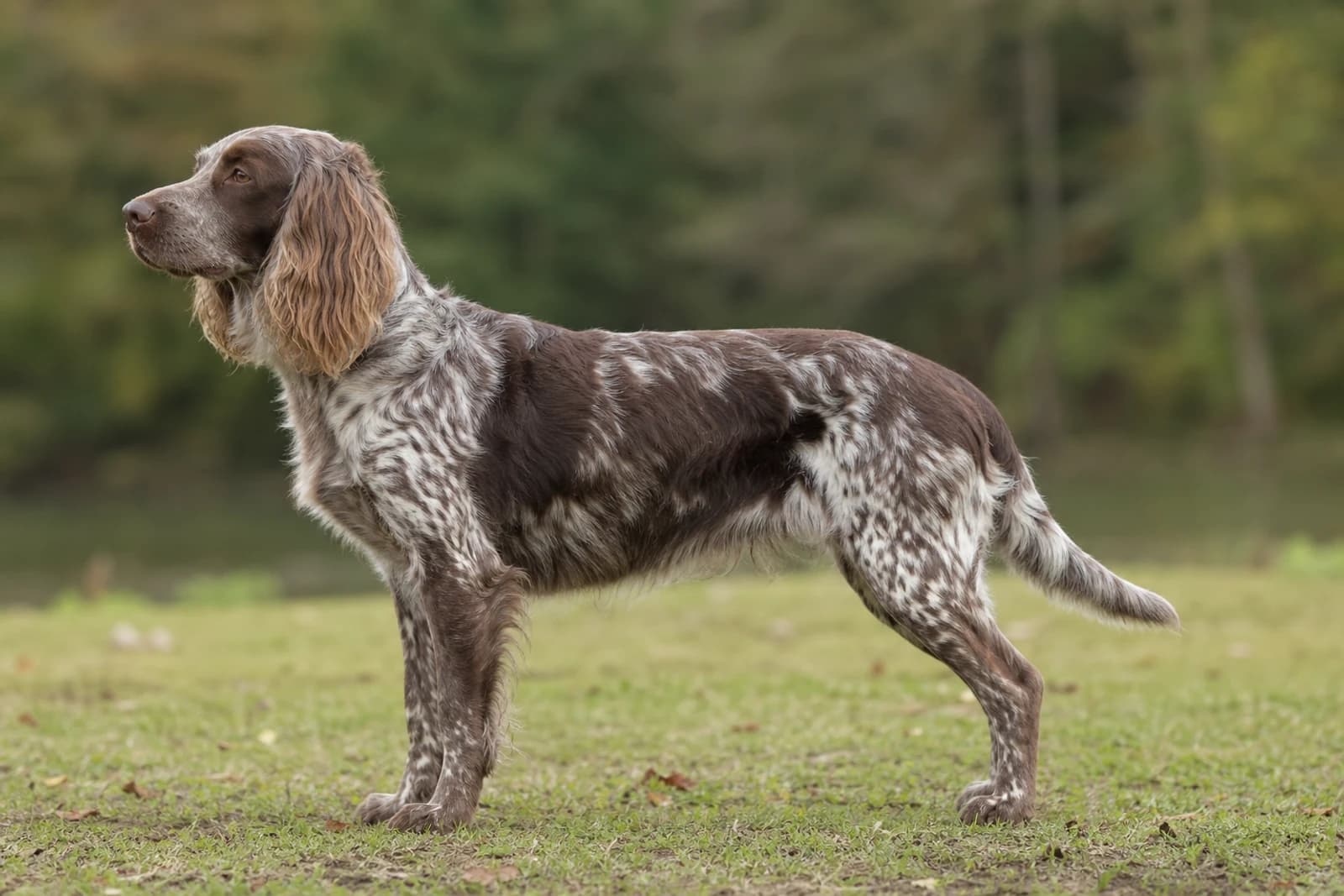
The German Spaniel, also known as the Deutscher Wachtelhund, is a versatile hunting breed prized for its keen nose, determination, and affectionate nature. While originally bred for flushing and retrieving game, this loyal dog can adapt to active family life with ample daily exercise and mental challenges. It bonds deeply with its family and thrives when given a job, excelling in fieldwork, scent work, and canine sports. Suited for experienced owners who enjoy outdoor adventures, the German Spaniel is a devoted, high-energy companion best in rural or suburban homes with space to roam.
At a glance
- Size
- Large
- Height
- 17–21 in
- Weight
- 40–55 lb
- Life span
- 12–14 years
- Coat colors
- Solid brown, Brown with white markings, Brown roan, Tricolor
- Coat type
- Medium-length, dense, water-repellent coat
How much does a German Spaniel cost?
Adopt / rescue
$75–$400
Usually includes spay/neuter, first shots, and a microchip.
Buy from a breeder
$700–$2,000
From a reputable, health-testing breeder.
Approximate USD. Prices vary widely by region, breeder, pedigree, age, and coat colour — adopting is the lower-cost and recommended route. Avoid suspiciously cheap “breeders”; they’re often puppy mills.
Estimate the full cost of a German Spaniel →German Spaniel photos
Views
Front, side, rear and top — the full silhouette.Poses
How the breed sits, lies, moves and plays.Puppy to senior
The breed across its whole life.Expressions
The breed’s range of moods.Close-up details
Eyes, ears, nose, paws, tail and coat.Coat colors
The breed’s recognized colors.Click any photo to enlarge. We show the German Spaniel from every angle — three views, poses, life stages, expressions, close-ups, coat and colors.
Appearance & size
A German Spaniel is built to disappear into thick cover one minute and plunge into icy water the next — you see it in every line. These are medium-to-large, solid dogs that pack surprising muscle into a frame that rarely tops 21 inches. Males run 18–21 inches at the withers, females 17–20 inches, and both carry 40–55 pounds of dense bone and working sinew. They feel heavier than they look when you hoist one into a truck, and that heft comes from a deep chest and substantial rib cage that support long days on the move.
Coat and colors
The coat is the breed’s all-weather armor. It’s medium-length, close-lying, and either slightly wavy or outright curly, with a thick undercoat that sheds water and brambles. Generous feathering on the backs of the legs, underside of the tail, ears, and chest gives them a soft outline without sacrificing utility. Color options are surprisingly narrow and purposeful:
- Solid liver (a deep, rich brown)
- Liver roan (brown hairs mixed with white, often with brown patches)
- Liver with small white markings on the chest and toes, occasionally a thin blaze
White beyond those modest allowances is a fault in the show ring, and you won’t see the flashy particolors of some other spaniels here.
Distinctive features
The head is clean and proportionate, with a slight stop, a muzzle about as long as the skull, and a level bite. Medium-sized, dark brown eyes lend a soft, intelligent expression — never hard or staring. Ears are set low, broad, and hang close to the head with a gentle wave of hair. The tail, whether left natural or traditionally docked, is a strong exclamation point. Natural tails are thick at the base, taper smoothly, and are carried horizontally or just above the back line when the dog is working; an excited dog never curls it over the back. Docked tails follow the same carriage but with a shorter brush.
From every angle
Front view: Broad chest, straight forelegs with well-laid-back shoulders, and strong, slightly sloping pasterns. The toes are tight and webbed — a detail you’ll appreciate when you watch them slice through water.
Side view: The body is slightly longer than tall, with a level, unbroken topline, a deep brisket reaching to the elbows, and well-sprung ribs that don’t taper too sharply at the loin. That length gives them the reach for an efficient, ground-covering trot.
Rear view: Thick, muscular thighs and well-let-down hocks deliver the power behind their swimming and flushing work. The tail emerges naturally from the croup and acts like a rudder in heavy cover and water.
What sticks with you is how un-fussy the whole package is. This is a dog put together entirely for function — no exaggerated angles, no glamour coat, just a tough, buoyant spaniel that can work all day and come home ready for more.
History & origin
The German Spaniel—called the Deutscher Wachtelhund in its homeland—was never meant to turn heads in a show ring. It was built from the ground up as a professional hunter’s right hand. In the 1880s and 1890s, a handful of German foresters and gamekeepers, led by Dr. Friedrich von Schmidt, realized they were losing the old, rugged flushing dogs that had worked the continent’s forests for centuries. The systematic shooting estates of the era needed a dog that could do it all: push game out of thick cover, track wounded animals across long distances, and retrieve from icy water—all with a calm, biddable temperament that wouldn’t interfere with a day’s work.
Von Schmidt didn’t start from scratch. He gathered the last remnants of the now-extinct old German quail dog (Stöberhund), mixed in some local pointing stock, and likely added a dash of early spaniel-type dogs used by waterfowlers. The result crystallized into a large, robust spaniel with a deep chest, excellent nose, and a coat that could handle frozen marshes and briar-choked underbrush. In 1903, the breed got its official name and a dedicated club, the Verein für Deutsche Wachtelhund. From day one, the emphasis was purely on working ability; registration required proof of performance, not just parentage. This single-minded focus kept the breed firmly in the hands of hunters and foresters, largely invisible to the pet world.
For most of the 20th century, the German Spaniel rarely crossed borders in big numbers. It wasn’t until 1954 that the FCI recognized it, and the United Kennel Club followed in 1996. Today, you’ll still find these dogs doing the job they were bred for—often with gamekeepers in Germany and a small but devoted following in North America—and you’re far less likely to see one napping on a city apartment sofa.
Temperament & personality
If you picture a calm, easygoing spaniel, the German Spaniel is going to surprise you. These are athletes first — bred to hunt all day through dense cover, then come home and settle in with their people. Your family gets a dog that’s equal parts relentless worker and affectionate shadow, but expect that energy to show up indoors if it isn’t burned off outside. A solid hour or more of running, swimming, or intense fetch is the baseline, not a nice extra. Without it, chewing, digging, and a barking habit can follow fast.
Temperament-wise, they’re bold, eager to please, and genuinely love to cooperate — but don’t mistake that for push-button obedience. Many German Spaniels are strong-willed and will take a mile if you give an inch. Rewards-based training and clear, consistent expectations work far better than heavy-handed corrections. They’re sensitive enough that harshness can shut them down, yet confident enough to test boundaries daily. That mix demands a trainer who’s patient and steady, not a first-time owner figuring things out.
Once you’re in their inner circle, the loyalty runs deep. These dogs velcro themselves to their people, happily following you from the kitchen to the couch and eyeing the front door if you grab your keys. That close bond can tip into anxiety-driven barking or destruction if they’re regularly left alone for long stretches. True to spaniel form, they can be mouthy — puppies will chew to explore and relieve teething pain, and adults often grab objects when excited. Stock up on durable chews early, and a homemade citrus spray on off-limits items can save your shoes.
With the household, German Spaniels tend to be gentle and patient with children they’ve been raised alongside, though a 40–55 lb dog in full wagging, bouncing mode is a lot for a toddler. Supervise interactions and teach kids to never interrupt the dog while it’s eating or chewing on a prized bone; stiff body posture and a hard stare are the classic precursors to a guarding snap. Around other dogs and pets, early socialization smooths most edges — they can coexist happily, but strong scent drive means small, scurrying critters outside might trigger a chase.
Watchdog instincts are sharp without veering into aggression. Expect an alert bark when someone approaches the house, and then, typically, a curious tail-wag once they see you’re comfortable with the stranger. Body language is an open book: a relaxed, loose-wiggly body with soft eyes says “all good,” while a forward lean and fixed stare spell trouble. You’ll also see plenty of trademark spaniel quirks — head tilts when you talk, an intense nose that finds every scent trail, and an honest-to-goodness love for rolling in foul-smelling things. Nobody’s sure why they do it, but it’s a reliable part of the package. If strong odors aren’t your thing, be ready with a good dog shampoo.
House-training a German Spaniel goes smoother when you stay ahead of their scent memory. A dog that urinates indoors leaves a cue to repeat the behavior, so clean accidents with an enzyme cleaner or a white vinegar spray to truly remove the smell. Praise and treat the moment they go outside, and they’ll catch on fast. Neutered males and spayed females tend to mark less, but some urine-marking can still happen on walks as your dog reads the neighborhood news — it’s just who they are.
Good with kids, dogs & other pets
With children, the German Spaniel starts from a solid place — patient and rare to snap without reason — but 40 to 55 pounds of joyful energy still needs managing. A dog of this size can accidentally bowl over a toddler, so early ground rules matter as much as the dog’s temperament. Teach kids not to climb on, startle, or bother a resting dog, and never leave a young child unsupervised, no matter how steady the dog has been.
This is a people-centered breed that forms intense attachments. Leaving a German Spaniel isolated in a yard for hours unravels that. He’ll bark, dig, or chew because he’s genuinely distressed, not stubborn. Plan for the dog to live inside the home, not out in a kennel run. If your household is gone all day, this breed will struggle; arrange for midday breaks or a dog walker so that loneliness doesn’t morph into separation anxiety.
With other dogs, early hands-on socialization is the lever that tips the outcome. A German Spaniel is not born confrontational, but if he misses varied, positive exposure before that window snaps shut around 16 weeks, you could end up with a dog who is timid around strangers, spooks at new dogs, or overreacts at the vet. Puppyhood should include short, pleasant meetings with well-socialized adult dogs, plus exposure to everyday sounds, surfaces, and bustling environments. A pup raised in isolation — whether from a puppy mill or a too-quiet home — often carries lasting fearfulness into adulthood.
For an adult German Spaniel who already prefers your company over the dog-park mosh pit, don’t force the issue. Compulsory socialization at that age can backfire, triggering stress, defensive snaps, or a fight that mimics predatory chase rather than play. If your dog is content sticking by your side, let him.
Cats and small pets demand the same head start. German Spaniels were bred to find and flush game, so a fleeing cat or a pet rabbit can ignite a chase sequence. Raise puppy and kitty together with short, gate-separated intros and heavy rewards for ignoring the cat. When adding an older German Spaniel to a home that already has pocket pets or cats, expect to manage the space with solid barriers and close supervision until you’re seeing weeks — not days — of relaxed body language around them.
Trainability & intelligence
The German Spaniel is sharp and picks up new cues fast, but he’s also an independent thinker bred to problem-solve in the field. That combination means he won’t blindly obey someone he doesn’t trust. Punishment or heavy-handed corrections backfire — they erode his confidence and can make him either shut down or become avoidant. What works is a relationship built on clear communication, patience, and a lot of small wins.
Start early, keep it positive
Puppy training should begin the day he comes home. Use high-value treats, a favorite toy, or brief, excited play as a paycheck for getting things right. Five minutes of focused work a few times a day beats a long, tedious session. The breed is sensitive, so a cheerful tone and gentle guidance get far more mileage than a stern voice. Because he’s so quick to connect cause and effect, he’ll learn the basics — sit, down, come — within a handful of reps, provided you’re paying him well and not drilling.
The recall and the prey drive
A German Spaniel’s nose can override his ears, especially outdoors. Building a bombproof recall takes months of incremental proofing, starting in a quiet hallway and slowly adding distance and distraction. Load the word “come” with jackpot rewards every single time, and never call him to you for something he’ll dislike. A long line gives you control without yanking his neck, preserving the trust that keeps him checking in.
Socialization is non-negotiable
Structured exposure to new people, different floor surfaces, traffic sounds, and other dogs between 3 and 14 weeks of age prevents the reservation that can tip into wariness later. Keep each experience light; let him investigate at his own pace and reward calm curiosity. Continue that low-key exposure well past puppyhood. Without it, an under-socialized German Spaniel can become snappy or reactive in unfamiliar situations — not out of aggression, but out of fear that was preventable.
Because he thrives on partnership, training sessions that feel like a game rather than a chore will hold his attention and build the steady, willing temperament you’ll rely on in the house and out on walks.
Exercise & energy needs
Plan on a solid 60 to 90 minutes of real movement every day, not just a couple of leash walks around the block. German Spaniels were built to quarter through thick cover, crash into cold water, and keep going until the day is done. A bored one will chew your drywall, dig escape tunnels, or bark at every falling leaf. You’ll get the best results with two or three sessions that mix hard running, swimming, and something that makes them think.
The right kind of tired
A tired German Spaniel is a content one, and physical exercise alone won’t cut it. These dogs have a powerful nose and an even stronger work ethic. Combine at least one of your daily outings with a job: off-leash fieldwork, drag a pheasant wing for them to track, or hit a pond for retrieving drills. Swimming is low-impact and exactly the sort of full-body work they love. Dog sports like agility, dock diving, and rally obedience channel that brain-body connection beautifully.
Keeping the mind busy
On days when weather or time limits your outdoor sessions, mental work picks up the slack. Hide a frozen Kong in the yard, scatter kibble in a snuffle mat, or set up a scent-discrimination game indoors. Even 15-minute clicker-training bursts tire out a working spaniel faster than an extra mile of road-running. Rotate puzzle toys often, or they’ll solve them and look at you for the next challenge.
A word on young dogs
German Spaniels grow into a sturdy 40–55 pounds, but that frame needs time to seal. Until growth plates close (usually around 12–18 months), avoid repetitive jumping, high-impact landings, and forced running on hard surfaces. Stick to natural terrain, soft ground, and swimming while bones mature. Once those joints are ready, you can ramp up to the full throttle this breed thrives on.
Grooming & coat care
Your German Spaniel’s dense, wavy double coat sheds dirt and water easily in the field, but it demands steady hands at home. Count on brushing at least 4–5 times a week, and ramp up to daily during spring and fall when the undercoat blows out in earnest. A medium-pin slicker brush with rounded tips glides through the tight waves to lift loose fur and debris, and a greyhound-style steel comb works behind the ears, throat, and feathering—those are the first spots that mat. Skip the cheap plastic brushes; they barely scratch the surface.
Bathe only when the dog starts to smell like the marsh or rolls in something particularly offensive—every 6–8 weeks is a good target. Use a mild dog shampoo to keep the coat’s natural oils intact, because over-washing strips the waterproofing that keeps a working spaniel comfortable. After a swim or a rinse-off, towel dry thoroughly and run the slicker through the coat while it’s still slightly damp to prevent tangles from setting.
Ears need a dedicated weekly check. Those long, pendulous ear leathers trap moisture and reduce airflow, making yeast and bacterial infections a real risk. Squirt a vet-approved cleaner into the canal, massage gently, and let the dog shake out what’s loose; then wipe the visible ear clean with a cotton pad. Never dig into the canal with a Q-tip.
Nails grow fast if the dog mostly works on soft ground. Clip or grind every 3–4 weeks—you should not hear clicking on the floor. Teeth get tartar just like any dog’s, so hit them with an enzymatic toothpaste two or three times a week minimum.
When the coat is dumping twice a year, an undercoat rake or a de-shedding tool can shorten the fluff-storm, but use a light touch. Over-working can cut the guard hairs and dull the coat’s luster. After heavy cover days, run your fingers through the feathering and check for stickers, foxtails, or ticks—catching those early prevents skin trouble down the line.
Shedding & allergies
A German Spaniel sheds hard and steady. This is a breed designed for rough water and thick cover, and its coat works like a continuous-filament factory — expect hair on your clothes, furniture, and floating through the air most of the year. If you need a tidy, low-fur dog, stop reading; this isn't it.
The coat that does the shedding
The German Spaniel wears a dense, wavy double coat that’s oily and water-repellent. The outer guard hairs are medium-long and lie close, while the undercoat is thick and wooly. That undercoat is what fuels the year-round sprinkling of hair, and it goes into overdrive twice a year. The seasonal blowout — spring and fall — dumps entire tufts in a matter of weeks. During those windows, a quick pass with your hand can pull out a palmful of loose fur.
What you’ll live with
Weekly brushing grabs some of the dead hair, but you won't outrun it. A slicker brush and an undercoat rake keep the coat from matting and reduce the airborne load, but the hair still finds its way into every corner. These dogs shed less like a trimmed poodle and more like a muddy Labrador coming off of duck season.
Drool isn’t a headline issue. Some individuals drip water after drinking or foam up after hard exercise, but you won't be wiping slobber off the walls.
The allergy reality
No double-coated hunting dog is hypoallergenic, and the German Spaniel is no exception. Dead skin cells (dander) hitch a ride on all that shed hair, spreading allergens steadily. Even with religious grooming and air purifiers, you’re signing up for a home filled with fur and dander. If anyone in your household has dog allergies, this breed isn't a smart gamble — you’re better off looking at truly low-shed breeds with single coats.
Diet & nutrition
A 45-pound German Spaniel who hunts hard all day burns through calories like a furnace; the same dog lounging between short walks does not. So measure food by the dog in front of you, not just the bag’s chart. Start with the manufacturer’s range for his ideal weight — usually 40 to 55 pounds — then adjust. You should be able to feel his ribs without pressing hard, and he should have a visible waist from above. If he’s losing that waist or you feel padding, cut back by a quarter-cup per meal and bump up his exercise before you even consider a “diet” food.
Puppy meals
Puppies go through four fast-growth months. Feed four evenly spaced meals a day until 16 weeks, then drop to three meals until six months. After that, a morning and evening schedule suits an adult just fine. Transition any new food slowly over a week or so. Starting with a high-quality large-breed puppy formula that supports steady bone growth helps protect the joints of a dog who’ll be jumping logs and swimming well into his teens.
Keeping a healthy weight and mind
Adult German Spaniels often run hot on food motivation — they’re sharp enough to train you into handing out an extra scoop. Use that drive to your advantage: make them work for meals in a puzzle bowl or a treat-dispensing toy. It slows down a speed-eater (which can help prevent bloat or regurgitation) and burns mental energy. Even if you feed kibble, you can mix in a spoonful of canned fish, a scrambled egg, or leftover steamed green beans for variety without overhauling your system. Skip the rich table scraps; a single high-fat meal can land an otherwise healthy dog in the emergency clinic with pancreatitis.
Senior adjustments
Around age seven, start watching the scale more closely. A senior who still trots on daily hikes may need only a slight reduction in the main meal, while one who’s content to supervise from the porch might need a leaner calorie load. There’s no evidence to support slashing protein in a healthy older dog — just keep the calories honest. Some seniors do better with three small meals instead of two, especially if they get acid reflux or seem hungry all the time. Whatever you pour in the bowl, serve it in his own dish and never from the table. A German Spaniel never forgets where a handout came from.
Health & lifespan
A German Spaniel you take care of will typically share your life for 12 to 14 years. That’s a long run for an active hunting dog, and many stay eager and birdy well into their senior years. This breed has a reputation for solid, durable health — but no dog is bulletproof.
The conditions that pop up most often in German Spaniels are what you’d expect from a medium-sized, floppy-eared athlete. Hip and elbow dysplasia can be a concern, as they are in many working dogs. Responsible breeders screen breeding stock through OFA or PennHIP before matching dogs, which stacks the odds in your favor. Ear infections are a more everyday nuisance. Those long, low-set ears trap moisture and debris, especially if your dog is a regular in swamps and thick cover. A quick wipe-out after water work and a weekly cleaning can head off most problems.
Eye disorders like progressive retinal atrophy (PRA) and cataracts turn up in some lines. Ask for proof that the parents have had a current eye exam by a veterinary ophthalmologist — not just a general check. A few families also see autoimmune thyroiditis or seizures, so a breeder who tracks multiple generations gives you a clearer picture.
The biggest thing you control is weight. A German Spaniel runs on an unusually high food drive (useful for training, dangerous for waistlines). Let a 50-pound dog pack on an extra 5 pounds, and those hips and elbows feel every ounce. Measure meals, use low-calorie training treats, and keep the dog at working weight.
Stick to a routine of annual vet visits — bump it to twice a year once your dog hits 8 or 9 — so you catch little changes you might miss. If you live where mosquitoes are a thing, heartworm prevention is non-negotiable; missing a dose during peak season is rolling the dice on a disease that’s tough and expensive to treat. A healthy German Spaniel from health-tested parents isn’t a guarantee, but it’s the kind of start that gets you to those 14 years still chasing birds like a much younger dog.
Living environment
A German Spaniel is a housedog, not an apartment dog. These 40–55 lb athletes were built to punch through thick cover and retrieve from icy water. Cramped quarters with no outlet will turn that drive into chewed baseboards and nervous pacing.
Yard and exercise needs
A securely fenced yard is non-negotiable. Their nose rules everything, and a high prey drive means they’ll bolt after a squirrel without a backward glance. Plan on a physical fence at least five feet tall; an invisible collar won’t stop a dog moving that fast.
But a yard is just the staging area, not the workout. Expect to provide at least an hour of hard exercise twice a day — running, swimming, or vigorous field work — not a sniff-and-stroll. Multiple shorter sessions often click better than one marathon outing, and mental work (scent games, puzzle toys) fills the tank when weather keeps you indoors.
Climate tolerance
That dense, water-resistant coat handles cold, wet conditions beautifully. A snowstorm or a frozen pond won’t slow them down. Heat is the real danger. Like many double-coated working breeds, they can overheat quickly during intense summer activity. Shift exercise to early morning or evening, and always have shade and water on hand.
Noise and barking
German Spaniels are vocal in the field but generally quiet indoors if their energy and mental needs are met. A bored dog, on the other hand, will howl, bark, or whine to vent frustration. They’re naturally alert, so you get a built-in watchdog, but teach a solid “quiet” cue early to keep the peace with neighbors.
Time alone
This breed bonds hard. Leaving a German Spaniel alone for a full workday invites separation anxiety and the destruction that comes with it. They thrive in homes where someone is around most of the time or a midday walker breaks up the stretch. Crate training from puppyhood and frozen food puzzles can build some independence, but this isn’t a dog you set and forget.
Who this breed suits
A German Spaniel isn’t a dog you bring home for casual company. These 40–55 lb, 17–21 in hunters were built to work dense cover and icy water all day, then do it again tomorrow. If your weekends don’t involve a field, marsh, or a training blind, you’ll be fighting a powerful tidal wave of instinct that no backyard can contain.
Who’s a great match
- Hunters and dog-sport enthusiasts who need a close-working flusher and retriever that switches on in a split second. The breed’s nose, persistence, and trainability make him a standout partner for upland birds, waterfowl, and tracking wounded game.
- Extremely active singles or families who log at least 90 minutes of hard, off-leash exercise every day—think trail running, biking alongside you, or repetitive water retrieves. A few leash walks won’t scratch the surface.
- Owners with a passion for nose work, agility, or obedience trialing. This dog’s high intelligence needs a job title, not just a hobby. He thrives when you treat training as a daily puzzle, not a six-week class.
- Families with older, dog-savvy kids who can handle a compact but powerhouse gundog that may bowl over a toddler in a burst of enthusiasm. When raised with the family and given clear boundaries, he’s affectionate and fiercely loyal indoors—just don’t expect him to lounge for long.
Who should think twice
- First-time dog owners. A beginner will find themselves outmaneuvered by a breed that figures out latches, patterns, and loopholes faster than most people correct them. Without experienced leadership, the smart, driven nature that makes him brilliant in the field turns into property destruction, nonstop demand barking, or escape artistry.
- Seniors or homebodies looking for a laid-back companion. Even a fit retiree will be hard-pressed to meet the physical outlet this dog demands well into his senior years (the breed lives 12–14 years). A German Spaniel doesn’t slow down just because you do.
- Apartment dwellers and suburbanites who can’t provide daily, controlled off-leash freedom. Confined spaces and short potty breaks will breed a hyper-vigilant, anxious dog that guards the couch and chews the drywall.
- Homes with rabbits, cats, or other small pets they value. Generations of selective breeding for high prey drive mean a fleeing squirrel or a pet bird is an invitation, not a roommate. Some individuals can live peaceably with a confident cat if raised together under strict supervision, but the risk never fully disappears.
If you can’t give a German Spaniel a working life—or a dead-ringer recreation of one—you’ll both pay the price in frustration and chaos. This is not a dog that bends to your lifestyle; you bend to his.
Cost of ownership
Purchase price
A well-bred German Spaniel pup from parents with OFA hip clearances, eye certifications, and a working background typically costs $1,500–$2,500. If you’re after a specific hunting line or a dog from imported European stock, expect the upper end — and a waiting list. This isn’t a breed you grab off Craigslist for $400. The small gene pool means responsible breeders are selective, and a low price almost always skips the health testing that keeps a working dog sound for a decade.
Monthly expenses
For an active 40–55 lb dog, the recurring costs settle into a predictable range — $150–$250 per month, depending on choices like food type and professional grooming.
- Food: A quality high-protein kibble runs $50–$80 monthly. If you mix in raw or fresh, add $20–$40.
- Grooming: The dense, water-repellent coat and floppy ears demand regular attention. Invest in a solid slicker brush, comb, and ear cleaner (about $20–$30/month in supplies), or book a professional groom every 6–8 weeks for $60–$90 per visit. Neglect the ears, and you’ll quickly fund a vet visit instead.
- Routine vet & preventives: Budget $500–$800 a year for exams, vaccines, heartworm, and flea/tick meds. That’s roughly $40–$70 monthly.
- Insurance: Pet insurance runs $35–$60 a month for a mid-size sporting breed. Without it, set aside an emergency fund of at least $2,000–$3,000 — ear infections, a blown-out cruciate, or a field mishap can hit all at once.
Year one also carries a few hundred in startup costs: a sturdy crate, a chew-proof leash and harness, and a steady supply of retrieving bumpers if you intend to hunt.
Over a 12–14-year life, a German Spaniel will run you north of $25,000 before any catastrophe surgery, but the larger commitment is the daily time you’ll spend keeping that sharp, energetic mind satisfied — the money part you can plan for.
Choosing a German Spaniel
The German Spaniel isn’t a breed you stumble into — they’re rare in the U.S. and most dedicated breeders place puppies in working or hunting homes. If you don’t hunt, you’ll need to show you can provide the same level of daily physical and mental work a sporting dog demands: think hours of off-leash running, swimming, and scent games, not a jog around the block. Be upfront about your lifestyle. A breeder who doesn’t ask hard questions about your plans isn’t doing their job.
Rescue is extremely uncommon, but it’s worth contacting the breed parent club — they sometimes know of adults needing rehoming. Otherwise, expect to get on a waiting list.
When you’ve found a prospective litter, ask to see health clearance certifications for both parents before you commit. Responsible breeders won’t hesitate. At a minimum, look for:
- Hip dysplasia screening through OFA (rated Fair or better) or PennHIP.
- Eye exam by a veterinary ophthalmologist (OFA Eye or CERF), done within the last year.
- Elbow dysplasia clearance (OFA).
- Some also test for autoimmune thyroiditis and cardiac issues.
Red flags: a seller who can’t produce the actual test results (a “vet check” doesn’t count), multiple litters on the ground at once, or a pair of breeding dogs under 2 years old — hips can’t be fully evaluated before then. Walk away if they’ll ship a puppy to anyone with a credit card, no application, no conversation.
If you can visit, observe the dam. She should be self-assured, not cowering or snarly — her temperament tells you a lot. Puppies should wade right up to investigate you, tails up. A little mild reserve is fine; a pup that hides in the corner and won’t engage is a liability in a breed meant for bold, close-working field days. Ask the breeder what they’ve already done to socialize the litter: exposure to crates, household noise, strangers, and ideally water or feathery toys helps shape a stable companion. A good breeder stays in your life long after you write the check.
Pros & cons
-
A genuine dual-purpose dog that hunts with relentless drive yet slides into family life without missing a beat — affectionate, clean indoors, and surprisingly calm when your day’s grab-bag of exercise is done.
-
An eager, soft-mouthed retriever born for water work and thick cover. If you hunt waterfowl, upland birds, or track wounded game, you’ll find a partner that reads your intentions and doesn’t quit.
-
Nose like a detective and a work ethic that thrives on task-based training. Teaching advanced obedience, scent work, or field drills feels like play because the dog brings 100% every time.
-
Moderate size with surprising substance: 40–55 pounds on a frame that navigates brush without tiring, yet small enough to curl up at your feet. Life span of 12–14 years means you get a long run with a dog that stays active well into its senior years.
-
Friendly but not fawning — bonds deeply with its people and is gentle with children, yet naturally reserved with strangers, which makes it a reliable early-warning system without the sharp edges of a guard dog.
-
Exercise is non-negotiable. A quick leash walk won’t dent this dog’s tank. Plan on a solid hour or more of off-leash running, swimming, or strenuous retrieving daily, or you’ll see that energy rerouted into barking, digging, and redecorating your drywall.
-
Prey drive runs hot. Squirrels, cats, and even the neighbor’s free-range chickens will trigger a chase instinct that overrides recall unless you’ve put in serious, consistent training. Off-leash reliability doesn’t come for free.
-
Likes the sound of its own voice. German Spaniels alert-bark, excitement-bark, and demand-bark with enthusiasm. Apartment life or thin walls are a bad fit.
-
Coat and ears need routine maintenance. The dense double coat sheds year-round and picks up burrs like velcro. Droopy ears trap moisture after swimming, turning into infection factories if you skip weekly cleaning and drying.
-
Rare breed, rare waitlist — finding a well-bred puppy from a responsible breeder who screens hips, eyes, and cardiac health often means a long hunt and a year or more on a waiting list.
Similar breeds & alternatives
If the German Spaniel’s around-the-clock hunting intensity feels like more than you need, a few closely related spaniels dial the drive back — without sacrificing a soft mouth and a happy, wagging attitude at home.
-
English Springer Spaniel (19–20 in, 40–50 lb, 12–14 years). The familiar bench/field split means you can pick a calm show line or a firecracker field line. Compared to the German Spaniel, Springers are often more overtly social and biddable, but they rarely match that heavy, oily double coat purpose-built for breaking ice on a retrieve. The German Spaniel is noticeably more single-minded about tracking and water work; a Springer is easier to steer toward a purely active family life.
-
Welsh Springer Spaniel (17–19 in, 35–55 lb, 12–15 years). A softer, red-and-white flushing dog with a gentle disposition. Where the German Spaniel throws itself into cold ponds with an almost grim tenacity, the Welshie is a milder upland partner that matures slowly and tends to be less vocal on scent. You’ll get a dog that settles more naturally indoors, but you’ll trade away the do-anything water drive.
-
Field Spaniel (17–18 in, 35–50 lb, 11–13 years). Similar heft, but lower to the ground with a longer, solid-colored body. Field Spaniels are methodical, calm workers — more of a sustained jogger than a burst-and-splash machine. A German Spaniel runs hotter, barks with excitement when game is close, and wants to retrieve from water at every opportunity. If you prize off-switch over all-day grit, the Field Spaniel is the easier housemate.
-
Boykin Spaniel (14–18 in, 25–40 lb, 10–15 years). Lighter, smaller, and bred to bust through southern swamps. Think of it as a compact, sunny cousin. The Boykin lacks the dense, weather-beating coat and sheer bone of the German Spaniel, so it’s less suited to punishing cold-water work. On the flip side, a Boykin often slides into family routines with less stubborness and a shorter recovery period after a hard hunt.
If you genuinely need a dog that retrieves ducks from freezing water and follows a day-old blood trail without missing a step, the German Spaniel fills that niche — and it will not apologize for the energy it brings. If you’re picturing a pet that still loves a wet hike but won’t rattle your windows every time a scent floats past, a Field Spaniel or Welsh Springer will feel like a relief.
Fun facts
- The German Spaniel is also called the Deutscher Wachtelhund, meaning 'German quail dog.'
- It is a versatile hunter, skilled at flushing, tracking, and retrieving on land and in water.
- The breed is known for its 'soft mouth,' carefully retrieving game without damage.
- Despite being a pure hunting dog, it forms extremely close bonds with its family and can be a gentle companion indoors.
Frequently asked questions
- Are German Spaniels good with children?
- German Spaniels are generally friendly and affectionate, making them good family companions. They tend to be patient with children, especially when socialized early. Supervision is always recommended due to their energetic nature and size.
- Do German Spaniels shed a lot?
- German Spaniels have a medium-length, dense coat that sheds moderately throughout the year. Regular brushing a few times per week can help manage loose hair and keep their coat healthy. They are not considered hypoallergenic.
- How much exercise does a German Spaniel need?
- As an energetic hunting breed, the German Spaniel requires at least an hour of vigorous exercise daily. Activities like running, swimming, or fetch are great, along with mental stimulation to prevent boredom. Without enough exercise, they can become restless.
- Is the German Spaniel suitable for apartment living?
- German Spaniels are typically not well-suited for apartment living due to their high energy levels and need for space. They thrive in homes with a fenced yard where they can safely run and play. Apartment living could be possible with dedicated outdoor exercise multiple times a day, but it is challenging.
- Are German Spaniels easy to train for first-time owners?
- German Spaniels are intelligent and eager to please, which can make them fairly trainable. However, they can also be independent and have a strong hunting drive, so consistency and positive reinforcement are essential. First-time owners should be prepared for a spirited dog that needs structured training.
Tools & calculators for German Spaniel owners
Quick estimates tailored to German Spaniels — pre-filled with this breed’s size where it matters.
Articles & stories about the German Spaniel
Sources & standards
This profile follows recognized breed standards from the American Kennel Club (AKC) and the Fédération Cynologique Internationale (FCI), along with established veterinary and breed-club guidance. These describe general breed tendencies — every dog is an individual.
Owner stories
Have a German Spaniel? Share your experience — grooming tips, personality quirks, anything goes.