

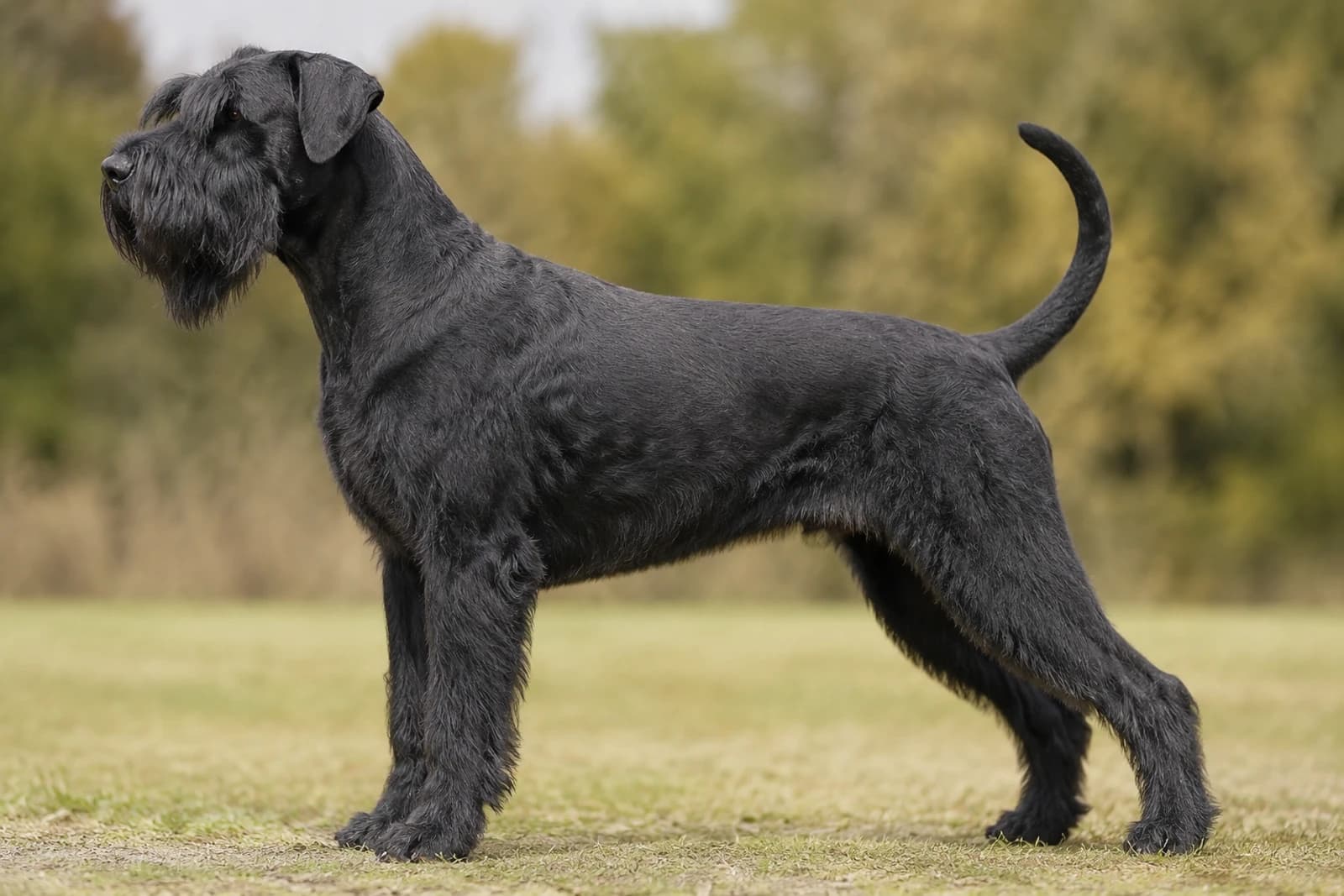
The Giant Schnauzer is a bold, powerful working dog suited to active, experienced owners seeking a loyal guardian and versatile athlete. With a strong work ethic and high intelligence, this breed thrives on mental and physical challenges, making it ideal for dog sports or protective roles. Its confident, sometimes imperious nature demands consistent, firm training. Best in spacious homes with access to outdoor activity, the Giant Schnauzer is deeply devoted to its family but reserved with strangers. Not recommended for first-time dog owners or sedentary households.
At a glance
- Size
- Giant
- Height
- 24–28 in
- Weight
- 65–90 lb
- Life span
- 10 years
- Coat colors
- solid black, pepper and salt
- Coat type
- wiry, dense double coat
- Group
- Working
How much does a Giant Schnauzer cost?
Adopt / rescue
$75–$400
Usually includes spay/neuter, first shots, and a microchip.
Buy from a breeder
$700–$2,000
From a reputable, health-testing breeder.
Approximate USD. Prices vary widely by region, breeder, pedigree, age, and coat colour — adopting is the lower-cost and recommended route. Avoid suspiciously cheap “breeders”; they’re often puppy mills.
Estimate the full cost of a Giant Schnauzer →Giant Schnauzer photos
Views
Front, side, rear and top — the full silhouette.Poses
How the breed sits, lies, moves and plays.Puppy to senior
The breed across its whole life.Expressions
The breed’s range of moods.Close-up details
Eyes, ears, nose, paws, tail and coat.Coat colors
The breed’s recognized colors.Click any photo to enlarge. We show the Giant Schnauzer from every angle — three views, poses, life stages, expressions, close-ups, coat and colors.
Appearance & size
You’ll notice the size first. Males typically stand between 26 and 28 inches at the shoulder and weigh anywhere from 70 to 90 pounds. Females usually come in at 24 to 26 inches and 65 to 80 pounds. Beneath that imposing frame is a dog built on a square: from chest to rump and from withers to ground, the proportions are nearly equal, which prevents the lanky look some big breeds get.
The coat is double-layered — a hard, wiry outer coat over a soft undercoat — and comes in two colors: solid black or pepper-and-salt. Pepper-and-salt isn’t a uniform gray; each individual hair bands light and dark, creating a salt-and-pepper effect with a dark mask on the face. The eyebrows and beard are the breed’s signature: long, bristly, and swept forward, they frame dark, oval eyes that always seem to be assessing whatever’s in front of them.
From the front, you’ll see a broad chest and straight, heavy-boned forelegs set under a deep brisket. The head is rectangular, with a strong, blunt muzzle. Ears are often cropped to a sharp, upright point in countries where it’s still permitted; where not, they fold forward naturally into a neat V. In profile, the withers are high, the back short and firm, and the ribs well-sprung but not barrel-shaped. There’s a moderate tuck-up, so the underline runs clean, not saggy. From behind, the hindquarters are powerfully muscled with well-angled stifles, driving a stride that covers ground without wasted motion. A natural tail is moderately long, carried saber-like when the dog is alert — a final, matter-of-fact detail on a dog designed to work without fuss.
History & origin
Picturesque Bavarian cattle farms didn’t just need a herding dog — they needed a 65- to 90-pound problem solver with a hard mouth, a harder head, and the stamina to push steers for miles without giving up. That’s where the Giant Schnauzer was built.
By the mid-1800s, farmers in the foothills of the Alps already had the medium-sized Standard Schnauzer handling rats, guarding the barn, and trotting alongside wagons. But driving large, stubborn cattle over rough Alp pastures to the butcher shops and breweries in Munich called for a lot more dog. Breeders crossed those tough, wiry Standards with taller, heavier working breeds — Great Danes, Bouviers des Flandres, and likely the shaggy black German Poodle — to get a taller, thicker-boned, all-black dog that could stop a charging oxen, intimidate a thief, and still fit inside a family kitchen. The result stood 24 to 28 inches at the shoulder and tipped the scales up to 90 pounds, a working dog that was intimidating but not oversized, agile enough to sprint through crowded market streets.
Called the Riesenschnauzer in Germany, the Giant Schnauzer became the definition of a versatile farmhand. He drove livestock to the busy beer halls and slaughterhouses, pulled small carts loaded with goods, and guarded the farmer’s purse and property with a fierce, natural suspicion of strangers. Brewery owners and butchers relied on him to patrol at night; a silent, thinking guard dog who didn’t bark without cause but backed up any threat with real force.
As the 20th century churned on, the breed’s working reputation spread. German police and military units adopted the Giant Schnauzer for patrol and messenger duties because of his trainability and no-nonsense nerve. He served in both world wars, and after World War II, American soldiers who’d seen the dogs in action brought them back to the states. The American Kennel Club recognized the breed in 1930, but it took a few more decades for dedicated breeders to establish a solid foothold here.
Today, the Giant Schnauzer is still a pure working dog through and through. Police forces, search-and-rescue teams, and competitive sport handlers prize him for the same gritty independence and sharp intelligence that made him a go-to farm dog in old Bavaria. And that 10-year average lifespan — shorter than you’d like — is a trade-off for a dog who lives at full throttle. He was never meant to be a casual companion, and that backstory follows him straight onto your leash.
Temperament & personality
A Giant Schnauzer doesn’t settle for being a pet—he expects to be your partner. This is a thinking, working dog through and through, built to guard, herd, and problem-solve all day. A quick walk around the neighborhood won’t touch his energy. Plan on a minimum of 60–90 minutes of hard exercise: running, advanced obedience, nose work, or a demanding job like protection sports. Without that outlet, a bored Giant Schnauzer will invent his own occupation, and you probably won’t like it.
Born to protect, slow to trust
Don’t mistake size and boldness for a go-with-anybody attitude. These dogs are reserved with strangers and intensely territorial. They perceive your home and family as their charge, often defining “home” by the scent of their people rather than a fence line. That makes them exceptional watchdogs—an intruder will think twice before facing that deep bark and 80-pound frame—but it also means early and relentless socialization is non-negotiable. If you want a dog who greets every visitor with a wag, look elsewhere. A Giant is more likely to stand between you and a new person until he decides everything checks out. That wariness can tip into aggression if not managed, so this breed is a poor fit for novice owners or households with frequent turnover of unfamiliar guests.
The strong-willed partner, not the obedient follower
He’s smart, but he’s not motivated by blind compliance. A Giant Schnauzer thrives under consistent, respectful leadership—force will backfire. He’ll test boundaries, anticipate your next move, and sometimes decide he knows better. You’ll get far more mileage out of short, challenging training sessions that make him think than from repetitive drills. The payoff is a dog who works with ferocious intensity once he respects you. Neglect the mental side, and he’ll turn into a 24/7 alarm system, barking at every leaf that blows past the window, or start indoor scent-marking to reassert his own territory when he feels his world is out of control.
Body language you need to know
Because this isn’t a soft, forgiving breed, you have to read him well. A stiff, square posture and a hard, direct stare often mean he’s on the verge of a challenge. In contrast, a loose, wiggly body and soft eyes signal a relaxed dog. Calming signals—lip licking, yawning, turning his head away—are his way of dialing down tension. Ignore those and you can push him into a reaction you don’t want. When you live with a Giant, learning this vocabulary isn’t optional.
Household realities and a few quirks
- With family, he’s affectionate but not clingy. He’ll lean against you on the couch, follow you from room to room, and take his guarding duties even into spaces that don’t smell strongly of the household—which can explain random accidents in a guest bedroom or basement if he doesn’t recognize it as “inside.”
- Food possessiveness can be real. Teach children early that the dog eats undisturbed. Pestering him near his bowl is an invitation to a serious growl or snap.
- Chewing is both a pacifier and a tool. Puppies chew to explore, and adult Giants often demolish hard objects to keep their jaws powerful and teeth clean. Channel that drive into sturdy, appropriate chews, or your baseboards will pay the price. A homemade spray of boiled citrus peels or a vinegar-and-water mix on forbidden targets can redirect him while you train.
- He might roll in foul-smelling things. Whether it’s to mask his own scent or just because he likes it—the scavenger ancestry runs deep—you’ll occasionally find your dignified protector smelling like a dead fish. It’s part of the package deal.
A 10-year commitment to a Giant Schnauzer means a decade of intense engagement. He’s not the dog you leave in the yard with a toy while you go to work for nine hours; isolation fuels anxiety-driven barking, chewing, and marking. Show him consistent, fair boundaries, give him a real job, and you’ll have a fiercely loyal guardian who reads you better than most people do.
Good with kids, dogs & other pets
A Giant Schnauzer who grows up with respectful kids often becomes an unshakeable guardian, but the breed’s size, strength, and work-first energy mean they are never a set-it-and-forget-it dog around young children. Even a friendly 80-pound dog can accidentally knock over a toddler during a bout of zoomies or an enthusiastic shoulder bump. This is a dog that wants to be in the middle of everything — perfect for a busy household — but children need to learn not to poke, pull, or crowd him while he eats or sleeps. When kids and the dog understand each other’s boundaries, the bond is incredibly strong. They’re naturally protective and patient with their own family, but they aren’t the type to silently tolerate endless roughhousing from visiting little ones. Always supervise interactions, and teach children to give the dog a quiet space when he retreats.
With other dogs, the picture depends heavily on early and ongoing socialization. A Giant Schnauzer raised with neutral, positive exposure to a wide variety of dogs from the prime puppy window — roughly 3 to 16 weeks — can be a rowdy but fair playmate. Without that foundation, same-sex aggression or intolerance of rude canine behavior can surface, especially as they mature. Even well-socialized adults often have a bossy streak. Introductions should be done on neutral ground, on leash, with short, positive sessions. Don’t force interactions with dogs they don’t like. A Giant Schnauzer who is perfectly content with his family doesn’t need a big circle of dog friends; respect that comfort zone.
Cats and small pets are a real gamble. Many Giant Schnauzers have high prey drive — they were bred to work independently and react to movement. A cat who runs can trigger a chase that ends badly, even if the dog previously ignored the cat lounging on the couch. Puppies raised with a confident, dog-savvy cat from the start have a much better shot at peaceful coexistence, but never leave them unsupervised. Small, furry critters like rabbits or guinea pigs are typically viewed as quarry. Secure, separate living spaces are the safest bet.
The single most overlooked factor is socialization timing. The critical window slams shut around 16 weeks. After that, a dog who missed broad, gentle exposure to kids, other dogs, and household bustle can become fearful, reactive, or overprotective. While dedicated training can help an adult dog feel safer, forced meet-and-greets with unfamiliar dogs or children will only spike his stress and may provoke a snap. Stack the deck by enrolling in puppy classes, introducing novel people and sounds weekly, and making every new experience boringly positive with high-value treats. A Giant Schnauzer who gets that early investment reads the world with level-headed confidence instead of suspicion.
Trainability & intelligence
Giant Schnauzers are whip-smart dogs that won’t blindly follow orders — they want to know what’s in it for them. This isn’t a breed that works for a pat on the head alone. They need a clear reason to cooperate, and they’ll call your bluff the second inconsistency creeps in. That brainpower, combined with a strong independent streak bred into a working guard dog, means you’re always negotiating, not just commanding.
Training starts the day you bring your puppy home. The 8-to-16-week window is critical for soaking up the right habits and for early socialization. Expose your pup gradually to different people, sounds, surfaces, and other animals — always keeping it calm and rewarding. A poorly socialized Giant Schnauzer quickly becomes suspicious and reactive, and with a 65–90 lb dog who can reach 28 inches at the shoulder, that’s a serious safety issue. You’re building a confident, discerning adult who can tell a genuine threat from the mail carrier — and that foundation doesn’t show up by accident.
How they learn best is through short, game-like sessions powered by high-value treats, a favorite tug toy, or genuine, energetic praise. Repetition bores them; mix up commands and incorporate real-world proofing early. Because these dogs are natural problem-solvers, advanced obedience, nose work, or even simple puzzle toys channel their brain in productive directions. Left mentally unemployed, they’ll invent their own job — often one that involves barking, digging, or dismantling the couch.
Recall demands extra respect. An independent thinker with strong guarding instincts may weigh your “come” against whatever moved in the brush. Never punish a Giant Schnauzer who finally returns. Jackpot the recall with something unforgettable, and practice it in a hundred boring places before you need it when a deer darts across the trail. If the command ever turns into a lose-lose for the dog, you’ll get a slow-motion return that rivals a teenager asked to take out the trash.
The training approach that actually works strips out force and doubles down on consistency and trust. Harsh corrections breed anxiety or outright defiance in a dog this smart and this powerful. When you make training a two-way conversation — where your timing is clear, your criteria don’t drift, and the dog gets paid for a job well done — the result is a rock-solid partner who reads situations almost before you do. Skip the power struggle and treat each session as a puzzle you solve together, and you’ll have an animal that responds reliably even when the stakes are high.
Exercise & energy needs
A Giant Schnauzer doesn’t do well with a quick potty break and a 20-minute stroll. This is a big, brainy working breed with real stamina, and you’ll feel it if you try to cut corners. Aim for at least 90 minutes of active exercise every day, split into two sessions. A single long walk won’t cut it — these dogs need variety, intensity, and a job to do with their body and mind.
What a typical day looks like
Morning is peak time. A 45–60 minute session that mixes brisk walking, hiking, or running off-leash (if safely fenced or on a long line) sets the tone. Let them sprint, trot uphill, or chase a ball. The afternoon deserves another 30–45 minutes — a fast-paced walk, a bike ride with a proper pulling attachment, or a training session that also moves the feet. Puppies under 18 months need shorter, gentler repeats (think 15–20 minutes) to protect growing joints; ramping up too early can raise the risk of hip and elbow trouble later.
Mental burn matters just as much
Physical fatigue alone won’t settle a Giant Schnauzer. They’re problem-solvers, and a bored one chews drywall, barks incessantly, or shadows you with nervous energy. Pair every physical workout with mental effort. Use puzzle toys that require manipulation, hide treats for scent games, or train advanced obedience commands and trick chains. Even a 10-minute “find it” session inside can take the edge off on a rainy day.
Activities that fit the breed
- Running or canicross — great for channeling their drive once joints are mature
- Hiking with a weighted pack — gives them a purposeful load to carry (start light)
- Agility or rally — sharpens impulse control and burns energy fast
- Protection sports (IPO/Schutzhund) — taps their guarding roots in a structured, safe way
- Scent work or nose games — uses their nose, which tires them out faster than straight running
Skip repetitive fetch on hard pavement, especially as a puppy. Rotate activities to keep them engaged. When a Giant Schnauzer’s daily routine includes intense, varied movement and a brain workout, you’ll have a calm, loyal dog at home. Skimp, and they’ll design their own chores — usually the destructive kind.
Grooming & coat care
The Giant Schnauzer’s dense, wiry double coat looks rugged but demands hands-on upkeep — neglect it and you’ll be sawing out mats by the third week. That harsh outer jacket and soft undercoat trap dead hair instead of dumping it on your sofa, so you’re trading vacuuming for dedicated brushing sessions. Two to three times a week is realistic for most homes, using a slicker brush with rounded pins to reach down to the skin and a metal comb to tease tangles out of the beard, leg furnishings, and undercarriage where mats form fastest.
Bathing and coat maintenance
Bathe every four to six weeks, or when the dog has rolled in something unforgivable. A clean, coarse coat feels almost crisp — exactly what you want for a breed that should be harsh to the touch. After bathing, don’t just air-dry; brush the coat while blow-drying to keep it from curling up and forming a fuzzy mess. How you handle the dead coat makes the biggest difference: hand-stripping (pulling out loose undercoat and outer guard hairs by hand or with a stripping knife) preserves the hard texture and rich pepper-and-salt or black color. Clipping is quicker and easier, but it softens the coat over time, fades the color, and can lead to more shedding because the dead hairs aren’t removed at the root. If you clip, expect to brush more often to keep that soft, loosened undercoat from knotting.
Nails, ears, and teeth
Long nails on a 90-pound dog turn a friendly paw into a bruise. Trim every two to three weeks, or as soon as you hear a click on the floor. Ears need weekly checks and a gentle wipe with a damp cloth — those drop ears don’t breathe well, and the heavy hair around the canal holds moisture. Brush teeth several times a week, because this breed can pack food into that beard and end up with breath that clears a room.
The seasonal shed
The undercoat does blow lightly in spring and fall, even though the Giant Schnauzer isn’t a big shedder in the Labrador sense. During those transitions, increase brushing to a daily comb-through for a week or two. That’s when a bristle brush can add a quick polish on the outer coat after you’ve tackled the tangles. If you start ear cleaning and nail trims when the dog is a puppy, you won’t be wrestling a full-grown powerhouse later — and that matters more than any brush you buy.
Shedding & allergies
You won’t find tumbleweeds of hair drifting across the floor with a Giant Schnauzer. Their dense, wiry double coat traps shed hair so effectively that most of it stays in the coat until you brush it out. That means minimal day-to-day shedding — the kind where you can wear black pants and still walk out the door without a lint roller.
Twice a year, usually in spring and fall, the undercoat does a more noticeable dump. During these seasonal blowouts, you’ll pull out surprising fistfuls of gray fluff with a slicker brush or undercoat rake. The hair still doesn’t float around the house; it just loads up your grooming tools. The trade-off: if you skip brushing for a week, that trapped dead hair starts forming mats against the skin, especially behind the ears, in the armpits, and along the belly.
Drool isn’t part of the deal. Giant Schnauzers have tight, dry lips and don’t sling slobber. You might see a damp beard after they drink, but that’s about it.
As for allergies, the Giant Schnauzer is often called hypoallergenic, but here’s the honest picture. No dog is 100% allergen-free — reactions come from dander, saliva, and urine, not just hair. Because they shed so little, they spread far less hair-borne dander around your home. Many people with mild to moderate dog allergies do live comfortably with them. The catch: that wiry coat needs consistent upkeep. If you let it turn into a neglected, matted pelt, you’ll trap dander and create a perfect storm for sensitive noses.
Regular grooming keeps allergens low.
- Brush 2–3 times a week to pull dead coat before it becomes a problem.
- Professional grooming every 4–8 weeks — either a clip (which softens the texture over time) or traditional hand-stripping that preserves the harsh, dirt-shedding outer layer.
- Bathing once a month or as needed with a mild dog shampoo to rinse away dander without stripping oils.
If someone in the house has known allergies, spend time around a well-groomed adult Giant Schnauzer before committing. Puppy coats are softer and less predictive of your reaction to the mature wire jacket. In the end, you give up a quiet vacuum and gain an hour of bonding with a slicker brush each week — a fair trade for a big working dog that doesn’t shed your sofa white.
Diet & nutrition
A Giant Schnauzer will work for her supper, but she’ll also eat until she pops if you let her. This breed is seriously food-motivated, and that combo—a dense, powerful frame and a bottomless appetite—makes portion control a top priority from day one.
Puppy feeding schedule
- 8 weeks to 4 months: 4 evenly spaced meals a day.
- 4 months to 6 months: drop to 3 meals a day.
- After 6 months: 2 meals a day, same as an adult.
Introduce new foods gradually. Start with lightly cooked and puréed meats, fish, fruits, and vegetables, or a high-quality large-breed puppy kibble. Around 12 weeks you can offer raw chicken wings under supervision if raw feeding is in your plan.
Adult portions and weight control
A lean, active 80-pound Giant Schnauzer needs roughly 1,800–2,200 calories a day, split into two meals. Don’t free-feed—use a measuring cup and keep a close eye on body condition. You want to feel ribs with a thin cover of fat, not a padded layer. Even an extra 5 pounds stresses joints that already work hard in a giant breed, and it can shorten that 10-year lifespan.
Anchor the diet in animal protein. A practical split looks like 60% meat (raw or cooked), 20–30% dog-safe fruits and vegetables, and the small remainder from eggs, grains like pearl barley or white rice, or plain yogurt. This lines up with what a carnivore’s digestive tract expects. Since dogs lack salivary amylase and their jaws move only vertically, blending or processing meals helps them absorb nutrients—especially for seniors or dogs with dental issues.
For scarfers, a food puzzle bowl turns mealtime into a mental challenge and prevents gulping. Never feed from the table; it teaches begging overnight and is a pain to undo. Serve any healthy leftovers in the dog’s own bowl.
Senior and special considerations
As your Giant Schnauzer ages and daily exercise tapers, creeping weight gain becomes the real enemy. Switch to smaller, more frequent meals if it helps, and gradually dial back total calories. There’s no good reason to cut protein in a healthy senior—just manage intake. Avoid rich, fatty foods (holiday table scraps are classic offenders) because they can trigger pancreatitis. Canned fish, cooked eggs, and puréed veggies make solid meal boosters, and blending everything is a game changer if teeth go missing.
One rule worth repeating: this is a carnivore. A vegetarian or vegan diet will shortchange a dog built to thrive on meat.
Health & lifespan
Count on around a decade with a Giant Schnauzer. Their typical lifespan is 10 years — right in line with other giant breeds — though exceptional care occasionally buys an extra year or two.
That big, athletic frame carries a few predictable weak spots. Gastric dilatation-volvulus (bloat) tops the list. A deep chest makes them vulnerable, so split meals into two or three smaller portions, avoid a heavy workout right after eating, and know the early signs. Hip and elbow dysplasia appear often enough that responsible breeders X-ray hips and elbows before breeding. Progressive retinal atrophy (PRA) and cataracts can steal vision early; an annual eye exam by a veterinary ophthalmologist catches them. Hypothyroidism surfaces in middle age, usually as unexplained weight gain, a dull coat, or sluggishness — easy to manage with daily medication once diagnosed. Skin trouble is another recurring theme. Some dogs develop “Schnauzer bumps” (comedones), crusty little lesions that can get infected if left alone. Environmental allergies and contact dermatitis aren’t rare, so diet and coat care deserve real attention. Osteosarcoma and lymphoma show up more than anyone wants, which is why routine vet visits matter — catching cancer early opens up the most options.
Prevention is the day-to-day workhorse. Monthly heartworm medicine during mosquito season (and one month beyond) isn’t optional. Rabies vaccination is required by law, and there’s no cure once symptoms appear. Keep your Giant Schnauzer lean. Extra pounds hammer already-susceptible joints and increase bloat risk. The dense double coat insulates well against cold but makes heat and humidity dangerous — save real exertion for the cooler morning or evening hours.
Don’t ignore the link between mental stress and physical flare-ups. A bored, isolated Giant Schnauzer can develop anxiety-driven behaviors that trigger digestive upsets or skin problems. Solid early socialization and respectful, consistent handling lower that stress load measurably.
When you shop for a puppy, ask the breeder for proof of these parental clearances:
- Hip and elbow evaluations (OFA or PennHIP)
- Cardiac exam by a board-certified cardiologist
- Eye exam registered with OFA or CERF
- Thyroid function test
Schedule that first vet visit within the first few days home and stick with annual exams — twice a year starting around age 7 or 8. A subtle shift in appetite, energy, or water intake is often the earliest warning you'll get.
Living environment
Apartment living and the Giant Schnauzer are a mismatch. This is a large, high-octane working dog that needs room to move and a job to do — a cramped space with shared walls sets you both up for frustration. A house with a securely fenced yard is non-negotiable. The fence should be at least six feet tall and solid; Giants have strong guarding instincts, a high prey drive, and will patrol perimeters, so a flimsy barrier won’t hold them.
Energy demands are serious. Plan on two vigorous 45‑ to 60‑minute sessions daily — not just a leash stroll, but off‑leash running, hiking, fetch, or structured work like agility. Mental exercise counts equally. Puzzle toys, scent games, and ongoing obedience training give an outlet for their quick brain. Without it, you’ll get creative destruction, non‑stop barking, or both.
Speaking of barking: a Giant Schnauzer is naturally watchful and vocal. You can shape it with training, but expecting a quiet dog is unrealistic. They alert to doorbells, passersby, or a squirrel with a deep, territorial bark. That’s a feature for a guardian, but a liability in a townhouse or condo.
Climate‑wise, their dense, wiry double coat handles cold weather well — they’ll happily plow through snow. Heat is the real risk. In summer, exercise moves to early morning or evening, and they need shade, water, and air‑conditioned indoor breaks to avoid overheating.
A Giant Schnauzer bonds hard to their people. Leave them alone for a full workday and you’ll likely see separation anxiety: barking non‑stop, chewing through drywall, or house soiling. Crate training and gradually building independence can help, but this breed works best in a home where someone is around most of the day. If your routine keeps you out from eight to six and you picture a quiet, low‑maintenance companion, the Giant Schnauzer will be a spectacularly poor fit.
Who this breed suits
You need a job for this dog, not just a side hobby. The Giant Schnauzer is a working breed through and through — 65 to 90 pounds of intensity, standing up to 28 inches tall, and wired to move and think for hours every day. If your routine already includes long, strenuous runs, serious off-leash hikes, or competitive dog sports like Schutzhund, agility, or herding, you’ll meet your match. These dogs shine with an owner who treats training as a daily ritual, not a six-week puppy class.
They bond deeply with one person or a tight family unit and naturally appoint themselves head of security. You’ll get a vigilant deterrent who’s reserved with strangers but a clown with trusted people, provided you’ve put in the foundation work. That means firm, consistent leadership from day one — this is not a breed that forgives indecision. Giant Schnauzers thrive with experienced handlers who can provide clear boundaries without brute force. Singles or couples who want a hard-charging partner for endurance exercise and a house that feels safe often find them a perfect fit.
Active families with sturdy, dog-savvy kids can work, but small children may get unintentionally steamrolled by a zooming 80-pound body. Early and relentless socialization is non-negotiable, especially to temper a natural suspicion that can tip into overreactiveness.
Grooming is a significant time and money commitment: a harsh, wiry coat needs weekly brushing and regular hand-stripping or clipping to keep it from matting into a mess. They shed very little, but that coat holds onto debris, making the post-hike cleanup a project.
Responsible breeders screen for hip and elbow dysplasia, eye disease, and hypothyroidism. A typical lifespan of 10 years is what you’re signing up for with a giant breed.
Think twice if you’re a first-time dog owner, want a quiet apartment companion, or can’t afford the equivalent of a second job. This dog will vocalize — loudly — at anything that moves near the property. Without an outlet, that brain turns to destructive problem-solving, and a bored Giant Schnauzer can remodel your kitchen in an afternoon. If you can’t provide a daily, two-hour block of focused physical and mental work, the dog will find its own mission, and you won’t like the results.
Cost of ownership
A well-bred Giant Schnauzer puppy from health-tested parents typically runs $2,500 to $4,500. Show prospects or pups from proven working lines can push that higher. If you go through a breed-specific rescue, adoption fees usually fall between $400 and $800.
Once the dog is home, the monthly tally looks something like this:
- Food: A 70–85 lb adult with a working-dog metabolism will burn through a high-quality kibble. Budget $80–$120 a month for food alone. Add a joint supplement and quality training treats, and you’re easily at $130–$150.
- Grooming: The wiry double coat is a major budget line. Professional hand-stripping preserves texture but costs $120–$200 every 6–8 weeks. Clipping is softer on the coat over time but still runs $80–$120 per session. Between appointments you’ll need a slicker brush, metal comb, and stripping tools (about $60–$100 upfront). Fast-growing, thick nails require trimming or grinding every few weeks — an extra $15–$25 if you pay someone.
- Vet & Insurance: Annual exams, vaccines, and heartworm/flea/tick preventives hover around $500–$700 total per year. Giant Schnauzers are prone to hip and elbow dysplasia, bloat, hypothyroidism, and certain cancers. Pet insurance for these risks typically costs $60–$100 a month. Without it, a bloat surgery can exceed $5,000, and a cruciate repair often tops $4,000 per knee. Because the breed’s average lifespan is just 10 years, significant health bills tend to hit earlier than you’d expect, so early enrollment pays off.
- Training & Gear: A sturdy crate ($150–$250), a no-pull harness, and durable chew toys are must-haves. Professional group training courses — borderline essential for this headstrong, intelligent breed — add another $150–$300 upfront.
All told, plan on $250 to $400 a month after the initial purchase, not counting a surprise emergency. Keep a dedicated vet fund or insurance policy solidly in place.
Choosing a Giant Schnauzer
If you’re set on a puppy from a breeder, zero in on the health clearances before you fall for a fuzzy face. Giant Schnauzers can develop dilated cardiomyopathy (DCM), hip and elbow dysplasia, and eye disorders, so the sire and dam need documented proof — not just a vet check. Insist on:
- Hips and elbows: OFA certification (Good or Excellent) or a PennHIP score above the breed median (typically 0.50 or better).
- Cardiac: A board-certified veterinary cardiologist’s clearance for DCM within the last year. Audiograms alone don’t cover it.
- Eyes: A current CAER exam from a veterinary ophthalmologist.
- Thyroid and a DNA test for von Willebrand’s disease (vWD) — a bleeding disorder that’s straightforward to test and eliminate.
A breeder who waves off any of these or sells puppies younger than eight weeks is a red flag. So is one who always has multiple litters on the ground, won’t let you meet at least one parent on the premises, or pushes a puppy on you like a retail transaction. Giant Schnauzers are 80-plus pounds of drive, protective instinct, and canine dominance. A responsible breeder will interview you hard — grilling you about your experience, fencing, and exactly what job the dog will do — because they know the wrong home ends in a surrender.
When it’s time to pick a puppy, let the breeder guide the match. They’ve watched the litter for weeks and can tell you which pup is the firecracker, which one is steady, and which one shrinks from new sounds. Avoid the extreme ends: the pup that won’t approach or the one that’s already pushing around littermates nonstop. You want a puppy that investigates you, recovers quickly from a dropped pan or a clap, and relaxes when you handle its paws and mouth. Ask what early socialization protocol the breeder uses — something like Puppy Culture or Avidog — because a Giant Schnauzer’s worldliness at 10 weeks sets the stage for the serious adult dog he becomes.
Rescue is an option if you’re experienced and don’t need a clean slate. Breed-specific rescues and all-breed groups sometimes place Giants, but many come with baggage: dog reactivity, resource guarding, or deeply ingrained protective habits that overwhelmed the previous owner. A foster-based rescue that gives you an honest, written behavior history is your safest path. If a breeder dodges health questions or a rescue glosses over a known bite history, keep walking. There are ethically bred, properly vetted Giants out there — you just have to be patient enough to find one.
Pros & cons
Pros
- A dedicated guardian who means it. Giant Schnauzers are intense, natural protectors — you don’t have to teach them to watch the house; they’ll do it on instinct and won’t hesitate if they sense a real threat.
- Smart and driven to work with you. These dogs shine in advanced obedience, schutzhund, and rally when handled by someone who enjoys training. They pick up commands quickly and need a job, not just a trick or two.
- A low-shedding coat that’s often easier on allergies. Their wiry double coat holds dead hair instead of dropping it everywhere, which can make them a decent fit for some allergy sufferers (though no dog is fully allergen-free).
- Built to keep up with an active life. At 65–90 pounds and 24–28 inches tall, they’ve got stamina to burn. A 45-minute run, a steep hike, or a hard game of fetch leaves them ready for more, not crashed on the couch.
- Deeply bonded to their own people. With consistent socialization from puppyhood, a Giant can be a playful, affectionate member of the family who’s gentle with respectful kids and comically goofy at home.
Cons
- The guarding never takes a day off. Suspicion toward strangers runs deep. You’ll manage careful introductions for life, and off-leash encounters in public aren’t something you can count on being casual.
- Expect a serious exercise commitment. A leisurely stroll around the block is almost useless here. Plan for a solid 60–90 minutes daily of running, swimming, or intense play, plus puzzle toys or nose work to tire out their brain.
- Grooming is hands-on and non-optional. That coat needs weekly brushing to prevent matting, plus professional-level clipping or hand-stripping every 6–8 weeks. Neglect it and you’ll deal with a painful, tangled mess.
- A terrible choice for a first-time dog owner. This breed will outthink and physically overpower a handler who isn’t experienced, calm, and consistent. Mistakes in training show up as pushy, demanding behavior.
- Health issues can hit hard and fast. Bloat, hip dysplasia, and certain cancers appear in the breed. Responsible breeders screen, but even well-bred dogs can face steep vet bills, and the typical lifespan hovers around just 10 years.
Similar breeds & alternatives
If you’re drawn to the Giant Schnauzer’s alertness and protective nature but wonder whether the breed’s relentless drive fits your daily reality, a few related breeds offer a similar working heritage with meaningful differences in demand, size, or coat.
-
Standard Schnauzer: The middle sibling, standing 17–20 inches and weighing 30–50 lb. You get the same wiry coat, beard, and quick mind in a smaller package that still needs a solid hour of exercise, but won’t bulldoze the house. Lifespan jumps to 13–15 years. A good pivot if you want the Schnauzer personality minus the giant frame and a slightly less intense guarding edge.
-
Black Russian Terrier: Bred in part from Giant Schnauzers, these dogs are heavier (80–145 lb) with a thick double coat that demands similar high-maintenance grooming. They’re often a touch calmer indoors yet still need a defined job. Expect a more reserved stranger reaction and a little less of the terrier’s sizzling, chase-driven spark. Lifespan 10–12 years.
-
Bouvier des Flandres: A rough-coated herder, 70–110 lb, with a steady, square build. The Bouvier tends to be less prey-obsessed than the Giant Schnauzer and brings a calmer, more deliberate guarding style—though it remains a serious dog that thrives with experienced handling. Coat upkeep is comparable; lifespan 10–12 years.
-
Airedale Terrier: The largest terrier, around 23 inches and 50–70 lb, sporting a similar tan-and-black wiry jacket. Airedales are independent thinkers with a playful, clownish streak. They still need a real run every day but rarely match the Giant Schnauzer’s sharp personal-protection focus. Lifespan 11–14 years, and you trade beard-wiping duty for slightly less gravity in the house.
-
Doberman Pinscher: Same 24–28-inch height range, 60–100 lb, but with a sleek, wash-and-wear coat. A Doberman is a velcro guardian that bonds fiercely and matches the Giant Schnauzer’s athleticism and trainability. They run hotter and tend to be more sensitive to harsh correction. Grooming drops to a weekly once-over, but you lose the wiry coat’s hypoallergenic perk. Lifespan 10–13 years.
Fun facts
- Originally bred in Germany to drive cattle and guard farms.
- Served as military and police dogs in both World Wars.
- The name 'Schnauzer' comes from the German word for 'muzzle', referring to the distinct bearded snout.
- The breed almost vanished after WWI, but dedicated breeders revived it.
Frequently asked questions
- Are Giant Schnauzers good with children?
- Giant Schnauzers can be good with children if raised together and properly socialized, but their large size and high energy may overwhelm small kids. Supervision and early training are essential to foster gentle interactions.
- Do Giant Schnauzers shed a lot?
- Giant Schnauzers have a wiry, dense coat that sheds very little, which can make them a better match for some allergy sufferers. However, their minimal shedding comes with high grooming needs to prevent matting.
- How much exercise does a Giant Schnauzer need?
- As a high-energy working breed, the Giant Schnauzer typically needs at least one to two hours of vigorous daily exercise. Without enough physical and mental activity, they may develop destructive behaviors.
- What are the grooming requirements for a Giant Schnauzer?
- Their coat requires brushing two to three times per week and professional clipping or hand stripping every six to eight weeks. Routine ear cleaning, nail trimming, and dental care are also important for overall health.
- Do Giant Schnauzers bark a lot?
- Giant Schnauzers are naturally alert and protective, so they tend to bark to announce strangers or unusual events. With consistent training, excessive barking can be managed, but they often remain watchful and vocal.
- Are Giant Schnauzers suitable for first-time dog owners?
- This breed is generally not recommended for first-time owners because of its strong will, intelligence, and need for experienced, consistent leadership. Early socialization and structured training are critical, and they can be challenging for novices.
Tools & calculators for Giant Schnauzer owners
Quick estimates tailored to Giant Schnauzers — pre-filled with this breed’s size where it matters.
Articles & stories about the Giant Schnauzer
Sources & standards
This profile follows recognized breed standards from the American Kennel Club (AKC) and the Fédération Cynologique Internationale (FCI), along with established veterinary and breed-club guidance. These describe general breed tendencies — every dog is an individual.
Owner stories
Have a Giant Schnauzer? Share your experience — grooming tips, personality quirks, anything goes.