

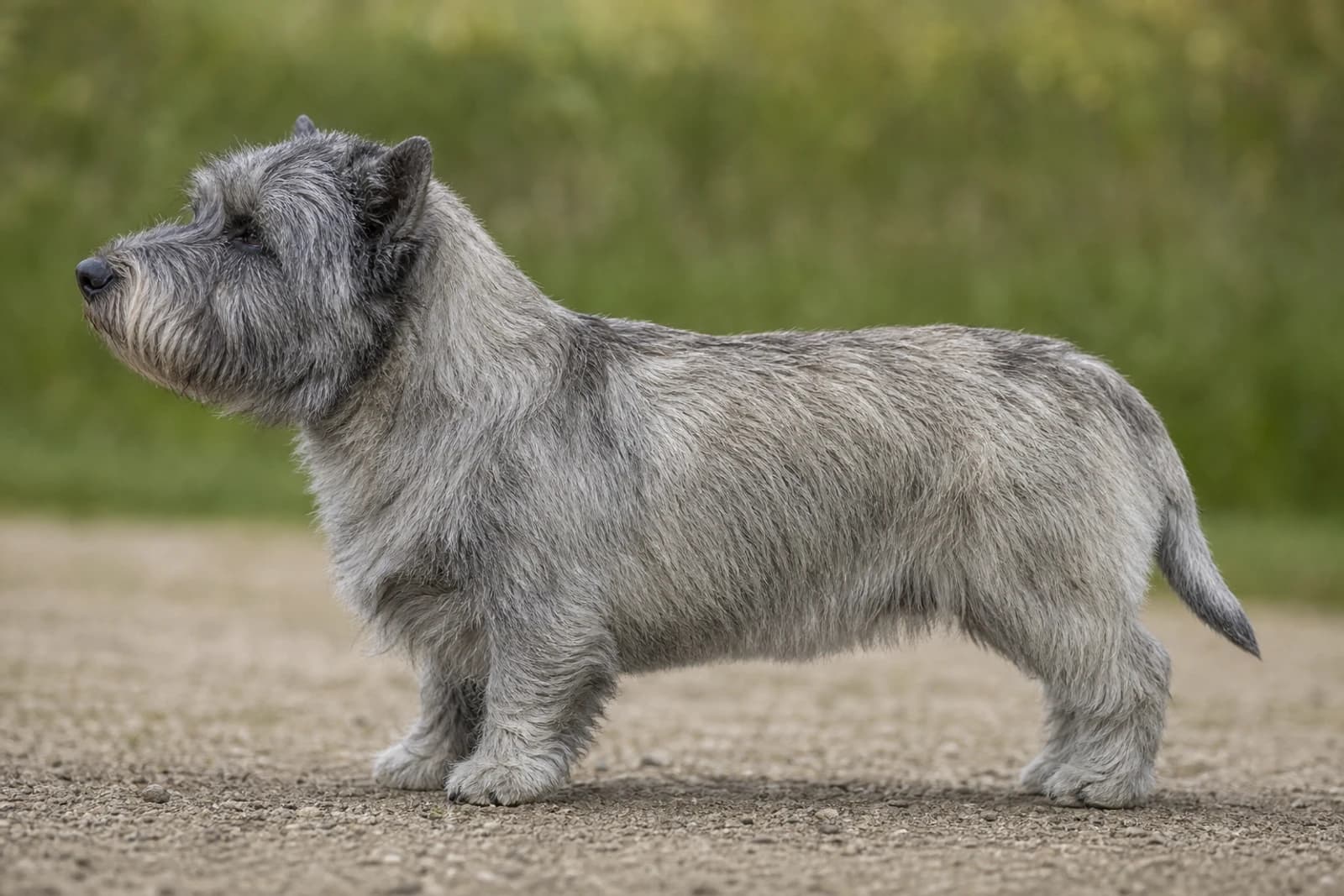
The Glen of Imaal Terrier is a medium-sized, sturdy terrier from Ireland, known for its spunky yet gentle nature. Perfect for active families or individuals who appreciate a dog with a big personality in a compact body, this breed is loyal, affectionate, and full of courage. They thrive on human companionship and are playful but can be independent. With their low-shedding coat, they suit allergy sufferers, but regular grooming is a must. Best for experienced owners, they require consistent training and socialization. Their unique history as farm dogs makes them adaptable, though they retain a strong prey drive.
At a glance
- Size
- Medium
- Height
- 14 in
- Weight
- 35–37 lb
- Life span
- 13–14 years
- Coat colors
- Blue Brindle, Wheaten
- Coat type
- Harsh, wiry double coat
How much does a Glen of Imaal Terrier cost?
Adopt / rescue
$75–$400
Usually includes spay/neuter, first shots, and a microchip.
Buy from a breeder
$700–$2,000
From a reputable, health-testing breeder.
Approximate USD. Prices vary widely by region, breeder, pedigree, age, and coat colour — adopting is the lower-cost and recommended route. Avoid suspiciously cheap “breeders”; they’re often puppy mills.
Estimate the full cost of a Glen of Imaal Terrier →Glen of Imaal Terrier photos
Views
Front, side, rear and top — the full silhouette.Poses
How the breed sits, lies, moves and plays.Puppy to senior
The breed across its whole life.Expressions
The breed’s range of moods.Close-up details
Eyes, ears, nose, paws, tail and coat.Coat colors
The breed’s recognized colors.Click any photo to enlarge. We show the Glen of Imaal Terrier from every angle — three views, poses, life stages, expressions, close-ups, coat and colors.
Appearance & size
The Glen of Imaal Terrier looks like a big dog compressed into a low-slung, no-nonsense frame. From any angle, the takeaway is substance: this is a terrier built to dig into tight burrows, wrestle badgers, and work all day over rough Irish hillsides.
Build and size
Height tops out at 14 inches at the withers, but don’t let that fool you—adults carry 35 to 37 pounds of bone, muscle, and barrel chest. The body is dramatically longer than tall, with a deep, well-sprung ribcage that drops to elbow level. The topline stays level and strong from shoulders to tail, and the loin is short and muscular. From the side, the dog’s profile is a long rectangle: low, solid, and purposeful. The rear shows powerful thighs and well-bent stifles, with hocks that are short and parallel when moving. This is not a leggy terrier; it’s a ground-covering worker whose build says “I can drag a fox out of a sette.”
From the front, the chest is wide and deep, filling the space between straight, heavily boned forelegs. The standout detail is the feet, which turn outward noticeably—a breed hallmark. That “Queen Anne” front (like the turned-out legs of antique furniture) isn’t a fault; it traces back to the original job of turning a spit over a kitchen fire, where a wide, paddling stance gave leverage. The front legs themselves are short, clean, and muscular, setting up the characteristic rolling gait.
Coat and color
The coat is a harsh, double-layered jacket that resists weather and dirt. Outer guard hairs are stiff and wiry, about 1.5 to 2.5 inches long, with a soft undercoat beneath. The texture matters more than perfect length—a correct Glen coat feels rough, not silky or fluffy. Colors come in three varieties:
- Wheaten: any shade from pale cream through gold to a deep red-wheaten, often with darker tips on ears and muzzle.
- Blue brindle: a dark blue-gray base with brindle striping, sometimes almost black at first glance.
- Blue: solid blue-gray, ranging from slate to lighter silver-blue.
Puppies often darken or lighten as they mature, and the coat is deliberately kept natural—no sculpted show trims. The head and ears have shorter, softer hair, while the neck and body wear a longer, shaggier jacket.
Distinctive features
A Glen’s head is a broad, powerful wedge. The skull is wide and slightly domed, with a strong, tapering muzzle that’s shorter than the skull. Dark, medium-sized eyes peer out with a steady, intelligent, no-excuses expression. Ears are small, set high, and either rose-shaped (folded back like a pocket) or half-prick (tipped forward); they’re never full drop or fully erect. The tail is traditionally docked to a moderate length—just long enough to grab if you need to pull the dog from a hole—and carried gaily, but it never curls over the back. From the rear, the tail is a jaunty flag above that solid, driving hind end.
Everything about the dog’s appearance points to function over flash. The thick pads, harsh coat, turned-out front, and deep chest aren’t cosmetic choices—they let the Glen of Imaal Terrier work wet Irish earth without tiring, and they explain why a 36-pound dog feels twice that size when you lift one into the car.
History & origin
The Glen of Imaal Terrier comes from a remote valley in Ireland’s Wicklow Mountains, where it worked harder than most. The breed’s name points to that exact spot — the Glen of Imaal — a rugged pocket of farmland settled by Flemish and lowland soldiers after the late 16th-century wars. Those families brought their own small, rough-coated dogs, and the dogs they bred into existence over the next 300 years became all-purpose farm terriers that didn’t just bark at vermin; they rooted badgers, dispatched rats, and hunted fox and otter on tough, rocky ground.
What sets the Glen apart from every other terrier is its second job inside the house. The same short, bowed front legs and long, muscular body that let the dog dig and squirm into tight earth dens also made it a natural turnspit dog. Farmers had wooden wheels rigged to rotate meat over the hearth, and a Glen of Imaal Terrier would run inside the wheel to keep the spit turning — an honest day’s work that kept the dog warm, fed, and valued when the hunting was slow. This dual-purpose life carved out a terrier that was less shouty and faster to settle than its cousins; it had to turn off the hunt instinct and chill by the fire once the wheel stopped.
Breeding stayed local and largely undocumented until the early 20th century. The Irish Kennel Club recognized the Glen in 1934, making it the last of Ireland’s four native terrier breeds to get official status. Still, numbers stayed small. After World War II, dedicated breeders in Ireland and the UK worked to preserve the original type — a dog that remained surprisingly unchanged from the rough-and-ready farm terrier of the 1800s. The American Kennel Club admitted the breed into its Terrier Group in 2004, and even today you won’t bump into a Glen of Imaal Terrier on every sidewalk. It’s a hidden gem, deliberately kept out of the spotlight by fanciers who guard its working bones, low-key attitude, and unexaggerated build.
Temperament & personality
The Glen of Imaal Terrier reads like a contradiction if you’re used to terriers. At 35–37 pounds and just 14 inches tall, he’s a dense, low-built dog who moves through the house with an almost casual calm — until the back door opens and you see the bold, scrappy worker emerge. This isn’t a dog who vibrates with nervous energy, but one who knows exactly what he wants and expects you to negotiate.
Built-in independence, not remote control
Glens were bred to work badgers and vermin alone, often out of sight of any handler. That solo decision-making lives on. He’ll greet you warmly, lean into your legs, and follow you from room to room, but he is rarely clingy. Affection is offered on his terms. Expect a steady, self-contained companion, not a velcro lapdog. With strangers, reserve is the rule; early, positive exposure to people and places keeps that wariness from hardening into suspicion.
Energy and daily rhythms
He doesn’t need a marathon, but he does need a job. A long, sniffy walk plus a hard play session — digging, tugging, chasing a ball — keeps him satisfied. Skip it, and he’ll make his own entertainment: baseboards, couch corners, the garden bed. Once exercised, he’s content to sprawl near your chair for hours. His sturdy build makes him a surprisingly good hiking partner, though that low center of gravity means he can pull like a miniature tractor on leash if never taught otherwise.
Watchdog and vocal stylings
Alert but not hysterical, a Glen will announce every delivery, squirrel incursion, and passing neighbor with a deep, barrel-chested bark that sounds cartoonishly large for a 35-pound dog. You can train a reliable “enough” cue, but the instinct to patrol windows won’t go away. He’s a watchdog, not just a noisemaker.
Living with other creatures
With his own family, he’s gentle and kid-tolerant — provided the kids respect his meals and personal space. Never interrupt a Glen while he’s eating; food possessiveness can surface, and a low-growl warning to a toddler is an accident waiting to happen. Teach children to let the dog eat in peace. With other dogs, the picture gets complicated. Same-sex aggression, especially between males, is real. Many Glens co-exist happily with a calm opposite-sex housemate, but off-leash encounters with unfamiliar dogs can go sideways fast. Prey drive is high, so cats and pocket pets are a gamble even with careful introductions.
A mind of his own
Training a Glen feels less like obedience and more like a respectful negotiation. He’s smart, but “will do” is not his factory setting. Heavy-handed corrections make him dig in. Short, upbeat sessions with high-value rewards work, and you’ll get farther asking politely than demanding. Housetraining can test your patience: he learns the rule quickly, but may also decide a forgotten corner behind the couch is more convenient than the rainy yard. Reward outdoor success immediately and scrub indoor accidents with an enzyme cleaner — the scent cue must vanish, or he’ll return to it.
Quirks and terrier habits
You’ll see the classic “Glen sit” — back legs splayed out like a frog — and you’ll see an instinct to dig that no amount of landscaping can fully erase. He also possesses jaw strength that belies his size. Adult Glens need tough, long-lasting chews to keep teeth clean and minds busy; teething puppies will sample everything. A homemade citrus spray or a vinegar odor-neutralizer can redirect those jaws from furniture to appropriate toys. And yes, like many terriers, he may roll in something foul out of sheer delight — a throwback to his scent-masking, scavenger heritage.
A Glen is not a push-button pet. Give him respect, consistent boundaries, and a solid hour of engagement each day, and you get a brave, affectionate, deeply entertaining housemate who’s just as happy napping at your feet as he is tackling rough terrain.
Good with kids, dogs & other pets
Glen of Imaal Terriers carry a patient, non-aggressive temperament that naturally suits homes with children. They’re sturdy little dogs at 35–37 pounds, not so delicate that a gentle bump sends them under the sofa, yet small enough for older kids to manage on a walk. Still, no dog-and-kid relationship runs on autopilot. Teach children to give the dog space when he’s eating or resting, and supervise all early interactions so everyone learns the right moves.
With other dogs in the house, Glens can blend in smoothly, especially when they’ve grown up together. Proper introductions on neutral ground and a gradual ramp-up in shared time go a long way. An unsocialized adult may be scrappy with unfamiliar dogs, but early puppy classes — starting between 3 and 14 weeks — stack the odds in your favor. Forced meet-ups with strange dogs once a dog is fearful or set in his ways tends to backfire, raising stress and risking scuffles. Respect his comfort zone.
The real wild card is smaller pets. These terriers were bred to dig after badger and kill vermin, so their prey drive is baked in. A cat who lives in the home and is introduced during the puppy’s critical socialization window (up to around 16 weeks) might earn a truce, but never leave the two together unsupervised. Rabbits, hamsters, and other pocket-sized animals are best kept safely separated — this is a dog who will likely see them as a job, not a friend.
Early socialization isn’t a nice-to-have; it’s what turns a Glen from a wary-onlooker into a confident, can-roll-with-it companion. Between birth and about four months, expose your puppy gradually to new people, friendly dogs, different surfaces, everyday sounds, and car rides. Miss that window, and you risk a dog who startles at doorbells or panics at the vet. Even later, gentle, positive training can ease anxiety, but it’s a slower road. These are also deeply companionable dogs — not a breed to leave alone in the backyard for hours. A Glen who becomes lonely or isolated can unravel into barking or destructive habits, so plan for a home where someone’s around a good part of the day.
Trainability & intelligence
A Glen of Imaal Terrier isn’t the type to trip over his own paws for a treat. At 14 inches and 35–37 pounds, he packs a quiet, calculating mind and the independent streak that comes from generations of earthdog work. He can learn quickly — but he’ll also decide whether your request is worth his time. That’s not stubbornness for its own sake; it’s a breed that was never meant to obey mindlessly. Training him means earning his trust first, then showing him the payoff every single time.
The training approach that actually works
Forget force. A Glen shuts down — or digs in harder — if you raise your voice or yank a leash. He responds to honest, positive reinforcement: a favorite toy, a scramble for a tossed treat, or genuine, low-key praise. Keep sessions short and unpredictable. Drill the same sit ten times in a row and you’ll watch his attention flatline. Mix it up, hide a reward, let him solve a simple problem, and he’ll lean in.
- Start young. Socialization needs to begin between 3 and 14 weeks. Get him safely onto different surfaces, around calm people, and exposed to everyday sounds. Without that, he can be aloof or suspicious with strangers, and that reserve quickly becomes reactivity.
- Build a reliable recall piece by piece. Glens have a nose and a prey drive. If he catches a whiff of something interesting, “come” will be background noise unless you’ve spent weeks proofing it with high-value rewards and zero punishment when he eventually wanders back.
- Accept the negotiation. He may argue about nail trims or going out in the rain. Instead of turning it into a battle, trade cooperation for something he craves — a chew, a game of tug. You’re not being soft; you’re working with the brain he has.
Expect training to feel a few beats slower than with a people-pleasing breed. The real win isn’t a dog who obeys instantly; it’s a dog who’s thought about the cue and still chose you. Push too hard and you’ll erode the relationship for weeks. Responsible breeders will tell you: these dogs can hold a grudge. So never confuse patience with permissiveness. Set clear, consistent rules, reward what you want, and ignore — truly ignore — the behavior you don’t. When a 35-pound terrier looks at you with that level stare and finally decides you’re worth listening to, the obedience you get is durable because it’s built on a partnership, not fear.
Exercise & energy needs
A Glen doesn’t demand marathon mileage, but short, lazy strolls won’t cut it. Plan on 45–60 minutes of exercise a day, broken into at least two sessions. A brisk 30‑minute walk in the morning, followed by an afternoon romp or off‑leash sniffari, usually hits the mark for a healthy adult. These terriers are built for short, intense bursts — scrambling over logs, flushing critters, or digging with single‑minded gusto — and then they crash.
Mental work matters as much as the physical. A bored Glen invents his own job, and you probably won’t like the excavation. Pair every walk with a 5‑minute training game, a puzzle toy, or a scatter‑feed in the grass. Their nose rules their world, so scent games and hide‑and‑seek tap into instincts that exhaust them faster than a second walk.
Because of that long, low body, skip high‑impact repetition: avoid endless stair sessions, hard landings, or agility with full‑height jumps. Instead, look at earthdog trials — they tunnel after artificial quarry, a perfect outlet for the digging drive without reshaping your garden. Structured nose work, barn hunt, or short hikes on uneven terrain are all fair game. A Glen who gets daily physical effort and a thinking challenge is a calm, good‑mannered housemate. Skip the brain work, and you’ll see digging, barking, or pushy demands you’ll be cleaning up for days.
Grooming & coat care
The Glen’s coat does you a favor — it sheds very little around the house. But that low-shed life comes with a definite catch: the coarse, medium-length double coat needs hand-stripping, not just brushing. If you let the dead hairs build up, the wiry texture goes soft and that weather-resistant jacket stops doing its job.
Brushing between strips
Aim to brush once or twice a week using a slicker brush with rounded pins and a metal greyhound comb. Work in sections, making sure you reach the downy undercoat to prevent mats hiding close to the skin. You’ll pull out some dead hair during those sessions, but regular brushing mostly keeps tangles at bay and spreads natural oils across that harsh outer layer.
The real work: hand-stripping
Every 3 to 4 months — or whenever the coat starts looking fluffy and unkempt — you need to pull out the dead topcoat by the root. You can do it with your fingers or a stripping knife, pulling small tufts in the direction of growth. It doesn’t hurt a Glen (the hair is ready to release), and it keeps the coat crisp, hard, and properly brindle, wheaten, or blue. Clipping with scissors or clippers cuts the hair instead of pulling it, which gradually ruins the texture; you’ll end up with a soft, faded, cottony coat that mats faster and holds dirt. If hand-stripping sounds daunting, a groomer familiar with terrier coats is worth every penny.
Bathing
Less is absolutely more. A Glen only needs a bath a few times a year — after a particularly muddy romp or if he rolls in something vile. Over-washing strips the natural oils that keep the coat weatherproof and that desirable rough feel. When you do bathe, use a dog shampoo made for harsh coats and never condition, which just fluffs the undercoat.
Ears, nails, and teeth
- Ears: Those drop ears trap moisture. Lift them weekly, wipe out any debris with a vet-approved cleaner, and check for redness or a yeasty smell.
- Nails: Thick, strong nails on those compact feet grow quickly. Check every 2–3 weeks and trim before they click on hard floors. If you let them get long, you risk splitting and toe discomfort.
- Teeth: Brush two to three times a week — small toothbrush, dog toothpaste. It’s a direct line to avoiding stinky breath and preventing periodontal issues down the road.
Seasonal coat shifts
Twice a year, usually spring and fall, the undercoat gives a heavier blow. You’ll see more loose fluff coming out during brushing. This isn’t true shedding in the leave-hair-everywhere sense, but for a few weeks you’ll need to brush two or three times a week to grab that insulating coat before it forms mats against the skin. A quick pass with an undercoat rake during these periods makes the whole process less of a battle.
Shedding & allergies
If you hate finding dog hair on your sofa, a Glen of Imaal Terrier suits you far better than most breeds. These medium-sized, scruffy terriers shed very little around the house—not zero, but close to it, provided you keep up with grooming. The catch isn’t shedding; it’s the maintenance that makes that low shed possible.
A Glen wears a harsh, wiry outer coat over a soft undercoat. Dead hairs from the undercoat tend to cling to the outer hairs rather than dropping onto your floor. That’s good for cleanliness, but it means those dead hairs need to be physically removed. Without intervention, they tangle, mat, and eventually form a tight, uncomfortable pelt.
Seasonal blowouts, common in double-coated dogs, are almost a non-event if you hand-strip the coat every 4–6 months. Hand-stripping pulls out the dead undercoat by the root, preserving the wiry texture and keeping shedding to an absolute minimum. If you go the scissor-clipping route instead, the coat softens, loses some of its self-cleaning ability, and you’ll see more loose hairs around the house—still minimal, but more than with a stripped coat. Either way, expect to brush for a few minutes weekly to prevent mats behind the ears, under the legs, and along the belly.
Drool is practically nonexistent. These aren’t dogs that leave wet spots on your pants or furniture.
Now, the hypoallergenic question. Glens are often listed as a hypoallergenic breed because they produce less dander and shed minimally. However, no dog is 100% allergen-free. Allergies are triggered by proteins in saliva, urine, and dander—not just hair. The wiry coat does trap dander close to the skin, so it’s not wafting into the air as easily. That can make a real difference for mild allergy sufferers. But if you or a family member has severe allergies, spend at least an hour with an adult Glen before bringing a puppy home. Reactions vary by individual dog and person, so a test visit tells you more than any breed label. If you can manage the grooming commitment—either learning to strip yourself or paying a groomer—you’ll get a nearly shed-free housemate who won’t coat your dark clothes in fur.
Diet & nutrition
A Glen’s compact, 35–37-pound frame and short legs punish every extra ounce. Carry too much weight and you’re asking a lot of that long back and those low-slung joints. This isn’t a breed that can pack on pounds quietly.
Portion control & weight management
Most adults stay fit on 1 to 1½ cups of high-quality dry food per day, split into two meals, but the label is just a starting point. Use a kitchen scale or a proper measuring cup, not a coffee mug. Check your dog’s waist and ribs every week. You want to feel ribs under a thin layer of fat — if you can’t, cut back a little and bump up exercise. A Glen of Imaal Terrier who gets a solid hour of off-leash time each day can handle a bit more food than a couch-loving counterpart, but never let food motivation (common enough in terriers) turn into obesity. Even a few extra pounds increase the strain on a spine that’s already working hard.
What to fill the bowl with
A good baseline: about 60% animal protein (raw or cooked meat, fish, eggs), 20-30% fruits and vegetables, and the last 10% from things like plain yogurt, oats, or pearl barley. Because a dog’s jaw chops vertically and doesn’t produce digestive enzymes in the saliva, blending or lightly processing vegetables and tougher ingredients helps your Glen actually absorb the nutrients instead of just passing them through. If you’ve got a Hoover on your hands, serve meals in a puzzle bowl or slow feeder — it turns 90 seconds of gulping into several minutes of brainwork.
Puppy feeding schedule
- Up to 4 months: four evenly spaced meals a day.
- 4 to 6 months: three meals a day.
- 6 months onward: two meals a day, just like an adult.
Transition a new puppy off the breeder’s food gradually. Start with lightly cooked, puréed meats, fish, and soft fruits or vegetables, or use a top-notch commercial puppy food. Around 12 weeks, you can introduce a raw chicken wing under supervision, letting the pup learn to chew carefully.
Older Glens
Senior dogs slow down, and a 13-14 year lifespan means years when the calorie burn drops. Watch for weight creep and cut back kibble slowly — not drastically — as your dog’s activity level changes. Smaller, more frequent meals can help an older stomach. Don’t slash protein without a vet’s specific order; there’s no real evidence that healthy seniors need a low-protein diet. If an older Glen has missing teeth or a tender mouth, puréeing meals makes nutrition much easier to absorb.
Mealtime habits that stick
Never feed from the table. Even a “just this once” scrap teaches a terrier that staring at your plate pays off, and breaking that habit is miserable. Leftovers go into the dog’s own bowl, set down away from the dinner table. Avoid heavy, fatty scraps (holiday ham, buttery potatoes) that can provoke pancreatitis. And no vegetarian or vegan experiments — this is a meat-eater’s digestive tract from teeth to tail, and removing animal protein deprives your Glen of what its body expects.
Health & lifespan
A Glen of Imaal Terrier typically lives 13 to 14 years, and many stay spry well into their teens with solid preventive care. That sturdiness doesn’t mean the breed is free of inherited quirks, so it pays to know what responsible breeders screen for and what you’ll watch for at home.
The biggest structural reality of a Glen is his dwarf build — long body, short legs. That geometry can make him prone to intervertebral disc disease (IVDD), where a disc in the spine bulges or ruptures. Keeping a Glen lean is non-negotiable. Even an extra 2 or 3 pounds multiplies the load on those discs. Weight also feeds into hip dysplasia, which shows up in the breed. Responsible breeders evaluate hips through the Orthopedic Foundation for Animals (OFA) or PennHIP before breeding.
Eye issues are another area where good breeders are proactive. Progressive retinal atrophy (PRA) and canine multifocal retinopathy (CMR) both appear in the gene pool. Breeders who screen through OFA Eye or CERF exams give you a much clearer picture of a pup’s long-term vision outlook. You might also hear about hypothyroidism — a low-functioning thyroid that can show up in middle age, sapping energy and coat quality. A simple yearly blood panel catches it early, and daily medication keeps it managed for a normal lifespan.
Allergies and skin trouble surface in plenty of Glens. If your dog gets itchy ears, chewing paws, or recurrent hot spots, it’s often something in the environment or diet, not just a random flare-up. Working with your vet on a high-quality diet and avoiding cheap fillers can make a real difference.
Beyond breed-specific stuff, the usual rhythms apply. Heartworm prevention every month during mosquito season (and one month beyond) is absolute, because treating an active heartworm case is rough and expensive. Rabies vaccination is legally required and fatal once symptoms appear. Annual exams catch subtle changes — a slight shift in appetite, a stiffer gait after rest — before they become crises.
The Glens that age gracefully are almost always the ones kept at a working weight, with consistent positive handling, and a vet who knows what to track in a dwarf terrier. That’s not a special formula — it’s just recognizing that the spine and joints will thank you for every pound you keep off, year in and year out.
Living environment
A Glen of Imaal Terrier settles into more living situations than people expect, but the deal-breaker is almost always noise. He’s a terrier through and through: alert, opinionated, and quick to sound off at a strange footstep, a squirrel through the window, or a delivery truck three streets over. An apartment can work if you’re committed to early training that teaches a solid “quiet” cue, and if your walls aren’t paper-thin. Otherwise, a single-family home where a few alert barks won’t ruffle the neighbors is a better match.
A securely fenced yard gets a lot of use. Glens are earthdog descendants, so digging is a hardwired hobby — fence lines need buried reinforcement or a sandbox to redirect the urge. They don’t need rolling acres, but a small patch of grass to patrol and a fence they can’t tunnel under matters more than square footage. Inside the house, they’re compact at 14 inches and 35–37 pounds, curling up small when the day’s work is done.
That “work” needs to be real. A Glen thrives on two 20–30 minute sessions a day — not a marathon, but purposeful movement with room to sniff and investigate. Tacking on a 10-minute puzzle toy or scent game in the morning cuts through the mental restlessness that leads to nuisance barking. Lean too hard on a lone long walk and you may miss his rhythm; he refuels in short, intense bursts, not steady-state cruising.
Climate-wise, the double coat — a soft undercoat and harsh outer jacket — gives him an edge in cool, damp weather. Hot pavement and midday summer sun, though, demand shade and earlier or later walks. He’s not a fragile dog, but you’ll see him slow down when the temperature climbs past his comfort zone.
Alone time is where honest expectations matter. Glens bond deeply with their people and were never bred to be kenneled in the backyard all day. A four-to-five-hour stretch is doable if you’ve burned off energy beforehand and leave a stuffed Kong or similar challenge. Beyond that, you can start to see stress chewing, howling, or escape-artist behavior. Gradual alone-time training when he’s young — stepping out for 10 minutes, then 30, without a production — pays off. If your workdays are consistently long, a midday dog walker or a neighbor’s check-in keeps the terrier brain from spinning out.
Who this breed suits
A Glen of Imaal Terrier fits best with someone who gets that terriers aren’t trying to be difficult — they’re wired to think for themselves. At 35–37 pounds and 14 inches tall, these are sturdy, compact dogs that live a healthy 13–14 years. They won’t ricochet off the walls, but a solid hour of walking and interactive play is required to keep them content. The real effort goes into the brainwork. A Glen can out-stubborn a mule, so a good-natured sense of humor matters more than drill-sergeant training.
Where they click
- First-time owners who genuinely commit to puppy kindergarten and understand the dog’s independence. A Glen learns fast when he sees a payoff; if you expect biddability, you’ll be frustrated. In return, you get a loyal, scrappy housemate who rarely holds a grudge.
- Families with older kids (think 10 and up) who respect the dog’s space. The breed isn’t fragile, but rough handling gets a growl, not stoic acceptance. In the right household, they’re a solid buddy for backyard games, bike rides, and blanket burrowing.
- Active seniors who still walk a mile or two a day. The size is manageable, and Glens shed very little — a real plus for neatniks. Just budget for a professional groomer or learn to hand-strip that wiry coat every few months; it’s non-negotiable maintenance.
- Singles get a low-key but involved companion. He’ll supervise your yard work with comic intensity, then nap through your meeting. Affection is on his terms, not a constant demand for cuddling.
This breed is a poor match if you:
- Keep free-roaming rodents or have a multi-cat household. Glens were bred to go to ground after vermin, and that drive doesn’t switch off.
- Want a dog-park social butterfly. Many adult Glens are dog-selective and quick to tangle with a same-sex canine who pushes the wrong button.
- Prize a showpiece lawn. Digging is a deeply ingrained hobby, not a fixable misdemeanor.
- Dream of off-leash hikes with a dog who snaps back the moment you call. When a scent trail fires up, recall becomes purely optional.
- Prefer a wash-and-go dog who never talks back. A Glen will negotiate, ignore, and occasionally outsmart you just because he can.
If a dog who treats rules like a negotiation makes you grin rather than fume, a Glen of Imaal might be your kind of partner.
Cost of ownership
A well-bred Glen of Imaal Terrier puppy from a responsible show or working home typically runs $2,500 to $3,500. These dogs aren’t produced in volume, so expect a wait and a breeder who screens for hip dysplasia, eye disease, and other inheritable issues. Rescue is an option but rare; adoption fees usually fall between $300 and $600 when a dog becomes available.
Once the pup’s home, budget for real, recurring expenses. A 35–37 lb terrier eats about 1½ to 2 cups of quality dry food a day, landing you at $40–$60 per month. Grooming is a major line item if you don’t learn hand-stripping: a professional stripping session every 8–10 weeks runs $70–$100, which works out to roughly $30–$50 monthly. Clipper cuts are cheaper but soften the wiry coat and can lead to skin trouble.
Veterinary care—annual exams, vaccinations, flea/tick/heartworm preventives—averages $50–$80 a month for an otherwise healthy adult. Pet insurance adds another $35–$55, more if you opt for a wellness rider. Factor in treats, durable chews, and the occasional training class, and you’re looking at a total monthly outlay around $170 to $300. Over a 13–14 year lifespan, that’s a serious commitment, and it doesn’t include the one-time costs of a crate, bed, leash, and bowls.
Choosing a Glen of Imaal Terrier
The Glen is a rare breed, so you won’t stumble on a litter the way you might a Lab or a Frenchie. Expect to get on a waiting list and answer just as many questions from the breeder as you ask. A good breeder isn’t selling puppies — they’re placing a tough, clever terrier into the right hands.
Finding a responsible breeder
Start with the national breed club’s breeder referral. You want someone who raises pups underfoot, not in a kennel. They should talk openly about the breed’s stubborn streak, its surprising strength for a 35 lb dog, and the work required to channel that grit into a solid family companion. They’ll ask about your yard, your activity level, your experience with terriers — and that’s exactly what you want.
Rescue option
Glen rescues do exist, but the wait can be long. If you go this route, the adoption coordinator will dig into your home setup. Many rehomed Glens are adults whose previous owners underestimated the grooming, the independence, or the dog’s need for a daily job. It’s a way to skip the puppy chaos, and you get a clearer read on temperament from the start.
Health clearances to ask for
No breed is free of inherited trouble. Responsible breeders screen both parents and show you the paperwork. Ask for:
- Hip certification from the OFA (Orthopedic Foundation for Animals) or PennHIP, rated fair or better.
- Eye exam by a board-certified veterinary ophthalmologist, done within the last year. Glens can carry progressive retinal atrophy (specifically cone-rod dystrophy 1), so a DNA test result for PRA (RPGR gene) should be clear or clear-by-parentage.
- Patellar luxation check — less common but still worth confirming the knees were examined.
A breeder who waves off these questions or says “the vet said they’re healthy” without the actual certificates is a red flag.
Red flags
- Multiple litters on the ground at once or a website that always has “available puppies.”
- Price tags that skyrocket for rare coat colors or “teacup” sizes (there’s no such thing).
- Puppies leaving before 8 weeks. Glens need that time with littermates to learn bite inhibition and respect — serious topics in a terrier pack.
- No written contract or health guarantee.
- Refusing to let you meet at least one parent dog. You want to see the temperament firsthand.
Picking your puppy
Spend time watching the litter interact. A Glen puppy should be curious and bold — the one who trots over to investigate your shoelaces, maybe gives a little growl at a toy, then moves on. Don’t choose out of pity: the pup cowering in the corner or the one that stiffens up when handled may be a lifetime management challenge. Ask the breeder which puppy matches what you told them about your household. They’ve been observing the litter for eight weeks; trust their read. Then go home with a terrier who will make you earn every bit of that steady, faithful adult dog.
Pros & cons
- Surprisingly quiet for a terrier. Glens don’t have the hair-trigger bark of many small earthdogs. When they do sound off, the deep, big-dog voice from a 35–37 lb body is more comical than constant.
- Manageable, medium build. At 14 inches tall and around 36 pounds, they’re sturdy enough for real hikes but compact enough to curl up in a chair after. No delicate, breakable frame here.
- Affectionate without being velcro. They love their people fiercely and will lean into you on the couch, but they won’t follow you room to room like a shadow. That independent streak means they can handle some alone time.
- Low-shedding harsh coat. The wiry double coat, when hand-stripped a couple of times a year, leaves almost no hair on furniture. Bonus: mud brushes out once it dries.
- Solid lifespan of 13–14 years, with some living well past that when bred carefully.
- A true, pushy terrier mind. Stubbornness is pre-installed. They’ll decide whether your command is worth obeying, so training requires patience, creativity, and a sense of humor — not just repetition.
- Prey drive that can’t be negotiated. Squirrels, cats, and small critters trigger a chase reflex that overrides recall. A fenced yard and a leash are non-negotiable.
- Same-sex dog aggression is common. Many Glens, especially males, will scrap with dogs of the same sex. Careful management and early socialization help, but expecting a dog-park social butterfly is not realistic.
- Digging is a default hobby. You can redirect it with a sandbox, but you won’t extinguish it. Flower beds within paw's reach are prime excavation sites.
- Responsible breeders screen hips and eyes. This isn’t a shattered-health breed, but progressive retinal atrophy (rcd3) and hip dysplasia exist in the gene pool. You need proof of DNA testing for rcd3 and OFA hip scores — skip any breeder who waves that off.
Similar breeds & alternatives
If you need the same low-to-the-ground, hard-as-nails terrier substance but a different size or energy output, a handful of breeds sit nearby. The Glen of Imaal Terrier is heavier than it looks—35 to 37 pounds packed into a 14-inch frame—so pay close attention to the real weight differences when you compare.
- Soft Coated Wheaten Terrier: Same Irish roots, but everything else scales up. Wheatens stand 17 to 19 inches and run 30 to 40 pounds, with a long, silky single coat that mats easily and demands constant brushing. They’re bouncier, need more room to run, and lean more toward a cheerful family clown than the Glen’s quiet, no-bark-necessary watchfulness.
- Irish Terrier: A full-sized racer built on longer legs. At 18 inches and 25 to 27 pounds, they’re taller and lighter, bred to run with hounds. The coat is a harsh red wire, and the temperament is distinctly hotter—more likely to pick a fight with another dog or dig a crater on a whim. You’ll get classic terrier fire where the Glen often gives you a solid couch companion with an off-switch.
- Scottish Terrier: Shares the short-legged, long-backed silhouette, but a Scottie weighs just 18 to 22 pounds. They’re intensely independent, sometimes standoffish, and tend to be more vocal than a Glen. Good if you want a compact, dignified character with that same “big dog in a small body” heft, but on a smaller scale.
- Cairn Terrier: Think scrappy and common instead of rare and heavy-boned. At 13 to 18 pounds, the Cairn is the compact, shaggy ratter that’s more likely to bolt after a squirrel. The Glen, by contrast, was built to battle a badger in a tight tunnel, and that shows in its quiet confidence and thicker bone.
The biggest alternative to weigh is availability. Glen of Imaal Terriers remain a rare breed, so you’ll likely face a breeder waitlist. If you need a dog sooner without sacrificing terrier grit, the Scottie or Cairn is easier to find through reputable channels, though you trade away the Glen’s unusual calm indoors and that singular bowed-front strut.
Fun facts
- Once used as turnspit dogs, running in wheels to turn meat over fires.
- Their unique 'Glen sit' involves sitting upright on their haunches like a human.
- They are one of the rarest terrier breeds, with only a few hundred registered annually.
- Bred to hunt badgers and foxes, they are fearless despite their small stature.
Frequently asked questions
- Are Glen of Imaal Terriers good with children?
- They can be good with children if raised with them, but their terrier nature means they may not tolerate rough handling. Supervision and early socialization are important. They tend to be loyal and playful but can be independent.
- Do Glen of Imaal Terriers shed a lot?
- They have a wiry, double coat that sheds minimally, making them a good option for some allergy sufferers. Regular grooming is needed to prevent matting, including brushing and occasional stripping. They are considered low-shedding dogs.
- How much exercise does a Glen of Imaal Terrier need?
- They require moderate daily exercise, such as walks and playtime, to stay physically and mentally stimulated. A fenced yard is ideal but not essential if they get sufficient outings. Their terrier energy can lead to mischief if under-exercised.
- Can Glen of Imaal Terriers live in an apartment?
- Their medium size and moderate exercise needs make them adaptable to apartment living, provided they get daily walks. They are relatively quiet indoors but may bark at noises, so training is helpful. A routine with outdoor activity is key.
- Are Glen of Imaal Terriers easy to train for first-time owners?
- They are intelligent but can be stubborn, which might challenge first-time owners. Consistent, positive training works best, as they can be independent thinkers. Early socialization and patience yield a well-mannered companion.
Tools & calculators for Glen of Imaal Terrier owners
Quick estimates tailored to Glen of Imaal Terriers — pre-filled with this breed’s size where it matters.
Articles & stories about the Glen of Imaal Terrier
Sources & standards
This profile follows recognized breed standards from the American Kennel Club (AKC) and the Fédération Cynologique Internationale (FCI), along with established veterinary and breed-club guidance. These describe general breed tendencies — every dog is an individual.
Owner stories
Have a Glen of Imaal Terrier? Share your experience — grooming tips, personality quirks, anything goes.