

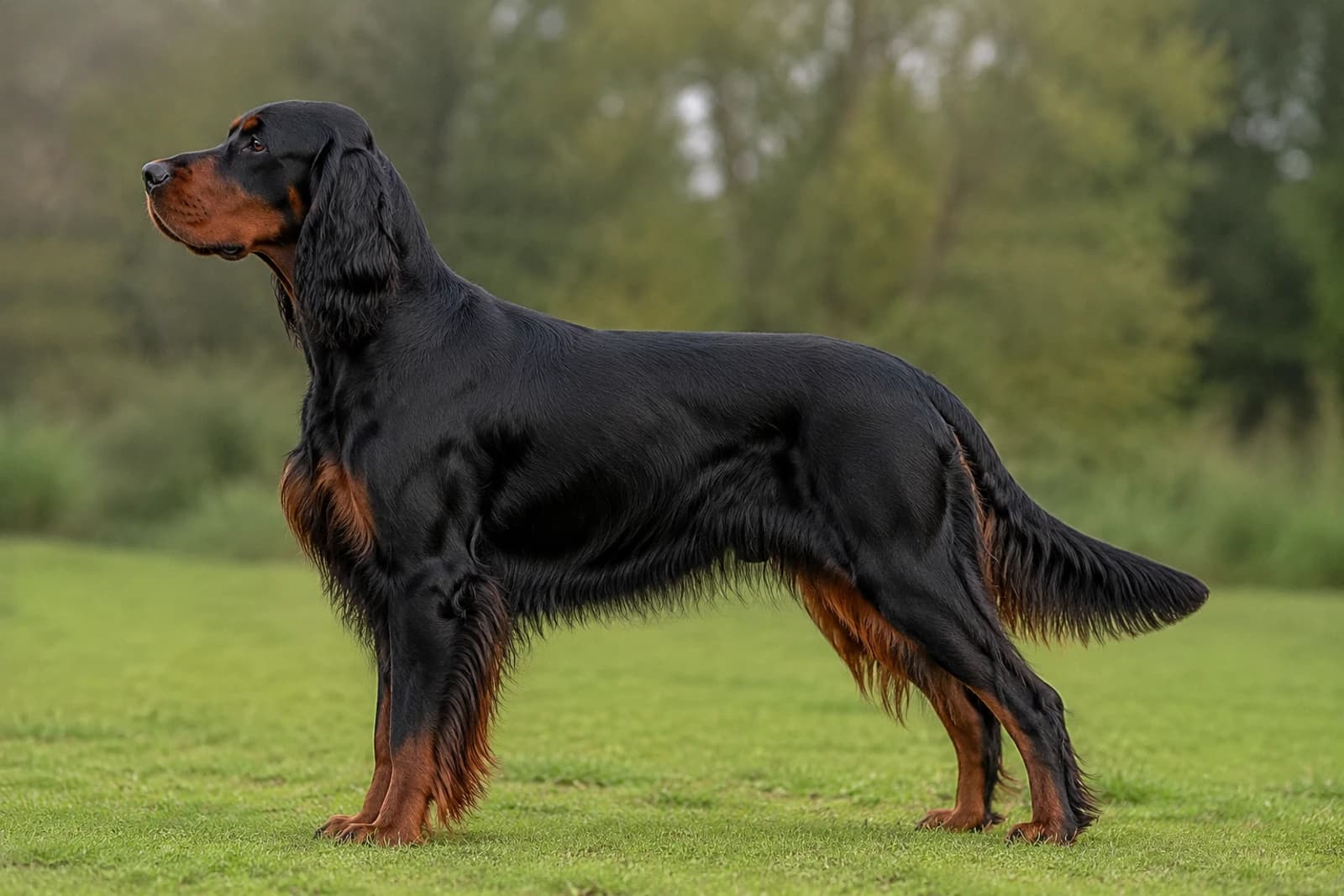
The Gordon Setter is a sturdy Scottish sporting dog with a black-and-tan coat, deep loyalty, and serious exercise needs. It can be a warm family companion, but it is happiest with space, training, and regular outdoor work.
At a glance
- Size
- Large
- Height
- 23–27 in
- Weight
- 45–80 lb
- Life span
- 12–13 years
- Coat colors
- Black and tan
- Coat type
- Medium to long silky coat
- Group
- Gun
- Origin
- Scotland
How much does a Gordon Setter cost?
Adopt / rescue
$75–$400
Usually includes spay/neuter, first shots, and a microchip.
Buy from a breeder
$700–$2,000
From a reputable, health-testing breeder.
Approximate USD. Prices vary widely by region, breeder, pedigree, age, and coat colour — adopting is the lower-cost and recommended route. Avoid suspiciously cheap “breeders”; they’re often puppy mills.
Estimate the full cost of a Gordon Setter →Gordon Setter photos
Views
Front, side, rear and top — the full silhouette.Poses
How the breed sits, lies, moves and plays.Puppy to senior
The breed across its whole life.Expressions
The breed’s range of moods.Close-up details
Eyes, ears, nose, paws, tail and coat.Coat colors
The breed’s recognized colors.Click any photo to enlarge. We show the Gordon Setter from every angle — three views, poses, life stages, expressions, close-ups, coat and colors.
Appearance & size
When you see a Gordon Setter, the first thing that registers is that glossy black coat with deep tan accents. This is the boldest and most substantial of the setters, and the only one with that specific black-and-tan color combo. There’s zero guesswork about the breed once you know the look.
Standing 23 to 27 inches at the shoulder and weighing anywhere from 45 to 80 pounds, you’ll notice a real size gap between males and females. Males typically fill out the higher end of both ranges, while females stay lighter and more refined. But even a smaller female reads as a substantial gun dog — never delicate. The frame is muscular and moderately angulated, built for endurance over a full day’s work in the Scottish Highlands, not a quick sprint.
The coat is a flat-lying or slightly wavy silk that’s not as long as an Irish Setter’s but still carries plenty of feathering. The black is a true raven black with brilliant sheen; the tan markings are a rich chestnut or mahogany red. Those markings aren’t random splashes. They show up in specific places:
- Muzzle and throat
- Two distinct “pips” above the eyes
- Broad patches on the chest
- Inside and back of the forelegs, up to the hocks and the stifle on the back legs
- Under the tail
A tiny white spot on the chest is considered a fault in the show ring, but it can pop up in otherwise healthy pups.
From the front, you’ll see a deep, well-sprung chest, straight forelegs with strong bone, and a head carried with purpose — the head is long and lean, with oval bone and a defined stop. The ears are set low, hang close to the head, and are fringed with silky hair. From the side, the topline slopes gently from the withers to the croup, the loin is short and strong, and the tail continues that line, carried horizontally or just a notch above the back. The belly has a moderate tuck-up but the deep chest dominates the profile. From the rear, you get a sense of the coiled power: well-muscled thighs, clearly defined stifles, and that long feathered tail waving like a flag when the dog is on scent. No docking — the tail stays natural and flowy. The overall picture isn’t flashy; it’s rugged elegance that says this dog can go all day.
History & origin
The Gordon Setter traces straight back to the early 1800s at Gordon Castle in Moray, Scotland, where Alexander, the Fourth Duke of Gordon, wanted a tireless, heavy-boned bird dog that could handle the rough Scottish Highlands. He didn’t start from scratch — local black-and-tan setters already existed — but his kennels disciplined the type, fixing the deep chestnut markings, solid black coat, and calm, methodical hunting style. By 1820 the breed was distinct enough to earn official recognition, though it was simply called the Black and Tan Setter back then. The Gordon name stuck later, honoring the duke’s influence.
The dog’s job was setting: quartering ahead of hunters on foot, catching the scent of partridge, pheasant, or grouse, then freezing in a low crouch (“set”) so the hunter could walk up and flush the birds. It was not a sprint-and-flash pointer. The Gordon worked deliberately, with stamina and a nose that could handle damp, windy moorland. That heavier build and steady temperament set it apart from its faster cousins, the English and Irish Setters.
During the 19th century the breed spread across the UK and then to the United States, where American shooters recognized its reliability in thick cover and its close-working range. While the English Setter and Irish Setter grabbed the spotlight for flashy field trials, the Gordon carved out a quieter reputation among hunters who didn’t mind a dog that took its time — and who appreciated a setter that stayed close, even in biting weather. The first Gordons were imported to North America in the 1840s, and the breed entered the AKC studbook in 1884.
What emerged in the 20th century wasn’t a split between show and field lines, but a drift. Show-bred Gordons became a little heavier and flashier, while field-bred lines remained leaner and retained that no-nonsense drive. Both still produce dogs that will lock up on a bird with the same stone-still intensity that the Duke of Gordon’s gamekeepers prized two centuries ago.
Temperament & personality
A Gordon Setter’s personality runs deep: intense and focused in the field, then calm and almost clingy at home — but only if his daily need for hard exercise has been met. Skip the real workout and that calm evaporates into pent-up energy that shows up as chewing on table legs, barking at shadows, or urine-marking your favorite chair. These dogs are scent-obsessed by design, and they remember exactly where they left their own mark. A bored Gordon quickly becomes a living room surveyor, lifting his leg on anything that smells like you. Cleaning it up thoroughly isn’t just housekeeping — it breaks a powerful cue that otherwise invites repeat performances.
With his own family, a Gordon Setter is all shadow. He wants to be in the same room, leaning against your leg, resting his head on your lap while you watch TV. Strangers get a different reception: a serious, reserved watchfulness that rarely tips into outright aggression, but you’ll hear a deep, deliberate bark the moment someone steps onto the property. He’s not a dog who instantly wags for every visitor; he’ll hang back and study the new person until you give the all-clear. This makes him a solid, no-fuss watchdog who won’t mistake the mail carrier for a lifelong enemy.
Strong-willed and smart, a Gordon Setter doesn’t respond well to harsh corrections. Getting meaningful cooperation from him means consistent, respectful handling — the same kind of patient engagement you’d use with a bright, stubborn colleague. Push him too hard and he’ll shut down or find ways around you. Teach your kids to leave him alone while he’s eating, because even the most easygoing Gordon can develop food-guarding habits if he’s pestered during meals.
Around the house, you’ll notice some quirky body language worth learning. A forward-leaning stance with a stiff body and direct stare is a warning that you’re about three seconds from a reaction, while a loose frame and soft, blinking eyes tell you he’s at ease. Yawning, lip-licking, or turning his head away — those are not signs he’s tired or suddenly shy; they’re subtle calming signals he’ll flash when he’s uncomfortable. And if he rolls in something foul, he’s not broken. That’s just a flash of deep scavenger wiring: some dogs like to advertise what they’ve found, and his nose makes a dead fish or raccoon poop unbelievably interesting.
Puppies chew to explore the world and soothe teething gums; adult Gordons often keep gnawing on hard things to maintain jaw strength. Give them appropriate outlets, like raw marrow bones or sturdy toys, or they’ll draft your furniture into the dental plan. With a Gordon Setter, you’re not just managing a pet; you’re sharing your life with a determined, affectionate gun dog who needs to run, sniff, and belong. Miss that, and he’ll write his own job description — and you probably won’t like the results.
Good with kids, dogs & other pets
A Gordon Setter’s patient, non-aggressive nature makes him one of the steadier large breeds around children — but that steadiness has a physical asterisk. He’s a 45–80 lb dog with a working gun dog’s enthusiasm, and a joyful full-body wag can level a toddler faster than you can say “down.” Kids who are old enough to handle his size will find a tireless playmate; smaller children need hands-on supervision and a grown-up within arm’s reach during playtime. Teach kids not to pull on those long, silky ears, and they’ll have a buddy for life.
With other dogs, the Gordon usually slides in easily. He was bred to work alongside other setters without squabbling, and that cooperative instinct carries over at home and at the park. Early and ongoing socialization still makes the difference between an easygoing adult and one who’s stiff or uncertain around strange dogs. The same goes for introductions to cats and small pets. If raised together from puppyhood with calm, positive exposures before 16 weeks, many Gordons coexist peacefully with indoor cats. But recall that this is a bird dog through and through — a fleeing rabbit or a flapping chicken in the yard will trigger a chase. Never leave him unsupervised with pocket pets or free-range birds.
One thing Gordons don’t tolerate well is social isolation. Bred to hunt all day within earshot of their person, they’re miserable when left alone in the backyard for hours. Loneliness can show up as barking, digging, or chewing. If your household is gone most of the day, set up a steady routine of morning exercise, puzzle toys, and a midday check-in, or have a plan for doggy daycare. A bored Gordon is a loud, destructive Gordon, and he’s just too big to let that slide.
Trainability & intelligence
A Gordon Setter learns fast — but only if the lesson feels like a collaboration, not a command. This is a bright, thoughtful dog with a sensitive core. He’ll shut down under a harsh word just when you need him most, and he’ll thrive under a calm, reward-heavy approach that plays to his desire to work with you.
Training style that clicks. Use positive reinforcement from the start: small, high-value treats, a game of tug, genuine praise. Short sessions — five to ten minutes — beat long drills every time. Consistency across family members matters, because a Gordon will notice the loophole if one person enforces “off” and another doesn’t. Punishment-based methods damage trust and can increase anxiety, turning a confident dog into one that hesitates.
Recall and scent distractions. Gordon Setters were bred to quarter the field and fix on game, so their nose can override their ears. Expect to invest serious effort in a reliable recall. Start in a low-distraction yard, use a long line, and reward every return like it’s the best thing that ever happened. High-value food is your friend here — dry biscuit won’t compete with a hot rabbit trail.
Socialization protects their temperament. Window of opportunity: 3 to 14 weeks. Expose your puppy gradually to different surfaces, sounds, people, and calm dogs. Even after that window closes, keep the world positive and predictable. A poorly socialized Gordon can become wary and noise-sensitive, so plan for ongoing, low-pressure outings through adolescence and into adulthood.
The stubborn streak is real, but it’s not defiance. It’s independence paired with a “what’s in it for me?” calculation. You’ll see it most when the dog is bored or the reward isn’t obvious. Swap out lures often, mix play and food, and keep sessions short enough to leave him wanting more. Building trust and clear communication comes first; once that bond is solid, off-leash reliability and advanced work fall into place naturally.
Expect a dog that mentally matures slowly — many Gordon Setters don’t settle into adult attention spans until age two or three. Plan for patient, relationship-based training across that whole stretch, and you’ll end up with a steady partner who works with you, not just for you.
Exercise & energy needs
Plan on a solid 60–90 minutes of vigorous exercise every day, split into at least two sessions. A quick stroll around the block won’t cut it. This is a big, tireless gun dog bred to quarter fields all day, nose down, at a steady gallop. Think off-leash running, long hikes over varied terrain, or an hour of hard-hunting training. If you skimp, you’ll get a restless, vocal dog who dismantles the recycling and paces the hallway.
Intensity matters as much as minutes. A Gordon Setter wants to stretch out and cover ground — sprinting, turning, and leaping through cover. A fenced area or open field where the dog can really run is ideal. Treadmill-style sidewalk jogging is boring and hard on joints before full maturity. Wait until roughly 18 months, when growth plates close, before introducing forced road running, repetitive jumping, or bikejoring on pavement. Even then, warm-ups and soft surfaces help protect hips.
Physical exercise alone isn’t enough. Mental fatigue keeps this brainy breed sane. Use scent games, hide toys or treats in the yard, or feed meals in puzzle feeders. A 15-minute nose work session can drain energy faster than another lap around the field. Training doubles as mental exercise — practice retrieving, directional hand signals, or steadiness on point.
- Field work and hunting tests are the breed’s happy place, engaging all their instincts.
- Scent work and tracking give the nose a serious job indoors or out.
- Long off-leash hikes let them self-regulate pace and sniff to their heart’s content.
- Canicross or skijoring (after joint maturity) pairs nicely with their love of pulling into a harness.
- Swimming builds endurance without pounding joints, and many Gordons take to water well.
A Gordon Setter who gets the right blend of body and brain work is an affectionate, calmly alert companion. Skip the mental piece and you’ll end up with a dog that’s been run ragged but is still wired. End each outing with the dog’s mind as tired as his legs.
Grooming & coat care
That silky black-and-tan coat is a Gordon Setter trademark — but it won’t look show-ring ready on its own. This is a double-coated breed with a medium-length, flat or slightly wavy outer coat and a dense, woolly underlayer that turns maintenance into a regular habit.
Brushing — Plan on at least three sessions a week with a slicker brush to detangle the long feathering on the legs, chest, belly, tail, and ears. Follow up with a metal greyhound comb to catch thin mats that form easily behind the ears, in the armpits, and along the flanks. For everyday smoothing, a pin brush works nicely. When the undercoat blows out in spring and fall, daily brushing becomes non-negotiable. You’ll see tumbleweeds of black hair under the furniture, and a quick daily pass during those weeks saves your vacuum — and your sanity. Use the cold months to watch for static-charged curls that snarl overnight.
Bathing — Bathe every 6–8 weeks, or sooner if your Gordon rolls in something unspeakable after a day in the field. A gentle dog-formulated shampoo preserves the coat’s natural sheen without stripping oils. Overbathing can dry out the skin, so rinse until the water runs absolutely clear. A forced-air dryer or a high-velocity pet dryer helps lift dead undercoat and dries the dense hair fast; leaving a Gordon damp encourages mildew and itching.
Trimming — You aren’t clipping this breed into a pattern. Neaten up the hair between the foot pads to improve traction and prevent painful ice balls or mud wads. Many owners also trim a little along the top edge of the ears and tidy stray hairs under the tail for cleanliness. For the show ring, scissor work is more extensive, but a pet Gordon doesn’t need a full trim.
Nails, ears, and teeth — Drop ears trap moisture and debris, so check them weekly. Wipe the inner flap with a vet-approved cleaner and dry thoroughly; never let water sit in the canal after a swim. Nails should be trimmed every 3–4 weeks — if you hear clicking on hard floors, they’re too long. Brush teeth a few times a week with dog toothpaste, or rely on dental chews approved by your vet.
Seasonal notes — Spring and fall bring the heaviest shed. An undercoat rake once a week during those transitions pulls loose wool without damaging the topcoat. If your Gordon is out in brush, do a tick check after every session, especially around the neck and under the ears. Staying ahead of mats and moisture keeps that rich black-and-tan coat healthy, shiny, and pleasant to live with — no matter the season.
Shedding & allergies
You’ll spot black and tan hair on dark pants, sofa cushions, and floating in a shaft of sunlight. Gordon Setters shed a steady, noticeable amount all year, with two seasonal blowouts that take things up a notch. Their coat is medium-length, straight or slightly wavy, and silky, with longer feathering on the ears, chest, belly, legs, and tail. That feathering holds loosened hair until you brush it out, so ignoring grooming means more tumbleweeds rolling across the floor.
A thorough pin-brush or slicker session two to three times a week catches the everyday shed and keeps the coat from matting behind the ears and in the britches. During spring and fall, plan on daily brushing. A warm bath every six to eight weeks loosens dead undercoat, too, but overbathing strips natural oils and leads to dry, flaky skin.
Drool is minimal. You might see a few drips after a big drink of water or while you’re fixing dinner, but this isn’t a breed that leaves wet streaks on your walls. A quick muzzle wipe now and then handles it.
On the allergy front, be realistic. Gordon Setters produce dander and the proteins in saliva that trigger reactions. No dog is truly hypoallergenic, and a breed that sheds this much isn’t a good match for someone with significant allergies. Spend time around adult Gordons in a home setting before committing. A HEPA air filter and consistent grooming reduce the allergen load, but they won’t make the problem disappear.
Diet & nutrition
Gordon Setters are big, driven athletes, but they can pack on weight the moment you’re not looking — plenty of them never outgrow that “I’m starving” act. Keeping your dog lean isn’t about looks; it directly protects hips and elbows from years of hard field galloping. Measure every meal with an actual cup, not a scoop-and-guess, and learn what ribs feel like through a light cover of flesh.
A working adult usually thrives on 2½ to 3½ cups of high-quality dry food a day, always split into two or three meals — a single heavy feed raises the risk of bloat in this deep-chested breed. Adjust for real life: a 55‑pound dog logging an hour of off‑leash running may need the upper end, while a 70‑pound housemate with a daily walk can hold steady on 2¾ cups. Go by body condition, not the bag chart, and cut back 10–15% anytime the waist starts disappearing.
- Puppies: Four evenly spaced meals until 4 months old, then three meals until 6 months, then the adult two‑meal pattern. Transition slowly from the breeder’s food into a high‑quality puppy formula or lightly cooked, puréed meats and vegetables. Supervised raw chicken wings can start around 12 weeks for teething.
- Seniors: Smaller, more frequent meals help digestion. As activity tails off, reduce portions gradually — older dogs still need good protein to hold muscle. If teeth are worn, purée everything; they absorb the nutrients far better than from half‑chewed chunks.
You don’t need a designer diet. Many owners aim for roughly 60% meat, fish, or eggs, 20–30% dog‑safe fruits and vegetables, and 10% extras like oatmeal, pearl barley, or plain yogurt. Blending or steaming vegetables breaks down cell walls their jaws can’t, making vitamins and minerals available. For touchy stomachs, plain white rice or cooked pearl barley are gentle fiber sources. A slow‑feeder or puzzle bowl knocks back gulping, slashes bloat risk, and wears out that Setter brain a little.
What you absolutely skip: fatty holiday trimmings (a single rich meal can trigger pancreatitis), table scraps fed from your hand, and vegetarian or vegan plans — a dog’s digestive machinery is built for meat. If leftovers need using, put them in your dog’s bowl, away from the dinner table, and never let begging take root. A medium‑sized raw meaty bone a couple of times a week keeps teeth cleaner and gums healthier, but always supervise.
When your Setter’s waistline starts to soften, drop the food slightly and add an extra 15 minutes of brisk movement each day. That one adjustment stops a lot of joint trouble before it starts.
Health & lifespan
A Gordon Setter normally lives 12–13 years — a respectable run for a dog this size. The people who bred your pup make a real difference. Reputable breeders screen for a handful of inherited problems so you don’t inherit expensive surprises down the road.
Health conditions that show up more often in Gordon Setters, hedged responsibly, include:
- Hip and elbow dysplasia — a loose joint fit that can lead to arthritis. Responsible breeders have their dogs’ hips and elbows X-rayed and rated by the OFA or PennHIP.
- Progressive retinal atrophy (PRA) — a gradual eye disease that causes blindness. Yearly eye exams by a veterinary ophthalmologist (and a CERF clearance in the parents) help catch it.
- Hypothyroidism — an underactive thyroid that slows metabolism. A blood panel every year or two spots it early; it’s manageable with medication.
- Gastric dilatation-volvulus (bloat) — a life-threatening twisting of the stomach, especially in deep-chested breeds. Feed two or three smaller meals instead of one big one, and don’t exercise your dog hard right before or after eating.
- Ear infections — those long, heavy drop ears trap moisture and debris. A weekly wipe with a vet-approved cleaner cuts the risk.
- Skin issues — the dense double coat can develop hot spots or allergic reactions if the dog stays damp or stressed. Thorough drying after a swim or bath and a nutrient-rich diet help.
Keeping weight off is non-negotiable here. Even an extra five pounds loads those growing joints in a bad way. A lean Gordon Setter, and you’ll see the outline of the last two ribs, is a healthier one.
Preventive care that applies to all dogs starts early: rabies vaccination (legally required, and there’s no effective treatment once symptoms hit), monthly heartworm prevention during mosquito season and for one month after, and annual wellness visits — more often once the dog becomes a senior. Notice a subtle drop in energy or a sudden appetite change? Don’t wait. In this breed, a shift in joint comfort or thyroid level is easier to manage when you catch it fast.
Living environment
A Gordon Setter is a big, driven bird dog at heart, not a couch-sized ornament. He tops out around 80 pounds and 27 inches at the shoulder, and that frame needs room. A house with a securely fenced yard is non-negotiable — underground e-fences won’t stop a dog bred to follow his nose through heavy cover. Without a safe place to stretch his legs off leash, you’ll be fighting his instincts every single day. Apartments and tightly packed condos set you both up for frustration.
Yard and space
The yard itself needs to be large enough for a full-tilt sprint, not just a postage stamp of grass. Gordons have a powerful, ground-covering gallop; they’ll use every inch. Expect to supplement yard time with at least 90 minutes of purposeful daily exercise, split into two sessions. A 45-minute morning run or a brain-tiring scent walk followed by an evening of fetch or structured training works far better than one long, mindless stroll. This is a breed that runs hot on drive — mental puzzles, hide-and-seek, and nosework games are as essential as physical miles.
Climate tolerance
That glossy black-and-tan coat is dense and weather-resistant, a direct inheritance from the Scottish Highlands. Gordons shrug off rain, drizzle, and cold that sends us reaching for another layer. The flip side: they wilt in heat. Shade, early-morning activity, and access to cool indoor spaces are mandatory during summer. Watch for heavy panting and cut sessions short when the temperature climbs.
Noise and barking
Gordons aren’t casual yappers. They’ll sound a deep, booming alarm when someone approaches, but a well-exercised adult usually settles back down once the introduction is made. Excessive barking tends to surface when boredom or pent-up energy are left unchecked — not because the breed is mouthy by nature.
Alone time
This is where many families get caught off guard. Gordons form tight bonds and can lean toward velcro-dog status. Left alone for long workdays without preparation, they may dig, chew, or bark out of anxiety. Gradual desensitization from puppyhood and midday breaks help, but if your household is empty for eight to ten hours daily, this breed will struggle. Two vigorous outings a day, plus a frozen puzzle toy in a quiet crate, can make shorter absences manageable — just don’t mistake endurance for independence.
Who this breed suits
This is a big, driven bird dog built to hunt all day over rough country—not a casual companion for a quiet household. The Gordon Setter fits best with someone who already has mud on their boots and a daily running or hiking habit. A 45–80-pound dog that can cover ground at a gallop needs at least 60–90 minutes of hard, off-leash exercise every day, not two short walks and a toss of a ball. If you hunt grouse, pheasant, or woodcock, you’ve found a tireless partner. If you don’t hunt, get ready for scent work, long-distance running, or a serious commitment to a dog sport like agility or tracking.
City-apartment life and long work hours are a bad match. A bored Gordon channels his energy into barking, digging, and pulling apart the sofa. The breed is also large and strong enough to knock over a toddler by accident, so families with very small children should think twice unless you can manage boundaries until the dog matures. The setter’s deep chest and long ears mean he’s not built for true “protection,” but he is protective in the sense of alert barking. That barking can be plentiful.
Who should look elsewhere:
- First-time owners who want a forgiving, easygoing breed. Gordon Setters are independent thinkers. Training takes patience—they’ll listen when they’re sure you mean it.
- Seniors or anyone with limited mobility. This dog will pull you off your feet if he sees a squirrel and you’re not braced for it. On a 15-minute leash stroll, he’s just warming up.
- People looking for a quiet house dog or a low-shedding breed. The coat sheds steadily, drool happens, and the breed needs brushing two or three times a week to keep the feathering free of mats and burrs.
A well-bred Gordon is loyal and affectionate with his own people but reserved with strangers—early, ongoing socialization prevents that reserve from turning into wariness. The breed bonds deeply and does badly in a home where he’s left alone for 10 hours a day.
If your ideal Saturday starts before sunrise with a trail run or a morning in the field, and you’d rather wipe mud off your floors than skip an adventure, this dog will make you feel understood. If your pace is slower and you value an orderly house above all else, you’ll both be miserable.
Cost of ownership
A well-bred Gordon Setter puppy from a breeder who screens for hips, elbows, eyes, and thyroid will set you back $1,500 to $2,500 on average. Show-prospect pups or those from sought-after hunting lines can push toward $3,000. If you go the rescue route, expect an adoption fee between $300 and $500, often including spay/neuter and initial vaccines. Budget another $300 to $500 for first-week supplies: a 42-inch crate with a divider, elevated food and water bowls to help reduce bloat risk, a 6-foot leather or biothane leash, a properly fitted collar, and a quality slicker brush plus a greyhound comb.
Monthly food costs run $70 to $100. An active 55–70 lb Gordon will eat roughly 3–4 cups of high-quality kibble daily, split into two meals. Because bloat is a real danger in this deep-chested breed, many owners skip cheap fillers that cause gas and avoid exercise for an hour after meals — not a dollar cost, but a routine that matters.
Grooming is a recurring line item. That glossy black-and-tan coat mats easily behind the ears, in the leg feathering, and along the tail. At home, you’re looking at 20–30 minutes of brushing three times a week. A professional groom every 6–8 weeks typically costs $80 to $120 depending on your area and whether you want a sanitary trim or a full breed-profile tidy-up. DIY saves the grooming fee, but you’ll still invest in a good blow-dryer and dematting tools.
Routine veterinary care — annual exam, core vaccines, heartworm and flea/tick prevention — averages $500 to $800 a year, or $40 to $65 a month. Gordon Setters can be prone to hip and elbow dysplasia, hypothyroidism, and progressive retinal atrophy. Responsible breeders do health testing, but issues still crop up. Pet insurance usually lands between $45 and $75 a month with a wellness rider; a single bloat surgery without insurance can hit $3,000 to $5,000 fast.
Don’t skip training in your budget. A bored Gordon chews, digs, and vocalizes. A 6-week group obedience class runs $150 to $250. If you tap into the breed’s birdy nose with field work or scent sports, plan on additional class fees or equipment. Realistically, expect your first-year total to land between $4,000 and $6,500, with ongoing years settling around $2,500 to $3,500 before you add any emergency surprises.
Choosing a Gordon Setter
You don’t get a Gordon Setter on a whim. This large, high-octane bird dog (23–27 inches, 45–80 pounds at maturity) needs a committed home, and where you get one shapes nearly everything that follows. Start with a breeder who treats the litter like a project, not a product, or investigate a breed-specific rescue if an adult dog fits your life right now.
Breeder or Rescue?
Gordon Setter rescues exist and often have young adults whose energy turned out to be more than the first owner bargained for. You skip the puppy chaos and get a dog whose adult temperament is already visible. That’s a genuine upside for some families. If you go the breeder route, you’re looking for someone who runs their dogs in the field, shows them, or both — someone who knows this is a slow-maturing breed that won’t settle into its adult brain until around three years old. Expect a waitlist. Good breeders don’t crank out litters.
Health Clearances That Matter
This breed can be prone to orthopedic and eye issues, so paper clearances are non-negotiable. Ask for these, verified in the Orthopedic Foundation for Animals (OFA) database:
- Hips: OFA good or excellent, or a PennHIP score with no signs of dysplasia.
- Elbows: OFA normal; elbow dysplasia is a real problem here.
- Eyes: Annual exam by a board-certified veterinary ophthalmologist — not just a vet check — with results registered in OFA or CERF.
- Thyroid: OFA thyroid panel, because autoimmune thyroiditis shows up in the breed often enough to matter.
- Progressive Retinal Atrophy (PRA): Ask for DNA test results for rcd4-PRA, the specific form that affects Gordon Setters. A clear-by-parentage puppy still needs an eye exam.
Some breeders add cardiac evaluations and bloat awareness to their protocol. While bloat has no single genetic test, a breeder who can talk openly about which dogs in the line have been fine — and which haven’t — is one who’s paying attention.
Red Flags to Walk Away From
Trust your gut when these crop up:
- No health clearances on sire or dam, or “I’ll get them done next week.”
- Puppies leaving before eight weeks. Gordon Setter pups need that time for mom and littermates to teach bite inhibition and social cues.
- You can’t meet the mother (and ideally the father, too) on the property. How a dog behaves at home is part of what you’re buying.
- Multiple litters on the ground at once or a breeder who doesn’t ask you a single question about your lifestyle, fencing, or experience with high-drive dogs.
- A guarantee that only covers death or “replacement puppies,” with no clear support if you develop health or temperament concerns down the road.
Picking Your Puppy
Visit the litter around six or seven weeks, after the breeder has had time to evaluate structure and nerve. Look for a puppy who moves toward you — curious, not frantic, and not hiding behind furniture. A properly raised Gordon Setter puppy is bold enough to investigate a stranger, even if the adult breed can be reserved. Ask the breeder which puppies they’d place in a family home versus an experienced working home, and listen to that call. Watch the mother: if she’s a steady, friendly dog who greets you without anxiety or sharpness, you’re off to a strong start.
Pros & cons
-
Loyal and deeply bonded. A Gordon Setter will attach itself to your family and thrive on being part of daily life. They return steadfast devotion with a gentle, steady affection that’s hard to beat.
-
Steady indoors when exercised. Once you meet their needs, they settle into a calm, loving house companion — content to sprawl at your feet rather than ricochet off the walls.
-
Striking, camera-ready looks. The glossy black coat with rich mahogany-tan points turns heads. You’ll never lack for comments on walks.
-
Keen nose and natural drive. Bred for a full day in the Scottish hills, they’re a top-tier partner for hunters, hikers, or runners who want a tireless outdoors buddy.
-
Great with kids when raised alongside them. Patient and playful, they can be a sturdy, tolerant playmate in an active household.
-
Demanding exercise regimen. A casual walk won’t cut it. These dogs need a solid 60–90 minutes of running, off-leash galloping, or fieldwork daily — or they’ll channel that energy into chewing, digging, and barking.
-
Separation distress is real. Gordons don’t do well left alone for hours. You’ll meet a howling, destructive mess if you can’t arrange company or doggy daycare.
-
High-maintenance coat. The beautiful feathering mats easily and sheds steadily. Expect to brush several times a week and stay on top of ear cleaning to prevent infections.
-
Slow to grow up. Puppy brainpower often hangs around past age two, so you’re managing a big (45–80 lb), goofy adolescent who needs patient, positive training — harsh corrections shut them down.
-
Loud, resonant bark. They alert to every delivery truck and passing squirrel. Apartment living and close neighbors are a recipe for friction.
-
Health predispositions. Responsible breeders screen for hip dysplasia, eye disorders, and the risk of bloat (a life-threatening emergency in deep-chested breeds), but you’ll want a solid vet budget and a plan for prevention.
Similar breeds & alternatives
If a black-and-tan setter’s steady, watchful nature appeals but you’re weighing other options, the closest relatives are the English Setter and Irish Setter. They’re all gun dogs with feathery coats and a need for daily running, but their personalities land in different spots on the spectrum.
English Setter
Often the easiest-going of the three. Males run 25–27 inches and 65–80 pounds, females a bit smaller — similar size to a Gordon but with a lighter, more elegant frame. Their speckled “belton” coat comes in orange, blue, liver, or tricolor, not the Gordon’s striking black-and-tan. Temperament-wise, the English is a merry, gentle dog who tends to be less reserved with strangers and not as intensely focused on one person. That makes them a solid pick if you want a setter’s athleticism without the Gordon’s more serious, protective edge. Grooming needs are comparable: feathering that mats if you ignore it.
Irish Setter
Taller and leaner than the Gordon — males hit 27 inches and around 70 pounds, all legs and rich mahogany red. The Irish is the extrovert of the setter family: exuberant, playful, and famously slow to mature. Where a Gordon might give a stranger a long, evaluating look, an Irish is more likely to bowl them over with a wagging tail. That endless enthusiasm means they need at least an hour of hard running and a job, or they’ll redecorate your house. Their coat is long and silky, so plan on regular brushing and combing to prevent painful mats.
Irish Red and White Setter
Less common but worth a look if the Gordon’s heavier build and darker coat draw you in. These are slightly smaller — 22.5–26 inches, 35–60 pounds — with a pearly white coat patched in solid red. Bred strictly for work, they tend to be a more moderate, level-headed athlete than the flashy Irish. The red and white shares the Gordon’s steady, methodical approach in the field, but without the wariness around people. Exercise needs are still high, but the lighter body can be easier to manage if you’re not up for wrangling 80 pounds of muscle.
Every setter demands serious off-leash time. The Gordon is the heaviest and quietest of the bunch; the English is the soft, family-friendly diplomat; the Irish is the relentless, joyful runner; and the red and white is the understated, work-driven cousin. Pick based on how much boisterous energy and social enthusiasm you actually want in your house.
Fun facts
- The Gordon Setter is the heaviest of the setter breeds.
- Its classic coat is black and tan.
- The breed was developed as a bird dog in Scotland.
Frequently asked questions
- How much exercise does a Gordon Setter need?
- Gordon Setters are high-energy dogs that require a lot of daily exercise. They typically need at least an hour of vigorous activity each day, such as running, hiking, or playing fetch. Without adequate exercise, they can become restless and may develop unwanted behaviors.
- Do Gordon Setters shed a lot?
- Gordon Setters have a moderate shedding level. Their long, silky coats shed year-round, with heavier shedding during seasonal changes. Regular brushing can help manage the loose hair around the home.
- Are Gordon Setters good with children?
- Gordon Setters can be excellent family dogs and are often affectionate and gentle with children. However, due to their large size and high energy, they may accidentally knock over small kids during play. Supervision and proper training are essential to ensure positive interactions.
- Are Gordon Setters suitable for apartment living?
- Gordon Setters are typically not well-suited for apartment living. Their high energy levels and need for space to run make them better for homes with large, securely fenced yards. They can adapt to smaller living spaces only if given ample daily outdoor exercise.
- How much grooming does a Gordon Setter require?
- Gordon Setters need regular grooming to keep their coat healthy and tangle-free. A thorough brushing two to three times per week is usually sufficient, though more frequent brushing may be needed during shedding seasons. Occasional baths and routine ear care are also important.
Tools & calculators for Gordon Setter owners
Quick estimates tailored to Gordon Setters — pre-filled with this breed’s size where it matters.
Articles & stories about the Gordon Setter
Sources & standards
This profile follows recognized breed standards from the American Kennel Club (AKC) and the Fédération Cynologique Internationale (FCI), along with established veterinary and breed-club guidance. These describe general breed tendencies — every dog is an individual.
Owner stories
Have a Gordon Setter? Share your experience — grooming tips, personality quirks, anything goes.