

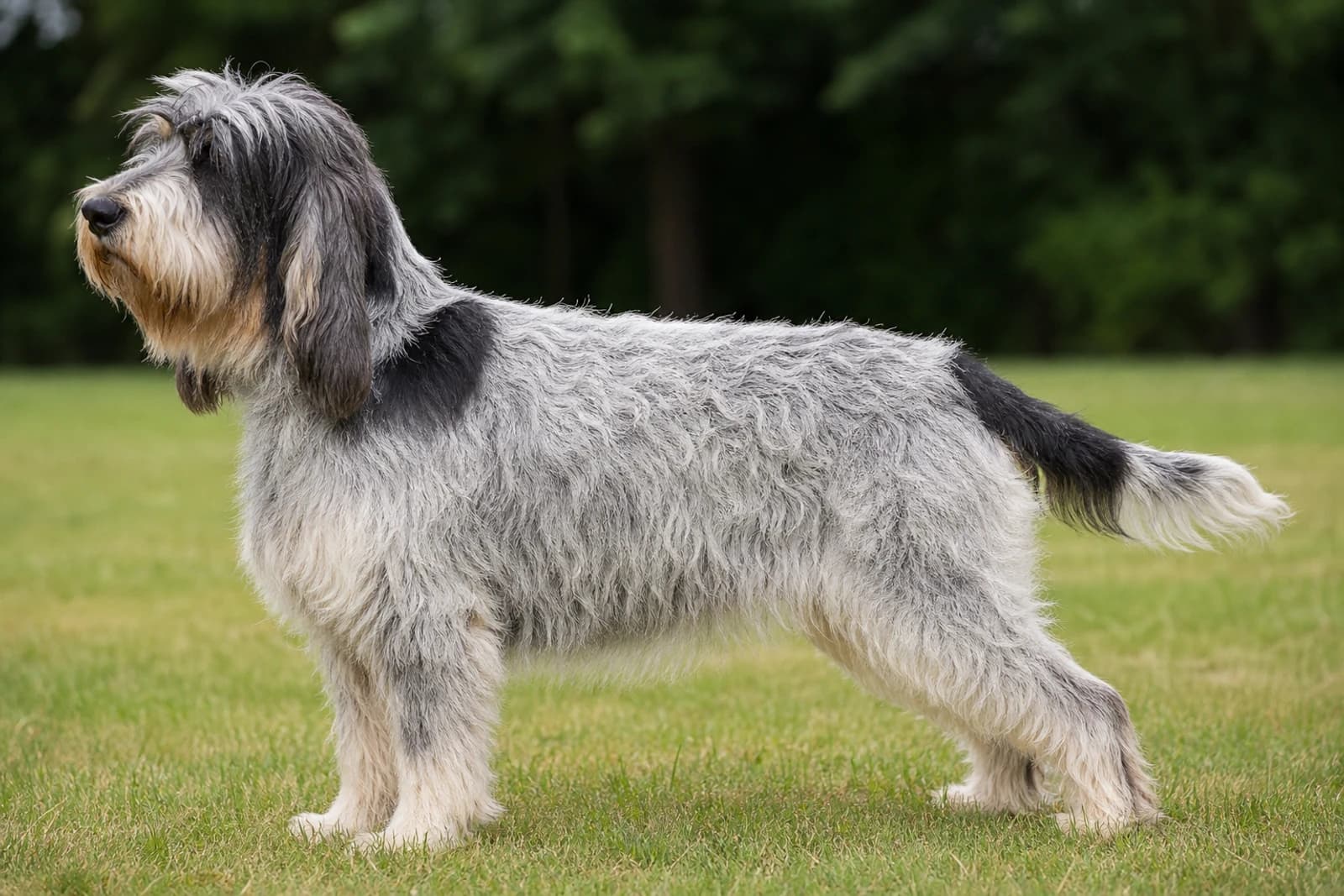
The Grand Basset Griffon Vendéen is a lively, rough-coated French scent hound, built for endurance over rough terrain. Standing 15–17 inches tall, this medium-sized, sturdy dog is cheerful, affectionate, and outgoing with family, yet independent and stubborn. They thrive with active owners who can provide daily exercise and secure space, as they follow their nose with enthusiasm. Their melodious bark and pack-hound heritage make them ideal for experienced owners or families with older children, but their prey drive may challenge homes with cats.
At a glance
- Size
- Medium
- Height
- 15–17 in
- Weight
- 40–44 lb
- Life span
- 12 years
- Coat colors
- White & Orange, White & Lemon, White & Black, Tricolor, White & Grizzle
- Coat type
- Rough, dense, weatherproof double coat
- Group
- Scenthounds
How much does a Grand Basset Griffon Vendéen cost?
Adopt / rescue
$75–$400
Usually includes spay/neuter, first shots, and a microchip.
Buy from a breeder
$700–$2,000
From a reputable, health-testing breeder.
Approximate USD. Prices vary widely by region, breeder, pedigree, age, and coat colour — adopting is the lower-cost and recommended route. Avoid suspiciously cheap “breeders”; they’re often puppy mills.
Estimate the full cost of a Grand Basset Griffon Vendéen →Grand Basset Griffon Vendéen photos
Views
Front, side, rear and top — the full silhouette.Poses
How the breed sits, lies, moves and plays.Puppy to senior
The breed across its whole life.Expressions
The breed’s range of moods.Close-up details
Eyes, ears, nose, paws, tail and coat.Coat colors
The breed’s recognized colors.Click any photo to enlarge. We show the Grand Basset Griffon Vendéen from every angle — three views, poses, life stages, expressions, close-ups, coat and colors.
Appearance & size
A low-slung, rectangular hound built to bust through brambles — that’s your first impression. The Grand Basset Griffon Vendéen stands just 15 to 17 inches at the shoulder, but stretches out long, and at 40 to 44 pounds he carries surprising heft for his height. You’ll feel it when you go to lift him into a car. He’s a solid medium dog, never leggy, with a substantial barrel chest and good bone.
The overall shape
What you see from the side is a long, level topline with just a hint of arch over the loin, and a deep brisket that drops to elbow level. The ribs are well sprung, giving that broad chest plenty of capacity for a houndy voice. His outline runs much longer than tall — the proportion is roughly 7 to 5 — so he travels low to the ground without the extreme shortness of a Basset Hound. The belly tucks up slightly, but this is no whippet waist; the whole package is workmanlike and muscular.
Coat and color
The coat is the definition of “rough and ready.” A double coat with a harsh, wiry outer layer and a dense undercoat, it’s built to shed water and ignore sticks and thorns. To the touch it feels crisp, never silky or woolly. What people remember, though, is the shaggy furnishings: a bushy mustache and beard, a fall of hair over the eyes that doesn’t quite hide the expression, and longer fringe on the ears.
Colors are predominantly white with any combination. The classic tri-color — white with black patches and tan points above the eyes, on the cheeks, and under the tail — is the one you see most. White and orange, white and lemon, and white with grizzle or sable also show up. Heavy ticking is common, so a dog might look almost blue from a distance when the white parts fill with tiny dark spots. The nose is black on tri-colors, but a brown nose is acceptable on orange or lemon coats.
The hallmark face
If you crouch down to his level, you’re met with an earnest, slightly disheveled expression. The head is longish, with a moderately domed skull and a defined stop. Eyes are dark, oval, and set deep under those prominent brows, which makes the look a little serious — until the tail wags. Ears are set low, long enough to reach the tip of the nose when pulled forward, and hang in soft folds with a fringe of longer hair. The mustache and beard make the muzzle appear broad and square, though the actual jaw is strong and scissor-bitten.
From front, side, and rear
From the front, the stance is wide and grounded: straight forelegs with good bone, elbows tight to the chest, and big, compact feet with hard pads. The chest is deep and oval, with a pronounced breastbone that’s easy to see. Move around to the side and the long-ribbed, slightly decongested body dominates, ending with a tail set high and carried like a saber — thick at the base, tapering, and usually in motion. From behind, the hindquarters are muscular without being bulky, the legs parallel, and the hocks well let down. The whole picture is a dog that looks like he could trot all day through heavy cover and still have energy to spare.
History & origin
The Grand Basset Griffon Vendéen comes straight out of the thick, thorny scrubland of France’s Vendée region — a coastal area south of Brittany known for its bocage, a patchwork of small fields separated by dense hedgerows and brambles. Translate the name word by word: grand (large), basset (low-set), griffon (wire-coated), Vendéen (from the Vendée). It’s a description as much as a name.
This dog was never meant for the horseback hunter. It was built for a person on foot. The original Grand Griffon Vendéen was a leggy, fast scenthound, great for open country but too tall and quick for the tangled undergrowth of the Vendée. In the 19th century, breeders began selecting for shorter legs to create a basset type — a hound that moved deliberately, keeping its nose buried in the scent without outpacing a walking human. The result was a tough, persistent pack hunter that specialized in rabbit and hare but could also handle larger game. Those harsh, wiry coats weren’t an accident either; they shed water and protected the dog from thorns that would shred a softer-coated breed.
For decades the Grand Basset and its smaller cousin, the Petit Basset Griffon Vendéen, were shown as two height varieties of one breed. That changed in the 1950s when the French kennel club officially split them. The PBGV went on to gather a strong international following. The GBGV nearly didn’t make it. World War II decimated many European breeds, and the Grand Basset was hit hard. A handful of dedicated breeders pulled the dog back from the brink, but numbers remained low.
In France, the GBGV has always been first and foremost a working scenthound, and plenty of them still do what they were bred for. Elsewhere, the breed has gradually shifted toward life as a family companion. The American Kennel Club welcomed the Grand Basset Griffon Vendéen into its Hound Group in 2018 after a stint in the Miscellaneous Class. Even so, it’s not a dog you’ll spot at every dog park. The breed’s small gene pool and niche status mean finding a responsible breeder — especially one who screens for health issues and doesn’t chase trends — often takes time and a willingness to get on a waiting list.
Temperament & personality
A Grand Basset Griffon Vendéen is a scenthound through and through — a big personality packed into that 40-pound, tousled frame. Bred to work in packs, these dogs are deeply social with their own people, but they’re not Velcro dogs. Affection comes on their terms: a good lean against your leg, a happy tail-thumping welcome, then off to patrol the yard with their nose glued to the ground. Expect a dog who loves you without needing to be on top of you.
That independence has a famous flip side. When a GBGV locks onto a scent, the rest of the world disappears. You can call, wave a treat, do a backflip — and you’ll still be talking to his rear end as he follows a trail. This single-mindedness isn’t disobedience; it’s the engine that made the breed. Smart but strong-willed, they respond best to patient, consistent training that respects their nose-driven agenda rather than trying to overpower it. Force shuts them down; a partnership built on clear routines and good-natured persistence wakes them up.
With family, most are calm and gentle after exercise, and they’re usually tolerant of children, but the scenthound curiosity and a sturdy body mean things can get knocked over in a moment of excitement. Teach kids to never interrupt a dog while eating, and make sure your GBGV has a quiet spot to enjoy meals undisturbed. If he stiffens, stops chewing, and gives you a hard stare, that’s a clear “back off” signal — respect it and everyone stays safe.
Inside, they’re alert watchdogs. A strange sound or an unfamiliar whiff at the front door triggers a deep, rolling bark that says “I’m aware, and now you are, too.” They aren’t guard dogs, but that vocal alarm comes with the territory. Left alone for long stretches, the barking can morph from an alert into an anxiety-driven behavior. A bored, lonely GBGV may also redesign your baseboards. Puppies chew to explore and ease teething pain; adults keep their jaws strong and teeth clean by gnawing hard objects. Provide rugged chew toys and rotate them, and use a citrus peel spray or a vinegar mix on off-limits items to redirect the destruction.
Speaking of smell — everything is scent to this dog. Urine marking indoors can become a habitual map. A single accident leaves a scent cue they’ll recognize and revisit, so clean it immediately with an enzymatic cleaner, then follow with a vinegar spray (white or cider) to neutralize the odor and break the cycle. When you catch them eliminating outdoors, reward that moment with a high-value treat; positive reinforcement builds the habit far faster than punishing mistakes. And in less-used rooms, the absence of your family’s scent may actually invite marking, because dogs define “home” partly by where you smell of you.
Quirks? You’ll discover plenty. A GBGV’s idea of fine fragrance is a dead worm or fox scat, and they’ll happily roll in it. This isn’t rebellion — it’s a throwback to scavenger ancestors. Some researchers compare it to human perfume use; your dog simply revels in the stench the way you enjoy a bouquet of flowers. Keep dog shampoo on hand.
Reading body language will save you both a lot of headaches. A forward lean with a rigid body and a direct, fixed stare often precedes a snap or a lunge. A relaxed, loose posture and soft eyes mean your dog is in a good place. Lip licking, yawning, and turning the head away are calming signals — his way of saying “I need a minute.” Learn to spot them, and you’ll sidestep unnecessary stress. In the end, a Grand Basset Griffon Vendéen gives back what you put in: a sense of humor, a loyal walking companion, and a dog who thinks a 60-minute sniffari is a fair trade for a nap at your feet. A securely fenced yard isn’t a luxury with this hound — it’s your peace of mind when a squirrel dares to pass through.
Good with kids, dogs & other pets
A Grand Basset Griffon Vendéen’s pack-hound heritage and easygoing nature make him a natural fit for homes with kids and other dogs. But “good with” doesn’t happen by accident — early socialization and sensible ground rules turn a tolerant pup into a truly reliable family member.
With children
These 40–44 lb dogs are patient and non-aggressive, sturdy enough to handle robust play without bowling a toddler over. Still, supervision matters. Young children need to learn not to tug long ears, climb on the dog’s back, or encourage jumping off furniture, which can strain a GBGV’s long spine. The breed craves company and doesn’t do well left alone in the backyard while the family is away. If your household is gone during the day, arrange a midday walk or doggy daycare to head off the distress that can come from extended isolation.
With other dogs
Bred to hunt in packs, GBGVs generally thrive with canine housemates. They read social signals well when properly socialized, and they rarely start trouble. Still, always introduce new dogs on neutral ground, feed them in separate spots, and watch for resource guarding until everyone is comfortable. Early, positive exposure to many calm adult dogs teaches a puppy how to navigate the dog world politely.
With cats and small pets
The scenthound nose never really clocks out. A GBGV may happily share a home with a cat he was raised alongside, but outdoor cats or a family hamster zipping across the floor can trigger a hardwired chase instinct. Keep pocket pets in secure enclosures. When introducing a GBGV to an indoor cat, do it slowly across a few weeks, using baby gates and supervised face-to-face time, and never leave them alone together until you’re certain the cat has a safe escape route the dog can’t follow.
Socialization that makes the difference
The sensitive window for raising a bombproof pup runs from about 3 to 16 weeks of age. During that stretch, expose your puppy to a wide range of friendly people — including hat-wearing strangers, toddlers who move unpredictably, and kids on bikes — plus calm adult dogs, traffic sounds, slick floors, and grooming tools. Short, positive encounters now build a brain that defaults to curiosity rather than fear. Even after the window closes, daily reinforcement helps an adult dog stay steady. If you adopt an older GBGV who missed early experiences, meet him where he is. Forcing him into crowded dog parks or loud gatherings can backfire and deepen his anxiety. Instead, let him set the pace, celebrate small brave moments, and use food to pair new situations with good things. The goal is a dog who takes life’s curveballs in stride, and that resilience is something you build together.
Trainability & intelligence
The Grand Basset Griffon Vendéen is smart but in no rush to prove it to you. He’ll learn a new cue in a handful of repetitions — then weigh the reward against whatever scent just drifted past his nose. Training him means accepting that his first job, always, is following a trail. You’re not fighting stubbornness so much as a single-minded instinct that’s been honed for centuries.
Motivation matters more than repetition. High-value treats — tiny pieces of chicken, cheese, or liver — get his attention. A stern voice doesn’t. Even the best snack loses its power when a rabbit bolts, so keep sessions lively and short. Five minutes of focused work beats fifteen minutes of bored drilling. When his eyes glaze over, he’s already found a more interesting smell.
The off-leash reality
Reliable recall is the GBGV’s biggest training hurdle. When his nose locks on, his ears turn off. You’ll need a long line in unfenced areas for months, maybe years. Some owners never trust a full off-leash recall in open spaces, and that’s not a failure — it’s respecting the dog’s wiring. Every successful recall needs a jackpot-level reward, every single time, or he’ll calculate that checking in isn’t worth abandoning the scent trail.
What works
- Start early and stay patient. Begin puppy socialization between 8 and 16 weeks — new people, calm dogs, different surfaces, everyday sounds. A GBGV who misses that window can become reactive and vocal in unfamiliar situations.
- Ban harsh corrections. He’s more sensitive than his rugged appearance suggests. Punishment shuts him down and breaks trust. Instead, mark desired behavior instantly with a cheerful “yes!” and follow with food or a quick game of tug.
- Be boringly consistent. If one person lets him jump up and another doesn’t, he’ll jump on everyone. Agree on house rules early and stick to them.
- Work his nose, don’t fight it. Hide treats around the house, teach “find it,” scatter his kibble in the yard. Scent games tire him out and sharpen his focus more than endless obedience drills.
A treat pouch, a long line, and a patient sense of humor will take you further than any rigid training plan. Give him a job that involves his nose, and he’ll surprise you with just how quick he is.
Exercise & energy needs
The Grand Basset Griffon Vendéen is a working scent hound through and through. A quick trot around the block won’t cut it. Plan on at least 60 to 90 minutes of daily exercise, split into a morning and late afternoon outing. This isn’t just leash mileage — most of that time should let him use his nose. Long, meandering sniff walks, exploring new trails, or a safely fenced field where he can follow scent trails at his own pace are what truly satisfy him.
Don’t expect a steady jogging partner. He’ll plant that bearded snout into every interesting smell and stubbornly decide the tempo. Because of that single-minded nose, reliable off-leash recall takes serious training; secure fences are non-negotiable.
A tired GBGV is a well-behaved GBGV, and mental work counts just as much as physical. Swap one walk for a scent work session indoors, a puzzle toy stuffed with his meal, or a tracking class. Without that brain drain, a bored hound becomes a champion counter-surfer, baying at the fence line for entertainment.
His long, low build comes with a real caveat. Like many dwarf-breed dogs, he can be prone to intervertebral disc problems. Keep him lean, use ramps for furniture and vehicles, and avoid high-impact jumping or hard surfaces for rough play. The sports this breed truly shines in — tracking, barn hunt, and scent work — play to his strengths while keeping his spine safe and his tail wagging.
Grooming & coat care
The shaggy, tousled look of a Grand Basset Griffon Vendéen comes from a harsh, wiry double coat that rarely stops working. If you skip a day, you'll feel it — dead undercoat gets trapped in that rough top layer and turns into mats overnight. Plan on a solid daily brush-out with a metal slicker brush that has rounded pins, followed by a wide-toothed comb to catch tangles near the skin. Work in sections: part the coat and go layer by layer, especially through the dense neck, chest, and rear feathering.
Seasonal shedding hits hard. Twice a year, usually spring and fall, the soft undercoat blows out in clumps. During those few weeks, bump up to twice-daily sessions and a warm bath to loosen the dead hair. Don't be surprised if you pull out enough fluff to fill a small trash can — it's normal, and outdoor exercise actually helps speed up this messy turnover.
Bathe only when they're truly dirty or start to smell gamey, roughly every 6–8 weeks. Over-washing strips the natural oils that keep that rough coat weather-resistant. Use a dog shampoo formulated for wire coats and towel dry; vigorous blow-drying can puff up the texture and hide tangles. For a truly functional, dirt-shedding coat, many owners opt for hand-stripping — manually plucking dead guard hairs a few times a year to preserve the harsh color and texture. It’s labour-intensive. A practical compromise is to have a groomer clip the coat short every 3–4 months, but know that clipping softens the hair permanently and it’ll grab more burrs and mud.
Those long, hanging ears are trouble magnets. Lift them every day to sniff for yeasty smells or redness, and clean with a vet-approved drying solution once a week. After a romp through wet grass or a swim, a quick wipe underneath prevents a hot, damp infection. Nails grow fast; clip them as soon as you hear a click on hard floors, typically every 3–4 weeks. For teeth, daily brushing beats a dental bill later, but a dental chew and annual vet check are the bare minimum.
Shedding & allergies
Brushing your GBGV becomes a routine, not a once-in-a-while task. This is a double-coated hound with a rough, harsh outer layer and a soft undercoat that sheds lightly year-round, then unloads in two seasonal blowouts (spring and fall). During those weeks, you’ll pull tufts of undercoat out with your fingers if you skip a grooming session. The wiry topcoat grabs onto fabric, so don’t be surprised to find hair embedded in upholstery even after vacuuming.
Drool isn’t a faucet like with some large hounds, but the trademark beard and mustache act like a sponge. After drinking, your dog will drip water across the floor, and you’ll wipe a wet face regularly. Post-meal beards need a quick towel-off, too.
If allergies are a dealbreaker in your household, this breed lands squarely in the “not recommended” column. No dog is truly hypoallergenic, but the GBGV produces plenty of dander and shedding hair that triggers reactions. The best you can do is brush them outside two to three times a week with a slicker brush and an undercoat rake, step it up to daily during blowouts, and keep them off your bed. Even then, a lot of hair simply becomes part of your life.
Diet & nutrition
Your Grand Basset Griffon Vendéen carries a long back and short legs, so the single most powerful thing you can do for her joints and spine is keep her lean. A trim 40–44 pound body has a dramatically lower risk of disc trouble than even a few extra pounds layered on.
Many GBGVs live for their next meal and will happily eat themselves into trouble. Free-feeding is out—measure both meals, and don’t rely on the bag’s suggestion alone. Start with about 2 to 2¼ cups of high-quality dry food per day for an adult (split into two meals), then tweak based on how her ribs feel. You want to feel them easily under a thin cover of flesh, not see them poking out and not have to dig. If you feed a homemade diet, a solid ratio is roughly 60% meat (raw or lightly cooked), 20–30% vegetables and fruit, and the remaining 10% from eggs, grains like pearl barley or white rice, or plain yogurt. Blend or purée vegetable-heavy meals—a dog’s jaw only chops vertically, and blending helps them pull out more nutrients.
- Puppies: Four evenly spaced meals a day until 4 months, then three meals until 6 months, then two like an adult. Transition slowly onto a new food, starting with lightly cooked and puréed meats, fish, fruits, and vegetables or a high-quality commercial puppy formula. You can introduce raw chicken wings around 12 weeks, under your direct supervision.
- Seniors: Switch to two or three smaller meals, keep weighing your dog regularly, and gradually cut back portions as her natural activity dials down. If teeth are missing, a puréed meal aids absorption and comfort.
Because these hounds often inhale food, a puzzle bowl or snuffle mat does double duty—it slows her down and works her brain. Never feed from the table; once begging gets a foothold, it’s a grind to undo. Put any leftover dog-safe veggies, cooked fish, or lean meat in her own bowl.
One sharp caveat: steer clear of rich, fatty scraps—especially after holiday meals. A sudden high-fat load can trigger pancreatitis, and a scent hound’s enthusiasm for “people food” makes that a real risk. If you need a quick, healthy meal base, unsalted water from cooking vegetables works fine as a stock, and you can combine a can of water-packed fish, a scrambled egg, and some cooked grain in minutes.
Health & lifespan
The Grand Basset Griffon Vendéen typically lives around 12 years, and plenty of them stay vigorous well into their teens — provided a few breed-specific weak spots get the attention they deserve.
That long, low silhouette is part of the breed’s charm, but it’s also a structural stress point. Intervertebral disc disease (IVDD) isn’t as rampant as in a Dachshund, yet it’s common enough that keeping your dog lean is non-negotiable. A GBGV at 40–44 pounds should have visible waist tuck and ribs you can feel without drilling down. Extra weight amplifies the load on the spine and makes every jump off the couch a gamble.
Hip dysplasia and patellar luxation turn up in some lines. Reputable breeders won’t skip OFA or PennHIP hip screenings and patella checks before breeding. Ask for the paperwork. Elbow dysplasia crops up less often but is still worth a conversation with the breeder.
Those heavy, low-set ears are a scent hound’s signature — and a moisture trap. After a hike through wet brush or a bath, dry the inside of the ear flap thoroughly. Weekly ear checks for redness, gunk, or a yeasty smell help you catch an infection before it turns painful. Skin allergies and seborrhea can set up house in the same oil-rich environment, so a dog who’s scratching more than usual may need a diet or environment adjustment.
Eye concerns are taken seriously by good breeders. Primary lens luxation, cataracts, and progressive retinal atrophy (PRA) all appear in the breed. Annual CERF or OFA eye exams by a veterinary ophthalmologist are smart, even when the parents tested clear.
Epilepsy surfaces in some GBGV families — there’s no genetic test yet, so ask whether seizures have shown up in close relatives. The breed can also be food-obsessed, and a dog who inhales his dinner in seconds might be at slightly higher risk of bloat. Two smaller meals and a rest period after eating trim that risk.
Because these hounds live nose-down in tall grass and woodlands, monthly heartworm prevention during mosquito season and a month beyond it is basic safety. Stay current on rabies — legally required and incurable once symptoms hit. Schedule an annual wellness exam; once your dog hits senior status, twice-yearly visits with bloodwork catch thyroid trouble or other creeping problems early. A GBGV who stays trim, gets those ears dried out, and has a consistent screening routine can easily give you a decade-plus of scent-obsessed joy.
Living environment
A securely fenced yard isn’t a nice-to-have with a Grand Basset Griffon Vendéen — it’s the starting point. This is a scenthound built to follow his nose, and when a rabbit or squirrel streaks through, he’ll tune out everything else, including you. An underground or flimsy 3-foot fence won’t cut it; a 6-foot physical barrier he can’t dig under is the only reliable safety net. That said, he’s not a dog who needs acreage to run laps. A modest yard gives him space to sniff, track, and puzzle over fresh scent trails, which tires out his brain far better than a long, boring walk.
Apartment life is possible but comes with a hard reality check: this breed bays. He’s a pack hound designed to be heard from a distance, and his voice carries. If you live in attached housing, your neighbors will know. A townhouse or single-family home with some buffer is a much easier fit. Inside, he’s a medium-sized dog (40–44 pounds, 15–17 inches tall) who doesn’t need palatial rooms, just a soft spot near his people.
Speaking of which, he does not do well left alone for long stretches. Pack hounds bond tightly. Hours of solitude can lead to mournful howling, destructive chewing, or indoor accidents — not out of spite, but anxiety. Crate training, a predictable routine, and leaving him with treat-release puzzles and frozen Kongs help, but the real solution is another dog. He’s genetically wired to live in a pack, so a compatible canine buddy often settles him far more effectively than any gadget.
Climate-wise, his rough, wiry double coat gives him decent insulation against damp brush and mild cold, but he’s no husky. He’ll need a dog coat and limited exposure when temperatures drop below freezing for more than a quick outing, and in summer heat, restrict vigorous sniffing sessions to early morning and evening. His long body shape also means you should block access to steep stairs and never encourage jumping from furniture or tailgates — spinal vulnerabilities run in basset breeds, so low-impact, nose-first exercise keeps his back safe and his spirit calm.
Who this breed suits
If you’ve got a fenced yard, a sense of humor about selective hearing, and a genuine love for a dog that follows its nose before your commands, a Grand Basset Griffon Vendéen could be your kind of chaos. These scenthounds are pack-driven, cheerful, and relentlessly curious — not remotely the couch-potato basset some people expect. At 40–44 pounds and 15–17 inches of shaggy muscle, they’re sturdy enough to knock over a toddler in a burst of happy enthusiasm, but also gentle enough to snuggle the whole family after their walk.
Who might be a great match
- Active families with kids and another dog. The GBGV thrives in a busy household where it’s rarely the only pet. Raised with children, they’re patient and playful. Expect noise, wrestling, and a dog that views your kid as a packmate. Supervise early interactions, because the wiggly body can be a little steamroller.
- First-time owners who don’t care about polished obedience. If you’re okay with a dog that sometimes acts like it’s never heard the word “come,” but you’ll cheerfully stroll for an hour-plus each day and laugh off the mischief, you’ll be fine. These dogs respond to food and patience, not drill-sergeant training.
- Active singles or couples with a secure yard and flexible schedules. The breed hates being alone for long stretches. If someone is home a lot, or you can manage a midday walk and plenty of together-time, the dog will pay you back with clownish devotion. A fenced yard is non-negotiable — a scent trail in the neighbor’s yard erases all recall.
- Active seniors who walk daily and are steady on their feet. A 40-pound hound on a scent can pull like a tractor, so you need the strength and balance to handle it. If you can, and you’re up for brushing that shaggy coat a few times a week and coping with the ever-present muddy beard, the companionship is immense.
Who should think twice
- Apartment dwellers or anyone without a safely fenced space. The GBGV bays, howls, and goes on vocal scent-rants. Close neighbors will not appreciate the opera. And without a yard to burn off nose-energy, these dogs get increasingly destructive.
- The off-leash dreamer. You’ll likely never have a dog that hikes reliably next to you on a forest trail. Its nose wins every time. If the image of a dog bounding back on command is central to your dog-owner identity, skip this breed.
- Clean freaks or furniture perfectionists. That tousled coat drags in leaves, burrs, and mud. Drool happens. Shedding is moderate but constant. The beard stays damp. You’ll vacuum more than you’d like and learn to live with a faint hound aroma.
- Sedentary households looking for a low-key basset. A GBGV needs a solid 60 minutes of sniff-heavy walking every day, plus brain games or scent work. Without that, they channel their frustration into digging, chewing, and serenading the neighborhood.
If your life can handle a lovable, stubborn loudmouth who lives for pack walks and scent trails, you’ll get a dog that makes every day feel like a small adventure. Just be honest about the noise, the mud, and the recall you’ll probably never have.
Cost of ownership
You’ll likely pay $1,500 to $2,500 for a well-bred Grand Basset Griffon Vendéen puppy from a breeder who screens hips, eyes, and patellas. Because the breed is still uncommon in the U.S., expect a waitlist — and slightly higher prices for show-prospect or dual-purpose lines. A lowball Craigslist price usually skips those genetic clearances, and that bargain can bite you later.
Month-to-month, plan on $150 to $250 in ongoing costs, with grooming and insurance making the biggest swing.
- Food: $40–60 a month for a quality kibble suited to a 40–44-pound dog. These hounds tend to live nose-to-ground, so treats for training add another $10–15. Just keep an eye on the scale — the breed puts on weight easily.
- Grooming: The rough double coat needs hand-stripping to stay correct. A professional groomer every 6–8 weeks runs $60–90 per visit, or about $30–45 a month. You can learn to strip the coat yourself with a stripping knife and a slicker brush, which turns the recurring cost into a one-time $50 tool kit and your time.
- Vet & prevention: Year-round flea, tick, and heartworm prevention for a medium dog costs $25–40 a month. An annual exam with vaccines spreads out to roughly $20–30 a month. Add pet insurance at $35–55 a month — a mid-level plan cushions you against the breed’s known risks (epilepsy, hip dysplasia, glaucoma) where a single emergency surgery can hit $3,000–5,000. Without insurance, stuff away at least that much in a separate savings account.
- Initial gear: Crates, a sturdy leash, a harness, bed, bowls, and puzzle toys to entertain that tracking nose run $200–500 the first month. A 6-week obedience class ($100–200) pays off fast — this is an independent hound who benefits from early focus work.
None of this includes the occasional replacement of a shredded dog bed or the fence reinforcement when your GBGV decides the neighbor’s rabbit is worth digging for.
Choosing a Grand Basset Griffon Vendéen
Start your search early. The Grand Basset Griffon Vendéen is a rare scenthound in the U.S., so a responsible breeder rarely has puppies waiting on the ground. Expect a waitlist — and a questionnaire — because a good breeder wants to know you’re ready for a vocal, nose-driven dog who can hit 44 lb of muscle.
Breeder or Rescue?
You’re far more likely to go the breeder route. GBGVs rarely land in shelters, but the breed’s national club does maintain a rescue network. If you pursue rescue, ask about the dog’s history with cats, kids, and off-leash reliability; many come from hunting homes and have serious small-animal drive.
Health Clearances That Matter
A 12-year lifespan means you want a puppy built to last. Insist on verifiable results — not just a vet check. Ask for:
- Hips – OFA or PennHIP evaluation; fair or better.
- Elbows – OFA clearance; elbow dysplasia can plague the breed.
- Eyes – An annual CAER exam from a veterinary ophthalmologist, not a routine vet eye check. Watch for cataracts and progressive retinal atrophy.
- Patellae – OFA patellar luxation clearance.
- Cardiac – An echocardiogram clears the dog of inherited heart issues.
- Thyroid – OFA thyroid panel within the last year.
Bloat is a known killer in deep-chested breeds. No genetic test exists, but ask bluntly if any close relatives died of GDV. A breeder who shrugs it off is a red flag.
Red Flags You Can’t Ignore
Run from anyone who sells puppies on a credit card swipe without a real conversation. Serious breeders don’t push “rare” color markups, ship pups sight-unseen to a stranger, or run multiple litters of different breeds under one roof. If you can’t meet at least the dam on site — kennel or home — and see clean, spacious runs and dogs who approach willingly, you’re not in the right place.
Picking Your Puppy
A well-bred GBGV pup is bold and nose-first. At 7–8 weeks, you should see a curious, wiggly puppy who engages with you, not one cowering in the corner or snarling over a toy. Watch the mother’s temperament; she’s your best window into your future dog’s adult personality. Ask how the litter was raised — an ideal breeder raises pups underfoot with household noises, visitors, and early crate introduction. The breeder should hand you a health guarantee that includes a take-back clause for the dog’s lifetime. If they can’t produce OFA links you can look up yourself, walk away.
Pros & cons
-
Warm, easygoing temperament that slots right into family life — genuinely affectionate and patient with gentle kids, rarely sharp or snappy.
-
Low-shedding rough coat means less fur on the sofa. A quick brush two or three times a week keeps things tidy.
-
True pack-hound nature: they typically get along beautifully with other dogs and see them as default friends, not rivals.
-
Medium size (40–44 pounds, 15–17 inches) hits a sweet spot — sturdy enough for long rambles but compact enough to curl up in your lap afterward.
-
An hour of walking with plenty of sniffing usually satisfies them; they’re happy to crash indoors rather than pace the house looking for a job.
-
Rock-solid prey drive. A squirrel, cat, or stray leaf blowing across the yard can send them off in full voice at surprising speed. A fenced yard is mandatory, and off-leash reliability is a long shot for most.
-
Loud, rolling bay — delightful if you love a classic hound voice, a serious headache in an apartment or thin-walled townhouse.
-
Independence you’ll need to laugh about. They’re smart but not eager to please; training takes food motivation, consistency, and a genuine sense of humor. Housebreaking often lags behind other breeds.
-
Can be noisy when left alone and prone to separation anxiety without patient, gradual conditioning to solo time.
-
Long, droopy ears trap moisture easily, so ear infections are a real risk. Weekly cleaning and drying need to become routine.
-
That shaggy wire coat mats without regular hand-stripping or clipping — budget for a pro groomer or be ready to learn the skill yourself.
Similar breeds & alternatives
Petit Basset Griffon Vendéen
The most direct swap if you want the same shaggy, big-eared scenthound in a light, portable package. At 13–15 inches and 25–40 pounds, the PBGV is essentially a scaled-down GBGV—same rough double coat, same merry stubbornness, and the same borderline-obsessive nose. You lose a bit of the GBGV’s deeper bark and sturdiness on rough trails, but gain a dog that’s easier to scoop into the car and can thrive in a smaller footprint. Coat care is identical: both need hand-stripping or regular carding to stay healthy.
Basset Hound
If the low-slung silhouette appeals but you’d rather trade a GBGV’s wiry coat and higher drive for a couch-hound with jowls, the Basset Hound is the classic alternative. Standing up to 15 inches and weighing 40–65 pounds, he’s heavier, swims in loose skin, and sheds constantly. A Basset Hound is content with a short, meandering walk where a GBGV demands a solid hour of off-leash running or sniffing. That calm comes with epic drool, booming bays, and a stubborn streak that makes a GBGV look like an obedience prospect.
Otterhound
On the opposite end of the size scale, the Otterhound is the GBGV’s giant, muddy cousin. Rough double coat, same independent, good-natured scenthound brain—but standing 24–27 inches and tipping 80–115 pounds. Otterhounds live for water, drag in debris, and need real space to stretch. The GBGV packs that gregarious griffon attitude into a manageable 40-pound body. If you have the room and a tolerance for a lovable, damp clown, the Otterhound delivers the same vibe in supersize.
Basset Fauve de Bretagne
A lesser-known French relative that hits a middle ground. At 12–15 inches and 35–40 pounds, this rough-coated scenthound brings a feistier, terrier-like spark to the basset formula. Its coat is harsh and warm fawn, and it’s often more reserved with strangers than the typically outgoing GBGV. The GBGV is a bit larger, usually wears a white-and-orange or tricolor coat, and tends to be more easygoing overall. Availability in the U.S. makes the GBGV far easier to find, but a Basset Fauve feels like a tighter-wound version of the same wire-haired package.
Beagle
When a scenthound companion is the priority and you don’t want a rough coat, the Beagle is the easy-to-find pick. At 13–15 inches and 20–30 pounds, Beagles are smooth, shedding machines with an even more vocal, high-pitched bark and a frantic, nose-first energy that can make a GBGV seem calm by comparison. You’ll still get that joyful “nose-on-a-leash” walk, but without the need for coat stripping. The GBGV is sturdier, sheds far less, and typically drools less—though you’ll be dealing with that wiry coat regularly.
Fun facts
- Originally bred to hunt hare in the Vendée region of France.
- Their name translates to 'Large Low Griffon Vendéen'.
- They are known for their distinctive, melodious baying voice.
Frequently asked questions
- Are Grand Basset Griffon Vendéens good with children?
- The Grand Basset Griffon Vendéen is typically friendly and playful, making it a good companion for kids. Supervision is recommended, and early socialization helps ensure gentle interactions.
- Do Grand Basset Griffon Vendéens shed a lot?
- This breed has a wiry, medium-length coat that sheds relatively little. Regular brushing minimizes loose hair and keeps the coat in good condition.
- How much exercise does a Grand Basset Griffon Vendéen need?
- As a scenthound, it needs moderate daily exercise, such as walks and scent-focused play. A securely fenced area is ideal to prevent wandering when an interesting smell catches its nose.
- Are Grand Basset Griffon Vendéens easy to groom?
- Grooming is straightforward, requiring weekly brushing and occasional hand-stripping to maintain the coat’s texture. Baths are needed only when necessary, and regular ear checks help prevent infections.
- Can a Grand Basset Griffon Vendéen live in an apartment?
- This breed can adapt to apartment living if given enough exercise and mental stimulation, but its tendency to bark or bay may cause issues in close quarters. A home with a yard is often a better fit.
- Do Grand Basset Griffon Vendéens bark a lot?
- As a scenthound, the Grand Basset Griffon Vendéen can be vocal, using its distinctive bark or bay to alert or express excitement. Training can help manage barking, but some noise is natural to the breed.
Tools & calculators for Grand Basset Griffon Vendéen owners
Quick estimates tailored to Grand Basset Griffon Vendéens — pre-filled with this breed’s size where it matters.
Articles & stories about the Grand Basset Griffon Vendéen
Sources & standards
This profile follows recognized breed standards from the American Kennel Club (AKC) and the Fédération Cynologique Internationale (FCI), along with established veterinary and breed-club guidance. These describe general breed tendencies — every dog is an individual.
Owner stories
Have a Grand Basset Griffon Vendéen? Share your experience — grooming tips, personality quirks, anything goes.