

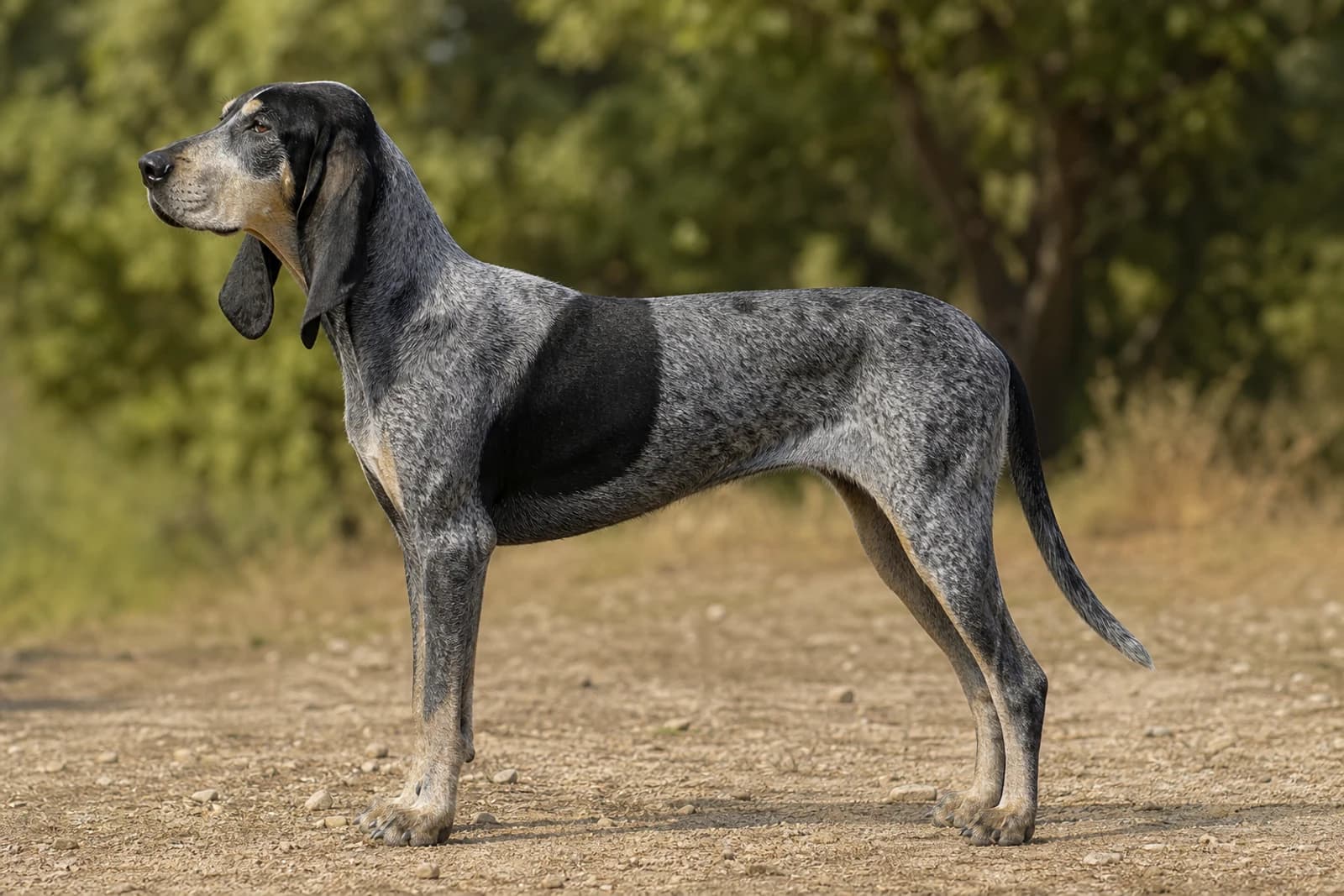
The Grand Bleu de Gascogne is a giant scent hound from France, recognized for its blue-mottled coat and deep bay. Best suited for experienced owners with large, fenced yards, this breed needs ample exercise. Gentle and affectionate with family, including children, it loves companionship but can be independent. As a pack hound, it gets along with other dogs but may chase smaller animals. Its high energy and strong hunting instincts require daily vigorous activity. With patient training and socialization, this loyal hound makes a devoted companion.
At a glance
- Size
- Giant
- Height
- 24–28 in
- Weight
- 80–120 lb
- Life span
- 12–14 years
- Coat colors
- Blue mottled (black and white) with tan points
- Coat type
- Short, dense, weather-resistant
How much does a Grand Bleu de Gascogne cost?
Adopt / rescue
$75–$400
Usually includes spay/neuter, first shots, and a microchip.
Buy from a breeder
$700–$2,000
From a reputable, health-testing breeder.
Approximate USD. Prices vary widely by region, breeder, pedigree, age, and coat colour — adopting is the lower-cost and recommended route. Avoid suspiciously cheap “breeders”; they’re often puppy mills.
Estimate the full cost of a Grand Bleu de Gascogne →Grand Bleu de Gascogne photos
Views
Front, side, rear and top — the full silhouette.Poses
How the breed sits, lies, moves and plays.Puppy to senior
The breed across its whole life.Expressions
The breed’s range of moods.Close-up details
Eyes, ears, nose, paws, tail and coat.Coat colors
The breed’s recognized colors.Click any photo to enlarge. We show the Grand Bleu de Gascogne from every angle — three views, poses, life stages, expressions, close-ups, coat and colors.
Appearance & size
When you first see a Grand Bleu de Gascogne, the word that comes to mind is majestic—not in a frilly show-dog way, but with the rugged, purposeful presence of a hound bred to hunt wolf and boar through the French countryside for a full day. This is a giant breed, and everything about its build telegraphs endurance and substance.
A male stands 25 to 28 inches at the shoulder; females typically 24 to 26 inches. Weights run from 80 to 120 pounds, with most adults settling into that hundred-pound range without an ounce of extra fat. The frame is long and rectangular—you’ll notice the body length outstrips the height—with a deep, well-sprung chest that drops to the elbows and a back that’s straight and solid, never swayed. From the side, the silhouette is almost a lesson in canine functionality: a powerful, slightly arched neck flows into clean shoulders, the ribcage extends far back, and a muscular loin leads to an ever-so-slightly tucked belly. The tail is carried like a saber, thick at the base and tapering, never curled over the back.
From the front, the chest is broad but not bulldog-wide, with straight forelegs and close, strong feet. The head demands attention: it’s long and noble, with a barely noticeable stop and a muzzle that’s the same length as the skull. The nose is black and wide-open, built for scenting. Eyes are dark brown, deeply set, and hold a calm, melancholy expression. The leathers—those iconic hound ears—are set at eye level or slightly lower, falling in soft folds that can reach well past the nose when pulled forward. They hang flat, and the inner edge turns slightly forward, framing the face.
At the rear, you see a broad, well-muscled thigh, a hock that’s just low enough for leverage without sacrificing agility, and that same tail extending the topline. The overall picture is power with a dash of elegance—a hound that can run for miles but never looks clumsy.
The coat is short, dense, and weatherproof, lying flat against the body. The color is what gives the breed its name: an overall white base that’s so heavily mottled with black ticking it creates a blue-gray, almost slate-colored effect. Large, irregular black patches are common across the back and sides. Warm tan markings are mandatory—they dot each eyebrow, cover the cheeks and muzzle, fill the inside of the ears, and appear on the legs and under the tail. A solid black saddle without ticking is a fault. Puppies sometimes show less ticking, but expect that blue cast to fill in as they mature.
History & origin
If you walked through the forests of Gascony in the 14th century and heard the deep, rolling baying of a pack on a scent, it was almost certainly the ancestors of today’s Grand Bleu de Gascogne. This is one of the oldest French scent hound breeds, rooted in the southwest corner of the country where the Pyrenees cast long shadows and large game was plentiful.
The breed’s direct forebear was the now-extinct Grand Chien de Gascogne, a massive, methodical hunter that likely descended from the legendary St. Hubert Hounds. Phoenician traders may have introduced early Eastern hounds into the mix centuries before, but whatever the exact recipe, Gascon nobility shaped these dogs into a wolfhound with no equal. They hunted in large, carefully bred packs to course wolves, deer, and wild boar across the rugged terrain. Size mattered — a giant, 80-to-120-pound hound wasn’t just intimidating; it had the stamina and bone to bring down big game and the voice to carry for miles.
The French Revolution shattered that world. Aristocratic packs were disbanded, dogs scattered or destroyed, and by the early 1800s the Grand Bleu was dangerously close to vanishing. Then the wolves themselves disappeared from France, removing the breed’s primary quarry. What saved the Grand Bleu from becoming a museum piece were a few determined breeders — Baron de Ruble chief among them — who in the 19th century scoured the countryside for remaining specimens. They rebuilt the breed around pure-type individuals, and some accounts suggest a careful infusion of English Foxhound blood to tighten up the pack’s drive without losing that iconic slow, deliberate hunting style.
The “bleu” in the name comes from the mottled black-on-white coat that gives a bluish sheen in certain light — a trait the revived breed held onto tightly. Grand Bleus never became a common sight outside France. They’re still rare, still a working pack hound at heart, and still prized by a dedicated group of hunters who appreciate a dog that trails with cold-nosed precision rather than flashy speed. A small number made their way to other countries, and the breed played a significant role in the development of the Bluetick Coonhound in the United States, but the pure Grand Bleu remains, even today, a living piece of medieval French hunting culture.
Temperament & personality
A pack hunter with a split personality
Inside the house, the Grand Bleu de Gascogne is a surprisingly calm, lumbering presence—often content to sprawl across the floor and snooze for hours. Outside, or when a scent trail catches his interest, that laid-back mask drops. He transforms into a single-minded, tireless tracker who will follow his nose wherever it leads, regardless of your plans. This is not a dog who thrives on brief leash strolls; he needs at least an hour of vigorous, off-leash exploration daily, ideally in a securely fenced area, because once his nose engages, recall disappears.
His temperament with his own people is gentle and affectionate without being needy. He’ll lean against your legs or rest his heavy head in your lap, but he’s not a velcro dog. With strangers, expect reserve rather than open friendliness. He’s not aggressive by nature, but a forward-leaning stance, stiff legs, and a hard stare signal discomfort that should never be ignored. A relaxed body and soft eyes, on the other hand, mean all is well. His deep, resonant bay serves as a watchful alert, but he’s no guard dog—he’s simply announcing a newcomer, often with more noise than follow-through.
The nose rules everything
Living with a Grand Bleu means living with a scent-driven brain. Territory marking is part of how he reads the world: he’ll sniff a spot, then urinate to leave his own scent-cue, building a memory map you can’t see. If you don’t erase indoor accidents thoroughly with an enzymatic cleaner or a white vinegar spray, the lingering odor invites him back to the same spot. He may even define “home” by the smell of family members rather than physical walls, which explains accidents in a rarely used guest room. Reward outdoor elimination immediately with a treat—positive reinforcement works far better than scolding, and he’s smart enough to connect the dots quickly.
His nose also leads to some messy quirks. Don’t be surprised when your dignified giant drops and rolls ecstatically in something foul—decomposing wildlife, manure, whatever smells strong. Theories vary: he might be masking his own scent (a hunting leftover), signaling to other dogs that he’s found a rich resource, or simply indulging in what his scavenger ancestry tells him is a fine perfume. You’ll likely just reach for the hose.
Family life and the stubborn streak
He’s generally good with children he grows up with, but his sheer size—80 to 120 pounds—makes him a risk for accidental knockdowns. Never leave a toddler unsupervised with any dog this large. Teach kids to leave him in peace when he eats; interrupting meals can trigger food guarding, a serious issue in a giant breed. Puppies of this breed chew heavily to relieve teething pain and explore, and adults keep chewing to maintain jaw strength and clean teeth. A homemade citrus spray (boiled lemon or orange peels) on off-limits furniture can redirect him safely.
His strong will means you’ll get nowhere with force. Respectful, consistent engagement works—he’ll cooperate when he trusts you, not when you try to dominate him. Neglect or long periods of isolation can flip his calm demeanor into anxiety-driven baying and destructive behavior. He’s a pack animal at heart and does best when his family includes him in daily life, not left alone in the yard. If you provide that, you’ll have a steady, noble companion for 12 to 14 years.
Good with kids, dogs & other pets
This pack hound’s patient, steady nature makes him a surprisingly gentle giant around kids — but his sheer size (80–120 lb) is the real conversation starter. A tail-high wiggle or a lean for affection can easily topple a toddler, so direct supervision is non-negotiable until children are old enough to stay on their feet. He’s not snappy or quick to correct; instead, he’ll simply walk away if things get too chaotic. That low-reactivity temperament buys you a lot of goodwill, but you still have to teach both dog and child respectful boundaries from day one.
With other dogs, the Grand Bleu tends to be easygoing and low on drama. He was bred to work in large, baying packs, so canine companionship usually feels natural. Households with a second well-matched dog can thrive. That said, a grown dog who missed out on early social exposure may be timid or uncertain — don’t force meetings. Let friendships develop slowly on neutral ground, and respect that some adults simply prefer their own people and a quiet routine.
Cats and small pets introduce a trickier layer. This is a deep-nosed scent hound, and a rabbit sprinting across the yard or a cat darting down the hall can flip on a chase switch you can’t entirely train out. Puppies raised alongside cats from the critical early weeks often learn to coexist just fine, but manage the environment: separate feeding areas, cat shelves for escape, and never leave the hound and a free-roaming small animal alone together. Those powerful instincts don’t vanish with a few treats — you’re managing a hardwired behavior, not fixing it.
All of this rests on early, broad socialization. The window between 3 and 16 weeks is when the Grand Bleu pup needs gradual, positive introductions to kids of various ages, other dogs, household sounds, and different surfaces. A puppy isolated in a kennel or left in the backyard will grow into a fearful, overreactive adult who struggles with everyday life. After that sensitive period closes, you can still help an older dog feel more comfortable — but you’re playing catch-up, and forced interactions only add stress. The goal isn’t to make him love every stranger or creature; it’s to build a calm, confident dog who can navigate a family home without fear. For this breed, that means being inside with his people, not tucked away in the yard. A Grand Bleu left alone for long hours or housed mostly outdoors often turns vocal, destructive, and deeply unhappy.
Trainability & intelligence
A Grand Bleu de Gascogne isn’t the dog who learns a trick in three reps just to make you happy. This is a big, deliberate scent hound, and his intelligence is wired for independent problem-solving — the kind that says, “I smell something more interesting than your cookie.” He’ll understand a new command quickly enough, but motivation evaporates the instant his nose catches a trail. Training, therefore, is a long game of building a relationship where he wants to check in with you, even when his instincts are screaming the opposite.
The single hardest skill will be recall. Bred to follow game for miles while baying at full voice, a Grand Bleu off-leash in an unfenced area is a liability. Use a long training line from puppyhood and reward every single check-in with treats so high-value they could double as currency — think freeze-dried liver, not dry biscuits. Practice in boring, enclosed spaces hundreds of times before gradually adding distance and distraction. Even then, expect that a fresh deer scent will override anything you offer, so reliable off-leash freedom may never happen.
What works: patience, consistency, and a reward system that feels like a negotiation, not a demand. A harsh word or leash pop will erode trust fast; this is a sensitive dog inside a 100-pound frame. If you punish him for blowing you off, he’ll just become more evasive. Focus instead on capturing moments you like — a voluntary glance your way, four feet on the floor instead of counter-surfing — and mark them with praise, play, or food. Keep sessions short and end before he’s bored.
During the critical socialization window between 3 and 14 weeks, gradually expose your puppy to new people, dogs, surfaces, and sounds, always pairing the experience with something positive. A Grand Bleu who isn’t thoughtfully socialized can slide into aloofness or fear-based reactivity that’s scary in a dog this powerful. Even with an adult, continue to layer calm, positive exposures so his default isn’t suspicion.
You’ll face stubbornness that can look like deafness, a deep, operatic baying when he’s frustrated, and times when your best training plan gets steamrolled by his nose. Accept that and you’ll appreciate the wins: a loose-leash walk where he occasionally glances back to read your face, a solid “wait” at the door, a recall that works when nothing else is more compelling. That’s the real finish line — a giant hound who trusts you enough to listen, most of the time.
Exercise & energy needs
A Grand Bleu de Gascogne isn’t a dog that burns off energy sprinting in circles—this is a deep-chested, giant-boned scent hound built for steady, marathon-style days following a trail. Plan for at least 60–90 minutes of daily exercise, always split into two sessions. A single half-hour stroll around the neighborhood won’t touch his needs, and skimping here is a fast track to binge-howling, restless pacing, or a nose that finds trouble indoors.
Most of that exercise should involve his nose. He’s hardwired to follow scent, and the mental drain of a good tracking session often tires him out more completely than pure physical work. Long, meandering walks over varied terrain—woods, fields, fire roads—where you let him dictate the sniffing pace are ideal. Swap the leash for a long line if you don’t have a safely fenced area, because once that nose locks on, his ears turn off.
- Scent work and nose games: Lay a track with a drag rag, hide treats in the yard, or teach him to find a specific toy. Formal nose work classes or barn hunt are even better.
- Hiking and trotting: A backpacking companion? Yes, once he’s fully grown. This breed can handle hours at a steady trot, but you need to build endurance gradually.
- What to avoid: Hard-impact stuff like repetitive ball chasing on asphalt or jogging alongside a bike before growth plates close (around 18–24 months). Giant breeds are prone to joint issues, so skip the jumping and sharp turns. Stick to soft ground and let him set a comfortable pace.
On days when a long hike isn’t possible, break his exercise into three shorter, scent-rich sessions and add a frozen puzzle toy or a round of hide-and-seek indoors. Just don’t cheat him on the daily total: a bored Grand Bleu will use his impressive lungpower, and your neighbors won’t thank you. A good rule of thumb is two substantial outings—one in the morning, one in the evening—with the longer session reserved for cooler hours, since this dog does not handle heat well.
Grooming & coat care
A Grand Bleu’s short, dense coat is built for all-day crisscrossing through brambles, but it sheds more than the sleek look suggests. This is a double-coated hound—a coarse, weather-shedding outer layer over a softer undercoat. For most of the year, a weekly 15-minute session with a rubber curry or a firm bristle brush pulls out dead hair, distributes natural oils, and brings out the telltale blue-roan gleam. When the undercoat lets loose in spring and fall, move to every other day; a slicker brush with rounded pins chases out the fluff, and a steel comb through the light feathering on the tail and backs of legs keeps tangles at bay.
Bathing is as-needed. Overdo it and you strip the protective oils that make that coat so weather-resistant. A damp wipe-down with a washcloth handles everyday dirt just fine. When the hound aroma pushes past polite limits, use a gentle deodorizing dog shampoo and rinse until the water runs clear—soap residue in those deep chest wrinkles spells trouble. Towel-dry the wrinkles thoroughly to prevent a damp, yeasty hotspot.
Ears are the big weekly chore. Long, low-set, velvety ears trap moisture and block airflow. Lift each ear after rainy walks, wipe the inner flap dry, and use a vet-approved ear cleaner once a week. Watch for redness or a musty smell—early warnings you can’t afford to miss.
Nails on an 80–120 lb dog can wear down on pavement, but don’t rely on it. Trim when you hear clicking on hard floors. Brush those big teeth two to three times a week to head off the gum issues giant breeds can be prone to. After a day in the field, run a comb over the entire body to catch burrs, ticks, or cuts—it keeps the skin healthy and tamps down that classic kennel smell before it settles in.
Shedding & allergies
This big hound sheds more than his short, dense coat suggests. Those stiff white hairs work their way into everything: couch cushions, wool socks, the back seat of your car. You won’t get by with a once-a-week vacuum. Plan on pulling out the hose attachment two or three times a week, and invest in a good lint roller collection.
Twice a year, usually as the seasons shift from winter to spring and again in late fall, the shedding kicks into overdrive. During these blowout windows, you’ll find clumps tucked along baseboards and floating into corners even a day after you cleaned. A rubber curry brush used outside during the worst weeks goes a long way toward keeping the interior of your home livable.
Drool is an equally prominent feature. The Grand Bleu de Gascogne has loose, expressive flews, and they leave a trail. After a long drink, water slings across the kitchen floor—and lower cabinets—when he shakes his head. Expect a drool strand or two on your pant leg after a good sniff, and keep a dedicated hand towel by the water bowl. It’s just part of life with a giant scent hound.
The realistic hypoallergenic picture: there isn’t one. No dog is truly hypoallergenic, and this breed produces dander, shed hair, and saliva-borne proteins without restraint. If you have a diagnosed dog allergy, or even a strong sensitivity, the Grand Bleu de Gascogne is a poor match. Spend time in close quarters with an adult before you commit—the things that don’t bother you during a short meet-and-greet often feel very different when you’re sharing a sofa every evening.
Diet & nutrition
A Grand Bleu de Gascogne will happily eat himself into a health crisis if you let him. This is a food-driven giant who, left to his own devices, can pack on pounds fast — and at 80 to 120 pounds, every extra ounce grinds on his joints.
Portion control comes first
Forget free-feeding. Measure everything. An adult male pushing the top of the weight range might eat 4–5 cups of high-quality dry food a day, split into two meals. A smaller, less active female may do fine on 3–4 cups. Exact amounts depend on age, metabolism, and how much real exercise he gets — a lazy hound who only strolls the block needs far less than one who runs the woods for an hour daily. Use a scale or a proper measuring cup, and adjust as you watch his waistline.
- Puppy schedule: Four meals a day until four months old, then three meals until six months. After that, switch to the adult two-meal rhythm.
- Seniors: As the dog slows down, drop the portions gradually. Some older dogs do better on three smaller meals. If teeth go missing, purée the meals to help absorption.
What to put in the bowl
Grand Bleus are built to process meat, so the backbone of their diet should be high-quality animal protein — think raw or cooked meat, plus organs. A practical split for homemade meals is roughly 60% meat, 20–30% dog-safe fruits and vegetables, and the rest from eggs, grains, or plain yogurt. If you're feeding kibble, pick a large-breed formula with glucosamine and controlled fat. Skip rich, fatty holiday leftovers; a sudden blast of fat can trigger pancreatitis in any dog, and a deep-chested breed like this doesn't need the scare.
Raw chicken wings (supervised) can be introduced around twelve weeks for a crunchy treat that cleans teeth. For a quick cooked meal, combine tinned fish, scrambled eggs, and some pearl barley or white rice for a gentle stomach filler.
One habit that pays off
Use a puzzle bowl or a food-dispensing toy. Not only does it slow down a gulper, but it puts that giant nose to work — ten minutes of mental scrambling burns more energy than you'd think. Serve all leftovers in his own dish, never from the table, to avoid training a beggar.
No vegetarian shortcuts. This breed’s digestive system simply isn't designed for it, and you'll shortchange essential nutrients. Keep him lean, feed him like the athlete he was bred to be, and he'll run well into his early teens.
Health & lifespan
A well-bred Grand Bleu de Gascogne often lives 12 to 14 years — a solid run for a giant breed. To get there, you’ll need to stay ahead of a few conditions that show up in big, deep-chested hounds.
Bloat (gastric dilatation-volvulus) is the emergency you read about and hope you never face. The stomach fills with gas and can twist, cutting off blood flow. Work with your vet on prevention: feed two or three smaller meals a day, use a slow-feeder bowl, and keep your dog quiet for an hour after eating. Know the signs — unproductive retching, a swollen belly, restless pacing — and have a plan for immediate vet care.
Joints take a pounding when a dog carries 80 to 120 pounds on a frame 24 to 28 inches tall. Hip and elbow dysplasia can develop, leading to arthritis down the road. Responsible breeders screen breeding stock through OFA or PennHIP evaluations and share those results openly. At home, keep your Grand Bleu lean; even a few extra pounds speed up joint wear. Use a large-breed puppy food to avoid too-rapid growth in the first year, and limit high-impact jumping on hard surfaces until growth plates close.
Those long, velvet ears are classic and charming, but they trap moisture and need weekly attention. Without a wipe-and-dry routine, yeast and bacterial infections creep in. Check ears after every swim or bath, and clean them with a vet-approved solution when you catch a musty smell or buildup.
Vaccination and parasite prevention belong on the list, not as afterthoughts. Rabies is legally required, and fatal once symptoms surface. Heartworm prevention, given monthly during mosquito season and for one month beyond it, is cheap insurance against an expensive, grueling treatment. Because big dogs can hide discomfort well, schedule an annual wellness exam — more often as your dog ages — and mention any subtle change: a slowed gait, picky eating, or new reluctance to climb stairs. Early conversations with your vet turn manageable problems into minor detours.
Living environment
A Grand Bleu de Gascogne was bred to course game across miles of French countryside, not to curl up in a studio apartment. This is a giant, deep-chested hound with a serious voice and a nose that can override every other sense. Even a ground-floor apartment with a small patio is a recipe for bellowing and destruction. You need a house with a securely fenced yard—at least six-foot fencing, because these dogs can clear a shorter barrier without thinking when scent calls. Letting them off-leash in an unfenced area isn’t safe either; the nose takes over and recall evaporates.
Space alone isn’t enough. A yard gives them a place to sniff and stretch, but a Grand Bleu still needs two solid 45–60 minute rambles or runs each day, nose down, exploring scents. Backyard potty breaks won’t cut it. Without that dedicated outlet, they funnel that drive into howling, fence-pacing, and interior redecorating you didn’t authorize.
And yes, the howling. It’s not a yap—it’s a deep, resonant bay that carries for blocks. Your neighbors will know when a squirrel trespasses. Consistent, positive training can teach a “quiet” cue, but expecting this breed to be silent is like expecting a retriever not to pick things up.
Climate-wise, the Grand Bleu handles cool and mild weather beautifully with that dense, short coat. Heat is another matter. They can overheat quickly during summer afternoons, so shift exercise to early mornings or evenings. Provide shade and water in the yard at all times.
Tolerance for being left alone is low. Bred to hunt in packs, these dogs form strong family bonds and can develop separation-related barking or digging if isolated for long workdays. Crate training plus mental exhaustion—scent games, puzzle toys, frozen kongs—helps buy you a few hours. Plan for a midday break or dog sitter if you’re gone more than 4–5 hours.
Who this breed suits
You bring home 90 pounds (or more) of athletic hound with a voice that carries for miles. That’s the reality check. The Grand Bleu de Gascogne suits people who genuinely want a giant, active companion and know what they’re signing up for.
Best fits
- Experienced dog owners who appreciate independent thinkers. These hounds were bred to make decisions on the trail, not to wait for your next command. They respond to patient, consistent training—not heavy-handedness.
- Active families with older kids. A 24–28 inch tall dog running at full tilt can bowl over a toddler without meaning to. School-age children who enjoy long hikes or play sessions in a securely fenced yard are a much better match. This breed needs a solid hour of hard running, not a leash stroll.
- Rural or large suburban homes with 6-foot fencing. A low fence is just a suggestion to a dog whose nose overrides everything. They’re escape artists when a scent tempts them.
- Hunters and nose-work hobbyists. If you want a trailing dog for big game or scent detection sports, you’ll be amazed. They live for their nose.
- People who don’t mind a messy house. Drool, seasonal shedding, and muddy paws come with the package. You’ll wipe walls and furniture.
Think twice if…
- You’re a first-time dog owner. This breed’s size, strength, and stubborn streak can overwhelm a novice.
- You live in an apartment or have close neighbors. The Grand Bleu’s deep, rolling baying is beautiful to a hunter but a noise complaint magnet in a subdivision.
- You want a quiet, low-energy couch companion. At 80–120 pounds, a bored Grand Bleu can dismantle your living room. They need daily physical and mental work, and they’ll let you know about it, loudly.
- You have small pets that might trigger a chase instinct. With their intense prey drive, cats and rabbits often look like quarry, unless raised together from puppyhood with careful management.
- You’re squeamish about drool or slobber. Ropes of saliva after drinking are a daily sight.
The Grand Bleu thrives with an owner who values loyalty over obedience, can give them space to run safely, and actually enjoys the music of a baying hound. Skip this breed if silence and tidiness rank high on your list.
Cost of ownership
Bringing home a Grand Bleu de Gascogne isn’t cheap, and the purchase price is only the beginning. Because the breed is rare in the U.S., finding a responsible breeder often means a $1,500 to $3,000 price tag, sometimes higher if you’re importing a pup from proven French hunting lines. Join a waiting list early — litters are few and far between.
Once your long-eared tank is home, the real numbers kick in. A 100-pound dog eats like one. Expect to go through a 30-lb bag of high-quality kibble every two to three weeks, landing you at $80 to $120 per month just for food. Treats, dental chews, and the occasional raw meaty bone add another $20–$30.
Grooming costs stay low. That short, dense coat needs a weekly rubber curry and a bath only when the hound aroma gets personal. If you pay for nail trims and a seasonal deshedding bath at a groomer, budget $30 to $50 per session every couple of months. At home, a good brush and dog-safe ear cleaner are all you really need.
Veterinary care is where a giant breed hits the wallet. Routine annual exams, vaccines, and year-round heartworm plus flea/tick prevention run about $600 to $900 a year. Then factor in the breed’s vulnerabilities: bloat (GDV), hip and elbow dysplasia, and ear infections from those heavy, low-set ears. A gastropexy at spay/neuter time is a wise upfront expense. Pet insurance for a giant scenthound often costs $70 to $110 per month with a solid payout cap, and it’s coverage you’ll likely use. Without insurance, a single bloat surgery can exceed $5,000 overnight.
Training classes are another line item you can’t skip. A Grand Bleu follows his nose before your voice, so group obedience and possibly scent-work classes ($150–$300 per course) will save your sanity and your recall. Add in the first-year gear — a heavy-duty crate, raised bowls to lower bloat risk, a martingale collar, a 30-foot long line — and you’re out another $300–$500 before the puppy even sprawls on the couch.
Month to month, with food, preventatives, insurance, and a training budget, you’re looking at $250 to $400. Over a 12- to 14-year life, that’s a $35,000–$50,000 dog, not counting the initial check you wrote to the breeder.
Choosing a Grand Bleu de Gascogne
You won’t stumble on a Grand Bleu de Gascogne at the local shelter or in a quick online search. This is a rare scenthound, so your first decision — responsible breeder or rescue — usually lands on a breeder who puts real time into the breed. Occasionally a hound-specific rescue or an owner-surrender appears, but if you go that route, expect an adult dog with an unknown medical history and possibly deep-rooted pack behaviors. An adult rescue can work if you already understand baying, roaming drives, and towering counters.
The breeder you want treats every litter as an intentional project, not a side income. They’ll show you OFA or PennHIP hip and elbow scores on both parents — hips are non-negotiable in a 80–120 lb giant with a deep chest. Ask about cardiac and eye clearances (a board-certified cardiologist and an ACVO exam) even though they aren’t universally required. A solid breeder also talks openly about bloat history and doesn’t dismiss it as “just something that happens.” They raise pups inside the home, let you meet at least one parent on-site, and grills you about your fence height, experience with hound noise, and daily exercise plans. Expect a contract: spay/neuter for pet homes, a return clause, and a health guarantee that covers genetic joint disease for at least the first two years.
Red flags are loud here. Run from anyone breeding dogs younger than 2 years old, skipping clearances with “my vet said they’re fine,” or offering a “rare” blue coat at a markup. A breeder who will ship a puppy sight-unseen with a credit card deposit, keeps multiple litters in kennel runs you can’t tour, or doesn’t ask how you’ll handle a 100-lb hound that bays for 20 minutes when a scent hits — that’s a sign to walk.
When you visit a litter, watch for a puppy that investigates you with its nose first, then settles into handling without panicking. A truly fearful, hiding pup in this breed can grow into a hard-to-live-with dog that startles and vocalizes nonstop. Look for clean ears, clear eyes, firm stools in the pen, and no belly-button bulges. The breeder should be able to point you toward the moderate pup — not the most dominant, not the wallflower — and explain why that dog fits your life. With a lifespan of 12–14 years, you’re choosing a loud, large family member. Waiting a year or more for the right litter beats settling for convenience.
Pros & cons
-
Pros:
- Gentle and deeply attached to their people — a Grand Bleu will happily pile onto the couch for a nap after a long day, despite their imposing 80–120 lb frame.
- Exceptionally steady with other dogs when raised together; centuries of working in large, harmonious packs make them a natural fit for multi-dog homes.
- A nose that can follow a cold trail for hours makes them a dream partner for hunters and serious scent-work enthusiasts. Their deep, melodious bay is pure music if you love the sound of a hound.
- Surprisingly low-maintenance coat: a short, dense double layer that needs just weekly brushing to manage seasonal shedding.
- A 12–14 year lifespan is a real gift for a giant breed, giving you more years with that affectionate, soulful personality.
-
Cons:
- That legendary voice is a dealbreaker for close neighbors. A Grand Bleu’s baying carries for miles and you won’t train it out of them — it’s hardwired.
- The nose rules everything. Off-leash walks without a rock-solid recall or very secure fencing are a recipe for your dog following a scent straight into the next county.
- Stubborn and independent, they were bred to make their own decisions on the trail. Training can feel like a negotiation; patience and creativity win out over heavy-handed methods.
- Massive size (24–28 inches tall) plus a body built for endurance means they need rigorous daily exercise — a couple of miles of running, not just a walk around the block. A tired Grand Bleu is a manageable one; a bored one will dismantle your yard.
- Deep chests put them at high risk for bloat, and those long, droopy ears trap moisture and debris, so you’ll be cleaning ears frequently. Drool is a constant companion — be ready for head-shake art on your walls.
- Finding a well-bred puppy can be a project; they remain rare outside France, so you may spend months on a waitlist.
Similar breeds & alternatives
If you love the deep, ringing bay and majestic hound silhouette of the Grand Bleu but are weighing other options, a few breeds offer a similar experience in a different-sized or differently-tempered package.
- Basset Bleu de Gascogne is the direct smaller cousin. You get the same tricolor ticking, soulful expression, and iconic voice packed into a short-legged, 35‑pound body that needs far less space and less strenuous daily miles. They trade the Grand Bleu’s towering, ground-covering stride for a plodding, comic determination — ideal if you want the breed’s look and pack-hound heart without the giant-scale logistics.
- Otterhound matches the Grand Bleu’s heft (80–115 pounds, 24–27 inches) and stamina but swaps the short, sleek coat for a rough, shaggy double coat built for water work. Both are rare pack-hounds with deep barks and a playful side, though the Otterhound tends to be a little more boisterous and water-obsessed. You’ll still need serious fencing, a tolerance for loud vocalizations, and an owner who won’t skimp on exercise.
- Bloodhound gives you another giant scent‑hound with a nose that never quits. At 80–110 pounds and 23–27 inches, they’re just as massive, but they’re built more squarely and carry more facial wrinkles and drool. Where the Grand Bleu was refined to run in large packs over open country, the Bloodhound is the ultimate single‑minded trailer — often more deliberate on the trail and less socially gregarious when the nose takes over.
- Petit Bleu de Gascogne hits the middle ground: about 20–24 inches and 35–45 pounds, it’s a medium-sized version of the Grand, not a basset. You lose the giant stature but keep the same sleek, tricolor coat, musical bay, and hunting drive, making it a more manageable entry to the Bleu de Gascogne family for an active home.
Every one of these breeds shares the Grand Bleu’s core hound nature: a voice that carries for miles, a nose that leads the brain, and a need for a securely fenced yard and consistent, patient training. The choice really comes down to how much dog you physically want to handle and what kind of voice and coat fit your household.
Fun facts
- The Grand Bleu de Gascogne is one of the oldest French scent hounds, dating back to the Middle Ages.
- It was originally bred for hunting large game like wolves and wild boar.
- They have a distinctive, deep, melodious bay that can be heard for miles.
- This breed is known for its excellent sense of smell and stamina in the field.
Frequently asked questions
- Is the Grand Bleu de Gascogne good with children?
- This breed can be gentle and patient with children, especially when raised with them. However, due to its large size (80–120 lb), supervision is recommended to prevent accidental knocks. Early socialization helps ensure positive interactions.
- How much exercise does a Grand Bleu de Gascogne need?
- As a scent hound bred for endurance, it requires significant daily exercise—typically over an hour of vigorous activity. Long walks, runs, or opportunities to sniff in a secure area are ideal to keep it mentally and physically satisfied. Without proper exercise, it may develop destructive behaviors.
- Does the Grand Bleu de Gascogne shed a lot?
- It has a short, dense coat that sheds moderately year-round, with heavier shedding during seasonal changes. Weekly brushing helps manage loose hair. Overall, grooming needs are relatively low compared to longer-haired breeds.
- Can a Grand Bleu de Gascogne live in an apartment?
- This giant breed generally does not suit apartment living due to its size and high energy levels. It thrives in a home with a large, securely fenced yard where it can explore. If exercised sufficiently outdoors, it may adapt, but a confined space can lead to restlessness.
- Is the Grand Bleu de Gascogne a good choice for first-time dog owners?
- It can be challenging for novices because of its independent, strong-willed nature and high exercise demands. Consistent, positive training from an early age is essential, and first-time owners may find its stubbornness difficult. Experienced hound handlers are often a better match.
Tools & calculators for Grand Bleu de Gascogne owners
Quick estimates tailored to Grand Bleu de Gascognes — pre-filled with this breed’s size where it matters.
Articles & stories about the Grand Bleu de Gascogne
Sources & standards
This profile follows recognized breed standards from the American Kennel Club (AKC) and the Fédération Cynologique Internationale (FCI), along with established veterinary and breed-club guidance. These describe general breed tendencies — every dog is an individual.
Owner stories
Have a Grand Bleu de Gascogne? Share your experience — grooming tips, personality quirks, anything goes.