

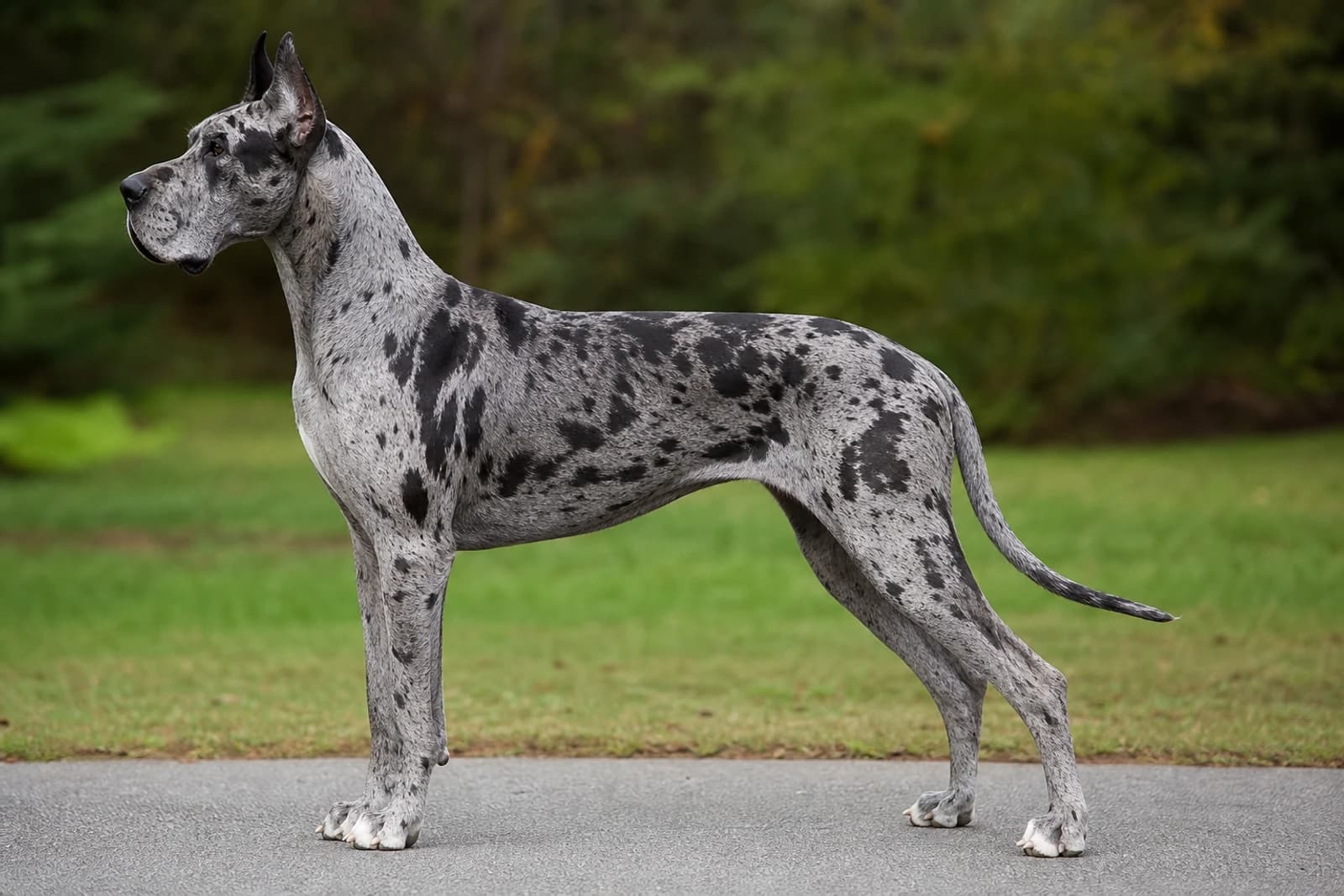
The Great Dane is a giant working breed with a famously gentle temperament and enormous space, food, and training needs. It can be wonderful with families, but its size makes early manners, supervision, and realistic ownership costs non-negotiable.
At a glance
- Size
- Giant
- Height
- 28–32 in
- Weight
- 110–175 lb
- Life span
- 7–10 years
- Coat colors
- Fawn, brindle, blue, black, harlequin, mantle, merle
- Coat type
- Short smooth coat
- Group
- Working
- Origin
- Germany
How much does a Great Dane cost?
Adopt / rescue
$100–$450
Usually includes spay/neuter, first shots, and a microchip.
Buy from a breeder
$1,200–$3,000
From a reputable, health-testing breeder.
Approximate USD. Prices vary widely by region, breeder, pedigree, age, and coat colour — adopting is the lower-cost and recommended route. Avoid suspiciously cheap “breeders”; they’re often puppy mills.
Estimate the full cost of a Great Dane →Great Dane photos
Views
Front, side, rear and top — the full silhouette.Poses
How the breed sits, lies, moves and plays.Puppy to senior
The breed across its whole life.Expressions
The breed’s range of moods.Close-up details
Eyes, ears, nose, paws, tail and coat.Coat colors
The breed’s recognized colors.Click any photo to enlarge. We show the Great Dane from every angle — three views, poses, life stages, expressions, close-ups, coat and colors.
Appearance & size
A Great Dane stops a conversation. Standing up to 32 inches at the shoulder and frequently topping 150 pounds, this is a dog built on an entirely different scale — you don’t just see one, you feel the room shift. The old nickname “Apollo of Dogs” nails it: power and elegance wrapped into a single, towering frame.
Height at the withers runs 28 to 32 inches, with males naturally at the top of that range. Weight spans 110 to 175 pounds; a leggy female might be 120 pounds of coiled energy, while a solid male can easily push past 160 and still be fit, not fat. The bone is heavy, the chest deep and broad, and the legs are long and straight — everything about the build says athlete, not just giant.
The coat is short, smooth, and lies flat against the body. It’s glossy when healthy and requires almost no grooming beyond a quick wipe-down. You’ll see a half-dozen distinct colors: fawn (golden with a black mask), brindle (fawn with black chevron stripes), blue (a solid steel gray), black, harlequin (white with irregular black patches torn-looking), and mantle (black blanket over a white base). Harlequins often have a few gray spots mixed in, and mismatched eyes are allowed in that pattern.
From the front, the head is long and rectangular, carried high on a well-arched neck. The stop is pronounced, the muzzle deep. Ears are medium-sized and naturally fold forward, though some owners keep the cropped stand-up look still seen in show rings. Eyes are medium, dark, and intelligent, with a steady gaze. Straight forelegs and a wide chest give a shot of confidence.
From the side, you see a square profile — it’s almost a perfect box from shoulder to hip and ground to withers. The underline tucks up noticeably behind that enormous ribcage. The tail is thick at the base and tapers to a point, hanging with a slight curve at rest; when the dog’s excited, it can clear coffee tables with one sweep, so watch those mugs.
From behind, the rear is muscular and well-angulated. Thighs are broad, and the legs move cleanly, without cow-hocks. The whole picture is balance over brute force. A Great Dane should never look clunky or overdone — you’re seeing controlled power, the kind that can rest a head on your dining table without jumping.
History & origin
If you’ve ever wondered why a German-bred dog is called a Great Dane, you’re not alone. The name is a complete geographical fake-out: the breed was shaped in Germany, not Denmark. Its raw material goes back to large guarding and hunting dogs—old English Mastiff and Irish Wolfhound types that were crossed and refined over centuries—but it was German nobles in the 1500s and 1600s who turned those dogs into the tall, fearless boar-hound they called the Deutsche Dogge (German Mastiff).
The Deutsche Dogge’s original job was anything but gentle. European wild boar were aggressive, sharp-tusked, and often over 300 pounds, and hunters needed a dog that could close in, seize, and hold the animal until the hunter finished the kill. Structure was purpose-built: towering height let the dog look a boar in the eye, deep chest and powerful jaw provided anchoring strength, and a temperament that mixed nerve with steady obedience kept things from turning suicidal. Working Danes often wore leather body armor and had their ears cropped to reduce the risk of tusks tearing them.
As firearms made boar hunting less common, the breed’s role shifted. Its sheer size and presence made it a natural estate guardian and a flashy status symbol for German aristocracy. Breeders started selecting for a calmer, more companionable temperament, smoothing the edges off a dog that once had to stare down a charging boar. By the late 1800s, German fanciers had unified the type, and the first formal breed standard was written in 1880, cementing the regal, square-proportioned look that earned the breed the nickname “Apollo of Dogs.”
So how did a German dog get a Danish name? In the 1700s, French naturalist Georges-Louis Leclerc, Comte de Buffon, encountered similar big dogs—some in Denmark—and used the term Grand Danois. English speakers latched onto it, and “Great Dane” stuck, ignoring the dog’s real origin. The breed arrived in the United States toward the end of the 19th century, and the AKC recognized the Great Dane in 1887. Today’s Dane is a far cry from the armored boar-hound of the 16th century, but he still carries the long legs, barrel chest, and upright carriage that let him run down dangerous game.
Temperament & personality
A devoted shadow with a giant frame
You won’t need a doorbell if you share your home with a Great Dane. That chest-rattling bark announces visitors with authority, but the dog behind it is usually angling for a neck scratch the moment you open the door. At 110 to 175 pounds, this is a breed that defaults to calm affection—and then leans his entire weight against your hip to make sure you’ve noticed. The forward lean isn’t a power move; it’s a contact bid from a dog who genuinely believes he fits in your lap. But “calm” and “gentle” are observed tendencies, not lifetime guarantees. Genetics matter, and so do early socialization and consistent, respectful handling. A poorly raised Dane is a 150-pound problem, so choose a breeder who prioritizes stable temperament and put in the work when the puppy is young.
Energy-wise, think sprinter, not marathoner. An adult needs a couple of brisk 20- to 30-minute walks and maybe a brief, thunderous zoom around the backyard. After that, he’s a couch ornament for the rest of the day. Skip the exercise and the boredom spills out: anxious pacing, a voice you can hear three doors down, or a sofa cushion turned confetti.
- Watchful, not wired for conflict. Most Danes are alert but slow to escalate. They’ll freeze and stare at something unfamiliar, stiffening the body. A hard stare, closed mouth, or rigid tail is your cue to intervene—not punish—before the dog feels cornered. A relaxed Dane moves loose-bodied with soft eyes and a tail that sweeps everything off the coffee table.
Day-to-day life with a Great Dane
These dogs orbit the family. They follow you from kitchen to bathroom, lean on you during TV time, and sleep best with some part of their body touching yours. That Velcro impulse has a flip side: isolation triggers separation anxiety faster than many owners expect. A Dane left alone for long hours can become destructive, vocal, or soil the house despite being previously trained. You’ll need to teach from day one that brief absences are safe, not just wish it away with a larger crate.
Around kids, a well-socialized Dane is famously sweet and shockingly patient. He also has a tail at child-face height and a body that accidentally clears a dining table. Supervise interactions with toddlers, and teach every child in the house one iron rule: never interrupt a Dane who is eating or resting on his bed. Food guarding—growling, a freeze, or a snap—can develop if a child darts toward the bowl during meals. Give the dog a quiet, predictable spot to eat, and let him finish in peace.
Chewing is a fact of life. Puppies gnaw to relieve teething discomfort, while adults crunch hard objects to keep their jaws strong and teeth clean. Direct that power to large, durable chews or a frozen Kong. A homemade citrus spray (boiled citrus peels) or a vinegar mix (white vinegar and cider vinegar) on chair legs can deter a bored chewer, and the vinegar also helps neutralize urine smells that otherwise lure him back to the same spot.
Quirks to expect and read
House training a giant breed means giant puddles, and Danes are scent-driven. They recognize their own urine marks and will re-soil areas that still smell of past accidents. Clean with an enzymatic cleaner or that vinegar spray to break the odor. Catch them in the act outdoors and reward immediately with a treat—it works far better than reacting after an indoor mess.
Your Dane will probably roll in something foul-smelling at least once. Theories from behavior research point to scavenger ancestry: masking their own scent might have once been useful, or they may simply enjoy the stink the way we enjoy a favorite perfume. Accept it as a quirk and keep a rinse bucket handy.
Learn to read calming signals. Lip licking, yawning, and turning the head away are a Dane’s low-key way of saying, “I need a minute.” A backward-leaning posture often signals fear or a desire to retreat—don’t force the interaction. Respect that, and you’ll get back a dog who’s remarkably cooperative as long as you stay firm and fair. Heavy-handed corrections backfire with this breed; quiet, clear expectations get through.
Give a Great Dane structure, proximity to his people, and a steady stream of affection, and you’ll live with a dignified 175-pound shadow who greets your return with a full-body lean and a wag that rearranges the furniture.
Good with kids, dogs & other pets
Living with children
A Great Dane’s affectionate, patient nature makes him a natural around children—but this is a dog who can weigh 175 pounds and stand over 30 inches at the shoulder. Nothing about his temperament says mean; everything about his size says be careful. A happy tail swipe to a toddler’s face, a clumsy lean against a high chair, or a burst of puppy zoomies can send a small child flying. You treat him like a gentle giant, but you never hand over the keys to the relationship.
Supervision is non-negotiable. Young kids shouldn’t try to ride him, hug him while he’s resting, or get in his face during meals. Teach them to stand still when he rushes up—running and screaming turns into a game he’s way too big to play safely. Many Dane owners set up baby gates so the dog has a quiet zone away from crawling infants, and everybody eats without an audience. On the flip side, a calm, well-raised Dane will happily sprawl out as a living rug during movie night, typically unbothered by the noise and chaos of family life.
Other dogs
Most Great Danes are socially easygoing with other dogs, especially if they’ve had positive experiences early on. The catch is physics. A 150-pound Dane who launches into a play bow in front of a 12-pound terrier can do real damage just by stepping wrong. Introduce him to smaller dogs on neutral ground and keep a leash handy until you see how he measures his movements. Off-leash play with dogs his own size is often the safest outlet.
Same-sex assertiveness can surface in some lines, so if you’re adding a second dog, a proven track record of peaceful cohabitation matters. A Dane who was isolated during puppyhood may grow up to be overexcited or fearful around other dogs, and at his size that’s a problem you can’t just manage with a tight grip on the collar.
Cats and small pets
A Great Dane raised alongside cats often learns to coexist without incident—many live quietly with the family feline, sometimes even deferring to them. But a flick of a tail or a sudden dash can switch on a chase instinct that a cat can’t outrun, and a single misplaced paw can break a bone. For rabbits, guinea pigs, and other small caged animals, permanent physical barriers are the smart play. Assume that a curious, 100+-pound dog exploring a hutch with his teeth or a swatting foot is a disaster waiting to happen.
The early puppy months set the tone. When a young Dane gets controlled, positive exposure to kids, small dogs, and the household cat, he learns to edit his enthusiasm around smaller beings. Miss that window, and you’ll spend far more time managing a full-grown giant who never quite got the memo. Expect to be the calm anchor in every introduction—his size makes your consistency the thing that keeps everyone safe.
Trainability & intelligence
You teach a Great Dane the same way you’d build a friendship — with patience, consistency, and zero intimidation. These dogs are sharper than their goofy reputation lets on. They want to cooperate, but they’ll shut down fast if you use harsh corrections or a heavy hand. A sensitive 150-pound dog who no longer trusts you is a genuine safety problem, not just a training failure.
Start the moment the puppy comes home, ideally between 3 and 14 weeks. Reward every sit, every check-in, every moment of calm with high-value treats, a quick game of tug, or quiet praise. Because Danes grow so fast — a 28-inch adolescent can rest his chin on the kitchen counter without stretching — you need housemanners grounded in positive repetition long before the dog hits 100 pounds. Short, upbeat sessions three or four times a day stick better than one marathon drill. This is a breed that will physically lean into you for reassurance; work with that need instead of against it.
- Recall deserves obsessive attention. A Dane who blows off “come” at the dog park isn’t just embarrassing — he can barrel through fences or frighten people without meaning to. Use jackpot rewards (real chicken, squeaky toys) and practice against increasing distractions. Never punish a slow return or you’ll teach him that coming back ends the fun. Even an adult Dane can behave like a lanky, easily distracted puppy until age two or three, so treat a reliable recall as an ongoing project, not a single puppy-class win.
- The big challenges aren’t about stubbornness; they’re about size and sensitivity. A typical Dane will check out if your tone gets sharp. You can’t manhandle a 175-pound dog into a down-stay, and you shouldn’t have to — when the relationship is right, he’ll melt into position because he knows exactly what you want and trusts the outcome. Boredom is another enemy. Danes are bred to work alongside people, and a dog this intelligent gets creatively naughty without daily mental engagement. Puzzle toys, nose work, or teaching a new trick every week keeps that clever brain busy.
- Physical realities matter. Puppies and young adults have vulnerable joints. Skip any training that asks for high-impact jumping, repetitive stair climbing, or forced long stays on slick floors until growth plates close. Teach “off,” “leave it,” and loose-leash walking early with flat rewards, not leash pops.
A well-trained Great Dane moves through the world like a calm, confident ambassador — heels past a lunging dog, settles under a café table, and returns the instant you call. That reliability is earned entirely through fair, reward-based work. Shortcut it with punishment, and you’ll spend years managing a nervous giant who acts out instead of tuning in. Get it right, and you have a partner who sizes up each new situation with a glance at your face, waiting for the cue he already trusts will be worth following.
Exercise & energy needs
A Dane doesn’t need a marathon—but a daily routine that respects a giant frame makes a world of difference. Most adults do best with about 45–60 minutes of total daily exercise, broken into two or three shorter sessions. A pair of 20–30 minute walks morning and evening, plus a brief sniffari or backyard amble, usually hits the sweet spot. The key isn’t distance or speed; it’s consistency and low impact.
This breed’s sheer size puts serious strain on developing bones and joints. Puppies and adolescents need especially careful management. Until growth plates close—often around 18–24 months—avoid high-impact stuff like repetitive jumping, hard-surface running, or stair-climbing marathons. Free play on grass is great; forced trotting beside a bike is not.
Mental work counts just as much. A Dane’s brain can get restless long before his body is tired. Short, upbeat training sessions, food puzzles, scent games, or learning a new trick will take the edge off without stressing joints. Many Danes enjoy carrying a light pack on walks (empty or with a couple of water bottles for balance) because it gives them a job to do. Rally, nose work, and gentle drafting are far better bets than agility or flyball.
Watch for the “zoomies” after a walk—that’s often an energy debt coming due, not a training problem. If you see it regularly, bump up mental stimulation or add a third short session. A dog this size can wreck a room when boredom hits, but overdoing physical exercise on hard surfaces risks lifelong lameness. Err on the side of more frequent, gentler outings, and your Dane will be calmer in the house and sounder in the joints.
Grooming & coat care
Your Great Dane’s coat is one of the easiest parts of living with a giant. It’s short, smooth, and single-layered — no insulating undercoat to blow out twice a year like a husky’s. That means minimal maintenance, but not zero maintenance.
Brushing
A quick once-over with a bristle brush or a rubber grooming mitt twice a week does most of the job. Bristle brushes (the kind with natural pig bristles) pull loose hair, spread skin oils, and leave the coat gleaming. You don’t need a slicker or a pin brush here — the fur is too short to tangle or mat. During spring and fall, when shedding ticks up a notch, swiping over the dog three times a week keeps stray hair off your sofa. It’s also a chance to check for cuts, hot spots, or the weird lumps and bumps giant breeds are prone to.
Bathing
Baths are a rare event. Over-washing strips the natural oils that make a short coat shine, so you might bathe a Dane every two or three months — or just when they roll in something foul. Use a gentle dog shampoo, and be prepared for the athletic challenge of rinsing a 150-pound dog who’d rather not stand still. Dry them thoroughly, especially in the wrinkles around the face and neck, to prevent skin irritation.
Nails, ears, and teeth
Big dogs put big pressure on their feet, so long nails can alter gait and strain joints. Trim nails every three to four weeks, or more often if you hear clicking on hard floors. Great Danes have naturally floppy ears that trap moisture and dirt; flip them open weekly, wipe with a damp cloth, and look for redness or odor — ear infections can take hold fast in that dark, warm environment. Teeth need brushing a few times a week, same as any other breed. Start early so a 150-pound dog doesn’t learn to say “no thanks.”
Seasonal coat care
There’s no dramatic blowout, but you’ll see more loose hair when daylight hours shift in spring and fall. Bump brushing up to every other day during those weeks, and run a fine-toothed comb down the back of the legs and belly where fine hair can accumulate. A Dane that gets regular outdoor time — even just long walks — naturally sheds dead coat too, so consistent exercise is a grooming ally.
The short coat also means your Dane has zero insulation against cold. In winter, if you live where temperatures drop, a waterproof coat is more about safety than fashion. Summer, on the other hand, requires zero haircuts or trims; just shade and water, and an eye out for sunburn on white patches if your dog is a harlequin or mantle.
Shedding & allergies
Great Danes shed more than you might guess from their short, slick coat. The hairs are stiff, needle-like, and they weave themselves into upholstery with surprising efficiency. Because a Dane is a giant, there’s simply more dog to shed—expect a constant low-level snowfall on your floors, furniture, and dark clothing. Weekly brushing with a rubber curry comb or hound glove knocks out loose hair and keeps the coat glossy, but it won’t stop the shedding.
Twice a year, usually in spring and fall, the volume ramps up for a seasonal blowout. During those weeks, daily brushing and a good vacuum become non-negotiable. The hair comes out in clouds, so you’ll want a lint roller stashed in every room and car.
- Drool is a much bigger daily reality than shedding. Those heavy, pendulous jowls act like a leaky faucet. After eating, drinking, or exerting himself, your Dane will fling slobber onto walls, ceilings, and legs. Many owners keep “slobber rags” stationed around the house.
- Forget hypoallergenic. No dog is truly allergen-free, but a Great Dane is a particularly poor choice for allergy sufferers. Their enormous surface area produces massive amounts of dander, and the drool spreads sticky proteins that trigger reactions. Even a “less shedding” individual won’t make the breed work for someone with significant allergies.
If you’re squeamish about a little (or a lot) of drool on your arm, your sofa, and sometimes your ceiling, a Dane’s daily greeting will wear you out faster than the shedding ever could.
Diet & nutrition
Feeding a Dane is less about filling a giant bowl and more about protecting a giant frame. These dogs put on serious bone and muscle in a short time, and every calorie either supports healthy joints or quietly works against them.
Puppy meals: slow growth for sound structure
Rapid growth in a giant-breed puppy invites skeletal problems down the road. From weaning until about four months old, split the day’s ration into four evenly spaced meals. Drop to three meals from four to six months, then settle into the adult rhythm of two meals a day for life. Use a large-breed puppy formula or a well-constructed raw/home-prepared plan that keeps calcium and phosphorus in balance — your breeder or a veterinary nutritionist can help you dial this in. A Great Dane pup should stay lean, with the hint of ribs visible, not roly-poly.
What an adult Dane’s plate should look like
Think of a species-appropriate plate as roughly 60% animal protein (raw or lightly cooked meat and fish), 20–30% fruits and vegetables, and the rest from eggs, plain yogurt, or small amounts of digestible grains like white rice. That ratio works whether you home-prepare meals or choose a high-quality commercial food.
An active 140-pound male may need between 2,500 and 3,500 calories a day, split into at least two meals. Smaller females and couch-lovers sit at the lower end. Skip the all-you-can-eat buffet; measure every meal. If he hoovers the bowl in seconds, use a puzzle feeder to slow him down — it’s gentler on his stomach and gives that busy brain a workout.
Weight, joints, and the ribs test
Extra pounds hammer hips, elbows, and a spine that’s already carrying a lot of dog. Make the “ribs check” a habit: you should feel each rib with light pressure, no digging needed. Can’t find them? Trim his daily intake by about 10% and increase low-impact exercise until you can. Steady weight management adds active years to a breed that doesn’t get many to spare.
The bloat factor
Great Danes are deep-chested and dangerously prone to gastric dilatation-volvulus (GDV). No raised bowls, no single massive meal, and no sprinting or wrestling for at least an hour before and two hours after eating. Some owners feed three smaller meals a day instead of two to shrink the stomach load. If he tends to gulp air, a slow-feed bowl or scattering his kibble on a snuffle mat makes a real difference.
Older Danes and sensible tweaks
By five or six, many Danes start to downshift. Watch for creeping weight and reduce calories before the scale punishes those aging joints. More frequent, smaller meals can be easier on a slower digestive system. If teeth are worn or missing, purée the usual meal — it delivers the same nutrition with less chewing. There’s no strong reason to slash protein; older dogs handle it just fine, and muscle mass matters.
Table scraps you didn’t ask for
Never feed directly from the table or the counter; a Dane who learns to beg is a 150-pound counter-surfer you can’t ignore. Put any healthy leftovers (a bit of cooked egg, plain vegetables, a shred of lean meat) into his bowl after your own meal. Rich, fatty holiday trimmings can trigger pancreatitis — a painful, expensive emergency. Keep it boring and measured, and he’ll stay healthier for it.
Health & lifespan
The numbers hit hard: 7 to 10 years is the typical lifespan, and that reality should shape every decision you make for a Great Dane. Giant breeds age on fast-forward, so proactive care isn’t a bonus—it’s what turns six good years into ten.
Great Danes can be prone to a cluster of serious, often silent conditions. Bloat (gastric dilatation-volvulus) tops the list. The stomach fills with gas and twists, cutting off blood flow—a genuine emergency. Many owners schedule a preventive gastropexy (tacking the stomach) during spay or neuter. You’ll also feed two or three smaller meals a day and keep your Dane quiet for an hour after eating.
- Hip dysplasia can develop, especially in giant pups that grow too fast or carry extra weight. Responsible breeders screen parents through OFA or PennHIP and can show you the scores.
- Dilated cardiomyopathy quietly weakens the heart muscle. Annual cardiac exams, including an echocardiogram when your vet recommends it, catch changes before heart failure steals your time together.
- Osteosarcoma (bone cancer) appears more often in giant breeds. Any limp or swelling that lasts more than a day or two warrants an immediate vet visit.
- Hypothyroidism and Wobbler syndrome (cervical instability) show up in some lines. Reputable breeders test and talk openly about what they’ve seen—and what they’re working to avoid.
Keeping a lean body is one of the most powerful tools you have. Every extra pound hammers already-stressed joints and strains a heart that may be predisposed to trouble. You should feel ribs under a light layer of flesh, not a thick pad of fat. Adjust portions based on what you see, not just the bag’s chart.
Preventive care is non-negotiable. Heartworm prevention goes monthly during mosquito season and for one month after it ends. Rabies vaccination is legally required; once symptoms appear, there’s no effective treatment. Schedule a thorough wellness exam at least once a year. Once your Dane hits five or six, twice-yearly visits with bloodwork and cardiac monitoring catch problems before you notice a single symptom.
A thin coat offers little insulation, so protect your Dane from extreme cold with a jacket and short outdoor spells. Early, positive socialization matters here too—chronic stress from fear or isolation can worsen heart and immune function, and a relaxed Dane makes every vet visit easier on both of you.
Watch your dog’s daily rhythm like a hawk. Slowing down on walks, a cough that lingers, drinking more water, or skipping a meal on a breed that rarely skips anything—these small shifts are loud warning signs in a giant breed. Full-on symptoms can arrive overnight. That’s not paranoia; it’s the partnership a Great Dane needs.
Living environment
A 175-pound dog doesn’t scream “apartment friendly,” but a Great Dane often adapts better than many toy breeds. They’re the ultimate couch potatoes indoors—low-energy, calm, and content to sprawl on a soft bed for hours. What they do need is daily, consistent walking: a couple of 20- to 30-minute strolls, not a marathon. Short, frequent outings keep joints safe and match their moderate energy levels, while still giving them a chance to sniff and explore. A fenced yard is a nice extra for off-leash zoomies, but it’s not a substitute for a walk, and you’ll rarely find a Dane doing laps on its own. They want to be near you, not banished outside.
That giant frame comes with some real limits. High-impact exercise—hard running on pavement, jumping, or stair-climbing during puppyhood—can damage developing joints. Stick to soft surfaces and controlled play, and save the intense stuff until growth plates close around age 18–24 months. Mentally, they thrive on short sessions of puzzle toys or scent games that tire out a giant brain without taxing bones.
Climate-wise, the single-layer coat offers zero insulation. In cold weather, expect to bundle your Dane in a coat and keep walks brief when temperatures plummet. Heat is equally risky: they can overheat fast, so summer exercise shifts to early morning or late evening. A climate-controlled home is non-negotiable.
On the noise front, most Danes are quiet. They’ll alert-bark if something’s off, but they don’t yap or carry on. Your neighbors may never hear them.
The real sticking point is alone time. A Great Dane bonds fiercely and can slide into separation anxiety if left alone for long workdays. Gradual desensitization—starting with five-minute departures—and an enriched environment (frozen Kongs, treat-dispensing toys) can build independence, but this is not a breed you can crate for nine hours and forget. If your schedule keeps you out all day, plan on a dog walker or doggy daycare, or consider a more solitary breed. The reward is a dog that rearranges its entire day to be in the same room with you.
Who this breed suits
Great Danes aren’t difficult dogs, but they are a lot of dog. The right owner is someone ready for a 150-pound shadow who leans, drools, and thinks they’re a lapdog.
Best fit
- First-time owners who are all-in on training. Danes are companionable, eager to please, and surprisingly manageable for beginners — if you commit to consistent, positive puppy classes before that cute 20-pound pup turns into a 120-pound teenager who can pull you off your feet.
- Families with older kids. The breed’s patient, affectionate nature makes them a natural family centerpiece. Just be realistic: a fast-moving tail wag is at face height for a toddler, and an excited zoomie can clear a coffee table. Homes with sturdy, dog-savvy kids (say, age 8+) tend to be the sweet spot.
- Homebodies and remote workers. Danes bond hard. They’d rather sprawl on the sofa next to you than do almost anything else. Someone who is home much of the day — or can bring the dog along — prevents the separation anxiety this breed can develop.
- Apartment dwellers with a plan. Yes, a 34-inch-tall dog can live in an apartment, but it takes honesty. You need a ground-floor unit or an elevator, a schedule that includes multiple potty breaks (bloat risk makes long gaps dangerous), and you’re okay with neighbors giving you side-eye in the hallway.
Think twice if…
- You want a jogging partner or a high-energy adventure dog. Adult Danes need moderate daily movement — a solid 45–60 minutes of leisurely walking, not marathons. Their joints and frame can’t handle hard, repetitive pounding. Pushing them too far as puppies can permanently damage growing bones.
- You’re on a tight budget. Everything costs more with a giant breed: food (high-quality kibble at 8–12 cups a day), preventatives dosed by weight, a crate the size of a compact car, and emergency vet care. A bloat surgery alone can run $4,000–$7,000.
- You prize a pristine house. Great Danes shed year-round, and the drool is legendary — on walls, on ceilings, on guests. If a rope of slobber across your freshly painted kitchen gives you the ick, this is not your breed.
- Longevity is a non-negotiable. A 7–10 year lifespan means you are signing up for heartbreak sooner than with smaller dogs. Dilated cardiomyopathy, osteosarcoma, and gastric torsion are common, even in well-bred dogs. Responsible breeders screen, but genetics can still deal a tough hand.
- You have very young children and limited supervision time. Dane gentleness is real, but accidental knockdowns are, too. A wobbly toddler and a tail like a baseball bat are a tense combination unless you’re right there to manage every interaction.
Cost of ownership
Bringing home a Great Dane puppy from a breeder who screens for heart, hip, and eye issues typically costs $1,500–$3,000, with show-line or titled pedigrees sometimes pushing higher. Adoption fees through a giant-breed rescue usually land in the $200–$500 range.
After that, the real budget-bender is food. A full-grown Dane can plow through 8–12 cups of high-quality kibble every day. That translates to a $80–$120-plus monthly grocery bill, and treats add another few bucks on top.
- Routine vet and prevention: Preventatives are dosed by weight, so heartworm, flea, and tick meds alone can run $40–$60 per month. An annual exam with giant-breed bloodwork and vaccines might set you back $300–$500.
- Pet insurance: Giant breeds carry higher premiums. Expect $50–$100 per month, often more if you choose a low deductible.
- Grooming: The short coat is low-maintenance, but bathing a 150-pound dog is a project. If you use a groomer for baths, nail trims, and ear cleaning, figure $60–$90 every few months.
- Supplies: You’ll need a crate and bed sized for a pony (think 54-inch crate), raised feeders to help reduce bloat risk, and durable toys. Initial gear easily totals $300–$500.
Vet emergencies hit harder here. Bloat (GDV) surgery can cost $3,000–$7,000, and many owners opt for a prophylactic gastropexy ($1,500–$3,000) during spay or neuter. Even routine procedures like dental cleanings cost more because anesthesia and medications scale with body mass.
Month to month, you’re looking at $200–$400 just for food and basic care. On top of that, a rainy-day fund of several thousand dollars isn’t a luxury — it’s the cost of sharing your home with a dog whose medical bills are sized just like the dog.
Choosing a Great Dane
Where to start: breeder or rescue?
You get 7–10 years with this giant, so every year counts. A responsible breeder puts you in the best position to know what you’re getting health-wise and temperament-wise. A rescue gives a dog a second chance—often a young adult whose goofy, lean-on-you personality is already clear, but the health history and early socialization are unknowns. Great Dane-specific rescues abound because people underestimate the food bill, the counter-surfing reach, and the sheer space one takes up. Both paths are valid, but they demand different homework.
Health testing you can’t skip
You’ll see a lot of “vet-checked” claims. Insist on the actual paperwork. For Great Danes, the non-negotiables are:
- Hips: OFA or PennHIP evaluation. Look for scores of fair or better on both hips.
- Cardiac: An echocardiogram done by a board-certified veterinary cardiologist within the past year. Dilated cardiomyopathy can be silent until middle age.
- Thyroid: A full thyroid panel from an approved lab.
- Eyes: Annual CAER exam.
Ask to see these results on both parents, and look them up yourself in the OFA database. If a breeder skips the cardiac echo because “my lines are clean,” keep moving. No test, no puppy.
Red flags that should make you walk away
A breeder who talks more about “rare” colors (blue, merle, harlequin) than about health testing is a giant red flag. So is anyone breeding for extreme size—a 200-pound Dane isn’t a flex, it’s a shorter lifespan waiting to happen. Other dealbreakers:
- Sells puppies younger than 8 weeks or doesn’t let you meet the dam on-site.
- Has no written contract that takes the dog back if you can’t keep it.
- Pushes supplements, raw diets as a cure-all, or dismisses bloat risk with “that won’t happen here.”
- Pairs you with the pup you point at instead of matching temperament to your home after weeks of observation.
Picking a puppy from a litter
A good breeder chooses for you. You’ll watch the litter interact, but the confident, curious middle-of-the-pack pup is almost always a safer bet than the shyest one cowering behind the couch or the bossy pup steamrolling littermates. Don’t chase the runt that’s half the size of the others—in giant breeds, that can signal hidden heart or growth issues.
Plan for an adult dog that stands 28–32 inches and weighs north of 110 pounds. That means your puppy’s first year is a careful balancing act: a large-breed puppy food (or an adult formula with controlled calcium and phosphorus) to grow bone slowly, no forced running on pavement, and a home with area rugs so those long legs don’t splay on hardwood. The breeder should send you home with detailed feeding guidelines, not a shrug.
Pros & cons
Pros
- A gentle giant in every sense. A well-socialized Dane is affectionate, patient with kids, and welcoming to visitors. That calm, steady temperament is why they’re called the “Apollo of Dogs.”
- Low-maintenance coat. The short, smooth fur needs just a weekly once-over with a hound glove or soft brush. Shedding is moderate but far easier to manage than most giant breeds.
- Modest exercise for a 150-pound dog. Expect about an hour of daily movement — a brisk walk and a fenced romp — then hours of couch-potato lounging. They are built for comfort indoors, not endless cardio.
- A natural visual deterrent. The towering frame and deep bark alone make most strangers think twice, without the sharpness of a true guard breed.
- Food drive speeds training. Most Danes work eagerly for a treat, so basic manners and even advanced cues often come quickly if you keep sessions short and positive.
Cons
- A lifespan that breaks your heart. Seven to ten years is the norm. Every single birthday matters with this breed.
- Giant-sized price tag. High-quality giant-breed kibble, two to three times the usual preventatives, higher anesthesia costs, and XXL beds, crates, and collars all add up fast.
- Bloat is a real emergency. Deep-chested dogs like Danes are at high risk for gastric dilatation-volvulus. Dilated cardiomyopathy, hip dysplasia, and osteosarcoma also appear in the breed. Responsible breeders screen, but the potential is always there.
- Drool comes with the territory. After a meal or a drink, expect wet strings on walls, clothes, and furniture. It’s not occasional — it’s a lifestyle.
- Training is a safety requirement, not an option. A Dane who jumps or pulls can knock over an adult or frighten a child. Without early, consistent leash manners and impulse control, you have a 130-pound liability.
- Heat and endurance limits. That deep chest and solid mass cause overheating quickly. They are not hot-weather athletes or distance-running companions.
- Growth demands strict management. Puppies gain weight explosively. Too much calcium or abrupt exercise can trigger painful conditions like panosteitis or hip malformation, so controlled feeding and surface choices are critical for the first 18 months.
- Thin coat, real chill. A Dane’s single layer offers almost no insulation. In cold or damp weather, they genuinely need a coat or sweater to stay comfortable.
- Accidental demolition crew. A happy tail at coffee-table height clears everything in one swipe. You’ll learn to decorate accordingly, or you’ll lose a few mugs.
Similar breeds & alternatives
If the Great Dane’s supersized body and gentle disposition have you hooked, a few other giants are worth a hard look—each with trade-offs that might steer you toward or away from that classic Dane.
Irish Wolfhound
Taller and lankier than the Dane, the Wolfhound routinely tops 32 inches at the shoulder but weighs less, often 105–120 pounds. Where the Dane’s short coat means a quick wipe-down, the Wolfhound’s wiry, double layer requires regular stripping and picks up burrs. Temperament shifts too: still sweet-natured, but more reserved with strangers and carrying a stronger sighthound prey drive—a running cat can trigger a chase the Dane is less likely to launch. Lifespan is even shorter, typically 6–8 years, and bloat remains a real risk.
Mastiff (English Mastiff)
If what you really love is sheer mass, the Mastiff delivers—males can hit 230 pounds on a 30-inch frame. You get the same short, easy-care coat, but with face-filling wrinkles and far heavier drool. Energy is lower indoors, yet the Mastiff tends to be more stubborn and naturally watchful, closer to a guard dog than the Dane’s socialite mentality. That bulk also makes stairs and hot weather bigger challenges. Expect more structural health concerns with extreme size; a responsible breeder will screen hips and elbows aggressively.
Saint Bernard
The Saint has the Dane’s oversized, family-friendly warmth locked in, but under a mountain of fur—either rough or smooth, always heavy-shedding. That coat insulates them well in cold climates but leads to overheating in summer. Drool is a constant, enough to trail across walls. Saints are generally even lower-key indoors than a Dane, content with shorter walks, though they still need ample space to stretch those 150-plus pounds. Grooming is a weekly event, not a quick brush-off.
Borzoi
For a giant that feels more like art than furniture, the Borzoi offers the same tall elegance as the Dane in a lighter, aerodynamic package (60–105 pounds). The long silky coat sheds, but not like a Saint. Temperament is cat-like—affectionate on their own terms, less needy, and possessed of an explosive sprint that can cover a field in seconds. That independent streak makes recall training a serious project compared to the Dane’s often biddable, people-pleasing nature. Inside, they’re quiet and surprisingly lazy, but off-lead life takes planning.
Fun facts
- Great Danes are nicknamed the Apollo of Dogs.
- Despite the name, the modern breed developed largely in Germany.
- Their short coat is easy to brush, but their size raises everyday costs.
Frequently asked questions
- Are Great Danes good with children?
- Great Danes are known for their gentle and patient temperament, making them generally good family dogs. Due to their giant size, however, they can accidentally knock over small children, so supervision is recommended. Early socialization and training help ensure safe interactions.
- How much do Great Danes shed?
- Great Danes shed a moderate amount, rated around 3 out of 5. Their short, smooth coat does lose hair, but regular weekly brushing can help manage loose fur around the home. They are not considered heavy shedders compared to some other breeds.
- How much exercise does a Great Dane need?
- They have a moderate energy level and typically need daily walks and some playtime to stay healthy. It’s important to avoid excessive running or jumping, especially in puppies, to protect their developing joints. Adult Great Danes often enjoy a balance of activity and relaxation.
- Are Great Danes easy to groom?
- Grooming a Great Dane is very easy, with a rating of 1 out of 5 for effort. A quick weekly brushing and occasional baths are usually all that’s needed to keep their short coat clean and shiny. They are a low-maintenance breed in terms of grooming.
- Can Great Danes live in apartments?
- Despite their giant size, Great Danes can adapt to apartment living if their exercise needs are met. They tend to be calm and low-energy indoors, but their sheer bulk requires enough space to move around comfortably. Daily walks and mental stimulation are crucial in smaller homes.
- Do Great Danes bark a lot?
- Great Danes are not typically excessive barkers; they tend to be quiet and only bark when necessary. However, individual personalities vary, and some may bark more if bored or alerting to something. Proper training can help minimize unwanted barking.
Tools & calculators for Great Dane owners
Quick estimates tailored to Great Danes — pre-filled with this breed’s size where it matters.
Articles & stories about the Great Dane
Sources & standards
This profile follows recognized breed standards from the American Kennel Club (AKC) and the Fédération Cynologique Internationale (FCI), along with established veterinary and breed-club guidance. These describe general breed tendencies — every dog is an individual.
Owner stories
Have a Great Dane? Share your experience — grooming tips, personality quirks, anything goes.