

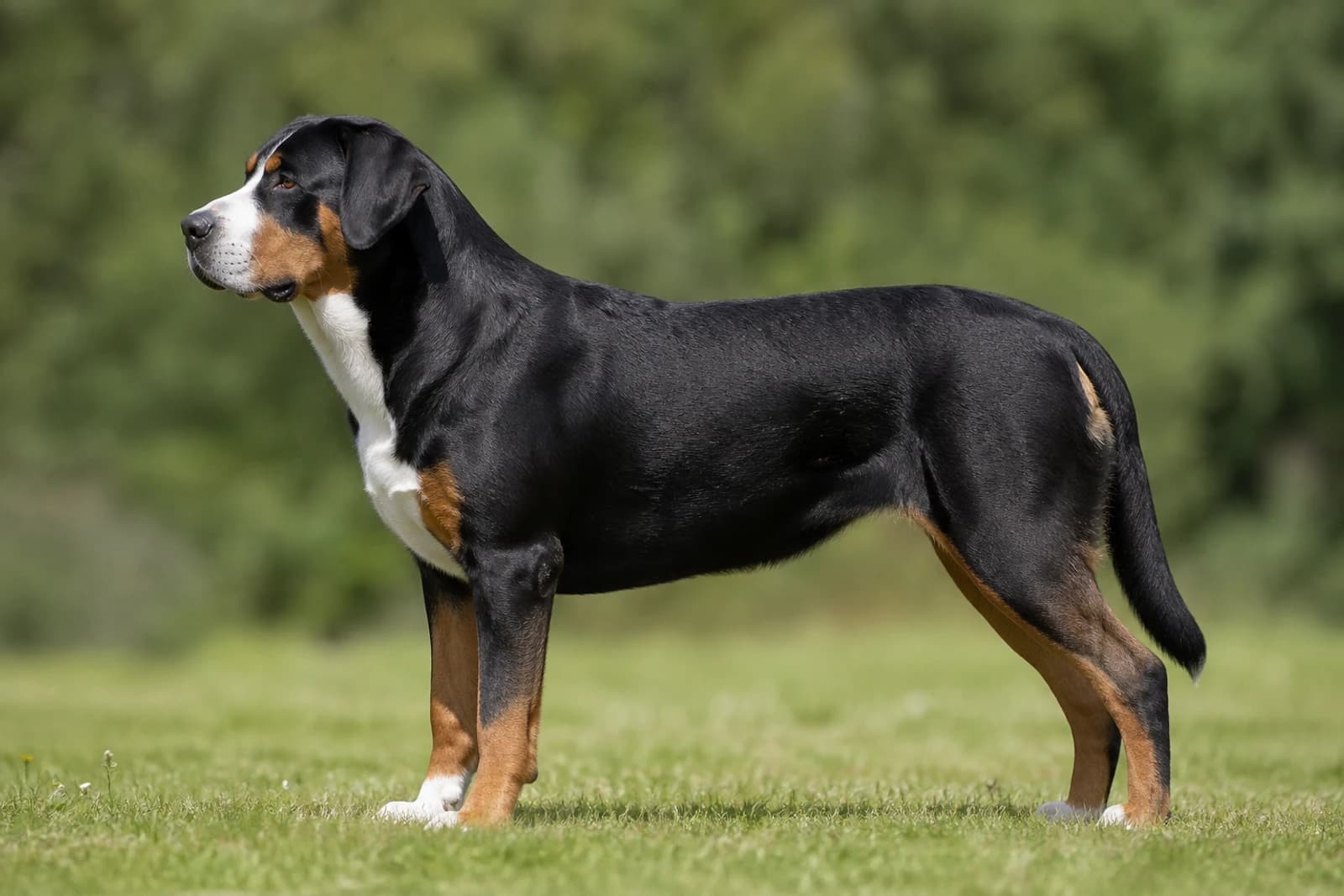
The Greater Swiss Mountain Dog is a giant working breed known for its gentle and loyal nature. Originally used for drafting and herding in Switzerland, these dogs are devoted family companions that thrive in homes with space to roam. They are good-natured and patient with children, though their large size requires supervision. Highly alert and confident, they make excellent watchdogs without being aggressive. With a short double coat, they shed heavily and need regular brushing. Suited for active owners who can provide consistent training and moderate exercise, this breed is not ideal for apartment living or sedentary lifestyles.
At a glance
- Size
- Giant
- Height
- 24–28 in
- Weight
- 79–130 lb
- Life span
- 8–11 years
- Coat colors
- Black with rust and white markings
- Coat type
- short, dense double coat
- Group
- Working
How much does a Greater Swiss Mountain Dog cost?
Adopt / rescue
$75–$400
Usually includes spay/neuter, first shots, and a microchip.
Buy from a breeder
$700–$2,000
From a reputable, health-testing breeder.
Approximate USD. Prices vary widely by region, breeder, pedigree, age, and coat colour — adopting is the lower-cost and recommended route. Avoid suspiciously cheap “breeders”; they’re often puppy mills.
Estimate the full cost of a Greater Swiss Mountain Dog →Greater Swiss Mountain Dog photos
Views
Front, side, rear and top — the full silhouette.Poses
How the breed sits, lies, moves and plays.Puppy to senior
The breed across its whole life.Expressions
The breed’s range of moods.Close-up details
Eyes, ears, nose, paws, tail and coat.Coat colors
The breed’s recognized colors.Click any photo to enlarge. We show the Greater Swiss Mountain Dog from every angle — three views, poses, life stages, expressions, close-ups, coat and colors.
Appearance & size
This is a draft horse of a dog—solid, muscular, and unmistakably built for heavy work in the Alps. The Greater Swiss Mountain Dog stands 24 to 28 inches at the shoulder and tips the scale somewhere between 79 and 130 pounds. In flesh and bone, males typically push toward the high end (often 105 to 130 pounds and 26 to 28 inches), while females settle into a slightly smaller but equally powerful frame (85 to 110 pounds, 24 to 27 inches). Either way, you’re looking at a substantial animal that takes up real space.
The coat gives the Swissy a clean, no-fuss silhouette. It’s a short, straight double coat—dense outer hair about an inch to an inch and a half long, with a thick, woolly undercoat. You won’t find feathering or wispy fringes anywhere. What you will find is a deep, glossy black base punctuated by symmetrical rust and white markings. Those markings are a breed signature:
- Rust appears above each eye, on the cheeks, on the sides of the muzzle, down the legs, and often on the inside of the thighs.
- White typically runs as a blaze from the muzzle up the forehead, covers the chest, wraps around the chin, paints the feet, and tips the tail. A white collar or spot on the neck is common and perfectly acceptable. No other color combination exists in the standard.
From the front, the dog looks broad and grounded. The chest is wide and deep, the forelegs are straight with heavy bone, and the feet are round and tight. From the side you’ll see a body that’s slightly longer than tall, a level topline, a deep brisket that reaches the elbows, and a moderate tuck-up. The hindquarters carry tremendous muscle, with well-let-down hocks and a strong, sweeping thigh. The tail hangs thick and heavy when relaxed; when the dog moves, it may lift but never curls over the back.
The head balances power and gentleness. The skull is flat and broad, the stop is distinct but not severe, and the muzzle ends bluntly with black lips. Dark brown, almond-shaped eyes give an alert, friendly expression. Triangular ears hang close to the head and frame the face without making it look droopy. The whole package reads as steady and capable—a working dog through and through. And that short, dense coat, while low maintenance, sheds like a snowstorm twice a year, so you’ll want a good vacuum on standby.
History & origin
You’re looking at the oldest and largest of the four Swiss Sennenhunde breeds — a group that includes the Bernese Mountain Dog, Appenzeller, and Entlebucher. The Greater Swiss Mountain Dog’s story starts nearly two thousand years ago, when Roman legions marched mastiff-type dogs across the Alps. Those heavy-boned dogs, likely descended from the ancient Molossus, interbred with local Alpine working dogs, laying the foundation for a rugged farm dog that could handle the brutal mountain terrain.
By the Middle Ages, these dogs had become indispensable on Swiss dairies and farms. They weren’t just one-trick ponies. A Greater Swiss Mountain Dog drove cattle to pasture and market, guarded the homestead against predators and thieves, and most famously hauled loaded carts of milk, cheese, and produce. That last job earned them the nickname “the poor man’s horse” — a 130-pound dog could pull a heavy cart where a horse or ox was out of reach. The breed was built exactly for that: a giant frame (males top out at 130 pounds), wide chest, and powerful hindquarters, all paired with a calm, steady temperament that kept them from spooking on a narrow mountain path.
Then mechanization arrived. By the late 1800s, railways and motorized vehicles replaced draft dogs, and the Greater Swiss Mountain Dog nearly vanished. Other Sennenhunde breeds, especially the Bernese, got more attention, while the big “Swissy” was written off as a relic. The turning point came in 1908, when a Swiss farmer named Franz Schertenleib brought a large, short-haired dog to a jubilee show in Langenthal. Dr. Albert Heim, a respected geologist and dog fancier, recognized the animal as an old-type Sennenhund that he’d only seen in historic illustrations. Heim urged dedicated breeding to save it, and the club for the “Grosser Schweizer Sennenhund” was formed shortly after.
World War II interrupted progress, but a core group of breeders slowly rebuilt the gene pool. The breed made its way to the United States in the 1960s and gained full American Kennel Club recognition in 1995, landing in the Working Group. Even though today’s Greater Swiss Mountain Dog is more likely to pull a kid’s wagon than a milk cart, that deep-seated drive to work hasn’t gone anywhere. If you don’t give a Swissy a real job, it’ll invent one — and probably use your couch as the starting line.
Temperament & personality
Most Greater Swiss Mountain Dogs live up to the idea of a calm, steady family member—right up until a stranger steps onto the driveway. Then you’ll hear a deep, chesty bark that says they’re paying attention. They’re watchful without being sharp, preferring to size up visitors from the porch rather than barrel in. Inside the house, that alertness melts into an affectionate, surprisingly gentle demeanor for a dog that can weigh 130 pounds. Expect a Swissy to lean against your legs, drape across your feet, and follow you from room to room. It’s not frantic clinginess—they’re just deeply bonded and don’t handle long isolation well. Neglect can spark anxiety-driven barking or destructive chewing, so this breed thrives as a full-time family member, not a backyard ornament.
Energy-wise, they’re moderate. A solid daily walk, some play, or a chance to haul a cart or backpack will settle them. They’re working dogs, not marathon runners, and they’re happy to crash on the cool floor afterward. Training taps into an intelligent but occasionally stubborn mind. Repetition alone bores them, and force shuts them down. Calm, consistent engagement with plenty of praise for small wins works far better. They read your body language intently: a forward-leaning posture can feel confrontational to a Swissy, while a soft, relaxed stance invites cooperation. Learn their signals too. A stiff body and direct stare mean the dog is uncomfortable and could escalate; a loose, wiggly frame and soft eyes say everything’s fine. Yawning, lip licking, or turning the head are requests for a break—respecting those signals builds trust.
With children, they’re typically patient and tolerant, but a 100-plus-pound dog always demands supervision. The number-one rule: never let anyone disturb the dog while it’s eating or working on a prized chew. Even the gentlest dog can develop food guarding if startled at the bowl, and with a breed this size the fallout is serious. Give them a quiet spot to eat in peace.
Swissys come with a few quirks. Many take great joy in rolling on dead things or other foul-smelling treasures—some dogs seem to just enjoy the stink, others may be masking their scent. Plan on occasional cleanups. Indoor territory marking can crop up, especially in less-trafficked rooms, because dogs define their “house” by family scent, not the floorplan. When accidents happen, clean thoroughly with an enzyme cleaner or a vinegar spray to neutralize the odor and prevent re-soiling. Reward outdoor elimination with a treat immediately after paws hit the grass, and you’ll build a strong house-training habit.
Puppies chew to explore and relieve teething pain. Adults chew to keep their jaws strong and teeth clean. Provide ample, sturdy chew toys and redirect unwanted gnawing with a homemade citrus spray on furniture—punishment only erodes the trust these sensitive dogs need. Read a Swissy’s center of gravity to gauge their mood: a forward lean often signals confidence or intent to move, while a backward lean can mean fear or a desire to retreat. A wagging tail alone tells you nothing—always check the whole body. Pay attention to those silent cues, and you’ll unlock the steady, affectionate partnership this breed is built for.
Good with kids, dogs & other pets
A Greater Swiss Mountain Dog who’s been raised with kids often acts like a gentle, oversized nanny — patient, forgiving, and happy to be in the middle of family chaos. That said, at 79 to 130 pounds and standing up to 28 inches at the shoulder, even a friendly lean or excited tail wag can floor a small child. Plan on supervising every interaction with toddlers and preschoolers, not because the dog intends harm, but because physics wins.
These dogs form tight bonds with their people and don’t do well when banished to a backyard or left alone for long stretches. A Swissy expects to be underfoot during dinner prep, sprawled across the couch during movie night, and included in backyard games. Loneliness hits them hard — it can show up as destructive chewing, barking, or digging — so they fit best in households where someone is around much of the day.
Other Dogs
Swissies generally carry a live-and-let-live attitude toward other dogs, but the outcome nearly always traces back to those first few months. Start introductions to friendly, vaccinated dogs between 3 and 14 weeks old and keep at it — arrange playdates, take short trips to the hardware store, walk on different sidewalks so your puppy meets a wide variety of calm, stable adults. Without this early work, even a breed with a naturally steady temperament can grow up skittish or socially awkward around strange dogs.
If you’re bringing an adult Swissy into your home and their socialization history is patchy, don’t force meet-and-greets at the dog park. Forcing a fearful dog into close quarters with strangers can backfire, ramping up stress and sometimes triggering a defensive snap. Instead, reward calm behavior from a distance and let the dog set the pace. Some adult Swissys stay perfectly content with just a few known neighborhood buddies and never become social butterflies — that’s okay.
Cats and Small Pets
Plenty of Swissys live peacefully with cats, especially when they’re raised together. The breed wasn’t fine-tuned for chasing down quick little animals, so prey drive is usually manageable. Still, a Swissy’s size makes a casual paw swipe or a playful bow a risky event for a rabbit, guinea pig, or a cat who’d rather not be slobbered on. Introduce cats and small mammals gradually, behind a baby gate, with the dog on leash, rewarding calm indifference. Even after they seem like best buds, leave critters safely separated when you’re not there to supervise.
For the best shot at a multi-species household, look for a breeder who exposes puppies to farm animals, cats, or household small pets during that critical 3-to-16-week window. If you’re adopting an adult, test the dog’s reaction to a cat in a controlled setting before you commit — and be honest about what you can manage long-term.
Trainability & intelligence
You’re raising a dog that can easily hit 100-plus pounds and still think it’s a lap puppy. Training isn’t just about tricks — it’s about building a safe, workable partnership with a powerful, intelligent animal that needs a job to feel settled.
Swissies learn fast when you make it worth their while. They come from draft-and-guard stock, which means they’re wired to cooperate with people, not blindly obey. That brain comes with an independent streak: if your request doesn’t make sense or the payoff feels lousy, you’ll get a look that says “I’ll think about it.” Positive, reward-based methods cut right through that. Use real food (pea-sized bits of cheese or chicken work well), a short tug session, or an excited ear scratch the moment the dog gets it right. Half-hearted praise won’t move the needle. A high-value reward delivered crisply will.
Start the day your puppy comes home. A 20-pound fluffball jumping up might be cute; a 130-pound adult slamming into a guest is a liability. Short, daily sessions beat marathon drilling. Swissy puppies get physically and mentally tired quickly, but they also bounce back fast — a few minutes of sit, down, and recall after a potty break, repeated throughout the day, sticks far more than one groaning half-hour. Consistency is your real currency here. If you let pulling on leash slide “just this once” because you’re in a hurry, you’ve taught a draft dog that pulling works.
Recall deserves extra care. A Swissy’s instinct to go check something out — a neighbor’s barbecue, a deer at the treeline — is strong, and their size means you can’t out-muscle them if they blow you off. Build recall from day one with a distinct cue and a jackpot reward (three or four treats in a row, unleashed play). Practice it in distraction-free spaces before you ever test it near tempting stuff. You want the “come” to be the most rewarding thing in the dog’s world, not a negotiation.
Harsh corrections backfire spectacularly with this breed. Yelling, jerking the leash, or swatting damages their trust and can create a head-ducking, anxious dog that still doesn’t do what you asked. That’s dangerous when you’re handling a dog of this size. Kind, clear, patient communication gets you reliability.
Socialization is part of trainability, not a separate thing. Expose your puppy to staircases, city streets, car rides, different floor textures, and friendly strangers — especially during that critical 3-to-14-week window. A poorly socialized Swissy can tip into suspicion or fear-based reactivity as an adult, and a reactive 120-pound dog is a serious management problem. Gradual, positive exposure teaches them that newness is normal, not a threat. Keep up those outings through adolescence, because the dog you see at 10 months is still growing into their judgement.
Channel the work drive early. Teaching a Swissy to carry a pack on walks, drag a lightweight cart (after growth plates close), or retrieve specific items turns their natural desire to pull and carry into a structured outlet. A Swissy with a job is a Swissy who listens.
Once the trust and the pattern of “I do this, good things happen” is set, you’ll have a partner who checks in with you on a hike without nagging, waits at an open door until released, and can settle inside because their brain has been used. That partnership takes no shortcuts — you give a fair ask, and you make it clear that cooperating always pays off.
Exercise & energy needs
A Swissy doesn’t need to run laps for hours—what he really craves is a predictable, job-like routine that works his body and his brain. He’s a draft dog built for steady pulling and all-day farm work, not sprints. That means exercise needs to be consistent, moderate, and joint-friendly.
Plan on 60 to 90 minutes of activity a day, split into at least two sessions. A 30‑minute morning walk and a longer evening walk with some hill work or a chance to haul a cart or wagon hits his sweet spot. These dogs stay strong and sane with purposeful movement—think hiking on soft trails, pulling a properly fitted cart, or swimming when the weather’s warm. Tossing a ball in the backyard won’t cut it. Under‑exercised Swissies get creative, and you’ll see it in the form of chewing, barking, or leaning on you harder than a 110‑pound dog should.
Mental exercise matters just as much. A 10‑minute scent game, a frozen puzzle feeder, or a quick obedience refresher can tire him out faster than another mile on pavement. He’s smart, and he’ll find his own problems to solve if you don’t provide them.
Because this breed can be prone to hip and elbow dysplasia, you have to protect young joints. Avoid high‑impact stuff—repeated jumping, long runs on concrete, or forced stair climbing—until growth plates close around 18 to 24 months. Stick to short, grassy walks, gentle play, and early positive training for puppies. Even as an adult, watch for fatigue or soreness and skip the hard surfaces when you can. A tired Swissy should still move easily, not hobble.
Hook him up with a backpack on a hike, teach him to pull a training cart, and work on a reliable recall early so he can safely explore off‑leash where it’s allowed. This is a dog that thrives when you treat exercise as a partnership, not a chore.
Grooming & coat care
The Greater Swiss Mountain Dog carries a dense double coat that sheds—a lot. Year-round, you will find hair on your floors, your clothes, and the couch; twice a year, during seasonal transitions, the shedding ramps up to what feels like a small blizzard. A solid brushing routine is the only way to stay ahead of it.
For day-to-day maintenance, grab a rubber curry brush or a medium-bristle brush. A quick pass two or three times a week pulls out dead undercoat before it drifts onto the furniture, spreads natural oils through the outer coat, and leaves it with a healthy sheen. When the heavy spring and fall blowouts hit, swap to a shedding tool or an undercoat rake. Use a light touch—these tools can irritate the skin if you press hard—and work in sections until the loose fluff stops flying. The goal is to remove the dead hair, not strip the coat.
Bathing a 100-plus-pound dog is a chore, and overdoing it strips the coat of its weather-resistant oils. Plan on a bath every few months, or when he rolls in something foul. A self-serve dog wash with a ramp and elevated tub saves your back. Between baths, a wipe-down with a damp cloth keeps him presentable.
Nail trims need to happen regularly—every three to four weeks for most Swissies. Overgrown nails on a giant breed can torque toes and change the way he stands. If you hear clicking on hard floors, it is past time. Ears should get a weekly look; the drop-ear shape can trap moisture and debris, so wipe gently with a vet-approved cleaner when you spot buildup. Teeth get the same routine as any other dog: brush several times a week with a dog-safe paste, and let your vet do a thorough check at annual visits.
Seasonal coat turnover responds to the outdoors. Consistent exercise and fresh air help loosen dead coat and encourage healthy new growth, which makes your brushing sessions more effective. The trade-off is that a Swissy who spends ample time outside will track in more dirt, so keep a towel by the door.
The honest truth: if you need a spotless house, this is a tough breed. But with the right tools and a predictable schedule, grooming is straightforward and becomes a way to catch skin issues, hot spots, or burrs before they become problems. Expect fur tumbleweeds—invest in a good vacuum—and you will be just fine.
Shedding & allergies
This is a giant dog with a dense double coat, and it sheds year-round — think a steady rain of short, dark hair, not an occasional sprinkle. The outer coat is straight and harsh, while the thick undercoat insulates against cold and heat, and pushes out in impressive waves during seasonal changes. Two full-blown coat blows a year, typically spring and fall, turn that manageable baseline into a blizzard. You’ll pull tufts of undercoat out by the handful, and tumbleweeds of black, tan, and white fuzz will drift across your floors despite daily cleanup.
Manage it with a slicker brush and an undercoat rake 2–3 times a week, bumped up to daily during blowouts. Even then, expect hair on your furniture, your clothes, and probably your toothbrush. A Swissy’s size just multiplies the sheer volume — 130 pounds of dog produces more shed hair than a 40-pound dog with an identical coat.
Drool is part of the package, though it’s not Old English Mastiff-level. Wet jowls are standard after drinking or eating, and mild slobber appears on warm days or when there’s food to anticipate. Keep a drool rag near the water bowl and wipe walls periodically.
If someone in the house has dog allergies, walk into this with clear eyes. No dog is hypoallergenic, and a Swissy is decidedly not. All that shedding spreads dander throughout your home, and the undercoat traps other common allergens like pollen. Spend extended time around adult Greater Swiss Mountain Dogs before bringing one home — your sinuses will give you the honest answer a website can’t.
Diet & nutrition
Puppies: fueling slow, steady growth
Until your Swissy pup hits 4 months old, split the day’s food into four evenly spaced meals. From 4 to 6 months, go to three meals, and after 6 months settle into the adult rhythm of two meals a day. Rapid growth is the enemy of giant-breed joints, so avoid pushing a puppy to get big fast. Choose a large-breed puppy formula (dry, raw, or lightly cooked) that keeps calcium and phosphorus levels reined in — or work with a nutritionist to build a balanced homemade plan. Transition any new food slowly over a week, starting with puréed meats, fish, and cooked fruits and vegetables to make nutrients easier to absorb. Raw chicken wings can show up around 12 weeks, under your direct supervision.
Keeping adults lean and satisfied
Greater Swiss Mountain Dogs are classic chowhounds. Leave food out all day and most will eat themselves into orthopedic trouble. Portion control and a consistent twice-a-day schedule are non-negotiable. Many Swissies thrive on a diet built around 60% raw and cooked meat, 20–30% fruits and vegetables, and the remaining 10% from things like eggs, plain yogurt, pearl barley, or white rice. Blending or processing the fruit-and-veggie portion helps — a dog’s jaw moves only vertically and there are no salivary enzymes to kickstart digestion, so a purée unlocks more nutrition. If you go with a commercial large-breed kibble, measure every meal with a real cup, not a guess.
These dogs carry 79–130 pounds on a frame that’s already prone to hip and elbow dysplasia. Even an extra five pounds can accelerate joint wear, so keep a hand on the ribs. You should feel them easily under a thin layer of fat. A hungry Swissy will inhale meals in seconds; a puzzle bowl or a snuffle mat turns mealtime into a slow, mentally enriching exercise instead of a sprint. Table begging is a hard habit to break — any healthy leftovers go into the dog’s own bowl, never straight from your plate, and rich holiday scraps are a pancreatitis risk you don’t want to take.
Senior Swissies: softening the edges
As the dog’s activity level tapers off, the calories need to come down with it. Obesity is the top nutritional threat for older Swissies, so adjust portions downward before you see the weight creep on. If teeth go missing or the mouth gets sensitive, purée the whole meal. Some older dogs feel better on three smaller meals instead of two; there’s no solid reason to cut protein drastically — mature dogs still need quality protein to hang onto muscle. Use vegetable cooking water to moisten food and batch-cook grains and lean proteins so you always have a healthy base ready. Keeping your Swissy lean into his golden years means fewer painkillers, more wiggly greetings, and extra seasons of that big, goofy grin.
Health & lifespan
A Greater Swiss Mountain Dog typically lives 8 to 11 years—a realistic range for a giant breed pushing 79 to 130 pounds. That shorter window doesn’t mean you can’t stack the odds in your favor. It does mean you need to go in with eyes wide open about the breed’s known physical vulnerabilities.
The most common issues revolve around joints and deep-chested anatomy. Elbow and hip dysplasia pop up in the breed, so responsible breeders screen with OFA (or PennHIP) x-rays before breeding any Swissy. They’ll also do annual eye exams through a board-certified veterinary ophthalmologist—distichiasis (eyelashes rubbing the cornea) and other eye anomalies aren’t rare. Epilepsy appears in some lines too, and while there’s no genetic test for it, a breeder who tracks family history honestly and avoids breeding dogs that seize is your best protection.
Bloat (gastric dilatation-volvulus) is the emergency every Swissy owner needs to know cold. A deep chest plus a big appetite is a recipe for a twisted stomach. Feed two or three smaller meals instead of one giant serving, keep your dog quiet for an hour after eating, and skip raised food bowls unless your vet specifically prescribes them. Learn the early signs—restlessness, unproductive retching, a swollen belly—and have your vet’s emergency number handy. Some owners opt for prophylactic gastropexy (tacking the stomach) during a spay or neuter; talk to your own vet about whether that makes sense.
Weight management isn’t cosmetic here. Even a few extra pounds hammer those growing joints, especially during the slow, steady growth that continues well past a Swissy’s first birthday. Keep them lean; you should feel ribs without digging. A solid hour of daily exercise, split across walks and off-leash romps on soft ground, helps preserve mobility far into the senior years.
General preventative care still applies. Monthly heartworm medication during mosquito season (and for a month after) protects a big heart that works hard enough already. Rabies vaccination is a legal no-brainer. Early, positive socialization tilts the stress needle down, which matters because chronic anxiety can suppress immunity and amplify digestion issues. Watch for subtle changes—a drop in appetite, less interest in play, stiffness after napping—and let your vet investigate early. Annual wellness exams, more frequent for seniors, aren’t optional with a dog built on this scale; they’re how you catch a limp, a cloudy lens, or a heart murmur before it steals good years.
Living environment
A Greater Swiss Mountain Dog won’t work in an apartment or a cramped house with a tiny yard. This is a 79–130 lb dog who takes up serious floor space just lying down, and his size alone makes daily life in close quarters a constant negotiation. You need a home with wide doorways, sturdy furniture, and at least one room where he can stretch out without blocking traffic.
Yard. A securely fenced yard is non-negotiable. The fence needs to be at least 6 feet high and well-anchored; a Swissy has the power to test wobbly gates or push under a low wire fence if bored. He isn’t a nonstop runner, but he does need room to trot, patrol, and burn energy off-leash. Without that outlet, expect digging near the fence line and chewed-up patio furniture.
Climate tolerance. The dense double coat makes him a natural in snow and chilly weather—he’ll happily sprawl in a cold yard for hours. Summer is the opposite problem. He can overheat fast, so plan on exercise in the coolest parts of the day, plenty of shade, and ready access to fresh water indoors and out.
Noise. You’ll hear a deep, booming bark whenever someone approaches the property. He’s a vigilant watchdog and doesn’t just yap—he announces visitors with real authority. In a detached house with some distance from neighbors, that’s an asset. In a townhouse or suburban subdivision, it can turn into a complaint magnet if he starts alarm-barking at every passing delivery truck. You’ll get the best version of this trait by giving him enough daily exercise and mental work; boredom makes the barking compulsive, not protective.
Tolerance for being left alone. Swissys form tight family bonds and don’t do well left on their own for a full workday. A puppy will whine and can become destructive; an adult can drift into howling or pacing if isolation stretches on. Crate training helps, but it’s not a cure-all. If your household is gone eight-plus hours consistently, plan on a dog walker mid-day, doggy daycare a few times a week, or having someone work from home. Combine that with mental stimulation—scatter feeding, puzzle toys, or a trip to a cart-pulling class—to keep his mind busy when you can’t be there. Otherwise, the stress tends to show up as barking, chewing, or attempts to dig his way to you.
Who this breed suits
You want a dog who is as much a part of your daily rhythm as your morning coffee—one who leans against your leg while you cook, sprawls at your feet during a movie, and alerts you to the delivery truck before the doorbell rings. The Greater Swiss Mountain Dog fits that picture best in an active home with space to stretch out and a routine that includes real physical work, not just a stroll around the block. This is a giant breed (79 to 130 pounds, standing as tall as 28 inches), so sheer size shapes every recommendation.
The ideal home
A house with a securely fenced yard gives a Swissy room to patrol and burn off energy without you needing to leash up for every potty break. A farm or acreage is even better. These dogs descend from draft and guardian stock; they want a job, whether it’s pulling a cart on a weekend hike, carrying a backpack on a long walk, or simply following you from room to room supervising chores. A family that treats the dog as an indoor companion—not an outdoor-only guard—will earn the breed’s deep, steady loyalty.
First-time owners
You can absolutely manage a Swissy as your first dog if you go in with your eyes open. The breed is not the hardest to train, but it’s a whole lot of dog to physically control when a 100-pound adolescent decides to chase a squirrel. Early, consistent training and socialization aren’t optional; a well-mannered Swissy is a joy, while an untrained one can accidentally hurt someone by jumping up. Find a positive-reinforcement trainer who understands working breeds and commit to daily practice. The breed’s gentle, easygoing nature works in your favor, but the sheer force of that tail wag will clear your coffee table.
Families
This is a dog that generally adores children. The Swissy’s patient, watchful personality makes it a natural fit for families with kids who understand how to treat a large animal respectfully. The caveat: a young Swissy doesn’t always know its own strength. A running, twisting 120-pound dog can bowl over a toddler without meaning to. Supervise interactions closely, and you’ll likely end up with a dog who positions itself between your child and the street, instinctively protective without aggression.
Singles
If you work long hours outside the home, think twice. A Swissy who spends too many hours alone can become a destructive, barking mess. A single owner with a flexible schedule or a work-from-home life, however, gets a loyal constant companion. The dog will match your energy—ready for a 45-minute brisk hike or a ski-joring session, then content to nap at your desk for hours. Just expect 70 pounds of head in your lap when you try to type.
Seniors
Most seniors will find a full-grown Swissy too physically demanding. Leash training a giant draft breed takes real upper-body strength, and even a well-trained dog can lunge after a rabbit. If you have mobility concerns or can’t safely handle an energetic 85-pound dog when it’s startled, this isn’t the breed. An older, already-trained Swissy from a rescue could work for a very active, strong senior with a large yard and no stairs, but a puppy is a risk you shouldn’t take.
Think twice if...
- You live in an apartment or a home without a yard the dog can actually use. These dogs are big-boned and can become restless and vocal when confined.
- You’re a neat freak. A Swissy sheds heavily twice a year and a little bit all the time. Drool and muddy paw prints come with the territory.
- You want a low-vet-bill dog. Giant breeds are expensive to feed and prone to bloat, hip dysplasia, and elbow issues. A responsible breeder screens, but no line is bulletproof.
- You dislike barking. This is a watchful breed that will announce every visitor, delivery, and suspicious squirrel until you teach a “quiet” cue—and even then, they’ll mutter their opinions.
- You plan to jog or bike long distances with your dog on pavement. While Swissies enjoy moderate, sustained exercise, their heavy frames and risk of joint injury mean you should stick to grass, trails, and controlled activities until growth plates close (often not before age two). A Swissy needs a solid 45–60 minutes of daily activity, but not a marathon partner. An 8–11 year lifespan means you’ll have just under a decade with a sound-bodied dog; overdoing it early shortens that window.
Cost of ownership
Bringing home a Greater Swiss Mountain Dog from a responsible breeder who screens for hip and elbow dysplasia, eye conditions, and bloat risk typically costs between $1,500 and $3,000. A pup with show-ring potential can run higher. Adoption through a Swissy rescue is a money-saver — fees are often under $500, though the dog usually arrives as an adult. That check just gets you in the door. The real commitment lives in the monthly budget for a dog that can top 130 pounds.
Monthly costs stack up fast:
- Food: An adult Swissy eats 4 to 6 cups of high-quality kibble a day. That’s $80 to $120 a month just for the bowl, not counting training treats or frozen raw additions. Grabbing the giant-sized bag is the only way to keep the per-pound price reasonable.
- Grooming: A slicker brush twice a week handles most shedding, but twice a year they blow coat and a shedding blade earns its keep. If you do it yourself, budget $0 to $30 a month for shampoo, balm, and tools. A pro bath and nail trim a few times a year adds $40–$60 a visit — worth it when you don’t feel like hoisting a wet 120-lb dog into a tub.
- Routine vet & preventives: Annual checkups, vaccines, and monthly heartworm/flea/tick prevention average $50 to $75 a month spread across the year. Preventives are dosed by weight, so a Swissy’s tab runs higher than a smaller dog’s. Skipping them isn’t a gamble you want to take.
- Pet insurance: A solid accident-and-illness policy runs $60 to $100 a month. Swissies can be prone to bloat, hip dysplasia, osteosarcoma, and splenic tumors. A single bloat surgery with gastropexy can hit $3,000–$7,000 without insurance. Even with coverage, keep a rainy-day fund for the deductible.
All told, expect to spend $200 to $350 a month on the predictable stuff. The giant breed surcharge is real — bigger everything means bigger bills — so knowing the numbers ahead of time lets you relax and enjoy the goofy, stubborn, gentle beast on your couch.
Choosing a Greater Swiss Mountain Dog
Start with a breeder who treats health screening like the bare minimum.
Greater Swiss Mountain Dogs are giant, fast-growing puppies that can tip the scales at 130 lb — so joints matter. A responsible breeder won’t just claim the parents are healthy; they’ll show you the paperwork. At a minimum, ask for OFA or PennHIP scores for hips and elbows and a current eye exam by a board-certified veterinary ophthalmologist. Some breeders also screen for shoulder osteochondrosis (OCD) or submit DNA for the breed-specific epilepsy marker, even though a definitive genetic test doesn’t exist yet. If a breeder shrugs off these clearances or says “my vet checked them,” walk away.
- Hip dysplasia — parents should have an OFA rating of Fair or better, the breeder can explain what the numbers actually mean for a 110 lb dog
- Elbow dysplasia — same; this is a heavy, working breed and elbows take a beating
- Eye disease — distichiasis, cataracts, and progressive retinal atrophy all show up in Swissies
- Gastric dilatation-volvulus (bloat) — you can’t test for it, but ask directly about bloat history in the line; a breeder who looks uncomfortable answering is a red flag
Red flags that are easy to spot once you know what to look for.
A breeder with multiple litters on the ground at once, or who pressures you to put down a deposit on the spot, doesn’t have the dogs’ interests first. Never buy from someone who ships a puppy sight unseen without a long phone interview first — good breeders interview you harder than you interview them. Puppies leaving before 8 weeks (10 is even better for a giant breed) is a dealbreaker. And if you can’t meet at least the dam on-site — mother should be calm, solid, and friendly with strangers — that’s your cue to leave.
Rescue is a different path, not a shortcut.
Swissy-specific rescues exist and they’re honest about the dogs they place. An adult rescue skips the land-shark puppy phase but may come with an unknown orthopedic history or separation anxiety, which this breed can develop fast. Because the lifespan sits at 8–11 years, a 4- or 5-year-old dog already has half its life behind it — and that’s a real tradeoff to weigh. Rescues will usually have already evaluated the dog around kids, cats, and other dogs, which can save you from a bad match.
Picking the puppy in front of you.
A healthy Swissy puppy is square, sturdy, and moves without a hitch or limp. Watch for clear, bright eyes, clean ears, and a pup that’s curious but not frantic. Avoid the puppy hiding in the corner or the one that flops over and won’t engage — you want the middle-of-the-road personality unless you have specific working plans. The breeder should hand you a written contract that spells out health guarantees and a return policy for the dog’s lifetime, not just a two-week window after sale.
Pros & cons
Pros:
- A gentle giant that genuinely loves being part of family life — patient with respectful kids and typically good with other pets when socialized early.
- Deeply loyal with a natural watch-dog instinct; they’ll alert-bark if something’s off, but aggression toward strangers isn’t the norm.
- Eager to work and please, which makes consistent training straightforward — food motivation and a calm handler go a long way.
- A manageable energy level for a dog this size: an hour of walking plus some play or a chance to pull a cart usually satisfies them without demanding long-distance runs.
- The short, dense double coat needs only weekly brushing to control loose hair, except during the twice-a-year shedding marathons.
Cons:
- Heavy, year-round shedding that turns into a full-blown hair snowstorm each spring and fall; you’ll find fur on everything.
- Giant frame (85–130 lb, up to 28 inches) means big food bills, higher veterinary costs, and the real risk of a happy tail clearing a coffee table or accidentally bumping over a small child.
- Short 8–11 year lifespan, with a predisposition to bloat, hip and elbow dysplasia, and other orthopedic issues; responsible breeders screen for these, but they remain a concern.
- A born draft dog’s pulling power — without solid leash training and a no-pull harness, a Swissy can drag you down the sidewalk at will.
- Slow to mature physically and mentally; expect a puppy brain in a giant body for two-plus years, demanding patience and steady, kind leadership.
- Not apartment-friendly: they need living space with enough floor to sprawl, and heat sensitivity means air-conditioning in summer isn’t optional.
- Drool is part of the package — especially after drinking or on warm days, expect occasional messy shakes and wet jowls.
Similar breeds & alternatives
If you’re drawn to the Greater Swiss Mountain Dog’s size and coloring but aren’t sold yet, the Bernese Mountain Dog is the most obvious comparison — they’re close cousins with the same tri-color look, but the differences run deep. The Bernese carries a long, silky double coat that needs more brushing and makes it harder to tolerate heat. Its lifespan averages just 6–8 years, compared to the Swissy’s 8–11 years, because of a higher cancer rate in the breed. While both are gentle with family, a Swissy tends to be more alert and watchful. A Bernese often leans softer and more eager to please; a Greater Swiss is more independent and might test boundaries with a sly sense of humor. If you live in a warmer climate or want a lower-maintenance coat, the Swissy’s short, dense fur is a real advantage — though both shed heavily.
For someone who loves the tri-color Swiss look but can’t handle giant proportions, the Entlebucher Mountain Dog is the smallest of the four Sennenhund breeds and a high-octane alternative. At 16–20 inches and 45–65 pounds, it has the same gleaming black, white, and rust pattern in a short, easy-care coat. Don’t let the size fool you — an Entlebucher is a driven herder with a sharp mind, not a laid-back draft dog. It needs more mental work and vigorous daily exercise than a Swissy, and it’s quicker to sound the alarm at every squirrel and delivery truck.
If the short coat and working-dog strength are your main focus, a Rottweiler comes in a similar weight class (often 80–135 pounds) with a solid, imposing frame. Rottweilers are more intensely protective by nature and often less forgiving of other dogs, whereas a Greater Swiss Mountain Dog typically brings an easier, more good-natured attitude to dog-dog interactions. A Swissy still makes an excellent watchdog, but the Rottweiler’s guarding instincts run deeper and demand earlier, firmer socialization.
Fun facts
- They are the largest of the four Swiss Sennenhund mountain dog breeds.
- Nearly extinct by the early 1900s, they were revived through dedicated breeding efforts.
- Historically used as draft dogs, they can pull carts and sleds.
- Their tricolor coat is a hallmark, with black, rust, and white markings.
Frequently asked questions
- Are Greater Swiss Mountain Dogs good with children?
- Greater Swiss Mountain Dogs are generally affectionate and patient with children, often forming strong bonds with their family. Their large size means supervision is recommended around small kids to prevent accidental knocks. Early socialization and training help ensure they remain gentle and well-mannered.
- How much exercise does a Greater Swiss Mountain Dog need?
- These dogs require moderate daily exercise, such as brisk walks or play sessions, to stay happy and healthy. They enjoy activities like hiking or pulling carts, but avoid intense exercise in hot weather due to their thick coat. Without enough activity, they can become restless and may develop destructive behaviors.
- Do Greater Swiss Mountain Dogs shed a lot?
- Yes, Greater Swiss Mountain Dogs are heavy shedders, especially during seasonal coat changes. Their short, dense double coat sheds year-round, requiring regular brushing to manage loose hair. Owners should be prepared for frequent vacuuming and grooming upkeep.
- Is the Greater Swiss Mountain Dog suitable for apartment living?
- Generally, this giant breed is not well-suited for apartments due to their size and exercise needs. They thrive in homes with a securely fenced yard where they can move around freely. With enough outdoor time, some may adapt, but their deep bark can be a challenge in close quarters.
- Are Greater Swiss Mountain Dogs easy to train for first-time owners?
- They are intelligent and eager to please, but can be stubborn, so consistent, positive training is key. First-time owners may find their strength and independent streak challenging without guidance. Early obedience classes and firm, patient leadership tend to yield the best results.
- Do Greater Swiss Mountain Dogs bark a lot?
- Greater Swiss Mountain Dogs have a loud, deep bark and will alert you to visitors or unusual activity, but they are not typically excessive barkers. They may vocalize more if bored or left alone for long periods. Proper exercise and training can help keep barking at a reasonable level.
Tools & calculators for Greater Swiss Mountain Dog owners
Quick estimates tailored to Greater Swiss Mountain Dogs — pre-filled with this breed’s size where it matters.
Articles & stories about the Greater Swiss Mountain Dog
Sources & standards
This profile follows recognized breed standards from the American Kennel Club (AKC) and the Fédération Cynologique Internationale (FCI), along with established veterinary and breed-club guidance. These describe general breed tendencies — every dog is an individual.
Owner stories
Have a Greater Swiss Mountain Dog? Share your experience — grooming tips, personality quirks, anything goes.