

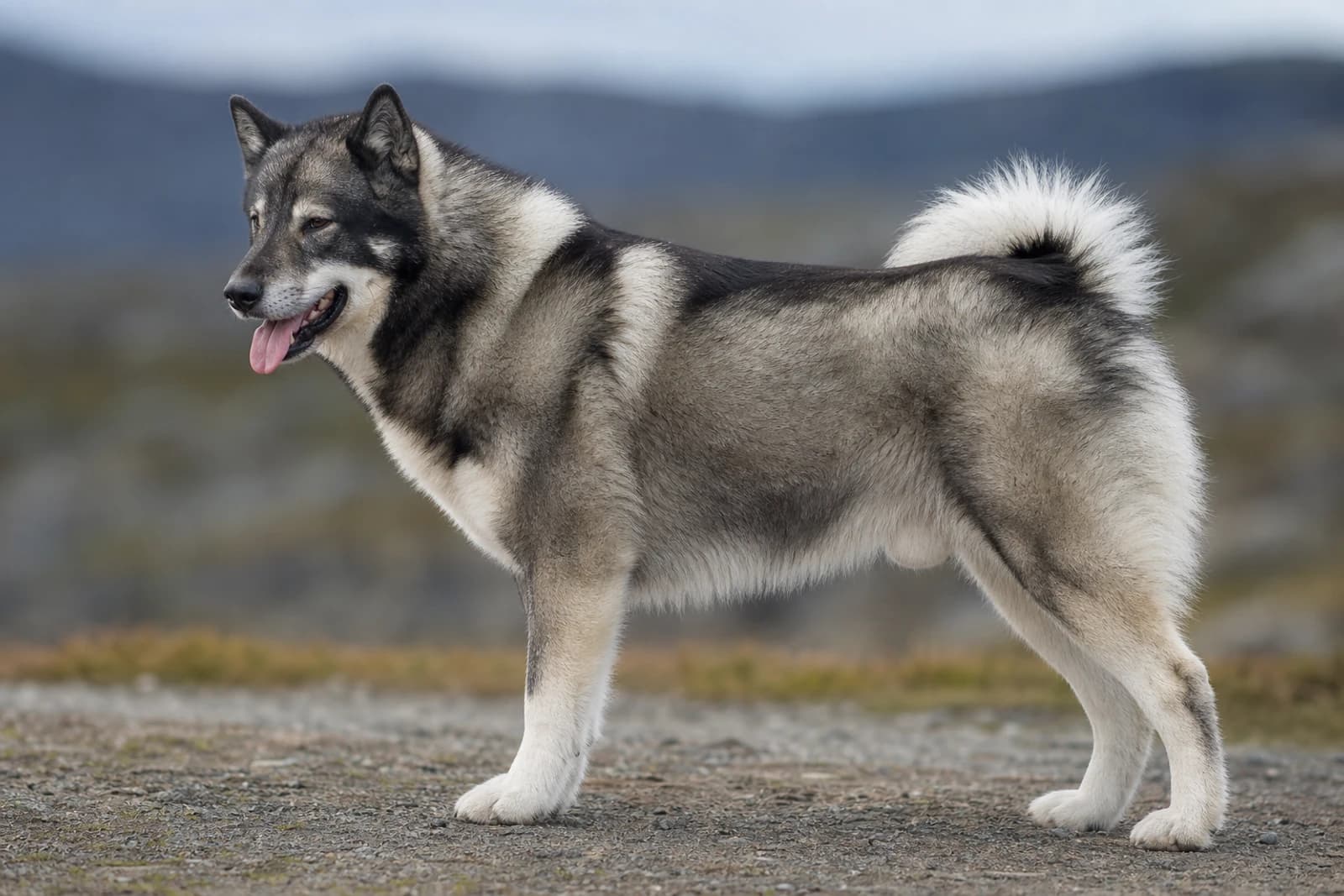
The Greenland Dog is a powerful, independent spitz-type sled dog originating from Greenland. Suited for experienced owners with an active, outdoor lifestyle, this breed thrives in cold climates and requires ample daily exercise and a job to do. Its loyal yet reserved nature makes it a devoted companion, but its high prey drive and strong-willed temperament mean it's not ideal for first-time owners, apartment living, or homes with small pets. With early socialization, they can get along with other dogs but may be aloof with strangers. This hardy, energetic breed is best for those who understand and appreciate Arctic working dogs.
At a glance
- Size
- Giant
- Height
- 20–27 in
- Weight
- 60–106 lb
- Life span
- 10 years
- Coat colors
- White, Black, Gray, Tan, Sable
- Coat type
- Thick double coat
- Group
- Spitz-Type
- Origin
- Greenland
How much does a Greenland Dog cost?
Adopt / rescue
$75–$400
Usually includes spay/neuter, first shots, and a microchip.
Buy from a breeder
$700–$2,000
From a reputable, health-testing breeder.
Approximate USD. Prices vary widely by region, breeder, pedigree, age, and coat colour — adopting is the lower-cost and recommended route. Avoid suspiciously cheap “breeders”; they’re often puppy mills.
Estimate the full cost of a Greenland Dog →Greenland Dog photos
Views
Front, side, rear and top — the full silhouette.Poses
How the breed sits, lies, moves and plays.Puppy to senior
The breed across its whole life.Expressions
The breed’s range of moods.Close-up details
Eyes, ears, nose, paws, tail and coat.Coat colors
The breed’s recognized colors.Click any photo to enlarge. We show the Greenland Dog from every angle — three views, poses, life stages, expressions, close-ups, coat and colors.
Appearance & size
A Greenland Dog is a powerhouse wrapped in a wolf-like Spitz silhouette, built to pull a loaded sled across sea ice for hours without complaint. You’re looking at a truly substantial canine — the breed lands in the giant category, though a lot of that heft comes from dense bone and hard muscle rather than towering height. Males typically stand 23 to 27 inches at the shoulder and weigh between 80 and 106 pounds, while females run a bit smaller, around 20 to 24 inches and 60 to 80 pounds. Close up, the dog feels even bigger: the chest is deep and broad, the neck is thick and slightly arched, and the whole frame says “endurance athlete.”
The coat is the first thing you notice in person. It’s a classic Arctic double layer: a soft, woolly undercoat for insulation and a coarse, straight outer coat that stands off the body enough to shed snow and ice. This isn’t a sleek, flat coat — it has real loft, thicker around the neck and rump. Colors cover the full Nordic palette: solid white, jet black, shades of gray from silver to charcoal, sable, and parti-color combinations with white legs, chest, and face markings. A mask around the eyes or a full facial cap with spectacles is common, giving each dog a distinct expression.
From the front, the head shape is pure Spitz: a broad skull, a moderate stop, and a wedge-shaped muzzle that tapers just enough. Ears are small, triangular, and prick upright, heavily furred inside. The eyes are dark, almond-shaped, and set at a slight slant — awake, direct, and without the softness you’d see in a retriever. From the side, the body is slightly longer than tall, with a level back, well-sprung ribs, and straight, heavy-boned forelegs. The tail is a bold feature; thickly furred, it curls forward over the back or to one side like a plume, and never dangles down. Move around behind the dog, and the hindquarters show broad, muscular thighs and a powerful drive; the tail plume usually covers part of the back, but you’ll still spot a clean, parallel rear stance. Everything about the Greenland Dog’s build says it was shaped by one unforgiving job.
History & origin
The Greenland Dog traces its ancestry to some of the earliest dogs ever to live alongside humans in the Arctic. You’re looking at a lineage that took shape with the Thule people — the predecessors of modern Inuit — who migrated across the Bering Strait and into Greenland roughly 1,000 years ago. Their dogs weren’t pets. They were a survival toolkit on four legs.
From the start, these were multipurpose working animals. Thule hunters used them to track seals, haul massive loads of walrus and whale meat on wooden sledges, and hold polar bears at spear-point until the hunter could close in. A Greenland Dog could easily reach 100 pounds or more of dense, cold-proof muscle, and a team of them could pull over a ton of freight across the ice. In a place where fuel and food were never guaranteed, the breed’s endurance and cooperation with people were genuine lifelines.
Because settlements in Greenland were so isolated — tiny villages separated by hundreds of miles of frozen sea — the dogs stayed remarkably pure for centuries. There was no steady influx of outside breeds to muddy the gene pool. When European explorers finally began using them, they tapped into a bloodline that was essentially unchanged since the days of the early Inuit.
That reliability caught the attention of Roald Amundsen, who selected Greenland Dogs for his 1911 South Pole expedition. He knew they could handle the grind better than any machine available. His lead dog, a female named Etah, famously helped carry the team to the pole and back, cementing the breed’s reputation for raw, no-frills grit.
By the mid-20th century, snowmobiles and airplanes started replacing working sled dogs, and the population took a nosedive. Greenland’s government and a network of dedicated mushers fought back with structured conservation measures, a closed stud book, and a recognition that the breed was a living piece of Arctic heritage. Today, Greenland Dogs still work as freight-haulers and long-distance racers in the polar north. A small number live as companions in other climates, but their history isn’t just background — it’s a loud, instinct-driven blueprint for a dog that needs to pull, follow a pack hierarchy, and use its own judgment.
Temperament & personality
A Greenland Dog isn’t a decorative giant—this is a friendly, 60-to-106-pound sled dog with a mind for hard work and a body built to pull all day. If you picture a calm, couch-potato companion, stop right here. These dogs want a job and a pack, and they’ll treat your household as their team. That means they need to be included, exercised to exhaustion, and respected. They’re loyal, curious, and surprisingly gentle with people they know, but they’re not fawning. Affection comes as a shoulder lean, a howl hello, or simply following you from room to room—not bouncing off the walls for belly rubs.
Energy-wise, expect a dog that needs at least an hour of serious movement daily: running, mushing, weight-pulling, or a bike ride at full tilt. A leisurely stroll around the block will leave them pent-up and destructive. Without that outlet, the same determination that makes them superb sledders turns into shredded furniture, excavated yards, and nonstop vocalizing. They’re heavy chewers at every stage: puppies explore with their mouths, and adults gnaw hard objects to keep their jaws strong and teeth clean. Provide ample raw bones, bully sticks, and sturdy chew toys. If they latch onto table legs instead, a homemade citrus spray (boiled citrus peels) or a white vinegar spray often sends them elsewhere—vinegar also helps neutralize urine odors, which is a big deal with this breed.
Which brings up a signature Greenland Dog quirk: they’re territorial markers. They deposit scent cues to define their world, and their spatial memory for those spots is sharp. An indoor accident that isn’t obliterated with an enzymatic cleaner becomes a repeat bathroom. Even without accidents, a spare room that doesn’t smell like the family may get “claimed” with urine. So keep your home smelling like you, clean messes thoroughly, and reward outdoor elimination immediately with a treat.
Watchfulness comes standard. They bark at unusual sounds or strangers approaching, and their sheer size—20 to 27 inches tall—makes that a deterrent. Yet they aren’t guard dogs in the aggressive sense; they’re more likely to hold a forward-leaning, alert posture than to charge. Learn to read their body language. A stiff, staring dog with a hard-set jaw is telling you he’s uncomfortable, not challenging you to a showdown; lip licking, yawning, or turning the head away are calming signals that say “back off.” Respect those early cues, and you’ll avoid escalation. Never interrupt this dog while it’s eating, and teach children to leave him entirely alone during meals. Overbearing handling can trigger food guarding, and a 100-pound dog guarding a bowl is no small matter.
With their own family, Greenland Dogs are deeply social. They do best inside the home, surrounded by their people. Isolation leads to anxiety-driven barking, digging, or escape attempts. They’re clever Houdinis, so a 6-foot fence with buried reinforcement is baseline. They can get along with other dogs when properly socialized—their pack nature helps—but same-sex dominance and high prey drive mean small pets are often targets. Novice owners who aren’t ready to lead with consistency, not force, will struggle. A strong-willed dog like this doesn’t respond to heavy-handed corrections; he needs clear boundaries, early training, and a life that taps his relentless drive. Meet those demands, and you’ll have a steady, brave companion who works with you like no other.
Good with kids, dogs & other pets
A Greenland Dog’s calm, patient nature makes him a solid match for families with kids who understand large breeds. He’s not the type to startle or snap over small slights, and his pack background means he instinctively values harmony inside the home. But weigh the numbers: at 60 to 106 pounds and up to 27 inches tall, even a friendly lean or a wagging tail can knock a toddler flat. Supervision is non-negotiable. Teach children to give the dog space when he’s eating or resting, and you’ll see the bond flourish without bruised egos or elbows.
With other dogs, this breed usually fits right in. Centuries of working in close teams on Arctic sled runs have wired them for cooperation. They often perk up when another dog joins the household and do best with consistent canine company. That said, they aren’t instant besties with every strange dog at the park. Their play style can be rowdy and physical, and some adults are selective about unfamiliar dogs, especially of the same sex. Early, ongoing socialization — starting well before that 12- to 16-week window slams shut — is what turns natural pack tolerance into real-world friendliness. Short, positive meet-ups with calm, known dogs build that skill without overwhelming anyone.
Small pets are a different story. Greenland Dogs were bred to survive harsh environments and think independently; a fleeing cat, rabbit, or even a small dog can flip a prey-drive switch. Some individuals coexist with indoor cats if they were raised together from puppyhood, but no amount of training fully erases the instinct. You’ll be managing the environment for life: secure separation, sturdy crates, and never leaving them unsupervised with anything that squeaks and runs. If you have a house full of free-roaming hamsters or birds, this is probably not your breed. He’s a devoted family dog, but his affection doesn’t extend to animals he views as quarry.
Trainability & intelligence
Greenland Dogs are sharp, observant problem-solvers — they learn a new command in a handful of repetitions once they see a reason to bother. The high trainability rating (5/5) reflects a dog that can master complex tasks, not one that blindly obeys. Bred to think independently while pulling sleds across shifting ice, this breed evaluates a request before deciding whether to comply. That means training hinges on a two-way relationship, not on barking orders.
What motivates a Greenland Dog
- Praise and play often trump treats. A wrestle with a tug toy or an excited "good dog" fires them up more than a biscuit.
- They’re sensitive to tone. A sharp correction or impatient body language damages trust fast, which can stall progress for days. Stay calm, even when they test you.
- Food rewards still work for precise shaping, but mix them with real-life reinforcers: the chance to run with you after a recall, or a break to sniff at the end of a loose-leash segment.
The real-world recall challenge
Greenland Dogs carry strong predatory drift and a deep-running instinct to chase anything that moves — wildlife, cats, a flapping tarp. Off-leash reliability in an unfenced area is a tall order, no matter how much training you’ve done. Start recall practice indoors at 8 weeks, then in securely fenced fields, rewarding with a sprint together or a quick game. Expect that a fully mature dog may never be trustworthy around a darting squirrel, and plan accordingly.
What works (and what backfires)
- Positive, relationship-based repetition builds the dog who wants to work with you. Short, upbeat sessions twice a day teach more than a marathon drill.
- Consistency without force. Set clear rules, but enforce them with redirection, not punishment. Jerking the leash or looming over this breed creates a shutdown animal or one that argues more loudly.
- Early socialization is non-negotiable. Between 3 and 14 weeks, expose the puppy to new people, different surfaces, kids, and other dogs — all at a pace that doesn’t overwhelm. A poorly socialized Greenland Dog can become aloof or reactive with strangers, and at 60–106 pounds that’s dangerous.
Common sticking points
- Stubbornness that looks like deafness. If they’ve decided the cue isn’t worth it, they’ll ignore you. Raise the value of your reinforcement — a higher-pitched voice, a beloved toy, or a quick sprint — before repeating the command.
- Pushy behavior around food or the door. Nip it early by rewarding “sit” or “wait” automatically, never by scolding. They learn fast that politeness pays.
Start the minute your puppy comes home, keep sessions fun, and never mistake their independent streak for a lack of intelligence. The more trust you bank before adolescence hits, the more willing that powerful 90-pound dog will be when you ask for a “down” on a cold sidewalk.
Exercise & energy needs
A Greenland Dog doesn’t need a walk around the block — he needs a job. Bred to haul heavy freight sleds across frozen tundra, this is raw pulling power wrapped in a Spitz coat. A couple of quick leash strolls won’t scratch the surface. Think two dedicated exercise sessions a day, each lasting a solid hour or more, and that’s the baseline. If you’re not mushing, you’ll be hiking, biking, or running alongside him while he pulls a cart or wears a weighted pack. These dogs were built to move, and they turn deeply unhappy — loud, destructive, escape-artist unhappy — when that need goes unmet.
Intensity matters as much as the clock. He needs to work: sustained trotting, hill climbs, pulling resistance. Sled work, canicross, bikejoring, skijoring, and weight pulling all fit the bill. Letting him run off-leash in a huge, securely fenced area helps, but without a task to focus on, his own pacing can shade into restlessness. He’s an independent problem-solver, so plain physical exercise isn’t enough. Morning and afternoon sessions should be paired with tough mental challenges — scent puzzles, hide-and-seek, obedience drills that require actual thought, or a frozen Kong packed with his meal that he has to excavate outside (even in summer — he’ll appreciate the cold treat).
Respect his growing body. A giant-breed puppy under 18 months shouldn’t be pulling heavy loads or pounding pavement for hours. Controlled, age-appropriate exercise on softer surfaces protects developing joints. Ask your vet about safe timelines for high-impact pulling. Skipping the cool-down after a run can set you up for a stiff, sore dog, so build in a slow walk and a chance to stretch.
When the exercise tank gets filled twice a day, you’ll see a calmer, more cooperative housemate. Skip it, and you’ll hear about it — shredded door frames, howling sessions, and a dog who invents his own fun, which usually involves digging to China.
Grooming & coat care
A Greenland Dog’s coat is the real deal — a dense, weatherproof double layer that shrugs off subzero wind and wet snow. It also sheds like nothing you’ve ever seen. Twice a year, during seasonal blowouts, you’ll pull handfuls of undercoat out every day. In between, the shedding is still noticeable, just less catastrophic.
Brushing routine
Plan on brushing 4–5 times a week as a baseline, and every single day when the coat is blowing. You need the right tools for a coat this thick. A metal slicker brush with rounded pins does the heavy lifting, breaking up loose undercoat and clearing out debris. Follow up with a wide-toothed comb or an undercoat rake to get down to the skin and prevent mats from forming in the woolly layers. Skip bristle brushes — they just skate over the top of this coat without touching the real problem underneath. Regular brushing keeps the natural oils distributed, reduces the flood of fur in your house, and gives you a chance to check for hot spots, ticks, or dry patches hidden under all that hair.
Bathing
Bathe a Greenland Dog only a handful of times a year, at most. Their coat is self-cleaning to a surprising degree, and frequent shampooing strips the protective oils that keep the outer guard hairs weather-resistant. When you do need to wash off something truly disgusting — think rotten fish or a skunk — use a mild dog shampoo and be prepared for a long drying time. That dense undercoat can hold moisture against the skin for hours, setting up the perfect conditions for hot spots and irritation. Towel dry thoroughly and, if your dog tolerates it, use a cool-force dryer to speed things up.
Nails, ears, and teeth
The breed’s big, thick nails grow fast and need a trim every 3–4 weeks. If you can hear clicking on the floor, they’re too long. Ear cleaning should happen weekly: flip up those small, thick ears, wipe out any gunk with a damp cloth or vet-approved solution, and sniff for any off odors that signal infection. Dental care matters as much here as anywhere — aim to brush the teeth a few times a week with a dog toothpaste. Many Greenland Dogs aren’t automatically cooperative for handling, so start these routines early and pair them with high-value treats.
Seasonal shedding
The massive undercoat blow happens in spring and fall, when the entire insulating layer turns over. For 2–4 weeks, you’ll feel like you’re grooming a sheep. Rake out the dead undercoat daily during these periods, or you’ll end up with felted mats that trap moisture and lead to skin infections. Outdoor exercise — which this breed needs in large doses anyway — helps loosen the dead coat naturally, so a good run before a brushing session makes the work go faster. Don’t reach for the clippers. Shaving a Greenland Dog destroys its natural temperature regulation and can lead to permanent coat damage. Manage the shedding with tools, not scissors.
Shedding & allergies
If you bring a Greenland Dog into your home, you’re signing up for a extreme shedding experience — think “fur tumbleweeds the size of small cats” rather than a few stray hairs on the couch. This is a giant spitz-type breed with a dense, double-layered coat built for Arctic sled work. The undercoat is thick and woolly, while the outer guard hairs are harsh and straight, and together they drop constantly. You’ll find fur on every surface year-round.
Twice a year, typically in spring and fall, the shedding shifts into a full seasonal blowout. During those weeks, the undercoat comes out in clumps so large you can literally pull it off in handfuls. Daily brushing isn’t optional — it’s a necessity if you want to keep the mess even slightly under control. A good undercoat rake, a slicker brush, and a high-velocity dryer are your best tools to avoid living in a snow globe of dog hair.
Drool is a non-issue for most individuals. Their mouths are relatively dry, so you won’t be wiping slobber off walls or furniture.
As for allergies, the Greenland Dog is about as far from hypoallergenic as a breed gets. They produce plenty of dander, and that nonstop shedding spreads it everywhere. If you or someone in your household has dog allergies, this breed will trigger them relentlessly.
The breed can be prone to skin problems — something to watch closely. Zinc-responsive dermatosis, hot spots, and other irritations can flare up under that dense coat, especially if it stays damp after a swim or a heavy sledding run. Responsible breeders screen for hereditary skin conditions, but you still need to dry the coat thoroughly after wet outings and stay on top of grooming. A neglected undercoat mats easily and traps moisture right against the skin, setting the stage for sores and infections. If you can’t commit to serious, frequent coat maintenance, a Greenland Dog will make your life — and its own — miserably itchy.
Diet & nutrition
Your Greenland Dog’s food bill directly reflects how hard he works. These dogs were built to haul sleds, so a lightly exercised pet living on the same calories as a working dog will pack on weight fast — and that extra weight punishes joints in a breed already vulnerable to hip and elbow trouble. A full-grown Greenland Dog spans 60 to 106 pounds. An energetic 80-pounder may burn through twice the daily intake of a lower-key 90-pound dog, so adjust portions by body condition, not just the scale.
Puppies need a large-breed formula to slow bone growth to a safe pace. Feed four evenly spaced meals until four months, three meals until six months, then transition to two meals a day for the rest of adulthood. Two smaller portions protect this deep-chested breed from bloat better than one enormous meal.
Protein from quality animal sources — chicken, salmon, lamb — should anchor the diet. Many owners lean into a meat-forward plan: roughly 60% raw or cooked meats and fish, 20–30% pulverized vegetables and fruits, and 10% extras like eggs, pearl barley, or plain yogurt. If you choose raw or home-cooked, a veterinary nutritionist is non-negotiable; missing key nutrients over a decade catches up hard. Avoid greasy table scraps and holiday fats that can trigger pancreatitis inside hours, and never feed from the table. Safe leftovers go straight into the dog’s bowl so begging never takes root.
Scoffing kibble in seconds invites another bloat risk. A slow-feeder bowl spreads a meal out and gives that sharp brain a job. By age seven, metabolism usually dips. Switch to three or four smaller meals a day, keep protein steady, and shave calories gently as exercise winds down. A lean, rib-feelable dog stays mobile longer.
Health & lifespan
A Greenland Dog typically lives about 10 years—right in line with what you’d expect for a giant breed. That decade can feel longer and healthier when you know the few trouble spots this dog is predisposed to and stay ahead of them.
Skin issues top the list. The dense double coat that insulates against Arctic cold also traps moisture and debris close to the skin. Hot spots, yeast infections, and allergic dermatitis can flare up if the dog stays damp or isn’t brushed out regularly. A high-quality diet with enough omega-3 fatty acids, thorough drying after a swim or bath, and a thorough weekly brushing session make a real difference. If you catch your dog licking or chewing at the same patch, get on it early—it’s far easier to manage before infection sets in.
Joint health is another common giant-breed concern. Hip and elbow dysplasia show up in the breed, and arthritis often follows as the dog ages. Responsible breeders screen parent dogs via OFA or PennHIP and can share those clearances. Keeping a puppy lean and avoiding high-impact jumping on hard surfaces during the rapid growth phase protects developing joints. Since these dogs often tip the scales anywhere from 60 to over 100 pounds, even a few extra pounds add serious strain. Measure meals, adjust portions with age and activity level, and resist those pleading eyes—obesity accelerates joint breakdown and shortens an already modest lifespan.
Bloat (gastric dilatation-volvulus) is a life-threatening risk with any deep-chested dog. The stomach can twist on itself, trapping gas and cutting off blood flow. You’ll see a distended belly, unproductive retching, and restlessness. This is a surgical emergency, so know the nearest 24-hour vet. Feeding two or three smaller meals instead of one large one and avoiding heavy exercise right after eating are sensible precautions.
Heat sensitivity is real. These dogs were built to pull sleds in subzero temperatures, not to jog in August. In warm weather, exercise early or late, always carry water, and watch for heavy panting, drooling, or unsteady movement. A child’s wading pool in the shade can be a lifesaver.
A couple of must-dos: monthly heartworm prevention during mosquito season (and one month after it ends), and keep the rabies vaccination current—it’s legally required and has no treatment once symptoms appear. Annual vet checkups help spot subtle shifts—a slight limp, a change in appetite, a dull coat—before they become full-blown problems.
Finally, don’t underestimate how much early socialization affects physical health. A Greenland Dog that learned handling as a puppy copes better with vet exams, grooming, and everyday stress. Chronic stress can suppress the immune system and worsen skin or digestive troubles, so that easy-going attitude you build early pays off for years.
Living environment
A Greenland Dog belongs where winter is the default setting. These are 60–106-pound sled dogs built to pull heavy loads across frozen terrain. An apartment, even a spacious one, would feel like a cage. They need a house with a large, securely fenced yard — and that fence needs to be tall, reinforced, and dug in deep, because this breed’s escape artistry is as legendary as its stamina. Think of the yard less as a “place to play” and more as a holding area between real workouts.
Climate tolerance is brutally black and white. They'll happily curl up in subzero snow and sleep through a blizzard. Heat and humidity, on the other hand, can turn dangerous fast. If you live where summers regularly climb past 70°F, you’re asking for trouble. Even with shade and water, a Greenland Dog’s dense double coat makes overheating a genuine risk. Air conditioning isn’t a luxury — it’s a requirement during warm months.
Noise-wise, shed the idea of a quiet house. This is a spitz-type working dog that communicates with piercing howls, barks, and yodels. They’ll sound off at wildlife, a distant siren, the neighbor’s leaf blower, or just because the pack should check in. That same pack mentality means they generally don’t do well left alone for long stretches. A bored, solitary Greenland Dog with a surplus of 60-plus-minute-twice-daily energy is going to re-landscape your yard, dismantle fencing, and shred anything left within reach. Two solid, high-intensity exercise sessions every day — pulling, running, or long-distance hiking — are non-negotiable. Add in puzzle toys, scent work, or anything that lets them work their brain, because physical tiredness alone won't cut it. If your lifestyle can’t absorb a dog that lives for hard labor and hates warm weather, keep looking. This breed is a working partner, not a housepet.
Who this breed suits
This is a working sled dog through and through, not a family companion shaped for modern suburban life. The right home is one that treats exercise, purpose, and pack structure as non-negotiables.
You’ll thrive with a Greenland Dog if…
- You’re an experienced sled-dog person, musher, or long-distance skijorer. This breed lives to pull, run, and work in brutal cold. A casual jogger won’t cut it. Expect to provide two or more hours of intense, purpose-driven activity every day — harness work, canicross over snow or dirt, freight pulling, or multi-day expeditions.
- You keep dogs in a working pack setting, not as a single house pet. Greenland Dogs are famously cooperative with other dogs but can redirect prey drive toward cats, small dogs, or livestock. A securely fenced rural property with a proper kennel setup and a clear hierarchy is the baseline, not a bonus.
- You value independence over biddability. This spitz-type brain doesn’t exist to please you. Commands are suggestions, not guarantees. You’ll earn cooperation through consistency, respect, and a job the dog finds meaningful — not through treat-dispensing charm alone.
- You embrace cold-weather living. That dense double coat, built for -40°F nights, makes heat a serious risk. Air-conditioned summers are a must; a purely indoor existence in a warm climate is not.
Think twice if…
- You’re a first-time dog owner, a senior with limited mobility, or want a dog that’s easy to control off-leash. Even a 60-pound Greenland Dog can drag a full-grown adult if a scent catches his attention. Prey drive is deeply ingrained; recall is never guaranteed.
- You have young children, small pets, or an apartment lifestyle. These are 60 to 106 pounds of unapologetic action. A wagging tail can clear a coffee table, and a bored Greenland Dog will dismantle walls, not just shoes. While they bond tightly with their humans, their rough-and-tumble play and low threshold for clumsy handling make them a poor match for most homes with toddlers.
- You can’t stomach a blunt lifespan of around 10 years. Giant working breeds give everything they have for that decade, and the goodbye comes sooner than you’d like. The commitment is short but absolute, with no room for a part-time effort.
Cost of ownership
Bringing home a Greenland Dog isn't like walking into a neighbor’s litter. These are rare working sled dogs, seldom found outside small circles of mushers and dedicated preservation breeders in North America. A puppy from proven working lines will typically run $1,500–$3,000+, and you’ll likely face a long waitlist, travel, or an import. Adoption is almost unheard of — most rescues that have them are breed-specific sled dog groups.
Once the dog is yours, monthly expenses land squarely in giant-breed territory. Here’s a realistic breakdown:
- Food: An active 80–100 lb Greenland Dog burns through serious calories. Count on 4–5 cups of high-quality, energy-dense kibble daily. That translates to $80–$110 a month; raw or freeze-dried diets can push it higher.
- Grooming: The thick double coat dumps massive amounts of undercoat twice a year, and you’ll battle tumbleweeds of hair the rest of the time. Budget for a good deshedding rake, a high-velocity dryer if you DIY, or $80–$120 per professional session a few times a year. Don’t skip nail trims and paw care for a dog built to run on ice.
- Veterinary: Routine annual care (exam, vaccinations, heartworm test, and preventives sized for a giant) easily runs $500–$700 a year. Preventives alone cost more because doses depend on body weight. The 10-year average lifespan means you need to be prepared for earlier onset of age-related issues like hip dysplasia, bloat, or eye problems.
- Insurance: For a giant, deep-chested breed prone to GDV and orthopedic trouble, expect premiums around $50–$80 per month with a solid policy. Without insurance, a single bloat surgery can top $5,000 overnight.
Plan for an additional $50–$100 monthly set aside for irregular costs like replacing chewed harnesses, extra boarding fees (many kennels won’t touch a primitive breed), and unexpected vet visits tied to their intensity. These dogs were never designed to be kept casually, and their expenses reflect it.
Choosing a Greenland Dog
Greenland Dogs are not typical house pets. They are rare, primitive sled dogs built to pull heavy loads in brutal cold, and finding one means working with a tiny network of serious breeders—most of whom will vet you more than you vet them. Right now, a rescue is unlikely; these dogs aren't ending up in shelters unless something went very wrong. If you do encounter an adult in need of rehoming, it will almost always be a retired or failed sled dog from a working kennel. That route can work, but only if you already have experience with high-drive spitz breeds.
Health clearances you should demand
Because the gene pool is small, responsible breeders obsess over hips, eyes, and overall structure. Ask to see:
- Hip dysplasia screening — OFA or PennHIP scores on both parents. A fair number of Greenland Dogs carry mild dysplasia; you want proof that the breeder isn't breeding affected dogs.
- Eye exam — a current CERF or OFA eye certification from a veterinary ophthalmologist. Progressive retinal atrophy and cataracts can surface.
- Elbow health — elbows are less of a headline issue than hips, but a conscientious breeder still screens.
- Cardiac evaluation — not universal, but some breeders will do a basic cardiac exam on breeding stock.
No one can guarantee a pup will never develop a health problem, but a breeder who skips all testing is a dead stop.
Red flags that matter
You are looking for a breeder who lives and breathes working sled dogs. Walk away if:
- The breeder never hooks their dogs to a sled or lets them run in harness. Greenland Dogs need a real job; a breeder who doesn’t work them can’t evaluate drive, temperament, or soundness under load.
- Puppies are raised in isolation—kennel-only, no household exposure. You want a pup that has been handled daily, heard normal kitchen noise, and toddled through a human living space.
- They sell pups earlier than 8 weeks. Snow breeds mature slowly; a pup taken too soon misses crucial canine social learning.
- They don’t ask you hard questions. A good breeder will want to know your yard setup, your escape-proof fencing, your winter tolerance, and exactly how you plan to exercise a 100-pound pulling machine.
Picking your puppy
Litters are infrequent, and waitlists can stretch 12–18 months. When you finally visit, watch for a pup that approaches you with a bold, level-headed curiosity. A Greenland Dog puppy should not cower or stiffen—but neither should it bulldoze the rest of the litter. Aim for the middle-of-the-pack pup: engaged, easy to startle and recover, comfortable being briefly held on its back. Avoid the extremely shy one and the one that seems to need no one. Breeders who do early neurological stimulation and expose puppies to light harness work around 5–6 weeks are giving you a head start.
If you can’t commit to serious daily running—not a couple of leash walks, but an hour or more of pulling, mushing, or off-leash hauling in safe open spaces—the right breeder will tell you the Greenland Dog is the wrong breed. That bluntness is the greenest flag of all.
Pros & cons
Pros
- Born to run and pull – a Greenland Dog’s idea of a good day is covering 30-plus miles in harness, not a quick jog around the block. If you’re a serious musher or long-distance skijorer, you get a partner with unmatched endurance.
- Thrives in real cold – the dense double coat and stout, square build shrug off subzero temperatures and biting wind that would send most breeds scrambling for a heated bed. They sleep outside contentedly while the snow piles up.
- Loyal to their pack – raised with their family, they form strong bonds and are watchful without being clingy. They’ll alert you to anything out of place with a booming howl, not frantic barking.
- Straightforward, hardy constitution – as a landrace-derived working spitz, they tend to be tough and free of the exaggerated features that saddle some giants with orthopedic trouble. With responsible care, they stay structurally sound well into old age.
- Surprisingly low “everyday” grooming – outside of biannual coat blows, the coarse self-cleaning fur doesn’t mat and rarely holds odor. A quick weekly rake does the trick for months at a time.
Cons
- Exercise needs are extreme – a bored Greenland Dog isn’t just unhappy; he’s destructive. They need 2–3 hours of hard pulling, running, or weight-pull work daily. A sedate household with weekend walks will produce a 90-pound wrecking crew.
- Prey drive rules their world – cats, small dogs, squirrels, livestock – they’ve been bred to chase and grab. A reliable off-leash recall is rare; most owners manage them as a contained, fenced, or tethered breed for life.
- Shedding on an industrial scale – twice a year, the undercoat comes out in tumbleweed clumps that fill garbage bags. During those weeks, your home, car, and clothes will wear a permanent layer of fur.
- Independent to the point of stubbornness – they haven’t been refined for biddability. Training is less “obedience” and more a negotiation. Novice owners often find themselves outmaneuvered by a dog who thinks for himself and sees little reason to take direction.
- Escape artists with dig-and-climb talent – a standard 4-foot fence is a suggestion. They’ll dig under, chew through, or scale barriers if the other side promises more interesting game. The yard needs serious fortification.
- Poor heat tolerance – over 50°F and they start to fade. In warm or humid climates, exercise shifts to predawn hours and cooling vests become mandatory; running them midday is genuinely dangerous.
- Shorter lifespan for a giant – a typical 10-year lifespan means the window is heartbreakingly brief. You’ll pack a lot of adventure into a decade, but you lose them faster than many other breeds.
- Noise carries – their howl is a haunting, carrying sound that neighbor relations may not survive. Social isolation or the sight of a snowmobile can trigger an extended concert.
Similar breeds & alternatives
Canadian Eskimo Dog
The Canadian Eskimo Dog is the Greenland Dog’s nearest genetic twin — so close that some registries treat them as regional variants of the same primitive landrace. You get an almost identical package: 20 to 27 inches at the shoulder, 60 to 105 pounds of tightly wound muscle, a dense double coat built for minus-40 nights, and a brain wired to pull sleds and hunt seals for hours without stopping. The difference is mainly geography. Greenland Dogs were isolated in Greenland, while the Canadian Eskimo Dog worked across the Canadian Arctic. In practice, both are hard, independent, pack-driven dogs that need an experienced owner willing to manage high prey drive and same-sex dog aggression. Finding either in the U.S. is a project — breeding stock is tiny — but if a Greenland Dog interests you, the Canadian Eskimo Dog will feel like the same long-distance machine with a slightly different postal code.
Alaskan Malamute
If the Greenland Dog’s size and power appeal but you’d prefer a freight hauler that tilts a little more toward its people than toward the pack, the Alaskan Malamute earns a long look. Malamutes typically stand 23 to 25 inches and weigh 75 to 85 pounds, with some lines hitting 100-plus pounds, so they match the Greenland Dog in substance. They were bred for heavy freighting, not sprinting, and they share the deep-chested build and undeniable strength. The personality split is real, though. A well-socialized Malamute is often more overtly friendly with human strangers — affection emerges faster — whereas a Greenland Dog tends to remain aloof and businesslike. Malamutes still carry a stubborn streak, a sky-high prey drive, and a need for serious daily work (think pulling a loaded cart or hiking with a weighted pack). Lifespan hovers around 10 to 12 years, a shade beyond the Greenland Dog’s typical decade. You’re still signing up for a powerful, shedding, escape-prone northern breed, but the Malamute swings a little closer to “house dog” and a little further from “polar expedition specialist.”
Siberian Husky
On the opposite end of the size chart sits the Siberian Husky: 35 to 60 pounds, 20 to 23.5 inches tall, and built for speed over raw pulling power. Where the Greenland Dog is a freight train, the Husky is a lightweight rally car. You get the same spitz silhouette, the piercing eyes, the talkative vocalizations, and a coat that snow drifts off while the dog sleeps comfortably in subzero temperatures. The big trade-off is manageability. A Husky’s smaller body is easier to handle on a leash when a rabbit zips by, and its famously sociable nature means it generally gets along with other dogs and people — qualities a Greenland Dog does not reliably offer. The catch: Huskies are Houdinis with fur. A bored Husky will climb fences, dig craters, and howl operettas. Exercise needs are still extreme (an hour of hard running, not a walk), but the Husky fits into suburban life better than a 100-pound primitive hunter ever could. The lifespan advantage is notable, too — 12 to 14 years is common. That extra time matters when you’re comparing a decade with a Greenland Dog to well over a dozen years with a resilient little sled dog.
Fun facts
- Greenland Dogs are one of the oldest Arctic breeds, used by the Inuit for over a thousand years for sledding and hunting.
- Their dense double coat allows them to sleep outside in temperatures as low as -50°F (-45°C).
- They are known for their incredible stamina, capable of covering long distances while pulling heavy sleds.
- Greenland Dogs communicate with a range of howls, yips, and barks, often answering each other over long distances.
Frequently asked questions
- How much exercise does a Greenland Dog need?
- Greenland Dogs are energetic working dogs that require significant daily exercise, typically at least one to two hours of vigorous activity. They thrive on pulling, running, and mentally stimulating tasks, so activities like sledding, canicross, or long hikes are ideal. Without sufficient exercise, they may become bored and develop destructive behaviors.
- Are Greenland Dogs good with children?
- Greenland Dogs can be good with children if raised with them and properly socialized, but their size and strength mean interactions should always be supervised. They are generally friendly and pack-oriented, but they may be too boisterous for small kids. Early socialization helps ensure gentle and appropriate behavior around family members.
- Do Greenland Dogs shed a lot?
- Yes, Greenland Dogs have a thick double coat and tend to shed heavily, especially during seasonal changes. Regular brushing, at least a few times per week, is necessary to manage loose fur and keep the coat healthy. Daily brushing during peak shedding periods can help keep the home cleaner.
- Can Greenland Dogs live in apartments?
- Greenland Dogs are not well-suited for apartment living due to their large size, high energy levels, and need for outdoor space. They thrive in homes with secure, spacious yards where they can move freely. An apartment can work only if the dog receives exceptional amounts of daily outdoor exercise and mental stimulation, but it’s generally not recommended.
- Are Greenland Dogs suitable for first-time owners?
- Greenland Dogs are typically not recommended for first-time owners because they are strong-willed, independent, and require consistent, experienced handling. Their high exercise needs and working-drive can be challenging without prior dog ownership experience. Training requires patience, firmness, and an understanding of spitz-type behaviors.
Tools & calculators for Greenland Dog owners
Quick estimates tailored to Greenland Dogs — pre-filled with this breed’s size where it matters.
Articles & stories about the Greenland Dog
Sources & standards
This profile follows recognized breed standards from the American Kennel Club (AKC) and the Fédération Cynologique Internationale (FCI), along with established veterinary and breed-club guidance. These describe general breed tendencies — every dog is an individual.
Owner stories
Have a Greenland Dog? Share your experience — grooming tips, personality quirks, anything goes.