

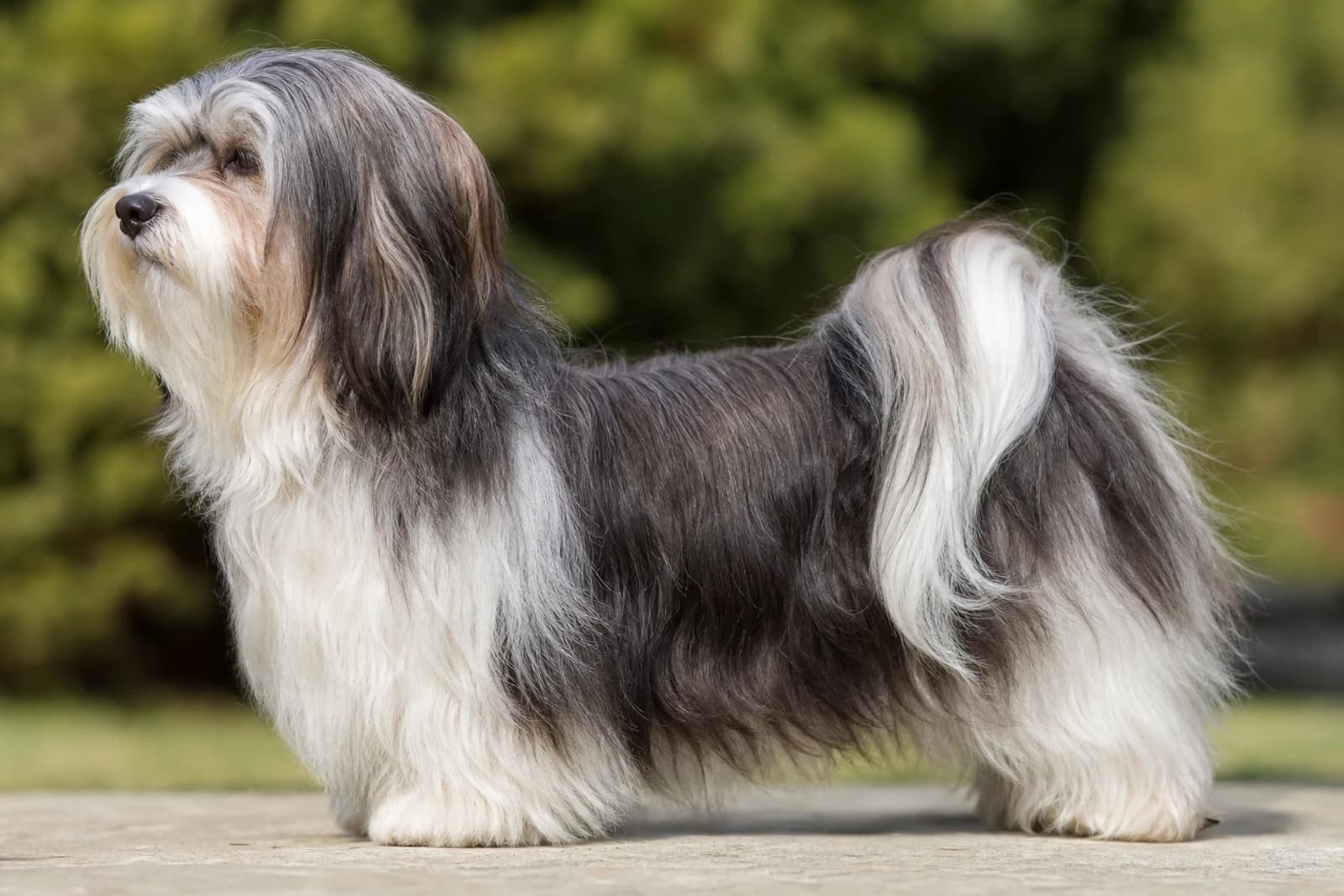
The Havanese is a small Cuban companion dog with a silky coat and an upbeat, people-centered personality. It is one of the stronger small-family candidates for apartments, first-time owners, and readers looking for a friendly low-shedding dog.
At a glance
- Size
- Small
- Height
- 8–12 in
- Weight
- 7–13 lb
- Life span
- 14–16 years
- Coat colors
- White, cream, gold, silver, blue, black, chocolate, parti-color
- Coat type
- Long silky double coat
- Group
- Companion
- Origin
- Cuba
How much does a Havanese cost?
Adopt / rescue
$100–$450
Usually includes spay/neuter, first shots, and a microchip.
Buy from a breeder
$1,200–$3,000
From a reputable, health-testing breeder.
Approximate USD. Prices vary widely by region, breeder, pedigree, age, and coat colour — adopting is the lower-cost and recommended route. Avoid suspiciously cheap “breeders”; they’re often puppy mills.
Estimate the full cost of a Havanese →Havanese photos
Views
Front, side, rear and top — the full silhouette.Poses
How the breed sits, lies, moves and plays.Puppy to senior
The breed across its whole life.Expressions
The breed’s range of moods.Close-up details
Eyes, ears, nose, paws, tail and coat.Coat colors
The breed’s recognized colors.Click any photo to enlarge. We show the Havanese from every angle — three views, poses, life stages, expressions, close-ups, coat and colors.
Appearance & size
The Havanese is a compact, sturdy dog who looks like he’s wearing a silk robe two sizes too big. He stands just 8 to 12 inches at the shoulder and tips the scale at 7 to 13 pounds — small enough to scoop up with one hand, but with enough bone and substance to feel like a real dog, not a delicate toy. The body is slightly longer than tall, giving him a rectangular silhouette that stays low to the ground. A deep chest, well-sprung ribs, and a level topline carry into a muscular rear; forelegs are straight and dewclaws may be removed. He’s built to trot with a springy, confident step, not prance.
Coat
The coat is the breed’s trademark — a long, profuse double layer that’s soft, lightweight, and can range from wavy to loose ringlets. It’s silky rather than cottony, and doesn’t shed much (dead hair gets caught in the coat instead of landing on the sofa). You’ll see every color imaginable: white, cream, champagne, gold, red, chocolate, black, blue, silver, plus parti-color, tricolor, brindle, sable, and combinations of all of the above. A puppy’s coat often darkens, lightens, or shifts pattern as it matures. Unlike the similar-looking Maltese, the Havanese coat can be corded if allowed to mat naturally, but most owners keep it brushed out into a full, flowing curtain.
Details you’ll notice
Dark, almond-shaped eyes and a broad black nose (brown on chocolate dogs) peek through the hair, giving an alert, slightly impish expression. The ears are drop, set high, and covered in long fringe that blends into the coat around the neck. The tail is a highlight: set high, it arches forward over the back and is draped in a long plume of hair that sways with every step. Feet are small and arched with hair tufts between the pads. A clean-shaven face or topknot is a matter of owner preference — in the ring, you see both natural falls and banded styles.
From every angle
- Front view: A rounded face framed by ear fringes, with eyes and nose peeking out. The chest is covered in a cascade of hair that often parts down the middle.
- Side view: The body’s rectangular shape is obvious — slightly longer than tall — with a level back and the tail curled forward like a flag. The coat sweeps all the way to the ground, hiding the legs.
- Rear view: The plumed tail drapes over the rump, and when he moves, you see quick, lively footwork and a bouncy gait that makes the whole back end wriggle.
This isn’t a breed that looks fragile; he’s a well-muscled small dog under all that hair, ready for a solid walk or a long nap on your lap without missing a beat.
History & origin
The Havanese is Cuba’s only native breed, and its story begins exactly where you’d expect—curled up in the laps of Havana’s 18th-century aristocracy. These small, silky-coated charmers descend from Old World Bichon types that sailed to the Caribbean with Spanish colonists. Most breed historians pinpoint the Bichon Tenerife (the same ancestor behind the Bichon Frise and Maltese) as the foundation stock. On the island, those little white dogs adapted over generations, likely picking up influence from other small companion breeds that arrived on trading ships. By the 1800s, a distinct type called the Blanquito de la Habana—the little white dog of Havana—had cemented itself in affluent Cuban households, prized for a cheerful temperament and a flowing coat that felt like raw silk.
Isolation did the rest. As the dogs became fixtures in Havana’s smart parlors, breeders refined them without chasing a rigid cosmetic standard. They were bred to be resilient indoor companions, content to warm a lap or trot alongside a carriage on a humid afternoon. The coat expanded in color beyond white, and the breed picked up its more descriptive alias: Havana Silk Dog. They remained largely a secret outside the island, shared quietly among island families for warmth and companionship, not for the show ring.
The breed nearly vanished overnight. During the Cuban Revolution in the late 1950s, many of the families who owned Havanese fled the country. Most dogs were left behind, and the population collapsed. The modern Havanese owes its existence to a handful of refugees who managed to smuggle their beloved pets into the United States. The founding stock was tiny—reliable records point to only 11 dogs that made it out and went on to produce offspring. From that precarious beginning, dedicated American breeders spent decades preserving the bloodline, keeping detailed records and carefully expanding numbers. The American Kennel Club recognized the breed in 1996, and the little dog from Old Havana transitioned from a pampered island novelty to a thriving, beloved companion on solid ground across the world.
Temperament & personality
You’re getting a small, sturdy shadow that treats every family member like they’re the most interesting person in the room. Havanese live to be part of the action — not off in a corner, not tucked in a purse all day. They’ll follow you from the laundry room to the couch and settle in your lap the moment you sit still. This isn’t a breed that does well with long stretches of isolation. When left alone too often, that people-motivated brain can cook up its own entertainment: nuisance barking, trash-can raids, or anxious chewing. The good news is that a Havanese is remarkably adaptable, happy to match the vibe of the household as long as you’re physically close.
Expect a comedian, not a robot. They’re clever dogs that pick up tricks fast, but they also have a streak of gentle stubbornness. A calm, consistent approach works far better than heavy-handed corrections, which can make them shut down. Short, upbeat training sessions with plenty of tiny treats will get you much further than long drills. They’re sensitive enough that a sharp tone can ruin the mood for the whole afternoon, so keep things light.
With family and strangers, the default is friendliness. A well-socialized Havanese greets visitors like long-lost friends, not intruders, though some are a bit reserved at first and will post a brief burst of barking to announce the doorbell. That watchfulness makes them a decent little alert dog, but don’t expect a guard dog — once you give the okay, the tail wags and the leaning-in for scratches begins. Around children, they’re usually patient and up for play, but as with any small dog, kids need to learn not to interrupt eating or sleeping, and to handle gently. Those small legs and long backs mean roughhousing on the floor is safer than a drop from a child’s arms.
A couple of quirks are worth knowing up front. Havanese can be slow to fully house train, not because they’re dumb, but because they’re so tuned in to scent. If an accident happens inside, the lingering odor tells them this is the potty spot, so you’ll need to clean thoroughly with an enzymatic cleaner to break that cycle. And while they’re not high-energy in a hyperactive way, they do need daily engagement — a brisk walk, a game of fetch down the hallway, or a puzzle toy. A bored Havanese with no outlet is likely to find your slippers very interesting. Give them that connection and mental work, and you’ll get a long-lived, cheerful companion who just wants to be where you are.
Good with kids, dogs & other pets
A Havanese can be a wonderful family dog — but only if everyone understands that a 10-pound dog is not a stuffed toy. Their default temperament is patient and non-aggressive, and they rarely show real defensiveness. With kind, supervised kids, they’ll play gentle games for as long as the attention lasts. The catch is that rough handling (a tumble off the couch, a too-tight hug, a child who moves fast and loud) can easily hurt or frighten a dog this small. So the rule is simple: teach children to sit on the floor to interact, keep the puppy-level energy calm, and always supervise. Even the most tolerant Havanese will shut down if they’re constantly grabbed or startled.
- Size matters. At 7–13 pounds and 8–12 inches tall, a Havanese is easily injured by a clumsy toddler. A Havanese pup can also mouth and jump on small kids playfully, so both sides need coaching.
- Start early. The socialization window closes around 12–16 weeks. That’s when you introduce the puppy to gentle children, other well-mannered dogs, and different household sounds. A Havanese who misses that window often grows up timid around new people or reactive to unexpected handling.
With other dogs, a well-socialized Havanese is usually easygoing and non-confrontational. They’ll happily share a home with another dog and often thrive with a calm, friendly companion. Early puppy playdates matter here — without them, an adult Havanese may become anxious or snappish around unfamiliar dogs, not out of aggression but out of pure fear. For an adult rescue who missed those early experiences, don’t force dog-park greetings. Let them set the pace; forced interactions on leash can raise stress and trigger a defensive nip.
Cats are typically no problem. Many Havanese live peacefully alongside feline housemates, especially if they meet as puppies. A resident cat who stands their ground will usually just get a polite sniff and then be ignored. With smaller pets — rabbits, guinea pigs, birds — common sense supervision still applies. While Havanese were bred as lapdogs, not hunters, a squeaky little animal that darts across the floor can wake up a chase instinct in any dog. Keep introductions slow and separate until you know your particular dog’s reaction.
One big thing people overlook: Havanese are intense people-dogs. They were developed to be constant companions, not backyard ornaments. Leaving one home alone for a full workday, day after day, often triggers serious distress — barking, destructiveness, or house-training backsliding. If your household is gone for long stretches, this breed will suffer. They need to be where you are, whether that means a dog-friendly office, a work-from-home setup, or a trusted midday visitor. Get that piece right, and you’ll have a cheerful, adaptable little shadow who fits into almost any busy home.
Trainability & intelligence
Havanese are clever little dogs who learn fast when the mood is upbeat, but they’re also sensitive enough that a stern tone can make them shut down completely. Reward-based training — using tiny treats, a favorite squeaky toy, or an excited “yes!” — is the only way to go. You’ll see results quickly because they’re food-motivated and genuinely enjoy engaging with you. At the same time, don’t confuse biddability with blind obedience: many Havanese have a playful, independent streak and will test whether “come” means “come right now” or “come when you’re done sniffing.”
Start puppy socialization between three and fourteen weeks, gradually exposing your Havanese to new people, sounds, surfaces, and calm, vaccinated dogs. This early investment pays off in a confident adult who doesn’t startle at the doorbell or bark at every passerby. Without it, they can become timid or reactive, and rebuilding that confidence is much harder later.
House-training often trips up new owners. Blame the small bladder, not a lack of intelligence. Take your puppy out on a strict schedule — after meals, naps, and play — and reward outdoor success instantly with a high-value jackpot the first few weeks. Crate training and belly bands help manage the indoor environment, but punishment for accidents will only teach your dog to sneak off and eliminate where you can’t see them.
Keep training sessions short, game-like, and never drill. A five-minute burst three times a day accomplishes more than one long, repetitive session. They pick up tricks, basic obedience, and even agility foundations just fine as long as you make it feel like a collaboration, not a demand. For recall, work with a long line in distraction-heavy settings; the Havanese prey drive isn’t sky-high, but a fleeing squirrel can still override a half-hearted “come” if you haven’t built a rock-solid reinforcement history. Treat every recall like a party, and never call them to you for something unpleasant.
Common challenges include alert barking, picky eating that can undercut treat-based training, and a tendency to get overstimulated in chaotic classes. Solve the first by teaching a “settle” cue and managing window access; the second by experimenting with real meat, cheese, or freeze-dried liver until you find what lights up their brain; the third by choosing smaller, reward-focused group classes where noise levels stay manageable. Patience and consistency, not force, create a dog who genuinely wants to get it right. End your sessions on a win — a simple sit or spin they already know — and your Havanese will be ready to work again tomorrow.
Exercise & energy needs
Don’t let his size fool you — the Havanese brings a playful, puppy-like energy well into adulthood. He’s not a marathon runner, but he’s no couch potato either. Two 20–30 minute activity sessions a day will keep him physically fit and mentally balanced. You can split that into even smaller bursts: a brisk morning walk, a lunchtime game of fetch down the hallway, an evening trick-training round.
Intensity matters less than consistency. Short, happy sprints suit him far better than one long, plodding walk. A fenced yard is a bonus, but a Havanese often gets his best workout right in the living room — chasing a toy or playing hide-and-seek with the kids. Because he’s small and athletic, you can burn off steam indoors on bad-weather days.
What really tires out this clever companion is mental stimulation. His brain runs on high gear, and puzzle toys, snuffle mats, and scent games pay off big. Teach him a new trick, work on rally moves, or set up a DIY nose-work course with hidden treats. A 10-minute training session often drains him more than a 20-minute walk.
- Good activities: rally obedience, trick training, indoor scent work, low-impact agility (think tunnels and ground-level weaves), and interactive toys that make him solve problems.
- Safety notes: Havanese have a long back relative to their legs; repeated jumping off sofas or beds can strain the spine. Use ramps or teach him to wait for a lift. Skip high jumps and hard landings. Also watch him in hot weather — his silky coat provides insulation, but overexertion in heat or humidity can cause him to overheat.
A bored Havanese will find his own entertainment, and you probably won’t like it — nuisance barking, shredding paper, shadow-chasing. Meeting his daily need for engagement prevents most behaviour complaints. A tired Havanese is a quiet, contented lap-mate; the mental workout you give him in a quick trick session often outlasts a walk around the block.
Grooming & coat care
Your Havanese's coat is one of the breed’s signature features — long, soft, and surprisingly light for how thick it looks. But that silkiness comes with a catch: it matts fast. Plan on brushing your dog every single day. Skip a day or two, and you’ll likely find tangles forming behind the ears, in the armpits, and under the belly where friction is highest.
A metal slicker brush with rounded pins does the heavy lifting, working through the top layer and down to the skin without scraping. Follow up with a greyhound-style comb to catch small snarls the slicker misses. Mist the coat lightly with a detangler spray or just water before you start — brushing a dry Havanese coat can cause breakage. If you’re keeping the coat long, line-brushing (lifting small sections to brush from the skin outward) prevents the dreaded matted-underneath, shiny-on-top situation.
- Bathing: Every 3 to 4 weeks works for most dogs, unless they roll in something. Use a mild dog shampoo and, more importantly, condition well. Rinse until the water runs clear, then dry thoroughly. A damp coat left to air-dry invites mats, so many owners invest in a good forced-air dryer or settle in with a human blow-dryer on a cool setting, brushing as they go.
- Trimming: You’ll need to do routine “clean-up” trims even if you like the natural look. Clip the hair around the eyes to keep it from poking, trim the paw pads for traction, and keep a short sanitary trim around the rear. Many families opt for a “puppy cut” — an even, 1–2 inch all-over clip — to make daily care much easier. A professional groomer visit every 4 to 6 weeks handles the detailed work.
- Nails, ears, and teeth: Small breeds often develop gum disease, so brush those teeth at least three times a week. Floppy Havanese ears need weekly sniff-and-wipe checks; clean with a vet-approved ear cleaner if you catch any yeasty smell or brown gunk. Nails get a trim every 2 to 3 weeks — if you can hear them clicking on the floor, they’re already too long.
- Seasonal considerations: Havanese shed minimally, so you won’t deal with big seasonal blow-outs. However, high humidity can turn a slightly knotted coat into a matted mess overnight. In wet or snowy months, wipe down the paws and belly after walks. A light leave-in conditioner spray helps combat static in dry winter air. Routine outdoor romps do support healthy coat turnover, so a tired, well-exercised Havanese often has a glossier coat, too.
Shedding & allergies
A Havanese drops almost no hair around the house—this is as close to a non-shedding dog as you’ll find. They have a long, silky double coat that grows continuously, more like human hair than typical dog fur. Loose hairs get caught in the surrounding coat instead of falling onto your floors and sofa. That’s the good news. The trade-off is that those trapped hairs will mat into painful tangles unless you brush thoroughly at least every other day, right down to the skin.
Because the breed doesn’t have a shedding undercoat, you won’t deal with a seasonal blowout. Some owners notice a subtle thinning in spring, but it’s nothing like the tumbleweeds a Husky or Lab leaves behind. On the drool front, these little charmers practically score a zero—you won’t be wiping slobber off your pants or walls.
Now the allergy reality. No dog is completely hypoallergenic. What triggers reactions is protein in dander, saliva, and urine, not the hair itself. A Havanese produces less airborne hair and dander, which means many allergy sufferers live comfortably with one. The catch is that individual sensitivity varies wildly. Regular bathing and keeping the coat clean further reduce allergens, but if allergies are a dealbreaker, spend time with an adult Havanese in a home setting before bringing a puppy home.
Diet & nutrition
A Havanese will happily eat himself into a potbellied silhouette if you let him. Food motivation runs deep in the breed, so you control the portions, not those big brown eyes. For a moderately active adult weighing 10 pounds, that usually means 250–300 calories a day, split into two meals. A bigger 13-pounder or a couch-lover may need less; a young dog who trots a solid 40 minutes daily might top 350. Weigh your dog every few weeks and adjust by a few kibbles or a teaspoon of meat — you want to feel ribs under a thin layer of fat, not a padded cushion.
The plate itself works best when it’s built around animal protein. A balanced diet looks roughly like high-quality cooked or raw meat, fish, and organ meats making up the bulk, with 20–30% coming from vegetables, fruits, and occasional eggs, grains, or plain yogurt. That can be a reputable small-breed commercial food (dry or wet) or a thoughtfully assembled homemade rotation. However you feed, steer clear of rich, fatty leftovers and holiday scraps; a single greasy meal can land a small dog in the vet with pancreatitis.
Puppy feeding schedule
- Up to 4 months: four small, evenly spaced meals a day.
- 4 to 6 months: drop to three meals.
- 6 months onward: two meals, like an adult.
Start a new puppy on a high-quality puppy formula or gently cooked, puréed meats, fish, fruits, and vegetables. Around 12 weeks, you can introduce a raw chicken wing or neck as a supervised chew — it’s excellent for jaw strength and dental health, but never leave a puppy alone with it.
When the years add up
Senior Havanese often slow down gradually. Because even a pound of extra weight taxes tiny joints and a long back, watch the scale closely. As activity dips, reduce calories before the dog visibly plumps up. You don’t need to cut protein; an older dog still needs muscle-preserving nutrition. Switch to smaller, more frequent meals if appetite or digestion becomes finicky, and for a dog with missing teeth or a sensitive mouth, purée the food so every calorie counts and gets absorbed.
Mealtime habits that last a lifetime
- Use a puzzle bowl or slow-feeder if your Havanese inhales food like a vacuum. It stretches a 30-second meal into a few minutes of brain work.
- Never feed directly from the table. Any tasty leftovers go into the dog’s own bowl, placed away from the dining area. That one move stops begging before it starts.
- For a quick healthy meal, combine a little canned fish (in water, no salt), cooked vegetables, and a scrambled egg or spoonful of cooked grain. The unsalted water from steaming veggies makes a light, nourishing broth you can pour over the food instead of plain water.
Keep the focus on lean body condition from puppyhood through old age, and you’ll stack the deck for those full 14–16 years.
Health & lifespan
Most Havanese live 14 to 16 years, and plenty stay spry past their mid-teens when they get consistent, no-nonsense care. That long runway means the small stuff adds up — neglected teeth, creeping weight gain, or a low-grade luxating patella left unchecked can steal years of comfort.
Start with the basics that every dog needs and that tiny dogs feel harder. Heartworm prevention goes year-round in many parts of the country; if your vet uses a seasonal schedule, give it through mosquito season and one month beyond. Rabies vaccination isn’t optional — it’s the law, and there’s no treatment once symptoms show. Because these little dogs are often up close with faces and kids, keeping current on shots protects everybody.
Dental disease is the quietest big deal in the breed. Small mouths crowd teeth, trap plaque, and blow up into periodontal problems that send bacteria straight to the heart and kidneys. Daily brushing and yearly dental cleanings under anesthesia aren’t extras — they’ll directly shape how many healthy years you get.
A few inherited conditions pop up often enough that responsible breeders screen for them, and your vet should check annually. Luxating patellas — kneecaps that slip out of place — are common. You’ll see a little skip or hop, then the leg goes back to normal. Mild cases stay managed with lean weight and muscle strength; bad ones need surgery. Eye issues like cataracts and progressive retinal atrophy can show up, so a yearly ophthalmologist exam catches changes before they steal vision. Hip dysplasia, while less dramatic than in big dogs, still appears in the gene pool, and Legg-Calvé-Perthes (a hip joint degeneration) occasionally shows up in young adults. Some lines carry a risk of liver shunt — a blood-flow abnormality that can cause stunted growth, odd behavior, or seizures — so a good breeder may test puppies. Heart murmurs and mitral valve disease become more common with age; your vet should listen hard at every visit.
Weight management is a hands-on job. Havanese love food, and an extra pound on a 10-pound frame is like 15 on a Lab. Those extra ounces grind on knees and hips and make breathing harder in hot weather. Use a gram scale for kibble, not a scoop, and keep treats tiny.
This coat looks plush, but it’s not a parka. In cold weather your dog will need a sweater and limited outside time. Heat is trickier — that thick hair holds warmth, so walk in the cool of the morning and watch for panting that doesn’t settle.
When you’re talking to breeders, ask to see OFA or PennHIP results for patellas and hips, and annual CERF or OFA eye clearances on the parents. A breeder who shrugs off these tests isn’t doing the one thing that stacks the odds in your favor. And no matter how careful the breeding, keep a twice-a-year vet rhythm: physical exam, bloodwork as the dog ages, and a quick dental check before small problems turn into big bills.
Living environment
The Havanese was practically invented for apartment living. You don’t need a yard, and a flight of stairs is enough of a workout for a dog this size. What you do need is a family that treats it like a roommate, not yard art.
A couple of short walks — think 15 to 20 minutes twice a day, not a single long march — paired with a few bursts of indoor fetch or hide-and-seek will keep one physically happy. This isn’t a breed that runs on a loop; mental wear‑and‑tear matters more than distance. Stuff a puzzle toy with kibble, teach a new trick, or let him shred a cardboard box (supervised) to drain the battery as effectively as a walk. Because Havanese are small and can be prone to luxating patellas or neck strain, skip high-impact leaps off the couch and hard stops during tug. Low and steady wins here.
Barking is moderate but trainable. They’ll sound the alarm when a delivery truck rumbles by or a stranger knocks — it’s companion‑dog vigilance, not nuisance yapping — and you can dial it way down with a solid “quiet” cue and early socialization. If you live in a condo with thin walls, it’s more than manageable.
Climate tolerance leans heat‑friendly. The breed originated in Cuba, and the plush double coat insulates against sun and humidity better than you’d expect. That same coat, however, doesn’t make them cold‑proof. Below freezing, they need a sweater and short outings, because 7‑pound dogs lose body heat fast. Extreme weather in either direction is best avoided with indoor play on those days.
The real sticking point is alone time. Havanese bond like epoxy. Left solo for full workdays, they can slide into destructive chewing, nonstop barking, or house‑soiling in a hurry — not out of spite, but anxiety. They do best in homes with someone around at least part of the day, or with a dog walker who breaks up the stretch. If your life demands 10‑hour absences, this isn’t your breed; if you can build a slow‑alone‑time routine starting at puppyhood, they’ll learn to nap while you’re at the grocery store. Without that, you’ll both be miserable.
Who this breed suits
A Havanese chooses his person and sticks like Velcro. If your household is empty most of the day, this isn’t your dog. Separation anxiety runs deep in the breed, and it often comes out as barking, soiling, or destructive chewing. But if someone is around for long stretches, you’ll have a cheerful, adaptable sidekick who fits into all kinds of lives.
- First-time owners get a forgiving, eager-to-please pup. They’re quick to housetrain and learn tricks without the stubborn streak some small breeds carry.
- Apartment and city dwellers score a quiet, portable companion. A couple of short walks and some indoor play meet their exercise needs—no yard necessary.
- Families with school-age kids (6+) who handle small dogs gently find a playful, sturdy friend. At 7–13 pounds, a Havanese is up for a game of fetch but just as happy curled on a lap.
- Seniors and retirees value the manageable size and low demand for intense exercise. A stroll around the block and a warm spot on the sofa are exactly their speed.
- Singles and couples wanting a constant, interactive shadow get exactly that—a dog who wants to be part of every conversation, errand, and lazy Sunday.
Think twice if:
- You work long hours and can’t arrange a midday visit. Consistent alone time breaks this breed’s spirit fast.
- You travel often. Repeated goodbyes and boarding stays take a toll on a dog wired for togetherness.
- Coat care feels like a chore. The silky, non-shedding coat mats if you skip daily brushing, and a 4-to-6-week trim schedule is non-negotiable.
- You have toddlers who might be clumsy with a small dog. Havanese are tolerant but can be hurt by rough handling, so older, gentle kids are the safer match.
This is a 14- to 16-year sidekick who’ll follow you from room to room every single day. If your schedule can’t offer that steady presence, a more independent breed will be kinder to both of you.
Cost of ownership
A Havanese puppy from a health-testing breeder who screens for patellas, eyes, and cardiac issues typically costs $1,800 to $3,500. Show-potential pups or rare colors can push past $4,000. Adoption through a Havanese rescue is far less — often $200–$500 — but waitlists stretch for months because these little charmers rarely end up homeless.
What you’ll spend month to month
- Food: A 10-pound dog doesn’t eat much. Quality kibble runs $25–$40 a month.
- Grooming: That long, silky coat is the real budget driver. A professional groom every 5 weeks costs $60–$80 a session — effectively $50–$80/month. You can learn to bathe, dry, and clip at home, but a good dryer, shears, and slicker brush will set you back a few hundred up front.
- Routine vet & prevention: Annual checkups, core vaccines, and year-round heartworm/flea/tick meds average $300–$500 a year. Small dogs often need annual dental cleanings (another $400–$800), so squirrel away $40–$60 per month for predictable care.
- Insurance: Policies for a young, healthy Havanese generally fall between $30 and $50 a month, with a big swing based on your deductible and reimbursement level.
Toss in toys, treats, a new leash now and then, and you’re looking at a real-world total of $130 to $220 a month. The single biggest lever you can pull is grooming — mastering it yourself saves over $500 a year. And because these dogs routinely live 14 to 16 years, that monthly rhythm really adds up.
Choosing a Havanese
Breeder or Rescue?
Both paths can lead to a wonderful dog, but they call for different homework. Havanese don’t show up in shelters constantly, but breed-specific rescues exist, and sometimes owners surrender adults when life changes. A rescue can be a great fit if you’re open to an adult dog with an unknown early history—you’ll skip housebreaking chaos and know the real personality from day one. Most families, however, go through a breeder to get a puppy with a predictable health background and early socialization that sets up that famously sunny Havanese temperament. The key is finding a breeder who does this right, not one cutting corners.
Health Clearances That Matter
Havanese are generally sturdy small dogs, but a handful of inheritable problems crop up when breeders don’t screen. Ask to see actual test results—not a promise, not “vet checked.” The Orthopedic Foundation for Animals (OFA) or PennHIP for hips and a patella check for luxating kneecaps are basics. Eye clearances from a veterinary ophthalmologist (CERF or OFA Eye) should be current within the last year. A BAER hearing test is non-negotiable: congenital deafness can occur in the breed, and responsible breeders BAER-test every puppy before placement. Many also run a liver function test or bile acid check to rule out portosystemic shunts, an uncommon but serious condition Havanese can be prone to. A cardiac exam is a plus, especially in lines where heart issues have appeared.
Spotting a Good Litter
You want to meet the dam, at minimum, and ideally the sire. Watch her temperament: she should be friendly and comfortable around you, not skittish or hiding. The puppies’ space ought to be clean, part of the household—not an isolated kennel run. Healthy Havanese puppies feel solid in your hands, with clear eyes, clean ears, and a full coat without bald spots or flaky skin. They should be curious, not nippy out of fear, and they should recover quickly from a startle. A breeder who handles pups daily and uses early neurological stimulation usually has 8-to-10-week-olds that are ready to bond and bounce back from little surprises. That’s what you’re paying for.
Red Flags to Walk Away From
- No health testing documentation. If they can’t show you the certificates, move on.
- Multiple litters on the ground or a website that always has “available puppies.” That smells like volume breeding, not careful selection.
- Selling puppies under 8 weeks. Havanese need that extra time with littermates for bite inhibition and social skills.
- “Teacup” or “micro” Havanese. The breed standard already puts them at 7–13 pounds. Breeding for freakishly tiny size invites fragile bones, liver shunts, and serious dental problems.
- No contract or health guarantee. Reputable breeders spell out what they cover and will take back a dog at any point if you can’t keep it.
- They don’t ask you any questions. A breeder who doesn’t screen you as thoroughly as you screen them is not invested in where their puppies land.
A well-bred Havanese from a breeder who does this right typically lives 14–16 years. That’s a long partnership, so the upfront legwork pays off every single day you share a couch with a happy, healthy dog who moves through life like you’re the best thing that ever happened to them.
Pros & cons
Pros
- A happy-go-lucky companion that fits into almost any life. Havanese are true velcro dogs — they’ll stick by your side whether you’re in a tiny apartment or a house with a yard. At 7–13 pounds and 8–12 inches tall, they’re portable without being fragile.
- Long, healthy years with the right start. A well-bred Havanese routinely lives 14–16 years. Responsible breeders screen for patellar luxation, heart issues, eye conditions, and liver shunt, so a good breeder gives you a real shot at a long-lived buddy.
- Surprisingly active without needing a marathon. A brisk walk, a game of fetch in the living room, or a short training session checks their exercise box. They’re game for more, but they won’t unravel without hours of hard running.
- Minimal shedding and a coat many allergy sufferers tolerate. The silky double coat drops very little hair. No dog is hypoallergenic, but the Havanese comes close for a lot of people — a big plus if you hate vacuuming dog hair off every surface.
- Naturally social and sweet-natured. They typically charm everyone: kids, strangers, other dogs. Early socialization builds on that outgoing personality and helps them stay confident in new situations.
Cons
- That beautiful coat is a grooming commitment. Expect to brush thoroughly at least every other day to prevent painful mats, and budget a professional trim every 4–8 weeks if you keep the coat long. Neglect it and you’ll deal with a matted mess — often requiring a shave-down.
- Separation anxiety comes with the territory. These dogs were bred for centuries to be constant companions, so being left alone for a full workday can trigger barking, chewing, or soiling. You’ll need to train alone time from day one, and even then, some individuals struggle.
- Housebreaking can test your patience. Havanese are notoriously slow to potty train. Cold weather, rain, or simply not feeling like going outside can lead to accidents indoors well into adulthood. Consistency and crate training are non‑negotiable.
- Alert barkers, not guard dogs. They’ll sound the alarm for the mail carrier, a squirrel, or a neighbor’s door slam. Without training, the noise can become a habit instead of a quick heads-up.
- Stubborn streaks hide under the eager-to-please exterior. They’re smart and generally trainable with positive reinforcement, but if something feels boring or coercive, they’ll quietly ignore you. Short, upbeat sessions win the day; drilling a command will not.
Similar breeds & alternatives
If the Havanese feels almost right but you’re curious about close cousins, a few other small companions pull the dials in slightly different directions—and the differences are often in the margins of size, coat, and energy.
- Maltese: A lot lighter at 4–7 lb, the Maltese swaps the Havanese’s sturdy body for a more delicate frame. That means less tolerance for clumsy handling by young children or bigger pets. The coat is straight, long, and tends to tangle faster; many owners keep it in a short “puppy cut.” If you need a true velcro dog but in a more fragile package, this is it. Havanese owners who want a dog that can actively play with the kids without constant worry usually stick with the Havanese’s 7–13 lb build.
- Bichon Frise: Roughly 10–20 lb, the Bichon is bouncier and often more vocal. The curly white coat doesn’t shed much but can mat like cotton candy, so professional grooming every 4–6 weeks is non-negotiable. Energy-wise, a Bichon often needs a solid 30–45 minutes of active play or brisk walking; a Havanese thrives on similar attention but is generally quieter indoors and less prone to alarm barking at every doorbell.
- Shih Tzu: Weighs 9–16 lb, but the flat face introduces breathing quirks and extra sensitivity to heat. A Shih Tzu can be more independent—less of a shadow, and a bit more stubborn about training. The long, flowing coat requires high-maintenance grooming unless clipped short. Both breeds share a steady, easygoing nature, but the Havanese’s longer muzzle and more eager-to-please temperament give it an edge for families who want a small dog that’s still up for learning tricks.
- Coton de Tulear: So close that some get them confused. Similar size (8–15 lb) and a comparable silky coat, though Cotons can carry a slightly cottony texture. Cotons are often described as clownish and a touch more theatrical, while Havanese are a little more adaptable and less likely to push boundaries. Both share a 14–16 year lifespan and the same need for early socialization.
All these breeds can be prone to patellar luxation and eye issues, so responsible breeders screen accordingly. If the Havanese’s sweet-spot weight and quiet, attached-to-you personality are exactly what you’re after, the alternatives either sacrifice sturdiness for a smaller body (Maltese) or add more grooming demands and noise (Bichon/Shih Tzu). Your choosiest decision may actually be whether you want a dog that follows you everywhere or one that’s content with a little more space.
Fun facts
- The Havanese is the national dog of Cuba.
- Its coat can be kept long or trimmed shorter for easier care.
- Many Havanese are natural little performers and attention-seekers.
Frequently asked questions
- Are Havanese good with children?
- Havanese are typically outgoing and affectionate, making them great companions for children who handle them gently. Their playful nature and sturdy small size allow them to enjoy family activities, though supervision with young kids is always recommended.
- Do Havanese shed a lot?
- The Havanese are known for minimal shedding, ranking 1 out of 5, which can be good for allergy sufferers. They have a long, silky coat that traps loose hair, so shedding is rarely noticeable. Regular brushing helps keep their coat healthy and further reduces loose hair.
- Are Havanese suitable for apartment living?
- Yes, Havanese are well-suited to apartment living due to their small size and moderate energy level. They are adaptable and can get sufficient exercise indoors with playtime, though daily walks are still beneficial. Their friendly nature also makes them good neighbors.
- How much grooming does a Havanese need?
- Havanese require regular grooming to maintain their long coat, with a rating of 4 out of 5 for grooming needs. Daily brushing is recommended to prevent mats and tangles, and professional grooming every 4–6 weeks is typical. They can also be kept in a shorter clip for easier maintenance.
- Are Havanese easy to train?
- Havanese are intelligent and eager to please, which tends to make training a positive experience. They respond well to reward-based methods and consistency, though they can be a bit stubborn at times. Early socialization and training are recommended to bring out their best behavior.
Tools & calculators for Havanese owners
Quick estimates tailored to Havaneses — pre-filled with this breed’s size where it matters.
Articles & stories about the Havanese
Sources & standards
This profile follows recognized breed standards from the American Kennel Club (AKC) and the Fédération Cynologique Internationale (FCI), along with established veterinary and breed-club guidance. These describe general breed tendencies — every dog is an individual.
Owner stories
Have a Havanese? Share your experience — grooming tips, personality quirks, anything goes.