

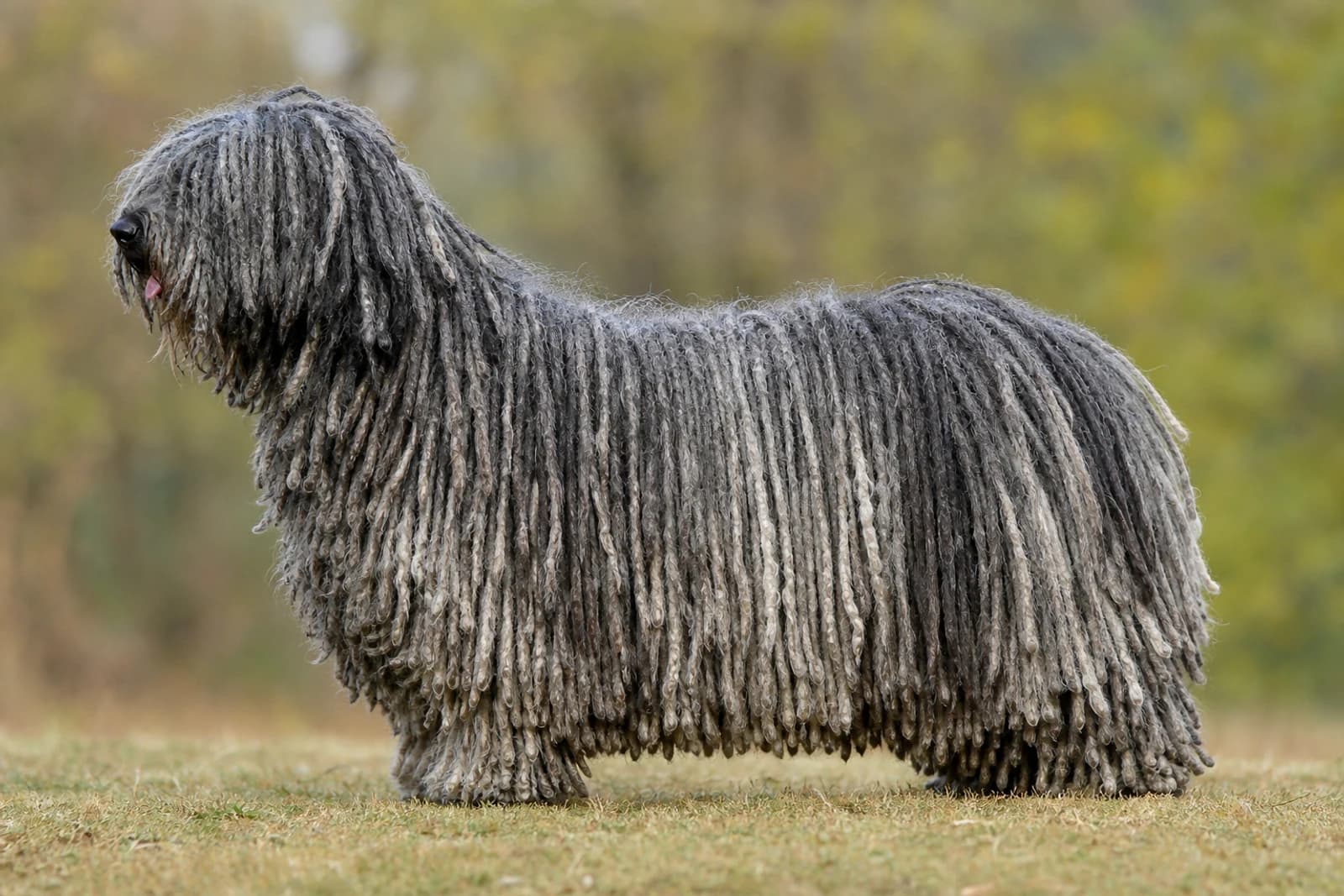
The Hungarian Puli is a lively, intelligent herding dog best known for its unique corded coat that resembles dreadlocks. This medium-sized breed thrives with active owners who can provide daily exercise and mental stimulation. Puli are loyal and protective, making excellent watchdogs, but their independent nature requires consistent, positive training. They suit families with older children and ample space, though their herding instincts may lead them to chase small animals. Not ideal for first-time owners due to high grooming maintenance and potential stubbornness, the Puli bonds deeply with its people and excels in dog sports like agility.
At a glance
- Size
- Medium
- Height
- 14–17 in
- Weight
- 22–33 lb
- Life span
- 12 years
- Coat colors
- Black, White, Gray
- Coat type
- Dense, corded double coat
How much does a Hungarian Puli cost?
Adopt / rescue
$75–$400
Usually includes spay/neuter, first shots, and a microchip.
Buy from a breeder
$700–$2,000
From a reputable, health-testing breeder.
Approximate USD. Prices vary widely by region, breeder, pedigree, age, and coat colour — adopting is the lower-cost and recommended route. Avoid suspiciously cheap “breeders”; they’re often puppy mills.
Estimate the full cost of a Hungarian Puli →Hungarian Puli photos
Views
Front, side, rear and top — the full silhouette.Poses
How the breed sits, lies, moves and plays.Puppy to senior
The breed across its whole life.Expressions
The breed’s range of moods.Close-up details
Eyes, ears, nose, paws, tail and coat.Coat colors
The breed’s recognized colors.Click any photo to enlarge. We show the Hungarian Puli from every angle — three views, poses, life stages, expressions, close-ups, coat and colors.
Appearance & size
The first thing anyone notices about a Puli is the coat—a dense, weatherproof mop of natural cords that moves like a living shag rug. Underneath that hair is a surprisingly agile, medium-sized dog: 14 to 17 inches at the shoulder, 22 to 33 pounds. The build is square, meaning the length from chest to rump nearly equals the height. That gives a compact, balanced silhouette whether the dog is standing or on the move. The chest is deep and moderately broad, the back stays level, and the loin is short and muscular—no sloping topline or exaggerated tuck-up.
Puppies start out with a soft, fluffy coat. Sometime between 9 and 12 months old, the texture begins to change; the undercoat and outer coat start felting into loose clumps. By two to three years, a fully mature Puli has cords that can reach the ground. The outer hair is coarse and wiry, while the undercoat remains softer, so a properly corded coat actually insulates the dog in both cold and heat. You can part the cords with your fingers to find a lean, sturdy dog—if the Puli will stand still long enough.
Colors include black, white, apricot (a rusty red), and gray. Black is the most common and hides dirt remarkably well, even on a farm. White Pulik often carry a slight cream cast. Apricot and gray are genetically recessive, so you’ll see them less frequently, but all are accepted. Skin pigmentation usually matches the coat: dark gray or black skin under black or gray cords, lighter skin under white or apricot.
From the front, the cords fall like a shaggy veil, but you can still spot a round, medium-sized head and dark, almond-shaped eyes peering out. The ears are set slightly high, V-shaped, and hang close to the head—they’re often completely buried in the cords. From the side, the square proportions stand out most clearly. The legs appear short, though the cords exaggerate that effect; the tail is carried level or with a slight curl over the back, blending entirely into the body coat. From behind, the hindquarters are well-muscled and drive the breed’s trademark quick, bouncy gait—you’ll mostly see a solid wall of swinging cords. That coat wasn’t just ornamental. It protected working dogs from Hungarian winters, sharp hooves, and predator bites. Today, it’s still a conversation starter on every walk.
History & origin
A thousand years ago, the Magyars swept into the Carpathian Basin with small, tireless dogs built to work sheep from sunrise to sunset. That dog was the Puli. The breed’s roots intertwine with the nomadic tribes of Asia—most likely descending from Tibetan herding dogs that traveled westward over centuries, eventually settling into the Hungarian plain. The name “Puli” itself may come from the word for a drover, the person who drove the flock, which tells you exactly what the Magyars expected of these dogs.
Hungarian shepherds developed a two-dog system. The large, white Komondor guarded the flock at night, while the smaller, darker Puli moved them from pasture to pasture during the day. A Puli was light on its feet, quick enough to dart under a sheep’s belly or nip a straggler’s heels without causing real harm. That corded coat wasn’t a fashion statement; it shed water, insulated against bitter cold, and gave a wolf or predator a mouthful of hair rather than flesh. The cords also helped the dog blend in with the flock, making it harder for a thief to pick out the real threat.
The breed survived like this for centuries, but the 20th century almost wiped it out. By the end of World War II, Hungary’s agricultural life had collapsed, and only a handful of Pulik remained. The breed owed its rescue to a few dogged breeders, particularly Dr. Emil Raitsits, who scoured remote farms for the last working lines. The first written standard emerged in the early 1920s, and the Hungarian Kennel Club recognized the Puli in 1924.
American interest took hold not long after. The first Pulik arrived in the U.S. in the 1930s, and the American Kennel Club recognized the breed in 1936. The Hungarian Revolution of 1956 brought another wave of imports, adding fresh bloodlines just when the gene pool needed it. While the Puli still herds sheep on a few scattered farms, most of today’s dogs are lively companions and show-ring standouts. That ancient instinct hasn’t vanished—a Puli with no livestock experience will enthusiastically try to round up anything that moves, from toddlers to tennis balls.
Temperament & personality
The Puli is a quick-witted herder with a serious work ethic and a surprisingly playful streak. That mop of cords hides a dog who is always thinking, always watching, and very much in charge of his own agenda—so don’t mistake the clownish looks for a pushover. You’re getting a confident, sometimes stubborn partner who thrives when he has a job to do and a person who treats him like the intelligent equal he believes he is.
Affection is on the dog’s terms. With his own family, he’s loyal and often velcro-like, following you from room to room and leaning into a good scratch when the mood strikes. Strangers get a cool, appraising stare. That reserve makes him an outstanding watchdog with zero training required. He’ll sound the alarm with a surprisingly big bark for his size, and once he starts, he may keep going—especially if he’s bored or isolated. Neglect or long hours alone can trigger anxiety-driven barking, so early, consistent socialization keeps the protective edge from sharpening into suspicion or a full-time soundtrack.
Energy runs high, but it’s a thinking dog’s energy. A Puli needs a solid hour of active engagement daily, not just a romp in the yard. Think a long run through the woods, a herding session, or a fast game of fetch layered with trick training. The mind must be worked. Without it, problem solving benefits no one: digging to China, barking marathons, or methodically chewing up whatever fits in his mouth. Puppies explore the world with their teeth to ease teething discomfort, so stock up on safe, durable chews. A homemade citrus or vinegar spray can deter gnawing on off-limits items.
He’s strong-willed, which means heavy-handed corrections backfire. Training works best when it’s a respectful, consistent puzzle—reward the behavior you want rather than trying to force it. A Puli who senses a power struggle simply digs in his heels and outlasts you. Make the right choice his idea, and he learns with lightning speed, strutting like he just won the lottery.
In a household with children or other pets, supervision and instruction are non-negotiable. This isn’t a breed that automatically tolerates tail-pulling or chaotic energy. Kids must learn to read relaxed, loose body language and soft eyes versus a stiff, forward-leaning posture with a direct stare—which often precedes a snap. Never interrupt a Puli while he’s eating or resting, to avoid food guarding. With proper introductions, he can coexist with other dogs, though same-sex dominance squabbles aren’t unusual. You’re not just bringing home a cute mop; you’re adding a sharp, independent mind to your family who needs structure, purpose, and your respect to become the brilliant companion he’s bred to be.
Good with kids, dogs & other pets
A Puli’s non-aggressive, patient temperament gives you a real head start with kids, but that same sharp herding brain can reframe running, shrieking children as a flock to manage. Expect heel-nipping and circling if the dog hasn’t learned boundaries. Those 22–33 pounds of corded muscle are sturdy, not fragile, so a well-socialized Puli can be a tireless playmate for school-age kids who understand not to yank on cords or tease. With toddlers, you supervise every second — the dog isn’t mean, but a quick nose poke or a nip aimed at moving ankles can startle a little one. Teach children to give the dog space when he’s resting; a Puli bonds hard and gets uneasy if cornered or chased.
With other dogs, the picture is largely shaped by puppyhood. A Puli exposed early and often to polite dogs of different sizes usually grows into an alert but level-headed adult. Without that foundation, you’re likely to see bossy herding behaviors — a Puli may try to control movement, and that can provoke fights with dogs who resent being pushed around. Keep first introductions on neutral ground, short and upbeat, and never force an adult Puli into a dog park mob if he’s already anxious. For some adults, staying content with their owner’s company is enough; forced socialization backfires.
Cats and small pets live with a Puli on a case-by-case basis. The herding instinct is strong, and a fleeing rabbit or guinea pig reads like livestock to chase. If you raise a puppy alongside a confident cat, many Pulis learn to co-exist calmly indoors — but they still need supervision when play escalates into chase mode. Birds, hamsters, and other pocket pets should always be securely caged and out of reach.
The common thread is early, positive exposure. The critical socialization window slams shut around 12–16 weeks: that’s when you calmly introduce the puppy to children, dogs, cats, different surfaces, and everyday bustle. Pulis are sensitive, so gradual, good-humored introductions build lasting confidence. Missing this period often leaves you with a dog who’s timid, noise-phobic, or snappy around unfamiliar people and animals. Even with conscientious socialization, this breed leans toward reserve with strangers and a strong work ethic — which means daily training and outlets for the herding drive are what keep a family Puli from deciding that the toddler or the terrier next door needs constant micromanagement.
Trainability & intelligence
The Puli isn't just smart — he's clever in a way that can make a less-prepared owner feel outmaneuvered. This is a 22–33-pound herding dog built to act independently, to anticipate livestock movement, and to problem-solve without waiting for a human to give the obvious command. That heritage means training him isn't about drilling obedience; it's about building a relationship where he wants to take your direction.
Why “sit” needs to make sense to him
He picks up new cues fast — often in just a handful of repetitions — but he bores just as quickly. Repetitive drilling kills his motivation. Short, game-like sessions that swap treats for a tug toy, a tossed ball, or a burst of enthusiastic praise keep his lightning brain engaged. The moment it feels like a chore, he’ll find something more interesting to do, and you’ll be staring at a dog who’s suddenly deaf to a recall he nailed yesterday.
The independence that humbles you
A Puli is not a push-button dog. He questions things. A straight “come” when he's nose-deep in a fascinating scent may go ignored unless you’ve built that cue with rock-solid reinforcement and proofed it across a hundred real-world distractions. Reward-based methods work, but they have to be creative: high-value rewards (freeze-dried liver, a squeaky toy he rarely sees) delivered immediately when he makes the right choice. Punishment or a hard tone doesn’t teach him — it erodes the trust you need to keep him cooperating. Once he distrusts you, he’ll go it alone every time.
The socialization window is non-negotiable
Pulis are naturally watchful and can tip into suspicious-with-strangers territory without early, careful exposure. Between 3 and 14 weeks old, your puppy needs a steady diet of positive experiences: men in hats, kids dropping toys, skateboards rattling past, different floor textures. You don’t flood him — you create short, pleasant encounters where he learns novelty isn’t a threat. Skipping this phase often yields an adult who barks first and asks questions later, and that reactivity is far harder to unwind than to prevent.
The training mindset that actually works
You’ll get the best out of this breed when you treat training as a collaboration. Use his herding smarts: teach him to put his toys away, to navigate simple obstacle courses, to find hidden treats. A bored Puli invents his own jobs — which might include disassembling the couch or outsmarting your trash-can latch. Consistent rules, delivered with patience and zero force, turn that independent streak into a dog who works with you, not for a paycheck. If you need blind compliance, look elsewhere. If you want a thinking partner who reads your intentions and acts on them, a Puli will rise to the challenge.
Exercise & energy needs
The Puli is a compact herding machine packed into 22–33 pounds. Don’t let the mop-like coat fool you—this dog was built to move livestock all day across rough terrain, and that drive still hums under the cords. Plan on at least 60 minutes of real exercise every day, split into two sessions. A single stroll around the neighborhood won’t satisfy him. He needs to run, change direction, and use his brain in tandem.
Short, intense bursts work better than a single long plod. Think 30 minutes of off-leash running, a vigorous game of fetch, or a fast-paced hike in the morning, followed by another active session in the evening. Pulis corner, circle, and leap instinctively, so they thrive in sports that tap those skills. Agility, flyball, rally, and herding trials are all perfect outlets. Even in the backyard, set up a simple obstacle course or hide a favorite toy—he’ll happily work for 15 minutes, then recharge.
Mental exercise counts as much as the physical kind. This is a breed that can out-think you on a sleepy Tuesday. Upping the mental challenge—scent work, puzzle toys, trick training—pays off. Teach him the names of toys, put his dinner in a snuffle mat, or practice heeling patterns that require quick turns. Without a job to do, a bored Puli turns into a vocal, furniture-rearranging shadow.
Be smart about intensity and weather. That corded coat insulates against cold but holds heat like a sweater. In warm months, exercise during the coolest parts of the day, and keep water handy. Swimming is fine on occasion, but the cords take forever to dry and can get heavy, so it’s not a go-to sport. Pulis are generally sturdy, but like many medium breeds they can be prone to hip dysplasia—avoid repetitive high-impact jumping on hard surfaces until growth plates close, and watch for any stiffness as they age.
A tired Puli is a happy, quiet housemate. Skip the brain work and you’ll have a clever, under-exercised dog inventing his own games—often at your expense.
Grooming & coat care
Your Puli’s coat is the star of the show, but it demands a whole different playbook from typical brushing. Once those cords form—usually between 9 and 12 months of age—you’ll never use a slicker brush or comb again. Instead, you’ll spend a few minutes each day using your fingers to gently separate each cord from root to tip, keeping them distinct and preventing them from weaving into one solid, painful mat. Letting cords fuse turns the coat into a heavy, pulling mess, so daily hand-maintenance is non-negotiable.
The puppy phase is your setup window. That soft, fluffy puppy coat needs regular brushing with a pin brush until it starts to “cable” around eight or nine months. At that point, you’ll put the brush away and begin sectioning the hair into cords by hand—a process that can take weeks of consistent work. Once established, the cords will tighten and felt naturally over the next year or two, and from then on, hand-separation is the main event.
Bathing a Puli isn’t a quick rinse. You’re submerging dozens of thick cords, working a mild shampoo through each one, and rinsing until the water runs completely clear. The bigger job is drying. Trapped moisture can mildew or set off a skin infection, so you’ll need a high-velocity dryer (no heat, or the cool setting) and plenty of time—often a full day—to get every cord bone-dry down to the skin. Because of that, many owners bathe only four to six times a year or when the dog truly reeks of swamp. Skip conditioner entirely; it can cause cords to loosen and slip apart.
Trimming is personal preference. You’ll likely keep the area around the eyes, ears, paw pads, and rear neatly trimmed for hygiene. Many owners shorten the cords to a practical mid-body length to stop the dog from hauling leaves and mud indoors—floor-length show coats are a part-time job. Routine nail trims, ear checks (those drop ears hide debris), and dental care stay the same as any other dog, but you’ll need to part the cords regularly to scan the skin for redness, hot spots, or parasites.
Because a Puli’s shed hair gets trapped inside the cords instead of falling on your floor, you get a virtually non-shedding dog that many allergy sufferers tolerate well. In warmer months, a shorter cord length helps with heat, but resist the urge to shave down to the skin—the cords provide insulation and sun protection. You’re trading daily brushing for daily cord-separating and occasional marathon drying sessions, and the payoff is a unique, head-turning coat that reflects exactly the hands-on care you’re willing to give.
Shedding & allergies
The Puli’s corded coat changes the whole shedding conversation. This breed barely sheds at all. Loose hairs don’t drop to the floor; they get caught up in the forming cords and stay there. You won’t find tufts on your sofa or need to lint-roll your pants after a cuddle session.
Seasonal blowouts? Not a thing with a Puli. Because there’s no traditional undercoat dump cycle, you skip the spring and fall fur storms that come with double-coated breeds. Puli puppies do go through a short, one-time transitional phase between 9 and 12 months as the fluffy puppy coat mats into cords—some loose fluff may escape then—but once the cords set, shedding drops to near zero.
Drool is equally rare. These are dry-mouthed dogs, so you’re not wiping slobber off walls or furniture.
No dog is truly hypoallergenic—allergies can also react to saliva, urine, and skin dander—but the Puli’s coat keeps most of that dander and hair locked in the cords rather than releasing it into the air. Many people with mild to moderate dog allergies do well with a clean, well-kept Puli. The catch (and it’s a real one): if you skip regular bath-and-dry sessions, those same cords trap dander, pollen, and dust, turning the dog into a mobile allergen reservoir. So the allergy-friendly reputation only holds up when you stay on top of grooming. A neglected Puli can get musty and irritating to sensitive noses fast.
If you’re allergic, spend an afternoon with an adult Puli before committing, and talk to the breeder about their cord-care routine. The cleaning burden shifts from your vacuum to your bathtub.
Diet & nutrition
A lean Puli is a durable athlete—carrying even a few extra pounds on a 22–33 lb frame puts real stress on hips and knees. Because many Pulis are food-motivated, the line between “pleasantly filled out” and overweight can blur fast. Start with the feeding guide on your chosen food for his ideal weight, then adjust every couple of weeks by how he looks and feels: you want a visible waist from above, and ribs you can feel with your fingertips but not see.
Meals by age
- Puppies need four evenly spaced meals daily until 4 months, then three meals until 6 months, then twice a day like an adult. Transition a new puppy gradually—lightly cooked and puréed meats, fish, fruits, and vegetables, or a high-quality commercial puppy food. Raw chicken wings can be introduced around 12 weeks under close supervision.
- Adults do well on two meals a day. Measure portions according to size, weight, and daily exercise; a Puli that runs an hour of herding games will need more fuel than a weekend stroller.
- Seniors often do better on smaller, more frequent meals. Monitor weight ruthlessly—metabolism slows as activity tapers off, so cut back food before the scale creeps up. Puréeing meals helps dogs with worn or missing teeth absorb nutrients.
Building a balanced bowl
A practical baseline: roughly 60% raw or cooked meat (muscle, bone, organ), 20–30% fruits and vegetables, and 10% extras like eggs, plain yogurt, or grains. Cooked pearl barley and white rice are digestible, fiber-rich options for dogs with sensitive stomachs. Blending or processing the whole meal aids absorption—dogs’ jaws don’t move sideways and they lack salivary enzymes to start breaking down plant matter. Unsalted vegetable cooking water makes a decent base if you’re short on stock.
Avoiding weight traps
Never feed directly from the table; even occasional handouts teach begging that’s hard to undo. Leftovers go in the dog’s own bowl, not your plate. Avoid excessively rich or fatty foods—especially after holidays—because they can trigger pancreatitis. If your Puli inhales meals, use a puzzle feeder to slow him down and add a bit of mental work.
What matters most is staying honest about how much your individual dog actually needs—not what the bag prescribes for a generic “active” house dog.
Health & lifespan
A healthy Puli typically shares your life for about 12 years, and many stay active and sharp well into their teens. This is a generally robust, medium-sized herder (22–33 pounds) without the avalanche of genetic problems that plague some breeds. But no dog is bulletproof, and a handful of inherited conditions pop up often enough that responsible breeders screen for them.
Hip dysplasia is the big one. It’s not unique to the breed, but when you’re buying a puppy, you want proof that both parents have passing OFA or PennHIP scores. Progressive retinal atrophy (PRA) and cataracts can also show up. PRA gradually steals vision and has no cure, so a breeder who runs yearly eye exams on their breeding stock (through a veterinary ophthalmologist, not just a regular vet check) is doing right by their pups. Patellar luxation—a trick knee that slips out of place—appears occasionally in smaller lines, so a quick knee exam during wellness visits catches it early.
That unmistakable corded coat isn’t just a style statement; it comes with its own maintenance-related health notes. Cords that stay damp after a swim or bath create a perfect setup for skin infections and hot spots. You’ll need to get them completely dry down to the skin, every single time. Even with perfect care, food or environmental allergies can irritate the skin, so pay attention to excessive scratching or a musty odor.
Weight management matters more than most owners realize. Pulis are clever, food-motivated, and can pack on ounces fast if portions creep up. Extra pounds put stress on joints and can worsen hip or knee issues. Keep treats measured and stick to a roughly hour-a-day exercise routine to maintain that lean, agile frame.
Don’t skip the basics. Monthly heartworm prevention during mosquito season (and a month past it), a legally required rabies vaccine, and an annual vet exam catch subtle shifts before they spiral. After age seven, twice-yearly senior panels and eye checks are smart money. And while it’s not a pill you can give, early socialization and consistent, positive handling reduce the stress that can fuel anxiety-driven barking or neurotic behaviors—protecting his mental health as much as his body.
Living environment
This is a herding dog with a 24/7 work ethic, so the best home is one where you can channel that energy every single day—not just a place with four walls.
Apartment, house, and yard
A securely fenced yard is the closest thing to a shortcut. It gives a 22–33-pound Puli room for off-leash sprints, sudden turns, and self-appointed perimeter patrols without you lacing up your shoes. Apartment living can work, but the real question isn’t square footage—it’s whether you can deliver at least an hour of hard exercise (running, vigorous fetch, herding games) split into morning and evening sessions, plus brain work in between. Without that outlet, a Puli will invent jobs you hate, like dismantling couch cushions. A house with a yard simply makes the daily logistics less grueling. But a yard alone isn’t enough; this is not a dog that entertains itself for long.
Climate tolerance
That iconic corded coat is built for the Hungarian steppe—cold, damp, and windy weather rarely bothers a Puli. They’ll happily hike through snow or rain while other dogs shiver. Heat is the real adversary. The cords create an insulating layer that can trap body heat, so a Puli left to run hard on a 90°F afternoon risks heat exhaustion fast. Summer exercise should shift to early mornings or evenings, with access to shade, cool water, and maybe a damp towel to lie on. Never shave the coat for summer relief; those cords also protect against sunburn, and a shaved coat may not regrow correctly.
Barking
You need a realistic view here: Pulik are loaded with opinions and a hair-trigger alarm system. They bark at the doorbell, the delivery truck three streets over, and the neighbor’s cat that dared to exist. Training a solid “enough” cue and making sure they’re genuinely tired can dial it down, but you will never silence the watchdog entirely. That instinct is baked in. Thin apartment walls or a condo with a noise-sensitive HOA are a terrible match. If you love a quiet house, this breed will push every button.
Being left alone
A Puli considers you part of its flock, and long separations feel like a crisis. A dog left alone for a full 8-hour workday, day after day, will often spiral into separation anxiety—barking marathons, destructive chewing, or accidents. Crate training, stuffed puzzle toys, and slow desensitization (leaving for 30 seconds, then a minute, building up) can help build coping skills, but this isn’t a naturally independent dog. A home with a remote worker, a staggered schedule, or reliable midday dog walker is far more realistic. They don’t want to be your roommate; they need to be woven into the daily hum of family life.
Who this breed suits
The Hungarian Puli fits owners who want a whip-smart herding dog in a compact, 22–33 lb package — and who genuinely enjoy a daily mental chess match. This breed doesn’t clock out after one walk. Plan on a solid 60 minutes of off-leash running, advanced training puzzles, or a dog sport like agility just to leave them pleasantly tired. Active singles, runners, or hikers who can bring the dog along will find an agile, tireless teammate. He’s also a great fit for families with older kids who understand how to direct that sharp brain. The Puli’s natural wariness around strangers and tendency to sound the alarm make him a vigilant watchdog for a home with a yard, though apartment dwellers should proceed carefully — that bark has conviction.
First-time owners can succeed, but only if they’re ready to become students of dog behavior. This isn’t a “relax on the couch after a stroll” breed. Without consistent, reward-based training and clear boundaries, a bored Puli will outsmart you and redecorate your home. Seniors or less active households should look elsewhere unless they’re seasoned dog handlers who can provide plenty of physical and mental outlets. The coat demands a reality check: those signature cords require weekly upkeep (separating, bathing, drying completely to avoid mildew) and take hours to dry. If you’re not up for that grooming commitment or don’t have the budget for a pro, the Puli becomes a frustrating money pit.
Think twice if you want a dog who instantly greets every guest with a wagging tail. Most Pulik are aloof with strangers, and early, frequent socialization is mandatory just to get a polite standoffishness rather than suspicion. They’re also not the breed for someone who prizes a quiet house — they notice everything and comment on it. But for the right owner — active, patient, handler-focused, with a sense of humor about the chaos a clever dog can create — this 14–17 inch dreadlocked dynamo is a deeply loyal partner who throws himself into every game, every run, and every training session with infectious enthusiasm.
Cost of ownership
A Hungarian Puli puppy from a responsible breeder who health-tests parents and raises pups underfoot rarely comes cheap. Expect to pay $1,500 to $3,000 for a pet-quality dog. Show prospects or pups from champion lines can push past $4,000. If the price seems too good to be true, it usually is — skimping here often means skipping the hip, eye, and patella screenings that matter for the breed.
Monthly costs are shaped by that one-of-a-kind coat. Here’s where your money goes.
- Food: A 22–33 lb dog eats less than you’d think, but a high-quality kibble still runs $40–70 per month. Some owners rotate in wet food or fresh toppers, which nudges the bill higher.
- Grooming: This is the line item that catches people off guard. Those cords aren’t wash-and-go. A professional groomer experienced with corded breeds charges $80–120 per session every 6–8 weeks, averaging out to $40–65 a month. Home maintenance between appointments (bathing, separating cords, drying completely to prevent mildew) demands time and the right equipment, so budget for a high-velocity dryer and some education if you go DIY.
- Routine vet care: Annual exams, vaccines, heartworm and flea/tick prevention land at $200–400 per year, or about $17–33 a month. Dental cleanings will add a couple hundred bucks when needed.
- Pet insurance: Premiums for a medium breed typically run $35–60 a month. A Puli can be prone to hip dysplasia, patellar luxation, and progressive retinal atrophy, so a policy with good orthopedic and hereditary-condition coverage can spare you a $3,000–$5,000 surprise down the road.
One-time startup costs pile on top: crate, bed, bowls, leash, collar, baby gates, and a sturdy cord-safe brush easily reach $300–600. Puppy kindergarten or basic obedience classes add another $150–300, and they are not optional for a smart, independent herder who will outthink you otherwise.
If you’re budgeting, put the grooming line right at the top. That coat is what makes a Puli a Puli, and keeping it healthy is the single biggest ongoing expense you’ll sign up for.
Choosing a Hungarian Puli
Responsible breeder or rescue
You can get your Puli from a breeder who invests in health and temperament, or through a rescue that places adults into new homes. Both paths work; the right one depends on how much puppy-raising chaos you’re ready for.
A responsible breeder does more than hand you a fluffy puppy. They’ll show you the dam (and often the sire) on site, walk you through the parents’ health clearances, and ask you plenty of questions about your lifestyle. Puppies go home no earlier than eight weeks, with age-appropriate vaccines, a written health guarantee, and a contract that spells out what happens if you ever can’t keep the dog.
Puli rescue is a solid option if you want to skip the teething and house-training marathons. The Puli Club of America maintains rescue contacts, and dedicated volunteers foster dogs coming out of shelters or owner surrenders. You’ll typically get an honest snapshot of the adult dog’s personality, energy level, and quirks. The trade-off is that you may not know the full health history, and some rescues need extra patience to settle in.
Health clearances you should ask to see
Pulis are generally sturdy, but a handful of inherited problems pop up. Responsible breeders screen breeding stock for the following, and they’ll hand you copies of the actual results—not just a verbal promise.
- Hips: OFA or PennHIP evaluation for hip dysplasia. Expect at least a fair or better OFA rating.
- Eyes: An annual eye exam by a veterinary ophthalmologist (CERF or OFA Eye Certification) to rule out progressive retinal atrophy (PRA) and other inherited eye disease. Parents should be current within the last year.
- Patellae: OFA patellar luxation evaluation. Loose kneecaps can be a problem in the breed, and a good breeder won’t breed dogs with clinically significant luxation.
If you’re looking at a puppy, ask whether grandparents were tested, too. A breeder who can rattle off a multi-generational health history isn’t guessing.
Red flags that should make you walk away
- No health clearances or excuses about “not needing” them.
- Puppies available right now without a wait — thoughtful litters are often spoken for before they hit the ground.
- Breeder won’t let you meet at least the dam on the premises, or dodges questions about where the dogs live.
- Puppies sold younger than eight weeks.
- Focus on rare colors, “teacup” sizes, or coat promises — a Puli puppy arrives with a fuzzy, non-corded puppy coat. Cords don’t fully form until 9–12 months. Anyone promising a fully corded eight-week-old is either misinformed or dishonest.
- Overly shy or frantic pups in a litter — normal Puli reserve with strangers is subtle, not panic. A puppy that hides, snaps, or shakes isn’t just “wary”; it’s a risk for lifelong fearfulness.
Picking the right puppy
You’re stacking the deck with a litter raised inside the home, exposed to everyday noises, different people, and gentle handling. At pickup, watch the whole litter interact before focusing on individuals. A solid Puli puppy is curious and will eventually trot over to investigate you, maybe with a second of hesitation. They shouldn’t bolt or cower in a corner. Eyes and nose should be clear, ears clean and free of odor, and the pup should move without limping or bunny-hopping.
Ask the breeder which puppy they’d place in an active family home versus a quiet single-person household. A good breeder has been observing these pups for two months and can match temperament to your real life, not just your enthusiasm. That kind of guidance – combined with full health testing and an honest conversation about the corded-coat commitment – puts a 12-year companion on four steady legs.
Pros & cons
No dog wears its personality quite as literally as the Puli — but that mop of cords comes with a steep care commitment and a sharp mind that doesn’t coast. Here’s the honest breakdown:
-
Corded coat is practically nonshedding once the cords mature, so you’re not vacuuming fur off every surface; many allergy-prone owners tolerate it well.
-
Compact, apartment-ready size at 22–33 lb and 14–17 in — small enough to tuck under a café table, sturdy enough for a real hike.
-
Vigilant, vocal watchdog who treats every delivery, squirrel, and leaf as a potential perimeter breach. You’ll always know something’s up.
-
Deeply loyal and people-focused — forms a tight, long-term bond with its family and takes “velcro dog” to a new level.
-
High-octane problem solver that eats up advanced training, trick work, and herding sports; boredom isn’t an option, but neither is a dull routine.
-
Solid 12-year lifespan gives you a long partnership when health testing and care are prioritized.
-
Coat care is a hands-on project — cords must be separated by hand, dried for hours (an overnight fan-dry after a bath is normal), and regularly checked for trapped moisture, debris, or pests. Skip it and the coat mats down to a painful, unhealthy mess.
-
Exercise isn’t a suggestion — a stroll around the block gets you exactly nowhere. Plan on at least 60–90 minutes of running, sprinting, and brain work daily, or you’ll hear about it.
-
Barks first, asks questions later — this is a breed that narrates life. Training can dial it down, but you will never own a quiet Puli.
-
Independent thinker with a short boredom fuse — drill the same command too many times and a Puli may decide your request is optional today.
-
Natural suspicion of strangers — without early, continual socialization, the aloof reserve tips into territorial posturing.
-
Health concerns — can be prone to hip dysplasia and progressive retinal atrophy (PRA); demand clearances from responsible breeders who screen both parents.
-
Off-leash freedom is hard-won — the herding instinct can override a recall when there’s a bike, jogger, or child to round up, so rock-solid training or a long line is your reality.
That corded coat doesn’t just look like a dredlocked rock star — it genuinely takes a full day to dry after a bath, and neglected cords can hide skin infections before you see them.
Similar breeds & alternatives
If the corded coat pulled you toward the Puli, a few other breeds offer that same unmistakable look — with very different living requirements. They swap size, drive, or day-to-day care in ways that might suit you better. If the coat is a deal-breaker, there’s a close cousin that ditches the cords entirely but keeps the intelligence.
-
Komondor
This is the Puli’s giant guardian relative, weighing in at 80–100+ pounds and standing 25.5 inches or taller. The white double coat naturally forms heavy, tassel-like cords, but the dog underneath is a serious livestock protector, not a nimble herder. A Komondor needs a secure yard, early socialization, and an owner ready for a deeply suspicious guard dog. Exercise demands are moderate — think long, purposeful patrols rather than frisbee bursts — but the gravity of the protective instinct is the real differentiator. Expect a life span of 10–12 years. -
Bergamasco Sheepdog
Size falls between the Puli and Komondor: usually 60–85 pounds, 22–24 inches at the shoulder. The coat is the key twist. Bergamascos develop wide, flat mats of hair (flocks) instead of individual round cords, and those flocks need far less hands-on separation once they’re correctly established at 1–2 years old. Temperament skews calmer, more independent, and less busy than the Puli’s. You’ll still get an intelligent herder, but with a quieter, watchful presence. Lifespan averages 13–15 years. -
Pumi
If the Puli’s sharp mind and busy attitude appeal but the corded coat feels overwhelming, the Pumi is a natural alternative. This Hungarian herder shares similar size — 22–33 pounds, 15–18.5 inches — but wears a curly, non-corded double coat that sheds minimally and needs regular combing. The Pumi brings a terrier-like spark: quick, vocal, and always scanning for action. Expect a dog that demands just as much mental and physical exercise (at least an hour daily), thrives on clicker training, and won’t hesitate to bark when something’s amiss. Living with a Pumi feels more electric and less self-contained than with a Puli. Typical life span is 12–13 years.
All three breeds still require real coat commitment and a job-to-do mindset — just expressed in sizes and daily rhythms that might fit your household better.
Fun facts
- The Puli's corded coat forms naturally as the soft undercoat and outer coat intertwine, taking up to four years to fully develop.
- This ancient breed has been herding sheep in Hungary for over 1,000 years, and is often called the 'Rastafarian dog' due to its dreadlocks.
- Pulik are exceptionally agile and frequently compete in dog sports like herding, obedience, and agility trials.
Frequently asked questions
- Are Hungarian Pulik good with children?
- Pulik can be wonderful family dogs and are often affectionate and playful with children they are raised with. However, their herding instincts may lead them to nip at heels during play, so supervision and early socialization are important for harmonious interactions.
- Do Hungarian Pulik shed a lot?
- Pulik are considered a low-shedding breed because their corded coat traps loose hair. However, the cords require meticulous maintenance to prevent matting and odor, so they are not a hypoallergenic choice despite minimal shedding.
- How much exercise does a Hungarian Puli need?
- As a herding breed, the Puli is energetic and needs at least 45–60 minutes of daily exercise, including brisk walks and mentally stimulating games. Without enough activity, they can become bored and may develop nuisance behaviors like excessive barking.
- How often does a Puli's corded coat need grooming?
- Once cords are fully formed—which can take up to two years—regular maintenance involves separating cords every few days and bathing every few weeks with a thorough drying process. Many owners choose to keep the coat clipped short for easier care.
- Can a Hungarian Puli live happily in an apartment?
- A Puli can adapt to apartment living if its exercise needs are met and it receives plenty of mental engagement. However, they are naturally alert and can be vocal, which might be challenging in close-quarters living with neighbors.
- Are Pulik easy to train for first-time owners?
- Pulik are highly intelligent and quick learners, but they also have an independent streak that can make training a challenge for inexperienced owners. Consistent, positive reinforcement and early socialization are key to raising a well-mannered companion.
Tools & calculators for Hungarian Puli owners
Quick estimates tailored to Hungarian Pulis — pre-filled with this breed’s size where it matters.
Articles & stories about the Hungarian Puli
Sources & standards
This profile follows recognized breed standards from the American Kennel Club (AKC) and the Fédération Cynologique Internationale (FCI), along with established veterinary and breed-club guidance. These describe general breed tendencies — every dog is an individual.
Owner stories
Have a Hungarian Puli? Share your experience — grooming tips, personality quirks, anything goes.