

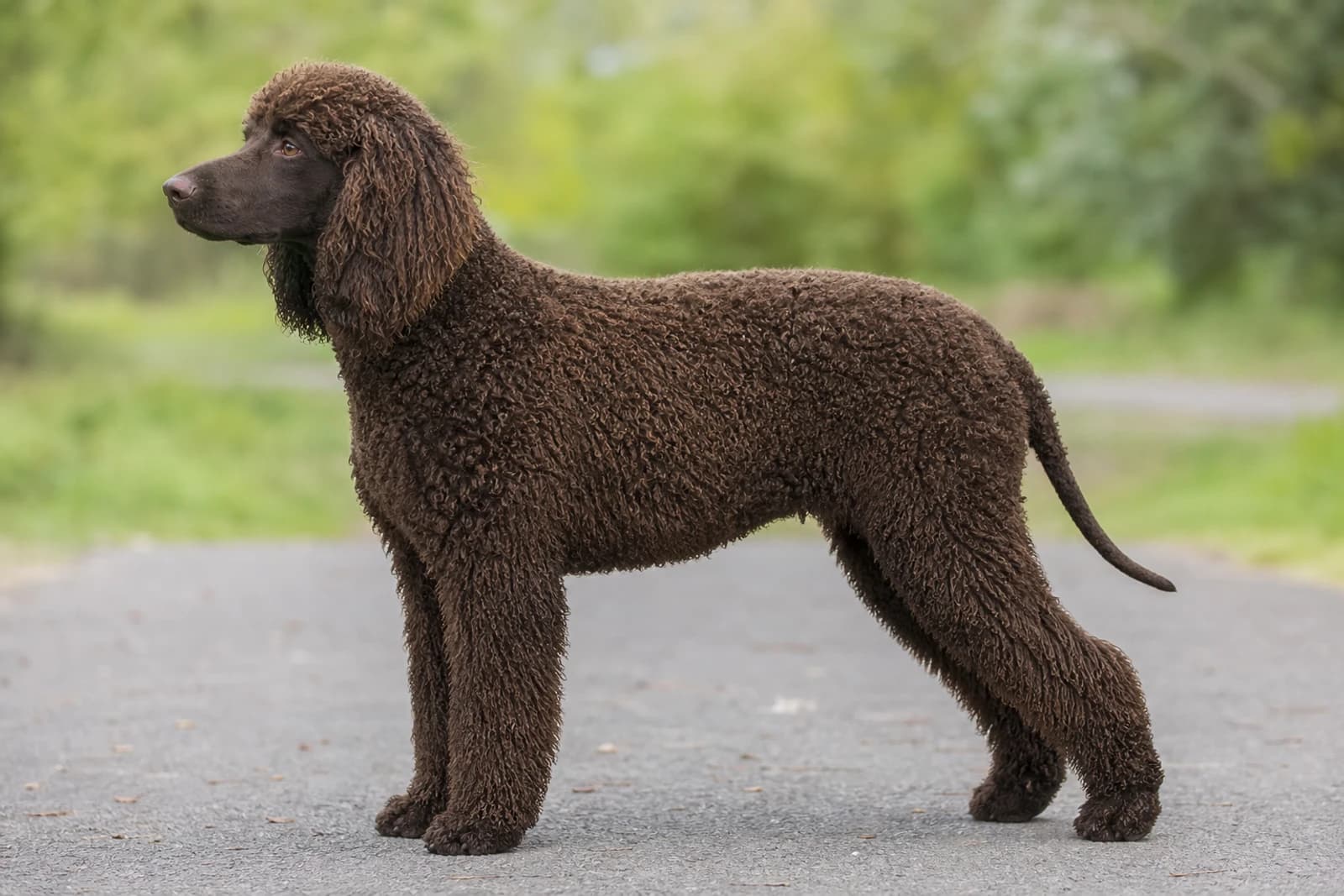
The Irish Water Spaniel is a large, energetic gun dog perfect for active families or individuals who love outdoor adventures and water activities. This intelligent and affectionate breed is known for its clownish personality and thrives on mental and physical stimulation. With a dense, water-repellent curly coat and minimal shedding, it requires regular grooming. While good with children and other dogs, its independent streak and high exercise needs make it less suitable for first-time owners or apartment living. This rare breed bonds deeply with its family and excels as both a hunting companion and a playful pet.
At a glance
- Size
- Large
- Height
- 20–23 in
- Weight
- 44–66 lb
- Life span
- 10–12 years
- Coat colors
- Liver
- Coat type
- Dense, water-repellent curls
- Group
- Gun
How much does a Irish Water Spaniel cost?
Adopt / rescue
$75–$400
Usually includes spay/neuter, first shots, and a microchip.
Buy from a breeder
$700–$2,000
From a reputable, health-testing breeder.
Approximate USD. Prices vary widely by region, breeder, pedigree, age, and coat colour — adopting is the lower-cost and recommended route. Avoid suspiciously cheap “breeders”; they’re often puppy mills.
Estimate the full cost of a Irish Water Spaniel →Irish Water Spaniel photos
Views
Front, side, rear and top — the full silhouette.Poses
How the breed sits, lies, moves and plays.Puppy to senior
The breed across its whole life.Expressions
The breed’s range of moods.Close-up details
Eyes, ears, nose, paws, tail and coat.Coat colors
The breed’s recognized colors.Click any photo to enlarge. We show the Irish Water Spaniel from every angle — three views, poses, life stages, expressions, close-ups, coat and colors.
Appearance & size
You know an Irish Water Spaniel when you see one — a tall, solid dog built like a sturdy rectangle on legs, wrapped in liver-colored curls that seem to drip off every inch of him except the face and tail. He stands 20 to 23 inches at the shoulder and tips the scale from 44 to 66 pounds, with males settling toward the top of both ranges. This is a dog who carries his weight with a kind of rolling, athletic ease: deep chest, well-sprung ribs, and enough bone to power through a day of retrieving in icy marsh water without looking heavy or coarse.
From the front, the head is the first thing that grabs you — a long, clean-muzzled skull topped with a mop of loose, corkscrewing curls that fall into a crisp peak between the eyes. That topknot is a breed hallmark, and it sits above a pair of long, low-set ears covered in curls that extend three or four inches beyond the leather, framing the face like a damp, brown velvet shawl. The eyes — dark amber or hazel, almond-shaped — peer out from behind the fringe with an expression that’s equal parts cunning and clown. Below, a sturdy neck flows into a chest that’s broad but not bulldog-wide, with shoulders laid back enough to allow a ground-eating stride.
In profile, you see the full workmanlike build. The body runs slightly longer than tall, giving that rectangular outline, with a level topline that doesn’t sag or slope. The chest reaches down to the elbows, and the tuck-up behind the ribs is moderate — there’s no greyhound-like waist here, just a functional core built for endurance. The legs are straight and well-muscled, with large, webbed feet (well-covered in hair between the toes) that make him a powerful swimmer. The whole picture is balanced: nothing exaggerated, nothing dainty.
From the rear, the most striking feature is the tail — what fanciers call a “rat tail.” It’s set high, carried nearly level with the back, and covered in smooth, tight skin except for a fringe of curls at the base that fades to a bare, whip-like taper within a few inches. That naked tail is a dead giveaway among water spaniels and absolutely correct. Behind, the hindquarters are thick and driving, with well-angled stifles that contribute to the breed’s effortless trot.
The coat is a story in itself: a dense, crisp double coat made of tight ringlets, not waves, dense enough to shed water and insulate against cold. The color is always a solid, rich liver — from a warm, cooked-liver shade to a deep, dark puce. A small white patch on the chest is allowed but never sought after. The curls are oily to the touch, a natural waterproofing that keeps the dog working in conditions that would send a retriever with a thinner coat shivering to shore. Grooming-wise, that coat mats if you ignore it, so regular brushing and occasional trimming keep it functional and smelling less like a wet swamp.
History & origin
The Irish Water Spaniel’s history reaches back to the bogs and riverbanks of 7th-century Ireland, making it one of the most ancient and unmistakable spaniels. No one can nail down the exact recipe, because early Irish breeders guarded their lines as jealously as a secret fishing spot. What we do know is that the dog was purpose-built for wildfowling — plunging into icy water after downed ducks and geese, then switching gears to flush and retrieve on dry land the same afternoon.
Most historians agree the foundation mix likely included the now-extinct English Water Spaniel, a dash of curly-coated retriever-type blood, perhaps the Barbet or even a pudel-like dog from the Continent. The result was a rough-and-ready, liver-colored swimmer with a dense, crisp-curl jacket that shed water like oilskin, and a strong, naked “rat tail” that worked as a rudder. That tail remains the breed’s calling card: thick at the base, almost hairless, and whip-thin at the tip.
The dog we recognize today solidified in the mid-19th century around Dublin, thanks almost entirely to one breeder: Justin McCarthy. He kept exhaustive records — rare for the era — and his dog Boatswain, born in 1849, became the acknowledged patriarch of every Irish Water Spaniel alive today. McCarthy’s dogs were built square, quick, and bold, with a topknot of curls that softened their expression but not their work ethic. In 1862 the breed made its show debut in Birmingham, England, and crossed to America shortly after. The American Kennel Club registered its first Irish Water Spaniel in 1878.
A brief surge in popularity in the late 1800s never quite held. Through two world wars the breed’s numbers dipped dangerously low. Today the Irish Water Spaniel is still a rare sight in the field and at shows, but responsible breeders have preserved it essentially unchanged — the same lanky, hard-swimming retriever that worked the Shannon’s reedy shores a thousand years ago, ready for a full day’s work and then some.
Temperament & personality
Irish Water Spaniels are equal parts goofball and genius. A typical IWS will follow you room to room, drop a soggy toy in your lap, and then outthink you when you try to get him off the couch. This is not a serene, low-maintenance breed. He’s a high-energy gun dog who needs real physical work and mental challenge, but he repays the effort with fierce loyalty and a sense of humor that’s impossible to ignore.
Energy and drive
Plan on a solid hour of hard exercise every day — a quick turn around the block won’t cut it. Swimming is his natural sport; that dense, curly coat was designed for icy water, and he’ll plunge into any pond or puddle he can find. Without enough outlet, his clever brain kicks into overdrive: digging, chewing, or redecorating with whatever he finds. Puppies chew to explore and relieve teething pain, so keep a stash of appropriate toys and a vinegar spray handy for off-limits items. Adult jaws stay strong with hard chews, so provide them unless you want your furniture to serve that purpose.
Living with an IWS
He attaches hard to his people. Expect a 45- to 66-pound shadow leaning on your leg or draping across your feet while you work. He’ll bark when someone pulls in the driveway — a deep, rolling alarm — but most IWS are more interested in greeting the stranger with a stolen sock than in guarding. Early, consistent socialization keeps his natural reserve from slipping into shyness or fear.
Household behavior depends on respect. Teach children to let him eat in peace; hovering near his bowl can trigger food guarding. He generally gets along with other dogs, though intact males may not back down from a same-sex challenge. Cats and small furry pets trigger his prey drive unless you’ve raised him with them from puppyhood.
Quirks and training
This breed comes with some built-in oddities. The oily coat has a distinct musk, and he may roll in things you find revolting — dead fish, deer droppings — a throwback to his retrieving past and possibly his idea of fine perfume. House training can be stubborn: if he marks inside, catch him mid-stream and hustle him out, then reward the correct spot with a treat immediately. Punishing accidents just teaches him to hide them. Clean any indoor mess with an enzyme cleaner to destroy the scent cue, or he’ll revisit the same spot.
He’s strong-willed, not thick-headed. Heavy-handed training shuts him down or sparks resistance. Work with his brain, not against it — short sessions, food rewards, and a playful attitude go miles. Neglect or isolation often leads to anxiety-driven barking or destruction; he’s a dog who thrives when he’s part of the daily rhythm of the house.
Reading the signs
You’ll avoid a lot of trouble by watching his body language. Lip licking, yawning, or turning his head away signals stress — give him space. A forward-leaning stance with a stiff body and hard stare means trouble is brewing. Conversely, soft eyes and a loose, wiggly frame tell you he’s relaxed and happy. A well-bred Irish Water Spaniel from lines screened for stable temperaments gives you a solid start, but every dog is an individual shaped by environment. If you can offer a mop, a good-natured approach to training, and daily swims, you’ll get one of the most entertaining partners in the spaniel family.
Good with kids, dogs & other pets
The Irish Water Spaniel’s patient, non-aggressive temperament makes him a natural fit for family life—but his size and clownish energy mean you’ll need to manage him carefully around young children. At 44 to 66 pounds and up to 23 inches tall, this is a strong, bounding dog who can send a toddler flying without meaning to. Rules for the household: no wrestling on the couch unless an adult is right there, and never leave a preschooler alone with him during zoomies. That said, a well-socialized IWS is genuinely affectionate and thrives on the constant companionship a busy family provides. He’s miserable if left alone for hours, so homes where someone is around most of the day are his best match.
With other dogs
Irish Water Spaniels generally get along with other dogs, especially if they meet plenty of friendly canines during the critical socialization window before 16 weeks. They can be somewhat reserved with unfamiliar dogs, so off-leash dog parks aren’t your best bet unless you’ve trained a rock-solid recall. Puppy kindergarten and ongoing playdates with known, calm dogs build the social skills that curb reactivity later. Around intact males, an unneutered IWS may posture, so neuter status and supervision matter. Most live happily as a second or third dog in the home, provided they’re not forced into constant, high-arousal group play as an adult.
With cats and small pets
This is a multi-purpose gun dog bred to retrieve over land and water. That drive doesn’t disappear indoors. Cats he’s raised with from puppyhood often become part of the pack—many IWS owners report peaceful cohabitation—but a strange cat darting through the yard is likely to trigger a chase. Small caged animals (rabbits, guinea pigs, hamsters) are simply a risk. Keep those enclosures secure and out of reach when you’re not supervising. Early, gentle exposure to the household cat at 8 to 12 weeks, using treats and short, positive sessions, gives you the best shot at a truce.
Trainability & intelligence
Irish Water Spaniels are quick studies with a mind of their own, and that combination makes training as much about earning trust as it is about teaching commands. They don't respond well to drill-sergeant routines. What lights them up is a handler who keeps sessions playful, unpredictable, and drenched in rewards — a tossed bumper, a chance to splash, or a high-value treat delivered the instant they get it right.
- Motivation is key. These dogs were bred to work independently in rough water, not to wait for a handler’s every cue. That means they’ll learn the sit-down-stay basics in a few repetitions, but they’ll also decide whether complying is worth their while. Use praise, a squeaky toy, or a short retrieve as the paycheck, and you’ll see the gears turning.
- Boredom is the enemy. Repeating the same exercise five times in a row is a sure way to lose them. Switch locations, mix up the order, or float a decoy in a kiddie pool to keep that brain engaged. Mental fatigue from problem-solving tires them out faster than physical exercise alone.
- Recall can be a sticking point. An Irish Water Spaniel’s nose and eyes are constantly scanning for birds, and a flushing duck trumps your voice if the foundation isn’t solid. Start long-line recall work around water and cover from puppyhood, then gradually add distractions. Never call them in only to end the fun — sometimes call, reward heavily, and release them right back to whatever they were doing.
Sensitivity hides under the clownish exterior. Harsh corrections shut these dogs down fast and can turn them distant. They thrive with clear, consistent communication: a calm, no-nonsense approach that never descends into intimidation. Early socialization is non-negotiable — expose puppies gradually to busy parks, different surfaces, and friendly strangers before 16 weeks, because the breed’s natural reserve can curdle into suspicion without it. An undersocialized Irish Water Spaniel may decide that new people aren’t worth the risk, and you’ll spend months undoing that wiring.
The payoff is a dog who thinks with you, not just for you. Work on building that partnership every single day from the moment you bring the pup home, and you’ll have a steady, creative retriever who’s as reliable in a duck blind as he is at the back door.
Exercise & energy needs
Plan on giving an Irish Water Spaniel a solid 60 to 90 minutes of real exercise every day — it’s non-negotiable for this breed. A quick leashed stroll around the neighborhood barely registers. These are large, powerful gun dogs built to hunt and retrieve in rough water for hours, and they come with the stamina to match. Expect to split that time into at least two focused sessions: a long morning off-leash run or a half-hour of hard swimming, then a second afternoon workout that mixes retrieving, training drills, or a vigorous hike.
Swimming isn’t just a nice extra here — it’s the breed’s sweet spot. The webbed feet and water-repellent coat are wasted on land alone. If you have access to a safe pond, lake, or beach, use it. Dock diving, water retrieves, and even just chasing a bumper through the waves will satisfy the dog’s deep need to work in its element. On dry days, substitute with a flirt pole, long-line fetch on varied terrain, or a session of rally or agility. The key is intensity, not just clock time.
Mental fatigue matters every bit as much. An Irish Water Spaniel’s brain is sharp and a little independent. Without a job, that intelligence curdles into creative destruction — think excavated couch cushions or a shredded drywall corner. Scent games, hide-and-seek with a favorite toy, or 15 minutes of steady obedience practice drain mental energy fast. Puzzle toys can fill gaps, but they’re no substitute for interactive problem-solving with you.
Be smart about puppies: their joints are still developing, so skip repetitive high-impact jumping until growth plates close. Adult dogs generally handle hard exercise well, but keep an eye on slippery floors and steep stairs after a swim session. Under-exercise a dog like this and you’ll quickly see anxiety, barking, or that sneaky, self-appointed redecorating habit. Give it what it was bred for, and you’ll have a tired, contented companion who’s more likely to curl up muddy and happy than dismantle your house.
Grooming & coat care
The Irish Water Spaniel’s crisp, liver-colored curls form a dense double coat designed to shed water, not fur—but that tight ringlet pattern is a magnet for mats. Daily brushing is the baseline you’re signing up for. A metal slicker brush with rounded pins works through the curls without snapping them, followed by a fine-toothed metal comb to hunt down hidden tangles behind the ears, under the legs, and along the feathering on the tail. Skip a day and a small snarl can tighten into a solid pelt that has to be cut out.
Bathing
Bathe every 6–8 weeks, or when he rolls in something truly rank. Use a mild, moisturizing shampoo that won’t strip the natural oils keeping the coat water-repellent. Thorough rinsing and drying is the part people rush—damp curls sitting against skin breed mildew and hot spots. A high-velocity dryer blows out dead undercoat and separates the ringlets far better than towel drying.
Trimming & clipping
Many owners keep the dog in a short, all-over clip (the “puppy cut”) for easy day-to-day upkeep, hitting the groomer every 4–6 weeks. If you want the traditional show outline, you’ll scissor the topknot, beard, and ears, and neaten the feet and tail. The correct crisp, hard texture comes from hand-stripping rather than clipping, but that skill is usually left to a pro. Either way, don’t let hair flop over the eyes or block the ear canals.
Nails, ears, and teeth
Long, lobular ears trap moisture after a swim, so clean them weekly with a vet-approved drying solution and lift the flaps to air out a few times a week. Nails often wear down on pavement, but check every two weeks—if you hear clicking on the floor, it’s trim time. Brush teeth daily with a dog-specific paste. Start all of this when he’s a puppy, and he’ll stand calmly for it as an adult.
Seasonal shifts
This breed doesn’t blow coat in the typical sense, but you’ll see a slight uptick in shed undercoat come spring. Bumping brushing to twice a day for a couple of weeks handles it. The real seasonal shift is swimming weather: all-out swims support healthy coat turnover and keep those curls crisp. Just rinse out chlorinated or salt water afterward, and dry the ears immediately. A quick ear check right after every swim prevents the kind of infections that slow down a dog who lives to retrieve.
Shedding & allergies
The Irish Water Spaniel’s tight, liver-colored curls are one of the best low-shed coats in the dog world, but that benefit comes with a serious grooming trade-off.
-
Shedding: You won’t see much hair around the house. The dense, double-layered coat traps dead hairs instead of dropping them onto your floors and furniture. Most of the loose fur ends up in your brush or comb. If you hate vacuuming up dog hair, this breed delivers. The catch: that trapped hair forms mats and cords quickly against the skin if you skip sessions.
-
Seasonal blowout: There’s really no classic “blowout” here. Unlike a breed with a fluffy undercoat that unloads twice a year, an Irish Water Spaniel sheds minimally all year. You might notice a slight uptick when a puppy transitions to an adult coat around 8–12 months, but it’s a blip, not a fur blizzard.
-
Drool: Overall, this is a dry-mouthed companion. You’ll see a wet beard after a big drink of water, and some dogs will drip a little when they’re staring down a treat. But constant, stringy slobber isn’t part of the package. Keep a towel near the water bowl and you’re fine.
-
The hypoallergenic picture: The Irish Water Spaniel often gets recommended for allergy sufferers because the coat doesn’t release much dander and hair into the air. No dog is 100% hypoallergenic, though—allergies are triggered by proteins in saliva, urine, and dander. The curls can hold onto dander close to the skin, so thorough weekly line-combing and a full trim or hand-strip every 6 to 8 weeks keep environmental allergens low. Sensitive people should still spend several hours with an adult dog before committing, because every immune system reacts differently. Think of it this way: you trade the silence of a shedding-free couch for the sound of a grooming table and a good detangling spray session every few days.
Diet & nutrition
Portion sizes for an Irish Water Spaniel are a moving target — you’re feeding the dog in front of you, not the one on the bag. A 45 lb adult who swims for an hour every day will need somewhere around 1,400–1,600 calories, while a more sedentary 65 lb house companion might do fine on 1,200. Start with the manufacturer’s guideline for your dog’s ideal weight, then adjust up or down based on rib feel: you want to feel the ribs under a thin layer of fat, not see them from across the room.
These are enthusiastic dogs with a real love for food, and they pack on pounds faster than you’d expect if their exercise dips. Carrying extra weight on a deep-chested, large frame adds stress to joints and can shorten an already modest 10–12 year lifespan. A measuring cup, not a coffee mug, keeps things honest. If you train with treats, subtract those calories from meals.
Puppies from eight weeks to four months eat four evenly spaced meals a day. Drop to three meals until six months, then twice a day for life. Transition a new puppy onto your chosen food over a week, starting with lightly cooked, puréed meats, fish, and soft fruits and vegetables, or a high-quality commercial puppy formula. Raw chicken wings can be introduced around twelve weeks under supervision, but skip them if your pup gulps rather than chews.
For adults, a diet built around roughly 60% meat (raw or cooked), 20–30% fruits and vegetables, and 10% extras like eggs, plain yogurt, or cooked grains covers nutritional bases without unnecessary fillers. Pearl barley and white rice are gentle carb sources if you’re batch-cooking at home. Purée or process meals when you can — dogs produce almost no salivary amylase and their jaws only shear up and down, so broken-down food digests more efficiently.
Seniors slow down, and that’s when obesity becomes a real threat. Keep the protein quality high — there’s no solid evidence that healthy old dogs need less — but feed smaller, more frequent meals and gradually reduce the total amount as their daily trot turns into a sniff-and-stroll. For a dog with missing teeth or a sensitive mouth, purée everything.
Keep a few hard rules in place. No scraps handed from the table; if there’s a safe leftover, put it in the dog’s bowl after you’ve finished eating. Skip rich holiday trimmings, which can trigger a severe bout of pancreatitis. And if your Water Spaniel inhales meals in 30 seconds, a food puzzle bowl turns dinner into a five-minute brain game that’s better for digestion and way more interesting for a smart hunting dog.
Health & lifespan
A healthy Irish Water Spaniel typically lives 10–12 years, and many stay active and clownish well into their senior years. Keeping that lifespan on track means focusing on a few breed-specific vulnerabilities and not skipping the basics.
Hip and elbow dysplasia appear in the breed, so responsible breeders screen with OFA or PennHIP evaluations before breeding. Eye problems — particularly cataracts and progressive retinal atrophy (PRA) — also get attention. A breeder who checks parents’ eyes annually through a veterinary ophthalmologist (CERF or OFA eye exams) is doing it right. Hypothyroidism can pop up in middle age, showing as weight gain, skin changes, or lethargy. Simple bloodwork catches it, and daily medication keeps it in check. Epilepsy has surfaced in some lines, but it’s far from routine.
Those thick, water-repellent curls are built for cold marsh work, but they also trap moisture against the skin. Ear infections are the most common nuisance you’ll face. After any swim or bath, thoroughly dry inside the ears — lift the leathers, use a vet-approved drying solution if needed, and never leave them damp. The dense coat can also overheat a dog in hot, humid weather, so exercise smart in summer and provide shade and water.
- Weight management matters more than most people admit. This is a big, food-motivated dog that will pack on pounds if you’re generous with treats. A lean IWS puts less strain on joints and has better odds against arthritis later in life.
- Monthly heartworm prevention during mosquito season (and one month after it ends) is non-negotiable. You live in mosquito country, they need it.
- Rabies vaccination is legally required everywhere in the US. There’s no second chance with rabies — once symptoms show, it’s fatal.
Schedule yearly wellness exams even when everything seems fine. As your dog ages past eight, twice-yearly visits with senior blood panels help catch changes early. Watch for subtle shifts: less interest in a favorite fetch toy, a head tilt when eating (ear discomfort), or new hesitancy on stairs. Those small signals are your cue to call the vet.
Living environment
This dog was built to plunge into icy water after downed game — not lounge around a studio apartment. An Irish Water Spaniel needs a house with a securely fenced yard, and the more space, the better. Apartment living sets everyone up for frustration: they’re large (44–66 pounds), brainy, and destructive when bored.
A yard is non-negotiable, but what they really want is a body of water. If you have a pond, a pool they’re allowed to use, or even a large kiddie pool, you’ll see this breed at its happiest. They’ll dig, splash, and swim every chance they get. Without water access, they’ll make do with a sprinkler or a mud puddle, but that dense, curly coat is designed for immersion. Just be prepared for a dog that tracks in water and debris.
Their coat insulates beautifully in cold environments, so they handle cool, damp climates with ease. In hot, humid weather, they can overheat quickly. During summer, exercise in the early morning or late evening, and always provide shade and fresh water. Never leave them outside unsupervised in high heat.
Irish Water Spaniels are naturally alert and bark with intention. They’ll announce strangers, delivery trucks, and suspicious squirrels. This isn’t a silent breed. Without exercise and mental work, the barking can become a habit. Expect to put effort into training a “quiet” cue.
Leaving one alone for eight-hour workdays is asking for trouble. They bond hard with their people and can slide into separation anxiety, especially if their physical and mental needs aren’t met first. A long run or a swim plus a puzzle toy stuffed with treats buys you a few hours of quiet. Still, this is a dog that belongs in a home where someone is around a good chunk of the day, or where a dog walker shows up midday. If you need a canine who counts the minutes alone without a fuss, the Irish Water Spaniel will disappoint.
Who this breed suits
If you genuinely want a dog who’ll race you to the lake and dive in first, the Irish Water Spaniel (IWS) could be your kind of chaos. This is a large, 44–66 lb athlete built for real work — a solid hour or more of off-leash running, swimming, or fetch isn’t a bonus, it’s the daily minimum to keep that clever brain from cooking up trouble. The ideal owner treats the dog as an activity partner, not a backyard ornament.
Best-fit owners
- Active singles or couples who hike, hunt, paddleboard, or live near dog-safe water. An IWS will happily jog beside a mountain bike or retrieve bumpers until your arm gives out.
- Families with older, steady-on-their-feet kids. The breed is generally affectionate and playful, but a full-speed, 55-lb spaniel can body-check a toddler without meaning to. Children who can throw a ball, respect a dog’s rest space, and help with positive-reinforcement training will find a loyal, up-for-anything buddy.
- Dog-savvy first-timers who mean business. The Irish Water Spaniel is sharp and learns fast, but also independent and easily bored by repetition. A novice who joins a reward-based training class, keeps sessions short, and stays good-humored when the dog outsmarts them can do well. Someone expecting a biddable Labrador will find a more inventive thinker.
- Work-from-home or flexible-schedule households. These spaniels form tight bonds and can tip into nuisance barking, chewing, or escape-artist stunts if left alone for long, regular stretches.
Who should think twice
- Couch potatoes and apartment dwellers without a safe, sizable off-leash area. A walk around the block barely registers. Under-exercised, an IWS will redecorate your home and vocalize like a foghorn.
- Anyone who wants a tidy, low-maintenance dog. That liver-colored rope-coat is striking — and it mats into solid plates if you skip brushing every few days. You’ll also need professional clipping every six to eight weeks, plus a ritual of drying and checking the heavy ears after every swim to keep infections at bay.
- Those seeking a quiet, polite housemate. The breed has an opinion and a carrying bark, especially when bored or alerted. They can be reserved with strangers, which means early socialization is non-negotiable — not a quick fix but a lifelong habit.
- Seniors or people with limited mobility rarely match the physical daily demand or the height of that 20–23 inch athletic frame, which can pull hard on leash and jump fences given half a chance.
Ownership here isn’t about simply loving a rare, curly-coated dog. It works when you genuinely enjoy managing a high-energy clown who will steal your spot on the sofa, soak your floor after a walk, and make you laugh the whole time.
Cost of ownership
A well-bred Irish Water Spaniel puppy from parents with current hip, eye, and thyroid clearances typically runs $1,800 to $3,000. Show-potential pups or those from field-titled lines sit at the upper end. Because the breed is uncommon, expect a waitlist and possibly a road trip to bring your dog home.
Once the pup arrives, budget $150–$250 a month for routine care:
- Food: $60–$80 for a high-quality kibble that fuels a 44–66 lb, high-energy water retriever. Raw or fresh diets can push this past $120.
- Grooming: That dense, curly liver coat mats if neglected. Professional grooming every 6–8 weeks costs $80–$120 per session — about $40–$60 a month. Between appointments you’ll still need a pin brush, detangling spray, and ear cleaner to manage the breed’s notoriously hairy, infection-prone ears.
- Routine vet care: Annual exams, core vaccines, and monthly heartworm/flea/tick preventatives land around $200–$350 per year, or $20–$30 a month.
- Pet insurance: Deep-chested, large breeds can face hip dysplasia, elbow issues, and bloat. Responsible breeders screen, but an accident-and-illness policy for an IWS typically costs $45–$65 a month.
- Training: Irish Water Spaniels are independent thinkers. A six-week group obedience class ($150–$250) gets you started; many owners add private sessions for rock-solid recalls around water.
One-time purchases add up, too. A crate, bed, grooming tools, waterproof collar, and a sturdy ramp for the car (you’ll want to protect those joints) often run $300–$500. All told, a first year with a well-bred IWS, including puppy price, commonly reaches $5,000 to $7,000.
Choosing a Irish Water Spaniel
You have two solid paths to finding an Irish Water Spaniel: a responsible breeder or a rescue. The breed’s numbers are small—fewer than 150 registered per year in the U.S.—so either route will take patience.
Rescue is always worth a look. The Irish Water Spaniel Club of America runs a rescue program, and occasionally an adult or adolescent lands in a shelter. A rescue adoption skip the puppy chaos, but you’ll need to be honest about any unknowns in the dog’s background, particularly around health and early socialization. Ask what vet care and behavioral evaluation have been done.
If you go through a breeder, vet them harder than they’ll vet you. A sound IWS is a robust, versatile gun dog, but the breed has a few health bottlenecks that demand serious screening. Insist on written proof of the following clearances on both parents—not just “the vet said they look fine”:
- Hip dysplasia: OFA or PennHIP evaluation.
- Eye exam: A current clearance from a board-certified veterinary ophthalmologist, with results registered at OFA. Look for any mention of cataracts, entropion, or progressive retinal atrophy.
- Thyroid: A full thyroid panel from an accredited lab, ideally repeated yearly on breeding dogs. Autoimmune thyroiditis can cut down a high-energy dog’s working life.
- Elbow dysplasia: Not universal, but careful breeders check elbows too.
Additional tests for congenital hair follicle dysplasia (the patchy “rat tail” appearance) and epilepsy aren’t screened via one clear-cut DNA test—but an open breeder will discuss the lines’ history with both. If they claim zero epilepsy in any relative, walk away. It’s in the breed, and a true steward knows it.
Red flags run the usual list but hit harder in a rare breed: no health documentation, breeding dogs under two years old, selling puppies before eight weeks, or making you feel like a bother for asking questions. A good breeder will also interview you—about your fencing, your lifestyle, and how you plan to exercise a dog that genuinely needs an hour or more of off-leash running plus mental work. Anyone who tells you a couple of sedate leash walks will do isn’t prioritizing the dog’s well-being.
Picking your puppy means watching the litter interact. You want a curious, middle-of-the-road pup—friendly, willing to approach, but not the constant brawler or the one shrinking behind the dam. Meet the mother in person and note her temperament. A shy or reactive dam often passes those tendencies on, no matter how good the pedigree looks on paper. Ask to see where the puppies spend their first weeks. A clean, stimulating indoor setup signals a breeder who’s building house manners from day one.
Go home with a contract that spells out health guarantees for at least the first two years, covering hips and eyes, and a take-back clause that kicks in if life goes sideways. That piece of paper is your real insurance policy.
Pros & cons
-
You get a true water dog. Irish Water Spaniels will retrieve from lakes and puddles with equal enthusiasm. Their coat is naturally water-repellent, and they’re built for long swims — if you love the outdoors and don't mind a muddy, wet dog piling into your car, this is your kind of sidekick.
-
A real brain, not just a pretty coat. They’re clever problem-solvers who pick up new skills fast. Pair that with a goofy, playful streak and you have a training partner who keeps you laughing — not a robotic command-follower.
-
Hypoallergenic-ish coat that doesn’t shed much. Their tight, liver-colored curls trap dander and loose hair, so you won't find tumbleweeds of fur on the furniture. That’s a big plus for allergy sufferers who still want a big, active dog.
-
Eager to be part of the family action. These spaniels bond tightly with their people and hate being left out. They’re typically good with kids and can get along with other dogs when socialized early.
-
That iconic coat is a maintenance commitment. Without brushing at least 2–3 times a week, the curls mat into painful, tight cords, especially behind the ears and under the legs. Professional grooming every 6–8 weeks is pretty much a given.
-
Exercise isn’t optional — it’s daily. A quick walk around the block won’t cut it. Expect to provide a solid hour or more of running, swimming, or focused retrieving. A bored Irish Water Spaniel will invent her own job, and you probably won't like it (digging, barking, counter-surfing).
-
Stubborn when she wants to be. The same intelligence that makes them fun to train also fuels selective hearing. They’ll test boundaries, especially during adolescence, so you need a patient, consistent hand.
-
Big dog energy in a 44–66 lb package. Don't let the medium-large size fool you — an untrained IWS can be a 50-pound cannonball of enthusiasm, jumping, yanking the leash, and clearing coffee tables with one swipe of a happy tail.
-
Health screening is non-negotiable. Responsible breeders check for hip dysplasia, eye disorders like progressive retinal atrophy, and von Willebrand’s disease. With a lifespan of 10–12 years, you’re signing up for a decade of vigilance and vet bills if hereditary conditions crop up.
Similar breeds & alternatives
If the Irish Water Spaniel’s clownish drive, topknot of curls, and hairless rat tail intrigue you but you want to cross-shop, a few breeds scratch a similar itch with their own twists.
-
American Water Spaniel — A smaller package at 25–45 pounds and 15–18 inches, bred for the same marsh work. They share a retrieving mania and a wavy-to-curly coat, but you lose the topknot and the bare tail. The AWS tends to be a little more reserved with strangers and slightly less boisterous indoors, while still needing a solid daily run-swim combo. If fitting a canoe or a compact sedan ranks high, this is the scaled-down choice.
-
Portuguese Water Dog — Similar in weight (35–60 pounds) and coat texture, from tight curls to loose waves. They bring a tenacious, guardy edge the genial Irish Water Spaniel lacks, plus a full, whip-cracking tail. Count on the same grooming cadence — thorough combing several times a week — and at least an hour of hard, wet exercise. The PWD’s stubborn streak may show up as more protective instinct; the IWS is typically just clowning around.
-
Curly-Coated Retriever — Taller and heavier (23–27 inches, 60–95 pounds), this retriever wears the tightest, most waterproof curls in dogdom. Temperament-wise, you’re moving from people-fixated goofball to an independent thinker with a dry wit. Coat maintenance is actually simpler (air-dry only, never brush when dry), but training demands patience and a light touch. The large frame and aloofness with strangers may suit a handler who doesn’t need a social butterfly.
-
Standard Poodle — Another curly water retriever at heart, standard Poodles tip the scale at 40–70 pounds and stand 18–24 inches. You trade the IWS’s intermittent stubbornness for hyper-biddable intelligence and a coat that demands pro-level clipping. If you love the Irish Water Spaniel’s working brain but want an off-switch that installs faster, a well-bred Standard often delivers — minus the rat tail and the topknot theatrics.
Fun facts
- One of the oldest spaniel breeds, originating in Ireland in the 1830s.
- Distinctive 'rat tail'—smooth and hairless, unlike the curly body.
- Exceptional swimmer with webbed feet and water-repellent coat.
- Known as the 'clown of the spaniel family' for its playful antics.
Frequently asked questions
- Are Irish Water Spaniels good family dogs?
- Irish Water Spaniels can be affectionate and devoted to their families, but they tend to have an independent streak and may be reserved with strangers. Early socialization and training are important to help them thrive in a household with children, as they are generally good with respectful kids who understand dog boundaries.
- Do Irish Water Spaniels shed a lot?
- No, Irish Water Spaniels are considered a low-shedding breed thanks to their dense, water-repellent double coat. However, they still lose some hair and require regular grooming to prevent matting, making them a potential choice for allergy sufferers who can tolerate minimal dander.
- How much exercise does an Irish Water Spaniel need?
- This active sporting breed requires a significant amount of daily exercise—typically at least an hour of vigorous activity like swimming, running, or fetching. Without sufficient physical and mental stimulation, they can become bored and possibly destructive, so they do best with an active owner.
- Are Irish Water Spaniels easy to train?
- Irish Water Spaniels are intelligent and can be trained effectively with positive reinforcement, but their independent nature may present challenges for novice owners. Consistent, patient training from an early age is recommended to channel their enthusiasm and working instincts.
- What is the typical size of an Irish Water Spaniel?
- Males usually stand 22–23 inches tall and weigh 55–66 pounds, while females are slightly smaller at 20–22 inches and 44–55 pounds. They are a robust, large breed with a distinctive curly topknot and a lean, athletic build.
- Do Irish Water Spaniels bark a lot?
- Irish Water Spaniels are not known to be excessive barkers, but they may bark to alert their owners of strangers or unusual activity. With proper training and sufficient exercise, nuisance barking is unlikely, though individual personalities vary.
Tools & calculators for Irish Water Spaniel owners
Quick estimates tailored to Irish Water Spaniels — pre-filled with this breed’s size where it matters.
Articles & stories about the Irish Water Spaniel
Sources & standards
This profile follows recognized breed standards from the American Kennel Club (AKC) and the Fédération Cynologique Internationale (FCI), along with established veterinary and breed-club guidance. These describe general breed tendencies — every dog is an individual.
Owner stories
Have a Irish Water Spaniel? Share your experience — grooming tips, personality quirks, anything goes.