

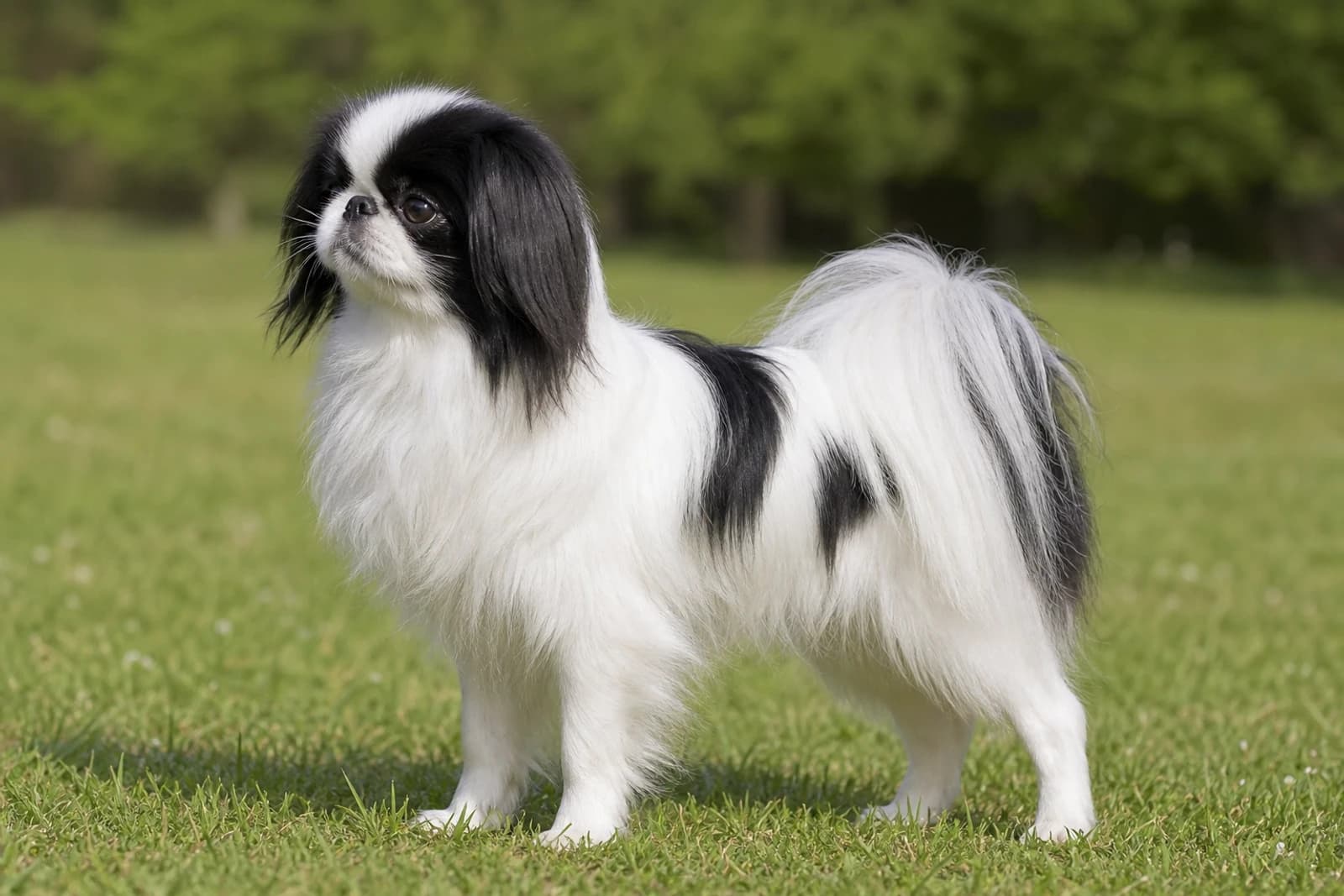
The Japanese Chin is an elegant, petite companion dog that thrives as a devoted lapdog. Ideal for apartment dwellers, seniors, or anyone seeking a calm, affectionate pet, this breed is known for its quiet nature and cat-like cleanliness. While they enjoy short play sessions and gentle walks, they are not suited for roughhousing with young children. With their silky coat and expressive face, the Japanese Chin requires moderate grooming and offers loyal, gentle companionship in a small package.
At a glance
- Size
- Small
- Height
- 8–11 in
- Weight
- 5–7 lb
- Life span
- 10 years
- Coat colors
- Black & White, Red & White, Black & Tan
- Coat type
- Silky, straight, long single coat
- Group
- Companion
- Origin
- Japan
How much does a Japanese Chin cost?
Adopt / rescue
$75–$400
Usually includes spay/neuter, first shots, and a microchip.
Buy from a breeder
$700–$2,000
From a reputable, health-testing breeder.
Approximate USD. Prices vary widely by region, breeder, pedigree, age, and coat colour — adopting is the lower-cost and recommended route. Avoid suspiciously cheap “breeders”; they’re often puppy mills.
Estimate the full cost of a Japanese Chin →Japanese Chin photos
Views
Front, side, rear and top — the full silhouette.Poses
How the breed sits, lies, moves and plays.Puppy to senior
The breed across its whole life.Expressions
The breed’s range of moods.Close-up details
Eyes, ears, nose, paws, tail and coat.Coat colors
The breed’s recognized colors.Click any photo to enlarge. We show the Japanese Chin from every angle — three views, poses, life stages, expressions, close-ups, coat and colors.
Appearance & size
At 8 to 11 inches at the shoulder and typically 5 to 7 pounds, this is a tiny dog with a light, almost buoyant step. The body is compact and well-proportioned — never stubby or fragile-looking, just refined. A square silhouette from the side, with a level topline and a deep, moderately broad chest that tapers neatly to a tucked-up belly.
The Head
The face is unmistakable. A broad, rounded skull, a distinct stop, and a short, pushed-in muzzle combine with enormous, dark, almond-shaped eyes that are set wide apart. The eyes have a liquid, astonished quality that defines the breed’s expression. Small, v-shaped ears hang slightly forward, covered in long feathering that often extends well past the leather. From the front, the white blaze on the forehead and the flat cheeks create a clean, open face. The nose sits flush between the eyes, with wide-open nostrils, though the flat face does mean these dogs can snort and snuffle.
Coat & Color
The coat is single-layered, long, and silky to the touch, not woolly or cottony. It falls straight with a slight stand-off from the body on the neck and shoulders, forming a modest ruff. Feathering cascades off the ears, the backs of the front legs, the rear from hock to paw, and heavily on the tail. The tail itself is a plume, carried arched forward over the back. Colors are sharply partitioned: a dense, brilliant white body with patches of either deep black or rich, warm red. These patches appear over the ears and eyes, on the body as large, uneven saddle marks, and sometimes dappled across the root of the tail. The face always sports a white blaze and a white muzzle. From any angle, a Chin looks like a tiny, animated piece of porcelain.
History & origin
A thousand years in the lap of luxury
This is one of the few breeds that never had a working job. The Japanese Chin was created to be an ornament, a quiet companion, and a living piece of art for the imperial court — and it’s been doing exactly that since the Nara period (710–794 AD).
Small, flat-faced dogs — likely ancestors from China and Korea — arrived in Japan as tributary gifts and were quickly sequestered inside palace walls. Over centuries, Japanese breeders refined them into a dog distinct from the Pekingese or Pug. They weren’t swapped haphazardly; ownership was a privilege restricted to nobility and samurai, and the dogs themselves were often given as priceless tokens of esteem between lords and ladies. Some were small enough to ride inside a kimono sleeve, earning them the nickname “sleeve dogs.”
For roughly a millennium, the breed was an unseen national treasure. That changed in the mid‑19th century when Japan opened its ports. Commodore Matthew Perry’s expedition received several dogs as diplomatic gifts, and soon a few made their way to Queen Victoria and European aristocracy. The West knew them as Japanese Spaniels until the late 20th century, when the American Kennel Club switched to Japanese Chin — a name that roughly means “little royal dog.” In 1964, the Fédération Cynologique Internationale (FCI) officially recognized Japan as the breed’s country of origin, solidifying its identity separate from other small Asian toys.
The Chin you meet today sits on couches rather than throne room cushions, but the dog itself is almost unchanged. A stubborn refusal to do anything useful, a gentle, cat‑like demeanor, and a talent for worming into the warmest lap in the house — that’s over a thousand years of very specific breeding at work.
Temperament & personality
You won’t hear much from a Japanese Chin. This is a quiet, observant little dog who saves barking for truly odd moments — a stranger at the door often earns a soft, quizzical stare instead of a racket. Don’t mistake that reserve for aloofness, though. The Chin bonds tightly to its people and practically reads moods as text: tense shoulders pull the dog closer, a calm voice earns a relaxed sigh and maybe a paw on your knee.
That emotional attunement cuts both ways. A Chin left alone hour after hour can unravel into anxious chewing, house-soiling, or the kind of frantic barking that feels all wrong for the breed. If your household is empty most of the day, this isn’t your dog. They need someone around — a work-from-home setup or a retired person’s rhythm suits them perfectly.
A streak of quiet stubbornness lives under all that politeness. Chins don’t respond to a raised voice or rough handling; they simply shut down. What works is a respectful, consistent approach — think gentle negotiation, not commands. They’ll learn exactly which rules you actually enforce and which ones they can politely ignore.
With family, the Chin is gentle and deeply affectionate. Small children, however, can overwhelm them. A sudden grab or a too-enthusiastic hug may trigger a freeze, a lip lick, or a yawn — all calming signals that say “I’m uncomfortable” long before a snap. Teach kids to give the dog peaceful meals without interruption and to invite the Chin to approach rather than swooping in. Watch body language: a soft, wiggly body means everything’s fine; a stiff stance with a direct stare means back off right now.
House-training has its quirks. Chins often define territory by scent, not by physical rooms. A guest bedroom that doesn’t smell like the household? That can become a marking spot. The fastest fix is thorough cleanup with an enzyme cleaner or a vinegar spray (white vinegar and cider vinegar mixed) that destroys urine odor rather than just masking it. Reinforce outdoor potty breaks the moment the dog finishes — a tasty treat right then teaches far more than punishing the puddle later.
Energy is low to moderate. A couple of short walks and some indoor playtime fill the tank. What a Chin really wants is a plush perch — the back of the sofa, a sunny windowsill — where they can survey the room with a cat’s regal stare. That impulse to climb and observe isn’t a flaw; it’s their built-in lookout post.
- Calming signals to know: lip licking, yawning, turning the head away. These aren’t tiredness — they mean the dog is trying to defuse tension or asking for space.
- Stubborn moments: a forward-leaning body mixed with a soft expression usually signals confident curiosity, not defiance, so you can redirect instead of correcting.
- Scent oddities: some Chins will gleefully roll in foul-smelling things outdoors. It’s not misbehavior — likely an ancient instinct to mask their own smell or “announce” a find to you.
Learn to read those tiny signals, and the Chin becomes a thoughtful, almost eerily courteous housemate who keeps your secrets and never interrupts.
Good with kids, dogs & other pets
The Japanese Chin is a devoted lapdog built for quiet companionship — not for roughhousing. At just 5–7 pounds, these delicate little dogs need to be handled with care, so every interaction with children and other animals should be gentle and supervised.
With young children
A Chin’s patient, non-aggressive nature can make them a sweet companion for kids — but only the right kids. They do best with gentle school-age children who can sit quietly and let the dog come to them, rather than toddlers who grab, chase, or squeal. A dropped toy or an accidental squeeze can easily injure a Chin. The breed is sensitive to noise and chaos, so households with high-decibel play or constant commotion aren’t a natural fit. Teach children to interact at the dog’s level, on the floor, and never to corner or loom over them. Even a normally easygoing Chin may snap if startled or hurt, but the overall bite risk is low when boundaries are respected.
Other dogs
Most Japanese Chins get along peacefully with other dogs, especially calm, well-mannered housemates. Their small size and somewhat deliberate movements mean a romping, 60-pound retriever can feel overwhelming. Early socialization with gentle dogs during puppyhood (the 3–14 week window) helps build confidence. If you already have a large or boisterous dog, introduce them in short, positive sessions on neutral ground, and watch your Chin’s body language — lip licking, turning away, or freezing all signal “I need a break.” Separate them before stress escalates. Adult Chins who missed early socialization can still thrive in a one-dog household or with a single compatible friend; forcing encounters with unfamiliar dogs only backfires.
Cats and small pets
Chins often live harmoniously alongside cats, particularly if the cat is calm and the two are introduced gradually. A confident, swatting cat can frighten or injure a tiny Chin, so give the dog escape routes and elevated resting spots away from feline traffic. Prey drive is minimal — a Chin may watch a pet rabbit or guinea pig with mild curiosity, not serious intent — but size disparity remains the main concern. Any animal that could step on or accidentally bowl over a 7-pound dog needs to be around only when you can supervise.
The socialization foundation
Puppyhood between 3 and 14 weeks is when a Chin learns that the world is safe. Introduce your pup to a variety of people, calm dogs, cats, and common household sounds (vacuum, doorbell, kitchen clatter) at a pace that keeps tail wags coming. A single scary encounter can imprint lasting fear, so prioritize positive, low-pressure exposures. If you adopt an adult Chin who didn’t get this early start, don’t force meet-and-greets — instead, help them feel secure at home with predictable routines and let them dictate the pace of new friendships. A well-socialized Chin can be a peaceful, adaptable presence in a multi-pet home, but their sensitive spirit always prefers a quiet corner and a trusted person nearby.
Trainability & intelligence
A sharp mind that requires a soft touch
Japanese Chins are keenly observant little dogs. They read your mood, your routines, and your body language in a heartbeat, and they learn new cues quickly when the lesson doesn’t feel like a chore. That said, they have zero tolerance for harsh voices or stern corrections. Raise your voice or yank on the leash, and a Chin won’t try harder—it will shut down, slink away, and remember the incident long after you’ve moved on.
Training that actually works
Reward-based methods aren’t just a nice idea with this breed; they’re the only path to reliable obedience. Use high-value treats, a cheerful tone, and short, upbeat sessions of five to ten minutes. A Chin will work for a piece of freeze-dried chicken or a favorite squeaky toy, but it needs to feel like a game, not a military drill. Gentle repetition cements cues—think three or four successful reps, then a break. Punishment-based approaches backfire spectacularly, damaging trust and triggering anxiety that can show up as avoidance or even house-soiling.
Socialization: start early, keep it positive
Like many small companion breeds, Japanese Chins can become wary of strangers and new environments if they aren’t gradually introduced to the world during their critical window (roughly 3 to 14 weeks old). Bring your puppy along to meet calm children, hear the vacuum cleaner, walk on different surfaces, and encounter friendly dogs—but never force an interaction. Every new experience should predict something good: a treat, gentle praise, or a quick play session. Adults who missed this exposure may need months of patient counter-conditioning to feel safe.
The recall question
Because Chins are independent thinkers, a rock-solid recall off-leash is a long-term project. They’re not a breed that will race back to you simply because you called; you need to build a rich rewards history and be more interesting than whatever they’re sniffing. In the yard or unfenced areas, keep them on a long line until you’ve proofed that response in a dozen different settings with zero corrections. Even then, many Chin owners prefer to keep them leashed or secured for safety.
Exercise & energy needs
A Japanese Chin doesn’t need a daily walk — and frankly, may do better without one. This is a 5-to-7‑pound companion dog perfectly content to meet its exercise quota indoors. A single 10‑minute session of gentle play can cover the bases, though you’ll often see more zest if you break it into two or three short bursts across the day. Skip the leashed route march; focus instead on living-room fetch with a soft toy, a quick game of hide-and-seek, or batting a crinkly ball down the hall.
Because the Chin is brachycephalic, intensity matters more than duration. Overheating and respiratory distress come on fast in flat‑faced dogs, so outdoor time in warm weather should be brief and shady — or skipped entirely. Likewise, this breed’s delicate build (8–11 inches tall, fine‑boned) means no jumping off furniture or high‑impact zoomies on slippery floors. Lap‑level parkour is more their speed.
Mental exercise isn’t optional; it’s what keeps a Chin from turning into a bored, yappy shadow. These are smart, playful dogs that thrive on interaction. Puzzle toys, snuffle mats, and a stash of food‑dispensing balls give their brains a workout without moving the furniture. Short training sessions — especially trick training — burn mental energy fast. A Chin that learns to spin, weave through your legs, or target a hand is a tired, happy Chin.
- Good activities: indoor hide-and-seek, low-to-the-ground fetch, shaping tricks with a clicker, scent games (hide a treat under a cup), short sessions of mat training or relaxation protocols.
- Avoid: midday heat, long walks on pavement, rough tug (risks neck strain), dog‑park chaos with larger dogs, anything that encourages sustained running or high leaps.
Two or three 5–10‑minute sessions of a mix of gentle play and brain games usually hit the sweet spot. Some Chins will happily do more; others declare the day complete after sniffing a puzzle toy and settling on your lap. That’s normal. A Chin that consistently acts restless or destructive probably needs more mental engagement, not more physical mileage. If your idea of exercise is a jogging partner or a weekend hiking companion, this isn’t the breed. For an apartment dweller who wants a dog whose energy demands can be met between the sofa and the kitchen island, the Japanese Chin is refreshingly low‑key.
Grooming & coat care
A Japanese Chin’s long, silky single coat looks high-maintenance, but it’s remarkably easy to care for once you settle into a routine. There’s no undercoat, so you skip the heavy seasonal blowouts and doggy odor that come with double-coated breeds. Shedding is minimal — you’ll find a few fine hairs on your lap, not tumbleweeds on the floor.
Daily brushing
A quick 5-minute session each day is enough to keep the coat smooth and mat-free. Use a pin brush or a metal slicker with rounded pins to work through the feathering on the ears, chest, legs, and tail — these areas tangle first. Follow with a wide-tooth comb behind the ears and in the pants, where friction knots can hide. Because the Chin lacks deep skin folds, you don’t need to clean a wrinkly face; just wipe away any eye discharge with a damp cloth if you see it.
Bathing and trimming
Bathe every 4–6 weeks, or when your dog finds something unspeakable to roll in. A gentle, hypoallergenic shampoo preserves the coat’s natural sheen and won’t strip the skin. Trimming is optional: you might snip the hair between paw pads for traction and tidy the feathering on the feet, but overall there’s no required clip or sculpting.
Nails, ears, and teeth
Trim nails every 2–3 weeks — those small feet sit on laps and fine furniture, so you’ll notice when they click. Check the drop ears weekly for redness or wax buildup; a quick pass with a soft, dry cloth is often all that’s needed. Aim for daily toothbrushing to keep that tiny mouth healthy, but even a few times a week makes a difference.
Through spring and fall, you might notice a slight uptick in loose hair. The daily brushing already handles it, so no extra tools or panic are necessary. If your Chin spends time outdoors on clean surfaces, the natural movement helps the coat turn over and shine.
Shedding & allergies
You won’t spend your weekends chasing fur tumbleweeds with a Japanese Chin. A single, silky coat and the complete absence of an undercoat mean this breed sheds very little — far less than most small companion dogs. Run a pin brush or a fine-toothed metal comb through that feathery coat twice a week, and you’ll catch the handful of dead hairs before they ever hit your upholstery. Many owners get away with even less, but the routine keeps the coat shiny and catches any tangles behind the ears.
Drool isn’t part of the package, either. You might notice a tiny drip after a long drink of water, but you won’t be wiping slobber off your arm or your furniture.
Because there’s no dense underlayer to blow out, you skip the dramatic seasonal shed that double-coated dogs deliver each spring and fall. Shedding stays light and steady all year long.
Real talk on allergies: no dog is truly hypoallergenic. The Chin produces less dander and loose hair than many breeds, which can make them a better fit for some mild allergy sufferers. Even so, individual reactions vary wildly. The only way to know for sure is to spend an hour handling an adult Chin at a breeder’s home — your nose will tell you more than any label can. The payoff is a tidy little housemate who leaves you more time for goofy fetch games than for lint-rolling your black jeans.
Diet & nutrition
A Japanese Chin gains weight on surprisingly little. At 5 to 7 pounds, a daily calorie budget sits around 200–250 calories — an extra tablespoon of kibble or a few training treats can slowly push a tiny dog into the overweight zone. Since extra pounds stress already delicate knees (luxating patellas are common) and make breathing harder for those flat faces, managing portions is the single most important thing you can do.
Puppy feeding
From weaning to about 4 months, offer four evenly spaced meals a day; then drop to three meals until roughly 6 months. By adulthood, two meals daily works well. You can start with a high-quality commercial small-breed puppy formula or gently cooked, puréed meats, fish, fruits, and vegetables. Around 12 weeks, small raw chicken wing tips — strictly under supervision — give a safe chew for jaw strength and dental health, but check with your vet first.
Everyday adult meals
Aim for a diet grounded in roughly 60% meat (raw and cooked), 20–30% fruits and vegetables, and the rest from eggs, plain yogurt, or digestible grains like pearl barley or white rice. This doesn’t have to be exact to the gram every meal, but it’s a helpful ratio to keep in mind. Because dogs lack salivary enzymes and their jaws only move vertically, blending or lightly processing home-prepared food can boost nutrient absorption — especially useful for a Chin who tends to swallow without much chewing. If your Chin inhales meals, a puzzle bowl slows down eating and gives their brain a workout at the same time.
Stick to real measurements
Forget the “scoop and guess” method. Use a kitchen scale for kibble or home-cooked portions, and recalibrate whenever you switch brands or protein sources. The calorie count on the bag is a starting point; watch your dog’s body condition and adjust. Chin don’t need heavy exercise, so even a slight dip in daily walks means you should trim their intake proactively.
The treat trap and holiday risks
A half-ounce of cheddar can be 60 calories — over a quarter of a Chin’s daily need. Weigh treats, or snap them into pea-sized crumbles for training. After holiday feasts, avoid handing down fatty scraps; rich foods can trigger pancreatitis in small dogs. If you want to mix in extras, stick to canned fish (in water, no salt added), cooked vegetables, or a spoonful of scrambled egg. Even the unsalted water from steaming vegetables makes a good base for dog food.
Senior adjustments
As your Chin ages and slows down, obesity becomes a real threat. Switch to three smaller meals if that helps with digestion, and purée meals for dogs with missing teeth or sensitive gums. There’s no strong reason to slash protein in older dogs, but you should gradually reduce total calories when you notice them napping through the day instead of trotting after you.
A few practical moves
- Batch-cook grains, veggies, or lean meats so you always have a healthy base ready.
- Serve any planned leftovers in your Chin’s own bowl — never from the table — to kill begging before it starts.
- If you try a vegetarian or vegan route, know that a dog’s gut and teeth are built to process meat; you’d be fighting their physiology and risking nutrient gaps.
Keep your Chin lean, and you’ll see the payback in easier breathing, springy movement, and a longer, more comfortable life. Measure everything, and never let those big, pleading eyes convince you that a “little” snack is harmless.
Health & lifespan
You can expect a Japanese Chin to live about 10 years. Don’t let the small package fool you — those 5 to 7 pounds pack in a handful of health quirks you’ll want to know about from day one.
Those prominent, expressive eyes are prone to trouble. Corneal abrasions, cataracts, and progressive retinal atrophy crop up in the breed. You might notice squinting, tearing, or a bluish haze. Annual eye exams with a veterinary ophthalmologist catch problems early, and responsible breeders screen both parents for inherited eye conditions and share those clearances.
Watch for a little skip or hop in the back legs — that’s often patellar luxation, where the kneecap slides out of its groove. Mild cases stay comfortable with lean weight and joint supplements, but surgery becomes a real possibility if it gets severe. Because the Chin is built so light, joint stability depends on staying trim. At this size, even a 0.5-pound gain can stress knees and breathing. Measure food carefully, use treats sparingly, and keep a consistent scale routine.
Heat is a serious hazard. That flattened face makes panting inefficient, so a Chin can overheat in minutes. Air conditioning is a must during warm months. Walk before sunrise or after sundown on hot days, and skip outdoor time entirely when it’s humid.
The tiny mouth crowds teeth together, setting the stage for early periodontal disease. Daily brushing with a dog-safe paste and professional cleanings starting around age two or three go a long way. Low blood sugar (hypoglycemia) is a real risk in puppies and even stressed adults, so feed small meals three or four times a day instead of one big bowl.
Skin sensitivities flare from fleas, dust, shampoo, or seasonal allergens. You’ll see licking at paws or a red belly. A high-quality diet with omega-3s and fast flea control usually settles things, but persistent itching needs a vet to rule out yeast or stubborn allergies.
Prevention is straightforward. Keep current on monthly heartworm medication during mosquito season and one month beyond it, and don’t skip the legally required rabies shot — rabies has no treatment once symptoms hit. Early handling and gentle socialization also make vet exams far less stressful, which directly impacts their health.
Before you bring a puppy home, ask the breeder for proof of eye and patella testing. Those two things drive much of the Chin’s long-term comfort. You’ll make the rest work with cool rooms, clean teeth, and a food scale.
Living environment
The Japanese Chin is one of the few breeds truly built for apartment life. A compact unit with no yard isn’t a compromise—it’s exactly the kind of settled, predictable space where a Chin relaxes. No fenced lawn required. Short potty breaks on leash or even an indoor litter-box setup in a pinch are enough. The 5–7 lb body and 8–11 in frame mean a brief stroll down the hall often counts as a decent leg-stretch.
People assume “small dog” means yappy, but this breed is notably quiet. A Chin will alert-bark when someone comes to the door—sharp and brief—then settle. Chronic noise isn’t part of their factory settings, which makes them a breatht to neighbors in thin-walled buildings.
Heat is the real outdoor danger. That flat, pushed-in face is adorable but makes panting inefficient. Anything above 80°F turns risky fast; stick to air-conditioned rooms during the dog days and shift walks to early morning or evening. Cold weather is easier—a sweater does the job—but below-freezing outings should be seconds, not minutes, with those tiny paws.
Exercise is best broken into several 10–15 minute sessions: indoor fetch, a romp with a soft toy, or a short, sniffy walk at the Chin’s own pace. Two or three of those daily covers their needs. Long forced marches or jogging alongside a bike aren’t just unpopular, they can stress joints and breathing. Mental work often wears out a Chin faster than physical work—scatter a few bits of kibble inside a puzzle toy or play a round of “find it” behind a cushion.
Jumping on and off furniture is a real spinal risk for a breed with a lightweight, elongated back. Pet stairs or a ramp to the sofa are a permanent fixture in Chin-savvy homes.
The knotty piece is alone-time. A Chin bonds so tightly to their person that leaving them solo for a full eight-hour workday, day in and day out, invites howling, pacing, or house-soiling. They do best with someone who works from home, is retired, or can arrange a midday break. Start with short absences early, leave a stuffed Kong, and keep arrivals boring so the dog doesn’t dread the countdown. A second small, quiet animal can sometimes take the edge off, but a Chin’s main requirement is proximity—not to a yard, but to you.
Who this breed suits
A 7-pound dog with the aristocratic air of a cat, the Japanese Chin is built for companionship, not for roughhousing. This is a lap dog down to its bones—originally bred to warm the laps of Japanese nobility, and it still expects that same level of closeness. The ideal home is a calm, indoor-focused one where someone is around most of the day.
Who’s a great match
- First-time owners looking for a small, affectionate dog that adapts to apartment life. A Chin doesn’t need a yard; a few short walks and indoor play satisfy its modest exercise needs—15 to 20 minutes twice a day is plenty.
- Seniors and quiet singles or couples who want a gentle shadow. These dogs bond deeply and will follow you from room to room, content to curl up on a cushion while you read or watch TV.
- People who appreciate a cat-like temperament. Chins perch on the back of the sofa, wash their faces with a paw, and are picky about new people. They’re clean, relatively quiet (they don’t bark without reason), and have an endearing, almost theatrical way of spinning or singing when happy.
- Someone able to cope with a short lifespan. At 10 years on average, you get a loyal decade with this breed, which works for an owner prepared for that emotional reality.
Who should think twice
- Families with very young or boisterous children. At 5 to 7 pounds and with a fine-boned frame, a Chin can be injured by a clumsy hug or an accidental fall. It will also stress out in a loud, unpredictable household.
- People who want a dog for long hikes, runs, or rough play. This is not a sporting breed. A Chin is a sprinter, not a marathoner, and it overheats easily in hot weather because of its flat face.
- Those who work long hours away from home. Separation anxiety is common. A Chin left alone for 8–10 hours daily is likely to become destructive, anxious, or lose house-training habits. If you’re gone most of the day, you’ll need a regular dog walker or a second dog to keep this one from falling apart.
The Chin isn’t a dog you casually add to a busy, noisy life. It’s a devoted indoor companion that thrives on calm, predictability, and the near-constant presence of its person. If that sounds like your natural environment, you’ll have a quirky little housedog that turns every nap into a duet.
Cost of ownership
The first check you write is likely to be the biggest. A well-bred Japanese Chin puppy from a responsible breeder who screens for heart, eye, and patella issues usually runs $1,500–$3,000, with show-potential pups occasionally climbing higher. Rescue adoption fees, when you can find one, land closer to $200–$500.
Day-to-day upkeep is fairly modest for a 5-to-7-pound dog. Because they eat so little, a high-quality small-breed kibble and a few treats rarely top $30 a month. Their silky, single coat needs brushing a couple times a week to stay tangle-free, and a professional groom every 6–8 weeks (bath, sanitary trim, nail grind) typically costs $40–$60 per visit. You can stretch that by learning to do nails and paw pad trims at home.
Where costs can bite is healthcare. That flat face and big, prominent eyes mean Japanese Chins are prone to corneal ulcers, dry eye, and respiratory snags, and many develop luxating patellas or heart murmurs. Count on $200–$400 a year for regular exams and prevention, with extra visits for eye flare-ups or joint issues. Pet insurance is a smart buffer — you’ll pay around $30–$45 a month for a solid policy that covers hereditary conditions. Dental cleanings under anesthesia, often needed by age 4 or 5, can add another $300–$700 unless you stay on top of daily tooth brushing.
Tucking away $80–$150 a month for routine food, grooming, preventives, and insurance keeps things predictable. The real safety net is setting aside an emergency fund or keeping that insurance active, because a scratched cornea or a sudden breathing scare can turn into a four-figure bill faster than a Chin can tilt its head.
Choosing a Japanese Chin
You’ll find Japanese Chin in two places: with a dedicated breeder who treats each litter like a family project, or through rescue. Both can lead you to a great dog, but the paths demand different questions.
Responsible breeder or rescue?
The breed’s small numbers mean you may wait for a well-bred puppy. A responsible breeder focuses on health and temperament first, not on cranking out multiple litters. They should grill you as much as you grill them — wanting to know where the puppy will sleep, how it will be supervised around children, and your plan for a dog whose lifespan hovers around 10 years.
Don’t overlook rescue. The Japanese Chin Club of America and small-dog rescues sometimes have adults or seniors looking for a quiet home. You skip the puppy phase, and you’ll often know more about the dog’s personality upfront.
Health clearances you need to see
A 5–7 lb dog with a pushed-in face comes with known weak points. Ask for these clearances on both parents, in writing, before you put down a deposit:
- Patellar luxation — OFA or PennHIP evaluation. Loose kneecaps are common in toy breeds.
- Cardiac exam — An echocardiogram read by a board-certified veterinary cardiologist. Mitral valve disease can show up later, but a baseline matters.
- Eye exam — CAER (formerly CERF) clearance from a veterinary ophthalmologist within the last year. Cataracts and progressive retinal atrophy can hide in the lines.
- Brachycephalic airway assessment — Not a formal registry clearance yet, but a breeder who discusses nostril openings (stenotic nares) and shows you parents who breathe easily is one to trust.
A breeder who dismisses any of these with “the vet says they’re healthy” instead of producing actual certificates is a red flag.
Red flags when contacting a breeder
- “Teacup” or “imperial” size claims — The standard already tops out at 7 lb. Breeding for smaller invites fragile bones and hypoglycemia.
- Ready-to-go puppies always available — Litters here are small (often 1–3 pups). A constant supply usually means a mill.
- No parent on site — At minimum, meet the dam. Watch her move and breathe. If she’s hiding or snorting heavily, walk away.
- Sends puppies home before 10–12 weeks — Chin puppies mature slowly and need those extra weeks for social footing and immune strength.
- Avoids your questions or turns the sale into a transaction — You want someone who stays in touch for the dog’s whole life.
Picking your puppy
You’re looking for the middle-of-the-road pup: not the bossy door-charger, not the one cowering in the corner. Watch the litter together. A healthy Chin puppy has bright, clear eyes with no tearing tracks, a clean bottom, and even breathing — a little snuffle is normal, but open-mouth panting or rasping without exercise is not.
Pick up the puppy. A 5–7 lb adult was once a palm-sized baby; bones should feel solid, not fragile as a bird’s. Peek in the ears (clean, pink), part the coat (no flea dirt or red skin), and ask about the puppy’s potty routine so far. A breeder who can’t describe individual personalities or hasn’t started socialization is cutting corners you’ll pay for later.
Pros & cons
-
A dedicated lap dog: Bred for centuries as an indoor companion, a Japanese Chin will plant itself on your knee, in the curve of your arm, or across your pillow and stay there for hours. They’re affectionate without being needy — just quietly, relentlessly present.
-
Minimal exercise, maximum apartment living: A couple of gentle 15-minute strolls and some indoor zoomies meet the needs of this 5–7 lb charmer. No yard? No problem. They’re content dashing from sofa to ottoman.
-
Naturally quiet: Chins rarely nuisance-bark, so neighbors never need to know you have a dog. They express themselves with soft grunts, chirps, and the occasional theatrical sigh.
-
Self-grooming, house-proud habits: They’ll lick their paws and clean their face like a cat. Once you lock in a potty routine, their fastidious nature makes them reliably house-trained — but they do have small bladders and a stubborn streak if you slack.
-
Gentle with calm households: They thrive with respectful older kids, seniors, and other easygoing pets. A Chin’s idea of a good time is tea on the couch, not a wrestling match.
-
Brachycephalic health challenges: That flat, pushed-in face limits airflow. They snort, reverse-sneeze, and overheat dangerously fast in warm weather. Walks happen in cool morning or evening hours, never mid-day heat.
-
Eyes that demand caution: Huge, prominent eyes are prone to scratches, infections, and even proptosis (popping out) from minor bumps. A tumble with a toddler or a zoomie into a table leg can turn into an emergency vet visit.
-
A 10-year lifespan is modest for a small breed: Responsible breeders screen for the lineup — heart murmurs, luxating patellas, dental crowding — but you’ll likely face vet bills before a decade is up.
-
House training can test your patience: Their bladder is the size of a thimble, and subtle cues are easy to miss. Without a rigid schedule and positive reinforcement, accidents become a frustrating pattern.
-
They shed, and they shed some more: That elegant, silky single coat drops a surprising amount of hair year-round. Daily brushing helps, but your dark clothing will permanently display a layer of white fuzz.
-
Separation anxiety is a real risk: Chins weld themselves to their person. Left alone for long workdays, they can become destructive or depressed. This is a dog for someone who’s home a lot, not a 10-hour-away employee.
Similar breeds & alternatives
Looking for a breed that matches the Japanese Chin’s delicate, cat-like personality but with a different twist? Here are a few small companions that share some traits—and what you actually trade off.
-
Pekingese: Both are flat-faced, ancient Asian lapdogs, but the Pekingese carries a lot more weight (up to 14 pounds) and a far more stubborn streak. While a Japanese Chin silently follows you around like a polite little ghost, the Pekingese often acts like the house runs on their schedule. The Chin is lighter on its feet and slightly more playful; both have brachycephalic respiratory limits, so heat sensitivity is a real daily consideration.
-
Cavalier King Charles Spaniel: If you want a soft, silky toy breed that’s openly affectionate and a bit larger (13–18 pounds), the Cavalier is the obvious pivot. They’re eager to please and need a solid 30–45 minutes of active daily exercise—more than a Chin’s short zoomies and light walks. The Chin tops out around 10 years; Cavaliers often reach 12–15 years but face a well-known mitral valve heart crisis. A Chin keeps to itself more and won’t demand constant cuddling, which suits a quieter household.
-
Shih Tzu: Another small brachycephalic breed with a long, flowing coat, but noticeably sturdier at 9–16 pounds. Shih Tzus are outgoing, cheerful clowns that usually welcome strangers and kids without hesitation. A Japanese Chin is reserved with new people and far more cat-like—watching from a distance, then bonding deeply on its own terms. Shih Tzu coats mat faster because of the dense double layer; both require regular brushing.
-
Maltese: They weigh about the same (4–7 pounds) and rock a silky white coat, but Maltese are livelier, bark more, and thrive on being the center of attention. Chins are nearly silent and perfectly happy entertaining themselves. Maltese tend to live 12–15 years; Chins average 10. You lean toward the Maltese for a peppy shadow, and toward the Chin for a calm, observant companion.
All these toy breeds are fragile around young children and heavy-handed play—a dropped dog or a tumble off the couch can mean a serious injury. If you need a bit more toughness in a tiny package, the Shih Tzu stands up to clumsy moments better than the lighter Chin.
Fun facts
- Japanese Chin were originally bred to warm the laps of Japanese royalty and nobles.
- They 'sing' rather than bark, making a characteristic yodeling sound.
- They have a cat-like habit of washing their faces with their paws.
Frequently asked questions
- How big do Japanese Chins get?
- Japanese Chins are small dogs, typically standing 8 to 11 inches tall and weighing between 5 and 7 pounds. They have a delicate, toy-sized build that makes them ideal for indoor living.
- Do Japanese Chins shed a lot?
- Japanese Chins have a silky, single coat that sheds moderately. Regular brushing a few times a week helps manage loose hair and keeps the coat smooth.
- Are Japanese Chins good with children?
- Japanese Chins can be good with older, gentle children who understand how to handle a small breed. Due to their petite size, they may be easily injured by rough play, so supervision is important.
- How much exercise does a Japanese Chin need?
- Japanese Chins require only low to moderate exercise, such as short daily walks and some indoor playtime. They are often content as lap dogs and adapt well to a less active lifestyle.
- Are Japanese Chins easy for first-time dog owners?
- Japanese Chins can be a good choice for first-time owners due to their affectionate and adaptable nature. However, they can be somewhat stubborn during training and benefit from consistent, positive reinforcement.
- Do Japanese Chins bark a lot?
- Japanese Chins are generally a quiet breed and do not tend to bark excessively. They may alert bark when someone approaches, but they are not known to be noisy dogs.
Tools & calculators for Japanese Chin owners
Quick estimates tailored to Japanese Chins — pre-filled with this breed’s size where it matters.
Articles & stories about the Japanese Chin
Sources & standards
This profile follows recognized breed standards from the American Kennel Club (AKC) and the Fédération Cynologique Internationale (FCI), along with established veterinary and breed-club guidance. These describe general breed tendencies — every dog is an individual.
Owner stories
Have a Japanese Chin? Share your experience — grooming tips, personality quirks, anything goes.