

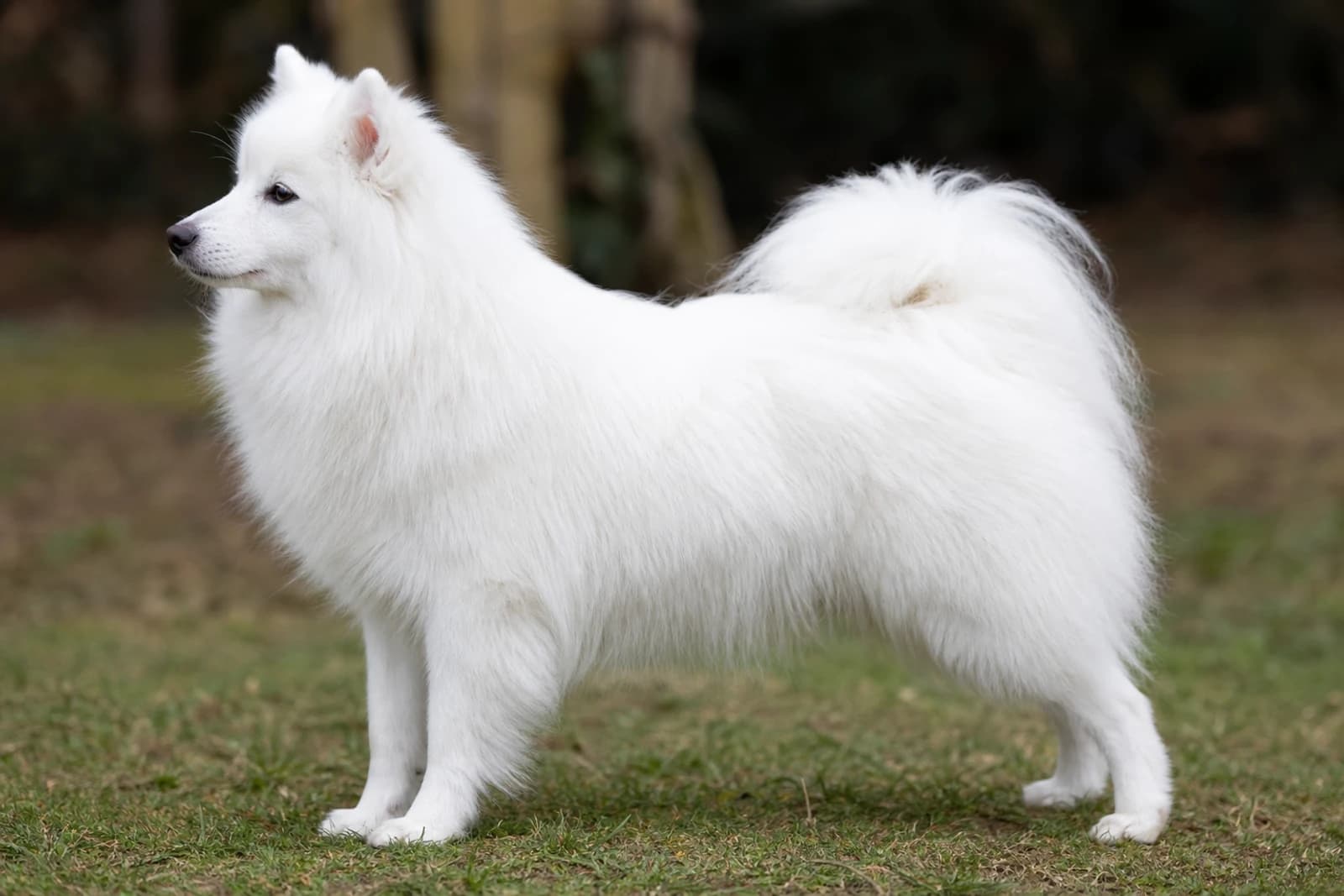
The Japanese Spitz is a small white companion spitz with a plume tail, foxlike face, and cheerful family temperament. It is a strong fit for readers looking for a small white fluffy dog, as long as they can handle seasonal shedding.
At a glance
- Size
- Small
- Height
- 12–15 in
- Weight
- 11–20 lb
- Life span
- 10–16 years
- Coat colors
- White
- Coat type
- White double coat
- Group
- Spitz-Type
- Origin
- Japan
How much does a Japanese Spitz cost?
Adopt / rescue
$75–$400
Usually includes spay/neuter, first shots, and a microchip.
Buy from a breeder
$700–$2,000
From a reputable, health-testing breeder.
Approximate USD. Prices vary widely by region, breeder, pedigree, age, and coat colour — adopting is the lower-cost and recommended route. Avoid suspiciously cheap “breeders”; they’re often puppy mills.
Estimate the full cost of a Japanese Spitz →Japanese Spitz photos
Views
Front, side, rear and top — the full silhouette.Poses
How the breed sits, lies, moves and plays.Puppy to senior
The breed across its whole life.Expressions
The breed’s range of moods.Close-up details
Eyes, ears, nose, paws, tail and coat.Coat colors
The breed’s recognized colors.Click any photo to enlarge. We show the Japanese Spitz from every angle — three views, poses, life stages, expressions, close-ups, coat and colors.
Appearance & size
A Japanese Spitz is a small, snow-white dog built like a miniature arctic fox — and it turns heads wherever it goes. Standing just 12 to 15 inches at the shoulder and weighing 11 to 20 pounds, this is a compact dog with a surprising amount of presence for its size. Under all that fluff, you’ll find a sturdy, balanced frame, never delicate or spindly.
From the front, the head forms a clean wedge that tapers to a pointed muzzle. The dark, almond-shaped eyes are set slightly oblique and rimmed in black, which together with the black nose and tight black lips gives the face a sharp, alert expression. The ears are small, triangular, and carried fully erect — they act like radar dishes, constantly swiveling to catch what’s going on.
In profile, the neck is well muscled and flows into a level topline. The chest is deep but not broad, and the legs are straight and fine-boned. A hallmark of the breed is the high-set, richly plumed tail that curls forward over the back, never drooping. When the dog moves, the gait is light, springy, and quick — almost like it’s bouncing across the ground.
From the rear, the tail plume is the main event, often spilling off to one side of the back, and the hindquarters show moderate angulation. The overall picture is one of a square, agile little dog that looks ready to play at a moment’s notice.
Coat and color
The Japanese Spitz wears a pure white double coat — that’s the only color allowed. The outer hairs are straight and stand away from the body, while the undercoat is dense, soft, and insulative. This combination creates a thick ruff around the neck and shoulders, feathering on the backs of the legs, and a showy tail plume. The coat is designed to shrug off dirt and moisture; when it dries, mud often just falls away. But it sheds — heavily. Twice a year, you’ll get drifts of white fluff everywhere. The rest of the time, a thorough brushing a few times a week keeps it clean and mat-free.
History & origin
The Japanese Spitz traces its start to the early 1920s, when a handful of pure white German Spitz dogs made the long trip to Japan by way of Siberia. Japanese dog fanciers had spotted the breed at a Tokyo dog show in 1921 and were immediately drawn to the snow-white coat, bright dark eyes, and foxy wedge-shaped head. Those first imports sparked a dedicated breeding program. Over the next decade, more white German Spitz were brought in from Europe, and breeders began selectively pairing them to lock in the crisp white coloring, compact size (12 to 15 inches at the shoulder), and the lively, upright spitz silhouette.
By 1948 the Japan Kennel Club had formally recognized the breed as the Nihon Supittsu—the Japanese Spitz. Unlike many spitz-type dogs that worked as hunters, sled dogs, or guard dogs, this little dog was bred from the start to be a cheerful family companion. Its original purpose was to charm, not to herd or haul.
Early on, the breed had a reputation for being exceptionally vocal—an alert watchdog that would bark at every knock and passing footstep. That wasn't ideal for a pet living in close quarters in Japan’s dense cities. Breeders responded by selecting for a calmer, more even temperament and reduced reactivity. Over a few generations, they produced a dog that still had all the spitz intelligence and playfulness but much less of the constant noise.
The result is a modern Japanese Spitz that is lively without being nervy, attentive without being on high alert all day. The breed steadily built a following across Japan and later in Europe and Australia, where its manageable size, clean white coat, and merry disposition fit neatly into suburban and apartment life. Today, while not yet a household name everywhere, the Japanese Spitz appears in show rings and living rooms around the world, a direct descendant of that 1920s breeding experiment—a dog designed to brighten the room, not patrol the fence line.
Temperament & personality
This little dog splits its personality in two with zero apology. To anyone outside the inner circle, the Japanese Spitz is a watchful, reserved guardian—a tiny white sentry who notices every squirrel, delivery truck, and leaf out of place. To the people they’ve claimed as their own, they are ridiculous clowns, patient lap-warmers, and uncannily graceful housemates.
Forming a tight bond happens fast and runs deep. Once you’re family, the Spitz’s default indoors is calm and almost cat-like—content to drape themselves over the back of the couch or curl up next to you while you read. But don’t mistake that poise for laziness. These dogs bring an upbeat, bouncy energy to play sessions and learn tricks with an eagerness that surprises people who only see the frou-frou coat. A good romp or a puzzle toy session settles them, but they need that outlet daily.
Their alertness edges into hyper-awareness, and they’ll bark. A lot. A stranger at the door, a neighbor’s car, a suspicious-looking plastic bag—all earn a clear, piercing commentary. Early socialization is the only thing that keeps this from turning into chronic reactivity. Expose a puppy to dozens of people, places, and sounds, and you’ll get a dog who’s discriminating rather than fearful. Skip that step, and you’ll have a dog who treats every unfamiliar face as a potential threat. They don’t warm up on command; they observe, assess, and decide, which some people read as aloof but is really just a careful, sensitive mind at work.
That sensitivity is the breed’s double edge. A Japanese Spitz tuned into your schedule and moods is a joy—they pick up on routines almost telepathically. Left alone too long or ignored, they unravel fast. Anxiety shows up as nonstop barking, destructive chewing, or indoor urine marking, which is less about spite and more about a dog desperately trying to manage stress. This breed genuinely struggles in empty houses. They need a person around a good chunk of the day, and they repay that availability with intense loyalty.
Underneath the white fluff is a stubborn streak, too. They’ll test boundaries and push back if you get heavy-handed—force shuts them down or triggers a battle of wills. Respectful, consistent leadership that works with their sharp brain is what gets results. Reward the things you want, ignore what you can, and redirect the rest.
You’re looking at a dog that’s half watchful guardian, half devoted shadow, and wholly unhappy as an afterthought. If your household includes someone home often and a sense of humor about the barking, the Japanese Spitz settles in like it was always there.
Good with kids, dogs & other pets
A Japanese Spitz can be a sweet-natured family addition, but the whole setup runs on two things: gentle handling and early, positive exposure to everyday life. These dogs are patient and non-aggressive by nature, so a well-socialized adult will often tolerate respectful kids without a grumble. The catch is their sensitivity. At 11 to 20 pounds and barely a foot tall, they feel vulnerable around grabby hands, sudden squeals, and high-energy chaos. A child who learns to sit quietly and offer a treat will earn a devoted shadow. Leave a toddler unsupervised to yank an ear or hug too hard, and you’ll end up with a dog that flinches or hides — not because it’s mean, but because it’s overwhelmed. Supervision is non-negotiable.
With other dogs, the Japanese Spitz tends to get along if the groundwork is laid while they’re still young. The critical socialization window slams shut around four months of age, so expose a puppy to calm, vaccinated adult dogs, varied people, and new sounds before that deadline. A dog who missed that window may become timid or reactive around unfamiliar dogs. You can still help an adult feel safer with dedicated training, but never force dog-park meetups or crowded play sessions. An older Spitz who’s perfectly content just hanging with their owner doesn’t need dog friends, and pushing it can create fear or fights.
Cats and small pets like rabbits generally work out when the Spitz grows up with them from puppyhood. Introduce them slowly, manage early interactions, and you’re likely to have a peaceful multi-species household. The same early exposure that prevents dog reactivity also curbs excessive wariness around other animals.
A final layer to keep in mind: this breed doesn’t do well left alone for long stretches. If your household empties out for work and school all day, the dog’s innate need for companionship can curdle into separation distress and constant barking. The ideal setup is a home where someone is around a lot and can commit to calm, consistent introductions — not a home that relies on the dog to absorb whatever the day throws at it.
Trainability & intelligence
If you’ve ever lived with a Spitz, you already know the drill: this is a thinking dog, not a push-button one. A Japanese Spitz picks up new cues with startling speed when the motivation is right, but he’s also sensitive enough to check out if training feels harsh or unpredictable. He won’t just ignore you — he’ll lose trust, and that’s when the breed’s tendency toward neurotic behaviors can surface.
Work with that brain, not against it. Short, cheerful sessions built around treats, tug toys, or a squeaky ball get you a dog who learns “sit,” “down,” and a recall in a handful of repetitions. Clicker training is especially effective because it marks the instant of success without emotion. Aim for five-minute bursts a few times a day instead of drilling. This breed stays engaged when you vary the exercise and stop before he gets bored.
Socialization before all else
The sensitive period for socialization runs from about 3 to 14 weeks. That means the clock is ticking the day your puppy comes home. Expose him gradually and positively to new people, friendly dogs, different floor surfaces, car rides, and normal household sounds. A well-socialized Japanese Spitz remains alert and watchful without tipping into barking fits or fear. Skip this step, and you may end up with a dog who panics at the vacuum or growls at a stranger in a hat — and that reactivity is much harder to undo in adulthood.
What never works
Punishment, yelling, or yanking the leash will wreck your dog’s confidence. This breed remembers rough handling and may start shutting down, avoiding you, or redirecting anxiety into obsessive behaviors like spinning or shadow chasing. Even a sharp tone can dim his enthusiasm. Always re-set with an easy cue he knows well, then reward heavily for cooperation.
The recall challenge
An off-leash recall is the fitness test for this partnership. Japanese Spitz have enough independence that a squirrel or a blowing leaf can override a half-hearted “come.” Build a bombproof recall by pairing the word with high-value rewards — think tiny bits of chicken or cheese — and practicing it hundreds of times in low-distraction environments before expecting a response outdoors. Never call him to end the fun; that teaches “come” means the leash goes on and the walk stops.
A Japanese Spitz who trusts his handler is a cheerful, fast-learning companion who thrives on clear communication. Skip the force, commit to short daily practice, and you’ll be rewarded with a dog who meets your eyes and waits for the next cue, fluffy tail waving.
Exercise & energy needs
Plan on giving your Japanese Spitz about an hour of real movement each day, broken into at least two outdoor sessions. A pair of solid 30-minute walks — where he gets to sniff, trot, and take in the neighborhood — usually fits the bill. These are small dogs (11–20 lb) with a moderate energy tank, not marathon runners, but skip a day and you’ll notice the difference: a restless Spitz often becomes a vocal one.
Outdoor time does more than burn calories. This is a Spitz breed through and through — alert, watchful, and quick to sound the alarm at every squirrel or delivery truck. Daily exposure to the world, at a relaxed pace, helps dial down that hyper-vigilance. Let him observe people, other dogs, and new sounds from a comfortable distance. Over time, he learns what’s normal and won’t treat every passerby as a potential intruder.
Mental exercise matters just as much. A bored Japanese Spitz will invent his own jobs, like barking at shadows or herding the cat. Work his clever brain with puzzle toys, frozen Kongs, or 10-minute training bursts throughout the day. He’s a natural at learning tricks — teach a new one weekly and you’ll both have fun. Scent games hit the sweet spot, too. Hide a couple of treats around the living room and let him hunt them down. A session of nose work can leave him as pleasantly tired as a long walk.
For more active days, try fetch in a fenced yard, flirt pole sessions on grass, or even a beginner agility course with low jumps. Japanese Spitzes are light and nimble, but they aren’t built for high-impact pounding. Protect those joints by discouraging hard leaps off the couch or bed — a set of pet stairs pays off. If you notice him bunny-hopping or skipping on a rear leg, have a vet check for luxating patellas, a common small-dog issue that sensible exercise habits help manage.
Tailor the schedule to your dog’s age and health. A young adult may thrive on two brisk walks plus a game of chase; a senior approaching 14 or 16 years still needs daily movement but at a gentler clip. On rainy days, skip the long walk and instead run through five minutes of obedience drills, followed by a puzzle feeder with his dinner. You’ll find that 20 minutes of thinking often tires him out faster than 20 minutes of walking.
Grooming & coat care
A Japanese Spitz wears a brilliant pure-white double coat that looks almost self-cleaning—but that dense undercoat traps dead hair and needs daily attention. Skip a day, and tiny white tumbleweeds will drift across your floors. A metal slicker brush with rounded pins is your go-to tool: it reaches through the outer guard hairs to pull out loose undercoat before it mats or lands on the couch. Follow with a greyhound comb to check behind the ears, under the legs, and around the ruff.
Bathing every 4 to 6 weeks keeps the coat bright without drying the skin. Use a whitening shampoo made for dogs, lather twice to lift grime from the thick fur, and rinse until the water runs absolutely clear—any leftover product can cause itching. Towel dry, then blow-dry on a cool setting while brushing; air-drying leaves the undercoat damp against the skin, an open invitation to hot spots.
This breed needs almost no trimming. A quick sanitary clip under the tail and a tidy-up of the hair between the paw pads reduces mud tracked indoors.
Ears, nails, and teeth
Erect ears catch dirt, so check weekly for wax or debris and wipe gently with a dog-safe cleanser. Those small feet—supporting a lean 11–20 pounds—produce fast-growing nails; trim every 2 to 3 weeks. Hear clicking on hard floors? You’ve waited too long. Brush teeth daily or at least several times a week with dog toothpaste to stay ahead of tartar.
Seasonal shed: Twice a year, a snowstorm hits. When the undercoat blows, brush twice daily and add a de-shedding rake or rubber curry brush to pull out handfuls of loose wool. Bathing with a high-velocity pet dryer during these heavy sheds blasts out dead coat before it fills your house.
Daily outdoor rambles aren’t just for energy—movement stimulates healthy coat turnover and cuts down stress-related shedding indoors. After a wet walk, let the mud dry and brush it right out; that dirt-repelling outer coat does exactly what it’s built to do.
Shedding & allergies
If you picture a dog that leaves no trace on your black sofa, cross the Japanese Spitz off your list. These little dogs are heavy seasonal shedders with moderate year-round loss, and that pure white coat is a master at appearing on everything you own.
Twice a year — typically spring and fall — the double coat blows out in earnest. For a few weeks, tufts of fluffy undercoat drift across hardwood floors, cling to upholstery, and turn dark pants into a snowscape. Outside of those big sheds, you’ll still see a steady, fine dusting of white hair. A robot vacuum or a solid lint-roller habit becomes part of the routine.
The one break you get: drool. The Japanese Spitz is an exceptionally dry-mouthed breed, so you’re not mixing slobber with all that fur.
On the allergy front, keep expectations realistic. No dog is truly hypoallergenic, and this breed sheds dander right along with the hair. Some people with mild allergies say they react less to a Japanese Spitz than to oily-coated breeds, possibly because the dry, stand-off coat doesn’t spread saliva-laden allergens as readily. But that’s anecdotal, not a guarantee. If allergies run in your household, spend unhurried time around adult dogs of the breed before bringing a puppy home.
- Brushing frequency: 2–3 times a week keeps the coat tidy, but daily brushing during a blowout cuts down on the indoor hair-drift.
- What to expect: White hair on dark clothes is a fact of life. A quick wipe with a damp cloth can remove most of what lands on smooth surfaces.
Diet & nutrition
Keep this little white dog lean. A Japanese Spitz packs a lot of personality into an 11–20 pound frame, and even an extra pound or two can quietly stress joints and cut years off a 10-to-16-year lifespan. Their thick, plush coat camouflages weight gain, so the bathroom scale and a hands-on rib check matter far more than a glance in the mirror.
Most adults do well on 400–500 calories a day, split into two meals. Use the feeding guide on your dog food only as a starting point — those numbers often run generous — and measure with a real measuring cup or kitchen scale. If you can’t easily feel the ribs under a thin layer of flesh, trim the portion back.
Many Japanese Spitz are surprisingly food-motivated. That eagerness makes training easier, but it also means they’ll pack on ounces fast if you’re free-pouring kibble or doling out table tidbits. Treats should be tiny and subtracted from the day’s total. Use a puzzle bowl if your dog hoovers food in seconds; it slows the inhale and gives that clever spitz brain a small workout.
Puppy feeding schedule
- Up to 4 months: four evenly spaced meals daily.
- 4 to 6 months: three meals.
- 6 months onward: transition to the adult routine of two meals a day.
Switch a puppy to your preferred food gradually — lightly cooked, puréed meat and vegetables or a high-quality commercial puppy formula. Raw meaty bones like chicken wings can be introduced around 12 weeks under close supervision, but many owners stick with a balanced kibble and focus on safe chewing outlets.
Older dogs
A slower metabolism and less sprinting around mean the meal that kept a five-year-old trim can make a ten-year-old soft. Drop portions a little and monitor weight monthly. There’s no solid reason to slash protein; just keep it high-quality. Some seniors feel better on three smaller meals a day, especially if missing teeth make chewing harder — blending or lightly processing the food aids digestion and absorption.
Stick to a diet built around animal protein. A dog’s digestive equipment is wired for meat, not a plant-heavy menu. Whether you choose a premium commercial food or a carefully balanced homemade mix, avoid rich, fatty human food (especially the holiday pan drippings) that can trigger pancreatitis. A foundation of cooked meat, with vegetables, eggs, and a modest grain like rice or barley, covers the bases without overcomplicating your life. You can even prep batches of grains and chopped vegetables in advance and portion them out — just serve them in the dog’s bowl so you don’t accidentally teach a begging habit.
Health & lifespan
A Japanese Spitz with a responsible breeder behind him usually lives 10 to 16 years. That’s a broad window because this is, as a whole, a remarkably sturdy little dog. You won’t find a laundry list of inherited nightmares here — the breed has largely sidestepped the major genetic boogeymen that plague many purebreds.
The one issue that does pop up with some regularity is skin trouble. Think allergies (environmental or food-driven), hot spots, or itchy dermatitis that can get out of hand fast under all that thick white fur. You might notice excessive licking, scratching, or a dull, reddish tint to the coat where saliva is staining it. A diet with quality fatty acids and prompt attention to flea control go a long way, but if your dog is rubbing raw patches into his skin, it’s vet time — don’t wait.
Responsible breeders screen for a couple of small-dog nuisances that can occasionally surface: luxating patellas (kneecaps that slip out of place) and eye conditions like entropion. They’re not rampant in the breed, but a good breeder will have the parents’ orthopedic and ophthalmologist clearances ready to show you. You can’t eliminate every risk, but you can stack the deck.
Dental health deserves a mention, too. A smaller jaw sometimes means crowded teeth, so daily brushing and annual cleanings aren’t optional extras — they’re the price of avoiding stinky breath and pricey extractions later.
One area where you have enormous control: weight. These guys are clever, food-driven, and just small enough that a few extra pounds puts real strain on those joints and can shorten that nice long lifespan. Measure meals, go easy on the treats, and pair it with real exercise — a brisk 45-minute walk and a romp in the yard, not just a quick loop around the block.
Routine vet care fills in the gaps. Monthly heartworm prevention during mosquito season (plus one month after the first freeze), a rabies shot because it’s the law, and a hands-on exam once a year catch things like a subluxating kneecap or early gum disease before they turn into expensive problems. A bored, isolated Japanese Spitz can also stress himself into destructive licking or barking fits, so don’t underestimate the health impact of simply keeping him engaged and close to his people.
That cloud-white coat is your early warning system — skin issues show up fast when you can’t hide discoloration or hair loss. Run your hands over your dog every week and you’ll spot trouble while it’s still a simple fix.
Living environment
You can absolutely keep a Japanese Spitz in an apartment, provided you commit to daily outdoor exercise and don’t leave him alone for marathon workdays. The trade-off is noise: these are alert watchdogs who announce every delivery, so thin walls aren’t your friend without solid training from the start.
Space and yard needs. A 12–15 inch, 11–20 pound dog needs surprisingly little square footage. No yard? No problem. What he does need is a steady rhythm of movement. Aim for two 20–30 minute brisk walks a day, plus a couple of short indoor play sessions or food puzzles. This breed runs best on frequent, moderate bursts — not one exhausting hike. Stairs and couch-sitting are fine, but discourage repeated high-impact jumps onto hard floors. Like many small dogs, a Japanese Spitz can be prone to patellar luxation, so ramps or simple “off” habits early on spare those knees.
Climate tolerance. That lustrous white double coat was made for cold, dry air — not humidity. Japanese Spitzes overheat fast. In warm months, walk early or late, keep a fan or air conditioning running indoors, and never leave him in a parked car. A cool, dry home keeps him comfortable and reduces the restless, clingy behavior that heat stress can provoke.
Barking and sound sensitivity. Alert barking is part of the package; he registers every passerby and delivery truck. Consistent “quiet” training, rewarding calm windowsill behavior, and putting that brain to work with puzzle toys go a long way. In a house with shared walls, ignoring the bark risks neighbor tensions, so build an alternative outlet early.
Being left alone. This is a velcro breed. A Japanese Spitz bonds tightly and can tip into genuine separation anxiety if regularly left solo for six-plus hours. Start alone-time desensitization right away: brief departures, a cozy crate or bed den, and high-value chews he only gets when you step out. A midday dog walker isn’t a luxury here — it’s often the line between a relaxed companion and a stressed dog who shreds baseboards.
Who this breed suits
The Japanese Spitz fits best with someone who wants a devoted shadow without the heavy-duty exercise demands of a larger dog. This breed thrives on companionship and will follow you from room to room, so if you can’t handle a dog who’s underfoot whenever you’re home, think twice. They’re small at 11–20 lb and 12–15 inches tall, which makes them manageable for apartment life, but they have a big-dog alertness and a tendency to sound the alarm at every knock or passing stranger. That bark is part of the package, so they suit owners who can train a quiet cue early and don’t mind some vocal enthusiasm.
First-time owners get a dog who’s bright, eager to please, and picks up commands quickly — the Japanese Spitz lives to work for praise. Their intelligence does mean they’ll notice if you’re inconsistent, so a little daily training goes a long way. They’re naturally clean and even housebreak quickly with a routine. Active families with children will find a playful, sturdy playmate who loves a game of fetch or chase, though their small size means very young kids need to learn gentle handling. These dogs often do well with other pets if introduced properly, but their spitz heritage gives them a mischievous streak — they might try to boss a larger, more laid-back dog around.
Seniors and singles who can offer a couple of good daily walks, plus some play sessions, will have an ideal companion. This isn’t a high-octane athlete; a 30-minute brisk walk and some indoor play often satisfy them, but they’ll happily join you for more. The trade-off is grooming. That pure white double coat sheds steadily and blows out heavily a couple times a year. If you dislike white fur on dark clothes, this breed isn’t for you. They also dislike being left alone for long hours — a Japanese Spitz with a job to do in your absence is a Japanese Spitz who might redecorate with shredded papers or bark the day away. Skip this breed if you’re out of the house 9-to-5 without a plan, or if you need a silent dog. Look elsewhere if you want a trail-running partner or a dog content to lounge in the yard all day — these are house dogs who need their people close.
Cost of ownership
The first number most people want to know: a Japanese Spitz puppy from a responsible breeder who does health testing usually costs $1,200 to $2,500. Show-potential or breeding-quality pups can push toward $3,000, while an adult from a breed rescue might be $200 to $500. Beyond the purchase price, expect to drop another $200–$400 upfront on a crate, bed, bowls, leash, collar, and initial vet visit.
Once he’s settled, the monthly rhythm looks like this:
- Food: A 11–20 lb dog eating premium dry food needs roughly 1 to 1½ cups a day. Budget $30–$50 a month for a high-quality kibble, plus $10–$15 for training treats.
- Grooming: That pure white double coat is beautiful but she constantly. Plan on brushing 2–3 times a week at home. A professional groom every 6–8 weeks costs $50–$70 in most areas, so figure $25–$40 per month averaged out. If you tackle it all yourself, good brushes, detangling spray, whitening shampoo, and tear-stain wipes run about $15–$25 a month.
- Vet and preventives: Annual exams, core vaccines, and year-round flea/tick/heartworm protection typically total $400–$600 annually. Set aside $35–$50 a month. Dental cleanings (small breeds often need them) add another $300–$600 every year or two.
- Pet insurance: For a small spitz, a comprehensive policy with a modest deductible often falls between $25 and $45 a month. This becomes a practical buffer since Japanese Spitz can be prone to luxating patellas and certain eye issues—conditions responsible breeders screen for but can’t always eliminate. A patella surgery alone can hit $2,000–$4,000.
Add in the little stuff (replacing chewed harnesses, the odd bag of dental chews) and a realistic monthly total lands between $100 and $200, not counting emergencies. Stashing an extra $30–$50 a month in a dedicated pet fund turns a surprise ACL injury or an unexpected dental extraction from a financial panic into a manageable problem.
Choosing a Japanese Spitz
Before you get swept away by a cloud-white puppy, know this: the breeder you pick makes or breaks the next 10–16 years. Japanese Spitz are generally hardy little dogs, but they aren't immune to sloppy breeding. A responsible source — breeder or rescue — is the difference between a joyful family member and a heartbreak you could have dodged.
A Good Breeder, or a Second-Chance Rescue
Start with the national breed club's referral list; those breeders commit to health testing and a code of ethics. You won't find a flood of Japanese Spitz in shelters, but it happens. Check adoption sites like Petfinder and don't overlook older dogs being rehomed by breeders or breed-specific rescue networks. An adult dog can slide right into your life with none of the puppy chaos.
Health Clearances You Need to See
Don't just take someone's word. Insist on written proof — ideally emailed to you before you ever visit — of at least these two screenings:
- Patellar luxation: This is a knee problem where the kneecap slips out of place, common in small breeds. Look for an OFA (Orthopedic Foundation for Animals) certification or a comparable PennHIP evaluation. A grade of "normal" tells you the joints are stable.
- Yearly eye exam: A board-certified veterinary ophthalmologist checks for inherited eye diseases. You want a current CAER (Companion Animal Eye Registry) number, not a quick glance from a general vet.
A breeder who also screens for hip dysplasia or runs a DNA panel for things like progressive retinal atrophy (PRA) is going the extra mile. Ask to see the certificates on the dam and sire. If you get a shrug or a story about how "they're all healthy," walk away.
Red Flags That Scream "Pass"
- No parent on the premises. You must meet the mother (and ideally the father). A shy, flinching, or unhealthy-looking dam is a dealbreaker.
- Puppies leaving before 8 weeks. A Japanese Spitz puppy needs that full time with its litter to learn bite inhibition and dog social skills.
- "Teacup" or "imperial" claims. These are marketing gimmicks for runty, often sickly pups.
- Multiple litters on the ground, blurry photos, or a seller who only meets you in a parking lot. Puppy mills and backyard breeders rely on your impulse. Don't give them money.
Picking Your Puppy from the Litter
Watch the whole litter interact. You want a puppy that notices you, maybe trots over to investigate, and recovers quickly after a startle — not the one cowering in a corner or the one relentlessly bullying its littermates. A confident, middle-of-the-road pup fits most families best.
Run your hands over the puppy. The coat should be thick and dry, not greasy or patchy. Eyes clear, ears clean, belly soft without a pot-bellied, wormy look. Check for any limp or hopping gait that could hint at a bad knee. A decent breeder will have already done early neurological stimulation and begun crate and potty training. They'll interview you as hard as you interview them; that's the sign of someone who wants their puppies in a forever home, not just any home.
Pros & cons
Pros
- Compact, sturdy build: 12–15 inches tall and 11–20 pounds — small enough for an apartment, tough enough for active play and short hikes without feeling fragile.
- Long-lived family companion: With a 10–16 year lifespan, this is a dog that bonds deeply with everyone in the household, not just one person, and stays playful well into old age.
- Sharp watchdog, zero aggression: They’ll announce every knock or rustle with a bark, but a wagging tail follows. You get a built-in alarm system without the liability.
- Modest exercise needs: Two brisk 30-minute walks and a few rounds of hide-and-seek or a puzzle toy usually do the trick — they’re adaptable, not wired to run all day.
- Surprisingly clean: The white double coat has a dirt-repelling quality and little “doggy” odor. Mud dries and brushes right out; a quick once-over keeps the coat gleaming.
Cons
- Heavy seasonal shedding: Twice a year they “blow” their undercoat, leaving drifts of white fluff everywhere. Weekly brushing is the baseline; daily brushing becomes non-negotiable during a shed cycle.
- Barking can spiral: That alertness easily morphs into non-stop commentary on every passing car or delivery truck unless you teach a solid “quiet” cue early on.
- Hates being left alone: These dogs live for company. A full workday solo can trigger separation anxiety — expect destructive chewing, barking, or house soiling if their social needs aren’t met.
- Wary of strangers without effort: Proper puppy socialization is crucial. An undersocialized Japanese Spitz may become skittish, snappy, or fear-reactive around unfamiliar people and dogs.
- Grooming is a commitment: Mats form easily behind the ears and on the legs; regular brushing, occasional baths (too-frequent bathing strips coat oils), and paw-pad trims aren’t optional. Also, be aware the breed can be prone to patellar luxation — ask breeders about knee screenings.
Similar breeds & alternatives
If the Japanese Spitz’s crisp white coat, fox-like face, and compact size caught your eye but you’re still sorting through options, a few other spitz-type breeds deliver a similar look with different trade-offs.
American Eskimo Dog
The Miniature Eskie lands right in the same 12–15 inch, 10–20 pound zone. Both are pure white with a thick double coat and a plumed tail. The differences are ancestry and, sometimes, volume. American Eskimo Dogs were developed in the US from German Spitz stock and tend to be a bit more watchful and vocal. Japanese Spitz lines often lean quieter — they’ll alert bark but typically settle faster. Eskies also come in Toy and Standard sizes, giving you more flexibility if the 11–20 pound Japanese Spitz window feels too rigid.
Pomeranian
Think of the Pomeranian as the concentrated version. At 3–7 pounds and 6–7 inches tall, Poms are a fraction of the Japanese Spitz’s 11–20 pounds. They share the upright ears, the heavily coated ruff, and a playful, confident personality. The Japanese Spitz is sturdier and far less fragile around kids or rough play. If you want a spitz-type dog you can actually scoop up with one hand, the Pom is your pick. If you’d rather have a small dog with real “dog” substance — one that won’t need you to rethink furniture and foot traffic — the Japanese Spitz fits better.
German Spitz (Mittel and Klein)
This is the closest cousin. Japanese Spitz were developed from white German Spitz imports in the early 20th century, and the resemblance is uncanny. The Mittel size runs 12–15 inches and 15–25 pounds, the Klein 9–11.5 inches and 8–15 pounds. The biggest practical difference is coat color: German Spitz come in black, brown, orange, wolf-sable, and white, while the Japanese Spitz is exclusively pure white. Temperament is nearly identical — lively, devoted, a bit reserved with strangers. Both breeds are rare in the US, so availability may end up steering your decision more than any subtle trait.
Samoyed
If you love the Japanese Spitz’s cloud-white coat and smiling expression but want a larger, more active breed, the Samoyed is the scaled-up version. Samoyeds stand 19–23.5 inches and weigh 35–65 pounds. They’re working sled dogs with much higher exercise needs — typically 60–90 minutes of real running, not just a stroll. The Japanese Spitz gives you that same snowy look in a smaller, apartment-friendlier package that’s happy with 45-60 minutes of daily walk-and-play time. It’s the difference between an athletic companion who thrives on winter hikes and a cheerful, moderate-energy housemate who’s content with a couple of good daily walks.
Fun facts
- Japanese Spitz are known for their pure white double coats.
- They are companion spitz dogs rather than sled dogs.
- The coat looks high-maintenance but repels dirt better than many long coats.
Frequently asked questions
- Are Japanese Spitz good with children?
- Japanese Spitz are affectionate and cheerful, typically forming strong bonds with family members. They can be playful and patient, but as with any dog, interactions with young children should be supervised. Early socialization helps ensure a well-mannered companion.
- How much do Japanese Spitz shed?
- Japanese Spitz shed a moderate amount year-round, with heavier shedding during seasonal changes. Their double coat drops fur regularly, so routine brushing helps manage loose hair. They are not considered hypoallergenic.
- What is the grooming routine for a Japanese Spitz?
- The Japanese Spitz has a thick double coat that requires brushing two to three times per week to prevent mats and control shedding. Bathing can be done every few months or when necessary, as their coat naturally repels dirt. Regular dental care, nail trims, and ear checks are also important.
- Do Japanese Spitz bark a lot?
- Japanese Spitz are alert and can be vocal, tending to bark at unfamiliar sounds or visitors. Training and early socialization can help minimize excessive barking. They are generally not nuisance barkers if their needs are met and they receive attention.
- Are Japanese Spitz suitable for apartment living?
- Yes, their small size and moderate energy level make them well-suited for apartments, provided they get daily walks and playtime. They are relatively quiet indoors but need mental stimulation to prevent boredom-related behaviors. Access to regular outdoor exercise is still essential.
- Are Japanese Spitz good for first-time dog owners?
- Japanese Spitz can be a good choice for first-time owners due to their eager-to-please nature and trainability. They are affectionate and adapt well to family routines, but they do require consistent grooming and companionship. Potential owners should be prepared for their alert barking and exercise needs.
Tools & calculators for Japanese Spitz owners
Quick estimates tailored to Japanese Spitzs — pre-filled with this breed’s size where it matters.
Articles & stories about the Japanese Spitz
Sources & standards
This profile follows recognized breed standards from the American Kennel Club (AKC) and the Fédération Cynologique Internationale (FCI), along with established veterinary and breed-club guidance. These describe general breed tendencies — every dog is an individual.
Owner stories
Have a Japanese Spitz? Share your experience — grooming tips, personality quirks, anything goes.