

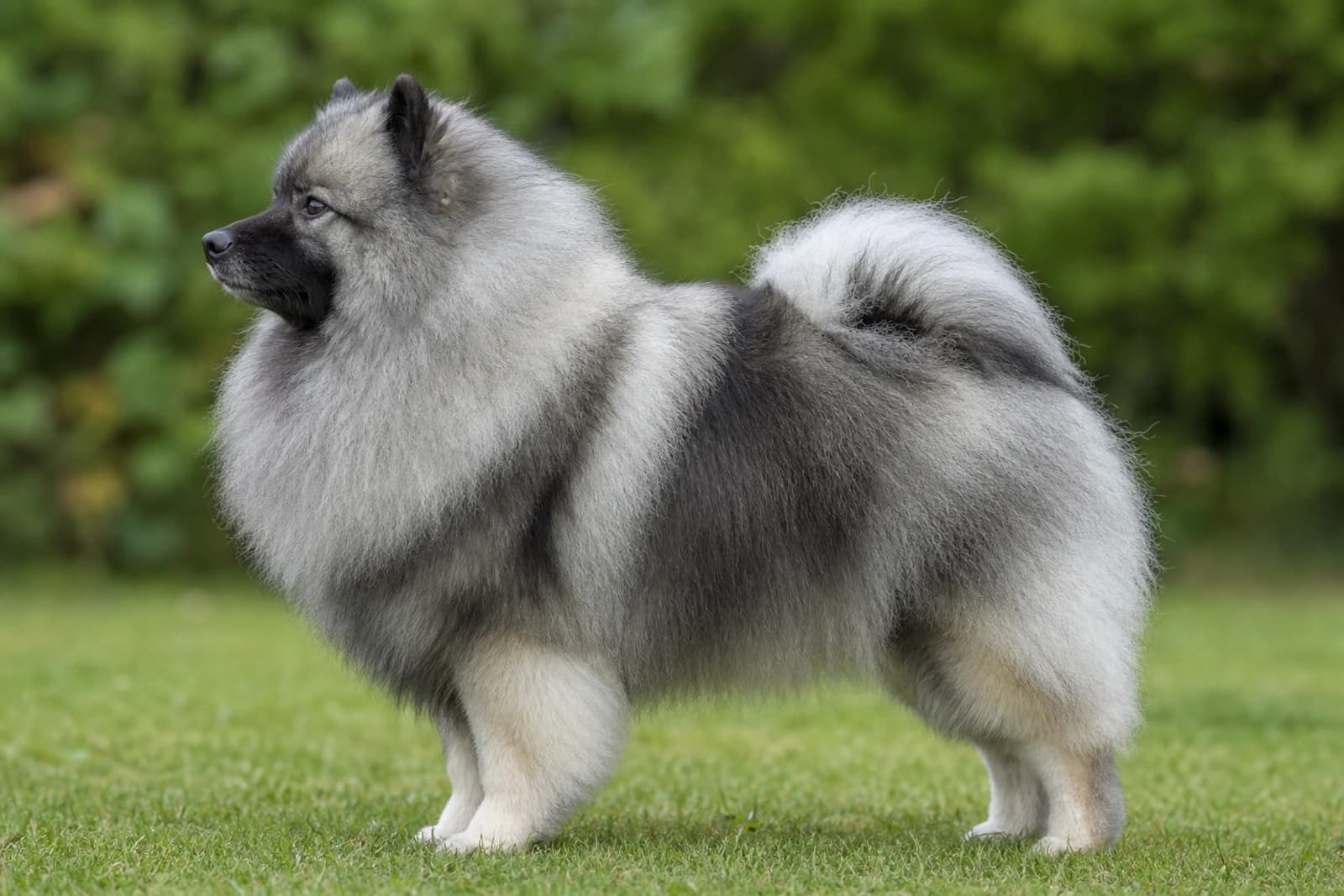
The Keeshond is a sociable, medium-sized spitz breed known for its plush coat and expressive 'spectacles.' This cheerful companion thrives on human interaction, making it ideal for families, singles, or first-time owners seeking an affectionate, people-oriented dog. Keenly alert, they are natural watchdogs, though their barking can be excessive without training. With moderate exercise needs and a friendly disposition toward children and other pets, the Keeshond adapts well to various living situations, including apartments, provided they receive daily walks and plenty of attention.
At a glance
- Size
- Medium
- Height
- 17–18 in
- Weight
- 33–44 lb
- Life span
- 12–15 years
- Coat colors
- Gray, black, and cream
- Coat type
- Thick, plush double coat
How much does a Keeshond cost?
Adopt / rescue
$75–$400
Usually includes spay/neuter, first shots, and a microchip.
Buy from a breeder
$700–$2,000
From a reputable, health-testing breeder.
Approximate USD. Prices vary widely by region, breeder, pedigree, age, and coat colour — adopting is the lower-cost and recommended route. Avoid suspiciously cheap “breeders”; they’re often puppy mills.
Estimate the full cost of a Keeshond →Keeshond photos
Views
Front, side, rear and top — the full silhouette.Poses
How the breed sits, lies, moves and plays.Puppy to senior
The breed across its whole life.Expressions
The breed’s range of moods.Close-up details
Eyes, ears, nose, paws, tail and coat.Coat colors
The breed’s recognized colors.Click any photo to enlarge. We show the Keeshond from every angle — three views, poses, life stages, expressions, close-ups, coat and colors.
Appearance & size
At the shoulder, a Keeshond stands 17 to 18 inches tall and weighs a solid 33 to 44 pounds — a squarely built, medium‑sized dog that feels far bigger the moment you run your hands into that cloud of coat. The body is slightly shorter than tall, giving it a compact, balanced silhouette, and the bone is sturdy without tipping into heaviness. A Keeshond moves with a brisk, almost prancing gait that makes the thick ruff bounce.
Coat and color. The outer coat is harsh, straight, and stands off from the body, while the undercoat is dense and soft, forming an insulating double layer. This gives the dog its signature “mane” — a heavy ruff that frames the face like a lion’s mane, more pronounced in males. The color is a striking mix of cream, light gray, and black. The outer guard hairs are tipped in black, which creates a shading effect across the back, sides, and tail. The underparts, chest, legs, and fluffy “trousers” on the hindquarters are a pale cream or light gray. The rich, dark plume of the tail is a showpiece all its own, with a lighter cream underside where it curls over the back.
Head and expression. From the front, the Keeshond is impossible to mistake. The head is wedge‑shaped, not too long, with a medium muzzle that tapers slightly. The small, triangular ears are set high and carried erect — dark, velvety, and mobile. The eyes are almond‑shaped, dark brown, and rimmed in black, and they are framed by a unique set of markings called “spectacles”: a thin, slanted line that runs from the outer corner of each eye and a lighter ring of hair around the eye itself. This gives the dog that alert, fox‑like, mischievously intelligent expression the breed is known for. The dark muzzle and light “eyebrows” only sharpen the look.
Body from every angle. From the side, the neck is moderately long and blends smoothly into well‑laid‑back shoulders. The topline remains level, the chest deep and springy. The tail lies tightly curled over the back with a double‑plume effect, so from the rear you see a cascade of long, dark‑tipped hair spilling down over heavily feathered hind legs — the “breeches” or trousers that match the ruff. The front legs are straight, with neat, cat‑like feet, and the feathering on the legs gives them a tapered, elegant finish even though the dog is anything but fragile. Nothing about a Keeshond looks out of balance; every floofy detail — the ruff, the spectacles, the plumed tail — comes back to that original square shape standing on four strong legs.
History & origin
The Keeshond traces its roots to the Netherlands, where these medium-sized spitz dogs earned their keep on the countless barges that moved goods and people along the country’s canals. Bargemen needed a compact, alert dog that could bark a warning at strangers, keep rats from spoiling the cargo, and provide cheerful company during long, slow journeys. With a thick double coat built for damp, northern weather and a sharp, no-nonsense bark, the Keeshond fit that bill perfectly. It’s essentially a Dutch cousin to the German Wolfspitz, but centuries of life on the waterways gave it a distinct identity.
The breed’s story took an unlikely political detour in the late 1700s. The Netherlands was bitterly divided between supporters of the House of Orange and a populist party known as the Patriots. A Patriot leader, Cornelius “Kees” de Gyselaer, was rarely seen without his barge dog at his side. The dog quickly caught on as a symbol of the common people’s revolt, appearing in cartoons and at rallies. People started calling the dogs “Keeshonden”—literally, Kees’s dogs. When the Orangists crushed the uprising in 1787, the breed’s political baggage made it deeply unfashionable. For the next century, barely anyone kept a Keeshond, and the dogs nearly died out.
A few determined fanciers stepped in around the turn of the 20th century to piece the breed back together. They scoured the countryside for remaining specimens and began a careful revival. The Dutch Keeshond Club was established in 1924, and interest soon spread to England. By 1928 the breed had arrived in the United States, and the American Kennel Club granted recognition in 1930. Through two world wars, the Keeshond held a small but steady foothold. It’s now firmly planted as a family companion—long past its barge-dog days, but still carrying that same sharp watchdog instinct and a hint of its rebel-rousing past.
Temperament & personality
A Keeshond doesn’t just like being around you — he needs it. Bred as a companion and watchdog on Dutch barges, this breed is hardwired to live right at the center of family life. Leave one alone in the backyard or an empty house for long stretches, and you’ll quickly get a loud, miserable dog who barks nonstop or chews through your drywall. Separation anxiety isn’t a quirk here; it’s a predictable result of isolation, so this breed fits best with a household where someone is around most of the day.
At the same time, a Keeshond isn’t a hyperactive cyclone. He’s lively and playful — a solid 30–45 minute walk plus some off-leash romping or a game of fetch usually does the trick — but he settles easily indoors, often draping himself over your feet or following you from room to room like a furry shadow. This balance makes him manageable for first-time owners who are ready to commit serious togetherness.
Watchdog, not guard dog. The Keeshond is an enthusiastic alarm system. He barks to let you know someone is approaching the door, and then — once the “intruder” is inside — he’s likely to lean against their leg and solicit ear scratches. The bark can be sharp and persistent, so early training to put it on cue is a must unless you enjoy a running commentary on every delivery truck and squirrel. He’s not suspicious or aggressive by nature, and a well-socialized Keeshond greets strangers with a wagging tail and the signature “smile” — that upturned-lip grimace that looks eerily like a human grin.
- Velcro personality: He’ll supervise your bathroom visits, nap on your paperwork, and park himself in the kitchen while you cook. This isn’t needy; it’s just how he’s wired.
- With kids and pets: Generally gentle and patient, but no dog is a stuffed toy. Teach children to respect his space, especially during meals. Disturbing a dog while he’s eating can trigger food guarding, so a Keeshond’s bowl should be a quiet, kid-free zone.
- Sharp but sensitive: He picks up on routines quickly and responds beautifully to positive, food-motivated training. Heavy-handed corrections backfire. A firm but upbeat approach — consistent rules, plenty of treats — gets the best from a breed that can be a touch stubborn if he thinks you’re being unfair.
- Fastidious nature: Keeshonds often groom themselves like cats and can be surprisingly tidy indoors once house-trained. If an accident happens, clean it with an enzyme-based product to obliterate the scent; lingering urine odors cue a dog to re-mark the same spot.
Quirks come with the package. Apart from the “smile,” you might see a Keeshond spin in tight circles when excited or rest his chin on your knee with a deep, dramatic sigh. And while he’s not a major escape artist, a bored Keeshond left in a yard may dig or bark relentlessly — a reminder that his place is inside, with you.
Temperament labels like “friendly” or “calm” describe the typical Keeshond, not a cast-iron guarantee. Socialization, breeding, and daily handling shape the dog you get. Still, choose a Keeshond if you want an affectionate, watchful shadow who treats your comings and goings as the main event, and be prepared to share the couch for the next 12 to 15 years.
Good with kids, dogs & other pets
Keeshonds were practically built for family life, and their patience with children is one of the reasons they earned the nickname “the smiling Dutchman.” They’re non-aggressive by nature, and a well-socialized adult typically tolerates clumsy hugs, sudden squeals, and the general chaos of a busy household without getting snappy. Still, at 33–44 pounds, they’re sturdy but not bombproof — a wobbly toddler can get knocked over when a Kees shakes his plumed tail during a greeting, so you’ll want to spot young children until everyone learns to read each other.
Pair that forgiving temperament with a Keeshond’s intense need for companionship, and you get a dog who genuinely wants to be in the middle of everything. That’s great for a family that’s home a lot, but it also means this isn’t a dog you leave in the backyard or alone for eight hours a day. Kids often become a built-in social circle, which helps prevent the distress and barking marathons a lonely Kees can develop.
With other dogs, the Keeshond is generally easygoing. They’re not looking to pick fights, and their default is to greet rather than guard. Good experiences during the 3-to-14-week puppy window matter enormously here. A puppy who regularly meets friendly, well-mannered adult dogs in that period tends to stay relaxed around new dogs for life. Skip that, and you risk a shy or over-aroused adult who doesn’t know how to read canine body language. If you’re adopting an older Kees who missed early socialization, don’t force dog-park interactions. A dog who is content just being with you may not need a pack of buddies, and pushing him can raise stress and trigger defensive snap.
Cats and small pets fall into a similar “raised with them, fine” category. A Keeshond’s original role as a barge watchdog didn’t require strong prey drive, so many live peacefully with the family cat or free-roam rabbit — provided introductions happen when the puppy is young and you supervise those early nose-to-whisker meetings. With pocket pets like hamsters, it’s smart to keep cages secure and out of reach, not because the breed is known to be predatory, but because a quick, squeaky movement can flip a playful swat into something rougher than you want. Teaching your Kees to settle calmly while you handle smaller animals builds a reliable “leave it” and keeps everyone safe.
Trainability & intelligence
You can teach a Keeshond just about anything once you figure out what he really wants, which is almost always your happy voice, a quick game of tug, or a tiny chunk of cheese. These dogs are sharp and they love working alongside people. The catch? A harsh word or frustrated tone can shut them down faster than a slammed door. That’s not drama — it’s a breed built on close partnership. They read your mood like a book, so if training starts feeling like a battle, you’ve already lost the thread.
Grab that sensitivity and turn it into a superpower. Keeshonds pick up new cues fast with positive reinforcement — think many short sessions where a sit or a down earns a treat, a throw of a toy, or just an exaggerated “YES!”. They’ll start offering behaviors to see what pleases you, which makes shaping complex tricks surprisingly fun. Clicker training fits them beautifully.
The one skill that demands extra realism is recall. A Keeshond who spots a squirrel or a delivery truck at full bark will not automatically snap back to a heel just because you called. Building a rocket-solid recall takes months of rewarding every single check-in, starting in a boring kitchen and working up to fenced fields, always trading the distraction for something far better. If you chase him down yelling, you’ll get a dog who plays keep-away. Don’t.
What tends to trip people up? Boredom and stubborn streaks. Keeshonds repeat the same drill too many times and they’ll invent their own version, or simply walk away. Keep sessions under five minutes and stop before they lose interest. They also have a low threshold for injustice — punishment-based methods create anxiety, not obedience, and can trigger avoidance or noise phobias down the line.
- Start socialization early, ideally between 3 and 14 weeks. Puppy drags you toward a clanging manhole cover? Reward. Stranger with a hat? More rewards. The goal is to build a dog who meets new people, sounds, and surfaces with a wag, not a worried bark. Keeshonds who miss that window can lean shy or reactive, so gentle, gradual exposure is non-negotiable.
- Use what motivates today. Kibble might work for a calm morning session, but a smelly chicken strip could be the only thing that competes with a barking dog next door. Don’t be stingy.
- Teach a solid “settle.” Their natural alertness means they’ll announce every leaf that falls. Pair a mat or crate with something lickable, and reward calm until it becomes their default when you’re busy.
A Keeshond’s intelligence shows up as problem-solving, not rote drill work. Give him clear rules, no surprises in tone, and a reason to think you’re the best part of his day, and he’ll hang on every word you say.
Exercise & energy needs
Plan on about 45 to 60 minutes of daily exercise, split into two sessions. A typical Keeshond does best with a 20- to 30-minute brisk walk in the morning and a similar evening outing, along with some off-leash sniff time or an enthusiastic game of fetch in the yard. They’re not high-octane athletes, but they have enough stamina for a moderate weekend hike once they’re fully grown — just steer clear of midday summer heat, because that thick double coat puts them at real risk of overheating.
Mental exercise counts just as much as the walks. Keeshonden are sharp, people-oriented dogs who get bored quickly when the family is busy. Hide a few treats around the living room, feed a meal out of a puzzle toy, or run through a 10-minute trick-training session. These dogs adore working with you, so sports like rally, nose work, and agility (with jumps kept low) are solid fits. A mentally underworked Keeshond often becomes a vocal one — demand barking, pacing, or chasing shadows are your cue to add more brain games, not just extra miles.
- Good matches: long sniff-walks, indoor hide-and-seek, flirt pole sessions, rally obedience, scent work, backyard agility.
- Go easy on: repetitive jumping on hard surfaces until growth plates close (puppies), and any activity that leaves them panting hard on hot days.
Keep at least one session really interactive. They don’t need a marathon partner; they need a thinking partner who’s consistent. Skip the mental workout and you’ll hear about it.
Grooming & coat care
That magnificent stand-off coat looks high-maintenance, but a Keeshond’s grooming routine is simpler than you’d think—as long as you never skip a session. This is a pure double coat: a dense, woolly undercoat supports long, straight guard hairs. Neglect it, and mats form fast against the skin, especially behind the ears, under the elbows, and along the britches.
Brushing needs to happen at least three to four times a week to keep things comfortable. During the two heavy seasonal sheds—usually spring and fall—you’ll want a quick daily pass to stay ahead of the blizzard. Reach for a metal slicker brush with rounded pins to rake out loose undercoat and a greyhound comb to check for hidden tangles down to the skin. Finish with a pin brush over the ruff and tail to fluff without pulling. If you line-groom (parting the coat section by section), you’ll miss fewer hotspots. A pig-bristle brush isn’t your main tool here; it’s for short coats and shine, not for detangling this plush density.
Bathing every six to eight weeks works for most Keeshonden—or just when they roll in something memorable. Use a gentle dog shampoo and follow with conditioner to keep the guard hairs from drying out. The real work is the dry time. A high-velocity dryer (on cool or low heat) blasts dead undercoat out and gets the skin fully dry, which is crucial to prevent hot spots. Letting a Keeshond air-dry in a thick coat invites trouble.
Trimming should be minimal. You might tidy the fur around the feet to keep mud at bay and neaten any stringy hairs on the hocks, but never shave or clipper-cut the body—it ruins the insulating properties of the double coat and can cause permanent texture changes. Nails get a trim every two to three weeks; if you hear clicking on the floor, you’re overdue. Ears need a gentle wipe with a damp cloth weekly, and teeth benefit from a daily brush (or at least a few times a week) to fend off tartar.
Seasonal coat care spikes when that undercoat lets go. A warm bath and a long session with the dryer and slicker brush can remove handfuls of dead hair in one go. Outdoor exercise on grass or dirt helps naturally loosen spent coat, too, so your regular walk doubles as a grooming boost. The payoff for all that brushing is a dog that stays remarkably clean and tangle-free between appointments—without the hair collecting in your couch cushions.
Shedding & allergies
You don't keep a lint roller on standby with a Keeshond — you keep a case of them, and you still end up wearing your dog to work. This breed sheds. A lot. All year. The dense, stand-off double coat drops a steady drizzle of fluff no matter the season, and then twice a year it turns into a genuine event.
The seasonal blowout and daily reality
When a Keeshond blows coat in the spring and fall, soft gray undercoat comes out in tufts you can pull free with your fingers. Expect fur tumbleweeds drifting across the kitchen floor within hours of vacuuming. A thorough, line-brushed grooming session once a week keeps the worst of it manageable, but during the heavy shedding weeks you'll reach for the slicker brush and comb every day or two just to stay ahead. The silver lining: their coat resists dirt and mud surprisingly well, and dried debris usually brushes right out.
Drool isn't part of the package
Keeshonden are a dry-mouthed breed. You won't find slobber trails on your furniture or need to carry a drool rag. The mess here is purely about hair, not saliva.
The real hypoallergenic picture
If anyone in your household has dog allergies, hear this clearly: no dog with a thick, shedding undercoat is hypoallergenic. Keeshonden produce plenty of dander, which sticks to all that shed fur and wafts into the air. Some allergy sufferers react less strongly to individual dogs — coat texture, proteins in the saliva, and grooming habits all shift the equation — but betting on a Keeshond to be gentle on allergies is a gamble with poor odds. Spend meaningful time inside a home with adult Keeshonden before committing, not just a quick meet at a breeder's yard where dander is diluted.
Diet & nutrition
Keeshonden are food lovers — and that’s where you need to be most vigilant. A Keeshond rarely says no to a meal, which makes weight gain a real danger. Even a few extra pounds on a 33–44 lb frame strains joints and can shorten a lifespan that should stretch to 12–15 years.
Measure every meal. For most adults, that means 1.5 to 2.5 cups of high-quality dry food per day, split into two feedings. Adjust based on your dog’s exact weight, body condition, and activity level: an active young Keeshond burns more than a couch-dwelling senior. If you can’t easily feel the ribs under a light cover of fat, cut back. Never free-feed.
Puppies need more frequent fuel. Until four months old, feed four evenly spaced meals. From four to six months, drop to three meals. After six months, transition to the adult two-meal schedule. Switch from puppy to adult formula gradually around 12–14 months, and never rush the change: mix the new food in over a week to spare their gut.
Seniors benefit from smaller, more frequent meals if their appetite dips or they develop dental issues. Purée meals for dogs with missing teeth, but don’t automatically cut protein — the real priority is weight control. As activity drops, reduce portions a little at a time, weighing your dog every few weeks to catch creep early.
A balanced kibble already covers their needs, but if you home-cook, aim for roughly 60% meat (cooked or raw), 20–30% fruits and vegetables, and 10% extras like eggs, grains, or yogurt. Lightly cook and blend or purée vegetables — dogs don’t grind plant matter horizontally, so blending boosts nutrient absorption. Pearl barley makes a digestible, high-fiber grain swap; white rice works for a sensitive stomach. Vegetable cooking water (unsalted) doubles as a quick stock base. Never impose a vegetarian diet — dogs are built to digest meat.
Because Keeshonden are so food-motivated, fast eating can become a problem. Spread kibble in a puzzle bowl or snuffle mat to slow them down and engage their brain.
Keep rich, fatty extras out of the bowl. Holiday scraps, bacon, and greasy trimmings can trigger pancreatitis, a painful and expensive emergency. If you want to share “people food,” stick to a spoonful of plain canned fish, a hard-boiled egg, or a few steamed veggies — served in their own bowl, never from the table. Begging is a nightmare to undo, so don’t teach it.
Check your Keeshond’s scale weight monthly. A 5-lb gain on a 40-lb dog is like 15 extra pounds on you — it wears down joints and robs years. A measuring cup and a bathroom scale add more healthy time together than any supplement ever will.
Health & lifespan
A healthy Keeshond easily reaches 12 to 15 years, and many stay playful well into their teens. That long lifespan makes prevention a real investment — what you do when the dog is young directly shapes those bonus years.
Responsible breeders screen for several inherited conditions that can pop up in the breed. Hip dysplasia, patellar luxation (a kneecap that slips out of place), hypothyroidism, and epilepsy all appear more often in Keeshonds than in some other mid-sized dogs. Eye troubles like progressive retinal atrophy (PRA) and cataracts also show up on the radar. None of these is a given, but a good breeder will provide OFA hip scores, patella evaluations, current eye clearances through CERF or equivalent, and thyroid panels for both parents. Ask to see those before you fall in love with a fluffy puppy.
Once the dog is home, routine vet care catches early warning signs. An annual wellness exam is the baseline — senior dogs benefit from twice-a-year checkups. Bloodwork often flags hypothyroidism or epilepsy medication levels before you spot a change. And because you live with this dog 24/7, watch for shifts in energy, appetite, or joint stiffness. A Keeshond that suddenly refuses to jump on the couch isn’t being stubborn; he might be hurting.
The breed’s thick double coat makes them cold-hardy but also heat-sensitive. They can overheat quickly on an 85°F walk, so adjust exercise timing and always offer shade and water. That same dense coat can trap moisture and set up hot spots or skin infections, especially if the dog stays damp. Brush regularly, dry thoroughly after baths, and pay attention to any red, oozy patches.
Weight talks loud with Keeshonds. They’re enthusiastic eaters and can pack on pounds without you realizing it. Extra weight stresses joints already at risk for hip and patella issues and shortens that life span. Stick with measured meals, treat calories counted in, and a stable weight in the 33–44 pound range.
Don’t overlook the basics that apply to any dog. Monthly heartworm prevention during mosquito season — plus one month after it ends — is nonnegotiable. Rabies vaccination is legally required everywhere in the U.S. and has no cure once symptoms appear. Keeshonds also form intense bonds with their people; long stretches of isolation can trigger stress-related barking, destructive chewing, or even immune dips. A well-socialized, mentally stimulated Keeshond is a healthier one.
Living environment
A Keeshond can settle happily into an apartment or a house with a yard — but the real question is whether your daily schedule and tolerance for conversation-match the dog’s needs. They were bred to be close companions on Dutch barges, so they crave nearness; a big, fenced property means little to them if you’re always in another room.
Apartment or house?
An apartment works fine if you commit to consistent exercise and train the barking early. These are alert dogs with a watchdog’s voice — they will announce delivery trucks, hallway footsteps, and the neighbor’s cat. Without management, that 35-pound dog can generate noise complaints in a building with shared walls. A house gives you a buffer, but even then, expect vocal vigilance. Both settings need air conditioning in warm months (see climate below).
Yard needs
A securely fenced yard is a perk, not a requirement. Keeshonden love to zoom in circles and patrol the perimeter, but a few brisk leash walks and an indoor play session can replace yard time. Snuffle mats and puzzle toys give their busy brains a workout when you’re short on outdoor space.
Climate tolerance
That glorious silver-and-cream coat is double-layered insulation. Cold is their happy place — a 20°F walk is a treat, whereas 80°F and humid becomes dangerous fast. Keep exercise to early mornings and late evenings in summer. Provide cool floors, fans, or a kiddie pool; never shave the coat — the undercoat also shields them from heat. Expect heavy shedding year-round, with massive blows twice a year.
The barking factor
You won’t train a Keeshond to be silent. You can train it to give a couple of warning woofs and then settle. Realistic goal: controlled alert barking, not silence. If you prize a totally quiet home, look elsewhere.
Tolerance for being left alone
Here’s the breed’s hardest-hitting downside. Keeshonden bond intensely with their people and can tip into isolation distress when left alone for long stretches. For a typical 9-to-5 household, you’ll need a plan — a dog walker midday, gradual desensitization starting in puppyhood, and plenty of mental enrichment (stuffed Kongs, scent games) to blunt the loneliness. A Keeshond left without coping tools often becomes a frantic barker and a chewer of drywall. If someone in the family works from home or you can stagger schedules, your dog will thrive. Expect a shadow that follows you from kitchen to couch, every time.
Who this breed suits
If you want a dog that treats you like the center of the universe, the Keeshond is a perfect fit. These 35- to 44-pound fluffballs don’t just coexist with their people — they glue themselves to your side. That loyalty makes them a fantastic choice for families, singles who work from home, and retirees who genuinely enjoy having a shadow. They’re gentle and patient with respectful kids, often participating happily in backyard play or couch snuggles, and they generally get along well with other pets, including cats.
First-time dog owners can do wonderfully with a Keeshond, provided they’re ready for the grooming commitment. This isn’t a wash-and-wear dog: a dense double coat means daily brushing during heavy shedding seasons and a steady supply of lint rollers year-round. On the upside, the breed is clever, eager to please, and responds best to positive, treat-based training — no heavy-handed corrections needed. A daily walk of 30 to 45 minutes plus some mental work (puzzle toys, short training sessions) keeps them content; they’re not marathon runners, but they won’t thrive as couch potatoes either.
Think twice if you’re gone for long workdays. Keeshonden can develop serious separation anxiety and will voice their displeasure with a sharp, persistent bark. That same alertness makes them excellent watchdogs, but it turns into a headache in apartments with thin walls or for owners who want peace and quiet at every doorbell ring. You also need to be okay with a dog who wants to be in the middle of everything — backyard-dwelling or even a separate room feels like punishment to them. If your idea of dog ownership is a low-shedding, independent companion you can leave alone all day, this breed will struggle. But if a 12- to 15-year partnership with a smiling, devoted “Velcro” dog sounds like exactly what you want, a Keeshond will deliver that in spades.
Cost of ownership
A responsibly bred Keeshond puppy usually falls between $1,800 and $3,000 — sometimes more if you’re working with a breeder who prioritizes health clearances for hips, patellas, and eyes, titles their dogs, and raises pups underfoot. Rescue adoption fees land around $300–$600, though purebred Kees in rescue aren’t common.
Once the dog is home, the steady costs settle into the moderate range for a 33–44-pound spitz, but the double coat drives the grooming math more than anything else.
Monthly expenses at a glance:
- Food: Figure $55–$80 a month for a high-quality kibble (around two cups a day, split between meals). You’ll spend a little more if you feed a fresh or raw diet. They love food and put on weight easily, so measure carefully — oversize portions drive up cost and vet risk.
- Grooming: This is where budgets split. If you handle it at home, plan on a $150–$250 upfront investment in a good pin brush, undercoat rake, high-velocity dryer, and a quality slicker, then a solid hour of brushing two or three times a week during shedding season. Professional grooming with a thorough blowout and scissoring runs $80–$130 every six to eight weeks, depending on your area. Skip the shaving — you’ll damage the insulating coat and regret it.
- Routine vet & preventatives: Annual exams, core shots, heartworm and flea/tick preventatives run about $400–$600 a year, or roughly $35–$50 a month. Add dental cleanings when your vet recommends them, because smallish mouths can trap trouble.
- Pet insurance: For a breed that can live 12–15 years, an accident-and-illness policy typically costs $35–$60 a month with a reasonable deductible. Responsibly bred lines lower some risks, but patellar luxation, thyroid issues, and occasional allergies do appear, so a policy buys peace of mind before anything shows up.
All told, expect a baseline of $150–$250 a month, not counting one-time supplies, boarding, or the training classes this people-oriented breed thrives on. The real cost variable is grooming — decide early whether you’ll learn the deep brushing routine yourself or build the pro appointment into your calendar every six weeks, because the sheer volume of undercoat never takes a break.
Choosing a Keeshond
Start with a breeder who treats health testing as a non‑negotiable baseline, not a bonus. Keeshonds can live a solid 12–15 years, but that longevity depends heavily on parent dogs screened for the issues that pop up in the breed. Specifically, ask for OFA or PennHIP evaluations on hips (fair or better is the minimum you want), plus an OFA patella exam to rule out luxating patellas, and a current ACVO eye clearance (no more than a year old). Many conscientious breeders also test elbows and run a thyroid panel, because hypothyroidism shows up enough to warrant it. Don’t accept a verbal promise that “the line is healthy”—request the actual clearance numbers and verify them on the OFA website yourself.
Red flags are easy to spot once you know what to look for. Walk away from anyone who breeds the same dam back‑to‑back or has multiple litters on the ground at once. Puppies should never leave before eight weeks; earlier than that is a dealbreaker. Avoid breeders who don’t let you meet at least the mother dog on‑site, or who seem vague about their socialization protocol. A well‑bred Keeshond puppy is curious, bouncy, and eager to engage—not cowering in a corner or snarking at a sibling. If a breeder brushes off your questions about temperament or acts annoyed that you’re doing homework, that’s your cue to leave.
Rescue is absolutely a viable path, and there are dedicated Keeshond rescue networks that know the breed inside and out. Adopting an adult can be a wonderful fit if you don’t mind skipping the puppy phase. You’ll still want to ask about known health history and any behavioral quirks, but the benefit is that a mature dog’s temperament is already on display.
When you’re face to face with a litter, ignore the coat pattern you think is cutest and pay attention to energy. Sit on the floor and see which puppy recovers quickly from a sudden noise (a dropped set of keys, a clap), voluntarily comes over to investigate you, and can be gently handled all over—ears, paws, tail—without pulling away. A Keeshond who’s aloof or overly timid as a baby often stays that way, and a properly socialized pup from a reputable source should be bright‑eyed and people‑focused. Take your time, visit more than once if you can, and get everything—health guarantee, return clause, AKC registration if that matters to you—in writing before you hand over a deposit.
Pros & cons
Pros
- Exceptionally people-focused and affectionate — a Keeshond wants to be part of every family moment and genuinely prefers company over solitude.
- Naturally good with gentle children and other pets when socialized early; their playful, upbeat personality makes them a steady, cheerful presence.
- A keen watchdog who barks to alert, but their open-armed greeting soons upends any guard-dog pretense.
- Moderate exercise needs fit many households: a couple of brisk 30-minute walks and active playtime typically do the job—no marathon runs required.
- Adaptable to apartments or houses as long as they get daily companionship; they’re sensitive to their people’s moods and settle indoors nicely.
- Eager to please and quick to pick up positive-reinforcement training, though they do best with variety — repetition bores them fast.
Cons
- Heavy shedding is the real deal: the dense double coat drops fur year-round, with a dramatic blowout twice a year that coats furniture and clothing alike.
- Grooming is non-negotiable. Brush 2–3 times a week, daily during shedding seasons, to prevent matting and keep the silver-tipped coat from taking over your home.
- Separation anxiety can surface swiftly. Expect barking, howling, or destructive chewing if left alone for full workdays — this is not a breed for empty houses.
- Vocal to a fault. They’ll remark on delivery trucks, passing dogs, and suspicious leaves, so a “quiet” cue and consistent training are must-haves unless you enjoy constant commentary.
- Poor heat tolerance means summer exercise needs early-morning or late-evening scheduling, and they’ll often choose the coolest tile over a sunny spot.
- That smart, independent streak can turn into selective listening when something more interesting captures their attention, calling for patient, persistent guidance.
Similar breeds & alternatives
If the Keeshond’s spectacled face and cheerful, moderate energy caught your eye, a few other Spitz breeds offer different trade-offs in size, coat, and drive.
- American Eskimo Dog – Comes in toy, miniature, and standard sizes (12–19 inches; 20–35 pounds for standards). The standard Eskie overlaps the Keeshond’s height but is often more alert and suspicious of strangers. Both share dense white or cream coats and big bark tendencies, but Eskies typically have sharper watch-dog instincts and need more mental work to stave off nuisance barking.
- Samoyed – Larger (19–24 inches, 35–65 pounds) and blindingly white. That famous Sammy smile comes with a working sled-dog background, so count on 60–90 minutes of real exercise daily, not a couple of walks. Grooming is a larger commitment too—Samoyed undercoat rains year-round. The Keeshond, by contrast, is a more house-friendly size and generally settles indoors with less fuss.
- Norwegian Elkhound – Another medium Spitz with a wolf-gray coat, standing 19–21 inches and 48–55 pounds. Elkhounds are tougher, more independent, and were bred to hold moose at bay—so expect even more barking and a stronger will. A Keeshond is notably softer with strangers and less likely to test your leadership.
- Finnish Lapphund – Similar in size (16–21 inches, 33–53 pounds) and temperament, Lapphunds are gentle, people-focused herders from the Arctic. They come in a wider color palette than the Keeshond’s signature gray-and-black. Exercise needs are similar, but the Lapphund’s herding heritage can mean a little more chase drive with kids and small pets.
The Keeshond’s sweet spot is a warm-weather-averse companion who packs intense family loyalty into a manageable 33–44-pound frame—without the independent handling challenges of the Elkhound or the full-throttle exercise demands of a Samoyed.
Fun facts
- Once served as companions on Dutch barges, earning the nickname 'Dutch Barge Dog'.
- Recognized for their distinctive 'spectacles'—markings around the eyes that give a smiling expression.
- Were adopted as the mascot of the Dutch Patriot political party in the 18th century.
- Known as 'the smiling Dutchman' for their cheerful, foxlike face.
Frequently asked questions
- Do Keeshonds shed a lot?
- Yes, Keeshonds shed heavily, especially during seasonal coat blows. Their thick double coat requires weekly brushing to manage loose fur, and daily brushing during shedding seasons can help keep it under control.
- Are Keeshonds good with children?
- Keeshonds are typically excellent with children, known for their gentle and patient nature. They enjoy family activities and form strong bonds, but as with any breed, interactions should be supervised with young kids.
- How much exercise does a Keeshond need?
- Keeshonds need moderate daily exercise, such as brisk walks and playtime, totaling about 30–60 minutes. They are adaptable but can become restless without enough mental and physical stimulation.
- Do Keeshonds bark a lot?
- Keeshonds can be vocal and tend to bark to alert their owners of anything unusual. Early training can help manage excessive barking, but some barking is part of their watchdog nature.
- Are Keeshonds suitable for apartment living?
- Keeshonds can adapt to apartment living if given enough daily exercise and mental engagement. Their medium size and moderate energy level make them suitable, but their barking tendency may need to be considered in close quarters.
- Are Keeshonds good for first-time dog owners?
- Keeshonds can be a good choice for first-time owners due to their eager-to-please and affectionate temperament. However, they require consistent grooming and training to manage their coat and alert barking, so new owners should be prepared for that commitment.
Tools & calculators for Keeshond owners
Quick estimates tailored to Keeshonds — pre-filled with this breed’s size where it matters.
Articles & stories about the Keeshond
Sources & standards
This profile follows recognized breed standards from the American Kennel Club (AKC) and the Fédération Cynologique Internationale (FCI), along with established veterinary and breed-club guidance. These describe general breed tendencies — every dog is an individual.
Owner stories
Have a Keeshond? Share your experience — grooming tips, personality quirks, anything goes.