

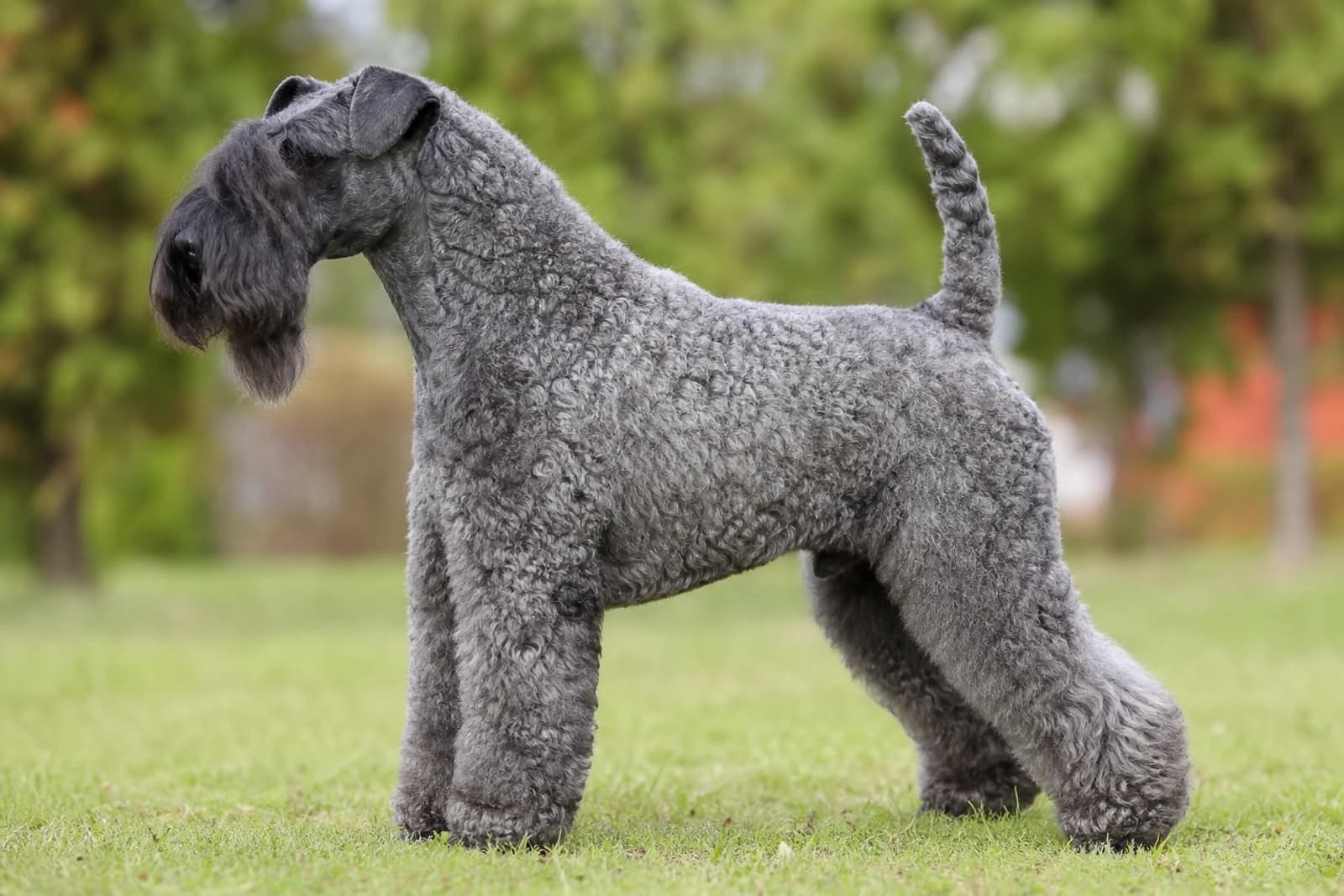
The Kerry Blue Terrier is a versatile, medium-sized terrier known for its soft, wavy blue-gray coat and lively spirit. Suited for active individuals or families, they are intelligent, affectionate, and thrive on companionship. Their non-shedding coat makes them hypoallergenic, but they require regular grooming and exercise. They excel in canine sports and are loyal companions, though their terrier stubbornness demands consistent, positive training.
At a glance
- Size
- Medium
- Height
- 18–19 in
- Weight
- 33–37 lb
- Life span
- 14 years
- Coat colors
- Blue-gray
- Coat type
- soft, dense, wavy, non-shedding coat
How much does a Kerry Blue Terrier cost?
Adopt / rescue
$75–$400
Usually includes spay/neuter, first shots, and a microchip.
Buy from a breeder
$700–$2,000
From a reputable, health-testing breeder.
Approximate USD. Prices vary widely by region, breeder, pedigree, age, and coat colour — adopting is the lower-cost and recommended route. Avoid suspiciously cheap “breeders”; they’re often puppy mills.
Estimate the full cost of a Kerry Blue Terrier →Kerry Blue Terrier photos
Views
Front, side, rear and top — the full silhouette.Poses
How the breed sits, lies, moves and plays.Puppy to senior
The breed across its whole life.Expressions
The breed’s range of moods.Close-up details
Eyes, ears, nose, paws, tail and coat.Coat colors
The breed’s recognized colors.Click any photo to enlarge. We show the Kerry Blue Terrier from every angle — three views, poses, life stages, expressions, close-ups, coat and colors.
Appearance & size
The Kerry Blue Terrier is a muscular, medium-sized dog with a surprisingly compact frame that belies the strength underneath. A mature Kerry stands 18 to 19 inches at the shoulder and weighs between 33 and 37 pounds — not a big dog, but one built to work all day. The chest is deep and moderately broad, the back short and level, and the whole silhouette suggests athletic balance rather than bulk.
That coat is the breed’s calling card. Puppies are born black, and over the first 18 months the color slowly clears to a range of blue-gray shades, from deep slate to a light silvery blue. The coat itself is single, dense, and soft — not the harsh wire of a typical terrier. It falls in loose, wavy locks that need regular shaping. Around the face, that soft hair forms a full beard and pronounced eyebrows, giving the Kerry a distinctly wise, sometimes mischievous expression. The nose is always black, a stark contrast against the blue fur.
From the front, the most striking features are the long, well-proportioned head, the dark, almond-shaped eyes set keenly apart, and those neat V-shaped ears that fold forward, drawn toward the sides of the skull. The neck arches cleanly into sloping shoulders. Step to the side and you’ll see the topline running dead straight from the withers to a high-set tail (docked where legal, carried erect). The rear angulation matches the front, so the dog moves with a ground-covering, springy gait. From behind, the hindquarters appear flat and wide, with well-muscled thighs and straight, parallel hocks.
One detail that catches people off guard is how the coat continues to shift in tone throughout life; many Kerries show lighter or darker shadings on the legs, chest, and beard. The overall impression is of an elegant, no-nonsense terrier — soft to the touch but hard as nails underneath.
History & origin
The Kerry Blue Terrier emerged from the rugged hills and farms of County Kerry in southwestern Ireland, where farmers needed a dog that could earn its keep in half a dozen different ways. Nobody kept written records, but most breed historians agree the Kerry was shaped from local Irish Terrier stock, the Soft Coated Wheaten Terrier, and very likely the Bedlington Terrier — the latter would explain the breed’s soft topknot and the distinctive coat that turns from black at birth to a blue-gray by around 18 months. An old, often-repeated story claims a blue dog swam ashore from a shipwreck and bred with local terriers, but the more practical truth is that generations of farm families simply kept the pups that worked hardest, looked most distinct, and held up best in the damp Irish climate.
Those early dogs had to do it all. A Kerry Blue didn’t just hunt rats and badgers around the barn; it herded cattle, guarded the homestead against intruders, and retrieved waterfowl from the lakes and rivers of Kerry. That multi-purpose job bred a dog with a square, muscular body, a dense single coat that repelled water and mud, and a quick, confident mind that could switch from varmint dispatch to flock control without missing a beat. The same gritty independence that let it work long days in rough country also made it a dog that forms intense loyalties and doesn’t back down — traits that still define the breed.
The transition from farmhand to recognized breed happened in the early 20th century. In 1920, the Irish Kennel Club drew up the first standard for the “Irish Blue Terrier,” later renamed the Kerry Blue Terrier. The American Kennel Club followed suit and recognized the breed in 1924. Around the same time, the Kerry became a kind of unofficial mascot of the Irish independence movement; Michael Collins, the revolutionary leader, famously kept a Kerry Blue named Convict 225. On this side of the Atlantic, the breed’s show career took off, and it grew into a steady companion dog without losing the scrappy, all-purpose instincts that made it indispensable on the old Kerry homesteads.
Today, you’ll find the Kerry Blue doing just about everything: competing in agility, working as a therapy dog, or simply keeping a watchful eye on its family from the living room couch. That farmer’s work ethic hasn’t faded — it just looks a little different now.
Temperament & personality
The Kerry Blue Terrier thinks he's the main event — and in most households, he quickly becomes one. These are sharp, confident dogs with a glint of mischief that keeps you on your toes. A well-socialized Kerry is affectionate and deeply bonded to his people, often following you from room to room not out of neediness, but because he wants to know what’s going on. He’s a medium-sized dog (33–37 lb, standing 18–19 inches) who doesn’t seem to realize his size. Around his family, he’s a goofball and a cuddler; around strangers, he’s an alert watchdog whose deep bark will make the delivery driver think twice. That watchfulness doesn’t slip into paranoia, but it does mean early and frequent socialization is non-negotiable. Without it, the breed’s natural reserve can curdle into suspicion or scrappiness with other dogs.
Energy-wise, this is no couch-potato terrier. A Kerry needs a solid hour of active exercise — real running, a vigorous game of fetch, or off-leash romps where it’s safe — plus mental puzzles to keep his clever brain from inventing his own entertainment (usually the destructive kind). Boredom and isolation are fast tracks to nuisance barking, obsessive digging, or chewing binges. If you work long hours without a plan, a Kerry will let the entire neighborhood know.
He’s notably strong-willed. Training with force will backfire; you’ll get a stubborn standoff instead of compliance. Respectful, consistent work — paired with food rewards and a sense of humor — gets results because these dogs genuinely enjoy cooperating with someone they trust. They’re incredibly smart about cause and effect. For example, a Kerry who has urinated indoors will return to that spot if the scent lingers, so cleaning with an enzyme-based cleaner (or a homemade vinegar spray) is critical during potty training. And because their territorial instincts run deep, some Kerries mark indoors as a way of claiming a space that smells like unfamiliar shoes or other pets. The fix: reward outdoor elimination lavishly, manage the environment, and don’t leave a teenage Kerry unattended in a new room.
Many Kerries are comedians. They may roll in something foul just to see your reaction — a playful quirk rooted in the same scavenger ancestry that makes any strong odor a treasure. They also have a surprisingly tender side, often learning to read your mood by the way you move. Watch their body language back: a relaxed, loose body and soft eyes during a belly rub; a sudden stiff posture and direct stare right before they decide the neighbor’s cat needs a lecture. That shift can be quick, and it’s why homes with very young children require close supervision — not because a well-bred Kerry is unsafe, but because a toddler might miss the dog’s calming signals (a lip lick, a turned head) that say “give me space.” In return, teach kids to let the dog eat in peace; like many terriers, Kerries can be possessive over food bowls if provoked.
Ultimately, a Kerry Blue lands best with an owner who enjoys a dog with opinions — someone who will laugh at the cheekiness, provide firm but fair boundaries, and never mistake a terrier’s independence for disloyalty.
Good with kids, dogs & other pets
Kerry Blue Terriers bring a patient, steady temperament to family life—but “good with kids” isn’t a guarantee you just assume. It’s a dynamic that depends on realistic expectations and supervision. At 33–37 pounds, this is a medium-sized dog sturdy enough to handle enthusiastic play with school-age children, yet small enough that a rowdy household still needs ground rules. His typically even nature means he’s unlikely to react sharply to an accidental ear pull, but he’s no stuffed animal. Toddlers can get bowled over by a burst of zoomies, and those terrier jaws can deliver a pinchy nip when play gets overexcited. Teach kids to give him space when he retreats to his bed or food bowl, and you’ll have a loyal playmate.
With other dogs, the Kerry’s success hinges on early, positive exposure. A well-socialized Kerry can be a good companion to another dog, especially a compatible opposite-sex housemate. But this is still a terrier—bossiness and same-sex aggression aren’t uncommon, and they can surface if he hits social maturity without enough positive experiences. Introductions should happen on neutral turf, not in the living room, and rushed greetings are a recipe for scuffles. If you miss the critical socialization window (3–14 weeks), don’t force an adult Kerry to be friends with every dog he meets. An adult who’s content just being with his people may not need a wide social circle, and pushing him adds stress, not confidence.
Cats, rabbits, and other small pets trigger the prey drive hardwired into this breed. Some Kerrys learn to accept a cat they’ve grown up with, but that truce is fragile—a sprinting feline can still flip a switch. Squirrels, rodents, and birds are simply not safe. Management, from sturdy baby gates to separate living zones, is the reality.
Socialization isn’t optional. Gradual, gentle introductions to different people, sounds, surfaces, and animals before 16 weeks build the foundation for a dog who rolls with life instead of reacting with fear. After that window tightens, progress takes more patience, but consistent training can still help an anxious dog cope. The flip side: an under-socialized Kerry may become timid around loud noises, overexcited around other dogs, or difficult to handle at the vet. He’s a close-bonding breed who hates being left alone for long stretches—expect a dog who wants to be underfoot, not banished to the backyard. Loneliness can brew into barking, digging, or destruction, so you’re signing up for a house companion, not a casual kennel dog.
Trainability & intelligence
A Kerry Blue won’t just take your word for it — he’ll test you. These 33–37 pound terriers are whip-smart problem solvers who learn a new routine in a heartbeat, but they’re also independent thinkers with a touch of mischief. If you repeat a command hoping he’ll obey simply because you said so, you’ll lose the argument. The real ticket is building a partnership where working with you is more rewarding than doing his own thing.
What motivates him. This dog thrives on clear, upbeat communication and a well-timed payoff. A mix of high-value treats, a squeaky toy, or an excited “yes!” works far better than drilling. Food motivation is solid, but play and your genuine enthusiasm often seal the deal. Boredom is his kryptonite — short, game-like sessions (five to ten minutes) keep his brain engaged without triggering that famous terrier stubbornness.
Recall and common challenges. A Kerry’s recall is a work in progress, not a guarantee. He’s got a history of making independent decisions around vermin, so a fleeing squirrel can override even a solid “come” unless you’ve built the behavior over months with outrageously good rewards. Never punish a slow return; you’ll teach him that coming back ends the fun. Instead, make yourself the most interesting thing in the park.
Start socialization young — between 3 and 14 weeks — with gentle exposure to different people, surfaces, and sounds. A poorly socialized Kerry can tip into suspicion and reactivity with strangers, so ongoing positive experiences matter just as much at six months as they did at ten weeks.
An approach that sticks. Skip force, alpha rolls, or stern corrections completely. This breed remembers harsh handling and repays it with avoidance or a clamped-shut mind. Consistency and patience shape the dog you want: set clear rules, reward what you like, and ignore or redirect what you don’t. The intelligence is all there — you just have to earn the willing cooperation.
Exercise & energy needs
Count on at least an hour of real exercise every day — this is a driven terrier, not a casual lap dog. A Kerry Blue rarely gets by on two 15-minute strolls. Aim for 60 minutes or more, split into two sessions. A morning run, a hard game of fetch in the yard, or an off-leash hike in the afternoon will drain the batteries far better than a single long walk around the block.
Intensity counts as much as the clock. At 33–37 pounds, with a muscular, agile build, these dogs descend from all-purpose farm workers who chased vermin, herded, and guarded. Loose-leash walking is fine for warm-ups, but it won’t tire a Kerry. You’ll need sprinting, swimming, or vigorous play that gets the heart rate up — a casual sniffari doesn’t cut it.
Mental stimulation is non-negotiable. A bored Kerry Blue invents his own jobs: digging, barking, dismantling couch cushions. Puzzle toys, scent games, and 5–10 minute training bursts scattered through the day keep that sharp brain busy. Hide treats in rolled-up towels, practice a new trick while your coffee brews, or work on obedience commands in short, frequent reps. These little hits of mental work take the edge off when you can’t get outdoors.
- Dog sports are where the breed shines. Agility, rally, flyball, and barn hunt combine the movement and problem-solving a Kerry craves.
- Running alongside a bike (with a safe bike attachment, once joints are mature) or long, exploratory hikes also play to their endurance.
- Scent work taps into the vermin-hunting instinct; a few minutes of “find it” in the house or yard is surprisingly draining.
Without that daily mix of physical and mental work, you’ll see restlessness, nuisance barking, and creative destruction. But hit their exercise sweet spot, and a Kerry Blue crashes contentedly at your feet in the evening — a dog who’s earned his rest.
Grooming & coat care
If you want a dog that doesn’t blanket your sofa in fur, the Kerry Blue Terrier delivers — but you’ll trade the vacuuming for a serious grooming commitment. Their soft, dense single coat is more like curly hair than typical dog fur. It barely sheds, yet it tangles into mats astonishingly fast if you skip a day or two.
Daily brushing is non-negotiable. Use a slicker brush with rounded pins to work through the waves, followed by a steel comb to catch snags right down to the skin. Pay extra attention behind the ears, under the collar, and along the thighs — those spots mat first. Twice-a-week line brushing works if you’re religious about it; every other day is safer for a pet that romps in wet grass or mud.
Bathing comes every 4–6 weeks, but never skip the pre-bath brush. A dirty Kerry Blue turns into a felted mess the moment water hits it. Blow-dry on a cool setting while brushing through to prevent the coat from tightening into cords.
Professional trimming or hand-stripping lands on the calendar every 6–8 weeks. Most family owners choose clippers for a tidy, even cut that softens the coat a notch. Hand-stripping (pulling dead topcoat by hand or with a stripping knife) preserves the breed’s crisp texture and the iconic blue-gray color; pups are born black and the true color emerges as the coat matures. Stripping is time-consuming and typically left to a groomer who knows terrier coats. Clipping produces a lighter, shaggier look and the color will gradually fade to a steely silver-blue.
Nails need a trim every 2–3 weeks — Kerries have fast-growing nails that click on hard floors when they’re overdue. Floppy, hairy ears trap moisture, so wipe them out weekly with a vet-approved cleaner, and pluck excess hair inside the ear canal to keep infections at bay. Tooth brushing several times a week rounds out the routine.
Seasonally, the coat stays fairly consistent. However, damp winter months and summer swims can spike the mat factor, so you might need to brush more often. The upside of all this handling? Regular grooming lets you check for lumps, hot spots, or skin issues early, which Kerries — like many terriers — can be prone to. Start handling feet, ears, and coat daily from puppyhood, or you’ll have a stubborn 35-pound wiggle monster on the grooming table later.
Shedding & allergies
A Kerry Blue Terrier sheds about as close to nothing as a dog can get. You won’t find tumbleweeds of hair under your furniture or a fine film of fur on your black pants after a hug. That’s because the breed carries a single, soft, wavy coat with no undercoat to dump seasonally. There’s no spring blowout, no fall molt — the dead hair never really falls away on its own; it stays trapped in those dense waves.
That trapped hair is the trade-off. Without a regular brushing schedule (ideally every other day) and a thorough combing at least weekly, the coat mats tightly against the skin. So while you’re not vacuuming fur, you are committing to hands-on coat maintenance or a standing appointment with a groomer every 4–6 weeks.
Drool is a non-issue. A Kerry Blue doesn’t leave wet marks on your leg or sling spit across the room when it shakes its head. Between the low shed and the dry mouth, this is a remarkably clean breed to share a home with.
The “hypoallergenic” label gets thrown around a lot. Here’s the realistic picture: no dog is 100% allergen-free because allergens come from dander, saliva, and urine, not just hair. A Kerry Blue does produce less airborne dander and shed hair, which means many people with mild to moderate dog allergies do well with them. But it’s not a guarantee. Individual reactions vary, and you’re really reacting to the proteins in dander, not the coat itself. If allergies run your household, spend time with adult Kerry Blues — not just puppies, whose dander profile can change — before you bring one home. The best test is getting your nose right in that curly coat and seeing how your body actually responds.
Diet & nutrition
A 33–37 lb adult Kerry Blue usually does well on 1.5–2 cups of high-quality kibble per day, split into two meals. The exact amount depends on age, build, and how hard you work the dog — a Blue that runs an hour off-leash daily needs more fuel than a weekend walker. Use the feeding guide on the bag as a starting point, then adjust by feel. You should be able to feel ribs without seeing them, and the waist should tuck up noticeably when viewed from above.
-
Puppies: Four evenly spaced meals a day until 4 months, three meals until 6 months, then the adult twice-a-day rhythm. At about 12 weeks, you can introduce raw chicken wings under supervision — great for jaw strength and mental work. Transition any diet change gradually over 5–7 days, starting with lightly cooked and puréed meats, fish, and veg or a high-quality puppy formula.
-
Weight management is a real thing with this breed. Terriers often run on food motivation, and a Kerry that figures out how to charm an extra scoop out of you can tip into overweight fast. Extra pounds add stress to joints and can shorten an otherwise long 14-year lifespan. Measure every meal; don’t free-feed. If he inhales his food, a puzzle bowl or snuffle mat slows him down and engages that busy terrier brain.
-
Home-prepared and raw: A sensible baseline is roughly 60% animal protein (muscle meat, raw meaty bones, fish), 20–30% dog-safe fruits and vegetables (puréed for better absorption), and about 10% eggs, grains like pearl barley, or plain yogurt. Raw diets need careful balancing — do it with a vet or canine nutritionist, not Pinterest.
-
Senior Kerries often benefit from smaller, more frequent meals as activity winds down. There’s no good evidence to cut protein in healthy older dogs, but you do need to ratchet down total calories. Watch his waistline proactively. If he’s missing teeth, purée the meals; his stomach does not care about texture, but his body will absorb nutrients better.
-
What to avoid: Rich, fatty table scraps — especially after holidays — can trigger pancreatitis. Never feed from the table. If you want to treat with leftovers, put them in his own bowl, away from the family meal. And skip vegetarian or vegan diets entirely; a terrier’s digestive system is built for meat, not beans. A plain, bland meal of cooked white rice and a little cooked fish can settle a sensitive stomach if needed.
Health & lifespan
A healthy Kerry Blue Terrier often reaches 14 years without much fuss, and many owners report their dogs staying bright-eyed and active well into their teens. That kind of lifespan doesn’t happen by accident—it leans on solid breeding choices and a handful of preventive habits.
Ask any breeder you’re considering what health screenings they do. Reputable ones typically test for hip dysplasia, eye disorders like cataracts and progressive retinal atrophy (PRA), and autoimmune thyroiditis. Some lines carry a risk of von Willebrand’s disease, a clotting disorder, so DNA testing matters. Don’t be shy about asking for results—transparency here is a green flag.
Skin trouble shows up often enough to deserve a mention. Kerry Blues can develop sebaceous adenitis, where oil glands go haywire and cause scaling, patchy hair loss, and a dull coat. Allergic dermatitis is another common culprit. A breeder who treats coat and skin as part of overall health will tell you if these conditions have popped up in their dogs. Once the dog is yours, don’t brush off persistent itching or redness as just a grooming issue—diet tweaks and early vet intervention can head off bigger problems.
At 33–37 pounds, a Kerry Blue is a compact, muscular terrier, not a lapdog. They pack on weight easily if you’re generous with treats or short on exercise. Extra pounds stress joints and can accelerate any underlying hip trouble, so keep meals measured. Real exercise—a solid 45–60 minutes of running, fetch, or off-leash romping—burns energy and keeps them sane, not just fit.
Prevention is straightforward. Heartworm medication goes monthly during mosquito season and for a month after. Rabies vaccination isn’t optional; it’s legally required and once symptoms appear, there’s no treatment. Early socialization and positive handling reduce the kind of chronic stress that fuels anxiety-driven behaviors like obsessive licking or barking, so start young and stay consistent.
Schedule annual wellness exams, and switch to twice a year once your dog hits senior status. Subtle changes—a drop in appetite, less enthusiasm for walks, a coat that suddenly looks off—are often the first clues. Catching something early tends to mean simpler, less expensive fixes down the road.
Living environment
A Kerry Blue doesn’t need a sprawling estate, but you do need a solid daily plan for burning off his terrier-drive energy. A house with a securely fenced yard is ideal — these dogs have a strong prey instinct and will bolt after squirrels if given half a chance. Apartment living can work if you’re committed to at least 60 minutes of active movement, split into a couple of sessions. A short morning walk won’t cut it; plan on a brisk 30-minute walk plus a hard play session — fetch, a flirt pole, or an off-leash run in a safe enclosed space. Without that outlet, you’ll see the creative destruction of a bored, intelligent dog figuring out his own fun.
Mental wear-down is just as important. Puzzle toys, scent games, and short, focused training bursts slot in perfectly alongside physical exercise. Multiple shorter sessions keep him from bouncing off the walls far better than one marathon walk that leaves him wired again two hours later. A tired Kerry is a quiet Kerry, but an under-exercised one will voice his opinions. They’re alert watchdogs, not nuisance barkers, and they usually settle when you acknowledge the “intruder” at the door — just don’t expect total silence.
This breed’s soft, wavy single coat makes them fairly adaptable. They handle cool Irish-style weather beautifully, but the dark coat absorbs heat; avoid heavy pavement exercise during the hottest parts of summer and provide shade and water. A light jacket helps in bitter cold, but they’re no husky.
The big vulnerability is being left alone. Kerry Blues bond hard with their people and can slide into anxious, destructive behaviors if you’re gone for long workdays. Start gradual alone-time training early — short departures paired with a frozen Kong or a treat-stuffed toy — and consider a dog walker or doggy daycare if your schedule keeps you out all day. A second dog in the home sometimes helps, but it’s no substitute for thoughtful desensitization and daily interaction.
Who this breed suits
A Kerry Blue Terrier fits best with an owner who genuinely enjoys the daily negotiation of living with a clever, high-energy terrier. This isn't a laid-back lap dog. At 33–37 pounds and 18–19 inches tall, he’s a medium-sized bundle of stamina and problem-solving drive. You need to be someone who sees a 45-minute off-leash romp or a solid hour of focused running, not a leisurely stroll, as a normal part of the day. A securely fenced yard is non-negotiable — these dogs have a hair-trigger prey drive and will bolt after squirrels, cats, or anything small that moves.
Who will click with a Kerry
- Active singles or couples who want a rugged, go-anywhere buddy. Hiking, jogging, and spirited fetch sessions are right up this dog’s alley.
- Families with older children (think 8 and up) who can respect a dog’s boundaries and not get knocked over during a zoomie. Kerries can be wonderful, playful family members when raised with kids, but they’re too rambunctious and mouthy for toddlers.
- Experienced dog owners who understand terrier stubbornness. Positive, consistent training from day one turns that trademark independence into a responsive, entertaining companion. If you’ve successfully lived with a terrier before, you’ll recognize the need for firm rules and a good sense of humor.
- People who enjoy hands-on grooming as a bonding ritual. The soft, wavy blue coat doesn’t shed much, but it mats if you ignore it. You’ll be brushing several times a week and scheduling a professional clip every 6–8 weeks.
- A household that prioritizes early socialization. Kerries can be dog-aggressive, especially toward same-sex dogs, so puppy classes and controlled, ongoing exposure are critical.
Who should think twice
- First-time dog owners without a solid plan. A Kerry’s long puppyhood (up to 2–3 years) and tendency to push boundaries can overwhelm someone still learning canine body language and training timing.
- Sedentary households or frail seniors. A 14-year lifespan means a decade and a half of intense daily exercise. This dog won’t be satisfied with short potty breaks; under-exercised Kerries become destructive and noisy.
- Families with very young children or homes with small pets. Even a well-socialized Kerry may instinctively chase a toddler’s quick movements or view a hamster as vermin. Management is possible, but the risk never entirely disappears.
- Apartment dwellers without a serious outdoor outlet. The breed’s alert barking and need to burn energy make close-quarters living with thin walls a nightmare if you can’t provide an hour of hard exercise every single day.
- Anyone seeking an off-leash trail dog without reservation. The prey drive and independence mean a Kerry often chooses the scent of a rabbit over your recall, even with training.
A Kerry Blue thrives when someone sees the demanding grooming, the daily workout, and the terrier tenacity not as chores, but as part of a lifelong partnership with a sharp, loyal dog who will keep you laughing.
Cost of ownership
A Kerry Blue Terrier puppy from a responsible breeder typically runs between $1,800 and $3,000 in the United States. You might see prices lower than that from less careful sources, but you’ll pay the difference later in health and temperament surprises. A well-bred Kerry with screened parents doesn’t come cheap, and a waiting list is common.
Once the dog is home, plan on spending roughly $150 to $300 a month, depending on your choices. Here’s where the money really goes:
- Food. A 35-pound Kerry eats about 1.5 to 2 cups of high-quality kibble daily. Budget $40 to $60 per month; feeding raw or freeze-dried can push that closer to $80.
- Grooming. The signature soft, wavy coat doesn’t shed, but it mats fast and needs professional grooming every 6 to 8 weeks. A full trim runs $70 to $100 per session, so $35 to $50 per month set aside. Factor in brushing spray, a slicker brush, and detangling comb at home — another $30 to $50 up front.
- Routine vet care. Annual exams, vaccinations, heartworm and flea/tick prevention add up. Expect $35 to $60 per month averaged out. Dental cleanings, which Kerries often need by middle age, can run $400 to $800 as a one-off.
- Pet insurance. A solid policy with illness and accident coverage for a medium purebred runs $35 to $55 per month. Skip it and one emergency surgery can wipe out years of savings — bloat, ear infections, and skin issues aren’t rare in the breed.
- Training and extras. Group obedience classes run $120 to $200 for a 6-week block. Add a sturdy crate ($60–$100), a good leash, puzzle toys, and replacement chews, and you’re easily looking at a one-time startup cost of $300 to $500, plus periodic refresh spending.
Over a 14-year lifespan, all-in ownership can easily cross $25,000, not counting the occasional sitter or boarding fee. Getting the dog is a rounding error next to giving it a long, healthy life.
Choosing a Kerry Blue Terrier
If you’ve settled on a soft-coated, blue-gray terrier with plenty of mischief behind those dark eyes, your next step is finding a dog from a responsible source. Kerry Blue Terriers aren’t common, so you’ll likely wait for the right litter — and that’s a good thing.
Breeder or rescue?
A reputable breeder is your most direct path to a healthy, well-socialized puppy. They’ll know the lineage, have done the relevant health screens, and raise pups indoors where they’re handled daily. Because the breed is relatively rare, breed-specific rescue groups do exist, but available dogs are few and often adults. If you go the rescue route, ask about any known bite history or resource guarding — a Kerry Blue’s terrier tenacity doesn’t disappear just because he needs a second home.
Health clearances to ask for
A breeder should happily show you proof of the following evaluations (ideally recorded in the OFA database):
- Hips: PennHIP or OFA radiographs. Kerries can be prone to hip dysplasia.
- Eyes: Annual CERF or OFA eye exams — look for cataracts and progressive retinal atrophy (PRA).
- Thyroid: A thyroid panel from a licensed veterinary lab, since autoimmune thyroiditis pops up in the breed.
- von Willebrand disease (vWD): DNA test for this bleeding disorder. Reputable breeders only pair dogs that won’t produce affected pups.
Red flags you shouldn’t ignore
Walk away if the seller won’t let you meet at least one parent on-site (the dam, at minimum), can’t produce health clearances, ships a puppy without you ever visiting, or pressures you with “only one left.” Puppies leaving before eight weeks, or a breeder who doesn’t ask you any questions about your lifestyle, are big warning signs.
Picking a puppy
A well-bred Kerry Blue puppy is curious and bouncy — not skittish, not a wallflower. Watch how the litter interacts. Even at seven or eight weeks, you’re seeing the foundation of an intelligent, slightly stubborn terrier. A puppy who comes right up to investigate your shoelaces but settles when held softly from underneath (rather than squirming frantically or freezing) is a solid bet. Ask which pup the breeder would choose for a family with your routine, and trust that guidance. The real test comes later — when that confident little ball of fuzz decides you’re 10 seconds late with dinner.
Pros & cons
Pros
- Soft, wavy coat that barely sheds — a real bonus if you hate vacuuming or have mild allergies. The blue-gray coat needs a trim every 6–8 weeks, not daily fur cleanup.
- Compact, sturdy build (18–19 inches, 33–37 pounds) fits apartments or homes with a yard. They’re medium-sized but feel solid and athletic.
- Alert and watchful without being yappy — a natural watchdog who announces strangers but settles down when you give the all-clear.
- Playful, affectionate family dog that bonds tightly and stays goofy well into old age. Raised with kids, they’re rough-and-tumble fun.
- Impressive 14-year lifespan gives you more time with a healthy, well-bred companion.
- Highly trainable in the right hands — sharp, food-motivated, and agile enough to shine in agility, rally, or trick work.
Cons
- High-maintenance grooming — that non-shedding coat mats fast without weekly brushing and regular professional clips. Neglect it and you’ll face a painful, pelted dog.
- Same-sex dog aggression is real — many Kerry Blues have a dominant, scrappy streak with other dogs, especially of the same sex. Dog parks often become a flashpoint.
- Terrier stubbornness on full display — an independent thinker who tests rules daily. Training takes consistency and creativity; harsh corrections just make them dig in harder.
- Intense prey drive — squirrels, cats, and small animals aren’t safe without a fenced yard and a bulletproof recall, which takes serious work.
- Exercise needs go way beyond a walk — they want a full hour of running, digging, tugging, or nosework, or they’ll dismantle your couch cushion by cushion.
- Not for novice or soft handlers — you need to find their stubborn charm amusing, not frustrating, and be willing to out-think a dog that never stops negotiating.
Similar breeds & alternatives
Soft Coated Wheaten Terrier
The Wheaten is the Kerry Blue’s closest cousin, and at 17–19 inches and 30–40 pounds, they share nearly identical dimensions. The real split is coat and temperament. A Kerry Blue’s wavy, blue-gray coat matures from a black puppy fuzz; the Wheaten stays the color of pale straw and feels softer, almost silky. Both are non-shedding and need clipping every six to eight weeks, so your grooming bill stays roughly the same. Where the Kerry can be watchful and a shade more assertive with strange dogs, a well-bred Wheaten often leans friendlier, with a bounce-off-the-walls “I haven’t met a stranger” attitude. If you want that terrier spark in a slightly more sociable package—and don’t mind giving up the unique blue glamour—the Wheaten is the obvious alternative.
Airedale Terrier
If you just want more dog, the Airedale is the larger-road option. At 23 inches and 50–65 pounds, an Airedale outweighs a Kerry Blue by a solid 20–30 pounds. The coat is hard, wiry, and sheds very little, but upkeep swaps clipping for regular hand-stripping unless you don’t mind a softer coat that fades in color. Temperamentally, Airedales carry the same terrier independence but can be more deliberate and less outright scrappy—though an adult male Airedale still isn’t a pushover with other dogs. You get a bigger frame for hiking or running, but you also sign up for a dog who may take directions as a polite suggestion rather than a command, whereas a Kerry Blue typically thrives on a job and a close handler. Lifespan tracks similarly (around 12–13 years), so size is the main trade-off.
Irish Terrier
Sticking with an Irish terrier but skipping the nonshedding coat brings you here. Irish Terriers run 18 inches tall and 25–27 pounds—lighter and more compact than a Kerry. They wear a dense, wiry red coat that sheds minimally but needs regular hand-stripping to stay tidy. The personality is where the contrast bites: the Irish Terrier is famously bold, sometimes reckless, and historically described as a daredevil. Kerry Blues are determined, but an Irish can dial that up to a thousand. If you enjoy a dog with an unshakable terrier edge but want a smaller frame and a shorter, stripped coat instead of a continuously growing blue fleece, the Irish Terrier fits. Just know that early training and a sense of humor are non-negotiable with both breeds.
Bedlington Terrier
For a completely different shape in a nonshedding terrier, glance at the Bedlington. They clock in much lighter—17–23 pounds, and around 15–17 inches—with that unmistakable lamb-like topknot and a coat that feels crisp rather than soft. Bedlingtons share the Kerry’s low-allergen grooming needs (regular clipping, no shedding), but the temperament tilts milder indoors and surprisingly fast outdoors. A Bedlington can happily lounge on the couch and then hit a full gallop at the park; a Kerry Blue tends to stay more alert and interactive between bursts. If the Kerry’s 35-pound solidness and blue-razzle-dazzle appeal but you need a dog that slides under apartment weight limits, the Bedlington is worth investigating. True terrier fire still lives in there, so don’t mistake that gentle appearance for a pushover.
Fun facts
- Puppies are born black and their coat gradually changes to the signature blue-gray by 18 months.
- Originally bred in County Kerry, Ireland, for hunting, herding, and guarding.
- They are often called the 'Irish Blue Terrier'.
- Requires professional grooming every 6-8 weeks to maintain their distinctive coat.
Frequently asked questions
- Do Kerry Blue Terriers shed?
- Kerry Blue Terriers have a soft, wavy coat that sheds very little, making them a good choice for many allergy sufferers. Regular grooming is needed to prevent matting and keep the coat healthy, as loose hairs are captured in the curls rather than falling out.
- Are Kerry Blue Terriers good with kids?
- Kerry Blue Terriers can be good family dogs when properly socialized and trained from puppyhood. They are playful and energetic, so they may accidentally knock over small children, and all interactions should be supervised to ensure safe, positive experiences.
- How much exercise does a Kerry Blue Terrier need?
- Kerry Blue Terriers are an active breed that requires at least an hour of exercise daily, including walks, play, and mental stimulation. Without enough physical and mental activity, they can become bored and develop unwanted behaviors.
- How often does a Kerry Blue Terrier need grooming?
- Their non-shedding coat needs professional grooming every 6 to 8 weeks, along with weekly brushing at home to prevent mats. Regular ear checks, nail trims, and dental care are also important to keep them comfortable and healthy.
- Are Kerry Blue Terriers easy to train?
- They are intelligent and quick learners, but their independent terrier nature can sometimes make training a challenge. Consistent, positive reinforcement methods work best, and early socialization is key to raising a well-mannered companion.
- Is a Kerry Blue Terrier a good apartment dog?
- They can adapt to apartment living if given enough daily exercise and mental engagement, but their alertness may lead to barking at noises. This breed does best in a home where someone is around often, as they form strong bonds and don't like being left alone for long periods.
Tools & calculators for Kerry Blue Terrier owners
Quick estimates tailored to Kerry Blue Terriers — pre-filled with this breed’s size where it matters.
Articles & stories about the Kerry Blue Terrier
Sources & standards
This profile follows recognized breed standards from the American Kennel Club (AKC) and the Fédération Cynologique Internationale (FCI), along with established veterinary and breed-club guidance. These describe general breed tendencies — every dog is an individual.
Owner stories
Have a Kerry Blue Terrier? Share your experience — grooming tips, personality quirks, anything goes.