

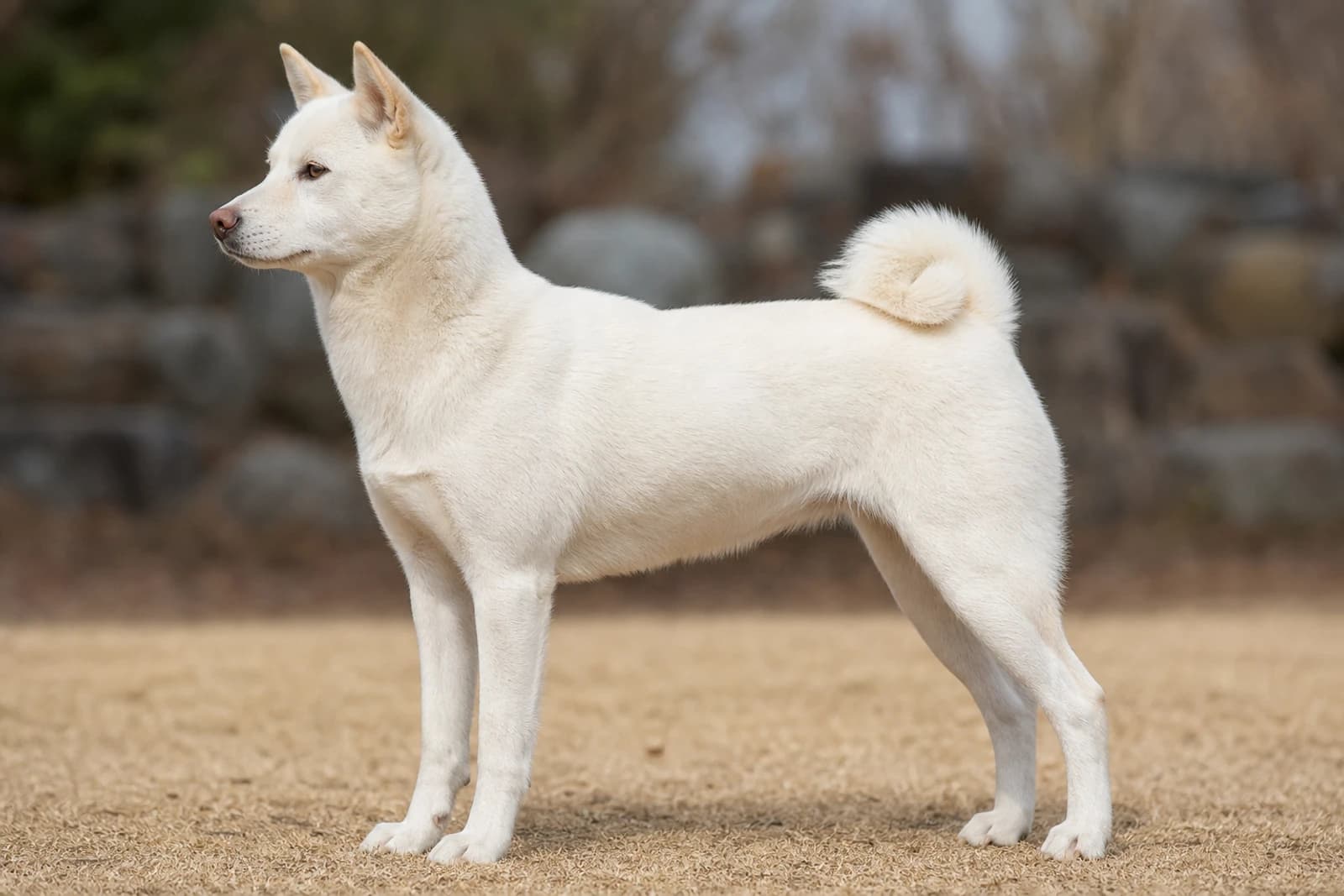
The Kishu is a noble and ancient Japanese breed, prized for its loyalty and hunting prowess. Best suited for experienced, active families, this breed thrives with a job to do and a handler who provides firm, consistent training. Reserved with strangers but deeply devoted to their people, Kishus need early socialization and daily exercise. They excel in homes with secure yards and are not ideal for apartment living or first-time owners. With a calm, dignified demeanor and a strong prey drive, the Kishu offers uncompromising companionship to those who understand its independent spirit.
At a glance
- Size
- Large
- Height
- 18–20 in
- Weight
- 29–60 lb
- Life span
- 11–13 years
- Coat colors
- white
- Coat type
- double coat; harsh and straight
- Origin
- Japan (Wakayama and Mie Prefectures)
How much does a Kishu cost?
Adopt / rescue
$75–$400
Usually includes spay/neuter, first shots, and a microchip.
Buy from a breeder
$700–$2,000
From a reputable, health-testing breeder.
Approximate USD. Prices vary widely by region, breeder, pedigree, age, and coat colour — adopting is the lower-cost and recommended route. Avoid suspiciously cheap “breeders”; they’re often puppy mills.
Estimate the full cost of a Kishu →Kishu photos
Views
Front, side, rear and top — the full silhouette.Poses
How the breed sits, lies, moves and plays.Puppy to senior
The breed across its whole life.Expressions
The breed’s range of moods.Close-up details
Eyes, ears, nose, paws, tail and coat.Coat colors
The breed’s recognized colors.Click any photo to enlarge. We show the Kishu from every angle — three views, poses, life stages, expressions, close-ups, coat and colors.
Appearance & size
A quick glance at a Kishu tells you it’s built for real work, not for show. These are medium-framed, large-sized dogs standing 18 to 20 inches at the shoulder and weighing anywhere from 29 to 60 pounds — the wide span partly reflects the difference between a lean, hard-muscled female and a thick-necked, broad-chested male. Either way, the body is compact and athletic, with a deep chest, a straight, firm back, and a tucked-up loin that hints at the stamina to follow boar or deer through mountain terrain all day.
The coat is a crisp, dense double coat that protects the dog in harsh weather. The outer guard hairs are harsh and straight; the undercoat is soft, thick, and sheds seasonally with enthusiasm. Color is simple — white is the only accepted coat color today. This clean, solid white makes the breed stand out against forest undergrowth and can lean toward a creamy or biscuit cast on the ears and saddle in some bloodlines without disqualification.
From the front, you’ll notice a well-developed, deep brisket and straight, sturdy forelegs set under a moderately wide chest. The shoulders are powerful but not loaded, so the dog never looks clumsy. Move to the side, and the balanced proportions become clear: the height at the withers nearly equals the body length, giving a square silhouette. The neck is thick and rises confidently from the shoulders, blending into a level topline that stays firm even when the dog is trotting. A moderate tuck at the belly and the strong, angled hindquarters behind tell you this animal can accelerate, pivot, and bound over rough ground without wasted motion. From the rear, the thighs are muscular, the hocks straight and well let down, and the overall impression is one of contained power.
The head has a distinctly Japanese spitz character — broad forehead with a defined stop, a wedge-shaped muzzle that tapers without becoming snipey, and small, dark brown, triangular eyes that give an alert, unwavering expression. The nose is usually black, though a lighter “snow nose” can appear in cold weather. Small, triangular ears stand pricked and tilt slightly forward, always moving. The tail is one of the breed’s defining features: set high, thick, and carried in a tight curl or sickle curve over the back. It’s not a plume — just a well-furnished, functional rudder that completes the balanced picture.
There’s no exaggeration here. The Kishu is clean-lined, un-fussy, and honest. Every feature, from the coat color to the tail set, points back to a dog that was developed to hunt silently, endure, and think for itself without a trace of decoration.
History & origin
The Kishu’s story stays tethered to the mountainous spine of Japan’s Kii Peninsula, where the old provinces of Kishu — today’s Wakayama and Mie Prefectures — gave the breed its name and its purpose. Long before anyone kept a studbook, hunters in those steep, forested valleys were breeding silent, single-minded dogs that could find and hold a wild boar until a human arrived with a spear. Those dogs were the raw clay of what would become the Kishu Ken, a landrace sharpened by centuries of selective pressure for grit, agility, and a nose that worked without a sound.
Genetic evidence pegs the breed’s ancestors among Japan’s original spitz-type dogs, brought to the islands by early migrations and then shaped by isolation. While other native breeds drifted toward different tasks, the Kishu remained a hard-use hunting tool first and everything else second. The region’s terrain — thick with cedar and cypress, crisscrossed by knife-edge ridges — rewarded dogs with a muscular, medium build, a dense white coat that hunters could spot in the undergrowth, and the endurance to cover ten or fifteen miles in a day without faltering. Historically, coat colors included brindle, red, and sesame, but the white coat became dominant through deliberate selection for visibility; today, white is the only accepted color in the breed standard.
In 1934, Japan’s Ministry of Education officially designated the Kishu as a Natural Monument, locking its status as a living cultural treasure alongside the other Nihon Ken. That designation didn’t just honor the breed — it standardized the type and kicked off a concerted preservation effort just before the chaos of World War II pulled its numbers dangerously low. Post-war, dedicated breeders and the Japan Dog Preservation Society (Nihon Ken Hozonkai) painstakingly rebuilt the population, leaning on remote bloodlines that had stayed purer because they were never swept up in the crossbreeding trends that diluted some other native dogs.
The Kishu entered the modern era still carrying its original job description. In rural Japan, you’ll still find it working boar hunts with a quiet intensity that borders on eerie. Outside its homeland, the breed remains genuinely scarce — a trickle of exports rather than a wave — which has kept its identity intact but also makes it one of the least-known of the Japanese native breeds. For an owner, that history translates into a dog that demands a meaningful outlet for its drive and a family that respects a deeply instinctive, independent mind shaped by a thousand years of necessity.
Temperament & personality
A Kishu isn’t a go-with-the-flow lab. This is a primitive Japanese hunting dog—bred for generations to track boar and deer in the mountains, often working at a distance and making its own decisions. As a result, you get a dog who is calm, brave, and fiercely independent, not a dog who hangs on your every command. That independent streak will define your life together, for better or for fun.
Core personality
Expect a quiet, dignified presence indoors and a laser-focused hunter outdoors. The breed bonds deeply with its own family and remains politely aloof with strangers—often called reserved, not shy. They’re not generally aggressive without reason, but a low friendliness score with unfamiliar people and dogs means they aren’t a good fit for a bustling, drop-in-anytime household. You have to earn a Kishu’s trust, and once you do, the loyalty runs deep.
Intelligence here isn’t about eagerness to please; it’s about problem-solving. These dogs learn fast but question what’s in it for them. Strong-willed to the core, they respond to respectful, consistent engagement, not heavy-handed corrections. Force will either shut them down or trigger a battle of wills you won’t win. Think partnership, not dictatorship.
Energy and mental needs
Count on a solid hour of meaningful exercise daily—a long run, a rugged hike, or extended off-leash time in a securely fenced area. A stroll around the block won’t touch their stamina. Mental work matters just as much as physical. Scent games, puzzle toys, and short training sessions give that clever brain something to do. Without it, a bored Kishu invents its own jobs: redesigning door frames, marking a new “territory” inside, or obsessively pacing.
Watchfulness
They notice everything on their property. You’ll get one sharp, alert bark when something is off, then they’ll watch and assess. They aren’t nuisance barkers, but they take home security seriously, and that instinct needs no training—it comes factory-set.
Affection and body language
Affection is understated, not needy. A Kishu may lean against your leg, follow you from room to room, or slide a head under your hand for a scratch, but they seldom smother you in kisses. You learn to read subtle signals: a soft, loose body and relaxed eyes mean contentment. A stiff posture, a hard direct stare, and a forward-leaning center of gravity usually signal discomfort or an imminent reaction toward another dog or a perceived threat. Lip licking, yawning, or turning the head away are their ways of saying “I need space.” Respect that and you’ll avoid most conflicts.
Quirks and household behavior
Territory marking comes naturally, especially with intact males. Their scent memory is formidable; a spot that smells like a previous “message” can trigger repeat marking indoors. Prompt, thorough cleanup with enzymatic cleaners is non-negotiable—the scent simply must disappear. Some Kishu also have a strong drive to mask their own odor by rolling in carrion or dead worms. It’s not disobedience; it’s an ancestral compulsion you manage, not train out. Reward a solid recall and keep high-value treats on you.
Around the house, a well-socialized Kishu can be a steady companion, but this isn’t a breed that automatically adores children, cats, or other pets. Early, positive exposure to kids and animals is essential, and even then, prey drive may override everything when a squirrel darts past. Same-sex dog aggression isn’t rare, and rough play from small children can worry a dog that guards its personal space. Supervise interactions, teach children to never bother the dog while eating or chewing, and provide a quiet retreat spot that’s off-limits to little hands.
Puppies and many adults chew to explore, relieve boredom, and keep jaws strong. If you come home to a mangled baseboard, ask yourself whether they got their full hour of running and a mental workout that day. Provide plenty of appropriate hard chews and, for off-limits items, a homemade citrus or vinegar spray can help discourage mouthing—but it’s no substitute for a tired, satisfied dog.
A Kishu is a clear-eyed, brave partner for someone who values a dog that thinks for itself, moves with quiet dignity, and gives trust once you prove you’re fair. That comes with a trade-off: they’re not a push-button pet, and they’re not for a first-time owner still figuring out the whole leadership thing.
Good with kids, dogs & other pets
A well-socialized Kishu is calm and genuinely patient with kids—it’s not the type to be easily rattled by noise or clumsy affection. That steady temperament only holds, though, if the dog has been raised with children or carefully desensitized to them from puppyhood. A 40- to 60-pound dog can still send a toddler flying with an excited hip check, so active supervision around small children is non-negotiable. Teach kids to respect the dog’s food, sleep, and quiet time. Kishus are sensitive and form tight bonds; harsh handling or surprise interruptions can make them wary, so house rules should be clear and gentle.
With other dogs, a Kishu is typically reserved rather than overtly aggressive, but early exposure makes all the difference. They gravitate toward a pack mentality and often mesh well with a known canine housemate, particularly one of the opposite sex—same-sex pairs are more apt to test each other. An adult Kishu who missed out on puppy play dates may never become a dog-park regular. That’s okay. Forced interactions after the critical socialization window (which starts to close around 12–16 weeks) often raise stress instead of social skills. Calm, controlled meet-ups on neutral ground are your best bet for introducing new dogs down the line.
Small pets are a different story. The Kishu was developed to hunt boar and deer, so chasing and grabbing are deeply programmed. Cats, rabbits, or guinea pigs can trigger that hardwired prey sequence. Raising a puppy alongside a cat helps, but never assume the family cat is safe when you’re not in the room. With pocket pets, the risk is real enough that many seasoned owners keep them strictly separated. If you’re aiming for a harmonious multi-species household, overload the first four months with gentle, upbeat exposure to every creature and person you want the adult dog to accept—and keep expectations realistic. A Kishu who simply co-exists without chasing is a success; one who becomes a cuddle buddy to the rabbit is the exception.
Trainability & intelligence
A Kishu learns fast — but it learns on its own terms. This is a dog bred to hunt boar independently in the mountains of Japan, making split-second decisions without waiting for a handler. That intelligence is paired with a strong, quiet stubbornness. You can’t bully or bribe a Kishu into blind obedience; you earn cooperation through a relationship built on trust and clear, consistent rules.
Start training the day your puppy comes home. Use positive reinforcement — tiny, high-value treats, a quick tug session, or calm praise — and keep sessions short and game-like. A Kishu gets bored with repetition and will simply check out if you drill the same command ten times in a row. Two or three good reps, then switch to something else. Because of their hunting background, they can be possessive of food and toys, so teach “drop it” and “leave it” early using trades, not force.
Recall is the big one. When a Kishu locks onto a scent or catches sight of movement, the world disappears. Do not expect a reliable off-leash recall without months of proofing on a long line in progressively distracting environments. If you live near woods or deer, accept that your Kishu may never be an off-leash dog in unfenced areas. That’s not a failure — it’s the breed.
Sensitivity runs deep here. A harsh tone or physical correction will erode trust fast, and a Kishu that shuts down or gets anxious becomes a much bigger problem. This breed does best with a handler who stays calm, reads the dog’s body language, and backs off when frustration creeps in.
Socialization is non-negotiable. The window between 3 and 14 weeks is critical. Expose your puppy daily to new people, calm dogs, different surfaces, traffic sounds, and being handled. Without that early and ongoing work, a Kishu’s natural reserve toward strangers can tip into fear-based reactivity. Even with good socialization, many remain aloof — a polite sniff, then moving on — and that’s perfectly normal for the breed.
Exercise & energy needs
A Kishu isn't content with a quick stroll around the block. Bred to hunt boar and deer in Japan’s rugged mountain forests, this is a dog with real stamina and a work-first brain. Expect to invest 60–90 minutes of vigorous daily exercise, split into at least two sessions — a single long walk rarely cuts it. A bored Kishu left to simmer on the sofa will redirect that drive into digging, chewing, or barking.
Off-leash trail running, hiking with elevation, and long jogs alongside a bike or canicross rig all fit the bill. The breed’s strong prey drive means reliable recall training is non-negotiable before you unclip the leash in an unfenced area. Once that’s solid, they’ll thrive on the freedom to cover ground and use their nose.
Mental fatigue matters just as much as physical output. This is an independent thinker that lights up when there’s a job to do. Hide loaded puzzle toys around the yard, build scent trails, or work on nosework and tracking — activities that tap into their natural problem-solving and hunting instincts. Agility and lure coursing can also satisfy the craving for speed and focus.
- Puppies: Keep sessions short and frequent, avoiding forced running on pavement or hard-packed trails until growth plates close (usually 12–18 months).
- Moderation: Dial back intensity in hot, humid weather. The dense double coat predisposes them to overheating if you push too hard in the sun.
- Under-exercise fallout: Shortchange this breed and you’ll see restlessness, hyper-vigilance, and destructive escape attempts, not a peacefully napping dog.
A tired Kishu is a happy, calm companion. Just don’t mistake “tired” for “physically exhausted” — their mind needs to be worked just as hard as their legs.
Grooming & coat care
The Kishu’s stark white double coat looks high-maintenance but actually shrugs off most dirt — until the undercoat decides to evacuate twice a year. A harsh, straight outer layer repels brambles and mud, while the dense undercoat insulates. That same undercoat creates a snowstorm of loose fur during a 2–3 week molt each spring and fall.
- Weekly brushing with a slicker brush or a pin brush clears dead hair and spreads natural oils the rest of the year.
- During shedding peaks, switch to daily sessions with an undercoat rake to pull out the soft fluff before it blankets your furniture.
- A natural bristle brush run over the coat afterward brings out a glossy sheen on those white guard hairs — and won’t scratch the skin.
Bathe only when you can see grime or smell a wet-dog odor, usually two or three times a year. Over-washing strips the coat’s natural water resistance. If you need to brighten up the white, use a gentle, low-residue dog shampoo; avoid blue or purple whiteners unless you really know what you’re doing, because they can stain if left on too long.
A white coat does expose grime around the belly and legs after a muddy walk. Wipe paws and feathering with a damp cloth right when you get home rather than reaching for the shampoo bottle.
Nails, ears, and teeth follow the same routine as any large spitz: trim nails every 3–4 weeks (if they click on hard floors, they’re too long), clean ears once a week with a vet-safe solution, and brush teeth several times a week. The Kishu’s prick ears rarely trap gunk, but they can collect dust on windy days, so a quick wipe is still worth it.
A useful seasonal tip: brushing your Kishu outside during heavy shedding will keep the blizzard of white fluff out of your home. Stick with an undercoat rake and avoid shedding blades with sharp teeth — those can break the coarse outer guard hairs and leave the coat looking dull.
Shedding & allergies
A Kishu’s crisp white coat comes with a steady undercurrent of shed fur. They are a double-coated Northern breed, meaning you’ll find loose hair on your floors year-round, not just during a single season.
Twice a year, typically spring and fall, the undercoat lets go in a dramatic blowout. For a few weeks, tufts of downy fluff will peel off in clumps, and daily brushing becomes the only way to keep it from drifting into every corner of the house. Outside of those blowouts, the shedding is moderate but constant — think a light dusting of white hair on dark furniture, car seats, and pant legs.
The flip side is that Kishus are generally clean dogs with little “doggy” odor and almost no drool. A quick shake of the head won’t send slobber flying; these are tight-lipped animals, not jowly at all.
That white coat does zero favors for allergy sufferers. No dog is truly hypoallergenic, and a Kishu produces normal amounts of dander and saliva proteins that trigger reactions. The fur itself isn’t the allergen, but all that shed hair carries dander everywhere. If someone in the home is sensitive, spend time around adult Kishus before committing — a weekly brush-out and frequent vacuuming will help, but they won’t make the breed allergy-proof.
Diet & nutrition
Portion control matters more than the brand of food you choose. Kishu are lean, athletic dogs, but a few extra pounds can quietly strain joints and shorten an already moderate 11–13 year lifespan. A 45-pound adult with typical daily exercise might need around 1,100–1,300 calories split between two meals, but treat that as a launching pad, not a rule — dial amounts up or down based on how your dog actually holds weight. If yours lives for food, a puzzle bowl or snuffle mat turns meals into mental work while slowing the inhale-and-burp routine.
Puppies need a steady rhythm. From weaning to four months, feed four evenly spaced meals a day; then three meals until six months; then twice-a-day feeding sticks for life. Transition to your own diet gradually, starting with lightly cooked and puréed meats, fish, fruits, and vegetables, or a high-quality commercial puppy food. Around twelve weeks, you can introduce raw chicken wings under direct supervision, but keep the emphasis on slow, lean growth — rapid gains don’t do a large-breed puppy’s developing joints any favors.
For adults, build the bowl around quality animal protein. A practical home-prepared target is roughly 60% meat (cooked or raw), 20–30% fruits and vegetables, and the remaining 10% from eggs, plain yogurt, or digestible grains like pearl barley or white rice. Blending or puréeing the whole mix helps with nutrient absorption because dogs lack salivary digestive enzymes and their jaws only move vertically. If you feed kibble, pick a protein-forward, moderate-fat formula and measure every scoop. Canned fish packed in water, cooked eggs, and leftover vegetables are easy add-ins that rotate proteins without overhauling the menu. An adult Kishu who still runs hilly trails or pulls weight in harness will obviously need more fuel than a weekend-walk companion, so adjust portion sizes — not the whole approach — to match the workload.
Seniors (around seven and up) often run into the same problem: the spirit stays willing, the activity dials back, and the pounds creep on. Switch to two or three smaller meals if digestion gets touchy, but don’t automatically slash protein; the old low-protein-for-old-dogs myth doesn’t hold up. Puréeing meals again can make a real difference for a dog missing teeth or dealing with a sensitive mouth. Watch the waistline closely and taper total calories as exercise tapers — senior obesity is one of the few things that reliably robs a Kishu of those later healthy years.
A few non-negotiables keep everything on the rails. Never feed from the table, ever—one holiday binge of fatty trimmings can trigger pancreatitis, and begging, once taught, is a nightmare to undo. Leftovers go in the dog’s own bowl, away from the dining chaos. Use unsalted vegetable cooking water as a meal base if you’re out of stock. Batch-cook grains, vegetables, or lean proteins so you always have a solid foundation ready. If you stick to a meat-based, measured plan and keep the waist visible, you’ll sidestep the weight-related trouble that shortens too many large dogs’ lives.
Health & lifespan
Kishu typically live 11 to 13 years, with well-cared-for dogs often reaching their mid-teens. They’re a hardy breed overall, but a handful of inherited conditions deserve your attention before you choose a puppy.
Breeders should provide OFA or PennHIP hip and elbow clearances on both parents. Eye issues like progressive retinal atrophy and cataracts appear occasionally—request current OFA Companion Animal Eye Registry (CAER) exam results. Hypothyroidism, though less common, is screened with a blood test and handled with inexpensive daily medication. Seasonal skin allergies can show up as itchy paws, red bellies, or ear problems; they usually improve with a high-quality diet and a rinse-down after exercise.
The Kishu’s white coat means light-colored skin that burns easily. Keep your dog in the shade during strong sun and dab pet-safe sunscreen on the nose and any thin-haired spots. Their dense double coat is built for cold, so summer outings are best early or late to avoid overheating.
Routine prevention: monthly heartworm medication from mosquito season through one month past, a legally required rabies vaccine, and up-to-date core shots. Annual vet exams—twice a year for seniors—catch problems while they’re small. Kishu are stoic and won’t complain much; watch for subtle shifts like lagging on walks, drinking more water, or hesitating on stairs. Those small clues often surface before lab work does.
Weight management can’t be an afterthought because that 29–60-pound window means portion sizes vary widely. Measure each meal, skip the free-feeding, and provide enough running to keep muscles strong and ribs easily felt. A lean dog lives longer and stays active well into old age.
Living environment
A Kishu is not a good fit for apartment life or a home where the yard is just a postage stamp. This is a hunting breed built to cover ground, and they need a securely fenced yard where they can blow off steam. A fence of at least 6 feet is non-negotiable—their prey drive is genuine, and a squirrel or stray cat can trigger a chase that ignores all recall. Underground electronic fences rarely stop a Kishu once they lock onto something interesting.
Plan on at least 60–90 minutes of purposeful exercise every day, split into two sessions. A quick walk around the block won’t cut it. These dogs thrive on off-leash running, hiking, or jogging, and they’re hardwired for mental work. Hide scent trails, set up puzzle feeders, or work on nosework games inside the house—it tires out their brain in a way that physical exercise alone never will.
The Kishu’s dense white double coat makes them surprisingly cold-hardy. They’ll happily romp through snow, but heat is another story. In warm weather, shift exercise to early morning or late evening and always have shade and water ready. Overheating can hit fast, even during moderate activity.
As for noise, you’ll get a sharp alert bark when something’s off, but they’re not a yappy breed. What they are is deeply attached to their people. A Kishu left alone for a full workday can develop serious separation anxiety—howling, destructive chewing, or obsessive pacing. They do best in a home where someone is around most of the time, or with a gradual desensitization plan that includes plenty of mental enrichment while you’re gone. This is a dog that wants to be part of the daily rhythm, not left in the backyard to entertain itself.
Who this breed suits
A Kishu is a devoted shadow to the right person and an exhausting mismatch for the wrong one. These dogs are not casual companions. Bred to hunt boar and deer in the mountains of Japan with minimal direction, they operate on sharp instinct, independence, and a work ethic that runs deep. If you want a dog that reliably comes when called, defers to strangers, or lives peacefully with the neighbor’s cat, you should think twice — hard.
The people who truly click with a Kishu are outdoorsy singles, couples, or families with older kids who already understand primitive breeds. You don’t need to be a professional trainer, but first-timers will find the breed’s combination of sensitivity, stubbornness, and sky-high prey drive overwhelming. A Kishu rarely gives a free pass to handler mistakes. They bond fiercely with their inner circle, yet they decide when and how to show affection, and they remain politely aloof or outright suspicious around unfamiliar people. Early and relentless socialization is non-negotiable, and even then, this is a watchful guard, not a gregarious greeter.
Living with a Kishu means embracing a high-energy, high-intelligence dog that needs a job. Expect to provide at least 60–90 minutes of off-leash running, hiking, or focused play daily — a couple of leash walks won’t cut it, and a bored Kishu will dismantle your yard, scale a six-foot fence, or invent games you won’t enjoy. They thrive with runners, mountain bikers, and avid hikers who have access to safely enclosed spaces. Because their recall can be selective when prey is involved, a securely fenced area or a long line on trails is realistic, not a failure of training.
Households with small animals — cats, rabbits, pocket pets, even small dogs that move like prey — should look elsewhere. Some Kishu coexist with familiar family cats if raised together from puppyhood, but the breed’s natural drive to chase and kill small fleeing things never sleeps, and management is constant. Similarly, dog parks are often a poor fit; same-sex aggression can surface, and their rough, silent hunting style doesn’t match the play-bow politics of a typical social dog.
Apartment dwellers and anyone seeking a low-key, quiet indoor companion will be disappointed unless they have a truly exceptional exercise plan. Seniors and sedentary owners will struggle with a lean, muscular dog that can weigh up to 60 pounds and lunge after a squirrel without warning. The white, double coat sheds heavily twice a year and throws a constant dusting of fur the rest of the time, so fastidious housekeepers should factor that in.
In the right, experienced hands, though, a Kishu is a loyal, clear-headed partner who loves a challenge. They’re clean, usually quiet indoors, and thrive on structured routines that respect their intelligence. Give them a purpose — backcountry exploration, scent work, or advanced trick training — and you’ll see a dog that works with joyful intensity, not robotic obedience. Just know that you’re signing up for a lifelong negotiation, not a push-button pet.
Cost of ownership
Bringing a Kishu home means paying for a piece of living Japanese history. Because the breed is exceptionally rare in the United States, puppy prices from a responsible breeder typically sit between $2,500 and $4,500. Imports from Japan add another $2,000+ in transport and health paperwork. Litters are scarce; expect a waiting list.
Once the dog is yours, monthly costs settle in the $150–$300 range, not counting one-time gear or training.
- Food: A lean, active 40-pound Kishu eats about 2–3 cups of high-quality dry food daily. Budget $50–$80 per month.
- Grooming: The short, harsh double coat repels dirt and rarely mats. Quick brushing twice a week and an occasional bath are all it takes. You might spend $10–$20 on supplies every few months; professional grooms are completely optional.
- Routine vet and prevention: Annual exams, core vaccines, heartworm and flea/tick preventives run $500–$800 a year — set aside roughly $40–$70 each month. Kishus are not overrun with health problems, but responsible breeders screen for hip dysplasia and luxating patellas. Orthopedic surgery later in life can easily reach $4,000, so saving ahead matters.
- Pet insurance: A solid accident-and-illness plan for this large purebred usually costs $40–$70 per month. Without it, a single emergency foreign-body surgery or an ACL tear can set you back $3,000–$6,000.
First-year gear adds up fast. A strong escape-proof crate, a tall fence (this is a prey-driven, agile dog), a martingale collar, and a tracking tag often total $300–$500. If you have never handled an independent primitive breed, plan on $150–$300 for a basic group training class, and more for one-on-one help with recall in unfenced spaces.
Choosing a Kishu
Right off the bat, the Kishu is a primitive breed with strong instincts — a devoted companion, but not a Labrador. Finding one starts with a choice between a dedicated breeder and the slim chance of rescue. Because the breed remains rare in North America, you’ll likely need to get on a waiting list.
Why a responsible breeder matters
A Kishu with poor socialization or shaky nerves can be aloof to the point of suspicion, hard to manage around other dogs, and prey-driven. Good breeders carefully select for stable temperament and expose pups to household sounds, handling, and new people before they go home. They won’t breed dogs with aggressive shyness or extreme reactivity. They’ll also ask you hard questions about your experience with independent, hunting-bred dogs.
Health clearances to request
The Kishu is generally healthy and long-lived, but that doesn’t mean skipping screenings. Ask for proof of:
- Hip evaluation – OFA or PennHIP, ideally scored “fair” or better (dysplasia does occur).
- Elbow evaluation – less common but still worth verifying, especially in lines that have produced lameness.
- Eye exam – a current CERF (or OFA eye) clearance rules out progressive retinal atrophy and other inherited eye issues.
- Patella check – some Kishu develop luxating patellas; a vet certification clears that.
- Thyroid panel – autoimmune thyroiditis crops up in primitive breeds; a normal panel from both parents adds peace of mind.
Breeders who dismiss these tests with “the breed has no problems” or “my vet said they’re fine” without written proof should make you walk away.
Red flags that save you heartache
- No health testing documentation for either parent — not even hip scores.
- Selling puppies online with a credit card and zero conversation.
- Multiple litters on the ground at once, or always having puppies available.
- You can’t meet at least the dam, or the setup looks like a kennel with no home life.
- Breeder pressures you to decide fast, or won’t take a puppy back if you can’t keep it.
- Promises of a “rare white wolf-like dog” rather than an honest talk about leash reactivity, prey drive, and the need for early, ongoing socialization.
Picking your puppy
Visit in person if you can. Watch the litter interact: you want a pup who investigates you without backing off, but also shows a moment of thoughtful hesitation — that’s typical Kishu reserve. Avoid the one who panics in a corner or the one who launches barking with zero recovery time. A solid breeder will have already begun crate training and will match you to a puppy based on temperament, not coat color (every Kishu is white, so that’s easy). Expect to wait 6–18 months for the right litter; anything sooner is suspicious.
Adoption and rescue
Adult Kishu occasionally turn up in breed-specific rescues or Japanese dog networks. The upside: you skip puppy chaos and may get a dog whose house manners and temperament are already apparent. The trade-off: many rescue Kishu were surrendered because their original owners couldn’t handle the breed’s independence and prey drive. Work with a group that assesses the dog in a foster home, not just a shelter run, and be upfront about your lifestyle — a Kishu with a known history of killing cats won’t magically become trustworthy in a home with a free-range parrot.
Be ready to commit to a decade-plus of daily mental work. Off-leash? Forget about it unless you’re in a securely fenced area. That’s the honest starting point.
Pros & cons
Ahead-of-the-pack loyalty, raw athletic ability, and a quiet, clean house temperament set the Kishu apart — but so does a seriously independent streak and strong hunting instinct. Here’s the honest balance.
Pros
- Deep, unwavering devotion to their family. Once a Kishu bonds, expect a shadow who’d follow you anywhere and is intensely protective without being a menace.
- Naturally tidy and low-odor. The short double coat stays remarkably clean, with little of the “dog smell” many double-coated breeds carry.
- Built for real adventure. At 29–60 lb and 18–20 in, they are muscular and agile, bred to hunt boar in Japan’s mountains. They’ll outlast you on hikes, runs, and all-day scrambles.
- Quiet house dog. Not a yapper. A Kishu typically barks only when something genuinely unusual is happening, making them an excellent fit for close neighbors.
- Manageable size, big-dog grit. Enough presence to feel like a sturdy partner outdoors, but compact enough to curl up on the sofa indoors (with proper exercise).
- Long-lived for a larger breed. An 11–13 year life span means you get a lot of years with this rare dog.
Cons
- Spine-tingling prey drive. Small animals — cats, squirrels, off-leash toy breeds — are chase triggers. A Kishu can cover ground in seconds, and recall won’t matter if instinct kicks in.
- Stranger aloofness that can tip into fear. They’re not a social butterfly. Without early, ongoing socialization, reserved can become reactive; plan to put in the work from puppyhood.
- “What’s in it for me?” attitude. Intelligence meets stubbornness. Training requires consistency, creative rewards, and a total lack of force — they’ll check out if you’re unfair or boring.
- Escape-artist problems. A bored Kishu can clear a 6-foot fence or slip a harness. Secure containment and off-leash reliability take serious effort.
- Twice-a-year fur blizzard. The all-white coat sheds heavily when seasons change, coating furniture, clothes, and dark floors.
- Hard to find, harder to vet. The breed is exceptionally rare outside Japan. Responsible breeders have long waitlists; expect to travel and be thoroughly screened.
Similar breeds & alternatives
If the Kishu’s quiet intensity and primitive independence appeal to you but you want a different size, a predictable color other than white, or slightly better availability, the Hokkaido Ken and Shikoku Ken are your closest matches.
- Hokkaido Ken – Standing 18–22 inches and usually 44–66 pounds, this is the most physically similar alternative. Like the Kishu, it’s a pure-minded Japanese hunter that bonds deeply with its people and stays reserved with strangers. The big difference is the coat: Hokkaidos come in brindle, red, black and tan, or white, so you aren’t locked into solid white. They tend to have a denser, double coat built for serious snow country, and they can be a touch more bold or watchful.
- Shikoku Ken – Lighter on its feet at 35–55 pounds and 17–22 inches, the Shikoku brings the same quiet, one-family loyalty. Its signature sesame coat (black-tipped guard hairs on a red undercoat) sets it apart visually. Expect a slightly sharper edge; fanciers describe the Shikoku as having less “off switch” than a Kishu around the house unless well exercised. It’s another rare breed outside Japan.
- Shiba Inu – At 13.5–16.5 inches and a mere 17–23 pounds, the Shiba is the small, widely available cousin. You gain a much easier size for city life and still get the fox-faced, independent spitz personality. What you lose is the substantial, athletic presence and the calm seriousness of a large Kishu.
If solid white is the thing you can’t give up, a Samoyed is the extreme opposite in temperament: an outgoing, smiley sledge dog instead of a reserved hunter, but you get the fluffy white coat and a similar 45–60 pound frame. Any of the Japanese native breeds above will suit you better, though, if you value a dog that acts like it’s thinking rather than one that wants to be everyone’s best friend.
Fun facts
- Designated a national monument in Japan in 1934.
- Used for hunting boar and deer in Japan's mountainous regions.
- The breed's white coat became preferred for visibility in dense forests.
- Nearly extinct after WWII, saved by dedicated breeders.
Frequently asked questions
- Are Kishu dogs good with children?
- Kishus can be good with children when properly socialized from a young age. They tend to be loyal and protective of their family, but interactions with young kids should always be supervised due to their strong prey drive. Overall, they are better suited to homes with older, respectful children.
- Do Kishus shed a lot?
- Kishus have a thick double coat that sheds moderately throughout the year and more heavily during seasonal changes. Weekly brushing helps manage loose hair and keeps their coat healthy. They are not considered hypoallergenic, so they may not be ideal for allergy sufferers.
- How much exercise does a Kishu need?
- Kishus are an active breed that requires daily exercise to stay happy and well-behaved. A long walk or jog plus some playtime in a securely fenced yard is typically sufficient. Without enough mental and physical stimulation, they may develop destructive habits.
- Is a Kishu easy to groom?
- Kishus are generally low-maintenance in terms of grooming. Their harsh, straight coat naturally repels dirt and only needs occasional baths. Regular brushing, nail trims, and ear cleaning are usually enough to keep them in good shape.
- Are Kishus suitable for apartment living?
- Kishus are not the best choice for apartment life due to their size and energy levels. They thrive in a home with a yard and can become restless in confined spaces. However, with sufficient daily outdoor exercise, they can adapt if their needs are consistently met.
- Are Kishus good for first-time owners?
- Kishus can be a challenge for first-time owners because of their independent and sometimes stubborn nature. They respond best to experienced handlers who can provide firm, consistent training. Early socialization and positive reinforcement are essential to bring out their best behavior.
Tools & calculators for Kishu owners
Quick estimates tailored to Kishus — pre-filled with this breed’s size where it matters.
Articles & stories about the Kishu
Sources & standards
This profile follows recognized breed standards from the American Kennel Club (AKC) and the Fédération Cynologique Internationale (FCI), along with established veterinary and breed-club guidance. These describe general breed tendencies — every dog is an individual.
Owner stories
Have a Kishu? Share your experience — grooming tips, personality quirks, anything goes.